Building the Evidence Base in Malawi
Background & Rationale Ongoing Save the Children Programs Integrating Family planning into sponsorship programs; since June 1, 2006 Why target men? Despite increases in access, uptake still low, particularly among young married women How to tailor interventions to men? Men obtain FP information from peers and informal networks  Educational messages should explore the economic side of limiting births and improving the family’s standard of living
Research Question Primary Question:  Does a male focused family planning intervention increase contraceptive uptake?  Secondary Question:  Are there relationships between contraceptive uptake and change in the following variables:  Ease in communicating  Frequency of communication
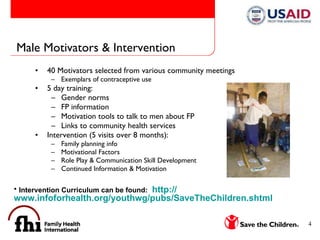
Male Motivators & Intervention 40 Motivators selected from various community meetings Exemplars of contraceptive use 5 day training:  Gender norms FP information Motivation tools to talk to men about FP Links to community health services Intervention (5 visits over 8 months):  Family planning info Motivational Factors Role Play & Communication Skill Development Continued Information & Motivation Intervention Curriculum can be found:   http:// www.infoforhealth.org/youthwg/pubs/SaveTheChildren.shtml
Eligibility of Participants Married to or currently living with a female sexual partner that is less than 25 years old Have not used modern contraception with their primary partner within the last 3 months (Consistent condom use, pills, injectables, IUD) Neither participant or partner has undergone sterilization Wife or primary partner is not currently exclusively breastfeeding a child less than 6 months of age Wife or primary partner is not currently pregnant
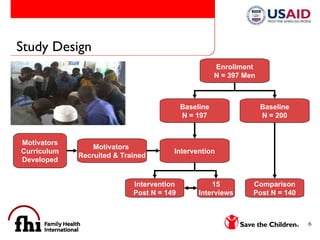
Study Design  Motivators Curriculum Developed Motivators  Recruited & Trained Enrollment N = 397 Men Comparison Post N = 140 Intervention Intervention Post N = 149 15 Interviews Baseline N = 197 Baseline N = 200
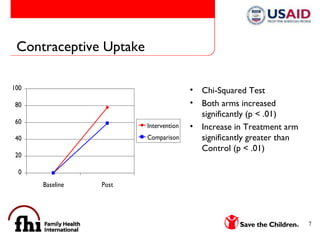
Contraceptive Uptake Chi-Squared Test Both arms increased significantly (p < .01) Increase in Treatment arm significantly greater than Control (p < .01)
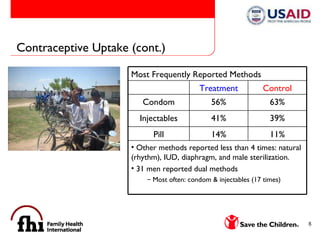
Contraceptive Uptake (cont.) Most Frequently Reported Methods 11% 14% Pill Other methods reported less than 4 times: natural (rhythm), IUD, diaphragm, and male sterilization.  31 men reported dual methods  Most often: condom & injectables (17 times) 39% 41% Injectables 63% 56% Condom Control Treatment
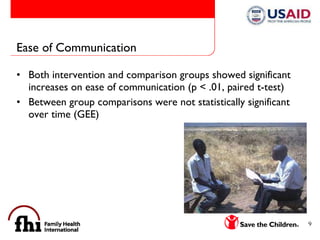
Ease of Communication Both intervention and comparison groups showed significant increases on ease of communication (p < .01, paired t-test) Between group comparisons were not statistically significant over time (GEE)
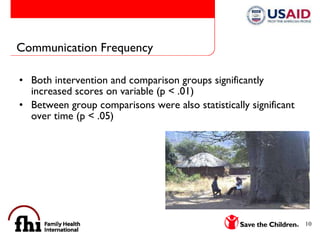
Communication Frequency  Both intervention and comparison groups significantly increased scores on variable (p < .01) Between group comparisons were also statistically significant over time (p < .05)
Exploratory Analysis  Testing relationships with primary outcome Correlations tested Multiple logistic regression  Covariates included:  Contraceptive uptake, group, age(s), level(s) of education, live births, communication items, and demographic characteristics Significant relationships identified:  It is easy to discuss family planning with my wife  (β = .45, OR = 1.57, p = .08) How often do you discuss family planning with your wife? (β = .48, OR = 1.62, p = .02)
Results: Qualitative Economic message received: “ Family planning is good and important because one is able take good care of the family with the limited resources available while  a family that does not practice family planning has difficulties in taking care of the children since [financial] resources are very limited ...” Communication improved: “ Before the educator came to shed more light on this issue I was doing what I could, basing on guess work without even discussing with my wife.  After the educator came I was able to discuss and communicate with my wife very well…”
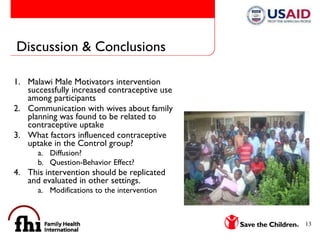
Discussion & Conclusions Malawi Male Motivators intervention successfully increased contraceptive use among participants Communication with wives about family planning was found to be related to contraceptive uptake What factors influenced contraceptive uptake in the Control group? Diffusion? Question-Behavior Effect? This intervention should be replicated and evaluated in other settings.  Modifications to the intervention
Thank you…

Malawi Male Motivators

  • 1.
    Building the EvidenceBase in Malawi
  • 2.
    Background & RationaleOngoing Save the Children Programs Integrating Family planning into sponsorship programs; since June 1, 2006 Why target men? Despite increases in access, uptake still low, particularly among young married women How to tailor interventions to men? Men obtain FP information from peers and informal networks Educational messages should explore the economic side of limiting births and improving the family’s standard of living
  • 3.
    Research Question PrimaryQuestion: Does a male focused family planning intervention increase contraceptive uptake? Secondary Question: Are there relationships between contraceptive uptake and change in the following variables: Ease in communicating Frequency of communication
  • 4.
    Male Motivators &Intervention 40 Motivators selected from various community meetings Exemplars of contraceptive use 5 day training: Gender norms FP information Motivation tools to talk to men about FP Links to community health services Intervention (5 visits over 8 months): Family planning info Motivational Factors Role Play & Communication Skill Development Continued Information & Motivation Intervention Curriculum can be found: http:// www.infoforhealth.org/youthwg/pubs/SaveTheChildren.shtml
  • 5.
    Eligibility of ParticipantsMarried to or currently living with a female sexual partner that is less than 25 years old Have not used modern contraception with their primary partner within the last 3 months (Consistent condom use, pills, injectables, IUD) Neither participant or partner has undergone sterilization Wife or primary partner is not currently exclusively breastfeeding a child less than 6 months of age Wife or primary partner is not currently pregnant
  • 6.
    Study Design Motivators Curriculum Developed Motivators Recruited & Trained Enrollment N = 397 Men Comparison Post N = 140 Intervention Intervention Post N = 149 15 Interviews Baseline N = 197 Baseline N = 200
  • 7.
    Contraceptive Uptake Chi-SquaredTest Both arms increased significantly (p < .01) Increase in Treatment arm significantly greater than Control (p < .01)
  • 8.
    Contraceptive Uptake (cont.)Most Frequently Reported Methods 11% 14% Pill Other methods reported less than 4 times: natural (rhythm), IUD, diaphragm, and male sterilization. 31 men reported dual methods Most often: condom & injectables (17 times) 39% 41% Injectables 63% 56% Condom Control Treatment
  • 9.
    Ease of CommunicationBoth intervention and comparison groups showed significant increases on ease of communication (p < .01, paired t-test) Between group comparisons were not statistically significant over time (GEE)
  • 10.
    Communication Frequency Both intervention and comparison groups significantly increased scores on variable (p < .01) Between group comparisons were also statistically significant over time (p < .05)
  • 11.
    Exploratory Analysis Testing relationships with primary outcome Correlations tested Multiple logistic regression Covariates included: Contraceptive uptake, group, age(s), level(s) of education, live births, communication items, and demographic characteristics Significant relationships identified: It is easy to discuss family planning with my wife (β = .45, OR = 1.57, p = .08) How often do you discuss family planning with your wife? (β = .48, OR = 1.62, p = .02)
  • 12.
    Results: Qualitative Economicmessage received: “ Family planning is good and important because one is able take good care of the family with the limited resources available while a family that does not practice family planning has difficulties in taking care of the children since [financial] resources are very limited ...” Communication improved: “ Before the educator came to shed more light on this issue I was doing what I could, basing on guess work without even discussing with my wife. After the educator came I was able to discuss and communicate with my wife very well…”
  • 13.
    Discussion & ConclusionsMalawi Male Motivators intervention successfully increased contraceptive use among participants Communication with wives about family planning was found to be related to contraceptive uptake What factors influenced contraceptive uptake in the Control group? Diffusion? Question-Behavior Effect? This intervention should be replicated and evaluated in other settings. Modifications to the intervention
  • 14.

Editor's Notes

  • #2 [slide 1: Title Slide] My name is Dominick Shattuck and I’m a community psychologist working for Family Health International. My presentation is about the Malawi Male Motivators. The project was implemented by Save the Children in the villages surrounding Mangochi, Malawi. There is not enough time to discuss the intervention in detail. I have made a handout that includes the website where you can access the full curriculum and it also has my contact information.
  • #3 [slide 2: Background and Rationale] Over the last 48 hours, we have heard many reasons why men should be included in family planning interventions. In the case of this study, Save the Children was finding that despite the extensive family planning efforts in the Mangochi area, they were not reaching young married women. Since this population of women was so challenging to access, they decided to focus on their husbands. As a result, an intervention was created that utilized peer information networks and emphasized the economic benefits of family planning for the husbands of these young women.
  • #4 [slide 3: Research Question] The work at Save the Children prompted two central research questions: First: Does a male focused family planning intervention increase contraceptive uptake? Second: Are there relationships between contraceptive uptake and communication?
  • #5 [slide 4: Male Motivator Intervention] Forty men, who embodied proper family planning methods were identified by tribal leadership and recruited to implement the Male Motivators Curriculum. [proper spacing, using family planning methods with wife] Over five days, these exemplars were trained to implement the Male Motivators curriculum, which was administered to the participants during 5 visits over 8 months. DON’T READ: The intervention was broken into four components: Visit 1 discussed benefits of birth spacing, the socio economic realities of having large families with children born close together and taught about different family planning methods Visit 2 addressed gender norms related to family planning, community perceptions of men who use family planning; and the educator disclosed his own experiences of using family planning Visit 3 encouraged men to discuss family planning with spouses, discuss the benefits of contraceptive decision making, and implement two activities “future island” and “spin and walk” exercises Visit 4 &amp; 5 provided time for participants to discuss the benefits and challenges related to their integration of the information they received and the skills they developed through this intervention
  • #6 [slide 5: Eligibility of Participants] To assess the effect of this intervention, we selected very “ripe” set of participants. They all have: Young partners Not currently using contraceptives (to their knowledge) Able to conceive (to the best of their knowledge) And their wives are not breastfeeding or pregnant
  • #7 [slide 6: Study Design] Upon enrollment, participants were randomized to either the intervention or comparison arm. A baseline assessment was conducted and those men in the comparison arm did not receive any direct contact with the study team until collection of the post data. This intervention was conducted in over 200 villages across 17 Traditional Authorities and health zones. A behavioral survey was administered to all participants and a systematic sub-sample of 15 men in the intervention group was interviewed. As you notice on the slide, there was a sizable loss to follow-up. I conducted an attrition analysis and determined that there were no significant differences between those who were lost and those who remained in the study.
  • #8 78% Treatment 56% Control [slide 7: Contraceptive Uptake] I tested the difference in contraceptive uptake using a Chi-squared test. As you will notice in the graph, participants reported large increases in contraceptive uptake. What is important about this graph is not only the large increases in reported contraceptive uptake, but to note that these groups increased differentially. In other words, there was a treatment effect. As you will notice in this slide and subsequent slides, I tested change from pre to post both within the study arm, as well as between the study arms…or to put it another way, I tested to see if there was differential change across groups.
  • #9 [slide 8: Contraceptive Uptake (cont.)] We asked the men, which type of contraceptive they were using. As you can see from the table, condoms were the most frequently identified method, followed by injectables and Pills. An interesting side note to these data is that 31 of the men reported dual method use. Part of the curriculum was to inform men of the risks of HIV infection, in particular multiple partners. The combination of Condoms and Injectables was most frequently mentioned together.
  • #10 [slide 9: Ease of Communication] A 4 items scale was administered to identify participants’ ease of communicating about family planning with their wives and peers. Communication was reported to become easier for participants in both arms of the study. But we cannot say that this change was different across the groups.
  • #11 [slide 10: Communication Frequency] Also administered, was a scale looking at the frequency of discussing family planning with their wives and peers. Both groups increased significantly over time. And, the intervention arms discussed family planning more frequently than the comparison group. As you can see, these guys are talking more frequently about family planning. I wanted to know more about this.
  • #12 [slide 11: Exploratory Analysis] So, the two communication subscales were further explored. First, correlations between these seven items and family planning uptake were tested and small positive correlations were identified. The two communication items (p &lt; .05) [“It is easy to discuss family planning with my wife” and “How often do you discuss family planning with your wife?”]. Using multiple logistic regression a model was fit with family planning uptake as the dependent variables. The demographic characteristics listed on the slide and the two items associated with talking with wives were included as covariates in the model. None of the demographic variables were significantly associated with the outcome. Ease of discussing family planning with a wife was a moderately significant covariate (β = .45, OR = 1.57, p = .08) And frequency of discussing family planning with your wife was found to be a significant predictor of family planning uptake (β = .48, OR = 1.62, p = .02).
  • #13 [slide 12: Results: Qualitative] As I mentioned earlier, we conducted a small number of in-depth interviews with participants from the intervention arm. These data provided rich examples of messaging retention, as well as, how communications improved in their homes over time. [read bold]
  • #14 [slide 13: Discussions &amp; Conclusions] First, the Male Motivator intervention increased contraceptive uptake. Second, not surprisingly communicating with your spouse is important. I find this second point to be most salient. Primarily, because effective communication is a tenant to having a productive and equitable relationships in any country. We need to learn more about how this communication played out, but from the qualitative data, it was positive. There are still questions about the high rate of contraceptive uptake in the control group. We suggest Diffusion of Innovations and/or Question Behavior Effect as possible frameworks to explain this change. I believe that many of you are familiar with Rogers, Diffusion of Innovations theory, which was applied to family planning research in Korea in by Rogers and Kincaid many moons ago. QBE, also called Reactance Theory in the psychological literature, suggests that your behaviors are influenced by the questions that are asked during data collection. In this case the baseline data. Both are interesting theories that could be tested through the proper research designs. We feel that this intervention and evaluation is a good foundation for additional male based interventions. Modification of this intervention has been proposed. ________________ Limitations Maturation effects &amp; participant selection Would the participants have implemented family planning without the intervention? Contamination from other interventions in area? Influence of self-reported data about contraceptive use Were the wives already using contraceptive, but not telling their husbands? Stats &amp; Scales Paired t-tests were used to examine within group differences over time for each construct. Between group change over time was examined using Generalized Estimating Equations (GEE) with identity link function and robust covariance matrix (Liang and Zeger, 1986; Zeger and Liang, 1986; Zeger et al. 1988; Lipsitz et al. 1994). EASE OF USE: Example item: My wife and I often discuss the financial consideration associated with having children. 4 items 5 point Likert ( Strongly Agree – Strongly Disagree ) Alpha = 0.67 Intervention Pre - 2.36 (.90) Post- 3.05 (.67) Control Pre - 2.40 (.89) Post - 2.85 (.77) FREQEUNCY OF FAMILY PLANNING: Example item: How often participants’ discussed family planning with wives, extended family, friends 3 items 4 point (Never, Rarely, Sometimes, Often) Alpha = 0.67 Intervention Pre - 2.36 (.90) Post- 3.05 (.67) Control Pre - 2.40 (.89) Post - 2.85 (.77)