Making the Implicit Explicit:  Teaching subject-matter literacy skills to previously unsuccessful learners Sept 23, 2011: NATSAP Midwest Region Conference, Hilton Oakbrook Terrace, Chicago, IL Ike & Burroughs, Educational Consultants Robert Burroughs, PhD
Introduction Research has found that  struggling learners have poor literacy skills in discipline-specific classes, such as science, history, or math (Klenck & Kibby, 2000). Moving from  “learning to read” to “reading to learn” is the crucial educational pivot. One factor in the difficulty of “reading to learn” is the implicit differences in the ways that different subjects organize and communicate information. Explicit instruction in implicit subject-matter differences will benefit struggling students.
Goals and Objectives Demonstrate the concept of multiple literacies through an experiential activity. Understand the importance of subject-matter literacies in curriculum and instruction. Demonstrate activities to use with students to strengthen subject-matter literacies.
A Brief Quiz on “Blue Notes” 1. What is a “blue note”? 2. Why does the author consider blue notes important to harmonies of popular songs? 3. How does “blue note” harmony differ from “classical” harmony?
Processing “Blue Notes” 1.   Write down all the words (vocabulary) you find difficult to understand in this excerpt. 2. Underline the “thesis” or main idea of this excerpt. 3. Write three questions, the answers to which would help you understand this passage.
Why “Blue Notes” Is Hard To Read Vocabulary Technical music terms: eg,  harmony, tonality, chord Adapted technical terms: eg,  minor key, cadential, scale Metaphors: eg,  excursion, resolve Symbols Background knowledge Audience
Ways of Knowing The specialized literacies of academic subjects: “ways of knowing, thinking and doing” (Applebee, 1996) Form the boundaries of subject matter, as well as participation criteria; for example: Acceptable topics of investigation Acceptable methods of inquiry What counts as compelling evidence What counts as persuasive modes of argument
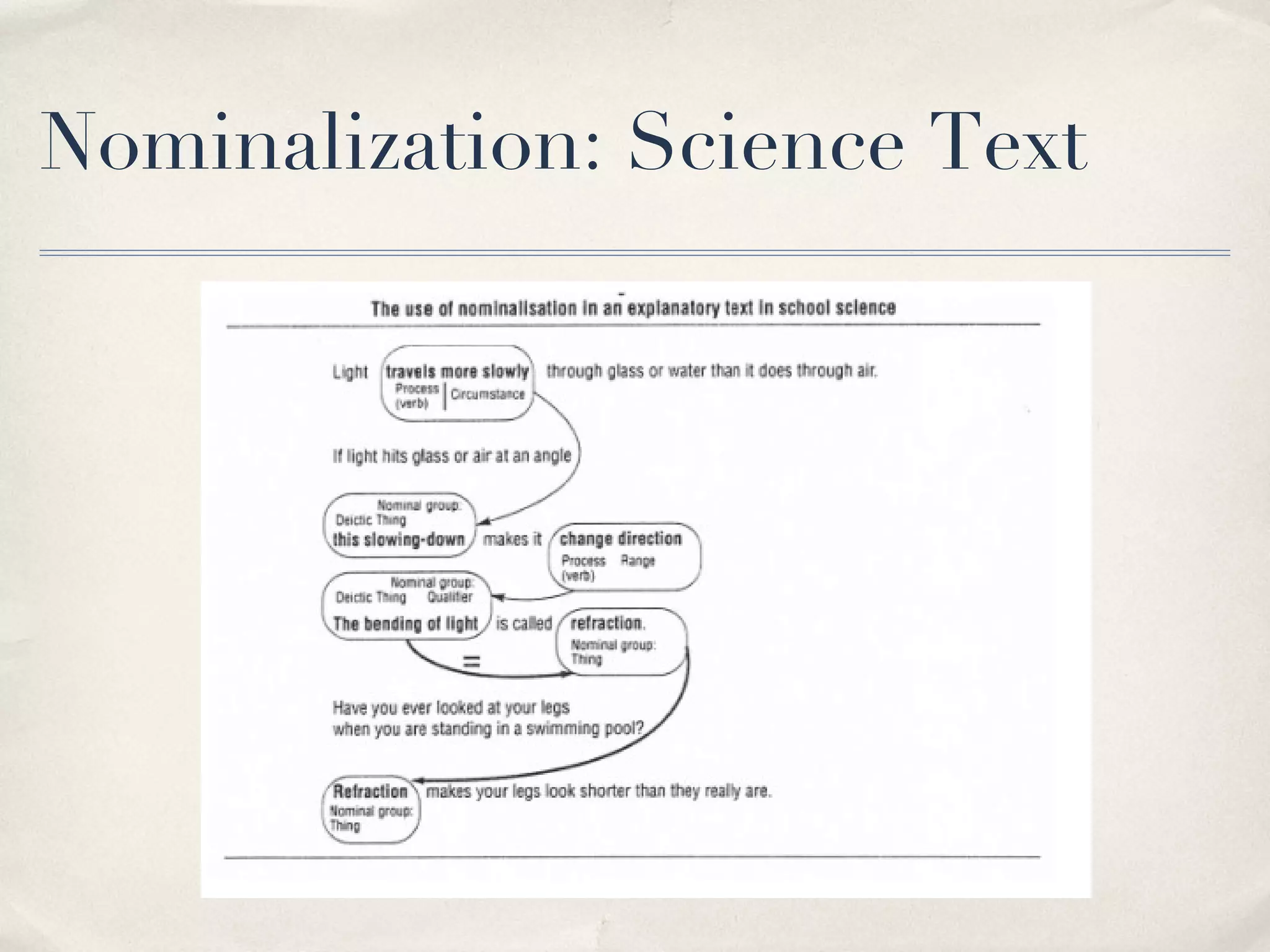
Nominalization Transformation of one grammatical form into another; typically actions (verbs) into things (nouns). Example: “ The production of rock waste by mechanical processes and chemical changes is called weathering.” Producing rock waste (an action) = “weathering” (a thing).
Nominalization: Science Text
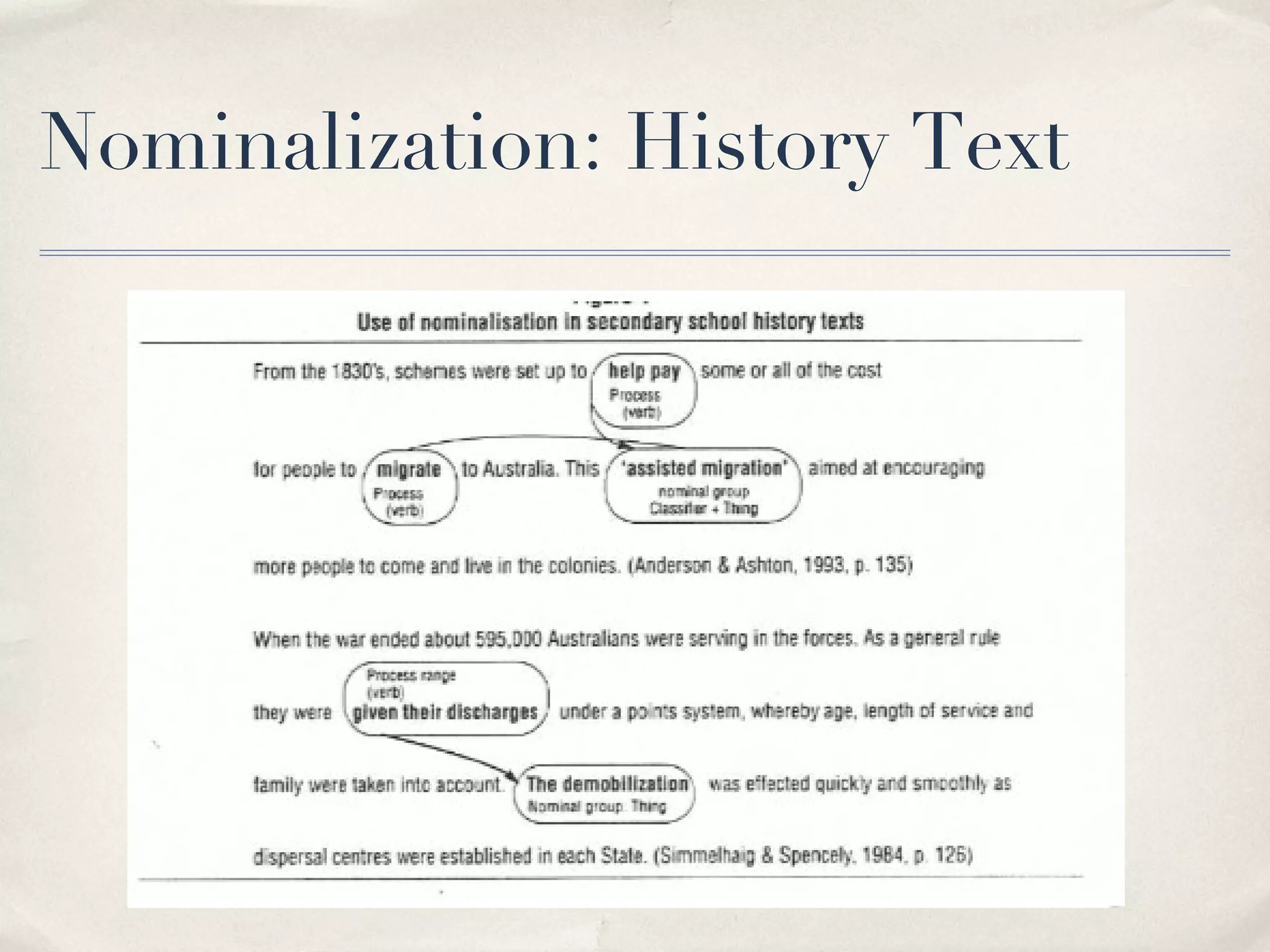
Nominalization: History Text
Nominalization: Science vs History Both texts use nominalization, but in different ways Science text uses it to further technical vocabulary of science History texts use it to create abstractions.
Text Structure: Science vs History Science argument often begins with hypothesis Implicit structure based on “scientific method” Focus on procedure, process, and methods Evidence stresses observations, data, experiments History often structured as narrative Focus on sequence of events and chronology Trends or generalizations highlighted from narrative Evidence stresses documents and artifacts
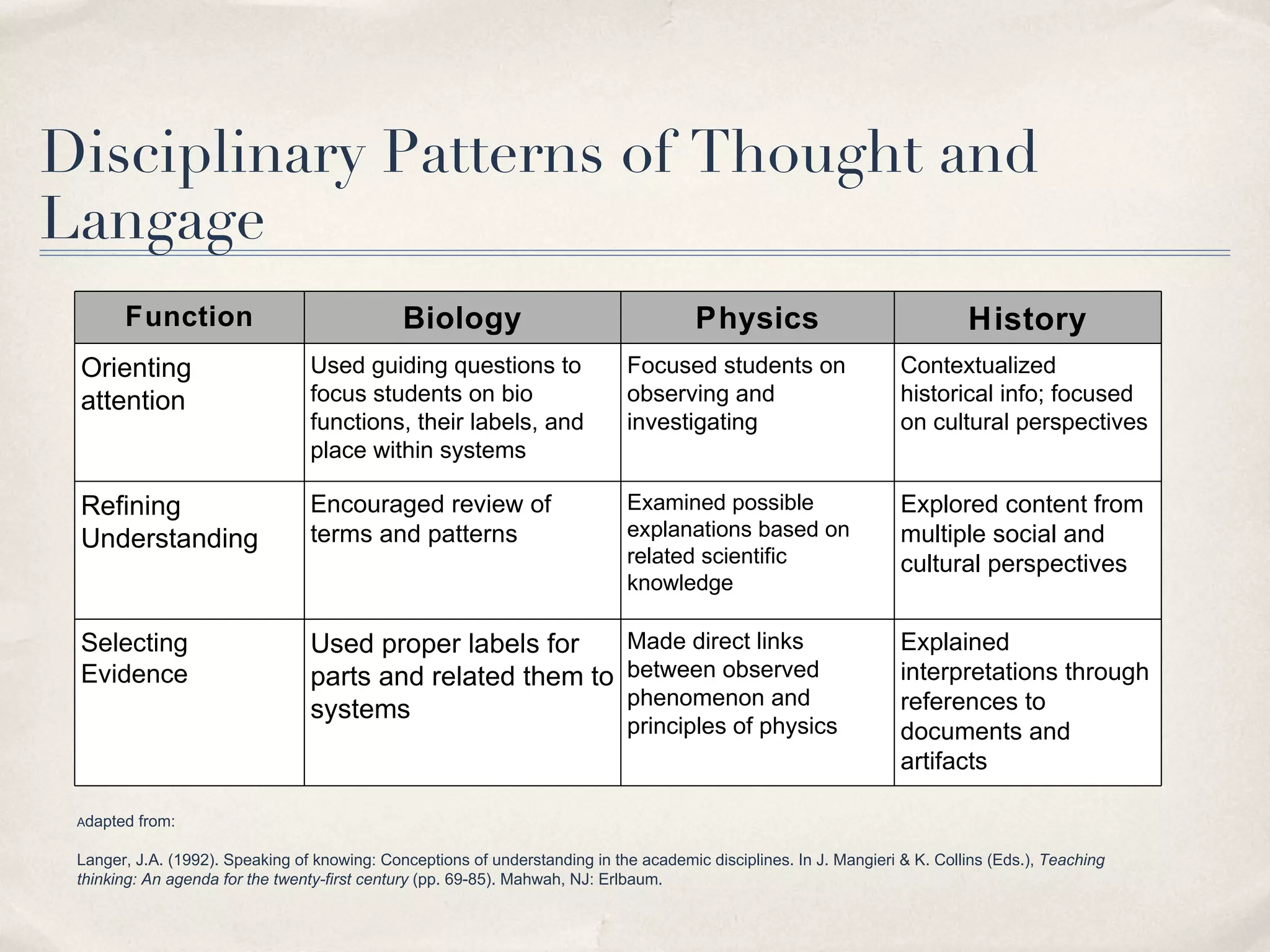
Disciplinary Patterns of Thought and Langage A dapted from: Langer, J.A. (1992). Speaking of knowing: Conceptions of understanding in the academic disciplines. In J. Mangieri & K. Collins (Eds.),  Teaching thinking: An agenda for the twenty-first century  (pp. 69-85). Mahwah, NJ: Erlbaum.  Function Biology Physics History Orienting attention Used guiding questions to focus students on bio functions, their labels, and place within systems Focused students on observing and investigating Contextualized historical info; focused on cultural perspectives Refining Understanding Encouraged review of terms and patterns Examined possible explanations based on related scientific knowledge Explored content from multiple social and cultural perspectives Selecting Evidence Used proper labels for parts and related them to systems Made direct links between observed phenomenon and principles of physics Explained interpretations through references to documents and artifacts Function Biology Physics History Orienting attention Used guiding questions to focus students on bio functions, their labels, and place with systems Focused students on observing and investigating Contextualized historical info; focused on cultural perspectives Refining Understanding Encouraged review of terms and patterns Examined possible explanations based on related scientific knowledge Explored content from multiple social and cultural perspectvites Selecting Evidence Used proper labels for parts and related them to systems Made direct links between observed phenomenon and principles of physics Explained interpretations through references to documents and artifacts
So What? “ Ways of knowing” are so internalized by teachers that it is automatic and unexpressed. Yet, students are often stumped by vocabulary and limited background knowledge. For many texts they read and write, students end up being the wrong audience.
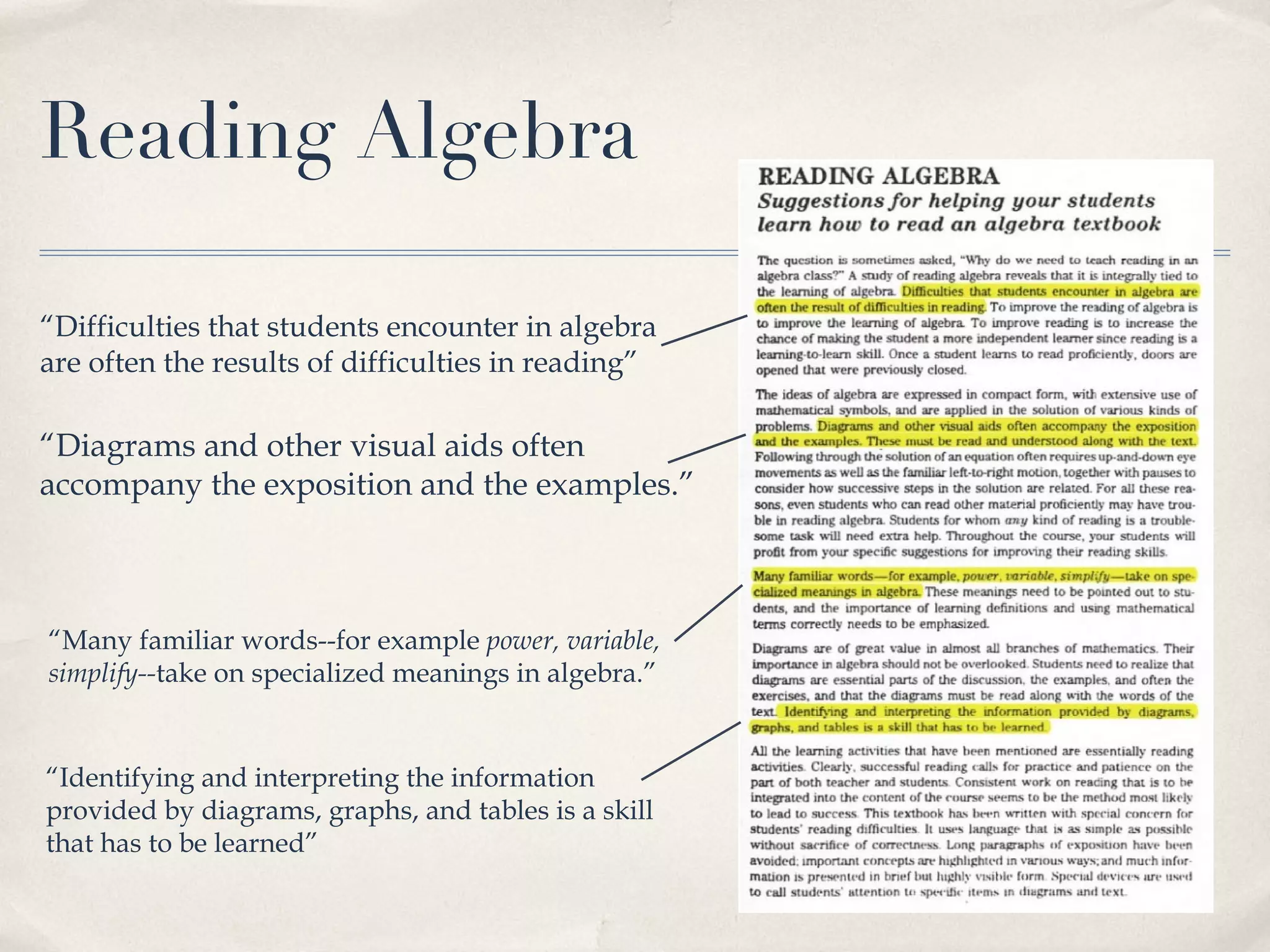
Reading Algebra “ Difficulties that students encounter in algebra are often the results of difficulties in reading” “ Diagrams and other visual aids often accompany the exposition and the examples.” “ Many familiar words--for example  power, variable, simplify-- take on specialized meanings in algebra.” “ Identifying and interpreting the information provided by diagrams, graphs, and tables is a skill that has to be learned”
Sample Activities & Approaches Explicitly  orienting attention, refining understanding,  and  citing evidence  in texts that students read. Explicitly addressing  text structures  as a way to improve reading and writing. “ Doing” science: Footprints
Orienting Students’ Attention What is this phenomenon (bomb shelters) an example of? Cold War paranoia? Nuclear warfare naivete? Government show? Explicit rationales and connections to previous material give students context for instruction.
Refining Understanding Questions that are related to how you frame the passage have the most coherence for students. What questions would you want your students to ask about this passage? Explicitly telling students the purpose of your questions will help clarify your questions for students.
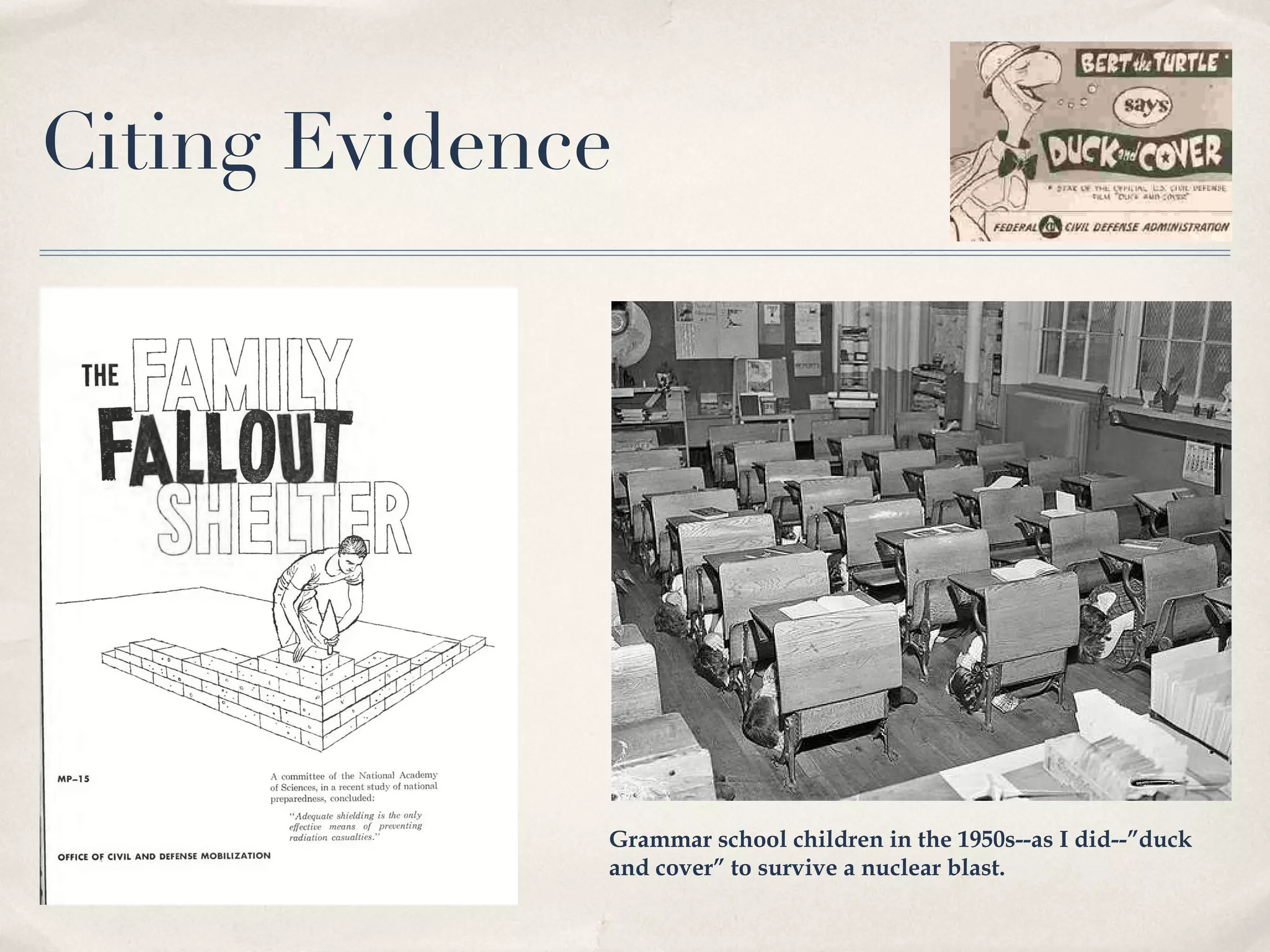
Citing Evidence Grammar school children in the 1950s--as I did--”duck and cover” to survive a nuclear blast.
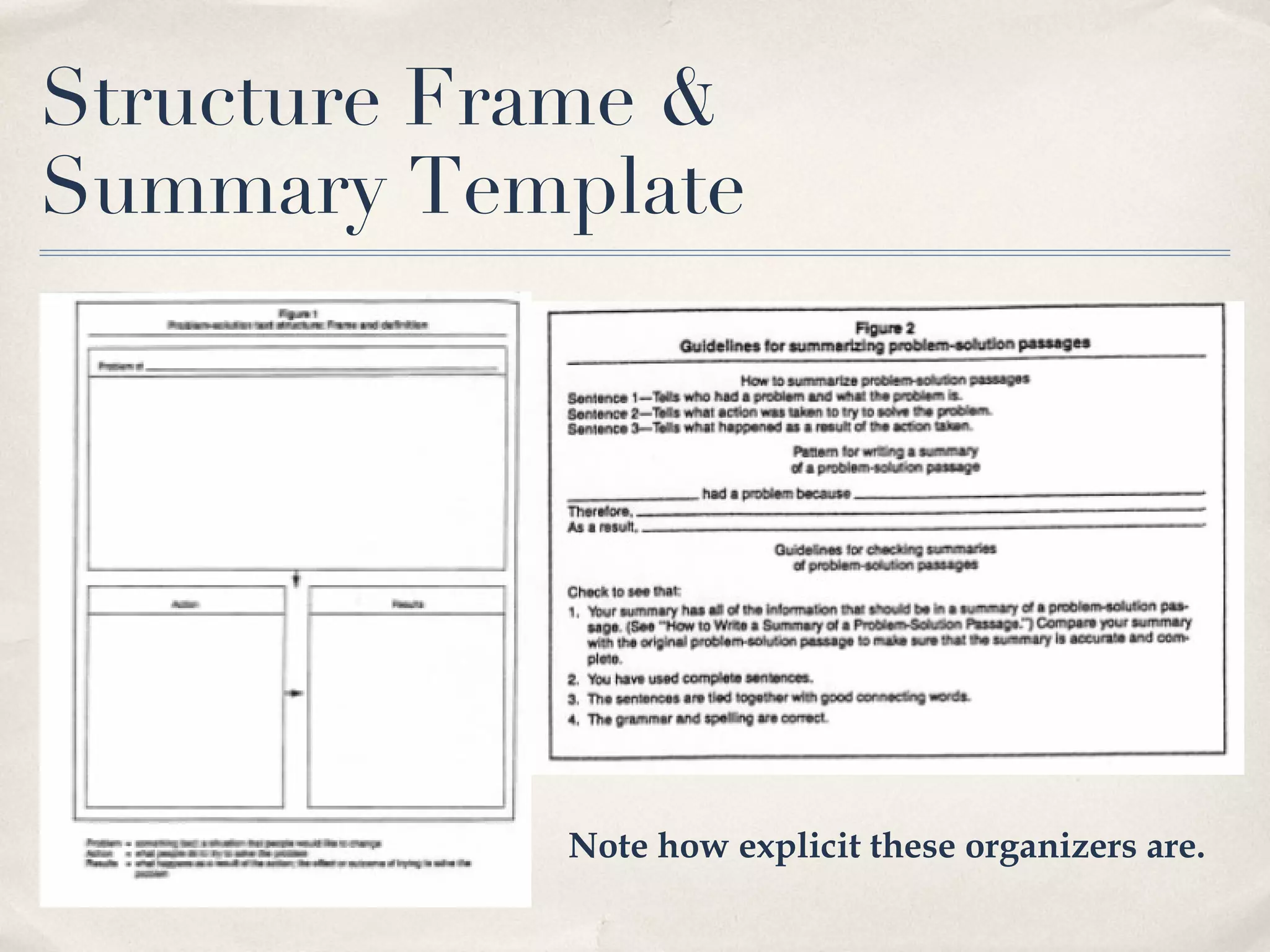
Structure Frame &  Summary Template Note how explicit these organizers are.
Other Text Structures Armbruster (1989) identifies several other text structures and provides frames and templates: Cause/effect text structure Sequence text structure Compare/contrast text structure
Footprints Instructions 1. With a partner, read your copy of the case below and study the footprint patterns on the back page. 2. On the data sheet, use the prompts to note what you observe in the footprints. 3. Write down all the hypotheses you can think of that could explain these footprints. 4. Discuss the different hypotheses you have generated, think about what information you would need to test or explain your hypotheses.
Footprints Scenarios You and a few close friends have taken a trip to Hawaii for the winter break. You really felt you needed to get away from the gloom of the mid-western winters to feel the warm sunshine and get out of those dreary winter clothes. Each day you and your friend have explored a new beach along the coastline. The edges by the water have new shell finds each day, the interiors of the beach have sand patterns and ripples where it is exposed to the wind, and interesting little sheltered spots that seem unchanged over time. One day when you and your friend are walking along a new stretch of beach you see the most unusual footprint patterns in the sand.
Thank You for Your Attendance Questions?

Making the Implicit Explicit

  • 1.
    Making the ImplicitExplicit: Teaching subject-matter literacy skills to previously unsuccessful learners Sept 23, 2011: NATSAP Midwest Region Conference, Hilton Oakbrook Terrace, Chicago, IL Ike & Burroughs, Educational Consultants Robert Burroughs, PhD
  • 2.
    Introduction Research hasfound that struggling learners have poor literacy skills in discipline-specific classes, such as science, history, or math (Klenck & Kibby, 2000). Moving from “learning to read” to “reading to learn” is the crucial educational pivot. One factor in the difficulty of “reading to learn” is the implicit differences in the ways that different subjects organize and communicate information. Explicit instruction in implicit subject-matter differences will benefit struggling students.
  • 3.
    Goals and ObjectivesDemonstrate the concept of multiple literacies through an experiential activity. Understand the importance of subject-matter literacies in curriculum and instruction. Demonstrate activities to use with students to strengthen subject-matter literacies.
  • 4.
    A Brief Quizon “Blue Notes” 1. What is a “blue note”? 2. Why does the author consider blue notes important to harmonies of popular songs? 3. How does “blue note” harmony differ from “classical” harmony?
  • 5.
    Processing “Blue Notes”1. Write down all the words (vocabulary) you find difficult to understand in this excerpt. 2. Underline the “thesis” or main idea of this excerpt. 3. Write three questions, the answers to which would help you understand this passage.
  • 6.
    Why “Blue Notes”Is Hard To Read Vocabulary Technical music terms: eg, harmony, tonality, chord Adapted technical terms: eg, minor key, cadential, scale Metaphors: eg, excursion, resolve Symbols Background knowledge Audience
  • 7.
    Ways of KnowingThe specialized literacies of academic subjects: “ways of knowing, thinking and doing” (Applebee, 1996) Form the boundaries of subject matter, as well as participation criteria; for example: Acceptable topics of investigation Acceptable methods of inquiry What counts as compelling evidence What counts as persuasive modes of argument
  • 8.
    Nominalization Transformation ofone grammatical form into another; typically actions (verbs) into things (nouns). Example: “ The production of rock waste by mechanical processes and chemical changes is called weathering.” Producing rock waste (an action) = “weathering” (a thing).
  • 9.
  • 10.
  • 11.
    Nominalization: Science vsHistory Both texts use nominalization, but in different ways Science text uses it to further technical vocabulary of science History texts use it to create abstractions.
  • 12.
    Text Structure: Sciencevs History Science argument often begins with hypothesis Implicit structure based on “scientific method” Focus on procedure, process, and methods Evidence stresses observations, data, experiments History often structured as narrative Focus on sequence of events and chronology Trends or generalizations highlighted from narrative Evidence stresses documents and artifacts
  • 13.
    Disciplinary Patterns ofThought and Langage A dapted from: Langer, J.A. (1992). Speaking of knowing: Conceptions of understanding in the academic disciplines. In J. Mangieri & K. Collins (Eds.), Teaching thinking: An agenda for the twenty-first century (pp. 69-85). Mahwah, NJ: Erlbaum. Function Biology Physics History Orienting attention Used guiding questions to focus students on bio functions, their labels, and place within systems Focused students on observing and investigating Contextualized historical info; focused on cultural perspectives Refining Understanding Encouraged review of terms and patterns Examined possible explanations based on related scientific knowledge Explored content from multiple social and cultural perspectives Selecting Evidence Used proper labels for parts and related them to systems Made direct links between observed phenomenon and principles of physics Explained interpretations through references to documents and artifacts Function Biology Physics History Orienting attention Used guiding questions to focus students on bio functions, their labels, and place with systems Focused students on observing and investigating Contextualized historical info; focused on cultural perspectives Refining Understanding Encouraged review of terms and patterns Examined possible explanations based on related scientific knowledge Explored content from multiple social and cultural perspectvites Selecting Evidence Used proper labels for parts and related them to systems Made direct links between observed phenomenon and principles of physics Explained interpretations through references to documents and artifacts
  • 14.
    So What? “Ways of knowing” are so internalized by teachers that it is automatic and unexpressed. Yet, students are often stumped by vocabulary and limited background knowledge. For many texts they read and write, students end up being the wrong audience.
  • 15.
    Reading Algebra “Difficulties that students encounter in algebra are often the results of difficulties in reading” “ Diagrams and other visual aids often accompany the exposition and the examples.” “ Many familiar words--for example power, variable, simplify-- take on specialized meanings in algebra.” “ Identifying and interpreting the information provided by diagrams, graphs, and tables is a skill that has to be learned”
  • 16.
    Sample Activities &Approaches Explicitly orienting attention, refining understanding, and citing evidence in texts that students read. Explicitly addressing text structures as a way to improve reading and writing. “ Doing” science: Footprints
  • 17.
    Orienting Students’ AttentionWhat is this phenomenon (bomb shelters) an example of? Cold War paranoia? Nuclear warfare naivete? Government show? Explicit rationales and connections to previous material give students context for instruction.
  • 18.
    Refining Understanding Questionsthat are related to how you frame the passage have the most coherence for students. What questions would you want your students to ask about this passage? Explicitly telling students the purpose of your questions will help clarify your questions for students.
  • 19.
    Citing Evidence Grammarschool children in the 1950s--as I did--”duck and cover” to survive a nuclear blast.
  • 20.
    Structure Frame & Summary Template Note how explicit these organizers are.
  • 21.
    Other Text StructuresArmbruster (1989) identifies several other text structures and provides frames and templates: Cause/effect text structure Sequence text structure Compare/contrast text structure
  • 22.
    Footprints Instructions 1.With a partner, read your copy of the case below and study the footprint patterns on the back page. 2. On the data sheet, use the prompts to note what you observe in the footprints. 3. Write down all the hypotheses you can think of that could explain these footprints. 4. Discuss the different hypotheses you have generated, think about what information you would need to test or explain your hypotheses.
  • 23.
    Footprints Scenarios Youand a few close friends have taken a trip to Hawaii for the winter break. You really felt you needed to get away from the gloom of the mid-western winters to feel the warm sunshine and get out of those dreary winter clothes. Each day you and your friend have explored a new beach along the coastline. The edges by the water have new shell finds each day, the interiors of the beach have sand patterns and ripples where it is exposed to the wind, and interesting little sheltered spots that seem unchanged over time. One day when you and your friend are walking along a new stretch of beach you see the most unusual footprint patterns in the sand.
  • 24.
    Thank You forYour Attendance Questions?