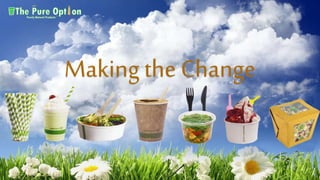
Making the Change
This document is designed to give you all the information your organisation may need in order to make the change from destructive plastic based packaging to
our Nature friendly™ plant based compostable packaging, but it should also give you a good understanding of our product range , our values, The Pure
Option™ and our vision for a plastic free future.
This document is designed to show you that changing to compostable plant based packaging makes business sense and comes with a number of other
advantages.
We have included links to the scientific research and certification at the end of the document, should you need to see any of the current research on the
materials and the effects of our products.
We hope to show you why The Pure Option™ are a perfect supply partner for your organisation and show you that we are well placed to help you achieve your
environmental goals.
Purpose of this document
Quick Summary for the short of time.
We appreciate that time is often an issue, so we have created a quick summary to give you an abridged version for the time sensitive.
All of our 300+ products are made from plants and are 100% compostable they do not emit either toxic fumes or liquids when being disposed of .
Our products should be disposed of in a commercial facility or home composter but should they be disposed of in landfill or incinerator , no harmful
environmental damage will take place but the environment will no benefit from the nutrient rich compost.
We are working on making our products more visibly a green product so your customers and food waste collection services know you are doing the right
thing and just as importantly , to let your waste collector know what to do with them , over the next two years we aim to have all our products with green
visual branding.
Prices have come down dramatically in the last 15 years and prices are predicted to drop and these savings will be passed on to bring the prices down to
the level of toxic plastic based non compostable products.
All of our products are biodegradable / compostable and are 100% positive for the environment .
Compostable packaging is better for the environment than recycling as all materials can only be recycled a limited number of times and when they are
disposed of they have a harmful effect on the environment whereas our products are always Nature Friendly™
We are investing in the UK as we have plans to create a research facility, certification / ethical audit company and manufacturing in the UK.
Our future plans will create new and improved bio packaging encompassing all areas of packaging which will eliminate single use plastics, reduce costs to
the end user , create living wage employment, regional wealth and further improve environmental performance.
The Pure Option™ is working on a business model that allows all of our supply chain to be audited to make certain they abide by TPO People friendly™ and
Feed a Field ™ set of principles and values.
FAQ’s
These are the questions we get asked repeatedly, but if we missed one, send us an email and we will get an answer for you.
“Are they all made of plants including the plasticky looking ones ?”
Yes all of our products are made of either trees or waste product from plants, either Corn, Sugar or Tree’s
“What happens if they end up in landfill ?”
We prefer if they were disposed of with food waste but if they are thrown into standard waste channels , they will eventually degrade but it does take longer , but it’s also
worth remembering they are still beneficial to the environment.
“What happens if they get incinerated ?”
We would never recommend incineration but they are quite safe to incinerated as they don’t emit toxic fumes and it’s not uncommon in some countries for PLA and
Bagasse products to be disposed of safely in a bio mass boiler.
“Can they be disposed of in my home compost bin ?”
Absolutely but due to the lower heat that a home composter makes, it does take longer and tests show this can be between 13 and 26 weeks.
“What happens if they end up in the sea ?”
They don’t turn into micro balls, they don’t leech toxins into the sea, they don’t emit Co2, so they are completely safe but they don’t breakdown in water so they will
eventually end up complete when they reach land.
“What happens if they end up mixed in with plastics?”
We are being asked this more and more by organisation that deal with Local Government but we have made some changes to stop this happening , they are made from
plants so they don’t cause environmental damage but we have been told that this can effect sorting for recycling so we are changing the design of our products to make
them more noticeably green packaging, and 100% compostable printed on them.
“Do we use plants that come from food stock?”
At the moment we don’t but as more and more people convert to Nature Friendly™ we will have to start using virgin food stocks but we are working on creating packaging
from Earth abundant sugar beet which produces more than is currently required.
We started our journey back in 2002 when both Charles and Deb Richardson started Big Apple Water Company, where they extracted and sold bottled mineral
water.
We were always environmentally engaged and wanted to make a difference so a chance encounter at a trade show at the Excel in London led to a joint venture
with a company called in Cap It All , distributing packaging made from plants all the way back in 2004.
We were so certain in the need to replace plastic packaging that we sold our bottled water business and threw every bit of money we had into the venture,
unfortunately it was too early for the business community and we had to close down this side of the business as we couldn’t keep absorbing losses.
It led to a period of reflection where we looked at the reasons for it’s failure and learnt some valuable lessons.
There were two reasons it failed, the main reason being the cost of producing PLA was 210% more expensive than plastics, so sadly price was a major factor
(current price comparisons are zero to 8% difference and falling).
The other reason was apathy towards the product, people just didn’t see plastic pollution as an issue and there was a lack of will from the media to report the
issue and the general public lacked the inclination to spend more to address the problem.
So the journey was halted for compostable packaging in the UK until another chance meeting with the people at Vegware who shared our desire to make a
difference, so we returned to the green packaging market again in 2015 and after three challenging years , the UK has finally embraced compostable packaging
and we are 120% up on last year ( thanks Blue Planet).
We are all committed to ethical business practices and we expect this of our supply chain, we care about people and we care about the planet so we expect
our suppliers to share these values, so we encourage our supply chain to follow TPO People friendly™ and Feed a Field ™ set of principles and values.
We aren’t environmental activists but we are concerned citizens who want to make a difference and look at ways of achieving the international and local
environment and we actively look at ways of doing things better and with a greater emphasis on ethical trading.
About Us
We hope that we can persuade you that we offer something special apart from great customers service and fantastic products, we think these things set us
apart from our competition.
1. We are a small family business who really do care about doing the right thing, we take being a good citizen seriously, we are transparent, honest and
ethical.
2. We only supply 100% Earth friendly compostable packaging, all of our products are great for the environment, ethical packaging is not an option, it’s our
only option.
3. All of our products have at least 68% less carbon than their plastic equivalent.
4. All of our products can be added to food waste and decompose into nutrient rich compost in 13 weeks.
5. Composted products can hold up 2.5 times more water than some soil types and have been used in North American to reduce flooding.
6. We want to improve our community and eventually all of our production will be researched and manufactured in the UK, with all employees earning
above the living wage and sharing in our success with profit sharing.
7. All our products ( except our FSC certified wood based products) are made from waste generated by the food industry , we don’t take food from edible
food stocks.
8. We do our research in the UK and we plan on using UK farm waste which will help UK farmers and remove farm waste.
9. We will be branding all of our products with easily identifiable compostable branding to inform people and eliminate our products being incorrectly
disposed of.
10. We are testing new polymers over the next two years and if they achieve their aims , it’s no exaggeration to say we will be changing the world.
11. Our products help you to meet environmental polices and they are all circular, everyone is a winner.
12. We’ve been working on this for 15 years ( sadly it didn’t go well , so we had to put it on hold until the time was right) so we have pedigree and knowledge
of compostable packaging.
13. Our business operates using TPO People friendly™ and Feed a Field ™ set of principles and values, so you can feel confident you are working with a ethical
and honorable company that cares about it’s employees and the employee’s of it’s supply chain.
What Makes Us Special
Here is a few of the benefits for you and your organisation ( we will go into more details later in this case study).
It’s been around a long time and it has plastic like qualities ( it’s often referred to as a bioplastic) and can be used for just about all applications.
It’s circular , it’s made by plants and when disposed of , ends up as compost for plants.
We recommend that our products should always be added to food waste collections but even if it ends up in landfill, it does not contaminate the land, will
eventually breakdown naturally, it can be burnt in a bio mass boiler as it does not emit toxic fumes ( it’s made from plants after all).
It doesn’t come from virgin food stocks , which means it doesn’t take away potential food sources, as it comes from the by product of the food industry and
is usually made from the sugar, plants , corn or sugar.
It’s now at a comparative price to petrochemical made plastic packaging as huge efforts have been put into reducing the cost, it’s typically 5% more
expensive from 211% in 2003.
It has no environmental downside , when it’s disposed of it turns into a nutrient rich compost which improves soil structure, macronutrients content,
improves soil water retention and creates healthier soil.
Prices have come down dramatically due to improvement in manufacturing.
Our entire range of products are designed to be positive for the environment and can break down in as little as 4 week.
83% of people in a poll by Kanter say they would choose a company which is ethical and environmentally engaged over a business that isn’t , so it’s good
for business as well as the planet.
Even when our products are not disposed of in the recommended compostable way , our products do not have health or environmental risk.
Saves money on the cost of waste disposal as they can be added to food waste and recirculated into compost.
It feels good to do the right thing , sometimes just doing the right thing is reason enough.
Benefits of switching
It’s not uncommon for people to believe that our plant based PLA / Bagasse packaging is new but it’s actually much older than people think, it’s been around a
long time but was sadly shelved to concentrate on petrol based packaging , but it’s a real versatile environmental superstar and thankfully as prices have gone
down , we can now produce it cheaper than ever , these are just a few of the benefits of green packaging.
All of our non wood based packaging comes from plant waste generated by the food industry, so it’s not removing valuable food stock.
It’s extremely versatile and we use it to make cups and line containers etc. but it’s also used to make 3d printing filament, pharmaceutical capsules and a
huge range of other usages ( constantly growing as more uses become available).
The polymer element of PLA (Polylactic Acid) comes from lactic acid which was invented in 1780 by Carl Scheele and originally came from sour milk, hence
the Latic part of the name.
Modern PLA designed was refined to be flexible and create a plastic appearance by Wallace Corruthers in 1930
PLA was invented before plastic ( plastic was patented as Parkesense in 1856, 76 years after LA (Lactic Acid).
PLA & bagasse does not breakdown in the marine environment so it does not contaminate or harm marine life.
PLA & bagasse never harms the environment, even if it is disposed of incorrectly , it still causes no harm to the environment ( they are made from plant
waste after all).
We are researching a new plant based material that completely breaks down in the marine environment and feeds marine life to replace PLA packaging.
Our wood based packaging is responsibly managed wood sources and is tracked from source.
Using our packaging reduces Carbon by at least 68% on their plastic equivalent.
The Pure Option™ is researching replacements for PLA that are harvested in the UK to reduce our Co2 impact even further.
Interesting facts about our packaging.
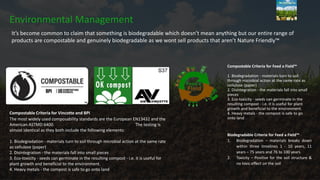
Compostable Criteria for Vincotte and BPI
The most widely used composability standards are the European EN13432 and the
American ASTMD 6400. The testing is
almost identical as they both include the following elements:
1. Biodegradation - materials turn to soil through microbial action at the same rate
as cellulose (paper)
2. Disintegration - the materials fall into small pieces
3. Eco-toxicity - seeds can germinate in the resulting compost - i.e. it is useful for
plant growth and beneficial to the environment.
4. Heavy metals - the compost is safe to go onto land
Environmental Management
Compostable Criteria for Feed a Field™
1. Biodegradation - materials turn to soil
through microbial action at the same rate as
cellulose (paper)
2. Disintegration - the materials fall into small
pieces
3. Eco-toxicity - seeds can germinate in the
resulting compost - i.e. it is useful for plant
growth and beneficial to the environment.
4. Heavy metals - the compost is safe to go
onto land
Biodegradable Criteria for Feed a Field™
1. Biodegradation – materials breaks down
within three timelines 1 - 10 years, 11
years – 75 years and 76 to 100 years.
2. Toxicity – Positive for the soil structure &
no toxic effect on the soil
It’s become common to claim that something is biodegradable which doesn’t mean anything but our entire range of
products are compostable and genuinely biodegradable as we wont sell products that aren’t Nature Friendly™
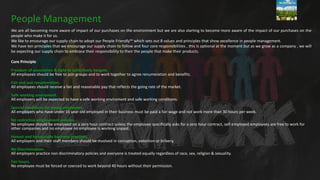
We are all becoming more aware of impact of our purchases on the environment but we are also starting to become more aware of the impact of our purchases on the
people who make it for us.
We like to encourage our supply chain to adopt our People Friendly™ which sets out 8 values and principles that show excellence in people management.
We have ten principles that we encourage our supply chain to follow and four core responsibilities , this is optional at the moment but as we grow as a company , we will
be expecting our supply chain to embrace their responsibility to their the people that make their products.
Core Principle
Freedom of association & right to collectively bargain.
All employees should be free to join groups and to work together to agree renumeration and benefits.
Fair and just renumeration.
All employees should receive a fair and reasonable pay that reflects the going rate of the market.
Safe working enviroment.
All employers will be expected to have a safe working enviroment and safe working conditions.
Special conditions for young employees.
All employers who have under 16 year old employed in their business must be paid a fair wage and not work more than 30 hours per week.
No restrictive employment policies.
No employee should be employed on a zero hour contract unless the employee specifically asks for a zero hour contract, self employed employees are free to work for
other companies and no employee no employee is working unpaid.
Honest and honourable business practices.
All employers and their staff members should be involved in corruption, extortion or bribery.
No Discrimination.
All employers practice non discriminatory policies and everyone is treated equally regardless of race, sex, religion & sexuality.
Fair hours.
No employee must be forced or coerced to work beyond 40 hours without their permission.
People Management
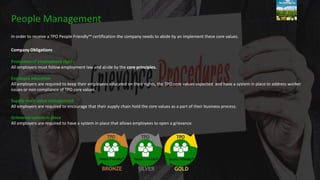
In order to receive a TPO People Friendly™ certification the company needs to abide by an implement these core values.
Company Obligations
Protection of employment rights
All employers must follow employment law and abide by the core principles.
Employee education
All employers are required to keep their employees educated on their rights, the TPO core values expected and have a system in place to address worker
issues or non compliance of TPO core values.
Supply chain value management
All employers are required to encourage that their supply chain hold the core values as a part of their business process.
Grievance system in place
All employers are required to have a system in place that allows employees to open a grievance.
People Management
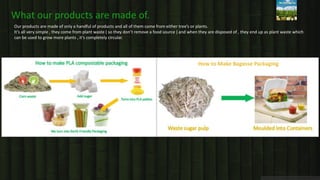
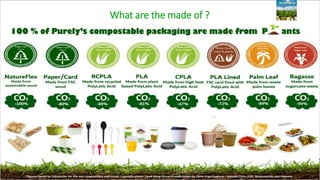
What our products are made of.
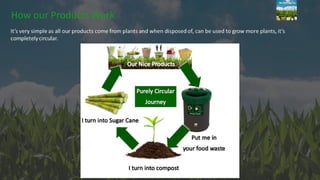
Our products are made of only a handful of products and all of them come from either tree’s or plants.
It’s all very simple , they come from plant waste ( so they don’t remove a food source ) and when they are disposed of , they end up as plant waste which
can be used to grow more plants , it’s completely circular.
How to Make Bagasse Packaging
Where they come from
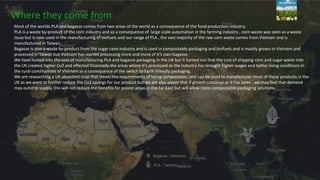
Most of the worlds PLA and bagasse comes from two areas of the world as a consequence of the food production industry.
PLA is a waste by-product of the corn industry and as a consequence of large scale automation in the farming industry , corn waste was seen as a waste
issue but is now used in the manufacturing of biofuels and our range of PLA , the vast majority of the raw corn waste comes from Vietnam and is
manufactured in Taiwan.
Bagasse is also a waste by-product from the sugar cane industry and is used in compostable packaging and biofuels and is mainly grown in Vietnam and
processed in Taiwan but Vietnam has started processing more and more of it’s own bagasse.
We have looked into the cost of manufacturing PLA and bagasse packaging in the UK but it turned out that the cost of shipping corn and sugar waste into
the UK created higher Co2 and effected financially the areas where it’s processed as the industry has brought higher wages and better living conditions in
the rural communities of Vietnam as a consequence of the switch to Earth friendly packaging.
We are researching a UK abundant crop that meets the requirements of being compostable, and can be used to manafacturer most of these products in the
UK as we want to further reduce the Co2 savings for our product but we are also aware that if growth continue as it has been , we may find that demand
may outstrip supply, this will not reduce the benefits for poorer areas in the Far East but will allow more compostable packaging solutions.
How our Products Work
What are the made of ?
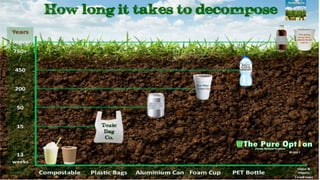
Why compostable is better than recyclable & biodegradable
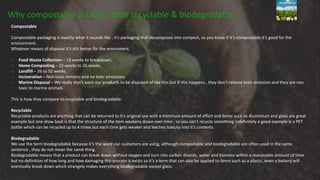
Compostable
Compostable packaging is exactly what it sounds like , it’s packaging that decomposes into compost, so you know if it’s compostable it’s good for the
environment.
Whatever means of disposal it’s still better for the enviroment.
Food Waste Collection – 13 weeks to breakdown.
Home Composting – 13 weeks to 26 weeks.
Landfill – 26 to 52 weeks.
Incineration – Non toxic remains and no toxic emissions.
Marine Disposal – We really don’t want our products to be disposed of like this but if this happens , they don’t release toxic emission and they are non
toxic to marine animals
This is how they compare to recyclable and biodegradable.
Recyclable
Recyclable products are anything that can be returned to it’s original use with a minimum amount of effort and items such as Aluminium and glass are great
example but one draw back is that the structure of the item weakens down over time , so you can’t recycle something indefinitely a good example is a PET
bottle which can be recycled up to 4 times but each time gets weaker and leeches toxicity into it’s contents.
Biodegradable
We use the term biodegradable because it’s the word our customers are using, although compostable and biodegradable are often used in the same
sentence , they do not mean the same thing.
Biodegradable means that a product can break down without oxygen and turn into carbon dioxide, water and biomass within a reasonable amount of time
but no definition of how long and how damaging this process is exists so it’s a term that can also be applied to items such as a plastic, even a battery will
eventually break down which strangely makes everything biodegradable except glass.
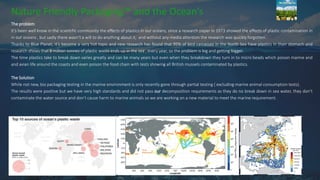
Nature Friendly Packaging™ and the Ocean’s
The problem
It’s been well know in the scientific community the effects of plastics in our oceans, since a research paper in 1973 showed the effects of plastic contamination in
in our oceans , but sadly there wasn’t a will to do anything about it, and without any media attention the research was quickly forgotten.
Thanks to Blue Planet, it’s become a very hot topic and new research has found that 95% of bird carcasses in the North Sea have plastics in their stomach and
research shows that 8 million tonnes of plastic waste ends up in the sea , every year, so the problem is big and getting bigger.
The time plastics take to break down varies greatly and can be many years but even when they breakdown they turn in to micro beads which poison marine and
and avian life around the coasts and even poison the food chain with tests showing all British mussels contaminated by plastics.
The Solution
While not new, bio packaging testing in the marine environment is only recently gone through partial testing ( excluding marine animal consumption tests).
The results were positive but we have very high standards and did not pass our decomposition requirements as they do no break down in sea water, they don’t
contaminate the water source and don’t cause harm to marine animals so we are working on a new material to meet the marine requirement.
The Cost of Disposal
Disposal of waste is quite rightly an expensive business and reflects the issue caused by waste, so it’s not only environmental costs but there is an actual cost
to dispose of items and that cost is dramatically different for food waste disposal.
The benefits of removing packaging products from landfill and into commercial composting facilities ( obviously this cant be done with plastic packaging),
reduces methane and carbon dioxide , saves money on Landfill Taxes, reduces peat extraction for composting and they actually make money as compost has a
resale value.
Layering of food waste in general landfill creates methane which is 21 times more damaging than Co2 so disposal in commercial composting actual reduces
methane and Co2 in the environment.
Disposing of all food based products including our plant made packaging into commercial composting instead of landfill would save 17 million tonnes of
Co2 emissions and if the same waste was stored into a landfill setting , it would save 357 million tonnes of methane emissions.
The UK sends to landfill 7.2 million tonnes of food waste which costs £6.4 billion to waste and with the Landfill tax increasing at 1% per year this could be
an extra £10.2 million pounds by 2020.
Sending this to commercial composting facilities would actually make £10.8 million profit based on resale at £1.50 for 50 litre bags on top of the huge
savings from non landfill wastage.
Converting food waste and plant based packaging to compost would actually eliminate the need to extract compost from endangered peat bogs saving
37,000 tonnes of Co2 emissions per year.
So the needs to change packaging to plant based packaging and to dispose of it in food waste makes financial sense, creates potential for employment and
income but more important it actually improves the environment.
The future for Plant based Packaging
Future of the Materials
Plant based compostable packaging was really expensive when we first tried to launch it 15 years ago buyers and the end users weren’t ready to make the change
change but improvements in manufacturing and a new found social consciousness motivating a shift in ethical products have driven prices down to almost parity
parity with toxic packaging, add in the upward trend in the cost to dispose of waste , we believe that we have reached a point where plant based packaging is
cheaper when you factor in the price of disposal and our plans for the future are to drive this cost down further.
The modern consumer is energized to change their buying habits to eliminate plastic waste which is driving a switch from petrol based packaging to plant based
based packaging and we are expecting that consumer demand will force a change in supermarket packaging that will need lead to compostable packaging
becoming the replacement for fossil fuel packaging such as Polypropylene and PET.
We expect legislation to come into force that includes an extra charge for toxic packaging disposal which will lead to a major price difference between the two
types of packaging , leading to plant based packaging becoming considerably cheaper.
The latest figures for the industry show a huge uptake in plant based packaging which is set to continue and we expect new manufacturing techniques along with
with new materials , UK based production all to contribute to driving prices down along with improved Co2 and better decomposition.
We expect the market to outstrip supply of corn and sugar waste material so companies like ours will have to look at new types of plant waste to use which
should lead to more locally based manufacturing of bio packaging , which should lead to job creation, improved farming income and reduced agricultural waste in
in the UK.
The future for The Pure Option™
Up to Now
The past three years have been a time of educating people about the effects of plastic packaging and we have consistently made a loss until the end of 2017
where focus of the effects of plastic packaging started to drive a change in the UK and to a lesser extend worldwide.
We are now making a profit and our sales are up over 212% on 2017 figures and we expect this to continue which will allow us to implement our 5 year plan.
The Future
We maybe small but we are ambitious and we have some really interesting plans for our future which we believe will make huge changes to the environment
both locally, nationally and internationally.
We are already working on a research program which should create a new polymers that can be used to create new bio polymers from British grown sugar beet .
beet .
We plan on opening a manufacturing facility that will create high income employment based on BSCI principles of employment.
Our use of British farmed sugar beet will reduce Co2 due to smaller shipping lines and improved farmer income , encouraging UK farmers to stay in farming.
We are looking into implementing our own certification system that means that compostable and biodegradable products meet a standard of performance which
which rates them on their environmental benefits.
We will be taking control of ethical and modern slavery audits by creating a worldwide audit team to check that a company is abiding by the TPO People friendly™
friendly™ and Feed a Field ™ set of principles and values.
Marketing
We’ve want to help inform and encourage you and your organisation to make the change so if you need a copy of this or any other presentation as a word
document, PDF or PowerPoint presentation please click the link below describing what marketing you would like and in what format.
Click Here
Thanks for your time.
We appreciate your interest in our products and we hope we have informed, educated you and encouraged you to make
the change.
If you have any questions or would like to discuss this document, please get in touch as we love to help.
©The Pure Option™ – All rights reserved.
Sources
The following have been used to provide evidence of the benefits of compostable / biodegradable packaging.
Research Sources
Soil Structure Landfill tax rates
Increased nutrient content Food waste and landfill
Better soil water retention Welsh landfill tax rates
Healthier Soil Food waste stats
Polyethylene bag cag decomposition timeline Peat bogs facts
Foam decomposition timeline Further research on peat bogs
Smithsonian on PLA
Marine testing results
Plastic distribution in our oceans
Volume of plastic waste in our oceans
History of PLA
Lactic Acid Invention
Invention of PLA
Price comparison done over a 6 month period using the UK’s largest packaging supplier
Information on sources of PLA
Mussels poisoned by plastics

Making the change

  • 1.
  • 2.
    This document isdesigned to give you all the information your organisation may need in order to make the change from destructive plastic based packaging to our Nature friendly™ plant based compostable packaging, but it should also give you a good understanding of our product range , our values, The Pure Option™ and our vision for a plastic free future. This document is designed to show you that changing to compostable plant based packaging makes business sense and comes with a number of other advantages. We have included links to the scientific research and certification at the end of the document, should you need to see any of the current research on the materials and the effects of our products. We hope to show you why The Pure Option™ are a perfect supply partner for your organisation and show you that we are well placed to help you achieve your environmental goals. Purpose of this document
  • 3.
    Quick Summary forthe short of time. We appreciate that time is often an issue, so we have created a quick summary to give you an abridged version for the time sensitive. All of our 300+ products are made from plants and are 100% compostable they do not emit either toxic fumes or liquids when being disposed of . Our products should be disposed of in a commercial facility or home composter but should they be disposed of in landfill or incinerator , no harmful environmental damage will take place but the environment will no benefit from the nutrient rich compost. We are working on making our products more visibly a green product so your customers and food waste collection services know you are doing the right thing and just as importantly , to let your waste collector know what to do with them , over the next two years we aim to have all our products with green visual branding. Prices have come down dramatically in the last 15 years and prices are predicted to drop and these savings will be passed on to bring the prices down to the level of toxic plastic based non compostable products. All of our products are biodegradable / compostable and are 100% positive for the environment . Compostable packaging is better for the environment than recycling as all materials can only be recycled a limited number of times and when they are disposed of they have a harmful effect on the environment whereas our products are always Nature Friendly™ We are investing in the UK as we have plans to create a research facility, certification / ethical audit company and manufacturing in the UK. Our future plans will create new and improved bio packaging encompassing all areas of packaging which will eliminate single use plastics, reduce costs to the end user , create living wage employment, regional wealth and further improve environmental performance. The Pure Option™ is working on a business model that allows all of our supply chain to be audited to make certain they abide by TPO People friendly™ and Feed a Field ™ set of principles and values.
  • 4.
    FAQ’s These are thequestions we get asked repeatedly, but if we missed one, send us an email and we will get an answer for you. “Are they all made of plants including the plasticky looking ones ?” Yes all of our products are made of either trees or waste product from plants, either Corn, Sugar or Tree’s “What happens if they end up in landfill ?” We prefer if they were disposed of with food waste but if they are thrown into standard waste channels , they will eventually degrade but it does take longer , but it’s also worth remembering they are still beneficial to the environment. “What happens if they get incinerated ?” We would never recommend incineration but they are quite safe to incinerated as they don’t emit toxic fumes and it’s not uncommon in some countries for PLA and Bagasse products to be disposed of safely in a bio mass boiler. “Can they be disposed of in my home compost bin ?” Absolutely but due to the lower heat that a home composter makes, it does take longer and tests show this can be between 13 and 26 weeks. “What happens if they end up in the sea ?” They don’t turn into micro balls, they don’t leech toxins into the sea, they don’t emit Co2, so they are completely safe but they don’t breakdown in water so they will eventually end up complete when they reach land. “What happens if they end up mixed in with plastics?” We are being asked this more and more by organisation that deal with Local Government but we have made some changes to stop this happening , they are made from plants so they don’t cause environmental damage but we have been told that this can effect sorting for recycling so we are changing the design of our products to make them more noticeably green packaging, and 100% compostable printed on them. “Do we use plants that come from food stock?” At the moment we don’t but as more and more people convert to Nature Friendly™ we will have to start using virgin food stocks but we are working on creating packaging from Earth abundant sugar beet which produces more than is currently required.
  • 5.
    We started ourjourney back in 2002 when both Charles and Deb Richardson started Big Apple Water Company, where they extracted and sold bottled mineral water. We were always environmentally engaged and wanted to make a difference so a chance encounter at a trade show at the Excel in London led to a joint venture with a company called in Cap It All , distributing packaging made from plants all the way back in 2004. We were so certain in the need to replace plastic packaging that we sold our bottled water business and threw every bit of money we had into the venture, unfortunately it was too early for the business community and we had to close down this side of the business as we couldn’t keep absorbing losses. It led to a period of reflection where we looked at the reasons for it’s failure and learnt some valuable lessons. There were two reasons it failed, the main reason being the cost of producing PLA was 210% more expensive than plastics, so sadly price was a major factor (current price comparisons are zero to 8% difference and falling). The other reason was apathy towards the product, people just didn’t see plastic pollution as an issue and there was a lack of will from the media to report the issue and the general public lacked the inclination to spend more to address the problem. So the journey was halted for compostable packaging in the UK until another chance meeting with the people at Vegware who shared our desire to make a difference, so we returned to the green packaging market again in 2015 and after three challenging years , the UK has finally embraced compostable packaging and we are 120% up on last year ( thanks Blue Planet). We are all committed to ethical business practices and we expect this of our supply chain, we care about people and we care about the planet so we expect our suppliers to share these values, so we encourage our supply chain to follow TPO People friendly™ and Feed a Field ™ set of principles and values. We aren’t environmental activists but we are concerned citizens who want to make a difference and look at ways of achieving the international and local environment and we actively look at ways of doing things better and with a greater emphasis on ethical trading. About Us
  • 6.
    We hope thatwe can persuade you that we offer something special apart from great customers service and fantastic products, we think these things set us apart from our competition. 1. We are a small family business who really do care about doing the right thing, we take being a good citizen seriously, we are transparent, honest and ethical. 2. We only supply 100% Earth friendly compostable packaging, all of our products are great for the environment, ethical packaging is not an option, it’s our only option. 3. All of our products have at least 68% less carbon than their plastic equivalent. 4. All of our products can be added to food waste and decompose into nutrient rich compost in 13 weeks. 5. Composted products can hold up 2.5 times more water than some soil types and have been used in North American to reduce flooding. 6. We want to improve our community and eventually all of our production will be researched and manufactured in the UK, with all employees earning above the living wage and sharing in our success with profit sharing. 7. All our products ( except our FSC certified wood based products) are made from waste generated by the food industry , we don’t take food from edible food stocks. 8. We do our research in the UK and we plan on using UK farm waste which will help UK farmers and remove farm waste. 9. We will be branding all of our products with easily identifiable compostable branding to inform people and eliminate our products being incorrectly disposed of. 10. We are testing new polymers over the next two years and if they achieve their aims , it’s no exaggeration to say we will be changing the world. 11. Our products help you to meet environmental polices and they are all circular, everyone is a winner. 12. We’ve been working on this for 15 years ( sadly it didn’t go well , so we had to put it on hold until the time was right) so we have pedigree and knowledge of compostable packaging. 13. Our business operates using TPO People friendly™ and Feed a Field ™ set of principles and values, so you can feel confident you are working with a ethical and honorable company that cares about it’s employees and the employee’s of it’s supply chain. What Makes Us Special
  • 7.
    Here is afew of the benefits for you and your organisation ( we will go into more details later in this case study). It’s been around a long time and it has plastic like qualities ( it’s often referred to as a bioplastic) and can be used for just about all applications. It’s circular , it’s made by plants and when disposed of , ends up as compost for plants. We recommend that our products should always be added to food waste collections but even if it ends up in landfill, it does not contaminate the land, will eventually breakdown naturally, it can be burnt in a bio mass boiler as it does not emit toxic fumes ( it’s made from plants after all). It doesn’t come from virgin food stocks , which means it doesn’t take away potential food sources, as it comes from the by product of the food industry and is usually made from the sugar, plants , corn or sugar. It’s now at a comparative price to petrochemical made plastic packaging as huge efforts have been put into reducing the cost, it’s typically 5% more expensive from 211% in 2003. It has no environmental downside , when it’s disposed of it turns into a nutrient rich compost which improves soil structure, macronutrients content, improves soil water retention and creates healthier soil. Prices have come down dramatically due to improvement in manufacturing. Our entire range of products are designed to be positive for the environment and can break down in as little as 4 week. 83% of people in a poll by Kanter say they would choose a company which is ethical and environmentally engaged over a business that isn’t , so it’s good for business as well as the planet. Even when our products are not disposed of in the recommended compostable way , our products do not have health or environmental risk. Saves money on the cost of waste disposal as they can be added to food waste and recirculated into compost. It feels good to do the right thing , sometimes just doing the right thing is reason enough. Benefits of switching
  • 8.
    It’s not uncommonfor people to believe that our plant based PLA / Bagasse packaging is new but it’s actually much older than people think, it’s been around a long time but was sadly shelved to concentrate on petrol based packaging , but it’s a real versatile environmental superstar and thankfully as prices have gone down , we can now produce it cheaper than ever , these are just a few of the benefits of green packaging. All of our non wood based packaging comes from plant waste generated by the food industry, so it’s not removing valuable food stock. It’s extremely versatile and we use it to make cups and line containers etc. but it’s also used to make 3d printing filament, pharmaceutical capsules and a huge range of other usages ( constantly growing as more uses become available). The polymer element of PLA (Polylactic Acid) comes from lactic acid which was invented in 1780 by Carl Scheele and originally came from sour milk, hence the Latic part of the name. Modern PLA designed was refined to be flexible and create a plastic appearance by Wallace Corruthers in 1930 PLA was invented before plastic ( plastic was patented as Parkesense in 1856, 76 years after LA (Lactic Acid). PLA & bagasse does not breakdown in the marine environment so it does not contaminate or harm marine life. PLA & bagasse never harms the environment, even if it is disposed of incorrectly , it still causes no harm to the environment ( they are made from plant waste after all). We are researching a new plant based material that completely breaks down in the marine environment and feeds marine life to replace PLA packaging. Our wood based packaging is responsibly managed wood sources and is tracked from source. Using our packaging reduces Carbon by at least 68% on their plastic equivalent. The Pure Option™ is researching replacements for PLA that are harvested in the UK to reduce our Co2 impact even further. Interesting facts about our packaging.
  • 9.
    Compostable Criteria forVincotte and BPI The most widely used composability standards are the European EN13432 and the American ASTMD 6400. The testing is almost identical as they both include the following elements: 1. Biodegradation - materials turn to soil through microbial action at the same rate as cellulose (paper) 2. Disintegration - the materials fall into small pieces 3. Eco-toxicity - seeds can germinate in the resulting compost - i.e. it is useful for plant growth and beneficial to the environment. 4. Heavy metals - the compost is safe to go onto land Environmental Management Compostable Criteria for Feed a Field™ 1. Biodegradation - materials turn to soil through microbial action at the same rate as cellulose (paper) 2. Disintegration - the materials fall into small pieces 3. Eco-toxicity - seeds can germinate in the resulting compost - i.e. it is useful for plant growth and beneficial to the environment. 4. Heavy metals - the compost is safe to go onto land Biodegradable Criteria for Feed a Field™ 1. Biodegradation – materials breaks down within three timelines 1 - 10 years, 11 years – 75 years and 76 to 100 years. 2. Toxicity – Positive for the soil structure & no toxic effect on the soil It’s become common to claim that something is biodegradable which doesn’t mean anything but our entire range of products are compostable and genuinely biodegradable as we wont sell products that aren’t Nature Friendly™
  • 10.
    We are allbecoming more aware of impact of our purchases on the environment but we are also starting to become more aware of the impact of our purchases on the people who make it for us. We like to encourage our supply chain to adopt our People Friendly™ which sets out 8 values and principles that show excellence in people management. We have ten principles that we encourage our supply chain to follow and four core responsibilities , this is optional at the moment but as we grow as a company , we will be expecting our supply chain to embrace their responsibility to their the people that make their products. Core Principle Freedom of association & right to collectively bargain. All employees should be free to join groups and to work together to agree renumeration and benefits. Fair and just renumeration. All employees should receive a fair and reasonable pay that reflects the going rate of the market. Safe working enviroment. All employers will be expected to have a safe working enviroment and safe working conditions. Special conditions for young employees. All employers who have under 16 year old employed in their business must be paid a fair wage and not work more than 30 hours per week. No restrictive employment policies. No employee should be employed on a zero hour contract unless the employee specifically asks for a zero hour contract, self employed employees are free to work for other companies and no employee no employee is working unpaid. Honest and honourable business practices. All employers and their staff members should be involved in corruption, extortion or bribery. No Discrimination. All employers practice non discriminatory policies and everyone is treated equally regardless of race, sex, religion & sexuality. Fair hours. No employee must be forced or coerced to work beyond 40 hours without their permission. People Management
  • 11.
    In order toreceive a TPO People Friendly™ certification the company needs to abide by an implement these core values. Company Obligations Protection of employment rights All employers must follow employment law and abide by the core principles. Employee education All employers are required to keep their employees educated on their rights, the TPO core values expected and have a system in place to address worker issues or non compliance of TPO core values. Supply chain value management All employers are required to encourage that their supply chain hold the core values as a part of their business process. Grievance system in place All employers are required to have a system in place that allows employees to open a grievance. People Management
  • 12.
    What our productsare made of. Our products are made of only a handful of products and all of them come from either tree’s or plants. It’s all very simple , they come from plant waste ( so they don’t remove a food source ) and when they are disposed of , they end up as plant waste which can be used to grow more plants , it’s completely circular. How to Make Bagasse Packaging
  • 13.
    Where they comefrom Most of the worlds PLA and bagasse comes from two areas of the world as a consequence of the food production industry. PLA is a waste by-product of the corn industry and as a consequence of large scale automation in the farming industry , corn waste was seen as a waste issue but is now used in the manufacturing of biofuels and our range of PLA , the vast majority of the raw corn waste comes from Vietnam and is manufactured in Taiwan. Bagasse is also a waste by-product from the sugar cane industry and is used in compostable packaging and biofuels and is mainly grown in Vietnam and processed in Taiwan but Vietnam has started processing more and more of it’s own bagasse. We have looked into the cost of manufacturing PLA and bagasse packaging in the UK but it turned out that the cost of shipping corn and sugar waste into the UK created higher Co2 and effected financially the areas where it’s processed as the industry has brought higher wages and better living conditions in the rural communities of Vietnam as a consequence of the switch to Earth friendly packaging. We are researching a UK abundant crop that meets the requirements of being compostable, and can be used to manafacturer most of these products in the UK as we want to further reduce the Co2 savings for our product but we are also aware that if growth continue as it has been , we may find that demand may outstrip supply, this will not reduce the benefits for poorer areas in the Far East but will allow more compostable packaging solutions.
  • 14.
  • 15.
    What are themade of ?
  • 16.
    Why compostable isbetter than recyclable & biodegradable Compostable Compostable packaging is exactly what it sounds like , it’s packaging that decomposes into compost, so you know if it’s compostable it’s good for the environment. Whatever means of disposal it’s still better for the enviroment. Food Waste Collection – 13 weeks to breakdown. Home Composting – 13 weeks to 26 weeks. Landfill – 26 to 52 weeks. Incineration – Non toxic remains and no toxic emissions. Marine Disposal – We really don’t want our products to be disposed of like this but if this happens , they don’t release toxic emission and they are non toxic to marine animals This is how they compare to recyclable and biodegradable. Recyclable Recyclable products are anything that can be returned to it’s original use with a minimum amount of effort and items such as Aluminium and glass are great example but one draw back is that the structure of the item weakens down over time , so you can’t recycle something indefinitely a good example is a PET bottle which can be recycled up to 4 times but each time gets weaker and leeches toxicity into it’s contents. Biodegradable We use the term biodegradable because it’s the word our customers are using, although compostable and biodegradable are often used in the same sentence , they do not mean the same thing. Biodegradable means that a product can break down without oxygen and turn into carbon dioxide, water and biomass within a reasonable amount of time but no definition of how long and how damaging this process is exists so it’s a term that can also be applied to items such as a plastic, even a battery will eventually break down which strangely makes everything biodegradable except glass.
  • 17.
    Nature Friendly Packaging™and the Ocean’s The problem It’s been well know in the scientific community the effects of plastics in our oceans, since a research paper in 1973 showed the effects of plastic contamination in in our oceans , but sadly there wasn’t a will to do anything about it, and without any media attention the research was quickly forgotten. Thanks to Blue Planet, it’s become a very hot topic and new research has found that 95% of bird carcasses in the North Sea have plastics in their stomach and research shows that 8 million tonnes of plastic waste ends up in the sea , every year, so the problem is big and getting bigger. The time plastics take to break down varies greatly and can be many years but even when they breakdown they turn in to micro beads which poison marine and and avian life around the coasts and even poison the food chain with tests showing all British mussels contaminated by plastics. The Solution While not new, bio packaging testing in the marine environment is only recently gone through partial testing ( excluding marine animal consumption tests). The results were positive but we have very high standards and did not pass our decomposition requirements as they do no break down in sea water, they don’t contaminate the water source and don’t cause harm to marine animals so we are working on a new material to meet the marine requirement.
  • 19.
    The Cost ofDisposal Disposal of waste is quite rightly an expensive business and reflects the issue caused by waste, so it’s not only environmental costs but there is an actual cost to dispose of items and that cost is dramatically different for food waste disposal. The benefits of removing packaging products from landfill and into commercial composting facilities ( obviously this cant be done with plastic packaging), reduces methane and carbon dioxide , saves money on Landfill Taxes, reduces peat extraction for composting and they actually make money as compost has a resale value. Layering of food waste in general landfill creates methane which is 21 times more damaging than Co2 so disposal in commercial composting actual reduces methane and Co2 in the environment. Disposing of all food based products including our plant made packaging into commercial composting instead of landfill would save 17 million tonnes of Co2 emissions and if the same waste was stored into a landfill setting , it would save 357 million tonnes of methane emissions. The UK sends to landfill 7.2 million tonnes of food waste which costs £6.4 billion to waste and with the Landfill tax increasing at 1% per year this could be an extra £10.2 million pounds by 2020. Sending this to commercial composting facilities would actually make £10.8 million profit based on resale at £1.50 for 50 litre bags on top of the huge savings from non landfill wastage. Converting food waste and plant based packaging to compost would actually eliminate the need to extract compost from endangered peat bogs saving 37,000 tonnes of Co2 emissions per year. So the needs to change packaging to plant based packaging and to dispose of it in food waste makes financial sense, creates potential for employment and income but more important it actually improves the environment.
  • 20.
    The future forPlant based Packaging Future of the Materials Plant based compostable packaging was really expensive when we first tried to launch it 15 years ago buyers and the end users weren’t ready to make the change change but improvements in manufacturing and a new found social consciousness motivating a shift in ethical products have driven prices down to almost parity parity with toxic packaging, add in the upward trend in the cost to dispose of waste , we believe that we have reached a point where plant based packaging is cheaper when you factor in the price of disposal and our plans for the future are to drive this cost down further. The modern consumer is energized to change their buying habits to eliminate plastic waste which is driving a switch from petrol based packaging to plant based based packaging and we are expecting that consumer demand will force a change in supermarket packaging that will need lead to compostable packaging becoming the replacement for fossil fuel packaging such as Polypropylene and PET. We expect legislation to come into force that includes an extra charge for toxic packaging disposal which will lead to a major price difference between the two types of packaging , leading to plant based packaging becoming considerably cheaper. The latest figures for the industry show a huge uptake in plant based packaging which is set to continue and we expect new manufacturing techniques along with with new materials , UK based production all to contribute to driving prices down along with improved Co2 and better decomposition. We expect the market to outstrip supply of corn and sugar waste material so companies like ours will have to look at new types of plant waste to use which should lead to more locally based manufacturing of bio packaging , which should lead to job creation, improved farming income and reduced agricultural waste in in the UK.
  • 21.
    The future forThe Pure Option™ Up to Now The past three years have been a time of educating people about the effects of plastic packaging and we have consistently made a loss until the end of 2017 where focus of the effects of plastic packaging started to drive a change in the UK and to a lesser extend worldwide. We are now making a profit and our sales are up over 212% on 2017 figures and we expect this to continue which will allow us to implement our 5 year plan. The Future We maybe small but we are ambitious and we have some really interesting plans for our future which we believe will make huge changes to the environment both locally, nationally and internationally. We are already working on a research program which should create a new polymers that can be used to create new bio polymers from British grown sugar beet . beet . We plan on opening a manufacturing facility that will create high income employment based on BSCI principles of employment. Our use of British farmed sugar beet will reduce Co2 due to smaller shipping lines and improved farmer income , encouraging UK farmers to stay in farming. We are looking into implementing our own certification system that means that compostable and biodegradable products meet a standard of performance which which rates them on their environmental benefits. We will be taking control of ethical and modern slavery audits by creating a worldwide audit team to check that a company is abiding by the TPO People friendly™ friendly™ and Feed a Field ™ set of principles and values.
  • 22.
    Marketing We’ve want tohelp inform and encourage you and your organisation to make the change so if you need a copy of this or any other presentation as a word document, PDF or PowerPoint presentation please click the link below describing what marketing you would like and in what format. Click Here
  • 23.
    Thanks for yourtime. We appreciate your interest in our products and we hope we have informed, educated you and encouraged you to make the change. If you have any questions or would like to discuss this document, please get in touch as we love to help. ©The Pure Option™ – All rights reserved.
  • 24.
    Sources The following havebeen used to provide evidence of the benefits of compostable / biodegradable packaging. Research Sources Soil Structure Landfill tax rates Increased nutrient content Food waste and landfill Better soil water retention Welsh landfill tax rates Healthier Soil Food waste stats Polyethylene bag cag decomposition timeline Peat bogs facts Foam decomposition timeline Further research on peat bogs Smithsonian on PLA Marine testing results Plastic distribution in our oceans Volume of plastic waste in our oceans History of PLA Lactic Acid Invention Invention of PLA Price comparison done over a 6 month period using the UK’s largest packaging supplier Information on sources of PLA Mussels poisoned by plastics