1
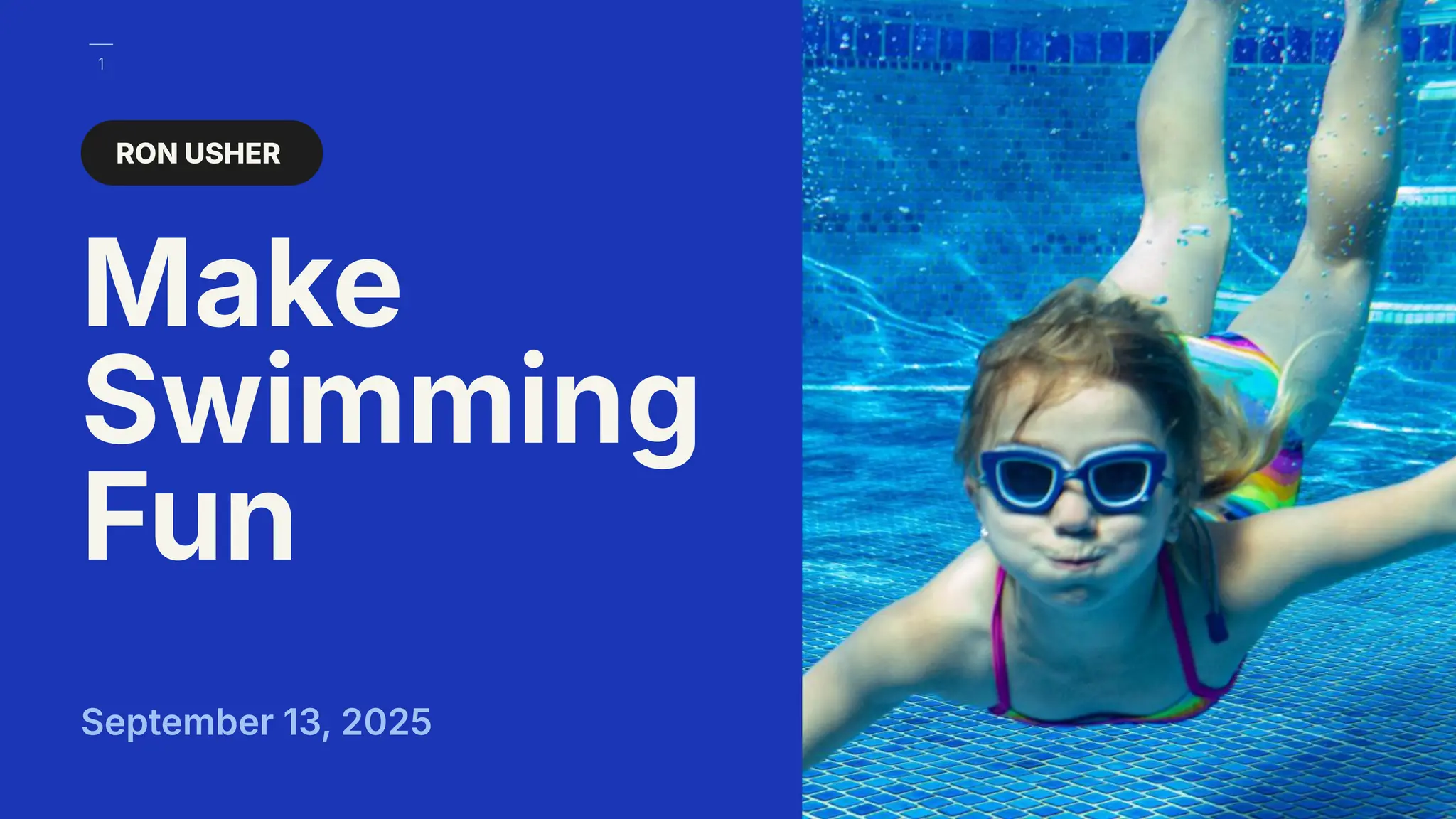
Make
Swimming
Fun
September 13, 2025
RON USHER
2
Making Swimming Fun
for Retention,
Improvement and
Enjoyment
Introduction
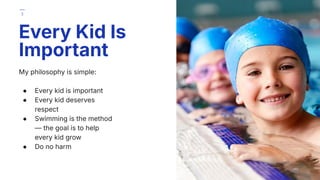
My philosophy is simple:
● Every kid is important
● Every kid deserves
respect
● Swimming is the method
— the goal is to help
every kid grow
● Do no harm
Every Kid Is
Important
3
Philosophy Shapes
Goals → Strategy → Tactics
4
Philosophy determines your goals
5
Philosophy determines your goals
Goals determine your strategy

6
Philosophy determines your goals
Goals determine your strategy

Strategy determine your tactics
7
Philosophy determines your goals
Goals determine your strategy
Strategy determine your tactics
Tactics are what you do
8
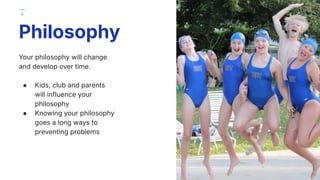
Your philosophy will change
and develop over time.
● Kids, club and parents
will influence your
philosophy
● Knowing your philosophy
goes a long ways to
preventing problems
Philosophy
9
10
You should have long, medium
and short term goals — for
yourself, for your group, for
individual swimmers
Setting Goals
Periodically ask yourself:
● What are your personal goals?
● What are your clubʼs goals?
● What are your athleteʼs goals?
Goals Change
Over Time
11
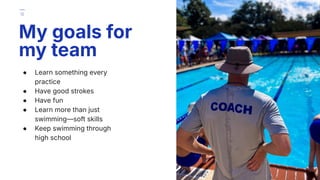
My goals for
my team
12
● Learn something every
practice
● Have good strokes
● Have fun
● Learn more than just
swimming—soft skills
● Keep swimming through
high school
13
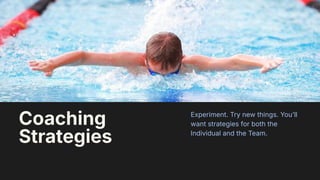
Experiment. Try new things. Youʼll
want strategies for both the
Individual and the Team.
Coaching
Strategies
● Yell
● Use Sarcasm
● Ignore
● Punish
● Threaten
What NOT
To Do
14
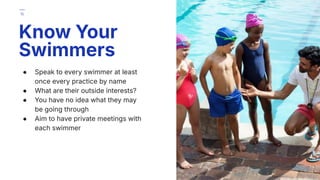
● Speak to every swimmer at least
once every practice by name
● What are their outside interests?
● You have no idea what they may
be going through
● Aim to have private meetings with
each swimmer
Know Your
Swimmers
15
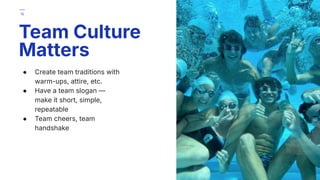
● Create team traditions with
warm-ups, attire, etc.
● Have a team slogan —
make it short, simple,
repeatable
● Team cheers, team
handshake
Team Culture
Matters
16
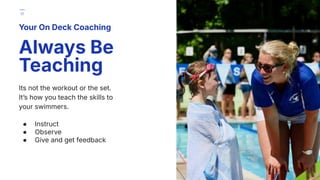
Its not the workout or the set.
Itʼs how you teach the skills to
your swimmers.
● Instruct
● Observe
● Give and get feedback
Your On Deck Coaching
Always Be
Teaching
17
Find a combination that works
for you.
● Educate
● Motivate
● Excite
Your On Deck Coaching
Entertainer vs.
Trainer
18
Dryland is underused. Use it to:
● Build athletic skills
● Strengthen mental skills
● Create team bonds
Your On Deck Coaching
Dryland Builds
Athletes
19
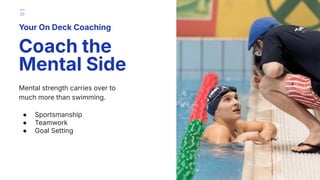
Mental strength carries over to
much more than swimming.
● Sportsmanship
● Teamwork
● Goal Setting
Your On Deck Coaching
Coach the
Mental Side
20
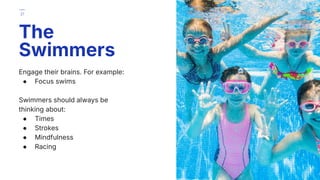
Engage their brains. For example:
● Focus swims
Swimmers should always be
thinking about:
● Times
● Strokes
● Mindfulness
● Racing
The
Swimmers
21
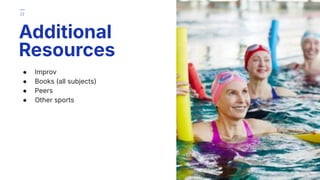
● Improv
● Books (all subjects)
● Peers
● Other sports
Additional
Resources
22
23
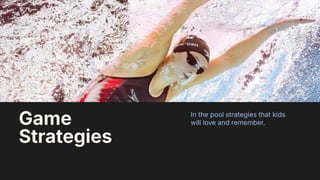
In the pool strategies that kids
will love and remember.
Game
Strategies
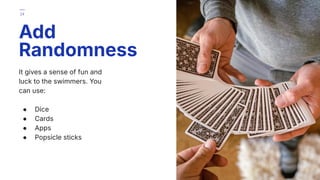
It gives a sense of fun and
luck to the swimmers. You
can use:
● Dice
● Cards
● Apps
● Popsicle sticks
Add
Randomness
24
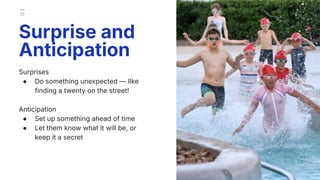
Surprises
● Do something unexpected — lIke
finding a twenty on the street!
Anticipation
● Set up something ahead of time
● Let them know what it will be, or
keep it a secret
Surprise and
Anticipation
25
● Birthday
● Holidays
● Random Recognition Days
(i.e. National Pizza Day,
National Dolphin Day, etc.)
● Pentathlons
Make Any Day
an Event
26
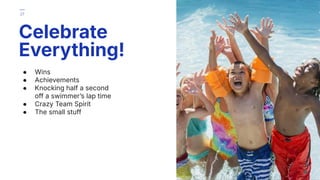
● Wins
● Achievements
● Knocking half a second
off a swimmerʼs lap time
● Crazy Team Spirit
● The small stuff
Celebrate
Everything!
27
● Travel as a team
● Create a team/group goal trip
● Give everyone the opportunity
to travel
● Traveling is critical for success
and retention of your team
Team
Travel
28
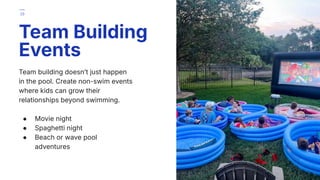
Team building doesnʼt just happen
in the pool. Create non-swim events
where kids can grow their
relationships beyond swimming.
● Movie night
● Spaghetti night
● Beach or wave pool
adventures
Team Building
Events
29
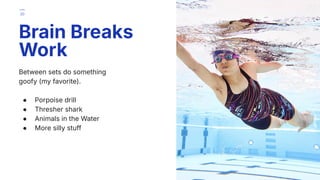
Between sets do something
goofy (my favorite).
● Porpoise drill
● Thresher shark
● Animals in the Water
● More silly stuff
Brain Breaks
Work
30
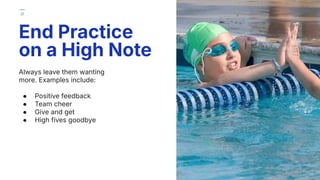
Always leave them wanting
more. Examples include:
● Positive feedback
● Team cheer
● Give and get
● High fives goodbye
End Practice
on a High Note
31
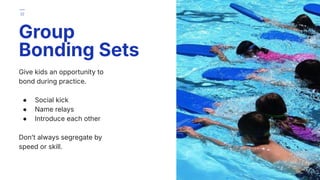
Give kids an opportunity to
bond during practice.
● Social kick
● Name relays
● Introduce each other
Donʼt always segregate by
speed or skill.
Group
Bonding Sets
32
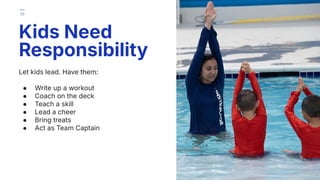
Let kids lead. Have them:
● Write up a workout
● Coach on the deck
● Teach a skill
● Lead a cheer
● Bring treats
● Act as Team Captain
Kids Need
Responsibility
33
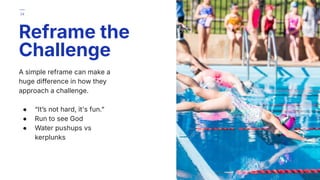
A simple reframe can make a
huge difference in how they
approach a challenge.
● “Itʼs not hard, it's fun.ˮ
● Run to see God
● Water pushups vs
kerplunks
Reframe the
Challenge
34
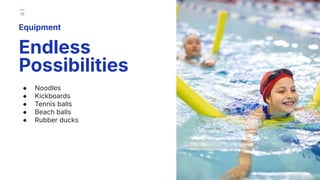
● Noodles
● Kickboards
● Tennis balls
● Beach balls
● Rubber ducks
Equipment
Endless
Possibilities
35
We remember and internalize
stories. They teach, and help
us retain information. Topics
include:
● Great swimmers and
athletes
● Real and imaginary
scenarios
Tell
Stories
36
Primitive team bonding works.
Think National Anthem, church,
and concerts.
● Boom Chakalaka
● Haka
Dance and
Choral
37
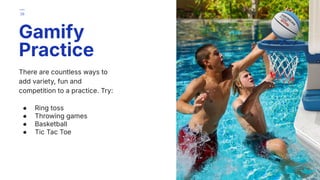
There are countless ways to
add variety, fun and
competition to a practice. Try:
● Ring toss
● Throwing games
● Basketball
● Tic Tac Toe
Gamify
Practice
38
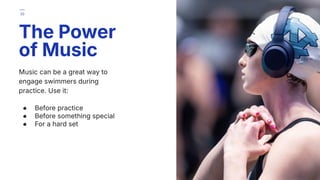
Music can be a great way to
engage swimmers during
practice. Use it:
● Before practice
● Before something special
● For a hard set
The Power
of Music
39
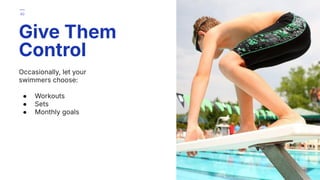
Occasionally, let your
swimmers choose:
● Workouts
● Sets
● Monthly goals
Give Them
Control
40
41
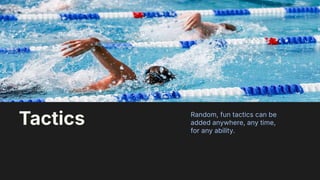
Random, fun tactics can be
added anywhere, any time,
for any ability.
Tactics
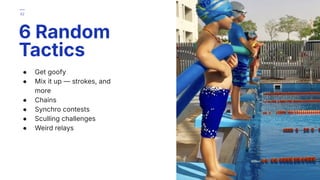
● Get goofy
● Mix it up — strokes, and
more
● Chains
● Synchro contests
● Sculling challenges
● Weird relays
6 Random
Tactics
42
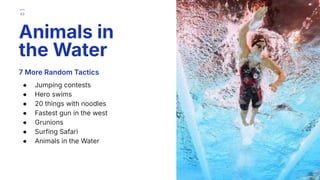
7 More Random Tactics
● Jumping contests
● Hero swims
● 20 things with noodles
● Fastest gun in the west
● Grunions
● Surfing Safari
● Animals in the Water
Animals in
the Water
43
44
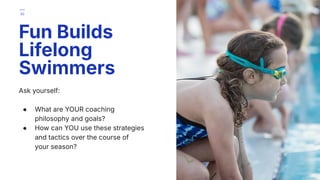
You now have a host of
strategies and tactics that will
improve your practices, and keep
the kids involved and improving.
Next Steps
Ask yourself:
● What are YOUR coaching
philosophy and goals?
● How can YOU use these strategies
and tactics over the course of
your season?
Fun Builds
Lifelong
Swimmers
45
46
46
Thank You
Ron Usher
rsusher@yahoo.com
coachronusher.com

Make Swimming Fun - Seminar from Ron Usher

  • 1.
  • 2.
    2 Making Swimming Fun forRetention, Improvement and Enjoyment Introduction
  • 3.
    My philosophy issimple: ● Every kid is important ● Every kid deserves respect ● Swimming is the method — the goal is to help every kid grow ● Do no harm Every Kid Is Important 3
  • 4.
    Philosophy Shapes Goals →Strategy → Tactics 4
  • 5.
  • 6.
    Philosophy determines yourgoals Goals determine your strategy 6
  • 7.
    Philosophy determines yourgoals Goals determine your strategy Strategy determine your tactics 7
  • 8.
    Philosophy determines yourgoals Goals determine your strategy Strategy determine your tactics Tactics are what you do 8
  • 9.
    Your philosophy willchange and develop over time. ● Kids, club and parents will influence your philosophy ● Knowing your philosophy goes a long ways to preventing problems Philosophy 9
  • 10.
    10 You should havelong, medium and short term goals — for yourself, for your group, for individual swimmers Setting Goals
  • 11.
    Periodically ask yourself: ●What are your personal goals? ● What are your clubʼs goals? ● What are your athleteʼs goals? Goals Change Over Time 11
  • 12.
    My goals for myteam 12 ● Learn something every practice ● Have good strokes ● Have fun ● Learn more than just swimming—soft skills ● Keep swimming through high school
  • 13.
    13 Experiment. Try newthings. Youʼll want strategies for both the Individual and the Team. Coaching Strategies
  • 14.
    ● Yell ● UseSarcasm ● Ignore ● Punish ● Threaten What NOT To Do 14
  • 15.
    ● Speak toevery swimmer at least once every practice by name ● What are their outside interests? ● You have no idea what they may be going through ● Aim to have private meetings with each swimmer Know Your Swimmers 15
  • 16.
    ● Create teamtraditions with warm-ups, attire, etc. ● Have a team slogan — make it short, simple, repeatable ● Team cheers, team handshake Team Culture Matters 16
  • 17.
    Its not theworkout or the set. Itʼs how you teach the skills to your swimmers. ● Instruct ● Observe ● Give and get feedback Your On Deck Coaching Always Be Teaching 17
  • 18.
    Find a combinationthat works for you. ● Educate ● Motivate ● Excite Your On Deck Coaching Entertainer vs. Trainer 18
  • 19.
    Dryland is underused.Use it to: ● Build athletic skills ● Strengthen mental skills ● Create team bonds Your On Deck Coaching Dryland Builds Athletes 19
  • 20.
    Mental strength carriesover to much more than swimming. ● Sportsmanship ● Teamwork ● Goal Setting Your On Deck Coaching Coach the Mental Side 20
  • 21.
    Engage their brains.For example: ● Focus swims Swimmers should always be thinking about: ● Times ● Strokes ● Mindfulness ● Racing The Swimmers 21
  • 22.
    ● Improv ● Books(all subjects) ● Peers ● Other sports Additional Resources 22
  • 23.
    23 In the poolstrategies that kids will love and remember. Game Strategies
  • 24.
    It gives asense of fun and luck to the swimmers. You can use: ● Dice ● Cards ● Apps ● Popsicle sticks Add Randomness 24
  • 25.
    Surprises ● Do somethingunexpected — lIke finding a twenty on the street! Anticipation ● Set up something ahead of time ● Let them know what it will be, or keep it a secret Surprise and Anticipation 25
  • 26.
    ● Birthday ● Holidays ●Random Recognition Days (i.e. National Pizza Day, National Dolphin Day, etc.) ● Pentathlons Make Any Day an Event 26
  • 27.
    ● Wins ● Achievements ●Knocking half a second off a swimmerʼs lap time ● Crazy Team Spirit ● The small stuff Celebrate Everything! 27
  • 28.
    ● Travel asa team ● Create a team/group goal trip ● Give everyone the opportunity to travel ● Traveling is critical for success and retention of your team Team Travel 28
  • 29.
    Team building doesnʼtjust happen in the pool. Create non-swim events where kids can grow their relationships beyond swimming. ● Movie night ● Spaghetti night ● Beach or wave pool adventures Team Building Events 29
  • 30.
    Between sets dosomething goofy (my favorite). ● Porpoise drill ● Thresher shark ● Animals in the Water ● More silly stuff Brain Breaks Work 30
  • 31.
    Always leave themwanting more. Examples include: ● Positive feedback ● Team cheer ● Give and get ● High fives goodbye End Practice on a High Note 31
  • 32.
    Give kids anopportunity to bond during practice. ● Social kick ● Name relays ● Introduce each other Donʼt always segregate by speed or skill. Group Bonding Sets 32
  • 33.
    Let kids lead.Have them: ● Write up a workout ● Coach on the deck ● Teach a skill ● Lead a cheer ● Bring treats ● Act as Team Captain Kids Need Responsibility 33
  • 34.
    A simple reframecan make a huge difference in how they approach a challenge. ● “Itʼs not hard, it's fun.ˮ ● Run to see God ● Water pushups vs kerplunks Reframe the Challenge 34
  • 35.
    ● Noodles ● Kickboards ●Tennis balls ● Beach balls ● Rubber ducks Equipment Endless Possibilities 35
  • 36.
    We remember andinternalize stories. They teach, and help us retain information. Topics include: ● Great swimmers and athletes ● Real and imaginary scenarios Tell Stories 36
  • 37.
    Primitive team bondingworks. Think National Anthem, church, and concerts. ● Boom Chakalaka ● Haka Dance and Choral 37
  • 38.
    There are countlessways to add variety, fun and competition to a practice. Try: ● Ring toss ● Throwing games ● Basketball ● Tic Tac Toe Gamify Practice 38
  • 39.
    Music can bea great way to engage swimmers during practice. Use it: ● Before practice ● Before something special ● For a hard set The Power of Music 39
  • 40.
    Occasionally, let your swimmerschoose: ● Workouts ● Sets ● Monthly goals Give Them Control 40
  • 41.
    41 Random, fun tacticscan be added anywhere, any time, for any ability. Tactics
  • 42.
    ● Get goofy ●Mix it up — strokes, and more ● Chains ● Synchro contests ● Sculling challenges ● Weird relays 6 Random Tactics 42
  • 43.
    7 More RandomTactics ● Jumping contests ● Hero swims ● 20 things with noodles ● Fastest gun in the west ● Grunions ● Surfing Safari ● Animals in the Water Animals in the Water 43
  • 44.
    44 You now havea host of strategies and tactics that will improve your practices, and keep the kids involved and improving. Next Steps
  • 45.
    Ask yourself: ● Whatare YOUR coaching philosophy and goals? ● How can YOU use these strategies and tactics over the course of your season? Fun Builds Lifelong Swimmers 45
  • 46.