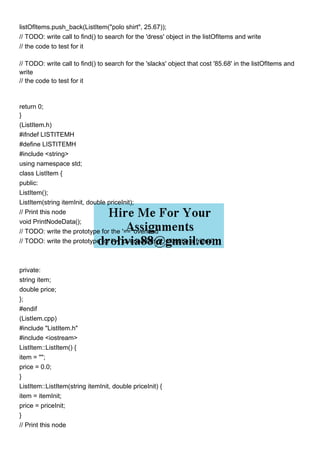
The document contains a C++ program that demonstrates working with STL containers such as vectors and lists, and includes placeholder comments for writing search functions using the find algorithm. It also defines a class 'listitem' which holds an item name and its price, with a need to implement operator overloads for comparisons. The main goal is to complete the program by implementing the specified search functionalities and operator overloads.
![(main.cpp)
#include "ListItem.h"
#include <string>
#include <list>
#include <vector>
#include <algorithm>
#include <iostream>
using namespace std;
int main () {
// working with a vector of ints
int myints[] = { 5, 10, 15, 20 };
std::vector<int> vectorOfNums (myints,myints+4);
std::vector<int>::iterator vectItr;
// TODO: write call to find() to search for 15 in the vectorOfNums
if (vectItr != vectorOfNums.end())
std::cout << "Element found: " << *vectItr << 'n';
else
std::cout << "Element not foundn";
// TODO: write call to find() to search for 85 in the vectorOfNums
if (vectItr != vectorOfNums.end())
std::cout << "Element found: " << *vectItr << 'n';
else
std::cout << "Element not foundn";
// working with a list of strings
std::list<std::string> listOfWords;
std::list<std::string>::iterator listIter;
listOfWords.push_back("house");
listOfWords.push_back("cup");
listOfWords.push_back("car");
listOfWords.push_back("lamp");
// TODO: write call to find() to search for 'lamp' in the listOfWords and write
// the code to test for it
// TODO: write call to find() to search for 'music' in the listOfWords and write
// the code to test for it
// working with a list of listItems
std::list<ListItem> listOfItems;
std::list<ListItem>::iterator listItemIter;
listOfItems.push_back(ListItem("shoes", 150.95));
listOfItems.push_back(ListItem("laptop", 1245.85));
listOfItems.push_back(ListItem("dress", 85.68));](https://image.slidesharecdn.com/maincppincludelistitemhincludeltstringgtin-230318115019-39c7e4de/85/maincpp-include-ListItemh-include-ltstringgt-in-pdf-1-320.jpg)
![(main.cpp)
#include "ListItem.h"
#include <string>
#include <list>
#include <vector>
#include <algorithm>
#include <iostream>
using namespace std;
int main () {
// working with a vector of ints
int myints[] = { 5, 10, 15, 20 };
std::vector<int> vectorOfNums (myints,myints+4);
std::vector<int>::iterator vectItr;
// TODO: write call to find() to search for 15 in the vectorOfNums
if (vectItr != vectorOfNums.end())
std::cout << "Element found: " << *vectItr << 'n';
else
std::cout << "Element not foundn";
// TODO: write call to find() to search for 85 in the vectorOfNums
if (vectItr != vectorOfNums.end())
std::cout << "Element found: " << *vectItr << 'n';
else
std::cout << "Element not foundn";
// working with a list of strings
std::list<std::string> listOfWords;
std::list<std::string>::iterator listIter;
listOfWords.push_back("house");
listOfWords.push_back("cup");
listOfWords.push_back("car");
listOfWords.push_back("lamp");
// TODO: write call to find() to search for 'lamp' in the listOfWords and write
// the code to test for it
// TODO: write call to find() to search for 'music' in the listOfWords and write
// the code to test for it
// working with a list of listItems
std::list<ListItem> listOfItems;
std::list<ListItem>::iterator listItemIter;
listOfItems.push_back(ListItem("shoes", 150.95));
listOfItems.push_back(ListItem("laptop", 1245.85));
listOfItems.push_back(ListItem("dress", 85.68));](https://image.slidesharecdn.com/maincppincludelistitemhincludeltstringgtin-230318115019-39c7e4de/75/maincpp-include-ListItemh-include-ltstringgt-in-pdf-1-2048.jpg)



![[KOSSA] C++ Programming - 17th Study - STL #3](https://cdn.slidesharecdn.com/ss_thumbnails/kossacprogramming-17thstudy-stl3-150531132722-lva1-app6891-thumbnail.jpg?width=640&height=640&fit=bounds)


