Snug Harbor
Arts & Gardens Gazette
Curricular Guide For Teachers and Learners
Theatre/Performing Arts: Our Music Hall and theatre provide exceptional venues for exploring modes of
performance and the vocabulary of the stage, including writing, directing, dance, music and film.
Visual Arts: Our museums, galleries and studios are ideal spaces for students not only to appreciate art history but to
explore different artistic mediums and to create art itself.
Architecture: The Center’s stunning collection of 28 buildings showcases the Greek Revival, Beaux Arts, Second
An Array of Arts and Cultural Resources For All
Empire and Italianate styles and affords tremendous opportunities to study the
evolution of building through history and to explore careers in engineering, design and
architecture.
Gardens: Our world-class botanic gardens are open year round and are a wonderful
laboratory for the study of botany, the identification of plants and understanding the
ecosphere, as well as helping beginning gardeners create their first gardens
Language and the Letter: We are committed to making English Language
Acquisition available to the community-at-large by providing creative writing
workshops to writers of every level and genre. Snug Harbor’s storied history provides
exciting primary-source documentation and material for a compelling study of
America’s first Social Welfare experiment.
Inside:
Our Storied Past...........2
Age Groupings..............2
Theatre Arts..................3
Visual Arts....................4
Architecture..................5
Horticulture..................6
Language, Letters.........7
Events Calendar............8
Contact..........................8
Cultural Center & Botanical Garden
Respect the Past, Value the Present, Create the Future
t
u
s
m
n
Our 15th century Chinese Scholar’s Garden is the first Ming Dynasty outdoor garden in the US. It is one of several specialized garden environments at The Harbor.
“Arts and Gardens Gazette” is a production of InnerMotivation; please visit www.innermotivation.org
Snug Harbor opened on August 1, 1833 as America’s first
home for “aged, worn-out and decrepit” seamen. It was
built on land given by Thomas Randall, whose father had
amassed a substantial fortune as ship owner, merchant and
privateer during the French and Indian War. Merely having
to prove that they had worked on an American ship for
at least 5 years, men could live out their final years with
dignity at the Harbor. As one considers the lack of a social
safety net in America during the 19th
Century, the Harbor
was an angel to people who had lived their lives in rugged
and earnest service to America.
During the 1970’s, at the behest of a dedicated group of
Social Welfare Angel in the 19th
Century; Cultural Center in the 21st
Century
Our curricular guide serves to establish the Center’s
commitment to rigorous education in the arts, horticulture and
literacy. With strong attention to the New York State Standards
and to the NYC Blueprints for Teaching and Learning in
the Arts, we intend to set a high bar for students as future
professionals and as well-informed audiences. For educators, we
offer a hybid of subject-based learning----driven by the content
to be learned----as well as outcomes-based learning----defined
by what skills and knowledge learners will take away with them
from their experiences at Snug Harbor.
Staten Islanders, Jacqueline Kennedy helped spearhead a landmarking movement to protect certain iconic buildings on the Harbor’s
83 acre-site. When landmarking was approved, Sug Harbor Cultural Center was the largest designated landmark enclave in New
York City.
Our curricula are k-12 state and city
standards-based, although we serve the
following three discrete student age
learning levels: k-5, 6-8 and 9-12 and adult.
With ample notice, we are able to gear
classes to the unique needs of students,
including special needs.
“Standards-Based Learning Experiences
That Are Subject and Outcomes Directed”
Age Groupings
Snug Harbor’s Storied Past
Our programs can be patterned for all learning levels.
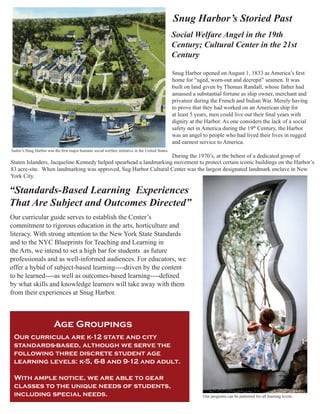
Sailor’s Snug Harbor was the first major humane social welfare initiative in the United States.
Theatre Arts
Theatre Arts foster proactivity, creative imagination, verbal mastery, collaborative teamwork and empathetic
understanding of other life situations. They instill and broaden an awareness of the range and depth of human
experience.
Acting/Directing: Our courses aim to free students from self-consciousness, fear and pretense,
and to enhance powers of concentration. In scene and monologue study, students will learn the basics of
communication in the medium. They will also work in movement, speech and voice. Actors learn discipline and
cooperation through working with the teacher as director.
u
As in a theatre, the eyes of men, after a well-
graced actor leaves the stage, are idly bent on
him that enters next. -William Shakespeare
Playwriting: Aspring playwrights learn their craft by seeing
their work read and performed to audiences. Through this process,
we help writers develop their own voice. Character maps, storytelling
and monologues are starting points that will, with time and nurture,
develop the “poetic voice” that makes for powerful writing. Students
read their ongoing work in class and on the stage, subject to
groundrules for constructive criticism.
History of the Theatre: We look at the development of
the artform of theatre as consisting of works written for the stage
throughout history. We explore theatre developed in classical Greece
and Rome, then move to the Renaissance, Reformation and the Age
of Shakespeare. Lastly, theatre of the 18th
, 19th
and 20th
centuries
is discussed, with an eye toward what can be expected in the 21st
century and beyond.
Connections: Theatre as Career and as Bridge to All the Arts: Students investigate career
opportunities in theatre, such as set design, lighting, playwriting, acting, directing and public relations. We also
examine the integration of other arts---dance, film, photography, music and other media—into a complex multi-
media art form.
“
“
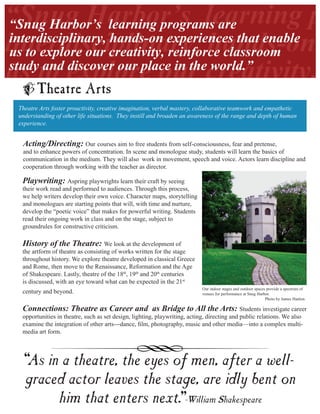
Our indoor stages and outdoor spaces provide a spectrum of
venues for performance at Snug Harbor.
			 Photo by James Hanlon
Creating Studio Art: We offer classes in drawing, painting, sculpture, printmaking and calligraphy. In
these pursuits, students will be solving design problems, exploring perspective, scale and point of view while
experimenting with materials and exploring a variety of ways to interpret their ideas.
Visual Arts consist of painting, drawing, collage, sculpture, photography and film making
and are among the most important means for shaping ideas, honing personal and cultural
values and exercising creativity.
Create your own visual style...let it be unique
for yourself yet identifiable for others.
-Orson Welles
Art History: This multi-
faceted discipline ranges from
ancient to modern. Inquiry here
is strongly interdisciplinary with
examinations not only of art but the
philosophical, social and political
conditions in which it was created.
Literacy in Visual Arts
Facilitates Connections
with Our World: What is the
vocabulary of visual art? We may
read a book and report on its plot,
but what of a painting or piece of
sculpture? How can we interpret
the artist’s meaning and draw
inferences to better understand
our world? Our programs strive to
Visual Arts
expand learners’ vocabulary and models for understanding their environment.
The Care and Feeding of Your Home Art Collection: Regardless of the monetary value
of your artwork, if it is personally meaningful, you should consider ways in which to display and protect the
artwork in question. When should trained professionals be called in to do the job? What do you need to know
to care for your art object-- to protect its safety and longevity--and what do you need to know about lighting,
matting and other aspects of presentation?
“ “
s
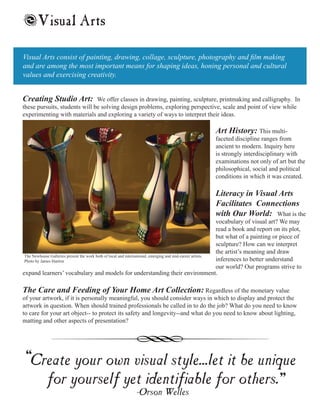
The Newhouse Galleries present the work both of local and international, emerging and mid-career artists.
Photo by James Hanlon
Architecture has evolved greatly since Snug Harbor was first built, but it is still the art and
science of designing and erecting buildings.
Our Landmarked Buildings: Investigate our 28 celebrated structures that are extraordinary examples
of Greek Revival, Beaux Arts, Second Empire and Italienate styles. Our “Temple buildings Front Five” were
designed by Minard Lafever (1798-1854) and are his last surviving masterpiece. The restoration process is still
underway and is a wonderful study in the preservation of historic buildings.
History of Architecture: In this
program, we introduce learners to all periods
of architcture from the pre-historic, through
Egyptian and Greek to Roman, Byzantine,
Romanesque, Gothic and Renaissance.
Living Buildings: Learn how the idea
of “sustainable architecture” has replaced the
old model of “building as machine.” Delve
into designs like the EpiCenter, which seek to
combine emerging technologies with age-old
strategies to generate less pollution, such as
harvesting their own water and energy needs
on site while improving the health of the
ecosystem rather than degrading it.
Careers in the Profession: As
an imaginative blend of art and science,
architecture encompasses an array of
professional roles and career paths, from
designers and structural experts to engineers,
interior disigners, landscape architects and
urban or regional planners. How does one
become a professional in any of these related
fields?
Architecture
Architecture is the learned game, correct and
magnificent, of forms assembled in the light.
-Le Corbusier
“ “
t
Opened in 1833, Snug Harbor possesses 28 extraordinary, landmarked structures of the 19th
century, including the Weiss Glass Gazebo. 		 Photo by James Hanlon
Knowing Plants: Students will learn to identify plants, trees and flowers in the region through a
combination of field and laboratory study. In our wetlands, meadows and horticultural gardens, students will
work with the descriptive vocabulary and unique characteristics of plant groups, and will be able to identify by
sight a number of plant families.
Landscape Architecture: As a professional art form, landscape architecture arranges and creates spaces
and objects---plants and structures—in a safe, efficient, healthful and life-enhancing way. Using our acclaimed
formal gardens as classroom students come to appreciate this art as a design continuum of living landscapes
ranging from wilderness to managed forests to sculpted gardens.
I bequeath myself to the dirt, to grow from the
grass I love; if you want me again, look for me
under your boot-soles. -Walt Whitman
Horticulture One could say that Mother Earth is the very soil, plants and atmosphere that enable
life to thrive here. Our programs address theory and practice in the healthy balance of physical, chemical
and biological processes.
The Biology of Plants: In the classroom and in
nature, students will gain understanding of the ways in
which plants function, by an exposure to terminology,
models and pictures that explain the parts of plants and
the functions they perform in the system that sustains
them. Among topics addressed are the great diversity of
plants occurred and what is the need for maintaining this
diversity?
Plants in an Ecosystem: An ecosystem is a
biological community of living and non-living things
of which plants are a critical part. A healthy ecosystem
transforms and recycles, whether it is a pond, rain forest,
grassland or compost pile.
Composting 101: The Compost Project offers a one-hour hands-on class to students on the importance
of recycling and composting.  The class includes free texts, interactive projects, and a LIVE worm bin to show
students composting in action. This class may be held at any Staten Island school for grades K-8, or on site at
The Center.
Caring for Your Garden and Houseplants: Have you dreamed of having a garden of your own,
but hesitate to try because you are overwhelmed by what you don’t know? We’ll help you with the research and
planning, so that pH level, water retention and soil chemical composition won’t keep you from the satisfaction of
having the perfect garden that expresses you. We’ll help you in the proper selection of plants, access to sunlight,
maintenance and—oh yes---weeds. We’ll point you in the right direction to take advantage of flower nurseries,
fellow gardeners, books and the internet to keep you on track.
Horticulture
“
“
n
Our wetlands, meadows, and gardens are laboratory for horticultural discovery.
Photo by James Hanlon
Snug Harbor Book Clubs: Made popular by media star, Oprah, book clubs offer the chance for
members to choose what they read, when, where, how and with whom. The key idea is “choice” and the activity
builds community among readers, sharpens comprehension, critical thought and enjoyment of reading. Groups
are arranged by interest and level or you can come to us with your own group and schedule into one of our
classroom spaces.
Culture and history come alive through language and the letter awakening the past and
illuminating the present--combining historical content and great books with modern
media and interactive teaching methods.
Language and the Letter
The Maritime History of New York
Harbor: Special attention to Sailors’ Snug Harbor
is taught in “Half Moon to Concorde”, a K-12
curriculum that introduces many aspects of the Harbor,
including America’s First Social Welfare Solution, the
geology of the New York City region, discovery and
exploration and the Dutch, English and Revolutionary
periods of our history.
Creative Writing Circles: Poets, playwrights
and short story authors in Poetry meet regularly on site
to give and get support through peer edit and individual
readings. Encouragement, constructive criticism and
camaraderie are well-known benefits of our writing
groups.
English Language Acquisition: Broadly,
language arts are reading, writing (including spelling,
grammar and all technical aspects) listening and
speaking. For newcomers to this country, learning
English is essential to communicating and making
sense of their new world. The aim of our literacy
instruction is to impart the tools so that our students
can communicate and interpret the spoken and written
word. We are especially determined to give our English
language learners the tools needed to find and excel at
challenging work or to continue their studies in higher
education.
Suit the action to the word, the word to the
action. -William Shakespeare
“ “
m
Our famed past, gloried present, and boundless future come to life through lan-
guage; thus our committment to the written and spoken word.
				 Photo by James Hanlon
NON PROFIT
ORGANIZATION
U.S. POSTAGE
PAID
PERMIT NO. 244
S.I., N.Y. 10301
Exhibits and Performances
SNUG HARBOR
Cultural Center & Botanical Garden
1000 Richmond Terrace
Staten Island, New York 10301
www.snug-harbor.org
April 2 - October 18
Waintrob Collection, an eclectic assemblage of work from
some of the leading American and European Artists of the
Twentieth Century
June 13 - August 23
Three Painting Traditions: Yvonne Simons, Robert Civello &
Max Spoerri, an exhibition of large-scale paintings, focusing
on color, movement and scale
May 7 - December 23
Dutch Treats: Highlights from the George Way Collection,
featuring over 100 works of 17th century Dutch art and furni-
ture in celebration of the 400th Anniversary of the arrival of
the Dutch in New York
September 24 - December 23
David X. Young’s collection of paintings, prints and works on
paper, the result of his opening his studio loft to jazz greats
such as Monk and Mingus
July 11 - September 13
LEMUR (League of Electronic Musical Urban Robots), a
Brooklyn-based group of artists and technologists who create
exotic, sculptural, musical instruments which integrate robotic
technology
July 30
Benny Goodman Band, the Borough President’s Concert
August 7
Public Shakespeare Workshop: The Public Theater joins with
Snug Harbor Cultural Center & Botanical Garden to present a
performance by The Public Theater’s Shakespeare Lab.
September 26
Smithsonian Museum Day, an all-day celebration with com-
plimentary admission for two to The NY Chinese Scholar’s
Garden, Main Hall Building C, The Newhouse Center For
Contemporary Art and The Connie Gretz Secret Garden
September 27
Harmony Street Fair: music, dance, cuisine, arts and crafts,
created to unite the burgeoning ethnic communities of New
York City
November 8
“The Very Hungry Caterpillar & Other Eric Carle Favor-
ites,” a stage performance which builds upon the international
success of The Very Hungry Caterpillar.
November 14 & 15
American Girl Fashion Show, a fun-filled afternoon for girls
and their families, friends, and favorite dolls
Please Contact Us:
(718) 448-2500 + 0 for Operator
info@snug-harbor.org

Snug Harbor Arts and Horticulture Curriculum

  • 1.
    Snug Harbor Arts &Gardens Gazette Curricular Guide For Teachers and Learners Theatre/Performing Arts: Our Music Hall and theatre provide exceptional venues for exploring modes of performance and the vocabulary of the stage, including writing, directing, dance, music and film. Visual Arts: Our museums, galleries and studios are ideal spaces for students not only to appreciate art history but to explore different artistic mediums and to create art itself. Architecture: The Center’s stunning collection of 28 buildings showcases the Greek Revival, Beaux Arts, Second An Array of Arts and Cultural Resources For All Empire and Italianate styles and affords tremendous opportunities to study the evolution of building through history and to explore careers in engineering, design and architecture. Gardens: Our world-class botanic gardens are open year round and are a wonderful laboratory for the study of botany, the identification of plants and understanding the ecosphere, as well as helping beginning gardeners create their first gardens Language and the Letter: We are committed to making English Language Acquisition available to the community-at-large by providing creative writing workshops to writers of every level and genre. Snug Harbor’s storied history provides exciting primary-source documentation and material for a compelling study of America’s first Social Welfare experiment. Inside: Our Storied Past...........2 Age Groupings..............2 Theatre Arts..................3 Visual Arts....................4 Architecture..................5 Horticulture..................6 Language, Letters.........7 Events Calendar............8 Contact..........................8 Cultural Center & Botanical Garden Respect the Past, Value the Present, Create the Future t u s m n Our 15th century Chinese Scholar’s Garden is the first Ming Dynasty outdoor garden in the US. It is one of several specialized garden environments at The Harbor. “Arts and Gardens Gazette” is a production of InnerMotivation; please visit www.innermotivation.org
  • 2.
    Snug Harbor openedon August 1, 1833 as America’s first home for “aged, worn-out and decrepit” seamen. It was built on land given by Thomas Randall, whose father had amassed a substantial fortune as ship owner, merchant and privateer during the French and Indian War. Merely having to prove that they had worked on an American ship for at least 5 years, men could live out their final years with dignity at the Harbor. As one considers the lack of a social safety net in America during the 19th Century, the Harbor was an angel to people who had lived their lives in rugged and earnest service to America. During the 1970’s, at the behest of a dedicated group of Social Welfare Angel in the 19th Century; Cultural Center in the 21st Century Our curricular guide serves to establish the Center’s commitment to rigorous education in the arts, horticulture and literacy. With strong attention to the New York State Standards and to the NYC Blueprints for Teaching and Learning in the Arts, we intend to set a high bar for students as future professionals and as well-informed audiences. For educators, we offer a hybid of subject-based learning----driven by the content to be learned----as well as outcomes-based learning----defined by what skills and knowledge learners will take away with them from their experiences at Snug Harbor. Staten Islanders, Jacqueline Kennedy helped spearhead a landmarking movement to protect certain iconic buildings on the Harbor’s 83 acre-site. When landmarking was approved, Sug Harbor Cultural Center was the largest designated landmark enclave in New York City. Our curricula are k-12 state and city standards-based, although we serve the following three discrete student age learning levels: k-5, 6-8 and 9-12 and adult. With ample notice, we are able to gear classes to the unique needs of students, including special needs. “Standards-Based Learning Experiences That Are Subject and Outcomes Directed” Age Groupings Snug Harbor’s Storied Past Our programs can be patterned for all learning levels. Sailor’s Snug Harbor was the first major humane social welfare initiative in the United States.
  • 3.
    Theatre Arts Theatre Artsfoster proactivity, creative imagination, verbal mastery, collaborative teamwork and empathetic understanding of other life situations. They instill and broaden an awareness of the range and depth of human experience. Acting/Directing: Our courses aim to free students from self-consciousness, fear and pretense, and to enhance powers of concentration. In scene and monologue study, students will learn the basics of communication in the medium. They will also work in movement, speech and voice. Actors learn discipline and cooperation through working with the teacher as director. u As in a theatre, the eyes of men, after a well- graced actor leaves the stage, are idly bent on him that enters next. -William Shakespeare Playwriting: Aspring playwrights learn their craft by seeing their work read and performed to audiences. Through this process, we help writers develop their own voice. Character maps, storytelling and monologues are starting points that will, with time and nurture, develop the “poetic voice” that makes for powerful writing. Students read their ongoing work in class and on the stage, subject to groundrules for constructive criticism. History of the Theatre: We look at the development of the artform of theatre as consisting of works written for the stage throughout history. We explore theatre developed in classical Greece and Rome, then move to the Renaissance, Reformation and the Age of Shakespeare. Lastly, theatre of the 18th , 19th and 20th centuries is discussed, with an eye toward what can be expected in the 21st century and beyond. Connections: Theatre as Career and as Bridge to All the Arts: Students investigate career opportunities in theatre, such as set design, lighting, playwriting, acting, directing and public relations. We also examine the integration of other arts---dance, film, photography, music and other media—into a complex multi- media art form. “ “ Our indoor stages and outdoor spaces provide a spectrum of venues for performance at Snug Harbor. Photo by James Hanlon
  • 4.
    Creating Studio Art:We offer classes in drawing, painting, sculpture, printmaking and calligraphy. In these pursuits, students will be solving design problems, exploring perspective, scale and point of view while experimenting with materials and exploring a variety of ways to interpret their ideas. Visual Arts consist of painting, drawing, collage, sculpture, photography and film making and are among the most important means for shaping ideas, honing personal and cultural values and exercising creativity. Create your own visual style...let it be unique for yourself yet identifiable for others. -Orson Welles Art History: This multi- faceted discipline ranges from ancient to modern. Inquiry here is strongly interdisciplinary with examinations not only of art but the philosophical, social and political conditions in which it was created. Literacy in Visual Arts Facilitates Connections with Our World: What is the vocabulary of visual art? We may read a book and report on its plot, but what of a painting or piece of sculpture? How can we interpret the artist’s meaning and draw inferences to better understand our world? Our programs strive to Visual Arts expand learners’ vocabulary and models for understanding their environment. The Care and Feeding of Your Home Art Collection: Regardless of the monetary value of your artwork, if it is personally meaningful, you should consider ways in which to display and protect the artwork in question. When should trained professionals be called in to do the job? What do you need to know to care for your art object-- to protect its safety and longevity--and what do you need to know about lighting, matting and other aspects of presentation? “ “ s The Newhouse Galleries present the work both of local and international, emerging and mid-career artists. Photo by James Hanlon
  • 5.
    Architecture has evolvedgreatly since Snug Harbor was first built, but it is still the art and science of designing and erecting buildings. Our Landmarked Buildings: Investigate our 28 celebrated structures that are extraordinary examples of Greek Revival, Beaux Arts, Second Empire and Italienate styles. Our “Temple buildings Front Five” were designed by Minard Lafever (1798-1854) and are his last surviving masterpiece. The restoration process is still underway and is a wonderful study in the preservation of historic buildings. History of Architecture: In this program, we introduce learners to all periods of architcture from the pre-historic, through Egyptian and Greek to Roman, Byzantine, Romanesque, Gothic and Renaissance. Living Buildings: Learn how the idea of “sustainable architecture” has replaced the old model of “building as machine.” Delve into designs like the EpiCenter, which seek to combine emerging technologies with age-old strategies to generate less pollution, such as harvesting their own water and energy needs on site while improving the health of the ecosystem rather than degrading it. Careers in the Profession: As an imaginative blend of art and science, architecture encompasses an array of professional roles and career paths, from designers and structural experts to engineers, interior disigners, landscape architects and urban or regional planners. How does one become a professional in any of these related fields? Architecture Architecture is the learned game, correct and magnificent, of forms assembled in the light. -Le Corbusier “ “ t Opened in 1833, Snug Harbor possesses 28 extraordinary, landmarked structures of the 19th century, including the Weiss Glass Gazebo. Photo by James Hanlon
  • 6.
    Knowing Plants: Studentswill learn to identify plants, trees and flowers in the region through a combination of field and laboratory study. In our wetlands, meadows and horticultural gardens, students will work with the descriptive vocabulary and unique characteristics of plant groups, and will be able to identify by sight a number of plant families. Landscape Architecture: As a professional art form, landscape architecture arranges and creates spaces and objects---plants and structures—in a safe, efficient, healthful and life-enhancing way. Using our acclaimed formal gardens as classroom students come to appreciate this art as a design continuum of living landscapes ranging from wilderness to managed forests to sculpted gardens. I bequeath myself to the dirt, to grow from the grass I love; if you want me again, look for me under your boot-soles. -Walt Whitman Horticulture One could say that Mother Earth is the very soil, plants and atmosphere that enable life to thrive here. Our programs address theory and practice in the healthy balance of physical, chemical and biological processes. The Biology of Plants: In the classroom and in nature, students will gain understanding of the ways in which plants function, by an exposure to terminology, models and pictures that explain the parts of plants and the functions they perform in the system that sustains them. Among topics addressed are the great diversity of plants occurred and what is the need for maintaining this diversity? Plants in an Ecosystem: An ecosystem is a biological community of living and non-living things of which plants are a critical part. A healthy ecosystem transforms and recycles, whether it is a pond, rain forest, grassland or compost pile. Composting 101: The Compost Project offers a one-hour hands-on class to students on the importance of recycling and composting.  The class includes free texts, interactive projects, and a LIVE worm bin to show students composting in action. This class may be held at any Staten Island school for grades K-8, or on site at The Center. Caring for Your Garden and Houseplants: Have you dreamed of having a garden of your own, but hesitate to try because you are overwhelmed by what you don’t know? We’ll help you with the research and planning, so that pH level, water retention and soil chemical composition won’t keep you from the satisfaction of having the perfect garden that expresses you. We’ll help you in the proper selection of plants, access to sunlight, maintenance and—oh yes---weeds. We’ll point you in the right direction to take advantage of flower nurseries, fellow gardeners, books and the internet to keep you on track. Horticulture “ “ n Our wetlands, meadows, and gardens are laboratory for horticultural discovery. Photo by James Hanlon
  • 7.
    Snug Harbor BookClubs: Made popular by media star, Oprah, book clubs offer the chance for members to choose what they read, when, where, how and with whom. The key idea is “choice” and the activity builds community among readers, sharpens comprehension, critical thought and enjoyment of reading. Groups are arranged by interest and level or you can come to us with your own group and schedule into one of our classroom spaces. Culture and history come alive through language and the letter awakening the past and illuminating the present--combining historical content and great books with modern media and interactive teaching methods. Language and the Letter The Maritime History of New York Harbor: Special attention to Sailors’ Snug Harbor is taught in “Half Moon to Concorde”, a K-12 curriculum that introduces many aspects of the Harbor, including America’s First Social Welfare Solution, the geology of the New York City region, discovery and exploration and the Dutch, English and Revolutionary periods of our history. Creative Writing Circles: Poets, playwrights and short story authors in Poetry meet regularly on site to give and get support through peer edit and individual readings. Encouragement, constructive criticism and camaraderie are well-known benefits of our writing groups. English Language Acquisition: Broadly, language arts are reading, writing (including spelling, grammar and all technical aspects) listening and speaking. For newcomers to this country, learning English is essential to communicating and making sense of their new world. The aim of our literacy instruction is to impart the tools so that our students can communicate and interpret the spoken and written word. We are especially determined to give our English language learners the tools needed to find and excel at challenging work or to continue their studies in higher education. Suit the action to the word, the word to the action. -William Shakespeare “ “ m Our famed past, gloried present, and boundless future come to life through lan- guage; thus our committment to the written and spoken word. Photo by James Hanlon
  • 8.
    NON PROFIT ORGANIZATION U.S. POSTAGE PAID PERMITNO. 244 S.I., N.Y. 10301 Exhibits and Performances SNUG HARBOR Cultural Center & Botanical Garden 1000 Richmond Terrace Staten Island, New York 10301 www.snug-harbor.org April 2 - October 18 Waintrob Collection, an eclectic assemblage of work from some of the leading American and European Artists of the Twentieth Century June 13 - August 23 Three Painting Traditions: Yvonne Simons, Robert Civello & Max Spoerri, an exhibition of large-scale paintings, focusing on color, movement and scale May 7 - December 23 Dutch Treats: Highlights from the George Way Collection, featuring over 100 works of 17th century Dutch art and furni- ture in celebration of the 400th Anniversary of the arrival of the Dutch in New York September 24 - December 23 David X. Young’s collection of paintings, prints and works on paper, the result of his opening his studio loft to jazz greats such as Monk and Mingus July 11 - September 13 LEMUR (League of Electronic Musical Urban Robots), a Brooklyn-based group of artists and technologists who create exotic, sculptural, musical instruments which integrate robotic technology July 30 Benny Goodman Band, the Borough President’s Concert August 7 Public Shakespeare Workshop: The Public Theater joins with Snug Harbor Cultural Center & Botanical Garden to present a performance by The Public Theater’s Shakespeare Lab. September 26 Smithsonian Museum Day, an all-day celebration with com- plimentary admission for two to The NY Chinese Scholar’s Garden, Main Hall Building C, The Newhouse Center For Contemporary Art and The Connie Gretz Secret Garden September 27 Harmony Street Fair: music, dance, cuisine, arts and crafts, created to unite the burgeoning ethnic communities of New York City November 8 “The Very Hungry Caterpillar & Other Eric Carle Favor- ites,” a stage performance which builds upon the international success of The Very Hungry Caterpillar. November 14 & 15 American Girl Fashion Show, a fun-filled afternoon for girls and their families, friends, and favorite dolls Please Contact Us: (718) 448-2500 + 0 for Operator info@snug-harbor.org