Magpie Game
Adapted from: Naturskolan i Lund (www.lund.se)
International School Grounds Month - 2015 Activity Guide
(www.lund.se/Global/Naturskolan/Diverse/ISGMguide2015.pdf)
Description: This curriculum-connected, wildlife-oriented game gives students an understanding
of the competition birds and other animals face from one another as they gather the resources
they need. It also provides students opportunities to use the math skills they are learning
(estimation, counting, greater than/less than, adding, subtracting, grouping, etc.) and teaches
students about strategy, and can be used to introduce science terminology. This game also
involves a lot of running, giving children exercise as they learn academic concepts!
Materials:
● A large number of popsicle sticks (or sticks gathered with permission from the school
grounds).We recommend having 20-50 sticks per “magpie couple” for their “nest”. If you
do not have a natural area where students can collect sticks, distribute the sticks over a
wide area before the game begins so the “magpies” can “forage” for them.
● 6 “shiny objects” per magpie couple. Small coloured balls work well as they are readily
visible and large enough not to get lost on a grass surface, but other materials like
stones (found by participants or provided) can also be used.
Directions:
● Start the game by letting the children form magpie couples, pairing off into groups of two.
● Ask each pair to choose a spot within the designated playing in which to build their nest.
● Bring the group back together and have each magpie couple estimate how many sticks
they think they can pick up in a minute. Have each pair share their estimate with the
group.
● Start the clock and let the magpies collect as many sticks as they can. Stress not to drop
them or leave them in a pile during this minute, other birds might steal them. Option: do
not allow stealing from nest sites.
● When the minute is finished, have the children count their sticks. Suggest counting by
two’s five’s. ten’s, etc. What is the result? Go around and discuss with the rest of the
magpies. Who has done best, those who collected the most sticks, or those whose
estimates were the closest to the actual number of sticks they collected?
● Next each magpie couple should build a nest with the sticks large enough so both can
stand or sit inside.
● After nest construction, give each group 6 “shiny objects” (balls). Explain that magpies
and some other species, included crows, like to collect shiny items. Has anyone seen
this? Does anyone have any ideas why the birds might do this?
● The magpies can now “fly” around to other nests to steal a shiny object and put it in their
own nest. They are only allowed to steal one object at a time. No throwing objects into
the nest, they must be placed. These are precious jewels. No magpie is allowed to stay
in or near the nest to protect their own objects.
● Start the clock (1-2 minutes, depending on your group’s stamina)
● After the time is up, each pair counts the number of objects they have in their nest.
Discuss with the group. How many objects do they have now? Did they gain some, or
lose some? Is there a pattern in the distribution of the objects? (sometimes nests on the
outer edges of the playing area are raided less than those in the centre, sometimes
intense competition between birds with neighbouring nests results in both pairs having a
net loss, sometimes there is no obvious pattern). If there is a pattern, can the group
come up with possible explanations? The teacher can link this to competition in nature.
More questions to ask students:
● After collecting sticks: Was your estimate higher or lower than what you actually got?
What was the difference? Double, half, a third?
● After collecting shiny objects: Did the number increase or decrease? What was the
difference? Double, half, a third?
● Look around where nests are built: who got the most amount taken from them? The
least? How does where you built your nest affect you?
Adaption techniques:
● After estimation, time a minute for children so they have an idea how long a minute is.
Would they change their estimation after seeing how long a minute is?
● Instead of magpies, couples could be crows or ravens.
● Instead of shiny objects, objects could represent food or water.
● Have children count the actual amount of sticks in a group. Ask for groups of 10, 20, 50,
100, etc. Work together to figure out how many sticks there were in total.
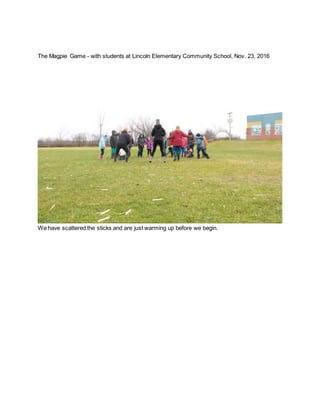
The Magpie Game - with students at Lincoln Elementary Community School, Nov. 23, 2016
We have scattered the sticks and are just warming up before we begin.
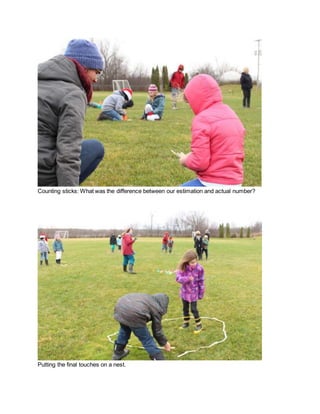
Counting sticks: What was the difference between our estimation and actual number?
Putting the final touches on a nest.
Just getting ready to steal objects from other magpies!
How many objects does each group have now? More or less? Double? Half?
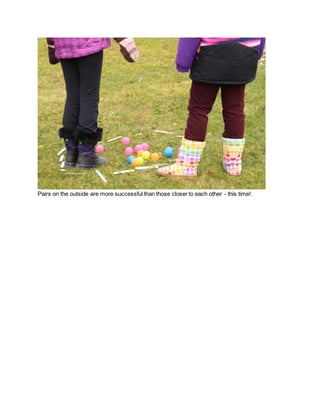
Pairs on the outside are more successful than those closer to each other - this time!.

MagpieGame

  • 1.
    Magpie Game Adapted from:Naturskolan i Lund (www.lund.se) International School Grounds Month - 2015 Activity Guide (www.lund.se/Global/Naturskolan/Diverse/ISGMguide2015.pdf) Description: This curriculum-connected, wildlife-oriented game gives students an understanding of the competition birds and other animals face from one another as they gather the resources they need. It also provides students opportunities to use the math skills they are learning (estimation, counting, greater than/less than, adding, subtracting, grouping, etc.) and teaches students about strategy, and can be used to introduce science terminology. This game also involves a lot of running, giving children exercise as they learn academic concepts! Materials: ● A large number of popsicle sticks (or sticks gathered with permission from the school grounds).We recommend having 20-50 sticks per “magpie couple” for their “nest”. If you do not have a natural area where students can collect sticks, distribute the sticks over a wide area before the game begins so the “magpies” can “forage” for them. ● 6 “shiny objects” per magpie couple. Small coloured balls work well as they are readily visible and large enough not to get lost on a grass surface, but other materials like stones (found by participants or provided) can also be used. Directions: ● Start the game by letting the children form magpie couples, pairing off into groups of two. ● Ask each pair to choose a spot within the designated playing in which to build their nest. ● Bring the group back together and have each magpie couple estimate how many sticks they think they can pick up in a minute. Have each pair share their estimate with the group. ● Start the clock and let the magpies collect as many sticks as they can. Stress not to drop them or leave them in a pile during this minute, other birds might steal them. Option: do not allow stealing from nest sites. ● When the minute is finished, have the children count their sticks. Suggest counting by two’s five’s. ten’s, etc. What is the result? Go around and discuss with the rest of the magpies. Who has done best, those who collected the most sticks, or those whose estimates were the closest to the actual number of sticks they collected? ● Next each magpie couple should build a nest with the sticks large enough so both can stand or sit inside. ● After nest construction, give each group 6 “shiny objects” (balls). Explain that magpies and some other species, included crows, like to collect shiny items. Has anyone seen this? Does anyone have any ideas why the birds might do this? ● The magpies can now “fly” around to other nests to steal a shiny object and put it in their own nest. They are only allowed to steal one object at a time. No throwing objects into the nest, they must be placed. These are precious jewels. No magpie is allowed to stay in or near the nest to protect their own objects.
  • 2.
    ● Start theclock (1-2 minutes, depending on your group’s stamina) ● After the time is up, each pair counts the number of objects they have in their nest. Discuss with the group. How many objects do they have now? Did they gain some, or lose some? Is there a pattern in the distribution of the objects? (sometimes nests on the outer edges of the playing area are raided less than those in the centre, sometimes intense competition between birds with neighbouring nests results in both pairs having a net loss, sometimes there is no obvious pattern). If there is a pattern, can the group come up with possible explanations? The teacher can link this to competition in nature. More questions to ask students: ● After collecting sticks: Was your estimate higher or lower than what you actually got? What was the difference? Double, half, a third? ● After collecting shiny objects: Did the number increase or decrease? What was the difference? Double, half, a third? ● Look around where nests are built: who got the most amount taken from them? The least? How does where you built your nest affect you? Adaption techniques: ● After estimation, time a minute for children so they have an idea how long a minute is. Would they change their estimation after seeing how long a minute is? ● Instead of magpies, couples could be crows or ravens. ● Instead of shiny objects, objects could represent food or water. ● Have children count the actual amount of sticks in a group. Ask for groups of 10, 20, 50, 100, etc. Work together to figure out how many sticks there were in total.
  • 3.
    The Magpie Game- with students at Lincoln Elementary Community School, Nov. 23, 2016 We have scattered the sticks and are just warming up before we begin.
  • 4.
    Counting sticks: Whatwas the difference between our estimation and actual number? Putting the final touches on a nest.
  • 5.
    Just getting readyto steal objects from other magpies! How many objects does each group have now? More or less? Double? Half?
  • 6.
    Pairs on theoutside are more successful than those closer to each other - this time!.