Measuring the Cost of
Living
Copyright © 2001 by Harcourt, Inc.
All rights reserved. Requests for permission to make copies of any part of the
work should be mailed to:
Permissions Department, Harcourt College Publishers,
6277 Sea Harbor Drive, Orlando, Florida 32887-6777.
Harcourt, Inc. items and derived items copyright © 2001 by Harcourt, Inc.
Measuring the Cost of Living
 Inflation refers to a situation in which the
economy’s overall price level is rising.
 The inflation rate is the percentage
change in the price level from the
previous period.
Harcourt, Inc. items and derived items copyright © 2001 by Harcourt, Inc.
Using Price Indexes
 Because inflation may overstate the value
of our GDP we need to make adjustments
accordingly.
 A price index is a measurement of how
the average price of a standard group of
goods changes over time.
 Price indexes are the way we adjust
nominal GDP (the value of GDP in
current dollars) to real GDP (the value of
GDP in constant dollars)
Harcourt, Inc. items and derived items copyright © 2001 by Harcourt, Inc.
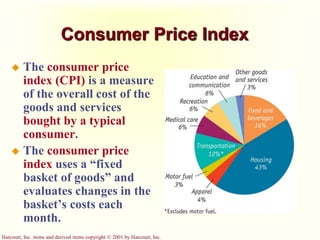
Consumer Price Index
 The consumer price
index (CPI) is a measure
of the overall cost of the
goods and services
bought by a typical
consumer.
 The consumer price
index uses a “fixed
basket of goods” and
evaluates changes in the
basket’s costs each
month.
Harcourt, Inc. items and derived items copyright © 2001 by Harcourt, Inc.
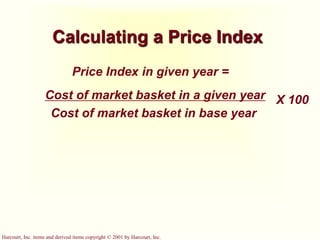
Calculating a Price Index
Price Index in given year =
Cost of market basket in a given year
Cost of market basket in base year
X 100
Harcourt, Inc. items and derived items copyright © 2001 by Harcourt, Inc.
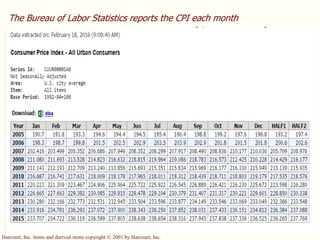
The Bureau of Labor Statistics reports the CPI each month
Harcourt, Inc. items and derived items copyright © 2001 by Harcourt, Inc.
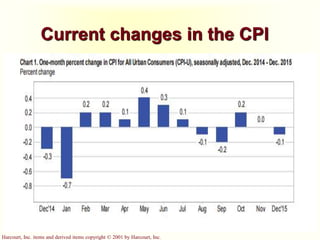
Current changes in the CPI
Harcourt, Inc. items and derived items copyright © 2001 by Harcourt, Inc.
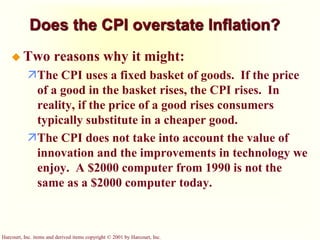
Does the CPI overstate Inflation?
 Two reasons why it might:
The CPI uses a fixed basket of goods. If the price
of a good in the basket rises, the CPI rises. In
reality, if the price of a good rises consumers
typically substitute in a cheaper good.
The CPI does not take into account the value of
innovation and the improvements in technology we
enjoy. A $2000 computer from 1990 is not the
same as a $2000 computer today.
Harcourt, Inc. items and derived items copyright © 2001 by Harcourt, Inc.
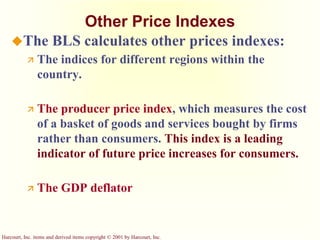
Other Price Indexes
The BLS calculates other prices indexes:
 The indices for different regions within the
country.
 The producer price index, which measures the cost
of a basket of goods and services bought by firms
rather than consumers. This index is a leading
indicator of future price increases for consumers.
 The GDP deflator
Harcourt, Inc. items and derived items copyright © 2001 by Harcourt, Inc.
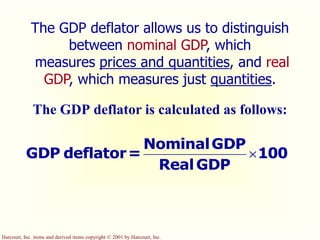
100
GDP
Real
GDP
Nominal
=
deflator
GDP 
The GDP deflator is calculated as follows:
The GDP deflator allows us to distinguish
between nominal GDP, which
measures prices and quantities, and real
GDP, which measures just quantities.
Harcourt, Inc. items and derived items copyright © 2001 by Harcourt, Inc.
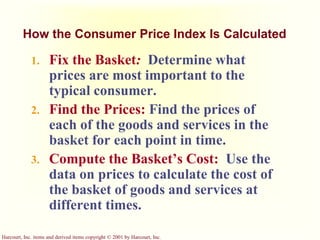
How the Consumer Price Index Is Calculated
1. Fix the Basket: Determine what
prices are most important to the
typical consumer.
2. Find the Prices: Find the prices of
each of the goods and services in the
basket for each point in time.
3. Compute the Basket’s Cost: Use the
data on prices to calculate the cost of
the basket of goods and services at
different times.
Harcourt, Inc. items and derived items copyright © 2001 by Harcourt, Inc.
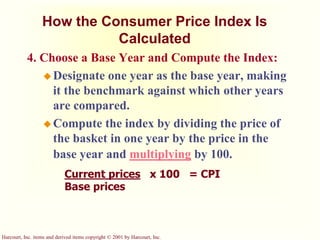
How the Consumer Price Index Is
Calculated
4. Choose a Base Year and Compute the Index:
 Designate one year as the base year, making
it the benchmark against which other years
are compared.
 Compute the index by dividing the price of
the basket in one year by the price in the
base year and multiplying by 100.
Current prices x 100 = CPI
Base prices
Harcourt, Inc. items and derived items copyright © 2001 by Harcourt, Inc.
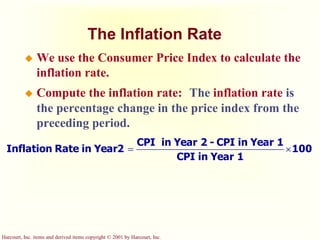
The Inflation Rate
100
1
Year
in
CPI
1
Year
in
CPI
-
2
Year
in
CPI
Year2
in
Rate
Inflation 

 We use the Consumer Price Index to calculate the
inflation rate.
 Compute the inflation rate: The inflation rate is
the percentage change in the price index from the
preceding period.
Harcourt, Inc. items and derived items copyright © 2001 by Harcourt, Inc.
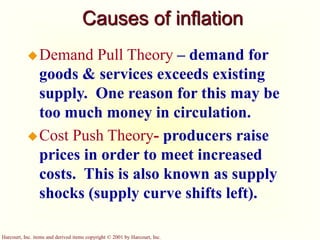
Causes of inflation
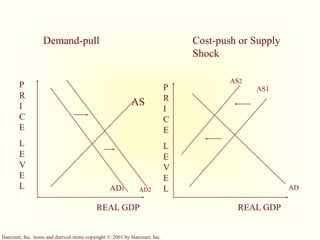
Demand Pull Theory – demand for
goods & services exceeds existing
supply. One reason for this may be
too much money in circulation.
Cost Push Theory- producers raise
prices in order to meet increased
costs. This is also known as supply
shocks (supply curve shifts left).
Harcourt, Inc. items and derived items copyright © 2001 by Harcourt, Inc.
Demand-pull Cost-push or Supply
Shock
P
R
I
C
E
L
E
V
E
L
P
R
I
C
E
L
E
V
E
L
REAL GDP REAL GDP
AS
AD1 AD2
AS2
AS1
AD
Harcourt, Inc. items and derived items copyright © 2001 by Harcourt, Inc.
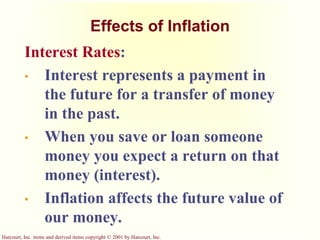
Effects of Inflation
Interest Rates:
• Interest represents a payment in
the future for a transfer of money
in the past.
• When you save or loan someone
money you expect a return on that
money (interest).
• Inflation affects the future value of
our money.
Harcourt, Inc. items and derived items copyright © 2001 by Harcourt, Inc.
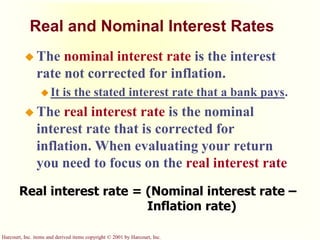
Real and Nominal Interest Rates
 The nominal interest rate is the interest
rate not corrected for inflation.
 It is the stated interest rate that a bank pays.
 The real interest rate is the nominal
interest rate that is corrected for
inflation. When evaluating your return
you need to focus on the real interest rate
Real interest rate = (Nominal interest rate –
Inflation rate)
Harcourt, Inc. items and derived items copyright © 2001 by Harcourt, Inc.
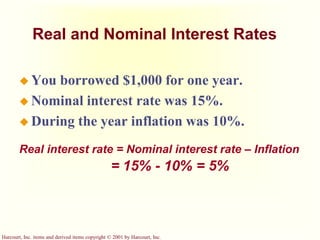
Real and Nominal Interest Rates
 You borrowed $1,000 for one year.
 Nominal interest rate was 15%.
 During the year inflation was 10%.
Real interest rate = Nominal interest rate – Inflation
= 15% - 10% = 5%
Harcourt, Inc. items and derived items copyright © 2001 by Harcourt, Inc.
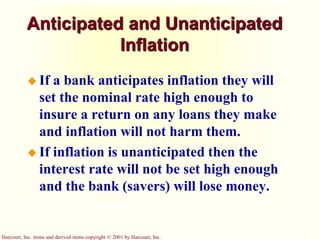
Anticipated and Unanticipated
Inflation
 If a bank anticipates inflation they will
set the nominal rate high enough to
insure a return on any loans they make
and inflation will not harm them.
 If inflation is unanticipated then the
interest rate will not be set high enough
and the bank (savers) will lose money.
Harcourt, Inc. items and derived items copyright © 2001 by Harcourt, Inc.
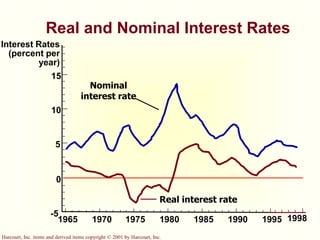
1965
Interest Rates
(percent per
year)
15
10
5
0
-5
1970 1975 1980 1985 1990 1995 1998
Nominal
interest rate
Real interest rate
Real and Nominal Interest Rates
Harcourt, Inc. items and derived items copyright © 2001 by Harcourt, Inc.
Who’s Hurt? Who’s Helped?
By Unanticipated Inflation
You’re hurt if you are a
 Creditor – the money
you loan out is worth less
when its paid back
 Saver – inflation rates
are normally higher than
interest rates
 Fixed income receiver- a
constant income will buy
less.
You’re helped if you are a
 Borrower- the money you
are repaying is worth less
 Flexible income earner-
 if your income is tied to
profits you will earn more
 If your income is adjusted
for inflation you will earn
more (COLA)
 Payer of fixed amounts

Macro module 14a inflation a

  • 1.
    Measuring the Costof Living Copyright © 2001 by Harcourt, Inc. All rights reserved. Requests for permission to make copies of any part of the work should be mailed to: Permissions Department, Harcourt College Publishers, 6277 Sea Harbor Drive, Orlando, Florida 32887-6777.
  • 2.
    Harcourt, Inc. itemsand derived items copyright © 2001 by Harcourt, Inc. Measuring the Cost of Living  Inflation refers to a situation in which the economy’s overall price level is rising.  The inflation rate is the percentage change in the price level from the previous period.
  • 3.
    Harcourt, Inc. itemsand derived items copyright © 2001 by Harcourt, Inc. Using Price Indexes  Because inflation may overstate the value of our GDP we need to make adjustments accordingly.  A price index is a measurement of how the average price of a standard group of goods changes over time.  Price indexes are the way we adjust nominal GDP (the value of GDP in current dollars) to real GDP (the value of GDP in constant dollars)
  • 4.
    Harcourt, Inc. itemsand derived items copyright © 2001 by Harcourt, Inc. Consumer Price Index  The consumer price index (CPI) is a measure of the overall cost of the goods and services bought by a typical consumer.  The consumer price index uses a “fixed basket of goods” and evaluates changes in the basket’s costs each month.
  • 5.
    Harcourt, Inc. itemsand derived items copyright © 2001 by Harcourt, Inc. Calculating a Price Index Price Index in given year = Cost of market basket in a given year Cost of market basket in base year X 100
  • 6.
    Harcourt, Inc. itemsand derived items copyright © 2001 by Harcourt, Inc. The Bureau of Labor Statistics reports the CPI each month
  • 7.
    Harcourt, Inc. itemsand derived items copyright © 2001 by Harcourt, Inc. Current changes in the CPI
  • 8.
    Harcourt, Inc. itemsand derived items copyright © 2001 by Harcourt, Inc. Does the CPI overstate Inflation?  Two reasons why it might: The CPI uses a fixed basket of goods. If the price of a good in the basket rises, the CPI rises. In reality, if the price of a good rises consumers typically substitute in a cheaper good. The CPI does not take into account the value of innovation and the improvements in technology we enjoy. A $2000 computer from 1990 is not the same as a $2000 computer today.
  • 9.
    Harcourt, Inc. itemsand derived items copyright © 2001 by Harcourt, Inc. Other Price Indexes The BLS calculates other prices indexes:  The indices for different regions within the country.  The producer price index, which measures the cost of a basket of goods and services bought by firms rather than consumers. This index is a leading indicator of future price increases for consumers.  The GDP deflator
  • 10.
    Harcourt, Inc. itemsand derived items copyright © 2001 by Harcourt, Inc. 100 GDP Real GDP Nominal = deflator GDP  The GDP deflator is calculated as follows: The GDP deflator allows us to distinguish between nominal GDP, which measures prices and quantities, and real GDP, which measures just quantities.
  • 11.
    Harcourt, Inc. itemsand derived items copyright © 2001 by Harcourt, Inc. How the Consumer Price Index Is Calculated 1. Fix the Basket: Determine what prices are most important to the typical consumer. 2. Find the Prices: Find the prices of each of the goods and services in the basket for each point in time. 3. Compute the Basket’s Cost: Use the data on prices to calculate the cost of the basket of goods and services at different times.
  • 12.
    Harcourt, Inc. itemsand derived items copyright © 2001 by Harcourt, Inc. How the Consumer Price Index Is Calculated 4. Choose a Base Year and Compute the Index:  Designate one year as the base year, making it the benchmark against which other years are compared.  Compute the index by dividing the price of the basket in one year by the price in the base year and multiplying by 100. Current prices x 100 = CPI Base prices
  • 13.
    Harcourt, Inc. itemsand derived items copyright © 2001 by Harcourt, Inc. The Inflation Rate 100 1 Year in CPI 1 Year in CPI - 2 Year in CPI Year2 in Rate Inflation    We use the Consumer Price Index to calculate the inflation rate.  Compute the inflation rate: The inflation rate is the percentage change in the price index from the preceding period.
  • 14.
    Harcourt, Inc. itemsand derived items copyright © 2001 by Harcourt, Inc. Causes of inflation Demand Pull Theory – demand for goods & services exceeds existing supply. One reason for this may be too much money in circulation. Cost Push Theory- producers raise prices in order to meet increased costs. This is also known as supply shocks (supply curve shifts left).
  • 15.
    Harcourt, Inc. itemsand derived items copyright © 2001 by Harcourt, Inc. Demand-pull Cost-push or Supply Shock P R I C E L E V E L P R I C E L E V E L REAL GDP REAL GDP AS AD1 AD2 AS2 AS1 AD
  • 16.
    Harcourt, Inc. itemsand derived items copyright © 2001 by Harcourt, Inc. Effects of Inflation Interest Rates: • Interest represents a payment in the future for a transfer of money in the past. • When you save or loan someone money you expect a return on that money (interest). • Inflation affects the future value of our money.
  • 17.
    Harcourt, Inc. itemsand derived items copyright © 2001 by Harcourt, Inc. Real and Nominal Interest Rates  The nominal interest rate is the interest rate not corrected for inflation.  It is the stated interest rate that a bank pays.  The real interest rate is the nominal interest rate that is corrected for inflation. When evaluating your return you need to focus on the real interest rate Real interest rate = (Nominal interest rate – Inflation rate)
  • 18.
    Harcourt, Inc. itemsand derived items copyright © 2001 by Harcourt, Inc. Real and Nominal Interest Rates  You borrowed $1,000 for one year.  Nominal interest rate was 15%.  During the year inflation was 10%. Real interest rate = Nominal interest rate – Inflation = 15% - 10% = 5%
  • 19.
    Harcourt, Inc. itemsand derived items copyright © 2001 by Harcourt, Inc. Anticipated and Unanticipated Inflation  If a bank anticipates inflation they will set the nominal rate high enough to insure a return on any loans they make and inflation will not harm them.  If inflation is unanticipated then the interest rate will not be set high enough and the bank (savers) will lose money.
  • 20.
    Harcourt, Inc. itemsand derived items copyright © 2001 by Harcourt, Inc. 1965 Interest Rates (percent per year) 15 10 5 0 -5 1970 1975 1980 1985 1990 1995 1998 Nominal interest rate Real interest rate Real and Nominal Interest Rates
  • 21.
    Harcourt, Inc. itemsand derived items copyright © 2001 by Harcourt, Inc. Who’s Hurt? Who’s Helped? By Unanticipated Inflation You’re hurt if you are a  Creditor – the money you loan out is worth less when its paid back  Saver – inflation rates are normally higher than interest rates  Fixed income receiver- a constant income will buy less. You’re helped if you are a  Borrower- the money you are repaying is worth less  Flexible income earner-  if your income is tied to profits you will earn more  If your income is adjusted for inflation you will earn more (COLA)  Payer of fixed amounts