1. Introduction:
Ready-made garments are mass-produced finished textile products of the clothing
industry. They are not custom tailored according to measurements, but rather
generalized according to anthropometric studies. They are made from many
different fabrics and yarns. Their characteristics depend on the fibres used in their
manufacture. Ready-made garments are divided into the following types: Outer
clothing: work wear and uniform, leisure wear, sportswear, suits, blouse, blazers,
jackets, cardigans, pullovers, coats, sports jackets, skirts, shirts, ties, jeans, shorts, T-
shirts, Underclothing, jersey goods, lingerie.
Bangladesh, the southern Asian country has a population of approximately 164
million people. The economy of Bangladesh is significantly dependent on agriculture.
But its a great news for the country that, readymade garments (RMG) sector of
Bangladesh has raised as the biggest earner of foreign currency. This sector creates
about 4.2 million employment opportunities and contributes significantly to the GDP.
Readymade garments (RMG) of Bangladesh are powered by young, urbanizing,
workers, where most of them are women.
2. Objective of the Study:
The objective of the study is to analyses problems and prospects of RMG sector at
Bangladesh. The broad objectives of the study are as follows
• To focus over garments industries- prospect.
• To find out the competitiveness of RMG sector.
• To analysis the existing problems.
• To define possible solutions of above problems.
• To brief the present situations with valid data.
3. Methodology
The study has been conducted mainly following qualitative methods. Data was
collected from secondary sources. Secondary data included government reports, court
judgments, national and international treaties, conventions, books, articles, research
papers, relevant laws and rules, various news reports from print and electronic media.
1
4. About Readymade Garment (RMG) Industry of Bangladesh:
The readymade garments industry acts as a catalyst for the development of
Bangladesh. The "Made in Bangladesh" tag has also brought glory for the country,
making it a prestigious brand across the globe. Bangladesh, which was once termed
by cynics a "bottomless basket”, has now become a "basket full of wonders." The
country with its limited resources has been maintaining 6% annual average GDP
growth rate and has brought about remarkable social and human development.
After the independence in 1971, Bangladesh was one of poorest countries in the
world. No major industries were developed in Bangladesh, when it was known as East
Pakistan, due to discriminatory attitude and policies of the government of the then
West Pakistan. So, rebuilding the war-ravaged country with limited resources
appeared to be the biggest challenge.
The industry that has been making crucial contribution to rebuilding the country and
its economy is none other than the readymade garment (RMG) industry which is now
the single biggest export earner for Bangladesh. The sector accounts for 81% of total
export earnings of the country.
5. History of Readymade Garments industry:
The first ready-made garment factory was established in New York in 1831. During
the American Civil War the need for ready-made uniforms helped the garment sector
grow in the United States. Near the end of the nineteenth century there were changes
in societal views towards ready-made garments: They were no longer seen as only for
the lower classes but also for the middle classes. This trend started in the United
States. In the beginning they were more popular with men than women. In the late
1860s 25% percent of garments produced in the US was ready-made but by 1890 the
portion had risen to 60%. By 1951 90% percent of garments sold in the United States
were ready made. During the same time two-thirds of garments sold in France was
ready made.
Once the cloth of Bangladesh achieved worldwide fame specially Muslim and
jamdani cloth or our country was used as the luxurious garments of the royal figures
in Europe and other countries. The British rulers in India did not develop our cloth
2
industries at all. Rather they destroyed them and imported cloths from England.
Garment Industry Large-scale production of readymade garments (RMG) in
organized factories is a relatively new phenomenon in Bangladesh. Until early sixties,
individual tailors made garments as per specifications provided by individual
customers who supplied the fabrics. The domestic market for readymade garment,
excepting children wears and men's knit underwear (genji) was virtually non-existent
in Bangladesh until the sixties.
Since the late 1970s, the RMG industry started developing in Bangladesh primarily as
an export-oriented industry although; the domestic market for RMG has been
increasing fast due to increase in personal disposable income and change in life style.
The sector rapidly attained high importance in terms of employment, foreign
exchange earnings and its contribution to national economy.
Most importantly, the growth of RMG sector produced a group of entrepreneurs who
have created a strong private sector. Of these entrepreneurs, a sizeable number is
female. A woman entrepreneur established one of the oldest export-oriented garment
factories, the Baishakhi Garment in 1977. Many women hold top executive positions
in RMG industry. The hundred percent export-oriented RMG industry experienced
phenomenal growth during the last 15 or so years. In 1978, there were only 9 export-
oriented garment manufacturing units, which generated export earnings of hardly one
million dollar. Some of these units were very small and produced garments for both
domestic and export markets. Four such small and old units were Reaz Garments,
Paris Garments, Jewel Garments and Baishakhi Garments.
Reaz Garments, the pioneer, was established in 1960 as a small tailoring outfit, named
Reaz Store in DHAKA. It served only domestic markets for about 15 years. In 1973 it
changed its name to M/s Reaz Garments Ltd. and expanded its operations into export
market by selling 10,000 pieces of men's shirts worth French Franc 13 million to a
Paris-based firm in 1978. It was the first direct exporter of garments from Bangladesh.
Desh Garments Ltd, the first non-equity joint-venture in the garment industry was
established in 1979. Desh had technical and marketing collaboration with Daewoo
Corporation of South Korea. It was also the first hundred percent export-oriented
company. It had about 120 operators including 3 women trained in South Korea, and
3
with these trained workers it started its production in early 1980. Another South
Korean Firm, Youngones Corporation formed the first equity joint-venture garment
factory with a Bangladeshi firm, Trexim Ltd. in 1980. Bangladeshi partners
contributed 51% of the equity of the new firm, named Youngones Bangladesh. It
exported its first consignment of padded and non-padded jackets to Sweden in
December 1980.
Till the end of 1982, there were only 47 garment manufacturing units. The
breakthrough occurred in 1984-85, when the number of garment factories increased to
587. The number of RMG factories shot up to around 2,900 in 1999. Bangladesh is
now one of the 12 largest apparel exporters of the world, the sixth largest supplier in
the US market and the fifth largest supplier of T-shirts in the EU market. The industry
has grown during the 1990s roughly at the rate of 22%.
At present there are about 5000 garment industries in the country and 75 percent of
them are in Dhaka. The rest are in Chittagong and Khulna. These Industries have
employed fifty lacks of people and 85 percent of them are illiterate rural women.
About 76 percent of our export earning comes from this sectors.
The country's RMG sector, to a creditable level has relieved Bangladesh from over
populous unemployment burden through providing the largest employment next to
agriculture, transport, and trade and industry sector. This sector has uplifted the
neglected section of the population, thus radically transforming the socio-economic
condition of the country. Such empowerment and employment raised awareness
regarding children education, health safety, population control disaster management
only so for. It is an epoch making event in the history of Bangladesh.
6. Prospects of readymade Garments (RMG) in Bangladesh:
The prospects of garments industry at Bangladesh are very promising. In the 1980's, there
were only 50 factories employing only a few thousand people. Currently, there are 4490
manufacturing units. The RMG sector contributes around 76 percent to the total export
earnings. In 2007 it earned $9.35 billion. This sector also contributes around
13 percent to the GDP, which was only around 3 percent in 1990 Of the estimated 4.2
million people employed in this sector, about 50 percent of them are women from rural areas.
4
In 2000, the industry consisting of some 3000 factories employed directly more than 1.5
million workers of whom almost 80% were female. USA is the largest importer of
Bangladeshi RMG products, followed by Germany, UK, France and other E.U countries.
The RMG industry of Bangladesh has expanded dramatically over the last three
decades. Traditionally, the jute industry dominated the industrial sector of the country
until the 1970s. Since the early 1980s, the RMG industry has emerged as an important
player in the economy of the country and has gradually replaced the jute industry. In
Bangladesh the RMG sector is one of the most profitable sectors in recent years.
For this reason most of the people of our country are very much interested about this
sector. As a result in now days in our country there are some successful RMG are
introduce which can compute the foreign buying house in international market. They
already bit some of the successful RMG in another country. It is a good sign for
Bangladesh that The Fashion Designing profession has recently emerged as one of the
most demandable careers among the youth. These young folks have their own creative
style of dressing and belief in setting a trend rather than following a trend set by
others. A career in fashion design not only involves meeting glamorous people and
interacting with rich and famous but also gives an impetus to the creative flair of the
people who possess a sense of style. But still Bangladesh is struggling to establish a
standard in fashion design for international market.
For Bangladesh, the readymade garment export industry has been the proverbial
goose that lays the golden eggs for over fifteen years now. The sector now dominates
the modern economy in export earnings, secondary impact and employment
generated. The events in 1998 serve to highlight the vulnerability of this industry to
both internal and external shocks on the demand and supply side. Given the
dominance of the sector in the overall modern economy of Bangladesh, this
vulnerability should be a matter of some concern to the policymakers in Bangladesh.
Although in gross terms the sector’s contributions to the country’s export earnings is
around 74 percent, in net terms the share would be much less partially because the
backward linkages in textile have been slow to develop.
The dependence on a single sector, no matter how resilient or sturdy that sector is, is a
matter of policy concern. We believe the policymakers in Bangladesh should work to
5
reduce this dependence by moving quickly to develop the other export industries
using the lessons learned from the success of apparel exports. Support for the apparel
sector should not be reduced. In fact, another way to reduce the vulnerability is to
diversify the product and the market mix. It is heartening to observe that the knit
products are rapidly gaining share in overall garment exports as these products are
sold in quota-free markets and reflect the strength of Bangladeshi producers in the
fully competitive global apparel markets.
7. Present Situation of RMG Sector in Bangladesh:
Bangladesh earns nearly $7 billion a year by exporting textile products, mainly to
Europe and the United States. This is about 70 percent of total export earnings of the
country. The RMG industry has around 4,000 units across the country. It employs
around 2.5 million workers, 90 percent of whom are poor women. Whenever the
country is criticized for its high level of corruption and confrontational politics, its
garment industry is held up as a success story.
Quota system was a great blessing for establishing our garments industry. We were
strongly benefited by using that. As a result we can see a matured garments industry
today. But while quota system was approaching to an end in 2004, there’s so many
got upset about the RMG sector of Bangladesh. Though in the latter it can’t be
affected here as the experts were seemed. We conquered the post quota challenges
and made that a successful story.
In RMG sector of Bangladesh, there are more than 5000 garment factories (private
statistics) at the current time, employing more than 12 lack labours, where 85% of the
labour force is women. But, according to BGMEA the number of garment factories in
Bangladesh around 4000. Now, RMG industry is the countries largest export earner
with the value of over $24.49bn of exports in the last financial year. Its a great news
for us that, Bangladesh is clearly ahead from other South Asian suppliers in terms of
capacity of the ready made garments industry.
Though, there are various types of garments are manufactured in Bangladesh, but all
the ready made garments are classified into two broad categories, where one is woven
products and another one is knitted products. A woven product includes Shirts, Pants
and Trousers. On the other hand, knitted product includes T-Shirts, Polo Shirts,
6
Undergarments, Socks, Stockings and Sweaters. Woven garments still dominate the
export earnings of the country. From BGMEA website its seen that, Day by day
knitted items production is increasing in considerable rate and now about 40% export
earnings has achieved from knitted products.
8. List of Bangladesh Readymade Garment Manufacturers and
Exporters:
=> AFTEX LIMITED
=> AGAMI APPARELS LTD.
=> AGAMI FASHIONS LIMITED
=> AGRANI SWEATERS LTD.
=> AG’S APPARELS LTD
=> AHMED FASHIONS
=> AHMEDIA GARMENTS (PTE) LTD.
=> AHSAN FASHIONS LTD.
=> AHSAN KNITTING LTD.
=> AIRTEES APPARELS LTD.
=> A ONE DRESSMAKERS LTD.
=> A PLUS INDUSTRIES LTD.
=> A.B. FASHIO WEAR LTD.
=> A.B. SIDDIQUEE APPARELS LTD.
=> A.B.C. ATTIRE LTD.
=> A.B.M APPARELS LTD.
=> A.B.M. FASHIONS LTD.
=> A.B.S. GARMENTS LTD.
=> A.D. ENTERPRISE (GARMENTS DIVISION)
=> A.F.M. SWEATERS LTD.
=> A.G. DRESSES LIMITED.
=> A.H. GARMENTS LTD.
=> A.J. SUPER GARMENTS LTD.
=> A.K. KHAN & CO. LTD. (GARMENTS DIV)
=> A.K.B. FASHIONWEAR (PVT) LTD.
=> A.K.J. FASHIONS FABRICS LTD.
=> A.K.M. KNIT WEAR LTD.
7
=> A.M. DESIGN LTD.
=> A.M.C. GARMENTS LTD.
=> A.M.K. APPARELS LTD.
=> A.N. GARMENTS LTD
=> A.Q.M. APPARELS (PVT) LTD.
=> A.R. FASHIONS LTD.
=> A.R. KHAN SIZING & FABRICS LTD.
=> A.R.A. GARMENTS & TEXTILES LTD.
=> A.R.B. KNIT WEAR LTD
=> A.S FASHION LTD. And so on.
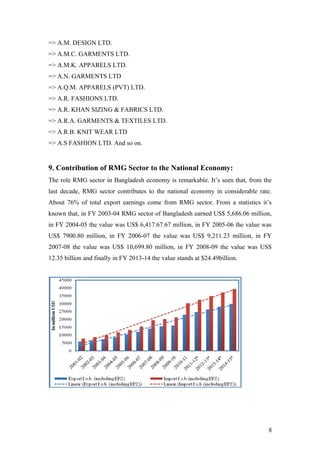
9. Contribution of RMG Sector to the National Economy:
The role RMG sector in Bangladesh economy is remarkable. It’s seen that, from the
last decade, RMG sector contributes to the national economy in considerable rate.
About 76% of total export earnings come from RMG sector. From a statistics it’s
known that, in FY 2003-04 RMG sector of Bangladesh earned US$ 5,686.06 million,
in FY 2004-05 the value was US$ 6,417.67.67 million, in FY 2005-06 the value was
US$ 7900.80 million, in FY 2006-07 the value was US$ 9,211.23 million, in FY
2007-08 the value was US$ 10,699.80 million, in FY 2008-09 the value was US$
12.35 billion and finally in FY 2013-14 the value stands at $24.49billion.
8
10. Opportunity of RMG Sector in Bangladesh:
RMG sector of Bangladesh has some key factors which inspired for steady growth of
this sector. Though its a matter of great surprising for so many that how RMG sector
of Bangladesh continues to show its robust performance in the world.
The main key factors which have great influence on RMG sector of Bangladesh are in
the following:
• Vast labour force,
• Skilled human resources,
• Technological upgrades,
• Government supports for textile and clothing,
• Special economic/export processing zones,
• Creation of textile and clothing villages,
• Incentive for use of local inputs,
• Duty reduction for the import of inputs/machines,
• Income tax reduction, and
• International supports like GSP, GSP+, duty free access etc.
By using the above key points we can easily take place the world’s readymade
garments market very strongly. But there’s some another key factors. If we apply
those key factors in our readymade garments sector, then we will achieve the first
priority to the worlds famous buyers note book.
Those key factors are-
• Cost Effective Strategy,
• New Product Development strategy,
• Product Diversification Strategy and
• Market Diversification Strategy.
All the above points are discussed in the below:
Cost Effective Strategy:
Cost Effective Strategy includes the following two key points:
• Cost Reduction Strategy and
• Labour Productivity Improvement.
Those key points are discussed in the below:
9
10.1. Cost Reduction Strategy:
Cost reduction strategy should begin with assigning the highest priority for
establishing backward linkages. The establishment of backward linkages will reduce
our dependence on foreign sources which will reduce the total and average production
cost of garments. This Strategy will make our products more competitive in the
world’s ready made garments market.
10.2. Labour Productivity Improvement:
Bangladeshi workers are not efficient as of Hong Kong, South Korea and Sri Lankan
workers. Wages are low in Bangladesh, but it does not necessarily mean that
relatively low wages workers automatically lead to higher productivity. So, to keep
place in the world’s largest competitive market, labor productivity must be improved.
10.3. New Product Development strategy:
Its a matter of great sorrow for us that, we are regularly produced the same products.
Our product categories are very less in quantities. Our product items that are exported
into foreign market are Shirts-60%, Jackets-11%, Knit items-10%, Trousers-7% and
Others-11.50%. To survive in the worlds most competitive RMG market, we have to
develop new product items with a lot of variations.
10.4. Product Diversification Strategy:
Product Diversification Strategy is an important factor to keep place in the worlds
ready made garments market. Different types of products should be produced by
applying fashion. Thailand, China, India, Pakistan, Hong Kong, Singapore, Malaysia,
Indonesia and others are the main competitors of Bangladesh. They are already ahead
of Bangladesh in product diversification strategy areas.
10.5. Market Diversification Strategy:
Bangladesh has exported their products in the worlds limited market. Mostly are in
USA, Canada and Europe. About 46% of its total garment exports goes to USA, 14%
to the Canada and rest of those into the European market. The competitors of
10
Bangladesh are regularly expands their markets and keep changing their products by
using fashion.
The following key factors must be undertaken during market diversification strategy:
• Market research on product design
• Market research on product development,
• Market promotion through trade fairs, exhibition, etc.
• Human resources development by providing training.
11. Problems surrounding readymade garments sector:
The garment industry of Bangladesh has been the key export division and a main
source of foreign exchange for the last 25 years. National labor laws do not apply in
the EPZs, leaving BEPZA in full control over work conditions, wages and benefits.
Garment factories in Bangladesh provide employment to 40 percent of industrial
workers. But without the proper laws the worker are demanding their various wants
and as a result conflict is began with the industry,
11.1. Raw materials:
Bangladesh imports raw materials for garments like cotton, thread color etc. This
dependence on raw materials hampers the development of garments industry.
Moreover, foreign suppliers often supply low quality materials, which result in low
quality products
11.2. Unskilled workers:
Most of the illiterate women workers employed in garments are unskilled and so their
products often become lower in quality.
11.3. Improper working environment:
Taking the advantages of workers’ poverty and ignorance the owners forced them to
work in unsafe and unhealthy work place overcrowded with workers beyond capacity
of the factory floor and improper ventilation.
Most of the garment factories in our country lack the basic amenities where our
garment workers sweat their brows from morning to evening to earn our countries the
11
major portion of our foreign exchange. Anybody visiting the factory the first
impression he or she will have that these workers are in a roost.
Improper ventilation, stuffy situation, filthy rooms are the characteristics of the
majority of our factories. The owners profit are the first priority and this attitude has
gone to such an extent that they do not care about their lives.
11.4. Lack of managerial knowledge:
There are some other problems which are associated with this sector. Those are- lack
of marketing tactics, absence of easily on-hand middle management, a small number
of manufacturing methods, lack of training organizations for industrial workers,
supervisors and managers, autocratic approach of nearly all the investors, fewer
process units for textiles and garments, sluggish backward or forward blending
procedure, incompetent ports, entry/exit complicated and loading/unloading takes
much time, time-consuming custom clearance etc.
11.5. Gendered division of labour:
In the garment industry in Bangladesh, tasks are allocated largely on the basis of
gender. This determines many of the working conditions of women workers. All the
workers in the sewing section are women, while almost all those in the cutting,
ironing and finishing sections are men. Women workers are absorbed in a variety of
occupations from cutting, sewing, inserting buttons, making button holes, checking,
cleaning the threads, ironing, folding, packing and training to supervising.
Women work mainly as helpers, machinists and less frequently, as line supervisors
and quality controllers. There are no female cutting masters. Men dominate the
administrative and management level jobs. Women are discriminated against in terms
of access to higher-paid white collar and management positions.
When asked why they prefer to amply women foe sewing, the owner and managers
gave several reasons. Most felt that sewing is traditionally done by women and that
women are more patient and more controllable than men.
11.6. Wages:
The government of Bangladesh sets minimum wages for various categories of
workers. According of Minimum Wage Ordinance 1994, apprentices’ helpers are to
receive Tk500 and Tk930 per month respectively. Apprentices are helpers who have
12
been working in the garment industry for less than three months. After three months,
Apprentices are appointed as helpers. Often female helpers are discriminated against
in terms of wages levels, and these wages are also often fixed far below the minimum
wage rate. A survey conducted in 1998 showed that 73% of female helpers, as
opposed to 15% of their male counterparts, did not receive even the minimum wage.
11.7. Insufficient of loan:
Insufficiency of loan in time, uncertainly of electricity, delay in getting materials, lack
of communication, problem in taxes etc. Often obstruct the industry. In the world
market 115 to 120 items of dress are in demand where as Bangladesh supplies only
ten to twelve items of garments. India, South Korea, Hong Kong, Singapore,
Thailand, Taiwan etc, have made remarkable progress in garments industries.
Bangladesh is going to challenge the garments of those countries in the world market.
11.8. Unit labour cost:
Bangladesh has the cheapest unit labour cost in South Asia. It costs only 11 cents to
produce a shirt in Bangladesh, whereas it costs 79 cents in Sri Lanka and 26 cents in
India. Clearly, Bangladesh’s comparative advantage lies in having the cheapest unit
labour cost.
11.9. Working hours:
Though the wages are low, the working hours are very long. The RMG factories claim
to operate one eight-hour shift six days a week. The 1965 factory Act allows women
to work delivery deadlines; however, women are virtually compelled to work after 8
o’clock. Sometimes they work until 3 o’clock in the morning and report back to start
work again five hours later ar 8 o’clock. They are asked to work whole months at a
time the Factory Act, which stipulates that no employee should work more than ten
days consecutively without a break.
11.10. Poor accommodation facilities:
As most of the garment workers come from the poor family and comes from the
remote areas and they have to attend to the duties on time, these workers have to hire
a room near the factory where four to five huddle in a room and spend life in sub
human condition.
13
For four to five workers there is one common latrine and a kitchen for which they
have to pay from Tk= 2000 to Tk=2500/-.They share this amount among themselves
to minimize the accommodation expense.
One cannot believe their eyes in what horrible condition they have to pass out their
time after almost whole day of hard work in the factory. After laborious job they
come into their roost, cook their food and have their dinner or lunch in unhygienic
floor or bed and sleep where they take their food. They share the single bed or sleep
on the floor.
The owners of these factories must not treat the workers as animals. The owners of
these factories who drive the most luxurious car and live in most luxurious house do
ever think that these are the workers who have made their living so juicy. Will these
selfish owners ever think of these workers of their better living for the sake of
humanity by providing better accommodation for these workers in addition to
providing with the job.
11.10.1. Safety Problems:
Because of the carelessness of the factory management and for their arrogance factory
doors used to be kept locked for security reason defying act.
Safety need for the worker is mandatory to maintain in all the organization. But
without the facility of this necessary product a lot of accident is occur incurred every
year in most of the company. Some important cause of the accident are given below-
11. Routes are blocked by storage materials
12. Machine layout is often staggered
13. Lack of signage for escape route
14. No provision for emergency lighting
15. Doors, opening along escape routes, are not fire resistant
16. Doors are not self-closing and often do not open along the direction of escape
17. Adequate doors as well as adequate staircases are not provided to aid quick exit
18. Fire exit or emergency staircase lacks proper maintenance
19. Lack of proper exit route to reach the place of safety
20. Parked vehicles, goods and rubbish on the outside of the building obstruct exits
to the open air
14
21. Fire in a Bangladesh factory is likely to spread quickly because the principle of
compartmentalization is practiced
12. Challenges for RMG Sector of Bangladesh:
Though RMG sector of Bangladesh has achieved the second spot for the highest
number of garments exporter, but it has a lot of problems.
The major problems faced by RMG sector currently is the lack of safety in working
place and working conditions for the millions of garments workers. It’s become a
great challenge for the upcoming financial year of Bangladesh. Another important one
is political stability.
Two major incidents in RMG sector of Bangladesh are the Tazreen fire and the Rana
Plaza collapse, which have brought the issue of workplace safety to the fore and led
all stakeholders to act accordingly. But it’s good news for RMG sector that, following
the unfortunate incidents, various platforms such as the Bangladesh Accord on Fire
and Building Safety, the Alliance for Bangladesh Worker Safety and National Plan of
Action have been formed to improve building and fire safety of Bangladesh’s garment
industry. Also BGMEA and BKMEA are working together here to solve such kinds of
problems. They have also taken necessary actions and invested huge amount of
money.
It’s a huge responsibility for the government of Bangladesh to ensure working place
safety in all the garments manufacturing factories. If we can’t do it, foreign buyers
will refuse to place order here, which will be a massive blow for RMG sector of
Bangladesh. We hope, the government of Bangladesh, BGMEA and BKMEA, with
the support of global brands and international development partners, will be able to
ensure the safety of the RMG industry and maintain the momentum of socio-
economic development in the country.
Political stability creates a negative impact on RMG sector of Bangladesh. If it
continues, it will be a massive blow to destroy our most valuable sector. So, political
leaders should come out immediately to solve such kinds of problems.
15
13. Recommendations of Readymade Garments Problems:
In addition to the substantial contribution to the economic arena, the social
contribution of the garments sector has also been significant. It has provided
employment to about three million workers, the majority of whom are young, poor
and illiterate women.
But there is a dark twist to this feel-good storyline. The RMG sector is going through
severe turbulence. The series of recent clashes between law enforcers and garment
workers is symptomatic of an unfolding crisis in the industry and puts it at risk of
losing its competitive edge in the global market.
Each violent incident has overtaken the other in scale and consequences. In the wake
of the recent incident in Ashulia, the Bangladesh Garment Manufacturers and
Exporters Association (BGMEA) decided to shut down hundreds of factories in the
area. The factories opened only after receiving assurance from the government that
their security would be ensured.
The grievances of the workers are genuine. In the absence of an appropriate formal
channel to air grievances and seek redress, the only avenues open to the RMG
workers are street protest, picketing, or gherao of a manager's office or a factory. (But
questions have also been raised about the actual identity of the unruly people going by
the name of workers, who have been causing havoc on the factories that provide them
with their means of livelihood.)
So far, the government has largely left the RMG sector to its devices. But, given the
recent incidents, the government has announced that it will be formulating a labour
policy and set a minimum wage for the garment workers; a move that was long
overdue. A cursory analysis of the labour legislation and a review of the institutions
show that the incidents of violence in the garment industry stem largely from legal
and institutional failures in the sector:
Reviewing and amending provisions of the labour act: The Bangladesh Labour Act,
2006 allows the owner to close the factory without having to inform an authority in
advance. This legal provision goes against the international best practice that
16
stipulates that a company must follow three steps before it declares a lay off; giving
its workers at least one month's notice, publishing that notice in newspapers, and
sending the notice to the inspector of labour. The Labour Act, 2006 needs to be
amended to protect workers' rights and to facilitate the process through formal and
legal channels.
.
Strengthening oversight and regulatory institutions: Most garment factories do not
follow the labour law and ILO conventions. The Labour Act, 2006 clearly stipulates
that the wages of a worker must be paid within seven workings days of the
completion of the stipulated wage period [Section 123 (1)]. This is not followed in
practice. In addition, some of the factories do not provide appointment letters/contract
letters, identity cards and service books. Health safety and security condition are also
not sufficient.
The Act has also empowered the Office of the Chief Inspector of Factories of the
Ministry of Labour and Employment to investigate compliance of the factories with
the Labour Act and report any violation of the Act to the Labour Court (Section 319).
However, it is severely constrained by lack of capacity and qualified personnel.
Most of the RMG workers are illiterate and do not have any knowledge about
workers' rights and labour laws, and cannot ensure the compliance of the laws on their
own. A key challenge, therefore, is to carry out awareness programs for workers on
rights and entitlements. Partnerships with civil society organisations, especially those
working on labour rights, could be effective.
There is no stipulated national norm for minimum wage. The current minimum wage
of a garment worker is Tk.1,664 per month. It was set in 2006 and has not been
adjusted for inflation. If it had been adjusted for inflation (around 7%), the wage
would have increased to Tk.2,334. The workers are presently demanding a minimum
monthly salary of Tk.5,000 and other financial benefits.
The Minimum Wage Board of the Ministry of Labour and Employment needs to
review the wages of the workers after every three years and ensure that, at a
minimum, the cost of living adjustments are made by the factories. There should also
17
be a provision of annual inflation adjustment. At 22 cents per hour, Bangladesh has
the lowest labour costs in the world, lower than Cambodia, Pakistan and Vietnam,
where the wages are 33 cents, 37 cents and 38 cents, respectively.
The labour cost (including wages, social charges, and a series of bonuses), however,
is not the only factor for sourcing decisions. Other factors include labour productivity,
quality and cost of available textile materials, energy prices, lead times, services
offered to apparel importers or brands, import tariff rates in Europe or the United
States, cost of freight, etc.
While it is accepted that cheap labour has been the major reason why Bangladesh
remains competitive in the international arena, it may be high time to improve factors
such as labour productivity to increase the industry's competitiveness.
Ensuring workers security: Given the recurring violence, regular security vigilance in
the industrial areas is necessary. In India, there is a multi-skilled security agency,
Central Industrial Security Force (CISF), set up in 1969, which provides integrated
security cover to both public sector and private sector undertakings. The government
of Bangladesh has a plan to form an industrial police force under the Ministry of
Home Affairs and deploy it in four major industrial zones -- Ashulia, Savar, Gazipur,
and Narayanganj.
However, the formation of the industrial police without ensuring appropriate workers'
rights may put the workers' safety at risk. In order to protect their interests, a counter-
balancing community-based committee should be formed, consisting of local law
makers, community leaders, workers' representatives, owners' representatives, and
local administration to facilitate security of workers and factories, monitor ecological
impact, and resolve disputes locally.
Is trade union really an option? In the absence of a comprehensive labour act and
strong office of chief inspector, another option that has been explored has been the
formation of a strong trade union to protect workers' rights. The Bangladesh Labour
Act, 2006 allows trade unions for both workers and owners.
The Act has laid down, in detail, the registration, membership, code of conduct of
18
members and officials of trade unions. The government made a decision, in principle,
to introduce trade unionism in garments sector in the aftermath of last year's bloody
incident at Nippon Garments, and formed a committee for this purpose.
Currently, there are several registered trade union federations and alliances for
garment workers. The noteworthy ones include the National Garments Workers'
Federation and the Bangladesh Garment Workers' Unity Council. But despite the
existence of those, the trade union movement in garments sector has been very weak.
Trade union activities in the garment factories are usually strictly prohibited. Many
garment workers lose their jobs because they try to join, or form, trade unions. The
garment manufacturers fear, rightly or wrongly, that trade unions may lead to an
unhealthy collusion between political parties and trade unions, which, in turn, would
hamper improvements in productivity and work environments. The owners also fear
that the trade unions will hamper the low wage employment, which is vital for
maintaining Bangladesh's competitiveness in the international arena.
The provisions in the Labour Act relating to joining and membership within trade
unions must be reviewed with consideration for sufficient safeguards for the
industries as well as the workers.
In conclusion, institutional and regulatory steps must be taken that ensure the
competitiveness of the sector and also guarantee that workers' voices are heard. It is
hoped that the labour policy that is being drafted will take the institutional and
regulatory points into consideration.
14. Hoping for RMG Sector of Bangladesh:
According to a foreign survey, it’s seen that 86 percent of the chief purchasing
officers in leading apparel companies in Europe and the United States planned to
decrease levels of sourcing in China over the next five years because of declining
profit margins and capacity constraints
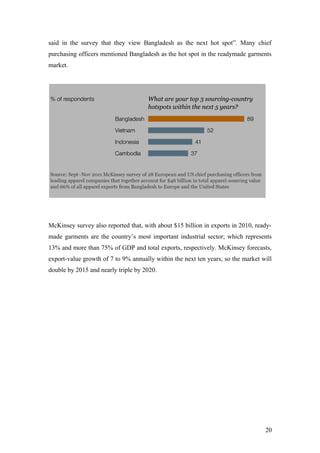
.Also they said in that survey, “Western buyers are evaluating a considerable number
of sourcing options in the Far East and Southeast Asia, many chief purchasing officers
19
said in the survey that they view Bangladesh as the next hot spot”. Many chief
purchasing officers mentioned Bangladesh as the hot spot in the readymade garments
market.
McKinsey survey also reported that, with about $15 billion in exports in 2010, ready-
made garments are the country’s most important industrial sector; which represents
13% and more than 75% of GDP and total exports, respectively. McKinsey forecasts,
export-value growth of 7 to 9% annually within the next ten years, so the market will
double by 2015 and nearly triple by 2020.
20
15. Conclusion:
Garment Sector plays an important role in the overall development of Bangladesh.
However, findings of the present study indicate that abuse of political and economic
power in the expansion and operation of business and interplay of government and
private sector irregularities and corruption have created a tendency to make excessive
profit and barriers to ensuring workers’ rights. Above all, this has been working as a
catalyst to create a long-term trap for creating conditions recurring fatal accidents
killing workers en masse. Unrest in this sector should not be treated as accident rather
it is the outcome of irregularities and corruption of relevant institutions and
stakeholders, their lack of transparency, accountability and responsiveness. Overall it
is the outcome of governance failure of this sector. To overcome these irregularities
and corruption, concerted efforts are needed and every concerned stakeholder has to
come forward to ensure proper expansion and sustainable development of this sector.
Based on the findings and observations of this research, following recommendations
are proposed to overcome governance problems in this sector.
It’s a prime duty for us to provide a perfect working place for the readymade
garments sector of Bangladesh which has given our economy a strong footing, created
jobs for millions of people, especially for women, lifted them from the abyss of
chronic poverty and given them a magnificent life. Now what we have needed to do is
dealing with all the challenges facing our readymade garments industry, paving the
way for its further development.
21

Macro Environment assignment

  • 1.
    1. Introduction: Ready-made garmentsare mass-produced finished textile products of the clothing industry. They are not custom tailored according to measurements, but rather generalized according to anthropometric studies. They are made from many different fabrics and yarns. Their characteristics depend on the fibres used in their manufacture. Ready-made garments are divided into the following types: Outer clothing: work wear and uniform, leisure wear, sportswear, suits, blouse, blazers, jackets, cardigans, pullovers, coats, sports jackets, skirts, shirts, ties, jeans, shorts, T- shirts, Underclothing, jersey goods, lingerie. Bangladesh, the southern Asian country has a population of approximately 164 million people. The economy of Bangladesh is significantly dependent on agriculture. But its a great news for the country that, readymade garments (RMG) sector of Bangladesh has raised as the biggest earner of foreign currency. This sector creates about 4.2 million employment opportunities and contributes significantly to the GDP. Readymade garments (RMG) of Bangladesh are powered by young, urbanizing, workers, where most of them are women. 2. Objective of the Study: The objective of the study is to analyses problems and prospects of RMG sector at Bangladesh. The broad objectives of the study are as follows • To focus over garments industries- prospect. • To find out the competitiveness of RMG sector. • To analysis the existing problems. • To define possible solutions of above problems. • To brief the present situations with valid data. 3. Methodology The study has been conducted mainly following qualitative methods. Data was collected from secondary sources. Secondary data included government reports, court judgments, national and international treaties, conventions, books, articles, research papers, relevant laws and rules, various news reports from print and electronic media. 1
  • 2.
    4. About ReadymadeGarment (RMG) Industry of Bangladesh: The readymade garments industry acts as a catalyst for the development of Bangladesh. The "Made in Bangladesh" tag has also brought glory for the country, making it a prestigious brand across the globe. Bangladesh, which was once termed by cynics a "bottomless basket”, has now become a "basket full of wonders." The country with its limited resources has been maintaining 6% annual average GDP growth rate and has brought about remarkable social and human development. After the independence in 1971, Bangladesh was one of poorest countries in the world. No major industries were developed in Bangladesh, when it was known as East Pakistan, due to discriminatory attitude and policies of the government of the then West Pakistan. So, rebuilding the war-ravaged country with limited resources appeared to be the biggest challenge. The industry that has been making crucial contribution to rebuilding the country and its economy is none other than the readymade garment (RMG) industry which is now the single biggest export earner for Bangladesh. The sector accounts for 81% of total export earnings of the country. 5. History of Readymade Garments industry: The first ready-made garment factory was established in New York in 1831. During the American Civil War the need for ready-made uniforms helped the garment sector grow in the United States. Near the end of the nineteenth century there were changes in societal views towards ready-made garments: They were no longer seen as only for the lower classes but also for the middle classes. This trend started in the United States. In the beginning they were more popular with men than women. In the late 1860s 25% percent of garments produced in the US was ready-made but by 1890 the portion had risen to 60%. By 1951 90% percent of garments sold in the United States were ready made. During the same time two-thirds of garments sold in France was ready made. Once the cloth of Bangladesh achieved worldwide fame specially Muslim and jamdani cloth or our country was used as the luxurious garments of the royal figures in Europe and other countries. The British rulers in India did not develop our cloth 2
  • 3.
    industries at all.Rather they destroyed them and imported cloths from England. Garment Industry Large-scale production of readymade garments (RMG) in organized factories is a relatively new phenomenon in Bangladesh. Until early sixties, individual tailors made garments as per specifications provided by individual customers who supplied the fabrics. The domestic market for readymade garment, excepting children wears and men's knit underwear (genji) was virtually non-existent in Bangladesh until the sixties. Since the late 1970s, the RMG industry started developing in Bangladesh primarily as an export-oriented industry although; the domestic market for RMG has been increasing fast due to increase in personal disposable income and change in life style. The sector rapidly attained high importance in terms of employment, foreign exchange earnings and its contribution to national economy. Most importantly, the growth of RMG sector produced a group of entrepreneurs who have created a strong private sector. Of these entrepreneurs, a sizeable number is female. A woman entrepreneur established one of the oldest export-oriented garment factories, the Baishakhi Garment in 1977. Many women hold top executive positions in RMG industry. The hundred percent export-oriented RMG industry experienced phenomenal growth during the last 15 or so years. In 1978, there were only 9 export- oriented garment manufacturing units, which generated export earnings of hardly one million dollar. Some of these units were very small and produced garments for both domestic and export markets. Four such small and old units were Reaz Garments, Paris Garments, Jewel Garments and Baishakhi Garments. Reaz Garments, the pioneer, was established in 1960 as a small tailoring outfit, named Reaz Store in DHAKA. It served only domestic markets for about 15 years. In 1973 it changed its name to M/s Reaz Garments Ltd. and expanded its operations into export market by selling 10,000 pieces of men's shirts worth French Franc 13 million to a Paris-based firm in 1978. It was the first direct exporter of garments from Bangladesh. Desh Garments Ltd, the first non-equity joint-venture in the garment industry was established in 1979. Desh had technical and marketing collaboration with Daewoo Corporation of South Korea. It was also the first hundred percent export-oriented company. It had about 120 operators including 3 women trained in South Korea, and 3
  • 4.
    with these trainedworkers it started its production in early 1980. Another South Korean Firm, Youngones Corporation formed the first equity joint-venture garment factory with a Bangladeshi firm, Trexim Ltd. in 1980. Bangladeshi partners contributed 51% of the equity of the new firm, named Youngones Bangladesh. It exported its first consignment of padded and non-padded jackets to Sweden in December 1980. Till the end of 1982, there were only 47 garment manufacturing units. The breakthrough occurred in 1984-85, when the number of garment factories increased to 587. The number of RMG factories shot up to around 2,900 in 1999. Bangladesh is now one of the 12 largest apparel exporters of the world, the sixth largest supplier in the US market and the fifth largest supplier of T-shirts in the EU market. The industry has grown during the 1990s roughly at the rate of 22%. At present there are about 5000 garment industries in the country and 75 percent of them are in Dhaka. The rest are in Chittagong and Khulna. These Industries have employed fifty lacks of people and 85 percent of them are illiterate rural women. About 76 percent of our export earning comes from this sectors. The country's RMG sector, to a creditable level has relieved Bangladesh from over populous unemployment burden through providing the largest employment next to agriculture, transport, and trade and industry sector. This sector has uplifted the neglected section of the population, thus radically transforming the socio-economic condition of the country. Such empowerment and employment raised awareness regarding children education, health safety, population control disaster management only so for. It is an epoch making event in the history of Bangladesh. 6. Prospects of readymade Garments (RMG) in Bangladesh: The prospects of garments industry at Bangladesh are very promising. In the 1980's, there were only 50 factories employing only a few thousand people. Currently, there are 4490 manufacturing units. The RMG sector contributes around 76 percent to the total export earnings. In 2007 it earned $9.35 billion. This sector also contributes around 13 percent to the GDP, which was only around 3 percent in 1990 Of the estimated 4.2 million people employed in this sector, about 50 percent of them are women from rural areas. 4
  • 5.
    In 2000, theindustry consisting of some 3000 factories employed directly more than 1.5 million workers of whom almost 80% were female. USA is the largest importer of Bangladeshi RMG products, followed by Germany, UK, France and other E.U countries. The RMG industry of Bangladesh has expanded dramatically over the last three decades. Traditionally, the jute industry dominated the industrial sector of the country until the 1970s. Since the early 1980s, the RMG industry has emerged as an important player in the economy of the country and has gradually replaced the jute industry. In Bangladesh the RMG sector is one of the most profitable sectors in recent years. For this reason most of the people of our country are very much interested about this sector. As a result in now days in our country there are some successful RMG are introduce which can compute the foreign buying house in international market. They already bit some of the successful RMG in another country. It is a good sign for Bangladesh that The Fashion Designing profession has recently emerged as one of the most demandable careers among the youth. These young folks have their own creative style of dressing and belief in setting a trend rather than following a trend set by others. A career in fashion design not only involves meeting glamorous people and interacting with rich and famous but also gives an impetus to the creative flair of the people who possess a sense of style. But still Bangladesh is struggling to establish a standard in fashion design for international market. For Bangladesh, the readymade garment export industry has been the proverbial goose that lays the golden eggs for over fifteen years now. The sector now dominates the modern economy in export earnings, secondary impact and employment generated. The events in 1998 serve to highlight the vulnerability of this industry to both internal and external shocks on the demand and supply side. Given the dominance of the sector in the overall modern economy of Bangladesh, this vulnerability should be a matter of some concern to the policymakers in Bangladesh. Although in gross terms the sector’s contributions to the country’s export earnings is around 74 percent, in net terms the share would be much less partially because the backward linkages in textile have been slow to develop. The dependence on a single sector, no matter how resilient or sturdy that sector is, is a matter of policy concern. We believe the policymakers in Bangladesh should work to 5
  • 6.
    reduce this dependenceby moving quickly to develop the other export industries using the lessons learned from the success of apparel exports. Support for the apparel sector should not be reduced. In fact, another way to reduce the vulnerability is to diversify the product and the market mix. It is heartening to observe that the knit products are rapidly gaining share in overall garment exports as these products are sold in quota-free markets and reflect the strength of Bangladeshi producers in the fully competitive global apparel markets. 7. Present Situation of RMG Sector in Bangladesh: Bangladesh earns nearly $7 billion a year by exporting textile products, mainly to Europe and the United States. This is about 70 percent of total export earnings of the country. The RMG industry has around 4,000 units across the country. It employs around 2.5 million workers, 90 percent of whom are poor women. Whenever the country is criticized for its high level of corruption and confrontational politics, its garment industry is held up as a success story. Quota system was a great blessing for establishing our garments industry. We were strongly benefited by using that. As a result we can see a matured garments industry today. But while quota system was approaching to an end in 2004, there’s so many got upset about the RMG sector of Bangladesh. Though in the latter it can’t be affected here as the experts were seemed. We conquered the post quota challenges and made that a successful story. In RMG sector of Bangladesh, there are more than 5000 garment factories (private statistics) at the current time, employing more than 12 lack labours, where 85% of the labour force is women. But, according to BGMEA the number of garment factories in Bangladesh around 4000. Now, RMG industry is the countries largest export earner with the value of over $24.49bn of exports in the last financial year. Its a great news for us that, Bangladesh is clearly ahead from other South Asian suppliers in terms of capacity of the ready made garments industry. Though, there are various types of garments are manufactured in Bangladesh, but all the ready made garments are classified into two broad categories, where one is woven products and another one is knitted products. A woven product includes Shirts, Pants and Trousers. On the other hand, knitted product includes T-Shirts, Polo Shirts, 6
  • 7.
    Undergarments, Socks, Stockingsand Sweaters. Woven garments still dominate the export earnings of the country. From BGMEA website its seen that, Day by day knitted items production is increasing in considerable rate and now about 40% export earnings has achieved from knitted products. 8. List of Bangladesh Readymade Garment Manufacturers and Exporters: => AFTEX LIMITED => AGAMI APPARELS LTD. => AGAMI FASHIONS LIMITED => AGRANI SWEATERS LTD. => AG’S APPARELS LTD => AHMED FASHIONS => AHMEDIA GARMENTS (PTE) LTD. => AHSAN FASHIONS LTD. => AHSAN KNITTING LTD. => AIRTEES APPARELS LTD. => A ONE DRESSMAKERS LTD. => A PLUS INDUSTRIES LTD. => A.B. FASHIO WEAR LTD. => A.B. SIDDIQUEE APPARELS LTD. => A.B.C. ATTIRE LTD. => A.B.M APPARELS LTD. => A.B.M. FASHIONS LTD. => A.B.S. GARMENTS LTD. => A.D. ENTERPRISE (GARMENTS DIVISION) => A.F.M. SWEATERS LTD. => A.G. DRESSES LIMITED. => A.H. GARMENTS LTD. => A.J. SUPER GARMENTS LTD. => A.K. KHAN & CO. LTD. (GARMENTS DIV) => A.K.B. FASHIONWEAR (PVT) LTD. => A.K.J. FASHIONS FABRICS LTD. => A.K.M. KNIT WEAR LTD. 7
  • 8.
    => A.M. DESIGNLTD. => A.M.C. GARMENTS LTD. => A.M.K. APPARELS LTD. => A.N. GARMENTS LTD => A.Q.M. APPARELS (PVT) LTD. => A.R. FASHIONS LTD. => A.R. KHAN SIZING & FABRICS LTD. => A.R.A. GARMENTS & TEXTILES LTD. => A.R.B. KNIT WEAR LTD => A.S FASHION LTD. And so on. 9. Contribution of RMG Sector to the National Economy: The role RMG sector in Bangladesh economy is remarkable. It’s seen that, from the last decade, RMG sector contributes to the national economy in considerable rate. About 76% of total export earnings come from RMG sector. From a statistics it’s known that, in FY 2003-04 RMG sector of Bangladesh earned US$ 5,686.06 million, in FY 2004-05 the value was US$ 6,417.67.67 million, in FY 2005-06 the value was US$ 7900.80 million, in FY 2006-07 the value was US$ 9,211.23 million, in FY 2007-08 the value was US$ 10,699.80 million, in FY 2008-09 the value was US$ 12.35 billion and finally in FY 2013-14 the value stands at $24.49billion. 8
  • 9.
    10. Opportunity ofRMG Sector in Bangladesh: RMG sector of Bangladesh has some key factors which inspired for steady growth of this sector. Though its a matter of great surprising for so many that how RMG sector of Bangladesh continues to show its robust performance in the world. The main key factors which have great influence on RMG sector of Bangladesh are in the following: • Vast labour force, • Skilled human resources, • Technological upgrades, • Government supports for textile and clothing, • Special economic/export processing zones, • Creation of textile and clothing villages, • Incentive for use of local inputs, • Duty reduction for the import of inputs/machines, • Income tax reduction, and • International supports like GSP, GSP+, duty free access etc. By using the above key points we can easily take place the world’s readymade garments market very strongly. But there’s some another key factors. If we apply those key factors in our readymade garments sector, then we will achieve the first priority to the worlds famous buyers note book. Those key factors are- • Cost Effective Strategy, • New Product Development strategy, • Product Diversification Strategy and • Market Diversification Strategy. All the above points are discussed in the below: Cost Effective Strategy: Cost Effective Strategy includes the following two key points: • Cost Reduction Strategy and • Labour Productivity Improvement. Those key points are discussed in the below: 9
  • 10.
    10.1. Cost ReductionStrategy: Cost reduction strategy should begin with assigning the highest priority for establishing backward linkages. The establishment of backward linkages will reduce our dependence on foreign sources which will reduce the total and average production cost of garments. This Strategy will make our products more competitive in the world’s ready made garments market. 10.2. Labour Productivity Improvement: Bangladeshi workers are not efficient as of Hong Kong, South Korea and Sri Lankan workers. Wages are low in Bangladesh, but it does not necessarily mean that relatively low wages workers automatically lead to higher productivity. So, to keep place in the world’s largest competitive market, labor productivity must be improved. 10.3. New Product Development strategy: Its a matter of great sorrow for us that, we are regularly produced the same products. Our product categories are very less in quantities. Our product items that are exported into foreign market are Shirts-60%, Jackets-11%, Knit items-10%, Trousers-7% and Others-11.50%. To survive in the worlds most competitive RMG market, we have to develop new product items with a lot of variations. 10.4. Product Diversification Strategy: Product Diversification Strategy is an important factor to keep place in the worlds ready made garments market. Different types of products should be produced by applying fashion. Thailand, China, India, Pakistan, Hong Kong, Singapore, Malaysia, Indonesia and others are the main competitors of Bangladesh. They are already ahead of Bangladesh in product diversification strategy areas. 10.5. Market Diversification Strategy: Bangladesh has exported their products in the worlds limited market. Mostly are in USA, Canada and Europe. About 46% of its total garment exports goes to USA, 14% to the Canada and rest of those into the European market. The competitors of 10
  • 11.
    Bangladesh are regularlyexpands their markets and keep changing their products by using fashion. The following key factors must be undertaken during market diversification strategy: • Market research on product design • Market research on product development, • Market promotion through trade fairs, exhibition, etc. • Human resources development by providing training. 11. Problems surrounding readymade garments sector: The garment industry of Bangladesh has been the key export division and a main source of foreign exchange for the last 25 years. National labor laws do not apply in the EPZs, leaving BEPZA in full control over work conditions, wages and benefits. Garment factories in Bangladesh provide employment to 40 percent of industrial workers. But without the proper laws the worker are demanding their various wants and as a result conflict is began with the industry, 11.1. Raw materials: Bangladesh imports raw materials for garments like cotton, thread color etc. This dependence on raw materials hampers the development of garments industry. Moreover, foreign suppliers often supply low quality materials, which result in low quality products 11.2. Unskilled workers: Most of the illiterate women workers employed in garments are unskilled and so their products often become lower in quality. 11.3. Improper working environment: Taking the advantages of workers’ poverty and ignorance the owners forced them to work in unsafe and unhealthy work place overcrowded with workers beyond capacity of the factory floor and improper ventilation. Most of the garment factories in our country lack the basic amenities where our garment workers sweat their brows from morning to evening to earn our countries the 11
  • 12.
    major portion ofour foreign exchange. Anybody visiting the factory the first impression he or she will have that these workers are in a roost. Improper ventilation, stuffy situation, filthy rooms are the characteristics of the majority of our factories. The owners profit are the first priority and this attitude has gone to such an extent that they do not care about their lives. 11.4. Lack of managerial knowledge: There are some other problems which are associated with this sector. Those are- lack of marketing tactics, absence of easily on-hand middle management, a small number of manufacturing methods, lack of training organizations for industrial workers, supervisors and managers, autocratic approach of nearly all the investors, fewer process units for textiles and garments, sluggish backward or forward blending procedure, incompetent ports, entry/exit complicated and loading/unloading takes much time, time-consuming custom clearance etc. 11.5. Gendered division of labour: In the garment industry in Bangladesh, tasks are allocated largely on the basis of gender. This determines many of the working conditions of women workers. All the workers in the sewing section are women, while almost all those in the cutting, ironing and finishing sections are men. Women workers are absorbed in a variety of occupations from cutting, sewing, inserting buttons, making button holes, checking, cleaning the threads, ironing, folding, packing and training to supervising. Women work mainly as helpers, machinists and less frequently, as line supervisors and quality controllers. There are no female cutting masters. Men dominate the administrative and management level jobs. Women are discriminated against in terms of access to higher-paid white collar and management positions. When asked why they prefer to amply women foe sewing, the owner and managers gave several reasons. Most felt that sewing is traditionally done by women and that women are more patient and more controllable than men. 11.6. Wages: The government of Bangladesh sets minimum wages for various categories of workers. According of Minimum Wage Ordinance 1994, apprentices’ helpers are to receive Tk500 and Tk930 per month respectively. Apprentices are helpers who have 12
  • 13.
    been working inthe garment industry for less than three months. After three months, Apprentices are appointed as helpers. Often female helpers are discriminated against in terms of wages levels, and these wages are also often fixed far below the minimum wage rate. A survey conducted in 1998 showed that 73% of female helpers, as opposed to 15% of their male counterparts, did not receive even the minimum wage. 11.7. Insufficient of loan: Insufficiency of loan in time, uncertainly of electricity, delay in getting materials, lack of communication, problem in taxes etc. Often obstruct the industry. In the world market 115 to 120 items of dress are in demand where as Bangladesh supplies only ten to twelve items of garments. India, South Korea, Hong Kong, Singapore, Thailand, Taiwan etc, have made remarkable progress in garments industries. Bangladesh is going to challenge the garments of those countries in the world market. 11.8. Unit labour cost: Bangladesh has the cheapest unit labour cost in South Asia. It costs only 11 cents to produce a shirt in Bangladesh, whereas it costs 79 cents in Sri Lanka and 26 cents in India. Clearly, Bangladesh’s comparative advantage lies in having the cheapest unit labour cost. 11.9. Working hours: Though the wages are low, the working hours are very long. The RMG factories claim to operate one eight-hour shift six days a week. The 1965 factory Act allows women to work delivery deadlines; however, women are virtually compelled to work after 8 o’clock. Sometimes they work until 3 o’clock in the morning and report back to start work again five hours later ar 8 o’clock. They are asked to work whole months at a time the Factory Act, which stipulates that no employee should work more than ten days consecutively without a break. 11.10. Poor accommodation facilities: As most of the garment workers come from the poor family and comes from the remote areas and they have to attend to the duties on time, these workers have to hire a room near the factory where four to five huddle in a room and spend life in sub human condition. 13
  • 14.
    For four tofive workers there is one common latrine and a kitchen for which they have to pay from Tk= 2000 to Tk=2500/-.They share this amount among themselves to minimize the accommodation expense. One cannot believe their eyes in what horrible condition they have to pass out their time after almost whole day of hard work in the factory. After laborious job they come into their roost, cook their food and have their dinner or lunch in unhygienic floor or bed and sleep where they take their food. They share the single bed or sleep on the floor. The owners of these factories must not treat the workers as animals. The owners of these factories who drive the most luxurious car and live in most luxurious house do ever think that these are the workers who have made their living so juicy. Will these selfish owners ever think of these workers of their better living for the sake of humanity by providing better accommodation for these workers in addition to providing with the job. 11.10.1. Safety Problems: Because of the carelessness of the factory management and for their arrogance factory doors used to be kept locked for security reason defying act. Safety need for the worker is mandatory to maintain in all the organization. But without the facility of this necessary product a lot of accident is occur incurred every year in most of the company. Some important cause of the accident are given below- 11. Routes are blocked by storage materials 12. Machine layout is often staggered 13. Lack of signage for escape route 14. No provision for emergency lighting 15. Doors, opening along escape routes, are not fire resistant 16. Doors are not self-closing and often do not open along the direction of escape 17. Adequate doors as well as adequate staircases are not provided to aid quick exit 18. Fire exit or emergency staircase lacks proper maintenance 19. Lack of proper exit route to reach the place of safety 20. Parked vehicles, goods and rubbish on the outside of the building obstruct exits to the open air 14
  • 15.
    21. Fire ina Bangladesh factory is likely to spread quickly because the principle of compartmentalization is practiced 12. Challenges for RMG Sector of Bangladesh: Though RMG sector of Bangladesh has achieved the second spot for the highest number of garments exporter, but it has a lot of problems. The major problems faced by RMG sector currently is the lack of safety in working place and working conditions for the millions of garments workers. It’s become a great challenge for the upcoming financial year of Bangladesh. Another important one is political stability. Two major incidents in RMG sector of Bangladesh are the Tazreen fire and the Rana Plaza collapse, which have brought the issue of workplace safety to the fore and led all stakeholders to act accordingly. But it’s good news for RMG sector that, following the unfortunate incidents, various platforms such as the Bangladesh Accord on Fire and Building Safety, the Alliance for Bangladesh Worker Safety and National Plan of Action have been formed to improve building and fire safety of Bangladesh’s garment industry. Also BGMEA and BKMEA are working together here to solve such kinds of problems. They have also taken necessary actions and invested huge amount of money. It’s a huge responsibility for the government of Bangladesh to ensure working place safety in all the garments manufacturing factories. If we can’t do it, foreign buyers will refuse to place order here, which will be a massive blow for RMG sector of Bangladesh. We hope, the government of Bangladesh, BGMEA and BKMEA, with the support of global brands and international development partners, will be able to ensure the safety of the RMG industry and maintain the momentum of socio- economic development in the country. Political stability creates a negative impact on RMG sector of Bangladesh. If it continues, it will be a massive blow to destroy our most valuable sector. So, political leaders should come out immediately to solve such kinds of problems. 15
  • 16.
    13. Recommendations ofReadymade Garments Problems: In addition to the substantial contribution to the economic arena, the social contribution of the garments sector has also been significant. It has provided employment to about three million workers, the majority of whom are young, poor and illiterate women. But there is a dark twist to this feel-good storyline. The RMG sector is going through severe turbulence. The series of recent clashes between law enforcers and garment workers is symptomatic of an unfolding crisis in the industry and puts it at risk of losing its competitive edge in the global market. Each violent incident has overtaken the other in scale and consequences. In the wake of the recent incident in Ashulia, the Bangladesh Garment Manufacturers and Exporters Association (BGMEA) decided to shut down hundreds of factories in the area. The factories opened only after receiving assurance from the government that their security would be ensured. The grievances of the workers are genuine. In the absence of an appropriate formal channel to air grievances and seek redress, the only avenues open to the RMG workers are street protest, picketing, or gherao of a manager's office or a factory. (But questions have also been raised about the actual identity of the unruly people going by the name of workers, who have been causing havoc on the factories that provide them with their means of livelihood.) So far, the government has largely left the RMG sector to its devices. But, given the recent incidents, the government has announced that it will be formulating a labour policy and set a minimum wage for the garment workers; a move that was long overdue. A cursory analysis of the labour legislation and a review of the institutions show that the incidents of violence in the garment industry stem largely from legal and institutional failures in the sector: Reviewing and amending provisions of the labour act: The Bangladesh Labour Act, 2006 allows the owner to close the factory without having to inform an authority in advance. This legal provision goes against the international best practice that 16
  • 17.
    stipulates that acompany must follow three steps before it declares a lay off; giving its workers at least one month's notice, publishing that notice in newspapers, and sending the notice to the inspector of labour. The Labour Act, 2006 needs to be amended to protect workers' rights and to facilitate the process through formal and legal channels. . Strengthening oversight and regulatory institutions: Most garment factories do not follow the labour law and ILO conventions. The Labour Act, 2006 clearly stipulates that the wages of a worker must be paid within seven workings days of the completion of the stipulated wage period [Section 123 (1)]. This is not followed in practice. In addition, some of the factories do not provide appointment letters/contract letters, identity cards and service books. Health safety and security condition are also not sufficient. The Act has also empowered the Office of the Chief Inspector of Factories of the Ministry of Labour and Employment to investigate compliance of the factories with the Labour Act and report any violation of the Act to the Labour Court (Section 319). However, it is severely constrained by lack of capacity and qualified personnel. Most of the RMG workers are illiterate and do not have any knowledge about workers' rights and labour laws, and cannot ensure the compliance of the laws on their own. A key challenge, therefore, is to carry out awareness programs for workers on rights and entitlements. Partnerships with civil society organisations, especially those working on labour rights, could be effective. There is no stipulated national norm for minimum wage. The current minimum wage of a garment worker is Tk.1,664 per month. It was set in 2006 and has not been adjusted for inflation. If it had been adjusted for inflation (around 7%), the wage would have increased to Tk.2,334. The workers are presently demanding a minimum monthly salary of Tk.5,000 and other financial benefits. The Minimum Wage Board of the Ministry of Labour and Employment needs to review the wages of the workers after every three years and ensure that, at a minimum, the cost of living adjustments are made by the factories. There should also 17
  • 18.
    be a provisionof annual inflation adjustment. At 22 cents per hour, Bangladesh has the lowest labour costs in the world, lower than Cambodia, Pakistan and Vietnam, where the wages are 33 cents, 37 cents and 38 cents, respectively. The labour cost (including wages, social charges, and a series of bonuses), however, is not the only factor for sourcing decisions. Other factors include labour productivity, quality and cost of available textile materials, energy prices, lead times, services offered to apparel importers or brands, import tariff rates in Europe or the United States, cost of freight, etc. While it is accepted that cheap labour has been the major reason why Bangladesh remains competitive in the international arena, it may be high time to improve factors such as labour productivity to increase the industry's competitiveness. Ensuring workers security: Given the recurring violence, regular security vigilance in the industrial areas is necessary. In India, there is a multi-skilled security agency, Central Industrial Security Force (CISF), set up in 1969, which provides integrated security cover to both public sector and private sector undertakings. The government of Bangladesh has a plan to form an industrial police force under the Ministry of Home Affairs and deploy it in four major industrial zones -- Ashulia, Savar, Gazipur, and Narayanganj. However, the formation of the industrial police without ensuring appropriate workers' rights may put the workers' safety at risk. In order to protect their interests, a counter- balancing community-based committee should be formed, consisting of local law makers, community leaders, workers' representatives, owners' representatives, and local administration to facilitate security of workers and factories, monitor ecological impact, and resolve disputes locally. Is trade union really an option? In the absence of a comprehensive labour act and strong office of chief inspector, another option that has been explored has been the formation of a strong trade union to protect workers' rights. The Bangladesh Labour Act, 2006 allows trade unions for both workers and owners. The Act has laid down, in detail, the registration, membership, code of conduct of 18
  • 19.
    members and officialsof trade unions. The government made a decision, in principle, to introduce trade unionism in garments sector in the aftermath of last year's bloody incident at Nippon Garments, and formed a committee for this purpose. Currently, there are several registered trade union federations and alliances for garment workers. The noteworthy ones include the National Garments Workers' Federation and the Bangladesh Garment Workers' Unity Council. But despite the existence of those, the trade union movement in garments sector has been very weak. Trade union activities in the garment factories are usually strictly prohibited. Many garment workers lose their jobs because they try to join, or form, trade unions. The garment manufacturers fear, rightly or wrongly, that trade unions may lead to an unhealthy collusion between political parties and trade unions, which, in turn, would hamper improvements in productivity and work environments. The owners also fear that the trade unions will hamper the low wage employment, which is vital for maintaining Bangladesh's competitiveness in the international arena. The provisions in the Labour Act relating to joining and membership within trade unions must be reviewed with consideration for sufficient safeguards for the industries as well as the workers. In conclusion, institutional and regulatory steps must be taken that ensure the competitiveness of the sector and also guarantee that workers' voices are heard. It is hoped that the labour policy that is being drafted will take the institutional and regulatory points into consideration. 14. Hoping for RMG Sector of Bangladesh: According to a foreign survey, it’s seen that 86 percent of the chief purchasing officers in leading apparel companies in Europe and the United States planned to decrease levels of sourcing in China over the next five years because of declining profit margins and capacity constraints .Also they said in that survey, “Western buyers are evaluating a considerable number of sourcing options in the Far East and Southeast Asia, many chief purchasing officers 19
  • 20.
    said in thesurvey that they view Bangladesh as the next hot spot”. Many chief purchasing officers mentioned Bangladesh as the hot spot in the readymade garments market. McKinsey survey also reported that, with about $15 billion in exports in 2010, ready- made garments are the country’s most important industrial sector; which represents 13% and more than 75% of GDP and total exports, respectively. McKinsey forecasts, export-value growth of 7 to 9% annually within the next ten years, so the market will double by 2015 and nearly triple by 2020. 20
  • 21.
    15. Conclusion: Garment Sectorplays an important role in the overall development of Bangladesh. However, findings of the present study indicate that abuse of political and economic power in the expansion and operation of business and interplay of government and private sector irregularities and corruption have created a tendency to make excessive profit and barriers to ensuring workers’ rights. Above all, this has been working as a catalyst to create a long-term trap for creating conditions recurring fatal accidents killing workers en masse. Unrest in this sector should not be treated as accident rather it is the outcome of irregularities and corruption of relevant institutions and stakeholders, their lack of transparency, accountability and responsiveness. Overall it is the outcome of governance failure of this sector. To overcome these irregularities and corruption, concerted efforts are needed and every concerned stakeholder has to come forward to ensure proper expansion and sustainable development of this sector. Based on the findings and observations of this research, following recommendations are proposed to overcome governance problems in this sector. It’s a prime duty for us to provide a perfect working place for the readymade garments sector of Bangladesh which has given our economy a strong footing, created jobs for millions of people, especially for women, lifted them from the abyss of chronic poverty and given them a magnificent life. Now what we have needed to do is dealing with all the challenges facing our readymade garments industry, paving the way for its further development. 21