To get more info, Please Contact Us : – +1 (315)557-6473 or
Visit : – www.economicshomeworkhelper.com
E-Mail : – info@economicshomeworkhelper.com
economicshomeworkhelper.com
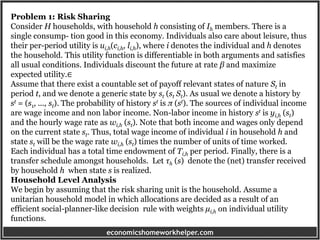
Problem 1: Risk Sharing
Consider H households, with household h consisting of Ih members. There is a
single consump- tion good in this economy. Individuals also care about leisure, thus
their per-period utility is ui,h(ci,h, li,h), where i denotes the individual and h denotes
the household. This utility function is differentiable in both arguments and satisfies
all usual conditions. Individuals discount the future at rate β and maximize
expected utility.∈
Assume that there exist a countable set of payoff relevant states of nature St in
period t, and we denote a generic state by st (st St). As usual we denote a history by
st = (s1, ..., st). The probability of history st is π (st). The sources of individual income
are wage income and non labor income. Non-labor income in history st is yi,h (st)
and the hourly wage rate as wi,h (st). Note that both income and wages only depend
on the current state st. Thus, total wage income of individual i in household h and
state st will be the wage rate wi,h (st) times the number of units of time worked.
Each individual has a total time endowment of Ti,h per period. Finally, there is a
transfer schedule amongst households. Let τh (s) denote the (net) transfer received
by household h when state s is realized.
Household Level Analysis
We begin by assuming that the risk sharing unit is the household. Assume a
unitarian household model in which allocations are decided as a result of an
efficient social-planner-like decision rule with weights µi,h on individual utility
functions.
economicshomeworkhelper.com
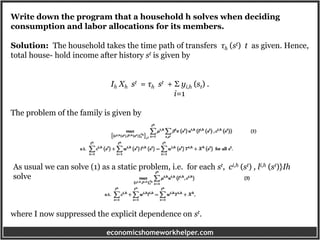
Write down the program that a household h solves when deciding
consumption and labor allocations for its members.
Solution: The household takes the time path of transfers τh (st) t as given. Hence,
total house- hold income after history st is given by
Ih Xh st = τh st + Σ yi,h (st) .
i=1
The problem of the family is given by
As usual we can solve (1) as a static problem, i.e. for each st, ci,h (st) , li,h (st)}Ih
solve
where I now suppressed the explicit dependence on st.
economicshomeworkhelper.com
Characterize the solution to the allocation problem. Please be explicit
on which variables ci,h and li,h depend. Provide a precise intuition why
the solution depends on those variables (and why not on some others).
Let Ī» be the multiplier on the constraint.
The necessary conditions for this problem are
µi,hui,h li,h, ci,h = λ
µi,hui,h li,h, ci,h = λwi,h.
Hence, the allocation between consumption and leisure is given by
ui,h (li,h, ci,h ) = wi,h
ui,h (li,h, ci,h)
and the consumption allocation across households is given by
µi,hui,h li,h, ci,h = µg,hug,h lg,h, cg,h
From (7) we can express leisure as an individual-specific function of consumption
and the wage rate, i.e.
Hence, we can express (4) as
li,h = φi,h ci,h, wi,h . .
economicshomeworkhelper.com
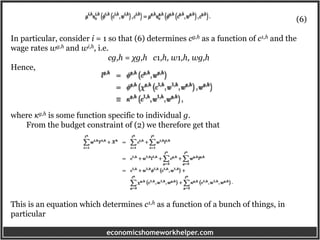
(6)
In particular, consider i = 1 so that (6) determines cg,h as a function of c1,h and the
wage rates wg,h and wi,h, i.e.
cg,h = χg,h c1,h, w1,h, wg,h
Hence,
where Īŗg,h is some function specific to individual g.
From the budget constraint of (2) we therefore get that
This is an equation which determines c1,h as a function of a bunch of things, in
particular
economicshomeworkhelper.com
i.e. consumption depends on all wage rates [w1,h, ..., wI ,h ] and total income
Ī£ih
i=1wi,hTi,h+Xh.
That consumption only depends on total income and not on its individual
components is the usual
result. However, now consumption depends on all wage rates of household
members. This is due to the leisure-labor choice encapsulated in (7).
With your answer to the previous question in mind: what do you think
of the usual risk sharing regressions? Why might a significant effect of
individual income in the consumption regression not be informative
about the absence of risk-sharing?
Solution: This model suggests, that individual income depends on total income
and all wage rates. In particular: if consumption and leisure are substitutes (i.e. the
marginal utility of consumption is high if leisure is low), individual consumption
will be positively related to the wage rate - if wages are high, the individual should
work and hence receive consumption due to the complementarity. If the wage rate
is positively correlated with personal income, we will find in a regression that
personal income is correlated with consumption conditional on aggregate income.
This however, is an implication of optimal risk sharing.
economicshomeworkhelper.com
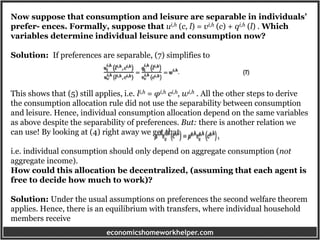
Now suppose that consumption and leisure are separable in individuals’
prefer- ences. Formally, suppose that ui,h (c, l) = vi,h (c) + qi,h (l) . Which
variables determine individual leisure and consumption now?
Solution: If preferences are separable, (7) simplifies to
This shows that (5) still applies, i.e. li,h = φi,h ci,h, wi,h . All the other steps to derive
the consumption allocation rule did not use the separability between consumption
and leisure. Hence, individual consumption allocation depend on the same variables
as above despite the separability of preferences. But: there is another relation we
can use! By looking at (4) right away we get that
i.e. individual consumption should only depend on aggregate consumption (not
aggregate income).
How could this allocation be decentralized, (assuming that each agent is
free to decide how much to work)?
Solution: Under the usual assumptions on preferences the second welfare theorem
applies. Hence, there is an equilibrium with transfers, where individual household
members receive
economicshomeworkhelper.com
endowments ei,h and then either trade in Arrow-Debreu markets for state-
contingent commodities or simply have a full set of state-contingent one-period
assets and markets for labor and the consumption good are open in each state st.
Does individual labor supply of agent i in household h depend on wages
and incomes of individuals in the household? Why or why not?
Solution: As clearly seen from above: individual labor supply is given by
income (conditional on aggregate income ΣIh wi,hTi,h+Xh). The intuition that the
wages of other individuals determine labor supply is the same as for consumption:
with non-separable preferences pareto-optimality requires that marginal utilities
of consumption are equalized. As this marginal utility depends on individual
leisure, the labor allocations depend on the distribution of wages in the economy.
For information about citing these materials or our Terms of
Use, visit:
https://www.economicshomeworkhelper.com/

Macro Development.pptx

  • 1.
    To get moreinfo, Please Contact Us : – +1 (315)557-6473 or Visit : – www.economicshomeworkhelper.com E-Mail : – info@economicshomeworkhelper.com
  • 2.
    economicshomeworkhelper.com Problem 1: RiskSharing Consider H households, with household h consisting of Ih members. There is a single consump- tion good in this economy. Individuals also care about leisure, thus their per-period utility is ui,h(ci,h, li,h), where i denotes the individual and h denotes the household. This utility function is differentiable in both arguments and satisfies all usual conditions. Individuals discount the future at rate β and maximize expected utility.∈ Assume that there exist a countable set of payoff relevant states of nature St in period t, and we denote a generic state by st (st St). As usual we denote a history by st = (s1, ..., st). The probability of history st is Ļ€ (st). The sources of individual income are wage income and non labor income. Non-labor income in history st is yi,h (st) and the hourly wage rate as wi,h (st). Note that both income and wages only depend on the current state st. Thus, total wage income of individual i in household h and state st will be the wage rate wi,h (st) times the number of units of time worked. Each individual has a total time endowment of Ti,h per period. Finally, there is a transfer schedule amongst households. Let Ļ„h (s) denote the (net) transfer received by household h when state s is realized. Household Level Analysis We begin by assuming that the risk sharing unit is the household. Assume a unitarian household model in which allocations are decided as a result of an efficient social-planner-like decision rule with weights µi,h on individual utility functions.
  • 3.
    economicshomeworkhelper.com Write down theprogram that a household h solves when deciding consumption and labor allocations for its members. Solution: The household takes the time path of transfers τh (st) t as given. Hence, total house- hold income after history st is given by Ih Xh st = τh st + Σ yi,h (st) . i=1 The problem of the family is given by As usual we can solve (1) as a static problem, i.e. for each st, ci,h (st) , li,h (st)}Ih solve where I now suppressed the explicit dependence on st.
  • 4.
    economicshomeworkhelper.com Characterize the solutionto the allocation problem. Please be explicit on which variables ci,h and li,h depend. Provide a precise intuition why the solution depends on those variables (and why not on some others). Let Ī» be the multiplier on the constraint. The necessary conditions for this problem are µi,hui,h li,h, ci,h = Ī» µi,hui,h li,h, ci,h = Ī»wi,h. Hence, the allocation between consumption and leisure is given by ui,h (li,h, ci,h ) = wi,h ui,h (li,h, ci,h) and the consumption allocation across households is given by µi,hui,h li,h, ci,h = µg,hug,h lg,h, cg,h From (7) we can express leisure as an individual-specific function of consumption and the wage rate, i.e. Hence, we can express (4) as li,h = φi,h ci,h, wi,h . .
  • 5.
    economicshomeworkhelper.com (6) In particular, consideri = 1 so that (6) determines cg,h as a function of c1,h and the wage rates wg,h and wi,h, i.e. cg,h = χg,h c1,h, w1,h, wg,h Hence, where Īŗg,h is some function specific to individual g. From the budget constraint of (2) we therefore get that This is an equation which determines c1,h as a function of a bunch of things, in particular
  • 6.
    economicshomeworkhelper.com i.e. consumption dependson all wage rates [w1,h, ..., wI ,h ] and total income Σih i=1wi,hTi,h+Xh. That consumption only depends on total income and not on its individual components is the usual result. However, now consumption depends on all wage rates of household members. This is due to the leisure-labor choice encapsulated in (7). With your answer to the previous question in mind: what do you think of the usual risk sharing regressions? Why might a significant effect of individual income in the consumption regression not be informative about the absence of risk-sharing? Solution: This model suggests, that individual income depends on total income and all wage rates. In particular: if consumption and leisure are substitutes (i.e. the marginal utility of consumption is high if leisure is low), individual consumption will be positively related to the wage rate - if wages are high, the individual should work and hence receive consumption due to the complementarity. If the wage rate is positively correlated with personal income, we will find in a regression that personal income is correlated with consumption conditional on aggregate income. This however, is an implication of optimal risk sharing.
  • 7.
    economicshomeworkhelper.com Now suppose thatconsumption and leisure are separable in individuals’ prefer- ences. Formally, suppose that ui,h (c, l) = vi,h (c) + qi,h (l) . Which variables determine individual leisure and consumption now? Solution: If preferences are separable, (7) simplifies to This shows that (5) still applies, i.e. li,h = φi,h ci,h, wi,h . All the other steps to derive the consumption allocation rule did not use the separability between consumption and leisure. Hence, individual consumption allocation depend on the same variables as above despite the separability of preferences. But: there is another relation we can use! By looking at (4) right away we get that i.e. individual consumption should only depend on aggregate consumption (not aggregate income). How could this allocation be decentralized, (assuming that each agent is free to decide how much to work)? Solution: Under the usual assumptions on preferences the second welfare theorem applies. Hence, there is an equilibrium with transfers, where individual household members receive
  • 8.
    economicshomeworkhelper.com endowments ei,h andthen either trade in Arrow-Debreu markets for state- contingent commodities or simply have a full set of state-contingent one-period assets and markets for labor and the consumption good are open in each state st. Does individual labor supply of agent i in household h depend on wages and incomes of individuals in the household? Why or why not? Solution: As clearly seen from above: individual labor supply is given by income (conditional on aggregate income ΣIh wi,hTi,h+Xh). The intuition that the wages of other individuals determine labor supply is the same as for consumption: with non-separable preferences pareto-optimality requires that marginal utilities of consumption are equalized. As this marginal utility depends on individual leisure, the labor allocations depend on the distribution of wages in the economy. For information about citing these materials or our Terms of Use, visit: https://www.economicshomeworkhelper.com/