Hire our experts for economics homework
help
To get more info, Please Contact Us : – +1(315)5576473 or
Visit : – www.economicshomeworkhelper.com
E-Mail : – info@economicshomeworkhelper.com
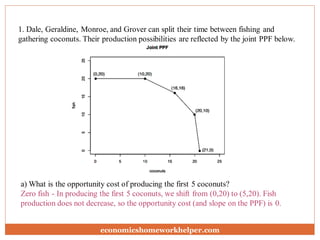
1. Dale, Geraldine, Monroe, and Grover can split their time between fishing and
gathering coconuts. Their production possibilities are reflected by the joint PPF below.
a) What is the opportunity cost of producing the first 5 coconuts?
Zero fish - In producing the first 5 coconuts, we shift from (0,20) to (5,20). Fish
production does not decrease, so the opportunity cost (and slope on the PPF) is 0.
economicshomeworkhelper.com
b) What is the opportunity cost of producing the first 2 fish?
2/10 coconuts - In producing the first 2 fish, we shift from (21,0) to (20.8,2). Coconut
output falls by 0.2. The slope of the last segment is -10, meaning the opportunity cost
of a coconut is 10 fish. This implies the opportunity cost of one fish is 1/10 coconuts.
This opportunity cost doesn’t change for the relevant range here, so the opportunity
cost of 2 fish is 2/10 coconuts.
c) If Geraldine has the second lowest opportunity cost of producing fish, what is her
opportunity cost for gathering one coconut?
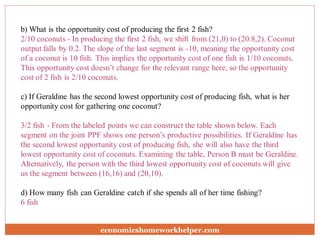
3/2 fish - From the labeled points we can construct the table shown below. Each
segment on the joint PPF shows one person’s productive possibilities. If Geraldine has
the second lowest opportunity cost of producing fish, she will also have the third
lowest opportunity cost of coconuts. Examining the table, Person B must be Geraldine.
Alternatively, the person with the third lowest opportunity cost of coconuts will give
us the segment between (16,16) and (20,10).
d) How many fish can Geraldine catch if she spends all of her time fishing?
6 fish
economicshomeworkhelper.com
2. Nowhereland is an island economy with population of 4 – Alice, Bob, Catherine and
David. Everyday there are two survival activities under the northerly Sea of Ferocity:
catching jellyfish and collecting seaweed. Both activities involve open water diving,
requiring the use of an oxygen tank. Thus, a special kind of capital called “oxygen tank”
is used in the production of these two goods. Each person possesses a different amount of
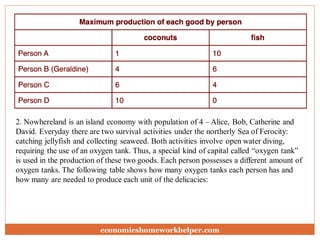
oxygen tanks. The following table shows how many oxygen tanks each person has and
how many are needed to produce each unit of the delicacies:
economicshomeworkhelper.com
Alice Bob Cathy David
Oxygen Tank Possessed
(Tanks)
6 10 8 15
Catching Jellyfish
(Tank/Jellyfish)
1 2 2 5
Collecting Seaweed
(Tank/Seaweed)
3 5 2 3
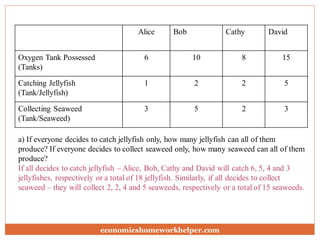
a) If everyone decides to catch jellyfish only, how many jellyfish can all of them
produce? If everyone decides to collect seaweed only, how many seaweed can all of them
produce?
If all decides to catch jellyfish – Alice, Bob, Cathy and David will catch 6, 5, 4 and 3
jellyfishes, respectively or a total of 18 jellyfish. Similarly, if all decides to collect
seaweed – they will collect 2, 2, 4 and 5 seaweeds, respectively or a total of 15 seaweeds.
economicshomeworkhelper.com
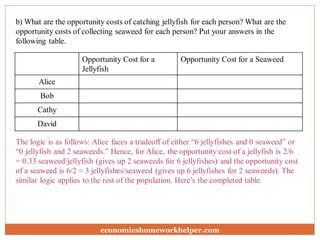
b) What are the opportunity costs of catching jellyfish for each person? What are the
opportunity costs of collecting seaweed for each person? Put your answers in the
following table.
Opportunity Cost for a
Jellyfish
Opportunity Cost for a Seaweed
Alice
Bob
Cathy
David
The logic is as follows: Alice faces a tradeoff of either “6 jellyfishes and 0 seaweed” or
“0 jellyfish and 2 seaweeds.” Hence, for Alice, the opportunity cost of a jellyfish is 2/6
= 0.33 seaweed/jellyfish (gives up 2 seaweeds for 6 jellyfishes) and the opportunity cost
of a seaweed is 6/2 = 3 jellyfishes/seaweed (gives up 6 jellyfishes for 2 seaweeds). The
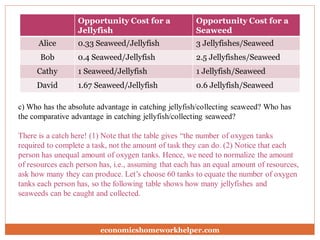
similar logic applies to the rest of the population. Here’s the completed table.
economicshomeworkhelper.com
Opportunity Cost for a
Jellyfish
Opportunity Cost for a
Seaweed
Alice 0.33 Seaweed/Jellyfish 3 Jellyfishes/Seaweed
Bob 0.4 Seaweed/Jellyfish 2.5 Jellyfishes/Seaweed
Cathy 1 Seaweed/Jellyfish 1 Jellyfish/Seaweed
David 1.67 Seaweed/Jellyfish 0.6 Jellyfish/Seaweed
c) Who has the absolute advantage in catching jellyfish/collecting seaweed? Who has
the comparative advantage in catching jellyfish/collecting seaweed?
There is a catch here! (1) Note that the table gives “the number of oxygen tanks
required to complete a task, not the amount of task they can do. (2) Notice that each
person has unequal amount of oxygen tanks. Hence, we need to normalize the amount
of resources each person has, i.e., assuming that each has an equal amount of resources,
ask how many they can produce. Let’s choose 60 tanks to equate the number of oxygen
tanks each person has, so the following table shows how many jellyfishes and
seaweeds can be caught and collected.
economicshomeworkhelper.com

Economics Homework Help

  • 1.
    Hire our expertsfor economics homework help To get more info, Please Contact Us : – +1(315)5576473 or Visit : – www.economicshomeworkhelper.com E-Mail : – info@economicshomeworkhelper.com
  • 2.
    1. Dale, Geraldine,Monroe, and Grover can split their time between fishing and gathering coconuts. Their production possibilities are reflected by the joint PPF below. a) What is the opportunity cost of producing the first 5 coconuts? Zero fish - In producing the first 5 coconuts, we shift from (0,20) to (5,20). Fish production does not decrease, so the opportunity cost (and slope on the PPF) is 0. economicshomeworkhelper.com
  • 3.
    b) What isthe opportunity cost of producing the first 2 fish? 2/10 coconuts - In producing the first 2 fish, we shift from (21,0) to (20.8,2). Coconut output falls by 0.2. The slope of the last segment is -10, meaning the opportunity cost of a coconut is 10 fish. This implies the opportunity cost of one fish is 1/10 coconuts. This opportunity cost doesn’t change for the relevant range here, so the opportunity cost of 2 fish is 2/10 coconuts. c) If Geraldine has the second lowest opportunity cost of producing fish, what is her opportunity cost for gathering one coconut? 3/2 fish - From the labeled points we can construct the table shown below. Each segment on the joint PPF shows one person’s productive possibilities. If Geraldine has the second lowest opportunity cost of producing fish, she will also have the third lowest opportunity cost of coconuts. Examining the table, Person B must be Geraldine. Alternatively, the person with the third lowest opportunity cost of coconuts will give us the segment between (16,16) and (20,10). d) How many fish can Geraldine catch if she spends all of her time fishing? 6 fish economicshomeworkhelper.com
  • 4.
    2. Nowhereland isan island economy with population of 4 – Alice, Bob, Catherine and David. Everyday there are two survival activities under the northerly Sea of Ferocity: catching jellyfish and collecting seaweed. Both activities involve open water diving, requiring the use of an oxygen tank. Thus, a special kind of capital called “oxygen tank” is used in the production of these two goods. Each person possesses a different amount of oxygen tanks. The following table shows how many oxygen tanks each person has and how many are needed to produce each unit of the delicacies: economicshomeworkhelper.com
  • 5.
    Alice Bob CathyDavid Oxygen Tank Possessed (Tanks) 6 10 8 15 Catching Jellyfish (Tank/Jellyfish) 1 2 2 5 Collecting Seaweed (Tank/Seaweed) 3 5 2 3 a) If everyone decides to catch jellyfish only, how many jellyfish can all of them produce? If everyone decides to collect seaweed only, how many seaweed can all of them produce? If all decides to catch jellyfish – Alice, Bob, Cathy and David will catch 6, 5, 4 and 3 jellyfishes, respectively or a total of 18 jellyfish. Similarly, if all decides to collect seaweed – they will collect 2, 2, 4 and 5 seaweeds, respectively or a total of 15 seaweeds. economicshomeworkhelper.com
  • 6.
    b) What arethe opportunity costs of catching jellyfish for each person? What are the opportunity costs of collecting seaweed for each person? Put your answers in the following table. Opportunity Cost for a Jellyfish Opportunity Cost for a Seaweed Alice Bob Cathy David The logic is as follows: Alice faces a tradeoff of either “6 jellyfishes and 0 seaweed” or “0 jellyfish and 2 seaweeds.” Hence, for Alice, the opportunity cost of a jellyfish is 2/6 = 0.33 seaweed/jellyfish (gives up 2 seaweeds for 6 jellyfishes) and the opportunity cost of a seaweed is 6/2 = 3 jellyfishes/seaweed (gives up 6 jellyfishes for 2 seaweeds). The similar logic applies to the rest of the population. Here’s the completed table. economicshomeworkhelper.com
  • 7.
    Opportunity Cost fora Jellyfish Opportunity Cost for a Seaweed Alice 0.33 Seaweed/Jellyfish 3 Jellyfishes/Seaweed Bob 0.4 Seaweed/Jellyfish 2.5 Jellyfishes/Seaweed Cathy 1 Seaweed/Jellyfish 1 Jellyfish/Seaweed David 1.67 Seaweed/Jellyfish 0.6 Jellyfish/Seaweed c) Who has the absolute advantage in catching jellyfish/collecting seaweed? Who has the comparative advantage in catching jellyfish/collecting seaweed? There is a catch here! (1) Note that the table gives “the number of oxygen tanks required to complete a task, not the amount of task they can do. (2) Notice that each person has unequal amount of oxygen tanks. Hence, we need to normalize the amount of resources each person has, i.e., assuming that each has an equal amount of resources, ask how many they can produce. Let’s choose 60 tanks to equate the number of oxygen tanks each person has, so the following table shows how many jellyfishes and seaweeds can be caught and collected. economicshomeworkhelper.com