Machine Learning in Real-Time
Predicting taxi fares in NYC with Dataiku
Alex COMBESSIE
March 2019
Intro: Why Real-Time is the New Black
REAL-Time ANSWERS: Google
Real-Time Transport: UBER
Real-Time Machine Learning: I
Agenda
1. In Search of Good Features
2. Traaaaaining Time!
3. Exposing our Model to Users... In a Real-Time App
Outro: Lessons Learned & a Few More Things
In Search of Good Features
Discovering the Data at Hand
Poor, Dirty Data
www.kaggle.com/c/new-york-city-taxi-fare-
prediction/data
● Only 4 raw features: pickup time and
location, drop-off location, number of
passengers
● Weird stuff:
○ 1.9M rides < 100 meters?
○ 100K rides > 300 km??
○ To the bottom of the Hudson???
Non Linear Relationships
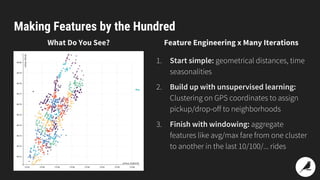
Making Features by the Hundred
Feature Engineering x Many Iterations
1. Start simple: geometrical distances, time
seasonalities
2. Build up with unsupervised learning:
Clustering on GPS coordinates to assign
pickup/drop-off to neighborhoods
3. Finish with windowing: aggregate
features like avg/max fare from one cluster
to another in the last 10/100/... rides
What Do You See?
Going Back to the Root Cause
Last Round of Enrichment
● Convert the formula into features
○ Flags for specific areas and hours
○ Tolls & airport trips
○ Traffic conditions ➝ the HERE API
Focus on What Matters
● Too many features: 4 ↗ 500 ↘ 100 (highest
correlated features)
The Not-So-Secret Formula
Traaaaaining Time!
Choose Your Weapon Algorithm
The Arsenal
● Better = - 0.3 RMSE
● Faster = x 3 speed
● Stronger = not Out of
Memory
LightGBM
Fighting the Evil Dr. Overfitting
By Feature
● Balanced view of all features
VS always learning from the
most predictive
● Reduce “colsample_bytree”
parameter to a lower
percentage of 60% instead
of 100% - a.k.a. Bagging
● Grid-Search
By Observation
● Generalize to the entire
dataset VS specific to a
small group of observations
● Limit tree growth by setting
a “min_split_gain”
threshold in addition to
“max_depth”
● MOAR Grid-Search
Exposing our Model to Users...
In a Real-Time App
From Batch to Real-Time (API)
API Service Structure
predict_fare: Python endpoint to take
raw features and output the fare
prediction, a “wrapper” to call...
A. _cluster: Python endpoint to
assign pickup and dropoff to
neighbourhood clusters
B. _traffic: Python endpoint to get
traffic data from the HERE API
C. _fare: our predictive model using
both raw features and traffic dataTurning a model into an API,
as easy as pie!
Just Demo
taxifare.dss-demo.dataiku.com
Outro
4 Things You Can Learn by Doing
1. Understand the problem
before building models
2. Do not add features for
the sake of features
3. Try as many algorithms
as possible
4. Simplify your pipeline
before deployment
From English data
and Japanese affix –iku (育)
“To raise or bring up; to grow up”
Literally,”Data Education”
or ”Let’s Grow the Data skills”
データ
育
Join Us at EGG LDN
The Human-Centered AI Conference
July 2, 2019
london.egg.dataiku.com
Early Bird Discount: MancML
Thanks!Questions?
Try it yourself
dataiku.com/dss/trynow
... or any Linux
server/container
Learn and stay in touch
academy.dataiku.com
mailto:
alex.combessie@dataiku.com
follow: @alex_combessie

Machine Learning in Real-Time

  • 1.
    Machine Learning inReal-Time Predicting taxi fares in NYC with Dataiku Alex COMBESSIE March 2019
  • 2.
    Intro: Why Real-Timeis the New Black REAL-Time ANSWERS: Google Real-Time Transport: UBER Real-Time Machine Learning: I
  • 3.
    Agenda 1. In Searchof Good Features 2. Traaaaaining Time! 3. Exposing our Model to Users... In a Real-Time App Outro: Lessons Learned & a Few More Things
  • 4.
    In Search ofGood Features
  • 5.
    Discovering the Dataat Hand Poor, Dirty Data www.kaggle.com/c/new-york-city-taxi-fare- prediction/data ● Only 4 raw features: pickup time and location, drop-off location, number of passengers ● Weird stuff: ○ 1.9M rides < 100 meters? ○ 100K rides > 300 km?? ○ To the bottom of the Hudson??? Non Linear Relationships
  • 6.
    Making Features bythe Hundred Feature Engineering x Many Iterations 1. Start simple: geometrical distances, time seasonalities 2. Build up with unsupervised learning: Clustering on GPS coordinates to assign pickup/drop-off to neighborhoods 3. Finish with windowing: aggregate features like avg/max fare from one cluster to another in the last 10/100/... rides What Do You See?
  • 7.
    Going Back tothe Root Cause Last Round of Enrichment ● Convert the formula into features ○ Flags for specific areas and hours ○ Tolls & airport trips ○ Traffic conditions ➝ the HERE API Focus on What Matters ● Too many features: 4 ↗ 500 ↘ 100 (highest correlated features) The Not-So-Secret Formula
  • 8.
  • 9.
    Choose Your WeaponAlgorithm The Arsenal ● Better = - 0.3 RMSE ● Faster = x 3 speed ● Stronger = not Out of Memory LightGBM
  • 10.
    Fighting the EvilDr. Overfitting By Feature ● Balanced view of all features VS always learning from the most predictive ● Reduce “colsample_bytree” parameter to a lower percentage of 60% instead of 100% - a.k.a. Bagging ● Grid-Search By Observation ● Generalize to the entire dataset VS specific to a small group of observations ● Limit tree growth by setting a “min_split_gain” threshold in addition to “max_depth” ● MOAR Grid-Search
  • 11.
    Exposing our Modelto Users... In a Real-Time App
  • 12.
    From Batch toReal-Time (API) API Service Structure predict_fare: Python endpoint to take raw features and output the fare prediction, a “wrapper” to call... A. _cluster: Python endpoint to assign pickup and dropoff to neighbourhood clusters B. _traffic: Python endpoint to get traffic data from the HERE API C. _fare: our predictive model using both raw features and traffic dataTurning a model into an API, as easy as pie!
  • 13.
  • 14.
  • 15.
    4 Things YouCan Learn by Doing 1. Understand the problem before building models 2. Do not add features for the sake of features 3. Try as many algorithms as possible 4. Simplify your pipeline before deployment
  • 16.
    From English data andJapanese affix –iku (育) “To raise or bring up; to grow up” Literally,”Data Education” or ”Let’s Grow the Data skills” データ 育
  • 17.
    Join Us atEGG LDN The Human-Centered AI Conference July 2, 2019 london.egg.dataiku.com Early Bird Discount: MancML
  • 18.
    Thanks!Questions? Try it yourself dataiku.com/dss/trynow ...or any Linux server/container Learn and stay in touch academy.dataiku.com mailto: alex.combessie@dataiku.com follow: @alex_combessie