The Complete Guide
For Machine
Learning App
Development
NIMBLE APPGENIE LLP
INDEX
1. What is Machine Learning?
2. Market Scenario of Machine Learning
3. Approaches for Machine Learning App
Development
4. States of AI Powered Mobile Apps
5. Why Should you Integrate AI into Mobile
Apps?
6. Step Wise for Machine Learning App
Development
7. Three Primary Ways to Implements AI
8. How to Starts Implementation of AI into Apps?
9. Top 5 AI Integrated Apps
10. Conclusion
WHAT IS MACHINE
LEARNING?
1. Machine Learning is the
science of getting
computers trained and
understanding and acting
as humans do.
2. When people think about
machine learning (ML),
they think of logistics,
forums, calculus figures in
the air, lots of numbers,
and almost every
important, relevant thing.
3. The Machine learning
algorithms used in machine
learning app development
could be divided into three
ways:
TYPES OF MACHINE
LEARNING
Supervised
Machine
Learning
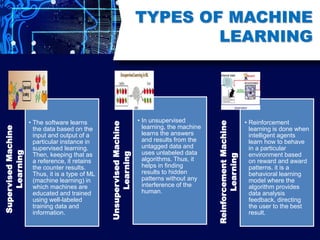
• The software learns
the data based on the
input and output of a
particular instance in
supervised learning.
Then, keeping that as
a reference, it retains
the counter results.
Thus, it is a type of ML
(machine learning) in
which machines are
educated and trained
using well-labeled
training data and
information.
Unsupervised
Machine
Learning
• In unsupervised
learning, the machine
learns the answers
and results from the
untagged data and
uses unlabeled data
algorithms. Thus, it
helps in finding
results to hidden
patterns without any
interference of the
human.
Reinforcement
Machine
Learning
• Reinforcement
learning is done when
intelligent agents
learn how to behave
in a particular
environment based
on reward and award
patterns. it is a
behavioral learning
model where the
algorithm provides
data analysis
feedback, directing
the user to the best
result.
MARKET SCENARIO OF
MACHINE LEARNING
• Machine learning is a digital transformation, and by
the end of 2021, is estimated to have received USD
58 billion in cumulative investment.
• The (machine learning) ML industry growth is
predicted to reach around USD 9 billion in the latter
part of 2022 at a compound annual growth rate
(CAGR) of approximately 42%.
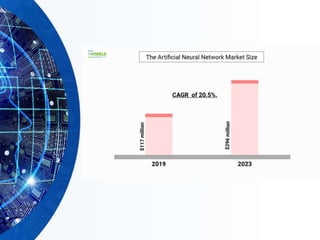
• According to Markets And Markets, the Artificial
Neural Network Market size grew from $117 million in
2019 to $296 million by 2024, at a CAGR (Compound
Annual Growth Rate) of 20.5%.
STATS OF AI-POWERED
MOBILE APPS
• According to research by Gartner, AI implementation was
rare; only 10% – 15% of enterprises had deployed AI or
would do so shortly. But now, in 2021 around 37% of
organizations have implemented AI, which is a 270%
increase in four years.
• According to Microsoft, around 44% of organizations fear
that they’ll lose out to startups if they’re too slow to
implement AI.
• According to the Street Wall Journal, from now until 2030,
AI advancements can increase Gross Domestic Product
(GDP) by 14% across the globe.
• According to research, GrandViewResearch foretells that
USD 25.0647 billion is the anticipated value of the global AI
market by 2028 at a CAGR of 40.2%.
APPROACHES FOR
MACHINE LEARNING
APP DEVELOPMENT
Use Pre-Built
Models
• Using pre-built models is
a shortcut way of
building machine
learning apps.
• As you can not set the
foundation of your
machine learning app on
a weaker model because
it would collapse.
• The reason is that they
know what and how to fix
and optimize everything
to provide you with good
functionality and the best
results.
Conversion Between
Model Formats
• In machine learning app
development, always adopt
a step-by-step approach
where each model used in
the ML (machine learning)
module is converted from
one format to another.
• To show similar results on
multiple platforms, keep
checking out suitable
converters that enable the
model conversion.
• It is a tip that will become
handy in your development
process.
Focus on Native
Development
• Machine learning
and Artificial
Intelligence
technology provide
efficient and
proficient services
based on its search
from the data set.
• Native applications
are rapid,
responsive, and offer
a significant user
experience.
STEPWISE GUIDE FOR
MACHINE LEARNING APP
DEVELOPMENTS
• Selection and Formulation of Problem
Statement
• Developing and Strategizing Plan
• Gathering Data
• Preparing and Analyzing Data-Sets
• Pre-processing Datasets
• Constructing Structure
• Developing Machine Learning Model
• Train The Machine Learning Model
• Test The Created Model
• Deployment of The Model
WHY SHOULD YOU
INTEGRATE AI INTO
MOBILE APPS?
• Personalization- Any AI algorithm attached to your mobile
application can analyze several sources of information, from social media
activities to credit ratings and also provide recommendations to every user
device.
• Advanced Search- The algorithms learn from the different queries
asked by customers and prioritize the results accordingly. Modern mobile
applications and search algorithms enable you to collect all the user data,
including typical actions and search histories.
• Predicting User Behavior- The significant advantage for
marketers of AI-based machine learning iOS app
development and android app development, is that they understand the
preferences of the user and behavior patterns.
CONTINUE………
• Improved Security Level- Artificial Intelligence can make a
very effective marketing tool for mobile apps to secure app authentication
and streamline the process.
• More Relevant Ads- Many industry experts have said that if you
want to move forward in this never-ending consumer market, it can only be
achieved by personalizing every experience for every customer.
• User Engagement- The Artificial Intelligence (AI) development
services and solutions engage companies to offer a span of features and
balanced customer support.
THREE PRIMARY
WAYS TO
IMPLEMENT AI
Reasoning
• AI is a very proficient
technology that absorbs
the power of reasoning
for solving queries.
• For example,
applications like Google
Maps, Zomato, Uber,
and many more
individuals travel to
different areas often
change the course or
route according to traffic
conditions.
Recommendation
• The technology based on
the customer’s preferences
then suggests the most
popular options in their
watch playlist or that
individuals with similar
tastes have watched.
• This is an amazingly popular
technology for streaming
services and is currently
being executed into various
applications.
Behavioral
• Every time someone
tries to impersonate
an online transaction
and takaes your data
via fraudulent
activities without
your knowledge, the
AI system can track
the uncommon
behavior and stop
the transaction then
and there only.
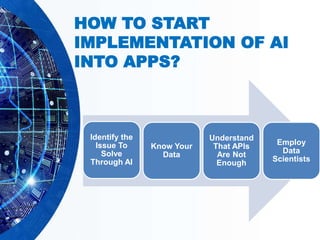
HOW TO START
IMPLEMENTATION OF AI
INTO APPS?
Identify the
Issue To
Solve
Through AI
Know Your
Data
Understand
That APIs
Are Not
Enough
Employ
Data
Scientists
TOP 5 AI-INTEGRATED
APPS
• Siri- As Siri is very popular, I don’t think it needs any
introduction. Indeed, it is a virtual voice assistant app by Apple.It
is available on all iOS devices.
• Cortana- Cortana is another innovative and best AI-powered
app launched by Microsoft, and it is also a virtual voice
assistant AI mobile app.
• Google Assistant- Google Assistant is the most
advanced and used virtual voice assistant AI mobile app
launched by Google.
• Alexa- Alexa is commonly known as Amazon Alexa because
it is an AI-powered app launched by Amazon.
• Elsa- Elsa is an AI-powered app that helps users to learn how
to speak English. Through this app, users can learn the
pronunciation and meaning of the words.
CONCLUSION
1. I’ve covered the step-by-step guide for machine learning app
development. Each step is significant in developing the perfect
architecture of a successful machine learning project. Also, it is essential
to follow each of the mentioned steps in the same order as presented
above.
2. I hope now it’s clear to you how to implement mobile apps, and it is time
to apply the top-notch performance and quality for AI to bring out the best
in the application. AI is becoming the future of the advancement of mobile
app development.

Machine learning app development

  • 1.
    The Complete Guide ForMachine Learning App Development NIMBLE APPGENIE LLP
  • 2.
    INDEX 1. What isMachine Learning? 2. Market Scenario of Machine Learning 3. Approaches for Machine Learning App Development 4. States of AI Powered Mobile Apps 5. Why Should you Integrate AI into Mobile Apps? 6. Step Wise for Machine Learning App Development 7. Three Primary Ways to Implements AI 8. How to Starts Implementation of AI into Apps? 9. Top 5 AI Integrated Apps 10. Conclusion
  • 3.
    WHAT IS MACHINE LEARNING? 1.Machine Learning is the science of getting computers trained and understanding and acting as humans do. 2. When people think about machine learning (ML), they think of logistics, forums, calculus figures in the air, lots of numbers, and almost every important, relevant thing. 3. The Machine learning algorithms used in machine learning app development could be divided into three ways:
  • 4.
    TYPES OF MACHINE LEARNING Supervised Machine Learning •The software learns the data based on the input and output of a particular instance in supervised learning. Then, keeping that as a reference, it retains the counter results. Thus, it is a type of ML (machine learning) in which machines are educated and trained using well-labeled training data and information. Unsupervised Machine Learning • In unsupervised learning, the machine learns the answers and results from the untagged data and uses unlabeled data algorithms. Thus, it helps in finding results to hidden patterns without any interference of the human. Reinforcement Machine Learning • Reinforcement learning is done when intelligent agents learn how to behave in a particular environment based on reward and award patterns. it is a behavioral learning model where the algorithm provides data analysis feedback, directing the user to the best result.
  • 5.
    MARKET SCENARIO OF MACHINELEARNING • Machine learning is a digital transformation, and by the end of 2021, is estimated to have received USD 58 billion in cumulative investment. • The (machine learning) ML industry growth is predicted to reach around USD 9 billion in the latter part of 2022 at a compound annual growth rate (CAGR) of approximately 42%. • According to Markets And Markets, the Artificial Neural Network Market size grew from $117 million in 2019 to $296 million by 2024, at a CAGR (Compound Annual Growth Rate) of 20.5%.
  • 7.
    STATS OF AI-POWERED MOBILEAPPS • According to research by Gartner, AI implementation was rare; only 10% – 15% of enterprises had deployed AI or would do so shortly. But now, in 2021 around 37% of organizations have implemented AI, which is a 270% increase in four years. • According to Microsoft, around 44% of organizations fear that they’ll lose out to startups if they’re too slow to implement AI. • According to the Street Wall Journal, from now until 2030, AI advancements can increase Gross Domestic Product (GDP) by 14% across the globe. • According to research, GrandViewResearch foretells that USD 25.0647 billion is the anticipated value of the global AI market by 2028 at a CAGR of 40.2%.
  • 9.
    APPROACHES FOR MACHINE LEARNING APPDEVELOPMENT Use Pre-Built Models • Using pre-built models is a shortcut way of building machine learning apps. • As you can not set the foundation of your machine learning app on a weaker model because it would collapse. • The reason is that they know what and how to fix and optimize everything to provide you with good functionality and the best results. Conversion Between Model Formats • In machine learning app development, always adopt a step-by-step approach where each model used in the ML (machine learning) module is converted from one format to another. • To show similar results on multiple platforms, keep checking out suitable converters that enable the model conversion. • It is a tip that will become handy in your development process. Focus on Native Development • Machine learning and Artificial Intelligence technology provide efficient and proficient services based on its search from the data set. • Native applications are rapid, responsive, and offer a significant user experience.
  • 10.
    STEPWISE GUIDE FOR MACHINELEARNING APP DEVELOPMENTS • Selection and Formulation of Problem Statement • Developing and Strategizing Plan • Gathering Data • Preparing and Analyzing Data-Sets • Pre-processing Datasets • Constructing Structure • Developing Machine Learning Model • Train The Machine Learning Model • Test The Created Model • Deployment of The Model
  • 11.
    WHY SHOULD YOU INTEGRATEAI INTO MOBILE APPS? • Personalization- Any AI algorithm attached to your mobile application can analyze several sources of information, from social media activities to credit ratings and also provide recommendations to every user device. • Advanced Search- The algorithms learn from the different queries asked by customers and prioritize the results accordingly. Modern mobile applications and search algorithms enable you to collect all the user data, including typical actions and search histories. • Predicting User Behavior- The significant advantage for marketers of AI-based machine learning iOS app development and android app development, is that they understand the preferences of the user and behavior patterns.
  • 12.
    CONTINUE……… • Improved SecurityLevel- Artificial Intelligence can make a very effective marketing tool for mobile apps to secure app authentication and streamline the process. • More Relevant Ads- Many industry experts have said that if you want to move forward in this never-ending consumer market, it can only be achieved by personalizing every experience for every customer. • User Engagement- The Artificial Intelligence (AI) development services and solutions engage companies to offer a span of features and balanced customer support.
  • 13.
    THREE PRIMARY WAYS TO IMPLEMENTAI Reasoning • AI is a very proficient technology that absorbs the power of reasoning for solving queries. • For example, applications like Google Maps, Zomato, Uber, and many more individuals travel to different areas often change the course or route according to traffic conditions. Recommendation • The technology based on the customer’s preferences then suggests the most popular options in their watch playlist or that individuals with similar tastes have watched. • This is an amazingly popular technology for streaming services and is currently being executed into various applications. Behavioral • Every time someone tries to impersonate an online transaction and takaes your data via fraudulent activities without your knowledge, the AI system can track the uncommon behavior and stop the transaction then and there only.
  • 14.
    HOW TO START IMPLEMENTATIONOF AI INTO APPS? Identify the Issue To Solve Through AI Know Your Data Understand That APIs Are Not Enough Employ Data Scientists
  • 15.
    TOP 5 AI-INTEGRATED APPS •Siri- As Siri is very popular, I don’t think it needs any introduction. Indeed, it is a virtual voice assistant app by Apple.It is available on all iOS devices. • Cortana- Cortana is another innovative and best AI-powered app launched by Microsoft, and it is also a virtual voice assistant AI mobile app. • Google Assistant- Google Assistant is the most advanced and used virtual voice assistant AI mobile app launched by Google. • Alexa- Alexa is commonly known as Amazon Alexa because it is an AI-powered app launched by Amazon. • Elsa- Elsa is an AI-powered app that helps users to learn how to speak English. Through this app, users can learn the pronunciation and meaning of the words.
  • 16.
    CONCLUSION 1. I’ve coveredthe step-by-step guide for machine learning app development. Each step is significant in developing the perfect architecture of a successful machine learning project. Also, it is essential to follow each of the mentioned steps in the same order as presented above. 2. I hope now it’s clear to you how to implement mobile apps, and it is time to apply the top-notch performance and quality for AI to bring out the best in the application. AI is becoming the future of the advancement of mobile app development.