M Information Systems 4th Edition Baltzan
Solutions Manual download pdf
https://testbankmall.com/product/m-information-systems-4th-edition-
baltzan-solutions-manual/
Visit testbankmall.com to explore and download the complete
collection of test banks or solution manuals!
Here are some recommended products for you. Click the link to
download, or explore more at testbankmall.com
Solution Manual for M: Information Systems, 4th Edition,
Paige Baltzan Amy Phillips
https://testbankmall.com/product/solution-manual-for-m-information-
systems-4th-edition-paige-baltzan-amy-phillips/
Solution Manual for M: Information Systems, 6th Edition
Paige Baltzan
https://testbankmall.com/product/solution-manual-for-m-information-
systems-6th-edition-paige-baltzan/
Test Bank for M: Information Systems, 6th Edition Paige
Baltzan
https://testbankmall.com/product/test-bank-for-m-information-
systems-6th-edition-paige-baltzan/
Solution Manual for Introduction to Statistics and Data
Analysis 6th by Peck
https://testbankmall.com/product/solution-manual-for-introduction-to-
statistics-and-data-analysis-6th-by-peck/
Test Bank for Supply Chain Logistics Management 5th by
Bowersox
https://testbankmall.com/product/test-bank-for-supply-chain-logistics-
management-5th-by-bowersox/
Test Bank for Urinalysis and Body Fluids, 6th Edition,
Susan King Strasinger, Marjorie Schaub Di Lorenzo 920-1
https://testbankmall.com/product/test-bank-for-urinalysis-and-body-
fluids-6th-edition-susan-king-strasinger-marjorie-schaub-di-
lorenzo-920-1/
Crime Prevention Theory and Practice 2nd Schneider
Solution Manual
https://testbankmall.com/product/crime-prevention-theory-and-
practice-2nd-schneider-solution-manual/
Test Bank for Marriages, Families, and Relationships:
Making Choices in a Diverse Society, 12th Edition, Mary
Ann Lamanna, Agnes Riedmann, Susan D. Stewart, ISBN-10:
1285736974, ISBN-13: 9781285736976
https://testbankmall.com/product/test-bank-for-marriages-families-and-
relationships-making-choices-in-a-diverse-society-12th-edition-mary-
ann-lamanna-agnes-riedmann-susan-d-stewart-
isbn-10-1285736974-isbn-13-9781285736976/
Solution Manual for State and Local Government The
Essentials, 6th Edition
https://testbankmall.com/product/solution-manual-for-state-and-local-
government-the-essentials-6th-edition/
Test Bank for Statistics for Managers Using Microsoft
Excel, 8th Edition, David M. Levine
https://testbankmall.com/product/test-bank-for-statistics-for-
managers-using-microsoft-excel-8th-edition-david-m-levine/
M: Information Systems - Instructor’s Manual Chapter 2 Page 2 of 15
Decision making and problem solving encompass large-scale, opportunity-oriented, strategically focused solutions.
Students today must posse’s decision-making and problem-solving abilities to compete in the ebusiness world.
Organizations today can no longer use a “cook book” approach to decision making. This chapter focuses on
technology to help make decisions, solve problems, and find new innovative opportunities including:
Transaction processing system
Decision support systems
Executive information systems
Artificial intelligence (AI)
Business process modeling
Business process management
Business process improvement
Business process reengineering
SECTION 2.1 – DECISION SUPPORT SYSTEMS
Making Organizational Business Decisions
Measuring Organization Business Decisions
Using MIS to Make Business Decisions
Using AI to Make Business Decisions
SECTION 2.2 – BUSINESS PROCESSES
Managing Business Processes
Using MIS to Improve Business Processes
M: Information Systems - Instructor’s Manual Chapter 2 Page 3 of 15
SECTION 2.1
DECISION SUPPORT SYSTEMS
What is the value of information? The answer to this important question varies depending on how the information
is used. Two people looking at the exact same pieces of information could extract completely different value from
the information depending on the tools they are using to look at the information. This chapter discusses
technologies that people can use to help make decisions and solve problems.
LEARNING OUTCOMES
Learning Outcome 2.1: Explain the importance of decision making for managers at each of the three
primary organization levels along with the associated decision characteristics.
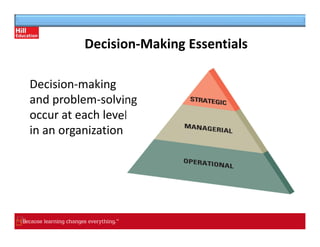
Decision-making skills are essential for all business professionals, at every company level, who make decisions
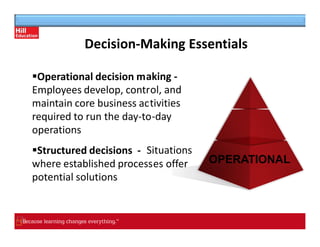
that run the business. At the operational level, employees develop, control, and maintain core business activities
required to run the day-to-day operations. Operational decisions are considered structured decisions, which arise
in situations where established processes offer potential solutions. Structured decisions are made frequently and
are almost repetitive in nature; they affect short-term business strategies.
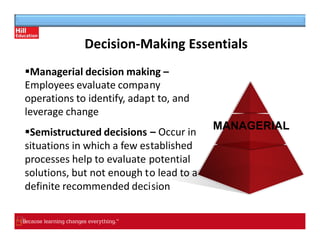
At the managerial level, employees are continuously evaluating company operations to hone the firm’s abilities to
identify, adapt to, and leverage change. Managerial decisions cover short- and medium-range plans, schedules,
and budgets along with policies, procedures, and business objectives for the firm. These types of decisions are
considered semistructured decisions; they occur in situations in which a few established processes help to
evaluate potential solutions, but not enough to lead to a definite recommended decision.
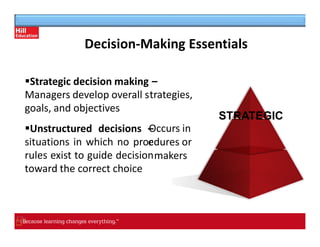
At the strategic level, managers develop overall business strategies, goals, and objectives as part of the
company’s strategic plan. They also monitor the strategic performance of the organization and its overall direction
in the political, economic, and competitive business environment. Strategic decisions are highly unstructured
decisions, occurring in situations in which no procedures or rules exist to guide decision makers toward the correct
choice. They are infrequent, extremely important, and typically related to long-term business strategy.
Learning Outcome 2.2: Define critical success factors (CSFs) and key performance indicators (KPIs), and
explain how managers use them to measure the success of MIS projects.
Metrics are measurements that evaluate results to determine whether a project is meeting its goals. Two core
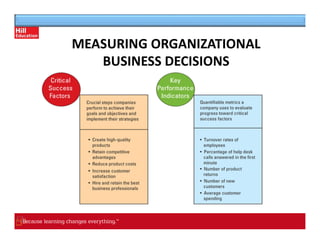
metrics are critical success factors and key performance indicators. CSFs are the crucial steps companies perform
to achieve their goals and objectives and implement their strategies and include creating high-quality products,
retaining competitive advantages, and reducing product costs. KPIs are the quantifiable metrics a company uses
to evaluate progress toward critical success factors. KPIs are far more specific than CSFs; examples include
turnover rates of employees, percentage of help-desk calls answered in the first minute, and number of products
returned.
It is important to understand the relationship between critical success factors and key performance indicators.
CSFs are elements crucial for a business strategy’s success. KPIs measure the progress of CSFs with quantifiable
measurements, and one CSF can have several KPIs. Of course, both categories will vary by company and
industry. Imagine improved graduation rates as a CSF for a college.
M: Information Systems - Instructor’s Manual Chapter 2 Page 4 of 15
Learning Outcome 2.3: Classify the different operational support systems, managerial support systems,
and strategic support systems, and explain how managers can use these systems to make decisions and
gain competitive advantages.
Being able to sort, calculate, analyze, and slice-and-dice information is critical to an organization’s success.
Without knowing what is occurring throughout the organization there is no way that managers and executives can
make solid decisions to support the business. The different operational, managerial, and strategic support systems
include:
Operational: A transaction processing system (TPS) is the basic business system that serves the
operational level (analysts) in an organization. The most common example of a TPS is an operational
accounting system such as a payroll system or an order-entry system.
Managerial: A decision support system (DSS) models information to support managers and business
professionals during the decision-making process.
Strategic: An executive information system (EIS) is a specialized DSS that supports senior level
executives within the organization.
Learning Outcome 2.4: Describe artificial intelligence and identify its five main types.
Artificial intelligence (AI) simulates human thinking and behavior, such as the ability to reason and learn. The five
most common categories of AI are:
1. Expert systems—computerized advisory programs that imitate the reasoning processes of experts in
solving difficult problems.
2. Neural networks—attempts to emulate the way the human brain works.
3. Genetic algorithm—a system that mimics the evolutionary, survival-of-the-fittest process to generate
increasingly better solutions to a problem.
4. Intelligent agents—a special-purpose knowledge-based information system that accomplishes specific
tasks on behalf of its users.
5. Virtual reality—a computer-simulated environment that can be a simulation of the real world or an
imaginary world.
CLASSROOM OPENER
GREAT BUSINESS DECISIONS – Walt Disney Decides to Call His Mouse Cartoon Character
Mickey, not Mortimer
Sunday, November 18, 1928, is a historic moment in time since it is the day that the premier of Steamboat Willie
debuted, a cinematic epic of seven minutes in length. This was the first cartoon that synchronized sound and
action.
Like all great inventions, Mickey Mouse began his life in a garage. After going bankrupt with the failure of his
Laugh O Gram Company, Walt Disney decided to rent a camera, assemble an animation stand, and set up a
studio in his uncle’s garage. At the age of 21, Walt and his older brother Roy launched the Disney Company in
1923. The company had a rocky start. Its first film, Alice, hardly made enough money to keep the company in
business. His second film, Oswald the Rabbit, was released in 1927 with small fanfare. Then Disney’s luck
changed and in 1928 he released his seven minute film about a small mouse named Mickey. Disney never looked
back.
The truth is Mickey Mouse began life as Mortimer Mouse. Walt Disney’s wife, Lilly, did not like the name and
suggested Mickey instead. Walt Disney has often been heard to say, “I hope we never lose sight of one fact – that
this was all started by a mouse.”
M: Information Systems - Instructor’s Manual Chapter 2 Page 5 of 15
Would Mortimer have been as successful as Mickey? Would Mortimer have been more successful than Mickey?
How could Walt Disney have used technology to help support his all-important decision to name his primary
character? There are many new technologies helping to drive decision support systems, however it is important to
note that some decisions, such as the name of a mouse, are made by the most complex decision support system
available - the human brain.
CLASSROOM EXERCISE
Building Artificial Intelligence
The idea of robots and artificial intelligence is something that has captured people’s attention for years. From the
robots in Star Wars to the surreal computer world in the Matrix, everyone seems to be fascinated with the idea of
robots.
Break your students into groups and challenge them to build a robot. The robot can perform any function or activity
they choose. The robot must contain a digital dashboard and enable decision support capabilities for its owner.
Have the students draw a prototype of their robot and present their robot to the class. Have your entire class vote
on which robot they would invest in if they were a venture capital firm.
CLASSROOM EXERCISE
Great Example of DSS
The Analyst™ is an online diagnostic tool that fills the gap between what you need and what busy, human doctors
can offer. With less and less time to address a patient's individual needs and yet more and more research and
other information to digest, incorrect and incomplete diagnoses are frequently made On this site they have a great
diagram that compares The Analyst to a Doctor.
http://www.diagnose-me.com/?page=dizz&gclid=CIbdzaP785ECFQwcawodfCXpxA
CLASSROOM EXERCISE
Hod Lipson Demonstrates Cool Little Robots
Hod Lipson demonstrates a few of his cool little robots, which have the ability to learn, understand themselves and
even self-replicate. At the root of this uncanny demo is a deep inquiry into the nature of how humans and living
beings learn and evolve, and how we might harness these processes to make things that learn and evolve.
Hod Lipson works at the intersection of engineering and biology, studying robots and the way they "behave" and
evolve. His work has exciting implications for design and manufacturing -- and serves as a window to understand
our own behavior and evolution.
http://www.ted.com/index.php/talks/view/id/165
CLASSROOM EXERCISE
Building AI – Facebook Founders Fund AI Start-Up
The idea of robots and artificial intelligence is something that has captured people’s attention for years. From the
robots in Star Wars to the surreal computer world in the Matrix, everyone seems to be fascinated with the idea of
robots.
Artificial intelligence research start-up Vicarious announced today that it has received a $15 million Series A round
led by Good Ventures. The funding values the company at more than $100 million.
http://www.inc.com/john-mcdermott/facebook-founders-fund-artificial-intelligence-start-up.html
Break your students into groups and challenge them to build a robot to compete for a $15 million grant from
Facebook. The robot can perform any function or activity they choose. The robot must contain a digital dashboard
M: Information Systems - Instructor’s Manual Chapter 2 Page 6 of 15
and enable decision support capabilities for its owner. Have the students draw a prototype of their robot and
present their robot to the class. Have your entire class vote on which robot they would invest in if they were a
venture capital firm.
***Best Videos for Class – show them in order to see the advances in technology!
Nao Robot Example (3 mins)
http://www.youtube.com/watch?v=2STTNYNF4lk
NAO Next Generation (3 mins)
http://www.youtube.com/watch?v=nNbj2G3GmAo&feature=related
NAO Robots – All The Single Ladies Dance (Students will LOVE this!!)
http://www.youtube.com/watch?v=vgEFC8Eb6i4&feature=related
CLASSROOM VIDEO
Something to Get Their Attention
Sheena Lyengar did her thesis work on “how people make decisions.” Great Ted.com to show your students.
http://www.ted.com/talks/sheena_iyengar_on_the_art_of_choosing.html
CLASSROOM VIDEO
Take a Walk or a Drive – Virtually!
This is an interesting website where you can view yourself walking or driving down streets in different cities. I use
this as a decision support tool to use to map a tour if I was planning a trip to one of these cities. There is an
excellent video on the website that demonstrates the amazing capabilities of Streetside.
http://www.microsoft.com/maps/en-GB/streetside.aspx
How can you use Streetside to improve business decisions?
How can you use Streetside to uncover business intelligence?
How can you use Streetside to develop a new business idea?
How can you use Streetside to revamp a business process
CLASSROOM EXERCISE
DSS Everywhere!
Break your students into groups and ask them to compare sensitivity analysis, what-if analysis, and goal-
seeking analysis and to provide a business example of when they would use each type?
▪ Sensitivity analysis – studies the impact on a single change in a current model. For example – if we
continually change the amount of inventory we carry, how low can our inventories go before issues
start occurring in other parts of the supply chain? This would require changing the inventory level and
watching the model to see “how sensitive” it is to inventory levels.
▪ What-if analysis – determines the impact of change on an assumption or an input. For example – if
the economic condition improves, how will it affect our sales?
▪ Goal-seeking analysis – solves for a desired goal. For example – we want to improve revenues by 30
percent, how much does sales have to increase and costs have to decrease to meet this goal?
• Can you name a few different situations when you would use consolidation, drill-down, and slice-and-dice?
▪ Consolidation would occur when grouping multiple store sales together to get a total for the company
▪ Drill-down would occur when digging into the numbers on the balance sheet or income statement,
such as revenues broken down into individual product revenues for each store during different dates
and times
M: Information Systems - Instructor’s Manual Chapter 2 Page 7 of 15
▪ Slice-and-dice would occur when users begin looking at information with different dimensions, similar
to the cubes of information
CLASSROOM EXERCISE
Measuring Efficiency and Effectiveness
Break your students into groups and ask them to create a plan to measure the efficiency and effectiveness of this
course and recommendations on how they would improve the course to make it more efficient and more effective.
Student answers to this exercise will vary. They will need to determine ways to benchmark current efficiency and
effectiveness and ways to continuously monitor and measure against the benchmarks to determine if the course is
becoming more or less efficient and effective (class quizzes and exams are the most obvious benchmarks). Ask
your students to present their plan and recommendations to the entire class. Be sure students’ plans and
recommendations address the following:
• Design of the classroom
• Room temperature
• Lighting and electronic capabilities of the classroom
• Technology available in the classroom
• Length of class
• Email and instant messaging
• Students’ attendance
• Students’ preparation
• Students’ arrival time
• Quizzes and exams (frequency, length, grades)
TEN WORST DRIVING DECISION ON VIDEO
Great way to kick off a discussion on how decisions impact business. People have accidents. That’s not what this
post is about. People also do stupid, reckless things. But we’re not focusing on that now either. This is about
people that obviously lack the requisite skills to operate a motor vehicle – who were also unfortunate enough to
have the evidence caught on film.
http://onemansblog.com/2007/02/07/10-worst-drivers-ever-caught-on-video/
ROBOT VIDEOS – GREAT AI
Robot Violinist - Video
http://www.youtube.com/watch?v=EzjkBwZtxp4
Robot Emotions
The emotional robot Science correspondent Alok Jha visits the University of Hertfordshire to meet an android
developed to show emotions
http://www.guardian.co.uk/technology/video/2010/aug/09/emotional-robot-university-hertfordshire
Robot Babies
The State Department readies new Internet freedom policies, the FAA may lift the ban on cell phones during air
travel, and Japanese researchers are working on robot babies.
http://news.cnet.com/1606-2_3-50100306.html
M: Information Systems - Instructor’s Manual Chapter 2 Page 8 of 15
BUSINESS DRIVEN START-UP – DIGITAL DASHBOARD
This isa great video to get your students thinking about how they can use Excel to create a digital dashboard. Ask your
students if they could setup adigital dashboard for their courses what would it look like andhow would it measure their
progress. How to Setup a Digital Dashboard in Microsoft Excel
http://www.youtube.com/watch?v=V9GMCS-WjyI
CORE MATERIAL
The core chapter material is covered in detail in the PowerPoint slides. Each slide contains detailed teaching notes
including exercises, class activities, questions, and examples. Please review the PowerPoint slides for detailed
notes on how to teach and enhance the core chapter material.
M: Information Systems - Instructor’s Manual Chapter 2 Page 9 of 15
SECTION 2.2
BUSINESS PROCESSES
LEARNING OUTCOMES
Learning Outcome 2.5: Explain the value of business processes for a company, and differentiate between
customer-facing and business-facing process.
A business process is a standardized set of activities that accomplish a specific task, such as processing a
customer’s order. Business processes transform a set of inputs into a set of outputs (goods or services) for
another person or process by using people and tools. Without processes, organizations would not be able to
complete activities. Customer-facing processes result in a product or service that is received by an organization’s
external customer. Business-facing processes are invisible to the external customer but essential to the effective
management of the business.
Learning Outcome 2.6: Demonstrate the value of business process modeling, and compare As-Is and To-
Be models.
Business process modeling (or mapping) is the activity of creating a detailed flowchart or process map of a work
process showing its inputs, tasks, and activities, in a structured sequence. A business process model is a graphic
description of a process, showing the sequence of process tasks, which is developed for a specific purpose and
from a selected viewpoint.
Business process modeling usually begins with a functional process representation of what the process problem
is, or an As-Is process model. As-Is process models represent the current state of the operation that has been
mapped, without any specific improvements or changes to existing processes. The next step is to build a To-Be
process model that displays how the process problem will be solved or implemented. To-Be process models show
the results of applying change improvement opportunities to the current (As-Is) process model. This approach
ensures that the process is fully and clearly understood before the details of a process solution are decided upon.
Learning Outcome 2.7: Differentiate among automation, streamlining, and reengineering.
Business process improvement attempts to understand and measure the current process and make performance
improvements accordingly. Automation is the process of computerizing manual tasks, making them more efficient
and effective, and dramatically lowering operational costs. Streamlining improves business process efficiencies by
simplifying or eliminating unnecessary steps. Bottlenecks occur when resources reach full capacity and cannot
handle any additional demands; they limit throughput and impede operations. Streamlining removes bottlenecks,
an important step if the efficiency and capacity of a business process are being increased. Business process
reengineering (BPR) is the analysis and redesign of workflow within and between enterprises and occurs at the
systems level or companywide level and is the end-to-end view of a process.
CLASSROOM OPENER
Cable Ready
A current cable subscriber calls up to change the date for activating the service at a new address from Feb. 22 to
March 1. The subscriber is successful and hangs up the phone happy. However, on February 22nd the cable at the
current home is disconnected and the customer is no longer happy. The customer service representative forgot to
change the date of the disconnection and only changed the date of the activation.
M: Information Systems - Instructor’s Manual Chapter 2 Page 10 of 15
Practically speaking, these two events will almost always be linked - and the system probably should have
prompted the customer service representative to ask if they were. The point: In focusing on business process, it is
important to facilitate real-world tasks that are, by nature, "integrated."
CLASSROOM EXERCISE
Examining And Reengineering A College Business Process
Ask your students to discuss issues they have encountered around the college due to an inefficient or ineffective
process. Choose one of the processes, break your students into groups, and ask them to reengineer the process.
How would they change it to make it more effective or more efficient? Would they add a new technology device to
help with the process such as a scanner, PDA, or RFID? Be sure to have them diagram the As-Is process and the
To-Be process. Have them present their reengineered processes to the class.
CLASSROOM EXERCISE
Reengineering a Process
There is nothing more frustrated than a broken process. Ask your students to break into groups and discuss
examples of broken processes that are currently causing them pain. The process can be a university process,
mail-order process, Internet-order process, return merchandise process, etc. Ask your students to agree on one of
the broken processes and to reengineer the process. Students should diagram the “As-Is” process and then
diagram their “To-Be” process. Bring in a large roll of brown package wrapping paper and masking tape. Give each
group two large pieces of the paper and ask them to tape the paper to the wall. These make for great “As-Is” and
“To-Be” process maps.
CLASSROOM EXERCISE
Videos on BPM
Microsoft's business and industry offers a surprisingly good introduction to people driving business success
through business process. The Business Process Management solution shows how to design a BizTalk application
to manage a business process such as service order processing. The solution demonstrates how to construct a
process manager and provides guidance about dividing a process into distinct stages. The solution also describes
how to construct interruptible orchestrations as well as extensive, sophisticated exception handling.
The sections provide an overview of the solution, detailed explanations of the patterns and design choices, and
information about building and running the solution.
http://msdn.microsoft.com/en-us/library/aa559473.aspx
Funny video to kick-off your process modeling lecture – Finding Love is a Process
http://www.youtube.com/watch?v=S-Mbr31f2dg
CLASSROOM EXERCISE
How’s My Driving – Just Ask My Car?
Using gadgets while you're driving can be a very bad thing, but an expert on automotive distractions says using a
gadget that watches you while you're driving can be a very good thing. More than 40,000 people die every year in
motor vehicle crashes, and research indicates that failures of attention - including distractions or drowsiness -
probably played a role in most of those crashes.
Meiji Zhang tries to use a cell phone while she's behind the wheel in a driving simulator that's designed to work like
a Chevy Malibu. The University of Iowa's National Advanced Driving Simulator was used to study the effects of
driving distractions.
M: Information Systems - Instructor’s Manual Chapter 2 Page 11 of 15
In one case he studied, a driver looked away from the road for 6 seconds to tap out a text message on her phone,
slipped out of her lane and came to attention only when the tires hit the curb. "When she actually saw the video
from the perspective of the camera, she was shocked to learn that she almost hit a telephone pole at 40 miles per
hour," Lee said.
How many of your student’s text, dial cell phones, etc. while driving?
Would this type of technology benefit your student drivers?
Break your students into groups and ask them to create a product that could help drivers pay greater attention to
driving and less attention to gadgets. How are autonomous driving vehicles going to impact their lives?
CLASSROOM EXERCISE
Defense Advanced Research Projects Agency (DARPA) Grand Challenge
Ask your student to review the DARPA website to become familiar with the competition.
http://www.darpa.mil/
How is the DoD using AI to improve its operations and save lives?
The DARPA Grand Challenge was designed to leverage American ingenuity to develop autonomous vehicle
technologies that can be used by the military. Using AI driven vehicles the DOD will be able to send vehicles
into dangerous situations without endangering any soldiers.
Why would the DoD use an event, such as the DARPA Grand Challenge, to further technological
innovation?
By offering a generous prize, along with notoriety the DOD is able to get many of the greatest minds in the
country working on creating autonomous vehicles. It is a win-win. The DOD receives the technology and the
winning team receives a prize and notoriety.
Describe how autonomous vehicles could be used by organizations around the world to improve
business efficiency and effectiveness.
There are numerous ways that autonomous vehicles could be used around by businesses from making
deliveries, transporting goods and services to taking employees to and from the airport. The uses are limitless.
The Ansari X is another technological innovation competition focusing on spacecraft. To win the $10
million Ansari X Prize, a private spacecraft had to be the first to carry the weight equivalent of three
people to an altitude of 62.14 miles twice within two weeks. SpaceShipOne, a privately built spacecraft,
won the $10 million Ansari X Prize on October 4, 2004. Describe the potential business impacts of the
Ansari X competition.
Space travel is the next exciting frontier. Business impacts could range from vacation trips to the moon to
picking up space materials for the production of goods and services. The competition could also inspire other
types of competition such as underwater houses and personal flying machines.
DARPA Videos
The DARPA challenge is an excellent topic when discussing AI. Here is the latest article on this year’s
DARPA challenge.
Robots And Their Masters Ready For DARPA 'War Zone' Race
http://www.informationweek.com/showArticle.jhtml;jsessionid=THMMTXP1BKGDIQSNDLRCKH0CJUNN2
JVN?articleID=193401499&queryText=aug+14
M: Information Systems - Instructor’s Manual Chapter 2 Page 12 of 15
CORE MATERIAL
The core chapter material is covered in detail in the PowerPoint slides. Each slide contains detailed teaching notes
including exercises, class activities, questions, and examples. Please review the PowerPoint slides for detailed
notes on how to teach and enhance the core chapter material.
REVIEW OR DISCUSSION QUESTIONS
1. Why must business professionals understand how MIS supports decision making and
problem solving?
Decision making is one of the most important and challenging aspects of management.
Decisions range from routine choices, such as how many items to order or how many people
to hire, to unexpected ones such as what to do if a key employee suddenly quits or needed
materials do not arrive. Today, with massive volumes of information available, managers are
challenged to make highly complex decisions—some involving far more information than the
human brain can comprehend, in increasingly shorter time frames.
2. What is the relationship between critical success factors and key performance indicators?
How can a manager use them to understand business operations?
Critical success factors (CSFs) are the crucial steps companies perform to achieve their goals
and objectives and implement their strategies. Key performance indicators (KPIs) are the
quantifiable metrics a company uses to evaluate progress toward critical success factors. KPIs
are far more specific than CSFs. It is important to understand the relationship between critical
success factors and key performance indicators. CSFs are elements crucial for a business
strategy’s success. KPIs measure the progress of CSFs with quantifiable measurements, and
one CSF can have several KPIs. Of course, both categories will vary by company and industry.
Imagine improve graduation rates as a CSF for a college.
3. What are the three different levels found in a company? What types of decisions are made
at each level?
A few key concepts about organizational structure will help our discussion of MIS decision-
making tools. The structure of a typical organization is similar to a pyramid, and the different
levels require different types of information to assist in decision making, problem solving, and
opportunity capturing. The operational level supports transactional information, the
managerial level supports analytical information and the strategic level supports executive
information systems.
4. Define transaction processing systems and describe the role they play in a business.
Transactional information encompasses all the information contained within a single business
M: Information Systems - Instructor’s Manual Chapter 2 Page 13 of 15
process or unit of work, and its primary purpose is to support the performance of daily
operational or structured decisions. Transactional information is created, for example, when
customers are purchasing stocks, making an airline reservation, or withdrawing cash from an
ATM. Managers use transactional information when making structured decisions at the
operational level, such as when analyzing daily sales reports to determine how much inventory
to carry.
5. Define decision support systems and describe the role they play in a business.
Decision support systems (DSSs) model information using OLAP, which provides assistance in
evaluating and choosing among different courses of action. DSSs enable high-level managers
to examine and manipulate large amounts of detailed data from different internal and external
sources. Analyzing complex relationships among thousands or even millions of data items to
discover patterns, trends, and exception conditions is one of the key uses associated with a
DSS.
6. Define expert systems and describe the role they play in a business.
Expert systems are computerized advisory programs that imitate the reasoning processes of
experts in solving difficult problems. Typically, they include a knowledge base containing
various accumulated experience and a set of rules for applying the knowledge base to each
particular situation. Expert systems are the most common form of AI in the business arena
because they fill the gap when human experts are difficult to find or retain or are too
expensive. The best-known systems play chess and assist in medical diagnosis.
7. What are the capabilities associated with digital dashboards?
Executive information systems use visualization to deliver specific key information to top
managers at a glance, with little or no interaction with the system. A common tool that
supports visualization is a digital dashboard, which tracks KPIs and CSFs by compiling
information from multiple sources and tailoring it to meet user needs.
8. What are the common DSS analysis techniques?
Consolidation is the aggregation of data from simple roll-ups to complex groupings of
interrelated information. For example, data for different sales representatives can then be
rolled up to an office level, then a state level, then a regional sales level. Drill-down enables
users to view details, and details of details, of information. This is the reverse of consolidation;
a user can view regional sales data and then drill down all the way to each sales
representative’s data at each office. Drill-down capability lets managers view monthly, weekly,
daily, or even hourly information. Slice-and-dice is the ability to look at information from
different perspectives. One slice of information could display all product sales during a given
promotion. Another slice could display a single product’s sales for all promotions. Slicing and
dicing is often performed along a time axis to analyze trends and find time-based patterns in
the information.
9. How does an electronic spreadsheet program, such as Excel, provide decision support
capabilities?
Excel can create DSS that can logically answer difficult optimization questions. Goal seek,
scenario manager, and solver are all DSS tools included in Excel.
M: Information Systems - Instructor’s Manual Chapter 2 Page 14 of 15
10. What is the difference between the ability of a manager to retrieve information instantly on
demand using an MIS and the capabilities provided by a DSS?
Managers can retrieve information from an MIS system however they will have to analyze the
information using a DSS for what-if analysis, sensitivity analysis, and goal-seeking analysis.
11. What is artificial intelligence? What are the five types of AI systems? What applications of AI
offer the greatest business value?
Artificial intelligence (AI) simulates human thinking and behavior, such as the ability to reason
and learn. Its ultimate goal is to build a system that can mimic human intelligence. AI systems
increase the speed and consistency of decision making, solve problems with incomplete
information, and resolve complicated issues that cannot be solved by conventional computing.
There are many categories of AI systems; five of the most familiar are (1) expert systems, (2)
neural networks, (3) genetic algorithms, (4) intelligent agents, and (5) virtual reality.
12. What is a business process and what role does it play in an organization?
A business process is a standardized set of activities that accomplish a specific task, such as
processing a customer’s order. Business processes transform a set of inputs into a set of
outputs—goods or services—for another person or process by using people and tools.
Understanding business processes helps a manager envision how the entire company
operates.
13. Why do managers need to understand business processes? Can you make a correlation
between systems thinking and business processes?
Some processes, such as a programming process, may be contained wholly within a single
department. However, most, such as ordering a product, are cross-functional or cross-
departmental processes and span the entire organization. The process of “order to delivery”
focuses on the entire customer order process across functional departments. Another example
is “product realization,” which includes not only the way a product is developed, but also the
way it is marketed and serviced. Some other cross-functional business processes are taking a
product from concept to market, acquiring customers, loan processing, providing post-sales
service, claim processing, and reservation handling. Understanding cross-functional business
process is the same as understanding systems thinking!
14. Why would a manager need to review an As-Is and To-Be process model?
As-Is process models represent the current state of the operation that has been mapped,
without any specific improvements or changes to existing processes. The next step is to build a
To-Be process model that displays how the process problem will be solved or implemented.
To-Be process models show the results of applying change improvement opportunities to the
current (As-Is) process model. This approach ensures that the process is fully and clearly
understood before the details of a process solution are decided upon. The To-Be process
model shows how we will realize the what.
15. How can a manager use automation, streamlining, and business process reengineering to
gain operational efficiency and effectiveness?
Automation is the process of computerizing manual tasks, making them more efficient and
M: Information Systems - Instructor’s Manual Chapter 2 Page 15 of 15
effective and dramatically lowering operational costs. Streamlining improves business process
efficiencies by simplifying or eliminating unnecessary steps. As the rate of change increases,
companies looking for rapid change and dramatic improvement are turning to business
process reengineering (BPR), the analysis and redesign of workflow within and between
enterprises. A business process reengineering effort begins with defining the scope and
objectives of the reengineering project and then takes the process designers through a
learning process with customers, employees, competitors, and new technology. Given this
knowledge base, the designers can create a plan of action based on the gap between current
processes, technologies, and structures and their vision of the processes of the future. It is
then top management’s job to implement the chosen solution.
16. Explain the difference between customer-facing processes and business-facing processes.
Which one is more important to an organization?
Customer-facing processes, also called front-office processes, result in a product or service
received by an organization’s external customer. They include fulfilling orders, communicating
with customers, and sending out bills and marketing information. Business-facing processes,
also called back-office processes, are invisible to the external customer but essential to the
effective management of the business; they include goal setting, day-to-day planning, giving
performance feedback and rewards, and allocating resources.
17. Explain how finding different ways to travel the same road relates to automation,
streamlining, and business process reengineering.
Better, faster, cheaper is the path taken by automation, streamlining, and business process
reengineering. Automation and streamlining are typically better, faster, and cheaper.
Business process reengineering can change the entire process in a way that changes the entire
industry standards making everything better, faster, and cheaper.
© The McGraw-Hill Companies, All Rights Reserved
CHAPTER TWO
DECISIONS AND
PROCESSES
VALUE DRIVEN
BUSINESS
CHAPTER TWO OVERVIEW
▪SECTION 2.1 – Decision Support Systems
• Making Organizational Business Decisions
• Measuring Organizational Business Decisions
• Using MIS to Make Business Decisions
• Using AI to Make Business Decisions
▪SECTION 2.2 – Business Processes
• Managing Business Processes
• Business Process Modeling
• Using MIS to Improve Business Processes
© The McGraw-Hill Companies, All Rights Reserved
SECTION 2.1
DECISION
SUPPORT SYSTEMS
LEARNING OUTCOMES
1. Explain the importance of decision making for managers at each
of the three primary organization levels along with the
associated decision characteristics
2. Define critical success factors (CSFs) and key performance
indicators (KPIs), and explain how managers use them to
measure the success of MIS projects
3. Classify the different operational, managerial, and strategic
support systems, and explain how managers can use them to
make decisions & gain competitive advantage
4. Describe artificial intelligence and identify its five main types
lysis techniques
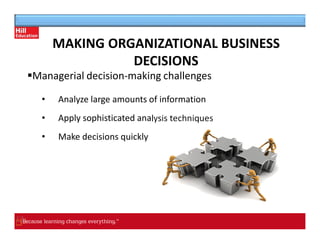
MAKING ORGANIZATIONAL BUSINESS
DECISIONS
▪Managerial decision-making challenges
• Analyze large amounts of information
• Apply sophisticated ana
• Make decisions quickly
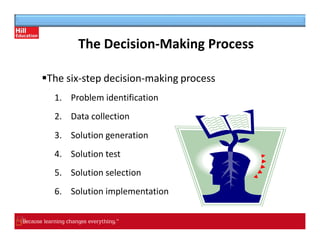
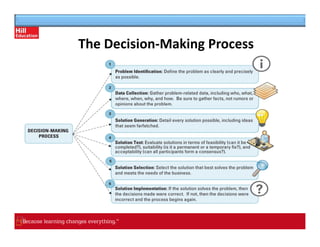
The Decision-Making Process
▪The six-step decision-making process
1. Problem identification
2. Data collection
3. Solution generation
4. Solution test
5. Solution selection
6. Solution implementation
The Decision-Making Process
Decision-Making Essentials
ing
el
Decision-making
and problem-solv
occur at each lev
in an organization
Decision-Making Essentials
aking -
ol, and
tivities
-day
Situations
es offer
▪Operational decision m
Employees develop, contr
maintain core business ac
required to run the day-to
operations
▪Structured decisions -
where established process
potential solutions
OPERATIONAL
Decision-Making Essentials
ny
t to, and
– Occur in
tablished
potential
o lead to a
sion
▪Managerial decision making –
Employees evaluate compa
operations to identify, adap
leverage change
▪Semistructured decisions
situations in which a few es
processes help to evaluate
solutions, but not enough t
definite recommended deci
MANAGERIAL
Decision-Making Essentials
–
trategies,
Occurs in
edures or
makers
▪Strategic decision making
Managers develop overall s
goals, and objectives
▪Unstructured decisions –
situations in which no proc
rules exist to guide decision
toward the correct choice
STRATEGIC
MEASURING ORGANIZATIONAL
BUSINESS DECISIONS
▪Project – A temporary activity a company
undertakes to create a unique product, service, or
result
▪Metrics – Measurements that evaluate results to
determine whether a project is meeting its goals
MEASURING ORGANIZATIONAL
BUSINESS DECISIONS
▪Critical success factors (CSFs) – The crucial steps
companies make to perform to achieve their goals and
objectives and implement strategies
• Create high-quality products
• Retain competitive advantages
• Reduce product costs
• Increase customer satisfaction
• Hire and retain the best professionals
MEASURING ORGANIZATIONAL
BUSINESS DECISIONS
MEASURING ORGANIZATIONAL
BUSINESS DECISIONS
▪Key performance indicators (KPIs) – The quantifiable
metrics a company uses to evaluate progress toward
critical success factors
• Turnover rates of employees
• Number of product returns
• Number of new customers
• Average customer spending
MEASURING ORGANIZATIONAL
BUSINESS DECISIONS
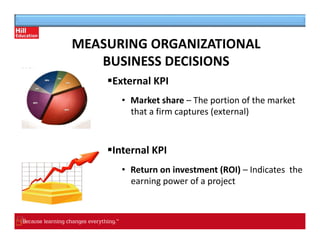
▪External KPI
• Market share – The portion of the market
that a firm captures (external)
▪Internal KPI
• Return on investment (ROI) – Indicates the
earning power of a project
Random documents with unrelated
content Scribd suggests to you:
But you never saw anybody so surprised as those cows! They
went out of that cornfield a whole lot faster than they went in.
Watch chased them way down to the very farthest corner of the
fence and Nibble skipped along beside them, just kicking up his
heels because he liked to see them run. Then Watch made them
listen while he laid down the law to them. “How do you like being
chased?” he barked. “Do you think it’s fun? Are you ever going to
chase that boy again?”
“But he hit me with a stone!” moaned the cow. “He hit me with a
stone.”
“Of course he did,” snapped Watch. “That’s because you didn’t
obey him. You’re his cows, and that’s his corn. Are you going to do
what he tells you or shall I teach you again?”
“Don’t!” they bellowed. “We’ll be good!” They meant it, too. They
were so scared even Nibble Rabbit felt sure they did.
“All right,” Watch agreed. “You have to obey whoever feeds you,
whether it’s Man or Mother Nature. You cows chose Man. Just
remember that.” And off he trotted with Nibble hopping along beside
him.
“I s’pose they can always go wild again, like the Red Cow’s
mother did, and like Louie’s doing,” Nibble remarked. “I’d hate to
belong to that man who was so cross to him and poor Tad Coon.”
But right then they came on that very person, nailing up the fence,
with Louie holding the lantern for him, friendly as anything. And he
was saying, “I’ll throw all this corn they’ve broken down over the
fence so the cows can finish it up in the morning, but you can take
all you want for your coon.”
Louie looked up and saw Watch. “Why, that’s Tommy Peele’s dog!”
he exclaimed. “He’s been helping us. That’s why the cows were
gone.” And he ran right over to thank the furry old fellow who stood
there proudly wagging his tail at them.
Even Louie’s father, who didn’t understand dogs any better than
he did boys, knew enough to say, “Good dog! I wish I had one like
him.” And Watch was so flattered over that, he wagged the whole
hind half of him.
“Aren’t you coming home?” asked Louie’s father after he finished
nailing up the fence. He didn’t just say, “Come home!” like he mostly
gave orders. Because he wasn’t angry any more; he felt more like
thanking Louie, just like Louie thanked that smart old dog. He’d have
had an awful time trying to do it all alone because his cows were so
awfully stubborn and disobedient.
“’Course not,” said Louie. He didn’t say why not because he knew
the minute he told his father what he meant to do there would be
some good reason why he mustn’t. Some grownups are like that,
but some aren’t; his mother wasn’t. He looked at Watch and
grinned, and his father knew he had some secret up his sleeve. The
nice old dog smiled back and cocked one ear. Watch didn’t have any
sleeve, but he did have a fine furry frill up the back of his leg to hide
his secret in.
“Well, you’re all right so long as you have that dog with you,” his
father agreed. “Come up in time for breakfast in the morning. Do
you want the lantern?”
Louie was just going to say that wild folks like he was didn’t need
lanterns, when he remembered about his secret. That lantern would
be fine for picking up all that corn. And it would be fine to have his
feast by, now that the moon had gone down. Of course that was his
secret. So he did keep it. And he had to tie up the nice sweet ears in
his shirt and throw them over the fence that way because he got
such a load he couldn’t carry them.
Of course Nibble Rabbit came sniffing up just as soon as his father
had gone. “What are you doing here?” asked Louie. “You’re Tommy
Peele’s rabbit. I ’spect next thing I’ll be finding Tommy Peele.” And at
that Watch began to bark. That was his secret. He thought it was a
shame to have all sorts of fun going on when Tommy wasn’t in it. He
was so pleased to have Louie guess, because it’s pretty hard to be a
dog and not be able to tell people what you want.
First thing they got back to Louie’s tent--with the lantern. And
they piled up the corn beside it. Then Watch went sniffing round
inside to see if there wasn’t room for Tommy in it. And what do you
s’pose he found? That old scamp of a Tad Coon, fast asleep.
So Watch gave Tad a little shake, just to wake him up. But you
know how scared of dogs Tad always was. He didn’t stop to see that
it was Watch. He let out a squall that woke up all the Woodsfolk and
bounced out of the tent and into the pond with a great big splash
before he got his eyes really opened.
Up popped Doctor Muskrat. He took one look at the lantern and
thought it was a fire, like the ones that sometimes burn up the
marsh. He began to shout: “Take to the water, quick! Take to the
water, quick! It’s the only safe place!” Chatter Squirrel came out on a
branch and began to shout, “Climb a tree!” And all the Woodsfolk
were scuttling round, scared most to death at that little blinky light.
Didn’t Watch just enjoy the joke on them.
But all the Woodsfolk didn’t run away from that twinkly light.
There was one furry-foot who stayed. And he was more pleased
about it than he even was about the feast--though he ate as much
as any one. But I’m not going to tell you who it was, or how it
happened that he wasn’t scared, or why he was so delighted. ’Cause
if I tell you all my s’prises ahead of time I won’t have any more to
write about.
Still I’ve given you such a great big hint maybe you’ll guess while
you’re waiting. And I’ve given you still a bigger hint who was the
next fellow who got to be friends with the Woodsfolk. I ’spect you
know already it was Louie Thomson’s dad. And of course that made
him friendly with Louie, too. And when a fellow’s dad gets to be a
really-truly friend he’s the best in all the world.
But the stranger who came sneaking in to Louie’s lantern party
after all the fun was over and done--the fellow who wasn’t a friend--
and the ructions he stirred up--and how the Woodsfolk were too
clever for him--I haven’t given you the least little hint in the world.
And I’m not going to. Not till you read it in the next book. So there!
THE END
*** END OF THE PROJECT GUTENBERG EBOOK TAD COON'S GREAT
ADVENTURE ***
Updated editions will replace the previous one—the old editions
will be renamed.
Creating the works from print editions not protected by U.S.
copyright law means that no one owns a United States
copyright in these works, so the Foundation (and you!) can copy
and distribute it in the United States without permission and
without paying copyright royalties. Special rules, set forth in the
General Terms of Use part of this license, apply to copying and
distributing Project Gutenberg™ electronic works to protect the
PROJECT GUTENBERG™ concept and trademark. Project
Gutenberg is a registered trademark, and may not be used if
you charge for an eBook, except by following the terms of the
trademark license, including paying royalties for use of the
Project Gutenberg trademark. If you do not charge anything for
copies of this eBook, complying with the trademark license is
very easy. You may use this eBook for nearly any purpose such
as creation of derivative works, reports, performances and
research. Project Gutenberg eBooks may be modified and
printed and given away—you may do practically ANYTHING in
the United States with eBooks not protected by U.S. copyright
law. Redistribution is subject to the trademark license, especially
commercial redistribution.
START: FULL LICENSE
THE FULL PROJECT GUTENBERG LICENSE
PLEASE READ THIS BEFORE YOU DISTRIBUTE OR USE THIS WORK
To protect the Project Gutenberg™ mission of promoting the
free distribution of electronic works, by using or distributing this
work (or any other work associated in any way with the phrase
“Project Gutenberg”), you agree to comply with all the terms of
the Full Project Gutenberg™ License available with this file or
online at www.gutenberg.org/license.
Section 1. General Terms of Use and Redistributing
Project Gutenberg™ electronic works
1.A. By reading or using any part of this Project Gutenberg™
electronic work, you indicate that you have read, understand,
agree to and accept all the terms of this license and intellectual
property (trademark/copyright) agreement. If you do not agree
to abide by all the terms of this agreement, you must cease
using and return or destroy all copies of Project Gutenberg™
electronic works in your possession. If you paid a fee for
obtaining a copy of or access to a Project Gutenberg™
electronic work and you do not agree to be bound by the terms
of this agreement, you may obtain a refund from the person or
entity to whom you paid the fee as set forth in paragraph 1.E.8.
1.B. “Project Gutenberg” is a registered trademark. It may only
be used on or associated in any way with an electronic work by
people who agree to be bound by the terms of this agreement.
There are a few things that you can do with most Project
Gutenberg™ electronic works even without complying with the
full terms of this agreement. See paragraph 1.C below. There
are a lot of things you can do with Project Gutenberg™
electronic works if you follow the terms of this agreement and
help preserve free future access to Project Gutenberg™
electronic works. See paragraph 1.E below.
1.C. The Project Gutenberg Literary Archive Foundation (“the
Foundation” or PGLAF), owns a compilation copyright in the
collection of Project Gutenberg™ electronic works. Nearly all the
individual works in the collection are in the public domain in the
United States. If an individual work is unprotected by copyright
law in the United States and you are located in the United
States, we do not claim a right to prevent you from copying,
distributing, performing, displaying or creating derivative works
based on the work as long as all references to Project
Gutenberg are removed. Of course, we hope that you will
support the Project Gutenberg™ mission of promoting free
access to electronic works by freely sharing Project Gutenberg™
works in compliance with the terms of this agreement for
keeping the Project Gutenberg™ name associated with the
work. You can easily comply with the terms of this agreement
by keeping this work in the same format with its attached full
Project Gutenberg™ License when you share it without charge
with others.
1.D. The copyright laws of the place where you are located also
govern what you can do with this work. Copyright laws in most
countries are in a constant state of change. If you are outside
the United States, check the laws of your country in addition to
the terms of this agreement before downloading, copying,
displaying, performing, distributing or creating derivative works
based on this work or any other Project Gutenberg™ work. The
Foundation makes no representations concerning the copyright
status of any work in any country other than the United States.
1.E. Unless you have removed all references to Project
Gutenberg:
1.E.1. The following sentence, with active links to, or other
immediate access to, the full Project Gutenberg™ License must
appear prominently whenever any copy of a Project
Gutenberg™ work (any work on which the phrase “Project
Gutenberg” appears, or with which the phrase “Project
Gutenberg” is associated) is accessed, displayed, performed,
viewed, copied or distributed:
This eBook is for the use of anyone anywhere in the United
States and most other parts of the world at no cost and with
almost no restrictions whatsoever. You may copy it, give it
away or re-use it under the terms of the Project Gutenberg
License included with this eBook or online at
www.gutenberg.org. If you are not located in the United
States, you will have to check the laws of the country where
you are located before using this eBook.
1.E.2. If an individual Project Gutenberg™ electronic work is
derived from texts not protected by U.S. copyright law (does not
contain a notice indicating that it is posted with permission of
the copyright holder), the work can be copied and distributed to
anyone in the United States without paying any fees or charges.
If you are redistributing or providing access to a work with the
phrase “Project Gutenberg” associated with or appearing on the
work, you must comply either with the requirements of
paragraphs 1.E.1 through 1.E.7 or obtain permission for the use
of the work and the Project Gutenberg™ trademark as set forth
in paragraphs 1.E.8 or 1.E.9.
1.E.3. If an individual Project Gutenberg™ electronic work is
posted with the permission of the copyright holder, your use and
distribution must comply with both paragraphs 1.E.1 through
1.E.7 and any additional terms imposed by the copyright holder.
Additional terms will be linked to the Project Gutenberg™
License for all works posted with the permission of the copyright
holder found at the beginning of this work.
1.E.4. Do not unlink or detach or remove the full Project
Gutenberg™ License terms from this work, or any files
containing a part of this work or any other work associated with
Project Gutenberg™.
1.E.5. Do not copy, display, perform, distribute or redistribute
this electronic work, or any part of this electronic work, without
prominently displaying the sentence set forth in paragraph 1.E.1
with active links or immediate access to the full terms of the
Project Gutenberg™ License.
1.E.6. You may convert to and distribute this work in any binary,
compressed, marked up, nonproprietary or proprietary form,
including any word processing or hypertext form. However, if
you provide access to or distribute copies of a Project
Gutenberg™ work in a format other than “Plain Vanilla ASCII” or
other format used in the official version posted on the official
Project Gutenberg™ website (www.gutenberg.org), you must,
at no additional cost, fee or expense to the user, provide a copy,
a means of exporting a copy, or a means of obtaining a copy
upon request, of the work in its original “Plain Vanilla ASCII” or
other form. Any alternate format must include the full Project
Gutenberg™ License as specified in paragraph 1.E.1.
1.E.7. Do not charge a fee for access to, viewing, displaying,
performing, copying or distributing any Project Gutenberg™
works unless you comply with paragraph 1.E.8 or 1.E.9.
1.E.8. You may charge a reasonable fee for copies of or
providing access to or distributing Project Gutenberg™
electronic works provided that:
• You pay a royalty fee of 20% of the gross profits you derive
from the use of Project Gutenberg™ works calculated using the
method you already use to calculate your applicable taxes. The
fee is owed to the owner of the Project Gutenberg™ trademark,
but he has agreed to donate royalties under this paragraph to
the Project Gutenberg Literary Archive Foundation. Royalty
payments must be paid within 60 days following each date on
which you prepare (or are legally required to prepare) your
periodic tax returns. Royalty payments should be clearly marked
as such and sent to the Project Gutenberg Literary Archive
Foundation at the address specified in Section 4, “Information
about donations to the Project Gutenberg Literary Archive
Foundation.”
• You provide a full refund of any money paid by a user who
notifies you in writing (or by e-mail) within 30 days of receipt
that s/he does not agree to the terms of the full Project
Gutenberg™ License. You must require such a user to return or
destroy all copies of the works possessed in a physical medium
and discontinue all use of and all access to other copies of
Project Gutenberg™ works.
• You provide, in accordance with paragraph 1.F.3, a full refund of
any money paid for a work or a replacement copy, if a defect in
the electronic work is discovered and reported to you within 90
days of receipt of the work.
• You comply with all other terms of this agreement for free
distribution of Project Gutenberg™ works.
1.E.9. If you wish to charge a fee or distribute a Project
Gutenberg™ electronic work or group of works on different
terms than are set forth in this agreement, you must obtain
permission in writing from the Project Gutenberg Literary
Archive Foundation, the manager of the Project Gutenberg™
trademark. Contact the Foundation as set forth in Section 3
below.
1.F.
1.F.1. Project Gutenberg volunteers and employees expend
considerable effort to identify, do copyright research on,
transcribe and proofread works not protected by U.S. copyright
law in creating the Project Gutenberg™ collection. Despite these
efforts, Project Gutenberg™ electronic works, and the medium
on which they may be stored, may contain “Defects,” such as,
but not limited to, incomplete, inaccurate or corrupt data,
transcription errors, a copyright or other intellectual property
infringement, a defective or damaged disk or other medium, a
computer virus, or computer codes that damage or cannot be
read by your equipment.
1.F.2. LIMITED WARRANTY, DISCLAIMER OF DAMAGES - Except
for the “Right of Replacement or Refund” described in
paragraph 1.F.3, the Project Gutenberg Literary Archive
Foundation, the owner of the Project Gutenberg™ trademark,
and any other party distributing a Project Gutenberg™ electronic
work under this agreement, disclaim all liability to you for
damages, costs and expenses, including legal fees. YOU AGREE
THAT YOU HAVE NO REMEDIES FOR NEGLIGENCE, STRICT
LIABILITY, BREACH OF WARRANTY OR BREACH OF CONTRACT
EXCEPT THOSE PROVIDED IN PARAGRAPH 1.F.3. YOU AGREE
THAT THE FOUNDATION, THE TRADEMARK OWNER, AND ANY
DISTRIBUTOR UNDER THIS AGREEMENT WILL NOT BE LIABLE
TO YOU FOR ACTUAL, DIRECT, INDIRECT, CONSEQUENTIAL,
PUNITIVE OR INCIDENTAL DAMAGES EVEN IF YOU GIVE
NOTICE OF THE POSSIBILITY OF SUCH DAMAGE.
1.F.3. LIMITED RIGHT OF REPLACEMENT OR REFUND - If you
discover a defect in this electronic work within 90 days of
receiving it, you can receive a refund of the money (if any) you
paid for it by sending a written explanation to the person you
received the work from. If you received the work on a physical
medium, you must return the medium with your written
explanation. The person or entity that provided you with the
defective work may elect to provide a replacement copy in lieu
of a refund. If you received the work electronically, the person
or entity providing it to you may choose to give you a second
opportunity to receive the work electronically in lieu of a refund.
If the second copy is also defective, you may demand a refund
in writing without further opportunities to fix the problem.
1.F.4. Except for the limited right of replacement or refund set
forth in paragraph 1.F.3, this work is provided to you ‘AS-IS’,
WITH NO OTHER WARRANTIES OF ANY KIND, EXPRESS OR
IMPLIED, INCLUDING BUT NOT LIMITED TO WARRANTIES OF
MERCHANTABILITY OR FITNESS FOR ANY PURPOSE.
1.F.5. Some states do not allow disclaimers of certain implied
warranties or the exclusion or limitation of certain types of
damages. If any disclaimer or limitation set forth in this
agreement violates the law of the state applicable to this
agreement, the agreement shall be interpreted to make the
maximum disclaimer or limitation permitted by the applicable
state law. The invalidity or unenforceability of any provision of
this agreement shall not void the remaining provisions.
1.F.6. INDEMNITY - You agree to indemnify and hold the
Foundation, the trademark owner, any agent or employee of the
Foundation, anyone providing copies of Project Gutenberg™
electronic works in accordance with this agreement, and any
volunteers associated with the production, promotion and
distribution of Project Gutenberg™ electronic works, harmless
from all liability, costs and expenses, including legal fees, that
arise directly or indirectly from any of the following which you
do or cause to occur: (a) distribution of this or any Project
Gutenberg™ work, (b) alteration, modification, or additions or
deletions to any Project Gutenberg™ work, and (c) any Defect
you cause.
Section 2. Information about the Mission of Project
Gutenberg™
Project Gutenberg™ is synonymous with the free distribution of
electronic works in formats readable by the widest variety of
computers including obsolete, old, middle-aged and new
computers. It exists because of the efforts of hundreds of
volunteers and donations from people in all walks of life.
Volunteers and financial support to provide volunteers with the
assistance they need are critical to reaching Project
Gutenberg™’s goals and ensuring that the Project Gutenberg™
collection will remain freely available for generations to come. In
2001, the Project Gutenberg Literary Archive Foundation was
created to provide a secure and permanent future for Project
Gutenberg™ and future generations. To learn more about the
Project Gutenberg Literary Archive Foundation and how your
efforts and donations can help, see Sections 3 and 4 and the
Foundation information page at www.gutenberg.org.
Section 3. Information about the Project Gutenberg
Literary Archive Foundation
The Project Gutenberg Literary Archive Foundation is a non-
profit 501(c)(3) educational corporation organized under the
laws of the state of Mississippi and granted tax exempt status
by the Internal Revenue Service. The Foundation’s EIN or
federal tax identification number is 64-6221541. Contributions
to the Project Gutenberg Literary Archive Foundation are tax
deductible to the full extent permitted by U.S. federal laws and
your state’s laws.
The Foundation’s business office is located at 809 North 1500
West, Salt Lake City, UT 84116, (801) 596-1887. Email contact
links and up to date contact information can be found at the
Foundation’s website and official page at
www.gutenberg.org/contact
Section 4. Information about Donations to the Project
Gutenberg Literary Archive Foundation
Project Gutenberg™ depends upon and cannot survive without
widespread public support and donations to carry out its mission
of increasing the number of public domain and licensed works
that can be freely distributed in machine-readable form
accessible by the widest array of equipment including outdated
equipment. Many small donations ($1 to $5,000) are particularly
important to maintaining tax exempt status with the IRS.
The Foundation is committed to complying with the laws
regulating charities and charitable donations in all 50 states of
the United States. Compliance requirements are not uniform
and it takes a considerable effort, much paperwork and many
fees to meet and keep up with these requirements. We do not
solicit donations in locations where we have not received written
confirmation of compliance. To SEND DONATIONS or determine
the status of compliance for any particular state visit
www.gutenberg.org/donate.
While we cannot and do not solicit contributions from states
where we have not met the solicitation requirements, we know
of no prohibition against accepting unsolicited donations from
donors in such states who approach us with offers to donate.
International donations are gratefully accepted, but we cannot
make any statements concerning tax treatment of donations
received from outside the United States. U.S. laws alone swamp
our small staff.
Please check the Project Gutenberg web pages for current
donation methods and addresses. Donations are accepted in a
number of other ways including checks, online payments and
credit card donations. To donate, please visit:
www.gutenberg.org/donate.
Section 5. General Information About Project
Gutenberg™ electronic works
Professor Michael S. Hart was the originator of the Project
Gutenberg™ concept of a library of electronic works that could
be freely shared with anyone. For forty years, he produced and
distributed Project Gutenberg™ eBooks with only a loose
network of volunteer support.
Project Gutenberg™ eBooks are often created from several
printed editions, all of which are confirmed as not protected by
copyright in the U.S. unless a copyright notice is included. Thus,
we do not necessarily keep eBooks in compliance with any
particular paper edition.
Most people start at our website which has the main PG search
facility: www.gutenberg.org.
This website includes information about Project Gutenberg™,
including how to make donations to the Project Gutenberg
Literary Archive Foundation, how to help produce our new
eBooks, and how to subscribe to our email newsletter to hear
about new eBooks.
Welcome to our website – the perfect destination for book lovers and
knowledge seekers. We believe that every book holds a new world,
offering opportunities for learning, discovery, and personal growth.
That’s why we are dedicated to bringing you a diverse collection of
books, ranging from classic literature and specialized publications to
self-development guides and children's books.
More than just a book-buying platform, we strive to be a bridge
connecting you with timeless cultural and intellectual values. With an
elegant, user-friendly interface and a smart search system, you can
quickly find the books that best suit your interests. Additionally,
our special promotions and home delivery services help you save time
and fully enjoy the joy of reading.
Join us on a journey of knowledge exploration, passion nurturing, and
personal growth every day!
testbankmall.com

M Information Systems 4th Edition Baltzan Solutions Manual

  • 1.
    M Information Systems4th Edition Baltzan Solutions Manual download pdf https://testbankmall.com/product/m-information-systems-4th-edition- baltzan-solutions-manual/ Visit testbankmall.com to explore and download the complete collection of test banks or solution manuals!
  • 2.
    Here are somerecommended products for you. Click the link to download, or explore more at testbankmall.com Solution Manual for M: Information Systems, 4th Edition, Paige Baltzan Amy Phillips https://testbankmall.com/product/solution-manual-for-m-information- systems-4th-edition-paige-baltzan-amy-phillips/ Solution Manual for M: Information Systems, 6th Edition Paige Baltzan https://testbankmall.com/product/solution-manual-for-m-information- systems-6th-edition-paige-baltzan/ Test Bank for M: Information Systems, 6th Edition Paige Baltzan https://testbankmall.com/product/test-bank-for-m-information- systems-6th-edition-paige-baltzan/ Solution Manual for Introduction to Statistics and Data Analysis 6th by Peck https://testbankmall.com/product/solution-manual-for-introduction-to- statistics-and-data-analysis-6th-by-peck/
  • 3.
    Test Bank forSupply Chain Logistics Management 5th by Bowersox https://testbankmall.com/product/test-bank-for-supply-chain-logistics- management-5th-by-bowersox/ Test Bank for Urinalysis and Body Fluids, 6th Edition, Susan King Strasinger, Marjorie Schaub Di Lorenzo 920-1 https://testbankmall.com/product/test-bank-for-urinalysis-and-body- fluids-6th-edition-susan-king-strasinger-marjorie-schaub-di- lorenzo-920-1/ Crime Prevention Theory and Practice 2nd Schneider Solution Manual https://testbankmall.com/product/crime-prevention-theory-and- practice-2nd-schneider-solution-manual/ Test Bank for Marriages, Families, and Relationships: Making Choices in a Diverse Society, 12th Edition, Mary Ann Lamanna, Agnes Riedmann, Susan D. Stewart, ISBN-10: 1285736974, ISBN-13: 9781285736976 https://testbankmall.com/product/test-bank-for-marriages-families-and- relationships-making-choices-in-a-diverse-society-12th-edition-mary- ann-lamanna-agnes-riedmann-susan-d-stewart- isbn-10-1285736974-isbn-13-9781285736976/ Solution Manual for State and Local Government The Essentials, 6th Edition https://testbankmall.com/product/solution-manual-for-state-and-local- government-the-essentials-6th-edition/
  • 4.
    Test Bank forStatistics for Managers Using Microsoft Excel, 8th Edition, David M. Levine https://testbankmall.com/product/test-bank-for-statistics-for- managers-using-microsoft-excel-8th-edition-david-m-levine/
  • 5.
    M: Information Systems- Instructor’s Manual Chapter 2 Page 2 of 15 Decision making and problem solving encompass large-scale, opportunity-oriented, strategically focused solutions. Students today must posse’s decision-making and problem-solving abilities to compete in the ebusiness world. Organizations today can no longer use a “cook book” approach to decision making. This chapter focuses on technology to help make decisions, solve problems, and find new innovative opportunities including: Transaction processing system Decision support systems Executive information systems Artificial intelligence (AI) Business process modeling Business process management Business process improvement Business process reengineering SECTION 2.1 – DECISION SUPPORT SYSTEMS Making Organizational Business Decisions Measuring Organization Business Decisions Using MIS to Make Business Decisions Using AI to Make Business Decisions SECTION 2.2 – BUSINESS PROCESSES Managing Business Processes Using MIS to Improve Business Processes
  • 6.
    M: Information Systems- Instructor’s Manual Chapter 2 Page 3 of 15 SECTION 2.1 DECISION SUPPORT SYSTEMS What is the value of information? The answer to this important question varies depending on how the information is used. Two people looking at the exact same pieces of information could extract completely different value from the information depending on the tools they are using to look at the information. This chapter discusses technologies that people can use to help make decisions and solve problems. LEARNING OUTCOMES Learning Outcome 2.1: Explain the importance of decision making for managers at each of the three primary organization levels along with the associated decision characteristics. Decision-making skills are essential for all business professionals, at every company level, who make decisions that run the business. At the operational level, employees develop, control, and maintain core business activities required to run the day-to-day operations. Operational decisions are considered structured decisions, which arise in situations where established processes offer potential solutions. Structured decisions are made frequently and are almost repetitive in nature; they affect short-term business strategies. At the managerial level, employees are continuously evaluating company operations to hone the firm’s abilities to identify, adapt to, and leverage change. Managerial decisions cover short- and medium-range plans, schedules, and budgets along with policies, procedures, and business objectives for the firm. These types of decisions are considered semistructured decisions; they occur in situations in which a few established processes help to evaluate potential solutions, but not enough to lead to a definite recommended decision. At the strategic level, managers develop overall business strategies, goals, and objectives as part of the company’s strategic plan. They also monitor the strategic performance of the organization and its overall direction in the political, economic, and competitive business environment. Strategic decisions are highly unstructured decisions, occurring in situations in which no procedures or rules exist to guide decision makers toward the correct choice. They are infrequent, extremely important, and typically related to long-term business strategy. Learning Outcome 2.2: Define critical success factors (CSFs) and key performance indicators (KPIs), and explain how managers use them to measure the success of MIS projects. Metrics are measurements that evaluate results to determine whether a project is meeting its goals. Two core metrics are critical success factors and key performance indicators. CSFs are the crucial steps companies perform to achieve their goals and objectives and implement their strategies and include creating high-quality products, retaining competitive advantages, and reducing product costs. KPIs are the quantifiable metrics a company uses to evaluate progress toward critical success factors. KPIs are far more specific than CSFs; examples include turnover rates of employees, percentage of help-desk calls answered in the first minute, and number of products returned. It is important to understand the relationship between critical success factors and key performance indicators. CSFs are elements crucial for a business strategy’s success. KPIs measure the progress of CSFs with quantifiable measurements, and one CSF can have several KPIs. Of course, both categories will vary by company and industry. Imagine improved graduation rates as a CSF for a college.
  • 7.
    M: Information Systems- Instructor’s Manual Chapter 2 Page 4 of 15 Learning Outcome 2.3: Classify the different operational support systems, managerial support systems, and strategic support systems, and explain how managers can use these systems to make decisions and gain competitive advantages. Being able to sort, calculate, analyze, and slice-and-dice information is critical to an organization’s success. Without knowing what is occurring throughout the organization there is no way that managers and executives can make solid decisions to support the business. The different operational, managerial, and strategic support systems include: Operational: A transaction processing system (TPS) is the basic business system that serves the operational level (analysts) in an organization. The most common example of a TPS is an operational accounting system such as a payroll system or an order-entry system. Managerial: A decision support system (DSS) models information to support managers and business professionals during the decision-making process. Strategic: An executive information system (EIS) is a specialized DSS that supports senior level executives within the organization. Learning Outcome 2.4: Describe artificial intelligence and identify its five main types. Artificial intelligence (AI) simulates human thinking and behavior, such as the ability to reason and learn. The five most common categories of AI are: 1. Expert systems—computerized advisory programs that imitate the reasoning processes of experts in solving difficult problems. 2. Neural networks—attempts to emulate the way the human brain works. 3. Genetic algorithm—a system that mimics the evolutionary, survival-of-the-fittest process to generate increasingly better solutions to a problem. 4. Intelligent agents—a special-purpose knowledge-based information system that accomplishes specific tasks on behalf of its users. 5. Virtual reality—a computer-simulated environment that can be a simulation of the real world or an imaginary world. CLASSROOM OPENER GREAT BUSINESS DECISIONS – Walt Disney Decides to Call His Mouse Cartoon Character Mickey, not Mortimer Sunday, November 18, 1928, is a historic moment in time since it is the day that the premier of Steamboat Willie debuted, a cinematic epic of seven minutes in length. This was the first cartoon that synchronized sound and action. Like all great inventions, Mickey Mouse began his life in a garage. After going bankrupt with the failure of his Laugh O Gram Company, Walt Disney decided to rent a camera, assemble an animation stand, and set up a studio in his uncle’s garage. At the age of 21, Walt and his older brother Roy launched the Disney Company in 1923. The company had a rocky start. Its first film, Alice, hardly made enough money to keep the company in business. His second film, Oswald the Rabbit, was released in 1927 with small fanfare. Then Disney’s luck changed and in 1928 he released his seven minute film about a small mouse named Mickey. Disney never looked back. The truth is Mickey Mouse began life as Mortimer Mouse. Walt Disney’s wife, Lilly, did not like the name and suggested Mickey instead. Walt Disney has often been heard to say, “I hope we never lose sight of one fact – that this was all started by a mouse.”
  • 8.
    M: Information Systems- Instructor’s Manual Chapter 2 Page 5 of 15 Would Mortimer have been as successful as Mickey? Would Mortimer have been more successful than Mickey? How could Walt Disney have used technology to help support his all-important decision to name his primary character? There are many new technologies helping to drive decision support systems, however it is important to note that some decisions, such as the name of a mouse, are made by the most complex decision support system available - the human brain. CLASSROOM EXERCISE Building Artificial Intelligence The idea of robots and artificial intelligence is something that has captured people’s attention for years. From the robots in Star Wars to the surreal computer world in the Matrix, everyone seems to be fascinated with the idea of robots. Break your students into groups and challenge them to build a robot. The robot can perform any function or activity they choose. The robot must contain a digital dashboard and enable decision support capabilities for its owner. Have the students draw a prototype of their robot and present their robot to the class. Have your entire class vote on which robot they would invest in if they were a venture capital firm. CLASSROOM EXERCISE Great Example of DSS The Analyst™ is an online diagnostic tool that fills the gap between what you need and what busy, human doctors can offer. With less and less time to address a patient's individual needs and yet more and more research and other information to digest, incorrect and incomplete diagnoses are frequently made On this site they have a great diagram that compares The Analyst to a Doctor. http://www.diagnose-me.com/?page=dizz&gclid=CIbdzaP785ECFQwcawodfCXpxA CLASSROOM EXERCISE Hod Lipson Demonstrates Cool Little Robots Hod Lipson demonstrates a few of his cool little robots, which have the ability to learn, understand themselves and even self-replicate. At the root of this uncanny demo is a deep inquiry into the nature of how humans and living beings learn and evolve, and how we might harness these processes to make things that learn and evolve. Hod Lipson works at the intersection of engineering and biology, studying robots and the way they "behave" and evolve. His work has exciting implications for design and manufacturing -- and serves as a window to understand our own behavior and evolution. http://www.ted.com/index.php/talks/view/id/165 CLASSROOM EXERCISE Building AI – Facebook Founders Fund AI Start-Up The idea of robots and artificial intelligence is something that has captured people’s attention for years. From the robots in Star Wars to the surreal computer world in the Matrix, everyone seems to be fascinated with the idea of robots. Artificial intelligence research start-up Vicarious announced today that it has received a $15 million Series A round led by Good Ventures. The funding values the company at more than $100 million. http://www.inc.com/john-mcdermott/facebook-founders-fund-artificial-intelligence-start-up.html Break your students into groups and challenge them to build a robot to compete for a $15 million grant from Facebook. The robot can perform any function or activity they choose. The robot must contain a digital dashboard
  • 9.
    M: Information Systems- Instructor’s Manual Chapter 2 Page 6 of 15 and enable decision support capabilities for its owner. Have the students draw a prototype of their robot and present their robot to the class. Have your entire class vote on which robot they would invest in if they were a venture capital firm. ***Best Videos for Class – show them in order to see the advances in technology! Nao Robot Example (3 mins) http://www.youtube.com/watch?v=2STTNYNF4lk NAO Next Generation (3 mins) http://www.youtube.com/watch?v=nNbj2G3GmAo&feature=related NAO Robots – All The Single Ladies Dance (Students will LOVE this!!) http://www.youtube.com/watch?v=vgEFC8Eb6i4&feature=related CLASSROOM VIDEO Something to Get Their Attention Sheena Lyengar did her thesis work on “how people make decisions.” Great Ted.com to show your students. http://www.ted.com/talks/sheena_iyengar_on_the_art_of_choosing.html CLASSROOM VIDEO Take a Walk or a Drive – Virtually! This is an interesting website where you can view yourself walking or driving down streets in different cities. I use this as a decision support tool to use to map a tour if I was planning a trip to one of these cities. There is an excellent video on the website that demonstrates the amazing capabilities of Streetside. http://www.microsoft.com/maps/en-GB/streetside.aspx How can you use Streetside to improve business decisions? How can you use Streetside to uncover business intelligence? How can you use Streetside to develop a new business idea? How can you use Streetside to revamp a business process CLASSROOM EXERCISE DSS Everywhere! Break your students into groups and ask them to compare sensitivity analysis, what-if analysis, and goal- seeking analysis and to provide a business example of when they would use each type? ▪ Sensitivity analysis – studies the impact on a single change in a current model. For example – if we continually change the amount of inventory we carry, how low can our inventories go before issues start occurring in other parts of the supply chain? This would require changing the inventory level and watching the model to see “how sensitive” it is to inventory levels. ▪ What-if analysis – determines the impact of change on an assumption or an input. For example – if the economic condition improves, how will it affect our sales? ▪ Goal-seeking analysis – solves for a desired goal. For example – we want to improve revenues by 30 percent, how much does sales have to increase and costs have to decrease to meet this goal? • Can you name a few different situations when you would use consolidation, drill-down, and slice-and-dice? ▪ Consolidation would occur when grouping multiple store sales together to get a total for the company ▪ Drill-down would occur when digging into the numbers on the balance sheet or income statement, such as revenues broken down into individual product revenues for each store during different dates and times

  • 10.
    M: Information Systems- Instructor’s Manual Chapter 2 Page 7 of 15 ▪ Slice-and-dice would occur when users begin looking at information with different dimensions, similar to the cubes of information CLASSROOM EXERCISE Measuring Efficiency and Effectiveness Break your students into groups and ask them to create a plan to measure the efficiency and effectiveness of this course and recommendations on how they would improve the course to make it more efficient and more effective. Student answers to this exercise will vary. They will need to determine ways to benchmark current efficiency and effectiveness and ways to continuously monitor and measure against the benchmarks to determine if the course is becoming more or less efficient and effective (class quizzes and exams are the most obvious benchmarks). Ask your students to present their plan and recommendations to the entire class. Be sure students’ plans and recommendations address the following: • Design of the classroom • Room temperature • Lighting and electronic capabilities of the classroom • Technology available in the classroom • Length of class • Email and instant messaging • Students’ attendance • Students’ preparation • Students’ arrival time • Quizzes and exams (frequency, length, grades) TEN WORST DRIVING DECISION ON VIDEO Great way to kick off a discussion on how decisions impact business. People have accidents. That’s not what this post is about. People also do stupid, reckless things. But we’re not focusing on that now either. This is about people that obviously lack the requisite skills to operate a motor vehicle – who were also unfortunate enough to have the evidence caught on film. http://onemansblog.com/2007/02/07/10-worst-drivers-ever-caught-on-video/ ROBOT VIDEOS – GREAT AI Robot Violinist - Video http://www.youtube.com/watch?v=EzjkBwZtxp4 Robot Emotions The emotional robot Science correspondent Alok Jha visits the University of Hertfordshire to meet an android developed to show emotions http://www.guardian.co.uk/technology/video/2010/aug/09/emotional-robot-university-hertfordshire Robot Babies The State Department readies new Internet freedom policies, the FAA may lift the ban on cell phones during air travel, and Japanese researchers are working on robot babies. http://news.cnet.com/1606-2_3-50100306.html
  • 11.
    M: Information Systems- Instructor’s Manual Chapter 2 Page 8 of 15 BUSINESS DRIVEN START-UP – DIGITAL DASHBOARD This isa great video to get your students thinking about how they can use Excel to create a digital dashboard. Ask your students if they could setup adigital dashboard for their courses what would it look like andhow would it measure their progress. How to Setup a Digital Dashboard in Microsoft Excel http://www.youtube.com/watch?v=V9GMCS-WjyI CORE MATERIAL The core chapter material is covered in detail in the PowerPoint slides. Each slide contains detailed teaching notes including exercises, class activities, questions, and examples. Please review the PowerPoint slides for detailed notes on how to teach and enhance the core chapter material.
  • 12.
    M: Information Systems- Instructor’s Manual Chapter 2 Page 9 of 15 SECTION 2.2 BUSINESS PROCESSES LEARNING OUTCOMES Learning Outcome 2.5: Explain the value of business processes for a company, and differentiate between customer-facing and business-facing process. A business process is a standardized set of activities that accomplish a specific task, such as processing a customer’s order. Business processes transform a set of inputs into a set of outputs (goods or services) for another person or process by using people and tools. Without processes, organizations would not be able to complete activities. Customer-facing processes result in a product or service that is received by an organization’s external customer. Business-facing processes are invisible to the external customer but essential to the effective management of the business. Learning Outcome 2.6: Demonstrate the value of business process modeling, and compare As-Is and To- Be models. Business process modeling (or mapping) is the activity of creating a detailed flowchart or process map of a work process showing its inputs, tasks, and activities, in a structured sequence. A business process model is a graphic description of a process, showing the sequence of process tasks, which is developed for a specific purpose and from a selected viewpoint. Business process modeling usually begins with a functional process representation of what the process problem is, or an As-Is process model. As-Is process models represent the current state of the operation that has been mapped, without any specific improvements or changes to existing processes. The next step is to build a To-Be process model that displays how the process problem will be solved or implemented. To-Be process models show the results of applying change improvement opportunities to the current (As-Is) process model. This approach ensures that the process is fully and clearly understood before the details of a process solution are decided upon. Learning Outcome 2.7: Differentiate among automation, streamlining, and reengineering. Business process improvement attempts to understand and measure the current process and make performance improvements accordingly. Automation is the process of computerizing manual tasks, making them more efficient and effective, and dramatically lowering operational costs. Streamlining improves business process efficiencies by simplifying or eliminating unnecessary steps. Bottlenecks occur when resources reach full capacity and cannot handle any additional demands; they limit throughput and impede operations. Streamlining removes bottlenecks, an important step if the efficiency and capacity of a business process are being increased. Business process reengineering (BPR) is the analysis and redesign of workflow within and between enterprises and occurs at the systems level or companywide level and is the end-to-end view of a process. CLASSROOM OPENER Cable Ready A current cable subscriber calls up to change the date for activating the service at a new address from Feb. 22 to March 1. The subscriber is successful and hangs up the phone happy. However, on February 22nd the cable at the current home is disconnected and the customer is no longer happy. The customer service representative forgot to change the date of the disconnection and only changed the date of the activation.
  • 13.
    M: Information Systems- Instructor’s Manual Chapter 2 Page 10 of 15 Practically speaking, these two events will almost always be linked - and the system probably should have prompted the customer service representative to ask if they were. The point: In focusing on business process, it is important to facilitate real-world tasks that are, by nature, "integrated." CLASSROOM EXERCISE Examining And Reengineering A College Business Process Ask your students to discuss issues they have encountered around the college due to an inefficient or ineffective process. Choose one of the processes, break your students into groups, and ask them to reengineer the process. How would they change it to make it more effective or more efficient? Would they add a new technology device to help with the process such as a scanner, PDA, or RFID? Be sure to have them diagram the As-Is process and the To-Be process. Have them present their reengineered processes to the class. CLASSROOM EXERCISE Reengineering a Process There is nothing more frustrated than a broken process. Ask your students to break into groups and discuss examples of broken processes that are currently causing them pain. The process can be a university process, mail-order process, Internet-order process, return merchandise process, etc. Ask your students to agree on one of the broken processes and to reengineer the process. Students should diagram the “As-Is” process and then diagram their “To-Be” process. Bring in a large roll of brown package wrapping paper and masking tape. Give each group two large pieces of the paper and ask them to tape the paper to the wall. These make for great “As-Is” and “To-Be” process maps. CLASSROOM EXERCISE Videos on BPM Microsoft's business and industry offers a surprisingly good introduction to people driving business success through business process. The Business Process Management solution shows how to design a BizTalk application to manage a business process such as service order processing. The solution demonstrates how to construct a process manager and provides guidance about dividing a process into distinct stages. The solution also describes how to construct interruptible orchestrations as well as extensive, sophisticated exception handling. The sections provide an overview of the solution, detailed explanations of the patterns and design choices, and information about building and running the solution. http://msdn.microsoft.com/en-us/library/aa559473.aspx Funny video to kick-off your process modeling lecture – Finding Love is a Process http://www.youtube.com/watch?v=S-Mbr31f2dg CLASSROOM EXERCISE How’s My Driving – Just Ask My Car? Using gadgets while you're driving can be a very bad thing, but an expert on automotive distractions says using a gadget that watches you while you're driving can be a very good thing. More than 40,000 people die every year in motor vehicle crashes, and research indicates that failures of attention - including distractions or drowsiness - probably played a role in most of those crashes. Meiji Zhang tries to use a cell phone while she's behind the wheel in a driving simulator that's designed to work like a Chevy Malibu. The University of Iowa's National Advanced Driving Simulator was used to study the effects of driving distractions.
  • 14.
    M: Information Systems- Instructor’s Manual Chapter 2 Page 11 of 15 In one case he studied, a driver looked away from the road for 6 seconds to tap out a text message on her phone, slipped out of her lane and came to attention only when the tires hit the curb. "When she actually saw the video from the perspective of the camera, she was shocked to learn that she almost hit a telephone pole at 40 miles per hour," Lee said. How many of your student’s text, dial cell phones, etc. while driving? Would this type of technology benefit your student drivers? Break your students into groups and ask them to create a product that could help drivers pay greater attention to driving and less attention to gadgets. How are autonomous driving vehicles going to impact their lives? CLASSROOM EXERCISE Defense Advanced Research Projects Agency (DARPA) Grand Challenge Ask your student to review the DARPA website to become familiar with the competition. http://www.darpa.mil/ How is the DoD using AI to improve its operations and save lives? The DARPA Grand Challenge was designed to leverage American ingenuity to develop autonomous vehicle technologies that can be used by the military. Using AI driven vehicles the DOD will be able to send vehicles into dangerous situations without endangering any soldiers. Why would the DoD use an event, such as the DARPA Grand Challenge, to further technological innovation? By offering a generous prize, along with notoriety the DOD is able to get many of the greatest minds in the country working on creating autonomous vehicles. It is a win-win. The DOD receives the technology and the winning team receives a prize and notoriety. Describe how autonomous vehicles could be used by organizations around the world to improve business efficiency and effectiveness. There are numerous ways that autonomous vehicles could be used around by businesses from making deliveries, transporting goods and services to taking employees to and from the airport. The uses are limitless. The Ansari X is another technological innovation competition focusing on spacecraft. To win the $10 million Ansari X Prize, a private spacecraft had to be the first to carry the weight equivalent of three people to an altitude of 62.14 miles twice within two weeks. SpaceShipOne, a privately built spacecraft, won the $10 million Ansari X Prize on October 4, 2004. Describe the potential business impacts of the Ansari X competition. Space travel is the next exciting frontier. Business impacts could range from vacation trips to the moon to picking up space materials for the production of goods and services. The competition could also inspire other types of competition such as underwater houses and personal flying machines. DARPA Videos The DARPA challenge is an excellent topic when discussing AI. Here is the latest article on this year’s DARPA challenge. Robots And Their Masters Ready For DARPA 'War Zone' Race http://www.informationweek.com/showArticle.jhtml;jsessionid=THMMTXP1BKGDIQSNDLRCKH0CJUNN2 JVN?articleID=193401499&queryText=aug+14
  • 15.
    M: Information Systems- Instructor’s Manual Chapter 2 Page 12 of 15 CORE MATERIAL The core chapter material is covered in detail in the PowerPoint slides. Each slide contains detailed teaching notes including exercises, class activities, questions, and examples. Please review the PowerPoint slides for detailed notes on how to teach and enhance the core chapter material. REVIEW OR DISCUSSION QUESTIONS 1. Why must business professionals understand how MIS supports decision making and problem solving? Decision making is one of the most important and challenging aspects of management. Decisions range from routine choices, such as how many items to order or how many people to hire, to unexpected ones such as what to do if a key employee suddenly quits or needed materials do not arrive. Today, with massive volumes of information available, managers are challenged to make highly complex decisions—some involving far more information than the human brain can comprehend, in increasingly shorter time frames. 2. What is the relationship between critical success factors and key performance indicators? How can a manager use them to understand business operations? Critical success factors (CSFs) are the crucial steps companies perform to achieve their goals and objectives and implement their strategies. Key performance indicators (KPIs) are the quantifiable metrics a company uses to evaluate progress toward critical success factors. KPIs are far more specific than CSFs. It is important to understand the relationship between critical success factors and key performance indicators. CSFs are elements crucial for a business strategy’s success. KPIs measure the progress of CSFs with quantifiable measurements, and one CSF can have several KPIs. Of course, both categories will vary by company and industry. Imagine improve graduation rates as a CSF for a college. 3. What are the three different levels found in a company? What types of decisions are made at each level? A few key concepts about organizational structure will help our discussion of MIS decision- making tools. The structure of a typical organization is similar to a pyramid, and the different levels require different types of information to assist in decision making, problem solving, and opportunity capturing. The operational level supports transactional information, the managerial level supports analytical information and the strategic level supports executive information systems. 4. Define transaction processing systems and describe the role they play in a business. Transactional information encompasses all the information contained within a single business
  • 16.
    M: Information Systems- Instructor’s Manual Chapter 2 Page 13 of 15 process or unit of work, and its primary purpose is to support the performance of daily operational or structured decisions. Transactional information is created, for example, when customers are purchasing stocks, making an airline reservation, or withdrawing cash from an ATM. Managers use transactional information when making structured decisions at the operational level, such as when analyzing daily sales reports to determine how much inventory to carry. 5. Define decision support systems and describe the role they play in a business. Decision support systems (DSSs) model information using OLAP, which provides assistance in evaluating and choosing among different courses of action. DSSs enable high-level managers to examine and manipulate large amounts of detailed data from different internal and external sources. Analyzing complex relationships among thousands or even millions of data items to discover patterns, trends, and exception conditions is one of the key uses associated with a DSS. 6. Define expert systems and describe the role they play in a business. Expert systems are computerized advisory programs that imitate the reasoning processes of experts in solving difficult problems. Typically, they include a knowledge base containing various accumulated experience and a set of rules for applying the knowledge base to each particular situation. Expert systems are the most common form of AI in the business arena because they fill the gap when human experts are difficult to find or retain or are too expensive. The best-known systems play chess and assist in medical diagnosis. 7. What are the capabilities associated with digital dashboards? Executive information systems use visualization to deliver specific key information to top managers at a glance, with little or no interaction with the system. A common tool that supports visualization is a digital dashboard, which tracks KPIs and CSFs by compiling information from multiple sources and tailoring it to meet user needs. 8. What are the common DSS analysis techniques? Consolidation is the aggregation of data from simple roll-ups to complex groupings of interrelated information. For example, data for different sales representatives can then be rolled up to an office level, then a state level, then a regional sales level. Drill-down enables users to view details, and details of details, of information. This is the reverse of consolidation; a user can view regional sales data and then drill down all the way to each sales representative’s data at each office. Drill-down capability lets managers view monthly, weekly, daily, or even hourly information. Slice-and-dice is the ability to look at information from different perspectives. One slice of information could display all product sales during a given promotion. Another slice could display a single product’s sales for all promotions. Slicing and dicing is often performed along a time axis to analyze trends and find time-based patterns in the information. 9. How does an electronic spreadsheet program, such as Excel, provide decision support capabilities? Excel can create DSS that can logically answer difficult optimization questions. Goal seek, scenario manager, and solver are all DSS tools included in Excel.
  • 17.
    M: Information Systems- Instructor’s Manual Chapter 2 Page 14 of 15 10. What is the difference between the ability of a manager to retrieve information instantly on demand using an MIS and the capabilities provided by a DSS? Managers can retrieve information from an MIS system however they will have to analyze the information using a DSS for what-if analysis, sensitivity analysis, and goal-seeking analysis. 11. What is artificial intelligence? What are the five types of AI systems? What applications of AI offer the greatest business value? Artificial intelligence (AI) simulates human thinking and behavior, such as the ability to reason and learn. Its ultimate goal is to build a system that can mimic human intelligence. AI systems increase the speed and consistency of decision making, solve problems with incomplete information, and resolve complicated issues that cannot be solved by conventional computing. There are many categories of AI systems; five of the most familiar are (1) expert systems, (2) neural networks, (3) genetic algorithms, (4) intelligent agents, and (5) virtual reality. 12. What is a business process and what role does it play in an organization? A business process is a standardized set of activities that accomplish a specific task, such as processing a customer’s order. Business processes transform a set of inputs into a set of outputs—goods or services—for another person or process by using people and tools. Understanding business processes helps a manager envision how the entire company operates. 13. Why do managers need to understand business processes? Can you make a correlation between systems thinking and business processes? Some processes, such as a programming process, may be contained wholly within a single department. However, most, such as ordering a product, are cross-functional or cross- departmental processes and span the entire organization. The process of “order to delivery” focuses on the entire customer order process across functional departments. Another example is “product realization,” which includes not only the way a product is developed, but also the way it is marketed and serviced. Some other cross-functional business processes are taking a product from concept to market, acquiring customers, loan processing, providing post-sales service, claim processing, and reservation handling. Understanding cross-functional business process is the same as understanding systems thinking! 14. Why would a manager need to review an As-Is and To-Be process model? As-Is process models represent the current state of the operation that has been mapped, without any specific improvements or changes to existing processes. The next step is to build a To-Be process model that displays how the process problem will be solved or implemented. To-Be process models show the results of applying change improvement opportunities to the current (As-Is) process model. This approach ensures that the process is fully and clearly understood before the details of a process solution are decided upon. The To-Be process model shows how we will realize the what. 15. How can a manager use automation, streamlining, and business process reengineering to gain operational efficiency and effectiveness? Automation is the process of computerizing manual tasks, making them more efficient and
  • 18.
    M: Information Systems- Instructor’s Manual Chapter 2 Page 15 of 15 effective and dramatically lowering operational costs. Streamlining improves business process efficiencies by simplifying or eliminating unnecessary steps. As the rate of change increases, companies looking for rapid change and dramatic improvement are turning to business process reengineering (BPR), the analysis and redesign of workflow within and between enterprises. A business process reengineering effort begins with defining the scope and objectives of the reengineering project and then takes the process designers through a learning process with customers, employees, competitors, and new technology. Given this knowledge base, the designers can create a plan of action based on the gap between current processes, technologies, and structures and their vision of the processes of the future. It is then top management’s job to implement the chosen solution. 16. Explain the difference between customer-facing processes and business-facing processes. Which one is more important to an organization? Customer-facing processes, also called front-office processes, result in a product or service received by an organization’s external customer. They include fulfilling orders, communicating with customers, and sending out bills and marketing information. Business-facing processes, also called back-office processes, are invisible to the external customer but essential to the effective management of the business; they include goal setting, day-to-day planning, giving performance feedback and rewards, and allocating resources. 17. Explain how finding different ways to travel the same road relates to automation, streamlining, and business process reengineering. Better, faster, cheaper is the path taken by automation, streamlining, and business process reengineering. Automation and streamlining are typically better, faster, and cheaper. Business process reengineering can change the entire process in a way that changes the entire industry standards making everything better, faster, and cheaper.
  • 19.
    © The McGraw-HillCompanies, All Rights Reserved CHAPTER TWO DECISIONS AND PROCESSES VALUE DRIVEN BUSINESS
  • 20.
    CHAPTER TWO OVERVIEW ▪SECTION2.1 – Decision Support Systems • Making Organizational Business Decisions • Measuring Organizational Business Decisions • Using MIS to Make Business Decisions • Using AI to Make Business Decisions ▪SECTION 2.2 – Business Processes • Managing Business Processes • Business Process Modeling • Using MIS to Improve Business Processes
  • 21.
    © The McGraw-HillCompanies, All Rights Reserved SECTION 2.1 DECISION SUPPORT SYSTEMS
  • 22.
    LEARNING OUTCOMES 1. Explainthe importance of decision making for managers at each of the three primary organization levels along with the associated decision characteristics 2. Define critical success factors (CSFs) and key performance indicators (KPIs), and explain how managers use them to measure the success of MIS projects 3. Classify the different operational, managerial, and strategic support systems, and explain how managers can use them to make decisions & gain competitive advantage 4. Describe artificial intelligence and identify its five main types
  • 23.
    lysis techniques MAKING ORGANIZATIONALBUSINESS DECISIONS ▪Managerial decision-making challenges • Analyze large amounts of information • Apply sophisticated ana • Make decisions quickly
  • 24.
    The Decision-Making Process ▪Thesix-step decision-making process 1. Problem identification 2. Data collection 3. Solution generation 4. Solution test 5. Solution selection 6. Solution implementation
  • 25.
  • 26.
  • 27.
    Decision-Making Essentials aking - ol,and tivities -day Situations es offer ▪Operational decision m Employees develop, contr maintain core business ac required to run the day-to operations ▪Structured decisions - where established process potential solutions OPERATIONAL
  • 28.
    Decision-Making Essentials ny t to,and – Occur in tablished potential o lead to a sion ▪Managerial decision making – Employees evaluate compa operations to identify, adap leverage change ▪Semistructured decisions situations in which a few es processes help to evaluate solutions, but not enough t definite recommended deci MANAGERIAL
  • 29.
    Decision-Making Essentials – trategies, Occurs in eduresor makers ▪Strategic decision making Managers develop overall s goals, and objectives ▪Unstructured decisions – situations in which no proc rules exist to guide decision toward the correct choice STRATEGIC
  • 30.
    MEASURING ORGANIZATIONAL BUSINESS DECISIONS ▪Project– A temporary activity a company undertakes to create a unique product, service, or result ▪Metrics – Measurements that evaluate results to determine whether a project is meeting its goals
  • 31.
    MEASURING ORGANIZATIONAL BUSINESS DECISIONS ▪Criticalsuccess factors (CSFs) – The crucial steps companies make to perform to achieve their goals and objectives and implement strategies • Create high-quality products • Retain competitive advantages • Reduce product costs • Increase customer satisfaction • Hire and retain the best professionals
  • 32.
  • 33.
    MEASURING ORGANIZATIONAL BUSINESS DECISIONS ▪Keyperformance indicators (KPIs) – The quantifiable metrics a company uses to evaluate progress toward critical success factors • Turnover rates of employees • Number of product returns • Number of new customers • Average customer spending
  • 34.
    MEASURING ORGANIZATIONAL BUSINESS DECISIONS ▪ExternalKPI • Market share – The portion of the market that a firm captures (external) ▪Internal KPI • Return on investment (ROI) – Indicates the earning power of a project
  • 35.
    Random documents withunrelated content Scribd suggests to you:
  • 36.
    But you neversaw anybody so surprised as those cows! They went out of that cornfield a whole lot faster than they went in. Watch chased them way down to the very farthest corner of the fence and Nibble skipped along beside them, just kicking up his heels because he liked to see them run. Then Watch made them listen while he laid down the law to them. “How do you like being chased?” he barked. “Do you think it’s fun? Are you ever going to chase that boy again?” “But he hit me with a stone!” moaned the cow. “He hit me with a stone.” “Of course he did,” snapped Watch. “That’s because you didn’t obey him. You’re his cows, and that’s his corn. Are you going to do what he tells you or shall I teach you again?” “Don’t!” they bellowed. “We’ll be good!” They meant it, too. They were so scared even Nibble Rabbit felt sure they did. “All right,” Watch agreed. “You have to obey whoever feeds you, whether it’s Man or Mother Nature. You cows chose Man. Just remember that.” And off he trotted with Nibble hopping along beside him. “I s’pose they can always go wild again, like the Red Cow’s mother did, and like Louie’s doing,” Nibble remarked. “I’d hate to belong to that man who was so cross to him and poor Tad Coon.” But right then they came on that very person, nailing up the fence, with Louie holding the lantern for him, friendly as anything. And he was saying, “I’ll throw all this corn they’ve broken down over the fence so the cows can finish it up in the morning, but you can take all you want for your coon.” Louie looked up and saw Watch. “Why, that’s Tommy Peele’s dog!” he exclaimed. “He’s been helping us. That’s why the cows were gone.” And he ran right over to thank the furry old fellow who stood there proudly wagging his tail at them. Even Louie’s father, who didn’t understand dogs any better than he did boys, knew enough to say, “Good dog! I wish I had one like him.” And Watch was so flattered over that, he wagged the whole hind half of him.
  • 37.
    “Aren’t you cominghome?” asked Louie’s father after he finished nailing up the fence. He didn’t just say, “Come home!” like he mostly gave orders. Because he wasn’t angry any more; he felt more like thanking Louie, just like Louie thanked that smart old dog. He’d have had an awful time trying to do it all alone because his cows were so awfully stubborn and disobedient. “’Course not,” said Louie. He didn’t say why not because he knew the minute he told his father what he meant to do there would be some good reason why he mustn’t. Some grownups are like that, but some aren’t; his mother wasn’t. He looked at Watch and grinned, and his father knew he had some secret up his sleeve. The nice old dog smiled back and cocked one ear. Watch didn’t have any sleeve, but he did have a fine furry frill up the back of his leg to hide his secret in. “Well, you’re all right so long as you have that dog with you,” his father agreed. “Come up in time for breakfast in the morning. Do you want the lantern?” Louie was just going to say that wild folks like he was didn’t need lanterns, when he remembered about his secret. That lantern would be fine for picking up all that corn. And it would be fine to have his feast by, now that the moon had gone down. Of course that was his secret. So he did keep it. And he had to tie up the nice sweet ears in his shirt and throw them over the fence that way because he got such a load he couldn’t carry them. Of course Nibble Rabbit came sniffing up just as soon as his father had gone. “What are you doing here?” asked Louie. “You’re Tommy Peele’s rabbit. I ’spect next thing I’ll be finding Tommy Peele.” And at that Watch began to bark. That was his secret. He thought it was a shame to have all sorts of fun going on when Tommy wasn’t in it. He was so pleased to have Louie guess, because it’s pretty hard to be a dog and not be able to tell people what you want. First thing they got back to Louie’s tent--with the lantern. And they piled up the corn beside it. Then Watch went sniffing round inside to see if there wasn’t room for Tommy in it. And what do you s’pose he found? That old scamp of a Tad Coon, fast asleep.
  • 38.
    So Watch gaveTad a little shake, just to wake him up. But you know how scared of dogs Tad always was. He didn’t stop to see that it was Watch. He let out a squall that woke up all the Woodsfolk and bounced out of the tent and into the pond with a great big splash before he got his eyes really opened. Up popped Doctor Muskrat. He took one look at the lantern and thought it was a fire, like the ones that sometimes burn up the marsh. He began to shout: “Take to the water, quick! Take to the water, quick! It’s the only safe place!” Chatter Squirrel came out on a branch and began to shout, “Climb a tree!” And all the Woodsfolk were scuttling round, scared most to death at that little blinky light. Didn’t Watch just enjoy the joke on them. But all the Woodsfolk didn’t run away from that twinkly light. There was one furry-foot who stayed. And he was more pleased about it than he even was about the feast--though he ate as much as any one. But I’m not going to tell you who it was, or how it happened that he wasn’t scared, or why he was so delighted. ’Cause if I tell you all my s’prises ahead of time I won’t have any more to write about. Still I’ve given you such a great big hint maybe you’ll guess while you’re waiting. And I’ve given you still a bigger hint who was the next fellow who got to be friends with the Woodsfolk. I ’spect you know already it was Louie Thomson’s dad. And of course that made him friendly with Louie, too. And when a fellow’s dad gets to be a really-truly friend he’s the best in all the world. But the stranger who came sneaking in to Louie’s lantern party after all the fun was over and done--the fellow who wasn’t a friend-- and the ructions he stirred up--and how the Woodsfolk were too clever for him--I haven’t given you the least little hint in the world. And I’m not going to. Not till you read it in the next book. So there! THE END
  • 39.
    *** END OFTHE PROJECT GUTENBERG EBOOK TAD COON'S GREAT ADVENTURE *** Updated editions will replace the previous one—the old editions will be renamed. Creating the works from print editions not protected by U.S. copyright law means that no one owns a United States copyright in these works, so the Foundation (and you!) can copy and distribute it in the United States without permission and without paying copyright royalties. Special rules, set forth in the General Terms of Use part of this license, apply to copying and distributing Project Gutenberg™ electronic works to protect the PROJECT GUTENBERG™ concept and trademark. Project Gutenberg is a registered trademark, and may not be used if you charge for an eBook, except by following the terms of the trademark license, including paying royalties for use of the Project Gutenberg trademark. If you do not charge anything for copies of this eBook, complying with the trademark license is very easy. You may use this eBook for nearly any purpose such as creation of derivative works, reports, performances and research. Project Gutenberg eBooks may be modified and printed and given away—you may do practically ANYTHING in the United States with eBooks not protected by U.S. copyright law. Redistribution is subject to the trademark license, especially commercial redistribution. START: FULL LICENSE
  • 40.
    THE FULL PROJECTGUTENBERG LICENSE
  • 41.
    PLEASE READ THISBEFORE YOU DISTRIBUTE OR USE THIS WORK To protect the Project Gutenberg™ mission of promoting the free distribution of electronic works, by using or distributing this work (or any other work associated in any way with the phrase “Project Gutenberg”), you agree to comply with all the terms of the Full Project Gutenberg™ License available with this file or online at www.gutenberg.org/license. Section 1. General Terms of Use and Redistributing Project Gutenberg™ electronic works 1.A. By reading or using any part of this Project Gutenberg™ electronic work, you indicate that you have read, understand, agree to and accept all the terms of this license and intellectual property (trademark/copyright) agreement. If you do not agree to abide by all the terms of this agreement, you must cease using and return or destroy all copies of Project Gutenberg™ electronic works in your possession. If you paid a fee for obtaining a copy of or access to a Project Gutenberg™ electronic work and you do not agree to be bound by the terms of this agreement, you may obtain a refund from the person or entity to whom you paid the fee as set forth in paragraph 1.E.8. 1.B. “Project Gutenberg” is a registered trademark. It may only be used on or associated in any way with an electronic work by people who agree to be bound by the terms of this agreement. There are a few things that you can do with most Project Gutenberg™ electronic works even without complying with the full terms of this agreement. See paragraph 1.C below. There are a lot of things you can do with Project Gutenberg™ electronic works if you follow the terms of this agreement and help preserve free future access to Project Gutenberg™ electronic works. See paragraph 1.E below. 1.C. The Project Gutenberg Literary Archive Foundation (“the Foundation” or PGLAF), owns a compilation copyright in the
  • 42.
    collection of ProjectGutenberg™ electronic works. Nearly all the individual works in the collection are in the public domain in the United States. If an individual work is unprotected by copyright law in the United States and you are located in the United States, we do not claim a right to prevent you from copying, distributing, performing, displaying or creating derivative works based on the work as long as all references to Project Gutenberg are removed. Of course, we hope that you will support the Project Gutenberg™ mission of promoting free access to electronic works by freely sharing Project Gutenberg™ works in compliance with the terms of this agreement for keeping the Project Gutenberg™ name associated with the work. You can easily comply with the terms of this agreement by keeping this work in the same format with its attached full Project Gutenberg™ License when you share it without charge with others. 1.D. The copyright laws of the place where you are located also govern what you can do with this work. Copyright laws in most countries are in a constant state of change. If you are outside the United States, check the laws of your country in addition to the terms of this agreement before downloading, copying, displaying, performing, distributing or creating derivative works based on this work or any other Project Gutenberg™ work. The Foundation makes no representations concerning the copyright status of any work in any country other than the United States. 1.E. Unless you have removed all references to Project Gutenberg: 1.E.1. The following sentence, with active links to, or other immediate access to, the full Project Gutenberg™ License must appear prominently whenever any copy of a Project Gutenberg™ work (any work on which the phrase “Project Gutenberg” appears, or with which the phrase “Project
  • 43.
    Gutenberg” is associated)is accessed, displayed, performed, viewed, copied or distributed: This eBook is for the use of anyone anywhere in the United States and most other parts of the world at no cost and with almost no restrictions whatsoever. You may copy it, give it away or re-use it under the terms of the Project Gutenberg License included with this eBook or online at www.gutenberg.org. If you are not located in the United States, you will have to check the laws of the country where you are located before using this eBook. 1.E.2. If an individual Project Gutenberg™ electronic work is derived from texts not protected by U.S. copyright law (does not contain a notice indicating that it is posted with permission of the copyright holder), the work can be copied and distributed to anyone in the United States without paying any fees or charges. If you are redistributing or providing access to a work with the phrase “Project Gutenberg” associated with or appearing on the work, you must comply either with the requirements of paragraphs 1.E.1 through 1.E.7 or obtain permission for the use of the work and the Project Gutenberg™ trademark as set forth in paragraphs 1.E.8 or 1.E.9. 1.E.3. If an individual Project Gutenberg™ electronic work is posted with the permission of the copyright holder, your use and distribution must comply with both paragraphs 1.E.1 through 1.E.7 and any additional terms imposed by the copyright holder. Additional terms will be linked to the Project Gutenberg™ License for all works posted with the permission of the copyright holder found at the beginning of this work. 1.E.4. Do not unlink or detach or remove the full Project Gutenberg™ License terms from this work, or any files containing a part of this work or any other work associated with Project Gutenberg™.
  • 44.
    1.E.5. Do notcopy, display, perform, distribute or redistribute this electronic work, or any part of this electronic work, without prominently displaying the sentence set forth in paragraph 1.E.1 with active links or immediate access to the full terms of the Project Gutenberg™ License. 1.E.6. You may convert to and distribute this work in any binary, compressed, marked up, nonproprietary or proprietary form, including any word processing or hypertext form. However, if you provide access to or distribute copies of a Project Gutenberg™ work in a format other than “Plain Vanilla ASCII” or other format used in the official version posted on the official Project Gutenberg™ website (www.gutenberg.org), you must, at no additional cost, fee or expense to the user, provide a copy, a means of exporting a copy, or a means of obtaining a copy upon request, of the work in its original “Plain Vanilla ASCII” or other form. Any alternate format must include the full Project Gutenberg™ License as specified in paragraph 1.E.1. 1.E.7. Do not charge a fee for access to, viewing, displaying, performing, copying or distributing any Project Gutenberg™ works unless you comply with paragraph 1.E.8 or 1.E.9. 1.E.8. You may charge a reasonable fee for copies of or providing access to or distributing Project Gutenberg™ electronic works provided that: • You pay a royalty fee of 20% of the gross profits you derive from the use of Project Gutenberg™ works calculated using the method you already use to calculate your applicable taxes. The fee is owed to the owner of the Project Gutenberg™ trademark, but he has agreed to donate royalties under this paragraph to the Project Gutenberg Literary Archive Foundation. Royalty payments must be paid within 60 days following each date on which you prepare (or are legally required to prepare) your periodic tax returns. Royalty payments should be clearly marked
  • 45.
    as such andsent to the Project Gutenberg Literary Archive Foundation at the address specified in Section 4, “Information about donations to the Project Gutenberg Literary Archive Foundation.” • You provide a full refund of any money paid by a user who notifies you in writing (or by e-mail) within 30 days of receipt that s/he does not agree to the terms of the full Project Gutenberg™ License. You must require such a user to return or destroy all copies of the works possessed in a physical medium and discontinue all use of and all access to other copies of Project Gutenberg™ works. • You provide, in accordance with paragraph 1.F.3, a full refund of any money paid for a work or a replacement copy, if a defect in the electronic work is discovered and reported to you within 90 days of receipt of the work. • You comply with all other terms of this agreement for free distribution of Project Gutenberg™ works. 1.E.9. If you wish to charge a fee or distribute a Project Gutenberg™ electronic work or group of works on different terms than are set forth in this agreement, you must obtain permission in writing from the Project Gutenberg Literary Archive Foundation, the manager of the Project Gutenberg™ trademark. Contact the Foundation as set forth in Section 3 below. 1.F. 1.F.1. Project Gutenberg volunteers and employees expend considerable effort to identify, do copyright research on, transcribe and proofread works not protected by U.S. copyright law in creating the Project Gutenberg™ collection. Despite these efforts, Project Gutenberg™ electronic works, and the medium on which they may be stored, may contain “Defects,” such as,
  • 46.
    but not limitedto, incomplete, inaccurate or corrupt data, transcription errors, a copyright or other intellectual property infringement, a defective or damaged disk or other medium, a computer virus, or computer codes that damage or cannot be read by your equipment. 1.F.2. LIMITED WARRANTY, DISCLAIMER OF DAMAGES - Except for the “Right of Replacement or Refund” described in paragraph 1.F.3, the Project Gutenberg Literary Archive Foundation, the owner of the Project Gutenberg™ trademark, and any other party distributing a Project Gutenberg™ electronic work under this agreement, disclaim all liability to you for damages, costs and expenses, including legal fees. YOU AGREE THAT YOU HAVE NO REMEDIES FOR NEGLIGENCE, STRICT LIABILITY, BREACH OF WARRANTY OR BREACH OF CONTRACT EXCEPT THOSE PROVIDED IN PARAGRAPH 1.F.3. YOU AGREE THAT THE FOUNDATION, THE TRADEMARK OWNER, AND ANY DISTRIBUTOR UNDER THIS AGREEMENT WILL NOT BE LIABLE TO YOU FOR ACTUAL, DIRECT, INDIRECT, CONSEQUENTIAL, PUNITIVE OR INCIDENTAL DAMAGES EVEN IF YOU GIVE NOTICE OF THE POSSIBILITY OF SUCH DAMAGE. 1.F.3. LIMITED RIGHT OF REPLACEMENT OR REFUND - If you discover a defect in this electronic work within 90 days of receiving it, you can receive a refund of the money (if any) you paid for it by sending a written explanation to the person you received the work from. If you received the work on a physical medium, you must return the medium with your written explanation. The person or entity that provided you with the defective work may elect to provide a replacement copy in lieu of a refund. If you received the work electronically, the person or entity providing it to you may choose to give you a second opportunity to receive the work electronically in lieu of a refund. If the second copy is also defective, you may demand a refund in writing without further opportunities to fix the problem.
  • 47.
    1.F.4. Except forthe limited right of replacement or refund set forth in paragraph 1.F.3, this work is provided to you ‘AS-IS’, WITH NO OTHER WARRANTIES OF ANY KIND, EXPRESS OR IMPLIED, INCLUDING BUT NOT LIMITED TO WARRANTIES OF MERCHANTABILITY OR FITNESS FOR ANY PURPOSE. 1.F.5. Some states do not allow disclaimers of certain implied warranties or the exclusion or limitation of certain types of damages. If any disclaimer or limitation set forth in this agreement violates the law of the state applicable to this agreement, the agreement shall be interpreted to make the maximum disclaimer or limitation permitted by the applicable state law. The invalidity or unenforceability of any provision of this agreement shall not void the remaining provisions. 1.F.6. INDEMNITY - You agree to indemnify and hold the Foundation, the trademark owner, any agent or employee of the Foundation, anyone providing copies of Project Gutenberg™ electronic works in accordance with this agreement, and any volunteers associated with the production, promotion and distribution of Project Gutenberg™ electronic works, harmless from all liability, costs and expenses, including legal fees, that arise directly or indirectly from any of the following which you do or cause to occur: (a) distribution of this or any Project Gutenberg™ work, (b) alteration, modification, or additions or deletions to any Project Gutenberg™ work, and (c) any Defect you cause. Section 2. Information about the Mission of Project Gutenberg™ Project Gutenberg™ is synonymous with the free distribution of electronic works in formats readable by the widest variety of computers including obsolete, old, middle-aged and new computers. It exists because of the efforts of hundreds of volunteers and donations from people in all walks of life.
  • 48.
    Volunteers and financialsupport to provide volunteers with the assistance they need are critical to reaching Project Gutenberg™’s goals and ensuring that the Project Gutenberg™ collection will remain freely available for generations to come. In 2001, the Project Gutenberg Literary Archive Foundation was created to provide a secure and permanent future for Project Gutenberg™ and future generations. To learn more about the Project Gutenberg Literary Archive Foundation and how your efforts and donations can help, see Sections 3 and 4 and the Foundation information page at www.gutenberg.org. Section 3. Information about the Project Gutenberg Literary Archive Foundation The Project Gutenberg Literary Archive Foundation is a non- profit 501(c)(3) educational corporation organized under the laws of the state of Mississippi and granted tax exempt status by the Internal Revenue Service. The Foundation’s EIN or federal tax identification number is 64-6221541. Contributions to the Project Gutenberg Literary Archive Foundation are tax deductible to the full extent permitted by U.S. federal laws and your state’s laws. The Foundation’s business office is located at 809 North 1500 West, Salt Lake City, UT 84116, (801) 596-1887. Email contact links and up to date contact information can be found at the Foundation’s website and official page at www.gutenberg.org/contact Section 4. Information about Donations to the Project Gutenberg Literary Archive Foundation Project Gutenberg™ depends upon and cannot survive without widespread public support and donations to carry out its mission of increasing the number of public domain and licensed works that can be freely distributed in machine-readable form
  • 49.
    accessible by thewidest array of equipment including outdated equipment. Many small donations ($1 to $5,000) are particularly important to maintaining tax exempt status with the IRS. The Foundation is committed to complying with the laws regulating charities and charitable donations in all 50 states of the United States. Compliance requirements are not uniform and it takes a considerable effort, much paperwork and many fees to meet and keep up with these requirements. We do not solicit donations in locations where we have not received written confirmation of compliance. To SEND DONATIONS or determine the status of compliance for any particular state visit www.gutenberg.org/donate. While we cannot and do not solicit contributions from states where we have not met the solicitation requirements, we know of no prohibition against accepting unsolicited donations from donors in such states who approach us with offers to donate. International donations are gratefully accepted, but we cannot make any statements concerning tax treatment of donations received from outside the United States. U.S. laws alone swamp our small staff. Please check the Project Gutenberg web pages for current donation methods and addresses. Donations are accepted in a number of other ways including checks, online payments and credit card donations. To donate, please visit: www.gutenberg.org/donate. Section 5. General Information About Project Gutenberg™ electronic works Professor Michael S. Hart was the originator of the Project Gutenberg™ concept of a library of electronic works that could be freely shared with anyone. For forty years, he produced and
  • 50.
    distributed Project Gutenberg™eBooks with only a loose network of volunteer support. Project Gutenberg™ eBooks are often created from several printed editions, all of which are confirmed as not protected by copyright in the U.S. unless a copyright notice is included. Thus, we do not necessarily keep eBooks in compliance with any particular paper edition. Most people start at our website which has the main PG search facility: www.gutenberg.org. This website includes information about Project Gutenberg™, including how to make donations to the Project Gutenberg Literary Archive Foundation, how to help produce our new eBooks, and how to subscribe to our email newsletter to hear about new eBooks.
  • 51.
    Welcome to ourwebsite – the perfect destination for book lovers and knowledge seekers. We believe that every book holds a new world, offering opportunities for learning, discovery, and personal growth. That’s why we are dedicated to bringing you a diverse collection of books, ranging from classic literature and specialized publications to self-development guides and children's books. More than just a book-buying platform, we strive to be a bridge connecting you with timeless cultural and intellectual values. With an elegant, user-friendly interface and a smart search system, you can quickly find the books that best suit your interests. Additionally, our special promotions and home delivery services help you save time and fully enjoy the joy of reading. Join us on a journey of knowledge exploration, passion nurturing, and personal growth every day! testbankmall.com