1
Table of Contents
S.NO. TOPIC PAGE NO.
1 Acknowledgement 2
2 Bonafide Certificate 3
3 Executive Summary 5
4 History of Unilever 6
5 ProductProfile-Introduction 8
6 History of Lux 10
7 PLC – Introduction and of Lux 12
8 Marketing Strategies of Lux 14
9 ProductPlanning of Lux 15
10 Theory of Marketing Mix and the marketing mix of Lux 19
11 Theory of Swot Analysis and the Swot Analysis of Lux 20
12 Competitors of Lux 25
13 Sample of the Questionnaire 26
14 Analysis 30
15 Survey Conclusion 32
16 Project Conclusion 34
17 Appendix 38
2
Executive Summary
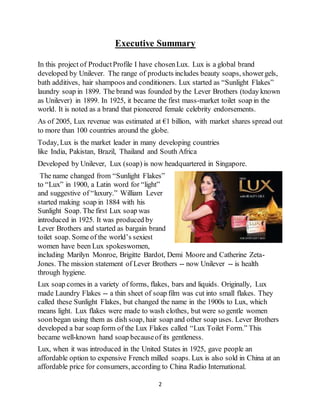
In this project of ProductProfile I have chosenLux. Lux is a global brand
developed by Unilever. The range of products includes beauty soaps, showergels,
bath additives, hair shampoos and conditioners. Lux started as “Sunlight Flakes”
laundry soap in 1899. The brand was founded by the Lever Brothers (today known
as Unilever) in 1899. In 1925, it became the first mass-market toilet soap in the
world. It is noted as a brand that pioneered female celebrity endorsements.
As of 2005, Lux revenue was estimated at €1 billion, with market shares spread out
to more than 100 countries around the globe.
Today, Lux is the market leader in many developing countries
like India, Pakistan, Brazil, Thailand and South Africa
Developed by Unilever, Lux (soap) is now headquartered in Singapore.
The name changed from “Sunlight Flakes”
to “Lux” in 1900, a Latin word for “light”
and suggestive of “luxury.” William Lever
started making soap in 1884 with his
Sunlight Soap. The first Lux soap was
introduced in 1925. It was produced by
Lever Brothers and started as bargain brand
toilet soap. Some of the world’s sexiest
women have been Lux spokeswomen,
including Marilyn Monroe, Brigitte Bardot, Demi Moore and Catherine Zeta-
Jones. The mission statement of Lever Brothers -- now Unilever -- is health
through hygiene.
Lux soap comes in a variety of forms, flakes, bars and liquids. Originally, Lux
made Laundry Flakes -- a thin sheet of soap film was cut into small flakes. They
called these Sunlight Flakes, but changed the name in the 1900s to Lux, which
means light. Lux flakes were made to wash clothes, but were so gentle women
soonbegan using them as dish soap, hair soap and other soap uses. Lever Brothers
developed a bar soap form of the Lux Flakes called “Lux Toilet Form.” This
became well-known hand soap becauseof its gentleness.
Lux, when it was introduced in the United States in 1925, gave people an
affordable option to expensive French milled soaps. Lux is also sold in China at an
affordable price for consumers, according to China Radio International.
3
History of Unilever
Unilever has been present in the North Africa and Middle East region since 1933, a
year which saw the appointment of the Binzagar family as the company’s agent
within Saudi Arabia while in the same year Unilever also entered the Egyptian
market. In 1954 Unilever made its first foray in the “Maghreb” market with the
launch of Omo in Algeria, from France, through a local partner followed by an
entry into Morocco in 1960 and Tunisia in 1961.
In 1992 Unilever came on-shore in the Arabia Peninsula with the setting up of an
office in Dubai and in the same year Lever Egypt was formed as a Joint-Venture
with the Fine Foods Company, a member of the Rachid Group. In 1999 Lever
Egypt and Fine FoodsGroup merged to form Unilever Egypt.
1910s-1920s:Unilever was formed in September 1929 by a merger of the
operations of British soapmaker Lever
Brothers and
Dutch margarine producer Margarine Unie.
The merger made sound commercial sense,
as palm oil was a major raw material for both
margarines and soaps, and could be imported
more efficiently in larger quantities.The initial
harvesting of palm oil was from British West
Africa, from where news reports seen back in
England showed the workers abroad in
favourable conditions. In 1911, the company
received a concessionfor 750,000 hectares of forest in Belgian Congo, mostly
south of Bandundu, where a system of forced labour operated. In 1922 Unilever
acquired Mac Fisheries, owner of T. Wall & Sons.
1930s-1940s:In the 1930s business grew and new ventures were launched in Africa
and Latin America. The Nazi occupation of Europe during the Second World War
meant that Unilever was unable to reinvest its capital into Europe, so it instead
acquired new businesses in the UK and the US. In 1943 it acquired T. J. Lipton, a
majority stake in Frosted Foods (owner of the Birds Eyebrand) and Batchelors
Peas, one of the largest vegetables canners in the UK. In 1944, Pepsodent was
acquired. After 1945 Unilever's once successfulUS businesses (Lever Brothers and
T.J. Lipton) began to decline. As a result Unilever began to operate a "hands off"
policy towards the subsidiaries, and left American management to its own devices.
4
1950s-1960s:Sunsilk was first launched in the UK in 1954. Dove was first
launched in the US in 1957. Unilever took full ownership of Frosted Foods in
1957, which it renamed Birds Eye. The US-based Good Humor ice cream business
was acquired in 1961. In 1971, Unilever acquired the British-based Lipton
Ltd from Allied Suppliers. In 1978, National Starchwas acquired for $487 million,
marking the largest ever foreign-acquisition of a US company at that point.
1970s-1980s:By the end of the 1970s, through acquisitions, Unilever had gained 30
percent of the Western European ice cream market. In 1982 Unilever management
decided to reposition itself from an unwieldy conglomerate to a more
concentrated FMCG company. In 1984 Unilever acquired Brooke Bond (maker
of PG Tips tea) for £390 million in the company's first successfulhostile
takeover. In 1986 Unilever strengthened its position in the world skin care market
by acquiring Chesebrough-Ponds (merged from Chesebrough
Manufacturing and Pond's Creams), etc.
1990s:The US division carried the Lever
Brothers name until the 1990s, when it
adopted that of the parent company. The
American unit has headquarters in New
Jersey, and no longer maintains a presence
at Lever House, a skyscraper on Park
Avenue in New York City.In 1993
Unilever acquired Breyers from Philip
Morris, which made the company the largest ice cream manufacturer in the United
States. In 1996 Unilever merge Elida Gibbs and Lever Brothers in its UK
operations..
2000s:InApril 2000 Unilever bought both Ben & Jerry's and Slim Fast for £1.63
billion. Later that year, the company acquired Best Foodsfor £13.4 billion. The
Bestfoods acquisition increased Unilever's scale in foods in America and added
brands such as Knorr and Hellmann's to its portfolioThe same year the company
bought worldwide mustard and products firm Maille. Maille had three boutiques in
Europe.In 2001 Unilever was split into two divisions: one for Foods and one for
Home and Personal Care. In September 2002, the company sold its specialty oils
and fats division, Loders Croklaan, for RM814 million (€218.5 million) to IOI
Corporation, a Kuala Lumpur, Malaysia-based oil palm company. As part of the
deal, the Loders Croklaan brand will be maintained.In May 2007 Unilever became
5
the first large-scale company to commit to sourcing all its tea in a sustainable
manner, employing the Rainforest Alliance, an international environmental NGO,
to certify its tea estates in East Africa, as well as third-party suppliers in Africa and
other parts of the world. It declared its aim to have all Lipton Yellow Label andPG
Tips tea bags sold in Western Europe certified by 2010, followed by all Lipton tea
bags globally by 2015.
2010-2014:On9 August 2010 Unilever signed an asset purchase agreement with
the Norwegian dairy group TINE, to acquire the activities of Diplom. On 24
September 2010 Unilever announced that it had entered into a definitive agreement
to business in Brazil to Cargill. On 27 September 2010 Unilever purchased
Alberto-Culver, a maker of personal care and household products including
Simple, VO5, Nexxus, TRESemmé, and Mrs. Dash, for US$3.7 billion. On 28
September 2010 Unilever and EVGA announced that they had signed an
agreement under Unilever. In February 2011 Unilever announced that it will
switch to 100% cage-free eggs for all products it produces worldwide. In March
2011 it was announced that
Unilever had entered into a
binding agreement to sell the
Sanex brand to Colgate-
Palmolive for €672 million, and
that Unilever would acquire
Colgate-Palmolive's laundry
detergent brands in Colombia
(Fab, Lavomatic and Vel) for US$215 million. On 24 August 2011 it was
announced that Unilever had agreed to sell the Alberto VO5 brand in the United
States and Puerto Rico, and the Rave brand globally, to Brynwood Partners VI
L.P. On 14 October2011 it was announced that Unilever had agreed to acquire
82% of the Russia-based beauty company Kalina. On 27 December 2012 it was
announced the Unilever is phasing out the use of microplastics in their personal
care products by2015.In July 2013 Unilever increased its stake in its Indian unit,
Hindustan Unilever, to 67% for around €2.45 billion.
6
PRODUCT PROFILE
Lux is a global brand developed by Unilever. The range of products includes
beauty soaps, shower gels, bath additives, hair shampoos and conditioners. Lux
started as “Sunlight Flakes” laundry soap in 1899.
In 1924, it became the first mass market toilet soap in the world. It is noted as a
brand that pioneered female celebrity endorsements.
As of 2005, Lux revenue is at 1.0 billion euros, with market shares spread out to
more than 100 countries across the globe.
Today, Lux is the market leader in
several countries including Brazil,
India, Thailand and South Africa.
One of the most popular beauty
products India in terms of soaps
and bodywashes is LUX soap. For
years, LUX has been one of the
India top soaps that offer a way to
gain smooth and fair looking skin
without worrying too much on how
old the user is. LUX soap came
from one of the biggest corporation
in the India today, Unilever. LUX
is a personal care brand owned by
Unilever. LUX is primarily made
from synthetic surfactants, as well
as some vegetable oil based soap ingredients, such as sodium palm kernelate.
LUX is formulated to be pH neutral, with a pH that is usually between 6.5 and
7.5.
LUX products are manufactured in the Netherlands, Untied States, Germany,
Ireland and Brazil. The LUX trademark and brand name is currently owned by
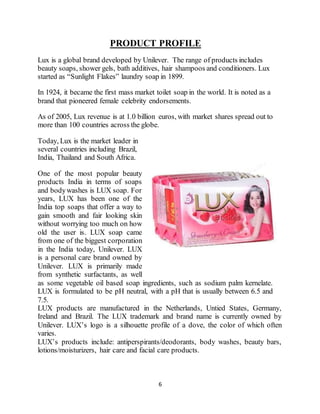
Unilever. LUX’s logo is a silhouette profile of a dove, the color of which often
varies.
LUX’s products include: antiperspirants/deodorants, body washes, beauty bars,
lotions/moisturizers, hair care and facial care products.
7
In the US, LUX bar soap is currently produced in the cool moisture, exfoliating,
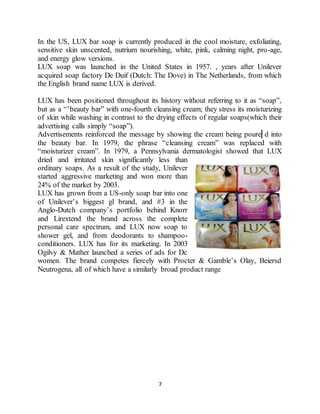
sensitive skin unscented, nutrium nourishing, white, pink, calming night, pro-age,
and energy glow versions.
LUX soap was launched in the United States in 1957. , years after Unilever
acquired soap factory De Duif (Dutch: The Dove) in The Netherlands, from which
the English brand name LUX is derived.
LUX has been positioned throughout its history without referring to it as “soap”,
but as a “’beauty bar” with one-fourth cleansing cream; they stress its moisturizing
of skin while washing in contrast to the drying effects of regular soaps(which their
advertising calls simply “soap”).
Advertisements reinforced the message by showing the cream being poure d into
the beauty bar. In 1979, the phrase “cleansing cream” was replaced with
“moisturizer cream”. In 1979, a Pennsylvania dermatologist showed that LUX
dried and irritated skin significantly less than
ordinary soaps. As a result of the study, Unilever
started aggressive marketing and won more than
24% of the market by 2003.
LUX has grown from a US-only soap bar into one
of Unilever’s biggest gl brand, and #3 in the
Anglo-Dutch company’s portfolio behind Knorr
and Lirextend the brand across the complete
personal care spectrum, and LUX now soap to
shower gel, and from deodorants to shampoo-
conditioners. LUX has for its marketing. In 2003
Ogilvy & Mather launched a series of ads for Dc
women. The brand competes fiercely with Procter & Gamble’s Olay, Beiersd
Neutrogena, all of which have a similarly broad product range
8
History of LUX
The brand was founded by the Lever Brothers (today known
as Unilever) in 1899. The name changed from “Sunlight
Flakes” to “Lux” in 1900, a Latin word for “light” and
suggestive of “luxury.”
Lux toilet soap was launched in the United States in 1925
and in the United Kingdom in 1928. Subsequently, Lux soap
has been marketed in several forms, including handwash,
shower gel and cream bath soap.
Beginnings
Lux’s early advertising campaigns aimed to educate users about its credentials as a
laundry productand appeared in magazines such
as Ladies Home Journal. By the early 1920s, it was a
hugely successfulbrand and in 1924, the Lever
Brothers conducted a contest that led them to a very
interesting finding: women were using Lux as pud
soaps.
Building beauty soapcredentials
Introduced in the United States in 1924, Lux became the world’s first mass market
toilet soap with the tagline “made as fine as French Soap”. In the first two years of
launch, Lux concentrated on building its beauty soap credentials. Advertisements
offered consumers “a beauty soap made in the French method” at an affordable
price, with the promise of smooth skin.
Made with fine-texture, rich in fragrance, and manufactured using a method
created in France, the first Lux toilet soap was sold for 10 cents
apiece.
1928–1940:9 out of 10 stars
This era saw key launches of LUX in the UK, India, Argentina
and Thailand. The brand concentrated on building its
association with the increasingly popular movie world, focusing
9
more on movie stars and their roles rather than on the product. In
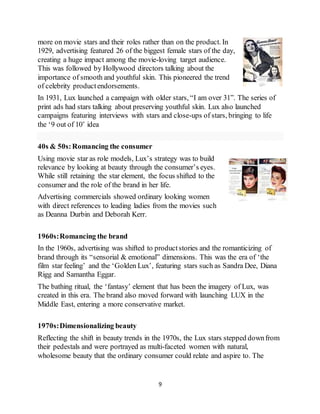
1929, advertising featured 26 of the biggest female stars of the day,
creating a huge impact among the movie-loving target audience.
This was followed by Hollywood directors talking about the
importance of smooth and youthful skin. This pioneered the trend
of celebrity productendorsements.
In 1931, Lux launched a campaign with older stars, “I am over 31”. The series of
print ads had stars talking about preserving youthful skin. Lux also launched
campaigns featuring interviews with stars and close-ups of stars, bringing to life
the ‘9 out of 10’ idea
40s & 50s:Romancing the consumer
Using movie star as role models, Lux’s strategy was to build
relevance by looking at beauty through the consumer’s eyes.
While still retaining the star element, the focus shifted to the
consumer and the role of the brand in her life.
Advertising commercials showed ordinary looking women
with direct references to leading ladies from the movies such
as Deanna Durbin and Deborah Kerr.
1960s:Romancing the brand
In the 1960s, advertising was shifted to productstories and the romanticizing of
brand through its “sensorial & emotional” dimensions. This was the era of ‘the
film star feeling’ and the ‘Golden Lux’, featuring stars such as Sandra Dee, Diana
Rigg and Samantha Eggar.
The bathing ritual, the ‘fantasy’ element that has been the imagery of Lux, was
created in this era. The brand also moved forward with launching LUX in the
Middle East, entering a more conservative market.
1970s:Dimensionalizing beauty
Reflecting the shift in beauty trends in the 1970s, the Lux stars stepped downfrom
their pedestals and were portrayed as multi-faceted women with natural,
wholesome beauty that the ordinary consumer could relate and aspire to. The
10
executions were more of ‘a day in the life’ of the stars with focus on their ‘natural
beauty’. Stars included Brigitte Bardot and Natalie Wood.
1980s:Owning the categoryspace
Establishing itself as the beauty soap for stars and beautiful women, the 1980s
emphasized the importance of skin care – the first step to beauty. Lux was
launched in China at this time. Sophia Loren, Raquel Welch and Cheryl Ladd were
some famous celebrities used during this time.
In India, actresses such as Hema Malini, Parveen Babi, Madhuri Dixit, Rani
Mukerji and Aishwarya Rai have endorsed Lux soap.
1990s – early2000s:Advanced skin benefits
In the 1990s, Lux moved from generic beauty benefits to focus on specific benefits
and transformation. More emphasis on functionality and variant associations with
different skin types as well as mention of ingredients. The communication was far
more regional specific and localized, using in Brazil stars like Malu
Mader and Debora Bloch.
This period launched productbrand extensions Shower Cream and Gels and Lux
Super Rich Shampoo in Japan and China.
Lux Style Awards
In 2002, Pakistan created the Lux Style Awards to celebrate the Pakistani film
industry.
2000s:Beyondmovie stars
In early 2000, the focus shifted from specific skin benefits to a stronger emotional
space. The brand provided the link between the aspirational role models and real
life with the campaign, ‘Lux brings out the star in you’. The benefit was now more
than just beauty, it was also about the confidence that comes from beautiful skin.
In 2005, Lux encouraged women to celebrate and indulge their femininity with the
“Play with Beauty” philosophy, with stars like Aishwarya Rai. The brand also
connected with consumers to take a more ‘active’ stance on beauty.
Today, Lux products are manufactured at 71 locations with more than 2000
suppliers and associates providing the raw materials. It has key markets in the
developing countries like Brazil, Pakistan, China, Bangladesh and South Africa,
11
and is a market leader in for soap bars in India, Pakistan, Brazil, Saudi Arabia,
Bangladesh, Thailand and Vietnam. In the United States, Lux soap is branded as
"Caress".
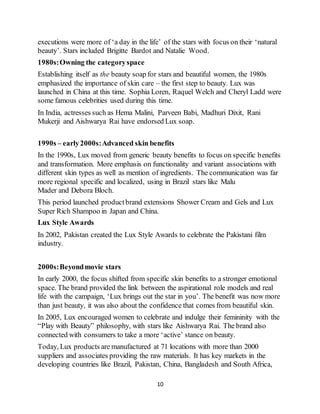
Product Variants-Lux(Sold Mainly in India, MiddleEast, Singapore)
Lux Fresh Splash Body Wash
Lux Strawberry Cream Body Wash
Lux Peach and Cream Body Wash
Lux Wake Me Up Body Wash
Lux Cherry and Cream Body Wash
Lux Creamy Perfection Body Wash
Lux Secret Bliss Body Wash
12
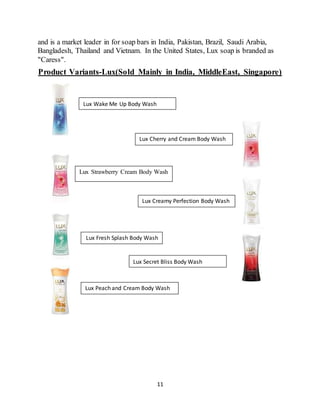
Lux Magic Spell Body Wash
Lux Soft Touch Hand Wash
Lux White Impress Hand Wash
Lux White Impress Whitening Body Wash
Lux Peach and Cream Hand Wash
Lux Jasmine and Almond Oil Body Wash
Lux Wake Me Up Hand Wash
Lux Magic Spell Fragranced Body Wash
Lux Magic Spell Hand Wash
Lux French Rose Infusion Body Wash
Lux Secret Bliss Hand Wash
Lux Secret Bliss Body Wash
13
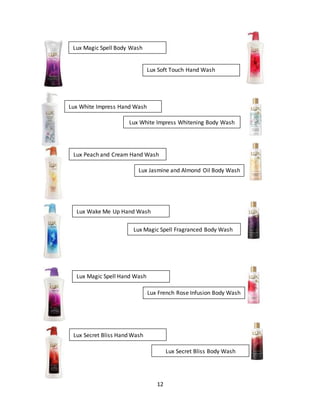
Lux Dream Delight Fragranced Body Wash
Lux White Radiance Whitening Soap
Lux Sandal and Cream Soap
Lux Fresh Splash Refreshing Body Wash
Lux Aqua Sparkle Body Wash
Lux Soft Touch Soap
Lux Dream Delight Fragranced Soap
Lux White Impress Soap
Lux Secret Bliss Soap
14
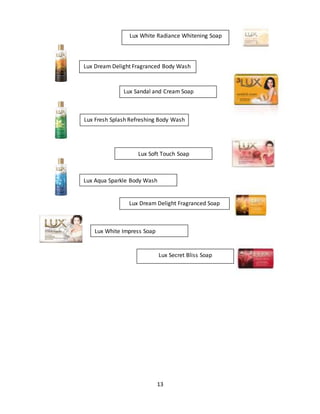
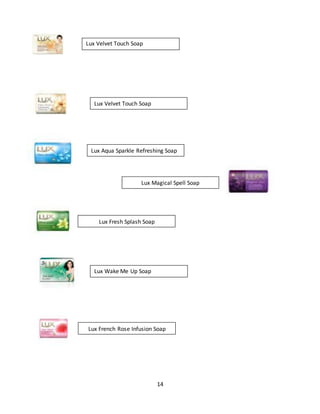
Lux Velvet Touch Soap
Lux Aqua Sparkle Refreshing Soap
Lux Magical Spell Soap
Lux Fresh Splash Soap
Lux Wake Me Up Soap
Lux French Rose Infusion Soap
15
Product Life Cycle (Theory)
Productlife cycle theory divides the marketing of a productinto four stages:
introduction, growth, maturity and decline. When productlife cycle is based on
sales volume, introduction and growth often becomeone stage. Forinternationally
available products, these three remaining stages include the effects of outsourcing
and foreign production.
GeneralTheory
When a productis first introduced in a particular country, it sees rapid growth in
sales volume becausemarket demand is unsatisfied. As more people who want the
productbuy it, demand and sales level off. When demand has been satisfied,
productsales decline to the level required for productreplacement. In international
markets, the productlife cycle accelerates due to the presence of "follower"
economies that rarely introduce new innovations but quickly imitate the successes
of others..
Growth
An effectively marketed productmeets a need in its target market. The supplier of
the producthas conducted market surveys and has established estimates for market
size and composition. He introduces the product, and the identified need creates
immediate demand that the supplier is ready to satisfy. Competition is low. Sales
volume grows rapidly. This initial stage of the productlife cycle is characterized
by high prices, high profits and wide promotion of the product. International
followers have not had time to develop imitations. The supplier of the productmay
export it, even into follower economies.
Maturity
In the maturity phase of the productlife cycle, demand levels off and sales volume
increases at a slower rate. Imitations appear in foreign markets and export sales
decline. The original supplier may reduce prices to maintain market share and
supportsales. Profit margins decrease, but the business remains attractive because
volume is high and costs, suchas those related to development and promotion, are
also lower.
Decline
In the final phase of the productlife cycle, sales volume decreases and many such
products are eventually phased out and discontinued. The follower economies have
developed imitations as good as the original productand are able to export them to
the original supplier's home market, further depressing sales and prices.
16
Product Life Cycle of Lux
Lux has been bringing the bestof beauty to every woman since 1925. During that
time they’ve been known as the beauty secret of some of the world’s most
glamorous stars, from Elizabeth Taylor, Audrey Hepburn and Marilyn Monroe to
Ashwarya Rai, Katrina Kaif and Shu Qi. Today, their range of beauty treats
delights women in more than 100 countries every day. The Philosophy of the
productis quite simple, it’s all about pleasure. Lux is committed to creating the
indulgent skin treats women crave to provide an exceptional experience in and out
of the shower.They infuse our products with fine fragrances crafted by the world’s
best perfume experts. They craft amazing textures, rich in indulgent ingredients, all
designed to exceed your expectations. Lux is not just a soap that smells good, it’s a
fine fragrance you can bathe in.Lux believes that beauty doesn’thave to be about
hard work, but rather, about pleasure. To bathe in luxurious Lux daily is to come
out feeling transformed, feeling on top of the world – inspiring every woman to
feel irresistible and confident in her own skin every day.
1.Introduction Stage Of Lux:
Lux launched world's first mass market beauty soap in US in 1924 and had been
launched in India in 1929. At that time there was only 1 competitor which was
lifebuoy which was Unilever's own brand. Lux was launched in major cities of
India like Mumbai, Calcutta etc.
market strategies in introduction phase:
 MARKETING OBJECTIVE: to create brand awareness in major cities of
India.
 PRODUCT:just entered with 1 product, no differentiation initially.
 PRICE: their initial price was slightly higher than their competitor lifebuoy,
as the initial costs were to be recovered.
 ADVERTISING: They invested a pretty high amount in advertising as they
wanted to create brand awareness and targeted early adopters who were
ready to buy the product. their first brand ambassador was Leela Chitnis.
DISTRIBUTION: the distribution was very selective, as they launched in
major cities only, and channel was through manufacturer, whole seller and
retailer.
2. Growth Stage Of Lux:
 MARKETING OBJECTIVE: To expand their market in different cities of
India and expand their market share.
17
 PRODUCT:It remained same till this phase.
 PRICE: Price was slightly cut down, in order to increase the market share.
 ADVERTISING: In this stage, they increased the budget to retain the
customers and attract new customers. Many top naught actresses were
signed like Juhi Chawla, Hema Malini, Zeenat Amaan, Madhuri Dixit,
Sharmila Tagore and Sridevi.
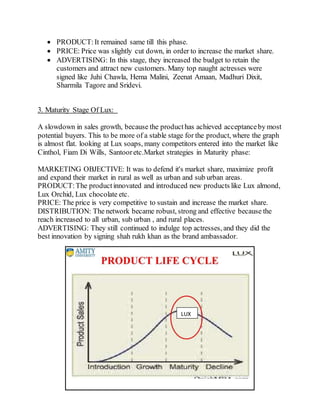
3. Maturity Stage Of Lux:
A slowdown in sales growth, because the producthas achieved acceptanceby most
potential buyers. This to be more of a stable stage for the product, where the graph
is almost flat. looking at Lux soaps, many competitors entered into the market like
Cinthol, Fiam Di Wills, Santooretc.Market strategies in Maturity phase:
MARKETING OBJECTIVE: It was to defend it's market share, maximize profit
and expand their market in rural as well as urban and sub urban areas.
PRODUCT:The productinnovated and introduced new products like Lux almond,
Lux Orchid, Lux chocolate etc.
PRICE: The price is very competitive to sustain and increase the market share.
DISTRIBUTION: The network became robust, strong and effective because the
reach increased to all urban, sub urban , and rural places.
ADVERTISING: They still continued to indulge top actresses, and they did the
best innovation by signing shah rukh khan as the brand ambassador.
LUX
18
Product Planning for Lux
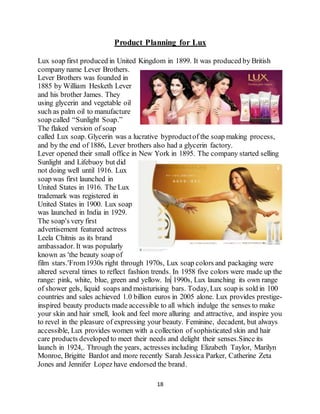
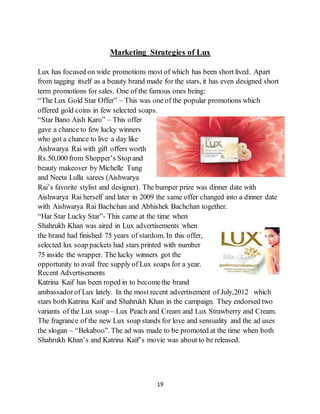
Lux soap first produced in United Kingdom in 1899. It was produced by British
company name Lever Brothers.
Lever Brothers was founded in
1885 by William Hesketh Lever
and his brother James. They
using glycerin and vegetable oil
such as palm oil to manufacture
soap called “Sunlight Soap.”
The flaked version of soap
called Lux soap. Glycerin was a lucrative byproductof the soap making process,
and by the end of 1886, Lever brothers also had a glycerin factory.
Lever opened their small office in New York in 1895. The company started selling
Sunlight and Lifebuoy but did
not doing well until 1916. Lux
soap was first launched in
United States in 1916. The Lux
trademark was registered in
United States in 1900. Lux soap
was launched in India in 1929.
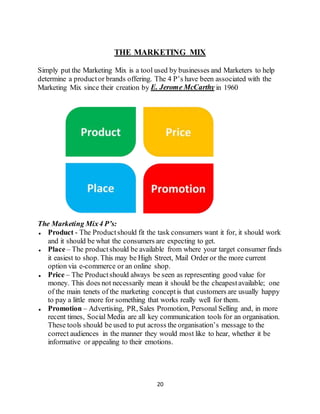
The soap's very first
advertisement featured actress
Leela Chitnis as its brand
ambassador. It was popularly
known as 'the beauty soap of
film stars.'From1930s right through 1970s, Lux soap colors and packaging were
altered several times to reflect fashion trends. In 1958 five colors were made up the
range: pink, white, blue, green and yellow. In 1990s, Lux launching its own range
of shower gels, liquid soaps and moisturising bars. Today, Lux soap is sold in 100
countries and sales achieved 1.0 billion euros in 2005 alone. Lux provides prestige-
inspired beauty products made accessible to all which indulge the senses to make
your skin and hair smell, look and feel more alluring and attractive, and inspire you
to revel in the pleasure of expressing your beauty. Feminine, decadent, but always
accessible, Lux provides women with a collection of sophisticated skin and hair
care products developed to meet their needs and delight their senses.Since its
launch in 1924,. Through the years, actresses including Elizabeth Taylor, Marilyn
Monroe, Brigitte Bardot and more recently Sarah Jessica Parker, Catherine Zeta
Jones and Jennifer Lopez have endorsed the brand.
19
Marketing Strategies of Lux
Lux has focused on wide promotions most of which has been short lived. Apart
from tagging itself as a beauty brand made for the stars, it has even designed short
term promotions for sales. One of the famous ones being:
“The Lux Gold Star Offer” – This was one of the popular promotions which
offered gold coins in few selected soaps.
“Star Bano Aish Karo” – This offer
gave a chance to few lucky winners
who got a chance to live a day like
Aishwarya Rai with gift offers worth
Rs.50,000 from Shopper’s Stop and
beauty makeover by Michelle Tung
and Neeta Lulla sarees (Aishwarya
Rai’s favorite stylist and designer). The bumper prize was dinner date with
Aishwarya Rai herself and later in 2009 the same offer changed into a dinner date
with Aishwarya Rai Bachchan and Abhishek Bachchan together.
“Har Star Lucky Star”- This came at the time when
Shahrukh Khan was aired in Lux advertisements when
the brand had finished 75 years of stardom. In this offer,
selected lux soap packets had stars printed with number
75 inside the wrapper. The lucky winners got the
opportunity to avail free supply of Lux soaps for a year.
Recent Advertisements
Katrina Kaif has been roped in to becomethe brand
ambassadorof Lux lately. In the most recent advertisement of July,2012 which
stars both Katrina Kaif and Shahrukh Khan in the campaign. They endorsed two
variants of the Lux soap – Lux Peach and Cream and Lux Strawberry and Cream.
The fragrance of the new Lux soap stands for love and sensuality and the ad uses
the slogan – “Bekaboo”. The ad was made to be promoted at the time when both
Shahrukh Khan’s and Katrina Kaif’s movie was about to be released.
20
THE MARKETING MIX
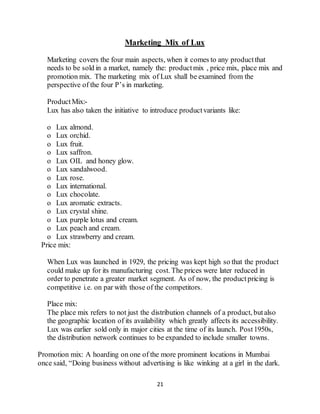
Simply put the Marketing Mix is a tool used by businesses and Marketers to help
determine a productor brands offering. The 4 P’s have been associated with the
Marketing Mix since their creation by E. Jerome McCarthy in 1960
The Marketing Mix4 P’s:
 Product - The Productshould fit the task consumers want it for, it should work
and it should be what the consumers are expecting to get.
 Place – The productshould be available from where your target consumer finds
it easiest to shop. This may be High Street, Mail Order or the more current
option via e-commerce or an online shop.
 Price – The Productshould always be seen as representing good value for
money. This does not necessarily mean it should be the cheapestavailable; one
of the main tenets of the marketing conceptis that customers are usually happy
to pay a little more for something that works really well for them.
 Promotion – Advertising, PR, Sales Promotion, Personal Selling and, in more
recent times, Social Media are all key communication tools for an organisation.
These tools should be used to put across the organisation’s message to the
correct audiences in the manner they would most like to hear, whether it be
informative or appealing to their emotions.
21
Marketing Mix of Lux
Marketing covers the four main aspects, when it comes to any productthat
needs to be sold in a market, namely the: productmix , price mix, place mix and
promotion mix. The marketing mix of Lux shall be examined from the
perspective of the four P’s in marketing.
ProductMix:-
Lux has also taken the initiative to introduce productvariants like:
o Lux almond.
o Lux orchid.
o Lux fruit.
o Lux saffron.
o Lux OIL and honey glow.
o Lux sandalwood.
o Lux rose.
o Lux international.
o Lux chocolate.
o Lux aromatic extracts.
o Lux crystal shine.
o Lux purple lotus and cream.
o Lux peach and cream.
o Lux strawberry and cream.
Price mix:
When Lux was launched in 1929, the pricing was kept high so that the product
could make up for its manufacturing cost. The prices were later reduced in
order to penetrate a greater market segment. As of now, the productpricing is
competitive i.e. on par with those of the competitors.
Place mix:
The place mix refers to not just the distribution channels of a product, butalso
the geographic location of its availability which greatly affects its accessibility.
Lux was earlier sold only in major cities at the time of its launch. Post1950s,
the distribution network continues to be expanded to include smaller towns.
Promotion mix: A hoarding on one of the more prominent locations in Mumbai
once said, “Doing business without advertising is like winking at a girl in the dark.
22
You know what you’re doing, but she doesn’t.”And thus, promotion seeks to
bridge the gap between ignorance and purchase.
The ‘how’ and ‘why’ behind the promotion goes a long way in brand building.
 As reiterated in this project, Lux was promoted as a productused by film
stars. And thus, every major actor has promoted the product. The list
included: Leela Chitnis, Madhubala, Nargis, Meena Kumari, Mala Sinha,
Sharmila Tagore, Waheeda Rehman, Saira Banu, Hema Malini, Zeenat
Aman, Juhi Chawla, Tabu, Madhuri Dixit, Sridevi, Aishwarya Rai,
Kareena Kapoor, Priyanka Chopra, Katrina Kaif, Asin and Kajal
Agarwal.
 Although Lux was always advertised as a productmeant for indulging
the senses, where bathing was a wonderful ritual in itself, it petered down
its approachin the recent years. The actors are still shown seen indulging
themselves. But the focus also moves towards the ordinary girl in a bid to
reach out to its female consumers.
 A wonderful example of this promotion was the 2005 ‘Mujhme Star
Jagaaye’ campaign featuring Aishwarya Rai and Shilpa Anand. The
campaign also promoted a Model Hunt that went underway soonafter.
 In 2001, Lux had announced a 22-carat Gold Star offer, wherein a gold
coin was hidden inside a bar of soap. The lucky consumers who find the
gold coin also have a chance to win an additional 30 grams of gold.
 In 2004, Lux launched a ‘Lux star bano, Aish karo’ contest where
consumers were supposed to buy a promotional pack of Lux and scratch
the special scratch card to earn their reward. Prizes varied from living a
day in Aishwarya Rai’s life to beauty kits, Neeta Lulla saris among a host
of other gift vouchers and well… more Lux soaps to be won.
 On its completion of 75 years in 2005, Lux roped in Shah Rukh Khan as
its first ever male ambassador. The advertisement featured the actor in a
bathtub, flanked by his leading ladies – Juhi Chawla, Kareena Kapoor,
Sridevi and Hema Malini. It was known as the ‘Har Star Lucky Star’
offer, where every wrapper guaranteed a gift, waiting to be unwrapped.
23
 In 2009, Aishwarya Rai and Abhishek Bachchan featured in the new
‘SoneSe Bhi Sona Lage’ campaign. The campaign also conducted a Lux
Super Star Offer where the lucky winners get to meet Aishwarya-
Abhishek in London. The campaign jingle became so immensely popular
that its varied renditions were used in the advertisements that featured
Katrina Kaif since 2009.
 Asin Thottumkal and Kajal Agarwal are the newest brand ambassadors of
Lux, modelling together for the “Kya Khoob Ho Tum” advertisement
that has been recently released.
 Lux also relies on market research for making innovative changes by
going for door-to-doorsampling of a product, oncea year, in urban and
rural areas. The brand image is firmly and favourably embedded in the
psyche of the consumers. The productis also not particularly expensive,
which is said to be a ‘winning combination.’
24
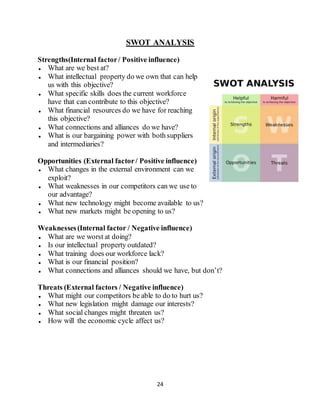
SWOT ANALYSIS
Strengths(Internal factor/ Positive influence)
 What are we best at?
 What intellectual property do we own that can help
us with this objective?
 What specific skills does the current workforce
have that can contribute to this objective?
 What financial resources do we have for reaching
this objective?
 What connections and alliances do we have?
 What is our bargaining power with both suppliers
and intermediaries?
Opportunities (External factor/ Positive influence)
 What changes in the external environment can we
exploit?
 What weaknesses in our competitors can we use to
our advantage?
 What new technology might become available to us?
 What new markets might be opening to us?
Weaknesses(Internal factor / Negative influence)
 What are we worst at doing?
 Is our intellectual property outdated?
 What training does our workforce lack?
 What is our financial position?
 What connections and alliances should we have, but don’t?
Threats (External factors / Negative influence)
 What might our competitors be able to do to hurt us?
 What new legislation might damage our interests?
 What social changes might threaten us?
 How will the economic cycle affect us?
25
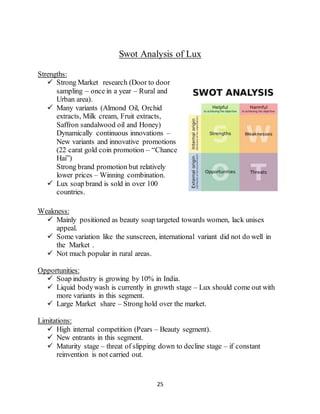
Swot Analysis of Lux
Strengths:
 Strong Market research (Door to door
sampling – once in a year – Rural and
Urban area).
 Many variants (Almond Oil, Orchid
extracts, Milk cream, Fruit extracts,
Saffron sandalwood oil and Honey)
Dynamically continuous innovations –
New variants and innovative promotions
(22 carat gold coin promotion – “Chance
Hai”)
Strong brand promotion but relatively
lower prices – Winning combination.
 Lux soap brand is sold in over 100
countries.
Weakness:
 Mainly positioned as beauty soap targeted towards women, lack unisex
appeal.
 Some variation like the sunscreen, international variant did not do well in
the Market .
 Not much popular in rural areas.
Opportunities:
 Soap industry is growing by 10% in India.
 Liquid bodywash is currently in growth stage – Lux should come out with
more variants in this segment.
 Large Market share – Strong hold over the market.
Limitations:
 High internal competition (Pears – Beauty segment).
 New entrants in this segment.
 Maturity stage – threat of slipping down to decline stage – if constant
reinvention is not carried out.
26
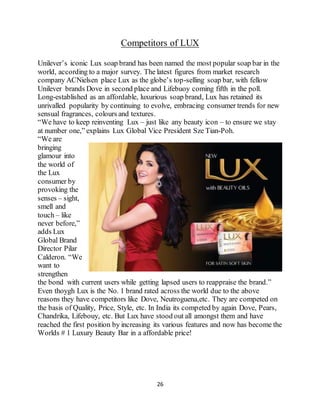
Competitors of LUX
Unilever’s iconic Lux soap brand has been named the most popular soap bar in the
world, according to a major survey. The latest figures from market research
company ACNielsen place Lux as the globe’s top-selling soap bar, with fellow
Unilever brands Dove in second place and Lifebuoy coming fifth in the poll.
Long-established as an affordable, luxurious soap brand, Lux has retained its
unrivalled popularity by continuing to evolve, embracing consumer trends for new
sensual fragrances, colours and textures.
“We have to keep reinventing Lux – just like any beauty icon – to ensure we stay
at number one,” explains Lux Global Vice President Sze Tian-Poh.
“We are
bringing
glamour into
the world of
the Lux
consumer by
provoking the
senses – sight,
smell and
touch – like
never before,”
adds Lux
Global Brand
Director Pilar
Calderon. “We
want to
strengthen
the bond with current users while getting lapsed users to reappraise the brand.”
Even thoygh Lux is the No. 1 brand rated across the world due to the above
reasons they have competitors like Dove, Neutroguena,etc. They are competed on
the basis of Quality, Price, Style, etc. In India its competed by again Dove, Pears,
Chandrika, Lifebouy, etc. But Lux have stood out all amongst them and have
reached the first position by increasing its various features and now has become the
Worlds # 1 Luxury Beauty Bar in a affordable price!
27
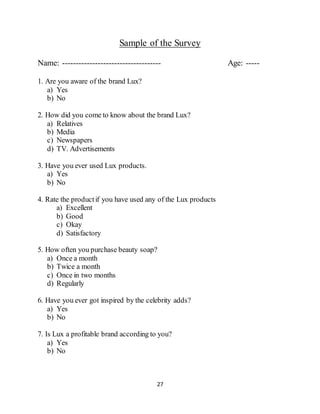
Sample of the Survey
Name: ------------------------------------ Age: -----
1. Are you aware of the brand Lux?
a) Yes
b) No
2. How did you come to know about the brand Lux?
a) Relatives
b) Media
c) Newspapers
d) TV. Advertisements
3. Have you ever used Lux products.
a) Yes
b) No
4. Rate the productif you have used any of the Lux products
a) Excellent
b) Good
c) Okay
d) Satisfactory
5. How often you purchase beauty soap?
a) Once a month
b) Twice a month
c) Once in two months
d) Regularly
6. Have you ever got inspired by the celebrity adds?
a) Yes
b) No
7. Is Lux a profitable brand according to you?
a) Yes
b) No
28
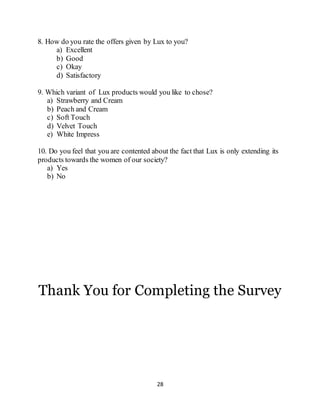
8. How do you rate the offers given by Lux to you?
a) Excellent
b) Good
c) Okay
d) Satisfactory
9. Which variant of Lux products would you like to chose?
a) Strawberry and Cream
b) Peach and Cream
c) Soft Touch
d) Velvet Touch
e) White Impress
10. Do you feel that you are contented about the fact that Lux is only extending its
products towards the women of our society?
a) Yes
b) No
Thank You for Completing the Survey
29
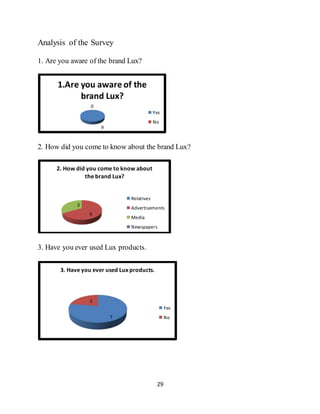
Analysis of the Survey
1. Are you aware of the brand Lux?
2. How did you come to know about the brand Lux?
3. Have you ever used Lux products.
9
0
1.Are you aware of the
brand Lux?
Yes
No
6
3
2. How did you come to know about
the brand Lux?
Relatives
Advertisements
Media
Newspapers
7
2
3. Have you ever used Lux products.
Yes
No
30
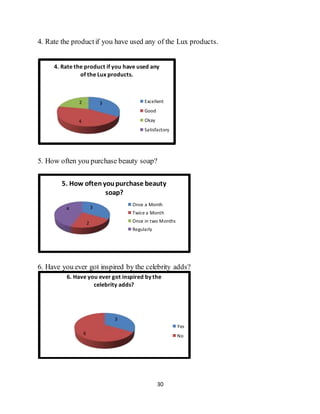
4. Rate the productif you have used any of the Lux products.
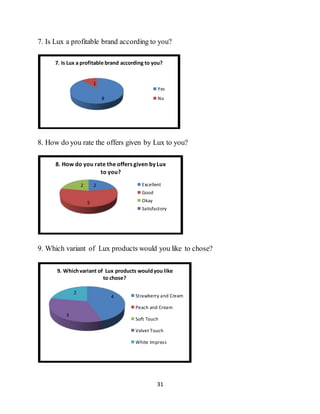
5. How often you purchase beauty soap?
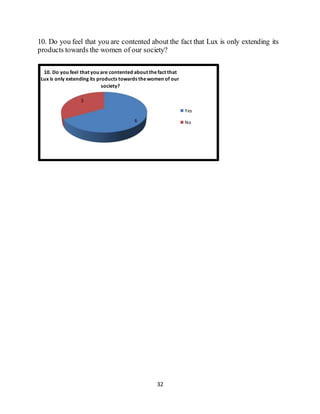
6. Have you ever got inspired by the celebrity adds?
3
4
2
4. Rate the product if you have used any
of the Lux products.
Excellent
Good
Okay
Satisfactory
3
2
4
5. How oftenyoupurchase beauty
soap?
Once a Month
Twice a Month
Once in two Months
Regularly
3
6
6. Have you ever got inspired by the
celebrity adds?
Yes
No
31
7. Is Lux a profitable brand according to you?
8. How do you rate the offers given by Lux to you?
9. Which variant of Lux products would you like to chose?
8
1
7. Is Lux a profitable brand according to you?
Yes
No
2
5
2
8. How do you rate the offers given by Lux
to you?
Excellent
Good
Okay
Satisfactory
4
3
2
9. Whichvariant of Lux products wouldyou like
to chose?
Strawberry and Cream
Peach and Cream
Soft Touch
Velvet Touch
White Impress
32
10. Do you feel that you are contented about the fact that Lux is only extending its
products towards the women of our society?
6
3
10. Do you feel that you are contented about thefact that
Lux is only extending its products towards thewomen of our
society?
Yes
No
33
Survey Conclusion
I had conductedthe survey using Watssapp a social media
portal. The survey was conductedamong the friends that I
had in my contacts. I had taken only for 9 people. The
survey I had conductedwere of 10 questions. Everyone is
aware of the brand Lux and most of them have used the
products. Most of them have rated as a good product
brand. Peoplelike the offers offered by Lux and have
accepted them. They know about Lux through
advertisements. They all like the variants provided by Lux
and also want more. They all like Lux because of its
affordability, quality, style, features, smell, etc. Another
reasons are because its rated as World’s No. 1 Luxury
Soap in a affordable rate and have never caused any
allergies and most of the peoplehave quite a good
impression on Lux.
34
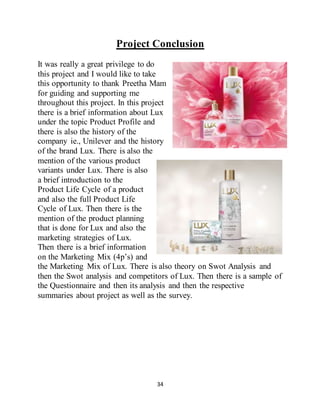
Project Conclusion
It was really a great privilege to do
this project and I would like to take
this opportunity to thank Preetha Mam
for guiding and supporting me
throughout this project. In this project
there is a brief information about Lux
under the topic Product Profile and
there is also the history of the
company ie., Unilever and the history
of the brand Lux. There is also the
mention of the various product
variants under Lux. There is also
a brief introduction to the
Product Life Cycle of a product
and also the full Product Life
Cycle of Lux. Then there is the
mention of the product planning
that is done for Lux and also the
marketing strategies of Lux.
Then there is a brief information
on the Marketing Mix (4p’s) and
the Marketing Mix of Lux. There is also theory on Swot Analysis and
then the Swot analysis and competitors of Lux. Then there is a sample of
the Questionnaire and then its analysis and then the respective
summaries about project as well as the survey.

Lux Marketing Mix

  • 1.
    1 Table of Contents S.NO.TOPIC PAGE NO. 1 Acknowledgement 2 2 Bonafide Certificate 3 3 Executive Summary 5 4 History of Unilever 6 5 ProductProfile-Introduction 8 6 History of Lux 10 7 PLC – Introduction and of Lux 12 8 Marketing Strategies of Lux 14 9 ProductPlanning of Lux 15 10 Theory of Marketing Mix and the marketing mix of Lux 19 11 Theory of Swot Analysis and the Swot Analysis of Lux 20 12 Competitors of Lux 25 13 Sample of the Questionnaire 26 14 Analysis 30 15 Survey Conclusion 32 16 Project Conclusion 34 17 Appendix 38
  • 2.
    2 Executive Summary In thisproject of ProductProfile I have chosenLux. Lux is a global brand developed by Unilever. The range of products includes beauty soaps, showergels, bath additives, hair shampoos and conditioners. Lux started as “Sunlight Flakes” laundry soap in 1899. The brand was founded by the Lever Brothers (today known as Unilever) in 1899. In 1925, it became the first mass-market toilet soap in the world. It is noted as a brand that pioneered female celebrity endorsements. As of 2005, Lux revenue was estimated at €1 billion, with market shares spread out to more than 100 countries around the globe. Today, Lux is the market leader in many developing countries like India, Pakistan, Brazil, Thailand and South Africa Developed by Unilever, Lux (soap) is now headquartered in Singapore. The name changed from “Sunlight Flakes” to “Lux” in 1900, a Latin word for “light” and suggestive of “luxury.” William Lever started making soap in 1884 with his Sunlight Soap. The first Lux soap was introduced in 1925. It was produced by Lever Brothers and started as bargain brand toilet soap. Some of the world’s sexiest women have been Lux spokeswomen, including Marilyn Monroe, Brigitte Bardot, Demi Moore and Catherine Zeta- Jones. The mission statement of Lever Brothers -- now Unilever -- is health through hygiene. Lux soap comes in a variety of forms, flakes, bars and liquids. Originally, Lux made Laundry Flakes -- a thin sheet of soap film was cut into small flakes. They called these Sunlight Flakes, but changed the name in the 1900s to Lux, which means light. Lux flakes were made to wash clothes, but were so gentle women soonbegan using them as dish soap, hair soap and other soap uses. Lever Brothers developed a bar soap form of the Lux Flakes called “Lux Toilet Form.” This became well-known hand soap becauseof its gentleness. Lux, when it was introduced in the United States in 1925, gave people an affordable option to expensive French milled soaps. Lux is also sold in China at an affordable price for consumers, according to China Radio International.
  • 3.
    3 History of Unilever Unileverhas been present in the North Africa and Middle East region since 1933, a year which saw the appointment of the Binzagar family as the company’s agent within Saudi Arabia while in the same year Unilever also entered the Egyptian market. In 1954 Unilever made its first foray in the “Maghreb” market with the launch of Omo in Algeria, from France, through a local partner followed by an entry into Morocco in 1960 and Tunisia in 1961. In 1992 Unilever came on-shore in the Arabia Peninsula with the setting up of an office in Dubai and in the same year Lever Egypt was formed as a Joint-Venture with the Fine Foods Company, a member of the Rachid Group. In 1999 Lever Egypt and Fine FoodsGroup merged to form Unilever Egypt. 1910s-1920s:Unilever was formed in September 1929 by a merger of the operations of British soapmaker Lever Brothers and Dutch margarine producer Margarine Unie. The merger made sound commercial sense, as palm oil was a major raw material for both margarines and soaps, and could be imported more efficiently in larger quantities.The initial harvesting of palm oil was from British West Africa, from where news reports seen back in England showed the workers abroad in favourable conditions. In 1911, the company received a concessionfor 750,000 hectares of forest in Belgian Congo, mostly south of Bandundu, where a system of forced labour operated. In 1922 Unilever acquired Mac Fisheries, owner of T. Wall & Sons. 1930s-1940s:In the 1930s business grew and new ventures were launched in Africa and Latin America. The Nazi occupation of Europe during the Second World War meant that Unilever was unable to reinvest its capital into Europe, so it instead acquired new businesses in the UK and the US. In 1943 it acquired T. J. Lipton, a majority stake in Frosted Foods (owner of the Birds Eyebrand) and Batchelors Peas, one of the largest vegetables canners in the UK. In 1944, Pepsodent was acquired. After 1945 Unilever's once successfulUS businesses (Lever Brothers and T.J. Lipton) began to decline. As a result Unilever began to operate a "hands off" policy towards the subsidiaries, and left American management to its own devices.
  • 4.
    4 1950s-1960s:Sunsilk was firstlaunched in the UK in 1954. Dove was first launched in the US in 1957. Unilever took full ownership of Frosted Foods in 1957, which it renamed Birds Eye. The US-based Good Humor ice cream business was acquired in 1961. In 1971, Unilever acquired the British-based Lipton Ltd from Allied Suppliers. In 1978, National Starchwas acquired for $487 million, marking the largest ever foreign-acquisition of a US company at that point. 1970s-1980s:By the end of the 1970s, through acquisitions, Unilever had gained 30 percent of the Western European ice cream market. In 1982 Unilever management decided to reposition itself from an unwieldy conglomerate to a more concentrated FMCG company. In 1984 Unilever acquired Brooke Bond (maker of PG Tips tea) for £390 million in the company's first successfulhostile takeover. In 1986 Unilever strengthened its position in the world skin care market by acquiring Chesebrough-Ponds (merged from Chesebrough Manufacturing and Pond's Creams), etc. 1990s:The US division carried the Lever Brothers name until the 1990s, when it adopted that of the parent company. The American unit has headquarters in New Jersey, and no longer maintains a presence at Lever House, a skyscraper on Park Avenue in New York City.In 1993 Unilever acquired Breyers from Philip Morris, which made the company the largest ice cream manufacturer in the United States. In 1996 Unilever merge Elida Gibbs and Lever Brothers in its UK operations.. 2000s:InApril 2000 Unilever bought both Ben & Jerry's and Slim Fast for £1.63 billion. Later that year, the company acquired Best Foodsfor £13.4 billion. The Bestfoods acquisition increased Unilever's scale in foods in America and added brands such as Knorr and Hellmann's to its portfolioThe same year the company bought worldwide mustard and products firm Maille. Maille had three boutiques in Europe.In 2001 Unilever was split into two divisions: one for Foods and one for Home and Personal Care. In September 2002, the company sold its specialty oils and fats division, Loders Croklaan, for RM814 million (€218.5 million) to IOI Corporation, a Kuala Lumpur, Malaysia-based oil palm company. As part of the deal, the Loders Croklaan brand will be maintained.In May 2007 Unilever became
  • 5.
    5 the first large-scalecompany to commit to sourcing all its tea in a sustainable manner, employing the Rainforest Alliance, an international environmental NGO, to certify its tea estates in East Africa, as well as third-party suppliers in Africa and other parts of the world. It declared its aim to have all Lipton Yellow Label andPG Tips tea bags sold in Western Europe certified by 2010, followed by all Lipton tea bags globally by 2015. 2010-2014:On9 August 2010 Unilever signed an asset purchase agreement with the Norwegian dairy group TINE, to acquire the activities of Diplom. On 24 September 2010 Unilever announced that it had entered into a definitive agreement to business in Brazil to Cargill. On 27 September 2010 Unilever purchased Alberto-Culver, a maker of personal care and household products including Simple, VO5, Nexxus, TRESemmé, and Mrs. Dash, for US$3.7 billion. On 28 September 2010 Unilever and EVGA announced that they had signed an agreement under Unilever. In February 2011 Unilever announced that it will switch to 100% cage-free eggs for all products it produces worldwide. In March 2011 it was announced that Unilever had entered into a binding agreement to sell the Sanex brand to Colgate- Palmolive for €672 million, and that Unilever would acquire Colgate-Palmolive's laundry detergent brands in Colombia (Fab, Lavomatic and Vel) for US$215 million. On 24 August 2011 it was announced that Unilever had agreed to sell the Alberto VO5 brand in the United States and Puerto Rico, and the Rave brand globally, to Brynwood Partners VI L.P. On 14 October2011 it was announced that Unilever had agreed to acquire 82% of the Russia-based beauty company Kalina. On 27 December 2012 it was announced the Unilever is phasing out the use of microplastics in their personal care products by2015.In July 2013 Unilever increased its stake in its Indian unit, Hindustan Unilever, to 67% for around €2.45 billion.
  • 6.
    6 PRODUCT PROFILE Lux isa global brand developed by Unilever. The range of products includes beauty soaps, shower gels, bath additives, hair shampoos and conditioners. Lux started as “Sunlight Flakes” laundry soap in 1899. In 1924, it became the first mass market toilet soap in the world. It is noted as a brand that pioneered female celebrity endorsements. As of 2005, Lux revenue is at 1.0 billion euros, with market shares spread out to more than 100 countries across the globe. Today, Lux is the market leader in several countries including Brazil, India, Thailand and South Africa. One of the most popular beauty products India in terms of soaps and bodywashes is LUX soap. For years, LUX has been one of the India top soaps that offer a way to gain smooth and fair looking skin without worrying too much on how old the user is. LUX soap came from one of the biggest corporation in the India today, Unilever. LUX is a personal care brand owned by Unilever. LUX is primarily made from synthetic surfactants, as well as some vegetable oil based soap ingredients, such as sodium palm kernelate. LUX is formulated to be pH neutral, with a pH that is usually between 6.5 and 7.5. LUX products are manufactured in the Netherlands, Untied States, Germany, Ireland and Brazil. The LUX trademark and brand name is currently owned by Unilever. LUX’s logo is a silhouette profile of a dove, the color of which often varies. LUX’s products include: antiperspirants/deodorants, body washes, beauty bars, lotions/moisturizers, hair care and facial care products.
  • 7.
    7 In the US,LUX bar soap is currently produced in the cool moisture, exfoliating, sensitive skin unscented, nutrium nourishing, white, pink, calming night, pro-age, and energy glow versions. LUX soap was launched in the United States in 1957. , years after Unilever acquired soap factory De Duif (Dutch: The Dove) in The Netherlands, from which the English brand name LUX is derived. LUX has been positioned throughout its history without referring to it as “soap”, but as a “’beauty bar” with one-fourth cleansing cream; they stress its moisturizing of skin while washing in contrast to the drying effects of regular soaps(which their advertising calls simply “soap”). Advertisements reinforced the message by showing the cream being poure d into the beauty bar. In 1979, the phrase “cleansing cream” was replaced with “moisturizer cream”. In 1979, a Pennsylvania dermatologist showed that LUX dried and irritated skin significantly less than ordinary soaps. As a result of the study, Unilever started aggressive marketing and won more than 24% of the market by 2003. LUX has grown from a US-only soap bar into one of Unilever’s biggest gl brand, and #3 in the Anglo-Dutch company’s portfolio behind Knorr and Lirextend the brand across the complete personal care spectrum, and LUX now soap to shower gel, and from deodorants to shampoo- conditioners. LUX has for its marketing. In 2003 Ogilvy & Mather launched a series of ads for Dc women. The brand competes fiercely with Procter & Gamble’s Olay, Beiersd Neutrogena, all of which have a similarly broad product range
  • 8.
    8 History of LUX Thebrand was founded by the Lever Brothers (today known as Unilever) in 1899. The name changed from “Sunlight Flakes” to “Lux” in 1900, a Latin word for “light” and suggestive of “luxury.” Lux toilet soap was launched in the United States in 1925 and in the United Kingdom in 1928. Subsequently, Lux soap has been marketed in several forms, including handwash, shower gel and cream bath soap. Beginnings Lux’s early advertising campaigns aimed to educate users about its credentials as a laundry productand appeared in magazines such as Ladies Home Journal. By the early 1920s, it was a hugely successfulbrand and in 1924, the Lever Brothers conducted a contest that led them to a very interesting finding: women were using Lux as pud soaps. Building beauty soapcredentials Introduced in the United States in 1924, Lux became the world’s first mass market toilet soap with the tagline “made as fine as French Soap”. In the first two years of launch, Lux concentrated on building its beauty soap credentials. Advertisements offered consumers “a beauty soap made in the French method” at an affordable price, with the promise of smooth skin. Made with fine-texture, rich in fragrance, and manufactured using a method created in France, the first Lux toilet soap was sold for 10 cents apiece. 1928–1940:9 out of 10 stars This era saw key launches of LUX in the UK, India, Argentina and Thailand. The brand concentrated on building its association with the increasingly popular movie world, focusing
  • 9.
    9 more on moviestars and their roles rather than on the product. In 1929, advertising featured 26 of the biggest female stars of the day, creating a huge impact among the movie-loving target audience. This was followed by Hollywood directors talking about the importance of smooth and youthful skin. This pioneered the trend of celebrity productendorsements. In 1931, Lux launched a campaign with older stars, “I am over 31”. The series of print ads had stars talking about preserving youthful skin. Lux also launched campaigns featuring interviews with stars and close-ups of stars, bringing to life the ‘9 out of 10’ idea 40s & 50s:Romancing the consumer Using movie star as role models, Lux’s strategy was to build relevance by looking at beauty through the consumer’s eyes. While still retaining the star element, the focus shifted to the consumer and the role of the brand in her life. Advertising commercials showed ordinary looking women with direct references to leading ladies from the movies such as Deanna Durbin and Deborah Kerr. 1960s:Romancing the brand In the 1960s, advertising was shifted to productstories and the romanticizing of brand through its “sensorial & emotional” dimensions. This was the era of ‘the film star feeling’ and the ‘Golden Lux’, featuring stars such as Sandra Dee, Diana Rigg and Samantha Eggar. The bathing ritual, the ‘fantasy’ element that has been the imagery of Lux, was created in this era. The brand also moved forward with launching LUX in the Middle East, entering a more conservative market. 1970s:Dimensionalizing beauty Reflecting the shift in beauty trends in the 1970s, the Lux stars stepped downfrom their pedestals and were portrayed as multi-faceted women with natural, wholesome beauty that the ordinary consumer could relate and aspire to. The
  • 10.
    10 executions were moreof ‘a day in the life’ of the stars with focus on their ‘natural beauty’. Stars included Brigitte Bardot and Natalie Wood. 1980s:Owning the categoryspace Establishing itself as the beauty soap for stars and beautiful women, the 1980s emphasized the importance of skin care – the first step to beauty. Lux was launched in China at this time. Sophia Loren, Raquel Welch and Cheryl Ladd were some famous celebrities used during this time. In India, actresses such as Hema Malini, Parveen Babi, Madhuri Dixit, Rani Mukerji and Aishwarya Rai have endorsed Lux soap. 1990s – early2000s:Advanced skin benefits In the 1990s, Lux moved from generic beauty benefits to focus on specific benefits and transformation. More emphasis on functionality and variant associations with different skin types as well as mention of ingredients. The communication was far more regional specific and localized, using in Brazil stars like Malu Mader and Debora Bloch. This period launched productbrand extensions Shower Cream and Gels and Lux Super Rich Shampoo in Japan and China. Lux Style Awards In 2002, Pakistan created the Lux Style Awards to celebrate the Pakistani film industry. 2000s:Beyondmovie stars In early 2000, the focus shifted from specific skin benefits to a stronger emotional space. The brand provided the link between the aspirational role models and real life with the campaign, ‘Lux brings out the star in you’. The benefit was now more than just beauty, it was also about the confidence that comes from beautiful skin. In 2005, Lux encouraged women to celebrate and indulge their femininity with the “Play with Beauty” philosophy, with stars like Aishwarya Rai. The brand also connected with consumers to take a more ‘active’ stance on beauty. Today, Lux products are manufactured at 71 locations with more than 2000 suppliers and associates providing the raw materials. It has key markets in the developing countries like Brazil, Pakistan, China, Bangladesh and South Africa,
  • 11.
    11 and is amarket leader in for soap bars in India, Pakistan, Brazil, Saudi Arabia, Bangladesh, Thailand and Vietnam. In the United States, Lux soap is branded as "Caress". Product Variants-Lux(Sold Mainly in India, MiddleEast, Singapore) Lux Fresh Splash Body Wash Lux Strawberry Cream Body Wash Lux Peach and Cream Body Wash Lux Wake Me Up Body Wash Lux Cherry and Cream Body Wash Lux Creamy Perfection Body Wash Lux Secret Bliss Body Wash
  • 12.
    12 Lux Magic SpellBody Wash Lux Soft Touch Hand Wash Lux White Impress Hand Wash Lux White Impress Whitening Body Wash Lux Peach and Cream Hand Wash Lux Jasmine and Almond Oil Body Wash Lux Wake Me Up Hand Wash Lux Magic Spell Fragranced Body Wash Lux Magic Spell Hand Wash Lux French Rose Infusion Body Wash Lux Secret Bliss Hand Wash Lux Secret Bliss Body Wash
  • 13.
    13 Lux Dream DelightFragranced Body Wash Lux White Radiance Whitening Soap Lux Sandal and Cream Soap Lux Fresh Splash Refreshing Body Wash Lux Aqua Sparkle Body Wash Lux Soft Touch Soap Lux Dream Delight Fragranced Soap Lux White Impress Soap Lux Secret Bliss Soap
  • 14.
    14 Lux Velvet TouchSoap Lux Velvet Touch Soap Lux Aqua Sparkle Refreshing Soap Lux Magical Spell Soap Lux Fresh Splash Soap Lux Wake Me Up Soap Lux French Rose Infusion Soap
  • 15.
    15 Product Life Cycle(Theory) Productlife cycle theory divides the marketing of a productinto four stages: introduction, growth, maturity and decline. When productlife cycle is based on sales volume, introduction and growth often becomeone stage. Forinternationally available products, these three remaining stages include the effects of outsourcing and foreign production. GeneralTheory When a productis first introduced in a particular country, it sees rapid growth in sales volume becausemarket demand is unsatisfied. As more people who want the productbuy it, demand and sales level off. When demand has been satisfied, productsales decline to the level required for productreplacement. In international markets, the productlife cycle accelerates due to the presence of "follower" economies that rarely introduce new innovations but quickly imitate the successes of others.. Growth An effectively marketed productmeets a need in its target market. The supplier of the producthas conducted market surveys and has established estimates for market size and composition. He introduces the product, and the identified need creates immediate demand that the supplier is ready to satisfy. Competition is low. Sales volume grows rapidly. This initial stage of the productlife cycle is characterized by high prices, high profits and wide promotion of the product. International followers have not had time to develop imitations. The supplier of the productmay export it, even into follower economies. Maturity In the maturity phase of the productlife cycle, demand levels off and sales volume increases at a slower rate. Imitations appear in foreign markets and export sales decline. The original supplier may reduce prices to maintain market share and supportsales. Profit margins decrease, but the business remains attractive because volume is high and costs, suchas those related to development and promotion, are also lower. Decline In the final phase of the productlife cycle, sales volume decreases and many such products are eventually phased out and discontinued. The follower economies have developed imitations as good as the original productand are able to export them to the original supplier's home market, further depressing sales and prices.
  • 16.
    16 Product Life Cycleof Lux Lux has been bringing the bestof beauty to every woman since 1925. During that time they’ve been known as the beauty secret of some of the world’s most glamorous stars, from Elizabeth Taylor, Audrey Hepburn and Marilyn Monroe to Ashwarya Rai, Katrina Kaif and Shu Qi. Today, their range of beauty treats delights women in more than 100 countries every day. The Philosophy of the productis quite simple, it’s all about pleasure. Lux is committed to creating the indulgent skin treats women crave to provide an exceptional experience in and out of the shower.They infuse our products with fine fragrances crafted by the world’s best perfume experts. They craft amazing textures, rich in indulgent ingredients, all designed to exceed your expectations. Lux is not just a soap that smells good, it’s a fine fragrance you can bathe in.Lux believes that beauty doesn’thave to be about hard work, but rather, about pleasure. To bathe in luxurious Lux daily is to come out feeling transformed, feeling on top of the world – inspiring every woman to feel irresistible and confident in her own skin every day. 1.Introduction Stage Of Lux: Lux launched world's first mass market beauty soap in US in 1924 and had been launched in India in 1929. At that time there was only 1 competitor which was lifebuoy which was Unilever's own brand. Lux was launched in major cities of India like Mumbai, Calcutta etc. market strategies in introduction phase:  MARKETING OBJECTIVE: to create brand awareness in major cities of India.  PRODUCT:just entered with 1 product, no differentiation initially.  PRICE: their initial price was slightly higher than their competitor lifebuoy, as the initial costs were to be recovered.  ADVERTISING: They invested a pretty high amount in advertising as they wanted to create brand awareness and targeted early adopters who were ready to buy the product. their first brand ambassador was Leela Chitnis. DISTRIBUTION: the distribution was very selective, as they launched in major cities only, and channel was through manufacturer, whole seller and retailer. 2. Growth Stage Of Lux:  MARKETING OBJECTIVE: To expand their market in different cities of India and expand their market share.
  • 17.
    17  PRODUCT:It remainedsame till this phase.  PRICE: Price was slightly cut down, in order to increase the market share.  ADVERTISING: In this stage, they increased the budget to retain the customers and attract new customers. Many top naught actresses were signed like Juhi Chawla, Hema Malini, Zeenat Amaan, Madhuri Dixit, Sharmila Tagore and Sridevi. 3. Maturity Stage Of Lux: A slowdown in sales growth, because the producthas achieved acceptanceby most potential buyers. This to be more of a stable stage for the product, where the graph is almost flat. looking at Lux soaps, many competitors entered into the market like Cinthol, Fiam Di Wills, Santooretc.Market strategies in Maturity phase: MARKETING OBJECTIVE: It was to defend it's market share, maximize profit and expand their market in rural as well as urban and sub urban areas. PRODUCT:The productinnovated and introduced new products like Lux almond, Lux Orchid, Lux chocolate etc. PRICE: The price is very competitive to sustain and increase the market share. DISTRIBUTION: The network became robust, strong and effective because the reach increased to all urban, sub urban , and rural places. ADVERTISING: They still continued to indulge top actresses, and they did the best innovation by signing shah rukh khan as the brand ambassador. LUX
  • 18.
    18 Product Planning forLux Lux soap first produced in United Kingdom in 1899. It was produced by British company name Lever Brothers. Lever Brothers was founded in 1885 by William Hesketh Lever and his brother James. They using glycerin and vegetable oil such as palm oil to manufacture soap called “Sunlight Soap.” The flaked version of soap called Lux soap. Glycerin was a lucrative byproductof the soap making process, and by the end of 1886, Lever brothers also had a glycerin factory. Lever opened their small office in New York in 1895. The company started selling Sunlight and Lifebuoy but did not doing well until 1916. Lux soap was first launched in United States in 1916. The Lux trademark was registered in United States in 1900. Lux soap was launched in India in 1929. The soap's very first advertisement featured actress Leela Chitnis as its brand ambassador. It was popularly known as 'the beauty soap of film stars.'From1930s right through 1970s, Lux soap colors and packaging were altered several times to reflect fashion trends. In 1958 five colors were made up the range: pink, white, blue, green and yellow. In 1990s, Lux launching its own range of shower gels, liquid soaps and moisturising bars. Today, Lux soap is sold in 100 countries and sales achieved 1.0 billion euros in 2005 alone. Lux provides prestige- inspired beauty products made accessible to all which indulge the senses to make your skin and hair smell, look and feel more alluring and attractive, and inspire you to revel in the pleasure of expressing your beauty. Feminine, decadent, but always accessible, Lux provides women with a collection of sophisticated skin and hair care products developed to meet their needs and delight their senses.Since its launch in 1924,. Through the years, actresses including Elizabeth Taylor, Marilyn Monroe, Brigitte Bardot and more recently Sarah Jessica Parker, Catherine Zeta Jones and Jennifer Lopez have endorsed the brand.
  • 19.
    19 Marketing Strategies ofLux Lux has focused on wide promotions most of which has been short lived. Apart from tagging itself as a beauty brand made for the stars, it has even designed short term promotions for sales. One of the famous ones being: “The Lux Gold Star Offer” – This was one of the popular promotions which offered gold coins in few selected soaps. “Star Bano Aish Karo” – This offer gave a chance to few lucky winners who got a chance to live a day like Aishwarya Rai with gift offers worth Rs.50,000 from Shopper’s Stop and beauty makeover by Michelle Tung and Neeta Lulla sarees (Aishwarya Rai’s favorite stylist and designer). The bumper prize was dinner date with Aishwarya Rai herself and later in 2009 the same offer changed into a dinner date with Aishwarya Rai Bachchan and Abhishek Bachchan together. “Har Star Lucky Star”- This came at the time when Shahrukh Khan was aired in Lux advertisements when the brand had finished 75 years of stardom. In this offer, selected lux soap packets had stars printed with number 75 inside the wrapper. The lucky winners got the opportunity to avail free supply of Lux soaps for a year. Recent Advertisements Katrina Kaif has been roped in to becomethe brand ambassadorof Lux lately. In the most recent advertisement of July,2012 which stars both Katrina Kaif and Shahrukh Khan in the campaign. They endorsed two variants of the Lux soap – Lux Peach and Cream and Lux Strawberry and Cream. The fragrance of the new Lux soap stands for love and sensuality and the ad uses the slogan – “Bekaboo”. The ad was made to be promoted at the time when both Shahrukh Khan’s and Katrina Kaif’s movie was about to be released.
  • 20.
    20 THE MARKETING MIX Simplyput the Marketing Mix is a tool used by businesses and Marketers to help determine a productor brands offering. The 4 P’s have been associated with the Marketing Mix since their creation by E. Jerome McCarthy in 1960 The Marketing Mix4 P’s:  Product - The Productshould fit the task consumers want it for, it should work and it should be what the consumers are expecting to get.  Place – The productshould be available from where your target consumer finds it easiest to shop. This may be High Street, Mail Order or the more current option via e-commerce or an online shop.  Price – The Productshould always be seen as representing good value for money. This does not necessarily mean it should be the cheapestavailable; one of the main tenets of the marketing conceptis that customers are usually happy to pay a little more for something that works really well for them.  Promotion – Advertising, PR, Sales Promotion, Personal Selling and, in more recent times, Social Media are all key communication tools for an organisation. These tools should be used to put across the organisation’s message to the correct audiences in the manner they would most like to hear, whether it be informative or appealing to their emotions.
  • 21.
    21 Marketing Mix ofLux Marketing covers the four main aspects, when it comes to any productthat needs to be sold in a market, namely the: productmix , price mix, place mix and promotion mix. The marketing mix of Lux shall be examined from the perspective of the four P’s in marketing. ProductMix:- Lux has also taken the initiative to introduce productvariants like: o Lux almond. o Lux orchid. o Lux fruit. o Lux saffron. o Lux OIL and honey glow. o Lux sandalwood. o Lux rose. o Lux international. o Lux chocolate. o Lux aromatic extracts. o Lux crystal shine. o Lux purple lotus and cream. o Lux peach and cream. o Lux strawberry and cream. Price mix: When Lux was launched in 1929, the pricing was kept high so that the product could make up for its manufacturing cost. The prices were later reduced in order to penetrate a greater market segment. As of now, the productpricing is competitive i.e. on par with those of the competitors. Place mix: The place mix refers to not just the distribution channels of a product, butalso the geographic location of its availability which greatly affects its accessibility. Lux was earlier sold only in major cities at the time of its launch. Post1950s, the distribution network continues to be expanded to include smaller towns. Promotion mix: A hoarding on one of the more prominent locations in Mumbai once said, “Doing business without advertising is like winking at a girl in the dark.
  • 22.
    22 You know whatyou’re doing, but she doesn’t.”And thus, promotion seeks to bridge the gap between ignorance and purchase. The ‘how’ and ‘why’ behind the promotion goes a long way in brand building.  As reiterated in this project, Lux was promoted as a productused by film stars. And thus, every major actor has promoted the product. The list included: Leela Chitnis, Madhubala, Nargis, Meena Kumari, Mala Sinha, Sharmila Tagore, Waheeda Rehman, Saira Banu, Hema Malini, Zeenat Aman, Juhi Chawla, Tabu, Madhuri Dixit, Sridevi, Aishwarya Rai, Kareena Kapoor, Priyanka Chopra, Katrina Kaif, Asin and Kajal Agarwal.  Although Lux was always advertised as a productmeant for indulging the senses, where bathing was a wonderful ritual in itself, it petered down its approachin the recent years. The actors are still shown seen indulging themselves. But the focus also moves towards the ordinary girl in a bid to reach out to its female consumers.  A wonderful example of this promotion was the 2005 ‘Mujhme Star Jagaaye’ campaign featuring Aishwarya Rai and Shilpa Anand. The campaign also promoted a Model Hunt that went underway soonafter.  In 2001, Lux had announced a 22-carat Gold Star offer, wherein a gold coin was hidden inside a bar of soap. The lucky consumers who find the gold coin also have a chance to win an additional 30 grams of gold.  In 2004, Lux launched a ‘Lux star bano, Aish karo’ contest where consumers were supposed to buy a promotional pack of Lux and scratch the special scratch card to earn their reward. Prizes varied from living a day in Aishwarya Rai’s life to beauty kits, Neeta Lulla saris among a host of other gift vouchers and well… more Lux soaps to be won.  On its completion of 75 years in 2005, Lux roped in Shah Rukh Khan as its first ever male ambassador. The advertisement featured the actor in a bathtub, flanked by his leading ladies – Juhi Chawla, Kareena Kapoor, Sridevi and Hema Malini. It was known as the ‘Har Star Lucky Star’ offer, where every wrapper guaranteed a gift, waiting to be unwrapped.
  • 23.
    23  In 2009,Aishwarya Rai and Abhishek Bachchan featured in the new ‘SoneSe Bhi Sona Lage’ campaign. The campaign also conducted a Lux Super Star Offer where the lucky winners get to meet Aishwarya- Abhishek in London. The campaign jingle became so immensely popular that its varied renditions were used in the advertisements that featured Katrina Kaif since 2009.  Asin Thottumkal and Kajal Agarwal are the newest brand ambassadors of Lux, modelling together for the “Kya Khoob Ho Tum” advertisement that has been recently released.  Lux also relies on market research for making innovative changes by going for door-to-doorsampling of a product, oncea year, in urban and rural areas. The brand image is firmly and favourably embedded in the psyche of the consumers. The productis also not particularly expensive, which is said to be a ‘winning combination.’
  • 24.
    24 SWOT ANALYSIS Strengths(Internal factor/Positive influence)  What are we best at?  What intellectual property do we own that can help us with this objective?  What specific skills does the current workforce have that can contribute to this objective?  What financial resources do we have for reaching this objective?  What connections and alliances do we have?  What is our bargaining power with both suppliers and intermediaries? Opportunities (External factor/ Positive influence)  What changes in the external environment can we exploit?  What weaknesses in our competitors can we use to our advantage?  What new technology might become available to us?  What new markets might be opening to us? Weaknesses(Internal factor / Negative influence)  What are we worst at doing?  Is our intellectual property outdated?  What training does our workforce lack?  What is our financial position?  What connections and alliances should we have, but don’t? Threats (External factors / Negative influence)  What might our competitors be able to do to hurt us?  What new legislation might damage our interests?  What social changes might threaten us?  How will the economic cycle affect us?
  • 25.
    25 Swot Analysis ofLux Strengths:  Strong Market research (Door to door sampling – once in a year – Rural and Urban area).  Many variants (Almond Oil, Orchid extracts, Milk cream, Fruit extracts, Saffron sandalwood oil and Honey) Dynamically continuous innovations – New variants and innovative promotions (22 carat gold coin promotion – “Chance Hai”) Strong brand promotion but relatively lower prices – Winning combination.  Lux soap brand is sold in over 100 countries. Weakness:  Mainly positioned as beauty soap targeted towards women, lack unisex appeal.  Some variation like the sunscreen, international variant did not do well in the Market .  Not much popular in rural areas. Opportunities:  Soap industry is growing by 10% in India.  Liquid bodywash is currently in growth stage – Lux should come out with more variants in this segment.  Large Market share – Strong hold over the market. Limitations:  High internal competition (Pears – Beauty segment).  New entrants in this segment.  Maturity stage – threat of slipping down to decline stage – if constant reinvention is not carried out.
  • 26.
    26 Competitors of LUX Unilever’siconic Lux soap brand has been named the most popular soap bar in the world, according to a major survey. The latest figures from market research company ACNielsen place Lux as the globe’s top-selling soap bar, with fellow Unilever brands Dove in second place and Lifebuoy coming fifth in the poll. Long-established as an affordable, luxurious soap brand, Lux has retained its unrivalled popularity by continuing to evolve, embracing consumer trends for new sensual fragrances, colours and textures. “We have to keep reinventing Lux – just like any beauty icon – to ensure we stay at number one,” explains Lux Global Vice President Sze Tian-Poh. “We are bringing glamour into the world of the Lux consumer by provoking the senses – sight, smell and touch – like never before,” adds Lux Global Brand Director Pilar Calderon. “We want to strengthen the bond with current users while getting lapsed users to reappraise the brand.” Even thoygh Lux is the No. 1 brand rated across the world due to the above reasons they have competitors like Dove, Neutroguena,etc. They are competed on the basis of Quality, Price, Style, etc. In India its competed by again Dove, Pears, Chandrika, Lifebouy, etc. But Lux have stood out all amongst them and have reached the first position by increasing its various features and now has become the Worlds # 1 Luxury Beauty Bar in a affordable price!
  • 27.
    27 Sample of theSurvey Name: ------------------------------------ Age: ----- 1. Are you aware of the brand Lux? a) Yes b) No 2. How did you come to know about the brand Lux? a) Relatives b) Media c) Newspapers d) TV. Advertisements 3. Have you ever used Lux products. a) Yes b) No 4. Rate the productif you have used any of the Lux products a) Excellent b) Good c) Okay d) Satisfactory 5. How often you purchase beauty soap? a) Once a month b) Twice a month c) Once in two months d) Regularly 6. Have you ever got inspired by the celebrity adds? a) Yes b) No 7. Is Lux a profitable brand according to you? a) Yes b) No
  • 28.
    28 8. How doyou rate the offers given by Lux to you? a) Excellent b) Good c) Okay d) Satisfactory 9. Which variant of Lux products would you like to chose? a) Strawberry and Cream b) Peach and Cream c) Soft Touch d) Velvet Touch e) White Impress 10. Do you feel that you are contented about the fact that Lux is only extending its products towards the women of our society? a) Yes b) No Thank You for Completing the Survey
  • 29.
    29 Analysis of theSurvey 1. Are you aware of the brand Lux? 2. How did you come to know about the brand Lux? 3. Have you ever used Lux products. 9 0 1.Are you aware of the brand Lux? Yes No 6 3 2. How did you come to know about the brand Lux? Relatives Advertisements Media Newspapers 7 2 3. Have you ever used Lux products. Yes No
  • 30.
    30 4. Rate theproductif you have used any of the Lux products. 5. How often you purchase beauty soap? 6. Have you ever got inspired by the celebrity adds? 3 4 2 4. Rate the product if you have used any of the Lux products. Excellent Good Okay Satisfactory 3 2 4 5. How oftenyoupurchase beauty soap? Once a Month Twice a Month Once in two Months Regularly 3 6 6. Have you ever got inspired by the celebrity adds? Yes No
  • 31.
    31 7. Is Luxa profitable brand according to you? 8. How do you rate the offers given by Lux to you? 9. Which variant of Lux products would you like to chose? 8 1 7. Is Lux a profitable brand according to you? Yes No 2 5 2 8. How do you rate the offers given by Lux to you? Excellent Good Okay Satisfactory 4 3 2 9. Whichvariant of Lux products wouldyou like to chose? Strawberry and Cream Peach and Cream Soft Touch Velvet Touch White Impress
  • 32.
    32 10. Do youfeel that you are contented about the fact that Lux is only extending its products towards the women of our society? 6 3 10. Do you feel that you are contented about thefact that Lux is only extending its products towards thewomen of our society? Yes No
  • 33.
    33 Survey Conclusion I hadconductedthe survey using Watssapp a social media portal. The survey was conductedamong the friends that I had in my contacts. I had taken only for 9 people. The survey I had conductedwere of 10 questions. Everyone is aware of the brand Lux and most of them have used the products. Most of them have rated as a good product brand. Peoplelike the offers offered by Lux and have accepted them. They know about Lux through advertisements. They all like the variants provided by Lux and also want more. They all like Lux because of its affordability, quality, style, features, smell, etc. Another reasons are because its rated as World’s No. 1 Luxury Soap in a affordable rate and have never caused any allergies and most of the peoplehave quite a good impression on Lux.
  • 34.
    34 Project Conclusion It wasreally a great privilege to do this project and I would like to take this opportunity to thank Preetha Mam for guiding and supporting me throughout this project. In this project there is a brief information about Lux under the topic Product Profile and there is also the history of the company ie., Unilever and the history of the brand Lux. There is also the mention of the various product variants under Lux. There is also a brief introduction to the Product Life Cycle of a product and also the full Product Life Cycle of Lux. Then there is the mention of the product planning that is done for Lux and also the marketing strategies of Lux. Then there is a brief information on the Marketing Mix (4p’s) and the Marketing Mix of Lux. There is also theory on Swot Analysis and then the Swot analysis and competitors of Lux. Then there is a sample of the Questionnaire and then its analysis and then the respective summaries about project as well as the survey.