Lung cancer
https://mbbshelp.com
Lung cancer
◼ The concept of "lung cancer" is a collective
uniting various origin, histology, clinical course
and results of treatment of malignant epithelial
tumors.
They develop from the surface epithelium of the
bronchial mucosa, bronchial mucous glands of
the bronchioles and alveoli.
◼ Distinctive features of lung cancer - the variety
of clinical forms, the tendency to early
recurrence, lymphatic and hematogenous
metastasis.
https://mbbshelp.com
Сlinical anatomy
◼ The right lung has three lobes,
which include 10 segments, left - of
2 lobes, containing 9 segments.
Bronchial tree. The trachea is
divided into right (short and wide)
and left (longer and narrower) main
bronchi.
https://mbbshelp.com
Epidemiology
◼ Takes 1st place in the structure of
cancer incidence in developed
countries.
◼ More than 1 million diagnosed cases
of lung cancer each year worldwide ,
representing more than 12% of all
diagnosed malignancies .
https://mbbshelp.com
Epidemiology
◼ Malignant tumors of the lung occupied 1st
place (20 - 30%) of cancer incidence in
the structure of the male population in
Western and Central Europe, the former
Soviet states , North America, South
Africa, Australia and New Zealand.
◼ In Russia, 1st place takes (12%) in the
structure incidence of malignant
neoplasms .
◼ Men suffer more often than women (ratio
8:1) .
https://mbbshelp.com
ETIOLOGY & RISK FACTORS
◼ I. Genetic factors.
1. Primary tumor multiplicity (cure patients
of malignant tumor)
2. Three cases and more lung cancer in the
family (close relatives).
◼ II. Modifying factors.
A. Exogenous:
1. Smoking.
2. Environmental contamination by
carcinogens.
3. Professional hazard.
https://mbbshelp.com
ETIOLOGY & RISK FACTORS
◼ B. Endogenous:
1. Age older than 50 years.
2. Chronic pulmonary diseases
(tuberculosis, pneumonia, bronchitis,
localized fibrosis)
3. Endocrine diseases.
https://mbbshelp.com
Morphological characteristics
◼ Distinguish:
• central lung cancer arising in the
large bronchi (the main, intermediate,
equity, segmental and subsegmental)
• peripheral originating from the
epithelium of the bronchi or smaller
localized in the lung parenchyma.
https://mbbshelp.com
Clinical - anatomical
classification:
◼ I. The central form
II. The peripheral shape
III. Mediastinal form - multiple
metastases to mediastinal lymph nodes
without fixed primary tumor in the lung.
IV. Disseminated (primary carcinomatosis)
– the plural lung without established
primary tumor to other organs.
https://mbbshelp.com
Forms of growth
Distinguished: (with central cancer of the
direction of growth)
◼ Exophytic (endobronchial) cancer when the
tumor grows into the lumen of the bronchus
• endophyte (exo bronchial) cancer with a
primary tumor growth in the thickness of the
pulmonary parenchyma
• Branched cancer with clutch shaped
peribronchial tumor growth around the bronchi
• mixed character of tumor growth with a
predominance of one or another component.
◼
https://mbbshelp.com
Forms of growth
Distinguished: (for peripheral
cancer)
• Hub rounded tumor
• pneumonia-like cancer
• Cancer apex syndrome Pancoast.
https://mbbshelp.com
Histology
◼ Squamous cell carcinoma - the most common
form, predominantly male smokers older.
• Glandular cancer occurs less frequently.
Occurs more frequently in women. Often occurs
in the peripheral bronchi, progresses slowly.
• small cell lung cancer often occurs in young,
but more often in people 50 - 59 years.
Characterized by an early and rapid metastasis,
poor prognosis. Most patients die within the first
year after diagnosis.
• large cell carcinoma - is rare.
https://mbbshelp.com
Metastases
◼ Lung cancer spreads by direct sprouting into
the surrounding tissue, as well as by lymphatic
and hematogenous metastasis. Metastases often
found in small cell, at least - with
adenocarcinoma, squamous cell carcinoma even
rarer metastasizes.
• First metastases affect thoracic lymph nodes:
bronchopulmonary, tracheobronchial and
tracheal about. Distant lymph node metastases -
supraclavicular, subclavian, abdominal lymph
nodes
https://mbbshelp.com
Metastases
◼ Metastases to distant organs mainly
by hematogenous. Metastases to the
liver, brain, bone lesions of
(metastases in the spine, ribs, skull,
limbs and pelvis), at least - in the
adrenal glands, kidneys, pancreas.
https://mbbshelp.com
Stage lung cancer
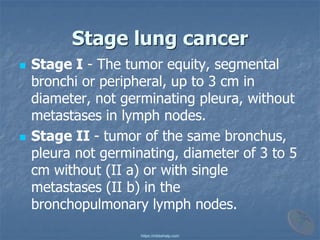
◼ Stage I - The tumor equity, segmental
bronchi or peripheral, up to 3 cm in
diameter, not germinating pleura, without
metastases in lymph nodes.
◼ Stage II - tumor of the same bronchus,
pleura not germinating, diameter of 3 to 5
cm without (II a) or with single
metastases (II b) in the
bronchopulmonary lymph nodes.
https://mbbshelp.com
Stage lung cancer
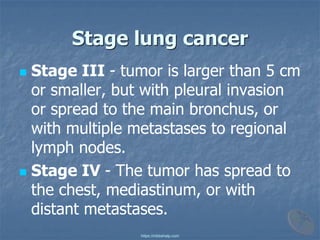
◼ Stage III - tumor is larger than 5 cm
or smaller, but with pleural invasion
or spread to the main bronchus, or
with multiple metastases to regional
lymph nodes.
◼ Stage IV - The tumor has spread to
the chest, mediastinum, or with
distant metastases.
https://mbbshelp.com
Symptoms
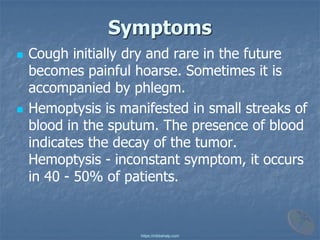
◼ Cough initially dry and rare in the future
becomes painful hoarse. Sometimes it is
accompanied by phlegm.
◼ Hemoptysis is manifested in small streaks of
blood in the sputum. The presence of blood
indicates the decay of the tumor.
Hemoptysis - inconstant symptom, it occurs
in 40 - 50% of patients.
https://mbbshelp.com
Symptoms
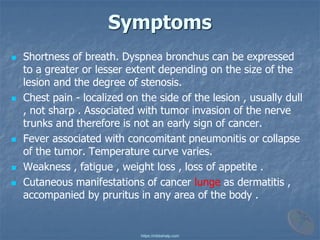
◼ Shortness of breath. Dyspnea bronchus can be expressed
to a greater or lesser extent depending on the size of the
lesion and the degree of stenosis.
◼ Chest pain - localized on the side of the lesion , usually dull
, not sharp . Associated with tumor invasion of the nerve
trunks and therefore is not an early sign of cancer.
◼ Fever associated with concomitant pneumonitis or collapse
of the tumor. Temperature curve varies.
◼ Weakness , fatigue , weight loss , loss of appetite .
◼ Cutaneous manifestations of cancer lunge as dermatitis ,
accompanied by pruritus in any area of ​​the body .
https://mbbshelp.com
Diagnostics
◼ Interviews with patients
◼ Objective study (external examination,
palpation of the chest, abdomen and
lymph nodes, percussion and auscultation)
◼ 1. External inspection - dry skin, puffy
face, the backlog of the chest when
breathing, changes in nails as "time
windows" and fingers type of drumsticks.
◼ 2. Palpation of the chest - on the affected
side weakened voice trembling.
https://mbbshelp.com
Diagnostics
◼ 3. percussion
◼ 4. Auscultation - wheezing, decreased
breath, crepitus.
◼ Laboratory tests (complete blood count)
◼ Sputum cytology
◼ fljurografiju
◼ Computed tomography
◼ Bronhografiya
◼ Bronchoscopy
https://mbbshelp.com
Diagnostics
◼ Transthoracic puncture and catheterization
of the bronchi
◼ Isotope scanning
◼ Pnevmomediastinografiya
◼ Mediastinoscopy.
https://mbbshelp.com
Treatment
◼ Radical treatment of lung cancer is surgery.
◼ Radiation and chemotherapy have conspicuous
palliative effect , but radical treatment of lung
cancer usually are not.
◼ Surgical treatment . Removes all of the affected
lung ( pneumonectomy ) , one ( lobectomy ) or
two ( bilobektomiya ) shares.
◼ • Lobectomy performed at the peripheral cancer
and cancer of the segmental bronchi 1 and 2
stage without metastases in lymph nodes radical
https://mbbshelp.com
Treatment
◼ Pneumonectomy indicated for central lung
cancer, as well as peripheral tumor metastases
or bronchopulmonary tracheobronchial lymph
nodes.
◼ Chemotherapy as an independent method of
treatment used in advanced forms of lung
cancer, as well as contraindications to surgery
and radiation therapy. Drugs are used:
Methotrexate,Cyclophosphamide, Adriamycin.
https://mbbshelp.com

Lung cancer-9.pdf

  • 1.
  • 2.
    Lung cancer ◼ Theconcept of "lung cancer" is a collective uniting various origin, histology, clinical course and results of treatment of malignant epithelial tumors. They develop from the surface epithelium of the bronchial mucosa, bronchial mucous glands of the bronchioles and alveoli. ◼ Distinctive features of lung cancer - the variety of clinical forms, the tendency to early recurrence, lymphatic and hematogenous metastasis. https://mbbshelp.com
  • 3.
    Сlinical anatomy ◼ Theright lung has three lobes, which include 10 segments, left - of 2 lobes, containing 9 segments. Bronchial tree. The trachea is divided into right (short and wide) and left (longer and narrower) main bronchi. https://mbbshelp.com
  • 4.
    Epidemiology ◼ Takes 1stplace in the structure of cancer incidence in developed countries. ◼ More than 1 million diagnosed cases of lung cancer each year worldwide , representing more than 12% of all diagnosed malignancies . https://mbbshelp.com
  • 5.
    Epidemiology ◼ Malignant tumorsof the lung occupied 1st place (20 - 30%) of cancer incidence in the structure of the male population in Western and Central Europe, the former Soviet states , North America, South Africa, Australia and New Zealand. ◼ In Russia, 1st place takes (12%) in the structure incidence of malignant neoplasms . ◼ Men suffer more often than women (ratio 8:1) . https://mbbshelp.com
  • 6.
    ETIOLOGY & RISKFACTORS ◼ I. Genetic factors. 1. Primary tumor multiplicity (cure patients of malignant tumor) 2. Three cases and more lung cancer in the family (close relatives). ◼ II. Modifying factors. A. Exogenous: 1. Smoking. 2. Environmental contamination by carcinogens. 3. Professional hazard. https://mbbshelp.com
  • 7.
    ETIOLOGY & RISKFACTORS ◼ B. Endogenous: 1. Age older than 50 years. 2. Chronic pulmonary diseases (tuberculosis, pneumonia, bronchitis, localized fibrosis) 3. Endocrine diseases. https://mbbshelp.com
  • 8.
    Morphological characteristics ◼ Distinguish: •central lung cancer arising in the large bronchi (the main, intermediate, equity, segmental and subsegmental) • peripheral originating from the epithelium of the bronchi or smaller localized in the lung parenchyma. https://mbbshelp.com
  • 9.
    Clinical - anatomical classification: ◼I. The central form II. The peripheral shape III. Mediastinal form - multiple metastases to mediastinal lymph nodes without fixed primary tumor in the lung. IV. Disseminated (primary carcinomatosis) – the plural lung without established primary tumor to other organs. https://mbbshelp.com
  • 10.
    Forms of growth Distinguished:(with central cancer of the direction of growth) ◼ Exophytic (endobronchial) cancer when the tumor grows into the lumen of the bronchus • endophyte (exo bronchial) cancer with a primary tumor growth in the thickness of the pulmonary parenchyma • Branched cancer with clutch shaped peribronchial tumor growth around the bronchi • mixed character of tumor growth with a predominance of one or another component. ◼ https://mbbshelp.com
  • 11.
    Forms of growth Distinguished:(for peripheral cancer) • Hub rounded tumor • pneumonia-like cancer • Cancer apex syndrome Pancoast. https://mbbshelp.com
  • 12.
    Histology ◼ Squamous cellcarcinoma - the most common form, predominantly male smokers older. • Glandular cancer occurs less frequently. Occurs more frequently in women. Often occurs in the peripheral bronchi, progresses slowly. • small cell lung cancer often occurs in young, but more often in people 50 - 59 years. Characterized by an early and rapid metastasis, poor prognosis. Most patients die within the first year after diagnosis. • large cell carcinoma - is rare. https://mbbshelp.com
  • 13.
    Metastases ◼ Lung cancerspreads by direct sprouting into the surrounding tissue, as well as by lymphatic and hematogenous metastasis. Metastases often found in small cell, at least - with adenocarcinoma, squamous cell carcinoma even rarer metastasizes. • First metastases affect thoracic lymph nodes: bronchopulmonary, tracheobronchial and tracheal about. Distant lymph node metastases - supraclavicular, subclavian, abdominal lymph nodes https://mbbshelp.com
  • 14.
    Metastases ◼ Metastases todistant organs mainly by hematogenous. Metastases to the liver, brain, bone lesions of (metastases in the spine, ribs, skull, limbs and pelvis), at least - in the adrenal glands, kidneys, pancreas. https://mbbshelp.com
  • 15.
    Stage lung cancer ◼Stage I - The tumor equity, segmental bronchi or peripheral, up to 3 cm in diameter, not germinating pleura, without metastases in lymph nodes. ◼ Stage II - tumor of the same bronchus, pleura not germinating, diameter of 3 to 5 cm without (II a) or with single metastases (II b) in the bronchopulmonary lymph nodes. https://mbbshelp.com
  • 16.
    Stage lung cancer ◼Stage III - tumor is larger than 5 cm or smaller, but with pleural invasion or spread to the main bronchus, or with multiple metastases to regional lymph nodes. ◼ Stage IV - The tumor has spread to the chest, mediastinum, or with distant metastases. https://mbbshelp.com
  • 17.
    Symptoms ◼ Cough initiallydry and rare in the future becomes painful hoarse. Sometimes it is accompanied by phlegm. ◼ Hemoptysis is manifested in small streaks of blood in the sputum. The presence of blood indicates the decay of the tumor. Hemoptysis - inconstant symptom, it occurs in 40 - 50% of patients. https://mbbshelp.com
  • 18.
    Symptoms ◼ Shortness ofbreath. Dyspnea bronchus can be expressed to a greater or lesser extent depending on the size of the lesion and the degree of stenosis. ◼ Chest pain - localized on the side of the lesion , usually dull , not sharp . Associated with tumor invasion of the nerve trunks and therefore is not an early sign of cancer. ◼ Fever associated with concomitant pneumonitis or collapse of the tumor. Temperature curve varies. ◼ Weakness , fatigue , weight loss , loss of appetite . ◼ Cutaneous manifestations of cancer lunge as dermatitis , accompanied by pruritus in any area of ​​the body . https://mbbshelp.com
  • 19.
    Diagnostics ◼ Interviews withpatients ◼ Objective study (external examination, palpation of the chest, abdomen and lymph nodes, percussion and auscultation) ◼ 1. External inspection - dry skin, puffy face, the backlog of the chest when breathing, changes in nails as "time windows" and fingers type of drumsticks. ◼ 2. Palpation of the chest - on the affected side weakened voice trembling. https://mbbshelp.com
  • 20.
    Diagnostics ◼ 3. percussion ◼4. Auscultation - wheezing, decreased breath, crepitus. ◼ Laboratory tests (complete blood count) ◼ Sputum cytology ◼ fljurografiju ◼ Computed tomography ◼ Bronhografiya ◼ Bronchoscopy https://mbbshelp.com
  • 21.
    Diagnostics ◼ Transthoracic punctureand catheterization of the bronchi ◼ Isotope scanning ◼ Pnevmomediastinografiya ◼ Mediastinoscopy. https://mbbshelp.com
  • 22.
    Treatment ◼ Radical treatmentof lung cancer is surgery. ◼ Radiation and chemotherapy have conspicuous palliative effect , but radical treatment of lung cancer usually are not. ◼ Surgical treatment . Removes all of the affected lung ( pneumonectomy ) , one ( lobectomy ) or two ( bilobektomiya ) shares. ◼ • Lobectomy performed at the peripheral cancer and cancer of the segmental bronchi 1 and 2 stage without metastases in lymph nodes radical https://mbbshelp.com
  • 23.
    Treatment ◼ Pneumonectomy indicatedfor central lung cancer, as well as peripheral tumor metastases or bronchopulmonary tracheobronchial lymph nodes. ◼ Chemotherapy as an independent method of treatment used in advanced forms of lung cancer, as well as contraindications to surgery and radiation therapy. Drugs are used: Methotrexate,Cyclophosphamide, Adriamycin. https://mbbshelp.com