COMPANY LAW IN MALAYSIA
Meetings
Presented by : Nurul Ilmiah binti Mohd. Zulkarnain
Muhammad Zulkefli bin Abdullah
Norazwani binti Azizan
Mohammad Azmer bin Ahmad @ Mazlan
Meeting
What is a
Meeting?
• Definition
• Exception
Types of
Meetings
• Statutory
Meeting
• Annual General
Meeting
• Extraordinary
General
Meeting
Notice of
Meeting
• To whom
• Method
• Period
• Contents
Proceedings at
Meeting
• Venue
• Quorum
• Proxy
• Chairman
• Vote
Resolution
• Types of
Resolution
• Special notice
• Resolution in
writing
Post Meeting
Requirements
• Lodgement with
ROC
• Minute book
What is a Meeting?
• Gathering of more than one person
Exception
- Sole member
- A meeting can be held despite the
attendance of only one member
- Fulfills the purposes of the Act
- In certain peculiar situations
• Wholly owned subsidiary
By parent/holding company
Separate legal entities
Must hold members’ meeting
Sect 147(6) - parent company’s corporate representative – to sign on
the minutes. (page 175)
Illustration
Corporate representative – company’s subsidiary or another
company which the appointor company has shares
• One person holds shares of a particular class in a company
Types of Meetings
Statutory Meeting
Annual General
Meeting (AGM)
Extraordinary General
Meeting (EGM)
Statutory Meeting
• Once in its lifetime by public company
• Sec 142(1) - every public company limited by shares must hold
statutory meeting between 1-3 months after it is entitled to
commence business
• When it is issued with Form 23 by Registrar of Companies
(ROC) (page 419)
• Sect 218 (1)(b) – the Court may order the winding up if –
default is made by the company in lodging the statutory
report or in holding the statutory meeting (page 231)
• Full and frank disclosure by promoter
Before the
meeting
During the
meeting
Agenda of the
meeting –formation
& matters arising in
report
A list of members
together with
respective
shareholdings
Duly certified by at
least 2 directors
Statutory report
Statutory report
1. Number of shares
allotted and
consideration
• Fully paid up or
partially paid up
• Paid in cash, in kind
or both
• Total cash received
for the shares
allotted
2. Account
• Moneys received &
paid
• Preliminary expenses
3. Names and
addresses
• Directors
• Managers
• Secretaries
• Auditors
• Trustees for
debentures holders
4. Contracts
• Approval of
members
• Proposed
modifications
AGM
• At least once every calendar year
– Company’s audited accounts will be tabled (Sect 169(1)) (page 191)
– Auditors are appointed (Sect 172) (page 198)
– Directors are elected
– Dividends are declared
• Interest of both officers and members
• Sect 143(1)- First AGM must be held within 18 months after
incorporation
- 15 months after the last preceding AGM
• Sect 169(1)- 6 months from the end of the financial year
• May apply to ROC for an extension of time
• What if the company fails to hold AGM?
Sect 143(4)- (a)…shall be guilty of an offence against the
Act
Members lose opportunity to query the directors
EGM
• Usually constitutes special businesses, which are urgent and
cannot be delayed until the next AGM
• Convened by the board of directors
• The EGM must be held not later than 2 months after receipt of
the request by the directors
Sect 144 Sect 145
Requirements Company with share capital: ≥ 10%
of paid up capital
Company with share capital: ≥ 10%
of issued capital
Company with no share capital: ≥
10% of voting rights
Company with no share capital: ≥
5% members
Preparation of meeting Company, failing which members Members
Expenses Company Members
TO ALL MEMBER
TO AUDITOR
PERIOD
• That is important members are given sufficient
notice of the meeting because members have
opportunity to query the directors on the
operations a and affairs of the company
• NOM contains information like the venue, date
and hour of meeting and the business transacted
• The notice may be either given personally or sent
by prepaid post to each member
Section 145(4):
• Notice of the meetings must be given to all members of the company who have
right to attend and vote
• Meeting will be void if fail to give notice to all members
• Must be given to all persons whose names appear in the company’s Register of
Members
Section 145(5):
• The meeting if the omission to give the notice
accidental
• To preserve the meeting where the company did not
deliberately omit serving the notice on a member
Case 1: Musselwhite v
Musselwhite (1962)
• Some member executed transfers of
their shares to the third parties but
the shares had yet to be transferred
• Their names remained in the Register
of Members
• The company did not give them
notice of meeting
• The court held that this was an
intentional omission and the meeting
was held to be void
Case 2: Re West Canadian
Collieries Ltd (1962)
• Failure to give the notice to nine
members was due to an
administrative error
• The court held that was an accidental
omission
• The omission did not void the meeting
The meeting may still be validated by the application of section
355(1) which provide that:
“No proceeding under this Act shall be invalidated by any defect,
irregularity or deficiency of notice or time unless Court is opinion that
substantial injustice has been which cannot be remedied by any order
of the Court”
Section 355 does not apply if there is injustice to a member who did not
receive the notice and did not attend the meeting
• The number of day required to be given to the
members
• According to Section 145(2A), the company give
notice at least 21 day2 to its members
• For private company, only 14 days’ notice to its
members
EXTRAORDINARY GENERAL
MEETING
• Section 145(2), an EGM needs to give
only 14 days
• For the special resolution, at least 21
days based on section 152(1)
Proceeding
at
Meeting
Venue
Vote
Chairman
Quorum
Proxy
Venue
• Section 145 A
 Where?
Anywhere in Malaysia
Not necessary at registered office
More that one venue
 How?
Technology
Quorum
• Section 147(1)
Definition
Minimum number of members who
must be present at the meeting.
Unless the AOA provide otherwise.
• Table A Article 47
Members shall include proxy
Proxy
• Section 149(1)
Every member who is entitled to
attend meeting has a statutory right
to appoint a proxy.
Proxy is a person who has been authorized
by a member to attend meeting on his behalf
• Section 149(1)(b)
Qualification of Proxy
Another member
An advocate (lawyer)
An approved company auditor
A person approved by ROC
Tan Guan Eng b BH Low Holding Sdn Bhd (1992)
Lim Hean Pin v Thean Seng Co Sdn Bhd & Ors (1992)
• Section 149(1)(c)
Maximum number of proxy
May appoint a maximum of two proxies
• Section 149(1)(d)
Appoint two proxies shall be invalid unless a specifies
proportions of his holding to be represented by each proxy.
Illustration
• Section 149(1)
Powers of Proxy
Attend meeting
Speak at meeting
Vote on poll but not hand
Right of Member
Issue: whether a member who has appointed a proxy may
continue exercise his rights to attend the meeting and vote?
Cousins v International Brick Co Ltd (1931)
Termination of appointment
Submitting a notice before the meeting
Proxy dies or unsound mind before meeting
Transfer all share before meeting
Chairman
• Section 147(1)(b)
Who?
Member can elect any member to be a chairman
Unless AOA provide otherwise.
Right of Chairman
Conduct of meeting
Ensuring meeting is properly conducted
Byng v London Life Association (1990)
Vote
• Section 148(1)
Exceptions:
Suspended until the member has paid all calls or other sums
payable in respect of his share.
Suspend the right of preference shareholders to attend and
vote at general meeting upon such conditions stated therein
Illustration
Vote by show of hands
Easier and quicker
Entitled to one vote
 Vote on poll
• Section 149(1)(a)
 Proxy may vote on poll
• Section 146(1)(a)
 Excluding the right to demand a poll at general meeting on any question or
matter other than the election of chairman shall be void.
• Section 146(1)(b)
 Carried out if demanded
 At least 5 members present who has voting power
 Member with at least 10% of voting power present at meeting
 Member with at least 10% of paid-up shares present at meeting
RESOLUTION
- Decision made by the members at the
general meetings
ORDINARY
RESOLUTION
SPECIAL
RESOLUTION
HYBRID
RESOLUTION
ORDINARY
RESOLUTION
REQUIRING
SPECIAL NOTICE
CIRCULAR
RESOLUTION/
RESOLUTION IN
WRITING
TYPE OF RESOLUTION
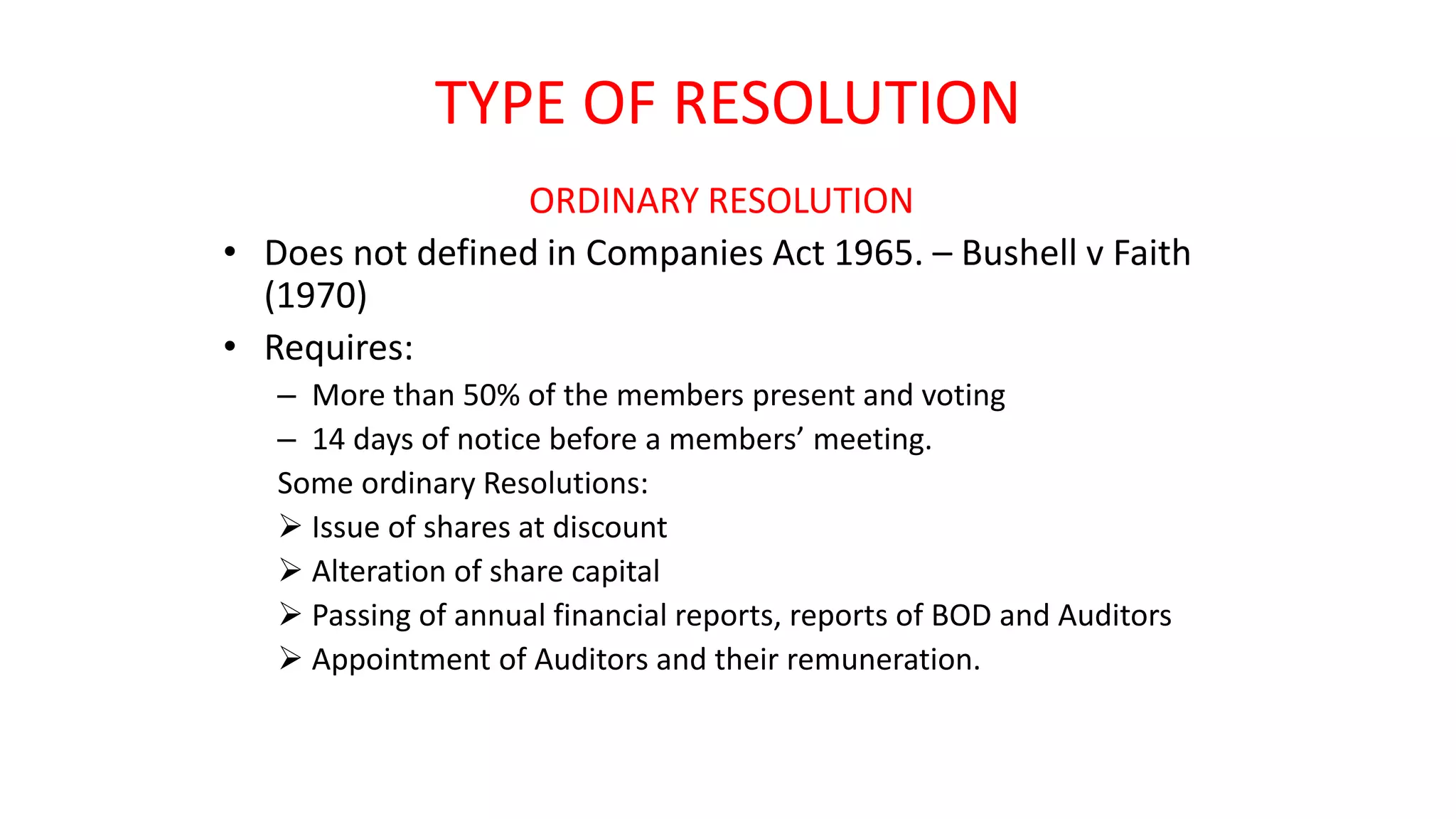
ORDINARY RESOLUTION
• Does not defined in Companies Act 1965. – Bushell v Faith
(1970)
• Requires:
– More than 50% of the members present and voting
– 14 days of notice before a members’ meeting.
Some ordinary Resolutions:
 Issue of shares at discount
 Alteration of share capital
 Passing of annual financial reports, reports of BOD and Auditors
 Appointment of Auditors and their remuneration.
SPECIAL RESOLUTION
• S.152 of CA which requires that:
– At least 75% of the members of the company present and voting.
– Notice should be given at least 21 days before the meeting.
– Must be lodged with the ROC within one month.
Some Special Resolution:
 Alteration of object clause of memorandum and the articles of a company.
 Change of name of a company.
 Variation of shareholders rights.
 Payment of interest out of capital.
HYBRID RESOLUTION
• The hybrid resolution is whereby, the company require to give at least
14 days’ notice to the members but require the support of at least 75%
of the votes.
• Requirement for a hybrid resolution to perform:
– S.129(6) – the appointment of a director who is above the age of 70 in a private
company which is a subsidiary of a public company.
– S.172(7) – the appointment of an auditor to replace the auditor who was
removed at a prior general meeting.
Min Days of Notice Min Votes Required
Ordinary Resolution 14 > Than 50%
Special Resolution 21 75%
Hybrid Resolution 14 75%
ORDINARY RESOLUTION REQUIRING SPECIAL
NOTICE
• In S.153 of CA – notice of intention
given by the members to the
company.
• Notice must be given by the
members not later than 28 days
before the meeting.
• Upon receipt of the notice, the
company then must give a notice to
the member at least 14 days before
meetings.
CIRCUMSTANCES
S.128(2) – removal of a director before
the expiration of his term of office
S.172(4) – removal of an auditor
at a general meeting
S.258(3) – removal of a liquidator
before the expiration of his term
of office.
CIRCULAR RESOLUTION / RESOLUTION IN WRITING
• S.152A of CA – a resolution is deemed passed if all members
who are entitled to attend and vote at the general meeting of
the company signed on the resolution.
• All members may not sign at the same copy of the document.
• 2 or more documents containing the proposed resolution may be certified by
the company secretary. – true and correct version
• the last member who sign the documents will hold the resolution.
POST-MEETING REQUIREMENTS
LODGEMENT
WITH THE ROC
MINUTE BOOK
LODGEMENT WITH THE ROC
S.145(1) of CA requires a printed copy of the Special Resolution and the
resolution or agreement which binds any class of shareholders to be
lodged with ROC within t (one) month of the passing resolution or
agreement, as the case may be.
SUBJECT TO THE ORDINARY RESOLUTION TO INCREASE ITS AUTHORISED
CAPITAL.
S.62(4) – lodgement of the resolution with ROC within 14 days.
S.165 – Every company, irrespective of whether it is a company with a
share capital or otherwise, to lodge with the ROC its annual return
within 1(one) month from the date of its AGM.
MINUTE BOOK
S.156 – the minutes of the proceedings of its
general meetings must be entered in the minute
book within 14 days from the date of the
meeting.
S.157 and S.359(1) – the book containing the
minutes of the proceeding of any general
meeting shall be kept at the company’s
registered office and shall be made available for
inspection by any member of the company.
The evidence of minutes which have been
signed by the chairman of that meeting or by
the chairman of the next meeting are:
• The meeting has been duly held and
convened
• The proceedings have been duly held
• The appointments of officers or liquidators
made at the meeting are valid.
Meetings - Company Law Malaysia

Meetings - Company Law Malaysia

  • 1.
    COMPANY LAW INMALAYSIA Meetings Presented by : Nurul Ilmiah binti Mohd. Zulkarnain Muhammad Zulkefli bin Abdullah Norazwani binti Azizan Mohammad Azmer bin Ahmad @ Mazlan
  • 2.
    Meeting What is a Meeting? •Definition • Exception Types of Meetings • Statutory Meeting • Annual General Meeting • Extraordinary General Meeting Notice of Meeting • To whom • Method • Period • Contents Proceedings at Meeting • Venue • Quorum • Proxy • Chairman • Vote Resolution • Types of Resolution • Special notice • Resolution in writing Post Meeting Requirements • Lodgement with ROC • Minute book
  • 3.
    What is aMeeting? • Gathering of more than one person
  • 4.
    Exception - Sole member -A meeting can be held despite the attendance of only one member - Fulfills the purposes of the Act - In certain peculiar situations
  • 5.
    • Wholly ownedsubsidiary By parent/holding company Separate legal entities Must hold members’ meeting Sect 147(6) - parent company’s corporate representative – to sign on the minutes. (page 175) Illustration Corporate representative – company’s subsidiary or another company which the appointor company has shares • One person holds shares of a particular class in a company
  • 6.
    Types of Meetings StatutoryMeeting Annual General Meeting (AGM) Extraordinary General Meeting (EGM)
  • 7.
    Statutory Meeting • Oncein its lifetime by public company • Sec 142(1) - every public company limited by shares must hold statutory meeting between 1-3 months after it is entitled to commence business • When it is issued with Form 23 by Registrar of Companies (ROC) (page 419) • Sect 218 (1)(b) – the Court may order the winding up if – default is made by the company in lodging the statutory report or in holding the statutory meeting (page 231) • Full and frank disclosure by promoter
  • 8.
    Before the meeting During the meeting Agendaof the meeting –formation & matters arising in report A list of members together with respective shareholdings Duly certified by at least 2 directors Statutory report
  • 9.
    Statutory report 1. Numberof shares allotted and consideration • Fully paid up or partially paid up • Paid in cash, in kind or both • Total cash received for the shares allotted 2. Account • Moneys received & paid • Preliminary expenses 3. Names and addresses • Directors • Managers • Secretaries • Auditors • Trustees for debentures holders 4. Contracts • Approval of members • Proposed modifications
  • 10.
    AGM • At leastonce every calendar year – Company’s audited accounts will be tabled (Sect 169(1)) (page 191) – Auditors are appointed (Sect 172) (page 198) – Directors are elected – Dividends are declared • Interest of both officers and members
  • 11.
    • Sect 143(1)-First AGM must be held within 18 months after incorporation - 15 months after the last preceding AGM • Sect 169(1)- 6 months from the end of the financial year • May apply to ROC for an extension of time • What if the company fails to hold AGM? Sect 143(4)- (a)…shall be guilty of an offence against the Act Members lose opportunity to query the directors
  • 12.
    EGM • Usually constitutesspecial businesses, which are urgent and cannot be delayed until the next AGM • Convened by the board of directors • The EGM must be held not later than 2 months after receipt of the request by the directors
  • 13.
    Sect 144 Sect145 Requirements Company with share capital: ≥ 10% of paid up capital Company with share capital: ≥ 10% of issued capital Company with no share capital: ≥ 10% of voting rights Company with no share capital: ≥ 5% members Preparation of meeting Company, failing which members Members Expenses Company Members
  • 15.
    TO ALL MEMBER TOAUDITOR PERIOD • That is important members are given sufficient notice of the meeting because members have opportunity to query the directors on the operations a and affairs of the company • NOM contains information like the venue, date and hour of meeting and the business transacted • The notice may be either given personally or sent by prepaid post to each member
  • 16.
    Section 145(4): • Noticeof the meetings must be given to all members of the company who have right to attend and vote • Meeting will be void if fail to give notice to all members • Must be given to all persons whose names appear in the company’s Register of Members
  • 17.
    Section 145(5): • Themeeting if the omission to give the notice accidental • To preserve the meeting where the company did not deliberately omit serving the notice on a member
  • 18.
    Case 1: Musselwhitev Musselwhite (1962) • Some member executed transfers of their shares to the third parties but the shares had yet to be transferred • Their names remained in the Register of Members • The company did not give them notice of meeting • The court held that this was an intentional omission and the meeting was held to be void Case 2: Re West Canadian Collieries Ltd (1962) • Failure to give the notice to nine members was due to an administrative error • The court held that was an accidental omission • The omission did not void the meeting
  • 19.
    The meeting maystill be validated by the application of section 355(1) which provide that: “No proceeding under this Act shall be invalidated by any defect, irregularity or deficiency of notice or time unless Court is opinion that substantial injustice has been which cannot be remedied by any order of the Court” Section 355 does not apply if there is injustice to a member who did not receive the notice and did not attend the meeting
  • 20.
    • The numberof day required to be given to the members • According to Section 145(2A), the company give notice at least 21 day2 to its members • For private company, only 14 days’ notice to its members EXTRAORDINARY GENERAL MEETING • Section 145(2), an EGM needs to give only 14 days • For the special resolution, at least 21 days based on section 152(1)
  • 21.
  • 22.
    Venue • Section 145A  Where? Anywhere in Malaysia Not necessary at registered office More that one venue  How? Technology
  • 23.
    Quorum • Section 147(1) Definition Minimumnumber of members who must be present at the meeting. Unless the AOA provide otherwise. • Table A Article 47 Members shall include proxy
  • 24.
    Proxy • Section 149(1) Everymember who is entitled to attend meeting has a statutory right to appoint a proxy. Proxy is a person who has been authorized by a member to attend meeting on his behalf
  • 25.
    • Section 149(1)(b) Qualificationof Proxy Another member An advocate (lawyer) An approved company auditor A person approved by ROC Tan Guan Eng b BH Low Holding Sdn Bhd (1992) Lim Hean Pin v Thean Seng Co Sdn Bhd & Ors (1992)
  • 26.
    • Section 149(1)(c) Maximumnumber of proxy May appoint a maximum of two proxies • Section 149(1)(d) Appoint two proxies shall be invalid unless a specifies proportions of his holding to be represented by each proxy. Illustration
  • 27.
    • Section 149(1) Powersof Proxy Attend meeting Speak at meeting Vote on poll but not hand Right of Member Issue: whether a member who has appointed a proxy may continue exercise his rights to attend the meeting and vote? Cousins v International Brick Co Ltd (1931)
  • 28.
    Termination of appointment Submittinga notice before the meeting Proxy dies or unsound mind before meeting Transfer all share before meeting
  • 29.
    Chairman • Section 147(1)(b) Who? Membercan elect any member to be a chairman Unless AOA provide otherwise. Right of Chairman Conduct of meeting Ensuring meeting is properly conducted Byng v London Life Association (1990)
  • 30.
    Vote • Section 148(1) Exceptions: Suspendeduntil the member has paid all calls or other sums payable in respect of his share. Suspend the right of preference shareholders to attend and vote at general meeting upon such conditions stated therein Illustration
  • 31.
    Vote by showof hands Easier and quicker Entitled to one vote
  • 32.
     Vote onpoll • Section 149(1)(a)  Proxy may vote on poll • Section 146(1)(a)  Excluding the right to demand a poll at general meeting on any question or matter other than the election of chairman shall be void. • Section 146(1)(b)  Carried out if demanded  At least 5 members present who has voting power  Member with at least 10% of voting power present at meeting  Member with at least 10% of paid-up shares present at meeting
  • 33.
    RESOLUTION - Decision madeby the members at the general meetings ORDINARY RESOLUTION SPECIAL RESOLUTION HYBRID RESOLUTION ORDINARY RESOLUTION REQUIRING SPECIAL NOTICE CIRCULAR RESOLUTION/ RESOLUTION IN WRITING
  • 34.
    TYPE OF RESOLUTION ORDINARYRESOLUTION • Does not defined in Companies Act 1965. – Bushell v Faith (1970) • Requires: – More than 50% of the members present and voting – 14 days of notice before a members’ meeting. Some ordinary Resolutions:  Issue of shares at discount  Alteration of share capital  Passing of annual financial reports, reports of BOD and Auditors  Appointment of Auditors and their remuneration.
  • 35.
    SPECIAL RESOLUTION • S.152of CA which requires that: – At least 75% of the members of the company present and voting. – Notice should be given at least 21 days before the meeting. – Must be lodged with the ROC within one month. Some Special Resolution:  Alteration of object clause of memorandum and the articles of a company.  Change of name of a company.  Variation of shareholders rights.  Payment of interest out of capital.
  • 36.
    HYBRID RESOLUTION • Thehybrid resolution is whereby, the company require to give at least 14 days’ notice to the members but require the support of at least 75% of the votes. • Requirement for a hybrid resolution to perform: – S.129(6) – the appointment of a director who is above the age of 70 in a private company which is a subsidiary of a public company. – S.172(7) – the appointment of an auditor to replace the auditor who was removed at a prior general meeting. Min Days of Notice Min Votes Required Ordinary Resolution 14 > Than 50% Special Resolution 21 75% Hybrid Resolution 14 75%
  • 37.
    ORDINARY RESOLUTION REQUIRINGSPECIAL NOTICE • In S.153 of CA – notice of intention given by the members to the company. • Notice must be given by the members not later than 28 days before the meeting. • Upon receipt of the notice, the company then must give a notice to the member at least 14 days before meetings. CIRCUMSTANCES S.128(2) – removal of a director before the expiration of his term of office S.172(4) – removal of an auditor at a general meeting S.258(3) – removal of a liquidator before the expiration of his term of office.
  • 38.
    CIRCULAR RESOLUTION /RESOLUTION IN WRITING • S.152A of CA – a resolution is deemed passed if all members who are entitled to attend and vote at the general meeting of the company signed on the resolution. • All members may not sign at the same copy of the document. • 2 or more documents containing the proposed resolution may be certified by the company secretary. – true and correct version • the last member who sign the documents will hold the resolution.
  • 39.
  • 40.
    LODGEMENT WITH THEROC S.145(1) of CA requires a printed copy of the Special Resolution and the resolution or agreement which binds any class of shareholders to be lodged with ROC within t (one) month of the passing resolution or agreement, as the case may be. SUBJECT TO THE ORDINARY RESOLUTION TO INCREASE ITS AUTHORISED CAPITAL. S.62(4) – lodgement of the resolution with ROC within 14 days. S.165 – Every company, irrespective of whether it is a company with a share capital or otherwise, to lodge with the ROC its annual return within 1(one) month from the date of its AGM.
  • 41.
    MINUTE BOOK S.156 –the minutes of the proceedings of its general meetings must be entered in the minute book within 14 days from the date of the meeting. S.157 and S.359(1) – the book containing the minutes of the proceeding of any general meeting shall be kept at the company’s registered office and shall be made available for inspection by any member of the company. The evidence of minutes which have been signed by the chairman of that meeting or by the chairman of the next meeting are: • The meeting has been duly held and convened • The proceedings have been duly held • The appointments of officers or liquidators made at the meeting are valid.