

Dimensions of changing consumer values within the Indian Food & Grocery Sector: An Empirical Study Manoj Nair International Business www.mrnair.com
Research Environment www.mrnair.com
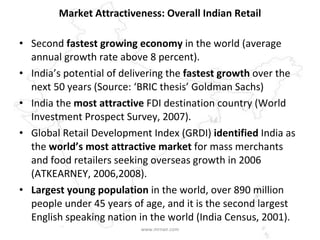
Market Attractiveness: Overall Indian Retail Second  fastest growing economy  in the world (average annual growth rate above 8 percent) . India’s potential of delivering the  fastest growth  over the next 50 years (Source: ‘BRIC thesis’ Goldman Sachs)   India the  most attractive  FDI destination country (World Investment Prospect Survey, 2007).   Global Retail Development Index (GRDI)  identified  India as the  world’s most attractive market  for mass merchants and food retailers seeking overseas growth in 2006 (ATKEARNEY, 2006,2008). Largest young population  in the world, over 890 million people under 45 years of age, and it is the second largest English speaking nation in the world (India Census, 2001).   www.mrnair.com
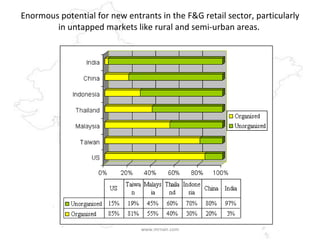
Enormous potential for new entrants in the F&G retail sector, particularly in untapped markets like rural and semi-urban areas.  www.mrnair.com
Market Attractiveness: Indian Food & Grocery Sector Valued at $236 billion (KIT, 2008), it’s the  sixth largest  grocery market in the world.  Expected to grow to $482 billion in 2020 with an overall  growth of 104 %.   The  unorganized segment constitutes 99%  of the total F&G market and is characterized by the traditional “kirana” or “mom & pop” stores.  Only  1 %  of the total F&G market and are characterized by cash and carry stores, hypermarkets, supermarkets, discount supermarkets and convenience stores.  www.mrnair.com
Market Attractiveness: Indian Food & Grocery Sector 68 million strong Indian middle class, with an  average income of USD 19,000  per year, will almost triple by year 2011. Population Density of approximately  400 people  per Sq Kms. Population: 1,147,995,904 (21.34% rise from 1991-2001) Birth rate: 21.76 births/1,000 population (2008 est.) Death rate: 6.4 deaths/1,000 population (2008 est.) 55%  of arable land (ranked 4 th  in the world) High Development opportunities in metropolitan and  Tier cities. (Tier 1, Tier2 and Tier3) (Source: India Census, 2001; Dept of Agriculture, India) www.mrnair.com
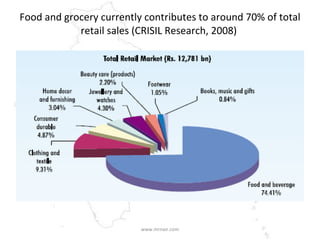
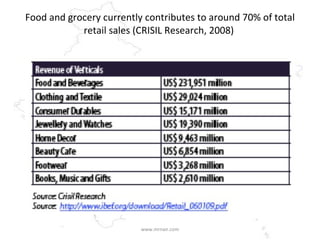
Food and grocery currently contributes to around 70% of total retail sales (CRISIL Research, 2008)  www.mrnair.com
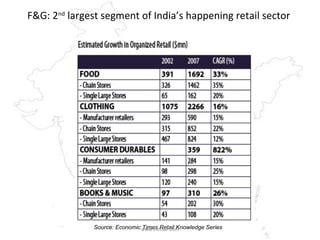
F&G: 2 nd  largest segment of India’s happening retail sector  Source: Economic Times Retail Knowledge Series www.mrnair.com
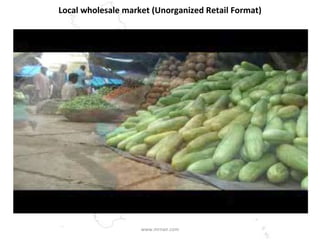
Local wholesale market (Unorganized Retail Format) www.mrnair.com
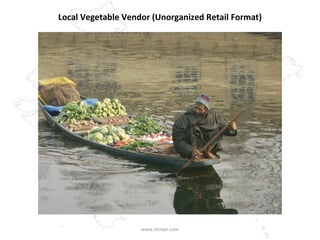
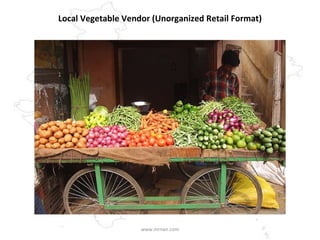
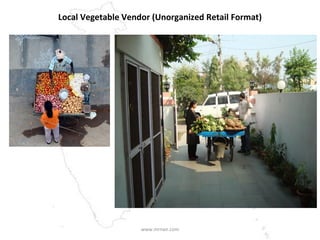
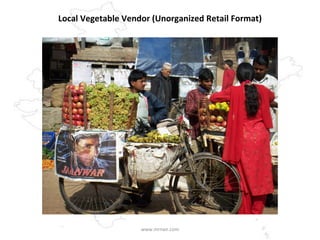
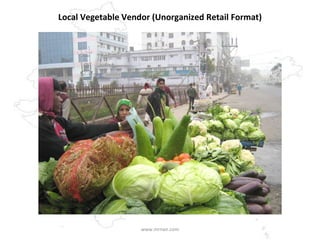
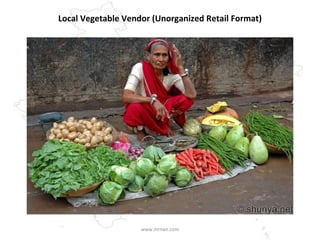
Local Vegetable Vendor (Unorganized Retail Format) www.mrnair.com
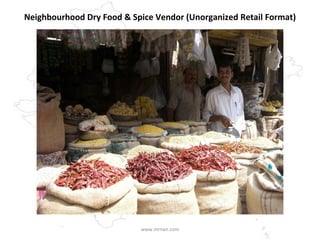
Neighbourhood Dry Food & Spice Vendor (Unorganized Retail Format) www.mrnair.com
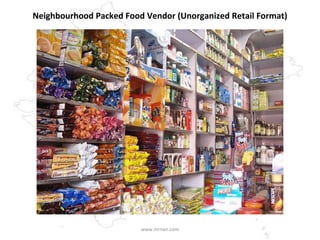
Neighbourhood Packed Food Vendor (Unorganized Retail Format) www.mrnair.com
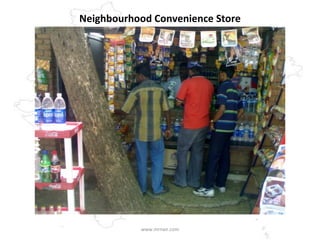
Neighbourhood Convenience Store www.mrnair.com
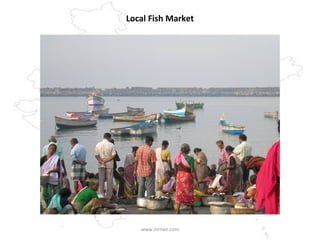
Local Fish Market www.mrnair.com
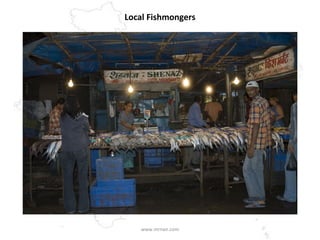
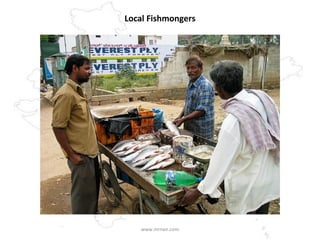
Local Fishmongers www.mrnair.com
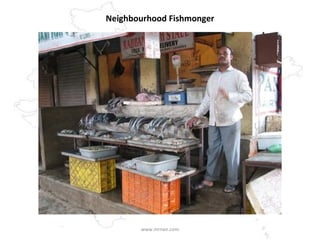
Neighbourhood Fishmonger www.mrnair.com
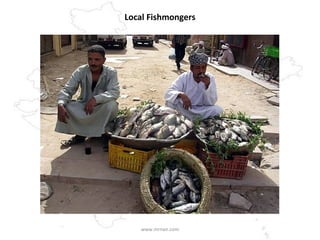
Local Fishmongers www.mrnair.com
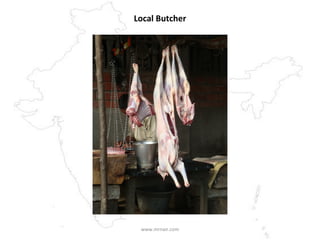
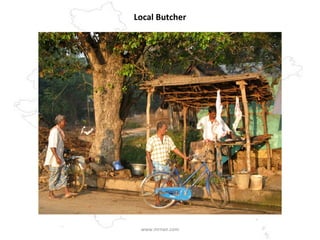
Local Butcher www.mrnair.com
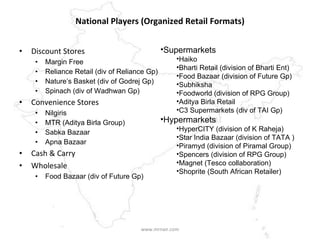
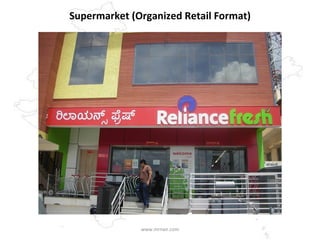
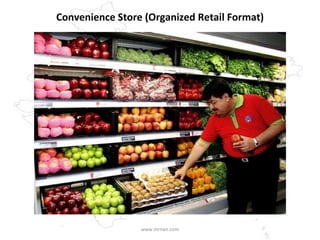
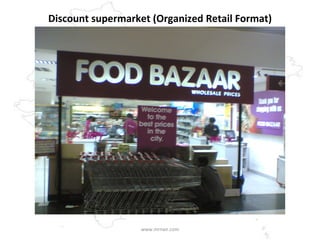
National Players (Organized Retail Formats) Discount Stores Margin Free Reliance Retail (div of Reliance Gp) Nature’s Basket (div of Godrej Gp) Spinach (div of Wadhwan Gp) Convenience Stores Nilgiris MTR (Aditya Birla Group) Sabka Bazaar Apna Bazaar Cash & Carry Wholesale Food Bazaar (div of Future Gp) www.mrnair.com Supermarkets Haiko Bharti Retail (division of Bharti Ent) Food Bazaar (division of Future Gp) Subhiksha  Foodworld (division of RPG Group) Aditya Birla Retail C3 Supermarkets (div of TAI Gp) Hypermarkets HyperCITY (division of K Raheja) Star India Bazaar (division of TATA ) Piramyd (division of Piramal Group) Spencers (division of RPG Group) Magnet (Tesco collaboration) Shoprite (South African Retailer)
Supermarket (Organized Retail Format) www.mrnair.com
Convenience Store (Organized Retail Format) www.mrnair.com
Discount supermarket (Organized Retail Format) www.mrnair.com
Challenges India is the second most  culturally and linguistically diverse  geographical entity after the African continent.  Cultural values and norms shape  individual perceptions  (Cui and Choudhury, 1998, Bock, 1994).   Rising  real estate prices  with  scarcity  of large tracts of  land . Poor  infrastructure  (roads, transportation, labour, bureaucracy) Foreign retailers can own up to 51% equity in single-brand business (Jan 2006).  Restriction  on retailers who sell multiple brand continues.  www.mrnair.com
Theoretical Framework www.mrnair.com
A different outlook  Industry recognition in mid 1980’s that “Technology driven approach was just not good enough”. Start of  customer driven movement . Customer driven thinking  “ the new mantra”. Efficient consumer response (ECR) strategies. (The Retail value chain) Profit is not a dirty word but  value  is much cleaner. www.mrnair.com
Theoretical Framework: Academic Perspective Peter Drucker’s “ the creation of value and wealth ”.  What customers exactly value . Why do they value Superior value to consumers  was established as one of the most successful business strategies of the 1990’s (Ravald and Gronroos, 1996).  Consumer values  as the next major source of  competitive advantage  (Woodruff, 1997;Butz and Goodstein, 1996). Obtaining value is fundamental  and  essential  in all exchange transactions (Holbrook, 1994).  www.mrnair.com
Recently study of  consumer value  has gained utmost importance among researchers and practitioners (Cronin et al., 2000, Holbrook, 1999),  Aiding formulation of important  marketing decisions  such as market  segmentation  (Tellis and Gaeth, 1990),  Product differentiation (Heskett et al., 1997),  Positioning policies (Kotler, 1999), and  Assessing consumer’s  purchase intention  (Bradley and Wood, 1994, Zeithaml, 1988).   www.mrnair.com
Observations (doubts) : Primary discourse analysis What components  of value proposition seen by customers to be  creating value  for them? Value perception is a  personal  thing. Create “ meaningful  value”. Create “more  valuable  value”. Customer decides  whether value is added or not. Value needs to be  continuously perceived and experienced . www.mrnair.com
Observations (accepted) : Primary discourse analysis The food retail industry is almost  entirely consumer-driven . Do what customers  expect  of you. Satisfied  customers are not necessarily loyal, but  loyal  customers are almost certainly satisfied. Customers  know  how they want to feel. Customer expectations are based on  prior experiences  in similar situations. Customers  do not expect the unexpected .  Customer satisfaction is  functional .   www.mrnair.com
Observations (debated): Primary discourse analysis Costs  to the customer. Price  is often just  not that important  in determining the customer’s perception of value.  Value creation  does  not always  have to involve the  addition . Delivered value Vs perceived value. Traditional marketing Vs Customer centric approach Avoiding “Sea of Mediocrity” Make customer value the “guiding star”.  www.mrnair.com
Emerging Trends in Indian F & G Sector Product : Movement towards  international preference  (product). Acceptance of  freedom of choice  (service). No compromise on “ personal touch ” (unorganized sect characteristic). Expectations: staff politeness, freshness of stock and the availability of latest brands. (KIT,  www.business-standard.com ) Place : Location, location, location. Supermarkets  only  located in city centers. Cost and effort  of  transportation  a major factor. Price : Consumer psyche – “ Value of money ” Modern enlightened customer – “ best prices and good quality ” www.mrnair.com
Emerging Trends in Indian F & G Sector Promotion : Promotional tools (free products, Bogof’s, festival discounts) Positioning : Shopping not chore but a “ lifestyle experience ”. Linked to one’s “ socio-economic standing ”. Ambience  and  entertainment  value a prime factor. Malls and supermarkets are the choice for  lifestyle products  and  premium grocery . Groceries  and  provisions  purchased form neighborhood stores. Concept of “ single point of purchase ” in pre-natal stage. Neighbourhood grocer – customer relationships span generations. Low appeal  for sterile and robotic perfection of modern retail shops. www.mrnair.com
Emerging F&G Reports Value conscious  Indian consumers, with a very low degree of consumer loyalty (McKinsey, 2008), could pose a challenge or even serious threat to the future growth of incumbent firms if their value needs are not met.   Companies that ultimately  understand the Indian consumer  will be the ones to last out in the end (Indian Retail News, 2009).  Retailing in India will not succeed with cut and paste global formats, and in order to succeed, retailers need a good understanding of the differences in  value perception of Indian consumers  when compared to the rest of the global market (McKinsey, 2008).  www.mrnair.com
Although previous studies have define consumer value exhibits uniform perception among academicians, “ personal perception ” (Woodall, 2003),  “ value in use ” (Vargo and Lusch, 2004),  “ interactive relativistic preference experience ” (Holbrook, 1999),  “ value created when product consumed ”  (Gronroos, 2006) and  “ value not only monetary but also emotional ”  (Gallarza and Saura, 2006, Petrick, 2002, Oh, 1999, Richins, 1994).  www.mrnair.com
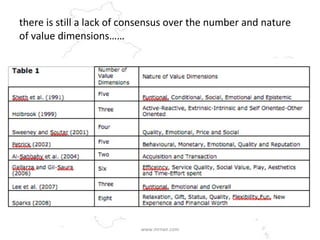
there is still a lack of consensus over the number and nature of value dimensions…… www.mrnair.com
Application of value dimensions Sparks (2008) conceptualized an eight dimensional value model and applied it to the study of a specific hospitality product in the  time share industry .  Gallarza (2006) attempted to scale Holbrook’s (1999) three dimensional value paradigm in a  tourism  related context. In a different study, Samuelsen and Silseth (2008) presented a theoretical model for antecedents and consequences of consumer value in a  business to business  service industry setting.   www.mrnair.com
Findings: Gallarza (2006) established a strong correlation between  satisfaction and value Sparks (2008) Consumer value and consumer satisfaction  are positively correlated and a set of value dimensions can predict consumer satisfaction.  Samuelsen and Silseth (2008) drivers of consumer value  when the service provided has a high degree of intangibility. www.mrnair.com
Findings from related studies: Consumer satisfaction  is better understood when examined through the lens of  consumer value  (Holbrook, 1999, Woodruff and Gardial, 1996). Consumer value  was proposed as the best and most complete antecedent of  satisfaction  (Woodruff, 1997; Parasuraman, 1997; McDougall and Levesque, 2000). Consumer value  has direct impact on  consumer satisfaction  (Yu et al., 2005). Meeting  consumer needs  increases  consumer satisfaction  (Porter, 1985)  Perceived value  may lead directly to the formation of  overall satisfaction  (Churchill and Surprenant, 1982).  A study of  consumer value  under the light of  consumer satisfaction  is incomplete without the study of its major  antecedents, mediating variables and consequences  (Hansen et al., 2008, Eggert and Ulaga, 2002).  www.mrnair.com
From the findings: Any future studies on  consumer value  the value-satisfaction relationship  antecedents and consequences   consumer value  Significant gap  in knowledge regarding application of in a  business to customer  in a retail context. Hypothesis are put forward :- H1:  Value  for Indian consumers is  multidimensional  and  dynamic . H2: Set of  value dimensions  will  predict variance  in  consumer satisfaction  and will display significant and positive correlation with it.  If so, H2a: Enhancing consumer value and emphasis of value delivered will have a positive effect on consumer satisfaction. www.mrnair.com
RESEARCH QUESTIONS What are the  dimensionalities  and  constructs  of consumer value within the Indian F&G retail sector? How can they be measured? What are the  antecedents and consequences  of different value dimensions?  What is their influence? To examine correlates between the various value constructs and develop a conceptual model elaborating the relationship between the key constructs. To test the proposed model for fit, and establish relational intensity between various value constructs and explain their impact on consumer satisfaction.  What are the  possible strategic options  available for MNCs entering the Indian retail sector based on identified dimensionalities of consumer value? To analyze findings in the light of current business strategies within the Indian F&G retail sector and recommend any improvements, changes, or practice adjustments for the future.  www.mrnair.com
Research Design www.mrnair.com
RESEARCH METHODS Initial in-depth descriptive literature review. Pilot study in the first year (Dec 2009) done in Mumbai. 3.  Main data collection (June 2010 and June 2011). exploratory data collection through semi-structured interviews & observations.  The critical incident technique (CIT) (Gremler, 2004).   Grounded theory approach (Strauss and Corbin, 1997). Repertory Grid (using factor analysis) Venues:  Four tier one cities in India (Bangalore, Chennai, Delhi and Mumbai).  Qualitative analysis (HyperResearch) Transcript + Field Notes   Repertory grid analysis  Dendrograms  collapsed constructs to main constructs or variables. 5.  Quantitative analysis (SPSS)  Survey questionnaire (Seven point Likert-type scales ) Multivariate and bivariate analysis 6.  Testing for model fit (Hansen et al., 2008) using available Structural Equation Modeling (AMOS) www.mrnair.com
SCOPE AND VALUE IN BRIEF: Identify and measure current  variables  unique to Indian F&G sector. Development of measurement scales as well as testing previously identified ones. Valuable  quantitative and qualitative data  to inform academic knowledge. Provide a strong platform for the research community, for future research. Enable International companies to devise more market specific,  consumer centric strategies  to enter and compete successfully within the Indian marketplace.  Stimulate  procedural changes  in the government and corporations. Improving  service to consumers ; thus contributing to growth within the industry. www.mrnair.com
For further information: www.mrnair.com For downloading presentation slides: www.mrnair.com  >>> click “slideshare” www.mrnair.com
www.mrnair.com
www.mrnair.com

LUBS Presentation

  • 1.
    Dimensions of changingconsumer values within the Indian Food & Grocery Sector: An Empirical Study Manoj Nair International Business www.mrnair.com
  • 2.
  • 3.
    Market Attractiveness: OverallIndian Retail Second fastest growing economy in the world (average annual growth rate above 8 percent) . India’s potential of delivering the fastest growth over the next 50 years (Source: ‘BRIC thesis’ Goldman Sachs) India the most attractive FDI destination country (World Investment Prospect Survey, 2007). Global Retail Development Index (GRDI) identified India as the world’s most attractive market for mass merchants and food retailers seeking overseas growth in 2006 (ATKEARNEY, 2006,2008). Largest young population in the world, over 890 million people under 45 years of age, and it is the second largest English speaking nation in the world (India Census, 2001). www.mrnair.com
  • 4.
    Enormous potential fornew entrants in the F&G retail sector, particularly in untapped markets like rural and semi-urban areas. www.mrnair.com
  • 5.
    Market Attractiveness: IndianFood & Grocery Sector Valued at $236 billion (KIT, 2008), it’s the sixth largest grocery market in the world. Expected to grow to $482 billion in 2020 with an overall growth of 104 %. The unorganized segment constitutes 99% of the total F&G market and is characterized by the traditional “kirana” or “mom & pop” stores. Only 1 % of the total F&G market and are characterized by cash and carry stores, hypermarkets, supermarkets, discount supermarkets and convenience stores. www.mrnair.com
  • 6.
    Market Attractiveness: IndianFood & Grocery Sector 68 million strong Indian middle class, with an average income of USD 19,000 per year, will almost triple by year 2011. Population Density of approximately 400 people per Sq Kms. Population: 1,147,995,904 (21.34% rise from 1991-2001) Birth rate: 21.76 births/1,000 population (2008 est.) Death rate: 6.4 deaths/1,000 population (2008 est.) 55% of arable land (ranked 4 th in the world) High Development opportunities in metropolitan and Tier cities. (Tier 1, Tier2 and Tier3) (Source: India Census, 2001; Dept of Agriculture, India) www.mrnair.com
  • 7.
    Food and grocerycurrently contributes to around 70% of total retail sales (CRISIL Research, 2008) www.mrnair.com
  • 8.
    Food and grocerycurrently contributes to around 70% of total retail sales (CRISIL Research, 2008) www.mrnair.com
  • 9.
    F&G: 2 nd largest segment of India’s happening retail sector Source: Economic Times Retail Knowledge Series www.mrnair.com
  • 10.
    Local wholesale market(Unorganized Retail Format) www.mrnair.com
  • 11.
    Local Vegetable Vendor(Unorganized Retail Format) www.mrnair.com
  • 12.
    Local Vegetable Vendor(Unorganized Retail Format) www.mrnair.com
  • 13.
    Local Vegetable Vendor(Unorganized Retail Format) www.mrnair.com
  • 14.
    Local Vegetable Vendor(Unorganized Retail Format) www.mrnair.com
  • 15.
    Local Vegetable Vendor(Unorganized Retail Format) www.mrnair.com
  • 16.
    Local Vegetable Vendor(Unorganized Retail Format) www.mrnair.com
  • 17.
    Neighbourhood Dry Food& Spice Vendor (Unorganized Retail Format) www.mrnair.com
  • 18.
    Neighbourhood Packed FoodVendor (Unorganized Retail Format) www.mrnair.com
  • 19.
  • 20.
    Local Fish Marketwww.mrnair.com
  • 21.
  • 22.
  • 23.
  • 24.
  • 25.
  • 26.
  • 27.
    National Players (OrganizedRetail Formats) Discount Stores Margin Free Reliance Retail (div of Reliance Gp) Nature’s Basket (div of Godrej Gp) Spinach (div of Wadhwan Gp) Convenience Stores Nilgiris MTR (Aditya Birla Group) Sabka Bazaar Apna Bazaar Cash & Carry Wholesale Food Bazaar (div of Future Gp) www.mrnair.com Supermarkets Haiko Bharti Retail (division of Bharti Ent) Food Bazaar (division of Future Gp) Subhiksha Foodworld (division of RPG Group) Aditya Birla Retail C3 Supermarkets (div of TAI Gp) Hypermarkets HyperCITY (division of K Raheja) Star India Bazaar (division of TATA ) Piramyd (division of Piramal Group) Spencers (division of RPG Group) Magnet (Tesco collaboration) Shoprite (South African Retailer)
  • 28.
    Supermarket (Organized RetailFormat) www.mrnair.com
  • 29.
    Convenience Store (OrganizedRetail Format) www.mrnair.com
  • 30.
    Discount supermarket (OrganizedRetail Format) www.mrnair.com
  • 31.
    Challenges India isthe second most culturally and linguistically diverse geographical entity after the African continent. Cultural values and norms shape individual perceptions (Cui and Choudhury, 1998, Bock, 1994). Rising real estate prices with scarcity of large tracts of land . Poor infrastructure (roads, transportation, labour, bureaucracy) Foreign retailers can own up to 51% equity in single-brand business (Jan 2006). Restriction on retailers who sell multiple brand continues. www.mrnair.com
  • 32.
  • 33.
    A different outlook Industry recognition in mid 1980’s that “Technology driven approach was just not good enough”. Start of customer driven movement . Customer driven thinking “ the new mantra”. Efficient consumer response (ECR) strategies. (The Retail value chain) Profit is not a dirty word but value is much cleaner. www.mrnair.com
  • 34.
    Theoretical Framework: AcademicPerspective Peter Drucker’s “ the creation of value and wealth ”. What customers exactly value . Why do they value Superior value to consumers was established as one of the most successful business strategies of the 1990’s (Ravald and Gronroos, 1996). Consumer values as the next major source of competitive advantage (Woodruff, 1997;Butz and Goodstein, 1996). Obtaining value is fundamental and essential in all exchange transactions (Holbrook, 1994). www.mrnair.com
  • 35.
    Recently study of consumer value has gained utmost importance among researchers and practitioners (Cronin et al., 2000, Holbrook, 1999), Aiding formulation of important marketing decisions such as market segmentation (Tellis and Gaeth, 1990), Product differentiation (Heskett et al., 1997), Positioning policies (Kotler, 1999), and Assessing consumer’s purchase intention (Bradley and Wood, 1994, Zeithaml, 1988). www.mrnair.com
  • 36.
    Observations (doubts) :Primary discourse analysis What components of value proposition seen by customers to be creating value for them? Value perception is a personal thing. Create “ meaningful value”. Create “more valuable value”. Customer decides whether value is added or not. Value needs to be continuously perceived and experienced . www.mrnair.com
  • 37.
    Observations (accepted) :Primary discourse analysis The food retail industry is almost entirely consumer-driven . Do what customers expect of you. Satisfied customers are not necessarily loyal, but loyal customers are almost certainly satisfied. Customers know how they want to feel. Customer expectations are based on prior experiences in similar situations. Customers do not expect the unexpected . Customer satisfaction is functional . www.mrnair.com
  • 38.
    Observations (debated): Primarydiscourse analysis Costs to the customer. Price is often just not that important in determining the customer’s perception of value. Value creation does not always have to involve the addition . Delivered value Vs perceived value. Traditional marketing Vs Customer centric approach Avoiding “Sea of Mediocrity” Make customer value the “guiding star”. www.mrnair.com
  • 39.
    Emerging Trends inIndian F & G Sector Product : Movement towards international preference (product). Acceptance of freedom of choice (service). No compromise on “ personal touch ” (unorganized sect characteristic). Expectations: staff politeness, freshness of stock and the availability of latest brands. (KIT, www.business-standard.com ) Place : Location, location, location. Supermarkets only located in city centers. Cost and effort of transportation a major factor. Price : Consumer psyche – “ Value of money ” Modern enlightened customer – “ best prices and good quality ” www.mrnair.com
  • 40.
    Emerging Trends inIndian F & G Sector Promotion : Promotional tools (free products, Bogof’s, festival discounts) Positioning : Shopping not chore but a “ lifestyle experience ”. Linked to one’s “ socio-economic standing ”. Ambience and entertainment value a prime factor. Malls and supermarkets are the choice for lifestyle products and premium grocery . Groceries and provisions purchased form neighborhood stores. Concept of “ single point of purchase ” in pre-natal stage. Neighbourhood grocer – customer relationships span generations. Low appeal for sterile and robotic perfection of modern retail shops. www.mrnair.com
  • 41.
    Emerging F&G ReportsValue conscious Indian consumers, with a very low degree of consumer loyalty (McKinsey, 2008), could pose a challenge or even serious threat to the future growth of incumbent firms if their value needs are not met. Companies that ultimately understand the Indian consumer will be the ones to last out in the end (Indian Retail News, 2009). Retailing in India will not succeed with cut and paste global formats, and in order to succeed, retailers need a good understanding of the differences in value perception of Indian consumers when compared to the rest of the global market (McKinsey, 2008). www.mrnair.com
  • 42.
    Although previous studieshave define consumer value exhibits uniform perception among academicians, “ personal perception ” (Woodall, 2003), “ value in use ” (Vargo and Lusch, 2004), “ interactive relativistic preference experience ” (Holbrook, 1999), “ value created when product consumed ” (Gronroos, 2006) and “ value not only monetary but also emotional ” (Gallarza and Saura, 2006, Petrick, 2002, Oh, 1999, Richins, 1994). www.mrnair.com
  • 43.
    there is stilla lack of consensus over the number and nature of value dimensions…… www.mrnair.com
  • 44.
    Application of valuedimensions Sparks (2008) conceptualized an eight dimensional value model and applied it to the study of a specific hospitality product in the time share industry . Gallarza (2006) attempted to scale Holbrook’s (1999) three dimensional value paradigm in a tourism related context. In a different study, Samuelsen and Silseth (2008) presented a theoretical model for antecedents and consequences of consumer value in a business to business service industry setting. www.mrnair.com
  • 45.
    Findings: Gallarza (2006)established a strong correlation between satisfaction and value Sparks (2008) Consumer value and consumer satisfaction are positively correlated and a set of value dimensions can predict consumer satisfaction. Samuelsen and Silseth (2008) drivers of consumer value when the service provided has a high degree of intangibility. www.mrnair.com
  • 46.
    Findings from relatedstudies: Consumer satisfaction is better understood when examined through the lens of consumer value (Holbrook, 1999, Woodruff and Gardial, 1996). Consumer value was proposed as the best and most complete antecedent of satisfaction (Woodruff, 1997; Parasuraman, 1997; McDougall and Levesque, 2000). Consumer value has direct impact on consumer satisfaction (Yu et al., 2005). Meeting consumer needs increases consumer satisfaction (Porter, 1985) Perceived value may lead directly to the formation of overall satisfaction (Churchill and Surprenant, 1982). A study of consumer value under the light of consumer satisfaction is incomplete without the study of its major antecedents, mediating variables and consequences (Hansen et al., 2008, Eggert and Ulaga, 2002). www.mrnair.com
  • 47.
    From the findings:Any future studies on consumer value the value-satisfaction relationship antecedents and consequences consumer value Significant gap in knowledge regarding application of in a business to customer in a retail context. Hypothesis are put forward :- H1: Value for Indian consumers is multidimensional and dynamic . H2: Set of value dimensions will predict variance in consumer satisfaction and will display significant and positive correlation with it. If so, H2a: Enhancing consumer value and emphasis of value delivered will have a positive effect on consumer satisfaction. www.mrnair.com
  • 48.
    RESEARCH QUESTIONS Whatare the dimensionalities and constructs of consumer value within the Indian F&G retail sector? How can they be measured? What are the antecedents and consequences of different value dimensions? What is their influence? To examine correlates between the various value constructs and develop a conceptual model elaborating the relationship between the key constructs. To test the proposed model for fit, and establish relational intensity between various value constructs and explain their impact on consumer satisfaction. What are the possible strategic options available for MNCs entering the Indian retail sector based on identified dimensionalities of consumer value? To analyze findings in the light of current business strategies within the Indian F&G retail sector and recommend any improvements, changes, or practice adjustments for the future. www.mrnair.com
  • 49.
  • 50.
    RESEARCH METHODS Initialin-depth descriptive literature review. Pilot study in the first year (Dec 2009) done in Mumbai. 3. Main data collection (June 2010 and June 2011). exploratory data collection through semi-structured interviews & observations. The critical incident technique (CIT) (Gremler, 2004). Grounded theory approach (Strauss and Corbin, 1997). Repertory Grid (using factor analysis) Venues: Four tier one cities in India (Bangalore, Chennai, Delhi and Mumbai). Qualitative analysis (HyperResearch) Transcript + Field Notes  Repertory grid analysis  Dendrograms  collapsed constructs to main constructs or variables. 5. Quantitative analysis (SPSS) Survey questionnaire (Seven point Likert-type scales ) Multivariate and bivariate analysis 6. Testing for model fit (Hansen et al., 2008) using available Structural Equation Modeling (AMOS) www.mrnair.com
  • 51.
    SCOPE AND VALUEIN BRIEF: Identify and measure current variables unique to Indian F&G sector. Development of measurement scales as well as testing previously identified ones. Valuable quantitative and qualitative data to inform academic knowledge. Provide a strong platform for the research community, for future research. Enable International companies to devise more market specific, consumer centric strategies to enter and compete successfully within the Indian marketplace. Stimulate procedural changes in the government and corporations. Improving service to consumers ; thus contributing to growth within the industry. www.mrnair.com
  • 52.
    For further information:www.mrnair.com For downloading presentation slides: www.mrnair.com >>> click “slideshare” www.mrnair.com
  • 53.
  • 54.