Slips, Trips, and Falls -
Workplace Safety
Tharveena Thomas
PE Dept
INJURY PREVENTION
You take hundreds of steps every
day. How many of those steps do
you take seriously?
By taking a few minutes to
understand how slips, trips, & falls
happen, you can prevent needless
and painful injuries.
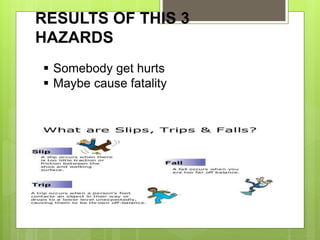
SLIPS
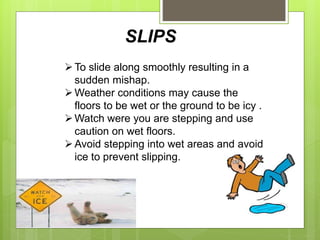
To slide along smoothly resulting in a
sudden mishap.
Weather conditions may cause the
floors to be wet or the ground to be icy .
Watch were you are stepping and use
caution on wet floors.
Avoid stepping into wet areas and avoid
ice to prevent slipping.
TRIPS
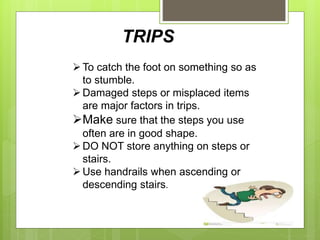
To catch the foot on something so as
to stumble.
Damaged steps or misplaced items
are major factors in trips.
Make sure that the steps you use
often are in good shape.
DO NOT store anything on steps or
stairs.
Use handrails when ascending or
descending stairs.
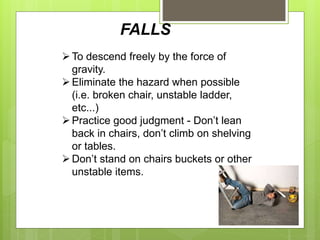
FALLS
To descend freely by the force of
gravity.
Eliminate the hazard when possible
(i.e. broken chair, unstable ladder,
etc...)
Practice good judgment - Don’t lean
back in chairs, don’t climb on shelving
or tables.
Don’t stand on chairs buckets or other
unstable items.
RESULTS OF THIS 3
HAZARDS
 Somebody get hurts
 Maybe cause fatality
HOW TO PREVENT ??
 Wear proper footwear
 Prevent a potential injury by cleaning up spills and wet
floors
 Keep isles and walkways clear of clutter or obstructions.
 Pick up objects,move electrical cords and other items to
eliminate the potential for injury.
 Place signs to warn others of the potential hazard
 Notify Supervisor
 Hold handrails on the stairs
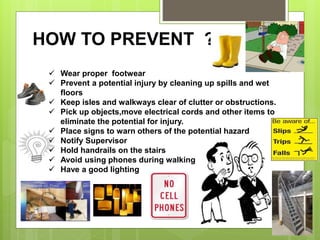
 Avoid using phones during walking
 Have a good lighting

LPO safety talk

  • 1.
    Slips, Trips, andFalls - Workplace Safety Tharveena Thomas PE Dept
  • 2.
    INJURY PREVENTION You takehundreds of steps every day. How many of those steps do you take seriously? By taking a few minutes to understand how slips, trips, & falls happen, you can prevent needless and painful injuries.
  • 3.
    SLIPS To slide alongsmoothly resulting in a sudden mishap. Weather conditions may cause the floors to be wet or the ground to be icy . Watch were you are stepping and use caution on wet floors. Avoid stepping into wet areas and avoid ice to prevent slipping.
  • 4.
    TRIPS To catch thefoot on something so as to stumble. Damaged steps or misplaced items are major factors in trips. Make sure that the steps you use often are in good shape. DO NOT store anything on steps or stairs. Use handrails when ascending or descending stairs.
  • 5.
    FALLS To descend freelyby the force of gravity. Eliminate the hazard when possible (i.e. broken chair, unstable ladder, etc...) Practice good judgment - Don’t lean back in chairs, don’t climb on shelving or tables. Don’t stand on chairs buckets or other unstable items.
  • 6.
    RESULTS OF THIS3 HAZARDS  Somebody get hurts  Maybe cause fatality
  • 7.
    HOW TO PREVENT??  Wear proper footwear  Prevent a potential injury by cleaning up spills and wet floors  Keep isles and walkways clear of clutter or obstructions.  Pick up objects,move electrical cords and other items to eliminate the potential for injury.  Place signs to warn others of the potential hazard  Notify Supervisor  Hold handrails on the stairs  Avoid using phones during walking  Have a good lighting