THENEXTMILLION.COM
JOHN RUFFOLO
Passion should be your priority
SOCIAL MEDIA MASTER
How Hootsuite became the
go-to social software for
companies around the world
C O V E R S T O R Y
You’ve Been
Shopify’d
There’s no hotter Canadian
tech company than Shopify.
Here’s how Chief Platform
Officer Harley Finkelstein
is using the cloud to make
your business better
IT’S ALL ABOUT
THE CLOUD
Companies are crazy for the
cloud, but many don’t know
what tools to use. We can help
Shopify’s
Harley
Finkelstein
shows us
how it’s
done
OCTOBER 2015 | $5.99
THENEXTMILLION.COM
TheNextM08_CVR_05.indd 1 2015-10-13 2:07 PM
Access thousands of group
fitness classes at hundreds
of local fitness studios and
gyms across Canada with
one membership. Discover
Yoga, Barre, Spin, CrossFit,
Boot Camps & More.
250+ Partner Studios/Gyms
1000+ Classes Every Week
$99/month
Calgary | Edmonton | Toronto | Ottawa | Montreal
.ca
get social - @fitsetpass | corporate packages - hello@fitset.ca | fitset.ca
OCTOBER 2015 | PAGE 1THENEXTMILLION.COM
SOCIAL MEDIA MASTER
In 2008, Ryan Holmes built
Hootsuite to help companies
manage their social media
accounts. His program – and
company of the same name
– has since become one of
Canada’s major tech success
stories
HOW I DID IT PAGE05 Reading time: 5 mins
BEYOND OUR
BORDERS
There comes a time
when a business owner
will want to expand the
company. But when’s the
right time to leave the
confines of Canada? We
ask the experts
ASK A PRO PAGE10 Reading time: 5 mins
THIS ISSUE AT A GLANCE
Here’s what we’re talking about inside
CLOUD COMPUTING FOR ALL
While every sized business can make use of the cloud,
what a small operation needs will likely be different
from what a large one requires. We look at the all the
options for your business
FEATURE PAGE 19 Reading time: 15 mins
COVER STORY Reading time: 15 mins
Capturing Criminals with High-Definition Cameras 07 4 mins
Trademark Company Needs Help Going Paperless 08 4 mins
Here’s How To Manage a Global Workforce 09 3 mins
Four Canadian Cloud-Computing Companies You Need To Know 22 18 mins
A Guide To Complicated Cloud Terms 26 8 mins
Ruffolo: Why Passion Should Trump Money 28 7 mins
PAGE READINGTIME
Canada’sCloudCompany.Ottawa’sShopify
isrevolutionizinghowcompaniesbigand
smalldobusiness.Isitthefutureof
e-commerce?Findoutonpage13
CONTENTS
PAGE 2 | OCTOBER 2015 THENEXTMILLION.COM
PUBLISHERS
Mario Paron, Peter McNeill and Kristina Valentini
EDITOR
Bryan Borzykowski
ART DIRECTOR
Erik Mohr
CONTRIBUTORS
Sarah Barmak, Brenda Bouw, LM Chabot,
Jennifer D. Foster, Claire Gagné, Erik Heinrich,
Diane Jermyn, Alex Azalea Jin, Guy Lancaster,
Reynard Li, Kari Medig, Brian G. Miske, Sunil Mistry,
Matt O’Grady, Chelsea Peters, Diane Peters,
Andrew Querner, Graham Roumieu, John Ruffolo,
Kim Shiffman, Jay Somerset, Sally Tan Soriano,
Rémi Thériault
GLOBE EDGE
Teena Poirier
DIRECTOR, CLIENT ENGAGEMENT AND GLOBE EDGE
Sean Stanleigh
MANAGING EDITOR, GLOBE CONTENT STUDIO
Liz Massicotte
PROGRAM MANAGER, GLOBE EDGE
Isabelle Cabral
PRODUCTION CO-ORDINATOR, THE GLOBE AND MAIL
The Next Million is designed and produced by
The Globe and Mail Custom Content Group on
behalf of KPMG Enterprise.
All Correspondence:
KPMG LLP
4100 Yonge Street, Suite 200,
North York, Ontario, M2P 2H3
enterprise@kpmg.ca
Printing and pre-press by DM Digital+1
DISCLAIMER: The information disclosed herein is intended to provide only
general guidance with respect to the various matters dealt with and is not an
exhaustive description of all issues and risks that may be present to any person
or persons. The information disclosed herein should not be regarded as advice
and is based solely on facts and circumstances provided to KPMG and should
not be regarded as suitable for use by any person or persons. Any information
herein is based on current tax law including judicial and administrative
interpretation. Tax law is subject to continual change, at times on a retroactive
basis and may result in incremental taxes, interest or penalties. Facts and
circumstances along with changes in law or its interpretation change impacts
such foregoing referred to information. The information herein is current as
of the date of the information and has not been updated for changes in law or
interpretation after the date thereof. For this reason, the reader should not rely
upon this information without seeking the advice of a qualified professional.
We accept no responsibility or liability for any reliance that the any person or
persons may place on the information contained herein. We neither warrant
nor represent that this is sufficient or appropriate for any purposes that any
person or persons may have.
The KPMG name, logo and “cutting through complexity” are registered
trademarks or trademarks of KPMG International.
ABOUT THE NEXT MILLION
M is the Roman numeral for one thousand. There was once a time
where no single letter held greater value. It wasn’t until centuries
later that appeared. means one million. But as impressive as
that sounds, we see it as the basis for something bigger still –
your business.
You’ve made it through the hurdles, pushed past the naysayers and
proven your ideas can work. You already know what it takes to be an
entrepreneur. It takes a special boldness, creativity and drive. You’ve
made it. Now it’s time to grow it. In The Next Million, we highlight the
success stories of entrepreneurs like you. Stories that will inspire you
from the first million to the next – and each one after that.
You’re the entrepreneur. We’re KPMG Enterprise.
T
he “cloud” seems to be another one of those business buzzwords – like “innova-
tion” – where over a few short years it’s gone from a competitive advantage to an
operational necessity for businesses of all sizes.
But why?
Millennials are now the biggest generation in the Canadian workforce, and they’re
placing high value in employers that encourage mobility, utilize the latest technology
and promote environmental responsibility through initiatives like paperless workplaces.
Beyond that, the amount of data companies are creating and collecting is truly vast and
only increasing. In many cases, cloud storage solutions are the only possible solution due
to sheer volume.
Close to 80 per cent of all workloads are expected to be processed using cloud
technology by 2018. What does this mean for you? In order for your business to attract
top talent and keep up with competitors in the near future, you should start thinking
about embracing cloud-based solutions now (if you haven’t already).
But let’s be clear, cloud computing – which refers to sharing resources over a public,
private or hybrid network – cannot by itself transform the way a business operates.
However, it can be a valuable tool to improve performance. At KPMG Enterprise, we work
with our clients to first identify an issue or inefficiency affecting the business’s greater
strategy. We then help create and implement custom cloud-based tools that solve the
problem and generate real results.
In this issue of The Next Million, you will hear from a range of Canadian companies that
have embraced the cloud and learn about the challenges and triumphs they faced while
doing so. I encourage you to consider how the stories and tools showcased relate to your
current business environment, and if a cloud-based solution may help you reach your
company’s current and future goals.
ILLUSTRATIONBYCHELSEAPETERS
GET A GRANT TO SUPPORT YOUR TECHNOLOGY ADOPTION PROJECT
Ask any entrepreneur – when it comes to funding a project, not all sources of capital are created
equal. Government grants and contributions are non-dilutive sources of funding, making them
particularly attractive for businesses that want to undertake projects involving technology
Mario Paron is the co-publisher of The Next Million and a Canadian managing partner at KPMG Enterprise. 
MARIO PARON
Get your head in the cloud
Buildinganagileandconnectedworkforceistheonlywayforward
PARON
22%
Marketing: reaching
new markets
32%
Transfer R&D and
commercialization
15%
Productivity:
adopting new tech
16%
Expansion: new buildings,
equipment or staff
15%
Other: Start-up,
entrepreneurship support
Top reasons for
securing grants
JUMBLEBERRY
PERFORMANCE-DRIVEN MARKETING
Questions? Contact us.
1-888-832-9785
info@jumbleberry.com
www.jumbleberry.com
PLACING ADVERTISERS IN THE DRIVERS SEAT
OF WINNING DIGITAL AD CAMPAIGNS
Your customers demand engaging and relevant ads and it must appeal to
them across multiple devices and formats to win their coveted attention.
Jumbleberry delivers superior direct-response ad campaigns with speed,
precision, and passion that convert attention into action.
I N TE GRITY • EXPERIENCE • VALUE ADD • FLEXIBLE STRUCTURE
We provide equity capital for owner/operator
succession, corporate carve-outs, management buyouts,
expansions and recapitalizations.
We believe in investing in people we trust, in businesses
we understand and where our experience matters. We
use leverage prudently to drive value and accelerate
growth in our portfolio of companies.
390 Bay Street, Suite 1200
Toronto, ON M5H 2Y2
ironbridgeequity.com
Where capital
and experience meet.
Ironbridge is a Toronto-based private equity firm focused exclusively on
investing in companies in the Canadian lower middle-market.
CONTACT US AT
info@ironbridgeequity.com
or 416.863.0105
THENEXTMILLION.COM
CAMERA CONNECTION
Avigilon brings security into high-definition
MANAGE A GLOBAL TEAM
Working with staff in far-off places
PAPERLESS PROBLEMS
One company’s quest to go all digital
BEYOND OUR BORDERS
Become the go-to exec in your sector
START
Expert tips, inspiration
and ideas for growing
your business
PHOTOGRAPHCOURTESYOFHOOTSUITE
SOCIAL
MEDIA
MASTER
Companies across the
world use Hootsuite
to manage their social
accounts. Now meet
the man behind the
platform
BY CLAIRE GAGNÉ
Now that social media is
everywhere, it’s easy to forget
that it was only a few years ago
that Facebook took off. Ryan
Holmes, though, knew in 2008
that social networking was
the future. When Holmes, a
Vancouver-based entrepreneur,
was working at a digital
marketing agency he also
founded, he built a prototype
for a product that would help
companies better engage with
customers over social media. He
launched Hootsuite in December
2009 and it immediately took
off. Today, the social media
platform has over 12 million
users in over 175 countries, and
offices in Canada, the United
States, Europe, South America
and Southeast Asia.
THENEXTMILLION.COM OCTOBER 2015 | PAGE 5
Does your company
have multiple
social media sites?
It’s likely using
software created
by Ryan Holmes,
the founder of
Hootsuite, to
manage those
accounts.
PAGE 6 | OCTOBER 2015 THENEXTMILLION.COM
I’m a long-time
entrepreneur.
I started my
first business,
a paintball company, in high
school, and I dropped out of
university to start a restaurant,
which I ran for a number of
years.
In 1999, the Internet
was booming, so I sold my
restaurant and holed up in
an apartment in Vancouver. I
taught myself HTML and CSS
to learn how to build things
for the Internet. I got a job at a
dot-com, which went really well
for about six months, until the
bottom fell out of the market.
I had a big belief that
the Internet wasn’t going
anywhere. I founded an
agency that did service work
for clients and also incubated
new products. As the company
grew and we started doing
more work with clients in
the social media realm, we
realized that there weren’t any
good tools to manage social
media. So that was the “aha”
moment for Hootsuite: we take
the complexity of managing
multiple social networks with
multiple team members and
make it easier for companies to
manage their social media.
Today, we have five
different products. We have a
publishing product that helps
people build and schedule
content that they put out on
social media channels like
Twitter, Facebook, LinkedIn
and more than 100 other
social networks. We have an
engagement product, which
helps companies listen to what
people are saying on social
media and respond to it. We
also have analytics, advertising
and campaigning products.
With the advent of cloud
computing, the cost of building
these products has been
reduced significantly. You don’t
need to build your own data
centre; you can simply spin
one up on Amazon or whatever
other cloud service that you
want. We’re sending more
than 5 million messages every
day around the world, and
our customers rely on us for
consistent, reliable uptime on
our products. We’re able to do
that through a cloud grid.
The “freemium” model has
been a big part of our story,
too. We give away our basic
product for free. As you get
more advanced in your usage,
you run into paywalls, and at
that point customers upgrade
to our Pro or Enterprise
products.
When you have one person
on social, it’s pretty simple.
But when you have tens of
thousands of people trying to
work effectively, it becomes
very difficult and challenging.
We try to make that task
simpler for brands around the
world.
We’ve made a few targeted
acquisitions, but we’re wary of
being overly acquisitive. We
feel it’s important to be the
best at what we do. We don’t
want to build a product that’s a
mile wide and an inch deep.
A lot of people ask if we’re
going public. I think public
companies have best practices
in place, and we’re building
those. If the timing is right,
we’ll look toward an IPO, but
we’re not in any rush. We’ll just
see what the right thing is for
the company.
It’s been a pretty amazing
process, going from three
people at the beginning to
almost 1,000 employees now.
If we look back to eight years
ago, everyone was talking
about whether social media
was relevant and if it was here
to stay. We now know that it
is relevant and it is here to
stay. We know that there’s
an absolute shift in how
companies are communicating
with their
customers, and
we’re pretty
blessed to be
sitting in the
middle of that.
HOW I DID IT
BY THE NUMBERS
Vitals
Hootsuite Media Inc.
Founded in
2008
approaching
1,000
full-time employees
12million
users
* We have a culture where
we want people to have the
power to make mistakes,
but it’s not okay to make
a mistake and not learn
from it. If you’re making the
same mistake over and over
again, you’ve got a problem.
* Name and branding are
critical, especially at an
early stage. You need to be
memorable.
* Listen to people. We listen
to our customers and other
stakeholders, like our
team and product people.
From there, we condense
and consolidate a product
vision.
ryan’s Tips
“IT’S BEEN A PRETTY
AMAZING PROCESS,
GOING FROM THREE
PEOPLE AT THE
BEGINNING TO ALMOST
1,000 EMPLOYEES NOW.”
THENEXTMILLION.COM
More tools to use
The beauty of cloud computing is that it can help companies grow in myriad ways. Last year,
KPMG asked business owners how the cloud will help them most. Here’s what they said
49%
DRIVE COST
EFFICIENCES
42%
BETTER ENABLE
MOBILE
WORKFORCE
37%
IMPROVE
ALIGNMENT
WITH
CUSTOMERS/
PARTNERS
35%
BETTER
LEVERAGE DATA
TO PROVIDE
INSIGHT
32%
NEW PRODUCT
DEVELOPMENT/
INNOVATION
30%
DEVELOP NEW
BUSINESS
MODELS
28%
SHIFT TO GLOBAL
SHARED SER-
VICES MODEL
28%
FASTER TIME
TO MARKET
OCTOBER 2015 | PAGE 7THENEXTMILLION.COM
PHOTOGRAPHBYTHOMASFRICKE
THE PRODUCT
CameraConnection
The video surveillance industry is undergoing big changes and
Vancouver’s Avigilon is leading the way
BY KIM SHIFFMAN
It’s impossible not to notice the many
security cameras in shopping malls,
airports, stadiums and banks. While
they’re meant to capture crooks and
increase customer safety, a lot of the video
technology that’s been traditionally used
doesn’t elicit much useful information.
That shouldn’t come as a surprise – we’ve
all seen those grainy camera clips on the
evening news.
In 2004, Alexander Fernandes thought
that he could create something better.
The long-time entrepreneur, who had
successfully founded and sold companies
in the past, had a passion for technology – 
specifically software, hardware and high-
end digital imaging. “As an entrepreneur,
I was always looking for the biggest
opportunities where I could dominate,” he
says. “I knew this was a big market, ripe
for the picking.”
Fernandes launched Avigilon, a
designer, manufacturer and marketer of
end-to-end video surveillance software
and equipment. In 2009, after several
years of R&D, the company began
selling its products to school campuses,
transportation systems, hospitals,
prisons, casinos and any other sector that
needed to capture high-quality video.
The company’s products quickly
took off. In 2014, its seventh revenue-
generating year, Avigilon’s sales reached
$271.4-million, representing a compound
annual growth rate of close to 100 per
cent. What’s more, the company is solidly
in the black, boasting 2014 net income
exceeding $35-million. Its stock is also
up 314 per cent since it went public on the
TSX in 2012.
Most businesses come for Avigilon’s 120
HD IP line of cameras that offer high-
tech features such as automatic image
enhancement – which can reveal details
such as licence plates or a suspect’s facial
features – but its cloud-based software is
a big part of the company’s solutions, too.
Each camera comes with secure video-
management software that uses cloud
technology, allowing organizations to
manage security across multiple sites
from any global location and from a
single platform, such as a computer
or smartphone app. The company has
also started offering adaptive video
analytics, which can classify people and
vehicles while eliminating normal scene
activity, such as moving trees, shadows or
reflections from water or glass.
Despite Avigilon’s success, growth
hasn’t been without its challenges. One
of the biggest challenges, says Fernandes,
is human resources. “A company’s plan
is only as good as its execution, and that
comes down to people,” he says. With
more than 800 employees, things will
inevitably go wrong: a shipper or receiver
enters the wrong customer address; the
accounting department charges a client
the wrong amount; an engineer is careless
with software.
Fernandes counters this reality with
a decisive strategy. “We’re constantly
culling the herd,” he says. “The bottom
10 per cent of our employees are made to
improve or are let go.” That said, Avigilon
employees enjoy high salaries and internal
promotions. “If you have the right people,
they’ll find solutions to problems,” he
explains.
With the right people and products in
place, Fernandes sees Avigilon growing
for years to come. The company’s market
share is close to 2 per cent, but because
the video surveillance market is so
fragmented, no other firm has gotten past
5 per cent.
“I’m expecting something
unprecedented in our industry,” he says.
“We’re going to get 10 per cent market
share.” And as for revenue, Fernandes
isn’t afraid to throw around the word
billion: “It’s my personal goal.”
PAGE 8 | OCTOBER 2015 THENEXTMILLION.COM
Sunil Mistry
PARTNER, KPMG LLP (CANADA);
KPMG ENTERPRISE
When we went paperless years ago, it took some
time for people to get over the psychological
aspect of not having paper – especially in an
audit accounting firm. Our entire audit files
are now all digital. We have clients who give us
paper, but we scan it into our system.
To overcome resistance, you have to rip off the Band-Aid. In our
office, we had what we called “the vault,” where all our files used to
be kept. We got rid of it. The equivalent for Coastal might be getting
rid of the filing cabinets and all of the old paperwork. Another thing
we did was have dedicated people scan all our old files, so they never
had to go back to their original storage location.
The next step would be to get rid of the printers. It really does
force everybody to deal with things onscreen.
Brian G. Miske
CHIEF MARKETING OFFICER,
KPMG LLP (CANADA)
Technology is incrementally increasing the
speed of competition, so change is a constant
in our society today. Leaders have to be change
agents focused on creating a story, a vision and a
purpose, while simultaneously communicating
and engaging people on a daily basis. Reitzel must be clear in
defining a vision of what lies behind her team and what lies before
them. Reitzel’s vision should dictate all communications by building
excitement about the future state of the company and identifying
the value in change, including what’s in it for each employee.
She needs to be able to articulate the reason why the change is
critical to the success of the organization, then guide that change
and re-energize the group throughout the process. In this, she
should lead by example, providing insights into her own behaviour.
Paperless
problems
Tanya Reitzel wants her employees to go
electronic. Some staff, though, are having
a hard time parting with paper
BY DIANE JERMYN
Tanya Reitzel, owner of Coastal Trademark Services Ltd., oversees
trademark registration and filing for some 2,000 clients. Over time, all of
that business had left Coastal with more than 5,000 paper files. For years,
Reitzel thought about creating a paperless office – mostly by moving her
computer network to the cloud, which would allow staff to share files
virtually, rather than having to print off pages – and in 2012 she finally
made the switch. But her whole company isn’t quite paperless yet.
Reitzel works in Kelowna, B.C. – she moved there after her husband
got a new job – but her six staff continue to work at the head office
in Vancouver. Any new files Reitzel opens are now electronic, so she
doesn’t have any paper to deal with, but not all of her employees have
given up the printed page. Her big challenge? Getting her entire staff,
who range from 25 to 40 years of age, on board.
The ones who are resisting simply like the way they’ve always done
things. She has told them that she wants the company to go paperless,
but she’s not forcing them to change, either. “I have advised them that
I want to be paperless by the end of the year, but I prefer not to be a
dictator,” she Reitzel.
“Their biggest issue is just that it’s the unknown,” she adds. “Most
have worked in the field for a long time. You get used to having that
paper file in front of you and being able to flip through the pages
easily to look at the documents underneath and review the file in that
manner. It’s hard to give that up.”
While Reitzel has given them each an extra computer screen, so
that they can open and review several pages at once, it’s still hard for
some of them to let go of paper.
THE PITCH
DISCLAIMER(MISTRY,MISKE)SEEPAGE2;PHOTOGRAPHYBYANDREWQUERNER;ILLUSTRATIONSBYCHELSEAPETERS
OCTOBER 2015 | PAGE 9THENEXTMILLION.COM
Every year, JeffZamluk gets dozens of goods designed, manufactured and shipped
in a globe-spanning process all managed from his home office in Victoria, B.C.
He works with as many as 40 subcontractors, mostly engineers and designers,
and numerous factories and logistics companies to run Swell Source, which
manufactures four sports product lines, including paddleboards and snowboards,
and helps about 60 outside clients transform ideas into manufactured goods.
Here’s his advice on how to run a company with scattered staff BY DIANE PETERS
HOW TO
COMMUNICATE
Swell Source projects
get broken down, task
by task, including
deadlines and links
to technical specs, on
spreadsheets shared
over Dropbox or
Google Drive. “Clarity
is key,” says Zamluk.
While faraway people
working on the same
project can leave notes
for each other in the
files, Zamluk knows it’s
on him to make sure
work gets done. He’s
on e-mail constantly,
keeping tabs and
issuing reminders.
Early mornings and late
nights are the norm,
due to everyone being
in different time zones.
FORGET THE PHONE
“I hate calling people
and I hate talking
on the phone,” says
Zamluk, ironically, in a
phone interview. With
phone calls, there’s
no record of promises
made, specs outlined
or deadlines created.
E-mail leaves a trail.
Zamluk also visits
his overseas team
members to build a
personal connection.
On the ground, he
asks about family and
hobbies. In China, that
means lots of nights
out doing karaoke.
ADJUST YOUR
STYLE
Zamluk works with
people in China,
Thailand, New
Zealand, Austria,
Hawaii and closer
to home. There are
radically different
working styles
between, say, the
terse, fact-driven
approach in China
and the more laid-
back small talk with
colleagues Down
Under. So he adjusts
his communication
approach and
expectations. But
sometimes he forgets
to switch gears. “If
I’m just back from
China, and I go up to
a Canadian and ‘say
I need this done by
this date and that’s it,’
they’ll push back and
say, ‘That was short
and kind of rude.’”
MAKE THE RIGHT
CONNECTIONS
Zamluk has been
manufacturing
products with overseas
partners for more
than a decade. He
has a set way of doing
business, and he can
tell if a potential new
subcontractor is a fit.
“I think the same vibe
you get in the office
develops in the virtual
world, too. Through
e-mails you can get
information and a
sense of a person and
how good a worker
they are.”
INNOVATE AT HOME
“All that remote
managing is good
for getting tasks and
projects done,” says
Zamluk. “However,
working with people
one-on-one is more
effective for coming
up with ad hoc ideas,
campaigns or even
business direction.”
So Zamluk often
taps into his local
network of friends
and colleagues to
help flesh out ideas.
His best ideas come
when he’s out with his
buddies, using his own
products on the water
or the slopes, he says.
Sometimes, nothing
beats close to home.
ILLUSTRATIONBYGRAHAMROUMIEU
PAGE 10 | OCTOBER 2015 THENEXTMILLION.COM
Q: I’d like to expand my business beyond Canada’s borders, but I’m
not sure if I’m ready. How can I tell if it’s the right time to set up
shop in other locations?
A: It’s a judgment call. No one knows exactly when the time is right, but it helps if
you work out all your concerns before making a push into other markets.
First, know your product. If you’ve already developed your product or service
here, consider the relatively friendly Canadian marketplace as your test market. Is
the offering as good as it can be? Have you done a broad enough test run that you’ve
solved the bugs that need to be fixed before moving into bigger, tougher and more
competitive markets?
Second, know where you’re going. It makes sense to look at the North American
market first before entering more global markets, particularly in the software
and cloud sectors. The United States is a leader in the area of Internet-functioning
businesses, so it’s a logical next step for most people with a cloud-related company.
However, keep in mind that the U.S. is a different market, and not only in terms of
its competitive landscape and distribution channels, but also its regulatory, and state
and local tax matters. Do some research, or consult your business adviser, about
those differences and then see what that means for your ability to expand into that
market. Do you have the expertise in-house?
Depending on your business, you could set up shop there or look for a partner to
help distribute your product, whether that’s a real business partner or a third-party
distribution chain. Also, make sure to safeguard your intellectual property by taking
all the steps you can to protect what you’re doing and to maintain your proprietary
interest in your company in foreign markets. At the same time, ensure that what
you’re doing isn’t an infringement on someone else’s copyright.
Finally, are you ready to ramp up production and follow through? You don’t want
to go out there and flop. Know how deep the market is, how much money you’ll need
to penetrate it and be ready to take on
all challenges.
—GUYLANCASTER, SENIORMANAGER,
CORPORATE TAX,KPMG LLP(CANADA)
Q: A lot of my business-owning friends
have become “thought leaders” in
their fields, and it’s brought in a lot of
business for them. What exactly does
that mean, and how can I do the same?
A: The amorphous concept of a thought leader
or thought leadership is quite basic: it’s about
differentiating yourself among your peers and
competitors to deliver something of value to your
target audiences that is aligned with your brand’s
values.
Organizations are in a continual state of
reflection, looking for new ways to inspire, lead
and shape the right team members to bring the
organization’s strategy to life, battling against a
market in near-constant disruption. Audiences
are short for time and overloaded with data. A
shorter attention span means that brands need
to reflect on the quality of the conversations with
these audiences.
 Thought leadership requires imagination and
community. It’s about creating and extending
relevant conversations and experiences that
build a halo for the brand, while deepening
relationships and revenue growth. The desired
outcome is the recognition from the market that
the individual or company deeply understands
its business, the needs of its customers and the
market environment in which it operates.
A thought leader first needs to own the
conversation. Understand what topic or
conversation you want to own in the market,
and then create a differentiated perspective and
story that can be shared across social and digital
channels, while being relevant during in-person
conversations.
Next, keep the story going. Look for feedback
and engage in two-way dialogues online and
through the different channels your audiences
frequent. Ultimately, becoming a thought leader
requires consistency and commitment from
the individual or group of individuals seeking
to become a recognized authority on an issue,
industry or market. 
—BRIANG.MISKE,CHIEF MARKETING OFFICER,
KPMG LLP(CANADA)
Barriers To Entry
While most companies know by now that the cloud can
help their business, there are still issues preventing people
from storing data virtually and using cloud programs.
Here’s what business owners said are their three biggest
cloud-related concerns.
Beyond our borders
ASK A PRO
53%
Data loss and
privacy risks
50%
Risk of intellectual
property theft
49%
Impact on IT
organization
DISCLAIMER(LANCASTER,MISKE)SEEPAGE2;ILLUSTRATIONBYALEXAZALEAJIN
SOURCE: 2014 KPMG CLOUD SURVEY REPORT
OCTOBER 2015 | PAGE 13THENEXTMILLION.COM
Shopify’d
How Canada’s newest tech star
wants to change commerce forever
BY SARAH BARMAK
PHOTOGRAPHY BY RÉMI THÉRIAULT
COVER
Harley Finkelstein’s
all smiles at Shopify’s
head office in Ottawa.
That’s partly due to the
company’s quick rise to
the top of Canadian tech.
PAGE 14 | OCTOBER 2015 THENEXTMILLION.COM
COVER
When Harley Finkelstein first met his future boss
at a coffee shop in Ottawa’s downtown Glebe neighbourhood in
2005, he was a young, struggling entrepreneur. He was putting
himself through a joint law and MBA program at the University
of Ottawa by running a business that sold customized T-shirts
for colleges, but his class requirements made it tough to meet
with customers face to face.
Finkelstein heard a group of smart young entrepreneurs
hung out regularly at Bridgehead, a café in the area. Curious,
he decided to visit. The person who stood out to him most was
Tobias Lütke, a brilliant programmer from Germany who had
just written new e-commerce software, so he could run his own
online snowboard business better. Finkelstein wanted to try
out the then-unnamed software himself.
Neither had an inkling that, within less than a decade,
they’d have retired their T-shirts and snowboards, and would
be on the team that leads one of Canada’s marquee tech
companies – a business that is making life easier for small and
medium-sized operations all over the world. Shopify, which
launched in 2006, sells an e-commerce platform that gives
anyone the tools to create and manage an online store.
The company was founded by Lütke, who is now its CEO,
programmer Daniel Weinand, Lütke’s childhood friend, and
businessman Scott Lake, who left in 2008. In 2009, Finkelstein
had finished a year at a Toronto law firm and was pondering his
next step. “I began to think about what to do as my life’s work,”
says Finkelstein. “I kept coming back to the idea that what I
had done with Shopify, many millions of others could do the
same thing.” He called up Lütke and said he’d like to come join
him at Shopify. He was working there by the next year.
The animated and extroverted Finkelstein and the reserved,
cerebral Lütke have opposite personalities, but they found they
complemented one another. “He was the hacker’s hacker, and I
was the hustler’s hustler,” says Finkelstein. “You couldn’t find
two people who are more different. He’s certainly a very deep
thinker; I much prefer articulating myself with words.”
Today, Finkelstein’s old T-shirt company, Smoofer, is
defunct – though preserved for the ages at Smoofer.myshopify.
com – and he is chief platform officer of Shopify. Finkelstein’s
job involves sales, business development and partnerships –
hustling at a very high level.
He’s doing his job well. Shopify has become a rising star since
it was founded and now has more than 175,000 merchants in
about 150 countries racking up some $10-billion in total sales
using the platform. According to many observers, as well as
Finkelstein himself, it is doing more than just making money:
it’s disrupting the way that business has traditionally been
done by lowering the barrier to entry for anyone who wants to
sell anything.
“As a young
entrepreneur, I was
competing against
some of the largest
companies in the
world, and I was
inspired by that.”
OCTOBER 2015 | PAGE 15THENEXTMILLION.COM
COVER
Making it easier to compete
Finkelstein speaks passionately about how Shopify helps
businesses around the world work smarter and for less, whether
they’re Google, the L.A. Lakers or Tesla Motors (a few of their
biggest customers) or as small as someone selling homemade
earrings in her spare time with nothing more than a laptop.
The software gives shops an extensive package of tools – a
professional online storefront, marketing and SEO, Web
hosting, analytics, store management functions, either a credit
card payment solution with Shopify Payments or the ability to
integrate with more than 70 payment gateways and much more
– many of which only the largest retailers had the money and
time to put in place in the days before Shopify.
“As a young entrepreneur, I was competing against some of the
largest companies in the world, and I was inspired by that,” says
Finkelstein, who has been an entrepreneur ever since he was 13,
when he asked his father for a loan to run a DJ business. “[Lütke]
was democratizing retail around the world,” he says.
An IPO that beat the hype
Most of Shopify’s customers are small to medium-sized
businesses, but in the process of helping the little guy, Shopify
has become big. In 2015, it had more than 600 staff and four
offices: its massive headquarters at 150 Elgin St. in Ottawa,
another in Montreal, one in Kitchener-Waterloo and the
distinctive Toronto office it opened in April 2014.
According to Director of Product Satish Kanwar, the office at
80 Spadina Ave. in downtown Toronto was designed as a spatial
“metaphor of commerce.” Its front reception area and office block
are laid out like a pop-up shop that promotes its merchants’
products. With high ceilings inspired by warehouses, two crate-
like enclosures for casual work and other touches, the rear office
represents shipping and transport. The third floor, currently
under development, will represent production and fabrication.
In 2014, Shopify launched Shopify Plus, a “white-glove”
edition of its platform to meet the needs of larger merchants.
It offers features such as dedicated project and account
management, access to priority support and early access to
beta features.
With this much growth and momentum, the company decided
that it was time to go public and raise money, so it could grow even
faster. With its self-assured presence and a leader who was named
ReportonBusiness’s 2014 CEO of the year, Shopify’s initial public
offering this spring was highly anticipated, and it lived up to the
hype. The firm dazzled in its May 21 debut on the New York Stock
Exchange – it started trading at US$28, more than 60 per cent
above its $17 offering price. Its IPO raised more than $131-million.
It’s the first Canadian e-commerce business to go public on
an American stock exchange since 2001, according to data
from market intelligence source Ipreo. Shopify’s wild success
cemented it as a global hot commodity and positioned it closer to
its peers (such as online craft and gift marketplace Etsy, which
went public just days after Shopify) than with most Canadian
tech firms. However, it did raise the hopes of other Canadian
digital companies – now everyone’s talking about Vancouver’s
Hootsuite and Waterloo’s D2L, an e-learning solutions company,
as being next in line for IPOs. In any case, Shopify serves as
proof that Canada’s tech industry has progressed far beyond its
Nortel days.
Dominating digital markets
Shopify has become so successful, so quickly, in part because
it smartly leverages a number of today’s central digital trends,
such as cloud computing, mobile and social media. It also
has a digital-age pricing plan. It’s a Software as a Service
(SaaS) company, which means clients sign up for a monthly
subscription (from $9 to $179 a month) to use its platform.
This replaces the model of traditional software, which is
usually sold as a license with a large, upfront payment.
This subscription-based model means the software is
hosted centrally on the cloud – clients don’t to need store
their own copy on their computers. Roughly 30 per cent
of all application spending by businesses is now on this
kind of SaaS model, and the segment has been growing
approximately 20 per cent a year for quite some time, even as
software spending as a whole has been on the decline, says
David Wismer, managing director of technology investment
and corporate banking at BMO Capital Markets.
Stock market investors like SaaS companies because of their
predictability, says Wismer. Instead of getting a company
to pay a one-time upfront fee, an SaaS business can charge,
say, $25,000 a month over a three-year term. “You’ve got
tremendous visibility into what the business will look like
in the coming quarters or even years,” he says. “With the old
licence model you just didn’t have that visibility.”
Shopping for all types
When Shopify started, its customers were mostly online
stores, but it’s evolved significantly over the years. In 2013,
it introduced Shopify POS, a point-of-sale system allowing
anyone to sell in physical stores, as well as online. It has made
bricks-and-mortar locations and pop-up shops avid users of
its technology. Shopify merchants can even sell on sites such
as Amazon and eBay, while still using Shopify as the back-end
PAGE 16 | OCTOBER 2015 THENEXTMILLION.COM
COVER
software that manages all aspects of their business. “Shopify
is the platform behind all that,” says Finkelstein. “It’s the first
thing you open in the morning and the last thing you close
when you go home at night.”
Shopify’s strategy is simple: make itself indispensable. Its
POS solution ensures merchants’ sales made in person – at a
farmers’ market, for example – are integrated instantly with
their online sales, meaning inventory and records are always
harmonized across the board. This has made it a go-to solution
for the growing world of pop-up stores, which often consist of
little more than a table spread with handmade trinkets and an
iPad for processing payments.
On June 2 of this year, Shopify announced that it was
partnering with Pinterest, the
photo-heavy social media site, to
help monetize the huge streams
of social media traffic that revolve
around viewing, liking and sharing
images of products, but which haven’t
always translated to sales. With new
“Buyable Pins” that have “Buy It”
buttons above the image, Shopify
merchants will be able to sell directly
on the Pinterest iPhone or iPad app
using Apple Pay or credit card. The
potential impact is huge. Two million
people pin products on Pinterest
each day – 20 times more than there
are daily shoppers at the Mall of
America, according to Shopify.
Naturally, Finkelstein is excited
about this recent development.
“We did a deep graphic of all social
channels, and some channels
bring many people to stores, but
checkout is low,” he says. “Pinterest
is a great place where people show
intent. You like the product, there’s
some interest. On pictures, you
are demonstrating intent to do
something with that product. A
natural next step is to allow people to
purchase the item once it’s pinned.”
The average amount of a transaction referred by Pinterest
is $50, higher than for any other social media channel. That
might be because typical Pinterest products are nice to look
at – and, thus, higher-end or collectible. “No one’s really going
to pin toilet paper,” says Finkelstein. “Potentially, the products
on Pinterest are more unique. [The higher price] might [also] be
because of the interest the pin creates.”
Making sales in a mobile world
As with social media, one of the challenges sellers face with the
growth of mobile traffic is converting browsing and interest
into sales. Traffic from mobile is increasing. The phenomenon
of “snacking” – people logging onto their smartphones
whenever they have a few spare minutes, such as in a doctor’s
waiting room or standing in a streetcar – is growing. But in
the past, shoppers had to type in their address and credit card
information manually in order to check out, meaning they’d
wait until they got home to their desktops to complete a sale.
That often meant sales would get lost in the process. Shopify
is trying to make buying on a mobile device more “friction-
free,” says Finkelstein, by partnering with the biggest social
and mobile companies to enable easier payment through Apple
Pay, Facebook and many other different formats. Shopify
merchants can even accept Bitcoin.
Finkelstein believes that mobile will be the primary way
we buy in the future. In Canada, mobile commerce is growing
at more than double the rate of overall e-commerce, and 19
per cent of Canadian online shoppers said they had made a
purchase from their smartphone in the last year, according to
a 2015 Ipsos study commissioned by PayPal. Mobile spending
in Canada reached $3.4-billion
in 2013, and that figure is
estimated to grow by 142 per
cent next year.
Finkelstein doesn’t care if
merchants sell on their phones,
tablets, laptops or in person,
however, as long as they’re
selling. While he may prefer
to do his shopping entirely
online, he says, his mother,
for instance, might want to
“showroom” – touch and view
products in a bricks-and-
mortar shop – before she buys
online, and his grandmother
might prefer the old-fashioned
physical shopping experience
from beginning to end.
“The future of retail isn’t
necessarily online versus
offline,” he says. “It’s retail
everywhere.”
Don’t fear
the cloud
The special sauce of all Shopify’s
solutions is the cloud. It is the fact that Shopify is a cloud
application that allows the company to charge merchants a
comparatively low price, says Finkelstein, because it keeps
costs low from the beginning. “Because we’re taking advantage
of cloud software, it allows us to make it affordable. Because
it’s affordable for us to allow merchants to build online stores,
it’s affordable for them to come online for the first time. For
small businesses, before Shopify, there was nothing. We were
competing with non-consumption. People using Shopify, for
the most part, are people who didn’t have businesses prior to it.
They couldn’t afford it, and it was too complicated.”
In 2011, Finkelstein told a reporter that he believed one day
all computing would be done through an online connection.
Now, cloud computing has shifted from a trend favoured by
early adopters to a mainstream tool. “My grandparents write
and e-mail using browsers,” he says.
In the past few years, concerns about processing payments
or putting other secure information in the cloud has largely
evaporated as trust grows, and the upside of not having to
“Because
we’re taking
advantage
of cloud
software,
it allows us
to make it
affordable.”
OCTOBER 2015 | PAGE 17THENEXTMILLION.COM
COVER
“The reason most
people don’t start
their own business
is fear – fear that
it’s too complicated.
We want to take
that barrier down.”
An inside look into
Shopify’s Ottawa office.
Graffiti-like artwork
covers many of the
walls at the company’s
headquarters.
PAGE 18 | OCTOBER 2015 THENEXTMILLION.COM
store data and applications locally grows more evident.
“The risk aversion that cloud online technology may
have had once upon a time is now gone,” says Finkelstein.
“Shopify takes security very seriously. We have one of the
best security teams around. In terms of any apprehension
that merchants may not want to use Shopify because we’re
in the cloud, we don’t really see that at all anymore. I think
that ship has sailed.”
He says traditional methods of doing transactions were
also never completely secure. “Frankly, take a bricks-and-
mortar retailer on Shopify, someone who was using a
traditional point-of-sale [system] years ago, and their data
wasn’t on the cloud, but it was sitting on a CPU next to their
cash register. If they have any type of electrical issue, if they
have a flood, if they get broken into, they lose their data. I
think the fact that now all their data’s available 24-7 and
backed up on the cloud means it’s actually safer.”
All these building blocks that put Shopify at the forefront
of digital trends – software as a service, social, mobile and
cloud technology – have made it a first choice for first-time
merchants around the world.
First choice for first-time
retailers
San Francisco artist Yelena Filipchuk never set out to open a
store. But interest in her large-scale, six-foot geometric steel
sculptures, called HYBYCOZO, that she created in 2014 was
high, with fans asking when she would make smaller versions
that they could buy as decor for their homes. That’s when her
lighting side project, COZO Design (cozodesign.com), was born,
featuring laser-cut wooden lights that cast intricate shadows.
Filipchuk weighed a few different selling platforms before
settling on Shopify to set up a retail store. The reason she
chose it? Simplicity. “Shopify had everything that every other
platform had, but the ease of use was the deciding factor,”
she says. The biggest test she faced was whether her site could
handle preorders, which would allow her to only order the
materials she needed – key, since she does everything out of
her apartment. Shopify came with this capability.
Filipchuk says that Shopify lowered the barrier to entry
for her small business. “Creating websites used to be such a
pain,” she says. “How many half-created websites do you have
registered to your name? I probably have at least 50. Shopify
is easy, and they have really, really good and quick customer
support, too.”
Even though most of its customers are based in the United
States, Shopify has said it has no plans to move stateside, and
that’s good for Canada. Their success while headquartered here
has been a valuable morale booster for this country’s business
community, says Wismer.
Democratizing business
While Shopify may be one of the most successful tech firms
in the country at the moment, it has even loftier goals. Lütke
and Finkelstein hope Shopify will do no less than transform
commerce, lowering the barriers to entry, so that anyone,
regardless of their circumstances, can start a business.
Finkelstein is evangelical on the subject. “The concept of
trade is fundamental to the human condition,” he argues, and
it should be easier for people to engage in it. “Twenty years ago,
if you were a young law student like I was and you wanted to
take your T-shirts and get them into the hands of consumers,
you would have no choice but to go to a big retail store, a
Walmart or a Sears. You’d have to convince a buyer at that store
to take your products and put them on shelves. That retailer
was taking half the margin. They were controlling the entire
process. Your entire fate was in their hands.
“The reason you had to go through a large retailer was because
they had distribution,” Finkelstein continues. “They can get your
product in the hands of consumers. The Internet changed all
that. The Internet gave all of us distribution to get any product
or idea into the hands of people who can consume it,” he says.
“When Tobi looked at the online retail market, he saw a
market that was broken. Unless you had a lot of money or were
very technical, like an engineer, you could not build a business,
and he felt that was wrong.”
Finkelstein has taken this idea of democratizing business
beyond just helping people create websites. Since 2009, he
has helped run Shopify’s Build-a-Business competition, which
has become one of the most well-known entrepreneurial
competitions around the world. The first contest lasted six
months and invited people to start a new business on Shopify,
promising $100,000 to the store with the highest sales in any
two-month period. The contest was a massive hit, with its first
winner, an iPad case maker called DODOcase, going on to
become a multimillion-dollar business.
The most recent Build-a-Business competition, which ended
in July 2015, awarded six winners a trip on a private jet
to Richard Branson’s Virgin Islands hideaway, Necker Island, to
spend five days with Branson and some of the world’s biggest
entrepreneurs, such as Daymond John and Seth Godin.
“We’ve created tens of thousands of new businesses over the
past five years of Build-a-Business competitions that may not
have existed otherwise,” he says. “The reason most people don’t
start their own business is fear – fear that it costs too much or
it’s too complicated. We want to take that barrier down. If you
know how to use e-mail, you can build a store on Shopify in a
couple of hours.”
Building a long-lasting
operation
It’s still early days for the company, but Lütke has said that
he’d like Shopify to be around 100 years from now. Finkelstein
thinks that’s possible, because the retail business is undergoing
some major – and perhaps lasting – changes.
“Commerce has been kind of boring over the past couple of
decades,” says Finkelstein. “We’ve seen a lot of the same strip
malls and big-box stores and mega shopping malls with water
slides in them. But it’s all the same stuff, and it’s mostly all run
by the same group of companies.” Finkelstein believes that over
the next couple of decades, we’ll see the power to sell products
shift from big retailers back into the hands of the people who
make those products.
“There’s this incredible energy around commerce and retail,”
he says. “The next five, 10, maybe 20 years are going to be some
of the most exciting times for retail and commerce in the last
100 years.” Shopify is aiming to make sure of that.
COVER
OCTOBER 2015 | PAGE 19THENEXTMILLION.COM
FEATURE
The beauty of the cloud
is that every company,
big or small, can use
it. However, what
cloud-based tools you
implement will depend
on your company’s size
BY MATT O’GRADY
ehind every cloud is
another cloud,” Judy
Garland once said –
and just looking at
the burgeoning world of
cloud computing, it’s hard to
disagree.
Whereas only two years ago
many businesses were still
asking, “What is the cloud?”
today, organizations as small
as three employees and as
large as 300,000 are taking
part or all of their business
processes online. According to
Cisco, 78 per cent of workloads
will be processed by cloud data
centres by 2018, while only 22
per cent will be processed by
traditional data centres.
While cloud computing
is, essentially, a catch-all
phrase for working virtually,
small, medium and large-
sized businesses all use the
cloud in different ways. Some
applications can be used across
all sizes, while others will
only make sense for certain
operations.
How can you set up a cloud-
based business for your
company? We explain.
THENEXTMILLION.COM
FEATURE
WHY GO TO THE CLOUD?
First, let’s look at the
benefits of going to the
cloud, which, in most basic
terms, means sharing
computing resources over
a network. In a nutshell,
cloud computing allows for
greater agility in providing
a product or service from
multiple locations and doing
so at a lower cost. Rather
than investing in all the
infrastructure or software
upfront, you pay for what
you use as you use it.
Prime targets for cloud
computing include fast-
growing companies, which
don’t know how much
infrastructure they’re
going to need three months
down the road; cyclical
businesses, which don’t
need fixed infrastructure
for large swaths of the year;
consolidating companies,
which need to integrate
systems quickly, often over
a large geographic territory;
and companies concerned
about security, for which
standardized configuration
management is critical.
Cloud computing can be
broken down into three key
segments: Infrastructure as
a Service (IaaS), Software
as a Service (SaaS) and
Platform as a Service (PaaS).
Depending on your business
needs, you may require some
or all of the above; although,
the size of your business also
plays a critical part in what
you’re going to use.
When you determine
what you need, there are
many companies that can
help get you up and running
in the cloud, including
traditional telecoms such
as Bell, Rogers and Telus;
software and hardware
providers like IBM, HP and
Dell; and other operations
such as CenturyLink, CGI,
Cogeco and SunGard.
SET-UPFORSMALLBUSINESSES
Small businesses have been making use of the cloud for
a lot longer than larger companies. Many didn’t know it
at the time, but Hotmail – the way many entrepreneurs
used to communicate with clients – is a cloud-computing
service.
Now, there are myriad cloud-based programs targeted
specifically to small businesses, such as FreshBooks
for invoicing, Dropbox for file storage, Quicken for
accounting and more. Not only are these programs easy
to use, but they can also save smaller companies a lot of
time and money.
In a 2013 study conducted by Rackspace and the
Manchester Business School, 88 per cent of companies
surveyed said that the cloud has reduced costs, while
56 per cent said that cloud services have helped them
boost profits. Most small businesses, though, use
cloud software to improve employee productivity
and communications, says Pam Casale, senior vice-
president of marketing for full-service cloud provider
Dimension Data.
Popular SaaS programs include Google Apps – it offers
an integrated suite of business e-mail, online storage,
video meetings and more – and Microsoft Office 365,
which is essentially the Microsoft Office suite in cloud
form. When it comes to cloud infrastructure (the actual
servers where data and files are stored), most rely on
the third-party companies they use, like Google and
Microsoft, to keep their information safe.
“These businesses have a handful of important
applications that run their operation, and they’re really
looking to take as many of their available dollars and
invest them in their business,” says Casale. “They want
a cloud provider to pick up responsibility for managing
their infrastructure.”
For file storage and backup services, most small
businesses use popular off-the-shelf service providers
such as Dropbox, Box.com and Microsoft’s OneDrive.
Large telcos like Telus and Bell also have their own
cloud-based services – Telus AgilIT and Bell Cloud
Compute, respectively – geared toward the storage/
backup market.
CLOUDFORMEDIUM-SIZEBUSINESSES
As a business grows, its cloud needs
to grow as well. The portfolio of
applications it needs to put on
the cloud becomes more complex
and starts to include customer
relationship management (CRM)
programs like those offered by
Salesforce.com, HR and financial
management programs like Workday,
and accounting programs like Simply.
Medium-sized businesses also have
different storage requirements,
sometimes driven by a need to
meet industry standards or certain
government regulations. For
instance, some companies may be
required to keep their data within a
particular jurisdiction or to hold it for
a five-year period.
At some point, a company starts
generating a high enough volume of
data –and a complexity of business
processes – that it needs help
managing that data. That’s where
managed cloud service providers like
Dimension Data or Telus Business
Solutions come into play.
“Mid-sized businesses are
thinking, ‘Oh my god, my business
is so complex – I have so many
servers, I have so many applications,
I have a very limited budget and
number of people to manage it,’”
says Julija Noskova, director of
cloud marketing for Telus Business
Solutions. “This is the point at which
they might want to go outside and
ask someone like us to help them
host their data in the cloud, which
allows them to easily access the data
and get additional computing space
as required.”
For those who don’t want or need
to outsource their IT management
to a third-party provider, there
are public IaaS providers, like
Amazon Web Services (AWS), that
offer a variety of compute, storage,
database, analytics, application and
deployment services for companies
over the cloud. But with public IaaS
providers, it’s incumbent on the
company’s internal IT organization
to set up the services and manage
them. AWS publishes a standard
that states what you can expect
from an availability and capacity
perspective – but that’s the extent of
their support.
“SOMEBUSINESSPROCESSESNEED
AGREATERLEVELOFSECURITYAND
TECHNICALSUPPORT,ANDTHAT’S
WHERETHEIDEAOFTHEPRIVATE
CLOUDCOMESINTOPLAY.”
PAGE 20 | OCTOBER 2015 THENEXTMILLION.COM
CLOUD FOR LARGE BUSINESSES
Once you get to larger clients,
you’re talking companies
with quite a large portfolio of
applications and usually a legacy
physical infrastructure that also
has to be replaced or integrated
into the cloud.
Innovation in certain sectors,
such as mobile banking in
the financial industry, has
necessitated big changes in
infrastructure in recent years.
“You want to make your client-
facing application available on
mobile devices, but when you
make that change it has to be
reflected in your ERP [enterprise
resource planning] system,” says
Casale.
ERP applications – from
companies like SAP and
Oracle – cover critical business systems,
from accounts payable and receivables
to inventory control. They’re notoriously
difficult and expensive to manage. Moving
those to the cloud can make management
simpler and more cost-effective.
Especially with larger companies, some
business processes need a greater level of
security and technical support, and that’s
where the idea of the private cloud comes
into play. In a public cloud environment,
you are ultimately sharing resources and
competing with other companies at peak
periods. If you have workloads that you need
to always have on and always performing
at a predefined level, then a private cloud,
with its dedicated and secure space, is the
way to go. This can range from computing
and storage space within a private cloud
provider’s data centre to cloud-based servers
that are housed on your own premises.
That said, a private cloud is substantially
more expensive, so you have to be selective
about what goes private and what goes
public. Increasingly, large companies
are adopting a so-called “hybrid cloud”
model, where they keep their low-risk
consumer-facing data in a public cloud
(say, information for their website), but
put high-risk data (customer or client
information) in a back-end system that’s on
a private cloud. Companies like Dimension
also offer a variation on the full-service
private model, whereby you pay a nominal
amount to get a private cloud installed
and are guaranteed a minimum usage,
usually about 10 per cent of that space, but
otherwise pay for what you use.
CLOUD COMPUTING: THE FUTURE
As more businesses move onto the cloud, the
question of how you manage those multiple
clouds – across applications, and from public
to private – becomes critical.
Today, companies that are invested
in cloud technology are dealing with
“cloud sprawl,” which makes it difficult
to figure out where the problem resides
when something goes wrong with an
application. What cloud is it on? Or is it
using traditional infrastructure, plus the
cloud? “There’s always that desire to have
a single pane of glass, where someone can
see where everything is, instead of having
to have special relationships with multiple
suppliers,” says Casale.
Cloud Control by Dimension Data and
ServiceMesh by CSC are two pieces of
software that allow companies that single
point of control. “These kinds of solutions are
going to become more and more sophisticated
over time,” says Casale. “In addition to just
providing a view, they’ll enable IT to move
applications between clouds.”
Whatever their future needs, the new
cloud world means more choice and more
flexibility for businesses of all sizes –
something that didn’t exist until recently.
“If you think back 20 years ago,
people built mainframes and put them
in their building,” says Tom Jolly, VP of
managed IT and cloud services for Telus.
“Then companies like IBM said, ‘Why
don’t you outsource that to us and pay us
a monthly fee?’” Now, with so many more
options for companies of all sizes, “those
days are more or less over.”
“PRIVATECLOUDIS
SUBSTANTIALLYMORE
EXPENSIVE,SOYOUHAVE
TOBESELECTIVEABOUT
WHATGOESPUBLICAND
WHATGOESPRIVATE.”
DATA
RESIDENCY
DILEMMA
Canadian companies
have been slower to
adopt the cloud than
our southern neighbours
in part because of
concerns around data
residency. Currently, the
U.S. Patriot Act allows
government and law
enforcement agencies
the ability to search
data retained by service
providers – Canadian
and provincial privacy
laws do not.
As a result, Canadian
companies that store
data on U.S.-based
clouds could be subject
to American privacy
laws. So it’s no surprise
that, according to
KPMG, one of the
questions companies
most often ask is,
“Where is my data?”
Cloud-hosting providers
used to find it difficult
to answer that question,
but it’s easier now as
many cloud companies
have made significant
investments to address
these concerns.
When your business is
adopting cloud services,
be sure to ask where
the data is being held.
If American laws are a
concern, then you may
want to consider a cloud
provider with a Canadian
presence that can ensure
your data remains on
Canadian soil.
FEATURE
OCTOBER 2015 | PAGE 21
PAGE 22 | OCTOBER 2015 THENEXTMILLION.COM
PHOTOGRAPHBYKARIMEDIG
PHOTOGRAPHBYLMCHABOT
PROFILES
Storage supremacy
STORING AND RETRIEVING BIG DATA FROM THE
CLOUD IS NOT JUST A JOB FOR GLOBAL RELAY’S
CEO, WARREN ROY. IT’S A PASSION
Creating a company that archives financial data for the world’s
biggest banks and stock exchanges may not sound as sexy
as launching a new social media platform like Instagram,
but for Warren Roy, CEO of Vancouver-based Global Relay
Communications Inc., there’s not a more exciting business
anywhere in the world to be found. 
“Seeing how hedge funds, investment dealers and banks
interact with each other gives you an understanding of how the
world works,” says Roy, founder of one of the financial industry’s
leading cloud services companies. “Big data is anything but
boring.”
The idea for Global Relay, which was founded in 1999 and
today counts some 20,000 financial companies in 90 countries
as clients, came to Roy when he realized that the move to digital
communication for business was creating a need to store and
keep track of a large volume of electronic data.
After the Enron and WorldCom
accounting scandals in the early 2000s,
new regulations meant that financial
firms and public companies were
suddenly required to preserve and
supervise their communications.
“This created a huge need for archiving
solutions like ours, and we’ve been
growing rapidly throughout the financial
world and other highly regulated
industries ever since,” says Roy, who’s in
his early fifties and managed construction
projects in Japan before launching his
business.
By archiving data with Global
Relay – the company stores e-mails,
texts and other documents authorizing
institutional trades on its own servers – 
clients can save time and money, because
on-premise archiving involves a huge
capital investment in storage hardware
and software licences. Additional
spending is required for upkeep and
maintenance, and there is often a need for a complete upgrade
every few years as systems become obsolete.
Global Relay takes care of all that work for them. “It’s a flexible
and scalable solution that can be implemented in hours and is
100 per cent professionally managed,” says Roy. “Moving to the
cloud lets companies focus on their core business, instead of
worrying about IT.”
By using the cloud, regulators in 73 countries can easily get
the information they need. If a regulator wants an e-mail or
even a certain tweet, it submits a request to Global Relay, which
then turns that request around in about 24 hours. The same task
performed in-house would likely take a week or more, says Roy.
But how is Global Relay able to thrive and make a name for
itself in a cloud storage industry dominated by the likes of HP,
Microsoft and Symantec? “We do all of our development in-
house,” says Roy. “This agility gives us an edge over some of the
multibillion-dollar giants we compete with because we can be
more adaptable with our solutions.”
Still, selling cloud services can be tricky. “One challenge is
that some organizations are reluctant to move storage of their
data off-site,” says Roy. “It has been a gradual process for people
to learn that a cloud solution like ours actually offers better
security.” —ERIK HEINRICH
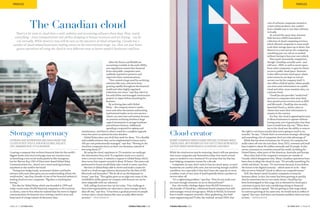
The Canadian cloud
There’s a lot more to cloud than e-mail, websites and accounting software these days. Now, nearly
everything – from transportation and clothes shopping to human resources and art buying – can be
run virtually. While America may still be seen as the epicentre of cloud computing, Canada has a
number of cloud-related businesses making waves on the international stage, too. Here are four home-
grown operations all using the cloud in very different ways to better people’s businesses and lives
OCTOBER 2015 | PAGE 23THENEXTMILLION.COM
PROFILES
PHOTOGRAPHBYKARIMEDIG
PHOTOGRAPHBYLMCHABOT
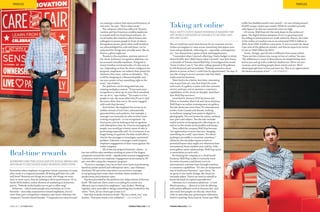
Cloud creator
EVERY COMPANY NEEDS SOME VIRTUAL STORAGE SPACE
THESE DAYS, BUT WHERE DO YOU GET IT AND HOW MUCH
DO YOU NEED? MONTREAL’S CLOUDOPS CAN HELP
While the cloud sector may be maturing, there’s still one question
that many companies ask themselves today: how much virtual
space is needed to run a business? It’s an issue that Ian Rae has
been helping companies answer for a decade.
Companies, he says, don’t want to buy too much space, as most
businesses are careful with costs, but not having enough could be
a problem, too, especially if they don’t have the capacity to serve
a sudden crush of new users if (and hopefully when) a product or
service takes off.
“It’s a rightsizing problem,” says Rae. “How do you make sure
you have enough resources on an on-demand basis?”
Rae, who holds a biology degree from McGill University, is
the founder of CloudOps, a Montreal-based company that sells
and manages virtual storage space. While at McGill, he learned
how to build computer networks. After graduating, Rae held
some engineering and IT jobs, but realized, around 2004, that
a lot of software companies wanted to
create online products, but couldn’t
find a reliable way to run their software
virtually.
At around the same time, Amazon
Web Services (AWS) launched its
collection of cloud-computing services,
which allowed companies to more easily
scale their storage space up or down. Rae
likens it to a taxi service for computing –
something you can call on as needed,
without having to buy your own vehicle.
This wasn’t necessarily competition,
though. CloudOps actually used – and
still uses – AWS, as well as server space
from other companies, to give its clients
access to public cloud space. However,
it also offers private cloud space, where
some resources are kept on virtual
servers run by the company itself. It
also offers a hybrid option, where people
can store some information on a public
cloud and other, more sensitive data, on
a private cloud.
CloudOps also provides “multicloud”
services to companies that want their
data spread across services such as AWS
and Microsoft. CloudOps also recently
launched Cloud.ca, which caters to
clients that want their information to
remain in the country.
For Rae, the cloud is appealing because
it allows businesses to operate without
having some sort of grand plan that they
have to build from day one. “What drew
me to the cloud was the ability to reserve
the right to not know exactly what you’re going to need in six
months,” he says. “I think that’s an enormous strategic advantage
and something a lot of companies don’t yet take advantage of.”
While Rae has been in business for 10 years, his company has
really taken off over the last three. Since 2012, revenues and staff
have tripled to about $6-million annually and 32 people. It also
serves customers in countries around the world, including the
United States, other parts of the Americas, Australia and Europe.
More than half of the company’s revenues are outside of
Canada, which disappoints him. Many Canadian operations have
been slow to adopt the cloud, he says. “It’s actually something I’m
a little sad about,” he says. “It’s worrisome because, if you believe
the future is the digital economy – which most of us do – then
why are we so behind? I think it affects our competitiveness.”
Still, Rae doesn’t need Canadian companies to keep his
business afloat. In fact, his roster has been growing so quickly
that he sometimes has to turn away clients. CloudOps has
been bootstrapped to this stage, but as demand for cloud space
continues to grow, he’s now considering taking on financial
partners to help it expand. “We are getting to that stage where,
to continue growing at the same rate, we would need an influx of
capital,” Rae says. And that’s one business problem that’s not bad
to have. —BRENDA BOUW
PAGE 24 | OCTOBER 2015 THENEXTMILLION.COM
Real-time rewards
ACHIEVERS USES THE CLOUD AND ITS SOCIAL MEDIA-LIKE
PROGRAM TO RECOGNIZE HARD-WORKING EMPLOYEES
Remember when employee recognition meant a promise of a pint
after work or a company-branded, ill-fitting golf shirt for a job
well done? Rewards are things we accept, not things we want.
And, in most cases, they do nothing to drive performance. Or as
Sarah-Beth Anders, senior director of marketing at Achievers,
puts it, “Nobody works harder just to get a coffee mug.”
Achievers – which some people may remember as I Love
Rewards – does help corporations reward employees, but it’s
more than just a recognition company, says Razor Suleman, the
company’s Toronto-based founder. “Companies are more focused
on creating a culture that spurs performance, in
real time,” he says. “That’s what we do.”
The company, which has offices in Toronto,
London and San Francisco, enables employers
to reward staff via cloud-based software. Its
social media-like interface allows bosses and
colleagues to praise people in front of others.
Recognition points, given when staff members
are acknowledged for a job well done, can be
redeemed for things they actually want, like an
iPad or a glitzy night out.
Thanks to the anywhere, anytime nature of
the cloud, Achievers’ recognition platform can
be accessed virtually anywhere. Designed to
mimic familiar social networks, it’s also easy to
use. Depending on how the client configures the
program, employees can redeem their points for
whatever they want, online or elsewhere. “You
could be shopping in a Banana Republic and
use your points to buy something right in the
store,” says Anders.
The platform can be integrated into any
existing workplace system. “If you want your
recognition to show up on your Slack newsfeed,
we can do it,” says Anders. “The easier it is for
people to use, the more often they’ll use it. And
the more often they use it, the more engaged
with work they become.”
Even better, the employer has access to an
endless stream of real-time, automatically
generated data and analytics. For example, a
manager can instantly see who on their team
is being recognized – or not recognized – by
their peers, just by looking at the recognition
and redemption rates. So, if you’re managing 20
people, you would get a better sense of who is
performing especially well. Or, if someone is no
longer being recognized, the data would offer a
clue for the manager to investigate a potential
problem. Likewise, a manager could compare
employee engagement of their team against the
entire company. 
All of this has helped Achievers’ clients – it
has one million-plus members working at some of the largest
companies around the world – significantly increase engagement.
Customers tend to see employee-engagement scores jump by 28
per cent after using the company’s program.
“If you’re a manager, you can see how your team is performing
based on points earned and redemption rates,” says Suleman.
Similarly, HR and other executives can see how a manager
is recognizing their team, then correlate these numbers to
productivity and retention rates.
The data provided by the platform also helps inform Achievers
itself. “We had one client come to us asking for a more tax-
efficient way to reward its employees,” says Anders. Working
together, they were able to design something that worked for the
client. “Now, all our clients get access to it.”
And that includes Achievers itself. “We are a client, too,” says
Anders. “Everyone needs to be validated.” —JAY SOMERSET
PROFILES
PHOTOGRAPHBYREYNARDLI
OCTOBER 2015 | PAGE 25THENEXTMILLION.COM
PROFILES
Taking art online
WALL HOP’S CLOUD-BASED BUSINESS IS MAKING THE
ART WORLD FAR MORE ACCESSIBLE TO BUYERS AND
SELLERS ALIKE
The art world has never been known for its customer service.
Unless you happen to come across something that piques your
taste and pocketbook, collecting art – especially contemporary
art – has always been a game of luck and happenstance.
“I remember when I started collecting, I had a budget in mind,
about $2,000, but I didn’t know what I wanted,” says Rob Green,
co-founder of Toronto-based Wall Hop. Green figured he would
“know it when I saw it,” but after calling upward of 40 galleries,
he felt flustered and intimidated. “Nobody wanted to share
photos or prices; at best, I could view by appointment,” he says. It
was like trying to access a private club that didn’t
really want his business.
There had to be a better, less time-consuming
way to purchase art, one that fused the taste
and touch of a gallery curator with the customer
service and ease, not to mention e-commerce
capabilities, of the cloud, he thought. And that’s
how Wall Hop was born.
Launched in January 2015 by Green and
fellow co-founders Alan Lok and Jason Salzman,
Wall Hop is an online contemporary art gallery.
The site showcases more than 70 contemporary
artists, from Canada and abroad, working
in mediums ranging from paint to digital to
photography. You can browse by colour, medium,
size, price and subject. The site also includes
useful articles on hanging and collecting art, as
well as in-the-studio artist profiles and essays.
They called the company Wall Hop because
“art appreciation is more than just hanging
something on a wall,” says Green. “It’s about
making it accessible to everyone, anywhere.”
Likewise, the site helps expose artists to
potential buyers they might not otherwise have
encountered, from markets near and far. (Like
most gallery-artist relationships, Wall Hop earns
a commission on each sale.)
By framing the company as a cloud-based
business, Wall Hop is able to instantly track
its entire inventory and better serve its
international customer base through seamless
e-commerce capabilities. “It’s also an inexpensive
way to build your business,” says Green. “As
we grow or our needs change, the cloud can
instantly adjust. There’s no need to rebuild or
break the bank on capital expenditures.”
Likewise, its e-commerce platform – it uses
WooCommerce – allows it to link its offering
with online affiliates such as Amazon Art, and
also track how people use the site, what they
click on and other key performance indicators.
And it’s working. Since launch, Green says Web
traffic has doubled month-over-month – it’s now sitting around
30,000 unique visitors per month. While he wouldn’t provide
sales figures, he did say conversion rates are high.
Of course, Wall Hop isn’t the only player in the online art
game. The digital democratization of art is a growing trend.
According to international art-trade authority Hiscox, the value
of the online art market rose to an estimated US$2.6-billion in
2014, from US$1.6-billion a year prior. It now accounts for about
5 per cent of the global art market, and Hiscox expects its worth
to rise to US$9-billion by 2019.
Green, though, says his site is different from many others.
“There are lots of places you can go to buy art online,” he says.
“The difference is, most of these places are simple listing sites,
and so you end up with a wide but shallow net. We’re not just
curators, we’re teaching people about artists and art. We’re
showing people how to buy and store art. This is art appreciation:
the democratization of art.” —JAY SOMERSET
PHOTOGRAPHBYREYNARDLI
THENEXTMILLION.COM
GLOSSARY
THENEXTMILLION.COM
GLOSSARY
Cloud computing
Cloud computing, or just “the
cloud,” is an all-encompassing
term that describes the delivery
of resources over the Internet
on a pay-per-use or subscription
basis. It can cover everything
from simple applications such as
e-mail to more complex systems
like financial analytics. Data
centre usage, where computing
power is essentially rented, is
also considered a cloud service.
Private cloud
A private cloud is computing
infrastructure such as a server
that is specifically devoted
to one company and blocked
from others by a firewall. Some
companies may own cloud
infrastructure and house it on
their own premises, but it can
also be located off-site or at a
third-party data centre.
Public cloud
With the public cloud, an
organization’s software, hardware
and devices are hosted and
managed by a third-party provider
and delivered over the Internet.
Public cloud services usually
involve standardized products
and are cheaper and easier to
implement. This can also be
referred to as a multitenant cloud.
Hybrid cloud
A blend of private and public, a
hybrid cloud takes advantage
of both models by providing
cheaper, standardized options
wherever possible, but also
customized aspects where
needed. Companies often put
more sensitive applications (such
as financial software and client
data) on a private cloud and other
programs (like a company app or
website) on a public cloud.
Hyperscale cloud
Some cloud service providers
offer companies the option to
hyperscale or to add computing,
memory, storage and networking
capabilities at a near-instant
pace. It’s a good choice for rapidly
growing companies.
Cloud migration
The process of moving onto the
cloud, down from it or from one
service provider to another is
known as cloud migration.
Cloud backup
A cloud backup is the process of
copying data to an off-site server
over the Internet.
IaaS (Infrastructure as a
Service)
Infrastructure as a Service
is a form of cloud computing
that relates to hardware. Many
C L O U D C O M P U T I N G
G L O S S A R Y
The “cloud” has morphed from a technology buzz phrase a few years ago
into a full-blown trend. Companies big and small are increasingly realizing
the cost and flexibility benefits of hosting their data and computing
processes off-site, rather than maintaining expensive hardware themselves.
But the field, like all aspects of information technology, is full of
indecipherable jargon. Here, thanks to some help from Microsoft Canada
and IBM Canada, is a glossary of terms that translates some of the cloud’s
arcane concepts into plain English
PAGE 26 | OCTOBER 2015 THENEXTMILLION.COM
GLOSSARY
THENEXTMILLION.COM
GLOSSARY
companies don’t want to develop
their own cloud system, so they
work with an outside company
that has servers, storage and
networking capabilities. IaaS is
an on-demand service – you can
scale storage space up or down
depending on your needs – and
it’s typically a pay-as-you-go
model.
SaaS (Software as a Service)
Perhaps the most popular form
of cloud computing, Software as
a Service is usually an application
or program that is accessed by
a user, often through a Web
browser or app, that is processed
remotely by a third party.
Everyday examples include the
file storage site Dropbox and
Netflix video streaming. SaaS
makes the same cloud-based
service available on a multitude
of devices to thousands or even
millions of users.
PaaS (Platform as a Service)
The third prong of basic cloud
computing, Platform as a
Service is aimed at software
and application developers.
PaaS gives these individuals
and departments a common,
standardized infrastructure on
which they can design their wares.
In other words, it’s a way for
people to create programs in the
cloud, rather than on their own
computers and servers. Creating
apps for Google’s Android and
Apple’s iOS is a form of PaaS,
with the respective companies
providing the basic platform on
which developers can play.
BPaaS (Business Process
as a Service)
Any business process, such as
payroll or e-commerce, delivered
over the Internet and accessible
by one or more devices, can be
considered a Business Process
as a Service. Companies can use
BPaaS to find efficiencies, unify
processes or improve customer
experiences. Many big Internet
companies, including eBay,
PayPal and Skype, are based
around automated BPaaS.
DraaS (Disaster Recovery
as a Service)
As its name implies, Disaster
Recovery as a Service is a
specialized form of cloud
computing that allows businesses
to continue operating in the
event of a catastrophe.
Virtual server
A virtual server, also known as
a virtual private server, works
in the same way as a dedicated
physical server, but it’s a form of
software. Several private virtual
servers can therefore exist on a
single physical server. Virtual
servers can be cheaper to rent;
although, their performance may
not be as good as that of a fully
dedicated server.
OpenStack
OpenStack is a free and open-
source cloud management
software suite that lets
companies access and organize
the use of infrastructure
from service vendors. Large
technology companies
including, IBM, HP and Cisco,
sell custom-made OpenStack
implementations of their services
for easier and simpler access.
Hadoop
Hadoop is an open-source
software project being developed
by the Apache Software
Foundation. Its goal is to provide
heavy processing power to
organizations spread across a
number of computer clusters
that are each made up of readily
available hardware. The software
assumes, accounts for and works
around expected hardware
failures.
Provisioning
Provisioning is the process
of deploying and managing
IT resources in the cloud,
according to a company’s
particular needs.
DevOps
A combination of development
and operations, DevOps is a
way of creating software that
stresses co-operation between
various stakeholders. Software
developers and IT staff work
together to create smooth,
customized systems for the
business.
Internet of things
A hot buzzword, the Internet of
things is the catch-all phrase for
connecting a variety of devices,
from wearable gadgets to sensor-
laden appliances, to a network.
The devices gather data by
“talking” to each other.
OCTOBER 2015 | PAGE 27
PAGE 28 | OCTOBER 2015 THENEXTMILLION.COM
E
very entrepreneur is
focused on “success.”
But what constitutes
success, especially in
the early stages of setting up
a new venture?
Our popular culture tends
to focus on the glamorous
aspects of starting a new
business, emphasizing how
entrepreneurship is the road
to untold wealth and fame.
I want to be clear
that I don’t blame the
media for zeroing in like
this on the sexy side of
entrepreneurship. But
this perspective leaves
out an important truth:
entrepreneurship is hard. It
takes persistence, energy and
grit to succeed.
This view also glosses
over how searching for
success will likely require an
entrepreneur to take some
calculated risks at first –
risks that may lead to failure.
And then, after drawing
lessons from that experience,
the entrepreneur tries again
(perhaps even a third time),
and hopefully hits a home
run in a subsequent venture.
Even if our popular
culture does not recognize
this truth, we need to see
entrepreneurship for what
it really is: a very difficult
undertaking.
I’ve seen this truth up
close many times. I have
worked for more than
25 years to help foster
innovation and growth
in Canada’s knowledge
economy. In my current role
as CEO of OMERS Ventures,
I’ve reviewed thousands of
pitches from entrepreneurs
seeking funding for exciting
products and services aimed
at large growing markets.
You’d get a much more
accurate understanding
of entrepreneurship from
our popular culture if it
instead emphasized how
much passion entrepreneurs
require to succeed.
What I mean is how,
particularly at the start of a
new venture, entrepreneurs
will need to overcome a
series of pitfalls. One quality
they will need at this stage,
perhaps more than any
other attribute, is a passion
for solving problems while
pursuing a larger vision.
Passion fuels a start-up, in
a sense, just like venture
capital does.
Some of these initial
Passion project
The quest for fame and fortune shouldn’t be
the drivers of entrepreneurial success. The
key is being passionate about your business
JOHN RUFFOLO IS CEO OF
OMERS VENTURES (TWITTER:
@OMERSVENTURES), THE VENTURE
CAPITAL INVESTMENT ARM OF
OMERS, ONE OF CANADA’S LARGEST
PENSION FUNDS, WITH $72-BILLION
IN NET ASSETS.
obstacles may require weeks,
months or even longer to
solve. You need tremendous
passion to make it past these
obstructions.
And for your venture to
thrive over the longer term,
you need to focus on solving
a business problem that
creates value for customers.
That, too, will demand a lot
of passion from you.
Whether we’re talking
about rising Canadian firms,
such as Shopify, Hootsuite
or Desire2Learn (which
OMERS Ventures is proud to
be invested in), or getting a
small local business off the
ground, success at the early
stages often comes down to
the passion of the founder
or founding team. Passion is
that driving force that never
backs down.
Making money is an
important measure of
success, as well, but in those
early days of a new venture,
making money needs to be
distinguished from being
passionate about solving
problems. I have seen too
many entrepreneurs who
were passionate about making
money cause their start-up to
fail because they had their eye
on the wrong ball.
When your passion is
focused and harnessed
toward solving a business
problem, it is a key
competitive advantage, just
like deep-domain expertise
or proprietary knowledge.
In my view, passion is a
badge of honour – and all
entrepreneurs should wear it
with pride.
ILLUSTRATIONBYCHELSEAPETERS
RUFFOLO
CLEANTECH + ENERGY
$108M
Government
$16M
Venture Capital
MANUFACTURING
$724M
Government
$14M
Venture Capital
TECH + DIGITAL MEDIA
$655M
Government
$240M
Venture Capital
TECH + DIGITAL MEDIA
$655M
Government
$240M
Venture Capital
HEALTH + LIFE SCIENCES
$336M
Government
$92M
Venture Capital
$
142M
95M
$
51M
$
237M
$
2M $
20M
$
102M
$
56M
Northern Region
Atlantic Region
$
673M
$$
372M
$
353M
$
1.65B
$
Total Government Awards
$
4 27 Billion
2% from Q1 2014
.
*
Total Venture Capital Deals
362 Million4% from Q1 2014
$ **
www.thefundingportal.com
*Aggregated by The Funding Portal
**Published by the CVCA
Funds Invested By Quarter
Canadian Funding Trends
Q1 2015
THE
FUNDINGINDEX
TM
$
2M
$
50M
Secure Grants and Capital for Your Business
Canadian businesses secured $4.3B under government funding programs in the first three months
of 2015, 4% more then they did in the previous quarter. The Funding Index assists companies to
understand and participate in this large and dynamic capital pool. Here are the Q1 outcomes for
January to March 2015.
Check out how your industry and region did using the interactive
infographic at thefundingportal.com/fundingindex.
SPECIAL INFORMATION FEATURE
Find Your Top Canadian and U.S. Funds
FundingSources Reports quickly and affordably identify the top funds for your company, pulled
from the only comprehensive database of all Canadian and American government funding
programs.
The Funding Index
Quick FAQs
Government
funding to the tech
sector is trending
upwards; it almost
doubled between
Q4 2014 and Q1
2015
Tech continued to
lead the way in VC,
securing $240M in
investments last
quarter
Funding to the
cleantech and
energy sectors saw a
decrease in Q1, but
is expected to
bounce back by
year-end
Canada has 4,500
government
funding programs
disbursing $27B/
year to support
business
Innovation, job
creation, skills
training, and
exporting are the
top priorities for
government funders
right now
Order a custom FundingSources Report at thefundingportal.com/fundingsources.
LowRes_The_Next_Million_Oct2015_Final_ Magazine

LowRes_The_Next_Million_Oct2015_Final_ Magazine

  • 1.
    THENEXTMILLION.COM JOHN RUFFOLO Passion shouldbe your priority SOCIAL MEDIA MASTER How Hootsuite became the go-to social software for companies around the world C O V E R S T O R Y You’ve Been Shopify’d There’s no hotter Canadian tech company than Shopify. Here’s how Chief Platform Officer Harley Finkelstein is using the cloud to make your business better IT’S ALL ABOUT THE CLOUD Companies are crazy for the cloud, but many don’t know what tools to use. We can help Shopify’s Harley Finkelstein shows us how it’s done OCTOBER 2015 | $5.99 THENEXTMILLION.COM TheNextM08_CVR_05.indd 1 2015-10-13 2:07 PM
  • 2.
    Access thousands ofgroup fitness classes at hundreds of local fitness studios and gyms across Canada with one membership. Discover Yoga, Barre, Spin, CrossFit, Boot Camps & More. 250+ Partner Studios/Gyms 1000+ Classes Every Week $99/month Calgary | Edmonton | Toronto | Ottawa | Montreal .ca get social - @fitsetpass | corporate packages - hello@fitset.ca | fitset.ca OCTOBER 2015 | PAGE 1THENEXTMILLION.COM SOCIAL MEDIA MASTER In 2008, Ryan Holmes built Hootsuite to help companies manage their social media accounts. His program – and company of the same name – has since become one of Canada’s major tech success stories HOW I DID IT PAGE05 Reading time: 5 mins BEYOND OUR BORDERS There comes a time when a business owner will want to expand the company. But when’s the right time to leave the confines of Canada? We ask the experts ASK A PRO PAGE10 Reading time: 5 mins THIS ISSUE AT A GLANCE Here’s what we’re talking about inside CLOUD COMPUTING FOR ALL While every sized business can make use of the cloud, what a small operation needs will likely be different from what a large one requires. We look at the all the options for your business FEATURE PAGE 19 Reading time: 15 mins COVER STORY Reading time: 15 mins Capturing Criminals with High-Definition Cameras 07 4 mins Trademark Company Needs Help Going Paperless 08 4 mins Here’s How To Manage a Global Workforce 09 3 mins Four Canadian Cloud-Computing Companies You Need To Know 22 18 mins A Guide To Complicated Cloud Terms 26 8 mins Ruffolo: Why Passion Should Trump Money 28 7 mins PAGE READINGTIME Canada’sCloudCompany.Ottawa’sShopify isrevolutionizinghowcompaniesbigand smalldobusiness.Isitthefutureof e-commerce?Findoutonpage13 CONTENTS
  • 3.
    PAGE 2 |OCTOBER 2015 THENEXTMILLION.COM PUBLISHERS Mario Paron, Peter McNeill and Kristina Valentini EDITOR Bryan Borzykowski ART DIRECTOR Erik Mohr CONTRIBUTORS Sarah Barmak, Brenda Bouw, LM Chabot, Jennifer D. Foster, Claire Gagné, Erik Heinrich, Diane Jermyn, Alex Azalea Jin, Guy Lancaster, Reynard Li, Kari Medig, Brian G. Miske, Sunil Mistry, Matt O’Grady, Chelsea Peters, Diane Peters, Andrew Querner, Graham Roumieu, John Ruffolo, Kim Shiffman, Jay Somerset, Sally Tan Soriano, Rémi Thériault GLOBE EDGE Teena Poirier DIRECTOR, CLIENT ENGAGEMENT AND GLOBE EDGE Sean Stanleigh MANAGING EDITOR, GLOBE CONTENT STUDIO Liz Massicotte PROGRAM MANAGER, GLOBE EDGE Isabelle Cabral PRODUCTION CO-ORDINATOR, THE GLOBE AND MAIL The Next Million is designed and produced by The Globe and Mail Custom Content Group on behalf of KPMG Enterprise. All Correspondence: KPMG LLP 4100 Yonge Street, Suite 200, North York, Ontario, M2P 2H3 enterprise@kpmg.ca Printing and pre-press by DM Digital+1 DISCLAIMER: The information disclosed herein is intended to provide only general guidance with respect to the various matters dealt with and is not an exhaustive description of all issues and risks that may be present to any person or persons. The information disclosed herein should not be regarded as advice and is based solely on facts and circumstances provided to KPMG and should not be regarded as suitable for use by any person or persons. Any information herein is based on current tax law including judicial and administrative interpretation. Tax law is subject to continual change, at times on a retroactive basis and may result in incremental taxes, interest or penalties. Facts and circumstances along with changes in law or its interpretation change impacts such foregoing referred to information. The information herein is current as of the date of the information and has not been updated for changes in law or interpretation after the date thereof. For this reason, the reader should not rely upon this information without seeking the advice of a qualified professional. We accept no responsibility or liability for any reliance that the any person or persons may place on the information contained herein. We neither warrant nor represent that this is sufficient or appropriate for any purposes that any person or persons may have. The KPMG name, logo and “cutting through complexity” are registered trademarks or trademarks of KPMG International. ABOUT THE NEXT MILLION M is the Roman numeral for one thousand. There was once a time where no single letter held greater value. It wasn’t until centuries later that appeared. means one million. But as impressive as that sounds, we see it as the basis for something bigger still – your business. You’ve made it through the hurdles, pushed past the naysayers and proven your ideas can work. You already know what it takes to be an entrepreneur. It takes a special boldness, creativity and drive. You’ve made it. Now it’s time to grow it. In The Next Million, we highlight the success stories of entrepreneurs like you. Stories that will inspire you from the first million to the next – and each one after that. You’re the entrepreneur. We’re KPMG Enterprise. T he “cloud” seems to be another one of those business buzzwords – like “innova- tion” – where over a few short years it’s gone from a competitive advantage to an operational necessity for businesses of all sizes. But why? Millennials are now the biggest generation in the Canadian workforce, and they’re placing high value in employers that encourage mobility, utilize the latest technology and promote environmental responsibility through initiatives like paperless workplaces. Beyond that, the amount of data companies are creating and collecting is truly vast and only increasing. In many cases, cloud storage solutions are the only possible solution due to sheer volume. Close to 80 per cent of all workloads are expected to be processed using cloud technology by 2018. What does this mean for you? In order for your business to attract top talent and keep up with competitors in the near future, you should start thinking about embracing cloud-based solutions now (if you haven’t already). But let’s be clear, cloud computing – which refers to sharing resources over a public, private or hybrid network – cannot by itself transform the way a business operates. However, it can be a valuable tool to improve performance. At KPMG Enterprise, we work with our clients to first identify an issue or inefficiency affecting the business’s greater strategy. We then help create and implement custom cloud-based tools that solve the problem and generate real results. In this issue of The Next Million, you will hear from a range of Canadian companies that have embraced the cloud and learn about the challenges and triumphs they faced while doing so. I encourage you to consider how the stories and tools showcased relate to your current business environment, and if a cloud-based solution may help you reach your company’s current and future goals. ILLUSTRATIONBYCHELSEAPETERS GET A GRANT TO SUPPORT YOUR TECHNOLOGY ADOPTION PROJECT Ask any entrepreneur – when it comes to funding a project, not all sources of capital are created equal. Government grants and contributions are non-dilutive sources of funding, making them particularly attractive for businesses that want to undertake projects involving technology Mario Paron is the co-publisher of The Next Million and a Canadian managing partner at KPMG Enterprise.  MARIO PARON Get your head in the cloud Buildinganagileandconnectedworkforceistheonlywayforward PARON 22% Marketing: reaching new markets 32% Transfer R&D and commercialization 15% Productivity: adopting new tech 16% Expansion: new buildings, equipment or staff 15% Other: Start-up, entrepreneurship support Top reasons for securing grants JUMBLEBERRY PERFORMANCE-DRIVEN MARKETING Questions? Contact us. 1-888-832-9785 info@jumbleberry.com www.jumbleberry.com PLACING ADVERTISERS IN THE DRIVERS SEAT OF WINNING DIGITAL AD CAMPAIGNS Your customers demand engaging and relevant ads and it must appeal to them across multiple devices and formats to win their coveted attention. Jumbleberry delivers superior direct-response ad campaigns with speed, precision, and passion that convert attention into action.
  • 4.
    I N TEGRITY • EXPERIENCE • VALUE ADD • FLEXIBLE STRUCTURE We provide equity capital for owner/operator succession, corporate carve-outs, management buyouts, expansions and recapitalizations. We believe in investing in people we trust, in businesses we understand and where our experience matters. We use leverage prudently to drive value and accelerate growth in our portfolio of companies. 390 Bay Street, Suite 1200 Toronto, ON M5H 2Y2 ironbridgeequity.com Where capital and experience meet. Ironbridge is a Toronto-based private equity firm focused exclusively on investing in companies in the Canadian lower middle-market. CONTACT US AT info@ironbridgeequity.com or 416.863.0105 THENEXTMILLION.COM CAMERA CONNECTION Avigilon brings security into high-definition MANAGE A GLOBAL TEAM Working with staff in far-off places PAPERLESS PROBLEMS One company’s quest to go all digital BEYOND OUR BORDERS Become the go-to exec in your sector START Expert tips, inspiration and ideas for growing your business PHOTOGRAPHCOURTESYOFHOOTSUITE SOCIAL MEDIA MASTER Companies across the world use Hootsuite to manage their social accounts. Now meet the man behind the platform BY CLAIRE GAGNÉ Now that social media is everywhere, it’s easy to forget that it was only a few years ago that Facebook took off. Ryan Holmes, though, knew in 2008 that social networking was the future. When Holmes, a Vancouver-based entrepreneur, was working at a digital marketing agency he also founded, he built a prototype for a product that would help companies better engage with customers over social media. He launched Hootsuite in December 2009 and it immediately took off. Today, the social media platform has over 12 million users in over 175 countries, and offices in Canada, the United States, Europe, South America and Southeast Asia. THENEXTMILLION.COM OCTOBER 2015 | PAGE 5 Does your company have multiple social media sites? It’s likely using software created by Ryan Holmes, the founder of Hootsuite, to manage those accounts.
  • 5.
    PAGE 6 |OCTOBER 2015 THENEXTMILLION.COM I’m a long-time entrepreneur. I started my first business, a paintball company, in high school, and I dropped out of university to start a restaurant, which I ran for a number of years. In 1999, the Internet was booming, so I sold my restaurant and holed up in an apartment in Vancouver. I taught myself HTML and CSS to learn how to build things for the Internet. I got a job at a dot-com, which went really well for about six months, until the bottom fell out of the market. I had a big belief that the Internet wasn’t going anywhere. I founded an agency that did service work for clients and also incubated new products. As the company grew and we started doing more work with clients in the social media realm, we realized that there weren’t any good tools to manage social media. So that was the “aha” moment for Hootsuite: we take the complexity of managing multiple social networks with multiple team members and make it easier for companies to manage their social media. Today, we have five different products. We have a publishing product that helps people build and schedule content that they put out on social media channels like Twitter, Facebook, LinkedIn and more than 100 other social networks. We have an engagement product, which helps companies listen to what people are saying on social media and respond to it. We also have analytics, advertising and campaigning products. With the advent of cloud computing, the cost of building these products has been reduced significantly. You don’t need to build your own data centre; you can simply spin one up on Amazon or whatever other cloud service that you want. We’re sending more than 5 million messages every day around the world, and our customers rely on us for consistent, reliable uptime on our products. We’re able to do that through a cloud grid. The “freemium” model has been a big part of our story, too. We give away our basic product for free. As you get more advanced in your usage, you run into paywalls, and at that point customers upgrade to our Pro or Enterprise products. When you have one person on social, it’s pretty simple. But when you have tens of thousands of people trying to work effectively, it becomes very difficult and challenging. We try to make that task simpler for brands around the world. We’ve made a few targeted acquisitions, but we’re wary of being overly acquisitive. We feel it’s important to be the best at what we do. We don’t want to build a product that’s a mile wide and an inch deep. A lot of people ask if we’re going public. I think public companies have best practices in place, and we’re building those. If the timing is right, we’ll look toward an IPO, but we’re not in any rush. We’ll just see what the right thing is for the company. It’s been a pretty amazing process, going from three people at the beginning to almost 1,000 employees now. If we look back to eight years ago, everyone was talking about whether social media was relevant and if it was here to stay. We now know that it is relevant and it is here to stay. We know that there’s an absolute shift in how companies are communicating with their customers, and we’re pretty blessed to be sitting in the middle of that. HOW I DID IT BY THE NUMBERS Vitals Hootsuite Media Inc. Founded in 2008 approaching 1,000 full-time employees 12million users * We have a culture where we want people to have the power to make mistakes, but it’s not okay to make a mistake and not learn from it. If you’re making the same mistake over and over again, you’ve got a problem. * Name and branding are critical, especially at an early stage. You need to be memorable. * Listen to people. We listen to our customers and other stakeholders, like our team and product people. From there, we condense and consolidate a product vision. ryan’s Tips “IT’S BEEN A PRETTY AMAZING PROCESS, GOING FROM THREE PEOPLE AT THE BEGINNING TO ALMOST 1,000 EMPLOYEES NOW.” THENEXTMILLION.COM More tools to use The beauty of cloud computing is that it can help companies grow in myriad ways. Last year, KPMG asked business owners how the cloud will help them most. Here’s what they said 49% DRIVE COST EFFICIENCES 42% BETTER ENABLE MOBILE WORKFORCE 37% IMPROVE ALIGNMENT WITH CUSTOMERS/ PARTNERS 35% BETTER LEVERAGE DATA TO PROVIDE INSIGHT 32% NEW PRODUCT DEVELOPMENT/ INNOVATION 30% DEVELOP NEW BUSINESS MODELS 28% SHIFT TO GLOBAL SHARED SER- VICES MODEL 28% FASTER TIME TO MARKET OCTOBER 2015 | PAGE 7THENEXTMILLION.COM PHOTOGRAPHBYTHOMASFRICKE THE PRODUCT CameraConnection The video surveillance industry is undergoing big changes and Vancouver’s Avigilon is leading the way BY KIM SHIFFMAN It’s impossible not to notice the many security cameras in shopping malls, airports, stadiums and banks. While they’re meant to capture crooks and increase customer safety, a lot of the video technology that’s been traditionally used doesn’t elicit much useful information. That shouldn’t come as a surprise – we’ve all seen those grainy camera clips on the evening news. In 2004, Alexander Fernandes thought that he could create something better. The long-time entrepreneur, who had successfully founded and sold companies in the past, had a passion for technology –  specifically software, hardware and high- end digital imaging. “As an entrepreneur, I was always looking for the biggest opportunities where I could dominate,” he says. “I knew this was a big market, ripe for the picking.” Fernandes launched Avigilon, a designer, manufacturer and marketer of end-to-end video surveillance software and equipment. In 2009, after several years of R&D, the company began selling its products to school campuses, transportation systems, hospitals, prisons, casinos and any other sector that needed to capture high-quality video. The company’s products quickly took off. In 2014, its seventh revenue- generating year, Avigilon’s sales reached $271.4-million, representing a compound annual growth rate of close to 100 per cent. What’s more, the company is solidly in the black, boasting 2014 net income exceeding $35-million. Its stock is also up 314 per cent since it went public on the TSX in 2012. Most businesses come for Avigilon’s 120 HD IP line of cameras that offer high- tech features such as automatic image enhancement – which can reveal details such as licence plates or a suspect’s facial features – but its cloud-based software is a big part of the company’s solutions, too. Each camera comes with secure video- management software that uses cloud technology, allowing organizations to manage security across multiple sites from any global location and from a single platform, such as a computer or smartphone app. The company has also started offering adaptive video analytics, which can classify people and vehicles while eliminating normal scene activity, such as moving trees, shadows or reflections from water or glass. Despite Avigilon’s success, growth hasn’t been without its challenges. One of the biggest challenges, says Fernandes, is human resources. “A company’s plan is only as good as its execution, and that comes down to people,” he says. With more than 800 employees, things will inevitably go wrong: a shipper or receiver enters the wrong customer address; the accounting department charges a client the wrong amount; an engineer is careless with software. Fernandes counters this reality with a decisive strategy. “We’re constantly culling the herd,” he says. “The bottom 10 per cent of our employees are made to improve or are let go.” That said, Avigilon employees enjoy high salaries and internal promotions. “If you have the right people, they’ll find solutions to problems,” he explains. With the right people and products in place, Fernandes sees Avigilon growing for years to come. The company’s market share is close to 2 per cent, but because the video surveillance market is so fragmented, no other firm has gotten past 5 per cent. “I’m expecting something unprecedented in our industry,” he says. “We’re going to get 10 per cent market share.” And as for revenue, Fernandes isn’t afraid to throw around the word billion: “It’s my personal goal.”
  • 6.
    PAGE 8 |OCTOBER 2015 THENEXTMILLION.COM Sunil Mistry PARTNER, KPMG LLP (CANADA); KPMG ENTERPRISE When we went paperless years ago, it took some time for people to get over the psychological aspect of not having paper – especially in an audit accounting firm. Our entire audit files are now all digital. We have clients who give us paper, but we scan it into our system. To overcome resistance, you have to rip off the Band-Aid. In our office, we had what we called “the vault,” where all our files used to be kept. We got rid of it. The equivalent for Coastal might be getting rid of the filing cabinets and all of the old paperwork. Another thing we did was have dedicated people scan all our old files, so they never had to go back to their original storage location. The next step would be to get rid of the printers. It really does force everybody to deal with things onscreen. Brian G. Miske CHIEF MARKETING OFFICER, KPMG LLP (CANADA) Technology is incrementally increasing the speed of competition, so change is a constant in our society today. Leaders have to be change agents focused on creating a story, a vision and a purpose, while simultaneously communicating and engaging people on a daily basis. Reitzel must be clear in defining a vision of what lies behind her team and what lies before them. Reitzel’s vision should dictate all communications by building excitement about the future state of the company and identifying the value in change, including what’s in it for each employee. She needs to be able to articulate the reason why the change is critical to the success of the organization, then guide that change and re-energize the group throughout the process. In this, she should lead by example, providing insights into her own behaviour. Paperless problems Tanya Reitzel wants her employees to go electronic. Some staff, though, are having a hard time parting with paper BY DIANE JERMYN Tanya Reitzel, owner of Coastal Trademark Services Ltd., oversees trademark registration and filing for some 2,000 clients. Over time, all of that business had left Coastal with more than 5,000 paper files. For years, Reitzel thought about creating a paperless office – mostly by moving her computer network to the cloud, which would allow staff to share files virtually, rather than having to print off pages – and in 2012 she finally made the switch. But her whole company isn’t quite paperless yet. Reitzel works in Kelowna, B.C. – she moved there after her husband got a new job – but her six staff continue to work at the head office in Vancouver. Any new files Reitzel opens are now electronic, so she doesn’t have any paper to deal with, but not all of her employees have given up the printed page. Her big challenge? Getting her entire staff, who range from 25 to 40 years of age, on board. The ones who are resisting simply like the way they’ve always done things. She has told them that she wants the company to go paperless, but she’s not forcing them to change, either. “I have advised them that I want to be paperless by the end of the year, but I prefer not to be a dictator,” she Reitzel. “Their biggest issue is just that it’s the unknown,” she adds. “Most have worked in the field for a long time. You get used to having that paper file in front of you and being able to flip through the pages easily to look at the documents underneath and review the file in that manner. It’s hard to give that up.” While Reitzel has given them each an extra computer screen, so that they can open and review several pages at once, it’s still hard for some of them to let go of paper. THE PITCH DISCLAIMER(MISTRY,MISKE)SEEPAGE2;PHOTOGRAPHYBYANDREWQUERNER;ILLUSTRATIONSBYCHELSEAPETERS OCTOBER 2015 | PAGE 9THENEXTMILLION.COM Every year, JeffZamluk gets dozens of goods designed, manufactured and shipped in a globe-spanning process all managed from his home office in Victoria, B.C. He works with as many as 40 subcontractors, mostly engineers and designers, and numerous factories and logistics companies to run Swell Source, which manufactures four sports product lines, including paddleboards and snowboards, and helps about 60 outside clients transform ideas into manufactured goods. Here’s his advice on how to run a company with scattered staff BY DIANE PETERS HOW TO COMMUNICATE Swell Source projects get broken down, task by task, including deadlines and links to technical specs, on spreadsheets shared over Dropbox or Google Drive. “Clarity is key,” says Zamluk. While faraway people working on the same project can leave notes for each other in the files, Zamluk knows it’s on him to make sure work gets done. He’s on e-mail constantly, keeping tabs and issuing reminders. Early mornings and late nights are the norm, due to everyone being in different time zones. FORGET THE PHONE “I hate calling people and I hate talking on the phone,” says Zamluk, ironically, in a phone interview. With phone calls, there’s no record of promises made, specs outlined or deadlines created. E-mail leaves a trail. Zamluk also visits his overseas team members to build a personal connection. On the ground, he asks about family and hobbies. In China, that means lots of nights out doing karaoke. ADJUST YOUR STYLE Zamluk works with people in China, Thailand, New Zealand, Austria, Hawaii and closer to home. There are radically different working styles between, say, the terse, fact-driven approach in China and the more laid- back small talk with colleagues Down Under. So he adjusts his communication approach and expectations. But sometimes he forgets to switch gears. “If I’m just back from China, and I go up to a Canadian and ‘say I need this done by this date and that’s it,’ they’ll push back and say, ‘That was short and kind of rude.’” MAKE THE RIGHT CONNECTIONS Zamluk has been manufacturing products with overseas partners for more than a decade. He has a set way of doing business, and he can tell if a potential new subcontractor is a fit. “I think the same vibe you get in the office develops in the virtual world, too. Through e-mails you can get information and a sense of a person and how good a worker they are.” INNOVATE AT HOME “All that remote managing is good for getting tasks and projects done,” says Zamluk. “However, working with people one-on-one is more effective for coming up with ad hoc ideas, campaigns or even business direction.” So Zamluk often taps into his local network of friends and colleagues to help flesh out ideas. His best ideas come when he’s out with his buddies, using his own products on the water or the slopes, he says. Sometimes, nothing beats close to home. ILLUSTRATIONBYGRAHAMROUMIEU
  • 7.
    PAGE 10 |OCTOBER 2015 THENEXTMILLION.COM Q: I’d like to expand my business beyond Canada’s borders, but I’m not sure if I’m ready. How can I tell if it’s the right time to set up shop in other locations? A: It’s a judgment call. No one knows exactly when the time is right, but it helps if you work out all your concerns before making a push into other markets. First, know your product. If you’ve already developed your product or service here, consider the relatively friendly Canadian marketplace as your test market. Is the offering as good as it can be? Have you done a broad enough test run that you’ve solved the bugs that need to be fixed before moving into bigger, tougher and more competitive markets? Second, know where you’re going. It makes sense to look at the North American market first before entering more global markets, particularly in the software and cloud sectors. The United States is a leader in the area of Internet-functioning businesses, so it’s a logical next step for most people with a cloud-related company. However, keep in mind that the U.S. is a different market, and not only in terms of its competitive landscape and distribution channels, but also its regulatory, and state and local tax matters. Do some research, or consult your business adviser, about those differences and then see what that means for your ability to expand into that market. Do you have the expertise in-house? Depending on your business, you could set up shop there or look for a partner to help distribute your product, whether that’s a real business partner or a third-party distribution chain. Also, make sure to safeguard your intellectual property by taking all the steps you can to protect what you’re doing and to maintain your proprietary interest in your company in foreign markets. At the same time, ensure that what you’re doing isn’t an infringement on someone else’s copyright. Finally, are you ready to ramp up production and follow through? You don’t want to go out there and flop. Know how deep the market is, how much money you’ll need to penetrate it and be ready to take on all challenges. —GUYLANCASTER, SENIORMANAGER, CORPORATE TAX,KPMG LLP(CANADA) Q: A lot of my business-owning friends have become “thought leaders” in their fields, and it’s brought in a lot of business for them. What exactly does that mean, and how can I do the same? A: The amorphous concept of a thought leader or thought leadership is quite basic: it’s about differentiating yourself among your peers and competitors to deliver something of value to your target audiences that is aligned with your brand’s values. Organizations are in a continual state of reflection, looking for new ways to inspire, lead and shape the right team members to bring the organization’s strategy to life, battling against a market in near-constant disruption. Audiences are short for time and overloaded with data. A shorter attention span means that brands need to reflect on the quality of the conversations with these audiences.  Thought leadership requires imagination and community. It’s about creating and extending relevant conversations and experiences that build a halo for the brand, while deepening relationships and revenue growth. The desired outcome is the recognition from the market that the individual or company deeply understands its business, the needs of its customers and the market environment in which it operates. A thought leader first needs to own the conversation. Understand what topic or conversation you want to own in the market, and then create a differentiated perspective and story that can be shared across social and digital channels, while being relevant during in-person conversations. Next, keep the story going. Look for feedback and engage in two-way dialogues online and through the different channels your audiences frequent. Ultimately, becoming a thought leader requires consistency and commitment from the individual or group of individuals seeking to become a recognized authority on an issue, industry or market.  —BRIANG.MISKE,CHIEF MARKETING OFFICER, KPMG LLP(CANADA) Barriers To Entry While most companies know by now that the cloud can help their business, there are still issues preventing people from storing data virtually and using cloud programs. Here’s what business owners said are their three biggest cloud-related concerns. Beyond our borders ASK A PRO 53% Data loss and privacy risks 50% Risk of intellectual property theft 49% Impact on IT organization DISCLAIMER(LANCASTER,MISKE)SEEPAGE2;ILLUSTRATIONBYALEXAZALEAJIN SOURCE: 2014 KPMG CLOUD SURVEY REPORT
  • 8.
    OCTOBER 2015 |PAGE 13THENEXTMILLION.COM Shopify’d How Canada’s newest tech star wants to change commerce forever BY SARAH BARMAK PHOTOGRAPHY BY RÉMI THÉRIAULT COVER Harley Finkelstein’s all smiles at Shopify’s head office in Ottawa. That’s partly due to the company’s quick rise to the top of Canadian tech.
  • 9.
    PAGE 14 |OCTOBER 2015 THENEXTMILLION.COM COVER When Harley Finkelstein first met his future boss at a coffee shop in Ottawa’s downtown Glebe neighbourhood in 2005, he was a young, struggling entrepreneur. He was putting himself through a joint law and MBA program at the University of Ottawa by running a business that sold customized T-shirts for colleges, but his class requirements made it tough to meet with customers face to face. Finkelstein heard a group of smart young entrepreneurs hung out regularly at Bridgehead, a café in the area. Curious, he decided to visit. The person who stood out to him most was Tobias Lütke, a brilliant programmer from Germany who had just written new e-commerce software, so he could run his own online snowboard business better. Finkelstein wanted to try out the then-unnamed software himself. Neither had an inkling that, within less than a decade, they’d have retired their T-shirts and snowboards, and would be on the team that leads one of Canada’s marquee tech companies – a business that is making life easier for small and medium-sized operations all over the world. Shopify, which launched in 2006, sells an e-commerce platform that gives anyone the tools to create and manage an online store. The company was founded by Lütke, who is now its CEO, programmer Daniel Weinand, Lütke’s childhood friend, and businessman Scott Lake, who left in 2008. In 2009, Finkelstein had finished a year at a Toronto law firm and was pondering his next step. “I began to think about what to do as my life’s work,” says Finkelstein. “I kept coming back to the idea that what I had done with Shopify, many millions of others could do the same thing.” He called up Lütke and said he’d like to come join him at Shopify. He was working there by the next year. The animated and extroverted Finkelstein and the reserved, cerebral Lütke have opposite personalities, but they found they complemented one another. “He was the hacker’s hacker, and I was the hustler’s hustler,” says Finkelstein. “You couldn’t find two people who are more different. He’s certainly a very deep thinker; I much prefer articulating myself with words.” Today, Finkelstein’s old T-shirt company, Smoofer, is defunct – though preserved for the ages at Smoofer.myshopify. com – and he is chief platform officer of Shopify. Finkelstein’s job involves sales, business development and partnerships – hustling at a very high level. He’s doing his job well. Shopify has become a rising star since it was founded and now has more than 175,000 merchants in about 150 countries racking up some $10-billion in total sales using the platform. According to many observers, as well as Finkelstein himself, it is doing more than just making money: it’s disrupting the way that business has traditionally been done by lowering the barrier to entry for anyone who wants to sell anything. “As a young entrepreneur, I was competing against some of the largest companies in the world, and I was inspired by that.” OCTOBER 2015 | PAGE 15THENEXTMILLION.COM COVER Making it easier to compete Finkelstein speaks passionately about how Shopify helps businesses around the world work smarter and for less, whether they’re Google, the L.A. Lakers or Tesla Motors (a few of their biggest customers) or as small as someone selling homemade earrings in her spare time with nothing more than a laptop. The software gives shops an extensive package of tools – a professional online storefront, marketing and SEO, Web hosting, analytics, store management functions, either a credit card payment solution with Shopify Payments or the ability to integrate with more than 70 payment gateways and much more – many of which only the largest retailers had the money and time to put in place in the days before Shopify. “As a young entrepreneur, I was competing against some of the largest companies in the world, and I was inspired by that,” says Finkelstein, who has been an entrepreneur ever since he was 13, when he asked his father for a loan to run a DJ business. “[Lütke] was democratizing retail around the world,” he says. An IPO that beat the hype Most of Shopify’s customers are small to medium-sized businesses, but in the process of helping the little guy, Shopify has become big. In 2015, it had more than 600 staff and four offices: its massive headquarters at 150 Elgin St. in Ottawa, another in Montreal, one in Kitchener-Waterloo and the distinctive Toronto office it opened in April 2014. According to Director of Product Satish Kanwar, the office at 80 Spadina Ave. in downtown Toronto was designed as a spatial “metaphor of commerce.” Its front reception area and office block are laid out like a pop-up shop that promotes its merchants’ products. With high ceilings inspired by warehouses, two crate- like enclosures for casual work and other touches, the rear office represents shipping and transport. The third floor, currently under development, will represent production and fabrication. In 2014, Shopify launched Shopify Plus, a “white-glove” edition of its platform to meet the needs of larger merchants. It offers features such as dedicated project and account management, access to priority support and early access to beta features. With this much growth and momentum, the company decided that it was time to go public and raise money, so it could grow even faster. With its self-assured presence and a leader who was named ReportonBusiness’s 2014 CEO of the year, Shopify’s initial public offering this spring was highly anticipated, and it lived up to the hype. The firm dazzled in its May 21 debut on the New York Stock Exchange – it started trading at US$28, more than 60 per cent above its $17 offering price. Its IPO raised more than $131-million. It’s the first Canadian e-commerce business to go public on an American stock exchange since 2001, according to data from market intelligence source Ipreo. Shopify’s wild success cemented it as a global hot commodity and positioned it closer to its peers (such as online craft and gift marketplace Etsy, which went public just days after Shopify) than with most Canadian tech firms. However, it did raise the hopes of other Canadian digital companies – now everyone’s talking about Vancouver’s Hootsuite and Waterloo’s D2L, an e-learning solutions company, as being next in line for IPOs. In any case, Shopify serves as proof that Canada’s tech industry has progressed far beyond its Nortel days. Dominating digital markets Shopify has become so successful, so quickly, in part because it smartly leverages a number of today’s central digital trends, such as cloud computing, mobile and social media. It also has a digital-age pricing plan. It’s a Software as a Service (SaaS) company, which means clients sign up for a monthly subscription (from $9 to $179 a month) to use its platform. This replaces the model of traditional software, which is usually sold as a license with a large, upfront payment. This subscription-based model means the software is hosted centrally on the cloud – clients don’t to need store their own copy on their computers. Roughly 30 per cent of all application spending by businesses is now on this kind of SaaS model, and the segment has been growing approximately 20 per cent a year for quite some time, even as software spending as a whole has been on the decline, says David Wismer, managing director of technology investment and corporate banking at BMO Capital Markets. Stock market investors like SaaS companies because of their predictability, says Wismer. Instead of getting a company to pay a one-time upfront fee, an SaaS business can charge, say, $25,000 a month over a three-year term. “You’ve got tremendous visibility into what the business will look like in the coming quarters or even years,” he says. “With the old licence model you just didn’t have that visibility.” Shopping for all types When Shopify started, its customers were mostly online stores, but it’s evolved significantly over the years. In 2013, it introduced Shopify POS, a point-of-sale system allowing anyone to sell in physical stores, as well as online. It has made bricks-and-mortar locations and pop-up shops avid users of its technology. Shopify merchants can even sell on sites such as Amazon and eBay, while still using Shopify as the back-end
  • 10.
    PAGE 16 |OCTOBER 2015 THENEXTMILLION.COM COVER software that manages all aspects of their business. “Shopify is the platform behind all that,” says Finkelstein. “It’s the first thing you open in the morning and the last thing you close when you go home at night.” Shopify’s strategy is simple: make itself indispensable. Its POS solution ensures merchants’ sales made in person – at a farmers’ market, for example – are integrated instantly with their online sales, meaning inventory and records are always harmonized across the board. This has made it a go-to solution for the growing world of pop-up stores, which often consist of little more than a table spread with handmade trinkets and an iPad for processing payments. On June 2 of this year, Shopify announced that it was partnering with Pinterest, the photo-heavy social media site, to help monetize the huge streams of social media traffic that revolve around viewing, liking and sharing images of products, but which haven’t always translated to sales. With new “Buyable Pins” that have “Buy It” buttons above the image, Shopify merchants will be able to sell directly on the Pinterest iPhone or iPad app using Apple Pay or credit card. The potential impact is huge. Two million people pin products on Pinterest each day – 20 times more than there are daily shoppers at the Mall of America, according to Shopify. Naturally, Finkelstein is excited about this recent development. “We did a deep graphic of all social channels, and some channels bring many people to stores, but checkout is low,” he says. “Pinterest is a great place where people show intent. You like the product, there’s some interest. On pictures, you are demonstrating intent to do something with that product. A natural next step is to allow people to purchase the item once it’s pinned.” The average amount of a transaction referred by Pinterest is $50, higher than for any other social media channel. That might be because typical Pinterest products are nice to look at – and, thus, higher-end or collectible. “No one’s really going to pin toilet paper,” says Finkelstein. “Potentially, the products on Pinterest are more unique. [The higher price] might [also] be because of the interest the pin creates.” Making sales in a mobile world As with social media, one of the challenges sellers face with the growth of mobile traffic is converting browsing and interest into sales. Traffic from mobile is increasing. The phenomenon of “snacking” – people logging onto their smartphones whenever they have a few spare minutes, such as in a doctor’s waiting room or standing in a streetcar – is growing. But in the past, shoppers had to type in their address and credit card information manually in order to check out, meaning they’d wait until they got home to their desktops to complete a sale. That often meant sales would get lost in the process. Shopify is trying to make buying on a mobile device more “friction- free,” says Finkelstein, by partnering with the biggest social and mobile companies to enable easier payment through Apple Pay, Facebook and many other different formats. Shopify merchants can even accept Bitcoin. Finkelstein believes that mobile will be the primary way we buy in the future. In Canada, mobile commerce is growing at more than double the rate of overall e-commerce, and 19 per cent of Canadian online shoppers said they had made a purchase from their smartphone in the last year, according to a 2015 Ipsos study commissioned by PayPal. Mobile spending in Canada reached $3.4-billion in 2013, and that figure is estimated to grow by 142 per cent next year. Finkelstein doesn’t care if merchants sell on their phones, tablets, laptops or in person, however, as long as they’re selling. While he may prefer to do his shopping entirely online, he says, his mother, for instance, might want to “showroom” – touch and view products in a bricks-and- mortar shop – before she buys online, and his grandmother might prefer the old-fashioned physical shopping experience from beginning to end. “The future of retail isn’t necessarily online versus offline,” he says. “It’s retail everywhere.” Don’t fear the cloud The special sauce of all Shopify’s solutions is the cloud. It is the fact that Shopify is a cloud application that allows the company to charge merchants a comparatively low price, says Finkelstein, because it keeps costs low from the beginning. “Because we’re taking advantage of cloud software, it allows us to make it affordable. Because it’s affordable for us to allow merchants to build online stores, it’s affordable for them to come online for the first time. For small businesses, before Shopify, there was nothing. We were competing with non-consumption. People using Shopify, for the most part, are people who didn’t have businesses prior to it. They couldn’t afford it, and it was too complicated.” In 2011, Finkelstein told a reporter that he believed one day all computing would be done through an online connection. Now, cloud computing has shifted from a trend favoured by early adopters to a mainstream tool. “My grandparents write and e-mail using browsers,” he says. In the past few years, concerns about processing payments or putting other secure information in the cloud has largely evaporated as trust grows, and the upside of not having to “Because we’re taking advantage of cloud software, it allows us to make it affordable.” OCTOBER 2015 | PAGE 17THENEXTMILLION.COM COVER “The reason most people don’t start their own business is fear – fear that it’s too complicated. We want to take that barrier down.” An inside look into Shopify’s Ottawa office. Graffiti-like artwork covers many of the walls at the company’s headquarters.
  • 11.
    PAGE 18 |OCTOBER 2015 THENEXTMILLION.COM store data and applications locally grows more evident. “The risk aversion that cloud online technology may have had once upon a time is now gone,” says Finkelstein. “Shopify takes security very seriously. We have one of the best security teams around. In terms of any apprehension that merchants may not want to use Shopify because we’re in the cloud, we don’t really see that at all anymore. I think that ship has sailed.” He says traditional methods of doing transactions were also never completely secure. “Frankly, take a bricks-and- mortar retailer on Shopify, someone who was using a traditional point-of-sale [system] years ago, and their data wasn’t on the cloud, but it was sitting on a CPU next to their cash register. If they have any type of electrical issue, if they have a flood, if they get broken into, they lose their data. I think the fact that now all their data’s available 24-7 and backed up on the cloud means it’s actually safer.” All these building blocks that put Shopify at the forefront of digital trends – software as a service, social, mobile and cloud technology – have made it a first choice for first-time merchants around the world. First choice for first-time retailers San Francisco artist Yelena Filipchuk never set out to open a store. But interest in her large-scale, six-foot geometric steel sculptures, called HYBYCOZO, that she created in 2014 was high, with fans asking when she would make smaller versions that they could buy as decor for their homes. That’s when her lighting side project, COZO Design (cozodesign.com), was born, featuring laser-cut wooden lights that cast intricate shadows. Filipchuk weighed a few different selling platforms before settling on Shopify to set up a retail store. The reason she chose it? Simplicity. “Shopify had everything that every other platform had, but the ease of use was the deciding factor,” she says. The biggest test she faced was whether her site could handle preorders, which would allow her to only order the materials she needed – key, since she does everything out of her apartment. Shopify came with this capability. Filipchuk says that Shopify lowered the barrier to entry for her small business. “Creating websites used to be such a pain,” she says. “How many half-created websites do you have registered to your name? I probably have at least 50. Shopify is easy, and they have really, really good and quick customer support, too.” Even though most of its customers are based in the United States, Shopify has said it has no plans to move stateside, and that’s good for Canada. Their success while headquartered here has been a valuable morale booster for this country’s business community, says Wismer. Democratizing business While Shopify may be one of the most successful tech firms in the country at the moment, it has even loftier goals. Lütke and Finkelstein hope Shopify will do no less than transform commerce, lowering the barriers to entry, so that anyone, regardless of their circumstances, can start a business. Finkelstein is evangelical on the subject. “The concept of trade is fundamental to the human condition,” he argues, and it should be easier for people to engage in it. “Twenty years ago, if you were a young law student like I was and you wanted to take your T-shirts and get them into the hands of consumers, you would have no choice but to go to a big retail store, a Walmart or a Sears. You’d have to convince a buyer at that store to take your products and put them on shelves. That retailer was taking half the margin. They were controlling the entire process. Your entire fate was in their hands. “The reason you had to go through a large retailer was because they had distribution,” Finkelstein continues. “They can get your product in the hands of consumers. The Internet changed all that. The Internet gave all of us distribution to get any product or idea into the hands of people who can consume it,” he says. “When Tobi looked at the online retail market, he saw a market that was broken. Unless you had a lot of money or were very technical, like an engineer, you could not build a business, and he felt that was wrong.” Finkelstein has taken this idea of democratizing business beyond just helping people create websites. Since 2009, he has helped run Shopify’s Build-a-Business competition, which has become one of the most well-known entrepreneurial competitions around the world. The first contest lasted six months and invited people to start a new business on Shopify, promising $100,000 to the store with the highest sales in any two-month period. The contest was a massive hit, with its first winner, an iPad case maker called DODOcase, going on to become a multimillion-dollar business. The most recent Build-a-Business competition, which ended in July 2015, awarded six winners a trip on a private jet to Richard Branson’s Virgin Islands hideaway, Necker Island, to spend five days with Branson and some of the world’s biggest entrepreneurs, such as Daymond John and Seth Godin. “We’ve created tens of thousands of new businesses over the past five years of Build-a-Business competitions that may not have existed otherwise,” he says. “The reason most people don’t start their own business is fear – fear that it costs too much or it’s too complicated. We want to take that barrier down. If you know how to use e-mail, you can build a store on Shopify in a couple of hours.” Building a long-lasting operation It’s still early days for the company, but Lütke has said that he’d like Shopify to be around 100 years from now. Finkelstein thinks that’s possible, because the retail business is undergoing some major – and perhaps lasting – changes. “Commerce has been kind of boring over the past couple of decades,” says Finkelstein. “We’ve seen a lot of the same strip malls and big-box stores and mega shopping malls with water slides in them. But it’s all the same stuff, and it’s mostly all run by the same group of companies.” Finkelstein believes that over the next couple of decades, we’ll see the power to sell products shift from big retailers back into the hands of the people who make those products. “There’s this incredible energy around commerce and retail,” he says. “The next five, 10, maybe 20 years are going to be some of the most exciting times for retail and commerce in the last 100 years.” Shopify is aiming to make sure of that. COVER OCTOBER 2015 | PAGE 19THENEXTMILLION.COM FEATURE The beauty of the cloud is that every company, big or small, can use it. However, what cloud-based tools you implement will depend on your company’s size BY MATT O’GRADY ehind every cloud is another cloud,” Judy Garland once said – and just looking at the burgeoning world of cloud computing, it’s hard to disagree. Whereas only two years ago many businesses were still asking, “What is the cloud?” today, organizations as small as three employees and as large as 300,000 are taking part or all of their business processes online. According to Cisco, 78 per cent of workloads will be processed by cloud data centres by 2018, while only 22 per cent will be processed by traditional data centres. While cloud computing is, essentially, a catch-all phrase for working virtually, small, medium and large- sized businesses all use the cloud in different ways. Some applications can be used across all sizes, while others will only make sense for certain operations. How can you set up a cloud- based business for your company? We explain.
  • 12.
    THENEXTMILLION.COM FEATURE WHY GO TOTHE CLOUD? First, let’s look at the benefits of going to the cloud, which, in most basic terms, means sharing computing resources over a network. In a nutshell, cloud computing allows for greater agility in providing a product or service from multiple locations and doing so at a lower cost. Rather than investing in all the infrastructure or software upfront, you pay for what you use as you use it. Prime targets for cloud computing include fast- growing companies, which don’t know how much infrastructure they’re going to need three months down the road; cyclical businesses, which don’t need fixed infrastructure for large swaths of the year; consolidating companies, which need to integrate systems quickly, often over a large geographic territory; and companies concerned about security, for which standardized configuration management is critical. Cloud computing can be broken down into three key segments: Infrastructure as a Service (IaaS), Software as a Service (SaaS) and Platform as a Service (PaaS). Depending on your business needs, you may require some or all of the above; although, the size of your business also plays a critical part in what you’re going to use. When you determine what you need, there are many companies that can help get you up and running in the cloud, including traditional telecoms such as Bell, Rogers and Telus; software and hardware providers like IBM, HP and Dell; and other operations such as CenturyLink, CGI, Cogeco and SunGard. SET-UPFORSMALLBUSINESSES Small businesses have been making use of the cloud for a lot longer than larger companies. Many didn’t know it at the time, but Hotmail – the way many entrepreneurs used to communicate with clients – is a cloud-computing service. Now, there are myriad cloud-based programs targeted specifically to small businesses, such as FreshBooks for invoicing, Dropbox for file storage, Quicken for accounting and more. Not only are these programs easy to use, but they can also save smaller companies a lot of time and money. In a 2013 study conducted by Rackspace and the Manchester Business School, 88 per cent of companies surveyed said that the cloud has reduced costs, while 56 per cent said that cloud services have helped them boost profits. Most small businesses, though, use cloud software to improve employee productivity and communications, says Pam Casale, senior vice- president of marketing for full-service cloud provider Dimension Data. Popular SaaS programs include Google Apps – it offers an integrated suite of business e-mail, online storage, video meetings and more – and Microsoft Office 365, which is essentially the Microsoft Office suite in cloud form. When it comes to cloud infrastructure (the actual servers where data and files are stored), most rely on the third-party companies they use, like Google and Microsoft, to keep their information safe. “These businesses have a handful of important applications that run their operation, and they’re really looking to take as many of their available dollars and invest them in their business,” says Casale. “They want a cloud provider to pick up responsibility for managing their infrastructure.” For file storage and backup services, most small businesses use popular off-the-shelf service providers such as Dropbox, Box.com and Microsoft’s OneDrive. Large telcos like Telus and Bell also have their own cloud-based services – Telus AgilIT and Bell Cloud Compute, respectively – geared toward the storage/ backup market. CLOUDFORMEDIUM-SIZEBUSINESSES As a business grows, its cloud needs to grow as well. The portfolio of applications it needs to put on the cloud becomes more complex and starts to include customer relationship management (CRM) programs like those offered by Salesforce.com, HR and financial management programs like Workday, and accounting programs like Simply. Medium-sized businesses also have different storage requirements, sometimes driven by a need to meet industry standards or certain government regulations. For instance, some companies may be required to keep their data within a particular jurisdiction or to hold it for a five-year period. At some point, a company starts generating a high enough volume of data –and a complexity of business processes – that it needs help managing that data. That’s where managed cloud service providers like Dimension Data or Telus Business Solutions come into play. “Mid-sized businesses are thinking, ‘Oh my god, my business is so complex – I have so many servers, I have so many applications, I have a very limited budget and number of people to manage it,’” says Julija Noskova, director of cloud marketing for Telus Business Solutions. “This is the point at which they might want to go outside and ask someone like us to help them host their data in the cloud, which allows them to easily access the data and get additional computing space as required.” For those who don’t want or need to outsource their IT management to a third-party provider, there are public IaaS providers, like Amazon Web Services (AWS), that offer a variety of compute, storage, database, analytics, application and deployment services for companies over the cloud. But with public IaaS providers, it’s incumbent on the company’s internal IT organization to set up the services and manage them. AWS publishes a standard that states what you can expect from an availability and capacity perspective – but that’s the extent of their support. “SOMEBUSINESSPROCESSESNEED AGREATERLEVELOFSECURITYAND TECHNICALSUPPORT,ANDTHAT’S WHERETHEIDEAOFTHEPRIVATE CLOUDCOMESINTOPLAY.” PAGE 20 | OCTOBER 2015 THENEXTMILLION.COM CLOUD FOR LARGE BUSINESSES Once you get to larger clients, you’re talking companies with quite a large portfolio of applications and usually a legacy physical infrastructure that also has to be replaced or integrated into the cloud. Innovation in certain sectors, such as mobile banking in the financial industry, has necessitated big changes in infrastructure in recent years. “You want to make your client- facing application available on mobile devices, but when you make that change it has to be reflected in your ERP [enterprise resource planning] system,” says Casale. ERP applications – from companies like SAP and Oracle – cover critical business systems, from accounts payable and receivables to inventory control. They’re notoriously difficult and expensive to manage. Moving those to the cloud can make management simpler and more cost-effective. Especially with larger companies, some business processes need a greater level of security and technical support, and that’s where the idea of the private cloud comes into play. In a public cloud environment, you are ultimately sharing resources and competing with other companies at peak periods. If you have workloads that you need to always have on and always performing at a predefined level, then a private cloud, with its dedicated and secure space, is the way to go. This can range from computing and storage space within a private cloud provider’s data centre to cloud-based servers that are housed on your own premises. That said, a private cloud is substantially more expensive, so you have to be selective about what goes private and what goes public. Increasingly, large companies are adopting a so-called “hybrid cloud” model, where they keep their low-risk consumer-facing data in a public cloud (say, information for their website), but put high-risk data (customer or client information) in a back-end system that’s on a private cloud. Companies like Dimension also offer a variation on the full-service private model, whereby you pay a nominal amount to get a private cloud installed and are guaranteed a minimum usage, usually about 10 per cent of that space, but otherwise pay for what you use. CLOUD COMPUTING: THE FUTURE As more businesses move onto the cloud, the question of how you manage those multiple clouds – across applications, and from public to private – becomes critical. Today, companies that are invested in cloud technology are dealing with “cloud sprawl,” which makes it difficult to figure out where the problem resides when something goes wrong with an application. What cloud is it on? Or is it using traditional infrastructure, plus the cloud? “There’s always that desire to have a single pane of glass, where someone can see where everything is, instead of having to have special relationships with multiple suppliers,” says Casale. Cloud Control by Dimension Data and ServiceMesh by CSC are two pieces of software that allow companies that single point of control. “These kinds of solutions are going to become more and more sophisticated over time,” says Casale. “In addition to just providing a view, they’ll enable IT to move applications between clouds.” Whatever their future needs, the new cloud world means more choice and more flexibility for businesses of all sizes – something that didn’t exist until recently. “If you think back 20 years ago, people built mainframes and put them in their building,” says Tom Jolly, VP of managed IT and cloud services for Telus. “Then companies like IBM said, ‘Why don’t you outsource that to us and pay us a monthly fee?’” Now, with so many more options for companies of all sizes, “those days are more or less over.” “PRIVATECLOUDIS SUBSTANTIALLYMORE EXPENSIVE,SOYOUHAVE TOBESELECTIVEABOUT WHATGOESPUBLICAND WHATGOESPRIVATE.” DATA RESIDENCY DILEMMA Canadian companies have been slower to adopt the cloud than our southern neighbours in part because of concerns around data residency. Currently, the U.S. Patriot Act allows government and law enforcement agencies the ability to search data retained by service providers – Canadian and provincial privacy laws do not. As a result, Canadian companies that store data on U.S.-based clouds could be subject to American privacy laws. So it’s no surprise that, according to KPMG, one of the questions companies most often ask is, “Where is my data?” Cloud-hosting providers used to find it difficult to answer that question, but it’s easier now as many cloud companies have made significant investments to address these concerns. When your business is adopting cloud services, be sure to ask where the data is being held. If American laws are a concern, then you may want to consider a cloud provider with a Canadian presence that can ensure your data remains on Canadian soil. FEATURE OCTOBER 2015 | PAGE 21
  • 13.
    PAGE 22 |OCTOBER 2015 THENEXTMILLION.COM PHOTOGRAPHBYKARIMEDIG PHOTOGRAPHBYLMCHABOT PROFILES Storage supremacy STORING AND RETRIEVING BIG DATA FROM THE CLOUD IS NOT JUST A JOB FOR GLOBAL RELAY’S CEO, WARREN ROY. IT’S A PASSION Creating a company that archives financial data for the world’s biggest banks and stock exchanges may not sound as sexy as launching a new social media platform like Instagram, but for Warren Roy, CEO of Vancouver-based Global Relay Communications Inc., there’s not a more exciting business anywhere in the world to be found.  “Seeing how hedge funds, investment dealers and banks interact with each other gives you an understanding of how the world works,” says Roy, founder of one of the financial industry’s leading cloud services companies. “Big data is anything but boring.” The idea for Global Relay, which was founded in 1999 and today counts some 20,000 financial companies in 90 countries as clients, came to Roy when he realized that the move to digital communication for business was creating a need to store and keep track of a large volume of electronic data. After the Enron and WorldCom accounting scandals in the early 2000s, new regulations meant that financial firms and public companies were suddenly required to preserve and supervise their communications. “This created a huge need for archiving solutions like ours, and we’ve been growing rapidly throughout the financial world and other highly regulated industries ever since,” says Roy, who’s in his early fifties and managed construction projects in Japan before launching his business. By archiving data with Global Relay – the company stores e-mails, texts and other documents authorizing institutional trades on its own servers –  clients can save time and money, because on-premise archiving involves a huge capital investment in storage hardware and software licences. Additional spending is required for upkeep and maintenance, and there is often a need for a complete upgrade every few years as systems become obsolete. Global Relay takes care of all that work for them. “It’s a flexible and scalable solution that can be implemented in hours and is 100 per cent professionally managed,” says Roy. “Moving to the cloud lets companies focus on their core business, instead of worrying about IT.” By using the cloud, regulators in 73 countries can easily get the information they need. If a regulator wants an e-mail or even a certain tweet, it submits a request to Global Relay, which then turns that request around in about 24 hours. The same task performed in-house would likely take a week or more, says Roy. But how is Global Relay able to thrive and make a name for itself in a cloud storage industry dominated by the likes of HP, Microsoft and Symantec? “We do all of our development in- house,” says Roy. “This agility gives us an edge over some of the multibillion-dollar giants we compete with because we can be more adaptable with our solutions.” Still, selling cloud services can be tricky. “One challenge is that some organizations are reluctant to move storage of their data off-site,” says Roy. “It has been a gradual process for people to learn that a cloud solution like ours actually offers better security.” —ERIK HEINRICH The Canadian cloud There’s a lot more to cloud than e-mail, websites and accounting software these days. Now, nearly everything – from transportation and clothes shopping to human resources and art buying – can be run virtually. While America may still be seen as the epicentre of cloud computing, Canada has a number of cloud-related businesses making waves on the international stage, too. Here are four home- grown operations all using the cloud in very different ways to better people’s businesses and lives OCTOBER 2015 | PAGE 23THENEXTMILLION.COM PROFILES PHOTOGRAPHBYKARIMEDIG PHOTOGRAPHBYLMCHABOT Cloud creator EVERY COMPANY NEEDS SOME VIRTUAL STORAGE SPACE THESE DAYS, BUT WHERE DO YOU GET IT AND HOW MUCH DO YOU NEED? MONTREAL’S CLOUDOPS CAN HELP While the cloud sector may be maturing, there’s still one question that many companies ask themselves today: how much virtual space is needed to run a business? It’s an issue that Ian Rae has been helping companies answer for a decade. Companies, he says, don’t want to buy too much space, as most businesses are careful with costs, but not having enough could be a problem, too, especially if they don’t have the capacity to serve a sudden crush of new users if (and hopefully when) a product or service takes off. “It’s a rightsizing problem,” says Rae. “How do you make sure you have enough resources on an on-demand basis?” Rae, who holds a biology degree from McGill University, is the founder of CloudOps, a Montreal-based company that sells and manages virtual storage space. While at McGill, he learned how to build computer networks. After graduating, Rae held some engineering and IT jobs, but realized, around 2004, that a lot of software companies wanted to create online products, but couldn’t find a reliable way to run their software virtually. At around the same time, Amazon Web Services (AWS) launched its collection of cloud-computing services, which allowed companies to more easily scale their storage space up or down. Rae likens it to a taxi service for computing – something you can call on as needed, without having to buy your own vehicle. This wasn’t necessarily competition, though. CloudOps actually used – and still uses – AWS, as well as server space from other companies, to give its clients access to public cloud space. However, it also offers private cloud space, where some resources are kept on virtual servers run by the company itself. It also offers a hybrid option, where people can store some information on a public cloud and other, more sensitive data, on a private cloud. CloudOps also provides “multicloud” services to companies that want their data spread across services such as AWS and Microsoft. CloudOps also recently launched Cloud.ca, which caters to clients that want their information to remain in the country. For Rae, the cloud is appealing because it allows businesses to operate without having some sort of grand plan that they have to build from day one. “What drew me to the cloud was the ability to reserve the right to not know exactly what you’re going to need in six months,” he says. “I think that’s an enormous strategic advantage and something a lot of companies don’t yet take advantage of.” While Rae has been in business for 10 years, his company has really taken off over the last three. Since 2012, revenues and staff have tripled to about $6-million annually and 32 people. It also serves customers in countries around the world, including the United States, other parts of the Americas, Australia and Europe. More than half of the company’s revenues are outside of Canada, which disappoints him. Many Canadian operations have been slow to adopt the cloud, he says. “It’s actually something I’m a little sad about,” he says. “It’s worrisome because, if you believe the future is the digital economy – which most of us do – then why are we so behind? I think it affects our competitiveness.” Still, Rae doesn’t need Canadian companies to keep his business afloat. In fact, his roster has been growing so quickly that he sometimes has to turn away clients. CloudOps has been bootstrapped to this stage, but as demand for cloud space continues to grow, he’s now considering taking on financial partners to help it expand. “We are getting to that stage where, to continue growing at the same rate, we would need an influx of capital,” Rae says. And that’s one business problem that’s not bad to have. —BRENDA BOUW
  • 14.
    PAGE 24 |OCTOBER 2015 THENEXTMILLION.COM Real-time rewards ACHIEVERS USES THE CLOUD AND ITS SOCIAL MEDIA-LIKE PROGRAM TO RECOGNIZE HARD-WORKING EMPLOYEES Remember when employee recognition meant a promise of a pint after work or a company-branded, ill-fitting golf shirt for a job well done? Rewards are things we accept, not things we want. And, in most cases, they do nothing to drive performance. Or as Sarah-Beth Anders, senior director of marketing at Achievers, puts it, “Nobody works harder just to get a coffee mug.” Achievers – which some people may remember as I Love Rewards – does help corporations reward employees, but it’s more than just a recognition company, says Razor Suleman, the company’s Toronto-based founder. “Companies are more focused on creating a culture that spurs performance, in real time,” he says. “That’s what we do.” The company, which has offices in Toronto, London and San Francisco, enables employers to reward staff via cloud-based software. Its social media-like interface allows bosses and colleagues to praise people in front of others. Recognition points, given when staff members are acknowledged for a job well done, can be redeemed for things they actually want, like an iPad or a glitzy night out. Thanks to the anywhere, anytime nature of the cloud, Achievers’ recognition platform can be accessed virtually anywhere. Designed to mimic familiar social networks, it’s also easy to use. Depending on how the client configures the program, employees can redeem their points for whatever they want, online or elsewhere. “You could be shopping in a Banana Republic and use your points to buy something right in the store,” says Anders. The platform can be integrated into any existing workplace system. “If you want your recognition to show up on your Slack newsfeed, we can do it,” says Anders. “The easier it is for people to use, the more often they’ll use it. And the more often they use it, the more engaged with work they become.” Even better, the employer has access to an endless stream of real-time, automatically generated data and analytics. For example, a manager can instantly see who on their team is being recognized – or not recognized – by their peers, just by looking at the recognition and redemption rates. So, if you’re managing 20 people, you would get a better sense of who is performing especially well. Or, if someone is no longer being recognized, the data would offer a clue for the manager to investigate a potential problem. Likewise, a manager could compare employee engagement of their team against the entire company.  All of this has helped Achievers’ clients – it has one million-plus members working at some of the largest companies around the world – significantly increase engagement. Customers tend to see employee-engagement scores jump by 28 per cent after using the company’s program. “If you’re a manager, you can see how your team is performing based on points earned and redemption rates,” says Suleman. Similarly, HR and other executives can see how a manager is recognizing their team, then correlate these numbers to productivity and retention rates. The data provided by the platform also helps inform Achievers itself. “We had one client come to us asking for a more tax- efficient way to reward its employees,” says Anders. Working together, they were able to design something that worked for the client. “Now, all our clients get access to it.” And that includes Achievers itself. “We are a client, too,” says Anders. “Everyone needs to be validated.” —JAY SOMERSET PROFILES PHOTOGRAPHBYREYNARDLI PHOTOGRAPHBYREYNARDLI OCTOBER 2015 | PAGE 25THENEXTMILLION.COM PROFILES Taking art online WALL HOP’S CLOUD-BASED BUSINESS IS MAKING THE ART WORLD FAR MORE ACCESSIBLE TO BUYERS AND SELLERS ALIKE The art world has never been known for its customer service. Unless you happen to come across something that piques your taste and pocketbook, collecting art – especially contemporary art – has always been a game of luck and happenstance. “I remember when I started collecting, I had a budget in mind, about $2,000, but I didn’t know what I wanted,” says Rob Green, co-founder of Toronto-based Wall Hop. Green figured he would “know it when I saw it,” but after calling upward of 40 galleries, he felt flustered and intimidated. “Nobody wanted to share photos or prices; at best, I could view by appointment,” he says. It was like trying to access a private club that didn’t really want his business. There had to be a better, less time-consuming way to purchase art, one that fused the taste and touch of a gallery curator with the customer service and ease, not to mention e-commerce capabilities, of the cloud, he thought. And that’s how Wall Hop was born. Launched in January 2015 by Green and fellow co-founders Alan Lok and Jason Salzman, Wall Hop is an online contemporary art gallery. The site showcases more than 70 contemporary artists, from Canada and abroad, working in mediums ranging from paint to digital to photography. You can browse by colour, medium, size, price and subject. The site also includes useful articles on hanging and collecting art, as well as in-the-studio artist profiles and essays. They called the company Wall Hop because “art appreciation is more than just hanging something on a wall,” says Green. “It’s about making it accessible to everyone, anywhere.” Likewise, the site helps expose artists to potential buyers they might not otherwise have encountered, from markets near and far. (Like most gallery-artist relationships, Wall Hop earns a commission on each sale.) By framing the company as a cloud-based business, Wall Hop is able to instantly track its entire inventory and better serve its international customer base through seamless e-commerce capabilities. “It’s also an inexpensive way to build your business,” says Green. “As we grow or our needs change, the cloud can instantly adjust. There’s no need to rebuild or break the bank on capital expenditures.” Likewise, its e-commerce platform – it uses WooCommerce – allows it to link its offering with online affiliates such as Amazon Art, and also track how people use the site, what they click on and other key performance indicators. And it’s working. Since launch, Green says Web traffic has doubled month-over-month – it’s now sitting around 30,000 unique visitors per month. While he wouldn’t provide sales figures, he did say conversion rates are high. Of course, Wall Hop isn’t the only player in the online art game. The digital democratization of art is a growing trend. According to international art-trade authority Hiscox, the value of the online art market rose to an estimated US$2.6-billion in 2014, from US$1.6-billion a year prior. It now accounts for about 5 per cent of the global art market, and Hiscox expects its worth to rise to US$9-billion by 2019. Green, though, says his site is different from many others. “There are lots of places you can go to buy art online,” he says. “The difference is, most of these places are simple listing sites, and so you end up with a wide but shallow net. We’re not just curators, we’re teaching people about artists and art. We’re showing people how to buy and store art. This is art appreciation: the democratization of art.” —JAY SOMERSET PHOTOGRAPHBYREYNARDLI PHOTOGRAPHBYREYNARDLI
  • 15.
    THENEXTMILLION.COM GLOSSARY THENEXTMILLION.COM GLOSSARY Cloud computing Cloud computing,or just “the cloud,” is an all-encompassing term that describes the delivery of resources over the Internet on a pay-per-use or subscription basis. It can cover everything from simple applications such as e-mail to more complex systems like financial analytics. Data centre usage, where computing power is essentially rented, is also considered a cloud service. Private cloud A private cloud is computing infrastructure such as a server that is specifically devoted to one company and blocked from others by a firewall. Some companies may own cloud infrastructure and house it on their own premises, but it can also be located off-site or at a third-party data centre. Public cloud With the public cloud, an organization’s software, hardware and devices are hosted and managed by a third-party provider and delivered over the Internet. Public cloud services usually involve standardized products and are cheaper and easier to implement. This can also be referred to as a multitenant cloud. Hybrid cloud A blend of private and public, a hybrid cloud takes advantage of both models by providing cheaper, standardized options wherever possible, but also customized aspects where needed. Companies often put more sensitive applications (such as financial software and client data) on a private cloud and other programs (like a company app or website) on a public cloud. Hyperscale cloud Some cloud service providers offer companies the option to hyperscale or to add computing, memory, storage and networking capabilities at a near-instant pace. It’s a good choice for rapidly growing companies. Cloud migration The process of moving onto the cloud, down from it or from one service provider to another is known as cloud migration. Cloud backup A cloud backup is the process of copying data to an off-site server over the Internet. IaaS (Infrastructure as a Service) Infrastructure as a Service is a form of cloud computing that relates to hardware. Many C L O U D C O M P U T I N G G L O S S A R Y The “cloud” has morphed from a technology buzz phrase a few years ago into a full-blown trend. Companies big and small are increasingly realizing the cost and flexibility benefits of hosting their data and computing processes off-site, rather than maintaining expensive hardware themselves. But the field, like all aspects of information technology, is full of indecipherable jargon. Here, thanks to some help from Microsoft Canada and IBM Canada, is a glossary of terms that translates some of the cloud’s arcane concepts into plain English PAGE 26 | OCTOBER 2015 THENEXTMILLION.COM GLOSSARY THENEXTMILLION.COM GLOSSARY companies don’t want to develop their own cloud system, so they work with an outside company that has servers, storage and networking capabilities. IaaS is an on-demand service – you can scale storage space up or down depending on your needs – and it’s typically a pay-as-you-go model. SaaS (Software as a Service) Perhaps the most popular form of cloud computing, Software as a Service is usually an application or program that is accessed by a user, often through a Web browser or app, that is processed remotely by a third party. Everyday examples include the file storage site Dropbox and Netflix video streaming. SaaS makes the same cloud-based service available on a multitude of devices to thousands or even millions of users. PaaS (Platform as a Service) The third prong of basic cloud computing, Platform as a Service is aimed at software and application developers. PaaS gives these individuals and departments a common, standardized infrastructure on which they can design their wares. In other words, it’s a way for people to create programs in the cloud, rather than on their own computers and servers. Creating apps for Google’s Android and Apple’s iOS is a form of PaaS, with the respective companies providing the basic platform on which developers can play. BPaaS (Business Process as a Service) Any business process, such as payroll or e-commerce, delivered over the Internet and accessible by one or more devices, can be considered a Business Process as a Service. Companies can use BPaaS to find efficiencies, unify processes or improve customer experiences. Many big Internet companies, including eBay, PayPal and Skype, are based around automated BPaaS. DraaS (Disaster Recovery as a Service) As its name implies, Disaster Recovery as a Service is a specialized form of cloud computing that allows businesses to continue operating in the event of a catastrophe. Virtual server A virtual server, also known as a virtual private server, works in the same way as a dedicated physical server, but it’s a form of software. Several private virtual servers can therefore exist on a single physical server. Virtual servers can be cheaper to rent; although, their performance may not be as good as that of a fully dedicated server. OpenStack OpenStack is a free and open- source cloud management software suite that lets companies access and organize the use of infrastructure from service vendors. Large technology companies including, IBM, HP and Cisco, sell custom-made OpenStack implementations of their services for easier and simpler access. Hadoop Hadoop is an open-source software project being developed by the Apache Software Foundation. Its goal is to provide heavy processing power to organizations spread across a number of computer clusters that are each made up of readily available hardware. The software assumes, accounts for and works around expected hardware failures. Provisioning Provisioning is the process of deploying and managing IT resources in the cloud, according to a company’s particular needs. DevOps A combination of development and operations, DevOps is a way of creating software that stresses co-operation between various stakeholders. Software developers and IT staff work together to create smooth, customized systems for the business. Internet of things A hot buzzword, the Internet of things is the catch-all phrase for connecting a variety of devices, from wearable gadgets to sensor- laden appliances, to a network. The devices gather data by “talking” to each other. OCTOBER 2015 | PAGE 27
  • 16.
    PAGE 28 |OCTOBER 2015 THENEXTMILLION.COM E very entrepreneur is focused on “success.” But what constitutes success, especially in the early stages of setting up a new venture? Our popular culture tends to focus on the glamorous aspects of starting a new business, emphasizing how entrepreneurship is the road to untold wealth and fame. I want to be clear that I don’t blame the media for zeroing in like this on the sexy side of entrepreneurship. But this perspective leaves out an important truth: entrepreneurship is hard. It takes persistence, energy and grit to succeed. This view also glosses over how searching for success will likely require an entrepreneur to take some calculated risks at first – risks that may lead to failure. And then, after drawing lessons from that experience, the entrepreneur tries again (perhaps even a third time), and hopefully hits a home run in a subsequent venture. Even if our popular culture does not recognize this truth, we need to see entrepreneurship for what it really is: a very difficult undertaking. I’ve seen this truth up close many times. I have worked for more than 25 years to help foster innovation and growth in Canada’s knowledge economy. In my current role as CEO of OMERS Ventures, I’ve reviewed thousands of pitches from entrepreneurs seeking funding for exciting products and services aimed at large growing markets. You’d get a much more accurate understanding of entrepreneurship from our popular culture if it instead emphasized how much passion entrepreneurs require to succeed. What I mean is how, particularly at the start of a new venture, entrepreneurs will need to overcome a series of pitfalls. One quality they will need at this stage, perhaps more than any other attribute, is a passion for solving problems while pursuing a larger vision. Passion fuels a start-up, in a sense, just like venture capital does. Some of these initial Passion project The quest for fame and fortune shouldn’t be the drivers of entrepreneurial success. The key is being passionate about your business JOHN RUFFOLO IS CEO OF OMERS VENTURES (TWITTER: @OMERSVENTURES), THE VENTURE CAPITAL INVESTMENT ARM OF OMERS, ONE OF CANADA’S LARGEST PENSION FUNDS, WITH $72-BILLION IN NET ASSETS. obstacles may require weeks, months or even longer to solve. You need tremendous passion to make it past these obstructions. And for your venture to thrive over the longer term, you need to focus on solving a business problem that creates value for customers. That, too, will demand a lot of passion from you. Whether we’re talking about rising Canadian firms, such as Shopify, Hootsuite or Desire2Learn (which OMERS Ventures is proud to be invested in), or getting a small local business off the ground, success at the early stages often comes down to the passion of the founder or founding team. Passion is that driving force that never backs down. Making money is an important measure of success, as well, but in those early days of a new venture, making money needs to be distinguished from being passionate about solving problems. I have seen too many entrepreneurs who were passionate about making money cause their start-up to fail because they had their eye on the wrong ball. When your passion is focused and harnessed toward solving a business problem, it is a key competitive advantage, just like deep-domain expertise or proprietary knowledge. In my view, passion is a badge of honour – and all entrepreneurs should wear it with pride. ILLUSTRATIONBYCHELSEAPETERS RUFFOLO CLEANTECH + ENERGY $108M Government $16M Venture Capital MANUFACTURING $724M Government $14M Venture Capital TECH + DIGITAL MEDIA $655M Government $240M Venture Capital TECH + DIGITAL MEDIA $655M Government $240M Venture Capital HEALTH + LIFE SCIENCES $336M Government $92M Venture Capital $ 142M 95M $ 51M $ 237M $ 2M $ 20M $ 102M $ 56M Northern Region Atlantic Region $ 673M $$ 372M $ 353M $ 1.65B $ Total Government Awards $ 4 27 Billion 2% from Q1 2014 . * Total Venture Capital Deals 362 Million4% from Q1 2014 $ ** www.thefundingportal.com *Aggregated by The Funding Portal **Published by the CVCA Funds Invested By Quarter Canadian Funding Trends Q1 2015 THE FUNDINGINDEX TM $ 2M $ 50M Secure Grants and Capital for Your Business Canadian businesses secured $4.3B under government funding programs in the first three months of 2015, 4% more then they did in the previous quarter. The Funding Index assists companies to understand and participate in this large and dynamic capital pool. Here are the Q1 outcomes for January to March 2015. Check out how your industry and region did using the interactive infographic at thefundingportal.com/fundingindex. SPECIAL INFORMATION FEATURE Find Your Top Canadian and U.S. Funds FundingSources Reports quickly and affordably identify the top funds for your company, pulled from the only comprehensive database of all Canadian and American government funding programs. The Funding Index Quick FAQs Government funding to the tech sector is trending upwards; it almost doubled between Q4 2014 and Q1 2015 Tech continued to lead the way in VC, securing $240M in investments last quarter Funding to the cleantech and energy sectors saw a decrease in Q1, but is expected to bounce back by year-end Canada has 4,500 government funding programs disbursing $27B/ year to support business Innovation, job creation, skills training, and exporting are the top priorities for government funders right now Order a custom FundingSources Report at thefundingportal.com/fundingsources.