The Loudness War: To Compress or Digress?
Introduction to the Music Industry
Rebecca Moine
April 26, 2010
Moine 1
The recording industry has made a complete transformation over the past few
decades with the advent of the digital music format. Although these technological
advances have facilitated the recording process, they have also led to the degradation
of digitally mastered albums’ dynamic range; therefore instilling increasing levels of
loudness. This issue, referred to as “The Loudness War”, is extremely relevant and
concerning because with the competitive nature of the music industry today, producers
feel the need to increase the volume of their records so they can catch the attention of
listeners. With the radio being the main means of promotion, the value of listenership
has become evermore important. Each station has but mere seconds to catch the
individual’s interest before he/she apathetically turns the knob to the proceeding station.
This leads to competing levels of loudness between artists, ensuing a technological
arms race. Yet, with every war there comes a price: the decay of music as we know it.
The high and low frequencies have become increasingly analogous to the extent where
their differences are few and far between. With the volume of albums increasing and the
quality of sound decreasing, society is faced with the question, should we compress or
digress?
Before progressing onward with further details of this war, one must understand
the basics of sound and hearing. Sound loudness describes the ear’s perception and
tolerance of sound. It is related to sound intensity, “the rate at which energy is being
carried by a sound wave through a given area” (Schlanger, 2008, P 2), but also factors
in the frequencies within the sound. The ear’s response to this increasing rate of sound
intensity is measured using a logarithmic loudness scale called the decibel scale. The
decibel (dB) is the unit for measuring sound-pressure level (SPL), “the acoustic
Moine 2
pressure that’s built up within a defined atmospheric area” (Huber, 2005, Pg 53) and
relative changes in signal level. The human ear has a wide auditory range; spanning
from the threshold of hearing (0 dB) to the threshold of pain (120 dB).
(http://www.elecfans.com/article/UploadPic/2009-5/200955111716154.gif )
The logarithm involved basically states that for sound to be heard twice as loud it must
increase in intensity by a factor of ten. This “rule of thumb” may seem misleading
because one would suppose the exponential growth of sound intensity to cause a more
radical change in loudness. However, it appears that “doubling the sound energy to the
sensitive inner ear does not double the strength of the nerve signal to the brain” (Nave,
Moine 3
2000, P 3). These “saturation effects” explain the discrepancy between the ratio of
sound intensity to loudness.
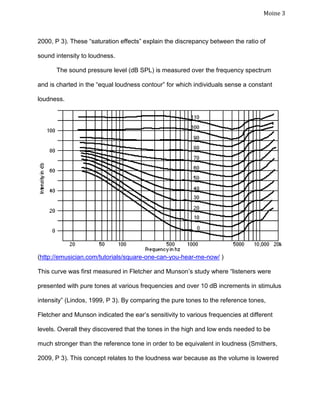
The sound pressure level (dB SPL) is measured over the frequency spectrum
and is charted in the “equal loudness contour” for which individuals sense a constant
loudness.
(http://emusician.com/tutorials/square-one-can-you-hear-me-now/ )
This curve was first measured in Fletcher and Munson’s study where “listeners were
presented with pure tones at various frequencies and over 10 dB increments in stimulus
intensity” (Lindos, 1999, P 3). By comparing the pure tones to the reference tones,
Fletcher and Munson indicated the ear’s sensitivity to various frequencies at different
levels. Overall they discovered that the tones in the high and low ends needed to be
much stronger than the reference tone in order to be equivalent in loudness (Smithers,
2009, P 3). This concept relates to the loudness war because as the volume is lowered
Moine 4
on audio products the highs and lows diminish; thus, boosts are made so the music will
sound unchanged whether it is soft or loud (Smithers, 2009, P 5).
The Loudness War occurred as a result of changing technology. The main
method of listening to music currently is via the digital format rather than the previous
method of audio CDs. CDs contain a large amount of data because they are not
compressed; they are considered “lossless” because they maintain all of the initial
information. However, “certain types of files likes audio, video and graphics can also be
compressed by discarding some of the original data; this form of compression is called
lossy compression” (hometech). MP3 compression is deemed lossy because once the
file is compressed to its smaller size, it cannot be restored to its original quality. MP3s
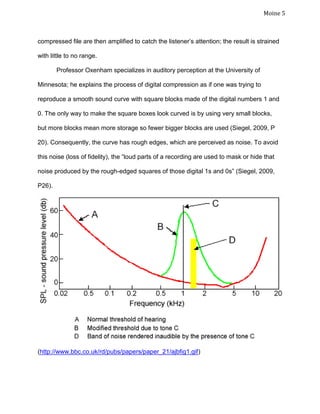
rely heavily on the process called “masking” which is when one frequency is covered by
another; but “the degree to which frequencies can mask each other varies across the
range of human hearing” (Wilburn, 2007, P 6). Parts of the audio spectrum are
discarded which are considered to be less important such as “higher frequencies from
the audio spectrum and sounds which may be hidden behind louder sounds”
(hometech). This produces a much smaller but more convenient file. Although the MP3
has facilitated the transaction and ease of file sharing it has also taken away a large
range of dynamics in the song. When the frequencies of two sounds are too close
together one will be masked; the instrument with the lower amplitude will be completely
hidden behind the louder instrument. By discarding the extreme highs and lows of the
audible spectrum, the song is losing its clarity and conviction. All songs start to sound
the same because of the monotony of the middle spectrum. The volumes of this
Moine 5
compressed file are then amplified to catch the listener’s attention; the result is strained
with little to no range.
Professor Oxenham specializes in auditory perception at the University of
Minnesota; he explains the process of digital compression as if one was trying to
reproduce a smooth sound curve with square blocks made of the digital numbers 1 and
0. The only way to make the square boxes look curved is by using very small blocks,
but more blocks mean more storage so fewer bigger blocks are used (Siegel, 2009, P
20). Consequently, the curve has rough edges, which are perceived as noise. To avoid
this noise (loss of fidelity), the “loud parts of a recording are used to mask or hide that
noise produced by the rough-edged squares of those digital 1s and 0s” (Siegel, 2009,
P26).
(http://www.bbc.co.uk/rd/pubs/papers/paper_21/ajbfig1.gif)

Loudness war

  • 1.
    The Loudness War:To Compress or Digress? Introduction to the Music Industry Rebecca Moine April 26, 2010
  • 2.
    Moine 1 The recordingindustry has made a complete transformation over the past few decades with the advent of the digital music format. Although these technological advances have facilitated the recording process, they have also led to the degradation of digitally mastered albums’ dynamic range; therefore instilling increasing levels of loudness. This issue, referred to as “The Loudness War”, is extremely relevant and concerning because with the competitive nature of the music industry today, producers feel the need to increase the volume of their records so they can catch the attention of listeners. With the radio being the main means of promotion, the value of listenership has become evermore important. Each station has but mere seconds to catch the individual’s interest before he/she apathetically turns the knob to the proceeding station. This leads to competing levels of loudness between artists, ensuing a technological arms race. Yet, with every war there comes a price: the decay of music as we know it. The high and low frequencies have become increasingly analogous to the extent where their differences are few and far between. With the volume of albums increasing and the quality of sound decreasing, society is faced with the question, should we compress or digress? Before progressing onward with further details of this war, one must understand the basics of sound and hearing. Sound loudness describes the ear’s perception and tolerance of sound. It is related to sound intensity, “the rate at which energy is being carried by a sound wave through a given area” (Schlanger, 2008, P 2), but also factors in the frequencies within the sound. The ear’s response to this increasing rate of sound intensity is measured using a logarithmic loudness scale called the decibel scale. The decibel (dB) is the unit for measuring sound-pressure level (SPL), “the acoustic
  • 3.
    Moine 2 pressure that’sbuilt up within a defined atmospheric area” (Huber, 2005, Pg 53) and relative changes in signal level. The human ear has a wide auditory range; spanning from the threshold of hearing (0 dB) to the threshold of pain (120 dB). (http://www.elecfans.com/article/UploadPic/2009-5/200955111716154.gif ) The logarithm involved basically states that for sound to be heard twice as loud it must increase in intensity by a factor of ten. This “rule of thumb” may seem misleading because one would suppose the exponential growth of sound intensity to cause a more radical change in loudness. However, it appears that “doubling the sound energy to the sensitive inner ear does not double the strength of the nerve signal to the brain” (Nave,
  • 4.
    Moine 3 2000, P3). These “saturation effects” explain the discrepancy between the ratio of sound intensity to loudness. The sound pressure level (dB SPL) is measured over the frequency spectrum and is charted in the “equal loudness contour” for which individuals sense a constant loudness. (http://emusician.com/tutorials/square-one-can-you-hear-me-now/ ) This curve was first measured in Fletcher and Munson’s study where “listeners were presented with pure tones at various frequencies and over 10 dB increments in stimulus intensity” (Lindos, 1999, P 3). By comparing the pure tones to the reference tones, Fletcher and Munson indicated the ear’s sensitivity to various frequencies at different levels. Overall they discovered that the tones in the high and low ends needed to be much stronger than the reference tone in order to be equivalent in loudness (Smithers, 2009, P 3). This concept relates to the loudness war because as the volume is lowered
  • 5.
    Moine 4 on audioproducts the highs and lows diminish; thus, boosts are made so the music will sound unchanged whether it is soft or loud (Smithers, 2009, P 5). The Loudness War occurred as a result of changing technology. The main method of listening to music currently is via the digital format rather than the previous method of audio CDs. CDs contain a large amount of data because they are not compressed; they are considered “lossless” because they maintain all of the initial information. However, “certain types of files likes audio, video and graphics can also be compressed by discarding some of the original data; this form of compression is called lossy compression” (hometech). MP3 compression is deemed lossy because once the file is compressed to its smaller size, it cannot be restored to its original quality. MP3s rely heavily on the process called “masking” which is when one frequency is covered by another; but “the degree to which frequencies can mask each other varies across the range of human hearing” (Wilburn, 2007, P 6). Parts of the audio spectrum are discarded which are considered to be less important such as “higher frequencies from the audio spectrum and sounds which may be hidden behind louder sounds” (hometech). This produces a much smaller but more convenient file. Although the MP3 has facilitated the transaction and ease of file sharing it has also taken away a large range of dynamics in the song. When the frequencies of two sounds are too close together one will be masked; the instrument with the lower amplitude will be completely hidden behind the louder instrument. By discarding the extreme highs and lows of the audible spectrum, the song is losing its clarity and conviction. All songs start to sound the same because of the monotony of the middle spectrum. The volumes of this
  • 6.
    Moine 5 compressed fileare then amplified to catch the listener’s attention; the result is strained with little to no range. Professor Oxenham specializes in auditory perception at the University of Minnesota; he explains the process of digital compression as if one was trying to reproduce a smooth sound curve with square blocks made of the digital numbers 1 and 0. The only way to make the square boxes look curved is by using very small blocks, but more blocks mean more storage so fewer bigger blocks are used (Siegel, 2009, P 20). Consequently, the curve has rough edges, which are perceived as noise. To avoid this noise (loss of fidelity), the “loud parts of a recording are used to mask or hide that noise produced by the rough-edged squares of those digital 1s and 0s” (Siegel, 2009, P26). (http://www.bbc.co.uk/rd/pubs/papers/paper_21/ajbfig1.gif)