Text
#ICANN50
IDN Variant TLD Program
ALAC Update
Monday, 23 June 2014
Text
#ICANN50
Text
#ICANN50
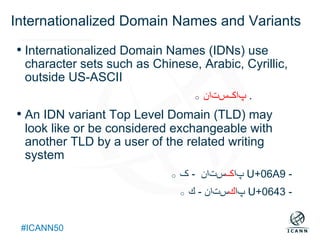
Internationalized Domain Names and Variants
• Internationalized Domain Names (IDNs) use
character sets such as Chinese, Arabic, Cyrillic,
outside US-ASCII
o  ‫ﭖپﺍاﮎکﺱسﺕتﺍاﻥن‬ .‫ﭖپﺍاﮎکﺱسﺕتﺍاﻥن‬
• An IDN variant Top Level Domain (TLD) may
look like or be considered exchangeable with
another TLD by a user of the related writing
system
o  ‫ﮎک‬ - ‫ﺍاﮎکﺱسﺕتﺍاﻥن‬‫ﮎک‬‫ﭖپﺍاﮎکﺱس‬ U+06A9 -
o  ‫ﻙك‬ - ‫ﺍاﻙكﺱسﺕتﺍاﻥن‬‫ﻙك‬‫ﭖپﺍاﻙكﺱس‬ U+0643 -
Text
#ICANN50
IDN Variant TLD Program
• To support IDN variants in the root zone, the
ICANN community, at the direction of the
Board1, undertook several projects to study and
make recommendations on their viability,
sustainability and delegation
• Being conducted in multiple phases, these
projects form the basis of an implementation
plan that will be considered by ICANN's Board
of Directors
1 https://www.icann.org/resources/board-material/resolutions-2010-09-25-en
Text
#ICANN50
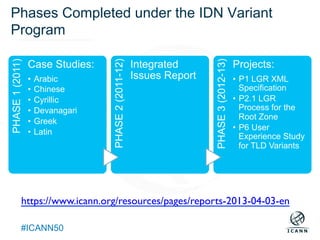
Phases Completed under the IDN Variant
Program
https://www.icann.org/resources/pages/reports-2013-04-03-en	

PHASE1(2011)
Case Studies:
•  Arabic
•  Chinese
•  Cyrillic
•  Devanagari
•  Greek
•  Latin
PHASE2(2011-12)
Integrated
Issues Report
PHASE3(2012-13)
Projects:
•  P1 LGR XML
Specification
•  P2.1 LGR
Process for the
Root Zone
•  P6 User
Experience Study
for TLD Variants
Text
#ICANN50
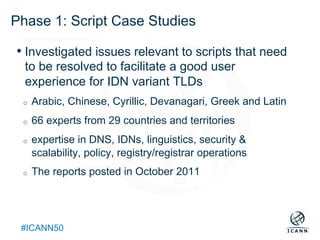
Phase 1: Script Case Studies
• Investigated issues relevant to scripts that need
to be resolved to facilitate a good user
experience for IDN variant TLDs
o  Arabic, Chinese, Cyrillic, Devanagari, Greek and Latin
o  66 experts from 29 countries and territories
o  expertise in DNS, IDNs, linguistics, security &
scalability, policy, registry/registrar operations
o  The reports posted in October 2011
Text
#ICANN50
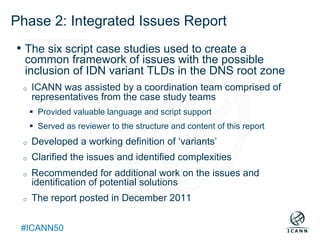
Phase 2: Integrated Issues Report
• The six script case studies used to create a
common framework of issues with the possible
inclusion of IDN variant TLDs in the DNS root zone
o  ICANN was assisted by a coordination team comprised of
representatives from the case study teams
§  Provided valuable language and script support
§  Served as reviewer to the structure and content of this report
o  Developed a working definition of ‘variants’
o  Clarified the issues and identified complexities
o  Recommended for additional work on the issues and
identification of potential solutions
o  The report posted in December 2011
Text
#ICANN50
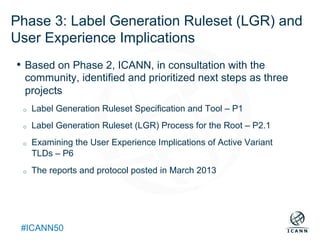
Phase 3: Label Generation Ruleset (LGR) and
User Experience Implications
•  Based on Phase 2, ICANN, in consultation with the
community, identified and prioritized next steps as three
projects
o  Label Generation Ruleset Specification and Tool – P1
o  Label Generation Ruleset (LGR) Process for the Root – P2.1
o  Examining the User Experience Implications of Active Variant
TLDs – P6
o  The reports and protocol posted in March 2013
Text
#ICANN50
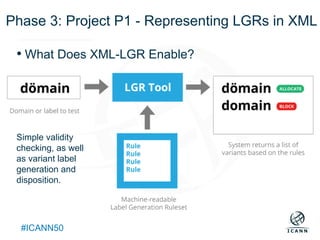
Phase 3: Project P1 - Representing LGRs in XML
• What Does XML-LGR Enable?
Simple validity
checking, as well
as variant label
generation and
disposition.
Text
#ICANN50
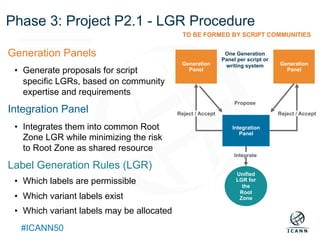
Phase 3: Project P2.1 - LGR Procedure
Generation
Panel
Generation
Panel
Integration
Panel
Unified
LGR for
the
Root
Zone
One Generation
Panel per script or
writing system
Propose
Reject / Accept Reject / Accept
Integrate
Generation Panels
•  Generate proposals for script
specific LGRs, based on community
expertise and requirements
Integration Panel
•  Integrates them into common Root
Zone LGR while minimizing the risk
to Root Zone as shared resource
Label Generation Rules (LGR)
•  Which labels are permissible
•  Which variant labels exist
•  Which variant labels may be allocated
TO BE FORMED BY SCRIPT COMMUNITIES
Text
#ICANN50
Phase 3: P6 – User Experience with variant
TLDs
• If two or more variants are delegated, what are the
user experience issues for the users:
o  End users
o  Power users (system admins, developers, etc.)
o  Registries, registrars, registrants
• Recommendations to provide an acceptable user
experience
• Response elicited and received by SOs/ACs
(GNSO, SSAC, ALAC) for further consideration
Text
#ICANN50
Current Work: P2.2 Implementation of LGR
•  Implementation of the LGR Procedure initiated
o  June 2013 - Call for SMEs for Integration Panel to develop Root Zone
LGR
o  July 2013 - Call for Generation Panels to propose Root Zone Label
Generation Rules
o  September 2013 - Seating of the Integration Panel
o  February 2014 – Arabic Generation Panel formed
o  March 2014 - MSR-1 released for public comment
o  April 2014 – Chinese Generation Panel proposal received
o  June 2014 - MSR-1 published
o  Outreach efforts for formulation of additional script Generation Panels
Text
#ICANN50
MSR-1 Content in Numbers
• 22 scripts
o  Arabic, Bengali, Cyrillic, Devanagari, Georgian, Greek,
Gujarati, Gurmukhi, Han, Hangul, Hebrew, Hiragana,
Kannada, Katakana, Lao, Latin, Malayalam, Oriya,
Sinhala, Tamil, Telugu and Thai
• ‘Common’ and ‘Inherited’ (shared)
• 32,790 code points
o  from 97,973 PVALID/CONTEXT code points defined in
Unicode 6.3
o  11,172 Hangul syllables and 19,850 Han ideographs
Text
#ICANN50
Next Steps
• Focus on P2.2
o  MSR-2 will complete the repertoire
§  adds some or all of the deferred scripts:
§  Armenian, Ethiopic, Khmer, Myanmar, Thaana, Tibetan
§  possible further extensions where warranted
§  Including existing script repertoire
§  In the meantime, MSR-1 is the basis for LGR-1
o  LGR-1 released after GP proposals are received and
successfully evaluated
o  Continued outreach efforts
• Ongoing analysis for viability of implementation for P7
Text
#ICANN50
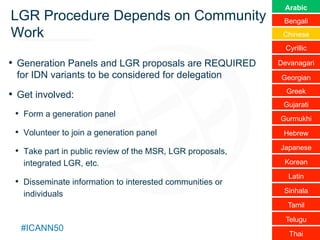
LGR Procedure Depends on Community
Work
•  Generation Panels and LGR proposals are REQUIRED
for IDN variants to be considered for delegation
•  Get involved:
•  Form a generation panel
•  Volunteer to join a generation panel
•  Take part in public review of the MSR, LGR proposals,
integrated LGR, etc.
•  Disseminate information to interested communities or
individuals
Arabic
Bengali
Chinese
Cyrillic
Devanagari
Georgian
Greek
Gujarati
Gurmukhi
Hebrew
Japanese
Korean
Latin
Sinhala
Tamil
Telugu
Thai
Text
#ICANN50
Outreach Efforts
•  Outreach efforts focused on organizing GPs
o  Tool kit
§  Outreach material for LGR
§  Simplified GP formation process
o  Video on IDN
o  Email to ICANN executive mailing list to help to reach out to their contacts
to create new GPs
•  Keeping community informed
o  Targeted events
§  IGF and regional IGFs
§  ICANN meetings
o  Web announcements and updates on ICANN community Wiki
o  Brochures and collateral materials
Text
#ICANN50
Thank You

ICANN 50: IDN Variant TLD Program ALAC Update

  • 1.
    Text #ICANN50 IDN Variant TLDProgram ALAC Update Monday, 23 June 2014
  • 2.
  • 3.
    Text #ICANN50 Internationalized Domain Namesand Variants • Internationalized Domain Names (IDNs) use character sets such as Chinese, Arabic, Cyrillic, outside US-ASCII o  ‫ﭖپﺍاﮎکﺱسﺕتﺍاﻥن‬ .‫ﭖپﺍاﮎکﺱسﺕتﺍاﻥن‬ • An IDN variant Top Level Domain (TLD) may look like or be considered exchangeable with another TLD by a user of the related writing system o  ‫ﮎک‬ - ‫ﺍاﮎکﺱسﺕتﺍاﻥن‬‫ﮎک‬‫ﭖپﺍاﮎکﺱس‬ U+06A9 - o  ‫ﻙك‬ - ‫ﺍاﻙكﺱسﺕتﺍاﻥن‬‫ﻙك‬‫ﭖپﺍاﻙكﺱس‬ U+0643 -
  • 4.
    Text #ICANN50 IDN Variant TLDProgram • To support IDN variants in the root zone, the ICANN community, at the direction of the Board1, undertook several projects to study and make recommendations on their viability, sustainability and delegation • Being conducted in multiple phases, these projects form the basis of an implementation plan that will be considered by ICANN's Board of Directors 1 https://www.icann.org/resources/board-material/resolutions-2010-09-25-en
  • 5.
    Text #ICANN50 Phases Completed underthe IDN Variant Program https://www.icann.org/resources/pages/reports-2013-04-03-en PHASE1(2011) Case Studies: •  Arabic •  Chinese •  Cyrillic •  Devanagari •  Greek •  Latin PHASE2(2011-12) Integrated Issues Report PHASE3(2012-13) Projects: •  P1 LGR XML Specification •  P2.1 LGR Process for the Root Zone •  P6 User Experience Study for TLD Variants
  • 6.
    Text #ICANN50 Phase 1: ScriptCase Studies • Investigated issues relevant to scripts that need to be resolved to facilitate a good user experience for IDN variant TLDs o  Arabic, Chinese, Cyrillic, Devanagari, Greek and Latin o  66 experts from 29 countries and territories o  expertise in DNS, IDNs, linguistics, security & scalability, policy, registry/registrar operations o  The reports posted in October 2011
  • 7.
    Text #ICANN50 Phase 2: IntegratedIssues Report • The six script case studies used to create a common framework of issues with the possible inclusion of IDN variant TLDs in the DNS root zone o  ICANN was assisted by a coordination team comprised of representatives from the case study teams §  Provided valuable language and script support §  Served as reviewer to the structure and content of this report o  Developed a working definition of ‘variants’ o  Clarified the issues and identified complexities o  Recommended for additional work on the issues and identification of potential solutions o  The report posted in December 2011
  • 8.
    Text #ICANN50 Phase 3: LabelGeneration Ruleset (LGR) and User Experience Implications •  Based on Phase 2, ICANN, in consultation with the community, identified and prioritized next steps as three projects o  Label Generation Ruleset Specification and Tool – P1 o  Label Generation Ruleset (LGR) Process for the Root – P2.1 o  Examining the User Experience Implications of Active Variant TLDs – P6 o  The reports and protocol posted in March 2013
  • 9.
    Text #ICANN50 Phase 3: ProjectP1 - Representing LGRs in XML • What Does XML-LGR Enable? Simple validity checking, as well as variant label generation and disposition.
  • 10.
    Text #ICANN50 Phase 3: ProjectP2.1 - LGR Procedure Generation Panel Generation Panel Integration Panel Unified LGR for the Root Zone One Generation Panel per script or writing system Propose Reject / Accept Reject / Accept Integrate Generation Panels •  Generate proposals for script specific LGRs, based on community expertise and requirements Integration Panel •  Integrates them into common Root Zone LGR while minimizing the risk to Root Zone as shared resource Label Generation Rules (LGR) •  Which labels are permissible •  Which variant labels exist •  Which variant labels may be allocated TO BE FORMED BY SCRIPT COMMUNITIES
  • 11.
    Text #ICANN50 Phase 3: P6– User Experience with variant TLDs • If two or more variants are delegated, what are the user experience issues for the users: o  End users o  Power users (system admins, developers, etc.) o  Registries, registrars, registrants • Recommendations to provide an acceptable user experience • Response elicited and received by SOs/ACs (GNSO, SSAC, ALAC) for further consideration
  • 12.
    Text #ICANN50 Current Work: P2.2Implementation of LGR •  Implementation of the LGR Procedure initiated o  June 2013 - Call for SMEs for Integration Panel to develop Root Zone LGR o  July 2013 - Call for Generation Panels to propose Root Zone Label Generation Rules o  September 2013 - Seating of the Integration Panel o  February 2014 – Arabic Generation Panel formed o  March 2014 - MSR-1 released for public comment o  April 2014 – Chinese Generation Panel proposal received o  June 2014 - MSR-1 published o  Outreach efforts for formulation of additional script Generation Panels
  • 13.
    Text #ICANN50 MSR-1 Content inNumbers • 22 scripts o  Arabic, Bengali, Cyrillic, Devanagari, Georgian, Greek, Gujarati, Gurmukhi, Han, Hangul, Hebrew, Hiragana, Kannada, Katakana, Lao, Latin, Malayalam, Oriya, Sinhala, Tamil, Telugu and Thai • ‘Common’ and ‘Inherited’ (shared) • 32,790 code points o  from 97,973 PVALID/CONTEXT code points defined in Unicode 6.3 o  11,172 Hangul syllables and 19,850 Han ideographs
  • 14.
    Text #ICANN50 Next Steps • Focus onP2.2 o  MSR-2 will complete the repertoire §  adds some or all of the deferred scripts: §  Armenian, Ethiopic, Khmer, Myanmar, Thaana, Tibetan §  possible further extensions where warranted §  Including existing script repertoire §  In the meantime, MSR-1 is the basis for LGR-1 o  LGR-1 released after GP proposals are received and successfully evaluated o  Continued outreach efforts • Ongoing analysis for viability of implementation for P7
  • 15.
    Text #ICANN50 LGR Procedure Dependson Community Work •  Generation Panels and LGR proposals are REQUIRED for IDN variants to be considered for delegation •  Get involved: •  Form a generation panel •  Volunteer to join a generation panel •  Take part in public review of the MSR, LGR proposals, integrated LGR, etc. •  Disseminate information to interested communities or individuals Arabic Bengali Chinese Cyrillic Devanagari Georgian Greek Gujarati Gurmukhi Hebrew Japanese Korean Latin Sinhala Tamil Telugu Thai
  • 16.
    Text #ICANN50 Outreach Efforts •  Outreachefforts focused on organizing GPs o  Tool kit §  Outreach material for LGR §  Simplified GP formation process o  Video on IDN o  Email to ICANN executive mailing list to help to reach out to their contacts to create new GPs •  Keeping community informed o  Targeted events §  IGF and regional IGFs §  ICANN meetings o  Web announcements and updates on ICANN community Wiki o  Brochures and collateral materials
  • 17.