IDN Program Update
Sarmad Hussain | IDN Program Sr. Manager | 24 June 2015
| 3
¤  IDN Program - Overview and Progress – Sarmad Hussain
¤  Integration Panel Update – Integration Panel
¤  Community Updates:
•  Arabic	
  Genera+on	
  Panel	
  –	
  Meikal	
  Mumin	
  
•  Armenian	
  Genera+on	
  Panel	
  –	
  	
  Igor	
  Mkrtumyan	
  
•  Japanese	
  Genera+on	
  Panel	
  -­‐	
  Hiro	
  Ho=a	
  	
  
•  Korean	
  Genera+on	
  Panel	
  	
  -­‐	
  Kyongsok	
  Kim	
  
¤   Q&A
Agenda
IDN Program – Overview and Progress
Sarmad Hussain
IDN Program Senior Manager
ICANN
| 5
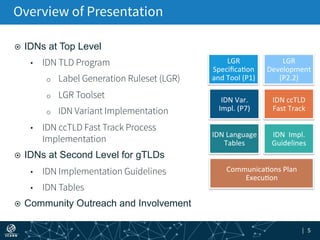
Overview of Presentation
¤  IDNs at Top Level
•  IDN TLD Program
o  Label Generation Ruleset (LGR)
o  LGR Toolset
o  IDN Variant Implementation
•  IDN ccTLD Fast Track Process
Implementation
¤  IDNs at Second Level for gTLDs
•  IDN Implementation Guidelines
•  IDN Tables
¤  Community Outreach and Involvement
LGR	
  
Specifica+on	
  
and	
  Tool	
  (P1)	
  
LGR	
  
Development	
  
(P2.2)	
  
IDN	
  Var.	
  
Impl.	
  (P7)	
  
IDN	
  ccTLD	
  
Fast	
  Track	
  
IDN	
  Language	
  
Tables	
  
IDN	
  	
  Impl.	
  
Guidelines	
  	
  
Communica+ons	
  Plan	
  
Execu+on	
  
| 6
IDN TLD Program
Reports and documentation of all completed projects available at:
https://www.icann.org/resources/pages/reports-2013-04-03-en.
PHASE	
  1	
  (2011)	
  
Case	
  Studies:	
  
Arabic	
  
Chinese	
  
Cyrillic	
  
Devanagari	
  
Greek	
  
La+n	
  
PHASE	
  2	
  (2011-­‐12)	
  
Integrated	
  Issues	
  
Report	
  	
  
PHASE	
  3	
  (2012-­‐13)	
  
Projects:	
  
P1	
  LGR	
  XML	
  
Specifica+on	
  
P2.1	
  LGR	
  Process	
  
for	
  the	
  Root	
  Zone	
  
P6	
  User	
  
Experience	
  Study	
  
for	
  TLD	
  Variants	
  
PHASE	
  4	
  (Since	
  2013)	
  
Projects:	
  
P1	
  LGR	
  Specs.	
  
and	
  Toolset	
  
P2.2	
  LGR	
  
Development	
  
P7	
  LGR	
  
Implementa+on	
  
Community agreed to define Label Generation Rules (LGR).
Iden+fy	
  Issues	
   Define	
  Problem	
  
Determine	
  
Solu+on	
  
Implement	
  
Solu+on	
  
| 7
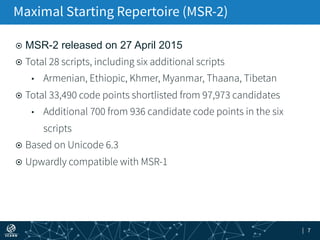
¤  MSR-2 released on 27 April 2015
¤  Total 28 scripts, including six additional scripts
•  Armenian, Ethiopic, Khmer, Myanmar, Thaana, Tibetan
¤  Total 33,490 code points shortlisted from 97,973 candidates
•  Additional 700 from 936 candidate code points in the six
scripts
¤  Based on Unicode 6.3
¤  Upwardly compatible with MSR-1
Maximal Starting Repertoire (MSR-2)
| 8
¤  Guidelines released for GPs on 27 April 2015
¤  https://www.icann.org/public-comments/lgr-
guidelines-2015-01-15-en
•  Guidelines for Developing Script‐Specific Label Generation Rules for
Integration into the Root Zone LGR
•  Considerations for Designing a Label Generation Ruleset for the Root Zone
•  Requirements for LGR Proposals
¤  Technical documents:
•  Variant Rules
•  Whole Label Evaluation (WLE) Rules
•  Representing Label Generation Rulesets using XML
Guidelines for Generation Panels
| 9
Status of LGR Development
•  28+	
  Scripts	
  
•  18+	
  Genera+on	
  Panels	
  
¤  Other:
•  Ethiopic
•  Georgian
•  Hebrew
•  Latin
•  Thaana
•  Thai
| 10
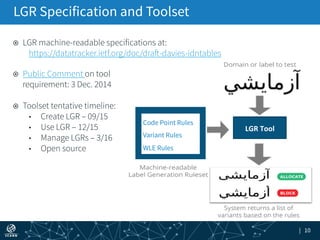
LGR	
  Tool	
  
Code Point Rules
Variant Rules
WLE Rules
LGR Specification and Toolset
¤  LGR machine-readable specifications at:
https://datatracker.ietf.org/doc/draft-davies-idntables
¤  Public Comment on tool
requirement: 3 Dec. 2014
¤  Toolset tentative timeline:
•  Create LGR – 09/15
•  Use LGR – 12/15
•  Manage LGRs – 3/16
•  Open source
| 11
Create Use Case: Code Point Screens Flow
Code points list
screen
Add code points
modal
Edit code point screen
Edit references
modal
Add variant modal
| 13
IDN ccTLD Fast Track Process
¤  Completed five years of operation
•  Requests in 18 scripts for 27 languages
•  37 IDN ccTLDs delegated in the Root Zone representing 29
countries/territories
¤  Currently under annual review
•  Public comment announced on 15 Jan. 2015
o  Second similarity review and process
•  Public comment closed on 17 March 2015
•  Next steps based on direction from the Board
| 14
¤  Submitted by new gTLD registries intending to offer IDNs:
•  Varied character repertoire and contextual rules
•  Reference Label Generation Rulesets (LGRs) for facilitation and
consistency in Pre-Delegation Testing (PDT) and the Registry Service
Evaluation Process (RSEP)
•  Reuse for better end-user experience
¤  Current Status
•  Development through vendor
o  Guidelines and documentation of authoritative sources
o  IDN table in LGR format
o  Expert review: linguistic and security and stability
o  Public comments
o  Publication after incorporating public feedback
•  Public comment – update process to allow review; coordinate with GPs;
wait till LGR for Root Zone; why LGR format
•  RFP released on 5 June 2015 – responses by 7 July 2015
IDN Tables
| 15
¤  Background and motivation
•  To promote IDN registration policies and practices and to minimize
consumer risk and confusion
•  Last updated in 2011; GNSO community requested for review
¤  Next steps
•  Formulate a WG to undertake the review
IDN Implementation Guidelines
| 16
¤  IDN Program sessions at ICANN meetings
¤  IDN Program updates to SOs/ACs at ICANN meetings
¤  Presentations
•  APRALO-APAC Hub Webinar on IDNs on 9 April 2015
•  Support IDN related outreach (APRICOT, MENOG, Russian IGF, DNS Forum,
Africa Internet Summit)
•  Direct outreach (Cambodia, Laos, Myanmar, Pakistan)
¤  IDN pages at ICANN Community Wiki and ICANN website
¤  IDN mailing lists
•  {vip, lgr, ArabicGP, ArmenianGP, ChineseGP, …}@icann.org
Communication and Outreach Efforts
| 17
Get Involved
Volunteer for your script Generation Panel (GP)
To contribute expertise, contribute to the GP for your script.
You can get involved by simply emailing your CV and a brief
statement of interest to idntlds@icann.org
Volunteer
Review
Listen
Review work through public comments
Sign up for the IDN mailing list vip@icann.org (to sign up,
visit https://mm.icann.org/listinfo/vip) and participated in
the review of IDN work being done at ICANN through the
public comments
Stay up to date
Attend regular IDN Program Update sessions at ICANN
meetings and sign up on the IDN mailing list vip@icann.org
to get updates on the IDN Program at ICANN
| 18
Useful Links for IDN Program
•  To join a Generation Panel for your language, submit CV and statement of interest at:
idntlds@icann.org; call for Generation Panels:
http://www.icann.org/en/news/announcements/announcement-11jul13-en.htm
•  LGR Document Repository:
https://community.icann.org/display/croscomlgrprocedure/Document+Repository
•  Community Wiki for LGR Project:
https://community.icann.org/display/croscomlgrprocedure/Root+Zone+LGR+Project
•  IDN ccTLD Fast Track Page:
https://www.icann.org/resources/pages/string-evaluation-completion-2014-02-19-en
•  IDN Implementation Guidelines:
https://www.icann.org/resources/pages/implementation-guidelines-2012-02-25-en
Integration Panel Updates
Asmus Freytag
Integration Panel
IDN Program
| 20
Maximal Starting
Repertoire –
version 2
Guidelines for
Generation Panels
Support to
Generation Panels
Planning
Communications
and Outreach
Preparation for
Integration of LGR
Proposals
Here’s a place to
introduce your
sixth agenda item
from your talk.
1 2 3
4 5
Integration Panel Activities Since ICANN 52
| 21
Maximal Starting Repertoire – v.2 [MSR-2]
¤  Includes six new scripts:
•  Armenian, Ethiopic, Khmer, Myanmar, Thaana, Tibetan
•  Existing 22 scripts in MSR-1 unchanged
¤  Now the basis for current round of LGR proposals
¤  Other scripts explored, not yet ready for inclusion
•  Cherokee
•  Undergoing revision – addition of lower-case register
•  Canadian Aboriginal Syllabic (CAS)
•  Doubts on level of use, community-preparedness
•  Others still (e.g. Ol Chiki ...)
| 22
MSR-2 Statistics
Script	
   PVALID	
   MSR-­‐2	
  
Armenian	
   39	
   38	
  
Ethiopic	
   456	
   364	
  
Khmer	
   95	
   78	
  
Myanmar	
   177	
   90	
  
Thaana	
   50	
   50	
  
Tibetan	
   119	
   80	
  
TOTAL	
   936	
   700	
  
MSR-­‐1	
   MSR-­‐2	
  
Scripts	
   22	
   28	
  
Code	
  Points	
   32,790	
   33,490	
  
MSR-2 Scripts MSR-1 vs. MSR-2
IDNA2008
PVALID	
  
Unicode	
  6.3	
   97,946	
  
| 23
MSR-2 – Keeping Pace with Unicode
¤  IETF has identified a problem in Unicode 7.0, and
therefore stopped updating IDNA2008 at 6.3
•  Unicode 8.0 just released
•  Unicode 9.0 to be delivered next year
¤  Result: When IETF resumes update of IDNA2008, MSR
may need to include newly coded characters
| 24
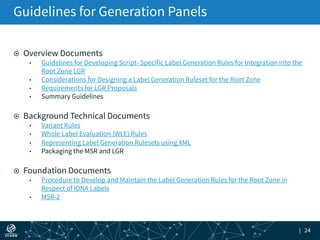
¤  Overview Documents
•  Guidelines for Developing Script‐Specific Label Generation Rules for Integration into the
Root Zone LGR
•  Considerations for Designing a Label Generation Ruleset for the Root Zone
•  Requirements for LGR Proposals
•  Summary Guidelines
¤  Background Technical Documents
•  Variant Rules
•  Whole Label Evaluation (WLE) Rules
•  Representing Label Generation Rulesets using XML
•  Packaging the MSR and LGR
¤  Foundation Documents
•  Procedure to Develop and Maintain the Label Generation Rules for the Root Zone in
Respect of IDNA Labels
•  MSR-2
Guidelines for Generation Panels
| 25
¤ Root Zone LGR Project Wiki
•  https://community.icann.org/display/croscomlgrprocedure/Root
+Zone+LGR+Project
¤ Root Zone LGR Project Document Repository
•  https://community.icann.org/display/croscomlgrprocedure/
Document+Repository
Resources
| 26
Generation Panels – State of Play
Draft LGRs received
Arabic, Armenian
1
2
Detailed discussions
Chinese, Japanese, Korean
3
Proposals to form GPs
received and under review
Neo-Brahmi (Indian), Cyrillic,
Khmer
Best strategies to co-ordinate use of
Han (Chinese) characters across CJK,
esp. variants
(e.g., Seoul meeting 15-16 May)
Note: Progress in understanding
co-ordination to aid future GPs.
Panels have requested ICANN
to appoint technical advisor
for co-ordination.
| 27
Planning, Communications and Outreach
¤  Prepare work-plan for FY 2015-2016:
•  Review first LGRs (label generation rule-sets) received from script GPs
(generation panels)
•  Produce first combined sets of LGRs 
•  Evaluate need for MSR-3 (with/without extra scripts)
•  Support new GPs as they form, and begin work on LGRs
¤  Note critical dependence on:
•  Speed of formation of GPs
•  Number of GPs concurrently active
•  Time-scale to LGR submission 
| 28
Preparation for Integration of LGR Proposals
¤  Review plans to package Integrated Root Zone LGR
¤  Process:
•  Get familiar with linguistic and technical issues of each script
•  Develop/refine tools to validate and correlate LGRs as received
•  Integrate effects of rules across scripts, e.g.
o  Contrasting variants, as among different languages using Han
o  Confusability among characters of different scripts
¤  Ultimate goals:
•  A set of mechanical verification steps
•  Applicable to preliminary and final LGRs
| 29
From the Integration Panel
Thank you for your attention!
Wil Tan, Marc Blanchet, Asmus Freytag, Michel Suignard, Nicholas Ostler
Update on Arabic GP
Meikal Mumin
Task Force on Arabic Script IDNs (TF-AIDN) /
Arabic Generation Panel
| 31
¤  TF-AIDN has open membership
¤  33 members
¤  18 countries
¤  Current members speak 9 languages using Arabic script, with further
expertise in use of Arabic script from East Asia, South Asia, Middle East,
Maghreb countries and Africa
¤  Current members come from diverse disciplines – academia (linguistics
and technical), registries, registrars, national and regional policy bodies,
community based organizations, technical community
Membership
| 32
Arabic Script TLDs Assigned or Delegated
	
  ‫ر‬‫اجلزائ‬ 	
   ‫بھارت‬ 	
   ‫تونس‬
	
  ‫ن‬‫عما‬ 	
   ‫املغرب‬ 	
   ‫مصر‬
	
  ‫ن‬‫ایرا‬ 	
   ‫السعودية‬ 	
   ‫قطر‬
	
  ‫ت‬‫امارا‬ 	
   ‫سودان‬ 	
   ‫فلسطني‬
	
  ‫ر‬‫بازا‬ 	
   ‫مليسيا‬ 	
  ‫ق‬‫عرا‬
	
  ‫ن‬‫پاکستا‬ 	
   ‫شبكة‬ 	
  ‫ع‬‫موق‬
	
  ‫ن‬‫االرد‬ 	
   ‫سورية‬
| 33
¤  Formation of Arabic Script Generation Panel
¤  Code point analysis
¤  Establishing principles for inclusion, exclusion, and deferral of Unicode
code points
¤  Analysis of Maximum Starting Repertoire (MSR) and feedback to
Integration Panel (IP)
¤  Analysis of code points for Label Generation Rules (LGR)
¤  Code point variants
¤  Establishing principles for code point variants
¤  Analysis of code points for code points variants
¤  Analysis of code point variant dispositions (allocatable vs. blocked)
Progress - Work accomplished - 1
| 34
¤  Development of Whole Label Evaluation (WLE) rules
¤  Establishing principles for WLE rules
¤  Determining the WLE rules
¤  Documentation of the work
¤  Text document summarizing Label Generation Rules for Arabic
¤  Label Generation Rules for Arabic in XML format
¤  Finalization of LGR proposal at F2F meeting in Singapore (ICANN52)
¤  Discussion with Integration Panel (IP) for feedback
¤  Currently reviewing IP feedback and finalizing proposal
¤  Next steps: Publish the final proposal for public comments
Progress - Work accomplished - 2
| 35
Current Code Point Repertoire
| 36
Examples of Variants


06C1	
   06D5	
   b/b	
   	
  
06C1	
   0647	
   a/a	
   Labels	
  in	
  Arabic	
  language	
  using	
  0647	
  in	
  the	
  final	
  and	
  isolated	
  
positions	
  will	
  be	
  typed	
  in	
  other	
  languages	
  using	
  06C1	
  (Urdu,	
  
Pashto,	
  Saraiki,	
  etc.)	
  which	
  is	
  identical	
  in	
  isolated	
  and	
  has	
  a	
  
variant	
  glyph	
  or	
  identical	
  glyph	
  form	
  in	
  final	
  position.	
  
06C1	
   06BE	
   b/b	
   	
  
06C1	
   0629	
   b/b	
   	
  
06C1	
   06C3	
   b/b	
   	
  
06C1	
   06C0	
   b/b	
   	
  
06C1	
   06C2	
   b/a	
   06C1	
  -­‐>b	
  06C2	
  (blocked),	
  06C2	
  -­‐>a	
  06C1	
  (allocatable)	
  
Partial table for HEH
| 37
Examples of WLE Rules
S.No.	
   Code	
  points	
  cannot	
  co-­‐
occur	
  within	
  a	
  label	
  
Notes	
  
1	
   0643	
  and	
  06A9	
  	
   ‫  
	ﻙك‬and	
  ‫ﮎک‬	
  	
  
2	
   0643	
  and	
  06AA	
   ‫  
	ﻙك‬and	
  ‫ڪ‬	
  
3	
   06CC	
  and	
  0649	
  	
   ‫  
	ﯼی‬and	
  ‫ﻯى‬	
  	
  
4	
   06C1	
  and	
  0647	
   ‫  
	ﻩه‬and	
  ‫ﻩه‬	
  
5	
   06C1	
  and	
  06D5	
   ‫  
	ﻩه‬and	
  ‫ە‬	
  
6	
   0647	
  and	
  06D5	
   ‫  
	ﻩه‬and	
  ‫ە‬	
  
7	
   0647	
  and	
  06BE	
   ‫  
	ﻩه‬and	
  ‫ﻫﮬﮪھ‬	
  
8	
   0629	
  and	
  06C3	
   ‫  
	ﺓة‬and	
  ‫ﺓة‬	


| 38
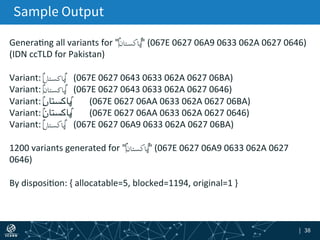
Sample Output
Genera+ng	
  all	
  variants	
  for	
  "‎‫ن‬‫پاکستا‬‎"	
  (067E	
  0627	
  06A9	
  0633	
  062A	
  0627	
  0646)	
  
(IDN	
  ccTLD	
  for	
  Pakistan)	


Variant:	
  ‎‫ں‬‫پاكستا‬‎	
   	
  (067E	
  0627	
  0643	
  0633	
  062A	
  0627	
  06BA)	
  	
  
Variant:	
  ‎‫ن‬‫پاكستا‬‎	
   	
  (067E	
  0627	
  0643	
  0633	
  062A	
  0627	
  0646)	
  	
  
Variant:	
  ‎‫ں‬‫پاڪستا‬‎	
   	
  (067E	
  0627	
  06AA	
  0633	
  062A	
  0627	
  06BA)	
  	
  
Variant:	
  ‎‫ن‬‫پاڪستا‬‎	
   	
  (067E	
  0627	
  06AA	
  0633	
  062A	
  0627	
  0646)	
  	
  
Variant:	
  ‎‫ں‬‫پاکستا‬‎	
   	
  (067E	
  0627	
  06A9	
  0633	
  062A	
  0627	
  06BA)	


1200	
  variants	
  generated	
  for	
  "‎‫ن‬‫پاکستا‬‎"	
  (067E	
  0627	
  06A9	
  0633	
  062A	
  0627	
  
0646)	


By	
  disposi+on:	
  {	
  allocatable=5,	
  blocked=1194,	
  original=1	
  }	
  
| 39
Thank You
¤  Workspace, news and document archive at
https://community.icann.org/display/MES/TF-AIDN+Work+Space
¤  Publicly archived email discussion at
http://lists.meswg.org/mailman/listinfo/tf-aidn
Update on Armenian GP
Igor Mkrtumyan
Armenian Generation Panel
Igor 	
  
General	
  informaBon	
  
Armenian	
  IDN	
  	
  
•  Code:	
  Armn	
  
•  N°:	
  230	
  
•  English	
  Name:	
  Armenian	
  
•  English	
  name	
  of	
  the	
  script:	
  Hye	
  
•  Na+ve	
  name	
  of	
  the	
  script:	
  հայ	
  
The	
  announcement	
  for	
  the	
  successful	
  comple1on	
  of	
  
Armenia's	
  string	
  evalua1on	
  has	
  been	
  posted	
  at	
  
h9ps://www.icann.org/news/
announcement-­‐2014-­‐11-­‐20-­‐en.	
  
41	
  
42	
  
•  The	
  Armenian	
  language	
  is	
  an	
  Indo-­‐European	
  
language	
  spoken	
  by	
  the	
  Armenians.	
  It	
  is	
  the	
  
official	
  language	
  of	
  the	
  Republic	
  of	
  
Armenia	
  and	
  the	
  self-­‐proclaimed	
  Nagorno-­‐
Karabakh	
  Republic.	
  It	
  has	
  historically	
  been	
  
spoken	
  throughout	
  the	
  Armenian	
  
Highlands	
  and	
  today	
  is	
  widely	
  spoken	
  in	
  
the	
  Armenian	
  Diaspora.	
  	
  
Armenian	
  language	
  
Armenian	
  language	
  
•  Armenians	
  has	
  its	
  own	
  unique	
  script,	
  
the	
  Armenian	
  alphabet,	
  invented	
  in	
  405	
  AD	
  
by	
  Mesrop	
  Mashtots.	
  
•  Linguists	
  classify	
  Armenian	
  as	
  an	
  independent	
  
branch	
  of	
  the	
  Indo-­‐European	
  language	
  family.	
  
•  There	
  are	
  two	
  standardized	
  modern	
  literary	
  
forms,	
  Eastern	
  Armenian	
  and	
  Western	
  
Armenian,	
  with	
  which	
  most	
  contemporary	
  
dialects	
  are	
  mutually	
  intelligible.	
  	
  
•  Total	
  Armenian	
  popula+on	
  in	
  the	
  world	
  is	
  about	
  
10mln.	
  
43	
  
44	
  
Official	
  language	
  in	
  Armenia	
  and	
  Nagorno	
  Karabakh	
  
Republic	
  
Big	
  Diaspora	
  using	
  the	
  Armenian	
  language	
  in	


Argen+na	
   Lebanon	
  
Brazil	
   Poland	
  
Cyprus	
  	
   Romania	
  
France	
   Syria	
  
Georgia	
   Turkey	
  
Hungary	
   Ukraine	
  
	
  Iran	
   United	
  States	
  
Iraq	
   Uruguay	
  
Geographic	
  territories	
  or	
  countries	
  with	
  
significant	
  user	
  communiBes	
  for	
  the	
  script	
  
45	
  
Armenian	
  GP	
  
•  Armenian	
  GP	
  was	
  created	
  
•  Armenian	
  GP	
  mailing	
  list	
  was	
  created	
  
Armeniangp@icann.org	
  
•  General	
  informa+on	
  about	
  the	
  mailing	
  list	
  is	
  at:	
  
h=ps://mm.icann.org/mailman/lis+nfo/armeniangp	
  
Armenian	
  MSR-­‐2	
  table	
  
46	
  
•  There	
  are	
  two	
  standardized	
  mutually	
  intelligible	
  
modern	
  literary	
  forms,	
  Eastern	
  Armenian	
  and	
  
Western	
  Armenian	
  with	
  some	
  difference	
  in	
  
orthographies.	
  But	
  as	
  both	
  are	
  wri=en	
  with	
  the	
  
same	
  script	
  it	
  doesn’t	
  influence	
  the	
  LGR	
  
document.	
  	
  
The	
  following	
  web	
  site	
  contains	
  a	
  full	
  descrip+on	
  
of	
  the	
  Armenian	
  repertoire	
  for	
  use	
  in	
  the	
  
Armenian	
  wri+ng	
  system:	
  
h=p://www.omniglot.com/wri+ng/armenian.htm	
  
MSR-­‐2	
  Armenian	
  Repertoire	
  
47	
  
48	
  
MSR-­‐2	
  Armenian	
  Repertoire	
  
Armenian	
  MSR-­‐2	
  table	
  
49	
  
•  This	
  defines	
  a	
  formal	
  reference	
  for	
  the	
  
jus+fica+on	
  of	
  the	
  repertoire	
  for	
  this	
  proposal.	
  
•  The	
  following	
  subset	
  of	
  code	
  points	
  iden+fied	
  as	
  
the	
  Unicode	
  range	
  U+0561..U+0586	
  will	
  be	
  
available	
  for	
  the	
  root	
  zone:	
  
Selected	
  code	
  points	
  
50	
  
Code	
   Script	
   Name	
   Code	
   Script	
   Name	
  
0561	
  	
   ա	
  	
   ARMENIAN	
  SMALL	
  LETTER	
  AYB	
   0574	
   	
  մ	
  	
   ARMENIAN	
  SMALL	
  LETTER	
  MEN	
  
0562	
   	
  բ	
  	
   ARMENIAN	
  SMALL	
  LETTER	
  BEN	
   0575	
   	
  յ	
  	
   RMENIAN	
  SMALL	
  LETTER	
  YI	
  
0563	
  	
   գ	
  	
   ARMENIAN	
  SMALL	
  LETTER	
  GIM	
   0576	
   	
  ն	
  	
   ARMENIAN	
  SMALL	
  LETTER	
  NOW	
  
0564	
  	
   դ	
   ARMENIAN	
  SMALL	
  LETTER	
  DA	
   0577	
   	
  շ	
  	
   ARMENIAN	
  SMALL	
  LETTER	
  SHA	
  
0565	
  	
   ե	
   ARMENIAN	
  SMALL	
  LETTER	
  ECH	
   0578	
   	
  ո	
  	
   ARMENIAN	
  SMALL	
  LETTER	
  VO	
  
0566	
  	
   զ	
   ARMENIAN	
  SMALL	
  LETTER	
  ZA	
   0579	
   	
  չ	
  	
   ARMENIAN	
  SMALL	
  LETTER	
  CHA	
  
0567	
   	
  է	
  	
   ARMENIAN	
  SMALL	
  LETTER	
  EH	
   057A	
   	
  պ	
   	
  ARMENIAN	
  SMALL	
  LETTER	
  PEH	
  
0568	
  	
   ը	
  	
   ARMENIAN	
  SMALL	
  LETTER	
  ET	
   057B	
   	
  ջ	
  	
   ARMENIAN	
  SMALL	
  LETTER	
  JHEH	
  
0569	
  	
   թ	
   ARMENIAN	
  SMALL	
  LETTER	
  TO	
   057C	
   	
  ռ	
  	
   ARMENIAN	
  SMALL	
  LETTER	
  RA	
  
056A	
  	
   ժ	
   ARMENIAN	
  SMALL	
  LETTER	
  ZHE	
   057D	
   	
  ս	
   ARMENIAN	
  SMALL	
  LETTER	
  SEH	
  
056B	
  	
   ի	
   ARMENIAN	
  SMALL	
  LETTER	
  INI	
   057E	
   	
  վ	
  	
   ARMENIAN	
  SMALL	
  LETTER	
  VEW	
  
056C	
   	
  լ	
  	
   ARMENIAN	
  SMALL	
  LETTER	
  LIWN	
   057F	
   	
  տ	
   	
  ARMENIAN	
  SMALL	
  LETTER	
  TIWN	
  
056D	
   	
  խ	
   	
  ARMENIAN	
  SMALL	
  LETTER	
  XEH	
   0580	
   	
  ր	
  	
   ARMENIAN	
  SMALL	
  LETTER	
  REH	
  
056E	
   	
  ծ	
  	
   ARMENIAN	
  SMALL	
  LETTER	
  CA	
   0581	
   	
  ց	
  	
   ARMENIAN	
  SMALL	
  LETTER	
  CO	
  
056F	
   	
  կ	
  	
   ARMENIAN	
  SMALL	
  LETTER	
  KEN	
   0582	
   	
  ւ	
  	
   ARMENIAN	
  SMALL	
  LETTER	
  YIWN	
  
0570	
   	
  հ	
  	
   ARMENIAN	
  SMALL	
  LETTER	
  HO	
   0583	
   	
  փ	
   	
  ARMENIAN	
  SMALL	
  LETTER	
  PIWR	
  
0571	
   	
  ձ	
  	
   ARMENIAN	
  SMALL	
  LETTER	
  JA	
   0584	
   	
  ք	
  	
   ARMENIAN	
  SMALL	
  LETTER	
  KEH	
  
0572	
   	
  ղ	
  	
   ARMENIAN	
  SMALL	
  LETTER	
  GHAD	
   0585	
   	
  օ	
  	
   ARMENIAN	
  SMALL	
  LETTER	
  OH	
  
0573	
   	
  ճ	
  	
   ARMENIAN	
  SMALL	
  LETTER	
  CHEH	
   0586	
   	
  ֆ	
  	
   ARMENIAN	
  SMALL	
  LETTER	
  FEH	
  
Variants	
  
51	
  
There	
  is	
  some	
  similarity	
  between	
  Armenian	
  
le=ers	
  GIM	
  and	
  ZA	
  but	
  we	
  considered	
  that	
  
it	
  is	
  not	
  enough	
  to	
  include	
  them	
  into	
  
variants.	
  So	
  our	
  conclusion	
  is:	
  
	
  The	
  Armenian	
  repertoire	
  does	
  not	
  contain	
  
in-­‐script	
  variants.	


Cross-­‐script	
  homoglyphs	
  	
  
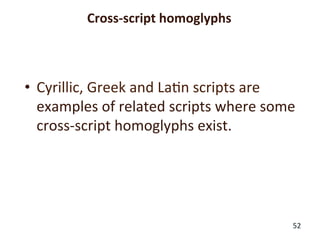
52	
  
•  Cyrillic,	
  Greek	
  and	
  La+n	
  scripts	
  are	
  
examples	
  of	
  related	
  scripts	
  where	
  some	
  
cross-­‐script	
  homoglyphs	
  exist.	


Armenian-­‐Cyrillic	
  homoglyphs	
  
53	
  
Armenian Le=er	
   Cyrillic	
  Le=er	
  
հ	
  U+0570	
  Armenian	
  
small	
  le=er	
  HO	
  
Һ U+04BB	
  Cyrillic	
  small	
  le=er	
  	
  
SHHA	
  
օ	
  U+0585	
  Armenian	
  
small	
  le=er	
  OH	


о	
  U+043E	
  Cyrillic	
  small	
  le=er	
  
O	
  
‘ո’	
  U+0578	
  Armenian	
  small	
  le=er	
  VO	
  and	
  ‘п’	
  U+43F	
  Cyrillic	
  small	
  le=er	
  PE	
  are	
  usually	
  
somewhat	
  dis+nct,	
  unless	
  both	
  are	
  in	
  italic	
  serif	
  style,	
  like	
  ‘п’	
  vs.	
  ‘n’,	
  where	
  they	
  would	
  
be	
  homoglyphs.	
  However,	
  they	
  are	
  not	
  included	
  into	
  cross-­‐script	
  variants	
  because	
  
italic	
  font	
  styles	
  are	
  insufficient	
  jus+fica+on	
  for	
  crea+ng	
  a	
  cross-­‐script	
  variant,	
  
especially	
  as	
  that	
  is	
  not	
  the	
  most	
  common	
  style	
  for	
  presen+ng	
  domain	
  names	
  to	
  the	
  
user.	
  	
  
Armenian	
  and	
  LaBn	
  homoglyphs	
  
54	
  
Armenian Letter	
   Latin Letter	
  
զ	
  U+0566	
  Armenian	
  small	
  le=er	
  ZA	
   q	
  U+0071	
  La+n	
  small	
  le=er	
  Q	
  
հ	
  U+0570	
  Armenian	
  small	
  le=er	
  HO	
   h	
  U+0068	
  La+n	
  small	
  le=er	
  H	
  
ո	
  U+0578	
  Armenian	
  small	
  le=er	
  VO	
   n	
  U+006E	
  La+n	
  small	
  le=er	
  N	
  
ս	
  U+057D	
  Armenian	
  small	
  le=er	
  SHE	
   u	
  U+0075	
  La+n	
  small	
  le=er	
  U	
  
ց	
  U+0581	
  Armenian	
  small	
  le=er	
  CO	
   g	
  U+0067	
  La+n	
  small	
  le=er	
  G	
  
ւ	
  U+0582	
  Armenian	
  small	
  le=er	
  
YIWN	
  
ɩ	
  U+0269	
  La+n	
  small	
  le=er	
  
IOTA	
  
օ	
  U+0585	
  Armenian	
  small	
  le=er	
  OH	
   o	
  U+006F	
  La+n	
  small	
  le=er	
  O	
  
Armenian	
  and	
  LaBn	
  homoglyphs	
  
55	
  
The	
  ARMENIAN	
  SMALL	
  LETTER	
  ZA	
  and	
  the	
  LATIN	
  SMALL	
  LETTER	
  Q	
  
are	
  not	
  perfect	
  homoglyphs	
  but	
  the	
  difference	
  is	
  may	
  not	
  be	
  
perceivable	
  at	
  normal	
  size.	
  A	
  label,	
  such	
  as	
  .զսօ	
  would	
  be	
  readily	
  
accepted	
  by	
  users	
  as	
  “the	
  same”	
  as	
  the	
  label	
  	
  .quo	
  (in	
  La+n).	
  
The	
  ‘g’	
  homoglyph	
  situa+on	
  only	
  exists	
  in	
  sans-­‐serif	
  style,	
  which,	
  
however,	
  is	
  a	
  very	
  common	
  choice	
  for	
  user	
  interfaces.	
  
Armenian	
  YIWN	
  and	
  La+n	
  IOTA	
  are	
  considered	
  homoglyphs	
  as	
  
their	
  visual	
  percep+on	
  is	
  quite	
  similar.	
  	
  
The	
  ARMENIAN	
  LETTER	
  YI	
  and	
  j	
  U+006A	
  LATIN	
  SMALL	
  LETTER	
  J	
  
are	
  not	
  considered	
  homoglyphs	
  as	
  “dot”	
  changes	
  the	
  visual	
  
percep+on	
  of	
  the	
  le=er.	
  That	
  is	
  why	
  this	
  case	
  is	
  not	
  included	
  into	
  
the	
  cross-­‐script	
  variants.	


Armenian	
  and	
  Greek	
  homoglyphs	
  
56	
  
Armenian	
  Le=er	
   Greek	
  Le=er	
  
ղ	
  U+0572	
  Armenian	
  small	
  le=er	
  
GHAD	
  
η	
  U+03B7	
  Greek	
  small	
  le=er	
  ETA	
  
ւ	
  U+0582	
  Armenian	
  small	
  le=er	
  
YIWN	
  
ι	
  U+03B9	
  Greek	
  small	
  le=er	
  IOTA	
  
օ	
  U+0585	
  Armenian	
  small	
  le=er	
  
OH	
  
ο	
  U+03BF	
  Greek	
  small	
  le=er	
  
OMICRON	
  
Armenian	
  YIWN	
  and	
  Greek	
  IOTA	
  as	
  well	
  as	
  Armenian	
  GHAD	
  and	
  
Greek	
  ETA	
  are	
  considered	
  homoglyphs	
  as	
  their	
  visual	
  percep+on	
  is	
  
quite	
  similar.	
  They	
  are	
  included	
  in	
  the	
  cross-­‐script	
  variants.	
  	
  
The	
  case	
  of	
  OH/OMICRON/Cyrillic	
  O/La+n	
  O	
  is	
  considered	
  cross-­‐
script	
  homoglyphs	
  because	
  of	
  strong	
  similarity.	
  	
  
57	
  
Conclusions	
  
As	
  result	
  of	
  integra+on,	
  blocked	
  variants	
  can	
  exist	
  between	
  script-­‐specific	
  
repertoires.	
  
Even	
  if	
  a	
  label	
  is	
  applied	
  for	
  in	
  one	
  script,	
  the	
  existence	
  of	
  certain	
  other	
  labels	
  
in	
  another	
  script	
  may	
  block	
  it	
  from	
  being	
  delegated	
  .	
  	
  
For	
  example,	
  both	
  .uno	
  and	
  .սոօ	
  would	
  be	
  well-­‐formed	
  TLDs	
  in	
  La+n	
  and	
  
Armenian,	
  
If	
  one	
  of	
  these	
  two	
  labels	
  is	
  applied	
  for	
  and	
  allocated,	
  the	
  other	
  would	
  be	
  
blocked.	
  Otherwise,	
  both	
  could	
  be	
  independently	
  allocated	
  to	
  different	
  
applicants	
  causing	
  user	
  confusion.	
  	
  
Armenian	
  GP	
  is	
  hardly	
  expec+ng	
  any	
  other	
  applica+on	
  for	
  an	
  Armenian	
  TLD	
  
but	
  in	
  cases	
  when	
  there	
  is	
  a	
  homoglyph	
  similarity	
  in	
  related	
  scripts	
  it	
  should	
  
be	
  blocked.	
  	
  
The	
  Armenian	
  GP	
  has	
  added	
  out	
  of	
  repertoire	
  blocked	
  variants	
  for	
  all	
  
homoglyphs	
  inves+gated	
  above,	
  except	
  for	
  cases	
  iden+fied	
  as	
  merely	
  
"similar".	


58	
  
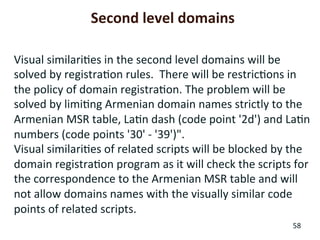
Visual	
  similari+es	
  in	
  the	
  second	
  level	
  domains	
  will	
  be	
  
solved	
  by	
  registra+on	
  rules.	
  	
  There	
  will	
  be	
  restric+ons	
  in	
  
the	
  policy	
  of	
  domain	
  registra+on.	
  The	
  problem	
  will	
  be	
  
solved	
  by	
  limi+ng	
  Armenian	
  domain	
  names	
  strictly	
  to	
  the	
  
Armenian	
  MSR	
  table,	
  La+n	
  dash	
  (code	
  point	
  '2d')	
  and	
  La+n	
  
numbers	
  (code	
  points	
  '30'	
  -­‐	
  '39')".	
  
Visual	
  similari+es	
  of	
  related	
  scripts	
  will	
  be	
  blocked	
  by	
  the	
  
domain	
  registra+on	
  program	
  as	
  it	
  will	
  check	
  the	
  scripts	
  for	
  
the	
  correspondence	
  to	
  the	
  Armenian	
  MSR	
  table	
  and	
  will	
  
not	
  allow	
  domains	
  names	
  with	
  the	
  visually	
  similar	
  code	
  
points	
  of	
  related	
  scripts.	
  	
  
Second	
  level	
  domains	
  
59	
  
Update on Japanese GP
Hiro Hotta <hotta@jprs.co.jp>
Yoshiro Yoneya <yoshiro.yoneya@jprs.co.jp>
Japanese Generation Panel
61
JGP meetings & related events
•  2014	
–  August 29 preparatory meeting (1)
–  September 12 preparatory meeting (2)
–  September 24 formal meeting (1)
–  October 24 formal meeting (2)
–  November 26 formal meeting (3)
–  December 18 formal meeting (4)
•  2015
–  January16 formal meeting (5)
–  February 4 formal meeting (6)
–  February 6 submission of JGP proposal to ICANN
–  February 20 formal meeting (7)
–  March 10 JGP establishment approved by ICANN
–  March 18 formal meeting (8)
–  April 15 formal meeting (9)
–  May 15-16 CJK coordination committee in Seoul
–  May 20 formal meeting (10)
–  June 17 formal meeting (11)
	
Copyright © 2015 Japanese Generation Panel
62
JGP members
•  Members and their expertise
–  Hiro Hotta chair
• Policy/business aspects of registry/registrar
–  Akinori Maemura vice chair
• Internet governance and domain name in general
–  Shigeki Goto
• Internet in general
–  Kazunori Konishi
• Internet in general
–  Tsugizo Kubo
• Trademarks and domain names
–  Yoshitaka Murakami (from February 4, 2015)
• Trademarks and gTLD markets as registry consultant
–  Shuichi Tashiro
• Character codes
–  Yoshiro Yoneya
• Technical aspects of IDN, LGR
Copyright © 2015 Japanese Generation Panel
Relationship among CJK language LGRs 	
Hira	
  
gana	
  
Katak
ana	
  
Han*	
  
Hangul	
  
・・・	
 ・・・	
Japanese LGR	
Chinese LGR	
Korean LGR	
Japanese	
  GP	
 Chinese	
  GP	
 KoreanGP	
coordination	
script	
* “Han” is called “Kanji” in Japan, “Hanja” in Korea	
Copyright © 2015 Japanese Generation Panel
Framework of CJK LGR integration
for Han characters 	
Chinese	
  LGR-­‐1	
  
Japanese	
  LGR-­‐1	
  
Korean	
  LGR-­‐1	
  
LGR-­‐M	
  
Chinese	
  LGR-­‐2	
  
Japanese	
  LGR-­‐2	
  
Korean	
  LGR-­‐2	
  
Developed by each GP
independently	
merge	
 extract	
integrated LGR	
Copyright © 2015 Japanese Generation Panel
65
Activities
•  JGP establishment
–  Proposal submitted to ICANN (February 6, 2015)
–  Establishment approved by ICANN (March 10, 2015)
•  Detailed task description of JGP
–  Done
–  Some more tasks or issues may come out or tasks may be
modified on the way of LGR development
•  through discussion with ICANN/IP
•  through discussion with CGP and KGP (as well as IP)
•  through investigation inside JGP
•  Development of Japanese LGR
–  CJK LGR integration algorithm was developed and agreed by
CGP, JGP, and KGP as a framework
–  As the input to the algorithm, preliminary Japanese LGR (which
is called LGR-1) was developed
Copyright © 2015 Japanese Generation Panel
66
Discussion status for Japanese LGR-1
•  Scopes of the character codes
–  Kanji, Hiragana, Katakana
–  For Kanji
•  JIS (Japanese Industrial Standard) level-1 and level-2
•  Variants & each variant type
–  For Kanji
•  Japanese LGR-1 will define no variants for itself
•  Integrated Japanese LGR (whick is called LGR-2) will import (=
passively adopt) variants of Chinese LGR-1 and Korean LGR-1
•  Types of each variant in Japanese LGR will be defined in a systematic
way == > need more investigation if reduction of allocatable labels is
needed, and how it can be done if needed
•  WLE (whole label evaluation)
–  Japanese LGR-1 may have no or very limited number of tiny rules
even if defined == > need more investigation
More detailed explanation is from the next slide	
Copyright © 2015 Japanese Generation Panel
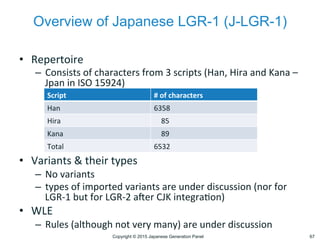
Overview of Japanese LGR-1 (J-LGR-1)	
•  Repertoire	
  
–  Consists	
  of	
  characters	
  from	
  3	
  scripts	
  (Han,	
  Hira	
  and	
  Kana	
  –	
  
Jpan	
  in	
  ISO	
  15924)	
  
•  Variants	
  &	
  their	
  types	
  
–  No	
  variants	
  
–  types	
  of	
  imported	
  variants	
  are	
  under	
  discussion	
  (nor	
  for	
  
LGR-­‐1	
  but	
  for	
  LGR-­‐2	
  aƒer	
  CJK	
  integra+on)	
  
•  WLE	
  
–  Rules	
  (although	
  not	
  very	
  many)	
  are	
  under	
  discussion	
  	
67
Script	
 #	
  of	
  characters	
Han	
 6358	
Hira	


  85	
Kana	


  89	
Total	
 6532	
Copyright © 2015 Japanese Generation Panel
Background of the J-LGR-1 (1/3)	
•  Selec+on	
  of	
  repertoire	
  
– Based	
  on	
  Japanese	
  Industrial	
  Standards	
  (JIS)	
  X	
  
0208:2012	
  Level-­‐1	
  and	
  Level-­‐2	
  
– JIS	
  X	
  0208	
  is	
  most	
  widely	
  used	
  character	
  set	
  in	
  
Japan	
  (all	
  characters	
  have	
  mapping	
  to	
  Unicode)	
  
•  And	
  also	
  has	
  track	
  record	
  in	
  IDN.jp	
  service	
  
– JGP	
  couldn’t	
  find	
  any	
  ra+onal	
  reason	
  to	
  add	
  /	
  
remove	
  characters	
  from	
  JIS	
  X	
  0208	
  
68Copyright © 2015 Japanese Generation Panel
•  Defini+on	
  of	
  variants	
  
–  JGP	
  compared	
  CGP’s	
  draƒ	
  LGR-­‐1	
  and	
  JGP’s	
  draƒ	
  LGR-­‐1	
  
•  Tenta+vely	
  JGP	
  concluded	
  that	
  serious	
  influence	
  of	
  CGP’s	
  
variants	
  to	
  Japanese	
  IDN	
  TLD	
  might	
  be	
  very	
  limited	
  
–  JGP	
  assessed	
  occurrence	
  of	
  “may	
  be	
  seriously	
  affected”	
  
codepoints	
  in	
  currently-­‐registered	
  Japanese	
  .JP	
  domain	
  
names	
  
•  Tenta+vely	
  JGP	
  concluded	
  that	
  such	
  codepoints	
  are	
  mostly	
  
used	
  as	
  independent	
  unique	
  characters	
  in	
  Japanese	
  IDNs	
  
–  From	
  the	
  above	
  assessment,	
  tenta+vely	
  JGP	
  concluded	
  
that	
  no	
  variants	
  needed	
  for	
  Japanese	
  LGR-­‐1	
  	
69Copyright © 2015 Japanese Generation Panel
Background of the J-LGR-1 (2/3)
•  Defini+on	
  of	
  WLE	
  
– JGP	
  considered	
  some	
  trivial	
  cases	
  
•  Hira/Kana	
  Prolonged	
  mark	
  as	
  the	
  first	
  character	
  of	
  a	
  
label	
  
•  Itera+on	
  mark	
  as	
  the	
  first	
  character	
  of	
  a	
  label	
  
– JGP	
  is	
  now	
  discussing	
  if	
  such	
  cases	
  should	
  be	
  
defined	
  in	
  LGR-­‐1	
  or	
  had	
  be=er	
  be	
  assessed	
  at	
  
the	
  new	
  gTLD	
  applica+on	
  evalua+on	
  step	
  by	
  
manned	
  panels	
Copyright © 2015 Japanese Generation Panel 70
Background of the J-LGR-1 (3/3)
Update on Korean GP
Kyongsok Kim
Korea Generation Panel
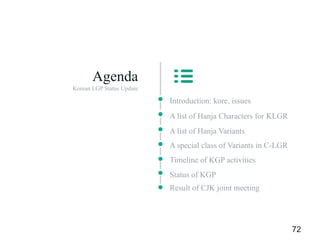
Introduction: kore, issues
A list of Hanja Characters for KLGR
A list of Hanja Variants
A special class of Variants in C-LGR
Timeline of KGP activities
Status of KGP
Result of CJK joint meeting
Agenda
Korean LGP Status Update
72
Characters to be included in “kore” (Korean Label)
 
Issues to be considered in KGP RE: CJK
coordination
 
Both Hangeul and Hanaja will be included
RE : Hanja (Hanzi, Han) : coordination among
CJK.
•  Hanja repertoire
•  Hanja Variants
•  Special class of Hanja Variants in C-LGR
•  Review of variants in C-LGR
•  Timeline of KGP activities
01
 
02
 
Introduction: kore, issues
 
Korean LGP Status Update
73
Alist of Hanja Characters for KLGR
 
Source of
Hanja Character Set # Chars
1) KS X 1001 4,888
2) KPS 9566 4,653
3) IICORE-K column marked 4,743
4) IICORE-KP column marked 4,653
5) Qualifying Examination of Korean Hanja
Proficiency
5,940
Union of 1) ~5)
[Hanja list v0.1 (2015. 5. 11)]
6,046
Missing in MSR-1 -29
[Hanja list v0.2 (2015. 6. 12)]
6,017
74
Korean LGP Status Update
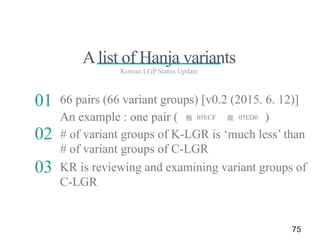
# of variant groups of K-LGR is ‘much less’ than
# of variant groups of C-LGR
66 pairs (66 variant groups) [v0.2 (2015. 6. 12)]
An example : one pair ( )
01
 
02

Idn program update icann53

  • 2.
    IDN Program Update SarmadHussain | IDN Program Sr. Manager | 24 June 2015
  • 3.
    | 3 ¤  IDNProgram - Overview and Progress – Sarmad Hussain ¤  Integration Panel Update – Integration Panel ¤  Community Updates: •  Arabic  Genera+on  Panel  –  Meikal  Mumin   •  Armenian  Genera+on  Panel  –    Igor  Mkrtumyan   •  Japanese  Genera+on  Panel  -­‐  Hiro  Ho=a     •  Korean  Genera+on  Panel    -­‐  Kyongsok  Kim   ¤   Q&A Agenda
  • 4.
    IDN Program –Overview and Progress Sarmad Hussain IDN Program Senior Manager ICANN
  • 5.
    | 5 Overview ofPresentation ¤  IDNs at Top Level •  IDN TLD Program o  Label Generation Ruleset (LGR) o  LGR Toolset o  IDN Variant Implementation •  IDN ccTLD Fast Track Process Implementation ¤  IDNs at Second Level for gTLDs •  IDN Implementation Guidelines •  IDN Tables ¤  Community Outreach and Involvement LGR   Specifica+on   and  Tool  (P1)   LGR   Development   (P2.2)   IDN  Var.   Impl.  (P7)   IDN  ccTLD   Fast  Track   IDN  Language   Tables   IDN    Impl.   Guidelines     Communica+ons  Plan   Execu+on  
  • 6.
    | 6 IDN TLDProgram Reports and documentation of all completed projects available at: https://www.icann.org/resources/pages/reports-2013-04-03-en. PHASE  1  (2011)   Case  Studies:   Arabic   Chinese   Cyrillic   Devanagari   Greek   La+n   PHASE  2  (2011-­‐12)   Integrated  Issues   Report     PHASE  3  (2012-­‐13)   Projects:   P1  LGR  XML   Specifica+on   P2.1  LGR  Process   for  the  Root  Zone   P6  User   Experience  Study   for  TLD  Variants   PHASE  4  (Since  2013)   Projects:   P1  LGR  Specs.   and  Toolset   P2.2  LGR   Development   P7  LGR   Implementa+on   Community agreed to define Label Generation Rules (LGR). Iden+fy  Issues   Define  Problem   Determine   Solu+on   Implement   Solu+on  
  • 7.
    | 7 ¤  MSR-2released on 27 April 2015 ¤  Total 28 scripts, including six additional scripts •  Armenian, Ethiopic, Khmer, Myanmar, Thaana, Tibetan ¤  Total 33,490 code points shortlisted from 97,973 candidates •  Additional 700 from 936 candidate code points in the six scripts ¤  Based on Unicode 6.3 ¤  Upwardly compatible with MSR-1 Maximal Starting Repertoire (MSR-2)
  • 8.
    | 8 ¤  Guidelinesreleased for GPs on 27 April 2015 ¤  https://www.icann.org/public-comments/lgr- guidelines-2015-01-15-en •  Guidelines for Developing Script‐Specific Label Generation Rules for Integration into the Root Zone LGR •  Considerations for Designing a Label Generation Ruleset for the Root Zone •  Requirements for LGR Proposals ¤  Technical documents: •  Variant Rules •  Whole Label Evaluation (WLE) Rules •  Representing Label Generation Rulesets using XML Guidelines for Generation Panels
  • 9.
    | 9 Status ofLGR Development •  28+  Scripts   •  18+  Genera+on  Panels   ¤  Other: •  Ethiopic •  Georgian •  Hebrew •  Latin •  Thaana •  Thai
  • 10.
    | 10 LGR  Tool   Code Point Rules Variant Rules WLE Rules LGR Specification and Toolset ¤  LGR machine-readable specifications at: https://datatracker.ietf.org/doc/draft-davies-idntables ¤  Public Comment on tool requirement: 3 Dec. 2014 ¤  Toolset tentative timeline: •  Create LGR – 09/15 •  Use LGR – 12/15 •  Manage LGRs – 3/16 •  Open source
  • 11.
    | 11 Create UseCase: Code Point Screens Flow Code points list screen Add code points modal Edit code point screen Edit references modal Add variant modal
  • 13.
    | 13 IDN ccTLDFast Track Process ¤  Completed five years of operation •  Requests in 18 scripts for 27 languages •  37 IDN ccTLDs delegated in the Root Zone representing 29 countries/territories ¤  Currently under annual review •  Public comment announced on 15 Jan. 2015 o  Second similarity review and process •  Public comment closed on 17 March 2015 •  Next steps based on direction from the Board
  • 14.
    | 14 ¤  Submittedby new gTLD registries intending to offer IDNs: •  Varied character repertoire and contextual rules •  Reference Label Generation Rulesets (LGRs) for facilitation and consistency in Pre-Delegation Testing (PDT) and the Registry Service Evaluation Process (RSEP) •  Reuse for better end-user experience ¤  Current Status •  Development through vendor o  Guidelines and documentation of authoritative sources o  IDN table in LGR format o  Expert review: linguistic and security and stability o  Public comments o  Publication after incorporating public feedback •  Public comment – update process to allow review; coordinate with GPs; wait till LGR for Root Zone; why LGR format •  RFP released on 5 June 2015 – responses by 7 July 2015 IDN Tables
  • 15.
    | 15 ¤  Backgroundand motivation •  To promote IDN registration policies and practices and to minimize consumer risk and confusion •  Last updated in 2011; GNSO community requested for review ¤  Next steps •  Formulate a WG to undertake the review IDN Implementation Guidelines
  • 16.
    | 16 ¤  IDNProgram sessions at ICANN meetings ¤  IDN Program updates to SOs/ACs at ICANN meetings ¤  Presentations •  APRALO-APAC Hub Webinar on IDNs on 9 April 2015 •  Support IDN related outreach (APRICOT, MENOG, Russian IGF, DNS Forum, Africa Internet Summit) •  Direct outreach (Cambodia, Laos, Myanmar, Pakistan) ¤  IDN pages at ICANN Community Wiki and ICANN website ¤  IDN mailing lists •  {vip, lgr, ArabicGP, ArmenianGP, ChineseGP, …}@icann.org Communication and Outreach Efforts
  • 17.
    | 17 Get Involved Volunteerfor your script Generation Panel (GP) To contribute expertise, contribute to the GP for your script. You can get involved by simply emailing your CV and a brief statement of interest to idntlds@icann.org Volunteer Review Listen Review work through public comments Sign up for the IDN mailing list vip@icann.org (to sign up, visit https://mm.icann.org/listinfo/vip) and participated in the review of IDN work being done at ICANN through the public comments Stay up to date Attend regular IDN Program Update sessions at ICANN meetings and sign up on the IDN mailing list vip@icann.org to get updates on the IDN Program at ICANN
  • 18.
    | 18 Useful Linksfor IDN Program •  To join a Generation Panel for your language, submit CV and statement of interest at: idntlds@icann.org; call for Generation Panels: http://www.icann.org/en/news/announcements/announcement-11jul13-en.htm •  LGR Document Repository: https://community.icann.org/display/croscomlgrprocedure/Document+Repository •  Community Wiki for LGR Project: https://community.icann.org/display/croscomlgrprocedure/Root+Zone+LGR+Project •  IDN ccTLD Fast Track Page: https://www.icann.org/resources/pages/string-evaluation-completion-2014-02-19-en •  IDN Implementation Guidelines: https://www.icann.org/resources/pages/implementation-guidelines-2012-02-25-en
  • 19.
    Integration Panel Updates AsmusFreytag Integration Panel IDN Program
  • 20.
    | 20 Maximal Starting Repertoire– version 2 Guidelines for Generation Panels Support to Generation Panels Planning Communications and Outreach Preparation for Integration of LGR Proposals Here’s a place to introduce your sixth agenda item from your talk. 1 2 3 4 5 Integration Panel Activities Since ICANN 52
  • 21.
    | 21 Maximal StartingRepertoire – v.2 [MSR-2] ¤  Includes six new scripts: •  Armenian, Ethiopic, Khmer, Myanmar, Thaana, Tibetan •  Existing 22 scripts in MSR-1 unchanged ¤  Now the basis for current round of LGR proposals ¤  Other scripts explored, not yet ready for inclusion •  Cherokee •  Undergoing revision – addition of lower-case register •  Canadian Aboriginal Syllabic (CAS) •  Doubts on level of use, community-preparedness •  Others still (e.g. Ol Chiki ...)
  • 22.
    | 22 MSR-2 Statistics Script   PVALID   MSR-­‐2   Armenian   39   38   Ethiopic   456   364   Khmer   95   78   Myanmar   177   90   Thaana   50   50   Tibetan   119   80   TOTAL   936   700   MSR-­‐1   MSR-­‐2   Scripts   22   28   Code  Points   32,790   33,490   MSR-2 Scripts MSR-1 vs. MSR-2 IDNA2008 PVALID   Unicode  6.3   97,946  
  • 23.
    | 23 MSR-2 –Keeping Pace with Unicode ¤  IETF has identified a problem in Unicode 7.0, and therefore stopped updating IDNA2008 at 6.3 •  Unicode 8.0 just released •  Unicode 9.0 to be delivered next year ¤  Result: When IETF resumes update of IDNA2008, MSR may need to include newly coded characters
  • 24.
    | 24 ¤  OverviewDocuments •  Guidelines for Developing Script‐Specific Label Generation Rules for Integration into the Root Zone LGR •  Considerations for Designing a Label Generation Ruleset for the Root Zone •  Requirements for LGR Proposals •  Summary Guidelines ¤  Background Technical Documents •  Variant Rules •  Whole Label Evaluation (WLE) Rules •  Representing Label Generation Rulesets using XML •  Packaging the MSR and LGR ¤  Foundation Documents •  Procedure to Develop and Maintain the Label Generation Rules for the Root Zone in Respect of IDNA Labels •  MSR-2 Guidelines for Generation Panels
  • 25.
    | 25 ¤ Root ZoneLGR Project Wiki •  https://community.icann.org/display/croscomlgrprocedure/Root +Zone+LGR+Project ¤ Root Zone LGR Project Document Repository •  https://community.icann.org/display/croscomlgrprocedure/ Document+Repository Resources
  • 26.
    | 26 Generation Panels– State of Play Draft LGRs received Arabic, Armenian 1 2 Detailed discussions Chinese, Japanese, Korean 3 Proposals to form GPs received and under review Neo-Brahmi (Indian), Cyrillic, Khmer Best strategies to co-ordinate use of Han (Chinese) characters across CJK, esp. variants (e.g., Seoul meeting 15-16 May) Note: Progress in understanding co-ordination to aid future GPs. Panels have requested ICANN to appoint technical advisor for co-ordination.
  • 27.
    | 27 Planning, Communicationsand Outreach ¤  Prepare work-plan for FY 2015-2016: •  Review first LGRs (label generation rule-sets) received from script GPs (generation panels) •  Produce first combined sets of LGRs  •  Evaluate need for MSR-3 (with/without extra scripts) •  Support new GPs as they form, and begin work on LGRs ¤  Note critical dependence on: •  Speed of formation of GPs •  Number of GPs concurrently active •  Time-scale to LGR submission 
  • 28.
    | 28 Preparation forIntegration of LGR Proposals ¤  Review plans to package Integrated Root Zone LGR ¤  Process: •  Get familiar with linguistic and technical issues of each script •  Develop/refine tools to validate and correlate LGRs as received •  Integrate effects of rules across scripts, e.g. o  Contrasting variants, as among different languages using Han o  Confusability among characters of different scripts ¤  Ultimate goals: •  A set of mechanical verification steps •  Applicable to preliminary and final LGRs
  • 29.
    | 29 From theIntegration Panel Thank you for your attention! Wil Tan, Marc Blanchet, Asmus Freytag, Michel Suignard, Nicholas Ostler
  • 30.
    Update on ArabicGP Meikal Mumin Task Force on Arabic Script IDNs (TF-AIDN) / Arabic Generation Panel
  • 31.
    | 31 ¤  TF-AIDNhas open membership ¤  33 members ¤  18 countries ¤  Current members speak 9 languages using Arabic script, with further expertise in use of Arabic script from East Asia, South Asia, Middle East, Maghreb countries and Africa ¤  Current members come from diverse disciplines – academia (linguistics and technical), registries, registrars, national and regional policy bodies, community based organizations, technical community Membership
  • 32.
    | 32 Arabic ScriptTLDs Assigned or Delegated  ‫ر‬‫اجلزائ‬   ‫بھارت‬   ‫تونس‬  ‫ن‬‫عما‬   ‫املغرب‬   ‫مصر‬  ‫ن‬‫ایرا‬   ‫السعودية‬   ‫قطر‬  ‫ت‬‫امارا‬   ‫سودان‬   ‫فلسطني‬  ‫ر‬‫بازا‬   ‫مليسيا‬  ‫ق‬‫عرا‬  ‫ن‬‫پاکستا‬   ‫شبكة‬  ‫ع‬‫موق‬  ‫ن‬‫االرد‬   ‫سورية‬
  • 33.
    | 33 ¤  Formationof Arabic Script Generation Panel ¤  Code point analysis ¤  Establishing principles for inclusion, exclusion, and deferral of Unicode code points ¤  Analysis of Maximum Starting Repertoire (MSR) and feedback to Integration Panel (IP) ¤  Analysis of code points for Label Generation Rules (LGR) ¤  Code point variants ¤  Establishing principles for code point variants ¤  Analysis of code points for code points variants ¤  Analysis of code point variant dispositions (allocatable vs. blocked) Progress - Work accomplished - 1
  • 34.
    | 34 ¤  Developmentof Whole Label Evaluation (WLE) rules ¤  Establishing principles for WLE rules ¤  Determining the WLE rules ¤  Documentation of the work ¤  Text document summarizing Label Generation Rules for Arabic ¤  Label Generation Rules for Arabic in XML format ¤  Finalization of LGR proposal at F2F meeting in Singapore (ICANN52) ¤  Discussion with Integration Panel (IP) for feedback ¤  Currently reviewing IP feedback and finalizing proposal ¤  Next steps: Publish the final proposal for public comments Progress - Work accomplished - 2
  • 35.
    | 35 Current CodePoint Repertoire
  • 36.
    | 36 Examples ofVariants     06C1   06D5   b/b     06C1   0647   a/a   Labels  in  Arabic  language  using  0647  in  the  final  and  isolated   positions  will  be  typed  in  other  languages  using  06C1  (Urdu,   Pashto,  Saraiki,  etc.)  which  is  identical  in  isolated  and  has  a   variant  glyph  or  identical  glyph  form  in  final  position.   06C1   06BE   b/b     06C1   0629   b/b     06C1   06C3   b/b     06C1   06C0   b/b     06C1   06C2   b/a   06C1  -­‐>b  06C2  (blocked),  06C2  -­‐>a  06C1  (allocatable)   Partial table for HEH
  • 37.
    | 37 Examples ofWLE Rules S.No.   Code  points  cannot  co-­‐ occur  within  a  label   Notes   1   0643  and  06A9     ‫  ﻙك‬and  ‫ﮎک‬     2   0643  and  06AA   ‫  ﻙك‬and  ‫ڪ‬   3   06CC  and  0649     ‫  ﯼی‬and  ‫ﻯى‬     4   06C1  and  0647   ‫  ﻩه‬and  ‫ﻩه‬   5   06C1  and  06D5   ‫  ﻩه‬and  ‫ە‬   6   0647  and  06D5   ‫  ﻩه‬and  ‫ە‬   7   0647  and  06BE   ‫  ﻩه‬and  ‫ﻫﮬﮪھ‬   8   0629  and  06C3   ‫  ﺓة‬and  ‫ﺓة‬    
  • 38.
    | 38 Sample Output Genera+ng  all  variants  for  "‎‫ن‬‫پاکستا‬‎"  (067E  0627  06A9  0633  062A  0627  0646)   (IDN  ccTLD  for  Pakistan)     Variant:  ‎‫ں‬‫پاكستا‬‎    (067E  0627  0643  0633  062A  0627  06BA)     Variant:  ‎‫ن‬‫پاكستا‬‎    (067E  0627  0643  0633  062A  0627  0646)     Variant:  ‎‫ں‬‫پاڪستا‬‎    (067E  0627  06AA  0633  062A  0627  06BA)     Variant:  ‎‫ن‬‫پاڪستا‬‎    (067E  0627  06AA  0633  062A  0627  0646)     Variant:  ‎‫ں‬‫پاکستا‬‎    (067E  0627  06A9  0633  062A  0627  06BA)       1200  variants  generated  for  "‎‫ن‬‫پاکستا‬‎"  (067E  0627  06A9  0633  062A  0627   0646)     By  disposi+on:  {  allocatable=5,  blocked=1194,  original=1  }  
  • 39.
    | 39 Thank You ¤ Workspace, news and document archive at https://community.icann.org/display/MES/TF-AIDN+Work+Space ¤  Publicly archived email discussion at http://lists.meswg.org/mailman/listinfo/tf-aidn
  • 40.
    Update on ArmenianGP Igor Mkrtumyan Armenian Generation Panel Igor  
  • 41.
    General  informaBon   Armenian  IDN     •  Code:  Armn   •  N°:  230   •  English  Name:  Armenian   •  English  name  of  the  script:  Hye   •  Na+ve  name  of  the  script:  հայ   The  announcement  for  the  successful  comple1on  of   Armenia's  string  evalua1on  has  been  posted  at   h9ps://www.icann.org/news/ announcement-­‐2014-­‐11-­‐20-­‐en.   41  
  • 42.
    42   •  The  Armenian  language  is  an  Indo-­‐European   language  spoken  by  the  Armenians.  It  is  the   official  language  of  the  Republic  of   Armenia  and  the  self-­‐proclaimed  Nagorno-­‐ Karabakh  Republic.  It  has  historically  been   spoken  throughout  the  Armenian   Highlands  and  today  is  widely  spoken  in   the  Armenian  Diaspora.     Armenian  language  
  • 43.
    Armenian  language   • Armenians  has  its  own  unique  script,   the  Armenian  alphabet,  invented  in  405  AD   by  Mesrop  Mashtots.   •  Linguists  classify  Armenian  as  an  independent   branch  of  the  Indo-­‐European  language  family.   •  There  are  two  standardized  modern  literary   forms,  Eastern  Armenian  and  Western   Armenian,  with  which  most  contemporary   dialects  are  mutually  intelligible.     •  Total  Armenian  popula+on  in  the  world  is  about   10mln.   43  
  • 44.
    44   Official  language  in  Armenia  and  Nagorno  Karabakh   Republic   Big  Diaspora  using  the  Armenian  language  in           Argen+na   Lebanon   Brazil   Poland   Cyprus     Romania   France   Syria   Georgia   Turkey   Hungary   Ukraine    Iran   United  States   Iraq   Uruguay   Geographic  territories  or  countries  with   significant  user  communiBes  for  the  script  
  • 45.
    45   Armenian  GP   •  Armenian  GP  was  created   •  Armenian  GP  mailing  list  was  created   Armeniangp@icann.org   •  General  informa+on  about  the  mailing  list  is  at:   h=ps://mm.icann.org/mailman/lis+nfo/armeniangp  
  • 46.
    Armenian  MSR-­‐2  table   46   •  There  are  two  standardized  mutually  intelligible   modern  literary  forms,  Eastern  Armenian  and   Western  Armenian  with  some  difference  in   orthographies.  But  as  both  are  wri=en  with  the   same  script  it  doesn’t  influence  the  LGR   document.     The  following  web  site  contains  a  full  descrip+on   of  the  Armenian  repertoire  for  use  in  the   Armenian  wri+ng  system:   h=p://www.omniglot.com/wri+ng/armenian.htm  
  • 47.
  • 48.
  • 49.
    Armenian  MSR-­‐2  table   49   •  This  defines  a  formal  reference  for  the   jus+fica+on  of  the  repertoire  for  this  proposal.   •  The  following  subset  of  code  points  iden+fied  as   the  Unicode  range  U+0561..U+0586  will  be   available  for  the  root  zone:  
  • 50.
    Selected  code  points   50   Code   Script   Name   Code   Script   Name   0561     ա     ARMENIAN  SMALL  LETTER  AYB   0574    մ     ARMENIAN  SMALL  LETTER  MEN   0562    բ     ARMENIAN  SMALL  LETTER  BEN   0575    յ     RMENIAN  SMALL  LETTER  YI   0563     գ     ARMENIAN  SMALL  LETTER  GIM   0576    ն     ARMENIAN  SMALL  LETTER  NOW   0564     դ   ARMENIAN  SMALL  LETTER  DA   0577    շ     ARMENIAN  SMALL  LETTER  SHA   0565     ե   ARMENIAN  SMALL  LETTER  ECH   0578    ո     ARMENIAN  SMALL  LETTER  VO   0566     զ   ARMENIAN  SMALL  LETTER  ZA   0579    չ     ARMENIAN  SMALL  LETTER  CHA   0567    է     ARMENIAN  SMALL  LETTER  EH   057A    պ    ARMENIAN  SMALL  LETTER  PEH   0568     ը     ARMENIAN  SMALL  LETTER  ET   057B    ջ     ARMENIAN  SMALL  LETTER  JHEH   0569     թ   ARMENIAN  SMALL  LETTER  TO   057C    ռ     ARMENIAN  SMALL  LETTER  RA   056A     ժ   ARMENIAN  SMALL  LETTER  ZHE   057D    ս   ARMENIAN  SMALL  LETTER  SEH   056B     ի   ARMENIAN  SMALL  LETTER  INI   057E    վ     ARMENIAN  SMALL  LETTER  VEW   056C    լ     ARMENIAN  SMALL  LETTER  LIWN   057F    տ    ARMENIAN  SMALL  LETTER  TIWN   056D    խ    ARMENIAN  SMALL  LETTER  XEH   0580    ր     ARMENIAN  SMALL  LETTER  REH   056E    ծ     ARMENIAN  SMALL  LETTER  CA   0581    ց     ARMENIAN  SMALL  LETTER  CO   056F    կ     ARMENIAN  SMALL  LETTER  KEN   0582    ւ     ARMENIAN  SMALL  LETTER  YIWN   0570    հ     ARMENIAN  SMALL  LETTER  HO   0583    փ    ARMENIAN  SMALL  LETTER  PIWR   0571    ձ     ARMENIAN  SMALL  LETTER  JA   0584    ք     ARMENIAN  SMALL  LETTER  KEH   0572    ղ     ARMENIAN  SMALL  LETTER  GHAD   0585    օ     ARMENIAN  SMALL  LETTER  OH   0573    ճ     ARMENIAN  SMALL  LETTER  CHEH   0586    ֆ     ARMENIAN  SMALL  LETTER  FEH  
  • 51.
    Variants   51   There  is  some  similarity  between  Armenian   le=ers  GIM  and  ZA  but  we  considered  that   it  is  not  enough  to  include  them  into   variants.  So  our  conclusion  is:    The  Armenian  repertoire  does  not  contain   in-­‐script  variants.      
  • 52.
    Cross-­‐script  homoglyphs     52   •  Cyrillic,  Greek  and  La+n  scripts  are   examples  of  related  scripts  where  some   cross-­‐script  homoglyphs  exist.      
  • 53.
    Armenian-­‐Cyrillic  homoglyphs   53   Armenian Le=er   Cyrillic  Le=er   հ  U+0570  Armenian   small  le=er  HO   Һ U+04BB  Cyrillic  small  le=er     SHHA   օ  U+0585  Armenian   small  le=er  OH     о  U+043E  Cyrillic  small  le=er   O   ‘ո’  U+0578  Armenian  small  le=er  VO  and  ‘п’  U+43F  Cyrillic  small  le=er  PE  are  usually   somewhat  dis+nct,  unless  both  are  in  italic  serif  style,  like  ‘п’  vs.  ‘n’,  where  they  would   be  homoglyphs.  However,  they  are  not  included  into  cross-­‐script  variants  because   italic  font  styles  are  insufficient  jus+fica+on  for  crea+ng  a  cross-­‐script  variant,   especially  as  that  is  not  the  most  common  style  for  presen+ng  domain  names  to  the   user.    
  • 54.
    Armenian  and  LaBn  homoglyphs   54   Armenian Letter   Latin Letter   զ  U+0566  Armenian  small  le=er  ZA   q  U+0071  La+n  small  le=er  Q   հ  U+0570  Armenian  small  le=er  HO   h  U+0068  La+n  small  le=er  H   ո  U+0578  Armenian  small  le=er  VO   n  U+006E  La+n  small  le=er  N   ս  U+057D  Armenian  small  le=er  SHE   u  U+0075  La+n  small  le=er  U   ց  U+0581  Armenian  small  le=er  CO   g  U+0067  La+n  small  le=er  G   ւ  U+0582  Armenian  small  le=er   YIWN   ɩ  U+0269  La+n  small  le=er   IOTA   օ  U+0585  Armenian  small  le=er  OH   o  U+006F  La+n  small  le=er  O  
  • 55.
    Armenian  and  LaBn  homoglyphs   55   The  ARMENIAN  SMALL  LETTER  ZA  and  the  LATIN  SMALL  LETTER  Q   are  not  perfect  homoglyphs  but  the  difference  is  may  not  be   perceivable  at  normal  size.  A  label,  such  as  .զսօ  would  be  readily   accepted  by  users  as  “the  same”  as  the  label    .quo  (in  La+n).   The  ‘g’  homoglyph  situa+on  only  exists  in  sans-­‐serif  style,  which,   however,  is  a  very  common  choice  for  user  interfaces.   Armenian  YIWN  and  La+n  IOTA  are  considered  homoglyphs  as   their  visual  percep+on  is  quite  similar.     The  ARMENIAN  LETTER  YI  and  j  U+006A  LATIN  SMALL  LETTER  J   are  not  considered  homoglyphs  as  “dot”  changes  the  visual   percep+on  of  the  le=er.  That  is  why  this  case  is  not  included  into   the  cross-­‐script  variants.      
  • 56.
    Armenian  and  Greek  homoglyphs   56   Armenian  Le=er   Greek  Le=er   ղ  U+0572  Armenian  small  le=er   GHAD   η  U+03B7  Greek  small  le=er  ETA   ւ  U+0582  Armenian  small  le=er   YIWN   ι  U+03B9  Greek  small  le=er  IOTA   օ  U+0585  Armenian  small  le=er   OH   ο  U+03BF  Greek  small  le=er   OMICRON   Armenian  YIWN  and  Greek  IOTA  as  well  as  Armenian  GHAD  and   Greek  ETA  are  considered  homoglyphs  as  their  visual  percep+on  is   quite  similar.  They  are  included  in  the  cross-­‐script  variants.     The  case  of  OH/OMICRON/Cyrillic  O/La+n  O  is  considered  cross-­‐ script  homoglyphs  because  of  strong  similarity.    
  • 57.
    57   Conclusions   As  result  of  integra+on,  blocked  variants  can  exist  between  script-­‐specific   repertoires.   Even  if  a  label  is  applied  for  in  one  script,  the  existence  of  certain  other  labels   in  another  script  may  block  it  from  being  delegated  .     For  example,  both  .uno  and  .սոօ  would  be  well-­‐formed  TLDs  in  La+n  and   Armenian,   If  one  of  these  two  labels  is  applied  for  and  allocated,  the  other  would  be   blocked.  Otherwise,  both  could  be  independently  allocated  to  different   applicants  causing  user  confusion.     Armenian  GP  is  hardly  expec+ng  any  other  applica+on  for  an  Armenian  TLD   but  in  cases  when  there  is  a  homoglyph  similarity  in  related  scripts  it  should   be  blocked.     The  Armenian  GP  has  added  out  of  repertoire  blocked  variants  for  all   homoglyphs  inves+gated  above,  except  for  cases  iden+fied  as  merely   "similar".    
  • 58.
    58   Visual  similari+es  in  the  second  level  domains  will  be   solved  by  registra+on  rules.    There  will  be  restric+ons  in   the  policy  of  domain  registra+on.  The  problem  will  be   solved  by  limi+ng  Armenian  domain  names  strictly  to  the   Armenian  MSR  table,  La+n  dash  (code  point  '2d')  and  La+n   numbers  (code  points  '30'  -­‐  '39')".   Visual  similari+es  of  related  scripts  will  be  blocked  by  the   domain  registra+on  program  as  it  will  check  the  scripts  for   the  correspondence  to  the  Armenian  MSR  table  and  will   not  allow  domains  names  with  the  visually  similar  code   points  of  related  scripts.     Second  level  domains  
  • 59.
  • 60.
    Update on JapaneseGP Hiro Hotta <hotta@jprs.co.jp> Yoshiro Yoneya <yoshiro.yoneya@jprs.co.jp> Japanese Generation Panel
  • 61.
    61 JGP meetings &related events •  2014 –  August 29 preparatory meeting (1) –  September 12 preparatory meeting (2) –  September 24 formal meeting (1) –  October 24 formal meeting (2) –  November 26 formal meeting (3) –  December 18 formal meeting (4) •  2015 –  January16 formal meeting (5) –  February 4 formal meeting (6) –  February 6 submission of JGP proposal to ICANN –  February 20 formal meeting (7) –  March 10 JGP establishment approved by ICANN –  March 18 formal meeting (8) –  April 15 formal meeting (9) –  May 15-16 CJK coordination committee in Seoul –  May 20 formal meeting (10) –  June 17 formal meeting (11) Copyright © 2015 Japanese Generation Panel
  • 62.
    62 JGP members •  Membersand their expertise –  Hiro Hotta chair • Policy/business aspects of registry/registrar –  Akinori Maemura vice chair • Internet governance and domain name in general –  Shigeki Goto • Internet in general –  Kazunori Konishi • Internet in general –  Tsugizo Kubo • Trademarks and domain names –  Yoshitaka Murakami (from February 4, 2015) • Trademarks and gTLD markets as registry consultant –  Shuichi Tashiro • Character codes –  Yoshiro Yoneya • Technical aspects of IDN, LGR Copyright © 2015 Japanese Generation Panel
  • 63.
    Relationship among CJKlanguage LGRs Hira   gana   Katak ana   Han*   Hangul   ・・・ ・・・ Japanese LGR Chinese LGR Korean LGR Japanese  GP Chinese  GP KoreanGP coordination script * “Han” is called “Kanji” in Japan, “Hanja” in Korea Copyright © 2015 Japanese Generation Panel
  • 64.
    Framework of CJKLGR integration for Han characters Chinese  LGR-­‐1   Japanese  LGR-­‐1   Korean  LGR-­‐1   LGR-­‐M   Chinese  LGR-­‐2   Japanese  LGR-­‐2   Korean  LGR-­‐2   Developed by each GP independently merge extract integrated LGR Copyright © 2015 Japanese Generation Panel
  • 65.
    65 Activities •  JGP establishment – Proposal submitted to ICANN (February 6, 2015) –  Establishment approved by ICANN (March 10, 2015) •  Detailed task description of JGP –  Done –  Some more tasks or issues may come out or tasks may be modified on the way of LGR development •  through discussion with ICANN/IP •  through discussion with CGP and KGP (as well as IP) •  through investigation inside JGP •  Development of Japanese LGR –  CJK LGR integration algorithm was developed and agreed by CGP, JGP, and KGP as a framework –  As the input to the algorithm, preliminary Japanese LGR (which is called LGR-1) was developed Copyright © 2015 Japanese Generation Panel
  • 66.
    66 Discussion status forJapanese LGR-1 •  Scopes of the character codes –  Kanji, Hiragana, Katakana –  For Kanji •  JIS (Japanese Industrial Standard) level-1 and level-2 •  Variants & each variant type –  For Kanji •  Japanese LGR-1 will define no variants for itself •  Integrated Japanese LGR (whick is called LGR-2) will import (= passively adopt) variants of Chinese LGR-1 and Korean LGR-1 •  Types of each variant in Japanese LGR will be defined in a systematic way == > need more investigation if reduction of allocatable labels is needed, and how it can be done if needed •  WLE (whole label evaluation) –  Japanese LGR-1 may have no or very limited number of tiny rules even if defined == > need more investigation More detailed explanation is from the next slide Copyright © 2015 Japanese Generation Panel
  • 67.
    Overview of JapaneseLGR-1 (J-LGR-1) •  Repertoire   –  Consists  of  characters  from  3  scripts  (Han,  Hira  and  Kana  –   Jpan  in  ISO  15924)   •  Variants  &  their  types   –  No  variants   –  types  of  imported  variants  are  under  discussion  (nor  for   LGR-­‐1  but  for  LGR-­‐2  aƒer  CJK  integra+on)   •  WLE   –  Rules  (although  not  very  many)  are  under  discussion   67 Script #  of  characters Han 6358 Hira        85 Kana        89 Total 6532 Copyright © 2015 Japanese Generation Panel
  • 68.
    Background of theJ-LGR-1 (1/3) •  Selec+on  of  repertoire   – Based  on  Japanese  Industrial  Standards  (JIS)  X   0208:2012  Level-­‐1  and  Level-­‐2   – JIS  X  0208  is  most  widely  used  character  set  in   Japan  (all  characters  have  mapping  to  Unicode)   •  And  also  has  track  record  in  IDN.jp  service   – JGP  couldn’t  find  any  ra+onal  reason  to  add  /   remove  characters  from  JIS  X  0208   68Copyright © 2015 Japanese Generation Panel
  • 69.
    •  Defini+on  of  variants   –  JGP  compared  CGP’s  draƒ  LGR-­‐1  and  JGP’s  draƒ  LGR-­‐1   •  Tenta+vely  JGP  concluded  that  serious  influence  of  CGP’s   variants  to  Japanese  IDN  TLD  might  be  very  limited   –  JGP  assessed  occurrence  of  “may  be  seriously  affected”   codepoints  in  currently-­‐registered  Japanese  .JP  domain   names   •  Tenta+vely  JGP  concluded  that  such  codepoints  are  mostly   used  as  independent  unique  characters  in  Japanese  IDNs   –  From  the  above  assessment,  tenta+vely  JGP  concluded   that  no  variants  needed  for  Japanese  LGR-­‐1   69Copyright © 2015 Japanese Generation Panel Background of the J-LGR-1 (2/3)
  • 70.
    •  Defini+on  of  WLE   – JGP  considered  some  trivial  cases   •  Hira/Kana  Prolonged  mark  as  the  first  character  of  a   label   •  Itera+on  mark  as  the  first  character  of  a  label   – JGP  is  now  discussing  if  such  cases  should  be   defined  in  LGR-­‐1  or  had  be=er  be  assessed  at   the  new  gTLD  applica+on  evalua+on  step  by   manned  panels Copyright © 2015 Japanese Generation Panel 70 Background of the J-LGR-1 (3/3)
  • 71.
    Update on KoreanGP Kyongsok Kim Korea Generation Panel
  • 72.
    Introduction: kore, issues Alist of Hanja Characters for KLGR A list of Hanja Variants A special class of Variants in C-LGR Timeline of KGP activities Status of KGP Result of CJK joint meeting Agenda Korean LGP Status Update 72
  • 73.
    Characters to beincluded in “kore” (Korean Label)
  • 74.
      Issues to beconsidered in KGP RE: CJK coordination
  • 75.
      Both Hangeul andHanaja will be included RE : Hanja (Hanzi, Han) : coordination among CJK. •  Hanja repertoire •  Hanja Variants •  Special class of Hanja Variants in C-LGR •  Review of variants in C-LGR •  Timeline of KGP activities 01
  • 76.
  • 77.
  • 78.
  • 79.
    Alist of HanjaCharacters for KLGR
  • 80.
      Source of Hanja CharacterSet # Chars 1) KS X 1001 4,888 2) KPS 9566 4,653 3) IICORE-K column marked 4,743 4) IICORE-KP column marked 4,653 5) Qualifying Examination of Korean Hanja Proficiency 5,940 Union of 1) ~5) [Hanja list v0.1 (2015. 5. 11)] 6,046 Missing in MSR-1 -29 [Hanja list v0.2 (2015. 6. 12)] 6,017 74 Korean LGP Status Update
  • 81.
    # of variantgroups of K-LGR is ‘much less’ than # of variant groups of C-LGR 66 pairs (66 variant groups) [v0.2 (2015. 6. 12)] An example : one pair ( ) 01
  • 82.