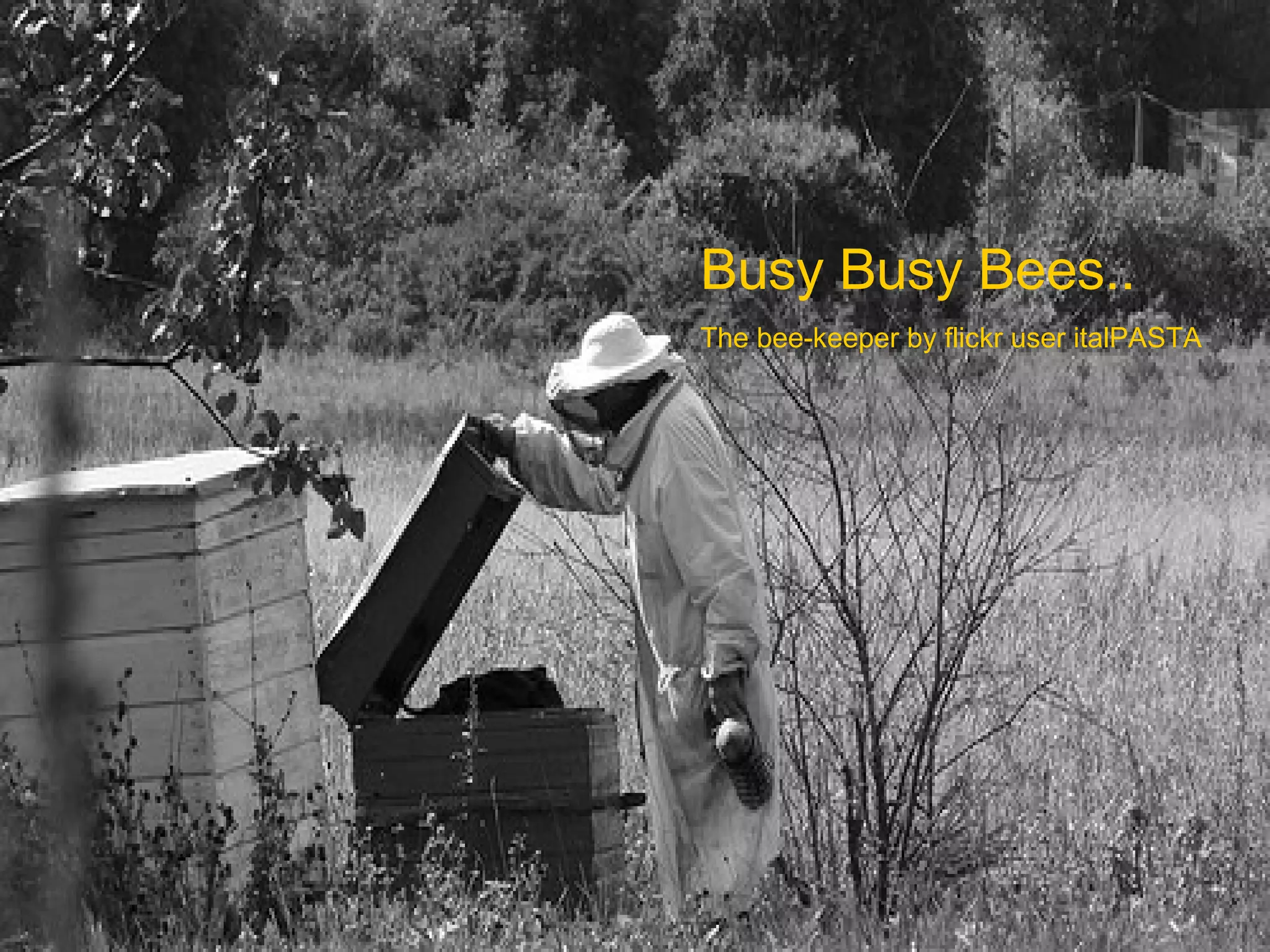
Busy Busy Bees.. The bee-keeper by flickr user italPASTA
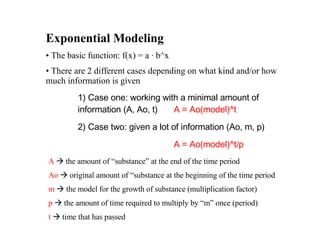
Exponential Modeling The basic function: f(x) = a · b^x There are 2 different cases depending on what kind and/or how much information is given  1) Case one: working with a minimal amount of  information (A, Ao, t) A = Ao(model)^t 2) Case two: given a lot of information (Ao, m, p) A = Ao(model)^t/p A     the amount of “substance” at the end of the time period Ao     original amount of “substance at the beginning of the time period m     the model for the growth of substance (multiplication factor) p     the amount of time required to multiply by “m” once (period) t     time that has passed
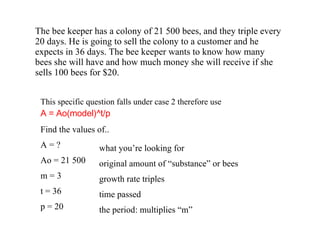
The bee keeper has a colony of 21 500 bees, and they triple every 20 days. He is going to sell the colony to a customer and he expects in 36 days. The bee keeper wants to know how many bees she will have and how much money she will receive if she sells 100 bees for $20. Find the values of.. A = ? Ao = 21 500 m = 3  t = 36 p = 20  This specific question falls under case 2 therefore use   A = Ao(model)^t/p what you’re looking for original amount of “substance” or bees growth rate triples time passed the period: multiplies “m”
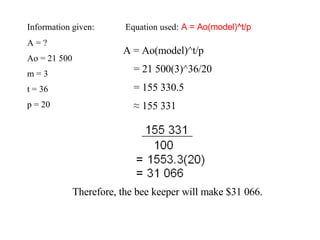
Information given:  Equation used:   A = Ao(model)^t/p A = ? Ao = 21 500 m = 3  t = 36 p = 20  A = Ao(model)^t/p = 21 500(3)^36/20 = 155 330.5 ≈   155 331 Therefore, the bee keeper will make $31 066.
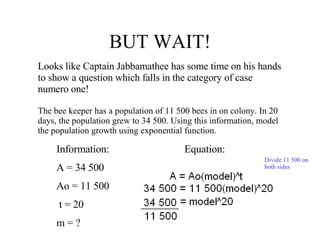
BUT WAIT! Looks like Captain Jabbamathee has some time on his hands to show a question which falls in the category of case numero one! The bee keeper has a population of 11 500 bees in on colony. In 20 days, the population grew to 34 500. Using this information, model the population growth using exponential function.  Information: Equation: A = 34 500 Ao = 11 500 t = 20 m = ?  Divide 11 500 on both sides
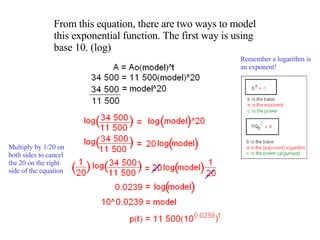
From this equation, there are two ways to model this exponential function. The first way is using base 10. (log) Remember a logarithm is an exponent! Multiply by 1/20 on both sides to cancel the 20 on the right side of the equation
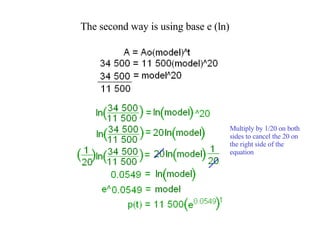
The second way is using base e (ln) Multiply by 1/20 on both sides to cancel the 20 on the right side of the equation

Logproblempres

  • 1.
    Busy Busy Bees..The bee-keeper by flickr user italPASTA
  • 2.
    Exponential Modeling Thebasic function: f(x) = a · b^x There are 2 different cases depending on what kind and/or how much information is given 1) Case one: working with a minimal amount of information (A, Ao, t) A = Ao(model)^t 2) Case two: given a lot of information (Ao, m, p) A = Ao(model)^t/p A  the amount of “substance” at the end of the time period Ao  original amount of “substance at the beginning of the time period m  the model for the growth of substance (multiplication factor) p  the amount of time required to multiply by “m” once (period) t  time that has passed
  • 3.
    The bee keeperhas a colony of 21 500 bees, and they triple every 20 days. He is going to sell the colony to a customer and he expects in 36 days. The bee keeper wants to know how many bees she will have and how much money she will receive if she sells 100 bees for $20. Find the values of.. A = ? Ao = 21 500 m = 3 t = 36 p = 20 This specific question falls under case 2 therefore use A = Ao(model)^t/p what you’re looking for original amount of “substance” or bees growth rate triples time passed the period: multiplies “m”
  • 4.
    Information given: Equation used: A = Ao(model)^t/p A = ? Ao = 21 500 m = 3 t = 36 p = 20 A = Ao(model)^t/p = 21 500(3)^36/20 = 155 330.5 ≈ 155 331 Therefore, the bee keeper will make $31 066.
  • 5.
    BUT WAIT! Lookslike Captain Jabbamathee has some time on his hands to show a question which falls in the category of case numero one! The bee keeper has a population of 11 500 bees in on colony. In 20 days, the population grew to 34 500. Using this information, model the population growth using exponential function. Information: Equation: A = 34 500 Ao = 11 500 t = 20 m = ? Divide 11 500 on both sides
  • 6.
    From this equation,there are two ways to model this exponential function. The first way is using base 10. (log) Remember a logarithm is an exponent! Multiply by 1/20 on both sides to cancel the 20 on the right side of the equation
  • 7.
    The second wayis using base e (ln) Multiply by 1/20 on both sides to cancel the 20 on the right side of the equation