Unit - I
Logistics Framework
© 2023 Sasidharan Murugan IND, Inc. All rights reserved.
Content
• Concept of Logistics Management
• Specific Logistics Concepts
• Scope of Logistics Management
• Importance of Logistics Management
• Transportation
• Warehousing
• Inventory Management
• Package and Unitization
• Control and Communication
Concept
• Logistics management is an integrating function which
coordinates and optimizes all logistics activities, as well
as integrates them with other functions, including
marketing, sales, manufacturing, finance, and
information technology.
• Logistics management activities include inbound and
outbound transportation management, fleet
management, warehousing, materials handling, order
fulfillment, logistics network design, inventory
management, supply/demand planning, and
management of third-party logistics services providers.
Definition
• As per the Council of Supply Chain
Management Professionals, logistics
management is that part of supply chain
management which plans, implements, and
controls the efficient, effective, forward and
reverse flow and storage of goods, services,
and related information between the point
of origin and the point of consumption in
order to meet customers’ requirements.
Lean Logistics Management
• Lean logistics management is a business
management philosophy that considers the
expenditure on resources utilized for the
achievement of any goal other than the
creation of value for the end customer.
• It is a process that recognizes and
eliminates wasteful activities from the
supply chain.
Agile Logistics Management
• Agile logistics management enables
achieving rapid response to customer
needs, along with the ability to quickly
reconfigure operations to respond rapidly
to unforeseen shifts in the marketplace.
• Agile logistics management is concerned
with doing things quickly, saving costs,
being responsive to market demands,
maintaining flexibility and high productivity.
Resilient Logistics Management
• Resilient Logistics Management is defined
as the system’s ability to return to its initial
state or a new or desired state after the
elimination of unproductive or negative
processes that influence the system.
• The four key pillars of resilient logistics
management are visibility, flexibility,
collaboration, and control.
Green Logistics Management
• Green logistics management concept is pro-
ecological and directly stems from the
deteriorating environment conditions
reflected in lower supply of raw materials,
excessive waste, and increased pollution
levels.
• Green logistics describes all attempts to
measure and minimize the ecological
impact of logistics activities of
organizations.
Characteristics
• Reduce
• Re-use
• Rework
• Refurbish
• Reclaim
• Recycle
• Remanufacture
Total Logistics Management
• Total Quality Management is an
approach in which managers constantly
communicate with organizational
stakeholders to emphasize the
importance of continuous quality
improvement that forms the basis of the
concept of total logistics management.
Focus on
• Customer satisfaction and continuous logistic
quality improvement.
• Professionalism and trust.
• Safety and security
• ‘one click’ activities implementation based on flow
processes, automation and computerization.
• Sustainable logistics development
• Secure effective and efficient goods and
information flow.
Scope of Logistics Management
• The goal is to support procurement,
manufacturing, and customer service
operational requirements.
• Logistics management is a supply chain
management component that is used to
meet customer demands through the
planning, control and implementation of
the effective movement and storage of
related information, goods, and services
from origin to destination.
Includes
• Business Logistics
• Materials Management
• Physical Distribution
• Supply Management
• Decentralized Logistics Management
Importance of Logistics Management
• Logistics management helps organizations
seeking to use logistics as the key to gain
competitive advantage.
• Includes elements like;
– Choosing the most effective routes for
transportation
– Discovering the most competent delivery
method
– Using software and IT resources to
proficiently handle related processes
Reasons
• Cost Reduction and Profit Maximization
• Efficient Flow of Manufacturing
Operations
• Competitive Edge
• Effective Communication System
• Sound Inventory Management
Transportation
• Transportation refers to the transfer of
goods from the supply chain's origin to
the final consumer.
Modes and Means of Transport
• Modes – medium through which the transportation takes
place.
– Land
– Sea
– Air
• Means – type of vehicle used to transport.
– Truck
– Rail
– Boat
– Ship
– Airplane
– Helicopter
Uses
• Package Carriers – weight between 200 to
250 kg.
• Railway – long-distance shipment of heavy
items.
• Waterways – bulk goods
• Air transportation – expensive and on time
delivery.
• Pipelines – oil and gases.
Role of air transportation
• High value products – high end items
and timely delivery is important.
• Urgent goods – Goods that cant be
waited. Perishable goods, medicines and
humanitarian reliefs.
Warehousing
• Warehousing is the process of storing
physical inventory for sale or distribution.
• Warehouses are used by all different types
of businesses that need to temporarily
store products in bulk before either
shipping them to other locations or
individually to end consumers.
Importance of Warehousing
• The purchase of wholesale goods in bulk that
may not fit in a physical retail store or yet be
purchased by an end consumer online.
• Large bulk orders - which allow these
businesses to negotiate lower prices with their
suppliers, thus improving their margins when
selling to customers.
• Keeping inventory available as demand
fluctuates to ensure products stay in stock.
Elements of warehousing
• Capacity planning
• Receiving inbound shipments
• Tracking inventory
• Storing products
• Controlling climate
• Reorganizing
• Retrieving and outbound shipping
Inventory Management
• Inventory management refers to the
process of ordering, storing, using, and
selling a company's inventory.
• This includes the management of raw
materials, components, and finished
products, as well as warehousing and
processing of such items.
Benefits of Inventory Management
• improves inventory accuracy, so you know what and how
much you have in stock.
• reduces the risk of overselling, so you don’t disappoint
your customers or lose sales.
• saves money, by avoiding excess inventory that ties up
cash and incurs storage costs.
• increases profits, by optimizing the inventory turnover
and avoiding stock outs or obsolescence.
• provides greater insights, by analyzing the sales trends
and inventory performance.
• enhances efficiency and productivity, by streamlining the
inventory processes and reducing labor costs.
Inventory Management Methods
• Just-in-time management (JIT)
• Materials Requirement Planning (MRP)
• Economic Order Quantity (EOQ)
• Days Sales of Inventory (DSI)
Just-in-time
• This method allows companies to save
significant amounts of money and reduce
waste by keeping only the inventory they
need to produce and sell products.
• This approach reduces storage and
insurance costs, as well as the cost of
liquidating or discarding excess inventory.
How does it works
Customer Places
Order
Manufacturer
Orders Materials
Required
Supplier Delivers
the Materials
Required
Manufacturer
assembles the
Product
Customer
Receives the
Product
Example
• A car manufacturer that orders and
receives parts from its suppliers only
after a customer places an order for a
vehicle. This way, the manufacturer
avoids excess inventory and saves on
storage costs.
Materials Requirement Planning
(MRP)
• This inventory management method is
sales-forecast dependent, meaning that
manufacturers must have accurate sales
records to enable accurate planning of
inventory needs and to communicate
those needs with materials suppliers in a
timely manner.
Example
• A car manufacturer uses MRP to
estimate how many engines, tires, seats,
and other parts it needs to assemble
cars every month. It also uses MRP to
coordinate the supply chain and
distribution of the cars to the
dealerships.
Economic Order Quantity (EOQ)
• This model is used in inventory management
by calculating the number of units a company
should add to its inventory with each batch
order to reduce the total costs of its inventory
while assuming constant consumer demand.
• The EOQ model seeks to ensure that the right
amount of inventory is ordered per batch so a
company does not have to make orders too
frequently and there is not an excess of
inventory sitting on hand.
How it can be calculated.
D is the annual demand
for the inventory item.
S is the cost per order.
H is the cost of holding
one unit of inventory for
one year.
For example, suppose a bookstore sells
500 books per year, and each book costs
Rs.10. The cost to place and receive an
order is Rs.5, and the cost to hold one
book for a year is Rs.2. Using the
formula the bookstore should order 35
or 36 books to minimize its total
inventory cost.
Days Sales of Inventory (DSI)
• This financial ratio indicates the average
time in days that a company takes to
turn its inventory, including goods that
are a work in progress, into sales.
• Generally, a lower DSI is preferred as it
indicates a shorter duration to clear off
the inventory, though the average DSI
varies from one industry to another.
Example
• Suppose a company has an average
inventory of Rs.100000 and a cost of
goods sold of Rs.200000 for the year.
• DSI = 100000/200000 X 365 = 182.5
• This means the company takes about
183 days to sell its inventory on average.
DSI = Average Cost of Inventory/Cost of goods sold per year X
365
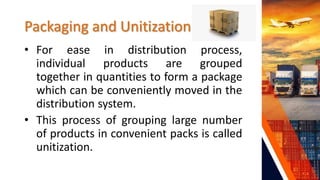
Packaging and Unitization
• For ease in distribution process,
individual products are grouped
together in quantities to form a package
which can be conveniently moved in the
distribution system.
• This process of grouping large number
of products in convenient packs is called
unitization.
Containers
• The containers are devices in which
individual items or master cartons are
placed during transportation activity.
• The purpose of providing the box
container is to protect the products or
the master cartons from damage during
transportation, storage and multiple
trans-shipment handling.
Uses
• Excellent protection from environmental
effects
• Space economies
• Substantial reduction in transit damages
• Reduction in pilferages
• Facilitate inter-modal transportation
Pallets
• Another method of load unitization is
stacking individual products or master
cartons on the pallets and tightly securing
them with metal straps or shrink films.
• Handling of pallets is done with forklift
truck.
• Pallets packaging does not give complete
protection to the product from the
environmental effects.
Slip-sheet
• Unitization of load is also done on the
slip-sheet, which lies flat on the floor.
• It is a disposable shipping platform
constructed out of high-tensile
laminated paper.
• it requires a special lifting device known
as push/pull attachment.
Control and Communication
• The logistics sector relies heavily on
efficient communication to streamline
operations, optimize supply chains,
enhance customer service, and ensure
seamless coordination among various
stakeholders.
Importance.
• Real-Time Information Exchange
• Supply Chain Visibility and Transparency
• Customer Service and Satisfaction
• Collaboration and Coordination
• Crisis Management and Resilience
Logistics Management

Logistics Management

  • 1.
    Unit - I LogisticsFramework © 2023 Sasidharan Murugan IND, Inc. All rights reserved.
  • 2.
    Content • Concept ofLogistics Management • Specific Logistics Concepts • Scope of Logistics Management • Importance of Logistics Management • Transportation • Warehousing • Inventory Management • Package and Unitization • Control and Communication
  • 3.
    Concept • Logistics managementis an integrating function which coordinates and optimizes all logistics activities, as well as integrates them with other functions, including marketing, sales, manufacturing, finance, and information technology. • Logistics management activities include inbound and outbound transportation management, fleet management, warehousing, materials handling, order fulfillment, logistics network design, inventory management, supply/demand planning, and management of third-party logistics services providers.
  • 4.
    Definition • As perthe Council of Supply Chain Management Professionals, logistics management is that part of supply chain management which plans, implements, and controls the efficient, effective, forward and reverse flow and storage of goods, services, and related information between the point of origin and the point of consumption in order to meet customers’ requirements.
  • 5.
    Lean Logistics Management •Lean logistics management is a business management philosophy that considers the expenditure on resources utilized for the achievement of any goal other than the creation of value for the end customer. • It is a process that recognizes and eliminates wasteful activities from the supply chain.
  • 6.
    Agile Logistics Management •Agile logistics management enables achieving rapid response to customer needs, along with the ability to quickly reconfigure operations to respond rapidly to unforeseen shifts in the marketplace. • Agile logistics management is concerned with doing things quickly, saving costs, being responsive to market demands, maintaining flexibility and high productivity.
  • 7.
    Resilient Logistics Management •Resilient Logistics Management is defined as the system’s ability to return to its initial state or a new or desired state after the elimination of unproductive or negative processes that influence the system. • The four key pillars of resilient logistics management are visibility, flexibility, collaboration, and control.
  • 8.
    Green Logistics Management •Green logistics management concept is pro- ecological and directly stems from the deteriorating environment conditions reflected in lower supply of raw materials, excessive waste, and increased pollution levels. • Green logistics describes all attempts to measure and minimize the ecological impact of logistics activities of organizations.
  • 9.
    Characteristics • Reduce • Re-use •Rework • Refurbish • Reclaim • Recycle • Remanufacture
  • 10.
    Total Logistics Management •Total Quality Management is an approach in which managers constantly communicate with organizational stakeholders to emphasize the importance of continuous quality improvement that forms the basis of the concept of total logistics management.
  • 11.
    Focus on • Customersatisfaction and continuous logistic quality improvement. • Professionalism and trust. • Safety and security • ‘one click’ activities implementation based on flow processes, automation and computerization. • Sustainable logistics development • Secure effective and efficient goods and information flow.
  • 12.
    Scope of LogisticsManagement • The goal is to support procurement, manufacturing, and customer service operational requirements. • Logistics management is a supply chain management component that is used to meet customer demands through the planning, control and implementation of the effective movement and storage of related information, goods, and services from origin to destination.
  • 13.
    Includes • Business Logistics •Materials Management • Physical Distribution • Supply Management • Decentralized Logistics Management
  • 14.
    Importance of LogisticsManagement • Logistics management helps organizations seeking to use logistics as the key to gain competitive advantage. • Includes elements like; – Choosing the most effective routes for transportation – Discovering the most competent delivery method – Using software and IT resources to proficiently handle related processes
  • 15.
    Reasons • Cost Reductionand Profit Maximization • Efficient Flow of Manufacturing Operations • Competitive Edge • Effective Communication System • Sound Inventory Management
  • 16.
    Transportation • Transportation refersto the transfer of goods from the supply chain's origin to the final consumer.
  • 17.
    Modes and Meansof Transport • Modes – medium through which the transportation takes place. – Land – Sea – Air • Means – type of vehicle used to transport. – Truck – Rail – Boat – Ship – Airplane – Helicopter
  • 18.
    Uses • Package Carriers– weight between 200 to 250 kg. • Railway – long-distance shipment of heavy items. • Waterways – bulk goods • Air transportation – expensive and on time delivery. • Pipelines – oil and gases.
  • 19.
    Role of airtransportation • High value products – high end items and timely delivery is important. • Urgent goods – Goods that cant be waited. Perishable goods, medicines and humanitarian reliefs.
  • 20.
    Warehousing • Warehousing isthe process of storing physical inventory for sale or distribution. • Warehouses are used by all different types of businesses that need to temporarily store products in bulk before either shipping them to other locations or individually to end consumers.
  • 21.
    Importance of Warehousing •The purchase of wholesale goods in bulk that may not fit in a physical retail store or yet be purchased by an end consumer online. • Large bulk orders - which allow these businesses to negotiate lower prices with their suppliers, thus improving their margins when selling to customers. • Keeping inventory available as demand fluctuates to ensure products stay in stock.
  • 22.
    Elements of warehousing •Capacity planning • Receiving inbound shipments • Tracking inventory • Storing products • Controlling climate • Reorganizing • Retrieving and outbound shipping
  • 23.
    Inventory Management • Inventorymanagement refers to the process of ordering, storing, using, and selling a company's inventory. • This includes the management of raw materials, components, and finished products, as well as warehousing and processing of such items.
  • 24.
    Benefits of InventoryManagement • improves inventory accuracy, so you know what and how much you have in stock. • reduces the risk of overselling, so you don’t disappoint your customers or lose sales. • saves money, by avoiding excess inventory that ties up cash and incurs storage costs. • increases profits, by optimizing the inventory turnover and avoiding stock outs or obsolescence. • provides greater insights, by analyzing the sales trends and inventory performance. • enhances efficiency and productivity, by streamlining the inventory processes and reducing labor costs.
  • 25.
    Inventory Management Methods •Just-in-time management (JIT) • Materials Requirement Planning (MRP) • Economic Order Quantity (EOQ) • Days Sales of Inventory (DSI)
  • 26.
    Just-in-time • This methodallows companies to save significant amounts of money and reduce waste by keeping only the inventory they need to produce and sell products. • This approach reduces storage and insurance costs, as well as the cost of liquidating or discarding excess inventory.
  • 27.
    How does itworks Customer Places Order Manufacturer Orders Materials Required Supplier Delivers the Materials Required Manufacturer assembles the Product Customer Receives the Product
  • 28.
    Example • A carmanufacturer that orders and receives parts from its suppliers only after a customer places an order for a vehicle. This way, the manufacturer avoids excess inventory and saves on storage costs.
  • 29.
    Materials Requirement Planning (MRP) •This inventory management method is sales-forecast dependent, meaning that manufacturers must have accurate sales records to enable accurate planning of inventory needs and to communicate those needs with materials suppliers in a timely manner.
  • 30.
    Example • A carmanufacturer uses MRP to estimate how many engines, tires, seats, and other parts it needs to assemble cars every month. It also uses MRP to coordinate the supply chain and distribution of the cars to the dealerships.
  • 31.
    Economic Order Quantity(EOQ) • This model is used in inventory management by calculating the number of units a company should add to its inventory with each batch order to reduce the total costs of its inventory while assuming constant consumer demand. • The EOQ model seeks to ensure that the right amount of inventory is ordered per batch so a company does not have to make orders too frequently and there is not an excess of inventory sitting on hand.
  • 32.
    How it canbe calculated. D is the annual demand for the inventory item. S is the cost per order. H is the cost of holding one unit of inventory for one year. For example, suppose a bookstore sells 500 books per year, and each book costs Rs.10. The cost to place and receive an order is Rs.5, and the cost to hold one book for a year is Rs.2. Using the formula the bookstore should order 35 or 36 books to minimize its total inventory cost.
  • 33.
    Days Sales ofInventory (DSI) • This financial ratio indicates the average time in days that a company takes to turn its inventory, including goods that are a work in progress, into sales. • Generally, a lower DSI is preferred as it indicates a shorter duration to clear off the inventory, though the average DSI varies from one industry to another.
  • 34.
    Example • Suppose acompany has an average inventory of Rs.100000 and a cost of goods sold of Rs.200000 for the year. • DSI = 100000/200000 X 365 = 182.5 • This means the company takes about 183 days to sell its inventory on average. DSI = Average Cost of Inventory/Cost of goods sold per year X 365
  • 35.
    Packaging and Unitization •For ease in distribution process, individual products are grouped together in quantities to form a package which can be conveniently moved in the distribution system. • This process of grouping large number of products in convenient packs is called unitization.
  • 36.
    Containers • The containersare devices in which individual items or master cartons are placed during transportation activity. • The purpose of providing the box container is to protect the products or the master cartons from damage during transportation, storage and multiple trans-shipment handling.
  • 37.
    Uses • Excellent protectionfrom environmental effects • Space economies • Substantial reduction in transit damages • Reduction in pilferages • Facilitate inter-modal transportation
  • 38.
    Pallets • Another methodof load unitization is stacking individual products or master cartons on the pallets and tightly securing them with metal straps or shrink films. • Handling of pallets is done with forklift truck. • Pallets packaging does not give complete protection to the product from the environmental effects.
  • 39.
    Slip-sheet • Unitization ofload is also done on the slip-sheet, which lies flat on the floor. • It is a disposable shipping platform constructed out of high-tensile laminated paper. • it requires a special lifting device known as push/pull attachment.
  • 40.
    Control and Communication •The logistics sector relies heavily on efficient communication to streamline operations, optimize supply chains, enhance customer service, and ensure seamless coordination among various stakeholders.
  • 41.
    Importance. • Real-Time InformationExchange • Supply Chain Visibility and Transparency • Customer Service and Satisfaction • Collaboration and Coordination • Crisis Management and Resilience