CS 210, Ch.1(part 2): The foundations: Logic & Proof, Sets, and Functions
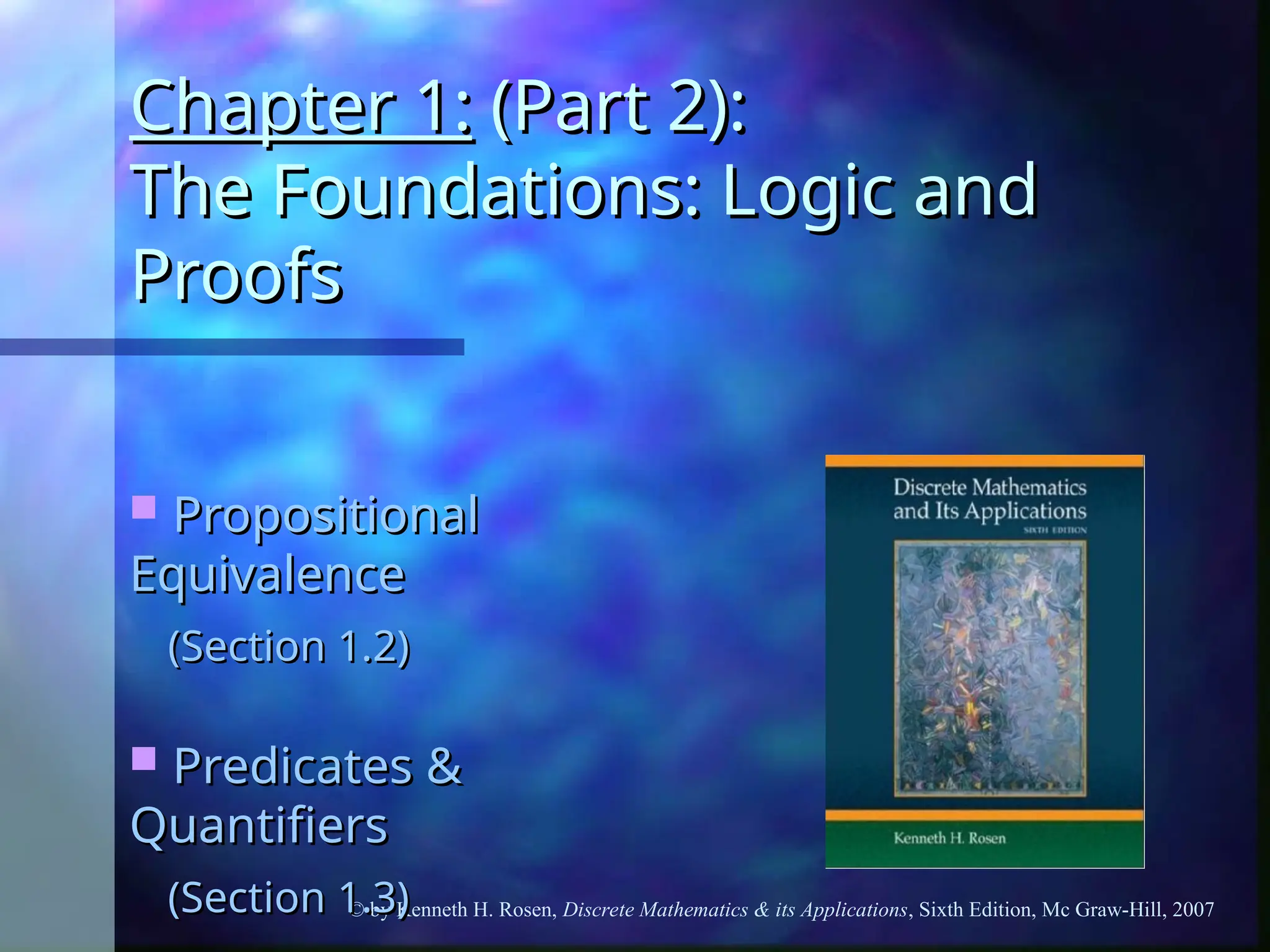
2
Propositional Equivalences (1.2)
Propositional Equivalences (1.2)
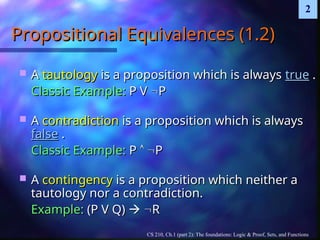
A
A tautology
tautology is a proposition which is always
is a proposition which is always true
true .
.
Classic Example:
Classic Example: P V
P V
P
P
A
A contradiction
contradiction is a proposition which is always
is a proposition which is always
false
false .
.
Classic Example:
Classic Example: P
P
P
P
A
A contingency
contingency is a proposition which neither a
is a proposition which neither a
tautology nor a contradiction.
tautology nor a contradiction.
Example:
Example: (P V Q)
(P V Q)
R
R
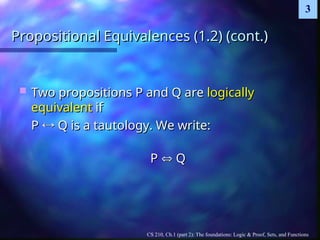
3.
CS 210, Ch.1(part 2): The foundations: Logic & Proof, Sets, and Functions
3
Propositional Equivalences (1.2) (cont.)
Propositional Equivalences (1.2) (cont.)
Two propositions P and Q are
Two propositions P and Q are logically
logically
equivalent
equivalent if
if
P
P
Q is a tautology. We write:
Q is a tautology. We write:
P
P
Q
Q
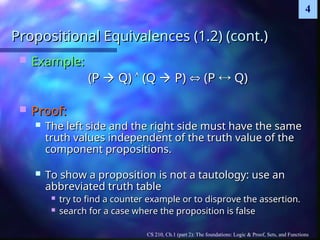
4.
CS 210, Ch.1(part 2): The foundations: Logic & Proof, Sets, and Functions
4
Propositional Equivalences (1.2) (cont.)
Propositional Equivalences (1.2) (cont.)
Example:
Example:
(P
(P
Q)
Q)
(Q
(Q
P)
P)
(P
(P
Q)
Q)
Proof:
Proof:
The left side and the right side must have the same
The left side and the right side must have the same
truth values independent of the truth value of the
truth values independent of the truth value of the
component propositions.
component propositions.
To show a proposition is not a tautology: use an
To show a proposition is not a tautology: use an
abbreviated truth table
abbreviated truth table
try to find a counter example or to disprove the assertion.
try to find a counter example or to disprove the assertion.
search for a case where the proposition is false
search for a case where the proposition is false
5.
CS 210, Ch.1(part 2): The foundations: Logic & Proof, Sets, and Functions
5
Propositional Equivalences (1.2) (cont.)
Propositional Equivalences (1.2) (cont.)
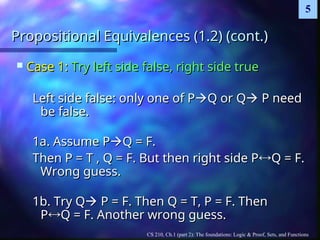
Case 1:
Case 1: Try left side false, right side true
Try left side false, right side true
Left side false: only one of P
Left side false: only one of P
Q or Q
Q or Q
P need
P need
be false.
be false.
1a. Assume P
1a. Assume P
Q = F.
Q = F.
Then P = T , Q = F. But then right side P
Then P = T , Q = F. But then right side P
Q = F.
Q = F.
Wrong guess.
Wrong guess.
1b. Try Q
1b. Try Q
P = F. Then Q = T, P = F. Then
P = F. Then Q = T, P = F. Then
P
P
Q = F. Another wrong guess.
Q = F. Another wrong guess.
6.
CS 210, Ch.1(part 2): The foundations: Logic & Proof, Sets, and Functions
6
Propositional Equivalences (1.2)
Propositional Equivalences (1.2)
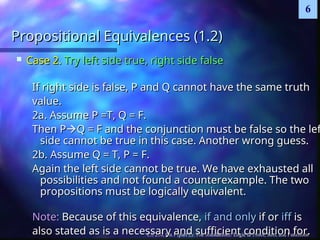
Case 2.
Case 2. Try left side true, right side false
Try left side true, right side false
If right side is false, P and Q cannot have the same truth
If right side is false, P and Q cannot have the same truth
value.
value.
2a. Assume P =T, Q = F.
2a. Assume P =T, Q = F.
Then P
Then P
Q = F and the conjunction must be false so the lef
Q = F and the conjunction must be false so the lef
side cannot be true in this case. Another wrong guess.
side cannot be true in this case. Another wrong guess.
2b. Assume Q = T, P = F.
2b. Assume Q = T, P = F.
Again the left side cannot be true. We have exhausted all
Again the left side cannot be true. We have exhausted all
possibilities and not found a counterexample. The two
possibilities and not found a counterexample. The two
propositions must be logically equivalent.
propositions must be logically equivalent.
Note:
Note: Because of this equivalence,
Because of this equivalence, if and only
if and only if or
if or iff
iff is
is
also stated as is a necessary and sufficient condition for.
also stated as is a necessary and sufficient condition for.
7.
CS 210, Ch.1(part 2): The foundations: Logic & Proof, Sets, and Functions
7
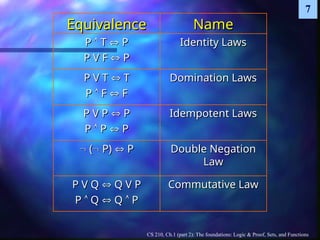
Equivalence
Equivalence Name
Name
P
P
T
T
P
P
P V F
P V F
P
P
Identity Laws
Identity Laws
P V T
P V T
T
T
P
P
F
F
F
F
Domination Laws
Domination Laws
P V P
P V P
P
P
P
P
P
P
P
P
Idempotent Laws
Idempotent Laws
(
(
P)
P)
P
P Double Negation
Double Negation
Law
Law
P V Q
P V Q
Q V P
Q V P
P
P
Q
Q
Q
Q
P
P
Commutative Law
Commutative Law
8.
CS 210, Ch.1(part 2): The foundations: Logic & Proof, Sets, and Functions
8
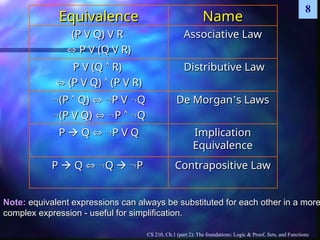
Equivalence
Equivalence Name
Name
(P V Q) V R
(P V Q) V R
P V (Q V R)
P V (Q V R)
Associative Law
Associative Law
P V (Q
P V (Q
R)
R)
(P V Q)
(P V Q)
(P V R)
(P V R)
Distributive Law
Distributive Law
(P
(P
Q)
Q)
P V
P V
Q
Q
(P V Q)
(P V Q)
P
P
Q
Q
De Morgan
De Morgan’
’s Laws
s Laws
P
P
Q
Q
P V Q
P V Q Implication
Implication
Equivalence
Equivalence
P
P
Q
Q
Q
Q
P
P Contrapositive Law
Contrapositive Law
Note:
Note: equivalent expressions can always be substituted for each other in a more
equivalent expressions can always be substituted for each other in a more
complex expression - useful for simplification.
complex expression - useful for simplification.
9.
CS 210, Ch.1(part 2): The foundations: Logic & Proof, Sets, and Functions
9
Propositional Equivalences (1.2) (cont.)
Propositional Equivalences (1.2) (cont.)
Normal or Canonical Forms
Normal or Canonical Forms
Unique representations of a proposition
Unique representations of a proposition
Examples:
Examples: Construct a simple proposition of
Construct a simple proposition of
two variables which is true only when
two variables which is true only when
P is true and Q is false: P
P is true and Q is false: P
Q
Q
P is true and Q is true: P
P is true and Q is true: P
Q
Q
P is true and Q is false or P is true and Q is true:
P is true and Q is false or P is true and Q is true:
(P
(P
Q) V (P
Q) V (P
Q)
Q)
10.
CS 210, Ch.1(part 2): The foundations: Logic & Proof, Sets, and Functions
10
Propositional Equivalences (1.2) (cont.)
Propositional Equivalences (1.2) (cont.)
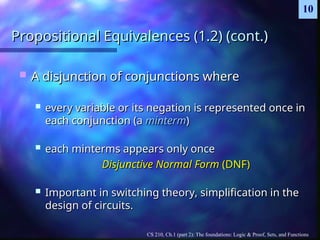
A disjunction of conjunctions where
A disjunction of conjunctions where
every variable or its negation is represented once in
every variable or its negation is represented once in
each conjunction (a
each conjunction (a minterm
minterm)
)
each minterms appears only once
each minterms appears only once
Disjunctive Normal Form
Disjunctive Normal Form (DNF)
(DNF)
Important in switching theory, simplification in the
Important in switching theory, simplification in the
design of circuits.
design of circuits.
11.
CS 210, Ch.1(part 2): The foundations: Logic & Proof, Sets, and Functions
11
Propositional Equivalences (1.2) (cont.)
Propositional Equivalences (1.2) (cont.)
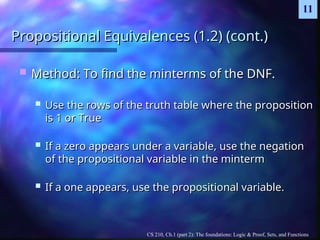
Method: To find the minterms of the DNF.
Method: To find the minterms of the DNF.
Use the rows of the truth table where the proposition
Use the rows of the truth table where the proposition
is 1 or True
is 1 or True
If a zero appears under a variable, use the negation
If a zero appears under a variable, use the negation
of the propositional variable in the minterm
of the propositional variable in the minterm
If a one appears, use the propositional variable.
If a one appears, use the propositional variable.
12.
CS 210, Ch.1(part 2): The foundations: Logic & Proof, Sets, and Functions
12
Propositional Equivalences (1.2) (cont.)
Propositional Equivalences (1.2) (cont.)
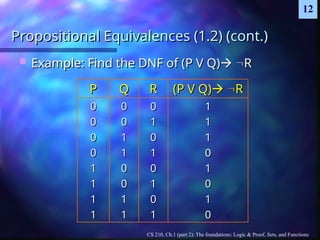
Example: Find the DNF of (P V Q)
Example: Find the DNF of (P V Q)
R
R
P
P Q
Q R
R (P V Q)
(P V Q)
R
R
0
0
0
0
0
0
0
0
1
1
1
1
1
1
1
1
0
0
0
0
1
1
1
1
0
0
0
0
1
1
1
1
0
0
1
1
0
0
1
1
0
0
1
1
0
0
1
1
1
1
1
1
1
1
0
0
1
1
0
0
1
1
0
0
13.
CS 210, Ch.1(part 2): The foundations: Logic & Proof, Sets, and Functions
13
Propositional Equivalences (1.2) (cont.)
Propositional Equivalences (1.2) (cont.)
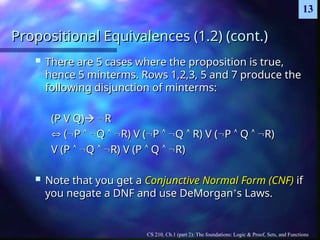
There are 5 cases where the proposition is true,
There are 5 cases where the proposition is true,
hence 5 minterms. Rows 1,2,3, 5 and 7 produce the
hence 5 minterms. Rows 1,2,3, 5 and 7 produce the
following disjunction of minterms:
following disjunction of minterms:
(P V Q)
(P V Q)
R
R
(
(
P
P
Q
Q
R) V (
R) V (
P
P
Q
Q
R) V (
R) V (
P
P
Q
Q
R)
R)
V (P
V (P
Q
Q
R) V (P
R) V (P
Q
Q
R)
R)
Note that you get a
Note that you get a Conjunctive Normal Form (CNF)
Conjunctive Normal Form (CNF) if
if
you negate a DNF and use DeMorgan
you negate a DNF and use DeMorgan’
’s Laws.
s Laws.
14.
CS 210, Ch.1(part 2): The foundations: Logic & Proof, Sets, and Functions
14
Predicates & Quantifiers (1.3)
Predicates & Quantifiers (1.3)
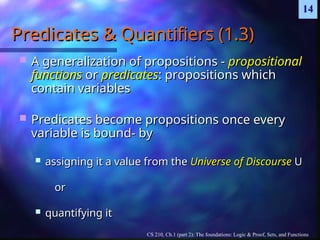
A generalization of propositions -
A generalization of propositions - propositional
propositional
functions
functions or
or predicates
predicates: propositions which
: propositions which
contain variables
contain variables
Predicates become propositions once every
Predicates become propositions once every
variable is bound- by
variable is bound- by
assigning it a value from the
assigning it a value from the Universe of Discourse
Universe of Discourse U
U
or
or
quantifying it
quantifying it
15.
CS 210, Ch.1(part 2): The foundations: Logic & Proof, Sets, and Functions
15
Predicates & Quantifiers (1.3) (cont.)
Predicates & Quantifiers (1.3) (cont.)
Examples:
Examples:
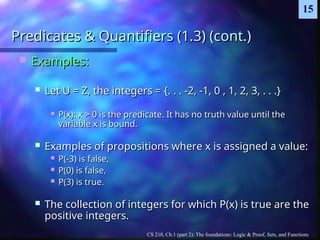
Let U = Z, the integers = {. . . -2, -1, 0 , 1, 2, 3, . . .}
Let U = Z, the integers = {. . . -2, -1, 0 , 1, 2, 3, . . .}
P(x): x > 0 is the predicate. It has no truth value until the
P(x): x > 0 is the predicate. It has no truth value until the
variable x is bound.
variable x is bound.
Examples of propositions where x is assigned a value:
Examples of propositions where x is assigned a value:
P(-3) is false,
P(-3) is false,
P(0) is false,
P(0) is false,
P(3) is true.
P(3) is true.
The collection of integers for which P(x) is true are the
The collection of integers for which P(x) is true are the
positive integers.
positive integers.
16.
CS 210, Ch.1(part 2): The foundations: Logic & Proof, Sets, and Functions
16
Predicates & Quantifiers (1.3) (cont.)
Predicates & Quantifiers (1.3) (cont.)
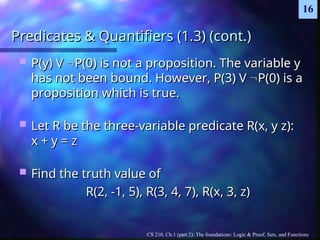
P(y) V
P(y) V
P(0) is not a proposition. The variable y
P(0) is not a proposition. The variable y
has not been bound. However, P(3) V
has not been bound. However, P(3) V
P(0) is a
P(0) is a
proposition which is true.
proposition which is true.
Let R be the three-variable predicate R(x, y z):
Let R be the three-variable predicate R(x, y z):
x + y = z
x + y = z
Find the truth value of
Find the truth value of
R(2, -1, 5), R(3, 4, 7), R(x, 3, z)
R(2, -1, 5), R(3, 4, 7), R(x, 3, z)
17.
CS 210, Ch.1(part 2): The foundations: Logic & Proof, Sets, and Functions
17
Predicates & Quantifiers (1.3) (cont.)
Predicates & Quantifiers (1.3) (cont.)
Quantifiers
Quantifiers
Universal
Universal
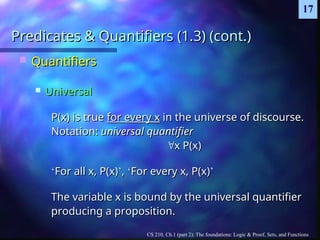
P(x) is true
P(x) is true for every x
for every x in the universe of discourse.
in the universe of discourse.
Notation:
Notation: universal quantifier
universal quantifier
x P(x)
x P(x)
‘
‘For all x, P(x)
For all x, P(x)’
’,
, ‘
‘For every x, P(x)
For every x, P(x)’
’
The variable x is bound by the universal quantifier
The variable x is bound by the universal quantifier
producing a proposition.
producing a proposition.
CS 210, Ch.1(part 2): The foundations: Logic & Proof, Sets, and Functions
19
Predicates & Quantifiers (1.3) (cont.)
Predicates & Quantifiers (1.3) (cont.)
Quantifiers
Quantifiers (cont.)
(cont.)
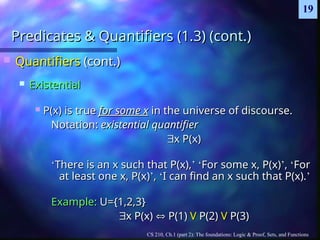
Existential
Existential
P(x) is true
P(x) is true for some x
for some x in the universe of discourse.
in the universe of discourse.
Notation:
Notation: existential quantifier
existential quantifier
x P(x)
x P(x)
‘
‘There is an x such that P(x),
There is an x such that P(x),’
’ ‘
‘For some x, P(x)
For some x, P(x)’
’,
, ‘
‘For
For
at least one x, P(x)
at least one x, P(x)’
’,
, ‘
‘I can find an x such that P(x).
I can find an x such that P(x).’
’
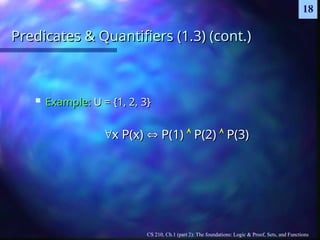
Example:
Example: U={1,2,3}
U={1,2,3}
x P(x)
x P(x)
P(1)
P(1) V
V P(2)
P(2) V
V P(3)
P(3)
20.
CS 210, Ch.1(part 2): The foundations: Logic & Proof, Sets, and Functions
20
Predicates & Quantifiers (1.3) (cont.)
Predicates & Quantifiers (1.3) (cont.)
Quantifiers
Quantifiers (cont.)
(cont.)
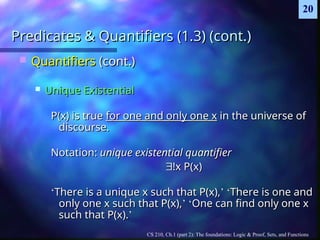
Unique Existential
Unique Existential
P(x) is true
P(x) is true for one and only one x
for one and only one x in the universe of
in the universe of
discourse.
discourse.
Notation:
Notation: unique existential quantifier
unique existential quantifier
!x P(x)
!x P(x)
‘
‘There is a unique x such that P(x),
There is a unique x such that P(x),’
’ ‘
‘There is one and
There is one and
only one x such that P(x),
only one x such that P(x),’
’ ‘
‘One can find only one x
One can find only one x
such that P(x).
such that P(x).’
’
21.
CS 210, Ch.1(part 2): The foundations: Logic & Proof, Sets, and Functions
21
Predicates & Quantifiers (1.3) (cont.)
Predicates & Quantifiers (1.3) (cont.)
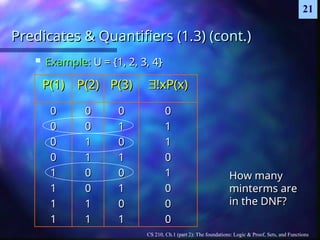
Example:
Example: U = {1, 2, 3, 4}
U = {1, 2, 3, 4}
P(1)
P(1) P(2)
P(2) P(3)
P(3)
!xP(x)
!xP(x)
0
0
0
0
0
0
0
0
1
1
1
1
1
1
1
1
0
0
0
0
1
1
1
1
0
0
0
0
1
1
1
1
0
0
1
1
0
0
1
1
0
0
1
1
0
0
1
1
0
0
1
1
1
1
0
0
1
1
0
0
0
0
0
0
How many
How many
minterms are
minterms are
in the DNF?
in the DNF?
22.
CS 210, Ch.1(part 2): The foundations: Logic & Proof, Sets, and Functions
22
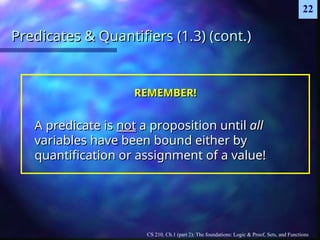
Predicates & Quantifiers (1.3) (cont.)
Predicates & Quantifiers (1.3) (cont.)
REMEMBER!
REMEMBER!
A predicate is
A predicate is not
not a proposition until
a proposition until all
all
variables have been bound either by
variables have been bound either by
quantification or assignment of a value!
quantification or assignment of a value!
23.
CS 210, Ch.1(part 2): The foundations: Logic & Proof, Sets, and Functions
23
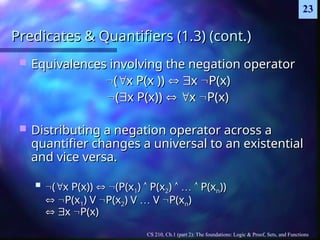
Predicates & Quantifiers (1.3) (cont.)
Predicates & Quantifiers (1.3) (cont.)
Equivalences involving the negation operator
Equivalences involving the negation operator
(
(
x P(x ))
x P(x ))
x
x
P(x)
P(x)
(
(
x P(x))
x P(x))
x
x
P(x)
P(x)
Distributing a negation operator across a
Distributing a negation operator across a
quantifier changes a universal to an existential
quantifier changes a universal to an existential
and vice versa.
and vice versa.
(
(
x P(x))
x P(x))
(P(x
(P(x1
1)
)
P(x
P(x2
2)
)
…
…
P(x
P(xn
n))
))
P(x
P(x1
1) V
) V
P(x
P(x2
2) V
) V …
… V
V
P(x
P(xn
n)
)
x
x
P(x)
P(x)
24.
CS 210, Ch.1(part 2): The foundations: Logic & Proof, Sets, and Functions
24
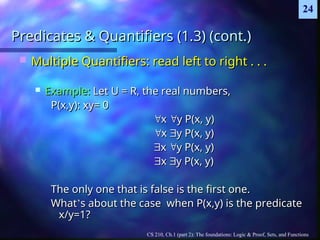
Predicates & Quantifiers (1.3) (cont.)
Predicates & Quantifiers (1.3) (cont.)
Multiple Quantifiers: read left to right . . .
Multiple Quantifiers: read left to right . . .
Example:
Example: Let U = R, the real numbers,
Let U = R, the real numbers,
P(x,y): xy= 0
P(x,y): xy= 0
x
x
y P(x, y)
y P(x, y)
x
x
y P(x, y)
y P(x, y)
x
x
y P(x, y)
y P(x, y)
x
x
y P(x, y)
y P(x, y)
The only one that is false is the first one.
The only one that is false is the first one.
What
What’
’s about the case when P(x,y) is the predicate
s about the case when P(x,y) is the predicate
x/y=1?
x/y=1?
25.
CS 210, Ch.1(part 2): The foundations: Logic & Proof, Sets, and Functions
25
Predicates & Quantifiers (1.3) (cont.)
Predicates & Quantifiers (1.3) (cont.)
Multiple Quantifiers: read left to right . . .
Multiple Quantifiers: read left to right . . .
Example:
Example: Let U = {1,2,3}. Find an expression equivalent to
Let U = {1,2,3}. Find an expression equivalent to
x
x
y P(x, y) where the variables are bound by substitution
y P(x, y) where the variables are bound by substitution
instead:
instead:
Expand from inside out or outside in.
Expand from inside out or outside in.
Outside in:
Outside in:
y P(1, y)
y P(1, y)
y P(2, y)
y P(2, y)
y P(3, y)
y P(3, y)
[P(1,1) V P(1,2) V P(1,3)]
[P(1,1) V P(1,2) V P(1,3)]
[P(2,1) V P(2,2) V P(2,3)]
[P(2,1) V P(2,2) V P(2,3)]
[P(3,1) V P(3,2) V P(3,3)]
[P(3,1) V P(3,2) V P(3,3)]
26.
CS 210, Ch.1(part 2): The foundations: Logic & Proof, Sets, and Functions
26
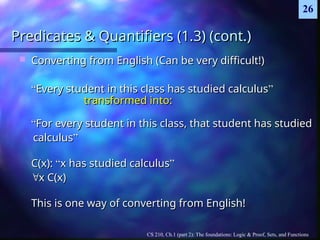
Predicates & Quantifiers (1.3) (cont.)
Predicates & Quantifiers (1.3) (cont.)
Converting from English (Can be very difficult!)
Converting from English (Can be very difficult!)
“
“Every student in this class has studied calculus
Every student in this class has studied calculus”
”
transformed into:
transformed into:
“
“For every student in this class, that student has studied
For every student in this class, that student has studied
calculus
calculus”
”
C(x):
C(x): “
“x has studied calculus
x has studied calculus”
”
x C(x)
x C(x)
This is one way of converting from English!
This is one way of converting from English!
27.
CS 210, Ch.1(part 2): The foundations: Logic & Proof, Sets, and Functions
27
Predicates & Quantifiers (1.3) (cont.)
Predicates & Quantifiers (1.3) (cont.)
Multiple Quantifiers: read left to right . . . (cont.)
Multiple Quantifiers: read left to right . . . (cont.)
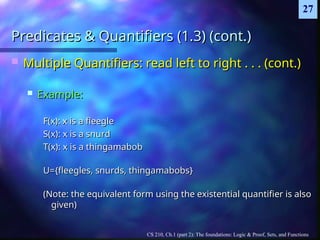
Example:
Example:
F(x): x is a fleegle
F(x): x is a fleegle
S(x): x is a snurd
S(x): x is a snurd
T(x): x is a thingamabob
T(x): x is a thingamabob
U={fleegles, snurds, thingamabobs}
U={fleegles, snurds, thingamabobs}
(Note: the equivalent form using the existential quantifier is also
(Note: the equivalent form using the existential quantifier is also
given)
given)
28.
CS 210, Ch.1(part 2): The foundations: Logic & Proof, Sets, and Functions
28
Predicates & Quantifiers (1.3) (cont.)
Predicates & Quantifiers (1.3) (cont.)
Everything is a fleegle
Everything is a fleegle
x F( x)
x F( x)
(
(
x
x
F(x))
F(x))
Nothing is a snurd.
Nothing is a snurd.
x
x
S(x)
S(x)
(
(
x S( x))
x S( x))
All fleegles are snurds.
All fleegles are snurds.
x [F(x)
x [F(x)
S(x)]
S(x)]
x [
x [
F(x) V S(x)]
F(x) V S(x)]
x
x
[F(x)
[F(x)
S(x)]
S(x)]
(
(
x [F(x) V
x [F(x) V
S(x)])
S(x)])
29.
CS 210, Ch.1(part 2): The foundations: Logic & Proof, Sets, and Functions
29
Predicates & Quantifiers (1.3) (cont.)
Predicates & Quantifiers (1.3) (cont.)
Some fleegles are thingamabobs.
Some fleegles are thingamabobs.
x [F(x)
x [F(x)
T(x)]
T(x)]
(
(
x [
x [
F(x) V
F(x) V
T(x)])
T(x)])
No snurd is a thingamabob.
No snurd is a thingamabob.
x [S(x)
x [S(x)
T(x)]
T(x)]
(
(
x [S(x )
x [S(x )
T(x)])
T(x)])
If any fleegle is a snurd then it's also a thingamabob
If any fleegle is a snurd then it's also a thingamabob
x [(F(x)
x [(F(x)
S(x))
S(x))
T(x)]
T(x)]
(
(
x [F(x)
x [F(x)
S(x)
S(x)
T( x)])
T( x)])
30.
CS 210, Ch.1(part 2): The foundations: Logic & Proof, Sets, and Functions
30
Predicates & Quantifiers (1.3) (cont.)
Predicates & Quantifiers (1.3) (cont.)
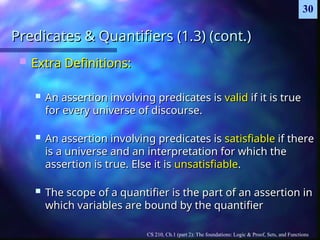
Extra Definitions:
Extra Definitions:
An assertion involving predicates is
An assertion involving predicates is valid
valid if it is true
if it is true
for every universe of discourse.
for every universe of discourse.
An assertion involving predicates is
An assertion involving predicates is satisfiable
satisfiable if there
if there
is a universe and an interpretation for which the
is a universe and an interpretation for which the
assertion is true. Else it is
assertion is true. Else it is unsatisfiable
unsatisfiable.
.
The scope of a quantifier is the part of an assertion in
The scope of a quantifier is the part of an assertion in
which variables are bound by the quantifier
which variables are bound by the quantifier
31.
CS 210, Ch.1(part 2): The foundations: Logic & Proof, Sets, and Functions
31
Predicates & Quantifiers (1.3) (cont.)
Predicates & Quantifiers (1.3) (cont.)
Examples:
Examples:
Valid:
Valid:
x
x
S(x)
S(x)
[
[
x S( x)]
x S( x)]
Not valid but satisfiable:
Not valid but satisfiable:
x [F(x)
x [F(x)
T(x)]
T(x)]
Not satisfiable:
Not satisfiable:
x [F(x)
x [F(x)
F(x)]
F(x)]
Scope:
Scope:
x [F(x) V S( x)] vs.
x [F(x) V S( x)] vs.
x [F(x)] V
x [F(x)] V
x [S(x)]
x [S(x)]
32.
CS 210, Ch.1(part 2): The foundations: Logic & Proof, Sets, and Functions
32
Predicates & Quantifiers (1.3) (cont.)
Predicates & Quantifiers (1.3) (cont.)
Dangerous situations:
Dangerous situations:
Commutativity of quantifiers
Commutativity of quantifiers
x
x
y P(x, y)
y P(x, y)
y
y
x P( x, y)?
x P( x, y)?
YES!
YES!
x
x
y P(x, y)
y P(x, y)
y
y
x P(x, y)?
x P(x, y)?
NO!
NO!
DIFFERENT MEANING!
DIFFERENT MEANING!
Distributivity of quantifiers over operators
Distributivity of quantifiers over operators
x [P(x)
x [P(x)
Q(x)]
Q(x)]
x P( x)
x P( x)
x Q( x)?
x Q( x)?
YES!
YES!
x [P( x)
x [P( x)
Q( x)]
Q( x)]
[
[
x P(x)
x P(x)
x Q( x)]?
x Q( x)]?
NO!
NO!
33.
CS 210, Ch.1(part 2): The foundations: Logic & Proof, Sets, and Functions
33
Sets (1.6)
Sets (1.6)
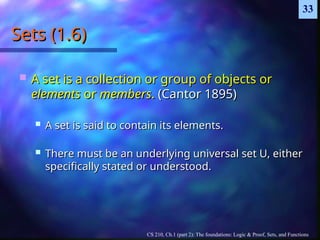
A set is a collection or group of objects or
A set is a collection or group of objects or
elements
elements or
or members
members.
. (Cantor 1895)
(Cantor 1895)
A set is said to contain its elements.
A set is said to contain its elements.
There must be an underlying universal set U, either
There must be an underlying universal set U, either
specifically stated or understood.
specifically stated or understood.
34.
CS 210, Ch.1(part 2): The foundations: Logic & Proof, Sets, and Functions
34
Sets (1.6) (cont.)
Sets (1.6) (cont.)
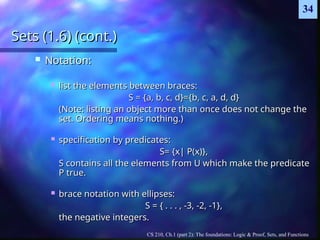
Notation:
Notation:
list the elements between braces:
list the elements between braces:
S = {a, b, c, d}={b, c, a, d, d}
S = {a, b, c, d}={b, c, a, d, d}
(Note: listing an object more than once does not change the
(Note: listing an object more than once does not change the
set. Ordering means nothing.)
set. Ordering means nothing.)
specification by predicates:
specification by predicates:
S= {x| P(x)},
S= {x| P(x)},
S contains all the elements from U which make the predicate
S contains all the elements from U which make the predicate
P true.
P true.
brace notation with ellipses:
brace notation with ellipses:
S = { . . . , -3, -2, -1},
S = { . . . , -3, -2, -1},
the negative integers.
the negative integers.
35.
CS 210, Ch.1(part 2): The foundations: Logic & Proof, Sets, and Functions
35
Sets (1.6) (cont.)
Sets (1.6) (cont.)
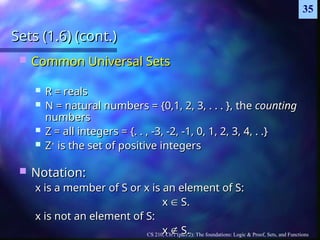
Common Universal Sets
Common Universal Sets
R = reals
R = reals
N = natural numbers = {0,1, 2, 3, . . . }, the
N = natural numbers = {0,1, 2, 3, . . . }, the counting
counting
numbers
numbers
Z = all integers = {. . , -3, -2, -1, 0, 1, 2, 3, 4, . .}
Z = all integers = {. . , -3, -2, -1, 0, 1, 2, 3, 4, . .}
Z
Z+
+
is the set of positive integers
is the set of positive integers
Notation:
Notation:
x is a member of S or x is an element of S:
x is a member of S or x is an element of S:
x
x
S.
S.
x is not an element of S:
x is not an element of S:
x
x
S.
S.
36.
CS 210, Ch.1(part 2): The foundations: Logic & Proof, Sets, and Functions
36
Sets (1.6) (cont.)
Sets (1.6) (cont.)
Subsets
Subsets
Definition:
Definition: The set A is a
The set A is a subset
subset of the set B, denoted
of the set B, denoted
A
A
B, iff
B, iff
x [x
x [x
A
A
x
x
B]
B]
Definition:
Definition: The
The void
void set, the
set, the null
null set, the
set, the empty
empty set, denoted
set, denoted
, is
, is
the set with no members.
the set with no members.
Note:
Note: the assertion x
the assertion x
is
is always
always false. Hence
false. Hence
x [x
x [x
x
x
B]
B]
is always true(vacuously). Therefore,
is always true(vacuously). Therefore,
is a subset of every
is a subset of every
set.
set.
Note:
Note: A set B is always a subset of itself.
A set B is always a subset of itself.
37.
CS 210, Ch.1(part 2): The foundations: Logic & Proof, Sets, and Functions
37
Sets (1.6) (cont.)
Sets (1.6) (cont.)
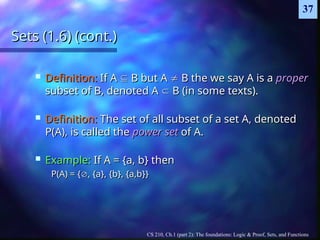
Definition:
Definition: If A
If A
B but A
B but A
B the we say A is a
B the we say A is a proper
proper
subset of B, denoted A
subset of B, denoted A
B (in some texts).
B (in some texts).
Definition:
Definition: The set of all subset of a set A, denoted
The set of all subset of a set A, denoted
P(A), is called the
P(A), is called the power set
power set of A.
of A.
Example:
Example: If A = {a, b} then
If A = {a, b} then
P(A) = {
P(A) = {
, {a}, {b}, {a,b}}
, {a}, {b}, {a,b}}
38.
CS 210, Ch.1(part 2): The foundations: Logic & Proof, Sets, and Functions
38
Sets (1.6) (cont.)
Sets (1.6) (cont.)
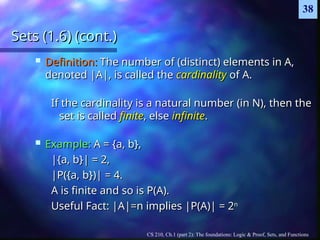
Definition:
Definition: The number of (distinct) elements in A,
The number of (distinct) elements in A,
denoted |A|, is called the
denoted |A|, is called the cardinality
cardinality of A.
of A.
If the cardinality is a natural number (in N), then the
If the cardinality is a natural number (in N), then the
set is called
set is called finite
finite, else
, else infinite
infinite.
.
Example:
Example: A = {a, b},
A = {a, b},
|{a, b}| = 2,
|{a, b}| = 2,
|P({a, b})| = 4.
|P({a, b})| = 4.
A is finite and so is P(A).
A is finite and so is P(A).
Useful Fact: |A|=n implies |P(A)| = 2
Useful Fact: |A|=n implies |P(A)| = 2n
n
39.
CS 210, Ch.1(part 2): The foundations: Logic & Proof, Sets, and Functions
39
Sets (1.6) (cont.)
Sets (1.6) (cont.)
N is infinite since |N| is not a natural number. It is called a
N is infinite since |N| is not a natural number. It is called a
transfinite cardinal number
transfinite cardinal number.
.
Note:
Note: Sets can be both
Sets can be both members
members and
and subsets
subsets of other sets.
of other sets.
Example:
Example:
A = {
A = {
,{
,{
}}.
}}.
A has two elements and hence four subsets:
A has two elements and hence four subsets:
, {
, {
}, {{
}, {{
}}. {
}}. {
,{
,{
}}
}}
Note that
Note that
is both a member of A and a subset of A!
is both a member of A and a subset of A!
Russell's paradox:
Russell's paradox: Let S be the set of all sets which are not
Let S be the set of all sets which are not
members of themselves. Is S a member of itself?
members of themselves. Is S a member of itself?
Another paradox:
Another paradox: Henry is a barber who shaves all people who
Henry is a barber who shaves all people who
do not shave themselves. Does Henry shave himself?
do not shave themselves. Does Henry shave himself?
40.
CS 210, Ch.1(part 2): The foundations: Logic & Proof, Sets, and Functions
40
Sets (1.6) (cont.)
Sets (1.6) (cont.)
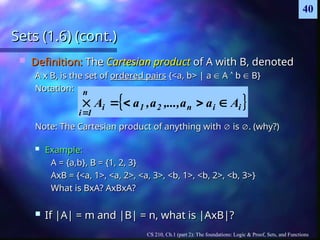
Definition:
Definition: The
The Cartesian product
Cartesian product of A with B, denoted
of A with B, denoted
A x B, is the set of
A x B, is the set of ordered pairs
ordered pairs {<a, b> | a
{<a, b> | a
A
A
b
b
B}
B}
Notation:
Notation:
Note: The Cartesian product of anything with
Note: The Cartesian product of anything with
is
is
. (why?)
. (why?)
Example:
Example:
A = {a,b}, B = {1, 2, 3}
A = {a,b}, B = {1, 2, 3}
AxB = {<a, 1>, <a, 2>, <a, 3>, <b, 1>, <b, 2>, <b, 3>}
AxB = {<a, 1>, <a, 2>, <a, 3>, <b, 1>, <b, 2>, <b, 3>}
What is BxA? AxBxA?
What is BxA? AxBxA?
If |A| = m and |B| = n, what is |AxB|?
If |A| = m and |B| = n, what is |AxB|?
i
i
n
2
1
i
n
1
i
A
a
a
,...,
a
,
a
A


![CS 210, Ch.1 (part 2): The foundations: Logic & Proof, Sets, and Functions
25
Predicates & Quantifiers (1.3) (cont.)
Predicates & Quantifiers (1.3) (cont.)
Multiple Quantifiers: read left to right . . .
Multiple Quantifiers: read left to right . . .
Example:
Example: Let U = {1,2,3}. Find an expression equivalent to
Let U = {1,2,3}. Find an expression equivalent to
x
x
y P(x, y) where the variables are bound by substitution
y P(x, y) where the variables are bound by substitution
instead:
instead:
Expand from inside out or outside in.
Expand from inside out or outside in.
Outside in:
Outside in:
y P(1, y)
y P(1, y)
y P(2, y)
y P(2, y)
y P(3, y)
y P(3, y)
[P(1,1) V P(1,2) V P(1,3)]
[P(1,1) V P(1,2) V P(1,3)]
[P(2,1) V P(2,2) V P(2,3)]
[P(2,1) V P(2,2) V P(2,3)]
[P(3,1) V P(3,2) V P(3,3)]
[P(3,1) V P(3,2) V P(3,3)]](https://image.slidesharecdn.com/grade12powerpointonlogicproofii-250806195950-6764087f/85/logic-and-proof-II-for-grade-12-students-ppt-25-320.jpg)
![CS 210, Ch.1 (part 2): The foundations: Logic & Proof, Sets, and Functions
28
Predicates & Quantifiers (1.3) (cont.)
Predicates & Quantifiers (1.3) (cont.)
Everything is a fleegle
Everything is a fleegle
x F( x)
x F( x)
(
(
x
x
F(x))
F(x))
Nothing is a snurd.
Nothing is a snurd.
x
x
S(x)
S(x)
(
(
x S( x))
x S( x))
All fleegles are snurds.
All fleegles are snurds.
x [F(x)
x [F(x)
S(x)]
S(x)]
x [
x [
F(x) V S(x)]
F(x) V S(x)]
x
x
[F(x)
[F(x)
S(x)]
S(x)]
(
(
x [F(x) V
x [F(x) V
S(x)])
S(x)])](https://image.slidesharecdn.com/grade12powerpointonlogicproofii-250806195950-6764087f/85/logic-and-proof-II-for-grade-12-students-ppt-28-320.jpg)
![CS 210, Ch.1 (part 2): The foundations: Logic & Proof, Sets, and Functions
29
Predicates & Quantifiers (1.3) (cont.)
Predicates & Quantifiers (1.3) (cont.)
Some fleegles are thingamabobs.
Some fleegles are thingamabobs.
x [F(x)
x [F(x)
T(x)]
T(x)]
(
(
x [
x [
F(x) V
F(x) V
T(x)])
T(x)])
No snurd is a thingamabob.
No snurd is a thingamabob.
x [S(x)
x [S(x)
T(x)]
T(x)]
(
(
x [S(x )
x [S(x )
T(x)])
T(x)])
If any fleegle is a snurd then it's also a thingamabob
If any fleegle is a snurd then it's also a thingamabob
x [(F(x)
x [(F(x)
S(x))
S(x))
T(x)]
T(x)]
(
(
x [F(x)
x [F(x)
S(x)
S(x)
T( x)])
T( x)])](https://image.slidesharecdn.com/grade12powerpointonlogicproofii-250806195950-6764087f/85/logic-and-proof-II-for-grade-12-students-ppt-29-320.jpg)
![CS 210, Ch.1 (part 2): The foundations: Logic & Proof, Sets, and Functions
31
Predicates & Quantifiers (1.3) (cont.)
Predicates & Quantifiers (1.3) (cont.)
Examples:
Examples:
Valid:
Valid:
x
x
S(x)
S(x)
[
[
x S( x)]
x S( x)]
Not valid but satisfiable:
Not valid but satisfiable:
x [F(x)
x [F(x)
T(x)]
T(x)]
Not satisfiable:
Not satisfiable:
x [F(x)
x [F(x)
F(x)]
F(x)]
Scope:
Scope:
x [F(x) V S( x)] vs.
x [F(x) V S( x)] vs.
x [F(x)] V
x [F(x)] V
x [S(x)]
x [S(x)]](https://image.slidesharecdn.com/grade12powerpointonlogicproofii-250806195950-6764087f/85/logic-and-proof-II-for-grade-12-students-ppt-31-320.jpg)
![CS 210, Ch.1 (part 2): The foundations: Logic & Proof, Sets, and Functions
32
Predicates & Quantifiers (1.3) (cont.)
Predicates & Quantifiers (1.3) (cont.)
Dangerous situations:
Dangerous situations:
Commutativity of quantifiers
Commutativity of quantifiers
x
x
y P(x, y)
y P(x, y)
y
y
x P( x, y)?
x P( x, y)?
YES!
YES!
x
x
y P(x, y)
y P(x, y)
y
y
x P(x, y)?
x P(x, y)?
NO!
NO!
DIFFERENT MEANING!
DIFFERENT MEANING!
Distributivity of quantifiers over operators
Distributivity of quantifiers over operators
x [P(x)
x [P(x)
Q(x)]
Q(x)]
x P( x)
x P( x)
x Q( x)?
x Q( x)?
YES!
YES!
x [P( x)
x [P( x)
Q( x)]
Q( x)]
[
[
x P(x)
x P(x)
x Q( x)]?
x Q( x)]?
NO!
NO!](https://image.slidesharecdn.com/grade12powerpointonlogicproofii-250806195950-6764087f/85/logic-and-proof-II-for-grade-12-students-ppt-32-320.jpg)
![CS 210, Ch.1 (part 2): The foundations: Logic & Proof, Sets, and Functions
36
Sets (1.6) (cont.)
Sets (1.6) (cont.)
Subsets
Subsets
Definition:
Definition: The set A is a
The set A is a subset
subset of the set B, denoted
of the set B, denoted
A
A
B, iff
B, iff
x [x
x [x
A
A
x
x
B]
B]
Definition:
Definition: The
The void
void set, the
set, the null
null set, the
set, the empty
empty set, denoted
set, denoted
, is
, is
the set with no members.
the set with no members.
Note:
Note: the assertion x
the assertion x
is
is always
always false. Hence
false. Hence
x [x
x [x
x
x
B]
B]
is always true(vacuously). Therefore,
is always true(vacuously). Therefore,
is a subset of every
is a subset of every
set.
set.
Note:
Note: A set B is always a subset of itself.
A set B is always a subset of itself.](https://image.slidesharecdn.com/grade12powerpointonlogicproofii-250806195950-6764087f/85/logic-and-proof-II-for-grade-12-students-ppt-36-320.jpg)



![UGC NET Computer Science & Application book.pdf [Sample]](https://cdn.slidesharecdn.com/ss_thumbnails/freesampleugcnetcomputerscienceapplication5-221017120357-ff322815-thumbnail.jpg?width=640&height=640&fit=bounds)


