Raising the
Appreciative Voice
A Meme for Recovery
Meme
….a form of cultural propagation, a way for people
to transmit social memories and cultural ideas to
each other. Not unlike the way that DNA and life will
spread from location to location, a meme idea will
also travel from mind to mind.
Evolutionary Biologist, Richard Dawkins, 1976
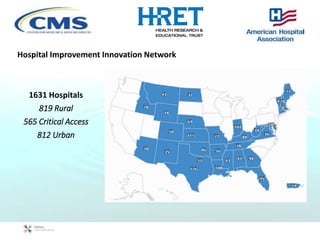
1631 Hospitals
819 Rural
565 Critical Access
812 Urban
Hospital Improvement Innovation Network
Psychiatric & Rehabilitation Hospital Project
 Research Topic:
o What are high performing hospitals doing well that allows them to
provide high quality, safe care to their patients? How can we
spread those practices to other hospitals?
 Task:
o Assemble a Technical Expert Panel of leaders in the field to advise
our team
o Complete site visits at hospitals nationwide to identify best
practices using the Appreciate Inquiry methodology
o Create a change package showcasing hospital best practices
4
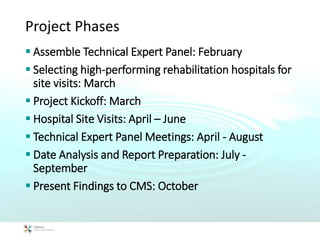
Project Phases
 Assemble Technical Expert Panel: February
 Selecting high-performing rehabilitation hospitals for
site visits: March
 Project Kickoff: March
 Hospital Site Visits: April – June
 Technical Expert Panel Meetings: April - August
 Date Analysis and Report Preparation: July -
September
 Present Findings to CMS: October
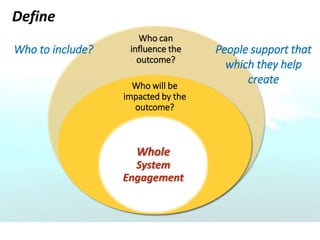
Who can
influence the
outcome?
Who will be
impacted by the
outcome?
Whole
System
Engagement
People support that
which they help
create
Who to include?
Define
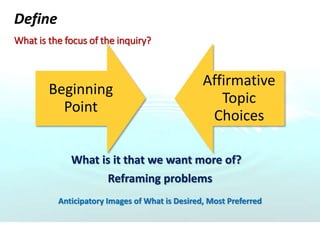
Beginning
Point
Affirmative
Topic
Choices
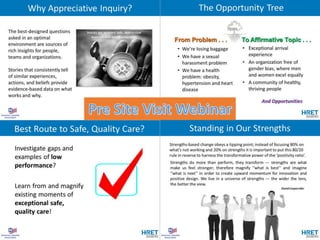
What is it that we want more of?
Reframing problems
Anticipatory Images of What is Desired, Most Preferred
What is the focus of the inquiry?
Define
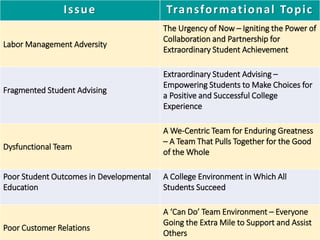
Issue Transformational Topic
Labor Management Adversity
The Urgency of Now – Igniting the Power of
Collaboration and Partnership for
Extraordinary Student Achievement
Fragmented Student Advising
Extraordinary Student Advising –
Empowering Students to Make Choices for
a Positive and Successful College
Experience
Dysfunctional Team
A We-Centric Team for Enduring Greatness
– A Team That Pulls Together for the Good
of the Whole
Poor Student Outcomes in Developmental
Education
A College Environment in Which All
Students Succeed
Poor Customer Relations
A ‘Can Do’ Team Environment – Everyone
Going the Extra Mile to Support and Assist
Others
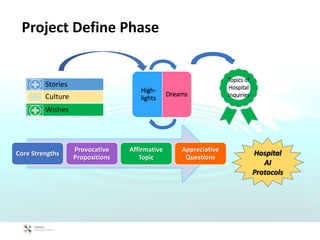
Project Define Phase
Core Strengths
Provocative
Propositions
Affirmative
Topic
Appreciative
Questions
High-
lights
Dreams
Stories
Culture
Wishes
Topics of
Hospital
Inquiries
Hospital
AI
Protocols
Kickoff Inquiry #1
Appreciative Interview:
Incredible Partners
An important feature of hospital improvement is engaging with the full range of
players to realize the expectations and dreams of your hospital, your community and
external partners, and the patients and families you serve.
As you think back over your experiences serving patients in the [psychiatric or
rehabilitation setting], wherever you have been part of this sphere in your
professional work, recall and tell me a story about one of those special moments
in which you were involved with a setting that kept the patient “at the center”
and achieved exceptional outcomes as connections and relationships forged the
way? Recall and describe in full detail when you were filled with excitement
about what you contributed positively on behalf of patients at that time.
Kickoff Inquiry #2
Appreciative Interview:
High Quality & Safety in the Moment
An important feature of hospital improvement is providing exceptional, high quality
and safe patient experiences to realize the expectations and dreams for your hospital,
your community and external partners, and the patients and families you serve.
As you think back over your experiences serving patients in the [psychiatric or
rehabilitation setting], wherever you have been part of this sphere in your
professional work, recall and tell me a story about one of those special moments
in which you were involved with a setting that kept the patient “at the center” in
the moment, and achieved exceptional, high quality and safe outcomes? Recall
and describe in full detail when you were filled with excitement about what you
contributed positively on behalf of patients at that time.
Provocative Propositions Inspired Topics
 We are committed to providing appropriate interventions, individualized
for the patient and family, that lead to positive outcomes both inside and
outside of the hospital.
 We optimize quality outcomes for patients by transparently sharing data
across the continuum of care to speed the pace of improvement.
 We promote and nurture committed staff and encourage nontraditional
approaches and care innovation in partnership with accountable
leadership.
 We create a compassionate, integrated environment of care for patients
and families that reflects a balance between ensuring safety while
maximizing patient autonomy and function.
 We live by a passionate shared vision and trusted relationships that
create extraordinary patient outcomes.
Reflect Back: Recall a time when….
Describe it in vivid detail. What was happening? Who was involved? What was your
role? What were the essential ingredients (conditions and factors) that created this
peak experience? This success (culture, values, relationships, leadership, systems,
ways of working)?
Explore Inward:
 What did you value most about this
experience? The role you played?
Others?
 What did you learn about yourself,
others through this peak experience?
Look Forward:
 What are your hopes and wishes for
replicating the same conditions and
factors of success into the future?
 How might you apply what you learned
from this experience to create more of
the same in the future?
Positive
Core
The framework for inquiry
Discovery
Site Visit Appreciative Questions
Rehabilitation
Rehabilitation hospitals make the most
of ensuring that their staff work hand-in-
hand in every aspect of the hospital’s
work. When they do that, patients and
families achieve extraordinary, safe and
timely patient outcomes.
Tell me about a time when you stepped
out of your comfort zone and took the
initiative to assist with the needs of a
patient. Recall and tell me a story about
one of those special moments in which
you were involved and a patient
benefitted from your actions.
Creating a place where rehabilitation
care is compassionately delivered and
addresses patient needs, family interests
and expectations is a daily opportunity.
Reflect and tell me a story about when
you were involved in helping a patient
and their family to improve their
abilities, independence and/or safety.
Think about the people and departments
in your hospital who you worked with in
harmony and with heart to provide that
care.
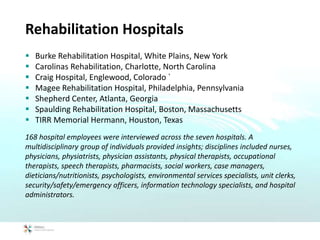
Rehabilitation Hospitals
 Burke Rehabilitation Hospital, White Plains, New York
 Carolinas Rehabilitation, Charlotte, North Carolina
 Craig Hospital, Englewood, Colorado `
 Magee Rehabilitation Hospital, Philadelphia, Pennsylvania
 Shepherd Center, Atlanta, Georgia
 Spaulding Rehabilitation Hospital, Boston, Massachusetts
 TIRR Memorial Hermann, Houston, Texas
168 hospital employees were interviewed across the seven hospitals. A
multidisciplinary group of individuals provided insights; disciplines included nurses,
physicians, physiatrists, physician assistants, physical therapists, occupational
therapists, speech therapists, pharmacists, social workers, case managers,
dieticians/nutritionists, psychologists, environmental services specialists, unit clerks,
security/safety/emergency officers, information technology specialists, and hospital
administrators.
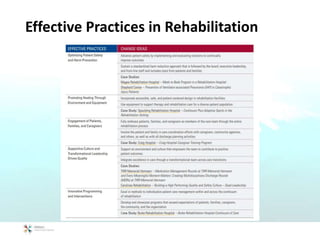
Effective Practices in Rehabilitation
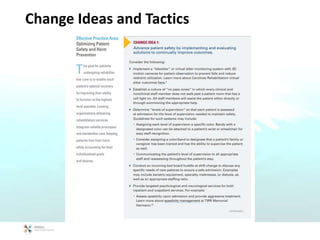
Change Ideas and Tactics
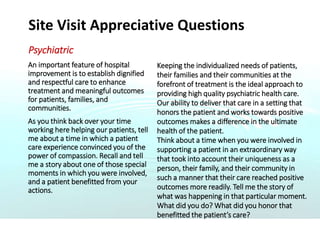
Site Visit Appreciative Questions
Psychiatric
An important feature of hospital
improvement is to establish dignified
and respectful care to enhance
treatment and meaningful outcomes
for patients, families, and
communities.
As you think back over your time
working here helping our patients, tell
me about a time in which a patient
care experience convinced you of the
power of compassion. Recall and tell
me a story about one of those special
moments in which you were involved,
and a patient benefitted from your
actions.
Keeping the individualized needs of patients,
their families and their communities at the
forefront of treatment is the ideal approach to
providing high quality psychiatric health care.
Our ability to deliver that care in a setting that
honors the patient and works towards positive
outcomes makes a difference in the ultimate
health of the patient.
Think about a time when you were involved in
supporting a patient in an extraordinary way
that took into account their uniqueness as a
person, their family, and their community in
such a manner that their care reached positive
outcomes more readily. Tell me the story of
what was happening in that particular moment.
What did you do? What did you honor that
benefitted the patient’s care?
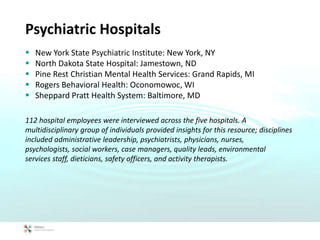
Psychiatric Hospitals
 New York State Psychiatric Institute: New York, NY
 North Dakota State Hospital: Jamestown, ND
 Pine Rest Christian Mental Health Services: Grand Rapids, MI
 Rogers Behavioral Health: Oconomowoc, WI
 Sheppard Pratt Health System: Baltimore, MD
112 hospital employees were interviewed across the five hospitals. A
multidisciplinary group of individuals provided insights for this resource; disciplines
included administrative leadership, psychiatrists, physicians, nurses,
psychologists, social workers, case managers, quality leads, environmental
services staff, dieticians, safety officers, and activity therapists.
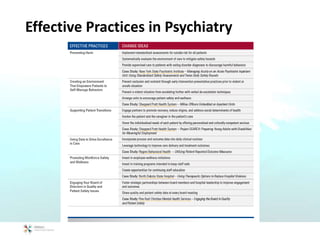
Effective Practices in Psychiatry
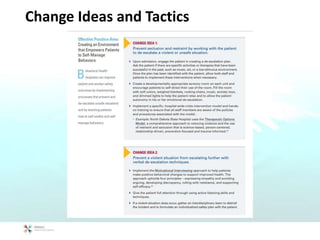
Change Ideas and Tactics
Questions
If my words did glow with the gold of sunshine
And my tunes were played on the harp unstrung
Would you hear my voice come through the music
Would you hold it near as it were your own?
It's a hand-me-down, the thoughts are broken
Perhaps they're better left unsung
I don't know, don't really care
Let there be songs to fill the air
Ripple in still water
When there is no pebble tossed
Nor wind to blow
Reach out your hand if your cup be empty
If your cup is full may it be again
Let it be known there is a fountain
That was not made by the hands of men
There is a road, no simple highway
Between the dawn and the dark of night
And if you go no one may follow
That path is for your steps alone
Ripple in still water
When there is no pebble tossed
Nor wind to blow
You who choose to lead must follow
But if you fall you fall alone
If you should stand then who's to guide you?
If I knew the way I would take you home
Ripple
Music by Jerry Garcia/Lyrics by Robert Hunter
To Learn More
Delivering High Quality Behavioral Health
Care: Practices and Innovations from Leading
Organizations
Published: October 16, 2018 by American
Hospital Association/Health Research &
Educational Trust
Enhancing Rehabilitation Care: Structures and
Processes from Leading Organizations
Published: October 16, 2018 by American
Hospital Association/Health Research &
Educational Trust
Defining the Meme for Recovery: Summoning
the Appreciative Voice
Published: Volume 20 Number 3, August 2018
by Appreciative Inquiry Practitioner

LL Donovan - Meme for Recovery.pptx

  • 1.
  • 2.
    Meme ….a form ofcultural propagation, a way for people to transmit social memories and cultural ideas to each other. Not unlike the way that DNA and life will spread from location to location, a meme idea will also travel from mind to mind. Evolutionary Biologist, Richard Dawkins, 1976
  • 3.
    1631 Hospitals 819 Rural 565Critical Access 812 Urban Hospital Improvement Innovation Network
  • 4.
    Psychiatric & RehabilitationHospital Project  Research Topic: o What are high performing hospitals doing well that allows them to provide high quality, safe care to their patients? How can we spread those practices to other hospitals?  Task: o Assemble a Technical Expert Panel of leaders in the field to advise our team o Complete site visits at hospitals nationwide to identify best practices using the Appreciate Inquiry methodology o Create a change package showcasing hospital best practices 4
  • 5.
    Project Phases  AssembleTechnical Expert Panel: February  Selecting high-performing rehabilitation hospitals for site visits: March  Project Kickoff: March  Hospital Site Visits: April – June  Technical Expert Panel Meetings: April - August  Date Analysis and Report Preparation: July - September  Present Findings to CMS: October
  • 6.
    Who can influence the outcome? Whowill be impacted by the outcome? Whole System Engagement People support that which they help create Who to include? Define
  • 7.
    Beginning Point Affirmative Topic Choices What is itthat we want more of? Reframing problems Anticipatory Images of What is Desired, Most Preferred What is the focus of the inquiry? Define
  • 8.
    Issue Transformational Topic LaborManagement Adversity The Urgency of Now – Igniting the Power of Collaboration and Partnership for Extraordinary Student Achievement Fragmented Student Advising Extraordinary Student Advising – Empowering Students to Make Choices for a Positive and Successful College Experience Dysfunctional Team A We-Centric Team for Enduring Greatness – A Team That Pulls Together for the Good of the Whole Poor Student Outcomes in Developmental Education A College Environment in Which All Students Succeed Poor Customer Relations A ‘Can Do’ Team Environment – Everyone Going the Extra Mile to Support and Assist Others
  • 9.
    Project Define Phase CoreStrengths Provocative Propositions Affirmative Topic Appreciative Questions High- lights Dreams Stories Culture Wishes Topics of Hospital Inquiries Hospital AI Protocols
  • 10.
    Kickoff Inquiry #1 AppreciativeInterview: Incredible Partners An important feature of hospital improvement is engaging with the full range of players to realize the expectations and dreams of your hospital, your community and external partners, and the patients and families you serve. As you think back over your experiences serving patients in the [psychiatric or rehabilitation setting], wherever you have been part of this sphere in your professional work, recall and tell me a story about one of those special moments in which you were involved with a setting that kept the patient “at the center” and achieved exceptional outcomes as connections and relationships forged the way? Recall and describe in full detail when you were filled with excitement about what you contributed positively on behalf of patients at that time.
  • 11.
    Kickoff Inquiry #2 AppreciativeInterview: High Quality & Safety in the Moment An important feature of hospital improvement is providing exceptional, high quality and safe patient experiences to realize the expectations and dreams for your hospital, your community and external partners, and the patients and families you serve. As you think back over your experiences serving patients in the [psychiatric or rehabilitation setting], wherever you have been part of this sphere in your professional work, recall and tell me a story about one of those special moments in which you were involved with a setting that kept the patient “at the center” in the moment, and achieved exceptional, high quality and safe outcomes? Recall and describe in full detail when you were filled with excitement about what you contributed positively on behalf of patients at that time.
  • 12.
    Provocative Propositions InspiredTopics  We are committed to providing appropriate interventions, individualized for the patient and family, that lead to positive outcomes both inside and outside of the hospital.  We optimize quality outcomes for patients by transparently sharing data across the continuum of care to speed the pace of improvement.  We promote and nurture committed staff and encourage nontraditional approaches and care innovation in partnership with accountable leadership.  We create a compassionate, integrated environment of care for patients and families that reflects a balance between ensuring safety while maximizing patient autonomy and function.  We live by a passionate shared vision and trusted relationships that create extraordinary patient outcomes.
  • 13.
    Reflect Back: Recalla time when…. Describe it in vivid detail. What was happening? Who was involved? What was your role? What were the essential ingredients (conditions and factors) that created this peak experience? This success (culture, values, relationships, leadership, systems, ways of working)? Explore Inward:  What did you value most about this experience? The role you played? Others?  What did you learn about yourself, others through this peak experience? Look Forward:  What are your hopes and wishes for replicating the same conditions and factors of success into the future?  How might you apply what you learned from this experience to create more of the same in the future? Positive Core The framework for inquiry Discovery
  • 15.
    Site Visit AppreciativeQuestions Rehabilitation Rehabilitation hospitals make the most of ensuring that their staff work hand-in- hand in every aspect of the hospital’s work. When they do that, patients and families achieve extraordinary, safe and timely patient outcomes. Tell me about a time when you stepped out of your comfort zone and took the initiative to assist with the needs of a patient. Recall and tell me a story about one of those special moments in which you were involved and a patient benefitted from your actions. Creating a place where rehabilitation care is compassionately delivered and addresses patient needs, family interests and expectations is a daily opportunity. Reflect and tell me a story about when you were involved in helping a patient and their family to improve their abilities, independence and/or safety. Think about the people and departments in your hospital who you worked with in harmony and with heart to provide that care.
  • 16.
    Rehabilitation Hospitals  BurkeRehabilitation Hospital, White Plains, New York  Carolinas Rehabilitation, Charlotte, North Carolina  Craig Hospital, Englewood, Colorado `  Magee Rehabilitation Hospital, Philadelphia, Pennsylvania  Shepherd Center, Atlanta, Georgia  Spaulding Rehabilitation Hospital, Boston, Massachusetts  TIRR Memorial Hermann, Houston, Texas 168 hospital employees were interviewed across the seven hospitals. A multidisciplinary group of individuals provided insights; disciplines included nurses, physicians, physiatrists, physician assistants, physical therapists, occupational therapists, speech therapists, pharmacists, social workers, case managers, dieticians/nutritionists, psychologists, environmental services specialists, unit clerks, security/safety/emergency officers, information technology specialists, and hospital administrators.
  • 17.
    Effective Practices inRehabilitation
  • 18.
  • 19.
    Site Visit AppreciativeQuestions Psychiatric An important feature of hospital improvement is to establish dignified and respectful care to enhance treatment and meaningful outcomes for patients, families, and communities. As you think back over your time working here helping our patients, tell me about a time in which a patient care experience convinced you of the power of compassion. Recall and tell me a story about one of those special moments in which you were involved, and a patient benefitted from your actions. Keeping the individualized needs of patients, their families and their communities at the forefront of treatment is the ideal approach to providing high quality psychiatric health care. Our ability to deliver that care in a setting that honors the patient and works towards positive outcomes makes a difference in the ultimate health of the patient. Think about a time when you were involved in supporting a patient in an extraordinary way that took into account their uniqueness as a person, their family, and their community in such a manner that their care reached positive outcomes more readily. Tell me the story of what was happening in that particular moment. What did you do? What did you honor that benefitted the patient’s care?
  • 20.
    Psychiatric Hospitals  NewYork State Psychiatric Institute: New York, NY  North Dakota State Hospital: Jamestown, ND  Pine Rest Christian Mental Health Services: Grand Rapids, MI  Rogers Behavioral Health: Oconomowoc, WI  Sheppard Pratt Health System: Baltimore, MD 112 hospital employees were interviewed across the five hospitals. A multidisciplinary group of individuals provided insights for this resource; disciplines included administrative leadership, psychiatrists, physicians, nurses, psychologists, social workers, case managers, quality leads, environmental services staff, dieticians, safety officers, and activity therapists.
  • 21.
  • 22.
  • 23.
  • 24.
    If my wordsdid glow with the gold of sunshine And my tunes were played on the harp unstrung Would you hear my voice come through the music Would you hold it near as it were your own? It's a hand-me-down, the thoughts are broken Perhaps they're better left unsung I don't know, don't really care Let there be songs to fill the air Ripple in still water When there is no pebble tossed Nor wind to blow Reach out your hand if your cup be empty If your cup is full may it be again Let it be known there is a fountain That was not made by the hands of men There is a road, no simple highway Between the dawn and the dark of night And if you go no one may follow That path is for your steps alone Ripple in still water When there is no pebble tossed Nor wind to blow You who choose to lead must follow But if you fall you fall alone If you should stand then who's to guide you? If I knew the way I would take you home Ripple Music by Jerry Garcia/Lyrics by Robert Hunter
  • 25.
    To Learn More DeliveringHigh Quality Behavioral Health Care: Practices and Innovations from Leading Organizations Published: October 16, 2018 by American Hospital Association/Health Research & Educational Trust Enhancing Rehabilitation Care: Structures and Processes from Leading Organizations Published: October 16, 2018 by American Hospital Association/Health Research & Educational Trust Defining the Meme for Recovery: Summoning the Appreciative Voice Published: Volume 20 Number 3, August 2018 by Appreciative Inquiry Practitioner

Editor's Notes

  • #2 Good Evening. Bonsoir. I’m Loretta Donovan, president of iAttain, and with me today as co-presenter, Jim Davy, Distinguished Practitioner in Residence and Director of the Center for Applied Appreciative Inquiry, Rutgers University. How do we “speak” to a large, dispersed population in the quest for Discovering, Dreaming, Designing and dwelling in our Destiny? How can we Define an inquiry that will unleash their core beliefs and strengths? What do we invite them to express? How do we tap what surfaces in the verbal, written and visual outputs of Discovery to shift expectations and outcomes more broadly? How might we unleash sights, sounds, behaviors and language to expand stories out of the reach of populations with congruent missions? What processes, tools, and experiences might engage leaders and employees across an entire industry to Dream, Design and work towards a Destiny whose meaning was bigger, bolder and more innovative grounded on an expansive, collective understanding of what is possible?
  • #3 This workshop introduces the concept of Appreciative Inquiry as meme. Richard Dawkins fostered the notion that a meme is a discrete "package of culture" that would travel via word of mouth. You may have heard the term used in relation to social media. However, I will share how the same model is inherently possible thru human interaction and influence.
  • #4 The Centers for Medicare & Medicaid Services (CMS) is a federal agency within the United States Department of Health and Human Services administers the Medicare program and works in partnership with state governments to administer Medicaid the Children's Health Insurance Program, and health insurance portability standards.
  • #5 In early 2018 CMS asked the American Hospital Association’s Hospital Improvement Innovation Network to expand its scope of work to include both psychiatric and rehabilitation hospitals. It specified Appreciate Inquiry as the framework from which to glean and disseminate the practices of high performing hospitals for high quality, safe patient care.
  • #10 A one-day kickoff involving the Technical Expert Panel and representatives of the selected High Performing Hospitals was conducted, with a total of fifteen key stakeholders participating, one event each for Rehabilitation and Psychiatry. The purpose of each kickoff was to identify the affirmative topics and draft appreciative questions that would be used in the site visits to the hospitals.