view on the problem
of littering and
potential solutions"
view on the problem
of littering and
potential solutions"
      Nic Groombridge
 St Mary’s University College
                       Litter Webinar 18 October
               1
Sociologist
but a sociologist of crime (or criminologist) with
‘green’ pretensions (my PhD on ‘car culture’ more of
a problem than ‘joyriding’)
green criminology or green perspectives in
criminology?
a ‘watermelon’? (green on the outside, red in the
middle)
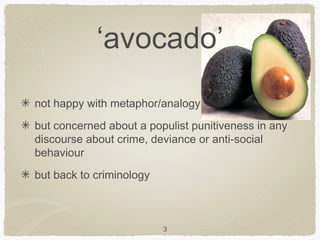
seeking to avoid being an ‘avocado’

                          2
‘avocado’
not happy with metaphor/analogy
but concerned about a populist punitiveness in any
discourse about crime, deviance or anti-social
behaviour
but back to criminology


                          3
criminology
criminology (whether psychological or sociological or
any other version) tends to look at mid range or very
obvious crimes and wrongs
so rarely war or terrorism and not as much on
volume crimes like car theft or burglary as their
volume might dictate
the exciting (‘gangs’) or what told by funders (‘gangs’
again) to look at

                           4
alternative criminologies
proliferation of attempts to understand/deal with
crime over time and across political spectrum
some prefer to talk of ‘harm’, or the ‘harm
perspective or even zemiology rather than ‘crime’ or
‘criminology’
so environmental harms might be studied
(theoretically including litter) but more usually harms
caused by Government or Corporations

                           5
so not litter then

litter clearly a volume crime but often seen
(dismissed?) as a nuisance
Yet often given a glancing mention in criminology
texts but not actually studied


                          6
green criminology any
             better?

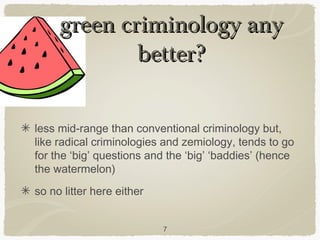
less mid-range than conventional criminology but,
like radical criminologies and zemiology, tends to go
for the ‘big’ questions and the ‘big’ ‘baddies’ (hence
the watermelon)
so no litter here either


                           7
Right Realism
Wilson and Kelling 'Broken Windows’
We suggest that ‘untended’ behavior also leads to the breakdown of community
controls. A stable neighborhood of families who care for their homes, mind
each other’s children, and confidently frown on unwanted intruders can change,
in a few years or even a few months, to an inhospitable and frightening jungle.
A piece of property is abandoned, weeds grow up, a window is smashed.
Adults stop scolding rowdy children; the children, emboldened, become more
rowdy. Families move out, unattached adults move in. Teenagers gather in
front of the corner store. The merchant asks them to move; they refuse. Fights
occur. Litter accumulates. (1982, page 2 of webversion)

Only mention of litter in their work but often picked out by criminologists and ...


                                         8
Dart Containers
The Broken Windows theory refers to an article by sociologists Dr. James Q.
Wilson and Dr. George Kelling that first appeared in the Atlantic Monthly in
March of 1982. In that article, the authors put forth the hypothesis that general
disorder in communities contributes to the rise of serious crime. The article
focused on the analogy of a broken window. If a window is broken and not
repaired quickly, soon more windows will be broken as the perception that no
one cares about the building spreads. When many of the windows have been
broken, the feeling is created that no one cares about the street and soon other
structures will be vandalized.

Litter and graffiti can act like broken windows. If not corrected these problems
create the impression that no one cares about the area and making it seem
dangerous.

We've all seen and heard the slogans. And we all know that litter is just plain
bad. What many people, however, are unwilling to admit, is that litter
is a "people issue" not a product issue.

                                previously on their website
and
 Keep America Beautiful
Poole [a KAB, Louisiana volunteer] was instrumental in bringing Dr. George
Kelling, renowned for his “broken windows theory”, to the 2005 Keep Louisiana
Beautiful state conference where she organized a special meeting for him to
address New Orleans Mayor Ray Nagin and state legislators. Poole’s goal was
to help change the perception among Louisiana community and political leaders
that litter is merely a cosmetic problem. Dr. Kelling explained how one broken
window sets off a chain reaction of physical deterioration, which leads to crime,
economic downturn and a lessened quality of life.


Which brings us to the litterature (!)
The Litterature

Common themes with some criminology but apart
from mention of Broken Windows no explicit
reference to sociology.

So for instance ...


                       11
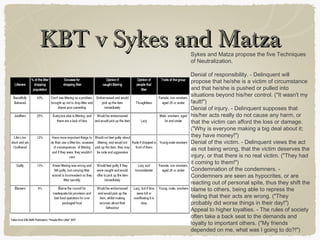
KBT v Sykes and Matza
             Sykes and Matza propose the five Techniques
             of Neutralization.

             Denial of responsibility. - Delinquent will
             propose that he/she is a victim of circumstance
             and that he/she is pushed or pulled into
             situations beyond his/her control. ("It wasn't my
             fault!")
             Denial of injury. - Delinquent supposes that
             his/her acts really do not cause any harm, or
             that the victim can afford the loss or damage.
             ("Why is everyone making a big deal about it;
             they have money!")
             Denial of the victim. - Delinquent views the act
             as not being wrong, that the victim deserves the
             injury, or that there is no real victim. ("They had
             it coming to them!")
             Condemnation of the condemners. -
             Condemners are seen as hypocrites, or are
             reacting out of personal spite, thus they shift the
             blame to others, being able to repress the
             feeling that their acts are wrong. ("They
             probably did worse things in their day!")
             Appeal to higher loyalties. - The rules of society
             often take a back seat to the demands and
             loyalty to important others. ("My friends
             depended on me, what was I going to do?!")
Sociological Criminology
       suggests ...
design and situation can be manipulated to help (but
I’m against litter but also sterility)

law and punishment don’t often work and may make
things worse (on individuals but not necessary
corporations/firms)

appropriate ‘policing’ can work

‘social bonds’: ‘attachment’ ‘involvement’ etc
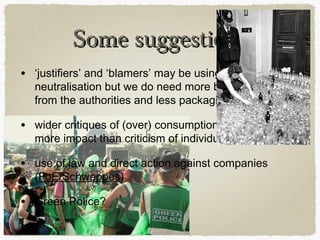
Some suggestions
• ‘justifiers’ and ‘blamers’ may be using techniques of
  neutralisation but we do need more bins and action
  from the authorities and less packaging

• wider critiques of (over) consumption likely to have
  more impact than criticism of individuals

• use of law and direct action against companies
  (FoE/Schweppes)

• Green Police?
My fears

litter will be used to criminalise

this worsened by growth of privatisation in Local
Authorities and CJS

litter picking as punishment
My hopes to ...
add littering to criminology - it is serious and
worthwhile -

   including green criminology. We should start at
   the bottom on the earth as it were

to make links with the ‘litterarti’

   that you

Litter webinar 18 october

  • 1.
    view on theproblem of littering and potential solutions" view on the problem of littering and potential solutions" Nic Groombridge St Mary’s University College Litter Webinar 18 October 1
  • 2.
    Sociologist but a sociologistof crime (or criminologist) with ‘green’ pretensions (my PhD on ‘car culture’ more of a problem than ‘joyriding’) green criminology or green perspectives in criminology? a ‘watermelon’? (green on the outside, red in the middle) seeking to avoid being an ‘avocado’ 2
  • 3.
    ‘avocado’ not happy withmetaphor/analogy but concerned about a populist punitiveness in any discourse about crime, deviance or anti-social behaviour but back to criminology 3
  • 4.
    criminology criminology (whether psychologicalor sociological or any other version) tends to look at mid range or very obvious crimes and wrongs so rarely war or terrorism and not as much on volume crimes like car theft or burglary as their volume might dictate the exciting (‘gangs’) or what told by funders (‘gangs’ again) to look at 4
  • 5.
    alternative criminologies proliferation ofattempts to understand/deal with crime over time and across political spectrum some prefer to talk of ‘harm’, or the ‘harm perspective or even zemiology rather than ‘crime’ or ‘criminology’ so environmental harms might be studied (theoretically including litter) but more usually harms caused by Government or Corporations 5
  • 6.
    so not litterthen litter clearly a volume crime but often seen (dismissed?) as a nuisance Yet often given a glancing mention in criminology texts but not actually studied 6
  • 7.
    green criminology any better? less mid-range than conventional criminology but, like radical criminologies and zemiology, tends to go for the ‘big’ questions and the ‘big’ ‘baddies’ (hence the watermelon) so no litter here either 7
  • 8.
    Right Realism Wilson andKelling 'Broken Windows’ We suggest that ‘untended’ behavior also leads to the breakdown of community controls. A stable neighborhood of families who care for their homes, mind each other’s children, and confidently frown on unwanted intruders can change, in a few years or even a few months, to an inhospitable and frightening jungle. A piece of property is abandoned, weeds grow up, a window is smashed. Adults stop scolding rowdy children; the children, emboldened, become more rowdy. Families move out, unattached adults move in. Teenagers gather in front of the corner store. The merchant asks them to move; they refuse. Fights occur. Litter accumulates. (1982, page 2 of webversion) Only mention of litter in their work but often picked out by criminologists and ... 8
  • 9.
    Dart Containers The BrokenWindows theory refers to an article by sociologists Dr. James Q. Wilson and Dr. George Kelling that first appeared in the Atlantic Monthly in March of 1982. In that article, the authors put forth the hypothesis that general disorder in communities contributes to the rise of serious crime. The article focused on the analogy of a broken window. If a window is broken and not repaired quickly, soon more windows will be broken as the perception that no one cares about the building spreads. When many of the windows have been broken, the feeling is created that no one cares about the street and soon other structures will be vandalized. Litter and graffiti can act like broken windows. If not corrected these problems create the impression that no one cares about the area and making it seem dangerous. We've all seen and heard the slogans. And we all know that litter is just plain bad. What many people, however, are unwilling to admit, is that litter is a "people issue" not a product issue. previously on their website
  • 10.
    and Keep AmericaBeautiful Poole [a KAB, Louisiana volunteer] was instrumental in bringing Dr. George Kelling, renowned for his “broken windows theory”, to the 2005 Keep Louisiana Beautiful state conference where she organized a special meeting for him to address New Orleans Mayor Ray Nagin and state legislators. Poole’s goal was to help change the perception among Louisiana community and political leaders that litter is merely a cosmetic problem. Dr. Kelling explained how one broken window sets off a chain reaction of physical deterioration, which leads to crime, economic downturn and a lessened quality of life. Which brings us to the litterature (!)
  • 11.
    The Litterature Common themeswith some criminology but apart from mention of Broken Windows no explicit reference to sociology. So for instance ... 11
  • 12.
    KBT v Sykesand Matza Sykes and Matza propose the five Techniques of Neutralization. Denial of responsibility. - Delinquent will propose that he/she is a victim of circumstance and that he/she is pushed or pulled into situations beyond his/her control. ("It wasn't my fault!") Denial of injury. - Delinquent supposes that his/her acts really do not cause any harm, or that the victim can afford the loss or damage. ("Why is everyone making a big deal about it; they have money!") Denial of the victim. - Delinquent views the act as not being wrong, that the victim deserves the injury, or that there is no real victim. ("They had it coming to them!") Condemnation of the condemners. - Condemners are seen as hypocrites, or are reacting out of personal spite, thus they shift the blame to others, being able to repress the feeling that their acts are wrong. ("They probably did worse things in their day!") Appeal to higher loyalties. - The rules of society often take a back seat to the demands and loyalty to important others. ("My friends depended on me, what was I going to do?!")
  • 13.
    Sociological Criminology suggests ... design and situation can be manipulated to help (but I’m against litter but also sterility) law and punishment don’t often work and may make things worse (on individuals but not necessary corporations/firms) appropriate ‘policing’ can work ‘social bonds’: ‘attachment’ ‘involvement’ etc
  • 14.
    Some suggestions • ‘justifiers’and ‘blamers’ may be using techniques of neutralisation but we do need more bins and action from the authorities and less packaging • wider critiques of (over) consumption likely to have more impact than criticism of individuals • use of law and direct action against companies (FoE/Schweppes) • Green Police?
  • 15.
    My fears litter willbe used to criminalise this worsened by growth of privatisation in Local Authorities and CJS litter picking as punishment
  • 16.
    My hopes to... add littering to criminology - it is serious and worthwhile - including green criminology. We should start at the bottom on the earth as it were to make links with the ‘litterarti’ that you