LITERARY
DEVICES
Objectives:
a. enumerate the different literary
devices;
b. understand the use of each
device;
c. create a story board that uses
different literary devices; and
d. create a poem using the literary
devices.
Presentation title 2
Introduction
Literary Devices refer to the structures used by writers in their literary
piece to express the message in a more vivid style and at the same time
help them achieve their purpose in writing. When delivered and
engaged properly, these literary devices help the readers appreciate,
understand and analyze the literary piece. Typically, these devices are
used for aesthetic and artistic purposes. That is, they are used to make
the literary work more eye-catching.
Presentation title 3
LITERARY DEVICES AND TERMS
This is derived from the Latin
word “Latira” which means
“letters of alphabet.” It is a
device wherein number of words
having the same consonant
sounds that occurs closely
together in a series. This method
of linking words for effect is also
called head rhyme or initial
rhyme.
Alliteration
5
Example:
But a better butter makes a batter
better.
Peter Piper picked a peck of
pickled peppers.
Alliteration
6
Is a form of word play in which
terms of a word or a phrase are
rearranged in such a way that a
new word or phrase is formed.
Usually using all the original
letters exactly once.
Anagram
7
Examples:
Conversation – voices rant on
the eyes – they see
Anagram – nag a ram
listen - silent
Anagram
8
It is a literary device in which
repetition of similar vowel
sounds take place in two or more
words within the line.
Assonance
9
Examples:
“The rain in Spain stays mainly in the
plain” (musical “My Fair Lady”)
Assonance
10
This is an expression that has
been overused to the point that it
loses its original meaning or
effect and mostly now sound
boring and at times irritating due
to the element that they have lost
the unique sense.
Cliché
11
Examples:
Read between the lines
They lived happily ever after
Cliché
12
This is a comparison in which the
idea is compared to another idea
that is quite different from it for the
purpose of explanation and
clarification. Metaphors and Similes
are used to interpret analogy.
However, analogy is more extensive
and elaborate. Writers use analogy
to link unfamiliar words or new ideas
with common or familiar objects to
make it easier for the readers to
comprehend the meaning.
Analogy
13
Examples:
Finding a good man is like finding needle
in a haystack.
The movie was a roller coaster ride of
emotions.
Analogy
14
This literally means “the opposite.”
This is used in writing or speech
when opposite words are introduced
together for contrasting effect. The
organizations of contrasted phrases
are similar in order to draw the
attention of the listeners and readers.
Antithesis
15
Examples:
"That's one small step for man, one giant
leap for mankind." by Neil Armstrong.
“You’re easy on the eyes, hard on the
heart”- from the song You’re Easy on the
Eyes by Terri Clark.
Antithesis
16
This is used when somebody dies,
and we want to commemorate his or
her memory. Generally, it is a brief
and concise composition having a
figurative sense in a verse or in a
prose form.
Epitaph
17
Examples:
Loving wife and mother
Beloved son, gone too soon
Gone, but not forgotten
Epitaph
18
This is derived from the Greek word
“tauto” which means “the same” and
“logos” which means “a word or an
idea.” Tautology is a repetitive use of
phrases or words that have the same
meanings. It’s just like expressing the
same idea twice or many times.
Tautology
19
Examples:
The evening sunset was beautiful.
In my opinion, I think he is wrong.
Tautology
20
Colloquialism
21
This is the manner of using informal
words, phrases and slang piece of
writing. This shows that the writers
tend to show that people are being
influenced by how the society speak.
More so, it is unavoidable to add
colloquial expressions to their
vocabulary.
Examples:
gonna - going to
y’all - you all
Colloquialism
22
Euphemism
23
Is a figurative language commonly
used to replace a word or a phrase
that is related to the idea which
make others uncomfortable. This is
replacing harsh, impolite or
unpleasant statements by saying
them indirectly. This is commonly
used in certain situations like death,
aging, getting fired in a jib and
others.
Examples:
big boned (overweight)
Passed away/going to a better place (died)
Euphemism
24
Oxymoron
25
This is a rhetorical device of pairing
two words together that are opposing
and/or contradictory. This has an
effect of creating an impression,
enhancing a concept and
entertaining the readers.
Examples:
virtual reality
black light
live recording
student teacher
Oxymoron
26
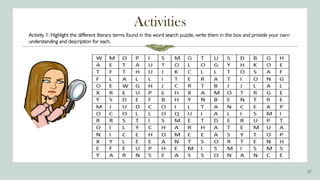
Activities
27
Activity 1: Highlight the different literary terms found in the word search puzzle, write them in the box and provide your own
understanding and description for each.
Presentation title 28
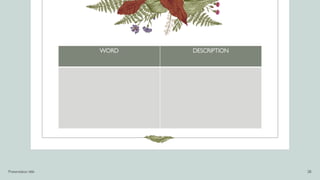
WORD DESCRIPTION
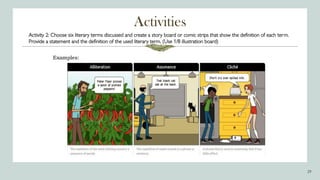
Activities
29
Activity 2: Choose six literary terms discussed and create a story board or comic strips that show the definition of each term.
Provide a statement and the definition of the used literary term. (Use 1/8 illustration board)
Activities
30
Activity 3: Choose a topic below then write your own poem (4 stanzas - 4 lines) about it, make sure to include the literary
terms learned. Use a separate sheet.
a. Online Learning
b. The New Normal
c. How Life has Changed
Thank you

literary-devices (1).pdf

  • 1.
  • 2.
    Objectives: a. enumerate thedifferent literary devices; b. understand the use of each device; c. create a story board that uses different literary devices; and d. create a poem using the literary devices. Presentation title 2
  • 3.
    Introduction Literary Devices referto the structures used by writers in their literary piece to express the message in a more vivid style and at the same time help them achieve their purpose in writing. When delivered and engaged properly, these literary devices help the readers appreciate, understand and analyze the literary piece. Typically, these devices are used for aesthetic and artistic purposes. That is, they are used to make the literary work more eye-catching. Presentation title 3
  • 4.
  • 5.
    This is derivedfrom the Latin word “Latira” which means “letters of alphabet.” It is a device wherein number of words having the same consonant sounds that occurs closely together in a series. This method of linking words for effect is also called head rhyme or initial rhyme. Alliteration 5
  • 6.
    Example: But a betterbutter makes a batter better. Peter Piper picked a peck of pickled peppers. Alliteration 6
  • 7.
    Is a formof word play in which terms of a word or a phrase are rearranged in such a way that a new word or phrase is formed. Usually using all the original letters exactly once. Anagram 7
  • 8.
    Examples: Conversation – voicesrant on the eyes – they see Anagram – nag a ram listen - silent Anagram 8
  • 9.
    It is aliterary device in which repetition of similar vowel sounds take place in two or more words within the line. Assonance 9
  • 10.
    Examples: “The rain inSpain stays mainly in the plain” (musical “My Fair Lady”) Assonance 10
  • 11.
    This is anexpression that has been overused to the point that it loses its original meaning or effect and mostly now sound boring and at times irritating due to the element that they have lost the unique sense. Cliché 11
  • 12.
    Examples: Read between thelines They lived happily ever after Cliché 12
  • 13.
    This is acomparison in which the idea is compared to another idea that is quite different from it for the purpose of explanation and clarification. Metaphors and Similes are used to interpret analogy. However, analogy is more extensive and elaborate. Writers use analogy to link unfamiliar words or new ideas with common or familiar objects to make it easier for the readers to comprehend the meaning. Analogy 13
  • 14.
    Examples: Finding a goodman is like finding needle in a haystack. The movie was a roller coaster ride of emotions. Analogy 14
  • 15.
    This literally means“the opposite.” This is used in writing or speech when opposite words are introduced together for contrasting effect. The organizations of contrasted phrases are similar in order to draw the attention of the listeners and readers. Antithesis 15
  • 16.
    Examples: "That's one smallstep for man, one giant leap for mankind." by Neil Armstrong. “You’re easy on the eyes, hard on the heart”- from the song You’re Easy on the Eyes by Terri Clark. Antithesis 16
  • 17.
    This is usedwhen somebody dies, and we want to commemorate his or her memory. Generally, it is a brief and concise composition having a figurative sense in a verse or in a prose form. Epitaph 17
  • 18.
    Examples: Loving wife andmother Beloved son, gone too soon Gone, but not forgotten Epitaph 18
  • 19.
    This is derivedfrom the Greek word “tauto” which means “the same” and “logos” which means “a word or an idea.” Tautology is a repetitive use of phrases or words that have the same meanings. It’s just like expressing the same idea twice or many times. Tautology 19
  • 20.
    Examples: The evening sunsetwas beautiful. In my opinion, I think he is wrong. Tautology 20
  • 21.
    Colloquialism 21 This is themanner of using informal words, phrases and slang piece of writing. This shows that the writers tend to show that people are being influenced by how the society speak. More so, it is unavoidable to add colloquial expressions to their vocabulary.
  • 22.
    Examples: gonna - goingto y’all - you all Colloquialism 22
  • 23.
    Euphemism 23 Is a figurativelanguage commonly used to replace a word or a phrase that is related to the idea which make others uncomfortable. This is replacing harsh, impolite or unpleasant statements by saying them indirectly. This is commonly used in certain situations like death, aging, getting fired in a jib and others.
  • 24.
    Examples: big boned (overweight) Passedaway/going to a better place (died) Euphemism 24
  • 25.
    Oxymoron 25 This is arhetorical device of pairing two words together that are opposing and/or contradictory. This has an effect of creating an impression, enhancing a concept and entertaining the readers.
  • 26.
    Examples: virtual reality black light liverecording student teacher Oxymoron 26
  • 27.
    Activities 27 Activity 1: Highlightthe different literary terms found in the word search puzzle, write them in the box and provide your own understanding and description for each.
  • 28.
  • 29.
    Activities 29 Activity 2: Choosesix literary terms discussed and create a story board or comic strips that show the definition of each term. Provide a statement and the definition of the used literary term. (Use 1/8 illustration board)
  • 30.
    Activities 30 Activity 3: Choosea topic below then write your own poem (4 stanzas - 4 lines) about it, make sure to include the literary terms learned. Use a separate sheet. a. Online Learning b. The New Normal c. How Life has Changed
  • 31.