QuAmC Form 26. NOrSU COBE-CQA Syllabus
Page 1 of 9
College
Logo
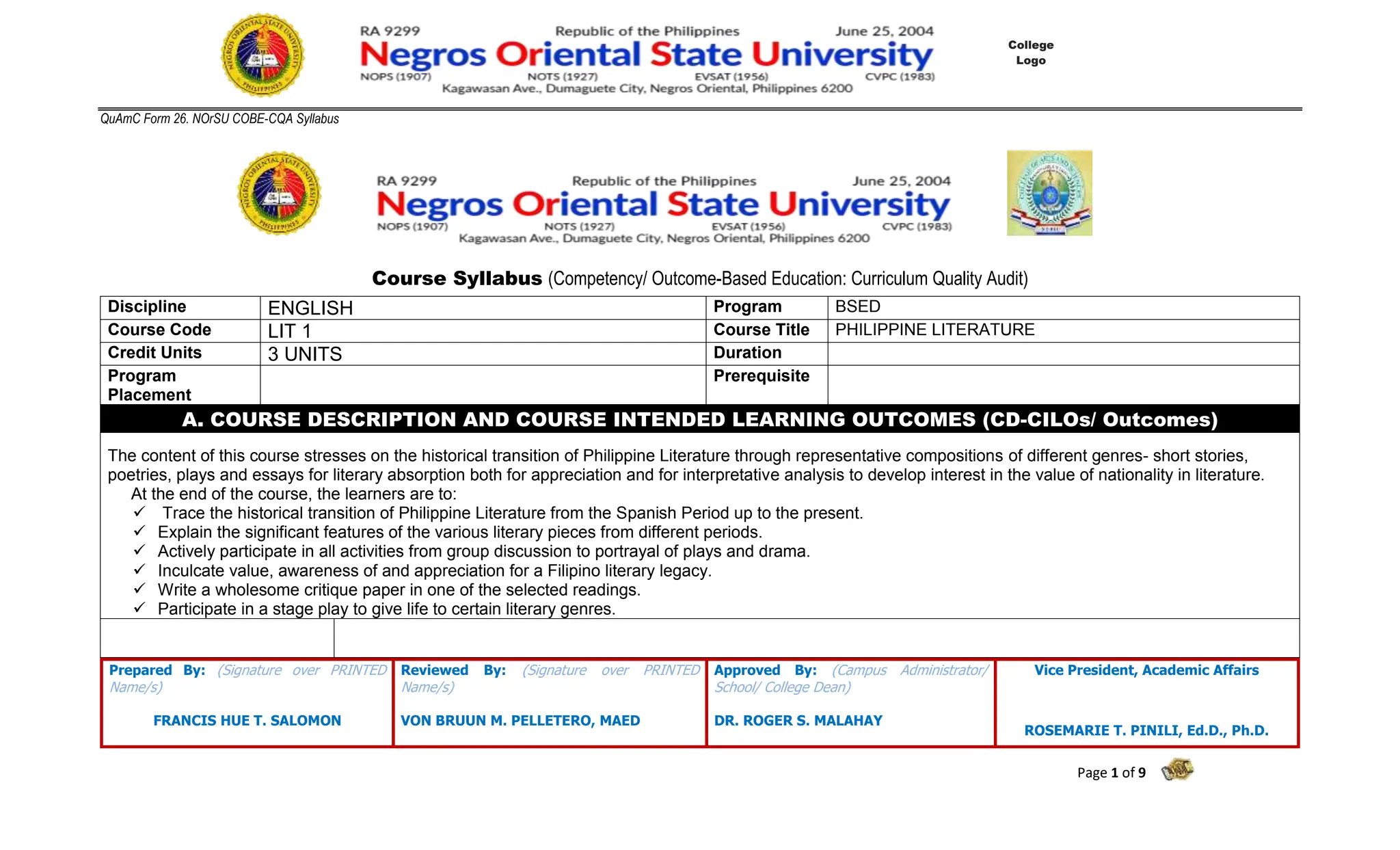
Course Syllabus (Competency/ Outcome-Based Education: Curriculum Quality Audit)
Prepared By: (Signature over PRINTED
Name/s)
FRANCIS HUE T. SALOMON
Reviewed By: (Signature over PRINTED
Name/s)
VON BRUUN M. PELLETERO, MAED
Approved By: (Campus Administrator/
School/ College Dean)
DR. ROGER S. MALAHAY
Vice President, Academic Affairs
ROSEMARIE T. PINILI, Ed.D., Ph.D.
Discipline ENGLISH Program BSED
Course Code LIT 1 Course Title PHILIPPINE LITERATURE
Credit Units 3 UNITS Duration
Program
Placement
Prerequisite
A. COURSE DESCRIPTION AND COURSE INTENDED LEARNING OUTCOMES (CD-CILOs/ Outcomes)
The content of this course stresses on the historical transition of Philippine Literature through representative compositions of different genres- short stories,
poetries, plays and essays for literary absorption both for appreciation and for interpretative analysis to develop interest in the value of nationality in literature.
At the end of the course, the learners are to:
 Trace the historical transition of Philippine Literature from the Spanish Period up to the present.
 Explain the significant features of the various literary pieces from different periods.
 Actively participate in all activities from group discussion to portrayal of plays and drama.
 Inculcate value, awareness of and appreciation for a Filipino literary legacy.
 Write a wholesome critique paper in one of the selected readings.
 Participate in a stage play to give life to certain literary genres.
QuAmC Form 26. NOrSU COBE-CQA Syllabus
Page 2 of 9
College
Logo
Code#: Revision#:___ Date Reviewed:______ Date Approved:________________ Effective Date:__________________
___Standard___Law___Regulation
____UNCONTROLLED ____C O N T R O L L E D
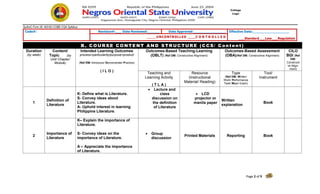
B. COURSE CONTENT AN D STRUCTURE (CCS/ C ontent)
Duration
(by week)
Content/
Topic (by
Unit/ Chapter/
Module)
Intended Learning Outcomes
process+particularity/purpose+product
(Ref DM: Introduce/ Demonstrate/ Practice)
( I L O )
Outcomes-Based Teaching-Learning
(OBLT) (Ref DM: Constructive Alignment)
Outcomes-Based Assessment
(OBA)(Ref DM: Constructive Alignment)
CILO
BGI (Ref
DM:
Constructi
ve Align-
ment)
Teaching and
Learning Activity
( T L A )
Resource
(Instructional
Material/ Reading)
Type
(Ref DM: Written
Work/ Performance
Task/ Major Exam)
Tool/
Instrument
1
Definition of
Literature
K- Define what is Literature.
S- Convey ideas about
Literature.
A- Uphold interest in learning
Philippine Literature.
 Lecture and
class
discussion on
the definition
of Literature
 LCD
projector or
manila paper
Written
explanation
Book
2
Importance of
Literature
K– Explain the importance of
Literature.
S- Convey ideas on the
importance of Literature.
A – Appreciate the importance
of Literature.
 Group
discussion
Printed Materials Reporting Book
QuAmC Form 26. NOrSU COBE-CQA Syllabus
Page 3 of 9
College
Logo
3
Literary
Genres
K-Enumerate the Literary
genres.
S- Show examples of literary
genres.
A – Uphold interest to various
literary genres.
 Group
reporting
Printed materials Paper and pen
test
Multimedia
Projector
Laptop
4. Kinds of
Literature
K – Identify the kinds of
literature.
S – Describe the different kinds
of literature.
A – Appreciate the different
kinds of literature.
 Lecture and
class
discussion
 Paired activity
Printed materials Oral Recitation Multimedia
5.
Prose
K – Identify the different kinds
of prose.
S – Show examples of different
kinds of prose.
A – Appreciate the beauty of
each kind of prose.
 Lecture and
class
discussion
 Group
reporting
Oral recitation Multimedia
6
Poetry
K – Identify the difference
between prose and poetry.
S- Show Example of the
different kinds of poetry.
A – Appreciate the beauty of the
 Lecture and
class
discussion
 Group
reporting
LCD projector or
manila paper
Oral recitation
Projector
Laptop
QuAmC Form 26. NOrSU COBE-CQA Syllabus
Page 4 of 9
College
Logo
Philippine poetries.
QuAmC Form 26. NOrSU COBE-CQA Syllabus
Page 5 of 9
College
Logo
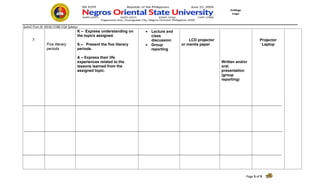
7.
Five literary
periods
K – Express understanding on
the topics assigned.
S – Present the five literary
periods.
A – Express their life
experiences related to the
lessons learned from the
assigned topic.
 Lecture and
class
discussion
 Group
reporting
LCD projector
or manila paper
Written and/or
oral
presentation
(group
reporting)
Projector
Laptop
QuAmC Form 26. NOrSU COBE-CQA Syllabus
Page 6 of 9
College
Logo
QuAmC Form 26. NOrSU COBE-CQA Syllabus
Page 7 of 9
College
Logo
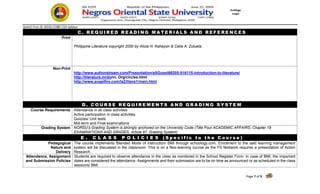
C . R E Q U I R E D R E A D I N G M A T E R I A L S A N D R E F E R E N C E S
Print
Philippine Literature copyright 2000 by Alicia H. Kahayon & Celia A. Zulueta
Non-Print
http://www.authorstream.com/Presentation/aSGuest66205-516115-introduction-to-literature/
http://literature.mrdonn. Org/circles.html
http://www.angelfire.com/la2/litera1/main.html
D . C O U R S E R E Q U I R E M E N T S A N D G R A D I N G S Y S T E M
Course Requirements Attendance in all class activities
Active participation in class activities
Quizzes/ Unit tests
Mid-term and Final examinations
Grading System NORSU’s Grading System is strongly anchored on the University Code (Title Four ACADEMIC AFFAIRS, Chapter 19
EXAMINATIONS AND GRADES, Article 97, Grading System)
E . C L A S S P O L I C I E S ( S p e c i f i c t o t h e C o u r s e )
Pedagogical
Nature and
Delivery
The course implements Blended Mode of Instruction/ BMI through schoology.com. Enrollment to the said learning management
system will be discussed in the classroom. This is on a flexi-learning course as the FS fieldwork requires a presentation of Action
Research.
Attendance, Assignment
and Submission Policies
Students are required to observe attendance in the class as monitored in the School Register Form. In case of BMI, the important
dates are considered the attendance. Assignments and their submission are to be on time as announced or as scheduled in the class
sessions/ BMI.
QuAmC Form 26. NOrSU COBE-CQA Syllabus
Page 8 of 9
College
Logo
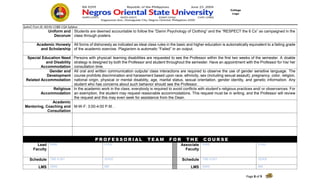
Uniform and
Decorum
Students are deemed accountable to follow the “Damn Psychology of Clothing” and the “RESPECT the 6 Cs” as campaigned in the
class through posters.
Academic Honesty
and Scholarship
All forms of dishonesty as indicated as ideal class rules in the basic and higher education is automatically equivalent to a failing grade
of the academic exercise. Plagiarism is automatic “Failed” in an output.
Special Education Need
and Disability
Accommodation
Persons with physical/ learning disabilities are requested to see the Professor within the first two weeks of the semester. A doable
strategy is designed by both the Professor and student throughout the semester. Have an appointment with the Professor for his/ her
consultation time.
Gender and
Development
Related Accommodation
All oral and written communication outputs/ class interactions are required to observe the use of gender sensitive language. The
course prohibits discrimination and harassment based upon race, ethnicity, sex (including sexual assault), pregnancy, color, religion,
national origin, physical or mental disability, age, marital status, sexual orientation, gender identity, and genetic information. Any
student who has concerns about such behavior should see the Professor.
Religious
Accommodation
In the academic work in the class, everybody is required to avoid conflicts with student’s religious practices and/ or observances. For
an exemption, the student may request reasonable accommodations. This request must be in writing, and the Professor will review
the request and this may even seek for assistance from the Dean.
Academic
Mentoring, Coaching and
Consultation
M-W-F: 3:00-4:00 P.M.…
P R O F E S S O R I A L T E A M F O R T H E C O U R S E
Lead
Faculty
NAME H EdQ Associate
Faculty
NAME H EdQ
Schedule TIME & DAY VENUE Schedule TIME & DAY VENUE
LMS EMAIL BMI LMS EMAIL BMI
QuAmC Form 26. NOrSU COBE-CQA Syllabus
Page 9 of 9
College
Logo
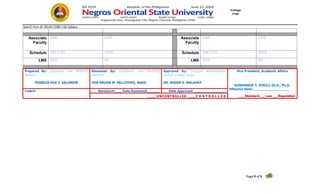
Associate
Faculty
NAME H EdQ Associate
Faculty
NAME H EdQ
Schedule TIME & DAY VENUE Schedule TIME & DAY VENUE
LMS EMAIL BMI LMS EMAIL BMI
Prepared By: (Signature over PRINTED
Name/s)
FRANCIS HUE T. SALOMON
Reviewed By: (Signature over PRINTED
Name/s)
VON BRUUN M. PELLETERO, MAED
Approved By: (Campus Administrator/
School/ College Dean)
DR. ROGER S. MALAHAY
Vice President, Academic Affairs
ROSEMARIE T. PINILI, Ed.D., Ph.D.
Effective Date:__________________
___Standard___Law___Regulation
Code#: Revision#:___ Date Reviewed:______ Date Approved:________________
____UNCONTROLLED ____C O N T R O L L E D

LIT-1-LIT-114.docx

  • 1.
    QuAmC Form 26.NOrSU COBE-CQA Syllabus Page 1 of 9 College Logo Course Syllabus (Competency/ Outcome-Based Education: Curriculum Quality Audit) Prepared By: (Signature over PRINTED Name/s) FRANCIS HUE T. SALOMON Reviewed By: (Signature over PRINTED Name/s) VON BRUUN M. PELLETERO, MAED Approved By: (Campus Administrator/ School/ College Dean) DR. ROGER S. MALAHAY Vice President, Academic Affairs ROSEMARIE T. PINILI, Ed.D., Ph.D. Discipline ENGLISH Program BSED Course Code LIT 1 Course Title PHILIPPINE LITERATURE Credit Units 3 UNITS Duration Program Placement Prerequisite A. COURSE DESCRIPTION AND COURSE INTENDED LEARNING OUTCOMES (CD-CILOs/ Outcomes) The content of this course stresses on the historical transition of Philippine Literature through representative compositions of different genres- short stories, poetries, plays and essays for literary absorption both for appreciation and for interpretative analysis to develop interest in the value of nationality in literature. At the end of the course, the learners are to:  Trace the historical transition of Philippine Literature from the Spanish Period up to the present.  Explain the significant features of the various literary pieces from different periods.  Actively participate in all activities from group discussion to portrayal of plays and drama.  Inculcate value, awareness of and appreciation for a Filipino literary legacy.  Write a wholesome critique paper in one of the selected readings.  Participate in a stage play to give life to certain literary genres.
  • 2.
    QuAmC Form 26.NOrSU COBE-CQA Syllabus Page 2 of 9 College Logo Code#: Revision#:___ Date Reviewed:______ Date Approved:________________ Effective Date:__________________ ___Standard___Law___Regulation ____UNCONTROLLED ____C O N T R O L L E D B. COURSE CONTENT AN D STRUCTURE (CCS/ C ontent) Duration (by week) Content/ Topic (by Unit/ Chapter/ Module) Intended Learning Outcomes process+particularity/purpose+product (Ref DM: Introduce/ Demonstrate/ Practice) ( I L O ) Outcomes-Based Teaching-Learning (OBLT) (Ref DM: Constructive Alignment) Outcomes-Based Assessment (OBA)(Ref DM: Constructive Alignment) CILO BGI (Ref DM: Constructi ve Align- ment) Teaching and Learning Activity ( T L A ) Resource (Instructional Material/ Reading) Type (Ref DM: Written Work/ Performance Task/ Major Exam) Tool/ Instrument 1 Definition of Literature K- Define what is Literature. S- Convey ideas about Literature. A- Uphold interest in learning Philippine Literature.  Lecture and class discussion on the definition of Literature  LCD projector or manila paper Written explanation Book 2 Importance of Literature K– Explain the importance of Literature. S- Convey ideas on the importance of Literature. A – Appreciate the importance of Literature.  Group discussion Printed Materials Reporting Book
  • 3.
    QuAmC Form 26.NOrSU COBE-CQA Syllabus Page 3 of 9 College Logo 3 Literary Genres K-Enumerate the Literary genres. S- Show examples of literary genres. A – Uphold interest to various literary genres.  Group reporting Printed materials Paper and pen test Multimedia Projector Laptop 4. Kinds of Literature K – Identify the kinds of literature. S – Describe the different kinds of literature. A – Appreciate the different kinds of literature.  Lecture and class discussion  Paired activity Printed materials Oral Recitation Multimedia 5. Prose K – Identify the different kinds of prose. S – Show examples of different kinds of prose. A – Appreciate the beauty of each kind of prose.  Lecture and class discussion  Group reporting Oral recitation Multimedia 6 Poetry K – Identify the difference between prose and poetry. S- Show Example of the different kinds of poetry. A – Appreciate the beauty of the  Lecture and class discussion  Group reporting LCD projector or manila paper Oral recitation Projector Laptop
  • 4.
    QuAmC Form 26.NOrSU COBE-CQA Syllabus Page 4 of 9 College Logo Philippine poetries.
  • 5.
    QuAmC Form 26.NOrSU COBE-CQA Syllabus Page 5 of 9 College Logo 7. Five literary periods K – Express understanding on the topics assigned. S – Present the five literary periods. A – Express their life experiences related to the lessons learned from the assigned topic.  Lecture and class discussion  Group reporting LCD projector or manila paper Written and/or oral presentation (group reporting) Projector Laptop
  • 6.
    QuAmC Form 26.NOrSU COBE-CQA Syllabus Page 6 of 9 College Logo
  • 7.
    QuAmC Form 26.NOrSU COBE-CQA Syllabus Page 7 of 9 College Logo C . R E Q U I R E D R E A D I N G M A T E R I A L S A N D R E F E R E N C E S Print Philippine Literature copyright 2000 by Alicia H. Kahayon & Celia A. Zulueta Non-Print http://www.authorstream.com/Presentation/aSGuest66205-516115-introduction-to-literature/ http://literature.mrdonn. Org/circles.html http://www.angelfire.com/la2/litera1/main.html D . C O U R S E R E Q U I R E M E N T S A N D G R A D I N G S Y S T E M Course Requirements Attendance in all class activities Active participation in class activities Quizzes/ Unit tests Mid-term and Final examinations Grading System NORSU’s Grading System is strongly anchored on the University Code (Title Four ACADEMIC AFFAIRS, Chapter 19 EXAMINATIONS AND GRADES, Article 97, Grading System) E . C L A S S P O L I C I E S ( S p e c i f i c t o t h e C o u r s e ) Pedagogical Nature and Delivery The course implements Blended Mode of Instruction/ BMI through schoology.com. Enrollment to the said learning management system will be discussed in the classroom. This is on a flexi-learning course as the FS fieldwork requires a presentation of Action Research. Attendance, Assignment and Submission Policies Students are required to observe attendance in the class as monitored in the School Register Form. In case of BMI, the important dates are considered the attendance. Assignments and their submission are to be on time as announced or as scheduled in the class sessions/ BMI.
  • 8.
    QuAmC Form 26.NOrSU COBE-CQA Syllabus Page 8 of 9 College Logo Uniform and Decorum Students are deemed accountable to follow the “Damn Psychology of Clothing” and the “RESPECT the 6 Cs” as campaigned in the class through posters. Academic Honesty and Scholarship All forms of dishonesty as indicated as ideal class rules in the basic and higher education is automatically equivalent to a failing grade of the academic exercise. Plagiarism is automatic “Failed” in an output. Special Education Need and Disability Accommodation Persons with physical/ learning disabilities are requested to see the Professor within the first two weeks of the semester. A doable strategy is designed by both the Professor and student throughout the semester. Have an appointment with the Professor for his/ her consultation time. Gender and Development Related Accommodation All oral and written communication outputs/ class interactions are required to observe the use of gender sensitive language. The course prohibits discrimination and harassment based upon race, ethnicity, sex (including sexual assault), pregnancy, color, religion, national origin, physical or mental disability, age, marital status, sexual orientation, gender identity, and genetic information. Any student who has concerns about such behavior should see the Professor. Religious Accommodation In the academic work in the class, everybody is required to avoid conflicts with student’s religious practices and/ or observances. For an exemption, the student may request reasonable accommodations. This request must be in writing, and the Professor will review the request and this may even seek for assistance from the Dean. Academic Mentoring, Coaching and Consultation M-W-F: 3:00-4:00 P.M.… P R O F E S S O R I A L T E A M F O R T H E C O U R S E Lead Faculty NAME H EdQ Associate Faculty NAME H EdQ Schedule TIME & DAY VENUE Schedule TIME & DAY VENUE LMS EMAIL BMI LMS EMAIL BMI
  • 9.
    QuAmC Form 26.NOrSU COBE-CQA Syllabus Page 9 of 9 College Logo Associate Faculty NAME H EdQ Associate Faculty NAME H EdQ Schedule TIME & DAY VENUE Schedule TIME & DAY VENUE LMS EMAIL BMI LMS EMAIL BMI Prepared By: (Signature over PRINTED Name/s) FRANCIS HUE T. SALOMON Reviewed By: (Signature over PRINTED Name/s) VON BRUUN M. PELLETERO, MAED Approved By: (Campus Administrator/ School/ College Dean) DR. ROGER S. MALAHAY Vice President, Academic Affairs ROSEMARIE T. PINILI, Ed.D., Ph.D. Effective Date:__________________ ___Standard___Law___Regulation Code#: Revision#:___ Date Reviewed:______ Date Approved:________________ ____UNCONTROLLED ____C O N T R O L L E D