Eastern Nazarene College
CO 210: Introduction to Applied Linguistics
Spring 2016
Instructor: Prof. Allison Nicole Tucker Office: Gardner 3rd Floor
Class Times: MWF 11:30-12:35 Phone: 434-989-1632
Classroom: Gardner 27 Office Hours: MWF 12:40-2:00 pm
Email: atucker@thewoodwardschool.org Or by appointment
Text:
Anne Curzan and Michael Adams, How English Works: A Linguistic Introduction, 2nd
edition ISBN – 13 978-0-205-60550-7
Description:
CO 210 is a 3-credit course required for all majors in Education, Literatures in
English, Communication Arts, Theatre, and Journalism and Writing. As stated in the
ENC course catalogue, this course is “concerned with teaching the English language.
It includes a study of the history of the English language, semantics, syntax,
phonetics, phonology, morphology, dialects, grammar [prescriptive and descriptive]
and usage.” Prerequisites: EN120, EN121
Goal:
To introduce students to the scientific study of language, with emphasis on
foundational ideas that have significant ramifications for people working in other
disciplines. To show students how interesting and applicable the study of language
is to every human that communicates via language (aka everyone).
Objectives:
1. Students will be able to identify and generate correct information about:
language and the brain, the design features of languages, language
acquisition, the anatomy of the vocal tract, and mental grammar (phonetics,
phonology, morphology, syntax, and semantics)
2. Students will identify and explain the foundational idea of modern linguistics,
and apply that knowledge to other fields such as education, journalism,
writing, political science, and public policy.
3. Students will correct mistaken statements about language, its acquisition, or
about educational matters pertaining to it.
4. Students will generate solutions to problems involving language and
communication using their knowledge of linguistics.
What to Expect:
Linguistics at this level is a content-driven class: there are scores of terms and
concepts that must be learned in order to discuss ideas. Students are expected to
complete assigned reading in preparation for class time, to pay attention and
participate during class, and ideally to review class notes and student materials
after class to process and learn materials. However, in-class time is meant to be
interactive. Classwork will include both individual and group work. Many class
sessions will begin with visually-based exercises and students are encouraged to
share related material prior to class when applicable.
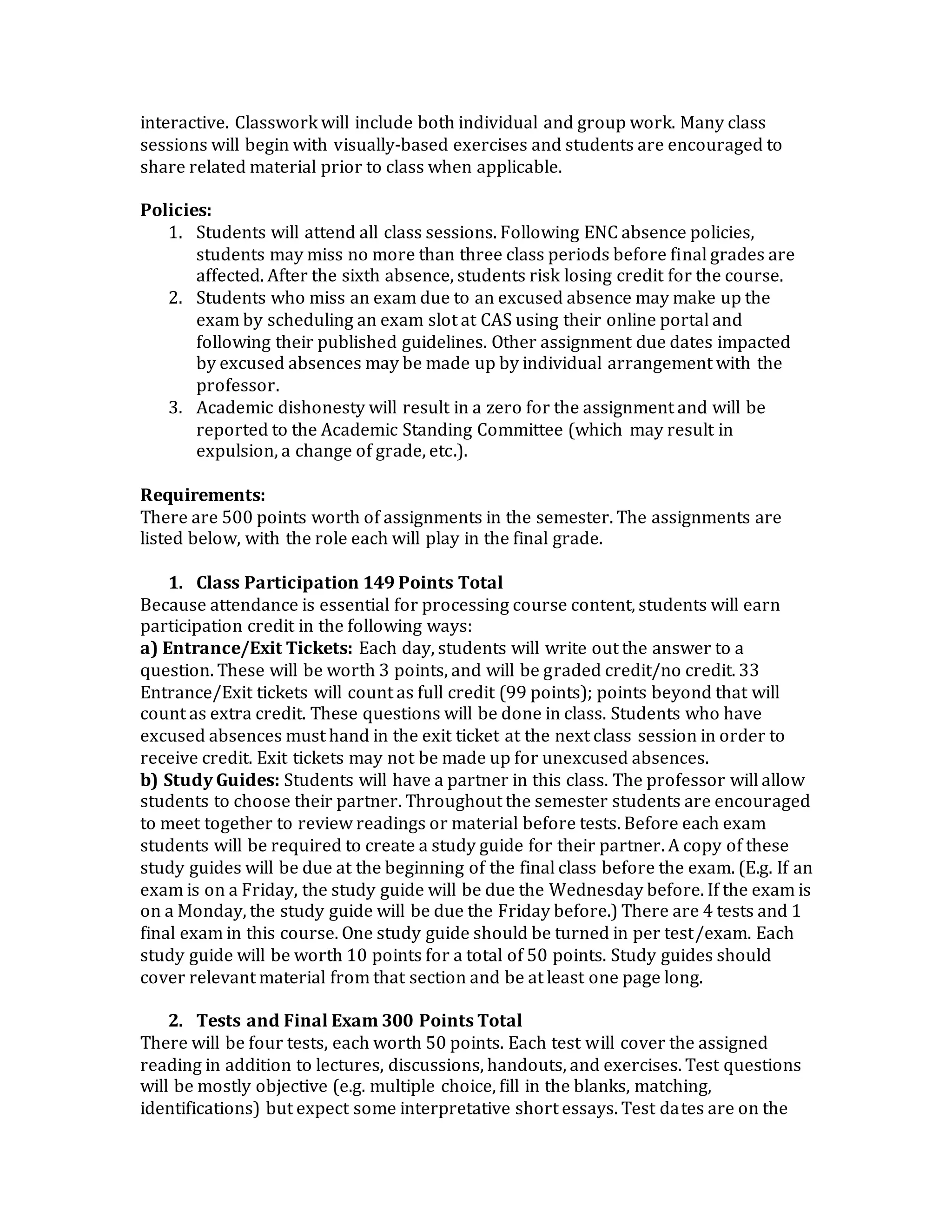
Policies:
1. Students will attend all class sessions. Following ENC absence policies,
students may miss no more than three class periods before final grades are
affected. After the sixth absence, students risk losing credit for the course.
2. Students who miss an exam due to an excused absence may make up the
exam by scheduling an exam slot at CAS using their online portal and
following their published guidelines. Other assignment due dates impacted
by excused absences may be made up by individual arrangement with the
professor.
3. Academic dishonesty will result in a zero for the assignment and will be
reported to the Academic Standing Committee (which may result in
expulsion, a change of grade, etc.).
Requirements:
There are 500 points worth of assignments in the semester. The assignments are
listed below, with the role each will play in the final grade.
1. Class Participation 149 Points Total
Because attendance is essential for processing course content, students will earn
participation credit in the following ways:
a) Entrance/Exit Tickets: Each day, students will write out the answer to a
question. These will be worth 3 points, and will be graded credit/no credit. 33
Entrance/Exit tickets will count as full credit (99 points); points beyond that will
count as extra credit. These questions will be done in class. Students who have
excused absences must hand in the exit ticket at the next class session in order to
receive credit. Exit tickets may not be made up for unexcused absences.
b) Study Guides: Students will have a partner in this class. The professor will allow
students to choose their partner. Throughout the semester students are encouraged
to meet together to review readings or material before tests. Before each exam
students will be required to create a study guide for their partner. A copy of these
study guides will be due at the beginning of the final class before the exam. (E.g. If an
exam is on a Friday, the study guide will be due the Wednesday before. If the exam is
on a Monday, the study guide will be due the Friday before.) There are 4 tests and 1
final exam in this course. One study guide should be turned in per test/exam. Each
study guide will be worth 10 points for a total of 50 points. Study guides should
cover relevant material from that section and be at least one page long.
2. Tests and Final Exam 300 Points Total
There will be four tests, each worth 50 points. Each test will cover the assigned
reading in addition to lectures, discussions, handouts, and exercises. Test questions
will be mostly objective (e.g. multiple choice, fill in the blanks, matching,
identifications) but expect some interpretative short essays. Test dates are on the
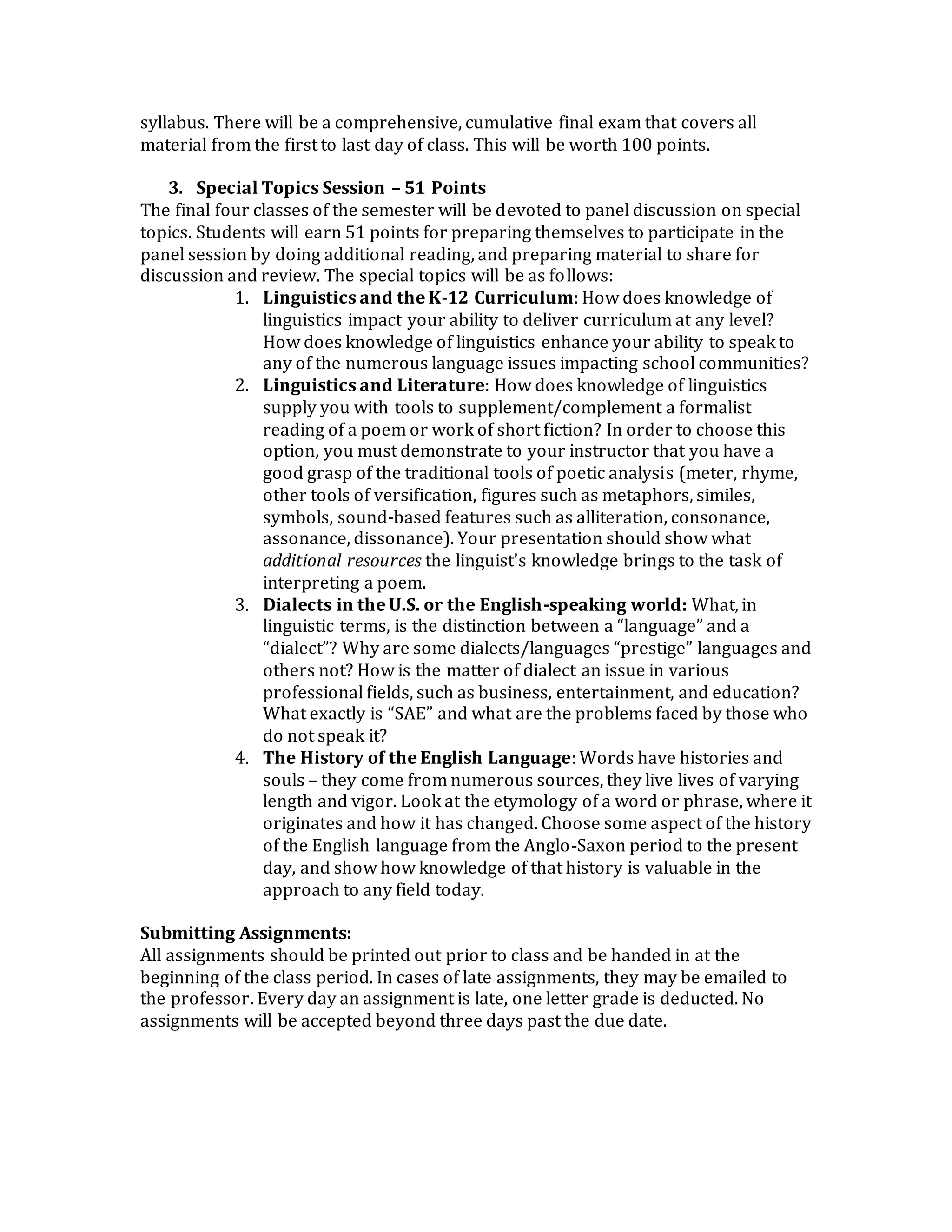
syllabus. There will be a comprehensive, cumulative final exam that covers all
material from the first to last day of class. This will be worth 100 points.
3. Special Topics Session – 51 Points
The final four classes of the semester will be devoted to panel discussion on special
topics. Students will earn 51 points for preparing themselves to participate in the
panel session by doing additional reading, and preparing material to share for
discussion and review. The special topics will be as follows:
1. Linguistics and the K-12 Curriculum: How does knowledge of
linguistics impact your ability to deliver curriculum at any level?
How does knowledge of linguistics enhance your ability to speak to
any of the numerous language issues impacting school communities?
2. Linguistics and Literature: How does knowledge of linguistics
supply you with tools to supplement/complement a formalist
reading of a poem or work of short fiction? In order to choose this
option, you must demonstrate to your instructor that you have a
good grasp of the traditional tools of poetic analysis (meter, rhyme,
other tools of versification, figures such as metaphors, similes,
symbols, sound-based features such as alliteration, consonance,
assonance, dissonance). Your presentation should show what
additional resources the linguist’s knowledge brings to the task of
interpreting a poem.
3. Dialects in the U.S. or the English-speaking world: What, in
linguistic terms, is the distinction between a “language” and a
“dialect”? Why are some dialects/languages “prestige” languages and
others not? How is the matter of dialect an issue in various
professional fields, such as business, entertainment, and education?
What exactly is “SAE” and what are the problems faced by those who
do not speak it?
4. The History of the English Language: Words have histories and
souls – they come from numerous sources, they live lives of varying
length and vigor. Look at the etymology of a word or phrase, where it
originates and how it has changed. Choose some aspect of the history
of the English language from the Anglo-Saxon period to the present
day, and show how knowledge of that history is valuable in the
approach to any field today.
Submitting Assignments:
All assignments should be printed out prior to class and be handed in at the
beginning of the class period. In cases of late assignments, they may be emailed to
the professor. Every day an assignment is late, one letter grade is deducted. No
assignments will be accepted beyond three days past the due date.
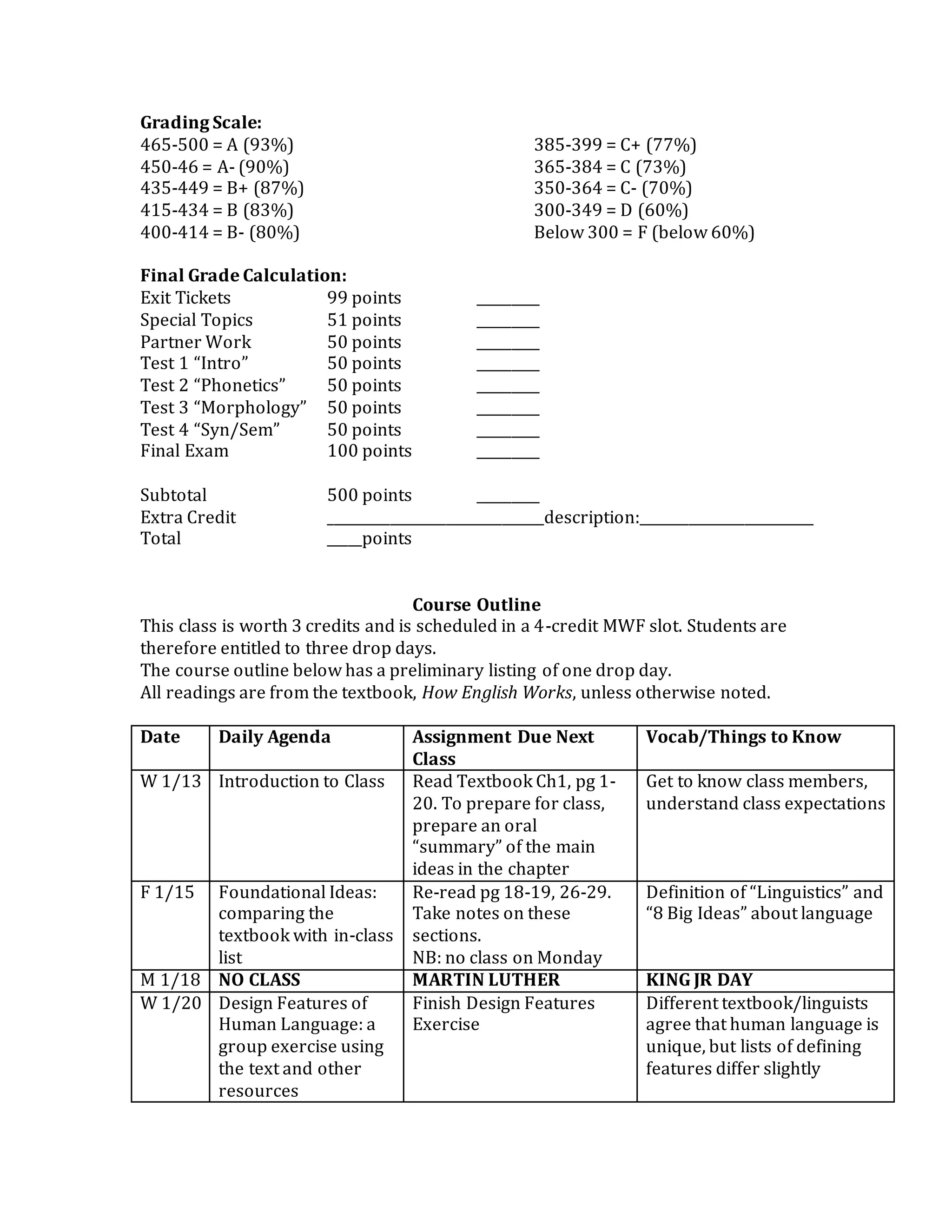
Grading Scale:
465-500 = A (93%) 385-399 = C+ (77%)
450-46 = A- (90%) 365-384 = C (73%)
435-449 = B+ (87%) 350-364 = C- (70%)
415-434 = B (83%) 300-349 = D (60%)
400-414 = B- (80%) Below 300 = F (below 60%)
Final Grade Calculation:
Exit Tickets 99 points _________
Special Topics 51 points _________
Partner Work 50 points _________
Test 1 “Intro” 50 points _________
Test 2 “Phonetics” 50 points _________
Test 3 “Morphology” 50 points _________
Test 4 “Syn/Sem” 50 points _________
Final Exam 100 points _________
Subtotal 500 points _________
Extra Credit _______________________________description:_________________________
Total _____points
Course Outline
This class is worth 3 credits and is scheduled in a 4-credit MWF slot. Students are
therefore entitled to three drop days.
The course outline below has a preliminary listing of one drop day.
All readings are from the textbook, How English Works, unless otherwise noted.
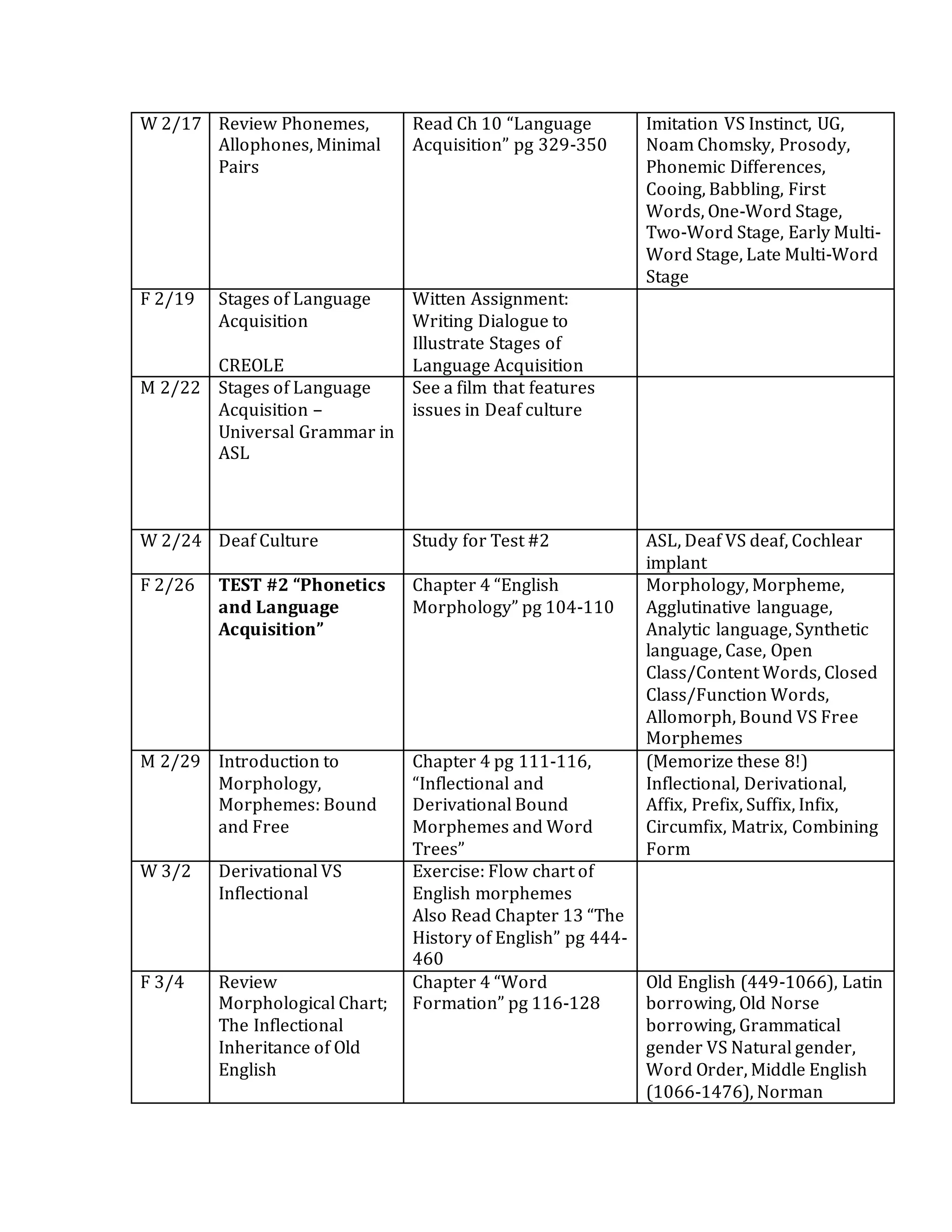
Date Daily Agenda Assignment Due Next
Class
Vocab/Things to Know
W 1/13 Introduction to Class Read Textbook Ch1, pg 1-
20. To prepare for class,
prepare an oral
“summary” of the main
ideas in the chapter
Get to know class members,
understand class expectations
F 1/15 Foundational Ideas:
comparing the
textbook with in-class
list
Re-read pg 18-19, 26-29.
Take notes on these
sections.
NB: no class on Monday
Definition of “Linguistics” and
“8 Big Ideas” about language
M 1/18 NO CLASS MARTIN LUTHER KING JR DAY
W 1/20 Design Features of
Human Language: a
group exercise using
the text and other
resources
Finish Design Features
Exercise
Different textbook/linguists
agree that human language is
unique, but lists of defining
features differ slightly
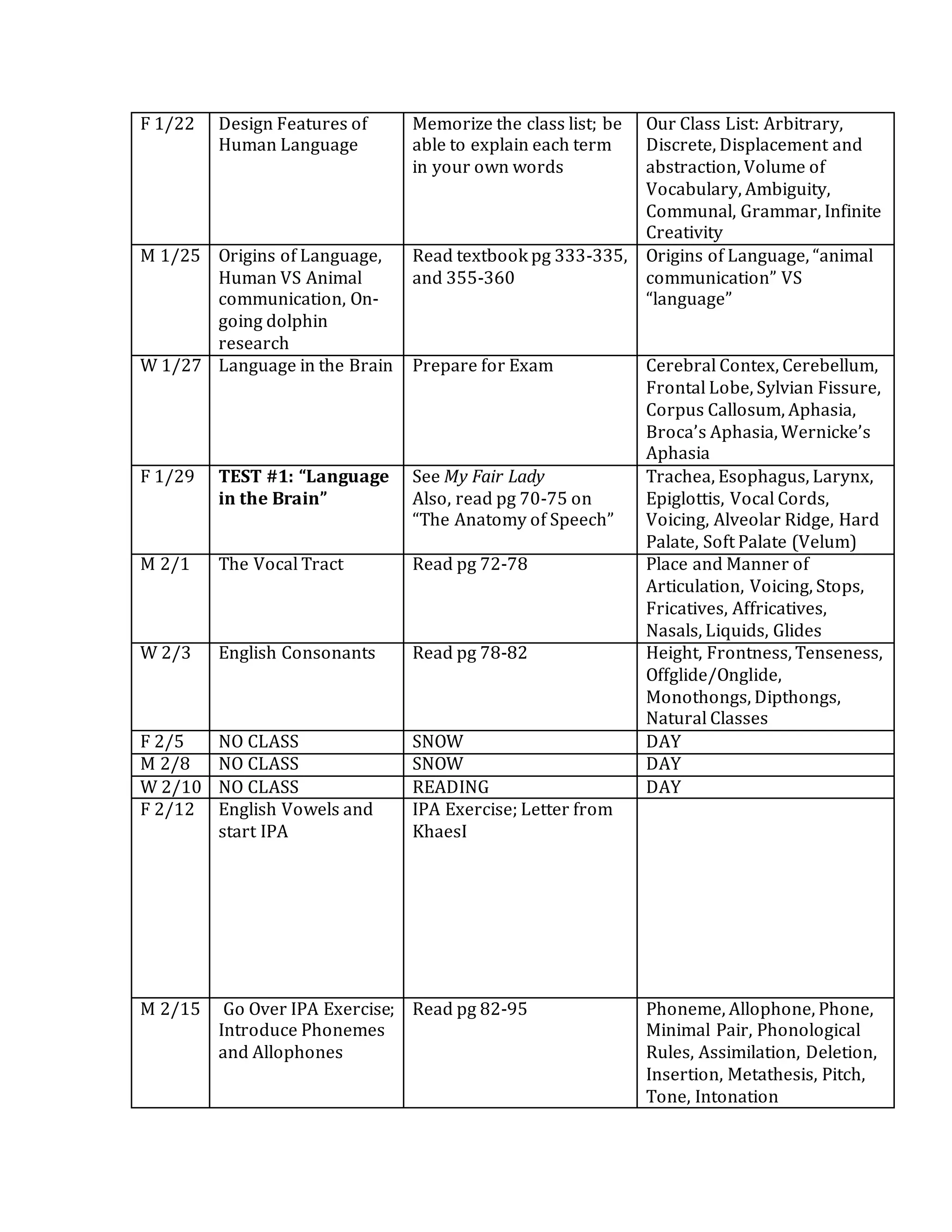
F 1/22 Design Features of
Human Language
Memorize the class list; be
able to explain each term
in your own words
Our Class List: Arbitrary,
Discrete, Displacement and
abstraction, Volume of
Vocabulary, Ambiguity,
Communal, Grammar, Infinite
Creativity
M 1/25 Origins of Language,
Human VS Animal
communication, On-
going dolphin
research
Read textbook pg 333-335,
and 355-360
Origins of Language, “animal
communication” VS
“language”
W 1/27 Language in the Brain Prepare for Exam Cerebral Contex, Cerebellum,
Frontal Lobe, Sylvian Fissure,
Corpus Callosum, Aphasia,
Broca’s Aphasia, Wernicke’s
Aphasia
F 1/29 TEST #1: “Language
in the Brain”
See My Fair Lady
Also, read pg 70-75 on
“The Anatomy of Speech”
Trachea, Esophagus, Larynx,
Epiglottis, Vocal Cords,
Voicing, Alveolar Ridge, Hard
Palate, Soft Palate (Velum)
M 2/1 The Vocal Tract Read pg 72-78 Place and Manner of
Articulation, Voicing, Stops,
Fricatives, Affricatives,
Nasals, Liquids, Glides
W 2/3 English Consonants Read pg 78-82 Height, Frontness, Tenseness,
Offglide/Onglide,
Monothongs, Dipthongs,
Natural Classes
F 2/5 NO CLASS SNOW DAY
M 2/8 NO CLASS SNOW DAY
W 2/10 NO CLASS READING DAY
F 2/12 English Vowels and
start IPA
IPA Exercise; Letter from
KhaesI
M 2/15 Go Over IPA Exercise;
Introduce Phonemes
and Allophones
Read pg 82-95 Phoneme, Allophone, Phone,
Minimal Pair, Phonological
Rules, Assimilation, Deletion,
Insertion, Metathesis, Pitch,
Tone, Intonation
W 2/17 Review Phonemes,
Allophones, Minimal
Pairs
Read Ch 10 “Language
Acquisition” pg 329-350
Imitation VS Instinct, UG,
Noam Chomsky, Prosody,
Phonemic Differences,
Cooing, Babbling, First
Words, One-Word Stage,
Two-Word Stage, Early Multi-
Word Stage, Late Multi-Word
Stage
F 2/19 Stages of Language
Acquisition
CREOLE
Witten Assignment:
Writing Dialogue to
Illustrate Stages of
Language Acquisition
M 2/22 Stages of Language
Acquisition –
Universal Grammar in
ASL
See a film that features
issues in Deaf culture
W 2/24 Deaf Culture Study for Test #2 ASL, Deaf VS deaf, Cochlear
implant
F 2/26 TEST #2 “Phonetics
and Language
Acquisition”
Chapter 4 “English
Morphology” pg 104-110
Morphology, Morpheme,
Agglutinative language,
Analytic language, Synthetic
language, Case, Open
Class/Content Words, Closed
Class/Function Words,
Allomorph, Bound VS Free
Morphemes
M 2/29 Introduction to
Morphology,
Morphemes: Bound
and Free
Chapter 4 pg 111-116,
“Inflectional and
Derivational Bound
Morphemes and Word
Trees”
(Memorize these 8!)
Inflectional, Derivational,
Affix, Prefix, Suffix, Infix,
Circumfix, Matrix, Combining
Form
W 3/2 Derivational VS
Inflectional
Exercise: Flow chart of
English morphemes
Also Read Chapter 13 “The
History of English” pg 444-
460
F 3/4 Review
Morphological Chart;
The Inflectional
Inheritance of Old
English
Chapter 4 “Word
Formation” pg 116-128
Old English (449-1066), Latin
borrowing, Old Norse
borrowing, Grammatical
gender VS Natural gender,
Word Order, Middle English
(1066-1476), Norman
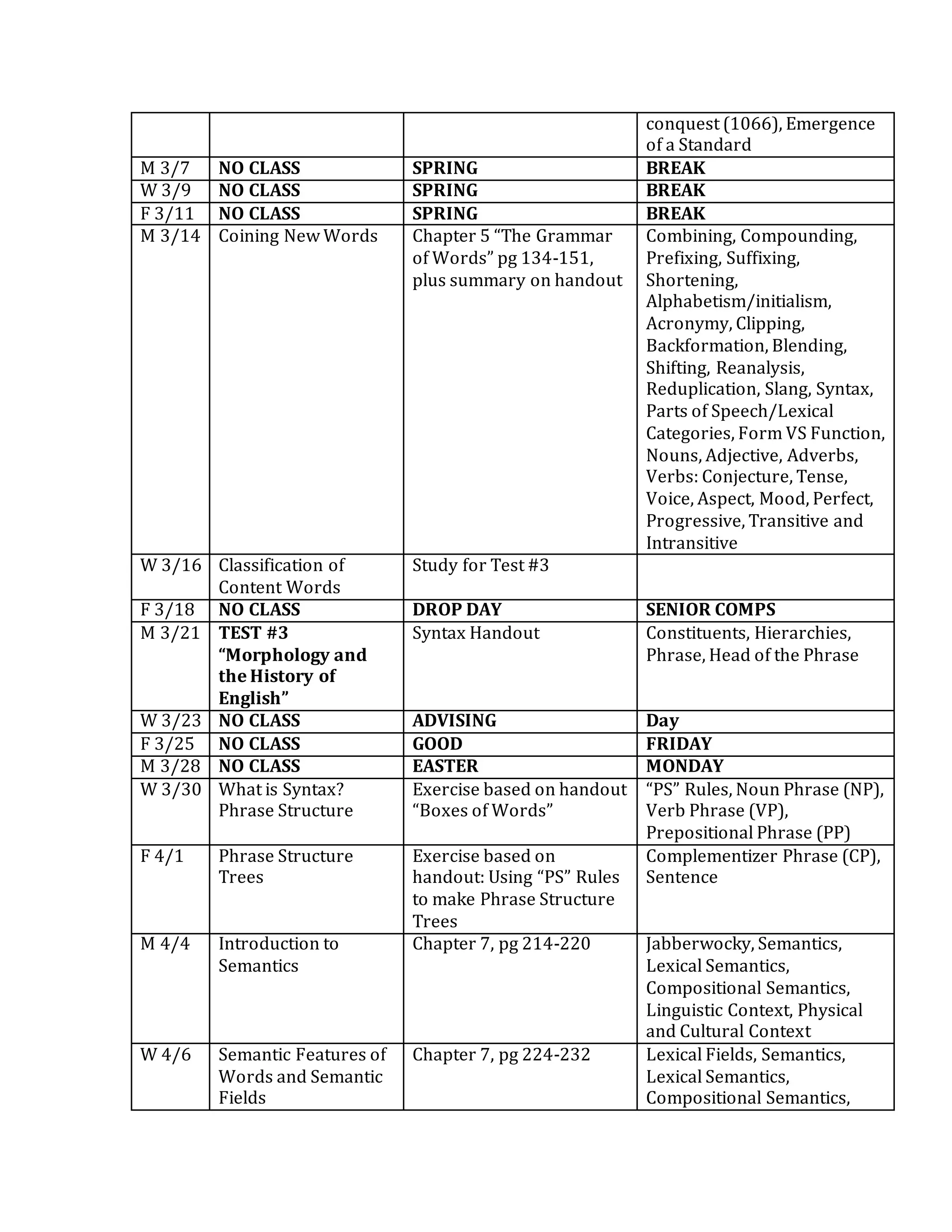
conquest (1066), Emergence
of a Standard
M 3/7 NO CLASS SPRING BREAK
W 3/9 NO CLASS SPRING BREAK
F 3/11 NO CLASS SPRING BREAK
M 3/14 Coining New Words Chapter 5 “The Grammar
of Words” pg 134-151,
plus summary on handout
Combining, Compounding,
Prefixing, Suffixing,
Shortening,
Alphabetism/initialism,
Acronymy, Clipping,
Backformation, Blending,
Shifting, Reanalysis,
Reduplication, Slang, Syntax,
Parts of Speech/Lexical
Categories, Form VS Function,
Nouns, Adjective, Adverbs,
Verbs: Conjecture, Tense,
Voice, Aspect, Mood, Perfect,
Progressive, Transitive and
Intransitive
W 3/16 Classification of
Content Words
Study for Test #3
F 3/18 NO CLASS DROP DAY SENIOR COMPS
M 3/21 TEST #3
“Morphology and
the History of
English”
Syntax Handout Constituents, Hierarchies,
Phrase, Head of the Phrase
W 3/23 NO CLASS ADVISING Day
F 3/25 NO CLASS GOOD FRIDAY
M 3/28 NO CLASS EASTER MONDAY
W 3/30 What is Syntax?
Phrase Structure
Exercise based on handout
“Boxes of Words”
“PS” Rules, Noun Phrase (NP),
Verb Phrase (VP),
Prepositional Phrase (PP)
F 4/1 Phrase Structure
Trees
Exercise based on
handout: Using “PS” Rules
to make Phrase Structure
Trees
Complementizer Phrase (CP),
Sentence
M 4/4 Introduction to
Semantics
Chapter 7, pg 214-220 Jabberwocky, Semantics,
Lexical Semantics,
Compositional Semantics,
Linguistic Context, Physical
and Cultural Context
W 4/6 Semantic Features of
Words and Semantic
Fields
Chapter 7, pg 224-232 Lexical Fields, Semantics,
Lexical Semantics,
Compositional Semantics,
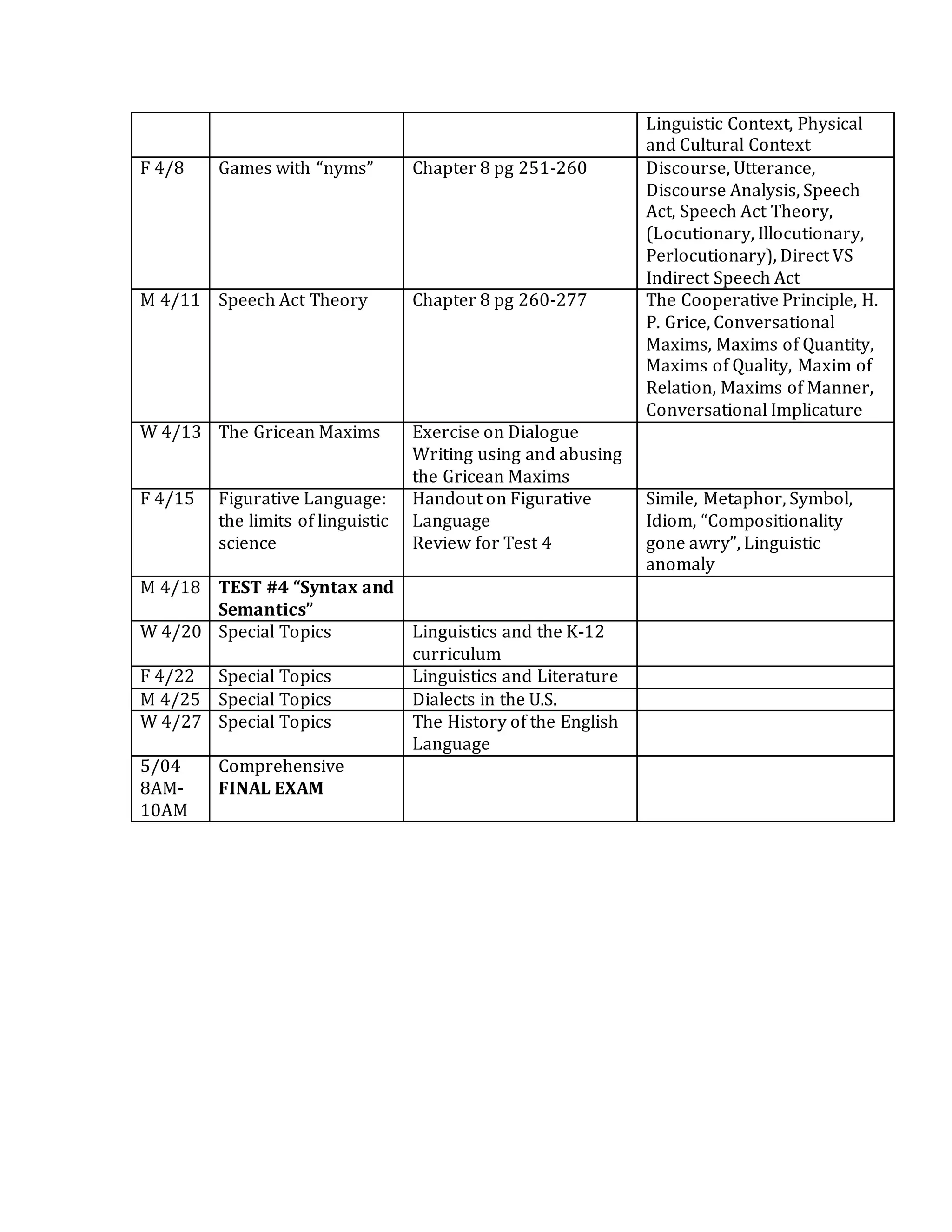
Linguistic Context, Physical
and Cultural Context
F 4/8 Games with “nyms” Chapter 8 pg 251-260 Discourse, Utterance,
Discourse Analysis, Speech
Act, Speech Act Theory,
(Locutionary, Illocutionary,
Perlocutionary), Direct VS
Indirect Speech Act
M 4/11 Speech Act Theory Chapter 8 pg 260-277 The Cooperative Principle, H.
P. Grice, Conversational
Maxims, Maxims of Quantity,
Maxims of Quality, Maxim of
Relation, Maxims of Manner,
Conversational Implicature
W 4/13 The Gricean Maxims Exercise on Dialogue
Writing using and abusing
the Gricean Maxims
F 4/15 Figurative Language:
the limits of linguistic
science
Handout on Figurative
Language
Review for Test 4
Simile, Metaphor, Symbol,
Idiom, “Compositionality
gone awry”, Linguistic
anomaly
M 4/18 TEST #4 “Syntax and
Semantics”
W 4/20 Special Topics Linguistics and the K-12
curriculum
F 4/22 Special Topics Linguistics and Literature
M 4/25 Special Topics Dialects in the U.S.
W 4/27 Special Topics The History of the English
Language
5/04
8AM-
10AM
Comprehensive
FINAL EXAM

ENC CO210 Intro to Linguistics Syllabus

  • 1.
    Eastern Nazarene College CO210: Introduction to Applied Linguistics Spring 2016 Instructor: Prof. Allison Nicole Tucker Office: Gardner 3rd Floor Class Times: MWF 11:30-12:35 Phone: 434-989-1632 Classroom: Gardner 27 Office Hours: MWF 12:40-2:00 pm Email: atucker@thewoodwardschool.org Or by appointment Text: Anne Curzan and Michael Adams, How English Works: A Linguistic Introduction, 2nd edition ISBN – 13 978-0-205-60550-7 Description: CO 210 is a 3-credit course required for all majors in Education, Literatures in English, Communication Arts, Theatre, and Journalism and Writing. As stated in the ENC course catalogue, this course is “concerned with teaching the English language. It includes a study of the history of the English language, semantics, syntax, phonetics, phonology, morphology, dialects, grammar [prescriptive and descriptive] and usage.” Prerequisites: EN120, EN121 Goal: To introduce students to the scientific study of language, with emphasis on foundational ideas that have significant ramifications for people working in other disciplines. To show students how interesting and applicable the study of language is to every human that communicates via language (aka everyone). Objectives: 1. Students will be able to identify and generate correct information about: language and the brain, the design features of languages, language acquisition, the anatomy of the vocal tract, and mental grammar (phonetics, phonology, morphology, syntax, and semantics) 2. Students will identify and explain the foundational idea of modern linguistics, and apply that knowledge to other fields such as education, journalism, writing, political science, and public policy. 3. Students will correct mistaken statements about language, its acquisition, or about educational matters pertaining to it. 4. Students will generate solutions to problems involving language and communication using their knowledge of linguistics. What to Expect: Linguistics at this level is a content-driven class: there are scores of terms and concepts that must be learned in order to discuss ideas. Students are expected to complete assigned reading in preparation for class time, to pay attention and participate during class, and ideally to review class notes and student materials after class to process and learn materials. However, in-class time is meant to be
  • 2.
    interactive. Classwork willinclude both individual and group work. Many class sessions will begin with visually-based exercises and students are encouraged to share related material prior to class when applicable. Policies: 1. Students will attend all class sessions. Following ENC absence policies, students may miss no more than three class periods before final grades are affected. After the sixth absence, students risk losing credit for the course. 2. Students who miss an exam due to an excused absence may make up the exam by scheduling an exam slot at CAS using their online portal and following their published guidelines. Other assignment due dates impacted by excused absences may be made up by individual arrangement with the professor. 3. Academic dishonesty will result in a zero for the assignment and will be reported to the Academic Standing Committee (which may result in expulsion, a change of grade, etc.). Requirements: There are 500 points worth of assignments in the semester. The assignments are listed below, with the role each will play in the final grade. 1. Class Participation 149 Points Total Because attendance is essential for processing course content, students will earn participation credit in the following ways: a) Entrance/Exit Tickets: Each day, students will write out the answer to a question. These will be worth 3 points, and will be graded credit/no credit. 33 Entrance/Exit tickets will count as full credit (99 points); points beyond that will count as extra credit. These questions will be done in class. Students who have excused absences must hand in the exit ticket at the next class session in order to receive credit. Exit tickets may not be made up for unexcused absences. b) Study Guides: Students will have a partner in this class. The professor will allow students to choose their partner. Throughout the semester students are encouraged to meet together to review readings or material before tests. Before each exam students will be required to create a study guide for their partner. A copy of these study guides will be due at the beginning of the final class before the exam. (E.g. If an exam is on a Friday, the study guide will be due the Wednesday before. If the exam is on a Monday, the study guide will be due the Friday before.) There are 4 tests and 1 final exam in this course. One study guide should be turned in per test/exam. Each study guide will be worth 10 points for a total of 50 points. Study guides should cover relevant material from that section and be at least one page long. 2. Tests and Final Exam 300 Points Total There will be four tests, each worth 50 points. Each test will cover the assigned reading in addition to lectures, discussions, handouts, and exercises. Test questions will be mostly objective (e.g. multiple choice, fill in the blanks, matching, identifications) but expect some interpretative short essays. Test dates are on the
  • 3.
    syllabus. There willbe a comprehensive, cumulative final exam that covers all material from the first to last day of class. This will be worth 100 points. 3. Special Topics Session – 51 Points The final four classes of the semester will be devoted to panel discussion on special topics. Students will earn 51 points for preparing themselves to participate in the panel session by doing additional reading, and preparing material to share for discussion and review. The special topics will be as follows: 1. Linguistics and the K-12 Curriculum: How does knowledge of linguistics impact your ability to deliver curriculum at any level? How does knowledge of linguistics enhance your ability to speak to any of the numerous language issues impacting school communities? 2. Linguistics and Literature: How does knowledge of linguistics supply you with tools to supplement/complement a formalist reading of a poem or work of short fiction? In order to choose this option, you must demonstrate to your instructor that you have a good grasp of the traditional tools of poetic analysis (meter, rhyme, other tools of versification, figures such as metaphors, similes, symbols, sound-based features such as alliteration, consonance, assonance, dissonance). Your presentation should show what additional resources the linguist’s knowledge brings to the task of interpreting a poem. 3. Dialects in the U.S. or the English-speaking world: What, in linguistic terms, is the distinction between a “language” and a “dialect”? Why are some dialects/languages “prestige” languages and others not? How is the matter of dialect an issue in various professional fields, such as business, entertainment, and education? What exactly is “SAE” and what are the problems faced by those who do not speak it? 4. The History of the English Language: Words have histories and souls – they come from numerous sources, they live lives of varying length and vigor. Look at the etymology of a word or phrase, where it originates and how it has changed. Choose some aspect of the history of the English language from the Anglo-Saxon period to the present day, and show how knowledge of that history is valuable in the approach to any field today. Submitting Assignments: All assignments should be printed out prior to class and be handed in at the beginning of the class period. In cases of late assignments, they may be emailed to the professor. Every day an assignment is late, one letter grade is deducted. No assignments will be accepted beyond three days past the due date.
  • 4.
    Grading Scale: 465-500 =A (93%) 385-399 = C+ (77%) 450-46 = A- (90%) 365-384 = C (73%) 435-449 = B+ (87%) 350-364 = C- (70%) 415-434 = B (83%) 300-349 = D (60%) 400-414 = B- (80%) Below 300 = F (below 60%) Final Grade Calculation: Exit Tickets 99 points _________ Special Topics 51 points _________ Partner Work 50 points _________ Test 1 “Intro” 50 points _________ Test 2 “Phonetics” 50 points _________ Test 3 “Morphology” 50 points _________ Test 4 “Syn/Sem” 50 points _________ Final Exam 100 points _________ Subtotal 500 points _________ Extra Credit _______________________________description:_________________________ Total _____points Course Outline This class is worth 3 credits and is scheduled in a 4-credit MWF slot. Students are therefore entitled to three drop days. The course outline below has a preliminary listing of one drop day. All readings are from the textbook, How English Works, unless otherwise noted. Date Daily Agenda Assignment Due Next Class Vocab/Things to Know W 1/13 Introduction to Class Read Textbook Ch1, pg 1- 20. To prepare for class, prepare an oral “summary” of the main ideas in the chapter Get to know class members, understand class expectations F 1/15 Foundational Ideas: comparing the textbook with in-class list Re-read pg 18-19, 26-29. Take notes on these sections. NB: no class on Monday Definition of “Linguistics” and “8 Big Ideas” about language M 1/18 NO CLASS MARTIN LUTHER KING JR DAY W 1/20 Design Features of Human Language: a group exercise using the text and other resources Finish Design Features Exercise Different textbook/linguists agree that human language is unique, but lists of defining features differ slightly
  • 5.
    F 1/22 DesignFeatures of Human Language Memorize the class list; be able to explain each term in your own words Our Class List: Arbitrary, Discrete, Displacement and abstraction, Volume of Vocabulary, Ambiguity, Communal, Grammar, Infinite Creativity M 1/25 Origins of Language, Human VS Animal communication, On- going dolphin research Read textbook pg 333-335, and 355-360 Origins of Language, “animal communication” VS “language” W 1/27 Language in the Brain Prepare for Exam Cerebral Contex, Cerebellum, Frontal Lobe, Sylvian Fissure, Corpus Callosum, Aphasia, Broca’s Aphasia, Wernicke’s Aphasia F 1/29 TEST #1: “Language in the Brain” See My Fair Lady Also, read pg 70-75 on “The Anatomy of Speech” Trachea, Esophagus, Larynx, Epiglottis, Vocal Cords, Voicing, Alveolar Ridge, Hard Palate, Soft Palate (Velum) M 2/1 The Vocal Tract Read pg 72-78 Place and Manner of Articulation, Voicing, Stops, Fricatives, Affricatives, Nasals, Liquids, Glides W 2/3 English Consonants Read pg 78-82 Height, Frontness, Tenseness, Offglide/Onglide, Monothongs, Dipthongs, Natural Classes F 2/5 NO CLASS SNOW DAY M 2/8 NO CLASS SNOW DAY W 2/10 NO CLASS READING DAY F 2/12 English Vowels and start IPA IPA Exercise; Letter from KhaesI M 2/15 Go Over IPA Exercise; Introduce Phonemes and Allophones Read pg 82-95 Phoneme, Allophone, Phone, Minimal Pair, Phonological Rules, Assimilation, Deletion, Insertion, Metathesis, Pitch, Tone, Intonation
  • 6.
    W 2/17 ReviewPhonemes, Allophones, Minimal Pairs Read Ch 10 “Language Acquisition” pg 329-350 Imitation VS Instinct, UG, Noam Chomsky, Prosody, Phonemic Differences, Cooing, Babbling, First Words, One-Word Stage, Two-Word Stage, Early Multi- Word Stage, Late Multi-Word Stage F 2/19 Stages of Language Acquisition CREOLE Witten Assignment: Writing Dialogue to Illustrate Stages of Language Acquisition M 2/22 Stages of Language Acquisition – Universal Grammar in ASL See a film that features issues in Deaf culture W 2/24 Deaf Culture Study for Test #2 ASL, Deaf VS deaf, Cochlear implant F 2/26 TEST #2 “Phonetics and Language Acquisition” Chapter 4 “English Morphology” pg 104-110 Morphology, Morpheme, Agglutinative language, Analytic language, Synthetic language, Case, Open Class/Content Words, Closed Class/Function Words, Allomorph, Bound VS Free Morphemes M 2/29 Introduction to Morphology, Morphemes: Bound and Free Chapter 4 pg 111-116, “Inflectional and Derivational Bound Morphemes and Word Trees” (Memorize these 8!) Inflectional, Derivational, Affix, Prefix, Suffix, Infix, Circumfix, Matrix, Combining Form W 3/2 Derivational VS Inflectional Exercise: Flow chart of English morphemes Also Read Chapter 13 “The History of English” pg 444- 460 F 3/4 Review Morphological Chart; The Inflectional Inheritance of Old English Chapter 4 “Word Formation” pg 116-128 Old English (449-1066), Latin borrowing, Old Norse borrowing, Grammatical gender VS Natural gender, Word Order, Middle English (1066-1476), Norman
  • 7.
    conquest (1066), Emergence ofa Standard M 3/7 NO CLASS SPRING BREAK W 3/9 NO CLASS SPRING BREAK F 3/11 NO CLASS SPRING BREAK M 3/14 Coining New Words Chapter 5 “The Grammar of Words” pg 134-151, plus summary on handout Combining, Compounding, Prefixing, Suffixing, Shortening, Alphabetism/initialism, Acronymy, Clipping, Backformation, Blending, Shifting, Reanalysis, Reduplication, Slang, Syntax, Parts of Speech/Lexical Categories, Form VS Function, Nouns, Adjective, Adverbs, Verbs: Conjecture, Tense, Voice, Aspect, Mood, Perfect, Progressive, Transitive and Intransitive W 3/16 Classification of Content Words Study for Test #3 F 3/18 NO CLASS DROP DAY SENIOR COMPS M 3/21 TEST #3 “Morphology and the History of English” Syntax Handout Constituents, Hierarchies, Phrase, Head of the Phrase W 3/23 NO CLASS ADVISING Day F 3/25 NO CLASS GOOD FRIDAY M 3/28 NO CLASS EASTER MONDAY W 3/30 What is Syntax? Phrase Structure Exercise based on handout “Boxes of Words” “PS” Rules, Noun Phrase (NP), Verb Phrase (VP), Prepositional Phrase (PP) F 4/1 Phrase Structure Trees Exercise based on handout: Using “PS” Rules to make Phrase Structure Trees Complementizer Phrase (CP), Sentence M 4/4 Introduction to Semantics Chapter 7, pg 214-220 Jabberwocky, Semantics, Lexical Semantics, Compositional Semantics, Linguistic Context, Physical and Cultural Context W 4/6 Semantic Features of Words and Semantic Fields Chapter 7, pg 224-232 Lexical Fields, Semantics, Lexical Semantics, Compositional Semantics,
  • 8.
    Linguistic Context, Physical andCultural Context F 4/8 Games with “nyms” Chapter 8 pg 251-260 Discourse, Utterance, Discourse Analysis, Speech Act, Speech Act Theory, (Locutionary, Illocutionary, Perlocutionary), Direct VS Indirect Speech Act M 4/11 Speech Act Theory Chapter 8 pg 260-277 The Cooperative Principle, H. P. Grice, Conversational Maxims, Maxims of Quantity, Maxims of Quality, Maxim of Relation, Maxims of Manner, Conversational Implicature W 4/13 The Gricean Maxims Exercise on Dialogue Writing using and abusing the Gricean Maxims F 4/15 Figurative Language: the limits of linguistic science Handout on Figurative Language Review for Test 4 Simile, Metaphor, Symbol, Idiom, “Compositionality gone awry”, Linguistic anomaly M 4/18 TEST #4 “Syntax and Semantics” W 4/20 Special Topics Linguistics and the K-12 curriculum F 4/22 Special Topics Linguistics and Literature M 4/25 Special Topics Dialects in the U.S. W 4/27 Special Topics The History of the English Language 5/04 8AM- 10AM Comprehensive FINAL EXAM