Listening Styles Profile
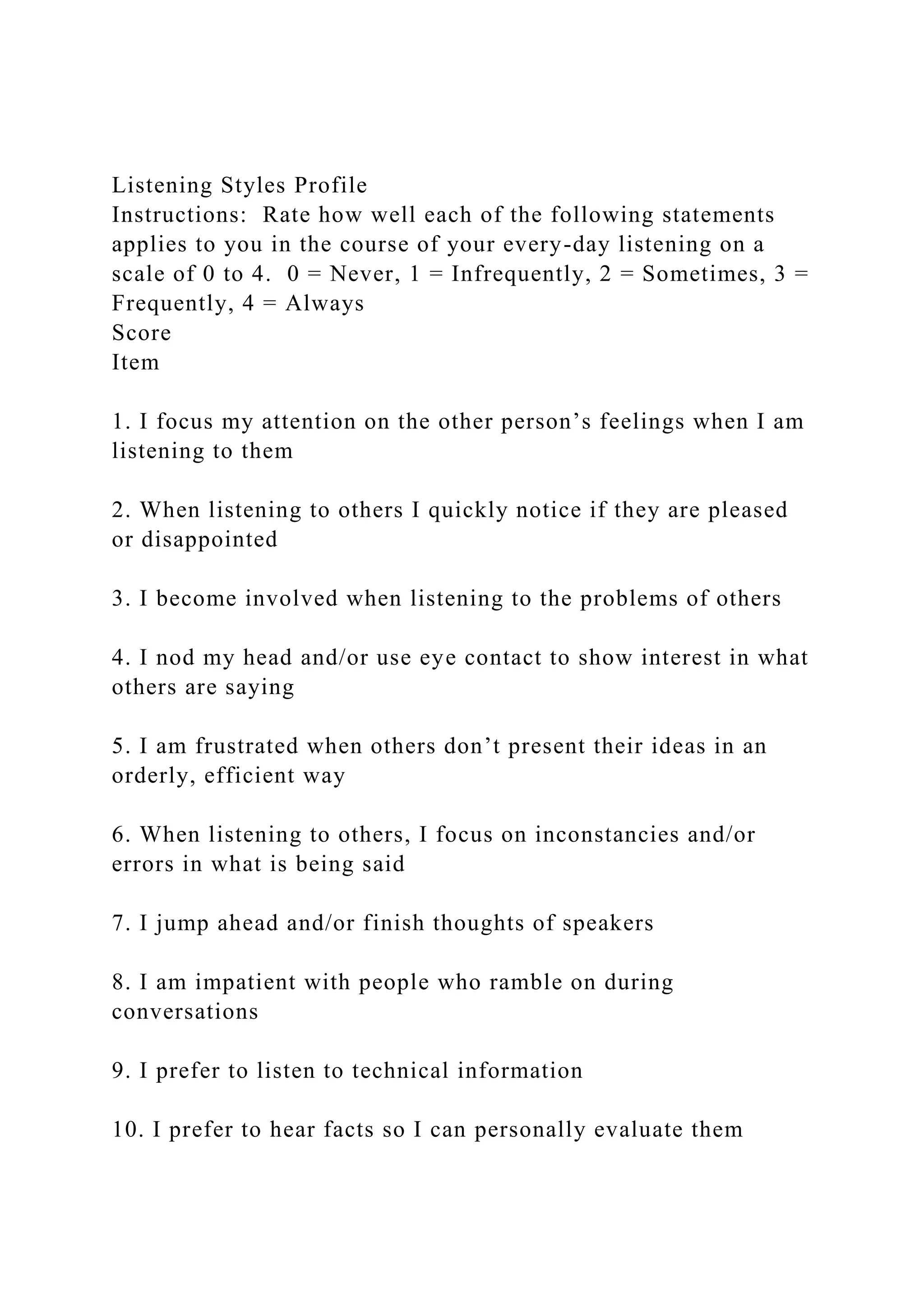
Instructions: Rate how well each of the following statements
applies to you in the course of your every-day listening on a
scale of 0 to 4. 0 = Never, 1 = Infrequently, 2 = Sometimes, 3 =
Frequently, 4 = Always
Score
Item
1. I focus my attention on the other person’s feelings when I am
listening to them
2. When listening to others I quickly notice if they are pleased
or disappointed
3. I become involved when listening to the problems of others
4. I nod my head and/or use eye contact to show interest in what
others are saying
5. I am frustrated when others don’t present their ideas in an
orderly, efficient way
6. When listening to others, I focus on inconstancies and/or
errors in what is being said
7. I jump ahead and/or finish thoughts of speakers
8. I am impatient with people who ramble on during
conversations
9. I prefer to listen to technical information
10. I prefer to hear facts so I can personally evaluate them
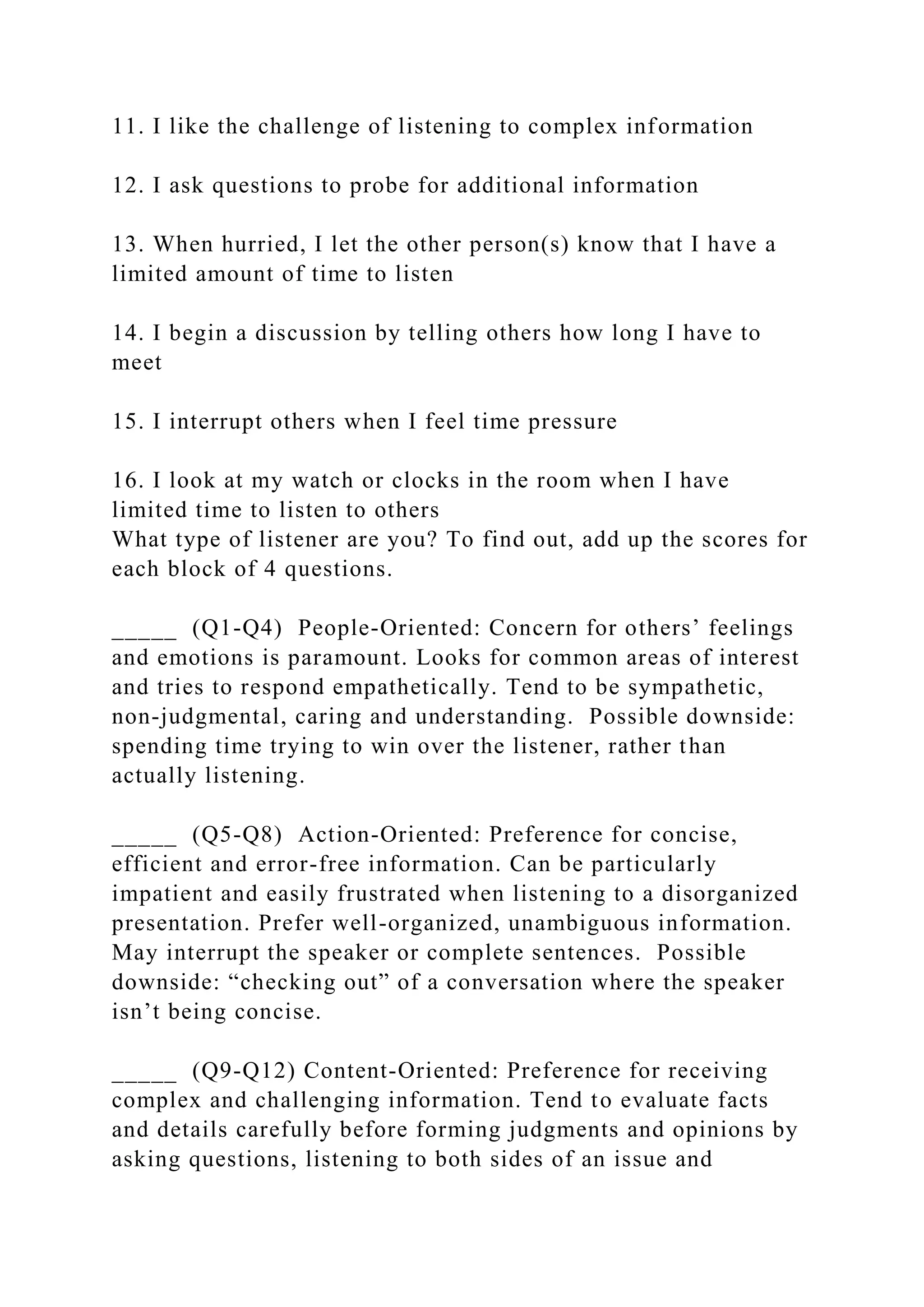
11. I like the challenge of listening to complex information
12. I ask questions to probe for additional information
13. When hurried, I let the other person(s) know that I have a
limited amount of time to listen
14. I begin a discussion by telling others how long I have to
meet
15. I interrupt others when I feel time pressure
16. I look at my watch or clocks in the room when I have
limited time to listen to others
What type of listener are you? To find out, add up the scores for
each block of 4 questions.
_____ (Q1-Q4) People-Oriented: Concern for others’ feelings
and emotions is paramount. Looks for common areas of interest
and tries to respond empathetically. Tend to be sympathetic,
non-judgmental, caring and understanding. Possible downside:
spending time trying to win over the listener, rather than
actually listening.
_____ (Q5-Q8) Action-Oriented: Preference for concise,
efficient and error-free information. Can be particularly
impatient and easily frustrated when listening to a disorganized
presentation. Prefer well-organized, unambiguous information.
May interrupt the speaker or complete sentences. Possible
downside: “checking out” of a conversation where the speaker
isn’t being concise.
_____ (Q9-Q12) Content-Oriented: Preference for receiving
complex and challenging information. Tend to evaluate facts
and details carefully before forming judgments and opinions by
asking questions, listening to both sides of an issue and
withholding judgment and eliminating any bias they may have
toward the speaker or the topic. Possible downside: ignores the
speaker’s emotional message in pursuit of facts.
_____ (Q13-Q16)Time-Oriented: Preference for brief or
hurried interactions with others. Tend to let others know how
much time they have available to listen or meet. Prefer brief
interactions and are more likely to interrupt or express
displeasure with their partner. Possible downside: people not
telling you everything because they are worried about time
constraints.
Most people have either one or two main styles. What impact
might yours have on your conversations with your colleagues, r,
direct reports, faculty or students? If you don’t think you have
the balance right, what do you need to do to make a change?
*Watson, K.W., Barker, L.L. & Weaver, J.B. The Listening
Styles Profile (LSP-16): Development and validation of an
instrument to assess four listening styles. The international
Journal of Listening, Vol. 9. Pp. 1-14. 1995.
_1434781007.pdf
Harvard ManageMentor — COACHING TOOLS
Active Listening Self-Assessment
Are You an Active Listener?
Coaches and mentors who listen actively tend to get the most
out of their coaching discussions and tend to be
better coaches overall. Use this self-assessment to think about
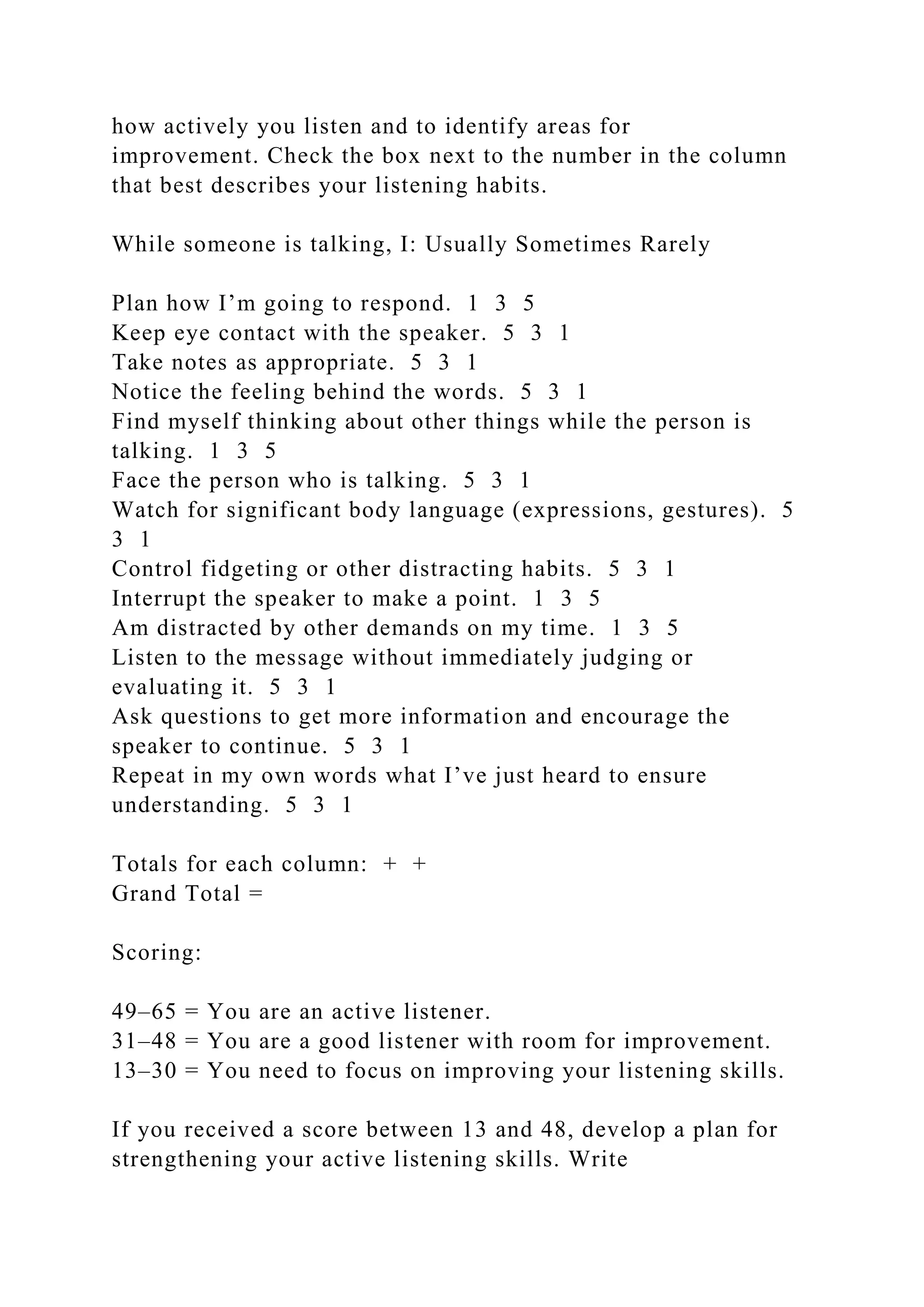
how actively you listen and to identify areas for
improvement. Check the box next to the number in the column
that best describes your listening habits.
While someone is talking, I: Usually Sometimes Rarely
Plan how I’m going to respond. 1 3 5
Keep eye contact with the speaker. 5 3 1
Take notes as appropriate. 5 3 1
Notice the feeling behind the words. 5 3 1
Find myself thinking about other things while the person is
talking. 1 3 5
Face the person who is talking. 5 3 1
Watch for significant body language (expressions, gestures). 5
3 1
Control fidgeting or other distracting habits. 5 3 1
Interrupt the speaker to make a point. 1 3 5
Am distracted by other demands on my time. 1 3 5
Listen to the message without immediately judging or
evaluating it. 5 3 1
Ask questions to get more information and encourage the
speaker to continue. 5 3 1
Repeat in my own words what I’ve just heard to ensure
understanding. 5 3 1
Totals for each column: + +
Grand Total =
Scoring:
49–65 = You are an active listener.
31–48 = You are a good listener with room for improvement.
13–30 = You need to focus on improving your listening skills.
If you received a score between 13 and 48, develop a plan for
strengthening your active listening skills. Write
your ideas in the space below.
© 2004 Harvard Business School Publishing. All rights
reserved.

Listening Styles ProfileInstructions Rate how well each of the.docx

  • 1.
    Listening Styles Profile Instructions:Rate how well each of the following statements applies to you in the course of your every-day listening on a scale of 0 to 4. 0 = Never, 1 = Infrequently, 2 = Sometimes, 3 = Frequently, 4 = Always Score Item 1. I focus my attention on the other person’s feelings when I am listening to them 2. When listening to others I quickly notice if they are pleased or disappointed 3. I become involved when listening to the problems of others 4. I nod my head and/or use eye contact to show interest in what others are saying 5. I am frustrated when others don’t present their ideas in an orderly, efficient way 6. When listening to others, I focus on inconstancies and/or errors in what is being said 7. I jump ahead and/or finish thoughts of speakers 8. I am impatient with people who ramble on during conversations 9. I prefer to listen to technical information 10. I prefer to hear facts so I can personally evaluate them
  • 2.
    11. I likethe challenge of listening to complex information 12. I ask questions to probe for additional information 13. When hurried, I let the other person(s) know that I have a limited amount of time to listen 14. I begin a discussion by telling others how long I have to meet 15. I interrupt others when I feel time pressure 16. I look at my watch or clocks in the room when I have limited time to listen to others What type of listener are you? To find out, add up the scores for each block of 4 questions. _____ (Q1-Q4) People-Oriented: Concern for others’ feelings and emotions is paramount. Looks for common areas of interest and tries to respond empathetically. Tend to be sympathetic, non-judgmental, caring and understanding. Possible downside: spending time trying to win over the listener, rather than actually listening. _____ (Q5-Q8) Action-Oriented: Preference for concise, efficient and error-free information. Can be particularly impatient and easily frustrated when listening to a disorganized presentation. Prefer well-organized, unambiguous information. May interrupt the speaker or complete sentences. Possible downside: “checking out” of a conversation where the speaker isn’t being concise. _____ (Q9-Q12) Content-Oriented: Preference for receiving complex and challenging information. Tend to evaluate facts and details carefully before forming judgments and opinions by asking questions, listening to both sides of an issue and
  • 3.
    withholding judgment andeliminating any bias they may have toward the speaker or the topic. Possible downside: ignores the speaker’s emotional message in pursuit of facts. _____ (Q13-Q16)Time-Oriented: Preference for brief or hurried interactions with others. Tend to let others know how much time they have available to listen or meet. Prefer brief interactions and are more likely to interrupt or express displeasure with their partner. Possible downside: people not telling you everything because they are worried about time constraints. Most people have either one or two main styles. What impact might yours have on your conversations with your colleagues, r, direct reports, faculty or students? If you don’t think you have the balance right, what do you need to do to make a change? *Watson, K.W., Barker, L.L. & Weaver, J.B. The Listening Styles Profile (LSP-16): Development and validation of an instrument to assess four listening styles. The international Journal of Listening, Vol. 9. Pp. 1-14. 1995. _1434781007.pdf Harvard ManageMentor — COACHING TOOLS Active Listening Self-Assessment Are You an Active Listener? Coaches and mentors who listen actively tend to get the most out of their coaching discussions and tend to be better coaches overall. Use this self-assessment to think about
  • 4.
    how actively youlisten and to identify areas for improvement. Check the box next to the number in the column that best describes your listening habits. While someone is talking, I: Usually Sometimes Rarely Plan how I’m going to respond. 1 3 5 Keep eye contact with the speaker. 5 3 1 Take notes as appropriate. 5 3 1 Notice the feeling behind the words. 5 3 1 Find myself thinking about other things while the person is talking. 1 3 5 Face the person who is talking. 5 3 1 Watch for significant body language (expressions, gestures). 5 3 1 Control fidgeting or other distracting habits. 5 3 1 Interrupt the speaker to make a point. 1 3 5 Am distracted by other demands on my time. 1 3 5 Listen to the message without immediately judging or evaluating it. 5 3 1 Ask questions to get more information and encourage the speaker to continue. 5 3 1 Repeat in my own words what I’ve just heard to ensure understanding. 5 3 1 Totals for each column: + + Grand Total = Scoring: 49–65 = You are an active listener. 31–48 = You are a good listener with room for improvement. 13–30 = You need to focus on improving your listening skills. If you received a score between 13 and 48, develop a plan for strengthening your active listening skills. Write
  • 5.
    your ideas inthe space below. © 2004 Harvard Business School Publishing. All rights reserved.