Linux Unveiled: From Novice to Guru Kameron Hussain
Linux Unveiled: From Novice to Guru Kameron Hussain
Linux Unveiled: From Novice to Guru Kameron Hussain
Linux Unveiled: From Novice to Guru Kameron Hussain
Linux Unveiled: From Novice to Guru Kameron Hussain
1.
Visit ebookmass.com todownload the full version and
explore more ebook or textbook
Linux Unveiled: From Novice to Guru Kameron
Hussain
_____ Click the link below to download _____
https://ebookmass.com/product/linux-unveiled-from-novice-to-
guru-kameron-hussain/
Explore and download more ebook or textbook at ebookmass.com
2.
Here are somerecommended products that we believe you will be
interested in. You can click the link to download.
Windows 11 Mastery: From Foundation to Mastery Kameron
Hussain & Frahaan Hussain
https://ebookmass.com/product/windows-11-mastery-from-foundation-to-
mastery-kameron-hussain-frahaan-hussain/
Windows 11 Mastery: From Foundation to Mastery 1st Edition
Kameron Hussain
https://ebookmass.com/product/windows-11-mastery-from-foundation-to-
mastery-1st-edition-kameron-hussain/
Mastering SDL for Game Creators Kameron Hussain
https://ebookmass.com/product/mastering-sdl-for-game-creators-kameron-
hussain/
NoSQL Essentials: Navigating the World of Non-Relational
Databases Kameron Hussain & Frahaan Hussain
https://ebookmass.com/product/nosql-essentials-navigating-the-world-
of-non-relational-databases-kameron-hussain-frahaan-hussain/
3.
Python & SQLMastery: 5 Books in 1: Your Comprehensive
Guide from Novice to Expert (2024 Edition) Andrew Reed
https://ebookmass.com/product/python-sql-mastery-5-books-in-1-your-
comprehensive-guide-from-novice-to-expert-2024-edition-andrew-reed/
Clean Code. An Agile Guide to Software Craft Kameron H.
https://ebookmass.com/product/clean-code-an-agile-guide-to-software-
craft-kameron-h/
Linux+ and LPIC-1 Guide to Linux Certification, 5th
Edition Jason W. Eckert
https://ebookmass.com/product/linux-and-lpic-1-guide-to-linux-
certification-5th-edition-jason-w-eckert/
Linux+ and LPIC-1 Guide to Linux Certification, 5th
Edition Jason W. Eckert
https://ebookmass.com/product/linux-and-lpic-1-guide-to-linux-
certification-5th-edition-jason-w-eckert-2/
The Enterprise Linux Administrator: Journey to a New Linux
Career 1st Edition Kenneth Hitchcock
https://ebookmass.com/product/the-enterprise-linux-administrator-
journey-to-a-new-linux-career-1st-edition-kenneth-hitchcock/
6.
Linux Unveiled: FromNovice to Guru
Kameron Hussain and Frahaan Hussain
Published by Sonar Publishing, 2024.
Table of Contents
Chapter1: The Genesis of Linux
1.1. The Birth of a Penguin: Origins of Linux
1.2. Open Source Revolution: The Philosophy of Linux
Open Source Principles
The GNU GPL and Linux
Collaboration and Community
Advantages of Open Source
The Legacy of Open Source in Linux
1.3. Distributions Galore: Understanding Different Flavors
Diversity of Linux Distributions
Popular Linux Distributions
Specialized Distributions
Package Management Systems
1.4. Community and Culture: The Heart of Linux
10.
The Open SourceCommunity
Linux User Groups (LUGs)
Distribution Communities
Licensing and Freedom
The Linux Culture
The Global Impact
1.5. Linux vs. Other Operating Systems: A Comparative Study
Open Source vs. Closed Source
Licensing
Hardware Compatibility
Software Ecosystem
Command Line Interface (CLI)
System Updates and Security
Cost Considerations
User Community and Support
Use Cases
11.
Conclusion
Chapter 2: Settingthe Stage
2.1. Choosing the Right Distribution
Distributions and Their Varieties
Consider Your Use Case
Community and Documentation
Conclusion
2.2. Installation Essentials: A Step-by-Step Guide
Backup Your Data
Create Installation Media
Boot from Installation Media
Begin the Installation
Installation Progress
Complete the Installation
First Boot and Post-Installation Tasks
2.3. Navigating the Linux Desktop Environment
12.
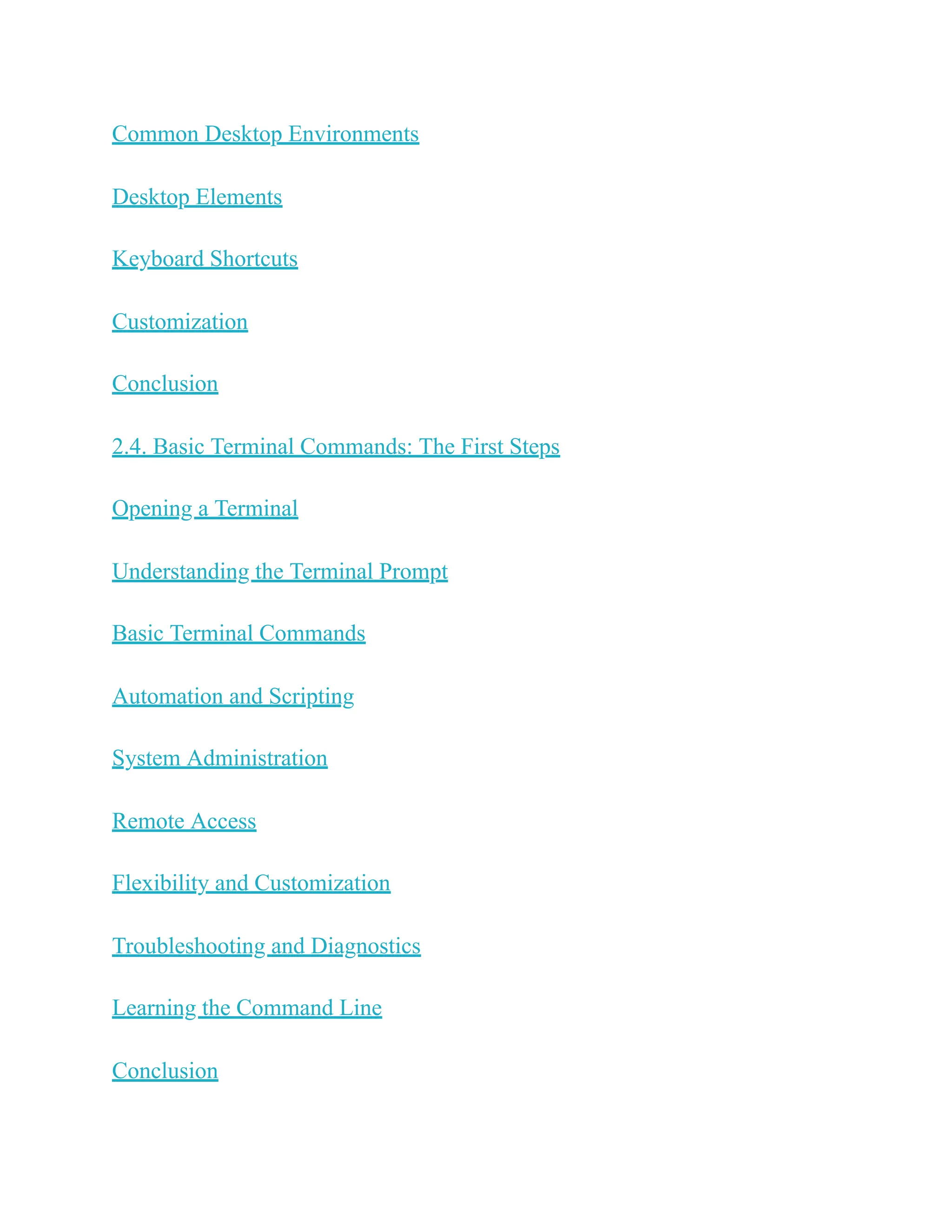
Common Desktop Environments
DesktopElements
Keyboard Shortcuts
Customization
Conclusion
2.4. Basic Terminal Commands: The First Steps
Opening a Terminal
Understanding the Terminal Prompt
Basic Terminal Commands
Automation and Scripting
System Administration
Remote Access
Flexibility and Customization
Troubleshooting and Diagnostics
Learning the Command Line
Conclusion
13.
3.2. Essential CommandLine Operations
Command Syntax
Navigating the File System
File and Directory Manipulation
Viewing and Editing Files
Working with Permissions
Process Management
3.3. File Management and Navigation
Listing Files and Directories
Navigating Directories
Creating and Removing Files and Directories
Copying and Moving Files
Finding Files
Conclusion
3.4. Users and Permissions: A Security Primer
User Accounts
14.
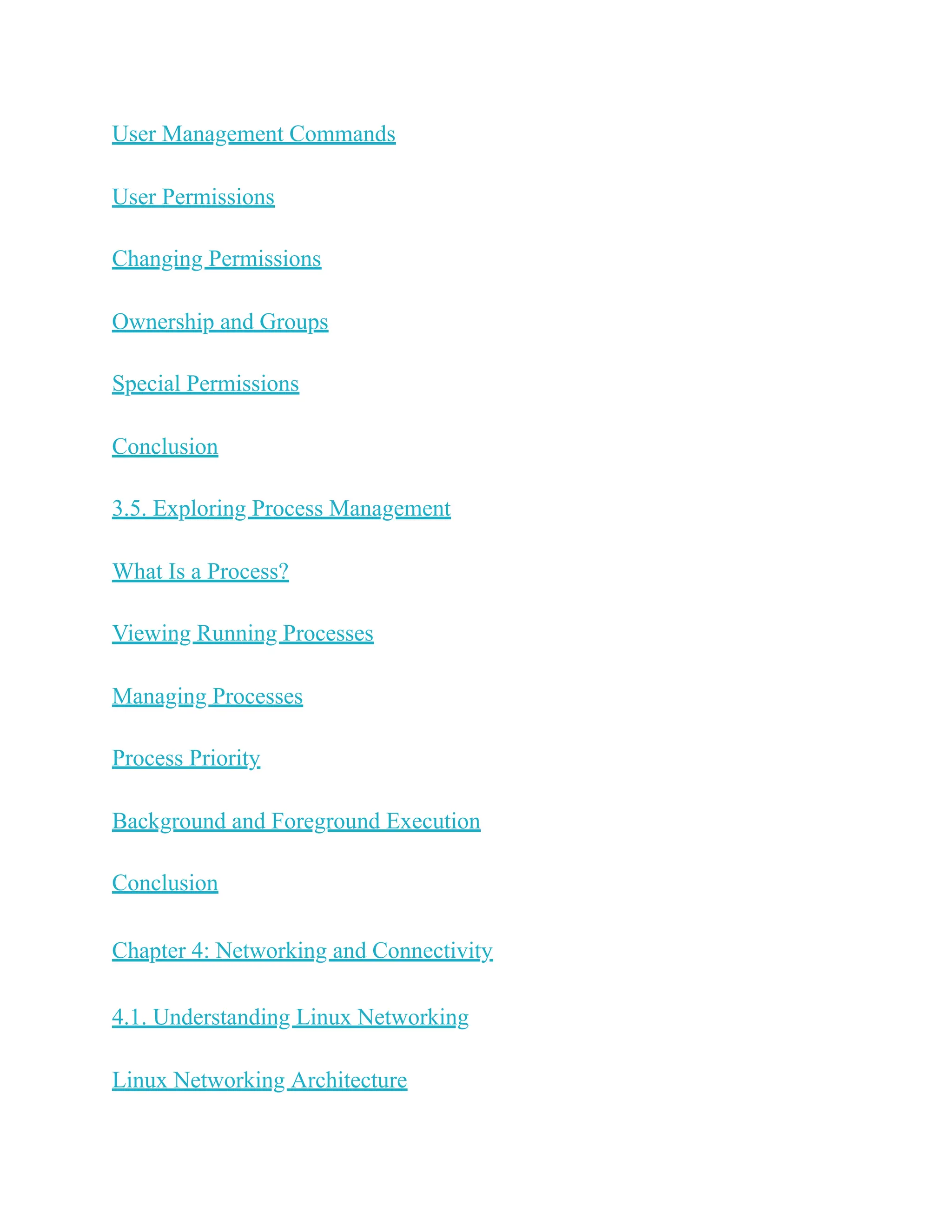
User Management Commands
UserPermissions
Changing Permissions
Ownership and Groups
Special Permissions
Conclusion
3.5. Exploring Process Management
What Is a Process?
Viewing Running Processes
Managing Processes
Process Priority
Background and Foreground Execution
Conclusion
Chapter 4: Networking and Connectivity
4.1. Understanding Linux Networking
Linux Networking Architecture
15.
Visit https://ebookmass.com todayto explore
a vast collection of ebooks across various
genres, available in popular formats like
PDF, EPUB, and MOBI, fully compatible with
all devices. Enjoy a seamless reading
experience and effortlessly download high-
quality materials in just a few simple steps.
Plus, don’t miss out on exciting offers that
let you access a wealth of knowledge at the
best prices!
16.
Network Interfaces
IP Addressing
Routingand Gateways
DNS and Name Resolution
Conclusion
4.2. Configuring Network Interfaces
Network Interface Names
Configuring Wired Ethernet Interfaces
Configuring Wireless Interfaces
Network Configuration Files
Network Manager
Conclusion
4.3. Secure Remote Access with SSH
SSH Basics
Generating SSH Key Pair
Copying Public Key to Remote Server
17.
Logging In withSSH Keys
Disabling Password Authentication
SSH Agent
Conclusion
4.4. Sharing Data: NFS and Samba
NFS (Network File System)
Samba
Conclusion
4.5. Advanced Networking Tools and Techniques
1. Wireshark
2. Netstat and ss
3. Nmap
4. TCPdump
5. iproute2
6. Traffic Shaping with tc
7. Virtual LANs (VLANs)
18.
8. IPv6 Configuration
9.Network Bonding
Conclusion
Chapter 5: System Administration Basics
5.1. User and Group Management
1. Creating User Accounts
2. Setting User Passwords
3. Modifying User Accounts
4. Deleting User Accounts
5. Creating Groups
6. Adding Users to Groups
7. Listing Users and Groups
8. Managing User Privileges
9. Locking and Unlocking User Accounts
10. User and Group Files
5.2. System Monitoring and Performance Tuning
19.
1. Monitoring Tools
2.Performance Tuning
3. Resource Monitoring and Alerts
4. Logs and Troubleshooting
5. Monitoring Solutions
Conclusion
5.3. Task Scheduling with Cron
1. Understanding Cron
2. Crontab Syntax
3. Editing Your Crontab
4. Examples of Cron Jobs
5. Common Crontab Commands
6. System-wide Cron Jobs
7. Logging Cron Output
Conclusion
5.4. Backup Strategies and Solutions
20.
1. Backup Strategies
2.Backup Solutions
3. Remote Backups
4. Backup Retention and Rotation
5. Testing Backups
6. Monitoring and Alerts
7. Documentation
Conclusion
5.5. System Logs and Troubleshooting
1. Log Files
2. Viewing Log Files
3. Filtering Log Entries
4. Log Rotation
5. Common Troubleshooting Scenarios
6. Debugging Tools
Conclusion
21.
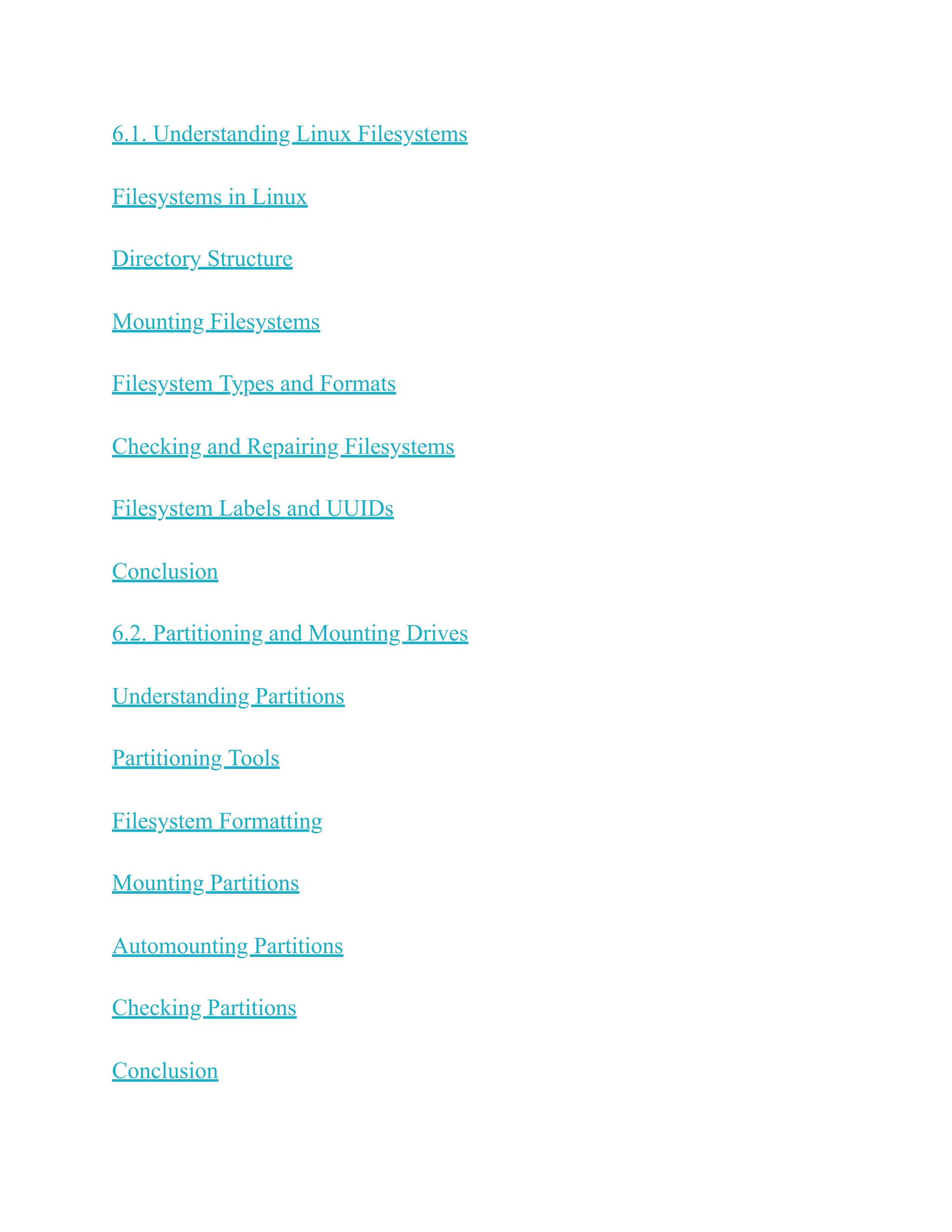
6.1. Understanding LinuxFilesystems
Filesystems in Linux
Directory Structure
Mounting Filesystems
Filesystem Types and Formats
Checking and Repairing Filesystems
Filesystem Labels and UUIDs
Conclusion
6.2. Partitioning and Mounting Drives
Understanding Partitions
Partitioning Tools
Filesystem Formatting
Mounting Partitions
Automounting Partitions
Checking Partitions
Conclusion
22.
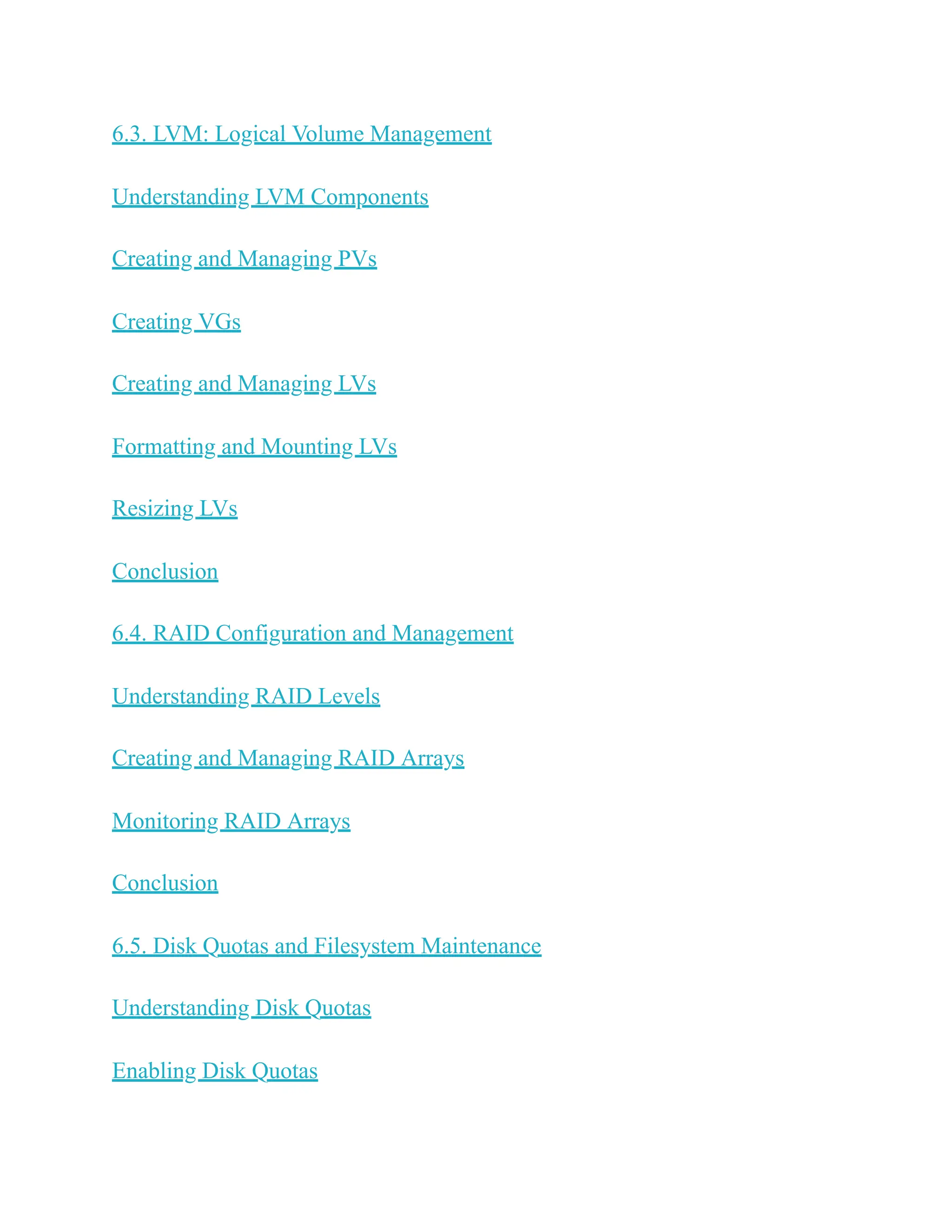
6.3. LVM: LogicalVolume Management
Understanding LVM Components
Creating and Managing PVs
Creating VGs
Creating and Managing LVs
Formatting and Mounting LVs
Resizing LVs
Conclusion
6.4. RAID Configuration and Management
Understanding RAID Levels
Creating and Managing RAID Arrays
Monitoring RAID Arrays
Conclusion
6.5. Disk Quotas and Filesystem Maintenance
Understanding Disk Quotas
Enabling Disk Quotas
23.
Setting User andGroup Quotas
Checking Quota Usage
Filesystem Maintenance
Conclusion
Chapter 7: Security and Hardening
7.1. Linux Security Essentials
User Accounts and Passwords
File Permissions and Ownership
Firewall Configuration
Regular Updates and Patch Management
Auditing and Monitoring
Security Policies and SELinux/AppArmor
Conclusion
7.2. Firewall Configuration and Management
Understanding Firewalls
iptables
24.
firewalld
Choosing Between iptablesand firewalld
Conclusion
7.3. Implementing Security Audits and Scans
Why Security Audits and Scans are Necessary
Security Audit Tools
Best Practices for Security Audits and Scans
Conclusion
7.4. SELinux and AppArmor: Mandatory Access Controls
Understanding Mandatory Access Control
SELinux (Security-Enhanced Linux)
AppArmor
Choosing Between SELinux and AppArmor
7.5. Secure Boot and Kernel Hardening
Secure Boot
Kernel Hardening
25.
Chapter 8: Scriptingand Automation
8.1. Introduction to Bash Scripting
What is Bash?
Why Use Bash Scripting?
Getting Started with Bash Scripts
Running Bash Scripts
Variables in Bash
User Input
Conditional Statements
Loops
Functions
Conclusion
8.2. Automating Tasks with Shell Scripts
Understanding Script Execution
Passing Arguments to Scripts
Conditional Statements in Scripts
26.
Visit https://ebookmass.com todayto explore
a vast collection of ebooks across various
genres, available in popular formats like
PDF, EPUB, and MOBI, fully compatible with
all devices. Enjoy a seamless reading
experience and effortlessly download high-
quality materials in just a few simple steps.
Plus, don’t miss out on exciting offers that
let you access a wealth of knowledge at the
best prices!
unjustifiable resentment ofthe Queen, however, rendered this
connection, for a time, a source of much misery to both parties. Her
capricious tyranny was such, as to induce her to feel offended, if any
of her courtiers had the audacity to love or marry without her
knowledge or permission; and the result of what she termed His
Lordship's clandestine marriage, was the instant dismissal of himself
and his lady to a prison. How long their confinement was protracted,
cannot now be accurately ascertained; that it was long in the opinion
of the Earl of Essex, appears from an address of his to the Lords of
Council, in which he puts the following interrogation:—"Was it
treason in my Lord of Southampton to marry my poor kinswoman,
that neither long imprisonment, nor any punishment besides, that
hath been usual, in like cases, can satisfy, or appease[8:B]?" But we
do know that it could not have existed beyond March, 1599; for on
the 27th of that month, Lord Southampton accompanied his friend
Essex to Ireland, where, immediately on his arrival, he was
appointed by the Earl, now Lord Deputy of that country, his general
of the horse.
This military promotion of Southampton is one among numerous
proofs of the imprudence of Essex, for it was not only without the
Queen's knowledge, but, as Camden has informed us, "clean
contrary to his instructions."[8:C] What was naturally to be expected,
therefore, soon occurred; Lord Southampton was, by the Queen's
orders, deprived of his commission, in the August following, and on
the 20th of September, 1599, he revisited London, where,
apprehensive of the displeasure of Her Majesty, he absented himself
from court, and endeavoured to soothe his inquietude by the
attractions of the theatre, to which his ardent admiration of the
genius of Shakspeare now daily induced him to recur.
29.
The resentment ofthe Queen, however, though not altogether
appeased, soon began to subside; and in December 1599, when
Lord Mountjoy was commissioned to supersede Essex in the Lord
Lieutenancy of Ireland, Lord Southampton was one of the officers
selected by Her Majesty to attend him. Farther than this she refused
to condescend; for, though His Lordship solicited for some weeks the
honour of kissing her hand, and was supported in this request by the
influence of Cecil, he solicited in vain, and was at length compelled
to rest satisfied with the expression of her wishes for the safety of
his journey.
One unpleasant consequence of his former transient campaign in
Ireland, had been a quarrel with the Lord Grey, who acting under
him as a colonel of horse had, from the impetuosity of youthful
valour, attacked the rebel force without orders; a contempt of
subordination which had been punished by his superior with a
night's imprisonment.[9:A] The fiery spirit of Grey could not brook
even this requisite attention to discipline, and he sent Southampton
a challenge, which the latter, on his departure for Ireland, in April
1600, accepted, by declaring, that he would meet Lord Grey in any
part of that country. The Queen, however, for the present arrested
the combat; but the animosity was imbittered by delay, and Lord
Southampton felt it necessary to his character to break off his
military engagements, which had conferred upon him the reputation
of great bravery and professional skill, and had received the marked
approval of the Lord Deputy, to satiate the resentment of Grey, who
had again called him to a meeting, and fixed its scene in the Low
Countries.
Of this interview we know nothing more than that it proved so
completely abortive, that, shortly afterwards, Lord Grey attacked
Southampton as he rode through the streets of London, an outrage
30.
which affords buta melancholy trait of the manners of the age,
though punished on the spot by the immediate committal of the
perpetrator to prison.
It had been happy, however, for the fame and repose of
Southampton, had this been the only unfortunate contest in which
he engaged; but he was recalled by Essex from the Low Countries,
in order to assist him in his insurrectionary movements against the
person and government of his sovereign. Blinded by the attachments
of friendship, which he cultivated with enthusiastic warmth, and
indignant at the treatment which he had lately received from the
Queen, he too readily listened to the treasonable suggestions of
Essex, and became one of the conspirators who assembled at the
house of this nobleman on the 8th of February 1601. Here they took
the decisive step of imprisoning the Queen's privy counsellors who
had been sent to enquire into the purport of their meeting, and from
this mansion they sallied forth, with the view of exciting the citizens
to rebellion. An enterprise so criminal, so rash, and chimerical,
immediately met the fate which it merited; and the trial of Essex and
Southampton for high treason took place on the 19th of February,
when, both being found guilty, the former, as is well known, expiated
his offence by death, while the latter, from the minor culpability of
his views, from the modesty and contrition which he exhibited in his
defence, and from the intercession of Cecil and the peers, obtained
a remission of the sentence affecting his life, but was condemned to
imprisonment in the Tower.
We have more than once mentioned the great partiality of Lord
Southampton to dramatic literature, and it is somewhat remarkable
that this partiality should have been rendered subservient to the
machinations of treason; for Bacon tells us, that "the afternoon
before the rebellion, Merick, (afterwards the defender of Essex-
31.
house,) with agreat company of others, that afterwards were all in
the action, had procured to be played before them the play of
deposing King Richard the Second;—when it was told him by one of
the players that the play was old, and they should have loss in
playing it, because few would come to it, there were forty shillings
extraordinary given to play it, and so thereupon played it was."[11:A]
It appears from the State Trials, vol. vii. p. 60., that the player to
whom the forty shillings were given, was Augustine Philippes, one of
the patentees of the Globe playhouse with Shakspeare, in 1603.
The term old applied to this play, which, according to the report
of the Queen, "was played forty times in open streets and
houses[11:B]," has induced Dr. Farmer and Mr. Tyrwhitt to conclude
that a play entitled Richard the Second, or Henry the Fourth, existed
before Shakspeare's dramas on these subjects. This position,
however, is dissented from by Mr. Chalmers, who says,—"In
opposition to Farmer and Tyrwhitt, I hold, though I have a great
respect for their memories, that it was illogical to argue, from a
nonentity, against an entity; that as no such play as the Henry IV.
which they spoke of had ever appeared, while Shakspeare's Richard
II. was apparent to every eye, it was inconsequential reasoning in
them to prefer the first play to the last: and I am, therefore, of
opinion, that the play of deposing Richard II. which was seditiously
played on the 7th of February 1600-1, was Shakspeare's Richard II.,
that had been originally acted in 1596, and first printed in 1597."
[11:C]
This opinion of Mr. Chalmers will be much strengthened when we
reflect that Lord Southampton's well-known attachment to the muse
of Shakspeare, would almost certainly induce him to prefer the play
32.
written by hisfavourite poet to the composition of an obscure, and,
without doubt, a very inferior writer.
The death of Elizabeth terminated the confinement and the
sufferings of Lord Southampton. No sooner had James acceded to
the throne, than he sent an order for his release from the Tower,
which took place on the 10th of April, 1603, and accompanied it with
a request that he would meet him on his way to England. This might
be considered as a certain presage of future favours, and was,
indeed, speedily followed, not only by the reversal of his attainder,
and the restoration of his property, but by an accumulation of
honours. He was immediately appointed master of the game to the
Queen; a pension of six hundred pounds per annum was allotted to
his lady; in July, 1603, he was installed a knight of the garter, and
created captain of Isle of Wight and of Carisbrooke Castle, and in
the following Spring he was constituted Lord Lieutenant of
Hampshire, and was chosen by the King as his companion in a
journey to Royston.
This flow of good fortune was, however, transiently impeded by
the jealousy of James, who, stimulated by the machinations of some
of his courtiers, envious of the returning prosperity of the Earl[12:A],
was led to suspect that an improper intimacy had taken place
between Southampton and his Queen; a charge of disaffection to His
Majesty was, therefore, brought against His Lordship, and he was
apprehended towards the close of June, 1604; but not the smallest
proof of his disloyalty having been substantiated, he was
immediately released, and as immediately retaken into favour.
Of his perfect reinstatement, indeed, in the affections of James
we possess a decided proof. Rowland Whyte, writing to Lord
Shrewsbury, on the 4th of March, 1604, says,—"My La. Southampton
33.
was brought tobed of a young Lord upon St. David's Day (March
1st) in the morning; a St. to be much honored by that howse for so
great a blessing, by wearing a leeke for ever upon that day."[12:B]
Now this child was christened at court on the 27th of the same
month, "the King, and Lord Cranburn, with the Countess of Suffolk,
being gossips[13:A];" an honour which was followed, in June, 1606,
by a more substantial mark of regard, the appointment of His
Lordship to be Warden of the New Forest, and Keeper of the Park of
Lindhurst.
In November, 1607, Lord Southampton lost his mother, who had
been wife successively to Henry Wriothesly Earl of Southampton, to
Sir Thomas Heneage, and to Sir William Hervey. We are told by Lord
Arundel that she "lefte the best of her stuffe to her sonne, and the
greatest part to her husband[13:B]"; this bequest, however, could not
have been very ample, for it did not obviate the necessity of her
son's applying, shortly afterwards, to trade and colonisation with the
view of increasing his property. In 1609, he was constituted a
member of the first Virginia Company, took a most active part in
their concerns, and was the chief promoter of the different voyages
to America, which were undertaken as well for the purposes of
discovery as for private interest.
The warmth of temper which distinguished Lord Southampton in
early life, seems not to have been adequately repressed by time and
experience; he was ever prone to resentment, though not difficult to
conciliate, and, unhappily, the manners of the age were not such as
to impose due restraint on the tumultuary passions. A quarrel with
Lord Montgomery, on a trifling occasion, which occurred in April,
1610, is but too striking an illustration of these remarks; "they fell
out at tennis," relates Winwood, "where the rackets flew about their
34.
ears, but thematter was compounded by the King, without further
bloodshed[13:C];" a passage, the close of which proves that they had
fought and wounded each other with the instruments of their
amusement!
We speedily recognise Lord Southampton, however, acting in a
manner more suitable to his station and character; on the 4th of
June, 1610, he officiated as carver at the magnificent festival which
was given in honour of young Henry's assumption of the title of
Prince of Wales; and in July, 1613, we find His Lordship entertaining
the King at his house in the New Forest, whither he had returned
from an expedition to the continent, expressly for this purpose, and
under the expectation of receiving a royal visit. After discharging this
duty to his sovereign, he again left his native country, and was
present, in the following year, with Lord Herbert of Cherbury, at the
siege of Rees, in the dutchy of Cleve.
It was at this period that his reputation as a patron of literature,
attained its highest celebrity, and it is greatly to be desired that
tradition had enabled us to dwell more minutely on his intercourse
with the learned. His bounty to, and encouragement of, Shakspeare
have conferred immortality on his name; to Florio, we have seen, he
extended a durable and efficient support; Brathwayt, in his
dedication of his "Scholar's Medley," 1614, calls him "learnings best
favourite;" and in 1617, he contributed very liberally to relieve the
distresses of Minsheu, the author of "The Guide to Tongues."
Doubtless, had we more ample materials for his life, these had not
been the only instances of his munificence to literary talent.
Still further promotion awaited this accomplished nobleman.
When James visited Scotland, in 1617, he accompanied his
sovereign, and rendered himself so acceptable by his courtesy and
35.
care, that, onthe 19th of April, 1619, he was rewarded by the
confidential situation of a privy-counsellor, an honour which he had
long anxiously held in view.
This completion of his wishes, however, was not attended with
the result which he had so sanguinely expected. He found himself
unable, from principle, to join in the measures of the court, and the
opposition which he now commenced against the King and his
ministers, had, in a mind so ardent, a natural tendency to excess. In
1620, and the two following years, he was chosen, contrary to the
wishes of government, treasurer of the Virginia Company, an office
of great weight and responsibility, but to which his zeal and activity
in forwarding the views of that corporation gave him a just claim.
Such, indeed, was the sense which the company entertained of his
merits, that his name was annexed to several important parts of
Virginia; as, for instance, Southampton-hundred, Hampton-roads,
&c.
Whilst he opposed the court merely in its commercial
arrangements, no personal inconvenience attended his exertions;
but when, in the session of parliament which took place towards the
commencement of the year 1621, he deemed it necessary to
withstand the unconstitutional views of ministers, he immediately
felt the arm of power. He had introduced with success a motion
against illegal patents; and during the sitting of the 14th of March,
so sharp an altercation occurred between himself and the Marquis of
Buckingham, that the interference of the Prince of Wales was
necessary to appease the anger of the disputants.
This stormy discussion, and His Lordship's junction with the
popular party, occasioned so much suspicion on the part of
government, that on the 16th of June, twelve days after the
36.
prorogation of parliament,he was committed to the custody of the
Dean of Westminster; nor was it until the 18th of the subsequent
July, that he was permitted to return to his house at Titchfield, under
a partial restraint, nor until the first of September, that he was
entirely liberated.
Unawed, however, by this unmerited persecution, and supported
by a numerous and respectable party, justly offended at the King's
pusillanimity in tamely witnessing his son-in-law's deprivation of the
Palatinate, he came forward, with augmented activity, in the
parliament of 1624, which opened on the 9th of February. Here he
sat on several committees; and when James, on the 5th of the June
following, found himself compelled to relinquish his pacific system,
and to enter into a treaty with the States-General, granting them
permission to raise four regiments in this country, he, unfortunately
for himself and his son, procured the colonelcy of one of them.[15:A]
Being under the necessity of taking up their winter-quarters at
Rosendale in Holland, the Earl, and his eldest son Lord Wriothesly,
were seized with a burning fever; "the violence of which distemper,"
says Wilson, "wrought most vigorously upon the heat of youth,
overcoming the son first, and the drooping father, having overcome
the fever, departed from Rosendale with an intention to bring his
sons body to England; but at Bergen-op-zoom he died of a lethargy
in the view and presence of the Relator, and were both in one small
bark brought to Southampton."[16:A] The son expired on the 5th of
November, and his parent on the tenth, and they were both buried in
the sepulchre of their fathers at Titchfield, on Innocents' day, 1624.
Thus perished, in the fifty-second year of his age, Henry Earl of
Southampton, leaving a widow, and three daughters, who, from a
letter preserved in the Cabala, appear to have been in confined
37.
circumstances; this epistleis from the Lord Keeper Williams to the
Duke of Buckingham, dated Nov. 7th, 1624, and requesting of that
nobleman "his grace and goodness towards the most distressed
widow and children of my Lord Southampton."[16:B]
If we except a constitutional warmth and irritability of temper, and
their too common result, an occasional error of judgment, there did
not exist, throughout the reigns of Elizabeth and James, a character
more truly amiable, great, and good than was that of Lord
Southampton. To have secured, indeed, the reverence and affection
of Shakspeare, was of itself a sufficient passport to the purest fame;
but the love and admiration which attended him was general. As a
soldier, he was brave, open, and magnanimous; as a statesman
remarkable for integrity and independence of mind, and perhaps no
individual of his age was a more enthusiastic lover, or a more
munificent patron, of arts and literature.
The virtues of his private life, as well as these features of his
public character, rest upon the authority of those who best knew
him. To the "noble" and "honourable disposition," ascribed to him by
Shakspeare, who affectionately declares, that he loves him "without
end," we can add the respectable testimony of Chapman, Sir John
Beaumont, and Wither, all intimately acquainted with him, and the
second his particular friend.
Chapman, in one of his dedicatory sonnets, prefixed to his version
of the Iliad, not only applies to him the epithet "learned," but
declares him to be the "choice of all our country's noblest
spirits[17:A];" and Beaumont, in an Elegy on his death, tells us that
his ambition was to draw
"A picture fit for this my noble friend,
38.
That his dearname may not in silence die."
In a beautiful strain of enthusiasm, he informs us, that his verses
are calculated for posterity, and
——————————— "not for the present age;
For what man lives, or breathes on England's stage,
That knew not brave Southampton, in whose sight
Most plac'd their day, and in his absence night?"
He then proceeds to sketch his character at the different periods
of his life:—
"When he was young, no ornament of youth
Was wanting in him;"
and, in manhood, he shone
"As best in martial deedes and courtly sports;"
until riper age, and the cares of the world, having begun to shade
his head with silver hairs,
"His valiant fervour was not then decaide,
But joyn'd with counsell, as a further aide."
After this eulogium on the more ostensible features of his life,
which terminates with the assertion, that
"No pow'r, no strong persuasion could him draw
From that, which he conceiv'd as right and law,"
he presents a most pleasing delineation of his domestic conduct and
enjoyments:—
39.
"When shall wein this realme a father finde
So truly sweet, or husband halfe so kinde?
Thus he enjoyde the best contents of life,
Obedient children, and a loving wife:
These were his parts in peace:"
and concludes with celebrating his love of letters and of literary
men:—
"I keepe that glory last, which is the best,
The love of learning, which he oft exprest
By conversation, and respect to those
Who had a name in artes, in verse or prose."[19:A]
Wither seems to have been equally impressed with the estimable
character of Lord Southampton, and to have meditated a record of
his life and virtues; for, in an epigram addressed to him, with a copy
of his "Abuses Stript and Whipt," he exclaims,
"I ought to be no stranger to thy worth,
Nor let thy virtues in oblivion sleep:
Nor will I, if my fortunes give me time."[19:B]
In short, to adopt the language of an enthusiastic admirer of our
dramatic bard, "Southampton died as he had lived, with a mind
untainted: embalmed with the tears of every friend to virtue, and to
splendid accomplishments: all who knew him, wished to him long
life, still lengthened with all happiness."[19:C]
That a nobleman so highly gifted, most amiable by his virtues,
and most respectable by his talents and his taste, should have been
strongly attached to Shakspeare, and this attachment returned by
40.
the poet withequal fervour, cannot excite much surprise; indeed,
that more than pecuniary obligation was the tie that connected
Shakspeare with his patron, must appear from the tone of his
dedications, especially from that prefixed to the "Rape of Lucrece,"
which breathes an air of affectionate friendship, and respectful
familiarity.[20:A] We should also recollect, that, according to tradition,
the great pecuniary obligation of Shakspeare to his patron, was
much posterior to the period of these dedications, being given for
the purpose of enabling the poet to make a purchase at his native
town of Stratford, a short time previous to his retirement thither.
It may, therefore, with safety be concluded, that admiration and
esteem were the chief motives which actuated Shakspeare in all the
stages of his intercourse with Lord Southampton, to whom, in 1593,
we have found he dedicated the "first heir of his invention."
Our reasons for believing that this poem was written in the
interval which occurred between the years 1587 and 1590, have
been already given in a former part of the work[20:B], and we shall
here, therefore, only transcribe the title page of the original edition,
which, though entered in the Stationers' books by Richard Field, on
the 18th of April, 1593, was supposed not to have been published
before 1594, until Mr. Malone had the good fortune to procure a
copy from a provincial catalogue, perhaps the only one remaining in
existence[20:C]:—
"Venus and Adonis.
Vilia miretur Vulgus, mihi flavus Apollo,
Pocula Castalia plena ministret aqua.
London. By Richard Field, and are to be solde at the Signe of the
White Greyhound, in Paules Church Yard. 1593."
41.
This, the earliestoffspring of our poet's prolific genius, consists of
one hundred and ninety-nine stanzas, each stanza including six lines,
of which the first four are in alternate rhime, and the fifth and sixth
form a couplet. Its length, indeed, is one of its principal defects; for
it has led, not only to a fatiguing circumlocution, in point of
language, but it has occasioned the poet frequently to expand his
imagery into a diffuseness which sometimes destroys its effect; and
often to indulge in a strain of reflection more remarkable for its
subtlety of conceit, than for its appropriation to the incidents before
him. Two other material objections must be noticed, as arising from
the conduct of the poem, which, in the first place, so far as it
respects the character of Adonis, is forced and unnatural; and, in the
second, has tempted the poet into the adoption of language so
meretricious, as entirely to vitiate the result of any moral purpose
which he might have had in view.
These deductions being premised, we do not hesitate to assert,
that the Venus and Adonis contains many passages worthy of the
genius of Shakspeare; and that, as a whole, it is superior in poetic
fervour to any production of a similar kind by his contemporaries,
anterior to 1587. It will be necessary, however, where so much
discrepancy of opinion has existed, to substantiate the first of these
assertions, by the production of specimens which shall speak for
themselves; and as the conduct and moral of the piece have been
given up as indefensible, these must, consequently, be confined to a
display of its poetic value; of its occasional merit with regard to
versification and imagery.
In the management of his stanza, Shakspeare has exhibited a
more general attention to accuracy of rhythm and harmony of
cadence, than was customary in his age; few metrical imperfections,
indeed, are discoverable either in this piece, or in any of his minor
42.
poems; but weare not limited to this negative praise, being able to
select from his first effort instances of positive excellence in the
structure of his verse.
Of the light and airy elegance which occasionally characterises the
composition of his Venus and Adonis, the following will be accepted
as no inadequate proofs:—
"Bid me discourse, I will enchant thine ear,
Or, like a fairy, trip upon the green,
Or, like a nymph, with long dishevel'd hair,
Dance on the sands, and yet no footing seen.
—————
"If love have lent you twenty thousand tongues,
And every tongue more moving than your own,
Bewitching like the wanton mermaid's songs,
Yet from mine ear the tempting tune is blown."
To terminate each stanza with a couplet remarkable for its
sweetness, terseness, or strength, is a refinement almost peculiar to
modern times; yet Shakspeare has sometimes sought for, and
obtained this harmony of close: thus Venus, lamenting the beauty of
Nature after the death of Adonis, exclaims,
"The flowers are sweet, their colours fresh and trim;
But true-sweet beauty liv'd and dy'd with him;"
and again, when reproaching the apathy of her companion,—
"O learn to love; the lesson is but plain,
And, once made perfect, never lost again."
43.
Nor are therewanting passages in which energy and force are
very skilfully combined with melody and rhythm; of the subsequent
extracts, which are truly excellent for their vigorous construction, the
lines in Italics present us with the point and cadence of the present
day. Venus, endeavouring to excite the affection of Adonis, who is
represented
——————— "more lovely than a man,
More white and red than doves or roses are,"
tells him,
"I have been woo'd, as I entreat thee now,
Even by the stern and direful god of war,
Whose sinewy neck in battle ne'er did bow—
Over my altars hath he hung his lance,
His batter'd shield, his uncontrolled crest,
And for my sake hath learn'd to sport and dance,
To coy, to wanton, dally, smile, and jest:"
and, on finding her efforts fruitless, she bursts forth into the
following energetic reproach:—
"Fie, lifeless picture, cold and senseless stone,
Well-painted idol, image, dull and dead,
Statue, contenting but the eye alone,
Thing like a man, but of no woman bred."
The death of Adonis, however, banishes all vestige of resentment,
and, amid numerous exclamations of grief and anguish, gives birth
to prophetic intimations of the hapless fate of all succeeding
attachments:—
44.
"Since thou artdead, lo! here I prophesy,
Sorrow on love hereafter shall attend;
It shall be waited on with jealousy,
Find sweet beginning, but unsavoury end;—
It shall suspect, where is no cause of fear;
It shall not fear, where it should most mistrust;
It shall be merciful, and too severe,
And most deceiving when it seems most just;—
It shall be fickle, false, and full of fraud,
And shall be blasted in a breathing-while;
The bottom poison, and the top o'er-straw'd
With sweets, that shall the sharpest sight beguile:
The strongest body shall it make most weak,
Strike the wise dumb, and teach the fool to speak."
These passages are not given with the view of impressing upon
the mind of the reader, that such is the constant strain of the
versification of the Venus and Adonis; but merely to show, that,
while in narrative poetry he equals his contemporaries in the general
structure of his verse, he has produced, even in his earliest attempt,
instances of beauty, melody, and force, in the mechanism of his
stanzas, which have no parallel in their pages. In making this
assertion, it must not be forgotten, that we date the composition of
Venus and Adonis anterior to 1590, that the comparison solely
applies to narrative poetry, and consequently that all contest with
Spenser is precluded.
It now remains to be proved, that the merits of this mythological
story are not solely founded on its occasional felicity of versification;
but that in description, in the power of delineating, with a master's
45.
hand, the variousobjects of nature, it possesses more claims to
notice than have hitherto been allowed.
After the noble pictures of the horse which we find drawn in the
book of Job, and in Virgil, few attempts to sketch this spirited animal
can be expected to succeed; yet, among these few, impartial
criticism may demand a station for the lines below:—
"Imperiously he leaps, he neighs, he bounds,
And now his woven girts he breaks asunder,
The bearing earth with his hard hoof he wounds,
Whose hollow womb resounds like heaven's thunder.—
His ears up prick'd; his braided hanging mane
Upon his compass'd crest now stands on end;
His nostrils drink the air, and forth again,
As from a furnace, vapours doth he send:—
Sometimes he trots, as if he told the steps,
With gentle majesty, and modest pride:
Anon he rears upright, curvets and leaps,
As who should say, lo! thus my strength is try'd.—
Look, when a painter would surpass the life,
In limning out a well-porportion'd steed,
His art's with Nature's workmanship at strife,
As if the dead the living should exceed;
So did this horse excell a common one,
In shape, in courage, colour, pace, and bone.
Round-hoof'd, short-jointed, fetlocks shag and long,
Broad-breast, full eyes, small head, and nostril wide,
46.
High crest, shortears, straight legs, and passing strong,
Thin mane, thick tail, broad buttock, tender hide."
Venus, apprehensive for the fate of Adonis, should he attempt to
hunt the boar, endeavours to dissuade him from his purpose, by
drawing a most formidable description of that savage inmate of the
woods, and by painting, on the other hand, the pleasures to be
derived from the pursuit of the hare. The danger necessarily
incurred from attacking the former, and the various efforts by which
the latter tries to escape her pursuers, are presented to us with
great fidelity and warmth of colouring.
"Thou had'st been gone, quoth she, sweet boy, ere this,
But that thou told'st me, thou would'st hunt the boar,
O be advis'd; thou know'st not what it is
With javelin's point a churlish swine to gore,
Whose tushes never-sheath'd he whetteth still,
Like to a mortal butcher, bent to kill.
On his bow back he hath a battle set
Of bristly pikes, that ever threat his foes;
His eyes, like glow-worms, shine when he doth fret;
His snout digs sepulchres where-e'er he goes;
Being mov'd, he strikes whate'er is in his way,
And whom he strikes, his crooked tushes slay.
His brawny sides, with hairy bristles armed,
Are better proof than thy spear's point can enter;
His short thick neck cannot be easily harmed;
Being ireful, on the lion he will venture.—
But if thou needs wilt hunt, be rul'd by me;
47.
Uncouple at thetimorous flying hare,
Or at the fox, which lives by subtlety,
Or at the roe, which no encounter dare:
Pursue these fearful creatures o'er the downs,
And on thy well-breath'd horse keep with thy hounds.
And when thou hast on foot the purblind hare,
Mark the poor wretch to overshoot his troubles,
How he out-runs the wind, and with what care
He cranks and crosses, with a thousand doubles:—
Sometime he runs among the flock of sheep,
To make the cunning hounds mistake their smell;
And sometime where earth-delving conies keep,
To stop the loud pursuers in their yell;
And sometime sorteth with a herd of deer;
Danger deviseth shifts; wit waits on fear:
For there his smell with others being mingled,
The hot scent-snuffling hounds are driven to doubt,
Ceasing their clamorous cry till they have singled
With much ado the cold fault cleanly out;
Then do they spend their mouths: Echo replies,
As if another chase were in the skies.
By this, poor Wat, far off upon a hill,
Stands on his hinder legs with listening ear,
To hearken if his foes pursue him still;
Anon their loud alarums he doth hear;
And now his grief may be compared well
To one sore-sick, that hears the passing bell.
48.
Then shall thousee the dew-bedabbled wretch
Turn, and return, indenting with the way;
Each envious briar his weary legs doth scratch,
Each shadow makes him stop, each murmur stay."
This poem abounds with similes, many of which include miniature
sketches of no small worth and beauty. A few of these shall be
given, and they will not fail to impart a favourable impression of the
fertility and resources of the rising bard. The fourth and fifth, which
we have distinguished by Italics, more especially deserve notice, the
former representing a minute piece of natural history, and the latter
describing in words adequate to their subject, one of the most
terrible convulsions of nature.
———————————— "as one on shore
Gazing upon a late-embarked friend,
Till the wild waves will have him seen no more,
Whose ridges with the meeting clouds contend."
———
——————— "as one that unaware
Hath dropp'd a precious jewel in the flood."
———
"Or 'stonish'd as night-wanderers often are,
Their light blown out in some mistrustful wood."
———
"Or, as the snail, whose tender horns being hit,
Shrinks backward in his shelly cave with pain."
49.
———
"As when thewind, imprison'd in the ground,
Struggling for passage, earth's foundation shakes."
We shall close these extracts from the Venus and Adonis, with
two passages which form a striking contrast, and which prove that
the author possessed, at the commencement of his career, no small
portion of those powers which were afterwards to astonish the
world; powers alike unrivalled either in developing the terrible or the
beautiful.
"And therefore hath she bribed the Destinies,
To cross the curious workmanship of nature,
To mingle beauty with infirmities,
And pure perfection with impure defeature;
Making it subject to the tyranny
Of sad mischances and much misery;
As burning fevers, agues pale and faint,
Life-poisoning pestilence, and frenzies wood,
The marrow-eating sickness, whose attaint
Disorder breeds by heating of the blood:
Surfeits, impostumes, grief, and damn'd despair—
And not the least of all these maladies,
But in one minute's sight brings beauty under—
As mountain snow melts with the mid-day sun."
———
"Lo! here the gentle lark, weary of rest,
From his moist cabinet mounts up on high,
50.
And wakes themorning, from whose silver breast
The sun ariseth in his majesty;
Who doth the world so gloriously behold,
That cedar tops and hills seem burnish'd gold.
Venus salutes him with this fair good morrow:
O thou clear god, and patron of all light,
From whom each lamp and shining star doth borrow
The beauteous influence that makes him bright."[27:A]
If we compare the Venus and Adonis of Shakspeare with its
classical prototypes; with the Epitaphium Adonidis of Bion, and the
beautiful narrative of Ovid, which terminates the tenth book of his
Metamorphoses, we must confess the inferiority of the English
poem, to the former in pathos, and to the latter in elegance; but if
we contrast it with the productions of its own age, it cannot fail of
being allowed a large share of relative merit. It has imbibed, indeed,
too many of the conceits and puerilities of the period in which it was
produced, and it has lost much interest by deviating from tradition;
for, as Mr. Steevens has remarked, "the common and more pleasing
fable assures us, that
———— "when bright Venus yielded up her charms,
The blest Adonis languish'd in her arms;"[28:A]
yet the passages which we have quoted, and the general strain of
the poem, are such as amply to account for the popularity which it
once enjoyed.
That this was great, that the work was highly valued by poetic
minds, and, as might be supposed, from the nature of its subject,
the favourite of the young, the ardent, and susceptible, there are not
51.
wanting several testimonies.In 1595, John Weever had written at
the age of nineteen, as he informs us, a collection of Epigrams,
which he published in 1599[28:B]; of these the twenty-second is
inscribed Ad Gulielmum Shakspeare, and contains a curious though
quaint encomium on some of the poet's earliest productions:—
"Honie tong'd Shakspeare, when I saw thine issue,
I swore Apollo got them, and none other,
Their rosie-tainted features clothed in tissue,
Some heaven-born goddesse said to be their mother.
Rose-cheeckt Adonis with his amber tresses,
Faire fire-hot Venus charming him to love her,
Chaste Lucretia virgine-like her dresses,
Proud lust-stung Tarquine seeking still to prove her."
[28:C]
In a copy of Speght's edition of Chaucer, which formerly belonged
to Dr. Gabriel Harvey, this physician, the noted opponent of Nash,
has inserted the following remarks:—"The younger sort take much
delight in Shakspeare's Venus and Adonis; but his Lucrece, and his
tragedy of Hamlet Prince of Denmarke, have it in them to please the
wiser sort, 1598."[29:A]
Meres, also, in his "Wit's Treasury," published in the same year
with the above date, draws a parallel between Ovid and Shakspeare,
resulting from the composition of this piece and his other minor
poems. "As the soule of Euphorbus," he observes, "was thought to
live in Pythagoras, so the sweete wittie soule of Ovid lives in
mellifluous and honey-tongued Shakspeare, witnes his Venus and
Adonis, his Lucrece, his sugred sonnets among his private friends,
&c."[29:B]
52.
A third tribute,and of a similar kind, was paid to the early efforts
of our author in 1598, by Richard Barnefield, from which it must be
inferred that the versification of Shakspeare was considered by his
contemporaries as pre-eminently sweet and melodious, a decision
for which many stanzas in the Venus and Adonis might furnish
sufficient foundation:—
"And Shakspeare thou, whose honey-flowing vein,
(Pleasing the world,) thy praises doth contain,
Whose Venus, and whose Lucrece, sweet and chaste,
Thy name in fame's immortal book hath plac'd,
Live ever you, at least in fame live ever!
Well may the body die, but fame die never."[29:C]
That singularly curious old comedy, "The Returne from
Parnassus," written in 1606, descanting on the poets of the age,
introduces Shakspeare solely on account of his miscellaneous
poems, a striking proof of their popularity; and, like his
predecessors, the author characterises them by the sweetness of
their metre:
"Who loves Adonis love, or Lucre's rape,
His sweeter verse contaynes hart-robbing life,
Could but a graver subject him content,
Without love's foolish lazy languishment."[30:A]
It appears, likewise, from this extract, and will further appear
from two subsequent quotations, that the meretricious tendency of
the Venus and Adonis did not altogether escape the notice or the
censure of the period which produced it.
53.
A more ampleeulogium on the merits of Shakspeare's first
production issued from the press in 1607, in a poem composed by
William Barksted, and entitled, Mirrha the Mother of Adonis; or
Lustes Prodigies, of which the concluding lines thus appreciate the
value of his model:—
"But stay, my Muse, in thine own confines keep,
And wage not warre with so deere lov'd a neighbour;
But having sung thy day-song, rest and sleep;
Preserve thy small fame, and his greater favor.
His song was worthie merit; Shakspeare, hee
Sung the faire blossome, thou the wither'd tree:
Laurel is due to him; his art and wit
Hath purchas'd it; cyprus thy brows will fit."[30:B]
A pasquinade on the literature of his times was published by John
Davies of Hereford in 1611; it first appeared in his "Scourge of Folly,"
under the title of "A Scourge for Paper-Persecutors," and among
other objects of his satire Paper, here personified, is represented as
complaining of the pruriency of Shakspeare's youthful fancy.
"Another (ah, harde happe) mee vilifies
With art of love, and how to subtilize,
Making lewd Venus with eternal lines
To tie Adonis to her love's designes;
Fine wit is shewn therein: but finer 'twere,
If not attired in such bawdy geare."[31:A]
The charge of subtilizing which this passage conveys, may
certainly be substantiated against the minor poetry of our bard: no
small portion of it is visible in the Venus and Adonis; but the Rape of
54.
Lucrece is extendedby its admission to nearly a duplicate of what
ought to have been its proper size.
To the quotations now given, as commemorative of Shakspeare's
primary effort in poetry, we shall add one, whose note of praise is,
that our author was equally excellent in painting lust or continency:
—
"Shakspeare, that nimble Mercury thy brain
Lulls many-hundred Argus' eyes asleep,
So fit for all thou fashionest thy vein,
At the horse-foot fountain thou hast drunk full deep.
Virtue's or vice's theme to thee all one is;
Who loves chaste life, there's Lucrece for a teacher:
Who list read lust, there's Venus and Adonis
True model of a most lascivious lecher."[31:B]
From the admiration thus warmly expressed by numerous
contemporaries, even when connected with slight censure, it will, of
course, be inferred that the demand for re-impressions of the Venus
and Adonis would be frequent; and this was, indeed, the fact. In the
year following the publication of the editio princeps, there is reason
to conclude that the second impression was printed; for the poem
appears again entered in the Stationers' books on the 23d of June,
1594, by —— Harrison, sen.; unless this entry be merely preliminary
to the edition of 1596, which was printed in small octavo, by Richard
Field, for John Harrison.[32:A] Of the subsequent editions, one was
published, in 1600, by John Harrison, in 12mo.; another occurs in
1602, and, in 1607, the Venus and Adonis was reprinted at
Edinburgh, "which must be considered," remarks Mr. Beloe, "as an
indubitable proof, that at a very early period the Scotch knew and
55.
admired the geniusof Shakspeare."[32:B] The title-page of this
edition has the same motto as in the original impression; beneath it
is a Phœnix in the midst of flames, and then follows "Edinburgh.
Printed by John Wreittoun, are to bee sold in his shop, a little
beneath the Salt Trone. 1607."
It is highly probable, that between the period of the Edinburgh
copy, and the year 1617, the date of the next extant edition, an
intervening impression may have been issued; Venus and Adonis, it
should be noticed, is entered in the Stationers' Register, by W.
Barrett, Feb. 16. 1616; and the next entry is by John Parker, March
8. 1619, preparatory perhaps to the edition which appeared in 1620.
In 1630, another re-print was called for, which was again repeated in
1640, and in the various subsequent editions of our author's poems.
The same favourable reception which accompanied the birth and
progress of the Venus and Adonis attended, likewise, the next poem
which our author produced, The Rape of Lucrece. This was printed in
quarto, in 1594, by Richard Field, for John Harrison, and has a
copious Argument prefixed, which, as Mr. Malone remarks, is a
curiosity, being, with the two dedications to the Earl of
Southampton, the only prose compositions of our great poet (not in
a dramatic form) now remaining.[33:A]
The Rape of Lucrece is written in stanzas of seven lines each; the
first four in alternate rhyme; the fifth line corresponding with the
second and fourth, and the sixth and seventh lines forming a
couplet. To this construction it is probable that Shakspeare was led
through the popularity of Daniel's Complaint of Rosamond, which
was published in 1592, and exhibits the same metrical system.
If we had just reason for condemning the prolixity of Venus and
Adonis, a still greater motive for similar censure will be found in the
56.
Rape of Lucrece,which occupies no less than two hundred and sixty-
five stanzas, and, of course, includes one thousand eight hundred
and fifty-five lines, whilst the tale, as conducted by Ovid, is
impressively related in about one hundred and forty verses!
From what source Shakspeare derived his fable, whether through
a classic or a Gothic channel is uncertain. The story is of frequent
occurrence in ancient writers; for, independent of the narrative in the
Fasti of the Roman poet, it has been told by Dionysius
Halicarnassensis, by Livy, by Dion Cassius, and Diodorus Siculus. "I
learn from Coxeter's notes," says Warton, "that the Fasti were
translated into English verse before the year 1570. If so, the many
little pieces now current on the subject of Lucretia, although her
legend is in Chaucer, might immediately originate from this source.
In 1568, occurs a Ballett called, 'The grevious complaynt of Lucrece.'
And afterwards, in the year 1569, is licenced to James Robertes, 'A
ballet of the death of Lucryssia.' There is also a ballad of the legend
of Lucrece, printed in 1576. These publications might give rise to
Shakspeare's Rape of Lucrece, which appeared in 1594. At this
period of our poetry, we find the same subject occupying the
attention of the public for many years, and successively presented in
new and various forms by different poets. Lucretia was the grand
example of conjugal fidelity throughout the Gothic ages."[34:A]
One material advantage which the Rape of Lucrece possesses
over its predecessor, is, that its moral is unexceptionable; and, on
this account, we have the authority of Dr. Gabriel Harvey, that it was
preferred by the graver readers. In every other respect, no very
decided superiority, we are afraid, can be adduced. It is more
studied and elaborate, it is true; but the result of this labour has in
many instances been only an accumulation of far-fetched imagery
and fatiguing circumlocution. Yet, notwithstanding these defects,
57.
palpable as theyare, the poem has not merited the depreciation to
which it has been subjected by some very fastidious critics. It
occasionally delights us by a few fervid sketches of imagination and
description; and by several passages of a moral and pathetic cast,
clothed in language of much energy and beauty; and though the
general tone of the versification be more heavy and encumbered
than that of the Venus and Adonis, it is sometimes distinguished by
point, legerity, and grace. The quotations, indeed, which we are
about to give from this neglected poem, are not only such as would
confer distinction on any work, but, to say more, they are worthy of
the poet which produced them.
Of metrical sweetness, of moral reflection, and of splendid and
appropriate imagery, we find an exquisite specimen at the very
opening of the poem. Collatine, boasting of his felicity "in the
possession of his beauteous mate," the bard exclaims—
"O happiness enjoy'd but of a few!
And, if possess'd, as soon decayed and done
As is the morning's silver melting dew,
Against the golden splendour of the sun!
A date expir'd, and cancel'd ere begun."[34:B]
Stanza iv.
We must not omit also the first clause of the sixteenth stanza,
which affords an admirable example of spirited and harmonious
rhythm. Tarquin in addressing Lucrece:—
"He stories to her ears her husband's fame,
Won in the fields of fruitful Italy;
And decks with praises Collatine's high name;
58.
Made glorious byhis manly chivalry,
With bruised arms and wreaths of victory."
One of the peculiar excellences of the Rape of Lucrece, is its
frequent expression of correct sentiment in pointed language and
emphatic verse. Tarquin, soliloquising on the crime which he is about
to commit, thus gives vent to the agonies of momentary contrition:—
"Fair torch, burn out thy light, and lend it not
To darken her whose light excelleth thine!
And die unhallow'd thoughts, before you blot
With your uncleanness that which is divine!
O shame to knighthood and to shining arms!
O foul dishonour to my houshold's grave!
O impious act, including all foul harms!
A martial man to be soft fancy's slave!—
What win I, if I gain the thing I seek?
A dream, a breath, a froth of fleeting joy!
Who buys a minute's mirth, to wail a week?
Or sells eternity, to get a toy?"
The same terseness of diction and concinnity of versification
appear in the subsequent lines:—
"Then for thy husband's and thy children's sake,
Tender my suit: bequeath not to their lot
The shame that from them no device can take,
The blemish that will never be forgot."
It may, likewise, be added, that simplicity and strength in the
modulation, together with a forcible plainness of phraseology,
59.
Welcome to ourwebsite – the ideal destination for book lovers and
knowledge seekers. With a mission to inspire endlessly, we offer a
vast collection of books, ranging from classic literary works to
specialized publications, self-development books, and children's
literature. Each book is a new journey of discovery, expanding
knowledge and enriching the soul of the reade
Our website is not just a platform for buying books, but a bridge
connecting readers to the timeless values of culture and wisdom. With
an elegant, user-friendly interface and an intelligent search system,
we are committed to providing a quick and convenient shopping
experience. Additionally, our special promotions and home delivery
services ensure that you save time and fully enjoy the joy of reading.
Let us accompany you on the journey of exploring knowledge and
personal growth!
ebookmass.com


















![unjustifiable resentment of the Queen, however, rendered this
connection, for a time, a source of much misery to both parties. Her
capricious tyranny was such, as to induce her to feel offended, if any
of her courtiers had the audacity to love or marry without her
knowledge or permission; and the result of what she termed His
Lordship's clandestine marriage, was the instant dismissal of himself
and his lady to a prison. How long their confinement was protracted,
cannot now be accurately ascertained; that it was long in the opinion
of the Earl of Essex, appears from an address of his to the Lords of
Council, in which he puts the following interrogation:—"Was it
treason in my Lord of Southampton to marry my poor kinswoman,
that neither long imprisonment, nor any punishment besides, that
hath been usual, in like cases, can satisfy, or appease[8:B]?" But we
do know that it could not have existed beyond March, 1599; for on
the 27th of that month, Lord Southampton accompanied his friend
Essex to Ireland, where, immediately on his arrival, he was
appointed by the Earl, now Lord Deputy of that country, his general
of the horse.
This military promotion of Southampton is one among numerous
proofs of the imprudence of Essex, for it was not only without the
Queen's knowledge, but, as Camden has informed us, "clean
contrary to his instructions."[8:C] What was naturally to be expected,
therefore, soon occurred; Lord Southampton was, by the Queen's
orders, deprived of his commission, in the August following, and on
the 20th of September, 1599, he revisited London, where,
apprehensive of the displeasure of Her Majesty, he absented himself
from court, and endeavoured to soothe his inquietude by the
attractions of the theatre, to which his ardent admiration of the
genius of Shakspeare now daily induced him to recur.](https://image.slidesharecdn.com/14648-250228232906-d6094a8c/75/Linux-Unveiled-From-Novice-to-Guru-Kameron-Hussain-28-2048.jpg)
![The resentment of the Queen, however, though not altogether
appeased, soon began to subside; and in December 1599, when
Lord Mountjoy was commissioned to supersede Essex in the Lord
Lieutenancy of Ireland, Lord Southampton was one of the officers
selected by Her Majesty to attend him. Farther than this she refused
to condescend; for, though His Lordship solicited for some weeks the
honour of kissing her hand, and was supported in this request by the
influence of Cecil, he solicited in vain, and was at length compelled
to rest satisfied with the expression of her wishes for the safety of
his journey.
One unpleasant consequence of his former transient campaign in
Ireland, had been a quarrel with the Lord Grey, who acting under
him as a colonel of horse had, from the impetuosity of youthful
valour, attacked the rebel force without orders; a contempt of
subordination which had been punished by his superior with a
night's imprisonment.[9:A] The fiery spirit of Grey could not brook
even this requisite attention to discipline, and he sent Southampton
a challenge, which the latter, on his departure for Ireland, in April
1600, accepted, by declaring, that he would meet Lord Grey in any
part of that country. The Queen, however, for the present arrested
the combat; but the animosity was imbittered by delay, and Lord
Southampton felt it necessary to his character to break off his
military engagements, which had conferred upon him the reputation
of great bravery and professional skill, and had received the marked
approval of the Lord Deputy, to satiate the resentment of Grey, who
had again called him to a meeting, and fixed its scene in the Low
Countries.
Of this interview we know nothing more than that it proved so
completely abortive, that, shortly afterwards, Lord Grey attacked
Southampton as he rode through the streets of London, an outrage](https://image.slidesharecdn.com/14648-250228232906-d6094a8c/75/Linux-Unveiled-From-Novice-to-Guru-Kameron-Hussain-29-2048.jpg)
![house,) with a great company of others, that afterwards were all in
the action, had procured to be played before them the play of
deposing King Richard the Second;—when it was told him by one of
the players that the play was old, and they should have loss in
playing it, because few would come to it, there were forty shillings
extraordinary given to play it, and so thereupon played it was."[11:A]
It appears from the State Trials, vol. vii. p. 60., that the player to
whom the forty shillings were given, was Augustine Philippes, one of
the patentees of the Globe playhouse with Shakspeare, in 1603.
The term old applied to this play, which, according to the report
of the Queen, "was played forty times in open streets and
houses[11:B]," has induced Dr. Farmer and Mr. Tyrwhitt to conclude
that a play entitled Richard the Second, or Henry the Fourth, existed
before Shakspeare's dramas on these subjects. This position,
however, is dissented from by Mr. Chalmers, who says,—"In
opposition to Farmer and Tyrwhitt, I hold, though I have a great
respect for their memories, that it was illogical to argue, from a
nonentity, against an entity; that as no such play as the Henry IV.
which they spoke of had ever appeared, while Shakspeare's Richard
II. was apparent to every eye, it was inconsequential reasoning in
them to prefer the first play to the last: and I am, therefore, of
opinion, that the play of deposing Richard II. which was seditiously
played on the 7th of February 1600-1, was Shakspeare's Richard II.,
that had been originally acted in 1596, and first printed in 1597."
[11:C]
This opinion of Mr. Chalmers will be much strengthened when we
reflect that Lord Southampton's well-known attachment to the muse
of Shakspeare, would almost certainly induce him to prefer the play](https://image.slidesharecdn.com/14648-250228232906-d6094a8c/75/Linux-Unveiled-From-Novice-to-Guru-Kameron-Hussain-31-2048.jpg)
![written by his favourite poet to the composition of an obscure, and,
without doubt, a very inferior writer.
The death of Elizabeth terminated the confinement and the
sufferings of Lord Southampton. No sooner had James acceded to
the throne, than he sent an order for his release from the Tower,
which took place on the 10th of April, 1603, and accompanied it with
a request that he would meet him on his way to England. This might
be considered as a certain presage of future favours, and was,
indeed, speedily followed, not only by the reversal of his attainder,
and the restoration of his property, but by an accumulation of
honours. He was immediately appointed master of the game to the
Queen; a pension of six hundred pounds per annum was allotted to
his lady; in July, 1603, he was installed a knight of the garter, and
created captain of Isle of Wight and of Carisbrooke Castle, and in
the following Spring he was constituted Lord Lieutenant of
Hampshire, and was chosen by the King as his companion in a
journey to Royston.
This flow of good fortune was, however, transiently impeded by
the jealousy of James, who, stimulated by the machinations of some
of his courtiers, envious of the returning prosperity of the Earl[12:A],
was led to suspect that an improper intimacy had taken place
between Southampton and his Queen; a charge of disaffection to His
Majesty was, therefore, brought against His Lordship, and he was
apprehended towards the close of June, 1604; but not the smallest
proof of his disloyalty having been substantiated, he was
immediately released, and as immediately retaken into favour.
Of his perfect reinstatement, indeed, in the affections of James
we possess a decided proof. Rowland Whyte, writing to Lord
Shrewsbury, on the 4th of March, 1604, says,—"My La. Southampton](https://image.slidesharecdn.com/14648-250228232906-d6094a8c/75/Linux-Unveiled-From-Novice-to-Guru-Kameron-Hussain-32-2048.jpg)
![was brought to bed of a young Lord upon St. David's Day (March
1st) in the morning; a St. to be much honored by that howse for so
great a blessing, by wearing a leeke for ever upon that day."[12:B]
Now this child was christened at court on the 27th of the same
month, "the King, and Lord Cranburn, with the Countess of Suffolk,
being gossips[13:A];" an honour which was followed, in June, 1606,
by a more substantial mark of regard, the appointment of His
Lordship to be Warden of the New Forest, and Keeper of the Park of
Lindhurst.
In November, 1607, Lord Southampton lost his mother, who had
been wife successively to Henry Wriothesly Earl of Southampton, to
Sir Thomas Heneage, and to Sir William Hervey. We are told by Lord
Arundel that she "lefte the best of her stuffe to her sonne, and the
greatest part to her husband[13:B]"; this bequest, however, could not
have been very ample, for it did not obviate the necessity of her
son's applying, shortly afterwards, to trade and colonisation with the
view of increasing his property. In 1609, he was constituted a
member of the first Virginia Company, took a most active part in
their concerns, and was the chief promoter of the different voyages
to America, which were undertaken as well for the purposes of
discovery as for private interest.
The warmth of temper which distinguished Lord Southampton in
early life, seems not to have been adequately repressed by time and
experience; he was ever prone to resentment, though not difficult to
conciliate, and, unhappily, the manners of the age were not such as
to impose due restraint on the tumultuary passions. A quarrel with
Lord Montgomery, on a trifling occasion, which occurred in April,
1610, is but too striking an illustration of these remarks; "they fell
out at tennis," relates Winwood, "where the rackets flew about their](https://image.slidesharecdn.com/14648-250228232906-d6094a8c/75/Linux-Unveiled-From-Novice-to-Guru-Kameron-Hussain-33-2048.jpg)
![ears, but the matter was compounded by the King, without further
bloodshed[13:C];" a passage, the close of which proves that they had
fought and wounded each other with the instruments of their
amusement!
We speedily recognise Lord Southampton, however, acting in a
manner more suitable to his station and character; on the 4th of
June, 1610, he officiated as carver at the magnificent festival which
was given in honour of young Henry's assumption of the title of
Prince of Wales; and in July, 1613, we find His Lordship entertaining
the King at his house in the New Forest, whither he had returned
from an expedition to the continent, expressly for this purpose, and
under the expectation of receiving a royal visit. After discharging this
duty to his sovereign, he again left his native country, and was
present, in the following year, with Lord Herbert of Cherbury, at the
siege of Rees, in the dutchy of Cleve.
It was at this period that his reputation as a patron of literature,
attained its highest celebrity, and it is greatly to be desired that
tradition had enabled us to dwell more minutely on his intercourse
with the learned. His bounty to, and encouragement of, Shakspeare
have conferred immortality on his name; to Florio, we have seen, he
extended a durable and efficient support; Brathwayt, in his
dedication of his "Scholar's Medley," 1614, calls him "learnings best
favourite;" and in 1617, he contributed very liberally to relieve the
distresses of Minsheu, the author of "The Guide to Tongues."
Doubtless, had we more ample materials for his life, these had not
been the only instances of his munificence to literary talent.
Still further promotion awaited this accomplished nobleman.
When James visited Scotland, in 1617, he accompanied his
sovereign, and rendered himself so acceptable by his courtesy and](https://image.slidesharecdn.com/14648-250228232906-d6094a8c/75/Linux-Unveiled-From-Novice-to-Guru-Kameron-Hussain-34-2048.jpg)

![prorogation of parliament, he was committed to the custody of the
Dean of Westminster; nor was it until the 18th of the subsequent
July, that he was permitted to return to his house at Titchfield, under
a partial restraint, nor until the first of September, that he was
entirely liberated.
Unawed, however, by this unmerited persecution, and supported
by a numerous and respectable party, justly offended at the King's
pusillanimity in tamely witnessing his son-in-law's deprivation of the
Palatinate, he came forward, with augmented activity, in the
parliament of 1624, which opened on the 9th of February. Here he
sat on several committees; and when James, on the 5th of the June
following, found himself compelled to relinquish his pacific system,
and to enter into a treaty with the States-General, granting them
permission to raise four regiments in this country, he, unfortunately
for himself and his son, procured the colonelcy of one of them.[15:A]
Being under the necessity of taking up their winter-quarters at
Rosendale in Holland, the Earl, and his eldest son Lord Wriothesly,
were seized with a burning fever; "the violence of which distemper,"
says Wilson, "wrought most vigorously upon the heat of youth,
overcoming the son first, and the drooping father, having overcome
the fever, departed from Rosendale with an intention to bring his
sons body to England; but at Bergen-op-zoom he died of a lethargy
in the view and presence of the Relator, and were both in one small
bark brought to Southampton."[16:A] The son expired on the 5th of
November, and his parent on the tenth, and they were both buried in
the sepulchre of their fathers at Titchfield, on Innocents' day, 1624.
Thus perished, in the fifty-second year of his age, Henry Earl of
Southampton, leaving a widow, and three daughters, who, from a
letter preserved in the Cabala, appear to have been in confined](https://image.slidesharecdn.com/14648-250228232906-d6094a8c/75/Linux-Unveiled-From-Novice-to-Guru-Kameron-Hussain-36-2048.jpg)
![circumstances; this epistle is from the Lord Keeper Williams to the
Duke of Buckingham, dated Nov. 7th, 1624, and requesting of that
nobleman "his grace and goodness towards the most distressed
widow and children of my Lord Southampton."[16:B]
If we except a constitutional warmth and irritability of temper, and
their too common result, an occasional error of judgment, there did
not exist, throughout the reigns of Elizabeth and James, a character
more truly amiable, great, and good than was that of Lord
Southampton. To have secured, indeed, the reverence and affection
of Shakspeare, was of itself a sufficient passport to the purest fame;
but the love and admiration which attended him was general. As a
soldier, he was brave, open, and magnanimous; as a statesman
remarkable for integrity and independence of mind, and perhaps no
individual of his age was a more enthusiastic lover, or a more
munificent patron, of arts and literature.
The virtues of his private life, as well as these features of his
public character, rest upon the authority of those who best knew
him. To the "noble" and "honourable disposition," ascribed to him by
Shakspeare, who affectionately declares, that he loves him "without
end," we can add the respectable testimony of Chapman, Sir John
Beaumont, and Wither, all intimately acquainted with him, and the
second his particular friend.
Chapman, in one of his dedicatory sonnets, prefixed to his version
of the Iliad, not only applies to him the epithet "learned," but
declares him to be the "choice of all our country's noblest
spirits[17:A];" and Beaumont, in an Elegy on his death, tells us that
his ambition was to draw
"A picture fit for this my noble friend,](https://image.slidesharecdn.com/14648-250228232906-d6094a8c/75/Linux-Unveiled-From-Novice-to-Guru-Kameron-Hussain-37-2048.jpg)
!["When shall we in this realme a father finde
So truly sweet, or husband halfe so kinde?
Thus he enjoyde the best contents of life,
Obedient children, and a loving wife:
These were his parts in peace:"
and concludes with celebrating his love of letters and of literary
men:—
"I keepe that glory last, which is the best,
The love of learning, which he oft exprest
By conversation, and respect to those
Who had a name in artes, in verse or prose."[19:A]
Wither seems to have been equally impressed with the estimable
character of Lord Southampton, and to have meditated a record of
his life and virtues; for, in an epigram addressed to him, with a copy
of his "Abuses Stript and Whipt," he exclaims,
"I ought to be no stranger to thy worth,
Nor let thy virtues in oblivion sleep:
Nor will I, if my fortunes give me time."[19:B]
In short, to adopt the language of an enthusiastic admirer of our
dramatic bard, "Southampton died as he had lived, with a mind
untainted: embalmed with the tears of every friend to virtue, and to
splendid accomplishments: all who knew him, wished to him long
life, still lengthened with all happiness."[19:C]
That a nobleman so highly gifted, most amiable by his virtues,
and most respectable by his talents and his taste, should have been
strongly attached to Shakspeare, and this attachment returned by](https://image.slidesharecdn.com/14648-250228232906-d6094a8c/75/Linux-Unveiled-From-Novice-to-Guru-Kameron-Hussain-39-2048.jpg)
![the poet with equal fervour, cannot excite much surprise; indeed,
that more than pecuniary obligation was the tie that connected
Shakspeare with his patron, must appear from the tone of his
dedications, especially from that prefixed to the "Rape of Lucrece,"
which breathes an air of affectionate friendship, and respectful
familiarity.[20:A] We should also recollect, that, according to tradition,
the great pecuniary obligation of Shakspeare to his patron, was
much posterior to the period of these dedications, being given for
the purpose of enabling the poet to make a purchase at his native
town of Stratford, a short time previous to his retirement thither.
It may, therefore, with safety be concluded, that admiration and
esteem were the chief motives which actuated Shakspeare in all the
stages of his intercourse with Lord Southampton, to whom, in 1593,
we have found he dedicated the "first heir of his invention."
Our reasons for believing that this poem was written in the
interval which occurred between the years 1587 and 1590, have
been already given in a former part of the work[20:B], and we shall
here, therefore, only transcribe the title page of the original edition,
which, though entered in the Stationers' books by Richard Field, on
the 18th of April, 1593, was supposed not to have been published
before 1594, until Mr. Malone had the good fortune to procure a
copy from a provincial catalogue, perhaps the only one remaining in
existence[20:C]:—
"Venus and Adonis.
Vilia miretur Vulgus, mihi flavus Apollo,
Pocula Castalia plena ministret aqua.
London. By Richard Field, and are to be solde at the Signe of the
White Greyhound, in Paules Church Yard. 1593."](https://image.slidesharecdn.com/14648-250228232906-d6094a8c/75/Linux-Unveiled-From-Novice-to-Guru-Kameron-Hussain-40-2048.jpg)




![And wakes the morning, from whose silver breast
The sun ariseth in his majesty;
Who doth the world so gloriously behold,
That cedar tops and hills seem burnish'd gold.
Venus salutes him with this fair good morrow:
O thou clear god, and patron of all light,
From whom each lamp and shining star doth borrow
The beauteous influence that makes him bright."[27:A]
If we compare the Venus and Adonis of Shakspeare with its
classical prototypes; with the Epitaphium Adonidis of Bion, and the
beautiful narrative of Ovid, which terminates the tenth book of his
Metamorphoses, we must confess the inferiority of the English
poem, to the former in pathos, and to the latter in elegance; but if
we contrast it with the productions of its own age, it cannot fail of
being allowed a large share of relative merit. It has imbibed, indeed,
too many of the conceits and puerilities of the period in which it was
produced, and it has lost much interest by deviating from tradition;
for, as Mr. Steevens has remarked, "the common and more pleasing
fable assures us, that
———— "when bright Venus yielded up her charms,
The blest Adonis languish'd in her arms;"[28:A]
yet the passages which we have quoted, and the general strain of
the poem, are such as amply to account for the popularity which it
once enjoyed.
That this was great, that the work was highly valued by poetic
minds, and, as might be supposed, from the nature of its subject,
the favourite of the young, the ardent, and susceptible, there are not](https://image.slidesharecdn.com/14648-250228232906-d6094a8c/75/Linux-Unveiled-From-Novice-to-Guru-Kameron-Hussain-50-2048.jpg)
![wanting several testimonies. In 1595, John Weever had written at
the age of nineteen, as he informs us, a collection of Epigrams,
which he published in 1599[28:B]; of these the twenty-second is
inscribed Ad Gulielmum Shakspeare, and contains a curious though
quaint encomium on some of the poet's earliest productions:—
"Honie tong'd Shakspeare, when I saw thine issue,
I swore Apollo got them, and none other,
Their rosie-tainted features clothed in tissue,
Some heaven-born goddesse said to be their mother.
Rose-cheeckt Adonis with his amber tresses,
Faire fire-hot Venus charming him to love her,
Chaste Lucretia virgine-like her dresses,
Proud lust-stung Tarquine seeking still to prove her."
[28:C]
In a copy of Speght's edition of Chaucer, which formerly belonged
to Dr. Gabriel Harvey, this physician, the noted opponent of Nash,
has inserted the following remarks:—"The younger sort take much
delight in Shakspeare's Venus and Adonis; but his Lucrece, and his
tragedy of Hamlet Prince of Denmarke, have it in them to please the
wiser sort, 1598."[29:A]
Meres, also, in his "Wit's Treasury," published in the same year
with the above date, draws a parallel between Ovid and Shakspeare,
resulting from the composition of this piece and his other minor
poems. "As the soule of Euphorbus," he observes, "was thought to
live in Pythagoras, so the sweete wittie soule of Ovid lives in
mellifluous and honey-tongued Shakspeare, witnes his Venus and
Adonis, his Lucrece, his sugred sonnets among his private friends,
&c."[29:B]](https://image.slidesharecdn.com/14648-250228232906-d6094a8c/75/Linux-Unveiled-From-Novice-to-Guru-Kameron-Hussain-51-2048.jpg)
![A third tribute, and of a similar kind, was paid to the early efforts
of our author in 1598, by Richard Barnefield, from which it must be
inferred that the versification of Shakspeare was considered by his
contemporaries as pre-eminently sweet and melodious, a decision
for which many stanzas in the Venus and Adonis might furnish
sufficient foundation:—
"And Shakspeare thou, whose honey-flowing vein,
(Pleasing the world,) thy praises doth contain,
Whose Venus, and whose Lucrece, sweet and chaste,
Thy name in fame's immortal book hath plac'd,
Live ever you, at least in fame live ever!
Well may the body die, but fame die never."[29:C]
That singularly curious old comedy, "The Returne from
Parnassus," written in 1606, descanting on the poets of the age,
introduces Shakspeare solely on account of his miscellaneous
poems, a striking proof of their popularity; and, like his
predecessors, the author characterises them by the sweetness of
their metre:
"Who loves Adonis love, or Lucre's rape,
His sweeter verse contaynes hart-robbing life,
Could but a graver subject him content,
Without love's foolish lazy languishment."[30:A]
It appears, likewise, from this extract, and will further appear
from two subsequent quotations, that the meretricious tendency of
the Venus and Adonis did not altogether escape the notice or the
censure of the period which produced it.](https://image.slidesharecdn.com/14648-250228232906-d6094a8c/75/Linux-Unveiled-From-Novice-to-Guru-Kameron-Hussain-52-2048.jpg)
![A more ample eulogium on the merits of Shakspeare's first
production issued from the press in 1607, in a poem composed by
William Barksted, and entitled, Mirrha the Mother of Adonis; or
Lustes Prodigies, of which the concluding lines thus appreciate the
value of his model:—
"But stay, my Muse, in thine own confines keep,
And wage not warre with so deere lov'd a neighbour;
But having sung thy day-song, rest and sleep;
Preserve thy small fame, and his greater favor.
His song was worthie merit; Shakspeare, hee
Sung the faire blossome, thou the wither'd tree:
Laurel is due to him; his art and wit
Hath purchas'd it; cyprus thy brows will fit."[30:B]
A pasquinade on the literature of his times was published by John
Davies of Hereford in 1611; it first appeared in his "Scourge of Folly,"
under the title of "A Scourge for Paper-Persecutors," and among
other objects of his satire Paper, here personified, is represented as
complaining of the pruriency of Shakspeare's youthful fancy.
"Another (ah, harde happe) mee vilifies
With art of love, and how to subtilize,
Making lewd Venus with eternal lines
To tie Adonis to her love's designes;
Fine wit is shewn therein: but finer 'twere,
If not attired in such bawdy geare."[31:A]
The charge of subtilizing which this passage conveys, may
certainly be substantiated against the minor poetry of our bard: no
small portion of it is visible in the Venus and Adonis; but the Rape of](https://image.slidesharecdn.com/14648-250228232906-d6094a8c/75/Linux-Unveiled-From-Novice-to-Guru-Kameron-Hussain-53-2048.jpg)
![Lucrece is extended by its admission to nearly a duplicate of what
ought to have been its proper size.
To the quotations now given, as commemorative of Shakspeare's
primary effort in poetry, we shall add one, whose note of praise is,
that our author was equally excellent in painting lust or continency:
—
"Shakspeare, that nimble Mercury thy brain
Lulls many-hundred Argus' eyes asleep,
So fit for all thou fashionest thy vein,
At the horse-foot fountain thou hast drunk full deep.
Virtue's or vice's theme to thee all one is;
Who loves chaste life, there's Lucrece for a teacher:
Who list read lust, there's Venus and Adonis
True model of a most lascivious lecher."[31:B]
From the admiration thus warmly expressed by numerous
contemporaries, even when connected with slight censure, it will, of
course, be inferred that the demand for re-impressions of the Venus
and Adonis would be frequent; and this was, indeed, the fact. In the
year following the publication of the editio princeps, there is reason
to conclude that the second impression was printed; for the poem
appears again entered in the Stationers' books on the 23d of June,
1594, by —— Harrison, sen.; unless this entry be merely preliminary
to the edition of 1596, which was printed in small octavo, by Richard
Field, for John Harrison.[32:A] Of the subsequent editions, one was
published, in 1600, by John Harrison, in 12mo.; another occurs in
1602, and, in 1607, the Venus and Adonis was reprinted at
Edinburgh, "which must be considered," remarks Mr. Beloe, "as an
indubitable proof, that at a very early period the Scotch knew and](https://image.slidesharecdn.com/14648-250228232906-d6094a8c/75/Linux-Unveiled-From-Novice-to-Guru-Kameron-Hussain-54-2048.jpg)
![admired the genius of Shakspeare."[32:B] The title-page of this
edition has the same motto as in the original impression; beneath it
is a Phœnix in the midst of flames, and then follows "Edinburgh.
Printed by John Wreittoun, are to bee sold in his shop, a little
beneath the Salt Trone. 1607."
It is highly probable, that between the period of the Edinburgh
copy, and the year 1617, the date of the next extant edition, an
intervening impression may have been issued; Venus and Adonis, it
should be noticed, is entered in the Stationers' Register, by W.
Barrett, Feb. 16. 1616; and the next entry is by John Parker, March
8. 1619, preparatory perhaps to the edition which appeared in 1620.
In 1630, another re-print was called for, which was again repeated in
1640, and in the various subsequent editions of our author's poems.
The same favourable reception which accompanied the birth and
progress of the Venus and Adonis attended, likewise, the next poem
which our author produced, The Rape of Lucrece. This was printed in
quarto, in 1594, by Richard Field, for John Harrison, and has a
copious Argument prefixed, which, as Mr. Malone remarks, is a
curiosity, being, with the two dedications to the Earl of
Southampton, the only prose compositions of our great poet (not in
a dramatic form) now remaining.[33:A]
The Rape of Lucrece is written in stanzas of seven lines each; the
first four in alternate rhyme; the fifth line corresponding with the
second and fourth, and the sixth and seventh lines forming a
couplet. To this construction it is probable that Shakspeare was led
through the popularity of Daniel's Complaint of Rosamond, which
was published in 1592, and exhibits the same metrical system.
If we had just reason for condemning the prolixity of Venus and
Adonis, a still greater motive for similar censure will be found in the](https://image.slidesharecdn.com/14648-250228232906-d6094a8c/75/Linux-Unveiled-From-Novice-to-Guru-Kameron-Hussain-55-2048.jpg)
![Rape of Lucrece, which occupies no less than two hundred and sixty-
five stanzas, and, of course, includes one thousand eight hundred
and fifty-five lines, whilst the tale, as conducted by Ovid, is
impressively related in about one hundred and forty verses!
From what source Shakspeare derived his fable, whether through
a classic or a Gothic channel is uncertain. The story is of frequent
occurrence in ancient writers; for, independent of the narrative in the
Fasti of the Roman poet, it has been told by Dionysius
Halicarnassensis, by Livy, by Dion Cassius, and Diodorus Siculus. "I
learn from Coxeter's notes," says Warton, "that the Fasti were
translated into English verse before the year 1570. If so, the many
little pieces now current on the subject of Lucretia, although her
legend is in Chaucer, might immediately originate from this source.
In 1568, occurs a Ballett called, 'The grevious complaynt of Lucrece.'
And afterwards, in the year 1569, is licenced to James Robertes, 'A
ballet of the death of Lucryssia.' There is also a ballad of the legend
of Lucrece, printed in 1576. These publications might give rise to
Shakspeare's Rape of Lucrece, which appeared in 1594. At this
period of our poetry, we find the same subject occupying the
attention of the public for many years, and successively presented in
new and various forms by different poets. Lucretia was the grand
example of conjugal fidelity throughout the Gothic ages."[34:A]
One material advantage which the Rape of Lucrece possesses
over its predecessor, is, that its moral is unexceptionable; and, on
this account, we have the authority of Dr. Gabriel Harvey, that it was
preferred by the graver readers. In every other respect, no very
decided superiority, we are afraid, can be adduced. It is more
studied and elaborate, it is true; but the result of this labour has in
many instances been only an accumulation of far-fetched imagery
and fatiguing circumlocution. Yet, notwithstanding these defects,](https://image.slidesharecdn.com/14648-250228232906-d6094a8c/75/Linux-Unveiled-From-Novice-to-Guru-Kameron-Hussain-56-2048.jpg)
![palpable as they are, the poem has not merited the depreciation to
which it has been subjected by some very fastidious critics. It
occasionally delights us by a few fervid sketches of imagination and
description; and by several passages of a moral and pathetic cast,
clothed in language of much energy and beauty; and though the
general tone of the versification be more heavy and encumbered
than that of the Venus and Adonis, it is sometimes distinguished by
point, legerity, and grace. The quotations, indeed, which we are
about to give from this neglected poem, are not only such as would
confer distinction on any work, but, to say more, they are worthy of
the poet which produced them.
Of metrical sweetness, of moral reflection, and of splendid and
appropriate imagery, we find an exquisite specimen at the very
opening of the poem. Collatine, boasting of his felicity "in the
possession of his beauteous mate," the bard exclaims—
"O happiness enjoy'd but of a few!
And, if possess'd, as soon decayed and done
As is the morning's silver melting dew,
Against the golden splendour of the sun!
A date expir'd, and cancel'd ere begun."[34:B]
Stanza iv.
We must not omit also the first clause of the sixteenth stanza,
which affords an admirable example of spirited and harmonious
rhythm. Tarquin in addressing Lucrece:—
"He stories to her ears her husband's fame,
Won in the fields of fruitful Italy;
And decks with praises Collatine's high name;](https://image.slidesharecdn.com/14648-250228232906-d6094a8c/75/Linux-Unveiled-From-Novice-to-Guru-Kameron-Hussain-57-2048.jpg)


