Linux in Schools
Name: Latifa Al Marri
Grade: 10BG
What is Linux?
• Linux is an operating system.
• It is the software on a computer that
enables applications and the computer
operator to access the devices on the
computer to perform desired functions.
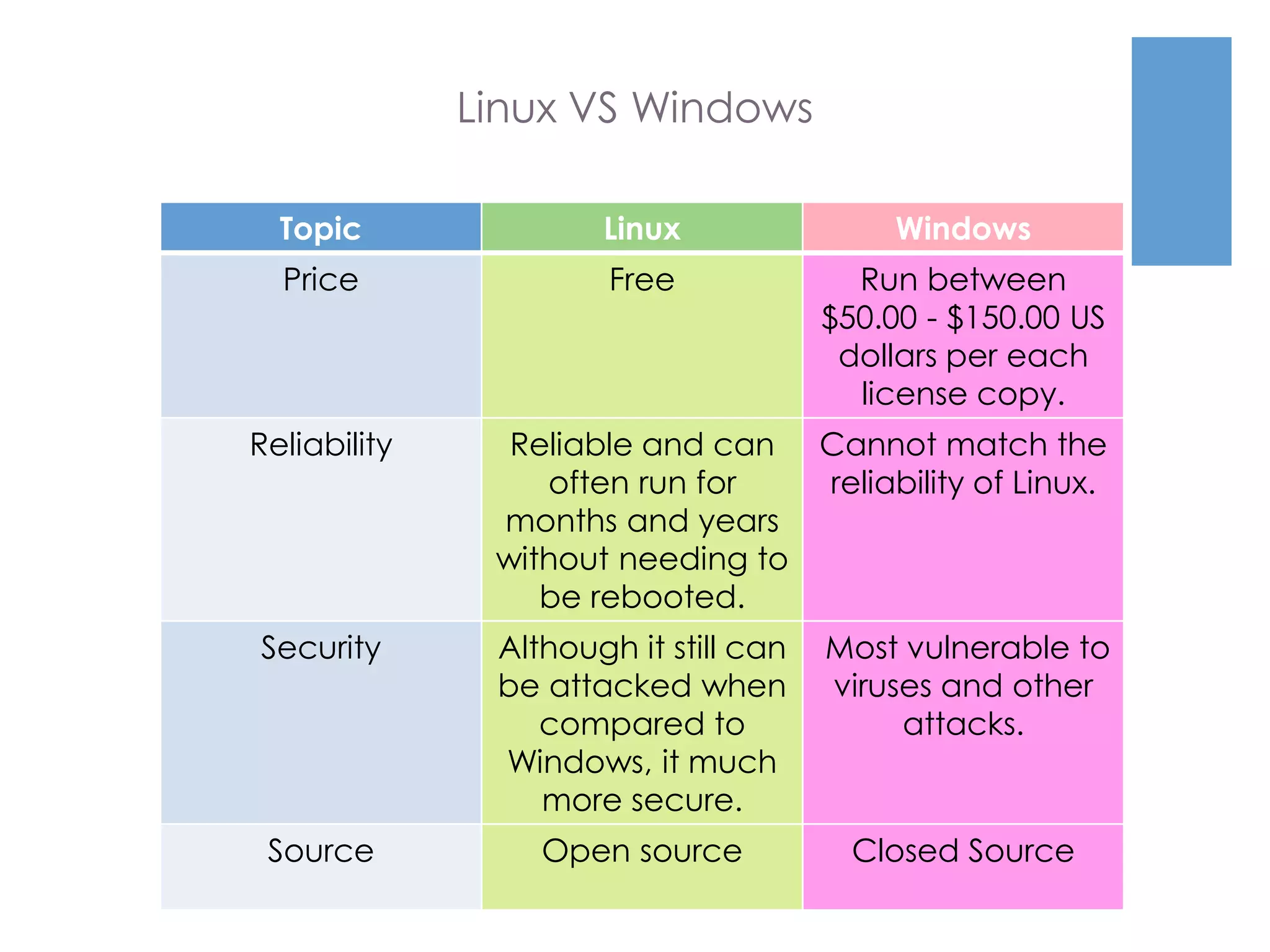
Linux VS Windows
Topic Linux Windows
Price Free Run between
$50.00 - $150.00 US
dollars per each
license copy.
Reliability Reliable and can
often run for
months and years
without needing to
be rebooted.
Cannot match the
reliability of Linux.
Security Although it still can
be attacked when
compared to
Windows, it much
more secure.
Most vulnerable to
viruses and other
attacks.
Source Open source Closed Source
Why Linux?
 Some governments turned
to Linux and other Free
Software as an affordable,
legal alternative to both
pirated software and
expensive proprietary
computer products from
Microsoft, Apple and other
commercial companies.
 The cost factor is not the
only one being considered
though – many transition to
Linux due to its superior
stability and openness of
the source code which in its
turn leverages information
security.
 In addition the province of
Jiangsu will install as many
as 150,000 Linux PCs, using
Loongson processors, in rural
schools starting in 2009.
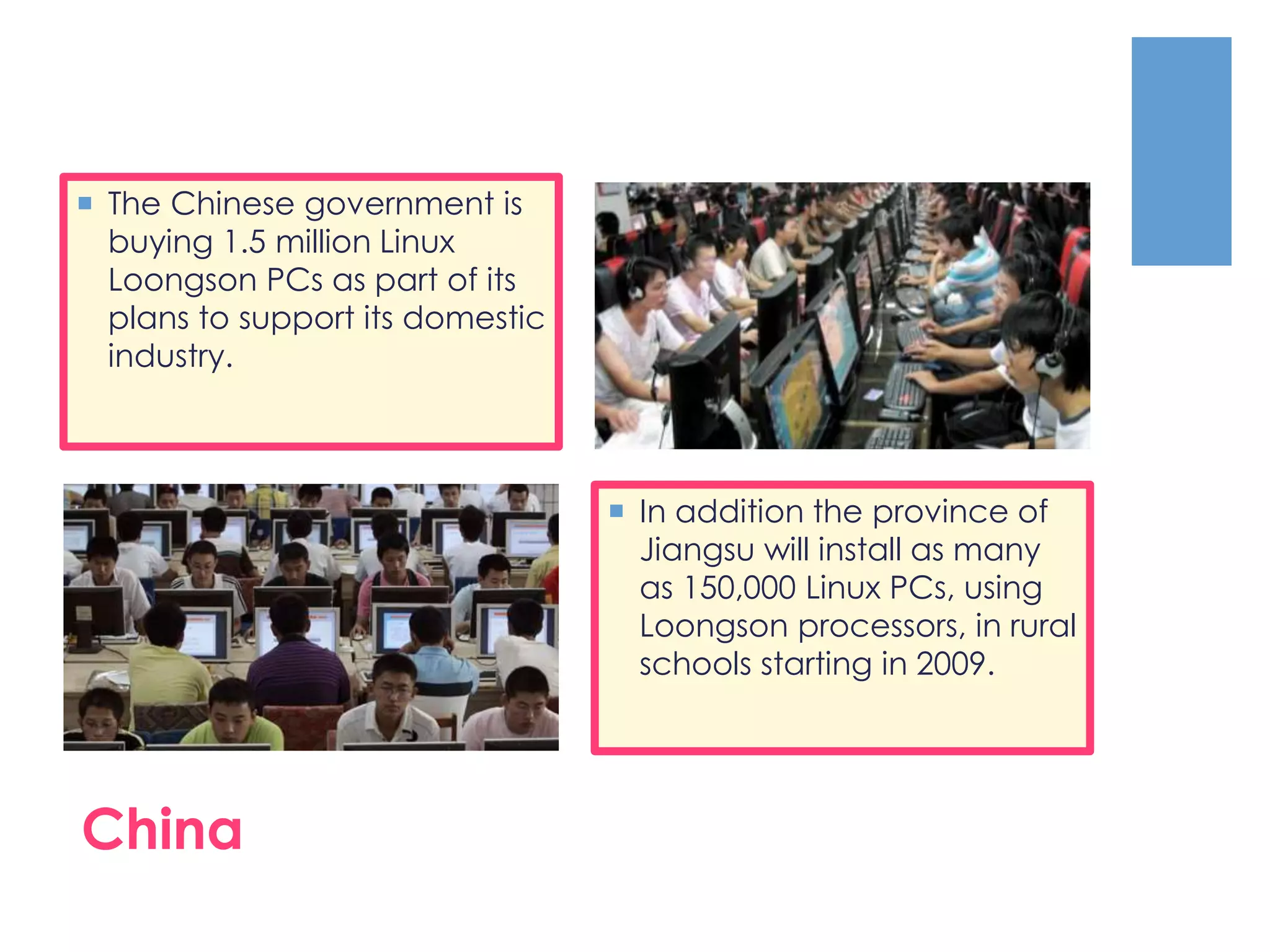
 The Chinese government is
buying 1.5 million Linux
Loongson PCs as part of its
plans to support its domestic
industry.
China
India
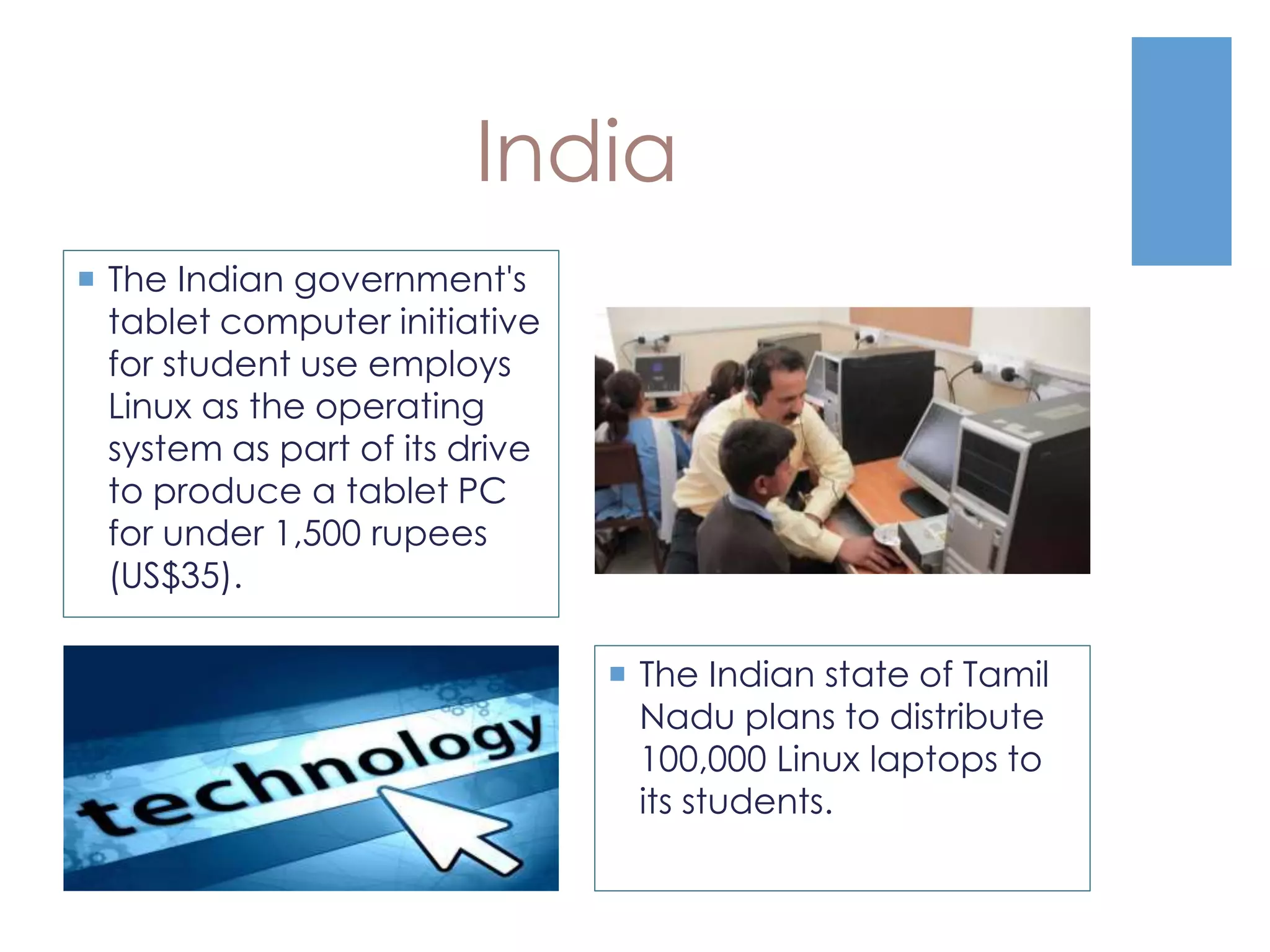
 The Indian state of Tamil
Nadu plans to distribute
100,000 Linux laptops to
its students.
 The Indian government's
tablet computer initiative
for student use employs
Linux as the operating
system as part of its drive
to produce a tablet PC
for under 1,500 rupees
(US$35).
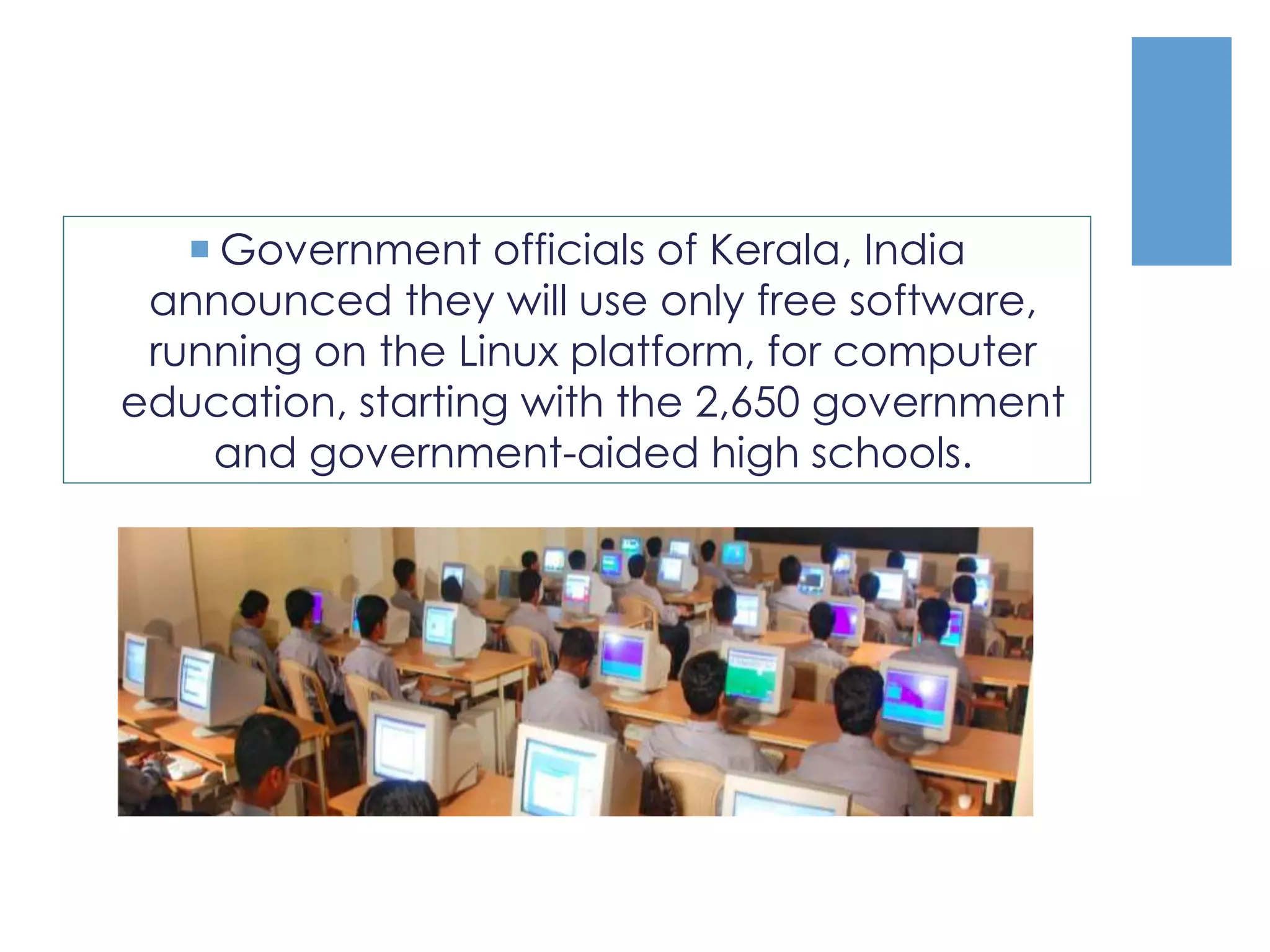
 Government officials of Kerala, India
announced they will use only free software,
running on the Linux platform, for computer
education, starting with the 2,650 government
and government-aided high schools.
Russia
Russia announced in October 2007 that all its
school computers will run on Linux.This is to avoid
cost of licensing currently unlicensed software.
Germany
Germany has announced
that 560,000 students in 33
universities will migrate to
Linux.
In 2012 the Leibniz-Rechenzentrum
(Leibniz Supercomputing Centre)
(LRZ) of the Bavarian Academy of
Sciences and Humanities unveiled
the SuperMUC, the world’s fourth
most powerful supercomputer.
The computer is x86-based
and features 155,000
processor cores with a
maximum speed of 3
petaflops of processing
power and 324 terabytes of
RAM. Its operating system is
SUSE Linux Enterprise Server.
BRAZIL
 Brazil has around
20,000 Linux desktops
running in
elementary and
secondary public
schools.
Brazil has 35 million students in
over 50,000 schools using
523,400 computer stations all
running Linux.
Philippines
The Philippines has deployed 13,000
desktops running on Fedora, the first 10,000
were delivered in December 2007 by
Advanced Solutions Inc. Another 10,000
desktops of Edubuntu and Kubuntu are
planned.
Italy
Schools in Bolzano,
Italy, with a student
population of 16,000,
switched to a custom
distribution of Linux,
(FUSS Soledad
GNU/Linux), in
September 2005.
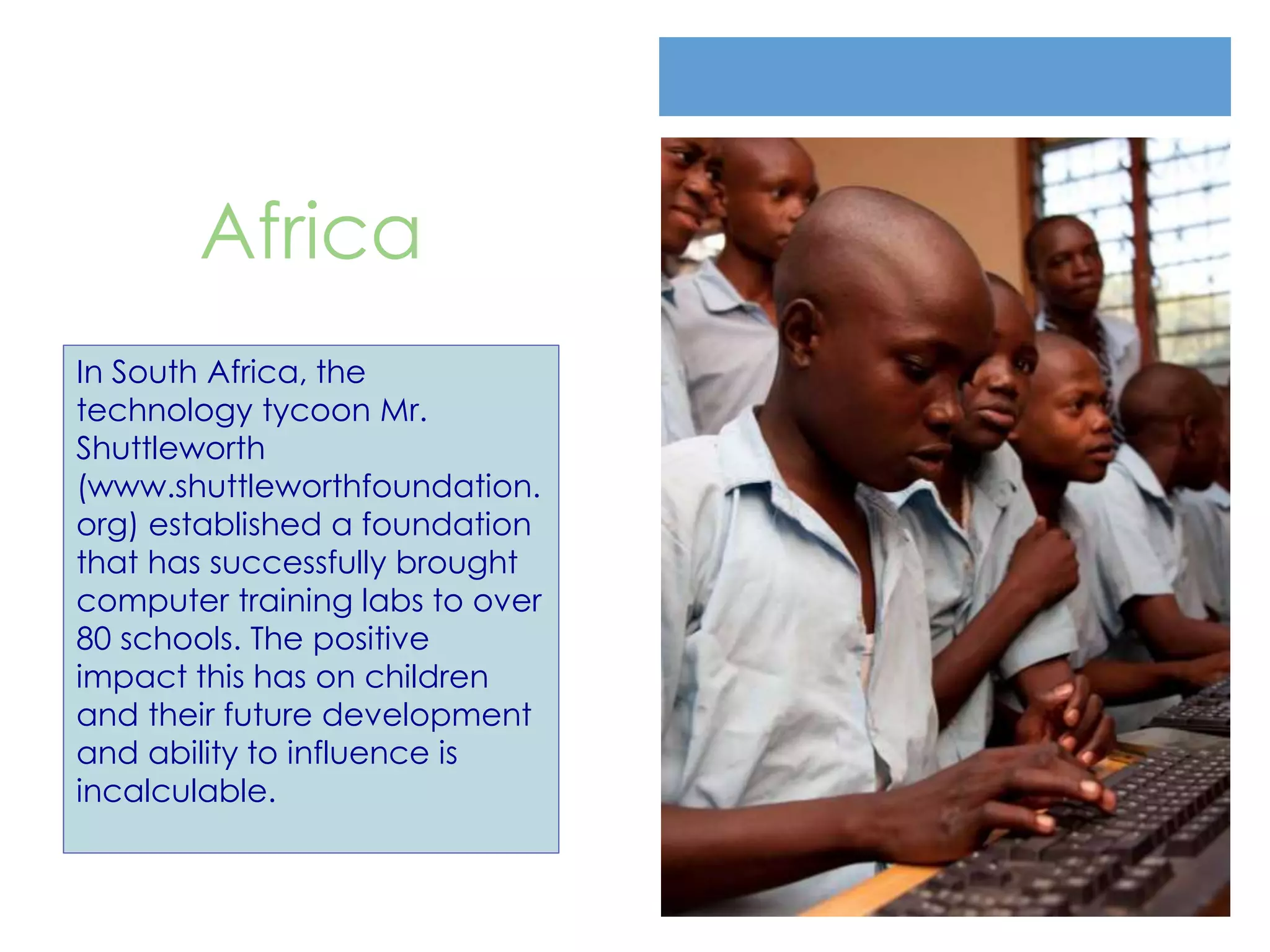
Africa
In South Africa, the
technology tycoon Mr.
Shuttleworth
(www.shuttleworthfoundation.
org) established a foundation
that has successfully brought
computer training labs to over
80 schools. The positive
impact this has on children
and their future development
and ability to influence is
incalculable.
Cuba
 Students from the
University of Information
Science in Cuba
launched its own
distribution of Linux
called Nova to promote
the replacement of
Microsoft Windows on
civilian and government
computers, a project
that is now supported by
the Cuban Government.
 By early 2011 the
Universidad de Ciencias
Informáticas announced
that they would migrate
more than 8000 PCs to
this new operating
system.
Georgia
In 2004 Georgia
began running all
its school
computers and
LTSP thin clients on
Linux, mainly using
Kubuntu, Ubuntu
and stripped
Fedora-based
distros.
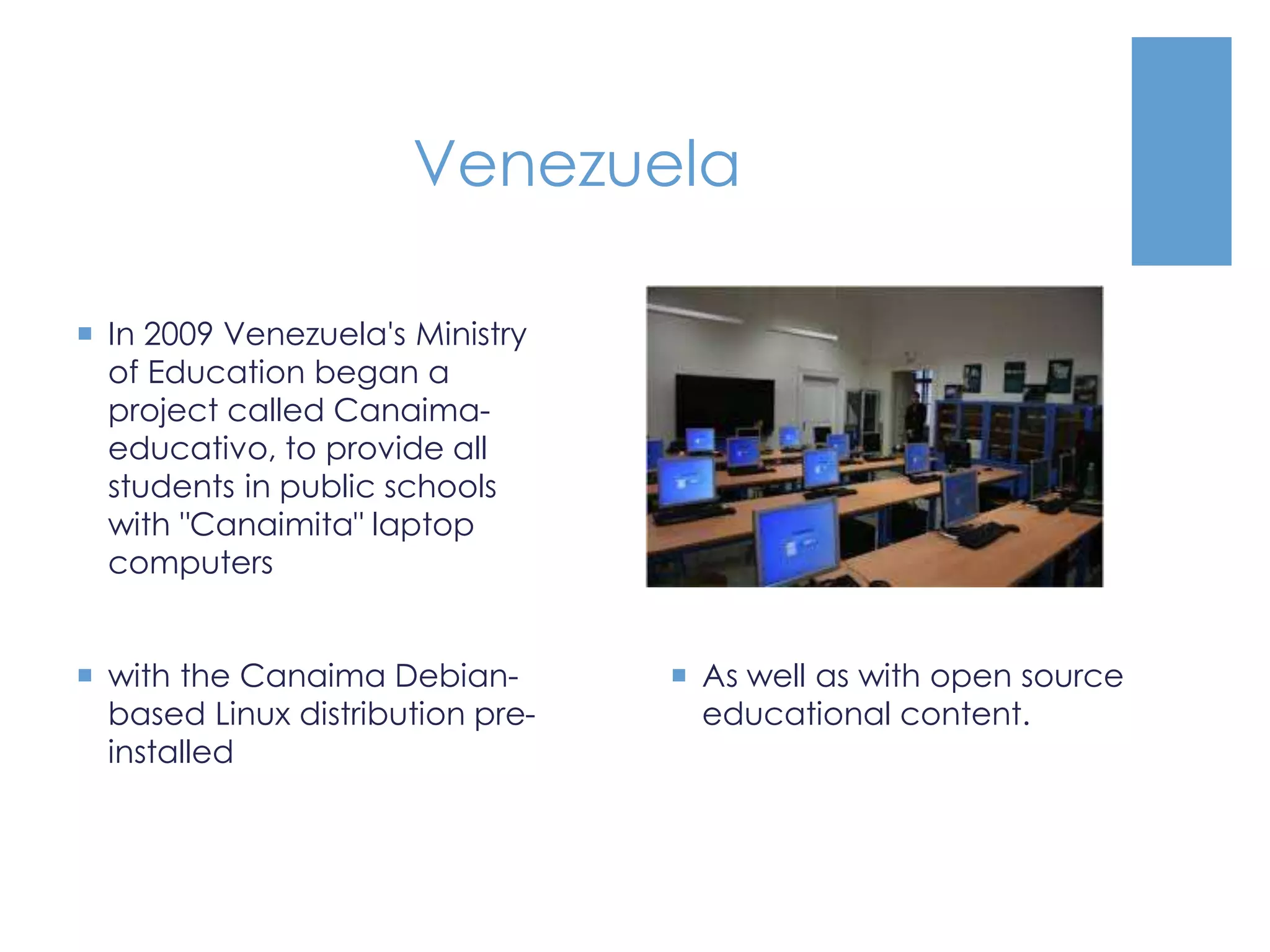
Venezuela
 In 2009 Venezuela's Ministry
of Education began a
project called Canaima-
educativo, to provide all
students in public schools
with "Canaimita" laptop
computers
 with the Canaima Debian-
based Linux distribution pre-
installed
 As well as with open source
educational content.
U.S.A
22,000 students in
the US state of
Indiana had
access to Linux
Workstations at
their high schools
in 2006.
REFRENCES
 http://en.wikipedia.org/wiki/List_of_Linux_adopte
rs
 http://www.slideshare.net/AhmadRb/iem2014-
foss
 http://www.reallylinux.com/docs/africa.shtml

Linux in Schools

  • 1.
    Linux in Schools Name:Latifa Al Marri Grade: 10BG
  • 2.
    What is Linux? •Linux is an operating system. • It is the software on a computer that enables applications and the computer operator to access the devices on the computer to perform desired functions.
  • 3.
    Linux VS Windows TopicLinux Windows Price Free Run between $50.00 - $150.00 US dollars per each license copy. Reliability Reliable and can often run for months and years without needing to be rebooted. Cannot match the reliability of Linux. Security Although it still can be attacked when compared to Windows, it much more secure. Most vulnerable to viruses and other attacks. Source Open source Closed Source
  • 5.
    Why Linux?  Somegovernments turned to Linux and other Free Software as an affordable, legal alternative to both pirated software and expensive proprietary computer products from Microsoft, Apple and other commercial companies.  The cost factor is not the only one being considered though – many transition to Linux due to its superior stability and openness of the source code which in its turn leverages information security.
  • 6.
     In additionthe province of Jiangsu will install as many as 150,000 Linux PCs, using Loongson processors, in rural schools starting in 2009.  The Chinese government is buying 1.5 million Linux Loongson PCs as part of its plans to support its domestic industry. China
  • 7.
    India  The Indianstate of Tamil Nadu plans to distribute 100,000 Linux laptops to its students.  The Indian government's tablet computer initiative for student use employs Linux as the operating system as part of its drive to produce a tablet PC for under 1,500 rupees (US$35).
  • 8.
     Government officialsof Kerala, India announced they will use only free software, running on the Linux platform, for computer education, starting with the 2,650 government and government-aided high schools.
  • 9.
    Russia Russia announced inOctober 2007 that all its school computers will run on Linux.This is to avoid cost of licensing currently unlicensed software.
  • 10.
    Germany Germany has announced that560,000 students in 33 universities will migrate to Linux. In 2012 the Leibniz-Rechenzentrum (Leibniz Supercomputing Centre) (LRZ) of the Bavarian Academy of Sciences and Humanities unveiled the SuperMUC, the world’s fourth most powerful supercomputer. The computer is x86-based and features 155,000 processor cores with a maximum speed of 3 petaflops of processing power and 324 terabytes of RAM. Its operating system is SUSE Linux Enterprise Server.
  • 11.
    BRAZIL  Brazil hasaround 20,000 Linux desktops running in elementary and secondary public schools. Brazil has 35 million students in over 50,000 schools using 523,400 computer stations all running Linux.
  • 12.
    Philippines The Philippines hasdeployed 13,000 desktops running on Fedora, the first 10,000 were delivered in December 2007 by Advanced Solutions Inc. Another 10,000 desktops of Edubuntu and Kubuntu are planned.
  • 13.
    Italy Schools in Bolzano, Italy,with a student population of 16,000, switched to a custom distribution of Linux, (FUSS Soledad GNU/Linux), in September 2005.
  • 14.
    Africa In South Africa,the technology tycoon Mr. Shuttleworth (www.shuttleworthfoundation. org) established a foundation that has successfully brought computer training labs to over 80 schools. The positive impact this has on children and their future development and ability to influence is incalculable.
  • 15.
    Cuba  Students fromthe University of Information Science in Cuba launched its own distribution of Linux called Nova to promote the replacement of Microsoft Windows on civilian and government computers, a project that is now supported by the Cuban Government.  By early 2011 the Universidad de Ciencias Informáticas announced that they would migrate more than 8000 PCs to this new operating system.
  • 16.
    Georgia In 2004 Georgia beganrunning all its school computers and LTSP thin clients on Linux, mainly using Kubuntu, Ubuntu and stripped Fedora-based distros.
  • 17.
    Venezuela  In 2009Venezuela's Ministry of Education began a project called Canaima- educativo, to provide all students in public schools with "Canaimita" laptop computers  with the Canaima Debian- based Linux distribution pre- installed  As well as with open source educational content.
  • 18.
    U.S.A 22,000 students in theUS state of Indiana had access to Linux Workstations at their high schools in 2006.
  • 20.