Linked Data and Services
                                                 Andreas Harth and Barry Norton


Institute AIFB


KIT – University of the State of Baden-Wuerttemberg and
National Laboratory of the Helmholtz Association                                  www.kit.edu
Outline

!    Motivation
!    Linked Data Principles
!    Query Processing over Linked Data
!    Linked Data Services (LIDS) and Linked Open
     Services (LOS)
!    Conclusion


                                       KIT – University of the State of Baden-Wuerttemberg and
                                       National Laboratory of the Helmholtz Association
Motivation

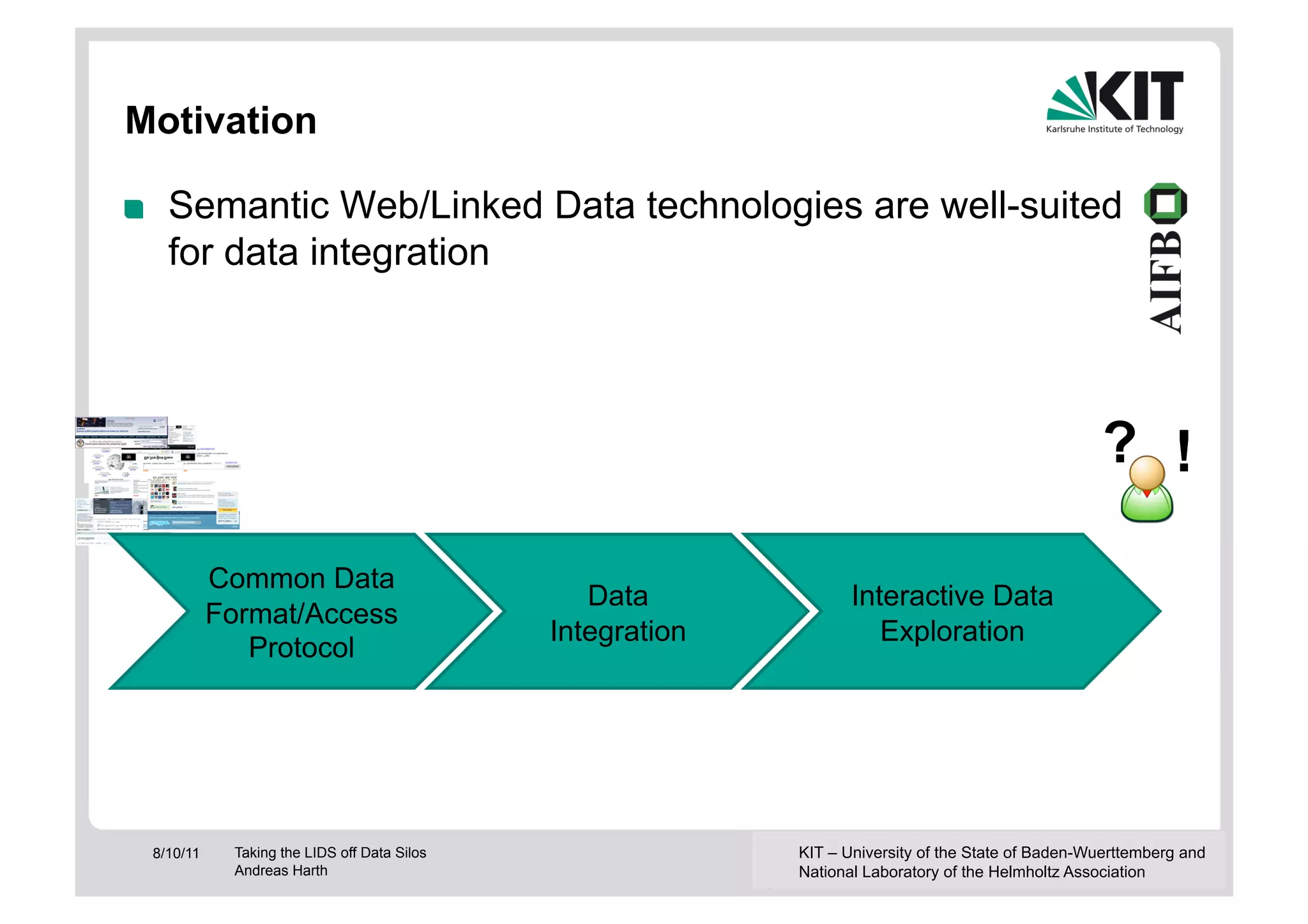
!      Semantic Web/Linked Data technologies are well-suited
       for data integration


                                                                                                        ? !

               Common Data
                                                    Data              Interactive Data
               Format/Access
                                                 Integration             Exploration
                  Protocol


     8/10/11    Taking the LIDS off Data Silos                 KIT – University of the State of Baden-Wuerttemberg and
                Andreas Harth                                  National Laboratory of the Helmholtz Association
Linked Data Principles*

1.     Use URIs to name things; not only documents, but
       also people, locations, concepts, etc.
2.     To enable agents (human users and machine agents
       alike) to look up those names, use HTTP URIs
3.     When someone looks up a URI we provide useful
       information; with 'useful' in the strict sense we usually
       mean structured data in RDF.
4.     Include links to other URIs allowing agents (machines
       and humans) to discover more things


      (*) http://www.w3.org/DesignIssues/LinkedData.html

                                                   KIT – University of the State of Baden-Wuerttemberg and
                                                   National Laboratory of the Helmholtz Association
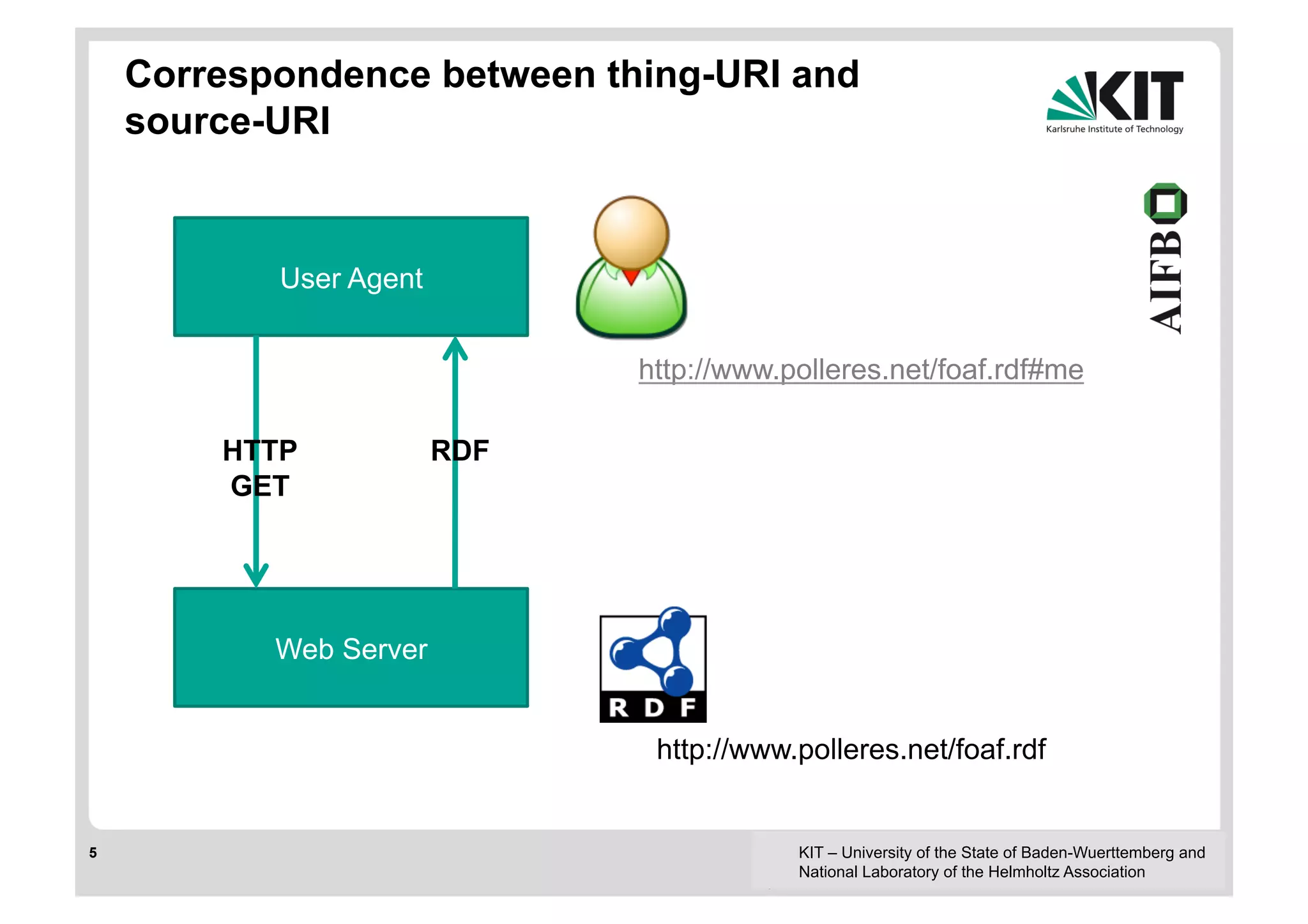
Correspondence between thing-URI and
    source-URI


           User Agent


                              http://www.polleres.net/foaf.rdf#me

        HTTP            RDF
        GET


           Web Server


                               http://www.polleres.net/foaf.rdf


5                                         KIT – University of the State of Baden-Wuerttemberg and
                                          National Laboratory of the Helmholtz Association
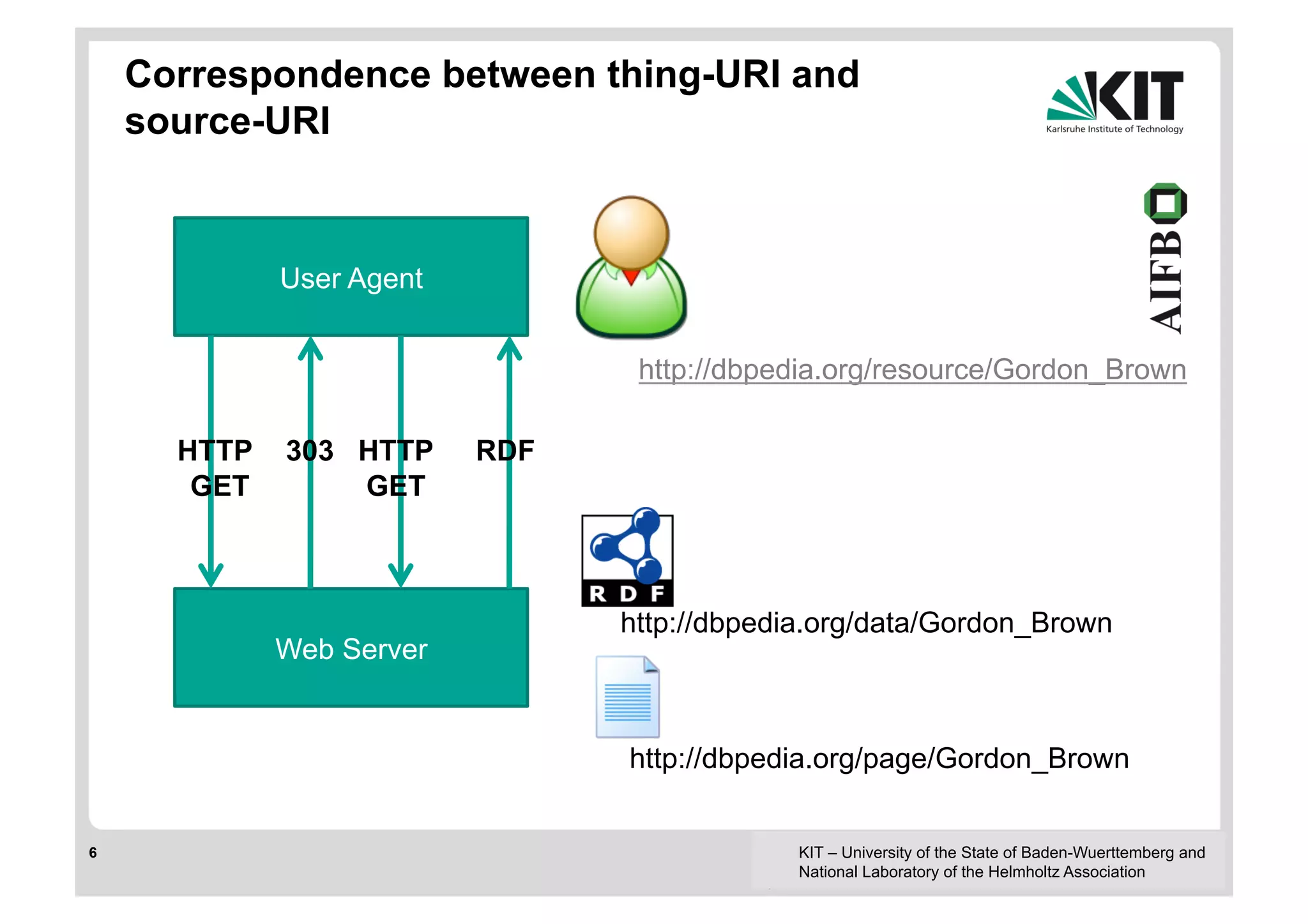
Correspondence between thing-URI and
    source-URI


             User Agent


                                 http://dbpedia.org/resource/Gordon_Brown

      HTTP   303 HTTP     RDF
       GET       GET


                                http://dbpedia.org/data/Gordon_Brown
             Web Server


                                http://dbpedia.org/page/Gordon_Brown


6                                            KIT – University of the State of Baden-Wuerttemberg and
                                             National Laboratory of the Helmholtz Association
KIT – University of the State of Baden-Wuerttemberg and
National Laboratory of the Helmholtz Association
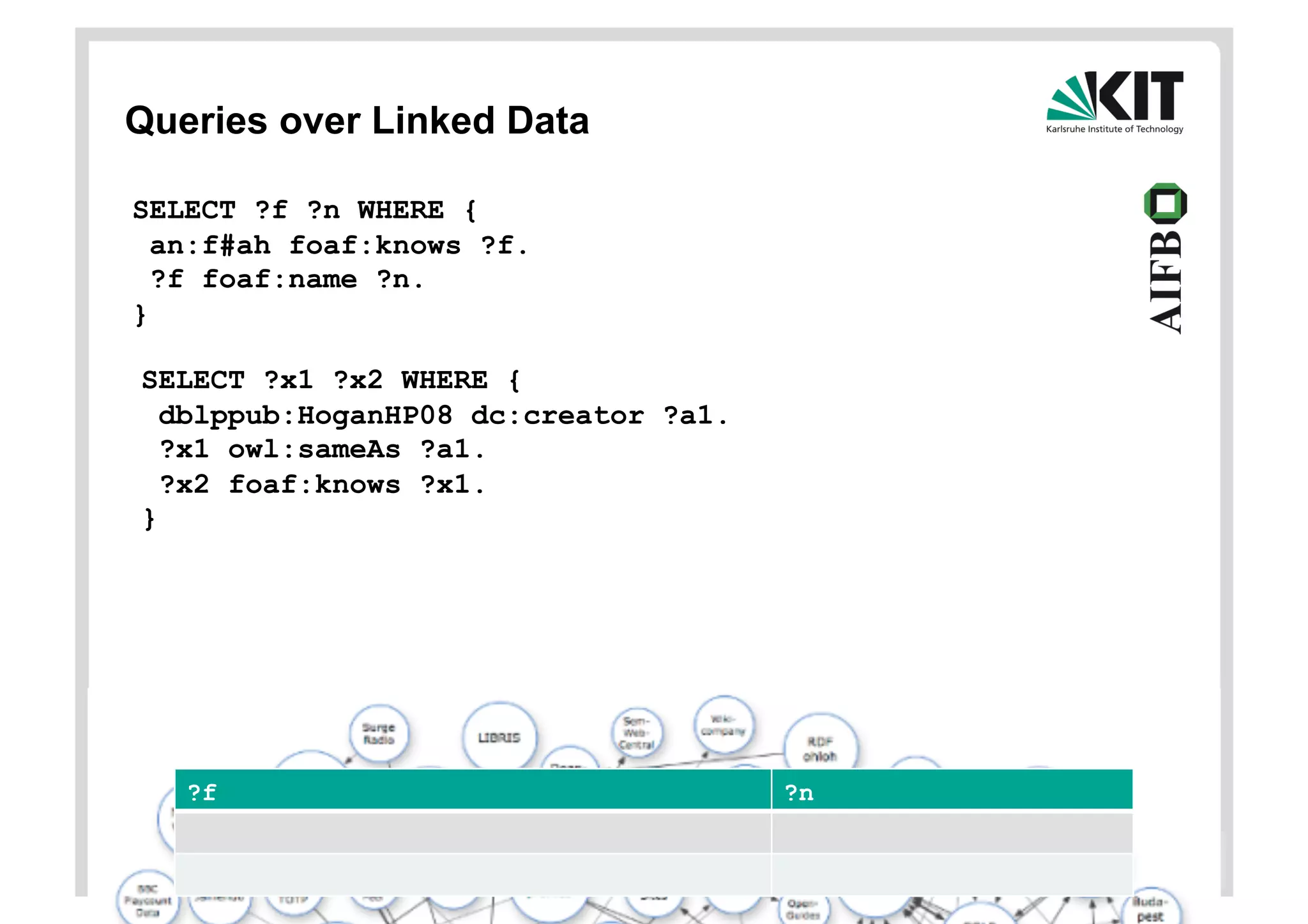
Queries over Linked Data

SELECT ?f ?n WHERE {
  an:f#ah foaf:knows ?f.
  ?f foaf:name ?n.
}

SELECT ?x1 ?x2 WHERE {
  dblppub:HoganHP08 dc:creator ?a1.
  ?x1 owl:sameAs ?a1.
  ?x2 foaf:knows ?x1.
}


   ?f                                 ?n

                                       KIT – University of the State of Baden-Wuerttemberg and
                                       National Laboratory of the Helmholtz Association
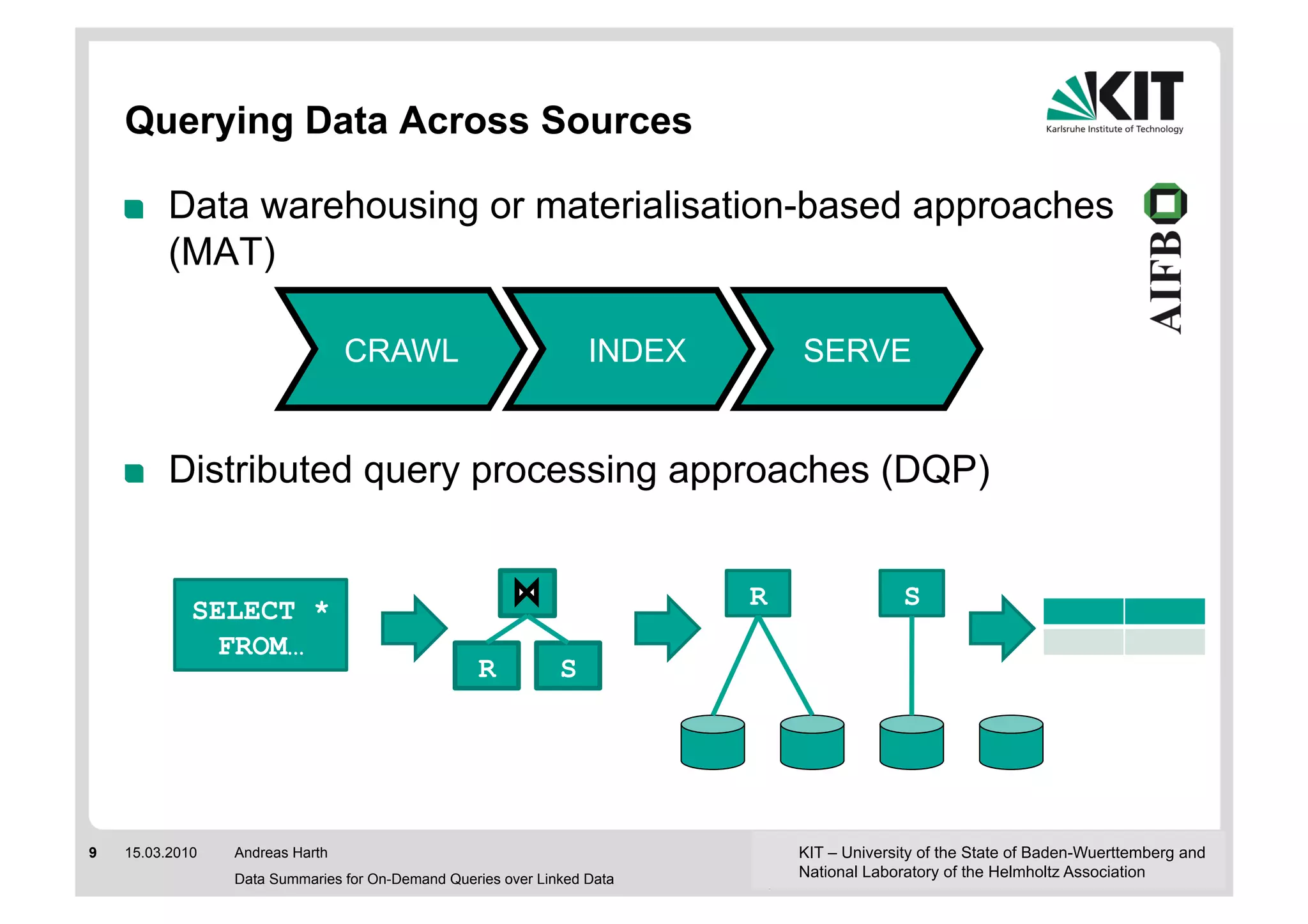
Querying Data Across Sources

    !     Data warehousing or materialisation-based approaches
          (MAT)

                                 CRAWL                            INDEX       SERVE


    !     Distributed query processing approaches (DQP)


             SELECT *                                                     R                 S
              FROM…
                                                   R          S


9   15.03.2010   Andreas Harth                                                KIT – University of the State of Baden-Wuerttemberg and
                 Data Summaries for On-Demand Queries over Linked Data        National Laboratory of the Helmholtz Association
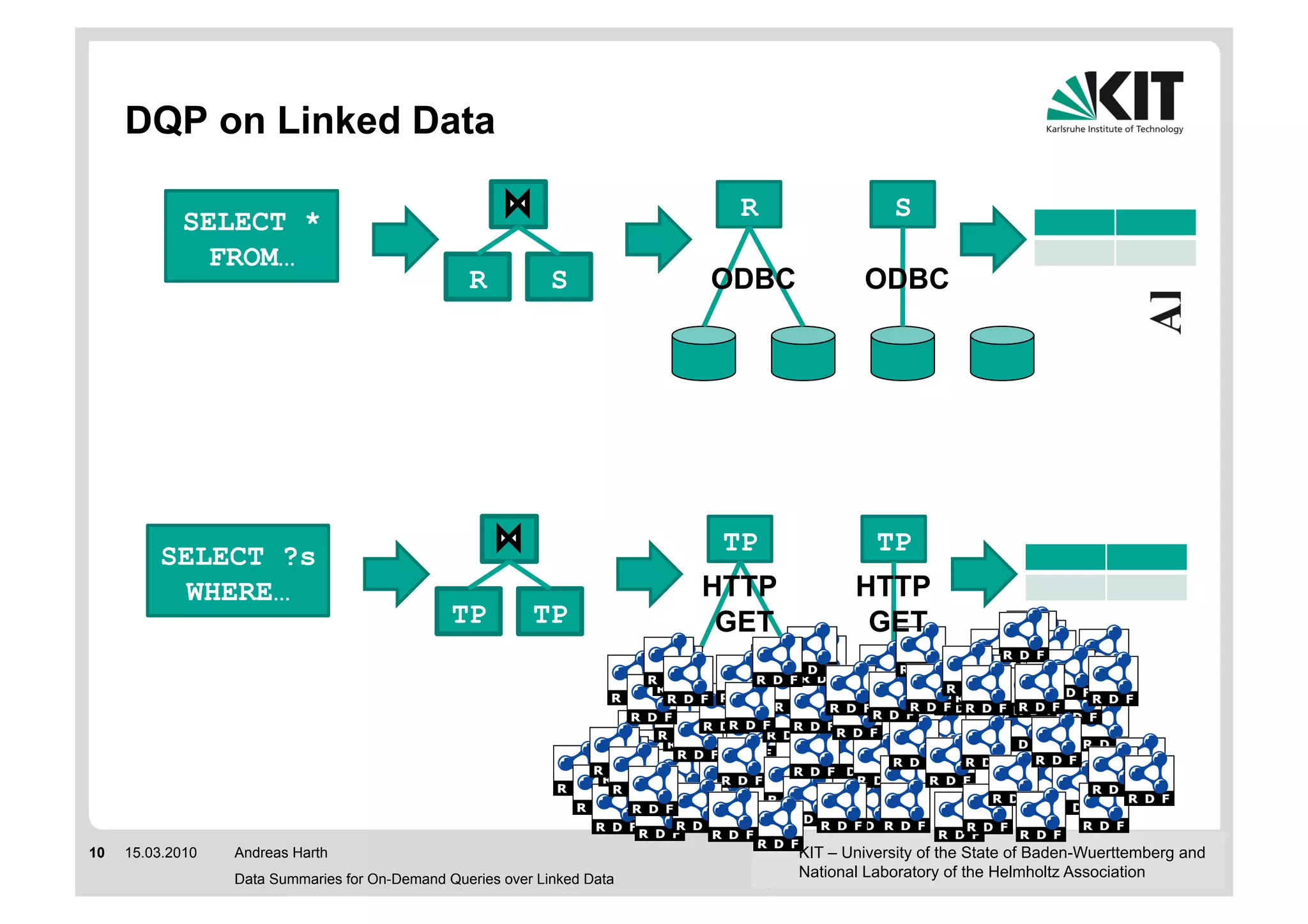
DQP on Linked Data

            SELECT *                                                        R                S
             FROM…
                                                  R           S           ODBC           ODBC


         SELECT ?s                                                         TP              TP
          WHERE…                                                          HTTP          HTTP
                                                TP         TP              GET           GET


10   15.03.2010   Andreas Harth                                                  KIT – University of the State of Baden-Wuerttemberg and
                  Data Summaries for On-Demand Queries over Linked Data          National Laboratory of the Helmholtz Association
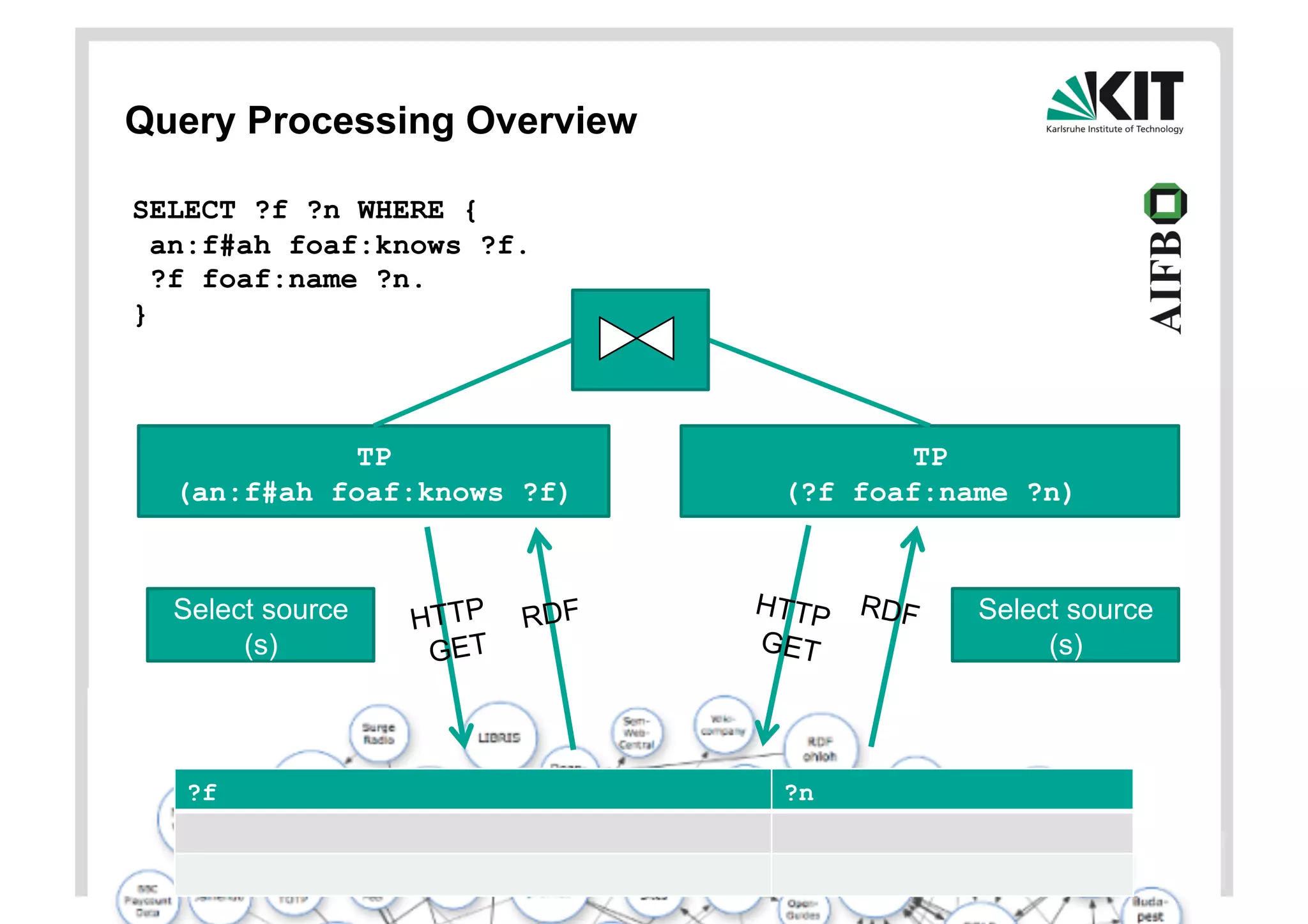
Query Processing Overview

      SELECT ?f ?n WHERE {
        an:f#ah foaf:knows ?f.
        ?f foaf:name ?n.
      }


                     TP                                                           TP
           (an:f#ah foaf:knows ?f)                                         (?f foaf:name ?n)


           Select source                                                  HTTP      RDF             Select source
                                          HTTP            RDF
                (s)                        GET                            GET                            (s)


             ?f                                                            ?n
             http://danbri.org/foaf.rdf#danbri                             Dan Brickley
11   15.03.2010   Andreas Harth                                             KIT – University of the State of Baden-Wuerttemberg and
                  Data Summaries for On-Demand Queries over Linked Data     National Laboratory of the Helmholtz Association
Barry


        KIT – University of the State of Baden-Wuerttemberg and
        National Laboratory of the Helmholtz Association
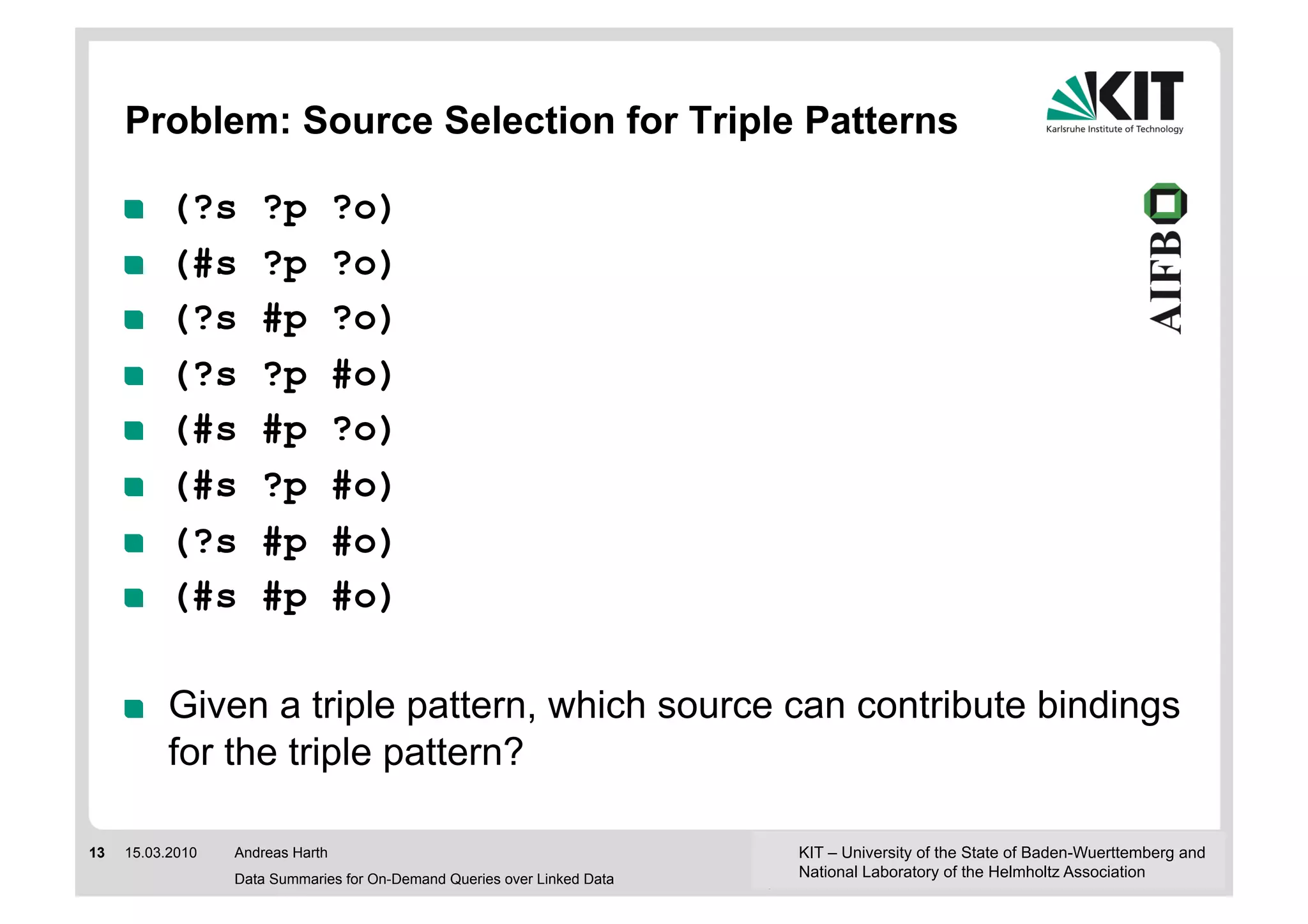
Problem: Source Selection for Triple Patterns

     !     (?s       ?p           ?o)
     !     (#s       ?p           ?o)
     !     (?s       #p           ?o)
     !     (?s       ?p           #o)
     !     (#s       #p           ?o)
     !     (#s       ?p           #o)
     !     (?s       #p           #o)
     !     (#s       #p           #o)

     !     Given a triple pattern, which source can contribute bindings
           for the triple pattern?

13   15.03.2010   Andreas Harth                                           KIT – University of the State of Baden-Wuerttemberg and
                  Data Summaries for On-Demand Queries over Linked Data   National Laboratory of the Helmholtz Association
Schema-Level Indices [Stuckenschmidt et al.
     2004]

     !     Keep index of properties and/or classes contained in
           sources

     !     (?s #p ?o), (?s rdf:type #o)

     !     Covers only queries containing schema-level elements
     !     Commonly used properties select potentially too many
           sources
                           SELECT ?x1 ?x2 WHERE {
                               SELECT ?f ?n WHERE {
                             dblppub:HoganHP08 dc:creator ?a1.
                                 an:f#ah foaf:knows ?f.
                             ?x1 owl:sameAs ?a1.
                                 ?f foaf:name ?n.
                             ?x2 foaf:knows ?x1.
                               }
                           }

14   15.03.2010   Andreas Harth                                           KIT – University of the State of Baden-Wuerttemberg and
                  Data Summaries for On-Demand Queries over Linked Data   National Laboratory of the Helmholtz Association
Direct Lookup (DL) [Hartig et al. 2009]

     !     Exploits correspondence between thing-URI and source-URI
     !     Linked Data sources (aka RDF files) return typically triples with a
           subject corresponding to the source
     !     Sometimes the sources return triples with object corresponding to the
           source

     !     (#s ?p ?o), (#s #p ?o), (#s #p #o)
     !     (?s ?p #o), (?s #p #o)

     !     Incomplete wrt. patterns but also wrt. to URI reuse across sources
     !     Limited parallelism, unclear how to schedule lookups
                            SELECT ?x1 ?x2 WHERE {
                                SELECT ?f ?n WHERE {
                              dblppub:HoganHP08 dc:creator ?a1.
                                  an:f#ah foaf:knows ?f.
                              ?x1 owl:sameAs ?a1.
                                  ?f foaf:name ?n.
                              ?x2 foaf:knows ?x1.
                                }
                            }
15   15.03.2010   Andreas Harth                                           KIT – University of the State of Baden-Wuerttemberg and
                  Data Summaries for On-Demand Queries over Linked Data   National Laboratory of the Helmholtz Association
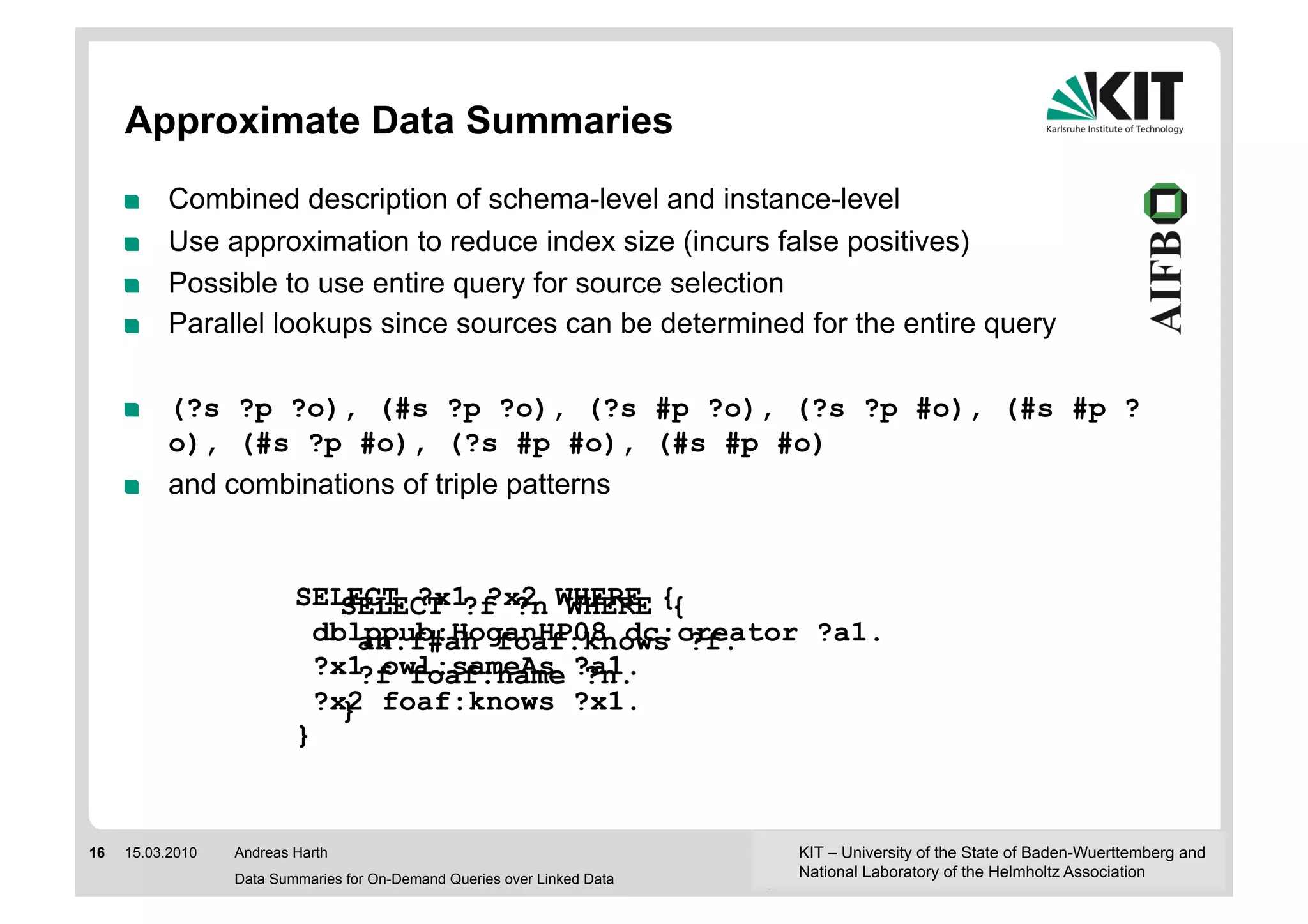
Approximate Data Summaries
     !     Combined description of schema-level and instance-level
     !     Use approximation to reduce index size (incurs false positives)
     !     Possible to use entire query for source selection
     !     Parallel lookups since sources can be determined for the entire query

     !     (?s ?p ?o), (#s ?p ?o), (?s #p ?o), (?s ?p #o), (#s #p ?
           o), (#s ?p #o), (?s #p #o), (#s #p #o)
     !     and combinations of triple patterns


                          SELECT ?x1 ?x2 WHERE {
                              SELECT ?f ?n WHERE {
                            dblppub:HoganHP08 dc:creator ?a1.
                                an:f#ah foaf:knows ?f.
                            ?x1 owl:sameAs ?a1.
                                ?f foaf:name ?n.
                            ?x2 foaf:knows ?x1.
                              }
                          }


16   15.03.2010   Andreas Harth                                           KIT – University of the State of Baden-Wuerttemberg and
                  Data Summaries for On-Demand Queries over Linked Data   National Laboratory of the Helmholtz Association
Implementation

!    Deploy wrappers „in the cloud“
!    Google App Engine: hosting of Java and Python
     webapps on Google’s Cloud infrastructure
!    Limited amount of processing time (6hrs/day)
!    Single-threaded applications

!    Suited for deploying wrappers
!    e.g. http://twitter2foaf.appspot.com/ converts Twitter
     user data to RDF


                                           KIT – University of the State of Baden-Wuerttemberg and
                                           National Laboratory of the Helmholtz Association
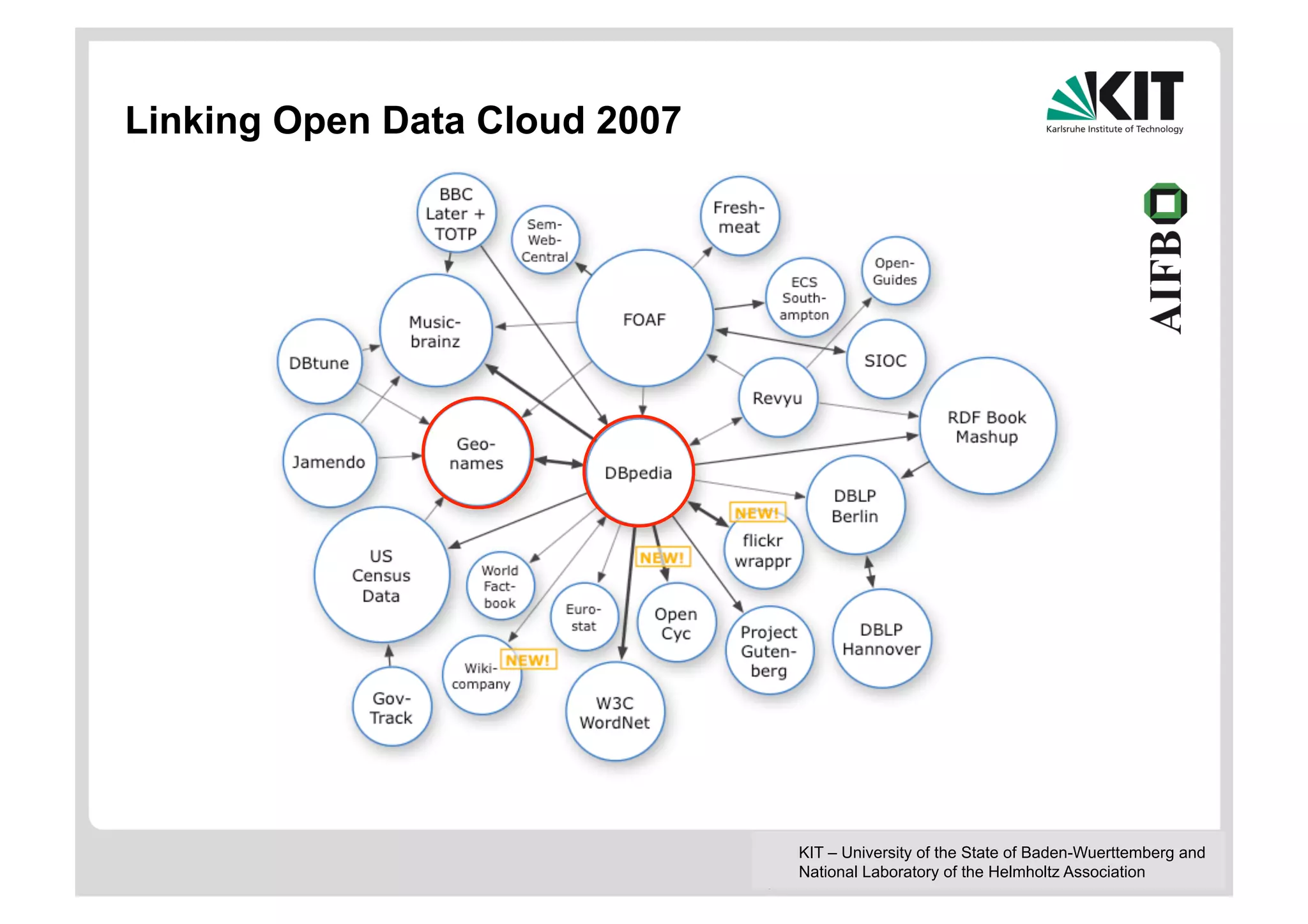
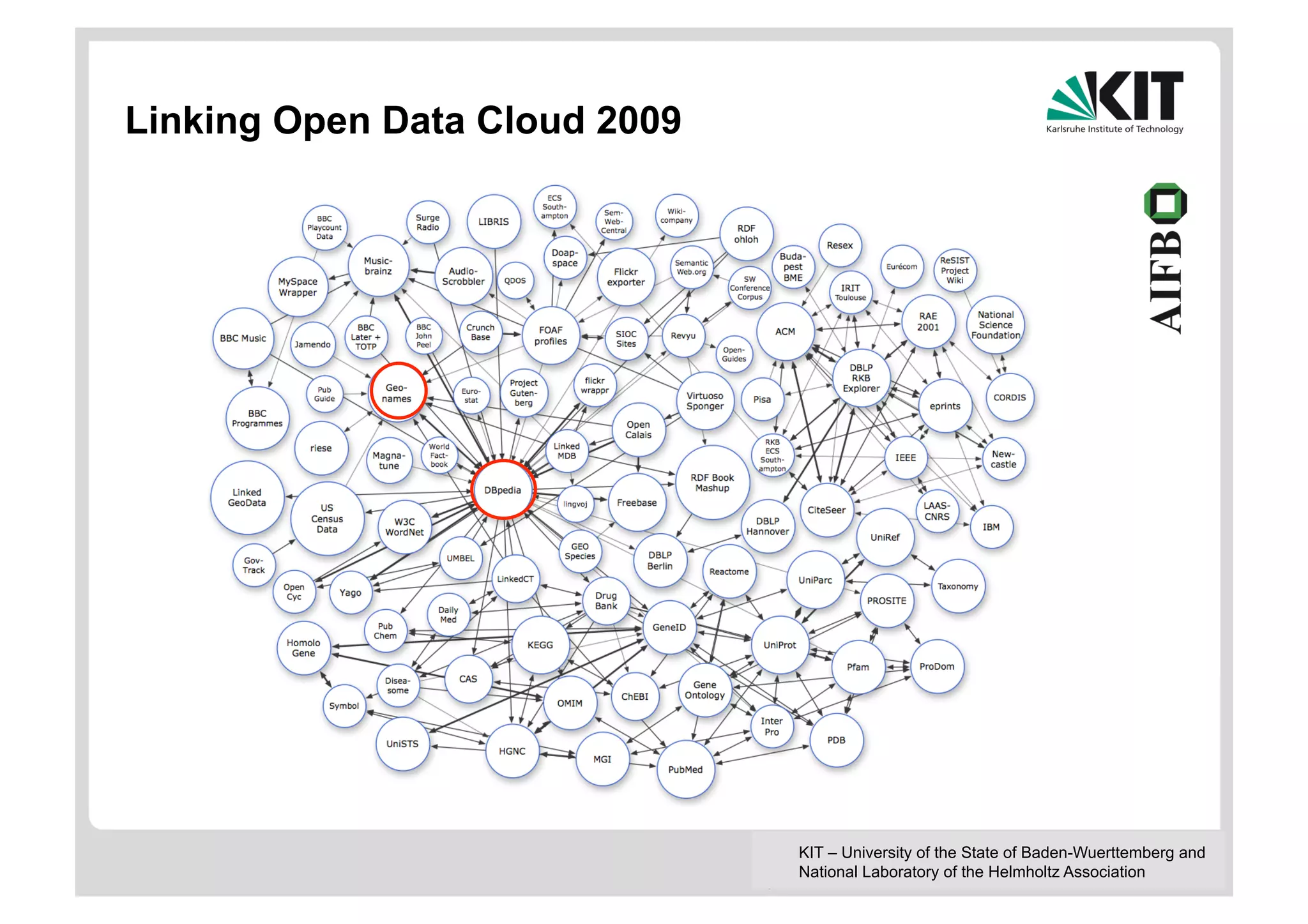
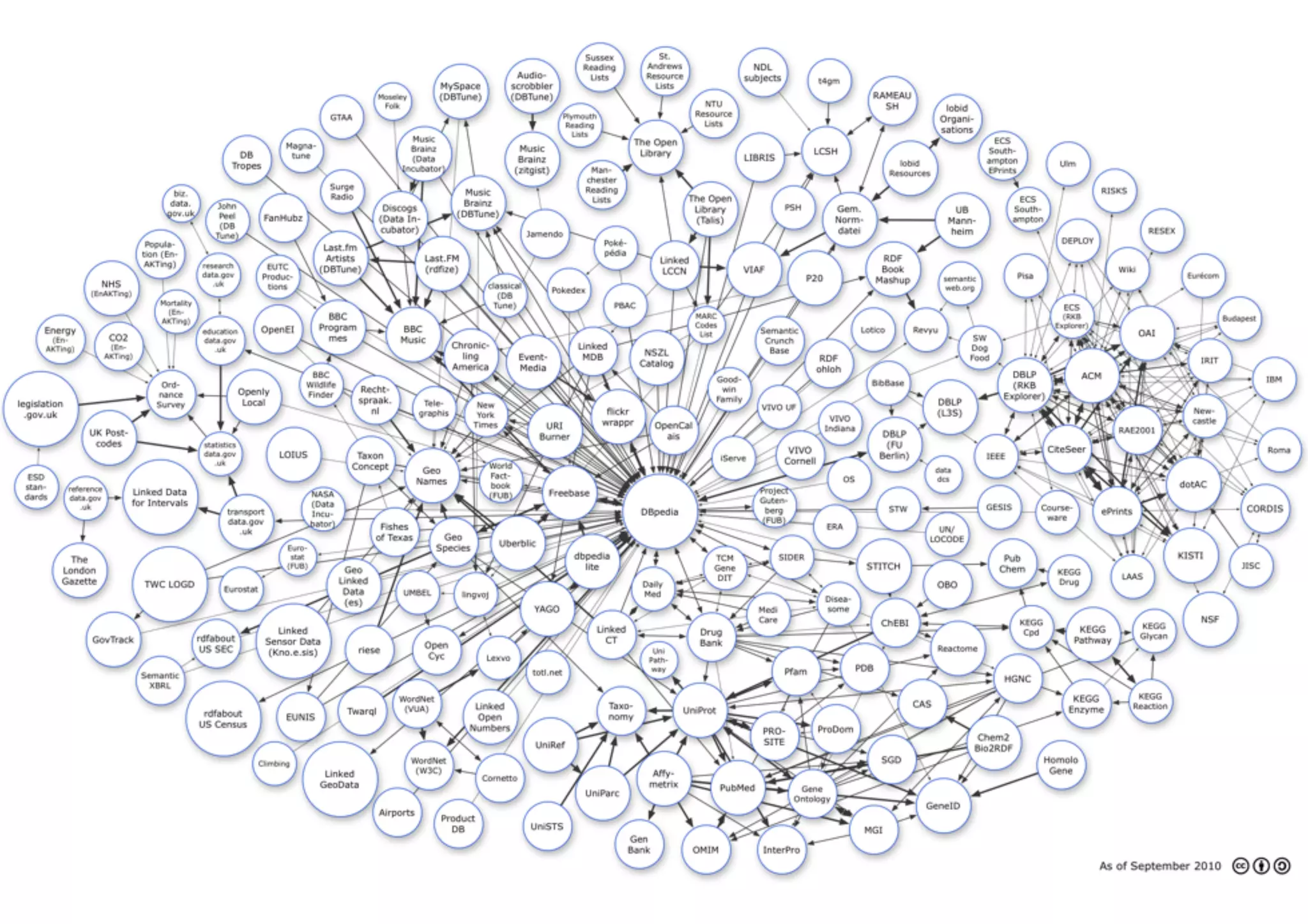
Linking Open Data Cloud 2007


                               KIT – University of the State of Baden-Wuerttemberg and
                               National Laboratory of the Helmholtz Association
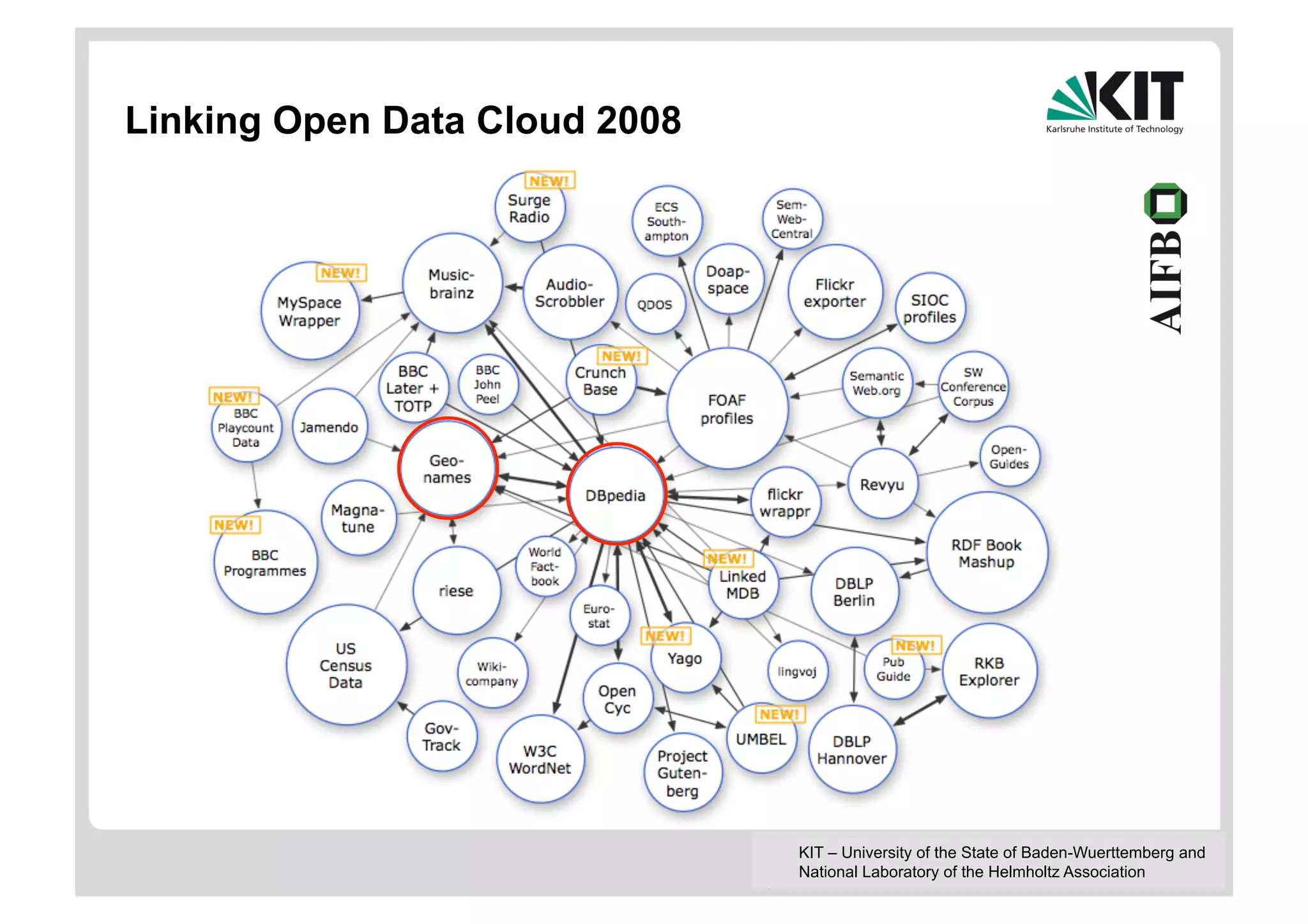
Linking Open Data Cloud 2008


                               KIT – University of the State of Baden-Wuerttemberg and
                               National Laboratory of the Helmholtz Association
Linking Open Data Cloud 2009


                               KIT – University of the State of Baden-Wuerttemberg and
                               National Laboratory of the Helmholtz Association
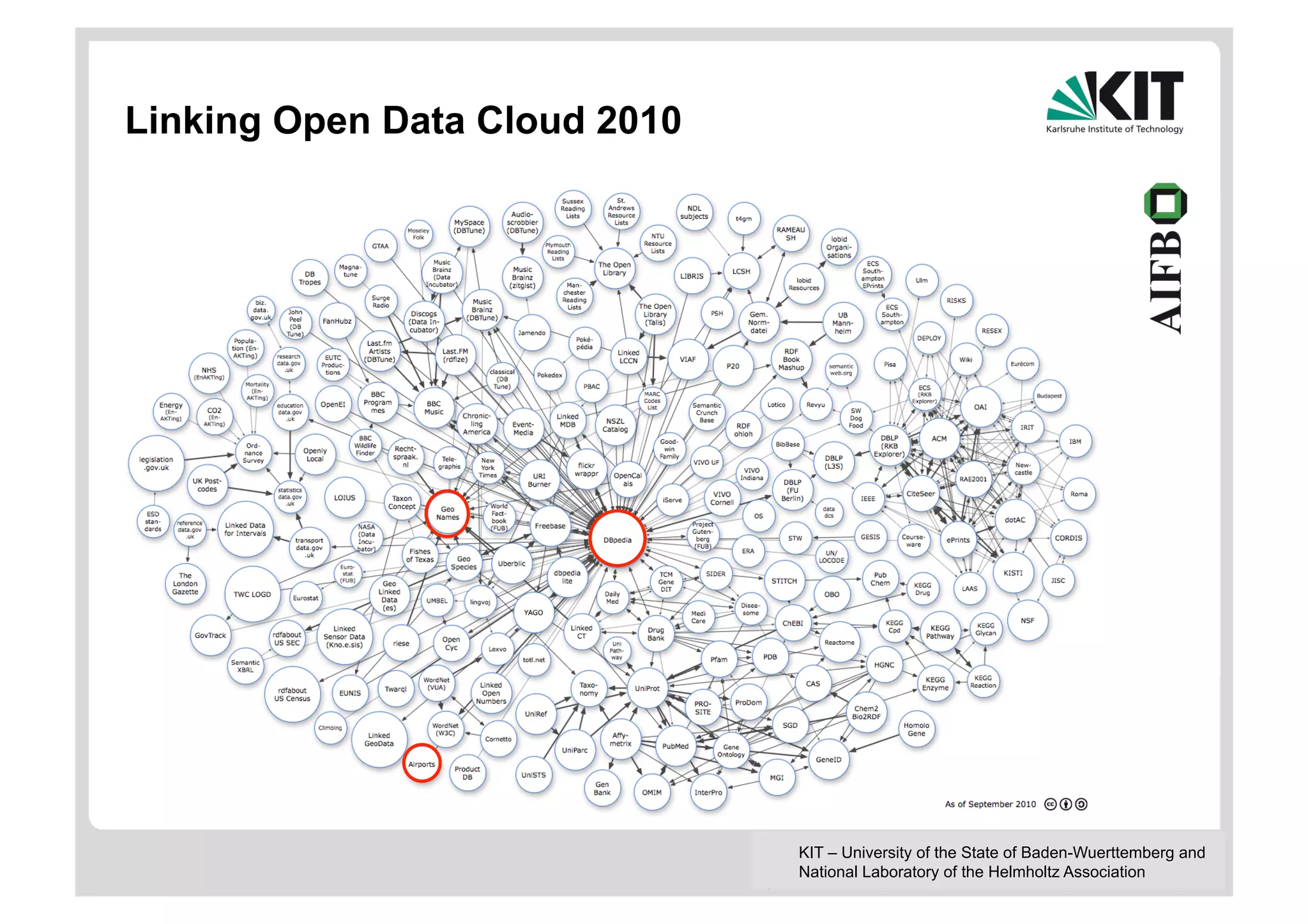
Linking Open Data Cloud 2010


                               KIT – University of the State of Baden-Wuerttemberg and
                               National Laboratory of the Helmholtz Association
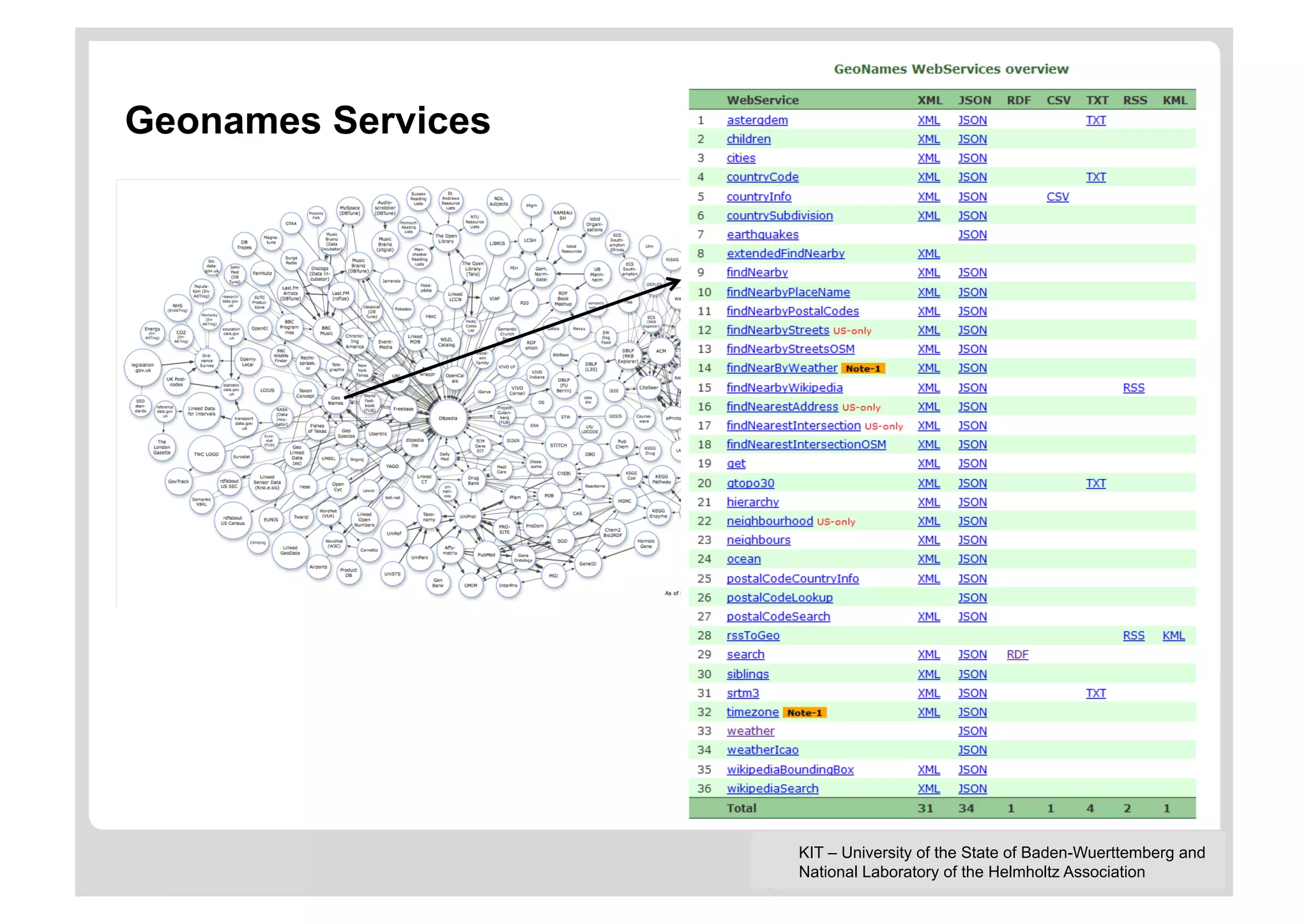
Geonames Services


                    KIT – University of the State of Baden-Wuerttemberg and
                    National Laboratory of the Helmholtz Association
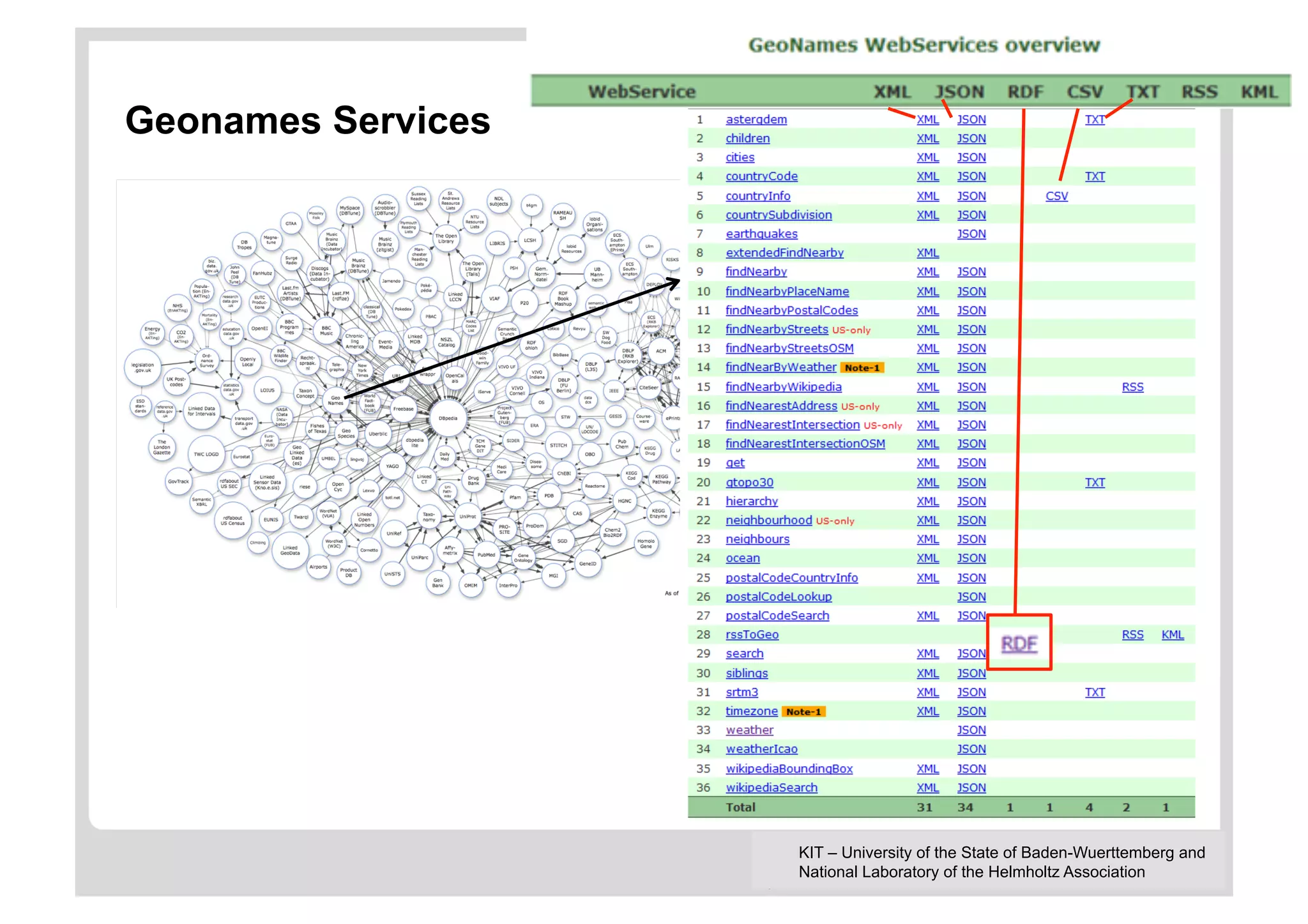
Geonames Services


                    KIT – University of the State of Baden-Wuerttemberg and
                    National Laboratory of the Helmholtz Association
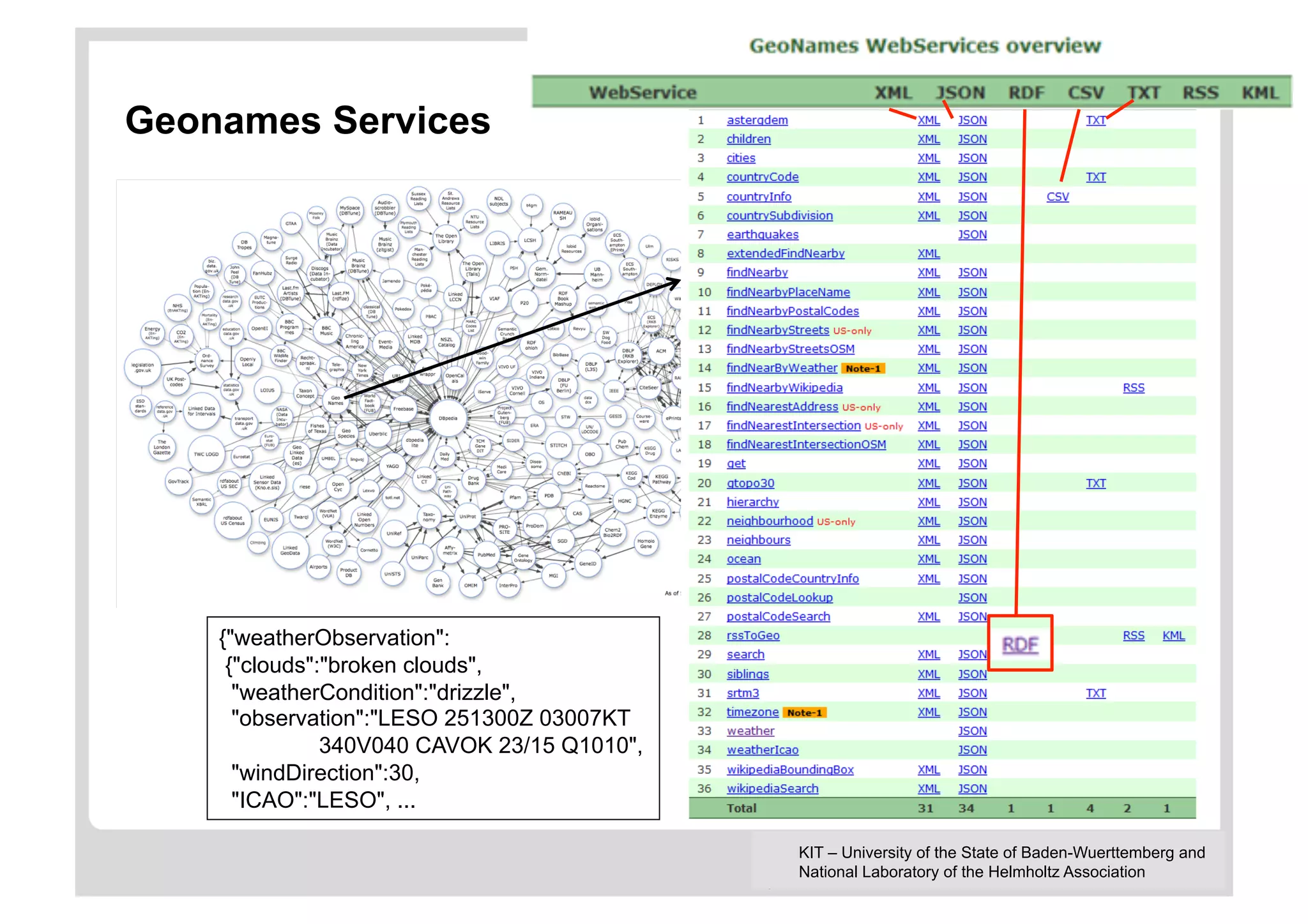
Geonames Services


    {"weatherObservation":
     {"clouds":"broken clouds",
      "weatherCondition":"drizzle",
      "observation":"LESO 251300Z 03007KT
               340V040 CAVOK 23/15 Q1010",
      "windDirection":30,
      "ICAO":"LESO", ...

                                             KIT – University of the State of Baden-Wuerttemberg and
                                             National Laboratory of the Helmholtz Association
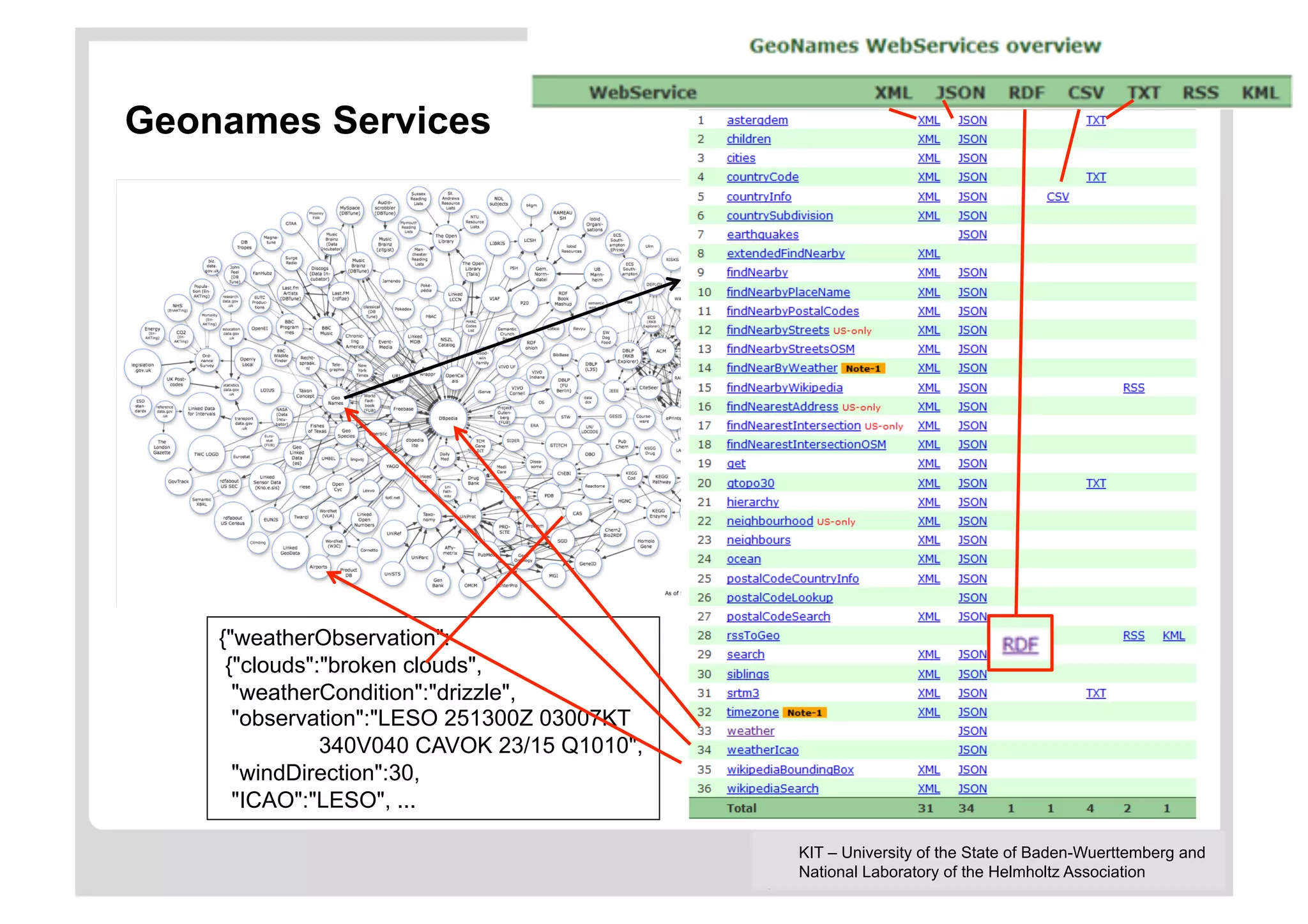
Geonames Services


    {"weatherObservation":
     {"clouds":"broken clouds",
      "weatherCondition":"drizzle",
      "observation":"LESO 251300Z 03007KT
               340V040 CAVOK 23/15 Q1010",
      "windDirection":30,
      "ICAO":"LESO", ...

                                             KIT – University of the State of Baden-Wuerttemberg and
                                             National Laboratory of the Helmholtz Association
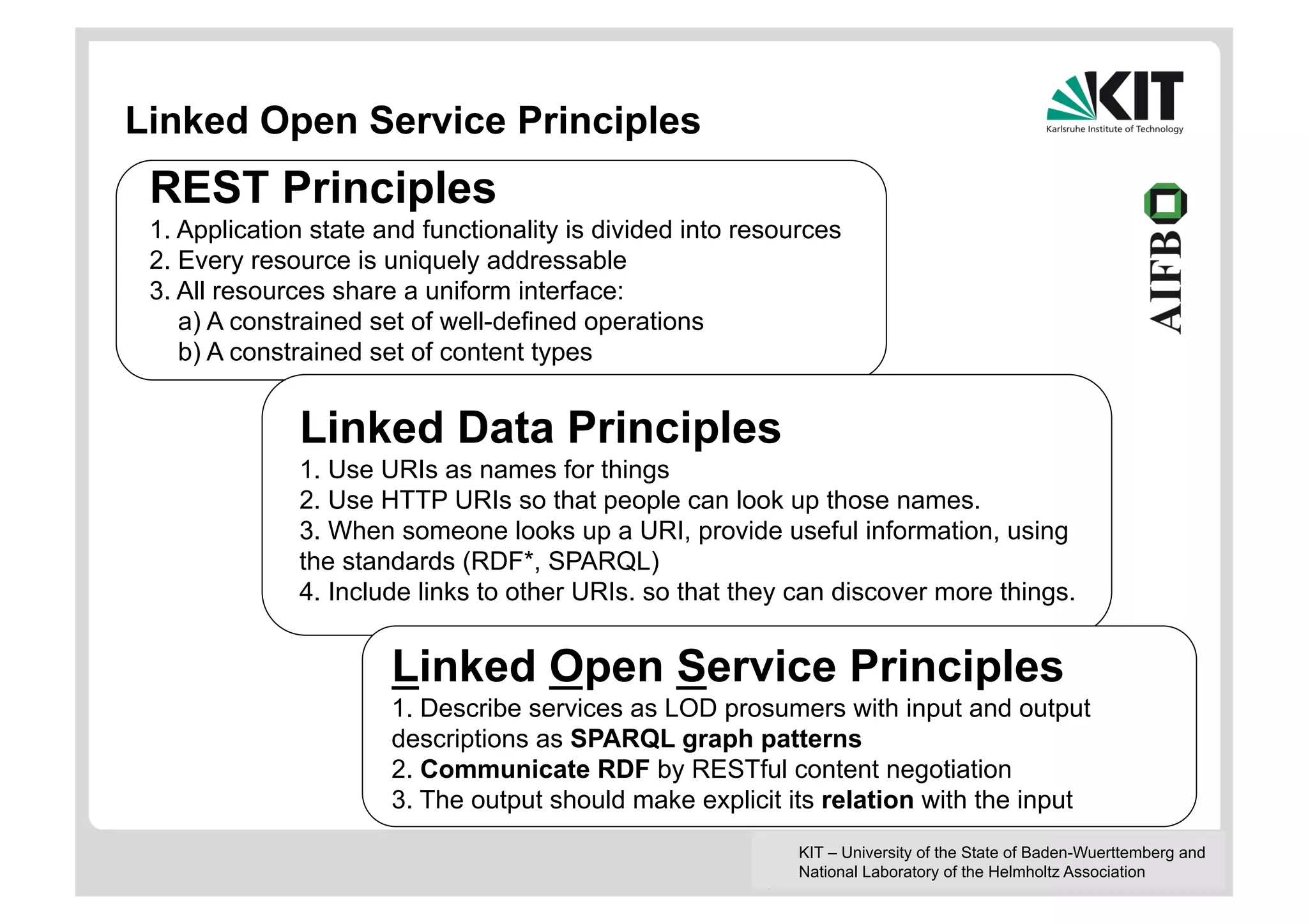
Linked Open Service Principles
 REST Principles
 1. Application state and functionality is divided into resources
 2. Every resource is uniquely addressable
 3. All resources share a uniform interface:
    a) A constrained set of well-defined operations
    b) A constrained set of content types


              Linked Data Principles
              1. Use URIs as names for things
              2. Use HTTP URIs so that people can look up those names.
              3. When someone looks up a URI, provide useful information, using
              the standards (RDF*, SPARQL)
              4. Include links to other URIs. so that they can discover more things.


                       Linked Open Service Principles
                       1. Describe services as LOD prosumers with input and output
                       descriptions as SPARQL graph patterns
                       2. Communicate RDF by RESTful content negotiation
                       3. The output should make explicit its relation with the input
                                                             KIT – University of the State of Baden-Wuerttemberg and
                                                             National Laboratory of the Helmholtz Association
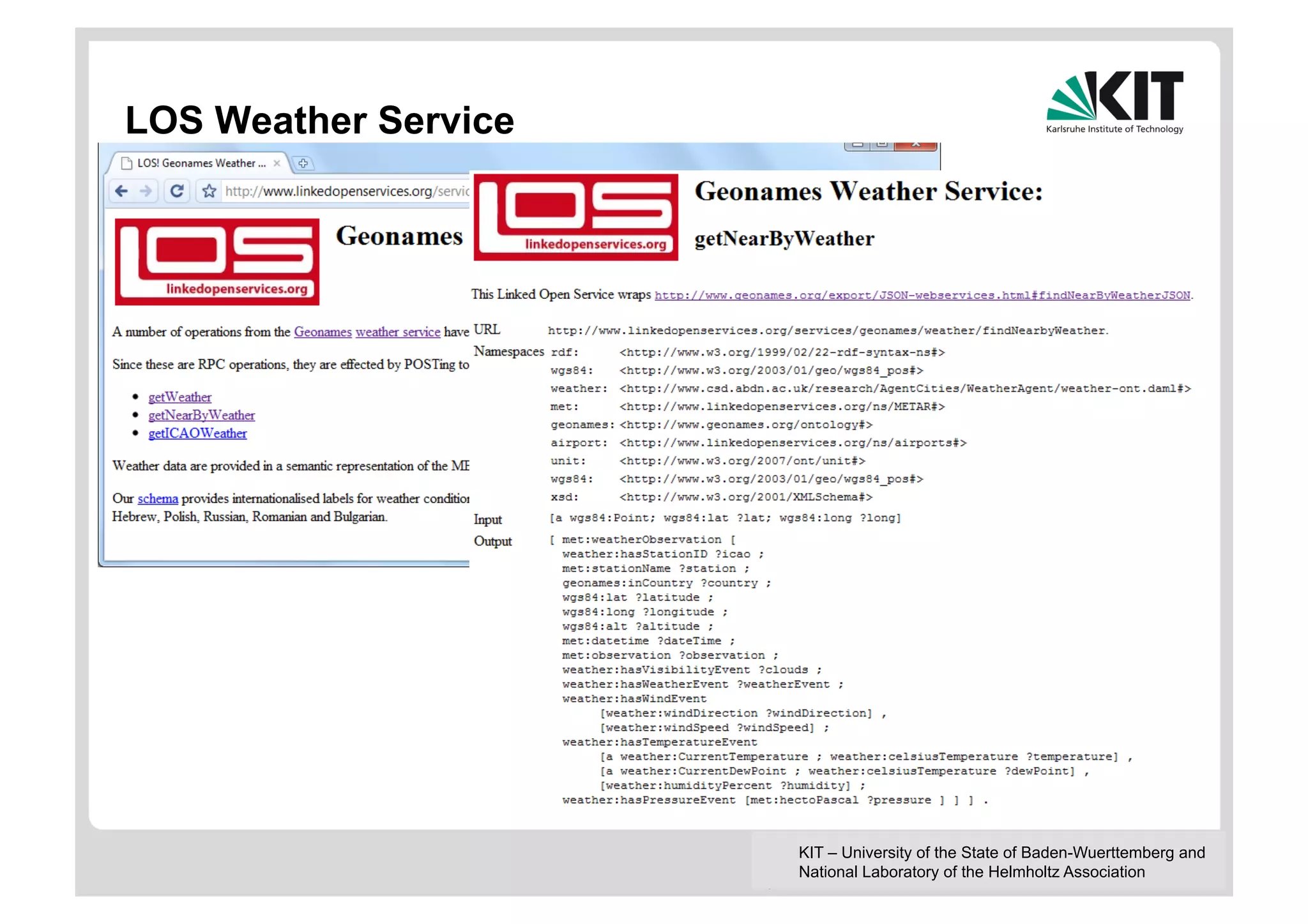
LOS Weather Service


                      KIT – University of the State of Baden-Wuerttemberg and
                      National Laboratory of the Helmholtz Association
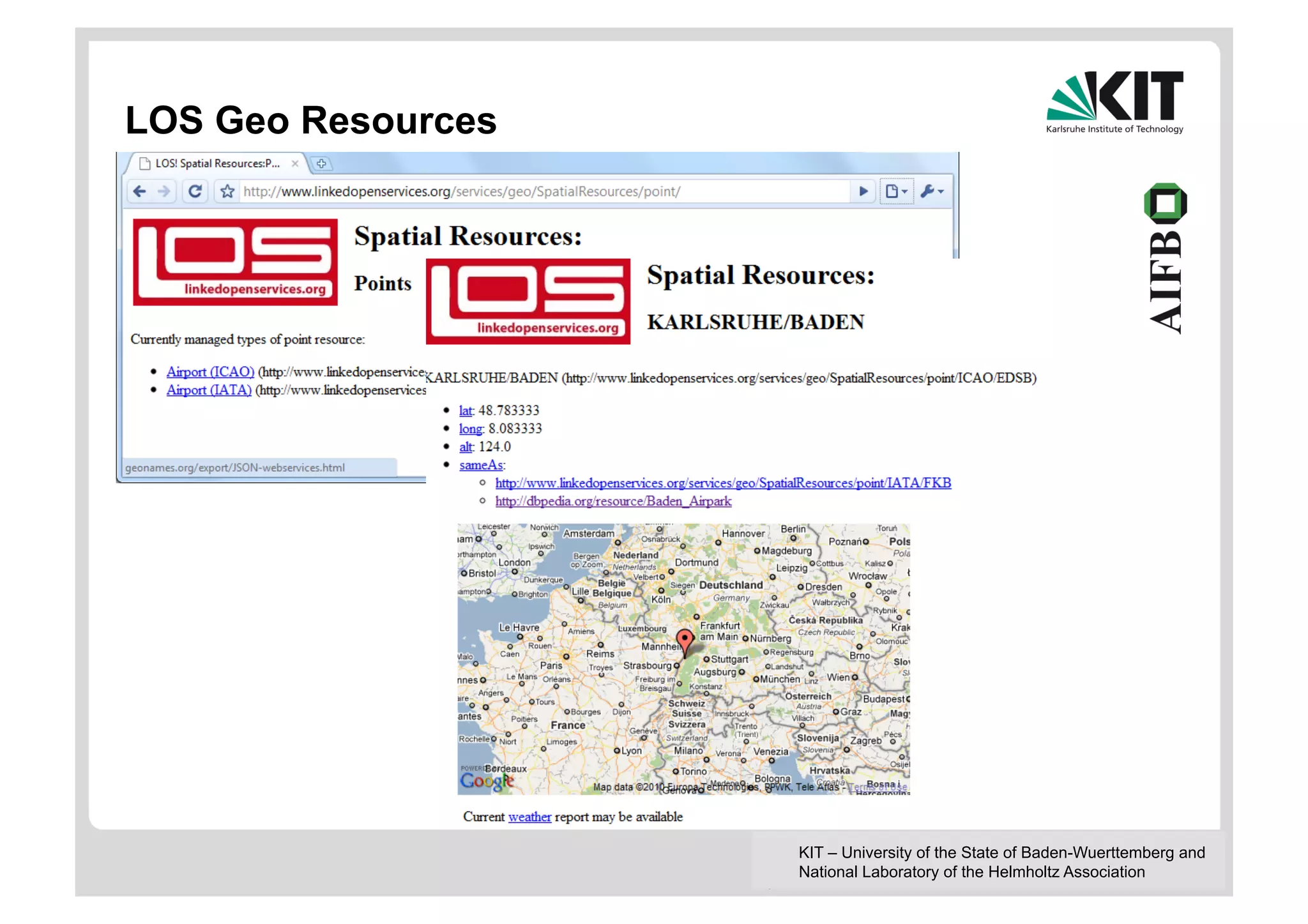
LOS Geo Resources


                    KIT – University of the State of Baden-Wuerttemberg and
                    National Laboratory of the Helmholtz Association
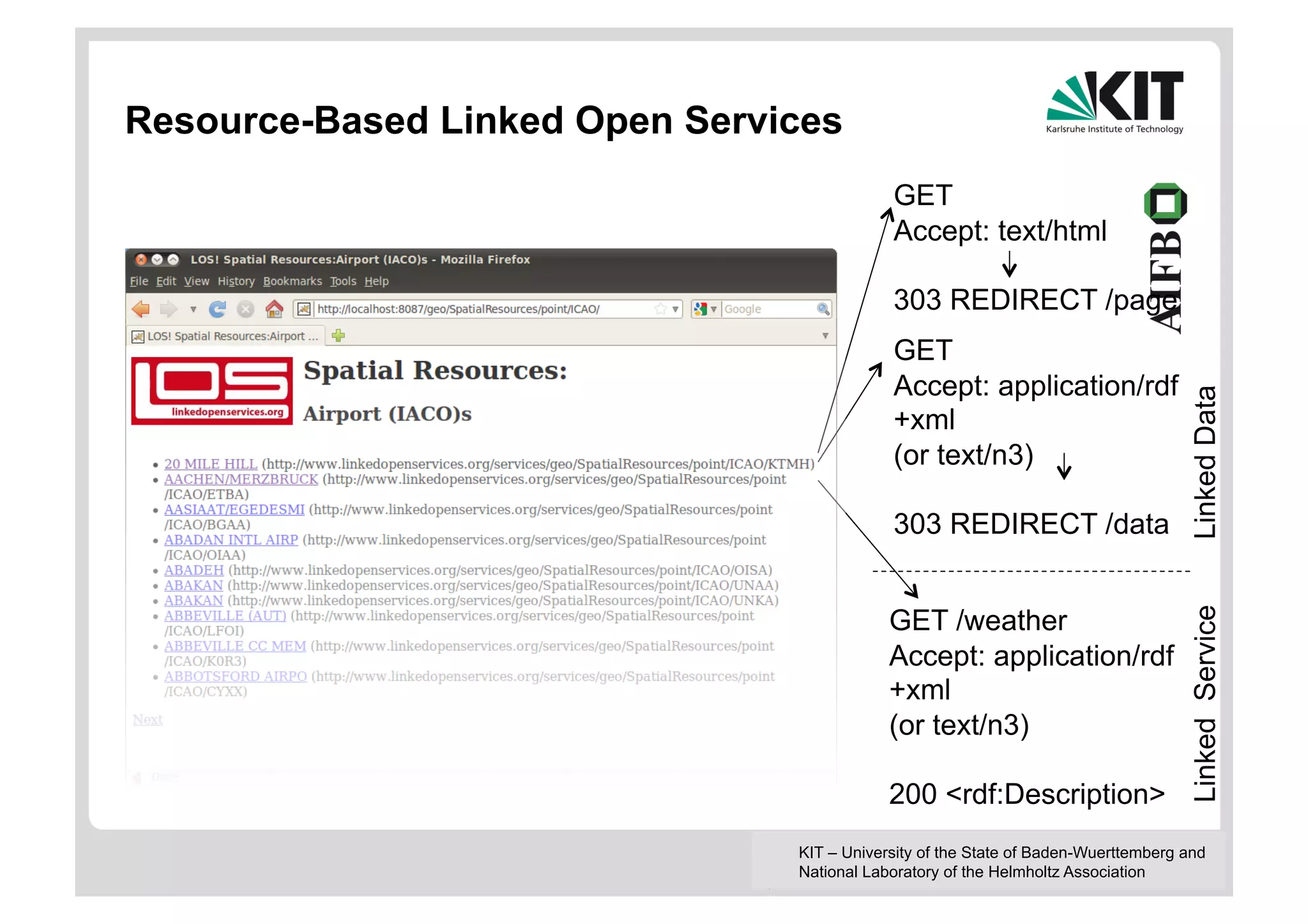
Resource-Based Linked Open Services
                                            GET
                                            Accept: text/html

                                            303 REDIRECT /page
                                            GET
                                            Accept: application/rdf


                                                                                    Linked Data
                                            +xml
                                            (or text/n3)

                                            303 REDIRECT /data


                                            GET /weather


                                                                                    Linked Service
                                            Accept: application/rdf
                                            +xml
                                            (or text/n3)

                                            200 <rdf:Description>
                                KIT – University of the State of Baden-Wuerttemberg and
                                National Laboratory of the Helmholtz Association
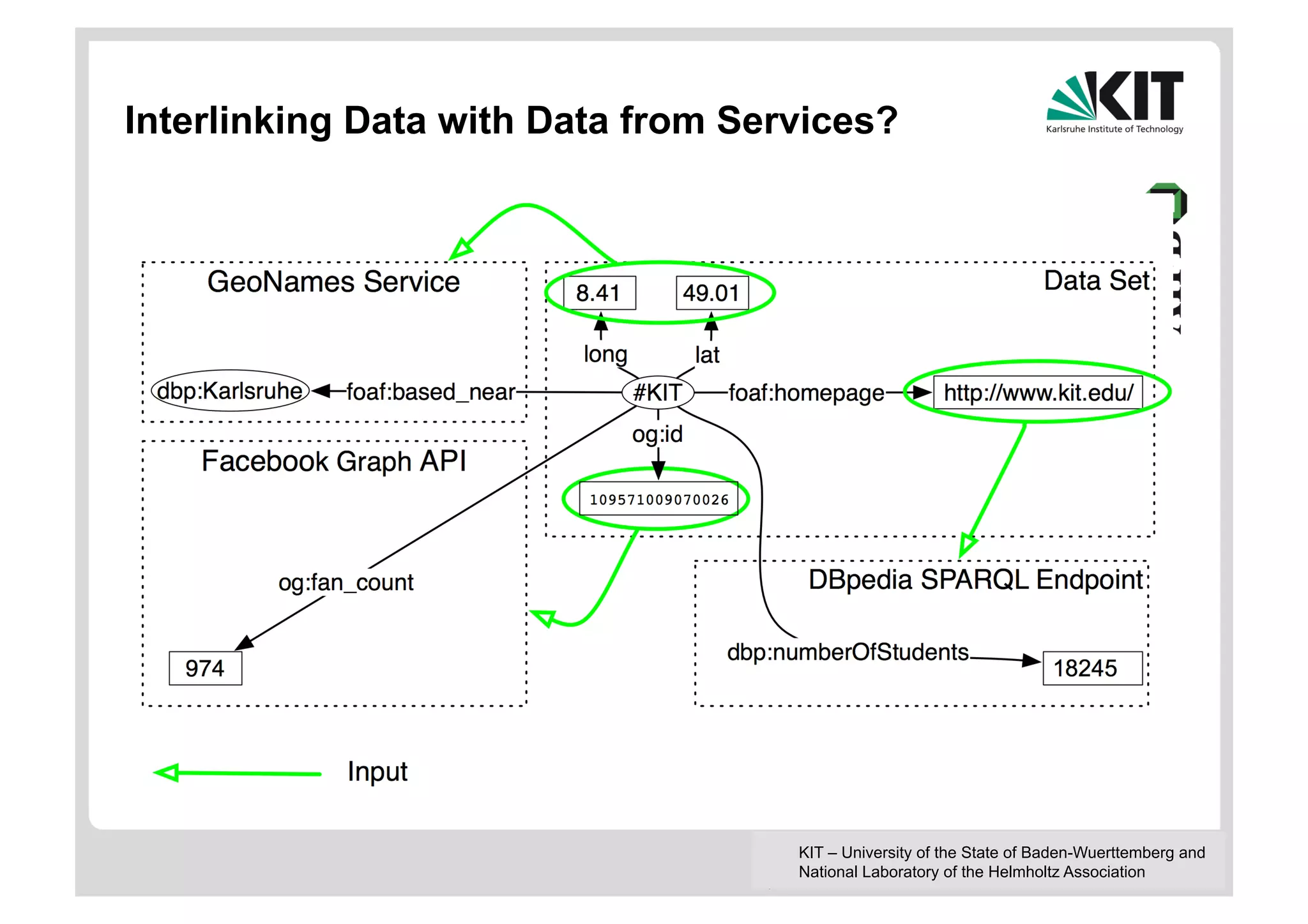
Interlinking Data with Data from Services?


                                    KIT – University of the State of Baden-Wuerttemberg and
                                    National Laboratory of the Helmholtz Association
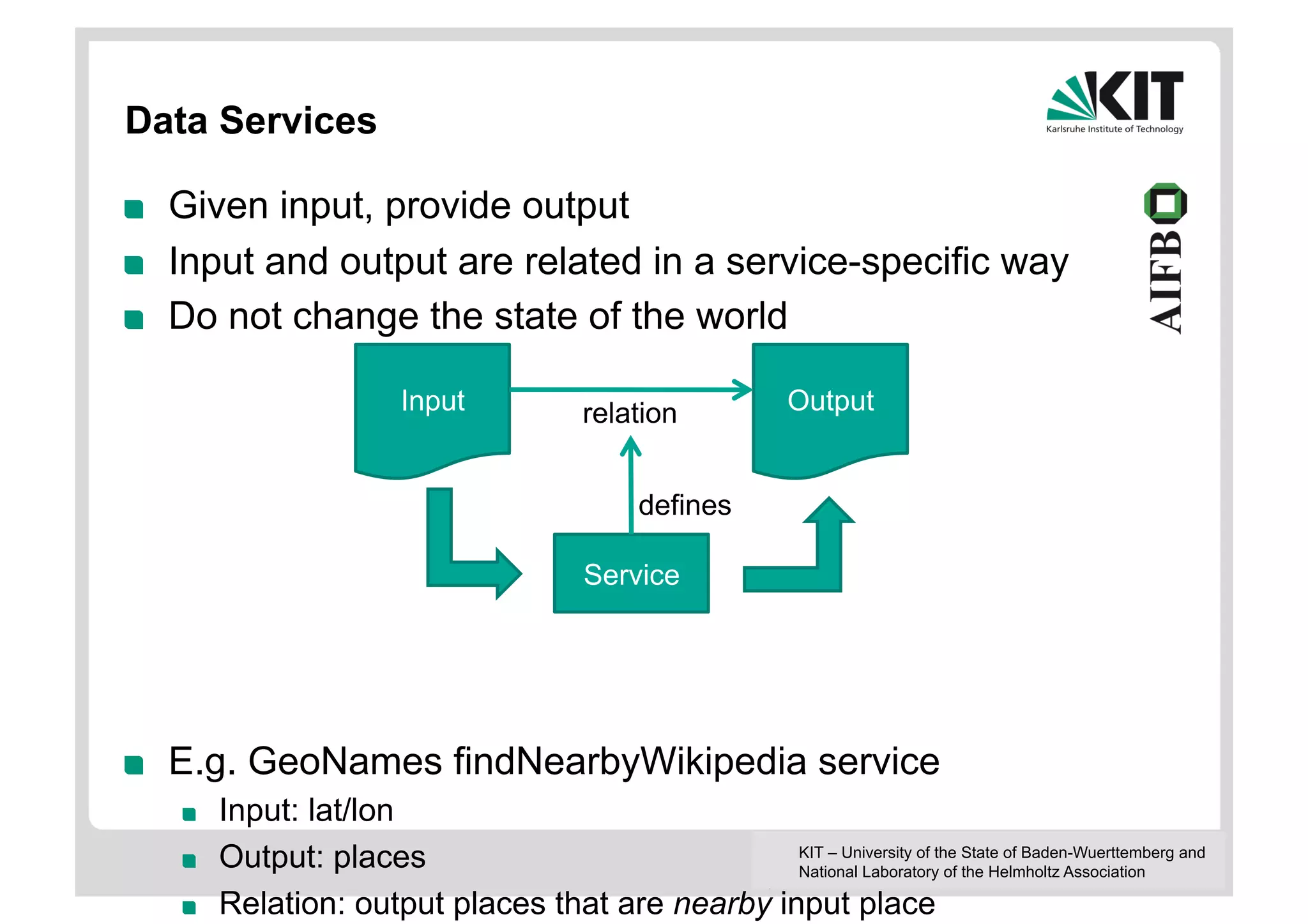
Data Services

!    Given input, provide output
!    Input and output are related in a service-specific way
!    Do not change the state of the world

                           Input             relation            Output


                                                   defines

                                             Service


!    E.g. GeoNames findNearbyWikipedia service
     !    Input: lat/lon
     !    Output: places                            KIT – University of the State of Baden-Wuerttemberg and
                                                    National Laboratory of the Helmholtz Association

     !    Relation: output places that are nearby input place
Linked Data Services

!     We’d like to integrate data services with Linked Data
1.    LIDS need to adhere to Linked Data principles

!     We’d like to use data services in software programs
2.    LIDS need machine-readable descriptions of input and
      output

!     Compared to naïve approach: assign URI to service output

!     Relationship between input and output is explicitly
      described

!     Dynamicity is supported              KIT – University of the State of Baden-Wuerttemberg and
                                           National Laboratory of the Helmholtz Association
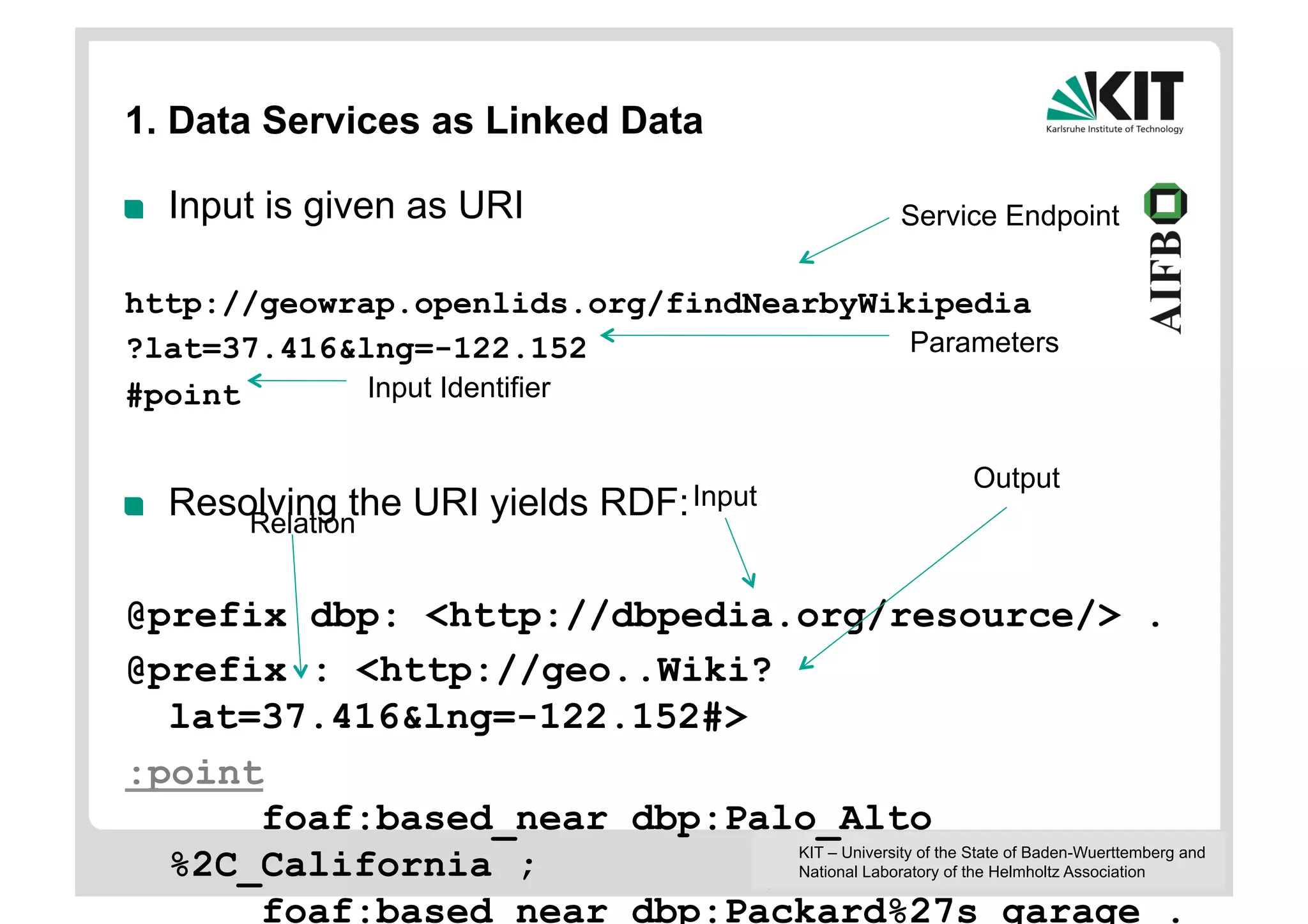
1. Data Services as Linked Data

!    Input is given as URI                                  Service Endpoint


http://geowrap.openlids.org/findNearbyWikipedia
?lat=37.416&lng=-122.152                 Parameters
#point       Input Identifier


                                                                 Output
!    Resolving the URI yields
         Relation
                                    RDF: Input

@prefix dbp: <http://dbpedia.org/resource/> .
@prefix : <http://geo..Wiki?
  lat=37.416&lng=-122.152#>
:point
      foaf:based_near dbp:Palo_Alto
                             KIT – University of the State of Baden-Wuerttemberg and
  %2C_California ;           National Laboratory of the Helmholtz Association

      foaf:based_near dbp:Packard%27s_garage .
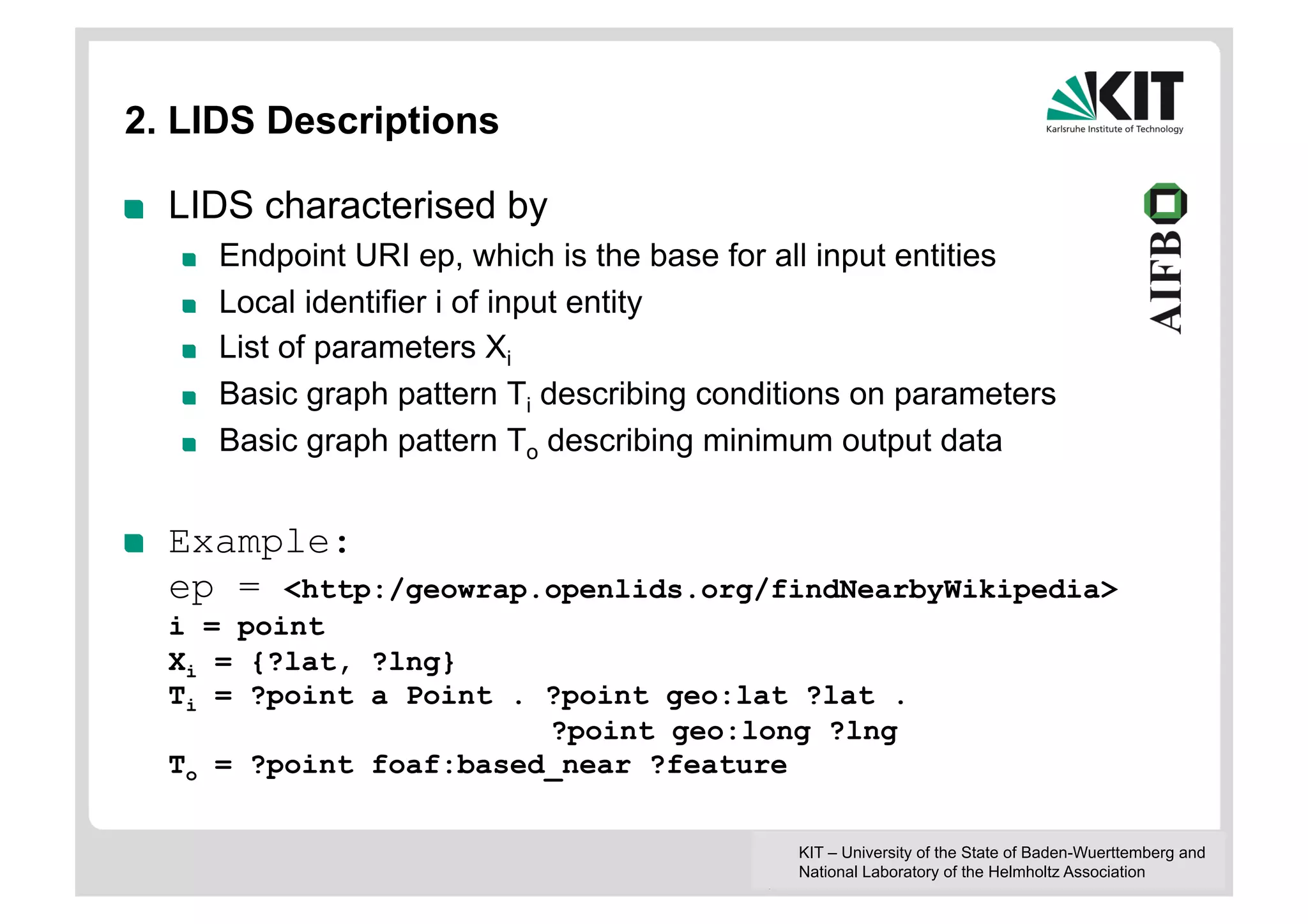
2. LIDS Descriptions

!    LIDS characterised by
     !    Endpoint URI ep, which is the base for all input entities
     !    Local identifier i of input entity
     !    List of parameters Xi
     !    Basic graph pattern Ti describing conditions on parameters
     !    Basic graph pattern To describing minimum output data


!    Example:
     ep = <http:/geowrap.openlids.org/findNearbyWikipedia>
     i = point
     Xi = {?lat, ?lng}
     Ti = ?point a Point . ?point geo:lat ?lat .
                           ?point geo:long ?lng
     To = ?point foaf:based_near ?feature

                                                  KIT – University of the State of Baden-Wuerttemberg and
                                                  National Laboratory of the Helmholtz Association
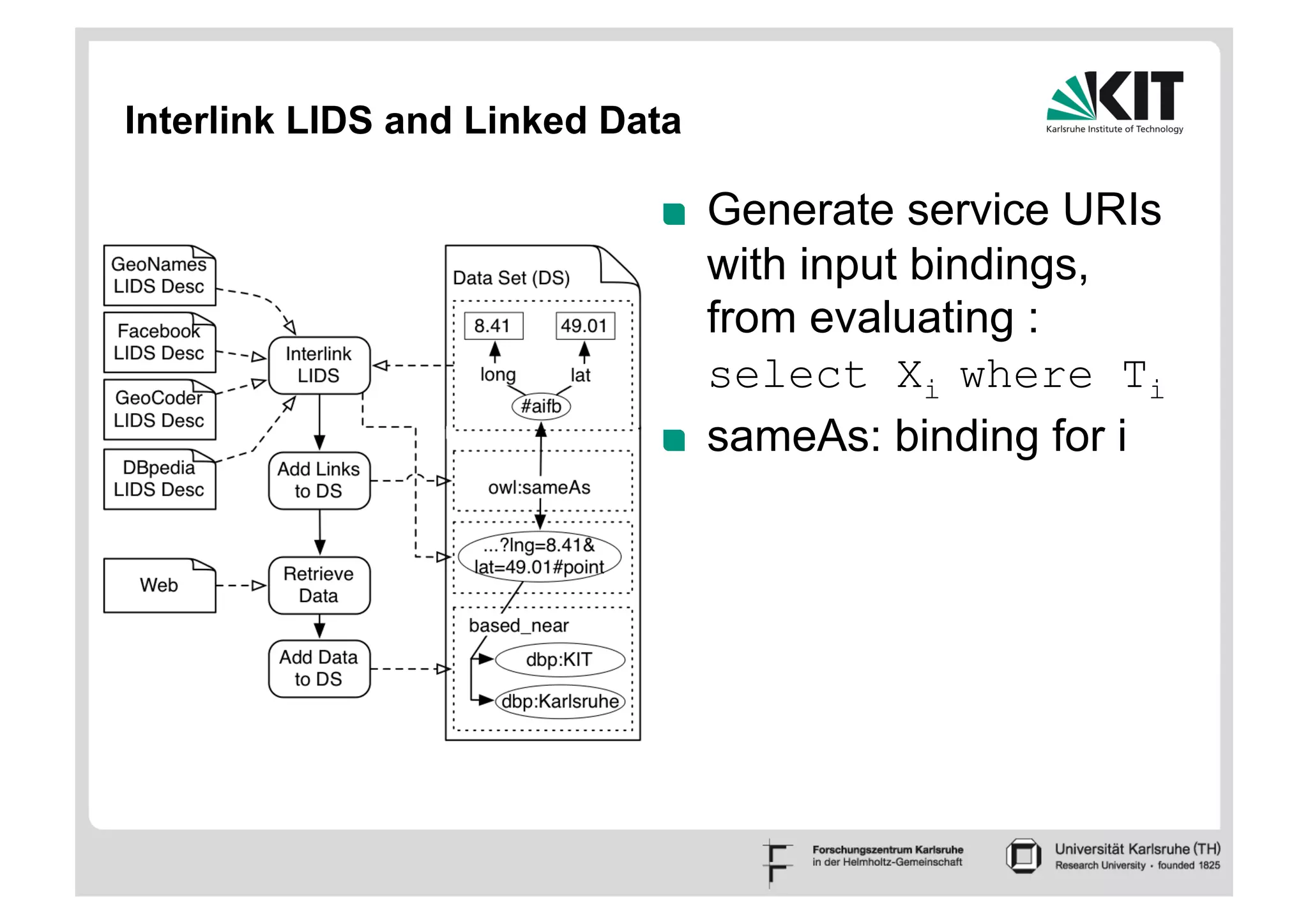
Interlink LIDS and Linked Data

                            !    Generate service URIs
                                 with input bindings,
                                 from evaluating :
                                 select Xi where Ti
                            !    sameAs: binding for i
Scale-Up Experiment: Link BTC to GeoNames

!    3 billion triples from the Billion Triple Challenge (BTC) 2010
     data set:
!    Annotate with LIDS wrapper of GeoNames findNearby
     service
!    Annotation time: < 12 hours on laptop!
!    ~ 12 hours for uncompressing the data set, cleaning
     results, and gather statistics

!    Original BTC data: 74 different domains that linked to
     GeoNames URIs
!    Interlinking process added 891 new now linked to LIDS
     geowrap
!    In total 2,448,160 new links were added
                                           KIT – University of the State of Baden-Wuerttemberg and
                                           National Laboratory of the Helmholtz Association
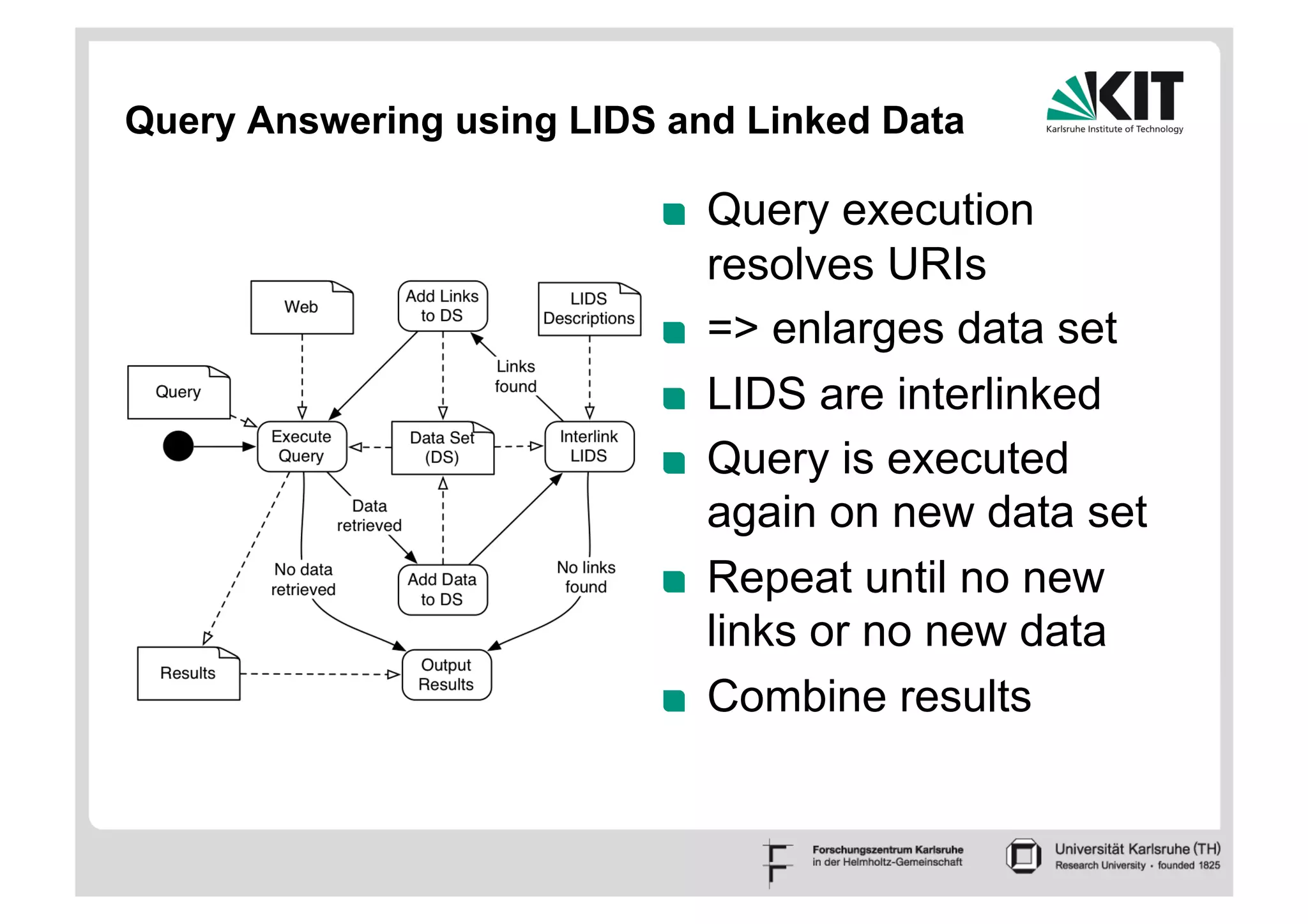
Query Answering using LIDS and Linked Data

                          !    Query execution
                               resolves URIs
                          !    => enlarges data set
                          !    LIDS are interlinked
                          !    Query is executed
                               again on new data set
                          !    Repeat until no new
                               links or no new data
                          !    Combine results
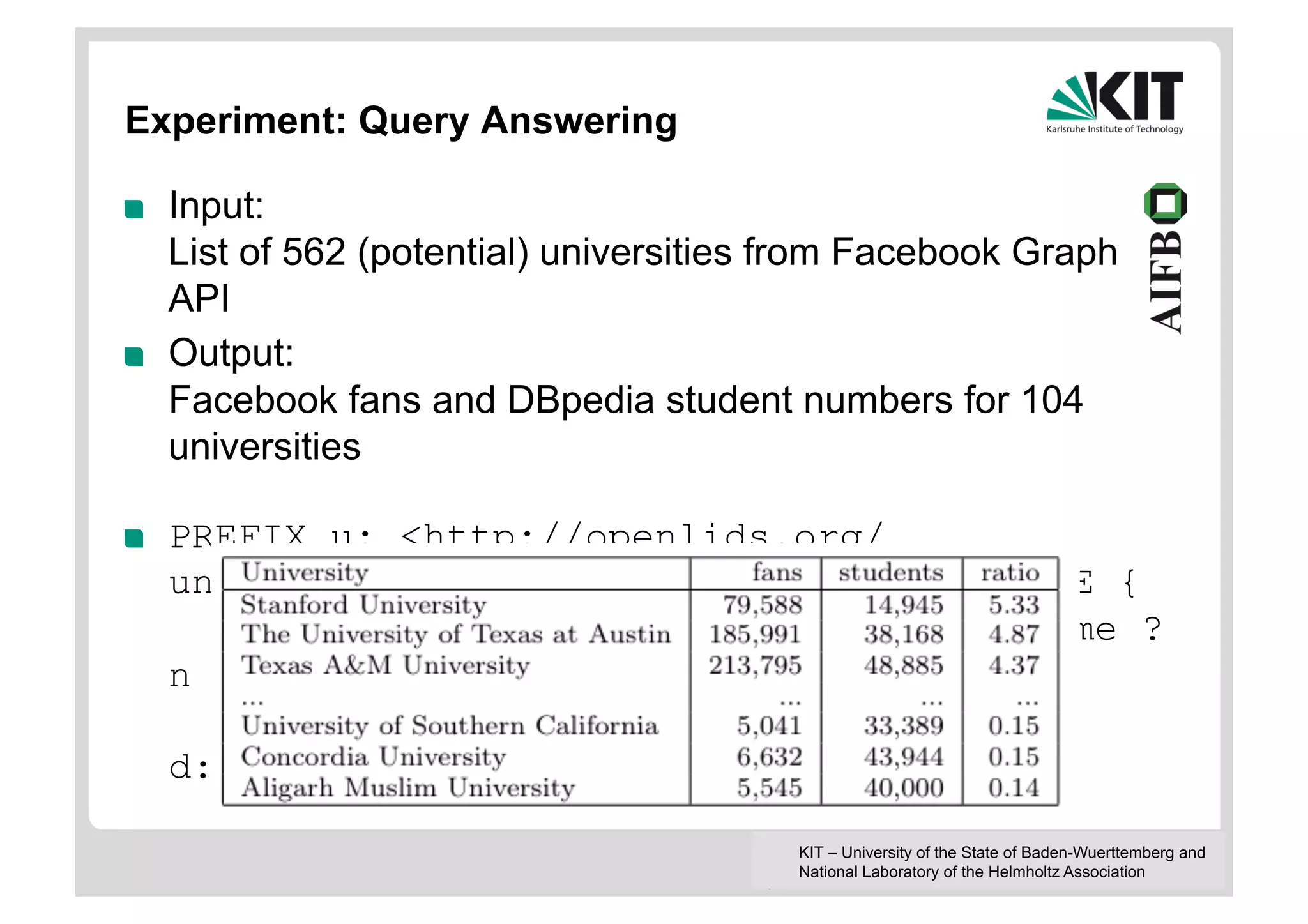
Experiment: Query Answering

!    Input:
     List of 562 (potential) universities from Facebook Graph
     API
!    Output:
     Facebook fans and DBpedia student numbers for 104
     universities

!    PREFIX u: <http://openlids.org/
     universities.rdf#> SELECT ?n ?f ?s WHERE {
           u:list foaf:topic ?u . ?u foaf:name ?
     n .
           ?u og:fan_count ?f .?u
     d:numberOfStudents ?s }

                                          KIT – University of the State of Baden-Wuerttemberg and
                                          National Laboratory of the Helmholtz Association
Linked Services and PlanetData

!    Several areas seem likely to produce services:
     !    Stream, inc. Sensor, resources (latest values)
     !    Any others exposing dynamic resources
     !    Dynamic computations, inc. on-the-fly quality
          assessments
!    Other areas seem likely to consider service
     technologies and move towards more service-like
     HTTP interactions
     !    Access control (OpenID, OAuth, etc.)
!    Finally, remaining areas could serve to complement
     LIDS/LOS alignment
     !    Provenance
                                            KIT – University of the State of Baden-Wuerttemberg and
                                            National Laboratory of the Helmholtz Association

Linked Data and Sevices

  • 1.
    Linked Data andServices Andreas Harth and Barry Norton Institute AIFB KIT – University of the State of Baden-Wuerttemberg and National Laboratory of the Helmholtz Association www.kit.edu
  • 2.
    Outline !  Motivation !  Linked Data Principles !  Query Processing over Linked Data !  Linked Data Services (LIDS) and Linked Open Services (LOS) !  Conclusion KIT – University of the State of Baden-Wuerttemberg and National Laboratory of the Helmholtz Association
  • 3.
    Motivation !  Semantic Web/Linked Data technologies are well-suited for data integration ? ! Common Data Data Interactive Data Format/Access Integration Exploration Protocol 8/10/11 Taking the LIDS off Data Silos KIT – University of the State of Baden-Wuerttemberg and Andreas Harth National Laboratory of the Helmholtz Association
  • 4.
    Linked Data Principles* 1.  Use URIs to name things; not only documents, but also people, locations, concepts, etc. 2.  To enable agents (human users and machine agents alike) to look up those names, use HTTP URIs 3.  When someone looks up a URI we provide useful information; with 'useful' in the strict sense we usually mean structured data in RDF. 4.  Include links to other URIs allowing agents (machines and humans) to discover more things (*) http://www.w3.org/DesignIssues/LinkedData.html KIT – University of the State of Baden-Wuerttemberg and National Laboratory of the Helmholtz Association
  • 5.
    Correspondence between thing-URIand source-URI User Agent http://www.polleres.net/foaf.rdf#me HTTP RDF GET Web Server http://www.polleres.net/foaf.rdf 5 KIT – University of the State of Baden-Wuerttemberg and National Laboratory of the Helmholtz Association
  • 6.
    Correspondence between thing-URIand source-URI User Agent http://dbpedia.org/resource/Gordon_Brown HTTP 303 HTTP RDF GET GET http://dbpedia.org/data/Gordon_Brown Web Server http://dbpedia.org/page/Gordon_Brown 6 KIT – University of the State of Baden-Wuerttemberg and National Laboratory of the Helmholtz Association
  • 7.
    KIT – Universityof the State of Baden-Wuerttemberg and National Laboratory of the Helmholtz Association
  • 8.
    Queries over LinkedData SELECT ?f ?n WHERE { an:f#ah foaf:knows ?f. ?f foaf:name ?n. } SELECT ?x1 ?x2 WHERE { dblppub:HoganHP08 dc:creator ?a1. ?x1 owl:sameAs ?a1. ?x2 foaf:knows ?x1. } ?f ?n KIT – University of the State of Baden-Wuerttemberg and National Laboratory of the Helmholtz Association
  • 9.
    Querying Data AcrossSources !  Data warehousing or materialisation-based approaches (MAT) CRAWL INDEX SERVE !  Distributed query processing approaches (DQP) SELECT * R S FROM… R S 9 15.03.2010 Andreas Harth KIT – University of the State of Baden-Wuerttemberg and Data Summaries for On-Demand Queries over Linked Data National Laboratory of the Helmholtz Association
  • 10.
    DQP on LinkedData SELECT * R S FROM… R S ODBC ODBC SELECT ?s TP TP WHERE… HTTP HTTP TP TP GET GET 10 15.03.2010 Andreas Harth KIT – University of the State of Baden-Wuerttemberg and Data Summaries for On-Demand Queries over Linked Data National Laboratory of the Helmholtz Association
  • 11.
    Query Processing Overview SELECT ?f ?n WHERE { an:f#ah foaf:knows ?f. ?f foaf:name ?n. } TP TP (an:f#ah foaf:knows ?f) (?f foaf:name ?n) Select source HTTP RDF Select source HTTP RDF (s) GET GET (s) ?f ?n http://danbri.org/foaf.rdf#danbri Dan Brickley 11 15.03.2010 Andreas Harth KIT – University of the State of Baden-Wuerttemberg and Data Summaries for On-Demand Queries over Linked Data National Laboratory of the Helmholtz Association
  • 12.
    Barry KIT – University of the State of Baden-Wuerttemberg and National Laboratory of the Helmholtz Association
  • 13.
    Problem: Source Selectionfor Triple Patterns !  (?s ?p ?o) !  (#s ?p ?o) !  (?s #p ?o) !  (?s ?p #o) !  (#s #p ?o) !  (#s ?p #o) !  (?s #p #o) !  (#s #p #o) !  Given a triple pattern, which source can contribute bindings for the triple pattern? 13 15.03.2010 Andreas Harth KIT – University of the State of Baden-Wuerttemberg and Data Summaries for On-Demand Queries over Linked Data National Laboratory of the Helmholtz Association
  • 14.
    Schema-Level Indices [Stuckenschmidtet al. 2004] !  Keep index of properties and/or classes contained in sources !  (?s #p ?o), (?s rdf:type #o) !  Covers only queries containing schema-level elements !  Commonly used properties select potentially too many sources SELECT ?x1 ?x2 WHERE { SELECT ?f ?n WHERE { dblppub:HoganHP08 dc:creator ?a1. an:f#ah foaf:knows ?f. ?x1 owl:sameAs ?a1. ?f foaf:name ?n. ?x2 foaf:knows ?x1. } } 14 15.03.2010 Andreas Harth KIT – University of the State of Baden-Wuerttemberg and Data Summaries for On-Demand Queries over Linked Data National Laboratory of the Helmholtz Association
  • 15.
    Direct Lookup (DL)[Hartig et al. 2009] !  Exploits correspondence between thing-URI and source-URI !  Linked Data sources (aka RDF files) return typically triples with a subject corresponding to the source !  Sometimes the sources return triples with object corresponding to the source !  (#s ?p ?o), (#s #p ?o), (#s #p #o) !  (?s ?p #o), (?s #p #o) !  Incomplete wrt. patterns but also wrt. to URI reuse across sources !  Limited parallelism, unclear how to schedule lookups SELECT ?x1 ?x2 WHERE { SELECT ?f ?n WHERE { dblppub:HoganHP08 dc:creator ?a1. an:f#ah foaf:knows ?f. ?x1 owl:sameAs ?a1. ?f foaf:name ?n. ?x2 foaf:knows ?x1. } } 15 15.03.2010 Andreas Harth KIT – University of the State of Baden-Wuerttemberg and Data Summaries for On-Demand Queries over Linked Data National Laboratory of the Helmholtz Association
  • 16.
    Approximate Data Summaries !  Combined description of schema-level and instance-level !  Use approximation to reduce index size (incurs false positives) !  Possible to use entire query for source selection !  Parallel lookups since sources can be determined for the entire query !  (?s ?p ?o), (#s ?p ?o), (?s #p ?o), (?s ?p #o), (#s #p ? o), (#s ?p #o), (?s #p #o), (#s #p #o) !  and combinations of triple patterns SELECT ?x1 ?x2 WHERE { SELECT ?f ?n WHERE { dblppub:HoganHP08 dc:creator ?a1. an:f#ah foaf:knows ?f. ?x1 owl:sameAs ?a1. ?f foaf:name ?n. ?x2 foaf:knows ?x1. } } 16 15.03.2010 Andreas Harth KIT – University of the State of Baden-Wuerttemberg and Data Summaries for On-Demand Queries over Linked Data National Laboratory of the Helmholtz Association
  • 17.
    Implementation !  Deploy wrappers „in the cloud“ !  Google App Engine: hosting of Java and Python webapps on Google’s Cloud infrastructure !  Limited amount of processing time (6hrs/day) !  Single-threaded applications !  Suited for deploying wrappers !  e.g. http://twitter2foaf.appspot.com/ converts Twitter user data to RDF KIT – University of the State of Baden-Wuerttemberg and National Laboratory of the Helmholtz Association
  • 18.
    Linking Open DataCloud 2007 KIT – University of the State of Baden-Wuerttemberg and National Laboratory of the Helmholtz Association
  • 19.
    Linking Open DataCloud 2008 KIT – University of the State of Baden-Wuerttemberg and National Laboratory of the Helmholtz Association
  • 20.
    Linking Open DataCloud 2009 KIT – University of the State of Baden-Wuerttemberg and National Laboratory of the Helmholtz Association
  • 21.
    Linking Open DataCloud 2010 KIT – University of the State of Baden-Wuerttemberg and National Laboratory of the Helmholtz Association
  • 22.
    Geonames Services KIT – University of the State of Baden-Wuerttemberg and National Laboratory of the Helmholtz Association
  • 23.
    Geonames Services KIT – University of the State of Baden-Wuerttemberg and National Laboratory of the Helmholtz Association
  • 24.
    Geonames Services {"weatherObservation": {"clouds":"broken clouds", "weatherCondition":"drizzle", "observation":"LESO 251300Z 03007KT 340V040 CAVOK 23/15 Q1010", "windDirection":30, "ICAO":"LESO", ... KIT – University of the State of Baden-Wuerttemberg and National Laboratory of the Helmholtz Association
  • 25.
    Geonames Services {"weatherObservation": {"clouds":"broken clouds", "weatherCondition":"drizzle", "observation":"LESO 251300Z 03007KT 340V040 CAVOK 23/15 Q1010", "windDirection":30, "ICAO":"LESO", ... KIT – University of the State of Baden-Wuerttemberg and National Laboratory of the Helmholtz Association
  • 26.
    Linked Open ServicePrinciples REST Principles 1. Application state and functionality is divided into resources 2. Every resource is uniquely addressable 3. All resources share a uniform interface: a) A constrained set of well-defined operations b) A constrained set of content types Linked Data Principles 1. Use URIs as names for things 2. Use HTTP URIs so that people can look up those names. 3. When someone looks up a URI, provide useful information, using the standards (RDF*, SPARQL) 4. Include links to other URIs. so that they can discover more things. Linked Open Service Principles 1. Describe services as LOD prosumers with input and output descriptions as SPARQL graph patterns 2. Communicate RDF by RESTful content negotiation 3. The output should make explicit its relation with the input KIT – University of the State of Baden-Wuerttemberg and National Laboratory of the Helmholtz Association
  • 27.
    LOS Weather Service KIT – University of the State of Baden-Wuerttemberg and National Laboratory of the Helmholtz Association
  • 28.
    LOS Geo Resources KIT – University of the State of Baden-Wuerttemberg and National Laboratory of the Helmholtz Association
  • 29.
    Resource-Based Linked OpenServices GET Accept: text/html 303 REDIRECT /page GET Accept: application/rdf Linked Data +xml (or text/n3) 303 REDIRECT /data GET /weather Linked Service Accept: application/rdf +xml (or text/n3) 200 <rdf:Description> KIT – University of the State of Baden-Wuerttemberg and National Laboratory of the Helmholtz Association
  • 30.
    Interlinking Data withData from Services? KIT – University of the State of Baden-Wuerttemberg and National Laboratory of the Helmholtz Association
  • 31.
    Data Services !  Given input, provide output !  Input and output are related in a service-specific way !  Do not change the state of the world Input relation Output defines Service !  E.g. GeoNames findNearbyWikipedia service !  Input: lat/lon !  Output: places KIT – University of the State of Baden-Wuerttemberg and National Laboratory of the Helmholtz Association !  Relation: output places that are nearby input place
  • 32.
    Linked Data Services !  We’d like to integrate data services with Linked Data 1.  LIDS need to adhere to Linked Data principles !  We’d like to use data services in software programs 2.  LIDS need machine-readable descriptions of input and output !  Compared to naïve approach: assign URI to service output !  Relationship between input and output is explicitly described !  Dynamicity is supported KIT – University of the State of Baden-Wuerttemberg and National Laboratory of the Helmholtz Association
  • 33.
    1. Data Servicesas Linked Data !  Input is given as URI Service Endpoint http://geowrap.openlids.org/findNearbyWikipedia ?lat=37.416&lng=-122.152 Parameters #point Input Identifier Output !  Resolving the URI yields Relation RDF: Input @prefix dbp: <http://dbpedia.org/resource/> . @prefix : <http://geo..Wiki? lat=37.416&lng=-122.152#> :point foaf:based_near dbp:Palo_Alto KIT – University of the State of Baden-Wuerttemberg and %2C_California ; National Laboratory of the Helmholtz Association foaf:based_near dbp:Packard%27s_garage .
  • 34.
    2. LIDS Descriptions !  LIDS characterised by !  Endpoint URI ep, which is the base for all input entities !  Local identifier i of input entity !  List of parameters Xi !  Basic graph pattern Ti describing conditions on parameters !  Basic graph pattern To describing minimum output data !  Example: ep = <http:/geowrap.openlids.org/findNearbyWikipedia> i = point Xi = {?lat, ?lng} Ti = ?point a Point . ?point geo:lat ?lat . ?point geo:long ?lng To = ?point foaf:based_near ?feature KIT – University of the State of Baden-Wuerttemberg and National Laboratory of the Helmholtz Association
  • 35.
    Interlink LIDS andLinked Data !  Generate service URIs with input bindings, from evaluating : select Xi where Ti !  sameAs: binding for i
  • 36.
    Scale-Up Experiment: LinkBTC to GeoNames !  3 billion triples from the Billion Triple Challenge (BTC) 2010 data set: !  Annotate with LIDS wrapper of GeoNames findNearby service !  Annotation time: < 12 hours on laptop! !  ~ 12 hours for uncompressing the data set, cleaning results, and gather statistics !  Original BTC data: 74 different domains that linked to GeoNames URIs !  Interlinking process added 891 new now linked to LIDS geowrap !  In total 2,448,160 new links were added KIT – University of the State of Baden-Wuerttemberg and National Laboratory of the Helmholtz Association
  • 37.
    Query Answering usingLIDS and Linked Data !  Query execution resolves URIs !  => enlarges data set !  LIDS are interlinked !  Query is executed again on new data set !  Repeat until no new links or no new data !  Combine results
  • 38.
    Experiment: Query Answering !  Input: List of 562 (potential) universities from Facebook Graph API !  Output: Facebook fans and DBpedia student numbers for 104 universities !  PREFIX u: <http://openlids.org/ universities.rdf#> SELECT ?n ?f ?s WHERE { u:list foaf:topic ?u . ?u foaf:name ? n . ?u og:fan_count ?f .?u d:numberOfStudents ?s } KIT – University of the State of Baden-Wuerttemberg and National Laboratory of the Helmholtz Association
  • 39.
    Linked Services andPlanetData !  Several areas seem likely to produce services: !  Stream, inc. Sensor, resources (latest values) !  Any others exposing dynamic resources !  Dynamic computations, inc. on-the-fly quality assessments !  Other areas seem likely to consider service technologies and move towards more service-like HTTP interactions !  Access control (OpenID, OAuth, etc.) !  Finally, remaining areas could serve to complement LIDS/LOS alignment !  Provenance KIT – University of the State of Baden-Wuerttemberg and National Laboratory of the Helmholtz Association