Dr.Sangeetha Vimalraj, SRMIST, Vadapalani
MULTIPLE LINEAR REGRESSION
Outline
Dr.Sangeetha Vimalraj, SRMIST, Vadapalani
⚫ Machine learning algorithms
⚫ Applications of linear regression
⚫ Understanding linear regression
⚫ Multiple linear regression
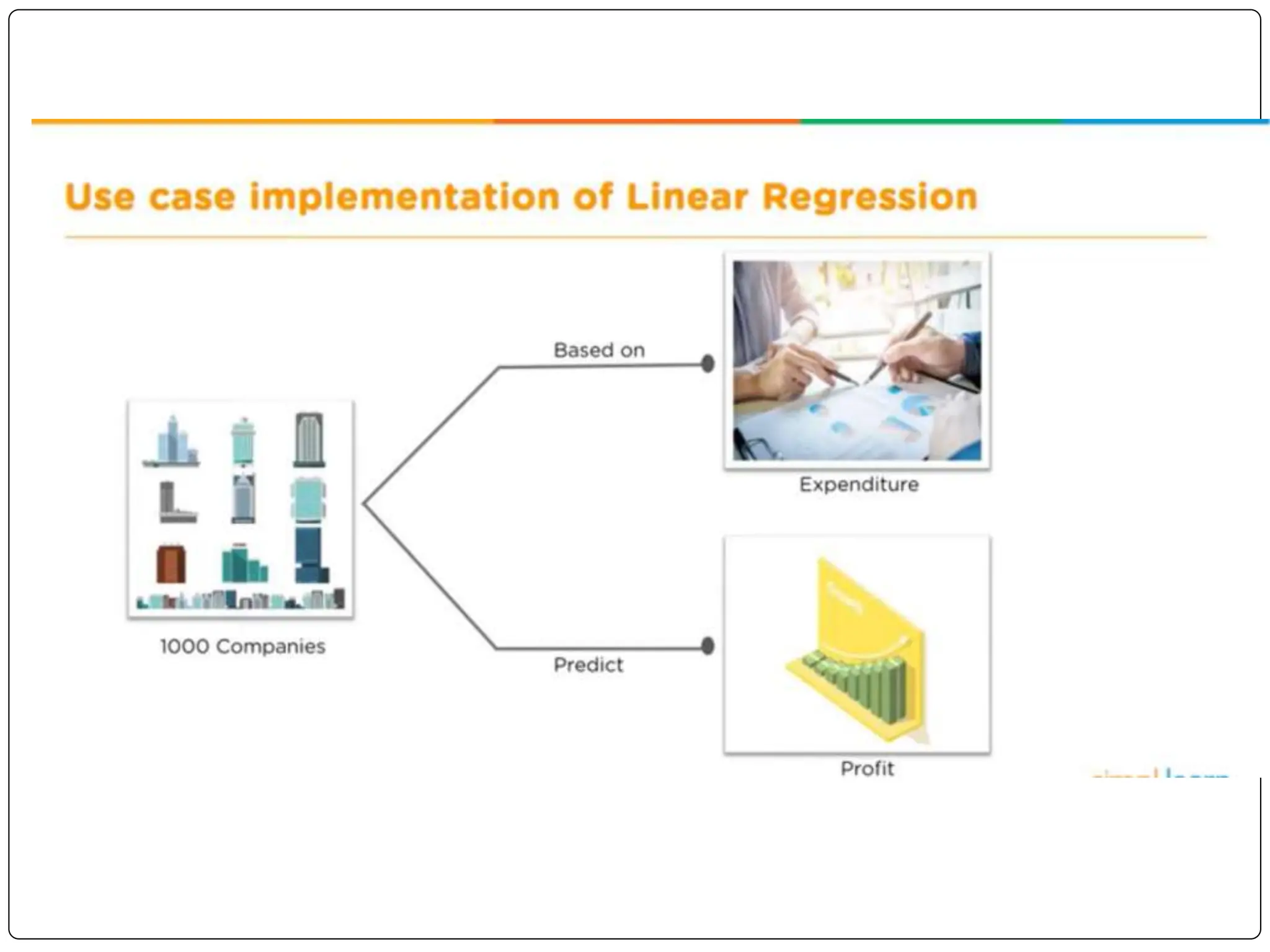
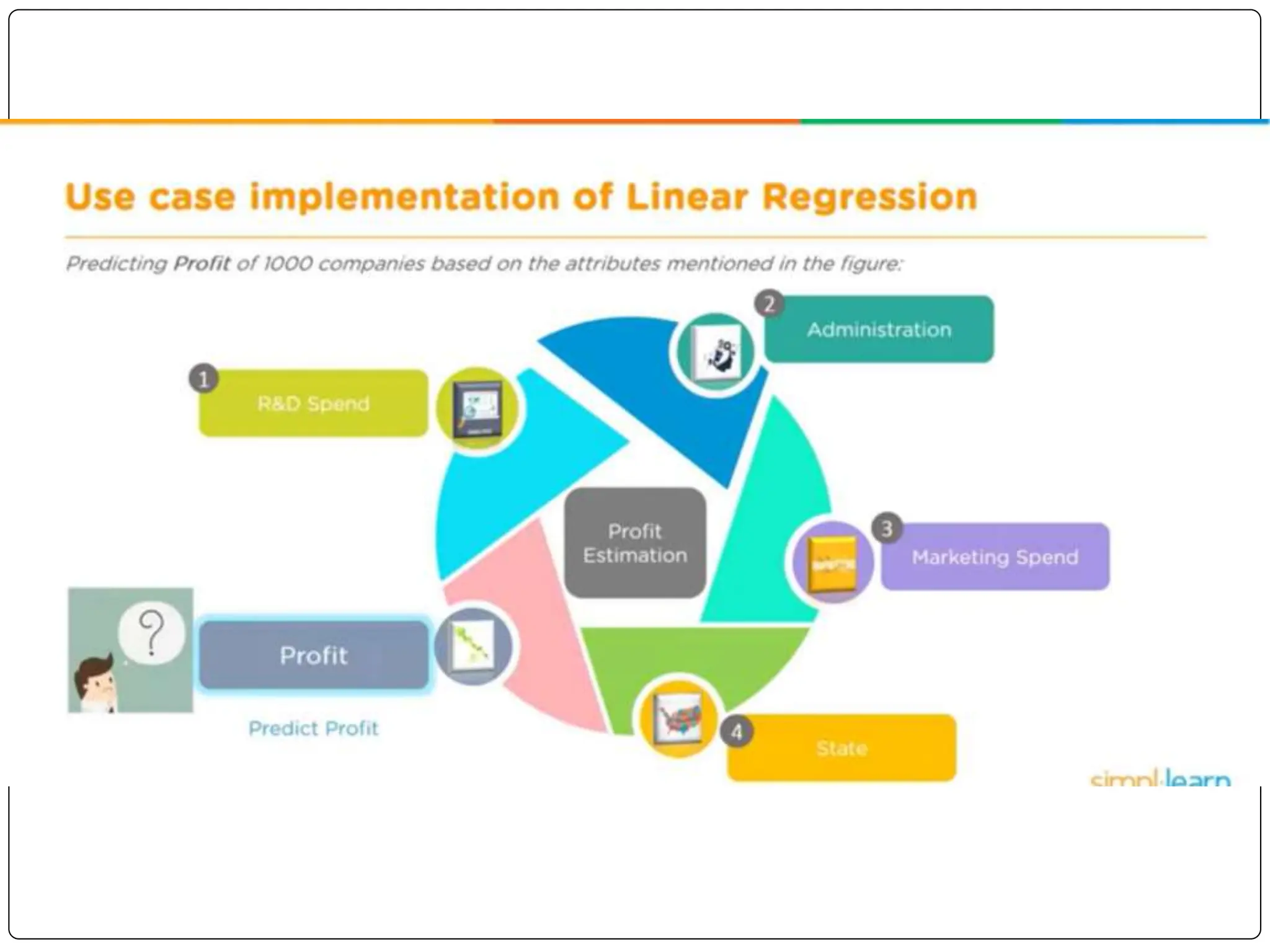
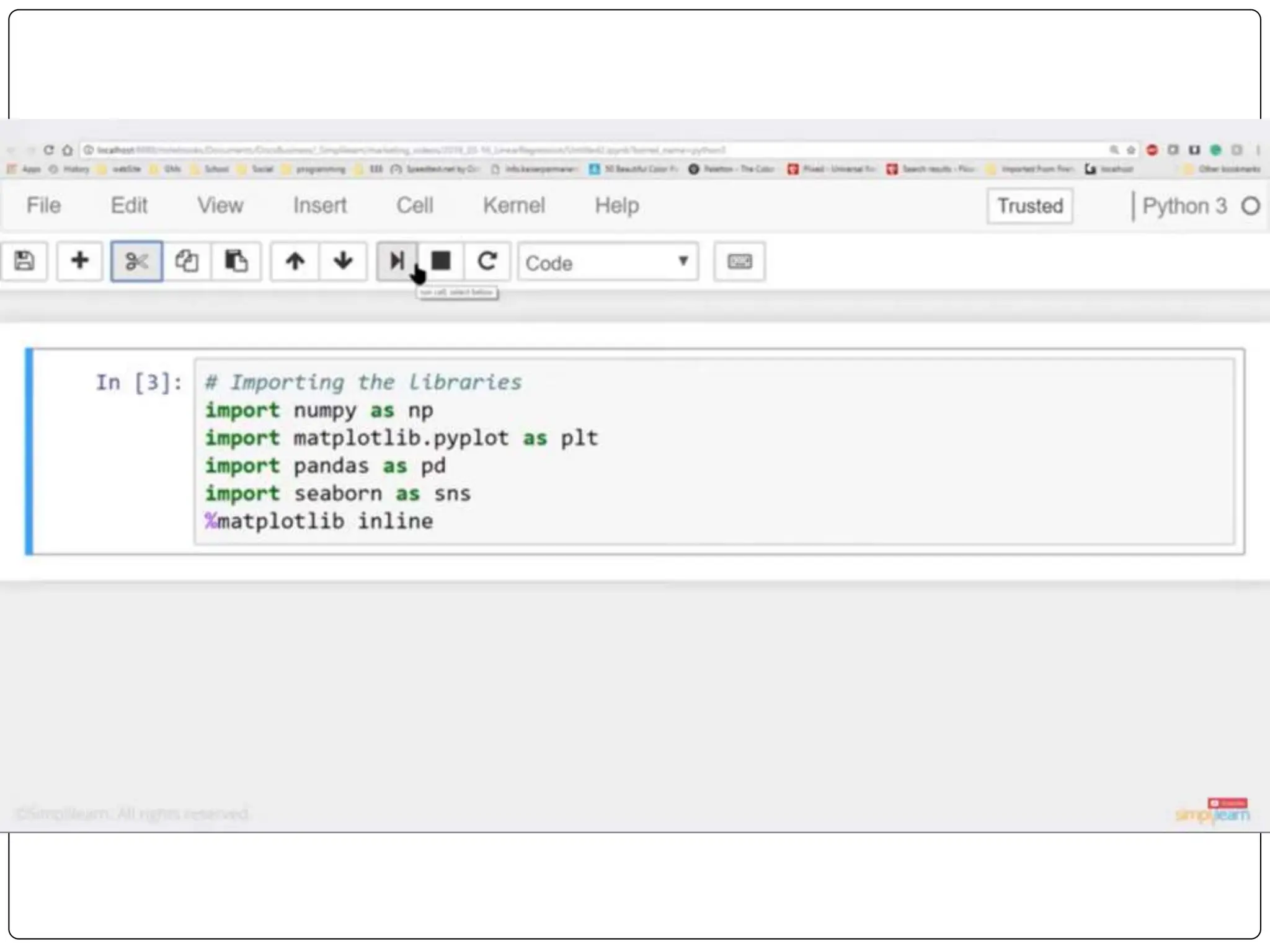
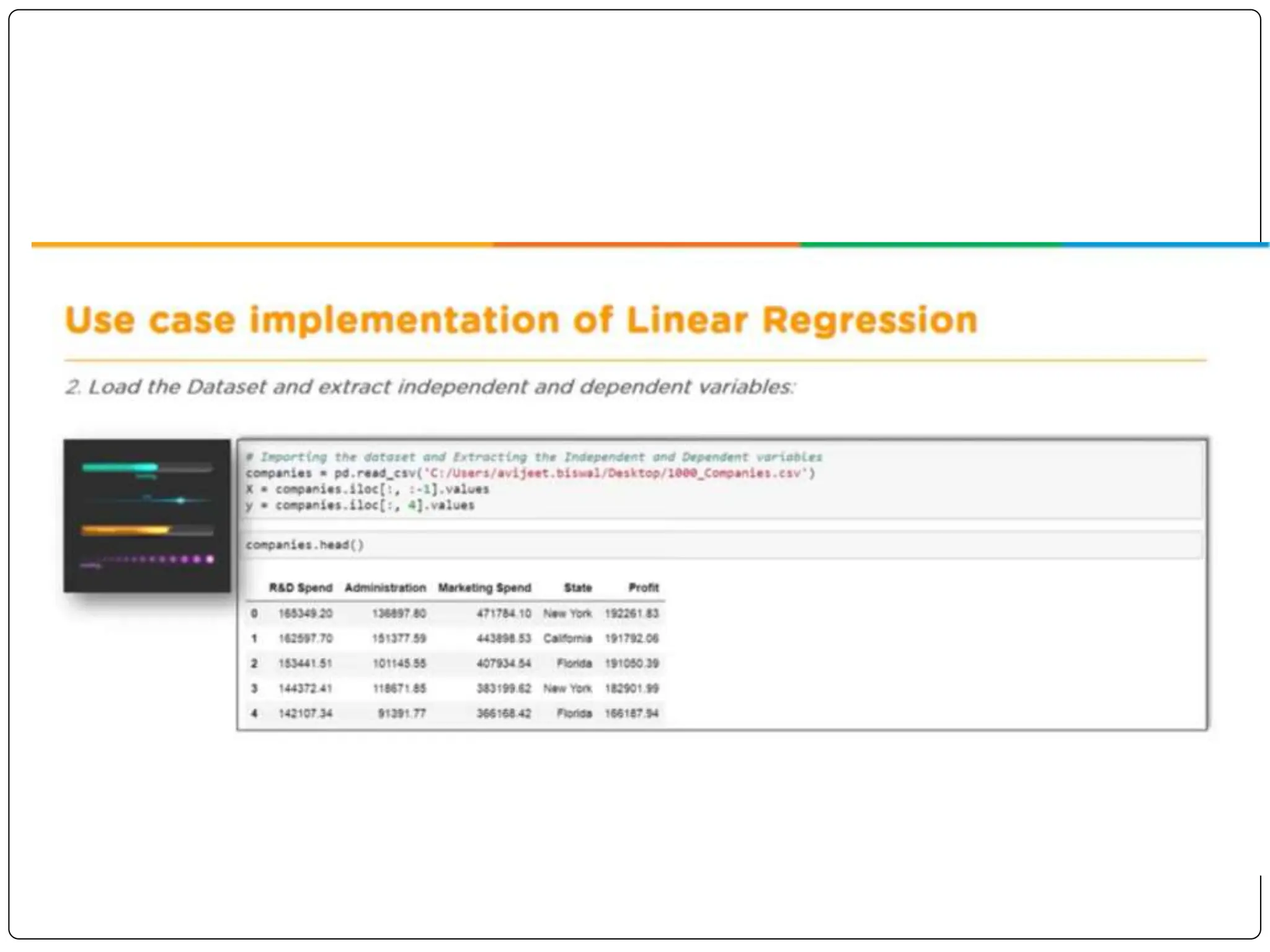
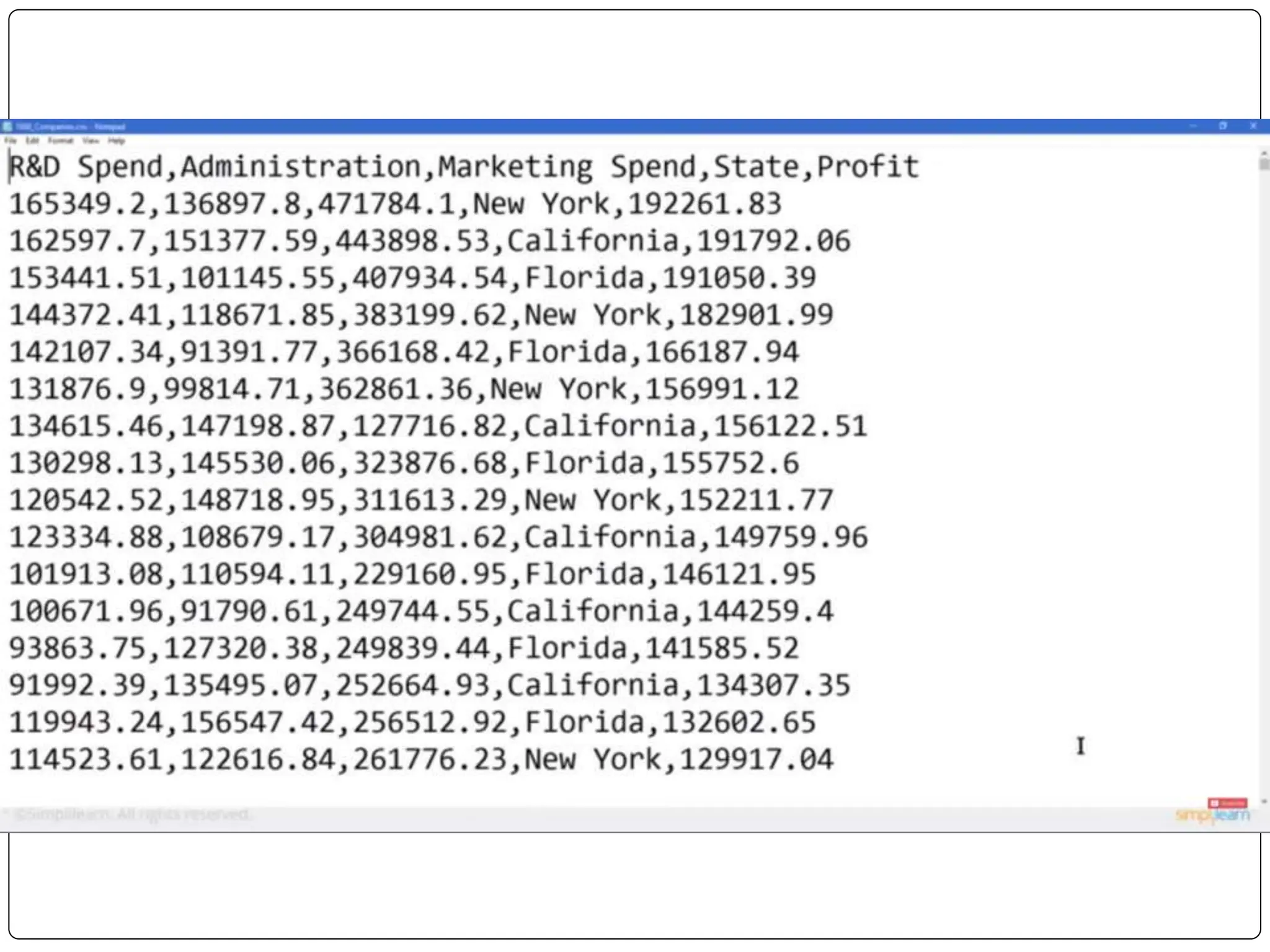
⚫ Use case: profit estimation of companies
Machine learning algorithms
Dr.Sangeetha Vimalraj, SRMIST, Vadapalani
The two most common uses for supervised learning
are:
● Regression
● Classification
Regression is divided into three types:
● Simple linear regression
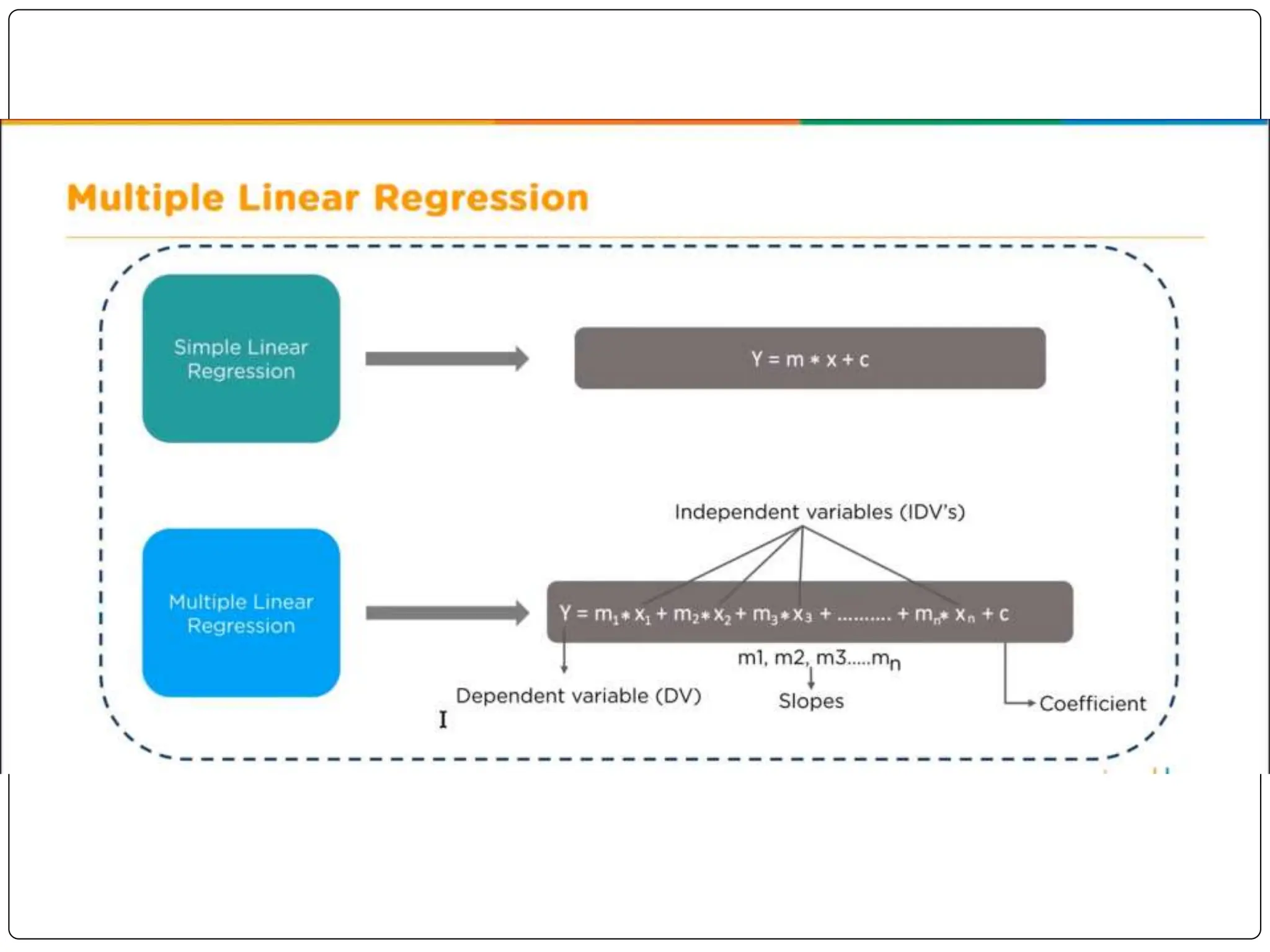
● Multiple linear regression
● Polynomial linear regression
Applications of linear
regression
Dr.Sangeetha Vimalraj, SRMIST, Vadapalani
● Economic Growth
● Product Price
● Housing Sales
● Score Predictions
Linear regression is a statistical model used to predict
the relationship between independent and dependent
variables by examining two factors:
1. Which variables, in particular, are significant
predictors of the outcome variable?
2. How significant is the regression line in terms of
making predictions with the highest possible
accuracy?
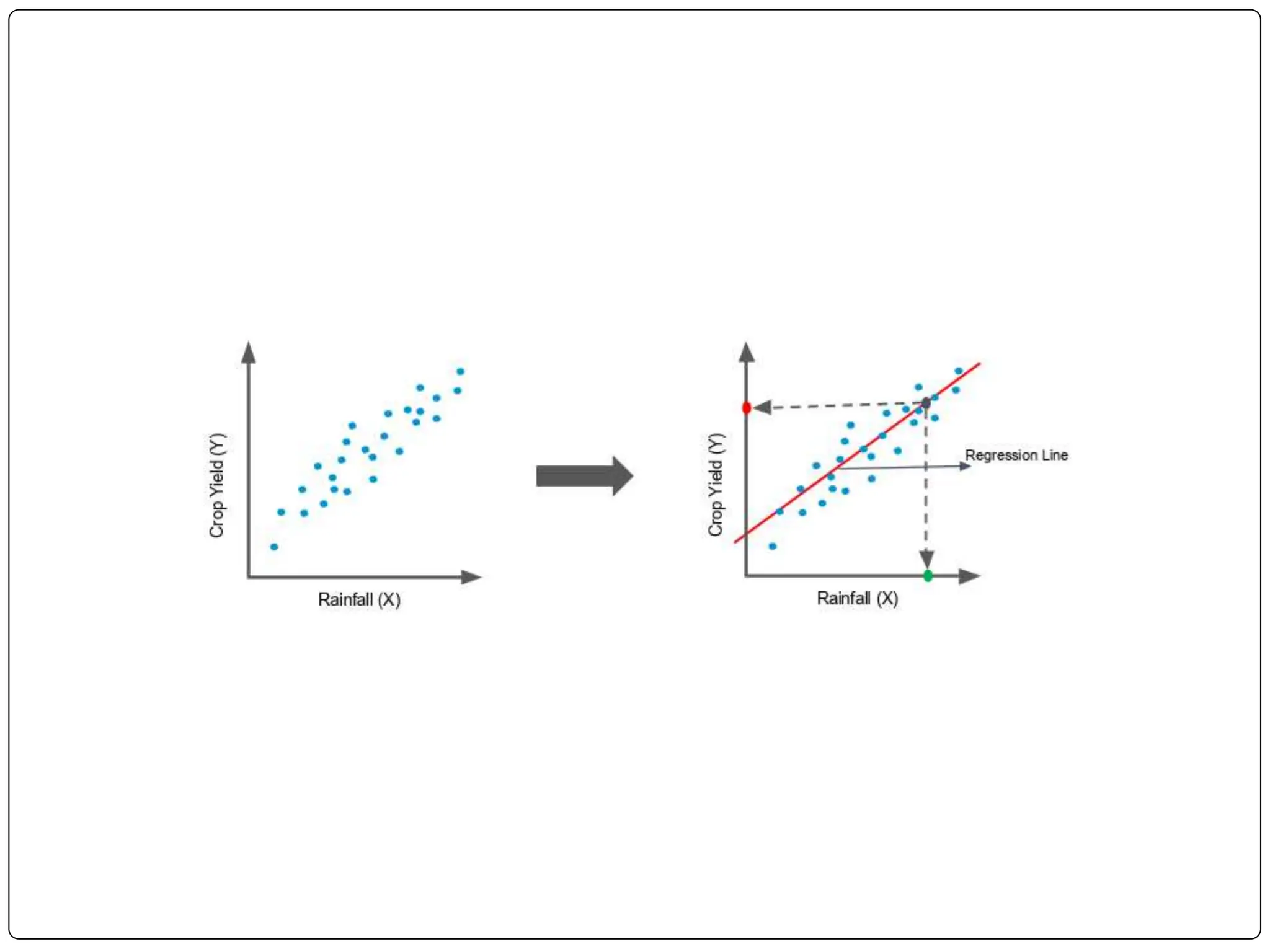
Example
Predict future crop yields based on the amount of
rainfall, using data regarding past crops and rainfall
amounts.
⚫ Independent Variable - Rainfall
⚫ Dependent Variable - Crop yield
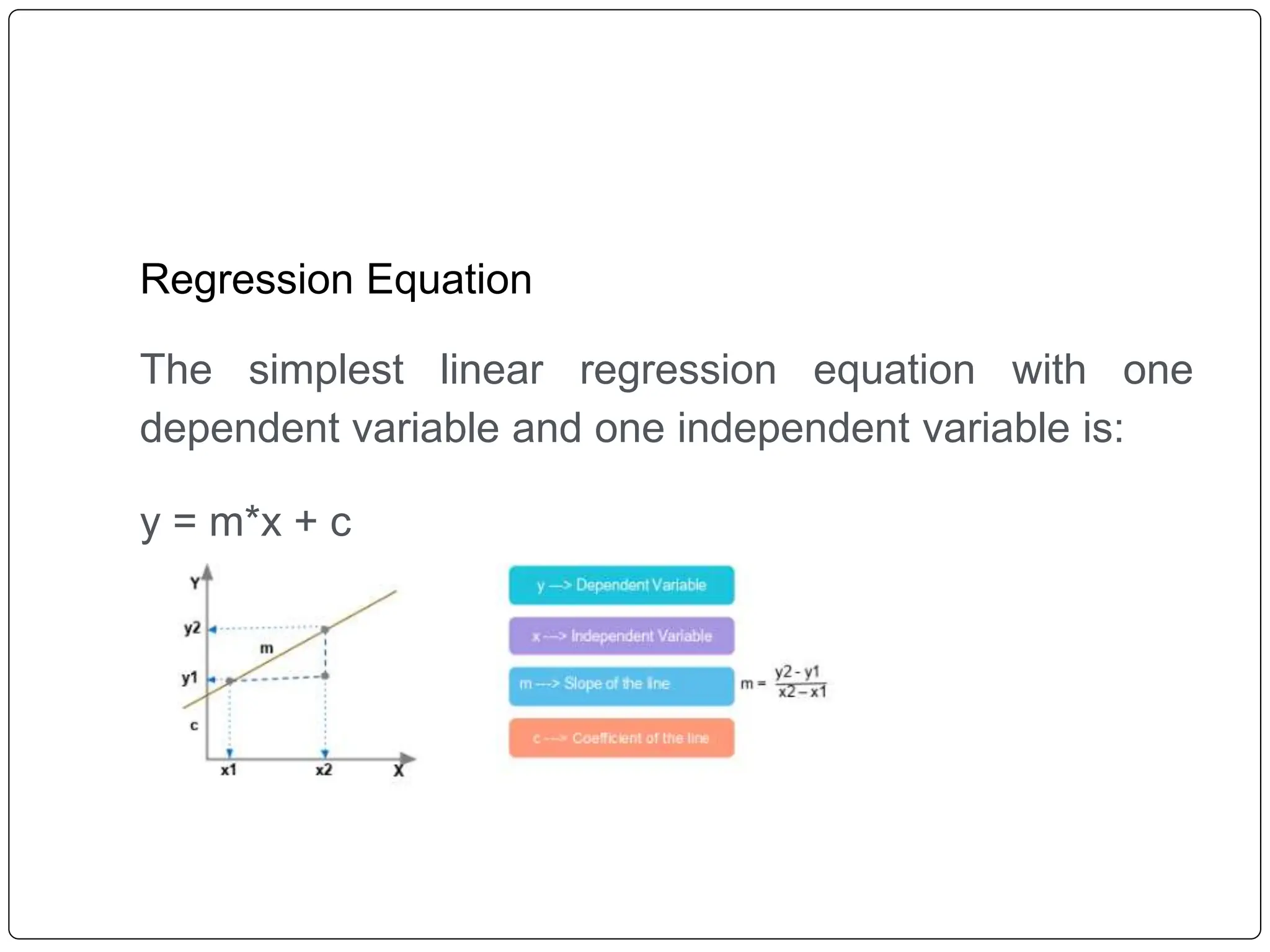
Regression Equation
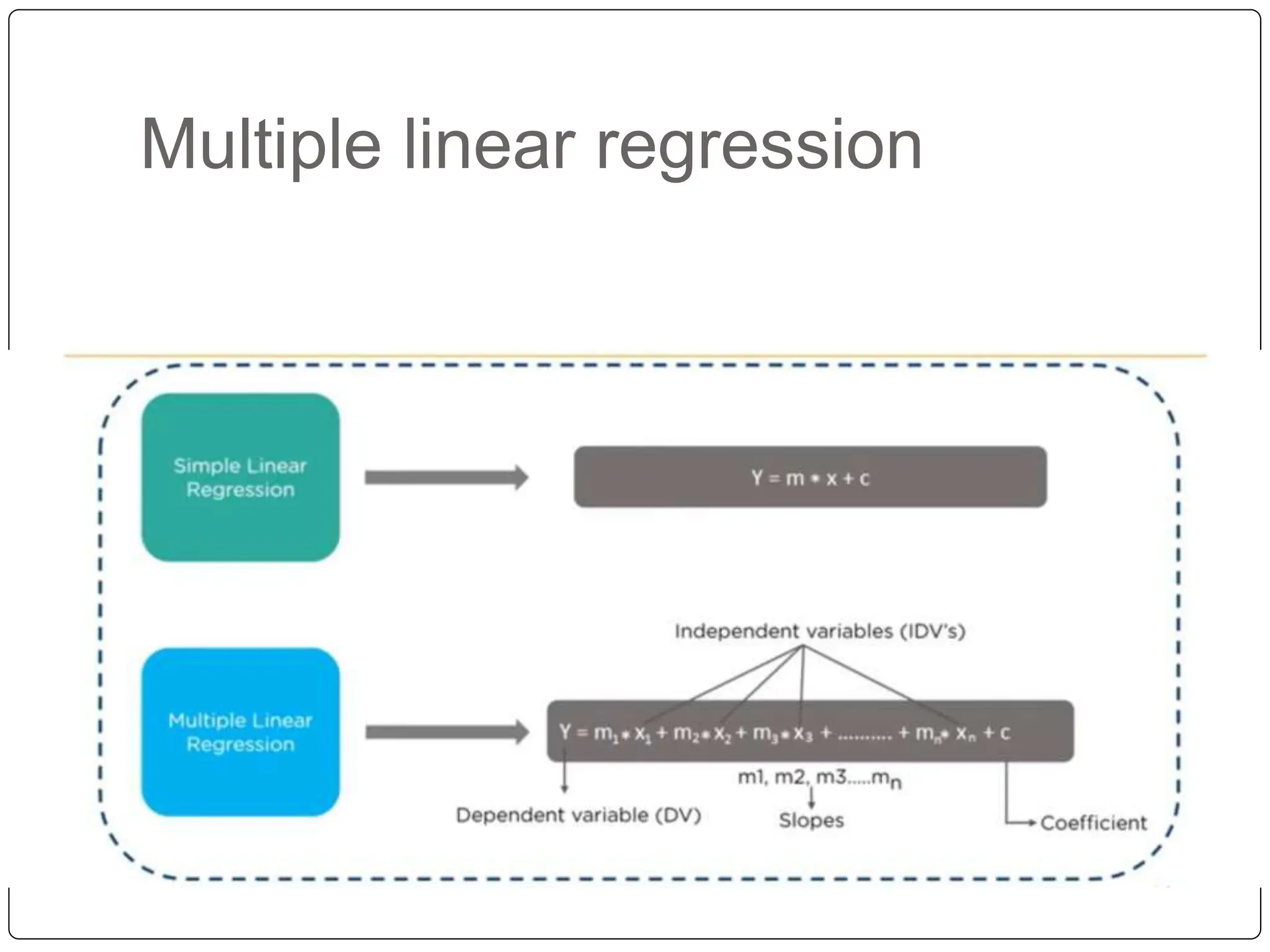
The simplest linear regression equation with one
dependent variable and one independent variable is:
y = m*x + c
EXAMPLE
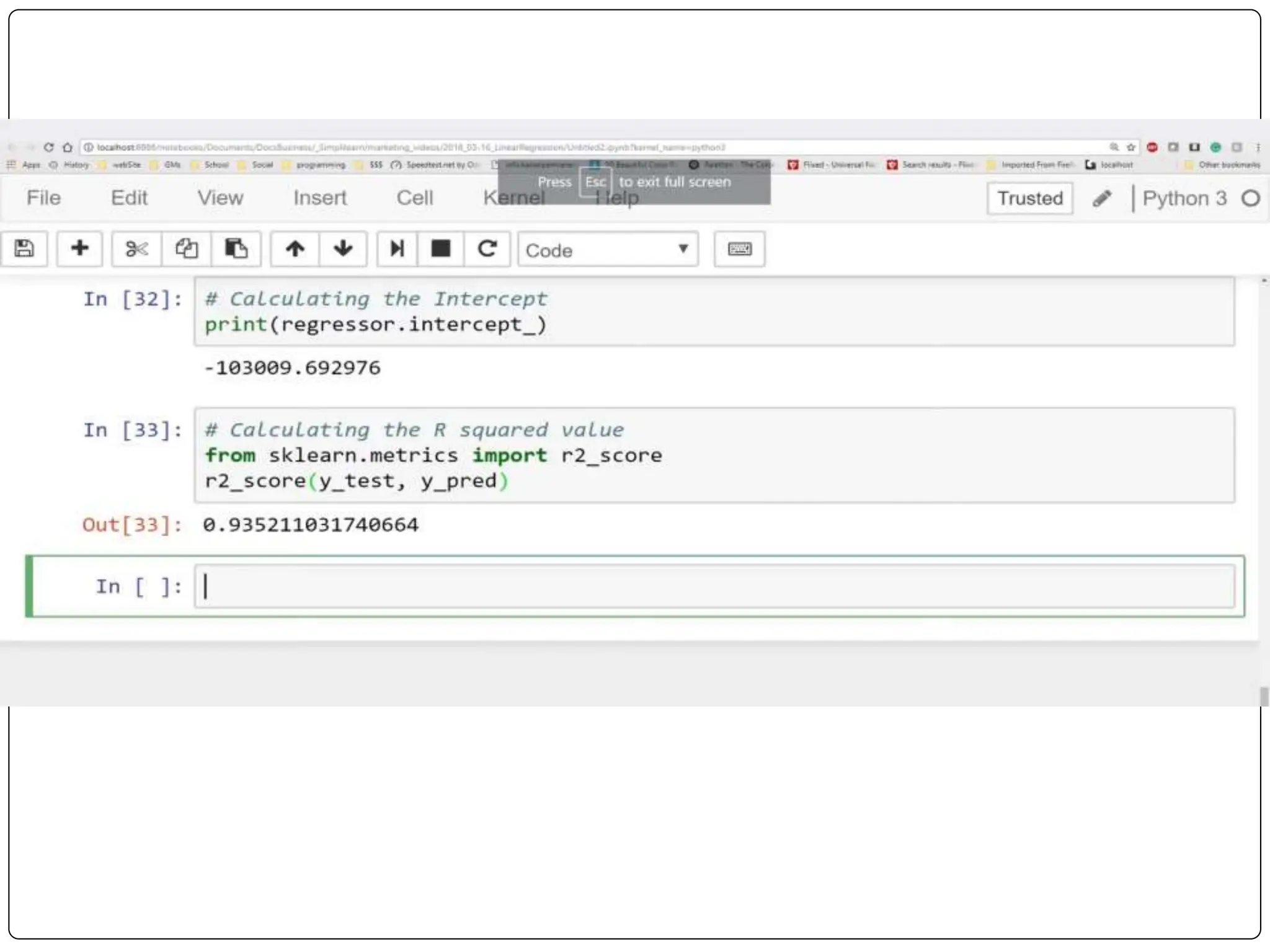
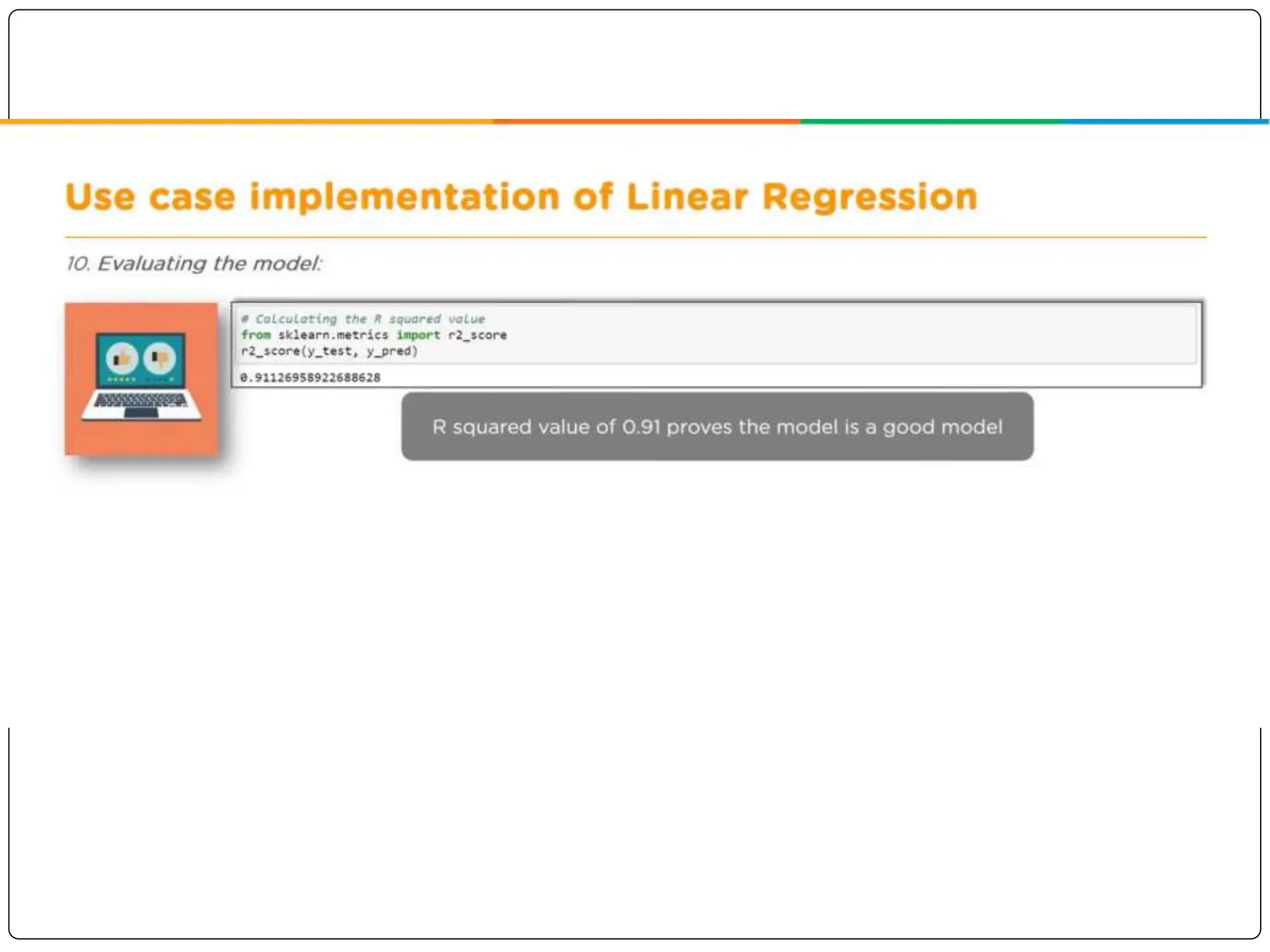
https://www.simplilearn.com/tutorials/machine-
learning-tutorial/linear-regression-in-python
Multiple linear regression
https://jupyter.org/
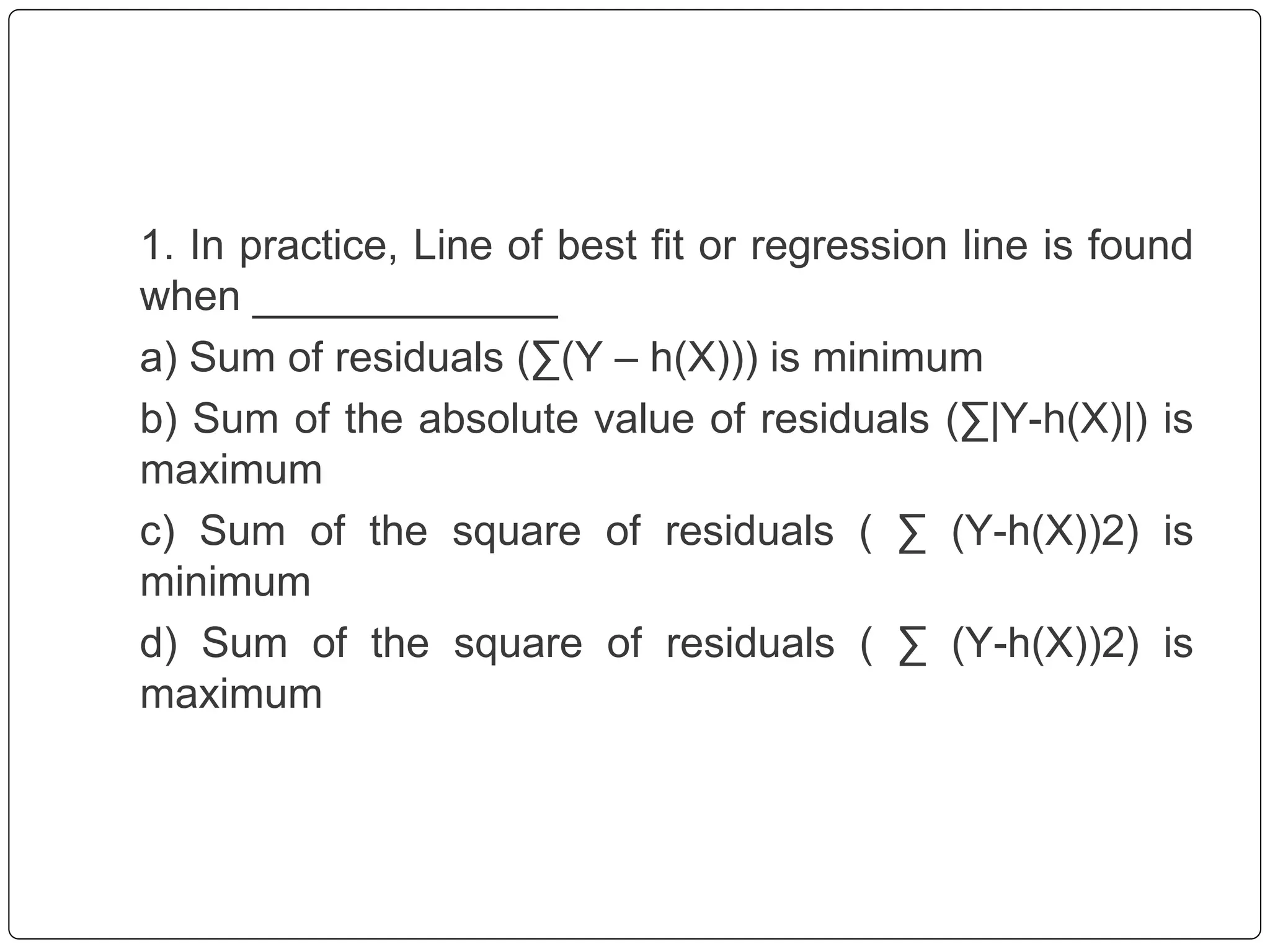
1. In practice, Line of best fit or regression line is found
when _____________
a) Sum of residuals (∑(Y – h(X))) is minimum
b) Sum of the absolute value of residuals (∑|Y-h(X)|) is
maximum
c) Sum of the square of residuals ( ∑ (Y-h(X))2) is
minimum
d) Sum of the square of residuals ( ∑ (Y-h(X))2) is
maximum
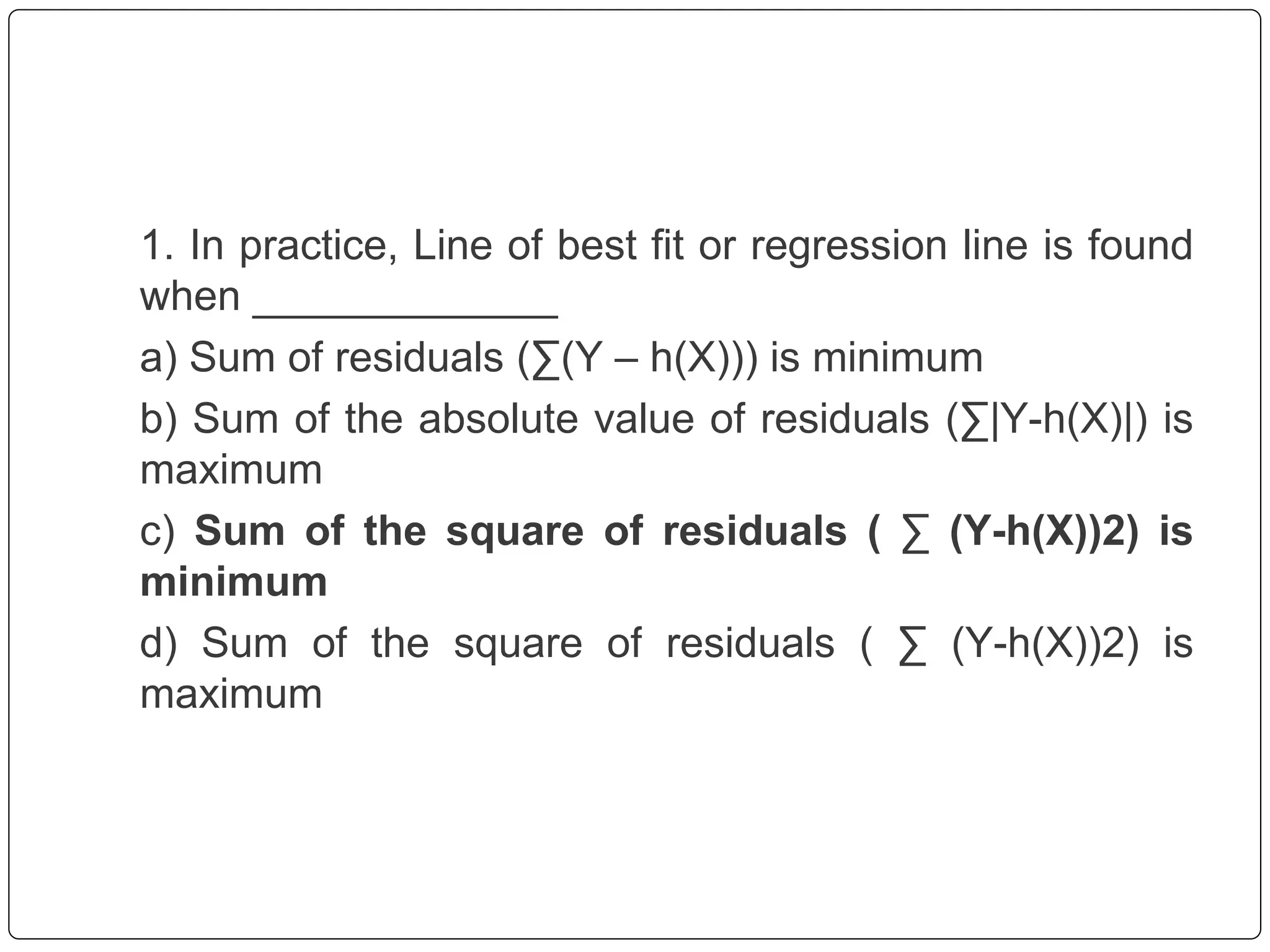
1. In practice, Line of best fit or regression line is found
when _____________
a) Sum of residuals (∑(Y – h(X))) is minimum
b) Sum of the absolute value of residuals (∑|Y-h(X)|) is
maximum
c) Sum of the square of residuals ( ∑ (Y-h(X))2) is
minimum
d) Sum of the square of residuals ( ∑ (Y-h(X))2) is
maximum
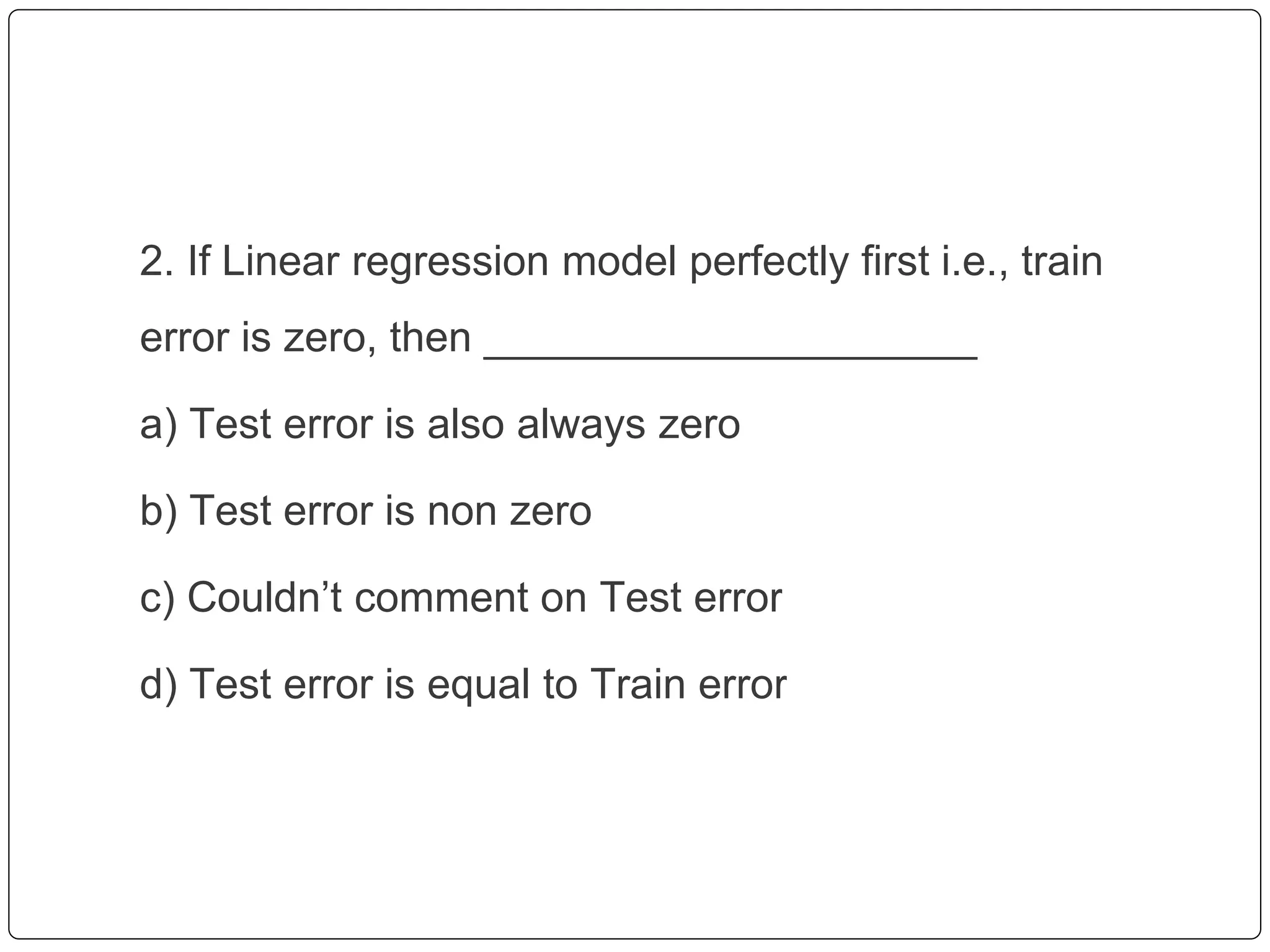
2. If Linear regression model perfectly first i.e., train
error is zero, then _____________________
a) Test error is also always zero
b) Test error is non zero
c) Couldn’t comment on Test error
d) Test error is equal to Train error
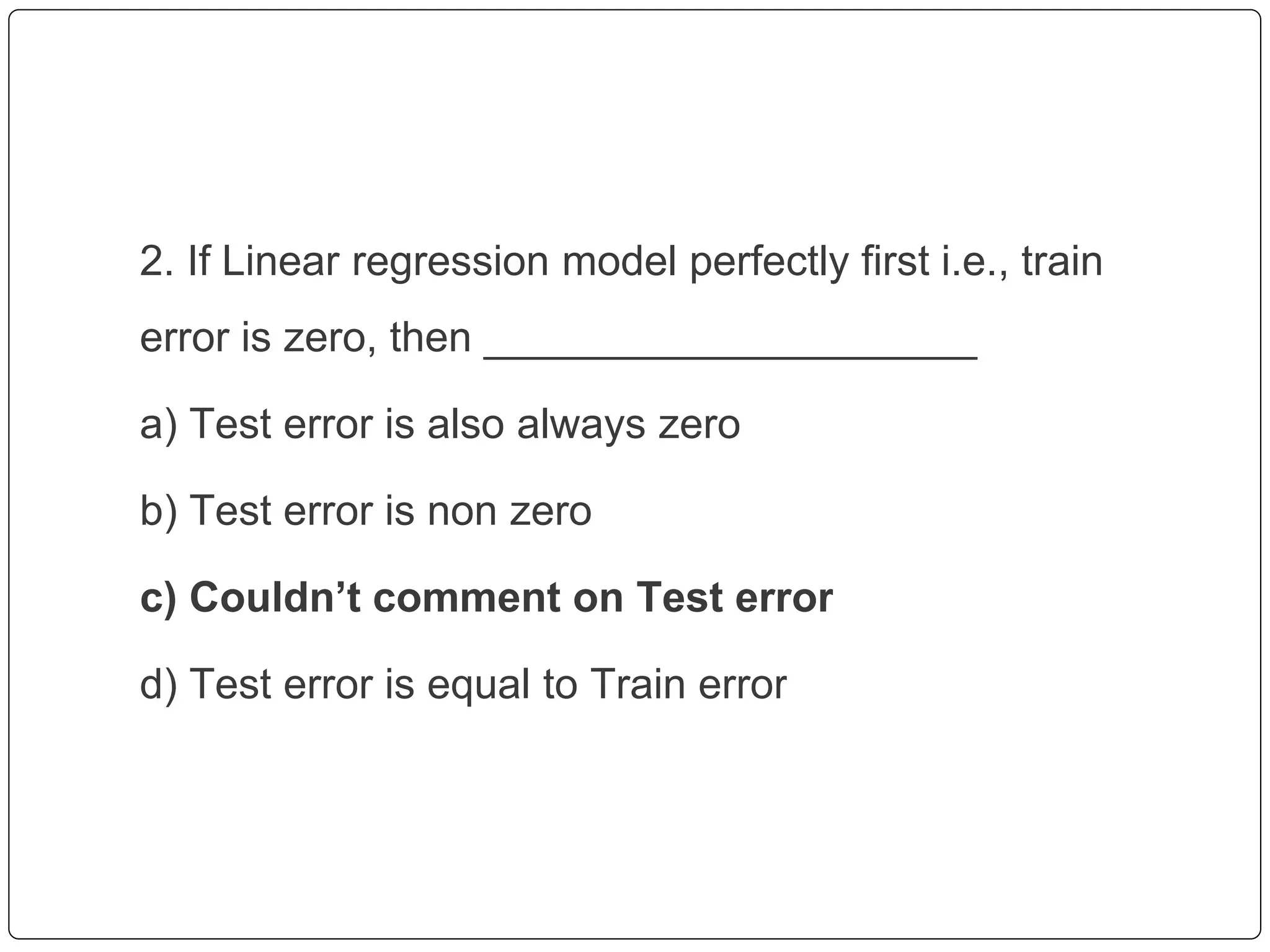
2. If Linear regression model perfectly first i.e., train
error is zero, then _____________________
a) Test error is also always zero
b) Test error is non zero
c) Couldn’t comment on Test error
d) Test error is equal to Train error
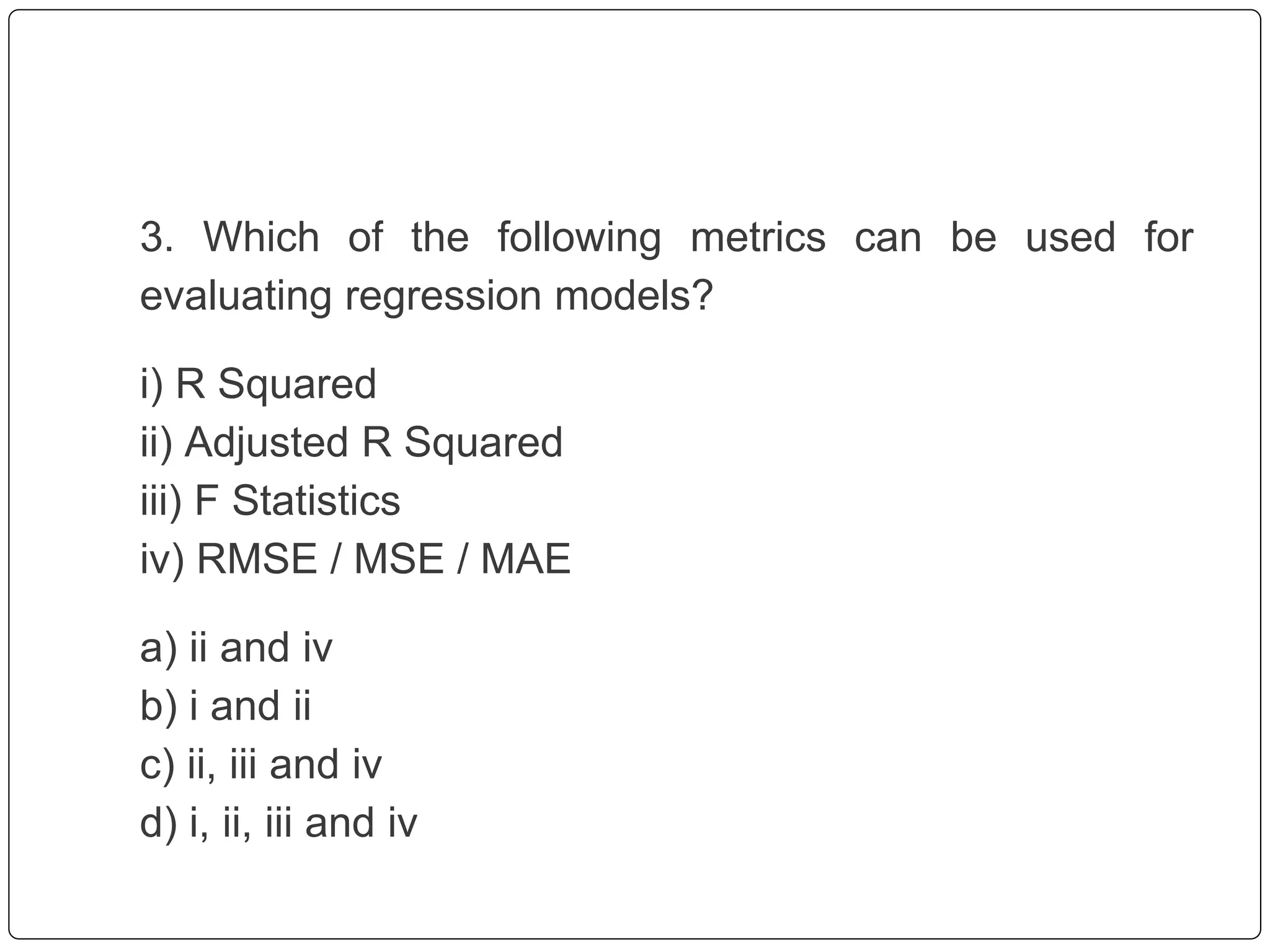
3. Which of the following metrics can be used for
evaluating regression models?
i) R Squared
ii) Adjusted R Squared
iii) F Statistics
iv) RMSE / MSE / MAE
a) ii and iv
b) i and ii
c) ii, iii and iv
d) i, ii, iii and iv
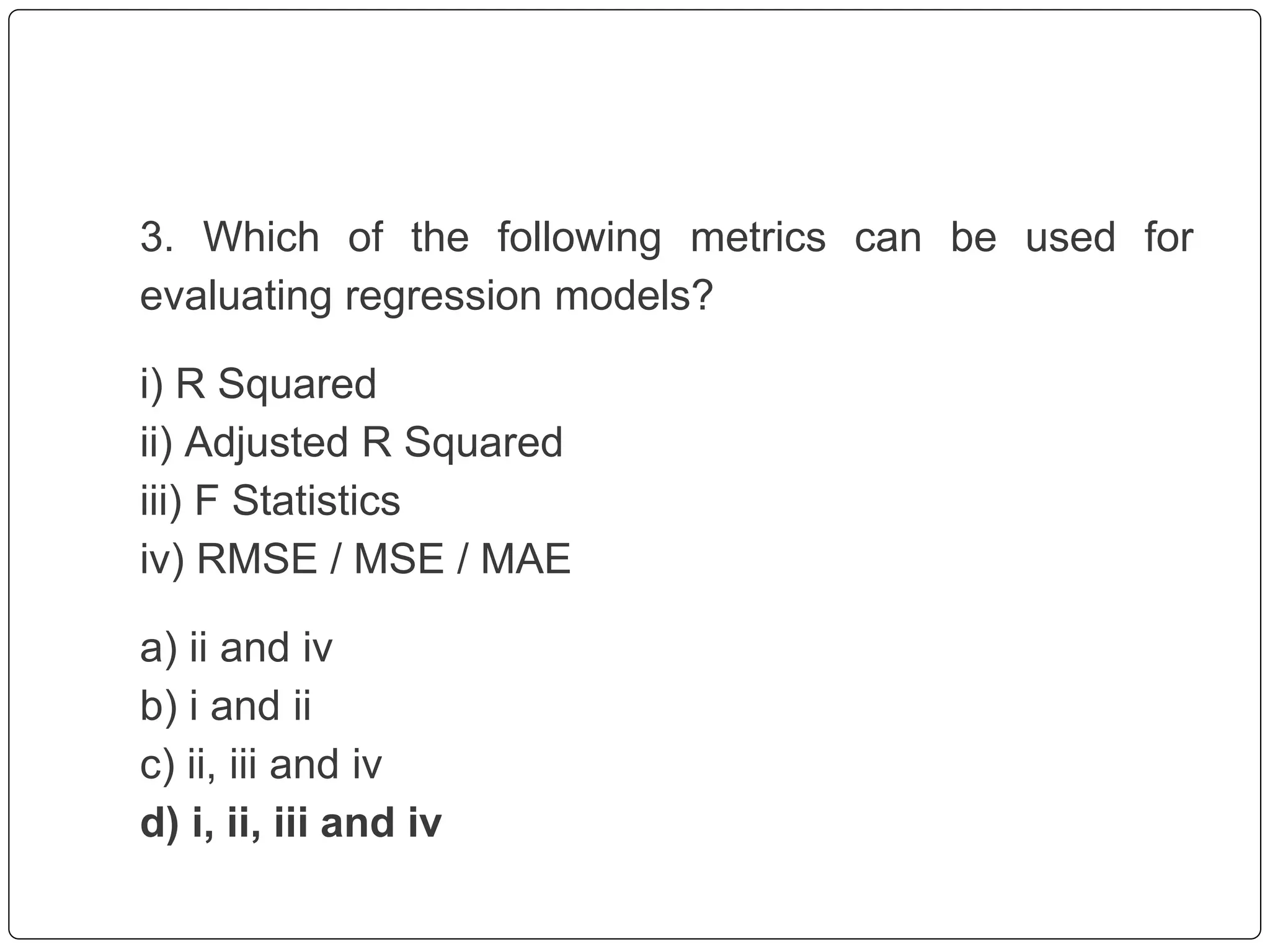
3. Which of the following metrics can be used for
evaluating regression models?
i) R Squared
ii) Adjusted R Squared
iii) F Statistics
iv) RMSE / MSE / MAE
a) ii and iv
b) i and ii
c) ii, iii and iv
d) i, ii, iii and iv
4. How many coefficients do you need to estimate in a
simple linear regression model (One independent
variable)?
a) 1
b) 2
c) 3
d) 4
4. How many coefficients do you need to estimate in a
simple linear regression model (One independent
variable)?
a) 1
b) 2
c) 3
d) 4
5. In a simple linear regression model (One
independent variable), If we change the input variable
by 1 unit. How much output variable will change?
a) by 1
b) no change
c) by intercept
d) by its slope
5. In a simple linear regression model (One
independent variable), If we change the input variable
by 1 unit. How much output variable will change?
a) by 1
b) no change
c) by intercept
d) by its slope
Explanation: For linear regression Y=a+bx+error. If neglect error then Y=a+bx. If x increases by
1, then Y = a+b(x+1) which implies Y=a+bx+b. So Y increases by its slope
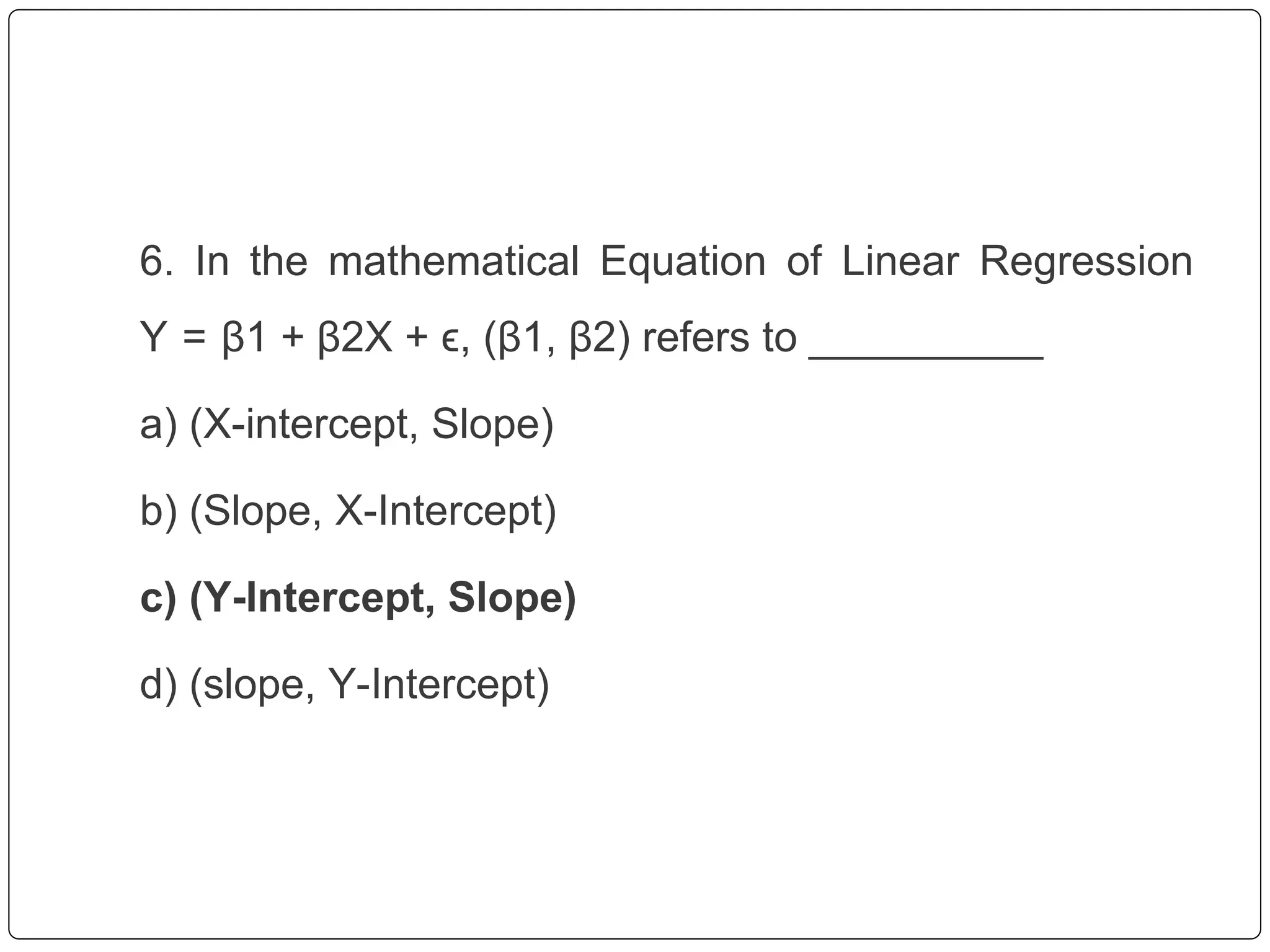
6. In the mathematical Equation of Linear Regression
Y = β1 + β2X + ϵ, (β1, β2) refers to __________
a) (X-intercept, Slope)
b) (Slope, X-Intercept)
c) (Y-Intercept, Slope)
d) (slope, Y-Intercept)
6. In the mathematical Equation of Linear Regression
Y = β1 + β2X + ϵ, (β1, β2) refers to __________
a) (X-intercept, Slope)
b) (Slope, X-Intercept)
c) (Y-Intercept, Slope)
d) (slope, Y-Intercept)
7.Linear Regression is a supervised machine learning
algorithm. True/False
7.Linear Regression is a supervised machine learning
algorithm. True/False
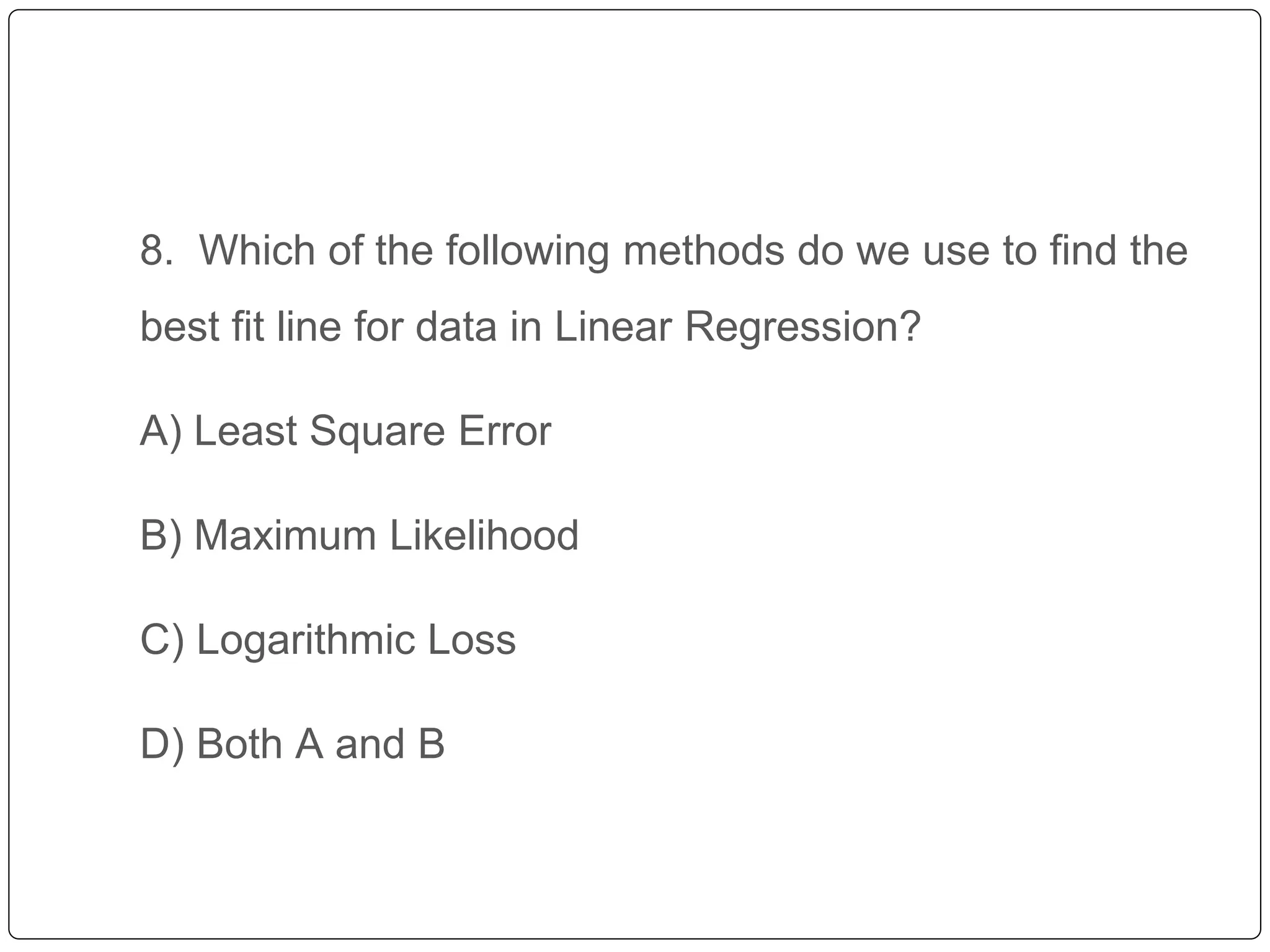
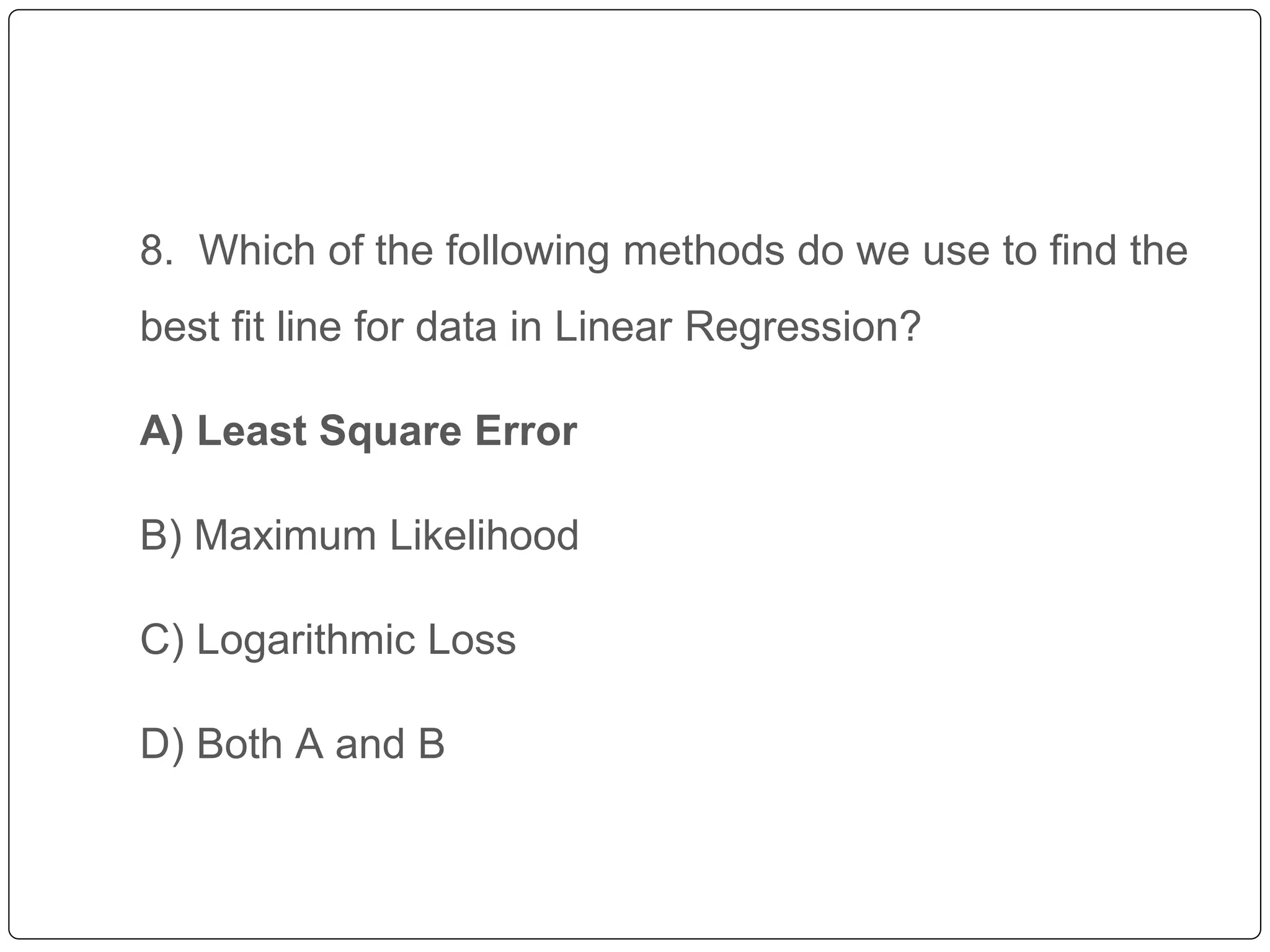
8. Which of the following methods do we use to find the
best fit line for data in Linear Regression?
A) Least Square Error
B) Maximum Likelihood
C) Logarithmic Loss
D) Both A and B
8. Which of the following methods do we use to find the
best fit line for data in Linear Regression?
A) Least Square Error
B) Maximum Likelihood
C) Logarithmic Loss
D) Both A and B
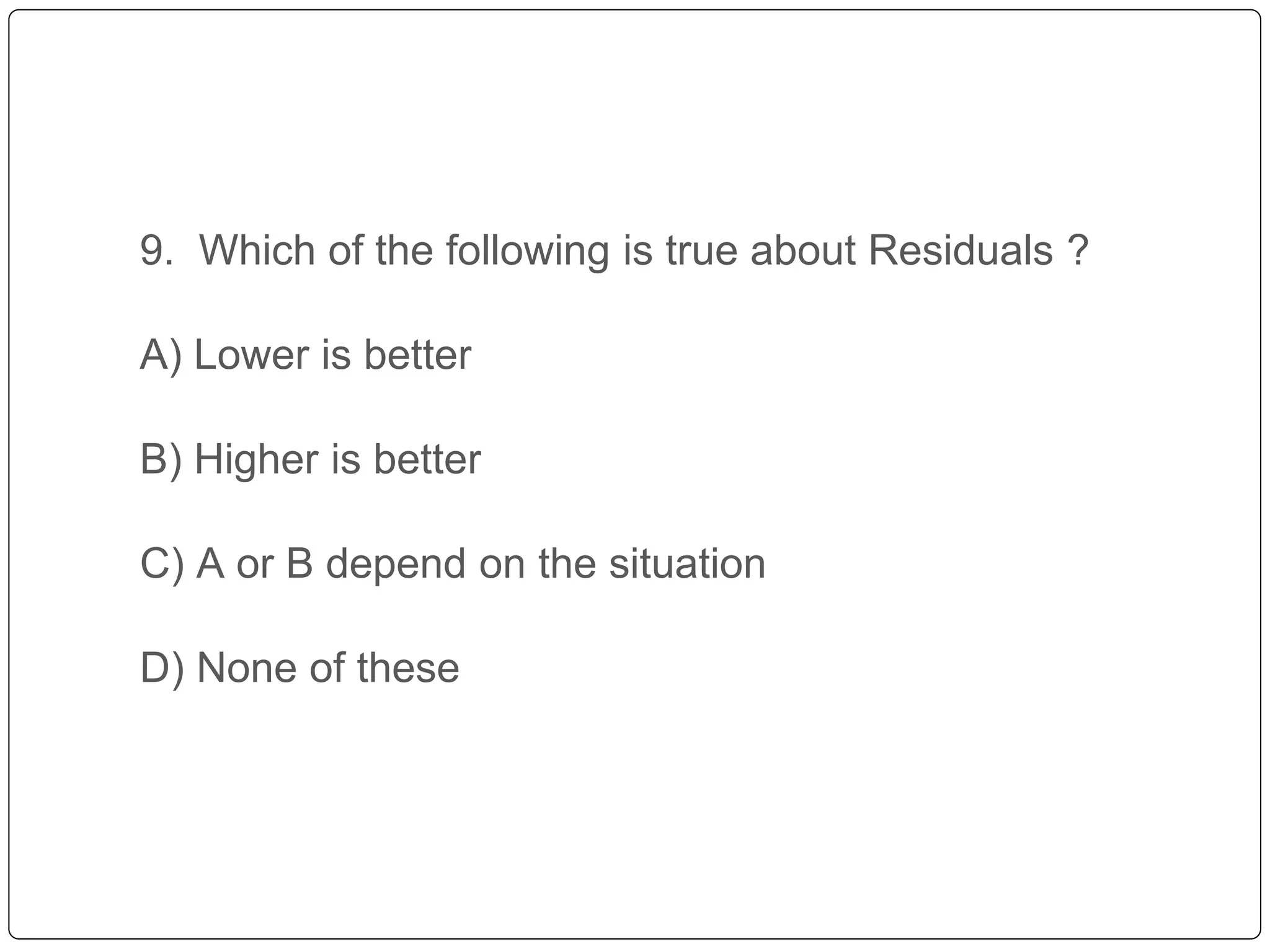
9. Which of the following is true about Residuals ?
A) Lower is better
B) Higher is better
C) A or B depend on the situation
D) None of these
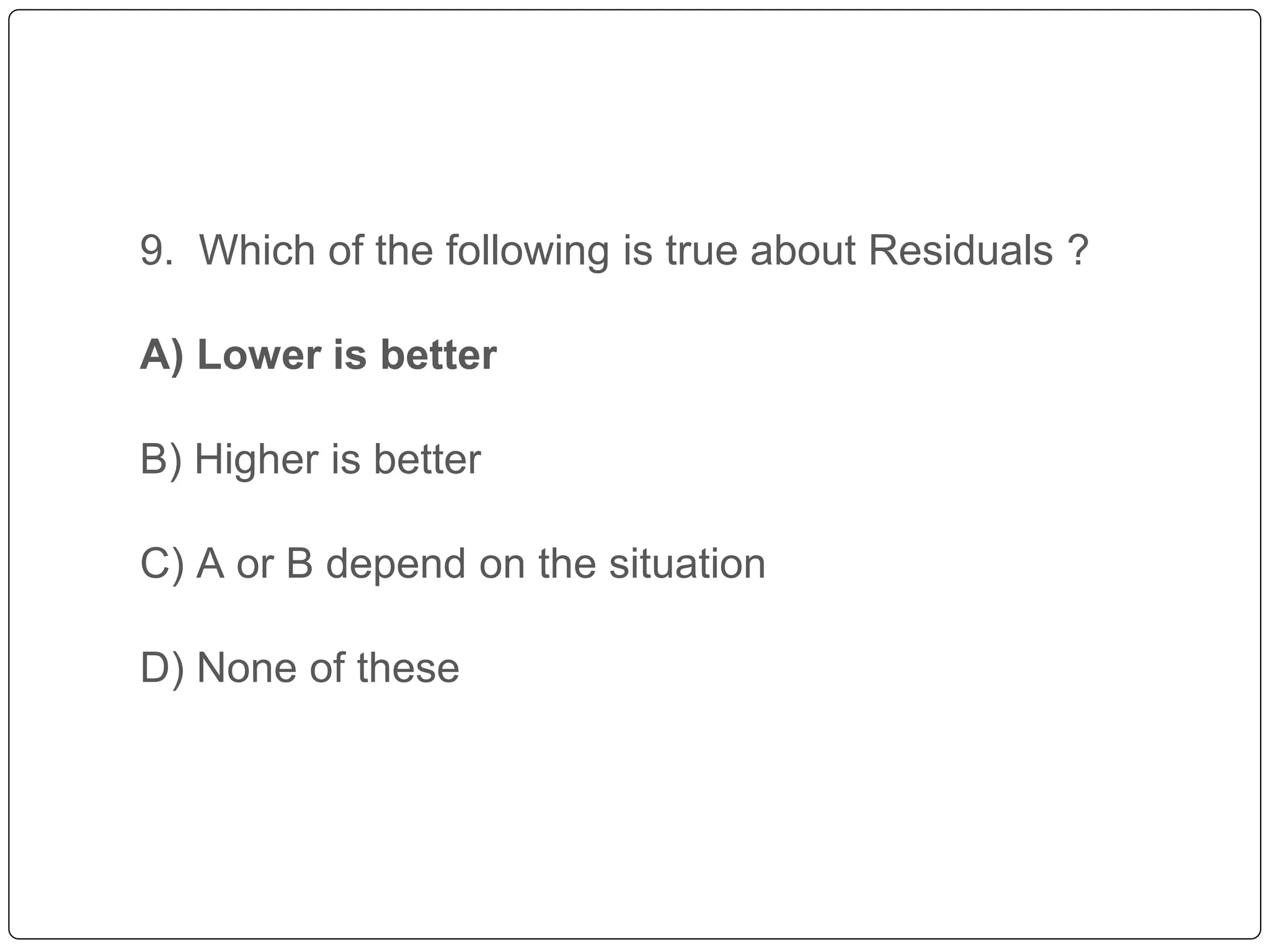
9. Which of the following is true about Residuals ?
A) Lower is better
B) Higher is better
C) A or B depend on the situation
D) None of these
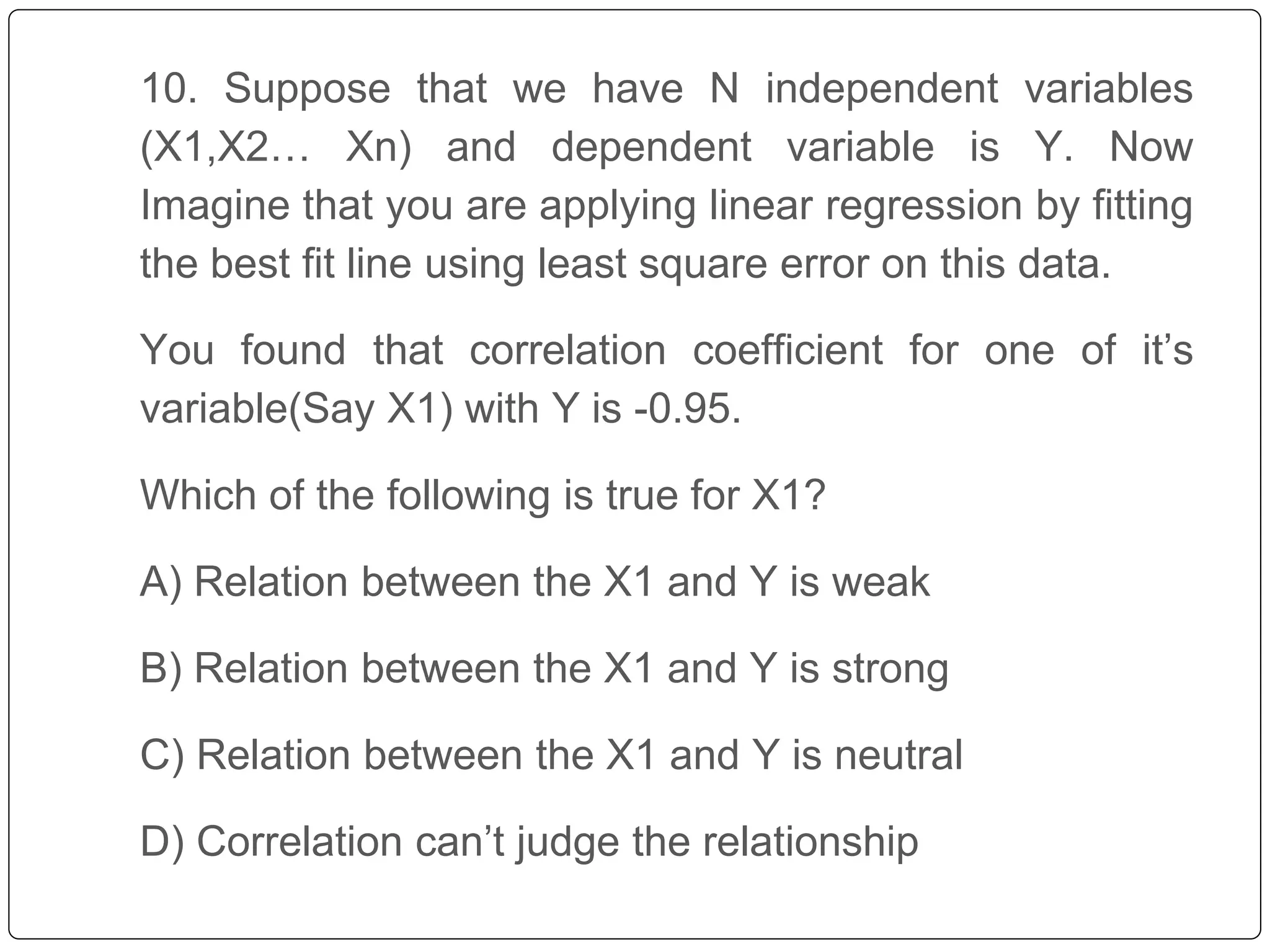
10. Suppose that we have N independent variables
(X1,X2… Xn) and dependent variable is Y. Now
Imagine that you are applying linear regression by fitting
the best fit line using least square error on this data.
You found that correlation coefficient for one of it’s
variable(Say X1) with Y is -0.95.
Which of the following is true for X1?
A) Relation between the X1 and Y is weak
B) Relation between the X1 and Y is strong
C) Relation between the X1 and Y is neutral
D) Correlation can’t judge the relationship
10. Suppose that we have N independent variables
(X1,X2… Xn) and dependent variable is Y. Now
Imagine that you are applying linear regression by fitting
the best fit line using least square error on this data.
You found that correlation coefficient for one of it’s
variable(Say X1) with Y is -0.95.
Which of the following is true for X1?
A) Relation between the X1 and Y is weak
B) Relation between the X1 and Y is strong
C) Relation between the X1 and Y is neutral
D) Correlation can’t judge the relationship

LINEAR REGRESSION.pptx

  • 1.
    Dr.Sangeetha Vimalraj, SRMIST,Vadapalani MULTIPLE LINEAR REGRESSION
  • 2.
    Outline Dr.Sangeetha Vimalraj, SRMIST,Vadapalani ⚫ Machine learning algorithms ⚫ Applications of linear regression ⚫ Understanding linear regression ⚫ Multiple linear regression ⚫ Use case: profit estimation of companies
  • 3.
    Machine learning algorithms Dr.SangeethaVimalraj, SRMIST, Vadapalani The two most common uses for supervised learning are: ● Regression ● Classification Regression is divided into three types: ● Simple linear regression ● Multiple linear regression ● Polynomial linear regression
  • 4.
    Applications of linear regression Dr.SangeethaVimalraj, SRMIST, Vadapalani ● Economic Growth ● Product Price ● Housing Sales ● Score Predictions
  • 5.
    Linear regression isa statistical model used to predict the relationship between independent and dependent variables by examining two factors: 1. Which variables, in particular, are significant predictors of the outcome variable? 2. How significant is the regression line in terms of making predictions with the highest possible accuracy?
  • 6.
    Example Predict future cropyields based on the amount of rainfall, using data regarding past crops and rainfall amounts. ⚫ Independent Variable - Rainfall ⚫ Dependent Variable - Crop yield
  • 7.
    Regression Equation The simplestlinear regression equation with one dependent variable and one independent variable is: y = m*x + c
  • 9.
  • 10.
  • 30.
  • 31.
    1. In practice,Line of best fit or regression line is found when _____________ a) Sum of residuals (∑(Y – h(X))) is minimum b) Sum of the absolute value of residuals (∑|Y-h(X)|) is maximum c) Sum of the square of residuals ( ∑ (Y-h(X))2) is minimum d) Sum of the square of residuals ( ∑ (Y-h(X))2) is maximum
  • 32.
    1. In practice,Line of best fit or regression line is found when _____________ a) Sum of residuals (∑(Y – h(X))) is minimum b) Sum of the absolute value of residuals (∑|Y-h(X)|) is maximum c) Sum of the square of residuals ( ∑ (Y-h(X))2) is minimum d) Sum of the square of residuals ( ∑ (Y-h(X))2) is maximum
  • 33.
    2. If Linearregression model perfectly first i.e., train error is zero, then _____________________ a) Test error is also always zero b) Test error is non zero c) Couldn’t comment on Test error d) Test error is equal to Train error
  • 34.
    2. If Linearregression model perfectly first i.e., train error is zero, then _____________________ a) Test error is also always zero b) Test error is non zero c) Couldn’t comment on Test error d) Test error is equal to Train error
  • 35.
    3. Which ofthe following metrics can be used for evaluating regression models? i) R Squared ii) Adjusted R Squared iii) F Statistics iv) RMSE / MSE / MAE a) ii and iv b) i and ii c) ii, iii and iv d) i, ii, iii and iv
  • 36.
    3. Which ofthe following metrics can be used for evaluating regression models? i) R Squared ii) Adjusted R Squared iii) F Statistics iv) RMSE / MSE / MAE a) ii and iv b) i and ii c) ii, iii and iv d) i, ii, iii and iv
  • 37.
    4. How manycoefficients do you need to estimate in a simple linear regression model (One independent variable)? a) 1 b) 2 c) 3 d) 4
  • 38.
    4. How manycoefficients do you need to estimate in a simple linear regression model (One independent variable)? a) 1 b) 2 c) 3 d) 4
  • 39.
    5. In asimple linear regression model (One independent variable), If we change the input variable by 1 unit. How much output variable will change? a) by 1 b) no change c) by intercept d) by its slope
  • 40.
    5. In asimple linear regression model (One independent variable), If we change the input variable by 1 unit. How much output variable will change? a) by 1 b) no change c) by intercept d) by its slope Explanation: For linear regression Y=a+bx+error. If neglect error then Y=a+bx. If x increases by 1, then Y = a+b(x+1) which implies Y=a+bx+b. So Y increases by its slope
  • 41.
    6. In themathematical Equation of Linear Regression Y = β1 + β2X + ϵ, (β1, β2) refers to __________ a) (X-intercept, Slope) b) (Slope, X-Intercept) c) (Y-Intercept, Slope) d) (slope, Y-Intercept)
  • 42.
    6. In themathematical Equation of Linear Regression Y = β1 + β2X + ϵ, (β1, β2) refers to __________ a) (X-intercept, Slope) b) (Slope, X-Intercept) c) (Y-Intercept, Slope) d) (slope, Y-Intercept)
  • 43.
    7.Linear Regression isa supervised machine learning algorithm. True/False
  • 44.
    7.Linear Regression isa supervised machine learning algorithm. True/False
  • 45.
    8. Which ofthe following methods do we use to find the best fit line for data in Linear Regression? A) Least Square Error B) Maximum Likelihood C) Logarithmic Loss D) Both A and B
  • 46.
    8. Which ofthe following methods do we use to find the best fit line for data in Linear Regression? A) Least Square Error B) Maximum Likelihood C) Logarithmic Loss D) Both A and B
  • 47.
    9. Which ofthe following is true about Residuals ? A) Lower is better B) Higher is better C) A or B depend on the situation D) None of these
  • 48.
    9. Which ofthe following is true about Residuals ? A) Lower is better B) Higher is better C) A or B depend on the situation D) None of these
  • 49.
    10. Suppose thatwe have N independent variables (X1,X2… Xn) and dependent variable is Y. Now Imagine that you are applying linear regression by fitting the best fit line using least square error on this data. You found that correlation coefficient for one of it’s variable(Say X1) with Y is -0.95. Which of the following is true for X1? A) Relation between the X1 and Y is weak B) Relation between the X1 and Y is strong C) Relation between the X1 and Y is neutral D) Correlation can’t judge the relationship
  • 50.
    10. Suppose thatwe have N independent variables (X1,X2… Xn) and dependent variable is Y. Now Imagine that you are applying linear regression by fitting the best fit line using least square error on this data. You found that correlation coefficient for one of it’s variable(Say X1) with Y is -0.95. Which of the following is true for X1? A) Relation between the X1 and Y is weak B) Relation between the X1 and Y is strong C) Relation between the X1 and Y is neutral D) Correlation can’t judge the relationship