Linear Programming
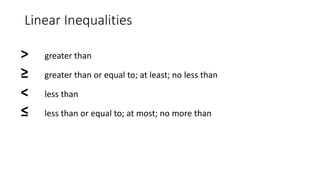
Linear Inequalities
> greater than
≥ greater than or equal to; at least; no less than
< less than
≤ less than or equal to; at most; no more than
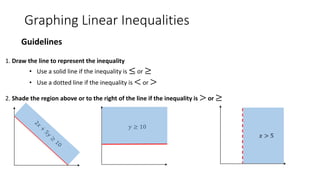
Graphing Linear Inequalities
Guidelines
2. Shade the region above or to the right of the line if the inequality is > or ≥
1. Draw the line to represent the inequality
• Use a solid line if the inequality is ≤ or ≥
• Use a dotted line if the inequality is < or >
𝑦 ≥ 10
𝑥 > 5
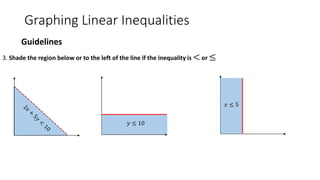
Graphing Linear Inequalities
Guidelines
3. Shade the region below or to the left of the line if the inequality is < or ≤
𝑦 ≤ 10
𝑥 ≤ 5
Graphing Linear Inequalities
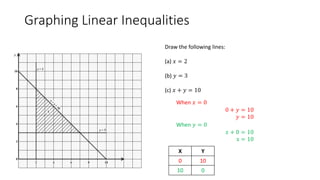
X Y
0 10
10 0
Draw the following lines:
(a) 𝑥 = 2
(b) 𝑦 = 3
(c) 𝑥 + 𝑦 = 10
When 𝑥 = 0
0 + 𝑦 = 10
𝑦 = 10
When 𝑦 = 0
𝑥 + 0 = 10
x = 10
Graphing Linear Inequalities
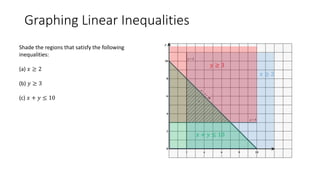
𝑥 ≥ 2
𝑥 + 𝑦 ≤ 10
𝑦 ≥ 3
Shade the regions that satisfy the following
inequalities:
(a) 𝑥 ≥ 2
(b) 𝑦 ≥ 3
(c) 𝑥 + 𝑦 ≤ 10
Example 1
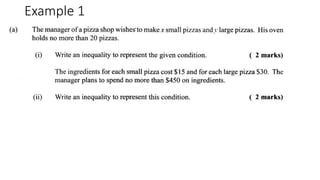
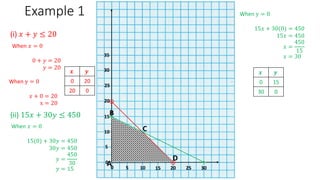
(i) 𝑥 + 𝑦 ≤ 20
(ii) 15𝑥 + 30𝑦 ≤ 450
Example 1
Example 1
5 10 15 20 25 30
0
0
5
10
15
20
25
30
35
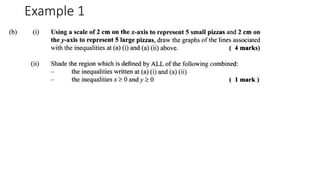
(i) 𝑥 + 𝑦 ≤ 20
(ii) 15𝑥 + 30𝑦 ≤ 450
When 𝑥 = 0
0 + 𝑦 = 20
𝑦 = 20
When y = 0
𝑥 + 0 = 20
x = 20
When 𝑥 = 0
15(0) + 30𝑦 = 450
30𝑦 = 450
𝑦 =
450
30
𝑦 = 15
When y = 0
15𝑥 + 30(0) = 450
15𝑥 = 450
𝑥 =
450
15
𝑥 = 30
𝒙 𝒚
0 20
20 0
𝒙 𝒚
0 15
30 0




A
B
C
D
Example 1
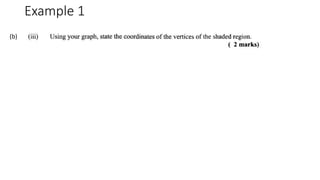
(iii) A (0, 0)
B (0, 15)
C (10, 10)
D (0, 20)
(b)
Example 1
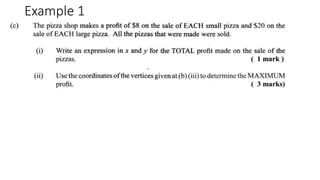
(i) Total profit = 8𝑥 + 20𝑦
(ii) B (0, 15), when 𝑥 = 0 then 𝑦 = 15
𝑇𝑜𝑡𝑎𝑙 𝑝𝑟𝑜𝑓𝑖𝑡 = 8 0 + 20 15 = 0 + 300 = 300
C (10, 10), when 𝑥 = 10 then 𝑦 = 10
𝑇𝑜𝑡𝑎𝑙 𝑝𝑟𝑜𝑓𝑖𝑡 = 8 10 + 20 10 = 80 + 200 = 280
D (0, 20), when 𝑥 = 0 then 𝑦 = 20
𝑇𝑜𝑡𝑎𝑙 𝑝𝑟𝑜𝑓𝑖𝑡 = 8 0 + 20 20 = 0 + 400 = 400
Therefore the maximum profit is $400,
when the pizza shop makes 0 small
pizza and 20 large pizzas.
Example 2
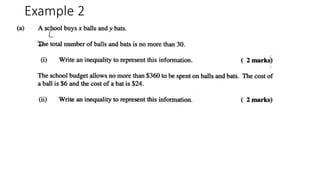
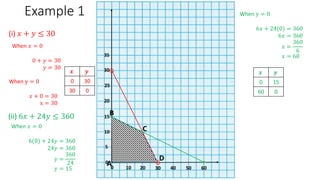
(i) 𝑥 + 𝑦 ≤ 30
(ii) 6𝑥 + 24𝑦 ≤ 360
Example 2
Example 1
10 20 30 40 50 60
0
0
5
10
15
20
25
30
35
When 𝑥 = 0
0 + 𝑦 = 30
𝑦 = 30
When y = 0
𝑥 + 0 = 30
x = 30
When 𝑥 = 0
6(0) + 24𝑦 = 360
24𝑦 = 360
𝑦 =
360
24
𝑦 = 15
When y = 0
6𝑥 + 24(0) = 360
6𝑥 = 360
𝑥 =
360
6
𝑥 = 60
𝒙 𝒚
0 30
30 0
𝒙 𝒚
0 15
60 0




A
B
C
D
(i) 𝑥 + 𝑦 ≤ 30
(ii) 6𝑥 + 24𝑦 ≤ 360
Example 2
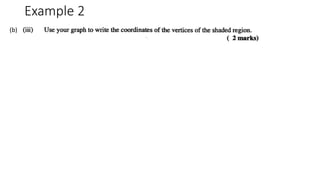
(b)
(iii) A (0, 0)
B (0, 15)
C (20, 10)
D (30, 0)
Example 2
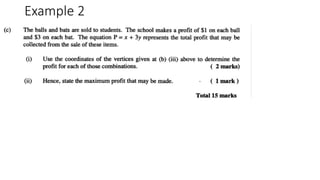
(i) P = 𝑥 + 3𝑦
B (0, 15), when 𝑥 = 0 then 𝑦 = 15
𝑃 = 1 0 + 3 15 = 0 + 45 = 45
C (20, 10), when 𝑥 = 20 then 𝑦 = 10
𝑃 = 1 20 + 3 10 = 20 + 30 = 50
D (30, 0), when 𝑥 = 30 then 𝑦 = 0
𝑃 = 1 30 + 3 0 = 30 + 0 = 30
(ii) Therefore the maximum profit that may
be made is $50, when 20 balls and 10 bats
are sold
Example 3
Example 3
Example 3
Linear Programming Based on CXC Curriculum

Linear Programming Based on CXC Curriculum

  • 1.
  • 2.
    Linear Inequalities > greaterthan ≥ greater than or equal to; at least; no less than < less than ≤ less than or equal to; at most; no more than
  • 3.
    Graphing Linear Inequalities Guidelines 2.Shade the region above or to the right of the line if the inequality is > or ≥ 1. Draw the line to represent the inequality • Use a solid line if the inequality is ≤ or ≥ • Use a dotted line if the inequality is < or > 𝑦 ≥ 10 𝑥 > 5
  • 4.
    Graphing Linear Inequalities Guidelines 3.Shade the region below or to the left of the line if the inequality is < or ≤ 𝑦 ≤ 10 𝑥 ≤ 5
  • 5.
    Graphing Linear Inequalities XY 0 10 10 0 Draw the following lines: (a) 𝑥 = 2 (b) 𝑦 = 3 (c) 𝑥 + 𝑦 = 10 When 𝑥 = 0 0 + 𝑦 = 10 𝑦 = 10 When 𝑦 = 0 𝑥 + 0 = 10 x = 10
  • 6.
    Graphing Linear Inequalities 𝑥≥ 2 𝑥 + 𝑦 ≤ 10 𝑦 ≥ 3 Shade the regions that satisfy the following inequalities: (a) 𝑥 ≥ 2 (b) 𝑦 ≥ 3 (c) 𝑥 + 𝑦 ≤ 10
  • 7.
    Example 1 (i) 𝑥+ 𝑦 ≤ 20 (ii) 15𝑥 + 30𝑦 ≤ 450
  • 8.
  • 9.
    Example 1 5 1015 20 25 30 0 0 5 10 15 20 25 30 35 (i) 𝑥 + 𝑦 ≤ 20 (ii) 15𝑥 + 30𝑦 ≤ 450 When 𝑥 = 0 0 + 𝑦 = 20 𝑦 = 20 When y = 0 𝑥 + 0 = 20 x = 20 When 𝑥 = 0 15(0) + 30𝑦 = 450 30𝑦 = 450 𝑦 = 450 30 𝑦 = 15 When y = 0 15𝑥 + 30(0) = 450 15𝑥 = 450 𝑥 = 450 15 𝑥 = 30 𝒙 𝒚 0 20 20 0 𝒙 𝒚 0 15 30 0     A B C D
  • 10.
    Example 1 (iii) A(0, 0) B (0, 15) C (10, 10) D (0, 20) (b)
  • 11.
    Example 1 (i) Totalprofit = 8𝑥 + 20𝑦 (ii) B (0, 15), when 𝑥 = 0 then 𝑦 = 15 𝑇𝑜𝑡𝑎𝑙 𝑝𝑟𝑜𝑓𝑖𝑡 = 8 0 + 20 15 = 0 + 300 = 300 C (10, 10), when 𝑥 = 10 then 𝑦 = 10 𝑇𝑜𝑡𝑎𝑙 𝑝𝑟𝑜𝑓𝑖𝑡 = 8 10 + 20 10 = 80 + 200 = 280 D (0, 20), when 𝑥 = 0 then 𝑦 = 20 𝑇𝑜𝑡𝑎𝑙 𝑝𝑟𝑜𝑓𝑖𝑡 = 8 0 + 20 20 = 0 + 400 = 400 Therefore the maximum profit is $400, when the pizza shop makes 0 small pizza and 20 large pizzas.
  • 12.
    Example 2 (i) 𝑥+ 𝑦 ≤ 30 (ii) 6𝑥 + 24𝑦 ≤ 360
  • 13.
  • 14.
    Example 1 10 2030 40 50 60 0 0 5 10 15 20 25 30 35 When 𝑥 = 0 0 + 𝑦 = 30 𝑦 = 30 When y = 0 𝑥 + 0 = 30 x = 30 When 𝑥 = 0 6(0) + 24𝑦 = 360 24𝑦 = 360 𝑦 = 360 24 𝑦 = 15 When y = 0 6𝑥 + 24(0) = 360 6𝑥 = 360 𝑥 = 360 6 𝑥 = 60 𝒙 𝒚 0 30 30 0 𝒙 𝒚 0 15 60 0     A B C D (i) 𝑥 + 𝑦 ≤ 30 (ii) 6𝑥 + 24𝑦 ≤ 360
  • 15.
    Example 2 (b) (iii) A(0, 0) B (0, 15) C (20, 10) D (30, 0)
  • 16.
    Example 2 (i) P= 𝑥 + 3𝑦 B (0, 15), when 𝑥 = 0 then 𝑦 = 15 𝑃 = 1 0 + 3 15 = 0 + 45 = 45 C (20, 10), when 𝑥 = 20 then 𝑦 = 10 𝑃 = 1 20 + 3 10 = 20 + 30 = 50 D (30, 0), when 𝑥 = 30 then 𝑦 = 0 𝑃 = 1 30 + 3 0 = 30 + 0 = 30 (ii) Therefore the maximum profit that may be made is $50, when 20 balls and 10 bats are sold
  • 17.
  • 18.
  • 19.