Limiting Access to Limited Resources?
Homelessness & Housing Options in
Wiltshire: September 2009 – May 2010
Social Policy report #001
Release date: 17/01/2011
____________________________________________
LimitingAccessToLimitedResources_FullReport_FINAL_17012011.doc
Author: Dominic Cassidy, Social Policy Officer, Wiltshire Advice Partnership Page 2 of 33
HOMELESSNESS & HOUSING OPTIONS IN WILTSHIRE
SEPTEMBER 2009 – MAY 2010
TABLE OF CONTENTS
1. Introduction...........................................................................................................3
1.1. Wiltshire Advice Partnership ........................................................................ 3
1.2. Partner background...................................................................................... 3
1.3. Focus, context and purpose......................................................................... 4
1.3.1. Focus .................................................................................................... 4
1.3.2. Context.................................................................................................. 4
1.3.3. Purpose................................................................................................. 6
1.4. Methodology................................................................................................. 6
1.4.1. Sources of data..................................................................................... 6
1.4.2. Evidence forms ..................................................................................... 7
1.4.3. Housing Options monitoring survey ...................................................... 8
1.4.4. Parameters of the report ....................................................................... 8
1.5. Structure....................................................................................................... 9
2. Homelessness prevention and Housing Options................................................11
2.1. Overview (1)............................................................................................... 11
2.2. Issues in detail (1) ...................................................................................... 13
2.2.1. Making a homelessness application.................................................... 13
2.2.2. Quality of information and advice........................................................ 16
3. Housing Options and 16 and 17 year olds..........................................................17
3.1. Overview (2)............................................................................................... 17
3.2. Issues in detail (2) ...................................................................................... 19
3.2.1. Assessing homelessness and ‘chid in need’ status............................. 19
3.2.2. Referrals to Children’s Services.......................................................... 19
3.2.3. Suitability of accommodation and repeat homelessness..................... 20
3.2.4. Quality of information and advice........................................................ 20
4. Housing Options monitoring survey....................................................................22
4.1. Quality of customer care ............................................................................ 22
4.2. Quality of advice......................................................................................... 22
4.3. Homelessness applications........................................................................ 23
4.4. Summary of survey .................................................................................... 23
5. Key findings........................................................................................................24
5.1. General: relevant to all applicants .............................................................. 24
5.2. 16 and 17 year olds.................................................................................... 26
5.3. Conclusion ................................................................................................. 27
6. Key recommendations........................................................................................29
7. Bibliography........................................................................................................31
8. List of appendices...............................................................................................32
1) Social Policy Evidence Form
2) Bureau Evidence Form
3) Housing Options Monitoring Questionnaire
4) Housing Options Monitoring Questionnaire results
5) Analysis of submitted social policy evidence forms
9. Acknowledgements ............................................................................................32
10. Contact details....................................................................................................33
____________________________________________
LimitingAccessToLimitedResources_FullReport_FINAL_17012011.doc
Author: Dominic Cassidy, Social Policy Officer, Wiltshire Advice Partnership Page 3 of 33
1. INTRODUCTION
1.1. Wiltshire Advice Partnership
The Wiltshire Advice Partnership (the Partnership/WAP) is one of a series of projects running
across the UK that are funded by the Big Lottery Advice Plus programme. The Partnership
has aims and objectives designed to develop, coordinate and improve existing advice
services to the people of Wiltshire. It is a three year project which is funded until August
2012.
The subject areas covered by the project are: Housing, Welfare Benefits, Debt and
Employment.
Its goals are to introduce a referral system between advice agencies; provide quality support
and training to its members so as to embed good and consistent practice between them; and
to identify any social policy issues affecting our clients and report those to the appropriate
bodies and campaign to effect changes.
The members of the Partnership are:
• Wiltshire Citizens Advice (WCA incorporates the four former Bureaux in Wiltshire and is
the lead Partner)
• Action for Blind People
• Age UK, Salisbury District
• Age UK, Wiltshire
• Alabaré Christian Care & Support
• Sarsen Housing Association
• Shearer & Company
• Sylvester Mackett
• Will Rolt Solicitors
1.2. Partner background
The Partnership have day to day experience of homelessness through contact with our
clients. Indeed homelessness prevention is a key part of our work in the area of Housing and
links into the associated areas of Debt, Employment and Welfare Benefits.
Three Partners (Will Rolt Solicitors, Shearer & Co. and Wiltshire Citizens Advice) have Legal
Services Commission housing contracts to supply caseworkers for clients with housing
difficulties. They have considerable experience both in dealing with clients who are homeless
____________________________________________
LimitingAccessToLimitedResources_FullReport_FINAL_17012011.doc
Author: Dominic Cassidy, Social Policy Officer, Wiltshire Advice Partnership Page 4 of 33
and in preventing homelessness. All three have contributed data during the period covered
by the report.
From this work we are very aware not only of the issues involved both legally and
procedurally but also in terms of the damage which homelessness inflicts on every aspect of
people’s lives including their health, relationships and financial well being.
1.3. Focus, context and purpose
1.3.1. Focus
The focus of this report is how the Housing Options service operated by Wiltshire Council
deals with clients who are homeless or threatened with homelessness within 28 days.
1.3.2. Context
In April 2009 the four former Wiltshire District Councils were merged to become the new
unitary authority of Wiltshire Council. In terms of housing options services this involved the
merging of four separate teams with offices in Chippenham, Devizes, Salisbury and
Trowbridge.
The climate for dealing with homelessness in Wiltshire is challenging. In April 2010 there
were 10,654 households on the housing register. In the previous year (1 April 2009-31 March
2010) 2052 homes were let to households on the register (Wiltshire Council (2010a),
Homelessness Strategy 2010-2015, pp.26-271
). If each year a similar number of households
on the housing register obtained lets it would take over 5 years to be housed without taking
into account any new households coming onto the register.
This issue is recognised by the Council, “There is a huge gap between the total number of
lets compared to the total number of households on the register. From the information
gleaned, it is evident that there is a long wait for households to be housed from the register,
as demand far outstrips supply.” They also pinpoint the causes, “There is a shortage of
suitable, affordable accommodation for those in housing need. Owner occupation and renting
in the private sector is beyond the means of a great number of households.” And they go on
to look to possible solutions, “Homelessness can only be prevented if suitable affordable
accommodation is made available. … It would be impossible for us to meet all the need for
housing through building new affordable homes, therefore in response to this high demand
1
Where a publication or document is referenced in the text, on first occurrence the title will be
provided in full, thereafter only the publisher, the year and the page number will be listed. For all
sources and complete references please see the Bibliography (section 7 below).
____________________________________________
LimitingAccessToLimitedResources_FullReport_FINAL_17012011.doc
Author: Dominic Cassidy, Social Policy Officer, Wiltshire Advice Partnership Page 5 of 33
we are required to look at alternatives, and because of the high percentage of private rented
accommodation in Wiltshire this was considered a priority.” (Wiltshire Council (2010a), pp.27-
28).
There is clearly a dichotomy between what is needed and what can be delivered in terms of
housing for homeless households but, it would seem, that the hope of the private rented
sector being able to provide a solution is “beyond the means of a great number of
households.”
Since the introduction of the Homelessness Act 2002, successive governments have
encouraged a prevention focused approach to homelessness.
“In its broadest terms, ‘homelessness prevention’ is where a local authority takes positive
action to provide housing assistance to someone who considers him or herself to be at risk of
homelessness in the near future, and as a result the person is able to either remain in his or
her existing accommodation or obtain alternative accommodation, providing a solution for at
least the next six months.” (DCLG (2009b), P1E Guidance: Homelessness Prevention and
Relief, p.4).
In recent years this prevention centred approach has been followed by the four separate
District Councils’ housing teams and now has been carried on by the new unified Housing
Options Service as part of their homelessness strategy. This policy has seen a significant
reduction in homelessness acceptances along with a corresponding reduction in the
numbers of people in temporary accommodation in recent years.
In 2003 central government invited local authorities to commit to a suggested target that the
number of homelessness acceptances be reduced each year (ODPM (2003b), Achieving
Positive Outcomes on Homelessness, pp.3, 8-10); DCLG (2007), Evaluating Homelessness
Prevention, p.20, 1.9); Wiltshire Council (2010a), p.5). This was followed up in 2005 with an
obligatory target to halve (from the level recorded in December 2004) the number of
households placed in temporary accommodation by December 2010 (ODPM (2005),
Sustainable Communities: Homes for All, p.57, 7.3).
In 2005-2006 in the whole of Wiltshire there were 882 applications for homelessness
assessments with 619 accepted as homeless; by 2009-2010 the level of applications had
fallen to 377 with acceptances falling to 271 (Wiltshire Council (2009), Key Trend [sic] in
Homelessness, p.2; and Wiltshire Council (2010a), p.34). In percentage terms this is a
____________________________________________
LimitingAccessToLimitedResources_FullReport_FINAL_17012011.doc
Author: Dominic Cassidy, Social Policy Officer, Wiltshire Advice Partnership Page 6 of 33
reduction of 57% in applications and 56% in acceptances. During the same period (2005-
2010) the number of households in temporary accommodation has fallen from 383 to 150 a
drop of almost 61% (Wiltshire Council (2010a), p.12). (Please note percentages are
calculated by WAP.)
In addition to the 377 households who were assessed for homelessness in 2009-2010, 1685
households who considered themselves as homeless or threatened with homelessness had
their homelessness prevented through actions by the Housing Options team. Amongst other
categories this includes 195 who were placed in supported accommodation, 378 who were
helped to find accommodation in the private sector through the Wilts Let rent deposit
guarantee scheme, and 518 who had their homelessness prevented through the provision of
advice and assistance (Wiltshire Council (2010a), p.14).
Despite the real achievements that are shown by these statistics in recent months members
of the Partnership have seen a number of clients who appear to have been disadvantaged by
the current procedures and practices being followed by the Housing Options team. Thus, we
have become concerned that the above falls in homelessness applications and the
corresponding fall of those in temporary accommodation may in part have been achieved at
the expense of properly assessing the housing needs of some people who were homeless or
threatened with homelessness.
1.3.3. Purpose
In order to try and get a clearer picture of the situation this report uses information from
clients and client cases to highlight issues with current practices on service provision. It looks
at various aspects of the service including the prevention of homelessness, the treatment of
applicants who are homeless or threatened with homelessness, the working practices for 16
and 17 year olds presenting to the Housing Options team and the consistency and quality of
customer care and advice.
Its purpose is to present the findings from our data collection exercises and make a series of
recommendations with the aim of improving services to the residents of Wiltshire.
1.4. Methodology
1.4.1. Sources of data
The report is based on two main sources of data. First, social policy ‘evidence forms’
submitted by WAP Partners and second a small sample survey using a client follow up
questionnaire, which we refer to as the ‘Housing Options monitoring survey’.
____________________________________________
LimitingAccessToLimitedResources_FullReport_FINAL_17012011.doc
Author: Dominic Cassidy, Social Policy Officer, Wiltshire Advice Partnership Page 7 of 33
In total 35 pieces of data were collected through evidence forms and the Housing Options
monitoring survey which represents just over 2% of the total of 1685 homelessness
preventions and almost 10% of the number of homelessness applications recorded by the
council in 2009-2010.
1.4.2. Evidence forms
Social policy evidence forms detail individual clients’ encounters with the service and the
issues of policy, procedure or practice experienced by them during these encounters (see
Appendices 1 and 2 for examples of the forms used). The forms were filled out by trained
Partner advisors and co-ordinators and submitted between 01/09/2009 and 14/05/2010.
During this time 23 relevant forms were submitted by five Partners: North Wiltshire Citizens
Advice Bureau (CAB), Salisbury & District CAB, Shearer & Co., West Wiltshire Wide CAB
and Will Rolt Solicitors and cover the council’s housing offices in Chippenham, Devizes,
Salisbury and Trowbridge.
The forms do not carry any details that would help identify the clients involved and, when
used as a case study in the report, the details are further edited to remove any characteristic
particulars to ensure client anonymity and confidentiality. We therefore cannot identify any of
the clients.
1.4.2.1 Limitations of evidence form data
The content of the evidence forms have been taken largely at face value. We rely on the
knowledge and skills of Partners’ trained advisors to give us an accurate account. WAP
verifies that the client exists, that different evidence forms do not duplicate the same client
and that case notes for each client are up to date.
It is important to note that the evidence forms submitted have a bias toward those who were
not satisfied with their outcome and/or the service they received and therefore sought further
help from Partners. In addition, advisors usually only submit evidence forms with examples of
poor practice.
The evidence forms can show broadly how things are going wrong but cannot shed light on
how frequent or widespread these problems are.
____________________________________________
LimitingAccessToLimitedResources_FullReport_FINAL_17012011.doc
Author: Dominic Cassidy, Social Policy Officer, Wiltshire Advice Partnership Page 8 of 33
1.4.2.2 Analysis of evidence form data
In order to establish the issues which the report details, the content of the evidence forms is
analysed by counting the number of times a particular type of incident occurred. It is,
therefore, a number of cases of similar incidents that reveal and verify that there is a real
issue of concern to be addressed. The issues related, therefore, do not come from isolated
incidents but only where one case is corroborated by at least one other similar case. (See
Appendix 7 for an analysis of the evidence forms received.)
1.4.2.3 Use of case studies
The report selects case studies from the submitted evidence forms which highlight and
identify the particular procedures and practices causing clients difficulties and that
demonstrate the effects of these practices on clients. These are not intended to be used as
case reviews because, as previously stated, we cannot identify clients.
The forms collected demonstrate multiple concerns for each client’s homelessness issue.
Thus, the cases cited are provided as illustrations of a main issue and also demonstrate a
range of other problems encountered. (See Appendix 7 for an analysis of the evidence forms
received.)
Any client’s case that is given as an exemplar is used only once.
1.4.3. Housing Options monitoring survey
The Housing Options monitoring survey was administered by the former West Wiltshire Wide
and North Wiltshire Citizens Advice Bureaux (see Appendices 3 and 4 for a copy of the
questionnaire and results respectively). The questionnaire asked about clients’ experiences
of the Housing Options service looking at the quality of customer care, advice and
homelessness applications. Advisors followed up Bureaux clients who had approached the
Housing Options Service between 01/09/2009 and 29/01/2010. A total of 12 responses were
collected from the clients of these two Partners.
The survey results should not be subject to the same degree of bias as the evidence forms
because all clients who were likely to have had contact with the Housing Options team were
contacted for feedback regardless of their experiences.
1.4.4. Parameters of the report
The results of the questionnaire and the evidence forms are not intended to provide either a
comprehensive review of the entire Housing Options service or a representative sample of
____________________________________________
LimitingAccessToLimitedResources_FullReport_FINAL_17012011.doc
Author: Dominic Cassidy, Social Policy Officer, Wiltshire Advice Partnership Page 9 of 33
the people who have approached the Council for homelessness advice and assistance.
Instead the report provides a summary of issues that have been encountered by WAP
Partner clients who have had dealings with the service.
In analysing the data overall, we are looking at what it can tell us about the broad strengths
and weaknesses of the services being provided rather than the specific details of particular
cases.
Each issue described can be used to infer the possible impact of the same policies,
procedures and practices on the wider group of people using those services that have not
been captured either because their cases were not reported by an advisor or because they
did not make contact with a WAP Partner.
It should also be remembered that, because of the sample size, the findings of this report
cannot be definitive. At best they give a provisional indication of issues occurring in the
service. Further research will need to be conducted in order to create a more detailed picture
of what is happening on the ground, establish when and where these issues occur, how
widespread and frequent they are, and whether any changes made to the service have had a
beneficial effect on clients. (See recommendation 12, p.30 below).
Even considering the limitations mentioned above, patterns are apparent in the data that
allow clear conclusions to be drawn and firm recommendations to be made.
1.5. Structure
The report is divided into six main sections:
• This section, the ‘Introduction’ (section 1), which outlines the focus, context and purpose
of the report as well as the methodology and structure.
• The research is presented in three sections,
o ‘Homelessness prevention and Housing Options’ (section 2), gives an overview of the
relevant legal framework, guidelines and best practice for adult homelessness and
then looks at the evidence forms submitted on how the Housing Options team is
dealing with those clients presenting as homeless or at risk of becoming homeless;
o ‘Housing Options and 16 & 17 year olds’ (section 3), gives an overview of the relevant
legal framework, recent cases and guidelines and then looks at the evidence forms
submitted on how the Housing Options team is dealing with 16 and 17 year olds;
o The ‘Housing Options monitoring survey’ (section 4), summarises the findings of the
client follow up questionnaire.
____________________________________________
LimitingAccessToLimitedResources_FullReport_FINAL_17012011.doc
Author: Dominic Cassidy, Social Policy Officer, Wiltshire Advice Partnership Page 10 of 33
• ‘Key findings’ (section 5), summarises the issues raised by the research overall and
draws conclusions.
• ‘Key recommendations’ (section 6), outlines WAP’s main recommendations.
Other sections contain a bibliography (7), a list of appendices (8), acknowledgements (9),
and contact details (10).
____________________________________________
LimitingAccessToLimitedResources_FullReport_FINAL_17012011.doc
Author: Dominic Cassidy, Social Policy Officer, Wiltshire Advice Partnership Page 11 of 33
2. HOMELESSNESS PREVENTION AND HOUSING OPTIONS
2.1. Overview (1)
In Homelessness Prevention: a guide to good practice (DCLG (2006a)), the authors outline
the essential principles that a housing options approach should include:
• “Providing an improved service for all customers with less distinction in the service
provided to applicants in relation to their probable ‘priority need’ status – asking ‘how can
we help?’ rather than ‘who can we help?’
• examining all possible accommodation solutions both in relation to retaining any existing
tenancy or residency and in respect of accessing a new tenancy
• exploring the pros and cons of any available and appropriate options to help applicants
themselves make informed decisions or choices
• adopting no prior assumptions as to whether a social rented tenancy might prove to be
an applicant’s most appropriate rehousing solution
• making full use of information about an interviewee’s current housing circumstances to
assess whether there is ‘reason to believe’ the applicant is homeless or threatened with
homelessness – and therefore eligible for a formal homelessness assessment
• processes with sufficient flexibility so that – where applicable – a full homelessness
assessment can be conducted without delay.” (DCLG (2006a), p.17, 2.12)
Housing Options interviews are also described as being “a crucial element of the new
approach to homelessness prevention. It is, therefore, important that this process improves
outcomes and does not unduly delay a statutory homelessness assessment if this is
necessary. It is also important that it is inspired by a desire to improve the help on offer, and
not by a ‘gatekeeping’ mentality – i.e. where the process is seen primarily as a device to
prevent or discourage people from seeking housing assistance. The housing options
approach should never replace or delay a statutory homelessness assessment where the
authority have reason to believe that someone is homeless or threatened with
homelessness.” (DCLG (2006a), p.17, 2.11)
Part 7 of the 1996 Housing Act (1996 Act) defines when a person is homeless or threatened
with homelessness and imposes duties on local housing authorities when an officer has
‘reason to believe’ that a person presenting themselves to the authority is homelessness or
threatened with homelessness. The first duty is to make “such inquiries as are necessary to
satisfy themselves (a) whether he is eligible for assistance and (b) if so, whether any duty,
and if so what duty, is owed to him” (Section 184 (1)).
____________________________________________
LimitingAccessToLimitedResources_FullReport_FINAL_17012011.doc
Author: Dominic Cassidy, Social Policy Officer, Wiltshire Advice Partnership Page 12 of 33
These inquiries should look at five criteria pertaining to the applicant:
1. Are they eligible for assistance?
o Under Section 183 (2), certain categories of people from abroad and asylum seekers
and their dependents are excluded from the local authority’s homeless duties
2. Is the household homeless or threatened with homelessness?
o As defined in Section 175 (1, 2 & 3), an applicant is homeless if there is no
accommodation they are entitled to occupy or that is reasonable for them to continue
to occupy, or they cannot secure entry to it, or it consists of a moveable structure,
vehicle or vessel and there is no place they are permitted to both place it and reside
in it.
o “A person is threatened with homelessness if it is likely that he will become homeless
within 28 days.” (Section 175 (4))
3. Is the applicant in priority need?
o Section 189 (1) of the 1996 Act and Statutory Instrument 2002/2051 The
Homelessness (Priority Need for Accommodation) (England) Order between them
provide that 11 categories of applicant have a priority need for accommodation, these
include: pregnant women; people with dependent children; people vulnerable due to
old age, mental illness, physical or mental disability “or other special reason”; 16 and
17 year olds; care leavers under the age of 21; people vulnerable as a result of:
having been a member of the armed forces, having been in prison, ceasing to occupy
accommodation because of violence or threats of violence.
4. Is the applicant intentionally homeless?
o “A person becomes homeless intentionally if he deliberately does or fails to do
anything in consequence of which he ceases to occupy accommodation which is
available for his occupation and which it would have been reasonable for him to
continue to occupy.” (Section 191 (1))
5. Does the applicant have a local connection?
o Under Section 199 (1) an applicant is counted as having a local connection with the
district of a local housing authority because they are or were normally resident there,
or they are employed there, or because of family associations, or because of “special
circumstances.”
Furthermore, “On completing their inquiries the authority shall notify the applicant of their
decision and, so far as any issue is decided against his interests, inform him of the reasons
for their decision” (Section 184 (3)). Moreover, under Section 184 (5) and (6), this notice
should be given in writing and inform the person of their right to request a review of the
decision.
____________________________________________
LimitingAccessToLimitedResources_FullReport_FINAL_17012011.doc
Author: Dominic Cassidy, Social Policy Officer, Wiltshire Advice Partnership Page 13 of 33
The Homelessness Code of Guidance for Local Authorities (DCLG (2006b)) provides a
comprehensive summary of the legislation and its implications for local authorities for follow.
In addition to the legislative framework and the published guidelines, the performance of the
service is measured using the Audit Commission’s Housing Inspectorate Key Lines of
Enquiry for Local Authority Strategic Involvement: Homelessness & Housing Advice (October
2007). These assess the service delivered against a pre-determined set of criteria regarding
what would constitute an excellent and a fair service (see Appendix 6 for complete KLOE’s).
2.2. Issues in detail (1)
2.2.1. Making a homelessness application
2.2.1.1 Responses to requests for assessments
Despite the duty of the Council to make inquiries under Section 184 of the 1996 Act when
they have reason to believe someone is homeless or threatened with homelessness, data
submitted indicates that there are occasions where the onus to trigger a homelessness
assessment seemed to be placed on the client and/or external agencies requesting one.
A) A client with a history of depression was threatened with eviction within 28 days. He
approached the Council for advice and assistance and showed a copy of the eviction
warrant but was asked to come back when the bailiffs had attended the property. When a
WAP Partner contacted the Housing office on the client’s behalf the request for an
assessment was accepted. In the interim, the client had found the pressure of the
possession proceedings and the fear of being ‘street homeless’ very worrying and
stressful.
In the above case the Housing office belatedly accepted the Partner’s referral after an initial
delay; however, on other occasions referrals for homelessness assessments were refused
as illustrated below.
B) A client with two young children presented herself to the Council but the Housing office
would not help her because it was thought that she was intentionally homeless. (No
formal assessment was made and no Section 184 decision notice was issued). A WAP
Partner advised the client to make an application to be assessed for homelessness and
gave her a referral letter as she met the criteria for priority need. The Housing office
refused to accept the application. At last contact the client was moving between different
family members’ accommodation none of which was large enough for the family.
____________________________________________
LimitingAccessToLimitedResources_FullReport_FINAL_17012011.doc
Author: Dominic Cassidy, Social Policy Officer, Wiltshire Advice Partnership Page 14 of 33
Because of this situation the school age child was not attending school and the client and
her children were very stressed and unsettled.
Client A was clearly about to become homeless and may have been in priority need due to
his mental illness and therefore should have received an assessment at first contact. If the
Partner had not intervened the client’s assessment would have been delayed even further.
Client B was actually homeless and was in priority need due to having dependent children
(Section 189 (1)). As such, even if she was found intentionally homeless, the Council should
have made suitable temporary housing available whilst she was given “a reasonable
opportunity of securing accommodation” for herself (Section 188 (1)), and further should also
have provided “advice and such assistance as they consider appropriate in the
circumstances” (Section 190 (2)). The Housing Service’s refusal to accept the referral for
client B ties in with the results of the Housing Options monitoring survey which suggest there
is under recording of clients who are homeless or threatened with homelessness (see
section 4 below). The approach taken by the Housing office also increased the stress and
worry felt by both clients.
2.2.1.2 Quality of assessments: Availability of accommodation
The outcome of some homelessness assessments appears to have been driven by officers
making the client aware of the lack of suitable interim and temporary accommodation.
C) A pregnant client was told that if she were accepted as homeless the only suitable
temporary accommodation was in another area of the county. This would have taken her
away from her family, support network and maternity care and so the client was
discouraged from continuing with the application. A WAP Partner advised her to re-visit
the Council and try to make an application for a homelessness decision again. She
returned shortly after having been told by the Housing office that there was no form to
make a homelessness application, and that she had already made one anyway. The
Partner provided the client with a referral letter as she was in priority need due to her
pregnancy (Section 189 (1)) and subsequently was contacted by the Housing office. They
accepted they had a duty to the client, but advised that a full homeless assessment and
decision had not been made because the client had stated she would not accept
accommodation outside the locality.
D) A client with a history of drug problems presented himself to the Council for advice and
assistance with his accommodation. He was told that if accepted as homeless he would
be offered accommodation in another area of the county, or in a hostel. He could not
____________________________________________
LimitingAccessToLimitedResources_FullReport_FINAL_17012011.doc
Author: Dominic Cassidy, Social Policy Officer, Wiltshire Advice Partnership Page 15 of 33
move out of the area because he had elderly relatives there who he helped look after and
did not want to accept hostel accommodation as it might bring him into contact with drug
takers when he was trying to stay ‘clean’. The WAP Partner contacted the Housing office
to be told officers had not proceeded with the homelessness assessment as they could
only offer accommodation out of the locality.
The cases above appear to demonstrate that formal homelessness assessments had been
started but were not completed when the client was made aware of the lack of availability of
suitable accommodation in their locality and as a result was discouraged from continuing.
(For a similar occurrence see client H (p.16 below)). In addition “Housing authorities should
…, wherever possible, secure accommodation that is as close as possible to where they
were previously living, so they can retain established links with schools, doctors, social
workers and other key services and support essential to the well-being of the household.”
(DCLG, (2006b), p.142, 17.41). Furthermore, there is a contradiction between client C being
told that she had already made a homeless application and the Partner adviser being told
that a full homelessness assessment had not been made.
2.2.1.3 Quality of assessments: Intentionality and Priority need
In addition, to the issue of accommodation, a number of cases (including client B (p.13
above)) demonstrate what appears to be an over-willingness on the part of officers to
assume clients are intentionally homeless whilst also appearing to be reluctant to recognise
their priority needs.
E) Clients with children below 16 became homeless because they were fleeing threats of
violence which were reported to the Police. They approached the Council for advice and
assistance. They were told that they were intentionally homeless and, because of this,
could not be given any help. (No formal assessment was made and no Section 184
decision notice was issued). They were sent away without any further advice. This
resulted in the family having to sleep in the living room of a relative’s small flat which has
caused them to feel unsettled, worried and stressed.
The decision regarding the clients’ intentionality could have been challenged if a Section 184
decision had been issued. Furthermore, according to Section 189 (1) of the 1996 Act and
Statutory Instrument 2002/2051, the clients could have been classed as being in priority
need under two criteria, first, that there were dependent children residing with the adults and
second, that they were fleeing threats of violence and therefore, under Section 188 (1), the
Council may have had an interim duty to accommodate the family whilst it made its inquiries.
____________________________________________
LimitingAccessToLimitedResources_FullReport_FINAL_17012011.doc
Author: Dominic Cassidy, Social Policy Officer, Wiltshire Advice Partnership Page 16 of 33
2.2.2. Quality of information and advice
Some clients appear to be put off making homelessness applications by officers providing
them with information that was inaccurate, misleading, inconsistent or confusing.
F) A client who had recently left prison and was returning to the area approached the
Council. She had been sofa surfing with friends and family but had nowhere permanent
to stay. She was seen by someone on the front desk and was told that if she found
private rented accommodation the Council would pay the deposit. Following this advice
the client went to a housing agency, found a property, completed the paperwork and
obtained a draft tenancy agreement. She returned to the housing office with the
paperwork but was told that her deposit would not be paid as she was not in priority
need. (No formal assessment was made and no Section 184 decision notice was issued).
The client did not have the money and so lost the property.
G) Another client had received a County Court Possession Order and was under threat of
eviction within 28 days. The Housing office advised him to go to a WAP Partner and ask
for them to apply to delay the Possession Order for 42 days. This was an unrealistic
expectation given the client’s situation and although the application for an extension was
made by the Partner it failed (as expected) and the property was re-possessed. With
advice from the Partner the client was able to find a privately rented room in a house.
H) A client who had had her home re-possessed, was advised to go to a credit union for a
loan to pay the deposit on a private rental property even though she was not a member of
the union and a qualifying period would be necessary before any loan could be given.
She had previously been told that if she were housed under the homelessness duty the
housing would be “miles away”.
In each of these cases the clients were advised to take a course of action that did not solve
their respective problems but created further difficulties and pressures at a time of intense
stress. Client F may have been vulnerable due to having been in prison and, therefore, in
priority need. Both clients G and H could have been assessed for homelessness.
____________________________________________
LimitingAccessToLimitedResources_FullReport_FINAL_17012011.doc
Author: Dominic Cassidy, Social Policy Officer, Wiltshire Advice Partnership Page 17 of 33
3. HOUSING OPTIONS AND 16 AND 17 YEAR OLDS
3.1. Overview (2)
In terms of homelessness, the treatment of 16 and 17 year old people is also governed by
the same legislation, guidelines and measures as adults. Added to these a local authority
has additional duties that arise in relation to “children in need”. Children in need are
statutorily defined in the Children Act 1989 (1989 Act):
• “… a child shall be taken to be in need if—
(a) he is unlikely to achieve or maintain, or to have the opportunity of achieving or
maintaining, a reasonable standard of health or development without the provision for
him of services by a local authority …;
(b) his health or development is likely to be significantly impaired, or further impaired,
without the provision for him of such services; or
(c) he is disabled”
(Section 17 (10))
Furthermore, Section 20 (1) states that:
• “Every local authority shall provide accommodation for any child in need within their area
who appears to them to require accommodation as a result of—
(a) there being no person who has parental responsibility for him;
(b) his being lost or having been abandoned; or
(c) the person who has been caring for him being prevented (whether or not
permanently, and for whatever reason) from providing him with suitable
accommodation or care.”
In recent years judgments have been handed down by the House of Lords in cases
concerning the interrelationship between the duty under section 20 of the 1989 Act and
duties under Part 7 of the 1996 Act in the case of young people aged 16 or 17 who require
accommodation. The most recent of these cases has been R (G) v Southwark [2009] UKHL
26.
In response to these judgements, the Secretaries of State for the Department of Children,
Schools and Families (DCSF) and for the Department of Communities and Local
Government (DCLG) issued updated guidance in April of this year entitled Provision of
Accommodation for 16 and 17 year old young people who may be homeless and/or
threatened with homelessness (April 2010 guidelines) (DCSF et al (2010)).
____________________________________________
LimitingAccessToLimitedResources_FullReport_FINAL_17012011.doc
Author: Dominic Cassidy, Social Policy Officer, Wiltshire Advice Partnership Page 18 of 33
“These judgments have restated and clarified the established legal position that the duty
under section 20 of the 1989 Act takes precedence over the duties in the 1996 Act in
providing for children in need who require accommodation, and that the specific duty owed
under section 20 of the 1989 Act takes precedence over the general duty owed to children in
need and their families under section 17 of the 1989 Act.” (DCSF et al (2010), p.2, Section
1.1)
“Where the initial approach or referral for housing assistance is made to housing services,
the authority should treat the approach/referral as an application for assistance under Part 7
of the 1996 Act. The authority will therefore need to decide whether there is reason to believe
the young person may be homeless or likely to become homeless within 28 days (section
184 of the1996 Act) and, if so, the authority will need to make inquiries to determine whether
any duty is owed under Part 7 of the 1996 Act.” - “If there is reason to believe the young
person may be eligible for assistance, may be homeless and may be 16 or 17 years of age,
the authority will have an immediate duty to secure interim accommodation (section 188(1) of
the 1996 Act) pending a decision whether any substantive duty is owed under Part 7. Such
accommodation must be suitable for a 16 & 17 year old and, in considering suitability,
authorities should bear in mind that 16 and 17 year olds who are homeless and estranged
from their family will be particularly vulnerable and in need of support. The Secretary of State
considers that Bed and Breakfast accommodation is unsuitable for 16 and 17 year olds.” – “If
the young person may be homeless or may be likely to become homeless within 28 days,
housing services should make an immediate referral to children’s services for an
assessment. This applies to all 16 and 17 year old applicants without exception” (DCSF
(2010), p.4, Sections 2.9, 2.10, 2.11)
The policy document issued by the Head of Housing Options for Wiltshire Council on 12 April
2010 regarding the treatment of 16 and 17 year olds, indicates the Council recognises the
need for:
1. Agreeing a joint protocol between Housing and Children’s Services including a clear
pathway and referral procedure.
2. Researching best practice at other local authorities where Children’s and Housing
Services are working together in order to develop good practices and procedures.”
3. Ensuring all staff and managers are fully aware of the Southwark ruling and its
implications for fulfilling the local authority’s statutory duties.
4. Ensuring all front line staff and managers have an understanding of the duties under Part
3 of the Children Act 1989 and Part 7 of the Housing Act 1996.
____________________________________________
LimitingAccessToLimitedResources_FullReport_FINAL_17012011.doc
Author: Dominic Cassidy, Social Policy Officer, Wiltshire Advice Partnership Page 19 of 33
5. Working strategically with registered social landlords; supported accommodation
providers; supporting people and other partners to secure a range of accommodation
options.
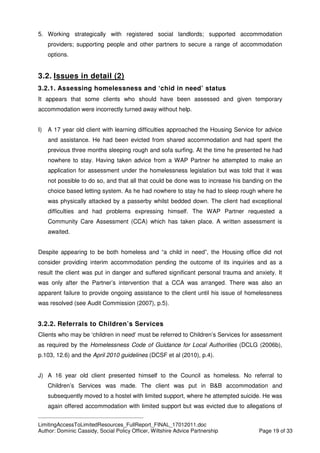
3.2. Issues in detail (2)
3.2.1. Assessing homelessness and ‘chid in need’ status
It appears that some clients who should have been assessed and given temporary
accommodation were incorrectly turned away without help.
I) A 17 year old client with learning difficulties approached the Housing Service for advice
and assistance. He had been evicted from shared accommodation and had spent the
previous three months sleeping rough and sofa surfing. At the time he presented he had
nowhere to stay. Having taken advice from a WAP Partner he attempted to make an
application for assessment under the homelessness legislation but was told that it was
not possible to do so, and that all that could be done was to increase his banding on the
choice based letting system. As he had nowhere to stay he had to sleep rough where he
was physically attacked by a passerby whilst bedded down. The client had exceptional
difficulties and had problems expressing himself. The WAP Partner requested a
Community Care Assessment (CCA) which has taken place. A written assessment is
awaited.
Despite appearing to be both homeless and “a child in need”, the Housing office did not
consider providing interim accommodation pending the outcome of its inquiries and as a
result the client was put in danger and suffered significant personal trauma and anxiety. It
was only after the Partner’s intervention that a CCA was arranged. There was also an
apparent failure to provide ongoing assistance to the client until his issue of homelessness
was resolved (see Audit Commission (2007), p.5).
3.2.2. Referrals to Children’s Services
Clients who may be ‘children in need’ must be referred to Children’s Services for assessment
as required by the Homelessness Code of Guidance for Local Authorities (DCLG (2006b),
p.103, 12.6) and the April 2010 guidelines (DCSF et al (2010), p.4).
J) A 16 year old client presented himself to the Council as homeless. No referral to
Children’s Services was made. The client was put in B&B accommodation and
subsequently moved to a hostel with limited support, where he attempted suicide. He was
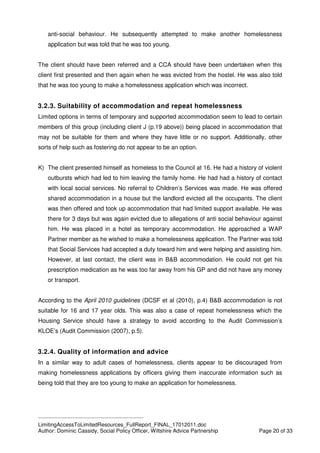
again offered accommodation with limited support but was evicted due to allegations of
____________________________________________
LimitingAccessToLimitedResources_FullReport_FINAL_17012011.doc
Author: Dominic Cassidy, Social Policy Officer, Wiltshire Advice Partnership Page 20 of 33
anti-social behaviour. He subsequently attempted to make another homelessness
application but was told that he was too young.
The client should have been referred and a CCA should have been undertaken when this
client first presented and then again when he was evicted from the hostel. He was also told
that he was too young to make a homelessness application which was incorrect.
3.2.3. Suitability of accommodation and repeat homelessness
Limited options in terms of temporary and supported accommodation seem to lead to certain
members of this group (including client J (p.19 above)) being placed in accommodation that
may not be suitable for them and where they have little or no support. Additionally, other
sorts of help such as fostering do not appear to be an option.
K) The client presented himself as homeless to the Council at 16. He had a history of violent
outbursts which had led to him leaving the family home. He had had a history of contact
with local social services. No referral to Children’s Services was made. He was offered
shared accommodation in a house but the landlord evicted all the occupants. The client
was then offered and took up accommodation that had limited support available. He was
there for 3 days but was again evicted due to allegations of anti social behaviour against
him. He was placed in a hotel as temporary accommodation. He approached a WAP
Partner member as he wished to make a homelessness application. The Partner was told
that Social Services had accepted a duty toward him and were helping and assisting him.
However, at last contact, the client was in B&B accommodation. He could not get his
prescription medication as he was too far away from his GP and did not have any money
or transport.
According to the April 2010 guidelines (DCSF et al (2010), p.4) B&B accommodation is not
suitable for 16 and 17 year olds. This was also a case of repeat homelessness which the
Housing Service should have a strategy to avoid according to the Audit Commission’s
KLOE’s (Audit Commission (2007), p.5).
3.2.4. Quality of information and advice
In a similar way to adult cases of homelessness, clients appear to be discouraged from
making homelessness applications by officers giving them inaccurate information such as
being told that they are too young to make an application for homelessness.
____________________________________________
LimitingAccessToLimitedResources_FullReport_FINAL_17012011.doc
Author: Dominic Cassidy, Social Policy Officer, Wiltshire Advice Partnership Page 21 of 33
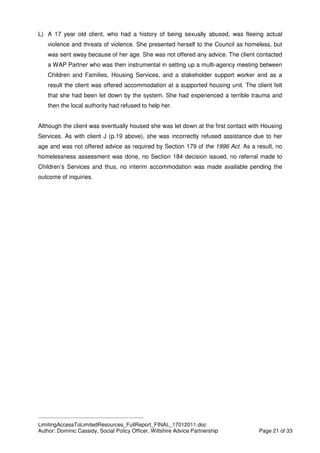
L) A 17 year old client, who had a history of being sexually abused, was fleeing actual
violence and threats of violence. She presented herself to the Council as homeless, but
was sent away because of her age. She was not offered any advice. The client contacted
a WAP Partner who was then instrumental in setting up a multi-agency meeting between
Children and Families, Housing Services, and a stakeholder support worker and as a
result the client was offered accommodation at a supported housing unit. The client felt
that she had been let down by the system. She had experienced a terrible trauma and
then the local authority had refused to help her.
Although the client was eventually housed she was let down at the first contact with Housing
Services. As with client J (p.19 above), she was incorrectly refused assistance due to her
age and was not offered advice as required by Section 179 of the 1996 Act. As a result, no
homelessness assessment was done, no Section 184 decision issued, no referral made to
Children’s Services and thus, no interim accommodation was made available pending the
outcome of inquiries.
____________________________________________
LimitingAccessToLimitedResources_FullReport_FINAL_17012011.doc
Author: Dominic Cassidy, Social Policy Officer, Wiltshire Advice Partnership Page 22 of 33
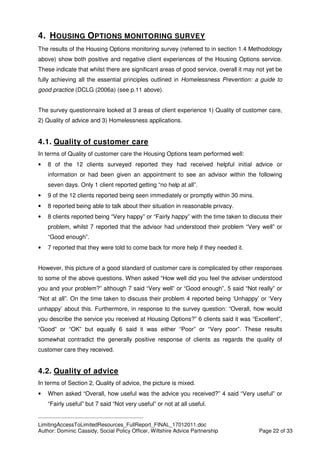
4. HOUSING OPTIONS MONITORING SURVEY
The results of the Housing Options monitoring survey (referred to in section 1.4 Methodology
above) show both positive and negative client experiences of the Housing Options service.
These indicate that whilst there are significant areas of good service, overall it may not yet be
fully achieving all the essential principles outlined in Homelessness Prevention: a guide to
good practice (DCLG (2006a) (see p.11 above).
The survey questionnaire looked at 3 areas of client experience 1) Quality of customer care,
2) Quality of advice and 3) Homelessness applications.
4.1. Quality of customer care
In terms of Quality of customer care the Housing Options team performed well:
• 8 of the 12 clients surveyed reported they had received helpful initial advice or
information or had been given an appointment to see an advisor within the following
seven days. Only 1 client reported getting “no help at all”.
• 9 of the 12 clients reported being seen immediately or promptly within 30 mins.
• 8 reported being able to talk about their situation in reasonable privacy.
• 8 clients reported being “Very happy” or “Fairly happy” with the time taken to discuss their
problem, whilst 7 reported that the advisor had understood their problem “Very well” or
“Good enough”.
• 7 reported that they were told to come back for more help if they needed it.
However, this picture of a good standard of customer care is complicated by other responses
to some of the above questions. When asked “How well did you feel the adviser understood
you and your problem?” although 7 said “Very well” or “Good enough”, 5 said “Not really” or
“Not at all”. On the time taken to discuss their problem 4 reported being ‘Unhappy’ or ‘Very
unhappy’ about this. Furthermore, in response to the survey question: “Overall, how would
you describe the service you received at Housing Options?” 6 clients said it was “Excellent”,
“Good” or “OK” but equally 6 said it was either “Poor” or “Very poor”. These results
somewhat contradict the generally positive response of clients as regards the quality of
customer care they received.
4.2. Quality of advice
In terms of Section 2, Quality of advice, the picture is mixed.
• When asked “Overall, how useful was the advice you received?” 4 said “Very useful” or
“Fairly useful” but 7 said “Not very useful” or not at all useful.
____________________________________________
LimitingAccessToLimitedResources_FullReport_FINAL_17012011.doc
Author: Dominic Cassidy, Social Policy Officer, Wiltshire Advice Partnership Page 23 of 33
• When asked “Was the information or advice you were given easy to understand?”
although 6 replied “Yes” there were 3 clients who indicated they had some difficulties
understanding.
• When asked “What Housing Options were suggested to you?” 3 clients said “No help was
offered” and a further client wasn’t sure or couldn’t remember what advice, if any, had
been given.
• Additionally, there are 12 possible responses to this question which acknowledge both
the range of options available and that each client may have more than one option to
choose or pursue at a time. On analysing responses to this question an average of 2
different possibilities was given to each client. Knowing about the different options
available is essential, but if these are not well understood by the client they may well lead
to further confusion.
• Furthermore, 6 of the 12 were not given anything in writing about the advice they
received or decisions that were taken about them.
Although, because of the limited number of respondents, the picture is not clear, when the
answers above are taken together, they may indicate that some clients are confused by the
advice they have received. If this is so, the fact that some clients were not given a written
record of the advice may have exacerbated the situation.
4.3. Homelessness applications
In terms of applications to be assessed for homelessness (dealt with by Section 3 of the
survey), WAP Partner advisors judged that 10 of the 12 respondents may have been
statutorily homeless or at risk of becoming homeless at the time of their contact with the
Housing Services team, of these 10 only 3 got the opportunity to make a homelessness
application. 5 did not get any homelessness assessment whilst the remaining 2 either didn’t
know or were not sure if they had made an application or not. If this result accurately reflects
the processing of clients who may be homeless or threatened with homelessness across the
whole client base it would suggest that the levels of homelessness in Wiltshire may be being
under recorded.
4.4. Summary of survey
Even though the results of this survey are tentative, they do seem to indicate that, whilst the
Housing Options service can often be very good in terms of customer care, there may be a
lack of consistency especially in certain key areas around quality of advice and
homelessness applications.
____________________________________________
LimitingAccessToLimitedResources_FullReport_FINAL_17012011.doc
Author: Dominic Cassidy, Social Policy Officer, Wiltshire Advice Partnership Page 24 of 33
5. KEY FINDINGS
The findings below are concerned with the apparent issues of procedure and practice found
within the Housing Options team that appear to have led to the outcomes and observations
related in the body of the report.
5.1. General: relevant to all applicants
The results from the Housing Options monitoring survey suggest that the Housing Options
team performs well on measures of customer care. There are significant areas of good
practice with clients reporting being seen promptly, being treated well and being given helpful
initial advice and information. (See section 4.1 Quality of customer of care, p.22 above)
However, the quality of housing options and homelessness advice does not seem to be
consistent. Moreover, clients often appear to be confused as to what their housing situation
is, what advice they have received and what processes or assessments they have been
through. Written summaries of interviews were not provided routinely and in at least one
case a client was seen and assessed by “someone on the front desk”. (See section 4.2
Quality of advice, p.22 above)
In addition, the number of clients who are homeless or threatened with homelessness may
be being under recorded. (See section 4.3, Homlessness applications, p.23 above)
One of the common themes reported in evidence forms is that many clients who approach
the Council seem to have undergone a somewhat restricted exploration of their current
housing/homelessness situation and/or their future housing options.
Officers do not appear to be taking into account the low threshold of the ‘reason to believe’
criterion when considering whether a client is homeless or threatened with homelessness
which would guide them to begin a formal assessment leading to a decision under Section
184 of the 1996 Act (DCLG (2007) p.35, 2.38). Instead clients appear to have experienced
an informal and incomplete assessment of their homelessness status where no formal
decisions or notices are recorded or given to the client. (See section 2.2.1.1 Responses to
requests for assessments, p.13 above)
Many of these informal and incomplete assessments appear to be accompanied by
interpretations of the intentionality and priority need criteria that could be open to question.
However since these were not accompanied by a formal Section 184 decision notice it was
not possible to request a review or appeal the decisions. Others appear to be terminated
____________________________________________
LimitingAccessToLimitedResources_FullReport_FINAL_17012011.doc
Author: Dominic Cassidy, Social Policy Officer, Wiltshire Advice Partnership Page 25 of 33
when the lack of availability of suitable interim or temporary accommodation in their locality
was drawn to clients’ attention by the officers conducting the assessment. (See sections
2.2.1.3 Quality of assessments: Intentionality and Priority need, p.15 and 2.2.1.2 Quality of
assessments: Availability of accommodation, p.14 respectively)
The above items appear to demonstrate that some officers may not fully understand their
legal duties under Part 7 of the 1996 Act.
Other data suggests that there may be delays in making homelessness assessments until
the client actually becomes homeless. (See section 2.2.1.1 Responses to requests for
assessments, p.13 above)
Some clients appear to be being diverted from making homelessness applications due to
receiving incorrect, inconsistent or confusing information or advice from officers. (See section
2.2.2 Quality of information and advice, p.16 above)
Officers sometimes appear to be relying on clients or VCS organisations to make direct
requests to be assessed for homelessness. Paradoxically, there are also examples that at
other times direct requests and referrals are being rejected. Furthermore, clients who were
thought to be homeless or threatened with homelessness by experienced WAP Partner
advisors were not given any formal homelessness assessment. (See section 2.2.1.1
Responses to requests for assessments, p.13 above)
In combination these practices will have a significant effect on client outcomes and appear to
have led directly to clients being disadvantaged in various ways:
• When no formal assessment of a relevant clients’ homelessness status is made there is
equally no assessment of what duties, if any, are owed to that client.
• When no formal Section 184 decision notice is issued, officers’ decisions cannot be
reviewed or appealed by clients.
• If clients have not been fully and formally assessed for homelessness they cannot be
assigned to the highest (Platinum) housing band or have access to the WiltsLet rent
deposit guarantee scheme.
• Where there is no formal assessment and decision cases will not be included within the
Council statistics for statutory homelessness in the county and thus those statistics will
not reflect the true level of homelessness. As a result, the particular pattern of
homelessness in Wiltshire and the diversity of issues facing clients who are homeless in
the county cannot be known. This will have an impact when putting together or reviewing
____________________________________________
LimitingAccessToLimitedResources_FullReport_FINAL_17012011.doc
Author: Dominic Cassidy, Social Policy Officer, Wiltshire Advice Partnership Page 26 of 33
the homelessness strategy as it could lead to the mistaken impression that the level of
homelessness is lower than it actually is resulting in little or no action being taken to
address it or action being taken that is poorly targeted.
• Incorrect and poor advice, information and assistance will lead clients to make decisions
that are not well informed and may not be in their best interests and/or may make their
situations worse.
• Poor practices, communication and customer service all have an impact on service
quality, and client outcomes can be seriously affected as a result. They have an
exaggerated adverse effect on those who are already vulnerable and suffering the
extreme pressures of homelessness by increasing the stress that individuals and families
are under. (DCLG (2007) pp.176-177, A4.9-A4.12)
5.2. 16 and 17 year olds
The majority of the cases reported point to significant problems, with this age group
encountering multiple issues when they approach the Council’s Housing Services.
Often clients do not appear to be getting an assessment either for homelessness under Part
7 of the 1996 Act or for ‘child in need’ status under Section 20 of the 1989 Act. (See section
3.2.1 Assessing homelessness and ‘child in need’ status, p.19 above)
There appears to be poor inter-departmental communication and co-ordination when dealing
with these clients: referrals to Children’s’ Services are not immediate and routine with WAP
Partners having to request multi-agency involvement and Community Care Assessments
(CCA). (See section 3.2.2 Referrals to Children’s Services, p.19 above)
The accommodation that is available for this age group often appears to be not suitable for
their needs with clients being placed in adult hostels, in places where there is limited or no
support and with the continued use of Bed and Breakfast (B&B) accommodation.
Additionally, the use of foster care does not seem to be considered as a possible option for
these clients. (See section 3.2.3 Suitability of accommodation and repeat homelessness,
p.20 above)
There are cases of repeat homelessness that appear not to have been dealt with effectively
as specified by the Audit Commission’s Key Lines of Enquiry (KLOE): an organisation
delivering an excellent service would provide “… an effective approach to tackling and
reducing cases of repeat homelessness.” In addition, there appears to be little provision
made for ongoing assistance to the client until their “issue of homelessness was resolved”
____________________________________________
LimitingAccessToLimitedResources_FullReport_FINAL_17012011.doc
Author: Dominic Cassidy, Social Policy Officer, Wiltshire Advice Partnership Page 27 of 33
(Audit Commission 2007, p.5). (See section 3.2.3 Suitability of accommodation and repeat
homelessness, p.20 above)
In addition, officers do not seem to always recognise the additional duties they have toward
16 and 17 year old clients as ‘children in need’, or the vulnerability of this group. (See 3.2.1
Assessing homelessness and ‘child in need’ status, and 3.2.2 Referrals to Children’s
Services, p.19 above)
Many impacts are similar to those of adult clients, and are outlined above. But other
outcomes are more relevant to this particular age group:
• Lack of supported accommodation is likely to lead to cases of failed tenancies and repeat
homelessness which will result in clients needing to rely more on Social and Housing
Services with the attendant costs to the Council and associated services that that implies,
not to mention the personal consequences for the client. (DCLG (2007), Annex 4,
‘Assessing the cost-effectiveness of homelessness prevention’, pp.175-182)
• Clients that are not followed-through until their homelessness issue is resolved fall
through the legal safety net and as a result have faced greater difficulties and dangers.
• Clients who are not assessed by Children’s Services will not have their needs
established.
5.3. Conclusion
Despite the areas of good practice, the concerns of the Partnership outlined above (1.3.2
Context, p.7) are born out by the data collected in that there are some clients of the Housing
Options Service, both adults and young people, who appear to have been denied the
statutory duties owed to them and/or were not offered good quality and timely housing
advice.
It appears that this is happening for four main reasons:
(i) Officers are not always considering the low threshold of the ‘reason to believe’ criterion
and,
(ii) they are conducting informal assessments as part of housing options interviews where
the client is told that they do not meet one or more of the five homelessness criteria.
(iii) Clients are discouraged from pursuing a homelessness application because they have
been told about the lack of temporary accommodation in their locality.
(iv) Clients are denied the chance to make an application because they are given
inaccurate, incorrect and inconsistent advice and information by officers.
____________________________________________
LimitingAccessToLimitedResources_FullReport_FINAL_17012011.doc
Author: Dominic Cassidy, Social Policy Officer, Wiltshire Advice Partnership Page 28 of 33
These four practices make it appear that the statutory duty to make a homelessness
assessment has become overly intertwined with the housing options process and the
prevention strategy. This leads officers to deal with these clients solely through
homelessness prevention measures when they should also be making homelessness
inquiries as required by statute as a parallel but separate process. (DCLG (2006a) p.16, 2.8;
p.17, 2.11 & 2.12; DCLG (2009b) p.6, Reason to believe; DCLG (2009c) p.4.)
The effect of these practices will be to reduce the number of homelessness assessments
carried out and, therefore, the numbers of decisions made which will, in its turn, reduce the
overall number of acceptances and therefore the numbers in temporary accommodation.
____________________________________________
LimitingAccessToLimitedResources_FullReport_FINAL_17012011.doc
Author: Dominic Cassidy, Social Policy Officer, Wiltshire Advice Partnership Page 29 of 33
6. KEY RECOMMENDATIONS
1. Ensure that best practice informs a set of standard procedures across the Council’s
Housing advice outlets and that this practice is recognised and disseminated to ensure a
consistently high level of customer care and service.
2. Ensure that a written statement is given to all clients interviewed by the Housing Options
service, regardless of whether a formal homelessness application was made. The
statement should outline (i) the information gained from the client, (ii) the advice given,
(iii) the options discussed and (iv) the referrals made. It should also include (v) a specific
item that indicates whether or not the officer ‘has reason to believe’ the client may be
homeless or at risk of becoming homeless within 28 days.
3. Ensure that robust guidance and training is given to Housing officers on (i) the low
threshold of the ‘has reason to believe’ criterion of the 1996 Act, (ii) the five criteria for a
homelessness assessment especially on interpreting ‘intentionality’ and ‘priority need’,
and (iii) in how Housing Options interviews should be conducted in order to avoid clients
being discouraged by factors beyond their control such as the lack of availability of
temporary accommodation in their locality, the shortage of social housing in general or
being given other information that otherwise dissuades them from continuing with their
application. Also, provide training on an ongoing basis for Housing Options staff on
homelessness legislation and ensure staff are regularly updated by attending training
courses.
4. Ensure that when an officer does have reason to believe that a client may be homeless
or threatened with homelessness that a homelessness assessment is immediately
started. And where any decision is taken by an officer that the client does not meet any of
the five criteria a written notice is given to the client stating the reasons for that decision
which should also be placed on the client’s permanent record. This written notice should
be given even if their homelessness situation has been prevented or relieved through
actions taken by the council or any other organisation.
5. Wherever possible accommodate people in interim and temporary accommodation that is
in the same immediate locality as their existing support networks as required by Section
17.41 of the Homelessness Code of Guidance for Local Authorities (DCLG (2006b),
p.142) and, if this is not possible right away and accommodation outside their immediate
locality has to be used, to rectify the situation as quickly as possible.
____________________________________________
LimitingAccessToLimitedResources_FullReport_FINAL_17012011.doc
Author: Dominic Cassidy, Social Policy Officer, Wiltshire Advice Partnership Page 30 of 33
6. Put in place a formal escalation procedure culminating in a single senior point of contact
for VCS organisations to call regarding cases where advisors consider clients who are
homelessness or threatened with homelessness have not been correctly processed or
assessed and for other homelessness procedures.
7. Ensure that when a 16 or 17 year old approaches the Council as homeless, Housing
Service officers immediately notify the Children’s Services in order that:
a) a Community Care Assessment can be undertaken;
b) an assessment of what duty (if any) is owed to the client can be made quickly;
c) Housing Services and Children and Families work together as a team to support
minors who are homeless or threatened with homelessness.
8. Put in place a formal escalation procedure culminating in a single senior point of contact
for VCS advisors to call regarding services specifically for 16 and 17 year olds.
9. Ensure additional guidance and training is provided to officers regarding the specific
needs of 16 & 17 year olds.
10. Ensure appropriate support is provided for 16 & 17 year olds as part of any placement or
tenancy in order to avoid cases of repeat homelessness.
11. Review the role of the Housing Liaison Group to ensure it becomes a forum for VCS
feedback and problem solving regarding issues of concern about homelessness and
proposed or planned changes to the service and “to co-ordinate the activities of all the
key players, across all sectors, who are contributing to meeting the aims of the
homelessness strategy” (DCLG (2006b), p.173). Alternatively, set up a separate
homelessness forum to fulfil this role.
12. Further research needs to be conducted, with input from the Council and other relevant
stakeholders in order to create a clearer picture of client encounters with the service and
to monitor the effects of the implementation of these recommendations on the outcomes
for clients.
We look forward to discussing this report and its recommendations with Councillors and key
Housing Service Officers.
____________________________________________
LimitingAccessToLimitedResources_FullReport_FINAL_17012011.doc
Author: Dominic Cassidy, Social Policy Officer, Wiltshire Advice Partnership Page 31 of 33
7. BIBLIOGRAPHY
Key
DCSF = Department for Children, Schools and Families
DCLG = Department for Communities and Local Government
ODPM = Office of the Deputy Prime Minister
Guidelines, Reports and Measures
• Audit Commission (1998) Home Alone; London: Audit Commission
• Audit Commission (2006) Compendium of inspection policy and practice; London: Audit
Commission
• Audit Commission (2007) Housing Inspectorate Key Lines of Enquiry: Local Authority
Strategic Involvement: Homelessness & Housing Advice; London: Audit Commission
• Crisis UK (2009) No One’s Priority: The treatment of single homeless people by local
authority homelessness services; London: Crisis
• DCSF, DCLG (2010) Provision of Accommodation for 16 and 17 year old young people
who may be homeless and/or require accommodation; available at:
http://www.communities.gov.uk/publications/housing/homelesssixteenseventeen
• DCLG (2006a) Homelessness Prevention: a guide to good practice; London: DCLG
• DCLG (2006b) Homelessness Code of Guidance for Local Authorities; London: DCLG
• DCLG (2007) Evaluating Homelessness Prevention; London: DCLG; available at:
http://www.communities.gov.uk/publications/housing/preventhomelessness
• DCLG (2009a) Homelessness prevention and relief: England 2008/9 experimental
statistics; London: DCLG
• DCLG (2009b) P1E Guidance: Homelessness Prevention and Relief; London: DCLG
• DCLG (2009c) Recording Homelessness Prevention and Relief at E10 of the P1E
Quarterly Return; London: DCLG
• DCLG (2009d) Fair and flexible: statutory guidance on social housing allocations for local
authorities in England; London: DCLG
• ODPM (2003a) Prevention of homelessness policy briefing #4; available at:
http://www.communities.gov.uk/documents/housing/pdf/137773.pdf
• ODPM (2003b) Achieving Positive Outcomes on Homelessness; available at:
http://www.communities.gov.uk/archived/publications/housing/achievingpositiveoutcomes
• ODPM (2004), Local Authorities’ Homelessness Strategies: Evaluation and Good
Practice; available at: http://www.communities.gov.uk/documents/housing/pdf/137869.pdf
• ODPM (2005), Sustainable Communities: Homes for All; available at:
http://www.communities.gov.uk/documents/corporate/pdf/homes-for-all.pdf
____________________________________________
LimitingAccessToLimitedResources_FullReport_FINAL_17012011.doc
Author: Dominic Cassidy, Social Policy Officer, Wiltshire Advice Partnership Page 32 of 33
• Wiltshire Council (2009), Wiltshire Council Key Trend [sic] in Homelessness; available
from Wiltshire Council
• Wiltshire Council (2010a), Homelessness Strategy 2010-2015; available from Wiltshire
Council
• Wiltshire Council (2010b) [untitled] guidance issued by Head of Housing, April 12;
Wiltshire Council; available from Wiltshire Council
• Wiltshire Council (2010c) [untitled] spreadsheet figures provided by Wiltshire Council to
Housing Liaison Group; available from Wiltshire Council
Primary and secondary legislation
• National Assistance Act 1948 (Section 21)
• Children Act 1989 (Section 20)
• Housing Act 1996 (Part 7)
• Homelessness Act 2002
• Statutory Instrument 2002/2051 The Homelessness (Priority Need for Accommodation)
(England) Order
8. LIST OF APPENDICES
1) WAP Social Policy Evidence Form
2) Bureau Evidence Form
3) Housing Options Monitoring Questionnaire
4) Housing Options Monitoring Questionnaire results
5) Analysis of submitted social policy evidence forms
9. ACKNOWLEDGEMENTS
Legal and background research:
• Robert Bruce (Wiltshire Citizens Advice - East)
• Melanie Jane Goode (BA Hons, PGCert, Graduate Diploma in Law) (Wiltshire Citizens
Advice – West)
Also many thanks to:
• All the volunteers and advisors who have made time in their busy schedules to conduct
the Housing Options monitoring survey, fill in and submit evidence forms to the
Partnership and follow up clients when requested.
• All those who gave their time to read various drafts of this report, giving valuable
comments on all aspects of its makeup.
____________________________________________
LimitingAccessToLimitedResources_FullReport_FINAL_17012011.doc
Author: Dominic Cassidy, Social Policy Officer, Wiltshire Advice Partnership Page 33 of 33
• The Big Lottery Advice Plus for their financial support.
• And finally, to Wiltshire Citizens Advice for hosting Partnership project workers.
10. CONTACT DETAILS
The Author of this report is Dominic Cassidy, Social Policy Officer for the Wiltshire Advice
Partnership. Email: dc.wilts-spo@kennetcab.cabnet.org.uk Tel: 01225 717 908

LimitingAccessToLimitedResources_FullReport_FINAL_17012011

  • 1.
    Limiting Access toLimited Resources? Homelessness & Housing Options in Wiltshire: September 2009 – May 2010 Social Policy report #001 Release date: 17/01/2011
  • 2.
    ____________________________________________ LimitingAccessToLimitedResources_FullReport_FINAL_17012011.doc Author: Dominic Cassidy,Social Policy Officer, Wiltshire Advice Partnership Page 2 of 33 HOMELESSNESS & HOUSING OPTIONS IN WILTSHIRE SEPTEMBER 2009 – MAY 2010 TABLE OF CONTENTS 1. Introduction...........................................................................................................3 1.1. Wiltshire Advice Partnership ........................................................................ 3 1.2. Partner background...................................................................................... 3 1.3. Focus, context and purpose......................................................................... 4 1.3.1. Focus .................................................................................................... 4 1.3.2. Context.................................................................................................. 4 1.3.3. Purpose................................................................................................. 6 1.4. Methodology................................................................................................. 6 1.4.1. Sources of data..................................................................................... 6 1.4.2. Evidence forms ..................................................................................... 7 1.4.3. Housing Options monitoring survey ...................................................... 8 1.4.4. Parameters of the report ....................................................................... 8 1.5. Structure....................................................................................................... 9 2. Homelessness prevention and Housing Options................................................11 2.1. Overview (1)............................................................................................... 11 2.2. Issues in detail (1) ...................................................................................... 13 2.2.1. Making a homelessness application.................................................... 13 2.2.2. Quality of information and advice........................................................ 16 3. Housing Options and 16 and 17 year olds..........................................................17 3.1. Overview (2)............................................................................................... 17 3.2. Issues in detail (2) ...................................................................................... 19 3.2.1. Assessing homelessness and ‘chid in need’ status............................. 19 3.2.2. Referrals to Children’s Services.......................................................... 19 3.2.3. Suitability of accommodation and repeat homelessness..................... 20 3.2.4. Quality of information and advice........................................................ 20 4. Housing Options monitoring survey....................................................................22 4.1. Quality of customer care ............................................................................ 22 4.2. Quality of advice......................................................................................... 22 4.3. Homelessness applications........................................................................ 23 4.4. Summary of survey .................................................................................... 23 5. Key findings........................................................................................................24 5.1. General: relevant to all applicants .............................................................. 24 5.2. 16 and 17 year olds.................................................................................... 26 5.3. Conclusion ................................................................................................. 27 6. Key recommendations........................................................................................29 7. Bibliography........................................................................................................31 8. List of appendices...............................................................................................32 1) Social Policy Evidence Form 2) Bureau Evidence Form 3) Housing Options Monitoring Questionnaire 4) Housing Options Monitoring Questionnaire results 5) Analysis of submitted social policy evidence forms 9. Acknowledgements ............................................................................................32 10. Contact details....................................................................................................33
  • 3.
    ____________________________________________ LimitingAccessToLimitedResources_FullReport_FINAL_17012011.doc Author: Dominic Cassidy,Social Policy Officer, Wiltshire Advice Partnership Page 3 of 33 1. INTRODUCTION 1.1. Wiltshire Advice Partnership The Wiltshire Advice Partnership (the Partnership/WAP) is one of a series of projects running across the UK that are funded by the Big Lottery Advice Plus programme. The Partnership has aims and objectives designed to develop, coordinate and improve existing advice services to the people of Wiltshire. It is a three year project which is funded until August 2012. The subject areas covered by the project are: Housing, Welfare Benefits, Debt and Employment. Its goals are to introduce a referral system between advice agencies; provide quality support and training to its members so as to embed good and consistent practice between them; and to identify any social policy issues affecting our clients and report those to the appropriate bodies and campaign to effect changes. The members of the Partnership are: • Wiltshire Citizens Advice (WCA incorporates the four former Bureaux in Wiltshire and is the lead Partner) • Action for Blind People • Age UK, Salisbury District • Age UK, Wiltshire • Alabaré Christian Care & Support • Sarsen Housing Association • Shearer & Company • Sylvester Mackett • Will Rolt Solicitors 1.2. Partner background The Partnership have day to day experience of homelessness through contact with our clients. Indeed homelessness prevention is a key part of our work in the area of Housing and links into the associated areas of Debt, Employment and Welfare Benefits. Three Partners (Will Rolt Solicitors, Shearer & Co. and Wiltshire Citizens Advice) have Legal Services Commission housing contracts to supply caseworkers for clients with housing difficulties. They have considerable experience both in dealing with clients who are homeless
  • 4.
    ____________________________________________ LimitingAccessToLimitedResources_FullReport_FINAL_17012011.doc Author: Dominic Cassidy,Social Policy Officer, Wiltshire Advice Partnership Page 4 of 33 and in preventing homelessness. All three have contributed data during the period covered by the report. From this work we are very aware not only of the issues involved both legally and procedurally but also in terms of the damage which homelessness inflicts on every aspect of people’s lives including their health, relationships and financial well being. 1.3. Focus, context and purpose 1.3.1. Focus The focus of this report is how the Housing Options service operated by Wiltshire Council deals with clients who are homeless or threatened with homelessness within 28 days. 1.3.2. Context In April 2009 the four former Wiltshire District Councils were merged to become the new unitary authority of Wiltshire Council. In terms of housing options services this involved the merging of four separate teams with offices in Chippenham, Devizes, Salisbury and Trowbridge. The climate for dealing with homelessness in Wiltshire is challenging. In April 2010 there were 10,654 households on the housing register. In the previous year (1 April 2009-31 March 2010) 2052 homes were let to households on the register (Wiltshire Council (2010a), Homelessness Strategy 2010-2015, pp.26-271 ). If each year a similar number of households on the housing register obtained lets it would take over 5 years to be housed without taking into account any new households coming onto the register. This issue is recognised by the Council, “There is a huge gap between the total number of lets compared to the total number of households on the register. From the information gleaned, it is evident that there is a long wait for households to be housed from the register, as demand far outstrips supply.” They also pinpoint the causes, “There is a shortage of suitable, affordable accommodation for those in housing need. Owner occupation and renting in the private sector is beyond the means of a great number of households.” And they go on to look to possible solutions, “Homelessness can only be prevented if suitable affordable accommodation is made available. … It would be impossible for us to meet all the need for housing through building new affordable homes, therefore in response to this high demand 1 Where a publication or document is referenced in the text, on first occurrence the title will be provided in full, thereafter only the publisher, the year and the page number will be listed. For all sources and complete references please see the Bibliography (section 7 below).
  • 5.
    ____________________________________________ LimitingAccessToLimitedResources_FullReport_FINAL_17012011.doc Author: Dominic Cassidy,Social Policy Officer, Wiltshire Advice Partnership Page 5 of 33 we are required to look at alternatives, and because of the high percentage of private rented accommodation in Wiltshire this was considered a priority.” (Wiltshire Council (2010a), pp.27- 28). There is clearly a dichotomy between what is needed and what can be delivered in terms of housing for homeless households but, it would seem, that the hope of the private rented sector being able to provide a solution is “beyond the means of a great number of households.” Since the introduction of the Homelessness Act 2002, successive governments have encouraged a prevention focused approach to homelessness. “In its broadest terms, ‘homelessness prevention’ is where a local authority takes positive action to provide housing assistance to someone who considers him or herself to be at risk of homelessness in the near future, and as a result the person is able to either remain in his or her existing accommodation or obtain alternative accommodation, providing a solution for at least the next six months.” (DCLG (2009b), P1E Guidance: Homelessness Prevention and Relief, p.4). In recent years this prevention centred approach has been followed by the four separate District Councils’ housing teams and now has been carried on by the new unified Housing Options Service as part of their homelessness strategy. This policy has seen a significant reduction in homelessness acceptances along with a corresponding reduction in the numbers of people in temporary accommodation in recent years. In 2003 central government invited local authorities to commit to a suggested target that the number of homelessness acceptances be reduced each year (ODPM (2003b), Achieving Positive Outcomes on Homelessness, pp.3, 8-10); DCLG (2007), Evaluating Homelessness Prevention, p.20, 1.9); Wiltshire Council (2010a), p.5). This was followed up in 2005 with an obligatory target to halve (from the level recorded in December 2004) the number of households placed in temporary accommodation by December 2010 (ODPM (2005), Sustainable Communities: Homes for All, p.57, 7.3). In 2005-2006 in the whole of Wiltshire there were 882 applications for homelessness assessments with 619 accepted as homeless; by 2009-2010 the level of applications had fallen to 377 with acceptances falling to 271 (Wiltshire Council (2009), Key Trend [sic] in Homelessness, p.2; and Wiltshire Council (2010a), p.34). In percentage terms this is a
  • 6.
    ____________________________________________ LimitingAccessToLimitedResources_FullReport_FINAL_17012011.doc Author: Dominic Cassidy,Social Policy Officer, Wiltshire Advice Partnership Page 6 of 33 reduction of 57% in applications and 56% in acceptances. During the same period (2005- 2010) the number of households in temporary accommodation has fallen from 383 to 150 a drop of almost 61% (Wiltshire Council (2010a), p.12). (Please note percentages are calculated by WAP.) In addition to the 377 households who were assessed for homelessness in 2009-2010, 1685 households who considered themselves as homeless or threatened with homelessness had their homelessness prevented through actions by the Housing Options team. Amongst other categories this includes 195 who were placed in supported accommodation, 378 who were helped to find accommodation in the private sector through the Wilts Let rent deposit guarantee scheme, and 518 who had their homelessness prevented through the provision of advice and assistance (Wiltshire Council (2010a), p.14). Despite the real achievements that are shown by these statistics in recent months members of the Partnership have seen a number of clients who appear to have been disadvantaged by the current procedures and practices being followed by the Housing Options team. Thus, we have become concerned that the above falls in homelessness applications and the corresponding fall of those in temporary accommodation may in part have been achieved at the expense of properly assessing the housing needs of some people who were homeless or threatened with homelessness. 1.3.3. Purpose In order to try and get a clearer picture of the situation this report uses information from clients and client cases to highlight issues with current practices on service provision. It looks at various aspects of the service including the prevention of homelessness, the treatment of applicants who are homeless or threatened with homelessness, the working practices for 16 and 17 year olds presenting to the Housing Options team and the consistency and quality of customer care and advice. Its purpose is to present the findings from our data collection exercises and make a series of recommendations with the aim of improving services to the residents of Wiltshire. 1.4. Methodology 1.4.1. Sources of data The report is based on two main sources of data. First, social policy ‘evidence forms’ submitted by WAP Partners and second a small sample survey using a client follow up questionnaire, which we refer to as the ‘Housing Options monitoring survey’.
  • 7.
    ____________________________________________ LimitingAccessToLimitedResources_FullReport_FINAL_17012011.doc Author: Dominic Cassidy,Social Policy Officer, Wiltshire Advice Partnership Page 7 of 33 In total 35 pieces of data were collected through evidence forms and the Housing Options monitoring survey which represents just over 2% of the total of 1685 homelessness preventions and almost 10% of the number of homelessness applications recorded by the council in 2009-2010. 1.4.2. Evidence forms Social policy evidence forms detail individual clients’ encounters with the service and the issues of policy, procedure or practice experienced by them during these encounters (see Appendices 1 and 2 for examples of the forms used). The forms were filled out by trained Partner advisors and co-ordinators and submitted between 01/09/2009 and 14/05/2010. During this time 23 relevant forms were submitted by five Partners: North Wiltshire Citizens Advice Bureau (CAB), Salisbury & District CAB, Shearer & Co., West Wiltshire Wide CAB and Will Rolt Solicitors and cover the council’s housing offices in Chippenham, Devizes, Salisbury and Trowbridge. The forms do not carry any details that would help identify the clients involved and, when used as a case study in the report, the details are further edited to remove any characteristic particulars to ensure client anonymity and confidentiality. We therefore cannot identify any of the clients. 1.4.2.1 Limitations of evidence form data The content of the evidence forms have been taken largely at face value. We rely on the knowledge and skills of Partners’ trained advisors to give us an accurate account. WAP verifies that the client exists, that different evidence forms do not duplicate the same client and that case notes for each client are up to date. It is important to note that the evidence forms submitted have a bias toward those who were not satisfied with their outcome and/or the service they received and therefore sought further help from Partners. In addition, advisors usually only submit evidence forms with examples of poor practice. The evidence forms can show broadly how things are going wrong but cannot shed light on how frequent or widespread these problems are.
  • 8.
    ____________________________________________ LimitingAccessToLimitedResources_FullReport_FINAL_17012011.doc Author: Dominic Cassidy,Social Policy Officer, Wiltshire Advice Partnership Page 8 of 33 1.4.2.2 Analysis of evidence form data In order to establish the issues which the report details, the content of the evidence forms is analysed by counting the number of times a particular type of incident occurred. It is, therefore, a number of cases of similar incidents that reveal and verify that there is a real issue of concern to be addressed. The issues related, therefore, do not come from isolated incidents but only where one case is corroborated by at least one other similar case. (See Appendix 7 for an analysis of the evidence forms received.) 1.4.2.3 Use of case studies The report selects case studies from the submitted evidence forms which highlight and identify the particular procedures and practices causing clients difficulties and that demonstrate the effects of these practices on clients. These are not intended to be used as case reviews because, as previously stated, we cannot identify clients. The forms collected demonstrate multiple concerns for each client’s homelessness issue. Thus, the cases cited are provided as illustrations of a main issue and also demonstrate a range of other problems encountered. (See Appendix 7 for an analysis of the evidence forms received.) Any client’s case that is given as an exemplar is used only once. 1.4.3. Housing Options monitoring survey The Housing Options monitoring survey was administered by the former West Wiltshire Wide and North Wiltshire Citizens Advice Bureaux (see Appendices 3 and 4 for a copy of the questionnaire and results respectively). The questionnaire asked about clients’ experiences of the Housing Options service looking at the quality of customer care, advice and homelessness applications. Advisors followed up Bureaux clients who had approached the Housing Options Service between 01/09/2009 and 29/01/2010. A total of 12 responses were collected from the clients of these two Partners. The survey results should not be subject to the same degree of bias as the evidence forms because all clients who were likely to have had contact with the Housing Options team were contacted for feedback regardless of their experiences. 1.4.4. Parameters of the report The results of the questionnaire and the evidence forms are not intended to provide either a comprehensive review of the entire Housing Options service or a representative sample of
  • 9.
    ____________________________________________ LimitingAccessToLimitedResources_FullReport_FINAL_17012011.doc Author: Dominic Cassidy,Social Policy Officer, Wiltshire Advice Partnership Page 9 of 33 the people who have approached the Council for homelessness advice and assistance. Instead the report provides a summary of issues that have been encountered by WAP Partner clients who have had dealings with the service. In analysing the data overall, we are looking at what it can tell us about the broad strengths and weaknesses of the services being provided rather than the specific details of particular cases. Each issue described can be used to infer the possible impact of the same policies, procedures and practices on the wider group of people using those services that have not been captured either because their cases were not reported by an advisor or because they did not make contact with a WAP Partner. It should also be remembered that, because of the sample size, the findings of this report cannot be definitive. At best they give a provisional indication of issues occurring in the service. Further research will need to be conducted in order to create a more detailed picture of what is happening on the ground, establish when and where these issues occur, how widespread and frequent they are, and whether any changes made to the service have had a beneficial effect on clients. (See recommendation 12, p.30 below). Even considering the limitations mentioned above, patterns are apparent in the data that allow clear conclusions to be drawn and firm recommendations to be made. 1.5. Structure The report is divided into six main sections: • This section, the ‘Introduction’ (section 1), which outlines the focus, context and purpose of the report as well as the methodology and structure. • The research is presented in three sections, o ‘Homelessness prevention and Housing Options’ (section 2), gives an overview of the relevant legal framework, guidelines and best practice for adult homelessness and then looks at the evidence forms submitted on how the Housing Options team is dealing with those clients presenting as homeless or at risk of becoming homeless; o ‘Housing Options and 16 & 17 year olds’ (section 3), gives an overview of the relevant legal framework, recent cases and guidelines and then looks at the evidence forms submitted on how the Housing Options team is dealing with 16 and 17 year olds; o The ‘Housing Options monitoring survey’ (section 4), summarises the findings of the client follow up questionnaire.
  • 10.
    ____________________________________________ LimitingAccessToLimitedResources_FullReport_FINAL_17012011.doc Author: Dominic Cassidy,Social Policy Officer, Wiltshire Advice Partnership Page 10 of 33 • ‘Key findings’ (section 5), summarises the issues raised by the research overall and draws conclusions. • ‘Key recommendations’ (section 6), outlines WAP’s main recommendations. Other sections contain a bibliography (7), a list of appendices (8), acknowledgements (9), and contact details (10).
  • 11.
    ____________________________________________ LimitingAccessToLimitedResources_FullReport_FINAL_17012011.doc Author: Dominic Cassidy,Social Policy Officer, Wiltshire Advice Partnership Page 11 of 33 2. HOMELESSNESS PREVENTION AND HOUSING OPTIONS 2.1. Overview (1) In Homelessness Prevention: a guide to good practice (DCLG (2006a)), the authors outline the essential principles that a housing options approach should include: • “Providing an improved service for all customers with less distinction in the service provided to applicants in relation to their probable ‘priority need’ status – asking ‘how can we help?’ rather than ‘who can we help?’ • examining all possible accommodation solutions both in relation to retaining any existing tenancy or residency and in respect of accessing a new tenancy • exploring the pros and cons of any available and appropriate options to help applicants themselves make informed decisions or choices • adopting no prior assumptions as to whether a social rented tenancy might prove to be an applicant’s most appropriate rehousing solution • making full use of information about an interviewee’s current housing circumstances to assess whether there is ‘reason to believe’ the applicant is homeless or threatened with homelessness – and therefore eligible for a formal homelessness assessment • processes with sufficient flexibility so that – where applicable – a full homelessness assessment can be conducted without delay.” (DCLG (2006a), p.17, 2.12) Housing Options interviews are also described as being “a crucial element of the new approach to homelessness prevention. It is, therefore, important that this process improves outcomes and does not unduly delay a statutory homelessness assessment if this is necessary. It is also important that it is inspired by a desire to improve the help on offer, and not by a ‘gatekeeping’ mentality – i.e. where the process is seen primarily as a device to prevent or discourage people from seeking housing assistance. The housing options approach should never replace or delay a statutory homelessness assessment where the authority have reason to believe that someone is homeless or threatened with homelessness.” (DCLG (2006a), p.17, 2.11) Part 7 of the 1996 Housing Act (1996 Act) defines when a person is homeless or threatened with homelessness and imposes duties on local housing authorities when an officer has ‘reason to believe’ that a person presenting themselves to the authority is homelessness or threatened with homelessness. The first duty is to make “such inquiries as are necessary to satisfy themselves (a) whether he is eligible for assistance and (b) if so, whether any duty, and if so what duty, is owed to him” (Section 184 (1)).
  • 12.
    ____________________________________________ LimitingAccessToLimitedResources_FullReport_FINAL_17012011.doc Author: Dominic Cassidy,Social Policy Officer, Wiltshire Advice Partnership Page 12 of 33 These inquiries should look at five criteria pertaining to the applicant: 1. Are they eligible for assistance? o Under Section 183 (2), certain categories of people from abroad and asylum seekers and their dependents are excluded from the local authority’s homeless duties 2. Is the household homeless or threatened with homelessness? o As defined in Section 175 (1, 2 & 3), an applicant is homeless if there is no accommodation they are entitled to occupy or that is reasonable for them to continue to occupy, or they cannot secure entry to it, or it consists of a moveable structure, vehicle or vessel and there is no place they are permitted to both place it and reside in it. o “A person is threatened with homelessness if it is likely that he will become homeless within 28 days.” (Section 175 (4)) 3. Is the applicant in priority need? o Section 189 (1) of the 1996 Act and Statutory Instrument 2002/2051 The Homelessness (Priority Need for Accommodation) (England) Order between them provide that 11 categories of applicant have a priority need for accommodation, these include: pregnant women; people with dependent children; people vulnerable due to old age, mental illness, physical or mental disability “or other special reason”; 16 and 17 year olds; care leavers under the age of 21; people vulnerable as a result of: having been a member of the armed forces, having been in prison, ceasing to occupy accommodation because of violence or threats of violence. 4. Is the applicant intentionally homeless? o “A person becomes homeless intentionally if he deliberately does or fails to do anything in consequence of which he ceases to occupy accommodation which is available for his occupation and which it would have been reasonable for him to continue to occupy.” (Section 191 (1)) 5. Does the applicant have a local connection? o Under Section 199 (1) an applicant is counted as having a local connection with the district of a local housing authority because they are or were normally resident there, or they are employed there, or because of family associations, or because of “special circumstances.” Furthermore, “On completing their inquiries the authority shall notify the applicant of their decision and, so far as any issue is decided against his interests, inform him of the reasons for their decision” (Section 184 (3)). Moreover, under Section 184 (5) and (6), this notice should be given in writing and inform the person of their right to request a review of the decision.
  • 13.
    ____________________________________________ LimitingAccessToLimitedResources_FullReport_FINAL_17012011.doc Author: Dominic Cassidy,Social Policy Officer, Wiltshire Advice Partnership Page 13 of 33 The Homelessness Code of Guidance for Local Authorities (DCLG (2006b)) provides a comprehensive summary of the legislation and its implications for local authorities for follow. In addition to the legislative framework and the published guidelines, the performance of the service is measured using the Audit Commission’s Housing Inspectorate Key Lines of Enquiry for Local Authority Strategic Involvement: Homelessness & Housing Advice (October 2007). These assess the service delivered against a pre-determined set of criteria regarding what would constitute an excellent and a fair service (see Appendix 6 for complete KLOE’s). 2.2. Issues in detail (1) 2.2.1. Making a homelessness application 2.2.1.1 Responses to requests for assessments Despite the duty of the Council to make inquiries under Section 184 of the 1996 Act when they have reason to believe someone is homeless or threatened with homelessness, data submitted indicates that there are occasions where the onus to trigger a homelessness assessment seemed to be placed on the client and/or external agencies requesting one. A) A client with a history of depression was threatened with eviction within 28 days. He approached the Council for advice and assistance and showed a copy of the eviction warrant but was asked to come back when the bailiffs had attended the property. When a WAP Partner contacted the Housing office on the client’s behalf the request for an assessment was accepted. In the interim, the client had found the pressure of the possession proceedings and the fear of being ‘street homeless’ very worrying and stressful. In the above case the Housing office belatedly accepted the Partner’s referral after an initial delay; however, on other occasions referrals for homelessness assessments were refused as illustrated below. B) A client with two young children presented herself to the Council but the Housing office would not help her because it was thought that she was intentionally homeless. (No formal assessment was made and no Section 184 decision notice was issued). A WAP Partner advised the client to make an application to be assessed for homelessness and gave her a referral letter as she met the criteria for priority need. The Housing office refused to accept the application. At last contact the client was moving between different family members’ accommodation none of which was large enough for the family.
  • 14.
    ____________________________________________ LimitingAccessToLimitedResources_FullReport_FINAL_17012011.doc Author: Dominic Cassidy,Social Policy Officer, Wiltshire Advice Partnership Page 14 of 33 Because of this situation the school age child was not attending school and the client and her children were very stressed and unsettled. Client A was clearly about to become homeless and may have been in priority need due to his mental illness and therefore should have received an assessment at first contact. If the Partner had not intervened the client’s assessment would have been delayed even further. Client B was actually homeless and was in priority need due to having dependent children (Section 189 (1)). As such, even if she was found intentionally homeless, the Council should have made suitable temporary housing available whilst she was given “a reasonable opportunity of securing accommodation” for herself (Section 188 (1)), and further should also have provided “advice and such assistance as they consider appropriate in the circumstances” (Section 190 (2)). The Housing Service’s refusal to accept the referral for client B ties in with the results of the Housing Options monitoring survey which suggest there is under recording of clients who are homeless or threatened with homelessness (see section 4 below). The approach taken by the Housing office also increased the stress and worry felt by both clients. 2.2.1.2 Quality of assessments: Availability of accommodation The outcome of some homelessness assessments appears to have been driven by officers making the client aware of the lack of suitable interim and temporary accommodation. C) A pregnant client was told that if she were accepted as homeless the only suitable temporary accommodation was in another area of the county. This would have taken her away from her family, support network and maternity care and so the client was discouraged from continuing with the application. A WAP Partner advised her to re-visit the Council and try to make an application for a homelessness decision again. She returned shortly after having been told by the Housing office that there was no form to make a homelessness application, and that she had already made one anyway. The Partner provided the client with a referral letter as she was in priority need due to her pregnancy (Section 189 (1)) and subsequently was contacted by the Housing office. They accepted they had a duty to the client, but advised that a full homeless assessment and decision had not been made because the client had stated she would not accept accommodation outside the locality. D) A client with a history of drug problems presented himself to the Council for advice and assistance with his accommodation. He was told that if accepted as homeless he would be offered accommodation in another area of the county, or in a hostel. He could not
  • 15.
    ____________________________________________ LimitingAccessToLimitedResources_FullReport_FINAL_17012011.doc Author: Dominic Cassidy,Social Policy Officer, Wiltshire Advice Partnership Page 15 of 33 move out of the area because he had elderly relatives there who he helped look after and did not want to accept hostel accommodation as it might bring him into contact with drug takers when he was trying to stay ‘clean’. The WAP Partner contacted the Housing office to be told officers had not proceeded with the homelessness assessment as they could only offer accommodation out of the locality. The cases above appear to demonstrate that formal homelessness assessments had been started but were not completed when the client was made aware of the lack of availability of suitable accommodation in their locality and as a result was discouraged from continuing. (For a similar occurrence see client H (p.16 below)). In addition “Housing authorities should …, wherever possible, secure accommodation that is as close as possible to where they were previously living, so they can retain established links with schools, doctors, social workers and other key services and support essential to the well-being of the household.” (DCLG, (2006b), p.142, 17.41). Furthermore, there is a contradiction between client C being told that she had already made a homeless application and the Partner adviser being told that a full homelessness assessment had not been made. 2.2.1.3 Quality of assessments: Intentionality and Priority need In addition, to the issue of accommodation, a number of cases (including client B (p.13 above)) demonstrate what appears to be an over-willingness on the part of officers to assume clients are intentionally homeless whilst also appearing to be reluctant to recognise their priority needs. E) Clients with children below 16 became homeless because they were fleeing threats of violence which were reported to the Police. They approached the Council for advice and assistance. They were told that they were intentionally homeless and, because of this, could not be given any help. (No formal assessment was made and no Section 184 decision notice was issued). They were sent away without any further advice. This resulted in the family having to sleep in the living room of a relative’s small flat which has caused them to feel unsettled, worried and stressed. The decision regarding the clients’ intentionality could have been challenged if a Section 184 decision had been issued. Furthermore, according to Section 189 (1) of the 1996 Act and Statutory Instrument 2002/2051, the clients could have been classed as being in priority need under two criteria, first, that there were dependent children residing with the adults and second, that they were fleeing threats of violence and therefore, under Section 188 (1), the Council may have had an interim duty to accommodate the family whilst it made its inquiries.
  • 16.
    ____________________________________________ LimitingAccessToLimitedResources_FullReport_FINAL_17012011.doc Author: Dominic Cassidy,Social Policy Officer, Wiltshire Advice Partnership Page 16 of 33 2.2.2. Quality of information and advice Some clients appear to be put off making homelessness applications by officers providing them with information that was inaccurate, misleading, inconsistent or confusing. F) A client who had recently left prison and was returning to the area approached the Council. She had been sofa surfing with friends and family but had nowhere permanent to stay. She was seen by someone on the front desk and was told that if she found private rented accommodation the Council would pay the deposit. Following this advice the client went to a housing agency, found a property, completed the paperwork and obtained a draft tenancy agreement. She returned to the housing office with the paperwork but was told that her deposit would not be paid as she was not in priority need. (No formal assessment was made and no Section 184 decision notice was issued). The client did not have the money and so lost the property. G) Another client had received a County Court Possession Order and was under threat of eviction within 28 days. The Housing office advised him to go to a WAP Partner and ask for them to apply to delay the Possession Order for 42 days. This was an unrealistic expectation given the client’s situation and although the application for an extension was made by the Partner it failed (as expected) and the property was re-possessed. With advice from the Partner the client was able to find a privately rented room in a house. H) A client who had had her home re-possessed, was advised to go to a credit union for a loan to pay the deposit on a private rental property even though she was not a member of the union and a qualifying period would be necessary before any loan could be given. She had previously been told that if she were housed under the homelessness duty the housing would be “miles away”. In each of these cases the clients were advised to take a course of action that did not solve their respective problems but created further difficulties and pressures at a time of intense stress. Client F may have been vulnerable due to having been in prison and, therefore, in priority need. Both clients G and H could have been assessed for homelessness.
  • 17.
    ____________________________________________ LimitingAccessToLimitedResources_FullReport_FINAL_17012011.doc Author: Dominic Cassidy,Social Policy Officer, Wiltshire Advice Partnership Page 17 of 33 3. HOUSING OPTIONS AND 16 AND 17 YEAR OLDS 3.1. Overview (2) In terms of homelessness, the treatment of 16 and 17 year old people is also governed by the same legislation, guidelines and measures as adults. Added to these a local authority has additional duties that arise in relation to “children in need”. Children in need are statutorily defined in the Children Act 1989 (1989 Act): • “… a child shall be taken to be in need if— (a) he is unlikely to achieve or maintain, or to have the opportunity of achieving or maintaining, a reasonable standard of health or development without the provision for him of services by a local authority …; (b) his health or development is likely to be significantly impaired, or further impaired, without the provision for him of such services; or (c) he is disabled” (Section 17 (10)) Furthermore, Section 20 (1) states that: • “Every local authority shall provide accommodation for any child in need within their area who appears to them to require accommodation as a result of— (a) there being no person who has parental responsibility for him; (b) his being lost or having been abandoned; or (c) the person who has been caring for him being prevented (whether or not permanently, and for whatever reason) from providing him with suitable accommodation or care.” In recent years judgments have been handed down by the House of Lords in cases concerning the interrelationship between the duty under section 20 of the 1989 Act and duties under Part 7 of the 1996 Act in the case of young people aged 16 or 17 who require accommodation. The most recent of these cases has been R (G) v Southwark [2009] UKHL 26. In response to these judgements, the Secretaries of State for the Department of Children, Schools and Families (DCSF) and for the Department of Communities and Local Government (DCLG) issued updated guidance in April of this year entitled Provision of Accommodation for 16 and 17 year old young people who may be homeless and/or threatened with homelessness (April 2010 guidelines) (DCSF et al (2010)).
  • 18.
    ____________________________________________ LimitingAccessToLimitedResources_FullReport_FINAL_17012011.doc Author: Dominic Cassidy,Social Policy Officer, Wiltshire Advice Partnership Page 18 of 33 “These judgments have restated and clarified the established legal position that the duty under section 20 of the 1989 Act takes precedence over the duties in the 1996 Act in providing for children in need who require accommodation, and that the specific duty owed under section 20 of the 1989 Act takes precedence over the general duty owed to children in need and their families under section 17 of the 1989 Act.” (DCSF et al (2010), p.2, Section 1.1) “Where the initial approach or referral for housing assistance is made to housing services, the authority should treat the approach/referral as an application for assistance under Part 7 of the 1996 Act. The authority will therefore need to decide whether there is reason to believe the young person may be homeless or likely to become homeless within 28 days (section 184 of the1996 Act) and, if so, the authority will need to make inquiries to determine whether any duty is owed under Part 7 of the 1996 Act.” - “If there is reason to believe the young person may be eligible for assistance, may be homeless and may be 16 or 17 years of age, the authority will have an immediate duty to secure interim accommodation (section 188(1) of the 1996 Act) pending a decision whether any substantive duty is owed under Part 7. Such accommodation must be suitable for a 16 & 17 year old and, in considering suitability, authorities should bear in mind that 16 and 17 year olds who are homeless and estranged from their family will be particularly vulnerable and in need of support. The Secretary of State considers that Bed and Breakfast accommodation is unsuitable for 16 and 17 year olds.” – “If the young person may be homeless or may be likely to become homeless within 28 days, housing services should make an immediate referral to children’s services for an assessment. This applies to all 16 and 17 year old applicants without exception” (DCSF (2010), p.4, Sections 2.9, 2.10, 2.11) The policy document issued by the Head of Housing Options for Wiltshire Council on 12 April 2010 regarding the treatment of 16 and 17 year olds, indicates the Council recognises the need for: 1. Agreeing a joint protocol between Housing and Children’s Services including a clear pathway and referral procedure. 2. Researching best practice at other local authorities where Children’s and Housing Services are working together in order to develop good practices and procedures.” 3. Ensuring all staff and managers are fully aware of the Southwark ruling and its implications for fulfilling the local authority’s statutory duties. 4. Ensuring all front line staff and managers have an understanding of the duties under Part 3 of the Children Act 1989 and Part 7 of the Housing Act 1996.
  • 19.
    ____________________________________________ LimitingAccessToLimitedResources_FullReport_FINAL_17012011.doc Author: Dominic Cassidy,Social Policy Officer, Wiltshire Advice Partnership Page 19 of 33 5. Working strategically with registered social landlords; supported accommodation providers; supporting people and other partners to secure a range of accommodation options. 3.2. Issues in detail (2) 3.2.1. Assessing homelessness and ‘chid in need’ status It appears that some clients who should have been assessed and given temporary accommodation were incorrectly turned away without help. I) A 17 year old client with learning difficulties approached the Housing Service for advice and assistance. He had been evicted from shared accommodation and had spent the previous three months sleeping rough and sofa surfing. At the time he presented he had nowhere to stay. Having taken advice from a WAP Partner he attempted to make an application for assessment under the homelessness legislation but was told that it was not possible to do so, and that all that could be done was to increase his banding on the choice based letting system. As he had nowhere to stay he had to sleep rough where he was physically attacked by a passerby whilst bedded down. The client had exceptional difficulties and had problems expressing himself. The WAP Partner requested a Community Care Assessment (CCA) which has taken place. A written assessment is awaited. Despite appearing to be both homeless and “a child in need”, the Housing office did not consider providing interim accommodation pending the outcome of its inquiries and as a result the client was put in danger and suffered significant personal trauma and anxiety. It was only after the Partner’s intervention that a CCA was arranged. There was also an apparent failure to provide ongoing assistance to the client until his issue of homelessness was resolved (see Audit Commission (2007), p.5). 3.2.2. Referrals to Children’s Services Clients who may be ‘children in need’ must be referred to Children’s Services for assessment as required by the Homelessness Code of Guidance for Local Authorities (DCLG (2006b), p.103, 12.6) and the April 2010 guidelines (DCSF et al (2010), p.4). J) A 16 year old client presented himself to the Council as homeless. No referral to Children’s Services was made. The client was put in B&B accommodation and subsequently moved to a hostel with limited support, where he attempted suicide. He was again offered accommodation with limited support but was evicted due to allegations of
  • 20.
    ____________________________________________ LimitingAccessToLimitedResources_FullReport_FINAL_17012011.doc Author: Dominic Cassidy,Social Policy Officer, Wiltshire Advice Partnership Page 20 of 33 anti-social behaviour. He subsequently attempted to make another homelessness application but was told that he was too young. The client should have been referred and a CCA should have been undertaken when this client first presented and then again when he was evicted from the hostel. He was also told that he was too young to make a homelessness application which was incorrect. 3.2.3. Suitability of accommodation and repeat homelessness Limited options in terms of temporary and supported accommodation seem to lead to certain members of this group (including client J (p.19 above)) being placed in accommodation that may not be suitable for them and where they have little or no support. Additionally, other sorts of help such as fostering do not appear to be an option. K) The client presented himself as homeless to the Council at 16. He had a history of violent outbursts which had led to him leaving the family home. He had had a history of contact with local social services. No referral to Children’s Services was made. He was offered shared accommodation in a house but the landlord evicted all the occupants. The client was then offered and took up accommodation that had limited support available. He was there for 3 days but was again evicted due to allegations of anti social behaviour against him. He was placed in a hotel as temporary accommodation. He approached a WAP Partner member as he wished to make a homelessness application. The Partner was told that Social Services had accepted a duty toward him and were helping and assisting him. However, at last contact, the client was in B&B accommodation. He could not get his prescription medication as he was too far away from his GP and did not have any money or transport. According to the April 2010 guidelines (DCSF et al (2010), p.4) B&B accommodation is not suitable for 16 and 17 year olds. This was also a case of repeat homelessness which the Housing Service should have a strategy to avoid according to the Audit Commission’s KLOE’s (Audit Commission (2007), p.5). 3.2.4. Quality of information and advice In a similar way to adult cases of homelessness, clients appear to be discouraged from making homelessness applications by officers giving them inaccurate information such as being told that they are too young to make an application for homelessness.
  • 21.
    ____________________________________________ LimitingAccessToLimitedResources_FullReport_FINAL_17012011.doc Author: Dominic Cassidy,Social Policy Officer, Wiltshire Advice Partnership Page 21 of 33 L) A 17 year old client, who had a history of being sexually abused, was fleeing actual violence and threats of violence. She presented herself to the Council as homeless, but was sent away because of her age. She was not offered any advice. The client contacted a WAP Partner who was then instrumental in setting up a multi-agency meeting between Children and Families, Housing Services, and a stakeholder support worker and as a result the client was offered accommodation at a supported housing unit. The client felt that she had been let down by the system. She had experienced a terrible trauma and then the local authority had refused to help her. Although the client was eventually housed she was let down at the first contact with Housing Services. As with client J (p.19 above), she was incorrectly refused assistance due to her age and was not offered advice as required by Section 179 of the 1996 Act. As a result, no homelessness assessment was done, no Section 184 decision issued, no referral made to Children’s Services and thus, no interim accommodation was made available pending the outcome of inquiries.
  • 22.
    ____________________________________________ LimitingAccessToLimitedResources_FullReport_FINAL_17012011.doc Author: Dominic Cassidy,Social Policy Officer, Wiltshire Advice Partnership Page 22 of 33 4. HOUSING OPTIONS MONITORING SURVEY The results of the Housing Options monitoring survey (referred to in section 1.4 Methodology above) show both positive and negative client experiences of the Housing Options service. These indicate that whilst there are significant areas of good service, overall it may not yet be fully achieving all the essential principles outlined in Homelessness Prevention: a guide to good practice (DCLG (2006a) (see p.11 above). The survey questionnaire looked at 3 areas of client experience 1) Quality of customer care, 2) Quality of advice and 3) Homelessness applications. 4.1. Quality of customer care In terms of Quality of customer care the Housing Options team performed well: • 8 of the 12 clients surveyed reported they had received helpful initial advice or information or had been given an appointment to see an advisor within the following seven days. Only 1 client reported getting “no help at all”. • 9 of the 12 clients reported being seen immediately or promptly within 30 mins. • 8 reported being able to talk about their situation in reasonable privacy. • 8 clients reported being “Very happy” or “Fairly happy” with the time taken to discuss their problem, whilst 7 reported that the advisor had understood their problem “Very well” or “Good enough”. • 7 reported that they were told to come back for more help if they needed it. However, this picture of a good standard of customer care is complicated by other responses to some of the above questions. When asked “How well did you feel the adviser understood you and your problem?” although 7 said “Very well” or “Good enough”, 5 said “Not really” or “Not at all”. On the time taken to discuss their problem 4 reported being ‘Unhappy’ or ‘Very unhappy’ about this. Furthermore, in response to the survey question: “Overall, how would you describe the service you received at Housing Options?” 6 clients said it was “Excellent”, “Good” or “OK” but equally 6 said it was either “Poor” or “Very poor”. These results somewhat contradict the generally positive response of clients as regards the quality of customer care they received. 4.2. Quality of advice In terms of Section 2, Quality of advice, the picture is mixed. • When asked “Overall, how useful was the advice you received?” 4 said “Very useful” or “Fairly useful” but 7 said “Not very useful” or not at all useful.
  • 23.
    ____________________________________________ LimitingAccessToLimitedResources_FullReport_FINAL_17012011.doc Author: Dominic Cassidy,Social Policy Officer, Wiltshire Advice Partnership Page 23 of 33 • When asked “Was the information or advice you were given easy to understand?” although 6 replied “Yes” there were 3 clients who indicated they had some difficulties understanding. • When asked “What Housing Options were suggested to you?” 3 clients said “No help was offered” and a further client wasn’t sure or couldn’t remember what advice, if any, had been given. • Additionally, there are 12 possible responses to this question which acknowledge both the range of options available and that each client may have more than one option to choose or pursue at a time. On analysing responses to this question an average of 2 different possibilities was given to each client. Knowing about the different options available is essential, but if these are not well understood by the client they may well lead to further confusion. • Furthermore, 6 of the 12 were not given anything in writing about the advice they received or decisions that were taken about them. Although, because of the limited number of respondents, the picture is not clear, when the answers above are taken together, they may indicate that some clients are confused by the advice they have received. If this is so, the fact that some clients were not given a written record of the advice may have exacerbated the situation. 4.3. Homelessness applications In terms of applications to be assessed for homelessness (dealt with by Section 3 of the survey), WAP Partner advisors judged that 10 of the 12 respondents may have been statutorily homeless or at risk of becoming homeless at the time of their contact with the Housing Services team, of these 10 only 3 got the opportunity to make a homelessness application. 5 did not get any homelessness assessment whilst the remaining 2 either didn’t know or were not sure if they had made an application or not. If this result accurately reflects the processing of clients who may be homeless or threatened with homelessness across the whole client base it would suggest that the levels of homelessness in Wiltshire may be being under recorded. 4.4. Summary of survey Even though the results of this survey are tentative, they do seem to indicate that, whilst the Housing Options service can often be very good in terms of customer care, there may be a lack of consistency especially in certain key areas around quality of advice and homelessness applications.
  • 24.
    ____________________________________________ LimitingAccessToLimitedResources_FullReport_FINAL_17012011.doc Author: Dominic Cassidy,Social Policy Officer, Wiltshire Advice Partnership Page 24 of 33 5. KEY FINDINGS The findings below are concerned with the apparent issues of procedure and practice found within the Housing Options team that appear to have led to the outcomes and observations related in the body of the report. 5.1. General: relevant to all applicants The results from the Housing Options monitoring survey suggest that the Housing Options team performs well on measures of customer care. There are significant areas of good practice with clients reporting being seen promptly, being treated well and being given helpful initial advice and information. (See section 4.1 Quality of customer of care, p.22 above) However, the quality of housing options and homelessness advice does not seem to be consistent. Moreover, clients often appear to be confused as to what their housing situation is, what advice they have received and what processes or assessments they have been through. Written summaries of interviews were not provided routinely and in at least one case a client was seen and assessed by “someone on the front desk”. (See section 4.2 Quality of advice, p.22 above) In addition, the number of clients who are homeless or threatened with homelessness may be being under recorded. (See section 4.3, Homlessness applications, p.23 above) One of the common themes reported in evidence forms is that many clients who approach the Council seem to have undergone a somewhat restricted exploration of their current housing/homelessness situation and/or their future housing options. Officers do not appear to be taking into account the low threshold of the ‘reason to believe’ criterion when considering whether a client is homeless or threatened with homelessness which would guide them to begin a formal assessment leading to a decision under Section 184 of the 1996 Act (DCLG (2007) p.35, 2.38). Instead clients appear to have experienced an informal and incomplete assessment of their homelessness status where no formal decisions or notices are recorded or given to the client. (See section 2.2.1.1 Responses to requests for assessments, p.13 above) Many of these informal and incomplete assessments appear to be accompanied by interpretations of the intentionality and priority need criteria that could be open to question. However since these were not accompanied by a formal Section 184 decision notice it was not possible to request a review or appeal the decisions. Others appear to be terminated
  • 25.
    ____________________________________________ LimitingAccessToLimitedResources_FullReport_FINAL_17012011.doc Author: Dominic Cassidy,Social Policy Officer, Wiltshire Advice Partnership Page 25 of 33 when the lack of availability of suitable interim or temporary accommodation in their locality was drawn to clients’ attention by the officers conducting the assessment. (See sections 2.2.1.3 Quality of assessments: Intentionality and Priority need, p.15 and 2.2.1.2 Quality of assessments: Availability of accommodation, p.14 respectively) The above items appear to demonstrate that some officers may not fully understand their legal duties under Part 7 of the 1996 Act. Other data suggests that there may be delays in making homelessness assessments until the client actually becomes homeless. (See section 2.2.1.1 Responses to requests for assessments, p.13 above) Some clients appear to be being diverted from making homelessness applications due to receiving incorrect, inconsistent or confusing information or advice from officers. (See section 2.2.2 Quality of information and advice, p.16 above) Officers sometimes appear to be relying on clients or VCS organisations to make direct requests to be assessed for homelessness. Paradoxically, there are also examples that at other times direct requests and referrals are being rejected. Furthermore, clients who were thought to be homeless or threatened with homelessness by experienced WAP Partner advisors were not given any formal homelessness assessment. (See section 2.2.1.1 Responses to requests for assessments, p.13 above) In combination these practices will have a significant effect on client outcomes and appear to have led directly to clients being disadvantaged in various ways: • When no formal assessment of a relevant clients’ homelessness status is made there is equally no assessment of what duties, if any, are owed to that client. • When no formal Section 184 decision notice is issued, officers’ decisions cannot be reviewed or appealed by clients. • If clients have not been fully and formally assessed for homelessness they cannot be assigned to the highest (Platinum) housing band or have access to the WiltsLet rent deposit guarantee scheme. • Where there is no formal assessment and decision cases will not be included within the Council statistics for statutory homelessness in the county and thus those statistics will not reflect the true level of homelessness. As a result, the particular pattern of homelessness in Wiltshire and the diversity of issues facing clients who are homeless in the county cannot be known. This will have an impact when putting together or reviewing
  • 26.
    ____________________________________________ LimitingAccessToLimitedResources_FullReport_FINAL_17012011.doc Author: Dominic Cassidy,Social Policy Officer, Wiltshire Advice Partnership Page 26 of 33 the homelessness strategy as it could lead to the mistaken impression that the level of homelessness is lower than it actually is resulting in little or no action being taken to address it or action being taken that is poorly targeted. • Incorrect and poor advice, information and assistance will lead clients to make decisions that are not well informed and may not be in their best interests and/or may make their situations worse. • Poor practices, communication and customer service all have an impact on service quality, and client outcomes can be seriously affected as a result. They have an exaggerated adverse effect on those who are already vulnerable and suffering the extreme pressures of homelessness by increasing the stress that individuals and families are under. (DCLG (2007) pp.176-177, A4.9-A4.12) 5.2. 16 and 17 year olds The majority of the cases reported point to significant problems, with this age group encountering multiple issues when they approach the Council’s Housing Services. Often clients do not appear to be getting an assessment either for homelessness under Part 7 of the 1996 Act or for ‘child in need’ status under Section 20 of the 1989 Act. (See section 3.2.1 Assessing homelessness and ‘child in need’ status, p.19 above) There appears to be poor inter-departmental communication and co-ordination when dealing with these clients: referrals to Children’s’ Services are not immediate and routine with WAP Partners having to request multi-agency involvement and Community Care Assessments (CCA). (See section 3.2.2 Referrals to Children’s Services, p.19 above) The accommodation that is available for this age group often appears to be not suitable for their needs with clients being placed in adult hostels, in places where there is limited or no support and with the continued use of Bed and Breakfast (B&B) accommodation. Additionally, the use of foster care does not seem to be considered as a possible option for these clients. (See section 3.2.3 Suitability of accommodation and repeat homelessness, p.20 above) There are cases of repeat homelessness that appear not to have been dealt with effectively as specified by the Audit Commission’s Key Lines of Enquiry (KLOE): an organisation delivering an excellent service would provide “… an effective approach to tackling and reducing cases of repeat homelessness.” In addition, there appears to be little provision made for ongoing assistance to the client until their “issue of homelessness was resolved”
  • 27.
    ____________________________________________ LimitingAccessToLimitedResources_FullReport_FINAL_17012011.doc Author: Dominic Cassidy,Social Policy Officer, Wiltshire Advice Partnership Page 27 of 33 (Audit Commission 2007, p.5). (See section 3.2.3 Suitability of accommodation and repeat homelessness, p.20 above) In addition, officers do not seem to always recognise the additional duties they have toward 16 and 17 year old clients as ‘children in need’, or the vulnerability of this group. (See 3.2.1 Assessing homelessness and ‘child in need’ status, and 3.2.2 Referrals to Children’s Services, p.19 above) Many impacts are similar to those of adult clients, and are outlined above. But other outcomes are more relevant to this particular age group: • Lack of supported accommodation is likely to lead to cases of failed tenancies and repeat homelessness which will result in clients needing to rely more on Social and Housing Services with the attendant costs to the Council and associated services that that implies, not to mention the personal consequences for the client. (DCLG (2007), Annex 4, ‘Assessing the cost-effectiveness of homelessness prevention’, pp.175-182) • Clients that are not followed-through until their homelessness issue is resolved fall through the legal safety net and as a result have faced greater difficulties and dangers. • Clients who are not assessed by Children’s Services will not have their needs established. 5.3. Conclusion Despite the areas of good practice, the concerns of the Partnership outlined above (1.3.2 Context, p.7) are born out by the data collected in that there are some clients of the Housing Options Service, both adults and young people, who appear to have been denied the statutory duties owed to them and/or were not offered good quality and timely housing advice. It appears that this is happening for four main reasons: (i) Officers are not always considering the low threshold of the ‘reason to believe’ criterion and, (ii) they are conducting informal assessments as part of housing options interviews where the client is told that they do not meet one or more of the five homelessness criteria. (iii) Clients are discouraged from pursuing a homelessness application because they have been told about the lack of temporary accommodation in their locality. (iv) Clients are denied the chance to make an application because they are given inaccurate, incorrect and inconsistent advice and information by officers.
  • 28.
    ____________________________________________ LimitingAccessToLimitedResources_FullReport_FINAL_17012011.doc Author: Dominic Cassidy,Social Policy Officer, Wiltshire Advice Partnership Page 28 of 33 These four practices make it appear that the statutory duty to make a homelessness assessment has become overly intertwined with the housing options process and the prevention strategy. This leads officers to deal with these clients solely through homelessness prevention measures when they should also be making homelessness inquiries as required by statute as a parallel but separate process. (DCLG (2006a) p.16, 2.8; p.17, 2.11 & 2.12; DCLG (2009b) p.6, Reason to believe; DCLG (2009c) p.4.) The effect of these practices will be to reduce the number of homelessness assessments carried out and, therefore, the numbers of decisions made which will, in its turn, reduce the overall number of acceptances and therefore the numbers in temporary accommodation.
  • 29.
    ____________________________________________ LimitingAccessToLimitedResources_FullReport_FINAL_17012011.doc Author: Dominic Cassidy,Social Policy Officer, Wiltshire Advice Partnership Page 29 of 33 6. KEY RECOMMENDATIONS 1. Ensure that best practice informs a set of standard procedures across the Council’s Housing advice outlets and that this practice is recognised and disseminated to ensure a consistently high level of customer care and service. 2. Ensure that a written statement is given to all clients interviewed by the Housing Options service, regardless of whether a formal homelessness application was made. The statement should outline (i) the information gained from the client, (ii) the advice given, (iii) the options discussed and (iv) the referrals made. It should also include (v) a specific item that indicates whether or not the officer ‘has reason to believe’ the client may be homeless or at risk of becoming homeless within 28 days. 3. Ensure that robust guidance and training is given to Housing officers on (i) the low threshold of the ‘has reason to believe’ criterion of the 1996 Act, (ii) the five criteria for a homelessness assessment especially on interpreting ‘intentionality’ and ‘priority need’, and (iii) in how Housing Options interviews should be conducted in order to avoid clients being discouraged by factors beyond their control such as the lack of availability of temporary accommodation in their locality, the shortage of social housing in general or being given other information that otherwise dissuades them from continuing with their application. Also, provide training on an ongoing basis for Housing Options staff on homelessness legislation and ensure staff are regularly updated by attending training courses. 4. Ensure that when an officer does have reason to believe that a client may be homeless or threatened with homelessness that a homelessness assessment is immediately started. And where any decision is taken by an officer that the client does not meet any of the five criteria a written notice is given to the client stating the reasons for that decision which should also be placed on the client’s permanent record. This written notice should be given even if their homelessness situation has been prevented or relieved through actions taken by the council or any other organisation. 5. Wherever possible accommodate people in interim and temporary accommodation that is in the same immediate locality as their existing support networks as required by Section 17.41 of the Homelessness Code of Guidance for Local Authorities (DCLG (2006b), p.142) and, if this is not possible right away and accommodation outside their immediate locality has to be used, to rectify the situation as quickly as possible.
  • 30.
    ____________________________________________ LimitingAccessToLimitedResources_FullReport_FINAL_17012011.doc Author: Dominic Cassidy,Social Policy Officer, Wiltshire Advice Partnership Page 30 of 33 6. Put in place a formal escalation procedure culminating in a single senior point of contact for VCS organisations to call regarding cases where advisors consider clients who are homelessness or threatened with homelessness have not been correctly processed or assessed and for other homelessness procedures. 7. Ensure that when a 16 or 17 year old approaches the Council as homeless, Housing Service officers immediately notify the Children’s Services in order that: a) a Community Care Assessment can be undertaken; b) an assessment of what duty (if any) is owed to the client can be made quickly; c) Housing Services and Children and Families work together as a team to support minors who are homeless or threatened with homelessness. 8. Put in place a formal escalation procedure culminating in a single senior point of contact for VCS advisors to call regarding services specifically for 16 and 17 year olds. 9. Ensure additional guidance and training is provided to officers regarding the specific needs of 16 & 17 year olds. 10. Ensure appropriate support is provided for 16 & 17 year olds as part of any placement or tenancy in order to avoid cases of repeat homelessness. 11. Review the role of the Housing Liaison Group to ensure it becomes a forum for VCS feedback and problem solving regarding issues of concern about homelessness and proposed or planned changes to the service and “to co-ordinate the activities of all the key players, across all sectors, who are contributing to meeting the aims of the homelessness strategy” (DCLG (2006b), p.173). Alternatively, set up a separate homelessness forum to fulfil this role. 12. Further research needs to be conducted, with input from the Council and other relevant stakeholders in order to create a clearer picture of client encounters with the service and to monitor the effects of the implementation of these recommendations on the outcomes for clients. We look forward to discussing this report and its recommendations with Councillors and key Housing Service Officers.
  • 31.
    ____________________________________________ LimitingAccessToLimitedResources_FullReport_FINAL_17012011.doc Author: Dominic Cassidy,Social Policy Officer, Wiltshire Advice Partnership Page 31 of 33 7. BIBLIOGRAPHY Key DCSF = Department for Children, Schools and Families DCLG = Department for Communities and Local Government ODPM = Office of the Deputy Prime Minister Guidelines, Reports and Measures • Audit Commission (1998) Home Alone; London: Audit Commission • Audit Commission (2006) Compendium of inspection policy and practice; London: Audit Commission • Audit Commission (2007) Housing Inspectorate Key Lines of Enquiry: Local Authority Strategic Involvement: Homelessness & Housing Advice; London: Audit Commission • Crisis UK (2009) No One’s Priority: The treatment of single homeless people by local authority homelessness services; London: Crisis • DCSF, DCLG (2010) Provision of Accommodation for 16 and 17 year old young people who may be homeless and/or require accommodation; available at: http://www.communities.gov.uk/publications/housing/homelesssixteenseventeen • DCLG (2006a) Homelessness Prevention: a guide to good practice; London: DCLG • DCLG (2006b) Homelessness Code of Guidance for Local Authorities; London: DCLG • DCLG (2007) Evaluating Homelessness Prevention; London: DCLG; available at: http://www.communities.gov.uk/publications/housing/preventhomelessness • DCLG (2009a) Homelessness prevention and relief: England 2008/9 experimental statistics; London: DCLG • DCLG (2009b) P1E Guidance: Homelessness Prevention and Relief; London: DCLG • DCLG (2009c) Recording Homelessness Prevention and Relief at E10 of the P1E Quarterly Return; London: DCLG • DCLG (2009d) Fair and flexible: statutory guidance on social housing allocations for local authorities in England; London: DCLG • ODPM (2003a) Prevention of homelessness policy briefing #4; available at: http://www.communities.gov.uk/documents/housing/pdf/137773.pdf • ODPM (2003b) Achieving Positive Outcomes on Homelessness; available at: http://www.communities.gov.uk/archived/publications/housing/achievingpositiveoutcomes • ODPM (2004), Local Authorities’ Homelessness Strategies: Evaluation and Good Practice; available at: http://www.communities.gov.uk/documents/housing/pdf/137869.pdf • ODPM (2005), Sustainable Communities: Homes for All; available at: http://www.communities.gov.uk/documents/corporate/pdf/homes-for-all.pdf
  • 32.
    ____________________________________________ LimitingAccessToLimitedResources_FullReport_FINAL_17012011.doc Author: Dominic Cassidy,Social Policy Officer, Wiltshire Advice Partnership Page 32 of 33 • Wiltshire Council (2009), Wiltshire Council Key Trend [sic] in Homelessness; available from Wiltshire Council • Wiltshire Council (2010a), Homelessness Strategy 2010-2015; available from Wiltshire Council • Wiltshire Council (2010b) [untitled] guidance issued by Head of Housing, April 12; Wiltshire Council; available from Wiltshire Council • Wiltshire Council (2010c) [untitled] spreadsheet figures provided by Wiltshire Council to Housing Liaison Group; available from Wiltshire Council Primary and secondary legislation • National Assistance Act 1948 (Section 21) • Children Act 1989 (Section 20) • Housing Act 1996 (Part 7) • Homelessness Act 2002 • Statutory Instrument 2002/2051 The Homelessness (Priority Need for Accommodation) (England) Order 8. LIST OF APPENDICES 1) WAP Social Policy Evidence Form 2) Bureau Evidence Form 3) Housing Options Monitoring Questionnaire 4) Housing Options Monitoring Questionnaire results 5) Analysis of submitted social policy evidence forms 9. ACKNOWLEDGEMENTS Legal and background research: • Robert Bruce (Wiltshire Citizens Advice - East) • Melanie Jane Goode (BA Hons, PGCert, Graduate Diploma in Law) (Wiltshire Citizens Advice – West) Also many thanks to: • All the volunteers and advisors who have made time in their busy schedules to conduct the Housing Options monitoring survey, fill in and submit evidence forms to the Partnership and follow up clients when requested. • All those who gave their time to read various drafts of this report, giving valuable comments on all aspects of its makeup.
  • 33.
    ____________________________________________ LimitingAccessToLimitedResources_FullReport_FINAL_17012011.doc Author: Dominic Cassidy,Social Policy Officer, Wiltshire Advice Partnership Page 33 of 33 • The Big Lottery Advice Plus for their financial support. • And finally, to Wiltshire Citizens Advice for hosting Partnership project workers. 10. CONTACT DETAILS The Author of this report is Dominic Cassidy, Social Policy Officer for the Wiltshire Advice Partnership. Email: dc.wilts-spo@kennetcab.cabnet.org.uk Tel: 01225 717 908