
Linux Infrastructure
Maturity Assessment
Maturing Your Linux
LIMA Objective
Linux Infrastructure
Maturity Assessment

To provide a Linux operating environment
that is fully aligned to your technical and
business requirements, dramatically reduce
deployment time, simplify maintenance,
increase stability, and reduce support and
management costs.
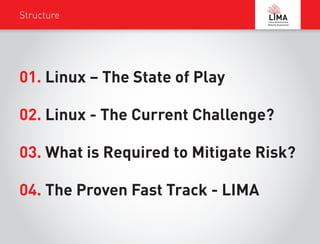
Structure
Linux Infrastructure
Maturity Assessment

01. Linux – The State of Play
02. Linux - The Current Challenge?
03. What is Required to Mitigate Risk?
04. The Proven Fast Track - LIMA
Structure
Linux Infrastructure
Maturity Assessment

01.

Linux – The State of Play
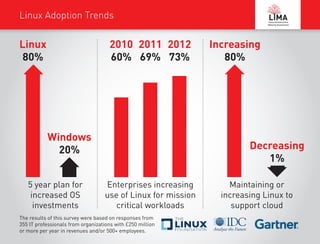
Linux Adoption Trends
Linux Infrastructure
Maturity Assessment

Linux
80%

2010 2011 2012
60% 69% 73%

Windows
20%
5 year plan for
increased OS
investments

Increasing
80%

Decreasing
1%
Enterprises increasing
use of Linux for mission
critical workloads

The results of this survey were based on responses from
355 IT professionals from organizations with £250 million
or more per year in revenues and/or 500+ employees.

Maintaining or
increasing Linux to
support cloud
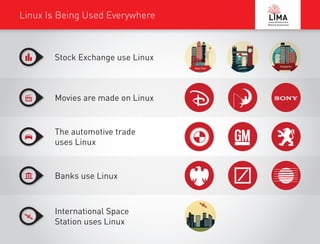
Linux Is Being Used Everywhere
Linux Infrastructure
Maturity Assessment

Stock Exchange use Linux
New York

Movies are made on Linux

The automotive trade
uses Linux

Banks use Linux

International Space
Station uses Linux

London

Singapore
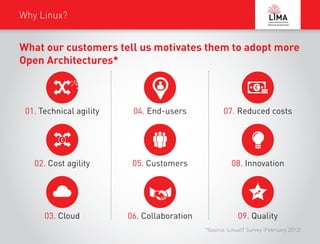
Why Linux?
Linux Infrastructure
Maturity Assessment

What our customers tell us motivates them to adopt more
Open Architectures*

01. Technical agility

04. End-users

07. Reduced costs

02. Cost agility

05. Customers

08. Innovation

03. Cloud

06. Collaboration

09. Quality
*Source: LinuxIT Survey (February 2013)
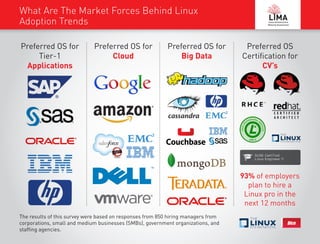
What Are The Market Forces Behind Linux
Adoption Trends
Preferred OS for
Tier-1
Applications

Preferred OS for
Cloud

Preferred OS for
Big Data

Linux Infrastructure
Maturity Assessment

Preferred OS
Certification for
CV’s

93% of employers
plan to hire a
Linux pro in the
next 12 months
The results of this survey were based on responses from 850 hiring managers from
corporations, small and medium businesses (SMBs), government organizations, and
staffing agencies.
Structure
Linux Infrastructure
Maturity Assessment

02.

Linux – The Current Challenge
Current Challenges For Linux
Linux Infrastructure
Maturity Assessment

OSS empowers organisations to increase innovation,
efficiency and competitiveness.
As OSS becomes more pervasive, the need for governance increases
exponentially. Open source governance should be embedded in broader
governance to insure IT supports the business goals, and appropriately
manages IT-related risks and opportunities.
As the use of OSS is growing and maturing, the need for governance has
become an integral part of mainstream IT management. OSS is ubiquitous
and unavoidable - having a policy against it is impractical and may place
you at a competitive disadvantage and more.
Current Challenges For Linux
Linux Infrastructure
Maturity Assessment

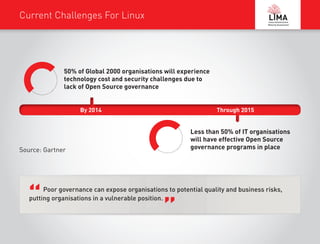
50% of Global 2000 organisations will experience
technology cost and security challenges due to
lack of Open Source governance
By 2014

Source: Gartner

Through 2015

Less than 50% of IT organisations
will have effective Open Source
governance programs in place

Poor governance can expose organisations to potential quality and business risks,
putting organisations in a vulnerable position.
Current Challenges For Linux
Linux Infrastructure
Maturity Assessment

Slashed IT budgets are forcing organisations to look at
cost effective alternatives like OSS whilst delivering quality and
innovation. However, lack of knowledge and information has driven
organisations to act outside normal governance when adopting Linux
and OSS.
Mike Curtis, Executive Director at LinuxIT

However, the very nature of OSS and historically the way in which
it has proliferated outside of corporate governance filters now means
it suffers from a lack of quality and adherence to governance policies.
This makes it appear inferior and riskier than governed IT estates,
explains Curtis.
Current Challenges For Linux
Linux Infrastructure
Maturity Assessment

Why your organisation will benefit from best practice
Linux architectures and systems management
The common issues
•	 Linux often entered into the organisation
via the backdoor many years ago and has
proliferated organically, rather than against a
strategy or plan.
•	 It has not, therefore, been subject to the same
rigorus standards or ROI assessments applied
across the UNIX and Microsoft estates.
•	 This very often leads to multiple,
undocumented builds of variable standards
across numerous Linux distributions.
Current Challenges For Linux
Linux Infrastructure
Maturity Assessment

•	 Some of these distributions do not carry the
enterprise assurances demanded of a mission
critical environment.
•	 They are often not optimised for the application in
terms of performance or security.
•	 Without a standardised architecture design and
documentation, there is a great deal of risk through
dependency on the engineer that built the servers.
•	 Servers are not built with operational efficiencies in
mind, so scaling up capacity is complex, expensive
and does not benefit from any economies of scale.
•	 It also often means they are not regularly updated
with security patches and fixes which can introduce
risk into the organisation.
Current Challenges For Linux
Linux Infrastructure
Maturity Assessment

•	 Because they have not been built against best
practice, there is often no facility to detect, isolate
and correct problems before they impact on the
business.
•	 Very often, security has not been considered to the
extent that it should have been when building these
servers, particularly in terms of identity management,
activity monitoring and virus/malware management.
•	 Ultimately poor practice around Linux causes an
increase in failure rates, security risk and costs while
decreasing productivity, operational efficiencies and
the value your organisation is able to deliver.
•	 Customers may not return if they’ve suffered from
a bad experience - for example, on an e-commerce
or m-commerce website, leading to lost sales
opportunities.
Structure
Linux Infrastructure
Maturity Assessment

03.

What is Required to Mitigate Risk?
Audit Linux Significance
Linux Infrastructure
Maturity Assessment

Perform a thorough audit of your
current Linux environments
Including what varieties of distributions,
versions and configurations exist and where,
why and how they are deployed and managed.
This includes all instances of Linux existing
and planned, the hardware it sits on and
applications it underpins, and how it integrates
into the environment. Be sure to document.
Audit Linux Competencies
Linux Infrastructure
Maturity Assessment

Undertake a skills assessment
To establish whether the necessary
competencies exist in-house or indeed with
your service provider.
Beware, there are very few service providers
that have these competencies themselves and
contractors simply cannot offer the integrated
services approach.
Implement Best Practice
Linux Infrastructure
Maturity Assessment

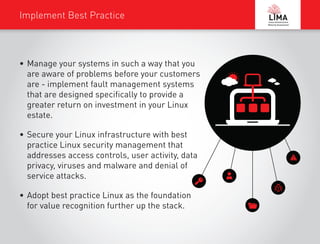
•	 Manage your systems in such a way that you
are aware of problems before your customers
are - implement fault management systems
that are designed specifically to provide a
greater return on investment in your Linux
estate.
•	 Secure your Linux infrastructure with best
practice Linux security management that
addresses access controls, user activity, data
privacy, viruses and malware and denial of
service attacks.
•	 Adopt best practice Linux as the foundation
for value recognition further up the stack.
Structure
Linux Infrastructure
Maturity Assessment

04.

The Proven Fast Track- LIMA
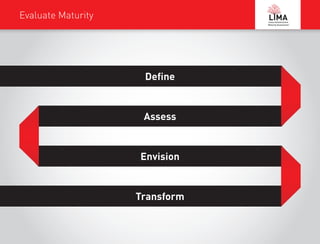
Evaluate Maturity
Linux Infrastructure
Maturity Assessment

Define

Assess

Envision

Transform
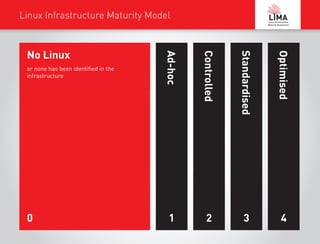
Linux Infrastructure Maturity Model
Linux Infrastructure
Maturity Assessment

Optimised

Standardised

Controlled

or none has been identified in the
infrastructure

Ad-hoc

No Linux

U

U

L

R

L

N

N

E

B

C

S

N

L

B

S

0

1

2

3

4

S

B
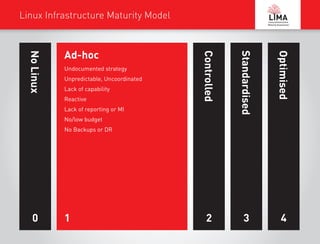
Linux Infrastructure Maturity Model
Linux Infrastructure
Maturity Assessment

Lack of capability
Reactive

Optimised

Unpredictable, Uncoordinated

Standardised

Undocumented strategy

Controlled

No Linux

Ad-hoc

2

3

4

Lack of reporting or MI
No/low budget
No Backups or DR

0

1
Linux Infrastructure Maturity Model
Linux Infrastructure
Maturity Assessment

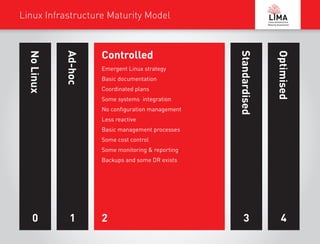
Basic documentation
Coordinated plans
Some systems integration
No configuration management

Optimised

Emergent Linux strategy

Standardised

Ad-hoc

No Linux

Controlled

3

4

Less reactive
Basic management processes
Some cost control
Some monitoring & reporting
Backups and some DR exists

0

1

2
Linux Infrastructure Maturity Model
Linux Infrastructure
Maturity Assessment

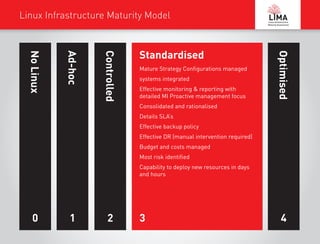
Mature Strategy Configurations managed
systems integrated
Effective monitoring & reporting with
detailed MI Proactive management focus

Optimised

Controlled

Ad-hoc

No Linux

Standardised

Consolidated and rationalised
Details SLA’s
Effective backup policy
Effective DR (manual intervention required)
Budget and costs managed
Most risk identified
Capability to deploy new resources in days
and hours

0

1

2

3

4
Linux Infrastructure Maturity Model
Linux Infrastructure
Maturity Assessment

Standardised

Controlled

Ad-hoc

No Linux

Optimised
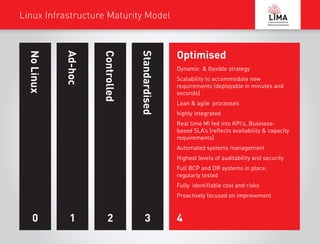
Dynamic & flexible strategy
Scalability to accommodate new
requirements (deployable in minutes and
seconds)
Lean & agile processes
highly integrated
Real time MI fed into KPI’s, Businessbased SLA’s (reflects availability & capacity
requirements)
Automated systems management
Highest levels of auditability and security
Full BCP and DR systems in place,
regularly tested
Fully identifiable cost and risks
Proactively focused on improvement

0

1

2

3

4
LIMA Process
Linux Infrastructure
Maturity Assessment

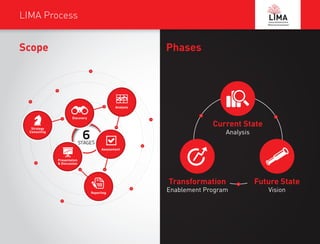
Scope

Phases

Analysis
Discovery

Current State

Strategy
Consulting

Analysis

Assessment
Presentation
& Discussion

Transformation

Reporting

Enablement Program

Future State
Vision
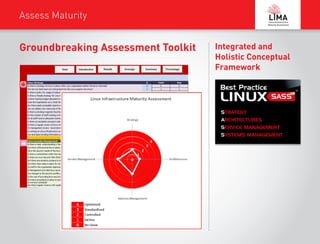
Assess Maturity
Linux Infrastructure
Maturity Assessment

Groundbreaking Assessment Toolkit

Integrated and
Holistic Conceptual
Framework
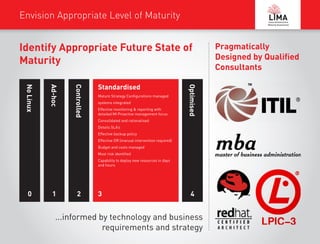
Envision Appropriate Level of Maturity
Linux Infrastructure
Maturity Assessment

Identify Appropriate Future State of
Maturity

Mature Strategy Configurations managed
systems integrated
Effective monitoring & reporting with
detailed MI Proactive management focus

Optimised

Controlled

Ad-hoc

No Linux

Standardised

Consolidated and rationalised
Details SLA’s
Effective backup policy
Effective DR (manual intervention required)
Budget and costs managed
Most risk identified
Capability to deploy new resources in days
and hours

0

1

2

3

4

...informed by technology and business
requirements and strategy

Pragmatically
Designed by Qualified
Consultants
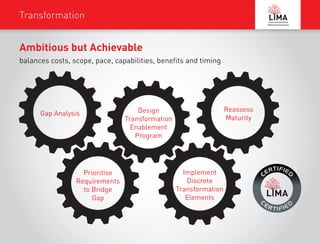
Transformation
Linux Infrastructure
Maturity Assessment

Ambitious but Achievable
balances costs, scope, pace, capabilities, benefits and timing

Gap Analysis

Prioritise
Requirements
to Bridge
Gap

Reassess
Maturity

Design
Transformation
Enablement
Program

Implement
Discrete
Transformation
Elements

Linux Infrastructure
Maturity Assessment
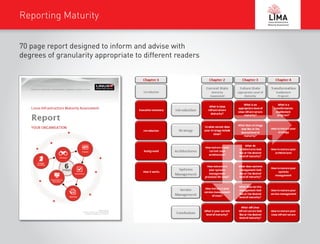
Reporting Maturity
Linux Infrastructure
Maturity Assessment

70 page report designed to inform and advise with
degrees of granularity appropriate to different readers
Accreditations
Linux Infrastructure
Maturity Assessment

Just some of our awards, accreditations and partnerships
Customers
Linux Infrastructure
Maturity Assessment

Some of our private sector customers
Telecommunications

Retail

Media &
Entertainment

Financial Services

Manufacturing
Technology

Transportation
Utilities
Customers
Linux Infrastructure
Maturity Assessment

Some of our public sector customers

Councils

Health

Education

Government

Not For Profit

Police

Charity
Linux Infrastructure
Maturity Assessment

Thank you

Reducing Risk And Cost In With A Linux Infrastructure Maturity Assessment

  • 1.
  • 2.
    LIMA Objective Linux Infrastructure MaturityAssessment To provide a Linux operating environment that is fully aligned to your technical and business requirements, dramatically reduce deployment time, simplify maintenance, increase stability, and reduce support and management costs.
  • 3.
    Structure Linux Infrastructure Maturity Assessment 01.Linux – The State of Play 02. Linux - The Current Challenge? 03. What is Required to Mitigate Risk? 04. The Proven Fast Track - LIMA
  • 4.
  • 5.
    Linux Adoption Trends LinuxInfrastructure Maturity Assessment Linux 80% 2010 2011 2012 60% 69% 73% Windows 20% 5 year plan for increased OS investments Increasing 80% Decreasing 1% Enterprises increasing use of Linux for mission critical workloads The results of this survey were based on responses from 355 IT professionals from organizations with £250 million or more per year in revenues and/or 500+ employees. Maintaining or increasing Linux to support cloud
  • 6.
    Linux Is BeingUsed Everywhere Linux Infrastructure Maturity Assessment Stock Exchange use Linux New York Movies are made on Linux The automotive trade uses Linux Banks use Linux International Space Station uses Linux London Singapore
  • 7.
    Why Linux? Linux Infrastructure MaturityAssessment What our customers tell us motivates them to adopt more Open Architectures* 01. Technical agility 04. End-users 07. Reduced costs 02. Cost agility 05. Customers 08. Innovation 03. Cloud 06. Collaboration 09. Quality *Source: LinuxIT Survey (February 2013)
  • 8.
    What Are TheMarket Forces Behind Linux Adoption Trends Preferred OS for Tier-1 Applications Preferred OS for Cloud Preferred OS for Big Data Linux Infrastructure Maturity Assessment Preferred OS Certification for CV’s 93% of employers plan to hire a Linux pro in the next 12 months The results of this survey were based on responses from 850 hiring managers from corporations, small and medium businesses (SMBs), government organizations, and staffing agencies.
  • 9.
  • 10.
    Current Challenges ForLinux Linux Infrastructure Maturity Assessment OSS empowers organisations to increase innovation, efficiency and competitiveness. As OSS becomes more pervasive, the need for governance increases exponentially. Open source governance should be embedded in broader governance to insure IT supports the business goals, and appropriately manages IT-related risks and opportunities. As the use of OSS is growing and maturing, the need for governance has become an integral part of mainstream IT management. OSS is ubiquitous and unavoidable - having a policy against it is impractical and may place you at a competitive disadvantage and more.
  • 11.
    Current Challenges ForLinux Linux Infrastructure Maturity Assessment 50% of Global 2000 organisations will experience technology cost and security challenges due to lack of Open Source governance By 2014 Source: Gartner Through 2015 Less than 50% of IT organisations will have effective Open Source governance programs in place Poor governance can expose organisations to potential quality and business risks, putting organisations in a vulnerable position.
  • 12.
    Current Challenges ForLinux Linux Infrastructure Maturity Assessment Slashed IT budgets are forcing organisations to look at cost effective alternatives like OSS whilst delivering quality and innovation. However, lack of knowledge and information has driven organisations to act outside normal governance when adopting Linux and OSS. Mike Curtis, Executive Director at LinuxIT However, the very nature of OSS and historically the way in which it has proliferated outside of corporate governance filters now means it suffers from a lack of quality and adherence to governance policies. This makes it appear inferior and riskier than governed IT estates, explains Curtis.
  • 13.
    Current Challenges ForLinux Linux Infrastructure Maturity Assessment Why your organisation will benefit from best practice Linux architectures and systems management The common issues • Linux often entered into the organisation via the backdoor many years ago and has proliferated organically, rather than against a strategy or plan. • It has not, therefore, been subject to the same rigorus standards or ROI assessments applied across the UNIX and Microsoft estates. • This very often leads to multiple, undocumented builds of variable standards across numerous Linux distributions.
  • 14.
    Current Challenges ForLinux Linux Infrastructure Maturity Assessment • Some of these distributions do not carry the enterprise assurances demanded of a mission critical environment. • They are often not optimised for the application in terms of performance or security. • Without a standardised architecture design and documentation, there is a great deal of risk through dependency on the engineer that built the servers. • Servers are not built with operational efficiencies in mind, so scaling up capacity is complex, expensive and does not benefit from any economies of scale. • It also often means they are not regularly updated with security patches and fixes which can introduce risk into the organisation.
  • 15.
    Current Challenges ForLinux Linux Infrastructure Maturity Assessment • Because they have not been built against best practice, there is often no facility to detect, isolate and correct problems before they impact on the business. • Very often, security has not been considered to the extent that it should have been when building these servers, particularly in terms of identity management, activity monitoring and virus/malware management. • Ultimately poor practice around Linux causes an increase in failure rates, security risk and costs while decreasing productivity, operational efficiencies and the value your organisation is able to deliver. • Customers may not return if they’ve suffered from a bad experience - for example, on an e-commerce or m-commerce website, leading to lost sales opportunities.
  • 16.
  • 17.
    Audit Linux Significance LinuxInfrastructure Maturity Assessment Perform a thorough audit of your current Linux environments Including what varieties of distributions, versions and configurations exist and where, why and how they are deployed and managed. This includes all instances of Linux existing and planned, the hardware it sits on and applications it underpins, and how it integrates into the environment. Be sure to document.
  • 18.
    Audit Linux Competencies LinuxInfrastructure Maturity Assessment Undertake a skills assessment To establish whether the necessary competencies exist in-house or indeed with your service provider. Beware, there are very few service providers that have these competencies themselves and contractors simply cannot offer the integrated services approach.
  • 19.
    Implement Best Practice LinuxInfrastructure Maturity Assessment • Manage your systems in such a way that you are aware of problems before your customers are - implement fault management systems that are designed specifically to provide a greater return on investment in your Linux estate. • Secure your Linux infrastructure with best practice Linux security management that addresses access controls, user activity, data privacy, viruses and malware and denial of service attacks. • Adopt best practice Linux as the foundation for value recognition further up the stack.
  • 20.
  • 21.
    Evaluate Maturity Linux Infrastructure MaturityAssessment Define Assess Envision Transform
  • 22.
    Linux Infrastructure MaturityModel Linux Infrastructure Maturity Assessment Optimised Standardised Controlled or none has been identified in the infrastructure Ad-hoc No Linux U U L R L N N E B C S N L B S 0 1 2 3 4 S B
  • 23.
    Linux Infrastructure MaturityModel Linux Infrastructure Maturity Assessment Lack of capability Reactive Optimised Unpredictable, Uncoordinated Standardised Undocumented strategy Controlled No Linux Ad-hoc 2 3 4 Lack of reporting or MI No/low budget No Backups or DR 0 1
  • 24.
    Linux Infrastructure MaturityModel Linux Infrastructure Maturity Assessment Basic documentation Coordinated plans Some systems integration No configuration management Optimised Emergent Linux strategy Standardised Ad-hoc No Linux Controlled 3 4 Less reactive Basic management processes Some cost control Some monitoring & reporting Backups and some DR exists 0 1 2
  • 25.
    Linux Infrastructure MaturityModel Linux Infrastructure Maturity Assessment Mature Strategy Configurations managed systems integrated Effective monitoring & reporting with detailed MI Proactive management focus Optimised Controlled Ad-hoc No Linux Standardised Consolidated and rationalised Details SLA’s Effective backup policy Effective DR (manual intervention required) Budget and costs managed Most risk identified Capability to deploy new resources in days and hours 0 1 2 3 4
  • 26.
    Linux Infrastructure MaturityModel Linux Infrastructure Maturity Assessment Standardised Controlled Ad-hoc No Linux Optimised Dynamic & flexible strategy Scalability to accommodate new requirements (deployable in minutes and seconds) Lean & agile processes highly integrated Real time MI fed into KPI’s, Businessbased SLA’s (reflects availability & capacity requirements) Automated systems management Highest levels of auditability and security Full BCP and DR systems in place, regularly tested Fully identifiable cost and risks Proactively focused on improvement 0 1 2 3 4
  • 27.
    LIMA Process Linux Infrastructure MaturityAssessment Scope Phases Analysis Discovery Current State Strategy Consulting Analysis Assessment Presentation & Discussion Transformation Reporting Enablement Program Future State Vision
  • 28.
    Assess Maturity Linux Infrastructure MaturityAssessment Groundbreaking Assessment Toolkit Integrated and Holistic Conceptual Framework
  • 29.
    Envision Appropriate Levelof Maturity Linux Infrastructure Maturity Assessment Identify Appropriate Future State of Maturity Mature Strategy Configurations managed systems integrated Effective monitoring & reporting with detailed MI Proactive management focus Optimised Controlled Ad-hoc No Linux Standardised Consolidated and rationalised Details SLA’s Effective backup policy Effective DR (manual intervention required) Budget and costs managed Most risk identified Capability to deploy new resources in days and hours 0 1 2 3 4 ...informed by technology and business requirements and strategy Pragmatically Designed by Qualified Consultants
  • 30.
    Transformation Linux Infrastructure Maturity Assessment Ambitiousbut Achievable balances costs, scope, pace, capabilities, benefits and timing Gap Analysis Prioritise Requirements to Bridge Gap Reassess Maturity Design Transformation Enablement Program Implement Discrete Transformation Elements Linux Infrastructure Maturity Assessment
  • 31.
    Reporting Maturity Linux Infrastructure MaturityAssessment 70 page report designed to inform and advise with degrees of granularity appropriate to different readers
  • 32.
    Accreditations Linux Infrastructure Maturity Assessment Justsome of our awards, accreditations and partnerships
  • 33.
    Customers Linux Infrastructure Maturity Assessment Someof our private sector customers Telecommunications Retail Media & Entertainment Financial Services Manufacturing Technology Transportation Utilities
  • 34.
    Customers Linux Infrastructure Maturity Assessment Someof our public sector customers Councils Health Education Government Not For Profit Police Charity
  • 35.