Lightning network
Proposed by Joseph Pool & Thaddeus Dryja
July 2022
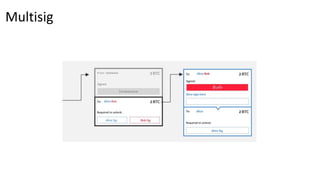
Multisig
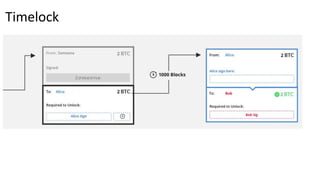
Timelock
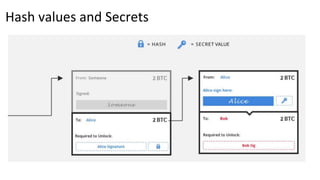
Hash values and Secrets
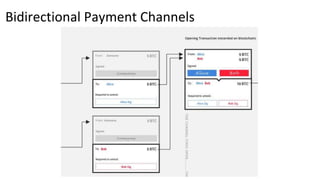
Bidirectional Payment Channels
Open channel
• To open the channel, Alice and Bob each send 5 bitcoins to a 2-of-2 multisig
address.
• Bitcoins can only be spent from this address if both Alice and Bob sign.
• Additionally, Alice and Bob both create a secret (a string of numbers), and
exchange the hash.
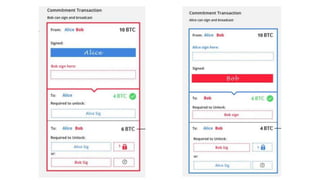
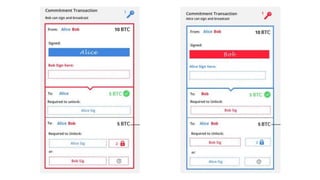
Commitment transaction
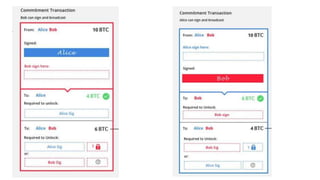
• Alice sends 4 bitcoins to herself, and 6 bitcoins to a 2nd-multisig address.
• Bob can unlock the 2nd-multisig addr, but only after 1000 extra blocks
mined. Or, it can be opened by Alice on her own, but only if she also includes
the secret for which Bob has just now given her the hash.
• Similarly, Bob sends 6 bitcoins to himself, and 4 bitcoins to the 2nd-multisig
addr. Alice can unlock this address if she waits an additional 1000 blocks, or
Bob can unlock it with Alice using her secret.
• After all this exchanging of “half-valid” commitment transactions and hashes of
secrets,
• They both sign and broadcast the opening transaction, to make sure it's
recorded on the blockchain.
• The channel is now officially open.
• Alice and Bob could sign and broadcast the half-valid commitment transaction
they got from the other. If Alice does, Bob gets six bitcoins immediately.
• If Bob does, Alice gets four bitcoins immediately. But whomever signs and
broadcasts the transaction will have to wait 1000 blocks to unlock the
subsequent multisig-address, and claim the remaining bitcoins.
• However, and this is the key trick of a payment channel: neither sign and
broadcast their half of the transaction at all.
Updating the Channel
• Bob wants to send Alice 1 bitcoin back (now, 5 btc for each)
• Similar process..
• They both sign their new half valid commitment transaction, and give it to each
other + exchange new secret’s hash.
• Alice and Bob hand each other their first secrets, as used in the first set-up.
Broadcast old commitment tx
• Bob cannot safely sign and broadcast the older commitment transaction any
more, because Alice now knows Bob's first secret.
• If Bob were to sign and broadcast that commitment transaction, he would
immediately send 4 bitcoins to Alice... and he would have to wait 1000 blocks
to claim his own six bitcoins.
• That's a problem, because now that Alice knows his secret, she could use this
time to beat Bob to the punch, and claim the other six bitcoins as well!
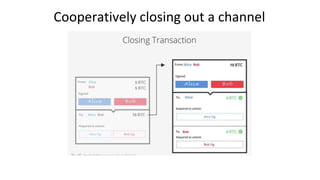
Cooperatively closing out a channel
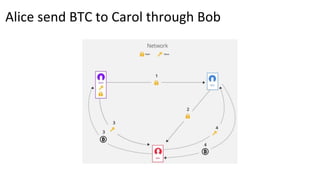
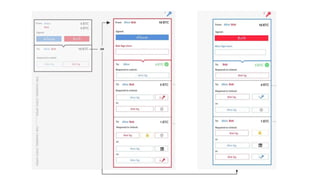
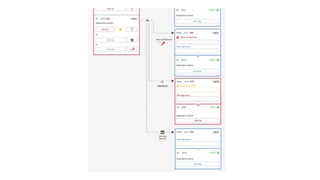
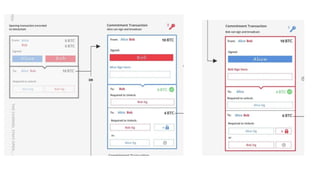
Alice send BTC to Carol through Bob
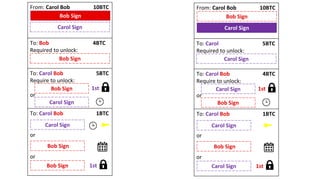
From: Carol Bob 10BTC
To: Bob 4BTC
Required to unlock:
To: Carol Bob 5BTC
Require to unlock:
or
To: Carol Bob 1BTC
or
or
Bob Sign
Bob Sign
Carol Sign
Bob Sign
Carol Sign
1st
Carol Sign
Bob Sign
Bob Sign 1st
From: Carol Bob 10BTC
To: Carol 5BTC
Required to unlock:
To: Carol Bob 4BTC
Require to unlock:
or
To: Carol Bob 1BTC
or
or
Carol Sign
Carol Sign
Bob Sign
Carol Sign
Bob Sign
1st
Carol Sign
Bob Sign
Carol Sign 1st
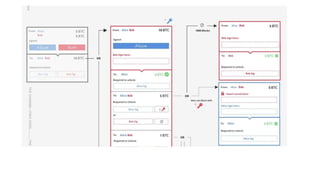
Settling the Status
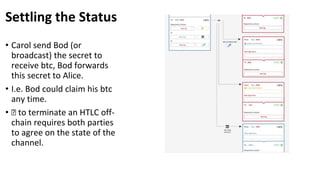
• Carol send Bod (or
broadcast) the secret to
receive btc, Bod forwards
this secret to Alice.
• I.e. Bod could claim his btc
any time.
• 🡪 to terminate an HTLC off-
chain requires both parties
to agree on the state of the
channel.
Notice about HTLC timeout
• If Bob gets the value from Carol only after Alice already reclaimed her coin
back, Bob is stuck in the middle after all.
• Therefore, The time-out in Bob and Carol’s HTLC must therefore
expire before the time-out in Alice and Bob’s HTLC expires.
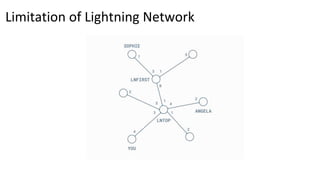
Limitation of Lightning Network
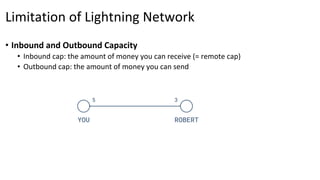
• Inbound and Outbound Capacity
• Inbound cap: the amount of money you can receive (= remote cap)
• Outbound cap: the amount of money you can send
Limitation of Lightning Network
Limitation
• High liveness requirements
- Nodes are required to be online in order to send and receive payments
• The network is congestion 🡪 not be able to get money back fast
• Opening and Closing Channel Fee + Routing Fee
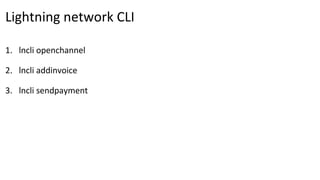
Lightning network CLI
1. lncli openchannel
2. lncli addinvoice
3. lncli sendpayment
DEX with LN
AMM
Oracle
trader DEX
Token A commitment
Token B commitment
DEX
Trader X Bid A/B
Request rate A/B
Trader Y
Ask B/A
AMM MODEL
TRADITIONAL MODEL
pBTC : PRV
10 : 20
trader DEX
1 pBTC channel 0
0 PRV channel 2
Rate BTC:PRV = 1:2
OPEN
pBTC :
PRV
10.5 : 19
trader DEX
0.5 pBTC
0.5
1 PRV 1
TRADE 0.5 BTC
1. Trader send pBTC half commitment
2. DEX send PRV half commitment
3. Trader send PRV half commitment
4. DEX send pBTC half commitment
AMM: UNISWAP MODEL
pBTC : PRV
10 : 15
Trader A DEX
BID 0.5 pBTC for 1PRV
BID
Trader A DEX
1 pBTC 0
0 PRV 2
MATCHING WITH OTHER TRADER
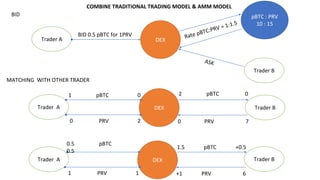
COMBINE TRADITIONAL TRADING MODEL & AMM MODEL
Trader B
Trader B
2 pBTC 0
0 PRV 7
Trader A DEX
0.5 pBTC
0.5
1 PRV 1
Trader B
1.5 pBTC +0.5
+1 PRV 6
Thank you

Lightning network used in blockchain and its application

  • 1.
    Lightning network Proposed byJoseph Pool & Thaddeus Dryja July 2022
  • 2.
  • 3.
  • 4.
  • 5.
  • 6.
    Open channel • Toopen the channel, Alice and Bob each send 5 bitcoins to a 2-of-2 multisig address. • Bitcoins can only be spent from this address if both Alice and Bob sign. • Additionally, Alice and Bob both create a secret (a string of numbers), and exchange the hash.
  • 7.
    Commitment transaction • Alicesends 4 bitcoins to herself, and 6 bitcoins to a 2nd-multisig address. • Bob can unlock the 2nd-multisig addr, but only after 1000 extra blocks mined. Or, it can be opened by Alice on her own, but only if she also includes the secret for which Bob has just now given her the hash. • Similarly, Bob sends 6 bitcoins to himself, and 4 bitcoins to the 2nd-multisig addr. Alice can unlock this address if she waits an additional 1000 blocks, or Bob can unlock it with Alice using her secret.
  • 9.
    • After allthis exchanging of “half-valid” commitment transactions and hashes of secrets, • They both sign and broadcast the opening transaction, to make sure it's recorded on the blockchain. • The channel is now officially open.
  • 10.
    • Alice andBob could sign and broadcast the half-valid commitment transaction they got from the other. If Alice does, Bob gets six bitcoins immediately. • If Bob does, Alice gets four bitcoins immediately. But whomever signs and broadcasts the transaction will have to wait 1000 blocks to unlock the subsequent multisig-address, and claim the remaining bitcoins. • However, and this is the key trick of a payment channel: neither sign and broadcast their half of the transaction at all.
  • 11.
    Updating the Channel •Bob wants to send Alice 1 bitcoin back (now, 5 btc for each) • Similar process.. • They both sign their new half valid commitment transaction, and give it to each other + exchange new secret’s hash. • Alice and Bob hand each other their first secrets, as used in the first set-up.
  • 15.
    Broadcast old commitmenttx • Bob cannot safely sign and broadcast the older commitment transaction any more, because Alice now knows Bob's first secret. • If Bob were to sign and broadcast that commitment transaction, he would immediately send 4 bitcoins to Alice... and he would have to wait 1000 blocks to claim his own six bitcoins. • That's a problem, because now that Alice knows his secret, she could use this time to beat Bob to the punch, and claim the other six bitcoins as well!
  • 16.
  • 17.
    Alice send BTCto Carol through Bob
  • 19.
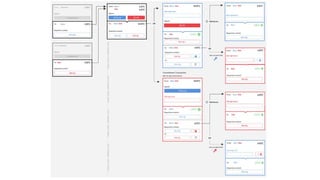
    From: Carol Bob10BTC To: Bob 4BTC Required to unlock: To: Carol Bob 5BTC Require to unlock: or To: Carol Bob 1BTC or or Bob Sign Bob Sign Carol Sign Bob Sign Carol Sign 1st Carol Sign Bob Sign Bob Sign 1st From: Carol Bob 10BTC To: Carol 5BTC Required to unlock: To: Carol Bob 4BTC Require to unlock: or To: Carol Bob 1BTC or or Carol Sign Carol Sign Bob Sign Carol Sign Bob Sign 1st Carol Sign Bob Sign Carol Sign 1st
  • 22.
    Settling the Status •Carol send Bod (or broadcast) the secret to receive btc, Bod forwards this secret to Alice. • I.e. Bod could claim his btc any time. • 🡪 to terminate an HTLC off- chain requires both parties to agree on the state of the channel.
  • 23.
    Notice about HTLCtimeout • If Bob gets the value from Carol only after Alice already reclaimed her coin back, Bob is stuck in the middle after all. • Therefore, The time-out in Bob and Carol’s HTLC must therefore expire before the time-out in Alice and Bob’s HTLC expires.
  • 25.
    Limitation of LightningNetwork • Inbound and Outbound Capacity • Inbound cap: the amount of money you can receive (= remote cap) • Outbound cap: the amount of money you can send
  • 26.
  • 28.
    Limitation • High livenessrequirements - Nodes are required to be online in order to send and receive payments • The network is congestion 🡪 not be able to get money back fast • Opening and Closing Channel Fee + Routing Fee
  • 29.
    Lightning network CLI 1.lncli openchannel 2. lncli addinvoice 3. lncli sendpayment
  • 30.
  • 31.
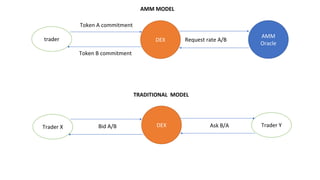
    AMM Oracle trader DEX Token Acommitment Token B commitment DEX Trader X Bid A/B Request rate A/B Trader Y Ask B/A AMM MODEL TRADITIONAL MODEL
  • 32.
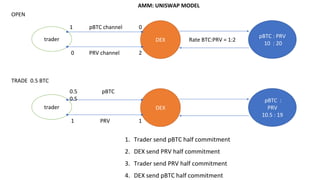
    pBTC : PRV 10: 20 trader DEX 1 pBTC channel 0 0 PRV channel 2 Rate BTC:PRV = 1:2 OPEN pBTC : PRV 10.5 : 19 trader DEX 0.5 pBTC 0.5 1 PRV 1 TRADE 0.5 BTC 1. Trader send pBTC half commitment 2. DEX send PRV half commitment 3. Trader send PRV half commitment 4. DEX send pBTC half commitment AMM: UNISWAP MODEL
  • 33.
    pBTC : PRV 10: 15 Trader A DEX BID 0.5 pBTC for 1PRV BID Trader A DEX 1 pBTC 0 0 PRV 2 MATCHING WITH OTHER TRADER COMBINE TRADITIONAL TRADING MODEL & AMM MODEL Trader B Trader B 2 pBTC 0 0 PRV 7 Trader A DEX 0.5 pBTC 0.5 1 PRV 1 Trader B 1.5 pBTC +0.5 +1 PRV 6
  • 34.