LearningObjectives
The Human Eye
The Important Parts of The Eye
Power of Accommodation
Defects of vision and their correction
Myopia or Near-sightedness, Hypermetropia or
Farsightedness, Presbyopia
Dispersion of light
 Scattering of light
TheImportant PartsofTheEye
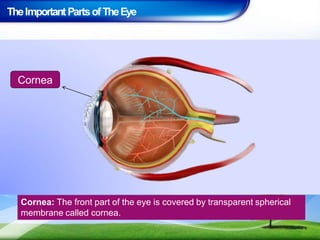
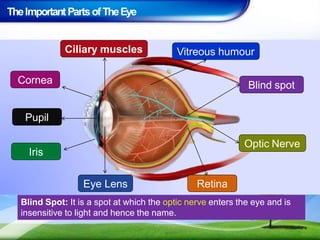
Cornea: The front part of the eye is covered by transparent spherical
membrane called cornea.
Cornea
TheImportant PartsofTheEye
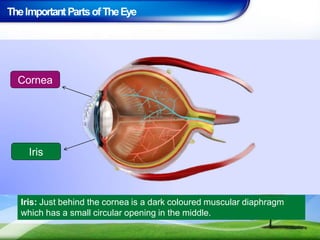
Iris: Just behind the cornea is a dark coloured muscular diaphragm
which has a small circular opening in the middle.
Cornea
Iris
TheImportant PartsofTheEye
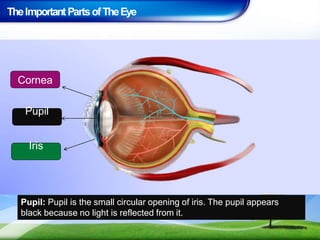
Pupil: Pupil is the small circular opening of iris. The pupil appears
black because no light is reflected from it.
Cornea
Pupil
Iris
TheImportant PartsofTheEye
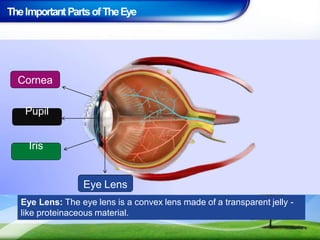
Eye Lens: The eye lens is a convex lens made of a transparent jelly -
like proteinaceous material.
Cornea
Pupil
Iris
Eye Lens
TheImportant PartsofTheEye
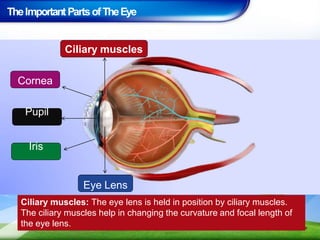
Ciliary muscles: The eye lens is held in position by ciliary muscles.
The ciliary muscles help in changing the curvature and focal length of
the eye lens.
Ciliary muscles
Cornea
Pupil
Iris
Eye Lens
TheImportant PartsofTheEye
Retina: The inner back surface of the eye ball is called retina. It is a
semi-transparent membrane which is light sensitive and is equivalent to
the screen of a camera.
Ciliary muscles
Cornea
Pupil
Iris
Eye Lens Retina
TheImportant PartsofTheEye
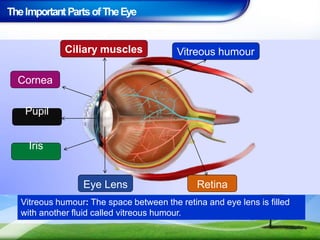
Vitreous humour: The space between the retina and eye lens is filled
with another fluid called vitreous humour.
Ciliary muscles
Cornea
Pupil
Iris
Eye Lens Retina
Vitreous humour
TheImportant PartsofTheEye
Blind Spot: It is a spot at which the optic nerve enters the eye and is
insensitive to light and hence the name.
Cornea
Iris
Pupil
Ciliary muscles
Eye Lens Retina
Vitreous humour
Blind spot
Optic Nerve
Power of Accommodation
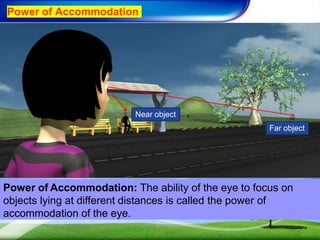
Power of Accommodation: The ability of the eye to focus on
objects lying at different distances is called the power of
accommodation of the eye.
Near object
Far object
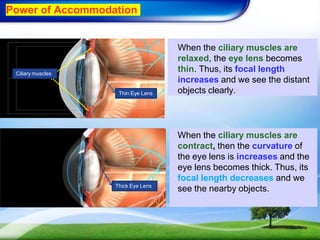
When the ciliary muscles are
relaxed, the eye lens becomes
thin. Thus, its focal length
increases and we see the distant
objects clearly.
When the ciliary muscles are
contract, then the curvature of
the eye lens is increases and the
eye lens becomes thick. Thus, its
focal length decreases and we
see the nearby objects.
Ciliary muscles
Thin Eye Lens
Thick Eye Lens
Power of Accommodation
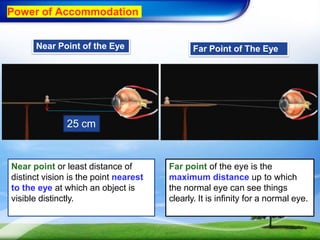
Near point or least distance of
distinct vision is the point nearest
to the eye at which an object is
visible distinctly.
Far Point of The Eye
Far point of the eye is the
maximum distance up to which
the normal eye can see things
clearly. It is infinity for a normal eye.
Near Point of the Eye
25 cm
Power of Accommodation
Defects of Vision and Their Correction
• Myopia or near-sightedness
• Hypermetropia or far-sightedness
• Presbyopia
• Cataract
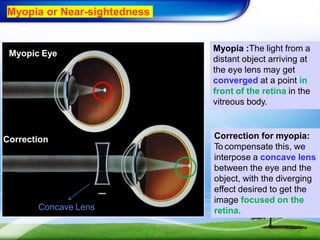
Myopia or Near-sightedness
Myopia :The light from a
distant object arriving at
the eye lens may get
converged at a point in
front of the retina in the
vitreous body.
Correction for myopia:
To compensate this, we
interpose a concave lens
between the eye and the
object, with the diverging
effect desired to get the
image focused on the
retina.
Myopic Eye
Correction
Concave Lens
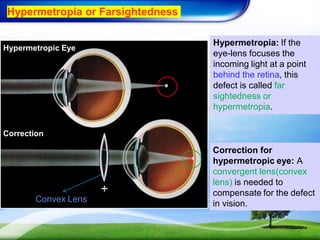
Hypermetropia or Farsightedness
Hypermetropia: If the
eye-lens focuses the
incoming light at a point
behind the retina, this
defect is called far
sightedness or
hypermetropia.
Correction for
hypermetropic eye: A
convergent lens(convex
lens) is needed to
compensate for the defect
in vision.
Correction
Hypermetropic Eye
Convex Lens
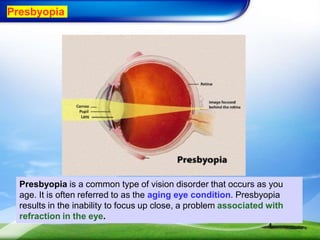
Presbyopia
Presbyopia is a common type of vision disorder that occurs as you
age. It is often referred to as the aging eye condition. Presbyopia
results in the inability to focus up close, a problem associated with
refraction in the eye.
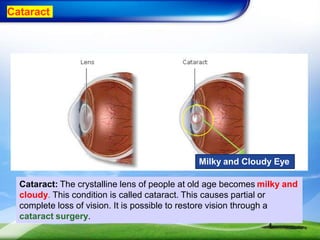
Cataract
Cataract: The crystalline lens of people at old age becomes milky and
cloudy. This condition is called cataract. This causes partial or
complete loss of vision. It is possible to restore vision through a
cataract surgery.
Milky and Cloudy Eye
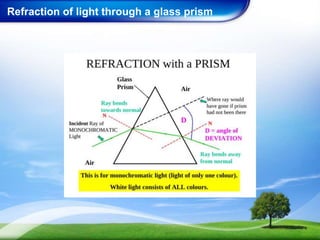
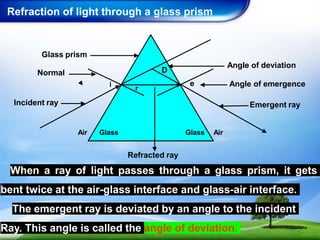
Refraction of light through a glass prism
Incident ray
Refracted ray
When a ray of light passes through a glass prism, it gets
bent twice at the air-glass interface and glass-air interface.
The emergent ray is deviated by an angle to the incident
Ray. This angle is called the angle of deviation.
Emergent ray
D
i
r
Air Glass Glass Air
Glass prism
e Angle of emergence
Angle of deviation
Normal
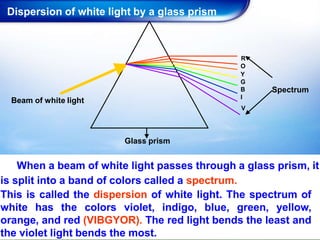
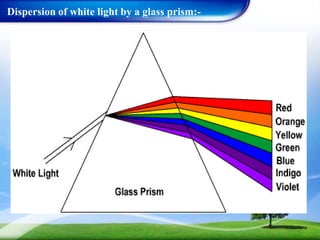
Dispersion of white light by a glass prism
Beam of white light
Spectrum
R
O
Y
G
B
I
V
When a beam of white light passes through a glass prism, it
is split into a band of colors called a spectrum.
This is called the dispersion of white light. The spectrum of
white has the colors violet, indigo, blue, green, yellow,
orange, and red (VIBGYOR). The red light bends the least and
the violet light bends the most.
Glass prism
Dispersion of white light by a glass prism:-
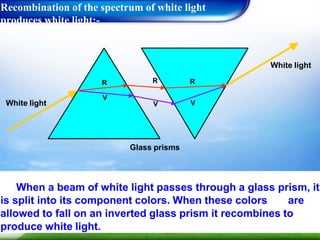
Recombination of the spectrum of white light
produces white light:-
R
V
V
R R
V
White light
White light
When a beam of white light passes through a glass prism, it
is split into its component colors. When these colors are
allowed to fall on an inverted glass prism it recombines to
produce white light.
Glass prisms
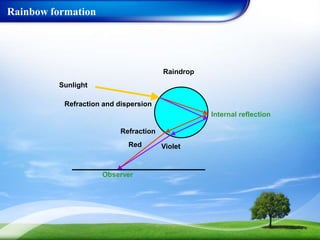
Rainbow formation
Raindrop
Violet
Sunlight
Refraction and dispersion
Internal reflection
Observer
Refraction
Red
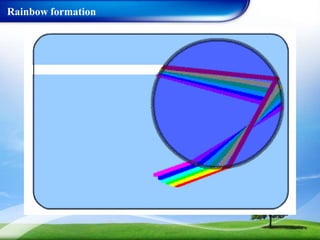
Rainbow formation
Atmospheric refraction :-
Apparent position
Eye
Star
Real position
Increasing
refractive index
of atmosphere
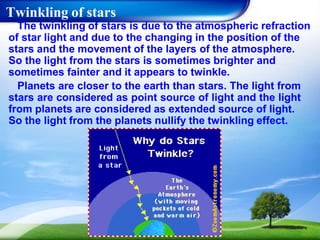
Twinkling of stars
The twinkling of stars is due to the atmospheric refraction
of star light and due to the changing in the position of the
stars and the movement of the layers of the atmosphere.
So the light from the stars is sometimes brighter and
sometimes fainter and it appears to twinkle.
Planets are closer to the earth than stars. The light from
stars are considered as point source of light and the light
from planets are considered as extended source of light.
So the light from the planets nullify the twinkling effect.
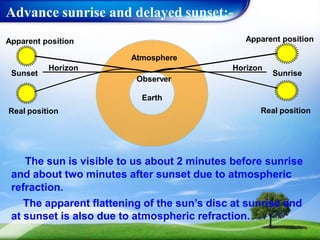
Advance sunrise and delayed sunset:-
Earth
Observer
Sunrise
Sunset
Apparent position
Apparent position
Atmosphere
The sun is visible to us about 2 minutes before sunrise
and about two minutes after sunset due to atmospheric
refraction.
The apparent flattening of the sun’s disc at sunrise and
at sunset is also due to atmospheric refraction.
Horizon Horizon
Real position Real position
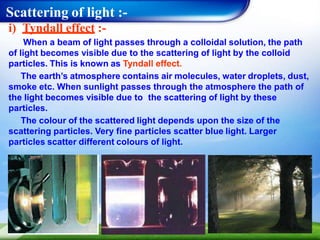
Scattering of light :-
i) Tyndall effect :-
When a beam of light passes through a colloidal solution, the path
of light becomes visible due to the scattering of light by the colloid
particles. This is known as Tyndall effect.
The earth’s atmosphere contains air molecules, water droplets, dust,
smoke etc. When sunlight passes through the atmosphere the path of
the light becomes visible due to the scattering of light by these
particles.
The colour of the scattered light depends upon the size of the
scattering particles. Very fine particles scatter blue light. Larger
particles scatter different colours of light.
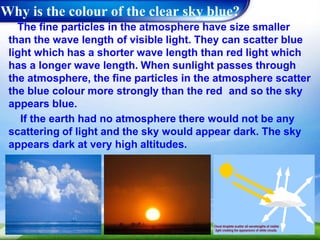
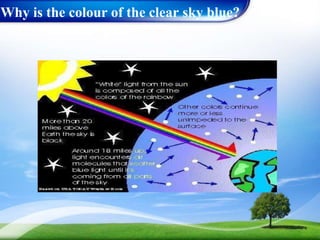
Why is the colour of the clear sky blue?
The fine particles in the atmosphere have size smaller
than the wave length of visible light. They can scatter blue
light which has a shorter wave length than red light which
has a longer wave length. When sunlight passes through
the atmosphere, the fine particles in the atmosphere scatter
the blue colour more strongly than the red and so the sky
appears blue.
If the earth had no atmosphere there would not be any
scattering of light and the sky would appear dark. The sky
appears dark at very high altitudes.
Why is the colour of the clear sky blue?
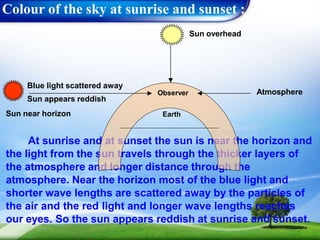
Colour of the sky at sunrise and sunset :
At sunrise and at sunset the sun is near the horizon and
the light from the sun travels through the thicker layers of
the atmosphere and longer distance through the
atmosphere. Near the horizon most of the blue light and
shorter wave lengths are scattered away by the particles of
the air and the red light and longer wave lengths reaches
our eyes. So the sun appears reddish at sunrise and sunset.
Observer
Sun overhead
Blue light scattered away
Sun appears reddish
Sun near horizon
Atmosphere
Earth
THANKYOU

LIGHT HUMAN EYE [Autosaved].pptx

  • 2.
    LearningObjectives The Human Eye TheImportant Parts of The Eye Power of Accommodation Defects of vision and their correction Myopia or Near-sightedness, Hypermetropia or Farsightedness, Presbyopia Dispersion of light  Scattering of light
  • 3.
    TheImportant PartsofTheEye Cornea: Thefront part of the eye is covered by transparent spherical membrane called cornea. Cornea
  • 4.
    TheImportant PartsofTheEye Iris: Justbehind the cornea is a dark coloured muscular diaphragm which has a small circular opening in the middle. Cornea Iris
  • 5.
    TheImportant PartsofTheEye Pupil: Pupilis the small circular opening of iris. The pupil appears black because no light is reflected from it. Cornea Pupil Iris
  • 6.
    TheImportant PartsofTheEye Eye Lens:The eye lens is a convex lens made of a transparent jelly - like proteinaceous material. Cornea Pupil Iris Eye Lens
  • 7.
    TheImportant PartsofTheEye Ciliary muscles:The eye lens is held in position by ciliary muscles. The ciliary muscles help in changing the curvature and focal length of the eye lens. Ciliary muscles Cornea Pupil Iris Eye Lens
  • 8.
    TheImportant PartsofTheEye Retina: Theinner back surface of the eye ball is called retina. It is a semi-transparent membrane which is light sensitive and is equivalent to the screen of a camera. Ciliary muscles Cornea Pupil Iris Eye Lens Retina
  • 9.
    TheImportant PartsofTheEye Vitreous humour:The space between the retina and eye lens is filled with another fluid called vitreous humour. Ciliary muscles Cornea Pupil Iris Eye Lens Retina Vitreous humour
  • 10.
    TheImportant PartsofTheEye Blind Spot:It is a spot at which the optic nerve enters the eye and is insensitive to light and hence the name. Cornea Iris Pupil Ciliary muscles Eye Lens Retina Vitreous humour Blind spot Optic Nerve
  • 11.
    Power of Accommodation Powerof Accommodation: The ability of the eye to focus on objects lying at different distances is called the power of accommodation of the eye. Near object Far object
  • 12.
    When the ciliarymuscles are relaxed, the eye lens becomes thin. Thus, its focal length increases and we see the distant objects clearly. When the ciliary muscles are contract, then the curvature of the eye lens is increases and the eye lens becomes thick. Thus, its focal length decreases and we see the nearby objects. Ciliary muscles Thin Eye Lens Thick Eye Lens Power of Accommodation
  • 13.
    Near point orleast distance of distinct vision is the point nearest to the eye at which an object is visible distinctly. Far Point of The Eye Far point of the eye is the maximum distance up to which the normal eye can see things clearly. It is infinity for a normal eye. Near Point of the Eye 25 cm Power of Accommodation
  • 14.
    Defects of Visionand Their Correction • Myopia or near-sightedness • Hypermetropia or far-sightedness • Presbyopia • Cataract
  • 15.
    Myopia or Near-sightedness Myopia:The light from a distant object arriving at the eye lens may get converged at a point in front of the retina in the vitreous body. Correction for myopia: To compensate this, we interpose a concave lens between the eye and the object, with the diverging effect desired to get the image focused on the retina. Myopic Eye Correction Concave Lens
  • 16.
    Hypermetropia or Farsightedness Hypermetropia:If the eye-lens focuses the incoming light at a point behind the retina, this defect is called far sightedness or hypermetropia. Correction for hypermetropic eye: A convergent lens(convex lens) is needed to compensate for the defect in vision. Correction Hypermetropic Eye Convex Lens
  • 17.
    Presbyopia Presbyopia is acommon type of vision disorder that occurs as you age. It is often referred to as the aging eye condition. Presbyopia results in the inability to focus up close, a problem associated with refraction in the eye.
  • 18.
    Cataract Cataract: The crystallinelens of people at old age becomes milky and cloudy. This condition is called cataract. This causes partial or complete loss of vision. It is possible to restore vision through a cataract surgery. Milky and Cloudy Eye
  • 19.
    Refraction of lightthrough a glass prism
  • 20.
    Refraction of lightthrough a glass prism Incident ray Refracted ray When a ray of light passes through a glass prism, it gets bent twice at the air-glass interface and glass-air interface. The emergent ray is deviated by an angle to the incident Ray. This angle is called the angle of deviation. Emergent ray D i r Air Glass Glass Air Glass prism e Angle of emergence Angle of deviation Normal
  • 21.
    Dispersion of whitelight by a glass prism Beam of white light Spectrum R O Y G B I V When a beam of white light passes through a glass prism, it is split into a band of colors called a spectrum. This is called the dispersion of white light. The spectrum of white has the colors violet, indigo, blue, green, yellow, orange, and red (VIBGYOR). The red light bends the least and the violet light bends the most. Glass prism
  • 22.
    Dispersion of whitelight by a glass prism:-
  • 23.
    Recombination of thespectrum of white light produces white light:- R V V R R V White light White light When a beam of white light passes through a glass prism, it is split into its component colors. When these colors are allowed to fall on an inverted glass prism it recombines to produce white light. Glass prisms
  • 24.
    Rainbow formation Raindrop Violet Sunlight Refraction anddispersion Internal reflection Observer Refraction Red
  • 25.
  • 26.
    Atmospheric refraction :- Apparentposition Eye Star Real position Increasing refractive index of atmosphere
  • 27.
    Twinkling of stars Thetwinkling of stars is due to the atmospheric refraction of star light and due to the changing in the position of the stars and the movement of the layers of the atmosphere. So the light from the stars is sometimes brighter and sometimes fainter and it appears to twinkle. Planets are closer to the earth than stars. The light from stars are considered as point source of light and the light from planets are considered as extended source of light. So the light from the planets nullify the twinkling effect.
  • 28.
    Advance sunrise anddelayed sunset:- Earth Observer Sunrise Sunset Apparent position Apparent position Atmosphere The sun is visible to us about 2 minutes before sunrise and about two minutes after sunset due to atmospheric refraction. The apparent flattening of the sun’s disc at sunrise and at sunset is also due to atmospheric refraction. Horizon Horizon Real position Real position
  • 29.
    Scattering of light:- i) Tyndall effect :- When a beam of light passes through a colloidal solution, the path of light becomes visible due to the scattering of light by the colloid particles. This is known as Tyndall effect. The earth’s atmosphere contains air molecules, water droplets, dust, smoke etc. When sunlight passes through the atmosphere the path of the light becomes visible due to the scattering of light by these particles. The colour of the scattered light depends upon the size of the scattering particles. Very fine particles scatter blue light. Larger particles scatter different colours of light.
  • 30.
    Why is thecolour of the clear sky blue? The fine particles in the atmosphere have size smaller than the wave length of visible light. They can scatter blue light which has a shorter wave length than red light which has a longer wave length. When sunlight passes through the atmosphere, the fine particles in the atmosphere scatter the blue colour more strongly than the red and so the sky appears blue. If the earth had no atmosphere there would not be any scattering of light and the sky would appear dark. The sky appears dark at very high altitudes.
  • 31.
    Why is thecolour of the clear sky blue?
  • 32.
    Colour of thesky at sunrise and sunset : At sunrise and at sunset the sun is near the horizon and the light from the sun travels through the thicker layers of the atmosphere and longer distance through the atmosphere. Near the horizon most of the blue light and shorter wave lengths are scattered away by the particles of the air and the red light and longer wave lengths reaches our eyes. So the sun appears reddish at sunrise and sunset. Observer Sun overhead Blue light scattered away Sun appears reddish Sun near horizon Atmosphere Earth
  • 33.