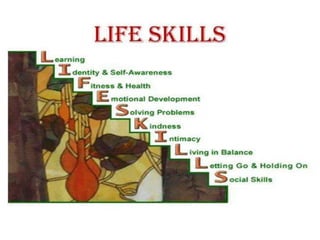
 Life skills are abilities for adaptive and positive behavior that
enable individuals to deal effectively with the demands and
challenges of everyday life (WHO,1997)
 Life skills include psychosocial competencies and inter personal
skills that help people make informed decision ,solve problems
,think critically, communicate effectively, build healthy social
relationship and cope with their lives in a healthy and productive
manner.
 Life skill facilitates a complete and integrated development of
individual to function effectively as social beings.
.
“Life skills based education is a behaviour
change or development approach designed
to address a balance of three areas:
knowledge, attitude, and skills”
-
UNICEF(2001),
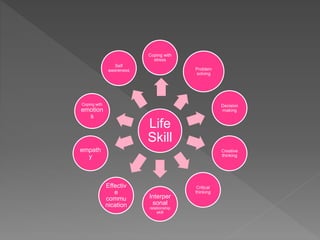
Life
Skill
Coping with
stress
Problem
solving
Decision
making
Creative
thinking
Critical
thinking
Interper
sonal
relationship
skill
Effectiv
e
commu
nication
empath
y
Coping with
emotion
s
Self
awareness
Adolescence is a vital stage of growth and
development and marks the period of
transition from childhood to adulthood.
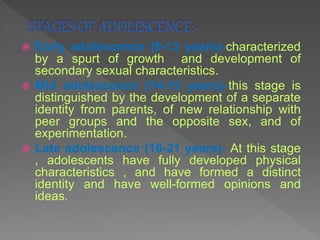
 Early adolescence (9-13 years)-characterized
by a spurt of growth and development of
secondary sexual characteristics.
 Mid adolescence (14-15 years)-this stage is
distinguished by the development of a separate
identity from parents, of new relationship with
peer groups and the opposite sex, and of
experimentation.
 Late adolescence (16-21 years)- At this stage
, adolescents have fully developed physical
characteristics , and have formed a distinct
identity and have well-formed opinions and
ideas.
 Adolescence is a development period
 Adolescence is a transitional period
 Adolescence is a problem age
 Adolescence is a time of search for identity
 Adolescence is a threshold of adulthood
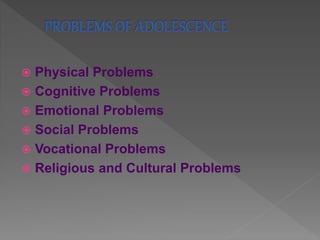
 Physical Problems
 Cognitive Problems
 Emotional Problems
 Social Problems
 Vocational Problems
 Religious and Cultural Problems
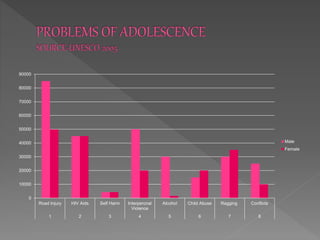
0
10000
20000
30000
40000
50000
60000
70000
80000
90000
Road Injury HIV Aids Self Harm Interperonal
Violence
Alcohol Child Abuse Ragging Conflicts
1 2 3 4 5 6 7 8
Male
Female
 To make life of adolescents valuable and to convert
them to individuals with high potential, educational
system should be reformed giving due importance
to life skill education.
 Life skills are those abilities which will help in the
promotion of general well being and psychosocial
competence of the individual.
 Life skills empower young people to take positive
action to protect them and promote health and
positive social relationships.
 It also entails being able to establish productive
interpersonal relationships with others.
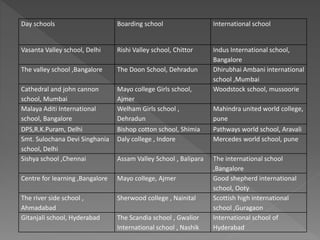
Day schools Boarding school International school
Vasanta Valley school, Delhi Rishi Valley school, Chittor Indus International school,
Bangalore
The valley school ,Bangalore The Doon School, Dehradun Dhirubhai Ambani international
school ,Mumbai
Cathedral and john cannon
school, Mumbai
Mayo college Girls school,
Ajmer
Woodstock school, mussoorie
Malaya Aditi International
school, Bangalore
Welham Girls school ,
Dehradun
Mahindra united world college,
pune
DPS,R.K.Puram, Delhi Bishop cotton school, Shimia Pathways world school, Aravali
Smt. Sulochana Devi Singhania
school, Delhi
Daly college , Indore Mercedes world school, pune
Sishya school ,Chennai Assam Valley School , Balipara The international school
,Bangalore
Centre for learning ,Bangalore Mayo college, Ajmer Good shepherd international
school, Ooty
The river side school ,
Ahmadabad
Sherwood college , Nainital Scottish high international
school ,Guragaon
Gitanjali school, Hyderabad The Scandia school , Gwalior
International school , Nashik
International school of
Hyderabad
 Adolescence is a period when the intellectual, physical and all
the capabilities are very high but their antisocial activities and
behavior are deteriorating all their capabilities and they are
becoming a burden to the society. Imparting life skill training
through inculcating life skill education will help our adolescents
to overcome such difficulties in life.
 Life skill education can serve as a remedy for the problems as it
helps the adolescents to lead a better life. There for life skill
education is a need of the society and every education system
should impart life skill education as a part of its curriculum as it
is capable of producing positive health behavior, positive
interpersonal relationships and well being of individuals.
 To be effective, life skills ultimately need to
be age-aligned and inculcated in schools
that are inclusive, with trained and motivated
teachers who can employ participatory and
experiential teaching practices.
 https://www.unicef.org/lifeskills/-7308.html
 https://en.m.wikipedia.org/wiki/life skills
based education
 www.cbse.nic.in>cce >life skill
 UNESCO 2005
 Unicef,2003,2005
Life_Skill_Education_PPT_-_Copy_(2)[1].pptx

Life_Skill_Education_PPT_-_Copy_(2)[1].pptx

  • 3.
     Life skillsare abilities for adaptive and positive behavior that enable individuals to deal effectively with the demands and challenges of everyday life (WHO,1997)  Life skills include psychosocial competencies and inter personal skills that help people make informed decision ,solve problems ,think critically, communicate effectively, build healthy social relationship and cope with their lives in a healthy and productive manner.  Life skill facilitates a complete and integrated development of individual to function effectively as social beings. .
  • 4.
    “Life skills basededucation is a behaviour change or development approach designed to address a balance of three areas: knowledge, attitude, and skills” - UNICEF(2001),
  • 5.
  • 6.
    Adolescence is avital stage of growth and development and marks the period of transition from childhood to adulthood.
  • 7.
     Early adolescence(9-13 years)-characterized by a spurt of growth and development of secondary sexual characteristics.  Mid adolescence (14-15 years)-this stage is distinguished by the development of a separate identity from parents, of new relationship with peer groups and the opposite sex, and of experimentation.  Late adolescence (16-21 years)- At this stage , adolescents have fully developed physical characteristics , and have formed a distinct identity and have well-formed opinions and ideas.
  • 8.
     Adolescence isa development period  Adolescence is a transitional period  Adolescence is a problem age  Adolescence is a time of search for identity  Adolescence is a threshold of adulthood
  • 9.
     Physical Problems Cognitive Problems  Emotional Problems  Social Problems  Vocational Problems  Religious and Cultural Problems
  • 10.
    0 10000 20000 30000 40000 50000 60000 70000 80000 90000 Road Injury HIVAids Self Harm Interperonal Violence Alcohol Child Abuse Ragging Conflicts 1 2 3 4 5 6 7 8 Male Female
  • 11.
     To makelife of adolescents valuable and to convert them to individuals with high potential, educational system should be reformed giving due importance to life skill education.  Life skills are those abilities which will help in the promotion of general well being and psychosocial competence of the individual.  Life skills empower young people to take positive action to protect them and promote health and positive social relationships.  It also entails being able to establish productive interpersonal relationships with others.
  • 12.
    Day schools Boardingschool International school Vasanta Valley school, Delhi Rishi Valley school, Chittor Indus International school, Bangalore The valley school ,Bangalore The Doon School, Dehradun Dhirubhai Ambani international school ,Mumbai Cathedral and john cannon school, Mumbai Mayo college Girls school, Ajmer Woodstock school, mussoorie Malaya Aditi International school, Bangalore Welham Girls school , Dehradun Mahindra united world college, pune DPS,R.K.Puram, Delhi Bishop cotton school, Shimia Pathways world school, Aravali Smt. Sulochana Devi Singhania school, Delhi Daly college , Indore Mercedes world school, pune Sishya school ,Chennai Assam Valley School , Balipara The international school ,Bangalore Centre for learning ,Bangalore Mayo college, Ajmer Good shepherd international school, Ooty The river side school , Ahmadabad Sherwood college , Nainital Scottish high international school ,Guragaon Gitanjali school, Hyderabad The Scandia school , Gwalior International school , Nashik International school of Hyderabad
  • 14.
     Adolescence isa period when the intellectual, physical and all the capabilities are very high but their antisocial activities and behavior are deteriorating all their capabilities and they are becoming a burden to the society. Imparting life skill training through inculcating life skill education will help our adolescents to overcome such difficulties in life.  Life skill education can serve as a remedy for the problems as it helps the adolescents to lead a better life. There for life skill education is a need of the society and every education system should impart life skill education as a part of its curriculum as it is capable of producing positive health behavior, positive interpersonal relationships and well being of individuals.
  • 15.
     To beeffective, life skills ultimately need to be age-aligned and inculcated in schools that are inclusive, with trained and motivated teachers who can employ participatory and experiential teaching practices.
  • 16.
     https://www.unicef.org/lifeskills/-7308.html  https://en.m.wikipedia.org/wiki/lifeskills based education  www.cbse.nic.in>cce >life skill  UNESCO 2005  Unicef,2003,2005