Life Process
• Life processes are the basic processes in living organisms
which are necessary for maintaining their life.
Which are these life processes
• Nutrition
• Respiration
• Transportation
• Excretion
Nutrition :-
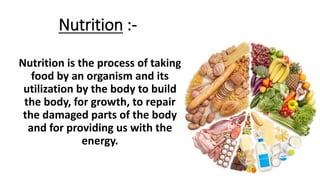
Nutrition is the process of taking
food by an organism and its
utilization by the body to build
the body, for growth, to repair
the damaged parts of the body
and for providing us with the
energy.
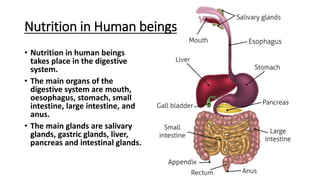
Nutrition in Human beings
• Nutrition in human beings
takes place in the digestive
system.
• The main organs of the
digestive system are mouth,
oesophagus, stomach, small
intestine, large intestine, and
anus.
• The main glands are salivary
glands, gastric glands, liver,
pancreas and intestinal glands.
• MOUTH –
• breaking down of food by teeth
• Converts starch into sugar by
salivary amylase
• OESOPHAGUS –
• Peristaltic movement
STOMACH
• Gastric glands
• Gastric juice
• Enzyme pepsin –
 breaks protein
• Hydrochloric acid –
 creates acidic medium to facilitate
the action of enzyme pepsin.
• Mucus –
 protects the walls of the stomach from
the action of the acid.
SMALL INTESTINE
Pancreatic juice
Trypsin –breaks protein
Lipase- breaks fat
Bile juice
Breaks fat into small globules
• Enzymes present in
intestinal juice converts :
• carbohydrates into glucose
• fats into fatty acids and
glycerol
• proteins into amino acids
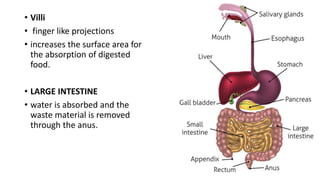
• Villi
• finger like projections
• increases the surface area for
the absorption of digested
food.
• LARGE INTESTINE
• water is absorbed and the
waste material is removed
through the anus.
Respiration
• Respiration is the process by which food is burnt in the cells of the body
with the help of oxygen to release energy. It takes place in the
mitochondria of the cells.
• The energy released during respiration is used to make ATP molecules
(Adenosine tri phosphate) from ADP molecules (Adenosine di phosphate)
and inorganic phosphate.
Energy
• ADP + Phosphate ATP
from respiration
• Energy is stored in the cells in the form of ATP molecules. When the
cells need energy, ATP is broken down in the presence of water to form
ADP and energy is released.
water
• ATP ADP + Energy
• The main organs of the
respiratory system are
nostrils, nasal cavity, pharynx,
larynx, trachea,
bronchi, bronchioles, lungs
and diaphragm.
• Nostrils/Nasal cavity
• Pharynx
• Larynx
• Trachea
• Rings of cartilage
• Bronchi – bronchioles
• Alveoli -increases the surface area for
the exchange of gases
Mechanism of breathing :-
• When we breathe in air, the
muscles of the diaphragm
contracts and moves
downward and the chest cavity
expands and air enters into the
lungs.
• When we breathe out air, the
muscles of the diaphragm
relaxes and moves upward and
the chest cavity contracts and
air goes out of the lungs.
Excretion in plants
THANK YOU

life process 1.pptx

  • 2.
    Life Process • Lifeprocesses are the basic processes in living organisms which are necessary for maintaining their life.
  • 3.
    Which are theselife processes • Nutrition • Respiration • Transportation • Excretion
  • 4.
    Nutrition :- Nutrition isthe process of taking food by an organism and its utilization by the body to build the body, for growth, to repair the damaged parts of the body and for providing us with the energy.
  • 5.
    Nutrition in Humanbeings • Nutrition in human beings takes place in the digestive system. • The main organs of the digestive system are mouth, oesophagus, stomach, small intestine, large intestine, and anus. • The main glands are salivary glands, gastric glands, liver, pancreas and intestinal glands.
  • 6.
    • MOUTH – •breaking down of food by teeth • Converts starch into sugar by salivary amylase • OESOPHAGUS – • Peristaltic movement
  • 7.
    STOMACH • Gastric glands •Gastric juice • Enzyme pepsin –  breaks protein • Hydrochloric acid –  creates acidic medium to facilitate the action of enzyme pepsin. • Mucus –  protects the walls of the stomach from the action of the acid.
  • 8.
    SMALL INTESTINE Pancreatic juice Trypsin–breaks protein Lipase- breaks fat Bile juice Breaks fat into small globules • Enzymes present in intestinal juice converts : • carbohydrates into glucose • fats into fatty acids and glycerol • proteins into amino acids
  • 9.
    • Villi • fingerlike projections • increases the surface area for the absorption of digested food. • LARGE INTESTINE • water is absorbed and the waste material is removed through the anus.
  • 10.
  • 11.
    • Respiration isthe process by which food is burnt in the cells of the body with the help of oxygen to release energy. It takes place in the mitochondria of the cells. • The energy released during respiration is used to make ATP molecules (Adenosine tri phosphate) from ADP molecules (Adenosine di phosphate) and inorganic phosphate. Energy • ADP + Phosphate ATP from respiration • Energy is stored in the cells in the form of ATP molecules. When the cells need energy, ATP is broken down in the presence of water to form ADP and energy is released. water • ATP ADP + Energy
  • 12.
    • The mainorgans of the respiratory system are nostrils, nasal cavity, pharynx, larynx, trachea, bronchi, bronchioles, lungs and diaphragm.
  • 13.
    • Nostrils/Nasal cavity •Pharynx • Larynx • Trachea • Rings of cartilage • Bronchi – bronchioles • Alveoli -increases the surface area for the exchange of gases
  • 14.
    Mechanism of breathing:- • When we breathe in air, the muscles of the diaphragm contracts and moves downward and the chest cavity expands and air enters into the lungs. • When we breathe out air, the muscles of the diaphragm relaxes and moves upward and the chest cavity contracts and air goes out of the lungs.
  • 19.
  • 20.