
1111
22
33
44
55
66
77
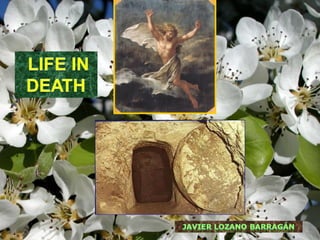
 The title of this book may seem provocative: “Life in death.” It wouldThe title of this book may seem provocative: “Life in death.” It would
seem more logical to say the contrary: “Death in life”, given that life endsseem more logical to say the contrary: “Death in life”, given that life ends
with death. Nevertheless, the title is more logical than what one maywith death. Nevertheless, the title is more logical than what one may
think, because it corresponds to the only reality that gives sense tothink, because it corresponds to the only reality that gives sense to
everything, and thus enables everything to be logical. If human life wereeverything, and thus enables everything to be logical. If human life were
to end with death, nothing would have sense. This title touches theto end with death, nothing would have sense. This title touches the
central aspect of Christianity: the resurrection of Christ. He is the Onecentral aspect of Christianity: the resurrection of Christ. He is the One
who gives us life in death through the resurrection.who gives us life in death through the resurrection.
 In the book we ask ourselves how this happens, and the answer is:In the book we ask ourselves how this happens, and the answer is:
through Health Pastoral Care. We develop the answer in two parts: in thethrough Health Pastoral Care. We develop the answer in two parts: in the
first part we try to explain what Health Pastoral Care is, and in the secondfirst part we try to explain what Health Pastoral Care is, and in the second
part we treat the essential themes that are the basis of an authenticpart we treat the essential themes that are the basis of an authentic
Health Pastoral Care.Health Pastoral Care.
 I am very grateful to Cardinal Paul Poupard, emeritus President of theI am very grateful to Cardinal Paul Poupard, emeritus President of the
Pontifical Council for Culture and Inter-religious Dialogue, who paid mePontifical Council for Culture and Inter-religious Dialogue, who paid me
the tribute of writing a beautiful Preface, making a complete and profoundthe tribute of writing a beautiful Preface, making a complete and profound
presentation of the book: I am sure that reading it will be very beneficial.presentation of the book: I am sure that reading it will be very beneficial.
88
99
1010
CONTENTSCONTENTSPrefacePreface
FIRST PART:FIRST PART:
HEALTH PASTORAL CARE IN THE CHURCHHEALTH PASTORAL CARE IN THE CHURCH
I.I. The Present State of Health Pastoral CareThe Present State of Health Pastoral Care
II.II.
What is Health Pastoral Care? What Should be DonWhat is Health Pastoral Care? What Should be Don
III.III. How Should it be Done?How Should it be Done?
SECOND PART:SECOND PART:
CENTRAL THEMES IN HEALTH PASTORAL CARECENTRAL THEMES IN HEALTH PASTORAL CARE
I.I. Life, Giving of LoveLife, Giving of Love
II.II. Pain, Enigma or Mystery?Pain, Enigma or Mystery?
III.III. ViaticumViaticum
IV.IV. HealthHealth 1010
1111
CONTENTS:CONTENTS:
PrefacePreface
IntroductionIntroduction
First Part :First Part : HEALTH PASTORAL CARE IN THE CHURCH.HEALTH PASTORAL CARE IN THE CHURCH.
I. Present SituationI. Present Situation
1. Present Situation1. Present Situation
2. Positive and Negative Points2. Positive and Negative Points
II. What is Health Pastoral Care? What Should be Done?II. What is Health Pastoral Care? What Should be Done?
1. The Gospels1. The Gospels
2. The Pontifical Magisterium2. The Pontifical Magisterium
III. How Should it be Done?III. How Should it be Done?
1. Elaboration according to the Ministries in the Church1. Elaboration according to the Ministries in the Church
2. Elaboration according to the Objectives2. Elaboration according to the Objectives
3. Practical Proposals:3. Practical Proposals:
- Challenges- Challenges
- General Proposals- General Proposals
- Ways- Ways
- Answers- Answers
1111
1212
Second Part:Second Part: CENTRAL THEMES IN HEALTH PASTORALCENTRAL THEMES IN HEALTH PASTORAL
CARECARE
Chapter 1:Chapter 1: LIFE, GIVING OF LOVELIFE, GIVING OF LOVE
I.I. Scientific FoundationScientific Foundation
 The Beginning of Human LifeThe Beginning of Human Life
 The Initial Elements of Human LifeThe Initial Elements of Human Life
 ConclusionsConclusions
II.II. Philosophical FoundationPhilosophical Foundation
 Opposition of ContradictionOpposition of Contradiction
 Opposition of ContrarietyOpposition of Contrariety
 ConclusionsConclusions
III.III. Theological ReflectionTheological Reflection
 Life in the Most Holy TrinityLife in the Most Holy Trinity
 Life in the IncarnationLife in the Incarnation
 Contradiction taken on in ContrarietyContradiction taken on in Contrariety
 ConclusionsConclusions
CONCLUSIONSCONCLUSIONS
1212
1313
Chapter 2:Chapter 2: PAIN AND DEATH: ENIGMA ORPAIN AND DEATH: ENIGMA OR
MYSTERY?MYSTERY?
IntroductionIntroduction
Types of KnowledgeTypes of Knowledge
1. Medical Observations on Pain1. Medical Observations on Pain
2. Solutions of the Great2. Solutions of the Great
ReligionsReligions
3. Dialogue with Christianity3. Dialogue with Christianity
I. The Enigma of PainI. The Enigma of Pain
1. Existential Approach1. Existential Approach
2. Reflection on the Experience2. Reflection on the Experience
II. The MysteryII. The Mystery
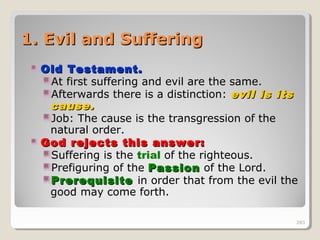
1. Evil and Suffering1. Evil and Suffering
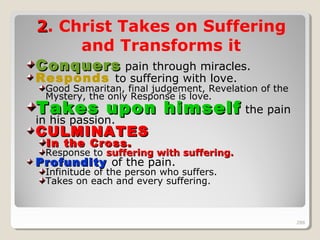
2. Christ takes on Suffering2. Christ takes on Suffering
and Transforms itand Transforms it
1313
III. CommentsIII. Comments
1. Epistemological Status1. Epistemological Status
2. The Gradual Approach of the2. The Gradual Approach of the
Thought of John Paul IIThought of John Paul II
3. The Core of the Mystery3. The Core of the Mystery
4. Understanding the Mystery4. Understanding the Mystery
5. From Suffering to Solidarity5. From Suffering to Solidarity
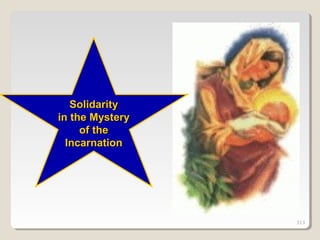
6. Constitutive Solidarity in Christ6. Constitutive Solidarity in Christ
7. Suffering considered from7. Suffering considered from
ResurrectionResurrection
8. The Meaning of the Glorious8. The Meaning of the Glorious
CrossCross
ConclusionConclusion
1414
Chapter 3:Chapter 3: VIATICUMVIATICUM
IntroductionIntroduction
1. Palliative care1. Palliative care
2. Catholic Spiritual Palliative2. Catholic Spiritual Palliative
CareCare
3. The Second Vatican Council3. The Second Vatican Council
4. Viaticum: the Core of the4. Viaticum: the Core of the
ReflectionReflection
I. Death and LifeI. Death and Life
1. Viaticum as the Apex of1. Viaticum as the Apex of
LifeLife
2. The Meaning of Death2. The Meaning of Death
II. CommunionII. Communion
1. Obscurity and Loneliness1. Obscurity and Loneliness
2. Viaticum: Light2. Viaticum: Light
3. Accompanying3. Accompanying
4. Proportions4. Proportions
III. EternityIII. Eternity
1. Eucharistic Presence1. Eucharistic Presence
2. Eternity2. Eternity
3. Immutability3. Immutability
4. Divinization through the4. Divinization through the
ViaticumViaticum
5. The Bridge to be Crossed5. The Bridge to be Crossed
6. The Dynamism of the6. The Dynamism of the
ViaticumViaticum
ConclusionConclusion
Palliative Care?Palliative Care?
1414
1515
Chapter 4:Chapter 4: HEALTHHEALTH
I. What is Health?I. What is Health?
1. Definitions1. Definitions
2. Observations2. Observations
II. Health as a tension towardsII. Health as a tension towards
harmony:harmony:
Religious backgroundReligious background
Old TestamentOld Testament
New TestamentNew Testament
III. Elements of John Paul II’sIII. Elements of John Paul II’s
Definition of Health:Definition of Health:
1. Tension1. Tension
2. Harmony2. Harmony
3. Physical3. Physical
4. Psychological4. Psychological
5. Social5. Social
6. Spiritual6. Spiritual
7. Unification7. Unification
8. Way8. Way
9. Diversity of Health9. Diversity of Health
CONCLUSIONSCONCLUSIONS
1616
Chapter 5:Chapter 5: PROFILE OF THE CATHOLICPROFILE OF THE CATHOLIC
PROFESSOR OF MEDICINEPROFESSOR OF MEDICINE
Introduction:Introduction:
CultureCulture
The TeacherThe Teacher
I. THE CATHOLIC PROFESSOR OFI. THE CATHOLIC PROFESSOR OF
MEDICINEMEDICINE
1. The Catholic Teacher of Medicine1. The Catholic Teacher of Medicine
2. The Teacher of Medicine as a2. The Teacher of Medicine as a
ProfessorProfessor
II. IDENTITY OF THE CATHOLICII. IDENTITY OF THE CATHOLIC
PHYSICIANPHYSICIAN
1. Charter for Health Care Workers1. Charter for Health Care Workers
2. Vocation and the Church: Three2. Vocation and the Church: Three
Characteristics of VocationCharacteristics of Vocation
A. BEINGA. BEING
1. The Profession1. The Profession
2. The Love of God2. The Love of God
3. Life3. Life
4. Medical Training4. Medical Training
B.B. WITHWITH
1. Revelation of Christ1. Revelation of Christ
2. Pain2. Pain
3. Health3. Health
C.C. FORFOR
1. Openness to the Patient1. Openness to the Patient
2. Fundamental Qualities of2. Fundamental Qualities of
the Physicianthe Physician
3. Portrait of the Physician3. Portrait of the Physician
4. Morality and Law4. Morality and Law
5. Teamwork5. Teamwork
CONCLUSIONSCONCLUSIONS
1616
17171717
1818
PrefacePreface
It is a true privilege for me to write a preface to this work, LIFE IN DEATH,
by my brother, neighbour and friend, Cardinal Javier Lozano Barragán, the
President of the Pontifical Council for Health Care Workers.
 With this evocative title, whose words ring out loud and clear as a
forcefully-made proclamation, the principal figure responsible for Health
Pastoral Care within the institutions of the Roman Curia that help the Holy
Father in his “care for all Churches” presents us with strong beliefs that are
underpinned by solid foundations and accompanied by a rich
documentation. His aim is to support the pastoral action of the whole of the
Church in this limitless field in which a determining struggle is under way
against the counter-culture of death, which is now invading the world at the
dawn of the new millennium.
1919
 In a notable pedagogic presentation, in which images of various
nuances command the attention of the reader and help him to remember a
summary of the points that are luminously expounded, the Cardinal
emphasises the striking statistics that reflect the centuries-old commitment
of the Church to service to the sick and the immense cohorts of all those
who suffer in the world, in the vastness of the five continents. However, he
does not conceal the growing shadows that are provoked by a galloping
secularisation of devastating effects, a true steamroller, which, if we are
not careful, will tend to reduce charity to mere philanthropy, depriving it of
its Christological roots and mutilating its eschatological dimension.
 “The truth is that only in the mystery of the incarnate Word does the
mystery of man take on light…Through Christ and in Christ, the riddles of
sorrow and death grow meaningful. Apart from His Gospel, they
overwhelm us. Christ has risen, destroying death by His death; He has
lavished life upon us so that, as sons in the Son, we can cry out in the
Spirit; Abba, Father!” (Gaudium et Spes, n. 22).
2020
Without this great vision of faith observed to us by the Second Vatican Council,
charity is transmuted into compassion, theological hope is reduced to human hope,
and the struggle for life becomes deprived of its principal motivation – the
safeguarding of that image of God which is every human person, beginning with the
weakest and the poorest, created in the image and likeness of his Creator, whose
mortal body, enveloped by his immortal soul, is called, beyond earthly death, to the
resurrection of the flesh and to eternal life, as indeed we profess in the Creed.
“How can I know where I am going if I do not know where I come from?”, his
Royal Highness Otto of Habsburg declared in his nineties. Although we live
ineluctably in this fleeting world, passing from the cradle to the grave, our faith
transcends the dramatic closure of this mortal finitude and opens it to an eternal
future of beauty, love and peace.
“Man rise infinitely above man”, wrote Pascal in one of his striking Thoughts, which
continue to make us reflect still today. “I do not die, I enter life”, the little Theresa
confided with faith in the infirmary of Carmel of Lisieux, at the moment of her return
to the heavenly Father.
2121
While the notable advances of technological developments and the growing
influence of the mass media are forming a new spirit based on positivism and
practical behaviour that is impregnated with a profound materialism, the dominant
culture sees death only as a definitive failure whose ineluctable expiry date is
continually rejected without, however, being able to be definitively exorcised. The life
sciences themselves would appear to reduce man to being only a living being
amongst other living beings, that is to say they would dissolve him, were they to
prove that life, however complex it may be, is reduced to nothing else but vulnerable
matter that is irremediably perishable. Like light broken down by a prism, man runs
the risk of being broken down by a clinical outlook that no longer manages to grasp
his living being in its personal unity and integrity.
All of this draws attention to the importance of a Pastoral Care in Health that is
based upon belief in the transcendence of man, a singular being who cannot be
reduced to the level of other living beings and to the mechanisms that structure
exchanges of energy. The man of the age of information technology and
disenchanted modernity, between the will to live and the certainty of dying needs to
rediscover in the faith in life after death, the strength to lead with serenity his
mysterious and shadowy passage towards the light. This is the horizon that Cardinal
Barragán gives to Health Pastoral Care, illustrating clearly how God, the Father of all
men, reconciled death with life through the death and resurrection of His beloved
Son Jesus, the son of the Virgin Mary.
2222
Of particular eloquence here is the author’s preliminary list of the Biblical
foundations of Health Pastoral Care, beginning with the inescapable reference to
the Good Shepherd of chapter ten of the Gospel of St. John, the Good Samaritan,
who continues to inspire the Church in her inexhaustible charity for the sick and for
all those who suffer in body and soul, to help them to live according to the ancient
adage mens sana in corpore sano.
With the Cardinal we follow Jesus through the streets of Palestine as he
unceasingly heals the sick and raises the dead. We reflect profitably on the
teaching of the Popes of our time, in particular the luminous Apostolic Letter of the
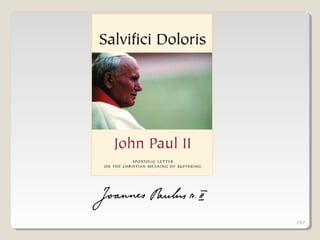
Servant of God John Paul II, Salvifici Doloris, and the reiterated appeals of his
successor, Pope Benedict XVI, for the formation of consciences and respectful
dialogue with non-believers.
 Nourished by these luminous teachings, Health Pastoral Care is offered to the
whole of the Church under the vigorous impulse of the Pontifical Council led by
Cardinal Barragán, who has recently successfully overcome a serious operation, in
a sequence that is limpid in all its components: “Challenges, Proposals, Ways,
Answers”.
2323
The maternal care of the Church for all sick and infirm people is expressed in the
teaching of hope in the resurrection, the sanctification of the sacraments, through
Anointing of the Sick, the Eucharist, and in particular Holy Viaticum, and fraternal
contacts impregnated with sensitivity.
Life in Death. In this valuable vademecum, with its philosophical, theological and
scientific facts on life and death, health, an ideal profile of the Christian medical
doctor and the Catholic idea of medical science and art could not but be present.
Far from replacing the local Churches, the Pontifical Council for Health Care
Workers, like all the dicasteries of the Roman Curia, has no other aim than that of
helping them to promote, direct, develop and coordinate the care of the whole of the
Church in this privileged sphere, something which requires a profound vision of
faith, steady hope, and charity without restrictions, following the example of Christ
the Good Shepherd, the Good Samaritan and divine Physician of bodies and souls.
We should thank Cardinal Barragán for offering us this valuable “service of love”
(Benedict XVI, Deus Caritas Est, n. 28).
From the Vatican, 11 June 2008
Cardinal Paul Poupard,
President Emeritus of the Pontifical Council for Culture and
the Pontifical Council for Inter-religious Dialogue
2424
INTRODUCTIONINTRODUCTION
Thanks to the advanced state of sciences and technology, many things that onceThanks to the advanced state of sciences and technology, many things that once
seemed impossible to us, today they are completely ordinary. It suffices to thinkseemed impossible to us, today they are completely ordinary. It suffices to think
about the means of social communication; because of the “internet” the telegramabout the means of social communication; because of the “internet” the telegram
was the first become outdated. Today one hardly sends a telegram. With thewas the first become outdated. Today one hardly sends a telegram. With the
wonder of mobile telephones we are increasingly closer to each other. Think aboutwonder of mobile telephones we are increasingly closer to each other. Think about
the “video conferences” by which we communicate live, using both sound andthe “video conferences” by which we communicate live, using both sound and
images. It would seem that in our era everything is possible. If not in our presentimages. It would seem that in our era everything is possible. If not in our present
time, it is possible in a virtuality that promises a proximate or remote future withtime, it is possible in a virtuality that promises a proximate or remote future with
technology that is up to now unforeseen. Not to talk about the field of Biogeneticstechnology that is up to now unforeseen. Not to talk about the field of Biogenetics
with the wonders it offers us.with the wonders it offers us.
Biomedicine is trying to cross all frontiers. Over the last years, the average age ofBiomedicine is trying to cross all frontiers. Over the last years, the average age of
humanity has increased considerably. Nevertheless, there is something that is nothumanity has increased considerably. Nevertheless, there is something that is not
yet overcome, neither will it ever be overcome, even with the highest progress ofyet overcome, neither will it ever be overcome, even with the highest progress of
science and technology in the most distant future, and that is the death.science and technology in the most distant future, and that is the death.
From the non-technological epochs to the present era people have desired to findFrom the non-technological epochs to the present era people have desired to find
“the source of perennial youth,” all in vain. The very aging of the cells and the“the source of perennial youth,” all in vain. The very aging of the cells and the
impossibility of replacing them in an advanced state of illness or old age, speak toimpossibility of replacing them in an advanced state of illness or old age, speak to
us of the scientific absurdity of being able to defeat death.us of the scientific absurdity of being able to defeat death.
In front of the inevitability of the end, our present society tries to hide death,In front of the inevitability of the end, our present society tries to hide death,
since held within its technical-scientific parameters, it does not find an answer atsince held within its technical-scientific parameters, it does not find an answer at
all. Moreover, it suffers defeat daily.all. Moreover, it suffers defeat daily.
2525
Thank God reality is not simply wrapped up in the parameters of scientific andThank God reality is not simply wrapped up in the parameters of scientific and
technological transformations. There are domains that are much more valid thantechnological transformations. There are domains that are much more valid than
those subject to the empirical scientific and technological experience, whichthose subject to the empirical scientific and technological experience, which
actually give us the deep vision of what we have available for achieving wondersactually give us the deep vision of what we have available for achieving wonders
that infinitely overcome the transformations of this same reality through itsthat infinitely overcome the transformations of this same reality through its
exploitation.exploitation.
This is precisely the goal of Health Pastoral Care: to overcome death byThis is precisely the goal of Health Pastoral Care: to overcome death by
harmonizing it with life. We appreciate and take all the sciences andharmonizing it with life. We appreciate and take all the sciences and
technologies into consideration, but we do not stop there. We go beyond themtechnologies into consideration, but we do not stop there. We go beyond them
by entering into the reality itself. We know that the complexity of the reality isby entering into the reality itself. We know that the complexity of the reality is
not exhausted in quantitative terms. Its quality is such that what is more realnot exhausted in quantitative terms. Its quality is such that what is more real
remains in the light and shades of the mystery.remains in the light and shades of the mystery.
We do not venture into something irrational, but in something that astounds, forWe do not venture into something irrational, but in something that astounds, for
being founded on utmost rationality, it exceeds it surpassing our own capacitybeing founded on utmost rationality, it exceeds it surpassing our own capacity
and does not require empirical knowledge but rather knowledge that is beyondand does not require empirical knowledge but rather knowledge that is beyond
the empirical. It is knowledge that surpasses comprehension of things that canthe empirical. It is knowledge that surpasses comprehension of things that can
be manipulated. It is knowledge based on what can be observed, however forbe manipulated. It is knowledge based on what can be observed, however for
this observation one needs a supplement of vision called faith. Thus that whichthis observation one needs a supplement of vision called faith. Thus that which
is observable turns into something adorable. And it is this knowledge changedis observable turns into something adorable. And it is this knowledge changed
into adoration that can finally give us the only way of overcoming death withinto adoration that can finally give us the only way of overcoming death with
death itself, and make it become an inexhaustible source of life.death itself, and make it become an inexhaustible source of life.
2626
How can this overcoming, this conversion of the tomb into a cradle beHow can this overcoming, this conversion of the tomb into a cradle be
achieved? This is the reason that moved me to write these few ideasachieved? This is the reason that moved me to write these few ideas
concerning the work we do in the Pontifical Council for Healthcareconcerning the work we do in the Pontifical Council for Healthcare
Workers. Certainly this is the nucleus of the Redemption that ChristWorkers. Certainly this is the nucleus of the Redemption that Christ
offers us, which exceeds a lot what can be said in Health Pastoraloffers us, which exceeds a lot what can be said in Health Pastoral
Care. My intention is to outline only some ideas from the GospelCare. My intention is to outline only some ideas from the Gospel
itself, the way the Popes have interpreted it in relation to this Pastoralitself, the way the Popes have interpreted it in relation to this Pastoral
Care, and the work we are doing in this Dicastery so as to realize thisCare, and the work we are doing in this Dicastery so as to realize this
divine wonder: to reconcile life with death and death with life; thedivine wonder: to reconcile life with death and death with life; the
harmony between life and death.harmony between life and death.
In this respect, one of the most important duties of this PontificalIn this respect, one of the most important duties of this Pontifical
Council is to enlighten people on all that concerns Pastoral Care inCouncil is to enlighten people on all that concerns Pastoral Care in
Health. It is therefore important to answer the question: what isHealth. It is therefore important to answer the question: what is
Health Pastoral Care? To offer some ideas that can help us arrive atHealth Pastoral Care? To offer some ideas that can help us arrive at
this answer is the objective that I intend to and will try to pursue inthis answer is the objective that I intend to and will try to pursue in
the following way:the following way:
The book is divided into two parts. In the first part, after the initialThe book is divided into two parts. In the first part, after the initial
general presentation of Health Pastoral Care, I will discuss threegeneral presentation of Health Pastoral Care, I will discuss three
points: To begin with, I talk about the state of Health Pastoral Care inpoints: To begin with, I talk about the state of Health Pastoral Care in
the world, giving its positive and negative points; subsequently I trythe world, giving its positive and negative points; subsequently I try
to answer the question on what Health Pastoral Care is from theto answer the question on what Health Pastoral Care is from the
perspective of the Gospels and the Pontifical Doctrine; finally as aperspective of the Gospels and the Pontifical Doctrine; finally as a
third step I will present what should be done so as to realize thisthird step I will present what should be done so as to realize this
Pastoral Care in Health: the challenges, proposals, ways and answers.Pastoral Care in Health: the challenges, proposals, ways and answers.
2626
27272727
Considering these perspectives I present some elements that I deemConsidering these perspectives I present some elements that I deem
important for the planning of Health Pastoral Care, be it at the level of ourimportant for the planning of Health Pastoral Care, be it at the level of our
Dicastery or that of the Episcopal conferences, dioceses and parishes; as wellDicastery or that of the Episcopal conferences, dioceses and parishes; as well
as the various religious charismas, orders and congregations that areas the various religious charismas, orders and congregations that are
involved in Health Pastoral Careinvolved in Health Pastoral Care..
I conclude the first part of the book indicating the way according to which I tryI conclude the first part of the book indicating the way according to which I try
to realize my proposal: to show how God our Father reconciled death with lifeto realize my proposal: to show how God our Father reconciled death with life
in the death and resurrection of his Son, Our Lord Jesus Christ.in the death and resurrection of his Son, Our Lord Jesus Christ.
The second part applies what Health Pastoral Care is to its crucial points,The second part applies what Health Pastoral Care is to its crucial points,
developing in five chapters the themes of life, suffering and death togetherdeveloping in five chapters the themes of life, suffering and death together
with the Sacrament of the Viaticum, and the theme of the health itself. Andwith the Sacrament of the Viaticum, and the theme of the health itself. And
the last chapter seeks to respond to the question on how to communicatethe last chapter seeks to respond to the question on how to communicate
nowadays these profound truths of Christianity to our contemporaries, evennowadays these profound truths of Christianity to our contemporaries, even
from the academic point of view.from the academic point of view.
The reflection that I now present can serve as a simple GUIDE FOR HEALTHThe reflection that I now present can serve as a simple GUIDE FOR HEALTH
PASTORAL CARE. It is a very general Guide that has to be appliedPASTORAL CARE. It is a very general Guide that has to be applied
practically in the dioceses and in the parishes according to the different localpractically in the dioceses and in the parishes according to the different local
circumstancescircumstances..
28282828
Regarding the method that I will use, it will be a combination of written textRegarding the method that I will use, it will be a combination of written text
and audiovisual presentation.and audiovisual presentation.
It is said that human culture has gone through three major formulations, thatIt is said that human culture has gone through three major formulations, that
is: the oral, written and audiovisual cultures. The oral culture is structured inis: the oral, written and audiovisual cultures. The oral culture is structured in
the meeting between persons; the written in the book and in the law; and thethe meeting between persons; the written in the book and in the law; and the
audiovisual in the news and in shows. It is also said that today we are actuallyaudiovisual in the news and in shows. It is also said that today we are actually
in the audiovisual culture, in which technology triumphs as the great conquerorin the audiovisual culture, in which technology triumphs as the great conqueror
of the limitations of space and timeof the limitations of space and time [1][1]..
Therefore, in the methodological presentation, I intend to use the three toolsTherefore, in the methodological presentation, I intend to use the three tools
of cultural transmission in such way that the fundamental ideas presented inof cultural transmission in such way that the fundamental ideas presented in
the ordinary text can stand out clearly with the help of special text format,the ordinary text can stand out clearly with the help of special text format,
voice, images, color and movement. The ordinary text will be interrupted atvoice, images, color and movement. The ordinary text will be interrupted at
particular points where it is deemed useful to insert a synthesis, an image or aparticular points where it is deemed useful to insert a synthesis, an image or a
video-clip. This presentation can be viewed on the screen of the computer. Forvideo-clip. This presentation can be viewed on the screen of the computer. For
this purpose a CD is offered, attached in the 3 cover page of the book. Thethis purpose a CD is offered, attached in the 3 cover page of the book. The
audiovisual presentation contains 9 video-clips and 637 slides. The video-clipsaudiovisual presentation contains 9 video-clips and 637 slides. The video-clips
offer a synthetic explanation of the various parts of the book and are situatedoffer a synthetic explanation of the various parts of the book and are situated
before the presentation of the parts they refer to.before the presentation of the parts they refer to.
[1][1] Cf. P. Morande,Cf. P. Morande, ““El indiferentismo religioso en América Latina. Desafíos pastorales,”El indiferentismo religioso en América Latina. Desafíos pastorales,” inin AteísmoAteísmo
y Fe XXVII-1,y Fe XXVII-1, 12-1812-18..
2929
I have to specify that two of the themes presented here, I had alreadyI have to specify that two of the themes presented here, I had already
discussed them elsewhere; they are significantly developed here, becausediscussed them elsewhere; they are significantly developed here, because
of their pertinence to the core of Pastoral Care in Health and for the noveltyof their pertinence to the core of Pastoral Care in Health and for the novelty
in the method, especially in as much as we try to present in a sensible andin the method, especially in as much as we try to present in a sensible and
concrete way through the different images, movements and colours, thatconcrete way through the different images, movements and colours, that
which in itself would otherwise be abstract. Here I would like to refer towhich in itself would otherwise be abstract. Here I would like to refer to
chapters two and four in the second part of the book; these themeschapters two and four in the second part of the book; these themes
(suffering and the physician) I had already discussed them in the book(suffering and the physician) I had already discussed them in the book
Teologia y MedicinaTeologia y Medicina, EDB (2001)., EDB (2001).
This book represents the fruits of my personal experience in almostThis book represents the fruits of my personal experience in almost
twelve years as President of the Pontifical Council for Health Care Workerstwelve years as President of the Pontifical Council for Health Care Workers
(for Health Pastoral Care).(for Health Pastoral Care).
It is my duty to thank all those who have made the publication of thisIt is my duty to thank all those who have made the publication of this
book in its audiovisual complexity, possible.book in its audiovisual complexity, possible.
3030
I particularly thank His Excellency Mgr. José Luis Redrado O.H.,I particularly thank His Excellency Mgr. José Luis Redrado O.H.,
Secretary of the Pontifical Council, Rev. Fr. Felice Ruffini M.I., theSecretary of the Pontifical Council, Rev. Fr. Felice Ruffini M.I., the
Undersecretary, for his efficient collaboration, Rev. Fr. Federico LombardiUndersecretary, for his efficient collaboration, Rev. Fr. Federico Lombardi
S.J., for the recording of the “Video-clips” at theS.J., for the recording of the “Video-clips” at the Centro Televisivo VaticanoCentro Televisivo Vaticano,,
Rev. Sr. Juliana Gomes Resende for her precious collaboration, Rev. Fr.Rev. Sr. Juliana Gomes Resende for her precious collaboration, Rev. Fr.
Charles Namugera, Rev. Mgr. Antonio Soto, and many others who haveCharles Namugera, Rev. Mgr. Antonio Soto, and many others who have
helped me in the arrangement, translation and correction of the texts in thehelped me in the arrangement, translation and correction of the texts in the
different languages. A special thanks also goes to the publisher “Velar” fordifferent languages. A special thanks also goes to the publisher “Velar” for
the excellent job done.the excellent job done.
May Our Lady, “Health of the Sick” accept this effort and render it usefulMay Our Lady, “Health of the Sick” accept this effort and render it useful
for the sick people, and for the many healthcare professionals and workersfor the sick people, and for the many healthcare professionals and workers
who want to practice their faith through the exercise of Medicine.who want to practice their faith through the exercise of Medicine.
Vatican City, 15 August 2008, Feast of the Assumption of Our Lady.Vatican City, 15 August 2008, Feast of the Assumption of Our Lady.
Javier Cardinal Lozano Barragán
President of the Pontifical Council for Health Care Workers
(for Health Pastoral Care)
3131
METHODOLOGYMETHODOLOGY
I first present theI first present the continuouscontinuous text.text.
I then illustrate the salient points inI then illustrate the salient points in
the text usingthe text using images, syntheses andimages, syntheses and
video-clips.video-clips.
The images or syntheses areThe images or syntheses are
presented usingpresented using variousvarious colourscolours,,
according to the sequence of ideas.according to the sequence of ideas.
It is aIt is a multimediamultimedia presentation thatpresentation that
seeks to underline the main ideas,seeks to underline the main ideas,
and not a mere repetition.and not a mere repetition.
3232
FIRST PART:FIRST PART:
HEALTHHEALTH
PASTORAL CAREPASTORAL CARE
IN THE CHURCHIN THE CHURCH
3333
3434
The first part of the book responds to the question on whatThe first part of the book responds to the question on what
Health Pastoral Care is. The answer is broken down intoHealth Pastoral Care is. The answer is broken down into
three points: 1. The present state of Health Pastoral Care inthree points: 1. The present state of Health Pastoral Care in
the world. 2. What should be done. 3. How it should bethe world. 2. What should be done. 3. How it should be
done. In the introduction to this part we present in a basicdone. In the introduction to this part we present in a basic
way what Health Pastoral Care is, adding what Christ saysway what Health Pastoral Care is, adding what Christ says
in thein the Gospel of JohnGospel of John, that He is the Shepherd, as well as, that He is the Shepherd, as well as
the command of Christ to his apostles to heal the sick, inthe command of Christ to his apostles to heal the sick, in
thethe Gospels of MarkGospels of Mark andand LukeLuke..
As regards the present state of Health Pastoral Care in theAs regards the present state of Health Pastoral Care in the
world, it is very important to note the considerable numberworld, it is very important to note the considerable number
of Centres for Health Pastoral Care managed by theof Centres for Health Pastoral Care managed by the
Catholic Church. This shows the importance of having clearCatholic Church. This shows the importance of having clear
concepts on what Health Pastoral Care is. In this part, weconcepts on what Health Pastoral Care is. In this part, we
point out the positive and negative points that need to bepoint out the positive and negative points that need to be
considered.considered.
3535
3636
PRELIMINARIESPRELIMINARIES
Biblical FoundationsBiblical Foundations
A general answer as to what Health Pastoral Care is, can obviously comeA general answer as to what Health Pastoral Care is, can obviously come
from the Word of God. It is the Lord who tells us what it is, and all ourfrom the Word of God. It is the Lord who tells us what it is, and all our
reflections can only be a development of what He tells us.reflections can only be a development of what He tells us.
By and large, it is chapter 10 ofBy and large, it is chapter 10 of John’s GospelJohn’s Gospel that offers us the primarythat offers us the primary
approach to understanding the whole of Pastoral Care, when we look at whatapproach to understanding the whole of Pastoral Care, when we look at what
the Good Shepherd, Christ himself does. In synthesis, we can say that histhe Good Shepherd, Christ himself does. In synthesis, we can say that his
action as the Good Shepherd has three fundamental features: He speaks toaction as the Good Shepherd has three fundamental features: He speaks to
his sheep and they listen to his voice; He feeds his sheep, to the point ofhis sheep and they listen to his voice; He feeds his sheep, to the point of
giving his life for them; and He gathers them in the sheepfold, where theygiving his life for them; and He gathers them in the sheepfold, where they
should all converge and where He defends them against the wolves (Jn 10, 1-should all converge and where He defends them against the wolves (Jn 10, 1-
21).21).
To be able to understand the link between the Church and Health, we need toTo be able to understand the link between the Church and Health, we need to
analyse the mission that Christ entrusts to his disciples and apostles, when heanalyse the mission that Christ entrusts to his disciples and apostles, when he
sends them to heal the sick (Lk 10, 9; Mk 16, 18).sends them to heal the sick (Lk 10, 9; Mk 16, 18).
If we now wish to understand Health Pastoral Care, we have to link the aboveIf we now wish to understand Health Pastoral Care, we have to link the above
mentioned two series of texts, the one on the Good Shepherd in John chaptermentioned two series of texts, the one on the Good Shepherd in John chapter
10, and those on the sending of the disciples and apostles to heal the sick.10, and those on the sending of the disciples and apostles to heal the sick.
Reading them together, we see that Health Pastoral Care consists in curingReading them together, we see that Health Pastoral Care consists in curing
the sick, hearing with them and in them the voice of Christ; feeding them tothe sick, hearing with them and in them the voice of Christ; feeding them to
the point of giving life for them together with Christ; uniting them in an intimatethe point of giving life for them together with Christ; uniting them in an intimate
communion with Christ and defending them against the wolves.communion with Christ and defending them against the wolves.
3737
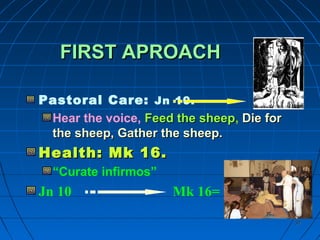
FIRST APROACHFIRST APROACH
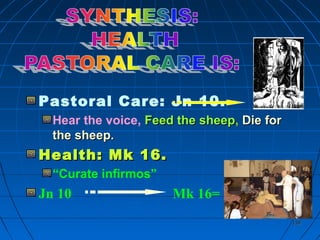
Pastoral Care: Jn 10.
Hear the voice, Feed the sheepFeed the sheep, Die forDie for
the sheep, Gather the sheep.the sheep, Gather the sheep.
Health: Mk 16.Health: Mk 16.
“Curate infirmos”
Jn 10 Mk 16=
3838
3939
1. THE PRESENT SITUATION1. THE PRESENT SITUATION
The first question that we ask ourselves now concerns the current situation of Health PastoralThe first question that we ask ourselves now concerns the current situation of Health Pastoral
Care in the Church.Care in the Church.
Looking at the statistics, we realize that today there are 114,738 centres for Health PastoralLooking at the statistics, we realize that today there are 114,738 centres for Health Pastoral
Care worldwide. These include hospices, advice centres, orphanages, asylums, rehabilitationCare worldwide. These include hospices, advice centres, orphanages, asylums, rehabilitation
and re-education centres, mother and child centres, etc. Many of these centres have beenand re-education centres, mother and child centres, etc. Many of these centres have been
established at the parish, diocesan or national levels; some are directed by Bishops, religiousestablished at the parish, diocesan or national levels; some are directed by Bishops, religious
Orders and Congregations, or by charities.Orders and Congregations, or by charities.
It is worth noting that in almost all Bishops’ Conferences there is a Department for HealthIt is worth noting that in almost all Bishops’ Conferences there is a Department for Health
Pastoral Care, headed by a Bishop appointed “ad hoc” by the same Bishops’ Conference.Pastoral Care, headed by a Bishop appointed “ad hoc” by the same Bishops’ Conference.
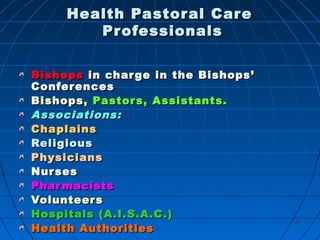
In addition to this, there are various Associations for Health Pastoral Care: chaplains, menIn addition to this, there are various Associations for Health Pastoral Care: chaplains, men
and women religious, physicians, nurses, pharmacists, volunteers and hospitals. Many are inand women religious, physicians, nurses, pharmacists, volunteers and hospitals. Many are in
contact with the national and international civil health care authorities.contact with the national and international civil health care authorities.
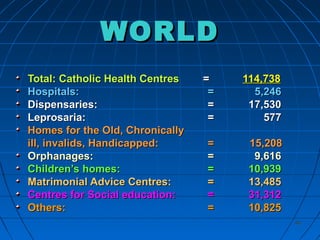
Precisely we have 114, 738 Catholic Centres for Health Pastoral Care, of which 5,246 arePrecisely we have 114, 738 Catholic Centres for Health Pastoral Care, of which 5,246 are
Hospitals, 17,530 Dispensaries, 577 Leprosaria, 15,208 Homes for the Old, the ChronicallyHospitals, 17,530 Dispensaries, 577 Leprosaria, 15,208 Homes for the Old, the Chronically
ill, Invalids, and the Handicapped, 9,616 Orphanages, 10,939 Children’s homes, 13,485ill, Invalids, and the Handicapped, 9,616 Orphanages, 10,939 Children’s homes, 13,485
Matrimonial Advice Centres, 31,312 Special centres for social education and re-educationMatrimonial Advice Centres, 31,312 Special centres for social education and re-education
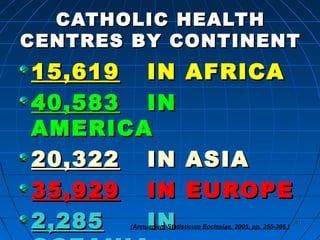
Centres, 10,825 other Institutions. Distributed by Continents we have: 15,619 Health PastoralCentres, 10,825 other Institutions. Distributed by Continents we have: 15,619 Health Pastoral
Centres in Africa; 40,583 in America; 20,322 in Asia; 35,929 in Europe, and 2,285 in Oceania.Centres in Africa; 40,583 in America; 20,322 in Asia; 35,929 in Europe, and 2,285 in Oceania.
[2][2]
[2][2] Secretaria StatusSecretaria Status, Annuarium Statisticum Ecclesiae 2005, Libreria Editrice Vaticana,, Annuarium Statisticum Ecclesiae 2005, Libreria Editrice Vaticana, pp. 355-366.pp. 355-366.
4040
WORLDWORLD
Total: Catholic Health CentresTotal: Catholic Health Centres == 114,738114,738
Hospitals:Hospitals: == 5,2465,246
Dispensaries:Dispensaries: == 17,53017,530
Leprosaria:Leprosaria: == 577577
Homes for the Old, ChronicallyHomes for the Old, Chronically
ill, invalids, Handicapped:ill, invalids, Handicapped: = 15,208= 15,208
Orphanages:Orphanages: == 9,6169,616
Children’s homes:Children’s homes: == 10,93910,939
Matrimonial Advice Centres:Matrimonial Advice Centres: == 13,48513,485
Centres for Social education:Centres for Social education: == 31,31231,312
Others:Others: == 10,82510,825
4141
CATHOLIC HEALTHCATHOLIC HEALTH
CENTRES BY CONTINENTCENTRES BY CONTINENT
15,61915,619 IN AFRICAIN AFRICA
40,58340,583 ININ
AMERICAAMERICA
20,32220,322 IN ASIAIN ASIA
35,92935,929 IN EUROPEIN EUROPE
2,2852,285 ININ(Annuarium Statisticum Ecclesiae, 2005, pp. 355-366.)
4242
Health Pastoral CareHealth Pastoral Care
ProfessionalsProfessionals
BishopsBishops in charge in the Bishops’in charge in the Bishops’
ConferencesConferences
Bishops,Bishops, Pastors, Assistants.Pastors, Assistants.
Associations:Associations:
ChaplainsChaplains
ReligiousReligious
PhysiciansPhysicians
NursesNurses
PharmacistsPharmacists
VolunteersVolunteers
Hospitals (A.I.S.A.C.)Hospitals (A.I.S.A.C.)
Health AuthoritiesHealth Authorities
4343
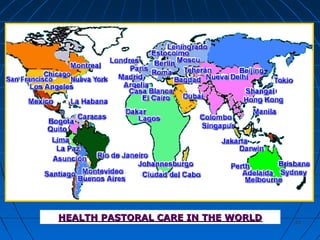
HEALTH PASTORAL CARE IN THE WORLDHEALTH PASTORAL CARE IN THE WORLD
44444444
4545
Positive PointsPositive Points
All that is mentioned above is positive, however, we would like toAll that is mentioned above is positive, however, we would like to
emphasize in particular:emphasize in particular:
the presence of Bishops in charge of Health Pastoral Care in eachthe presence of Bishops in charge of Health Pastoral Care in each
Conference of Bishops;Conference of Bishops;
the efficiency of International Associations of Catholic Doctors,the efficiency of International Associations of Catholic Doctors,
Pharmacists and Nurses;Pharmacists and Nurses;
the starting of a union of Catholic Hospitals;the starting of a union of Catholic Hospitals;
the union of hospital Chaplains;the union of hospital Chaplains;
the Catholic Volunteers;the Catholic Volunteers;
and the interest in Health Pastoral Care, manifested byand the interest in Health Pastoral Care, manifested by
Conferences of Bishops during their “Ad LiminaConferences of Bishops during their “Ad Limina”” visits.visits.
4646
Positive PointsPositive Points
Bishops in ChargeBishops in Charge of Health Pastoralof Health Pastoral
Care in each Conference of Bishops.Care in each Conference of Bishops.
A certain efficiency ofA certain efficiency of FIAMC,FIAMC,
CICIAMS and theCICIAMS and the Pharmacists’Pharmacists’
associations.associations.
Starting of the union ofStarting of the union of CatholicCatholic
HospitalsHospitals
Union of HospitalUnion of Hospital ChaplainsChaplains
Catholic VolunteersCatholic Volunteers
““Ad LiminaAd Limina”” Visits.Visits.
4747
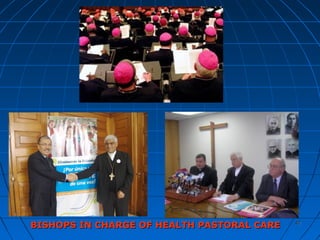
BISHOPS IN CHARGE OF HEALTH PASTORAL CAREBISHOPS IN CHARGE OF HEALTH PASTORAL CARE
4848
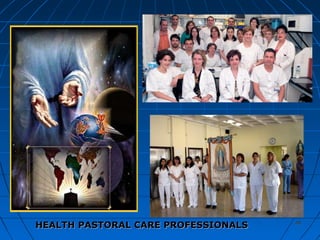
HEALTH PASTORAL CARE PROFESSIONALSHEALTH PASTORAL CARE PROFESSIONALS
4949
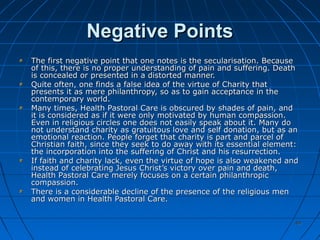
Negative PointsNegative Points
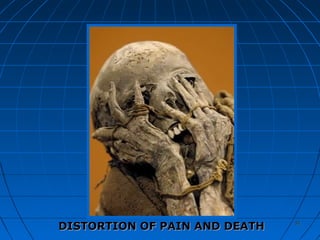
The first negative point that one notes is the secularisation. BecauseThe first negative point that one notes is the secularisation. Because
of this, there is no proper understanding of pain and suffering. Deathof this, there is no proper understanding of pain and suffering. Death
is concealed or presented in a distorted manner.is concealed or presented in a distorted manner.
Quite often, one finds a false idea of the virtue of Charity thatQuite often, one finds a false idea of the virtue of Charity that
presents it as mere philanthropy, so as to gain acceptance in thepresents it as mere philanthropy, so as to gain acceptance in the
contemporary world.contemporary world.
Many times, Health Pastoral Care is obscured by shades of pain, andMany times, Health Pastoral Care is obscured by shades of pain, and
it is considered as if it were only motivated by human compassion.it is considered as if it were only motivated by human compassion.
Even in religious circles one does not easily speak about it. Many doEven in religious circles one does not easily speak about it. Many do
not understand charity as gratuitous love and self donation, but as annot understand charity as gratuitous love and self donation, but as an
emotional reaction. People forget that charity is part and parcel ofemotional reaction. People forget that charity is part and parcel of
Christian faith, since they seek to do away with its essential element:Christian faith, since they seek to do away with its essential element:
the incorporation into the suffering of Christ and his resurrection.the incorporation into the suffering of Christ and his resurrection.
If faith and charity lack, even the virtue of hope is also weakened andIf faith and charity lack, even the virtue of hope is also weakened and
instead of celebrating Jesus Christ’s victory over pain and death,instead of celebrating Jesus Christ’s victory over pain and death,
Health Pastoral Care merely focuses on a certain philanthropicHealth Pastoral Care merely focuses on a certain philanthropic
compassion.compassion.
There is a considerable decline of the presence of the religious menThere is a considerable decline of the presence of the religious men
and women in Health Pastoral Care.and women in Health Pastoral Care.
5050
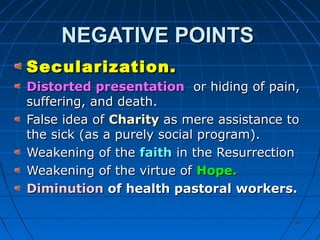
NEGATIVE POINTSNEGATIVE POINTS
Secularization.Secularization.
Distorted presentationDistorted presentation or hiding of pain,or hiding of pain,
suffering, and death.suffering, and death.
False idea ofFalse idea of CharityCharity as mere assistance toas mere assistance to
the sick (as a purely social program).the sick (as a purely social program).
Weakening of theWeakening of the faithfaith in the Resurrectionin the Resurrection
Weakening of the virtue ofWeakening of the virtue of Hope.Hope.
DiminutionDiminution of health pastoral workers.of health pastoral workers.
5151
DISTORTION OF PAIN AND DEATHDISTORTION OF PAIN AND DEATH
5252
5353
5454
In the second point of the firstIn the second point of the first partpart of the book, under theof the book, under the
title “What should be done”, we move on to the explanationtitle “What should be done”, we move on to the explanation
of what Health Pastoral Care is. We present this on twoof what Health Pastoral Care is. We present this on two
levels: the first one is that of the Gospels. Here we asklevels: the first one is that of the Gospels. Here we ask
ourselves, how does Christ behave when he heals the sick?ourselves, how does Christ behave when he heals the sick?
In this way we find out the true concept of Health PastoralIn this way we find out the true concept of Health Pastoral
Care and, therefore, what we have to do in order to realizeCare and, therefore, what we have to do in order to realize
it. We examine 22 miracles of healing performed by ourit. We examine 22 miracles of healing performed by our
Lord and we draw from His conduct, fifteen essentialLord and we draw from His conduct, fifteen essential
elements for the realization of an authentic Health Pastoralelements for the realization of an authentic Health Pastoral
Care.Care.
Furthermore, we ask ourselves as to how the Gospel ofFurthermore, we ask ourselves as to how the Gospel of
Health is interpreted in the Magisterial Teaching of the lastHealth is interpreted in the Magisterial Teaching of the last
two Pontiffs: John Paul II and Benedict XVI. We organizetwo Pontiffs: John Paul II and Benedict XVI. We organize
this interpretation according to the three classical ministriesthis interpretation according to the three classical ministries
in the Church: Word, Sanctification and Communioin the Church: Word, Sanctification and Communion.n.
5555
5656
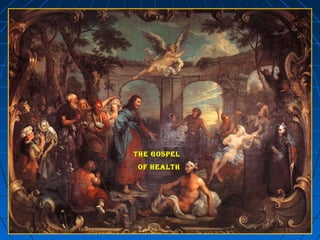
THE GOSPELTHE GOSPEL
OF HEALTHOF HEALTH
5757
WHAT IS HEALTH PASTORALWHAT IS HEALTH PASTORAL
CARE?CARE?
THE GOSPELSTHE GOSPELS
In order to expound more on the answerIn order to expound more on the answer
to the question on what Health Pastoralto the question on what Health Pastoral
Care is, we shall now reflect on fourCare is, we shall now reflect on four
points:points:
a general view of healings accomplisheda general view of healings accomplished
by Jesus Christ; the enumeration of theby Jesus Christ; the enumeration of the
basic elements derived from thesebasic elements derived from these
healings; the evangelical way behind thesehealings; the evangelical way behind these
elements; and the synthesis of the actionelements; and the synthesis of the action
of the healing Christ in the Parable of theof the healing Christ in the Parable of the
“Good Samaritan”.“Good Samaritan”.
5858
General View of Healings in theGeneral View of Healings in the
GospelsGospels
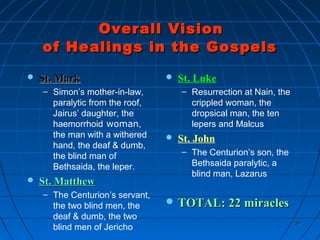
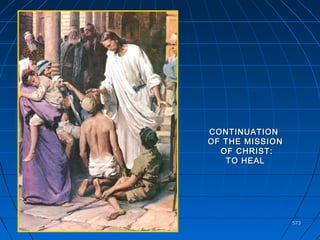
We find the following miracles inWe find the following miracles in St. Mark’s GospelSt. Mark’s Gospel: the healing of Peter’s mother in: the healing of Peter’s mother in
law, the healing of the paralytic, who is brought down through the roof, thelaw, the healing of the paralytic, who is brought down through the roof, the
resurrection of Jairus’ daughter, the healing of the haemorrhoid woman, the manresurrection of Jairus’ daughter, the healing of the haemorrhoid woman, the man
with a withered hand, the deaf and dumb, the blind man from Bethsaida and of thewith a withered hand, the deaf and dumb, the blind man from Bethsaida and of the
leper.leper. [3][3]
St. MathewSt. Mathew reports the healings of the Centurion’s servant, of two blind men, of thereports the healings of the Centurion’s servant, of two blind men, of the
deaf and dumb and of two blind men from Jericho.deaf and dumb and of two blind men from Jericho. [4][4]
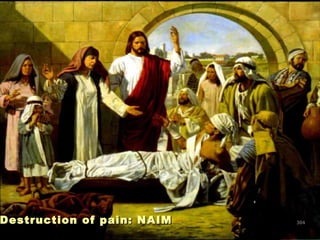
St. LukeSt. Luke, we find the resurrection of the son of the widow of Nain, the healing of the, we find the resurrection of the son of the widow of Nain, the healing of the
crippled woman in the synagogue, of the dropsical man and of 10 leprous men, ascrippled woman in the synagogue, of the dropsical man and of 10 leprous men, as
well as that of Malcus.well as that of Malcus. [5][5]
St. JohnSt. John reports the healing of the Centurion’s son, the paralytic from Bethsaida, ofreports the healing of the Centurion’s son, the paralytic from Bethsaida, of
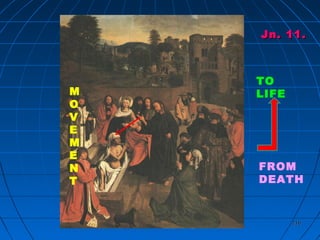
a blind man and the resurrection of Lazarus.a blind man and the resurrection of Lazarus. [6][6]
On the whole, the Gospels report 22 miracles, but it is evident that for theOn the whole, the Gospels report 22 miracles, but it is evident that for the
synoptics, many times different evangelists refer to the same miracle.synoptics, many times different evangelists refer to the same miracle.
There are other references to healing miracles in general. The evangelists thenThere are other references to healing miracles in general. The evangelists then
report how in certain occasions Christ healed many sick people.report how in certain occasions Christ healed many sick people.
[3][3] Mk 1, 29:32, 40-45; 2, 1-12; 5, 21-43; 7: 31-37; 8, 22-26.Mk 1, 29:32, 40-45; 2, 1-12; 5, 21-43; 7: 31-37; 8, 22-26.
[4][4] Mt 8, 5-13; 9, 27-31; 12 2-23, 20, 29-34.Mt 8, 5-13; 9, 27-31; 12 2-23, 20, 29-34.
[5][5] Lk 7, 11-17; 13, 10-13; 14, 1-6; 17, 11-19; 22, 50-51.Lk 7, 11-17; 13, 10-13; 14, 1-6; 17, 11-19; 22, 50-51.
[6][6] Jn 4, 46-54; 5, 1-9; 9, 1-7; 11, 38-44. Here we do not take into consideration the interventions of Christ on evil spirits.Jn 4, 46-54; 5, 1-9; 9, 1-7; 11, 38-44. Here we do not take into consideration the interventions of Christ on evil spirits.
5959
Overall VisionOverall Vision
of Healings in the Gospelsof Healings in the Gospels
 St. MarkSt. Mark
– Simon’s mother-in-law,
paralytic from the roof,
Jairus’ daughter, the
haemorrhoid woman,
the man with a withered
hand, the deaf & dumb,
the blind man of
Bethsaida, the leper.
 St. MatthewSt. Matthew
– The Centurion’s servant,
the two blind men, the
deaf & dumb, the two
blind men of Jericho
 St. Luke
– Resurrection at Nain, the
crippled woman, the
dropsical man, the ten
lepers and Malcus
 St. John
– The Centurion’s son, the
Bethsaida paralytic, a
blind man, Lazarus
 TOTAL: 22 miraclesTOTAL: 22 miracles
6060
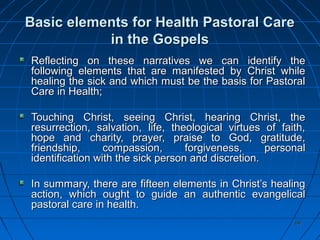
Basic elements for Health Pastoral CareBasic elements for Health Pastoral Care
in the Gospelsin the Gospels
Reflecting on these narratives we can identify theReflecting on these narratives we can identify the
following elements that are manifested by Christ whilefollowing elements that are manifested by Christ while
healing the sick and which must be the basis for Pastoralhealing the sick and which must be the basis for Pastoral
Care in Health;Care in Health;
Touching Christ, seeing Christ, hearing Christ, theTouching Christ, seeing Christ, hearing Christ, the
resurrection, salvation, life, theological virtues of faith,resurrection, salvation, life, theological virtues of faith,
hope and charity, prayer, praise to God, gratitude,hope and charity, prayer, praise to God, gratitude,
friendship, compassion, forgiveness, personalfriendship, compassion, forgiveness, personal
identification with the sick person and discretion.identification with the sick person and discretion.
In summary, there are fifteen elements in Christ’s healingIn summary, there are fifteen elements in Christ’s healing
action, which ought to guide an authentic evangelicalaction, which ought to guide an authentic evangelical
pastoral care in health.pastoral care in health.
6161
EVANGELICAL ELEMENTS OFEVANGELICAL ELEMENTS OF
HEALTH PASTORAL CAREHEALTH PASTORAL CARE
Contact with Christ
Seeing Christ
Hearing Christ’s voice
Resurrection
Salvation
Life
Virtues: Faith, Hope and
Charity
Prayer
Praise
Gratitude
Friendship
Compassion
Forgiveness
Identifying with the sick
person
Discretion
 TOTAL: 15 elements
6262
The Evangelical Way for HealthThe Evangelical Way for Health
Pastoral CarePastoral Care
Now if we, on the basis of the above elements, want to mark outNow if we, on the basis of the above elements, want to mark out
the way that Health Pastoral Care should take, in order to followthe way that Health Pastoral Care should take, in order to follow
in the footsteps of Christ, the Good Shepherd who heals hisin the footsteps of Christ, the Good Shepherd who heals his
sheep, we have to say that:sheep, we have to say that:
Health Pastoral Care consists in fundamentally uniting the world ofHealth Pastoral Care consists in fundamentally uniting the world of
health and its care to Christ, manifesting to all his salvifichealth and its care to Christ, manifesting to all his salvific
presence as a source of life and as the only way of masteringpresence as a source of life and as the only way of mastering
one’s own life.one’s own life.
In this health pastoral care, it is necessary to listen to ChristIn this health pastoral care, it is necessary to listen to Christ
always and see him through faith and a solid hope in thealways and see him through faith and a solid hope in the
resurrection.resurrection.
The pastoral health care worker should be all-friendly, full of tactThe pastoral health care worker should be all-friendly, full of tact
and identify with each patient. He should be compassionate,and identify with each patient. He should be compassionate,
forgiving, does not alienate the patient and strive to see that allforgiving, does not alienate the patient and strive to see that all
care is directed towards and converges in the Resurrection ofcare is directed towards and converges in the Resurrection of
Christ and his own.Christ and his own.
In order to follow this way, he needs to constantly revive theIn order to follow this way, he needs to constantly revive the
three virtues of faith, hope and charity, deepening them throughthree virtues of faith, hope and charity, deepening them through
prayers of petition, commendation and thanksgiving to the Lord.prayers of petition, commendation and thanksgiving to the Lord.
6363
The way for Health PastoralThe way for Health Pastoral
CareCare
The way for Pastoral Care in Health is developed through realizing the
fundamental link between the world of Health and Christ,
which manifests the Lord as the loving source and master of life, and the only
salvific presence.
In this Pastoral Care it is necessary to hear and see God with
the solid hope of resurrection.
One has to prosper in friendship, tact, identifying with every sick person,
having compassion, forgiving and respecting everyone.
And also see to it that all this Pastoral Care converges in the resurrection of
the Lord and our own.
There is need to constantly revive the three theological virtues of faith, hope
and charity. These are deepened through prayers of petition, praise and
thanksgiving.
6464
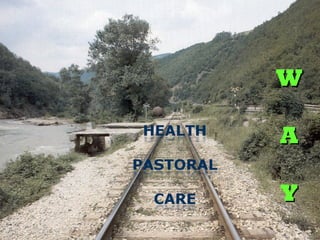
WW
AA
YY
6565
6666
A practical synthesis of theA practical synthesis of the
Gospel of HealthGospel of Health
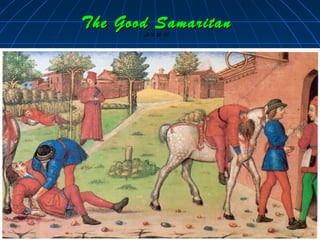
The practical synthesis of all that we have said isThe practical synthesis of all that we have said is
contained in the parable of the Good Samaritan (Lk, 10,contained in the parable of the Good Samaritan (Lk, 10,
25-37) who is Christ himself (the emblem of our25-37) who is Christ himself (the emblem of our
Pontifical Council).Pontifical Council).
Eight elements can be identified in this parable: (i) theEight elements can be identified in this parable: (i) the
Good Samaritan is fully conscious of the reality, he seesGood Samaritan is fully conscious of the reality, he sees
the wounded man; (ii) He feels compassion, he isthe wounded man; (ii) He feels compassion, he is
touched; (iii) He treats him, he pours oil and wine on histouched; (iii) He treats him, he pours oil and wine on his
wounds; (iv) He shares his property, he puts thewounds; (iv) He shares his property, he puts the
wounded man on his horse; (v) Entrusts him towounded man on his horse; (v) Entrusts him to
competent people, he puts the wounded man in the carecompetent people, he puts the wounded man in the care
of the innkeeper; (vi) He spends his money generously,of the innkeeper; (vi) He spends his money generously,
gives him two coins; (vii) He is prepared to pay the rest,gives him two coins; (vii) He is prepared to pay the rest,
“if anything lacks…”; (viii) He checks the results, when“if anything lacks…”; (viii) He checks the results, when
he returns.he returns.
6767
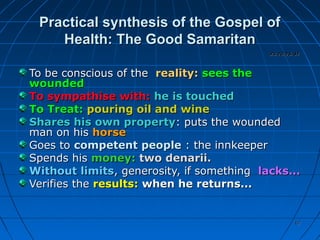
Practical synthesis of the Gospel ofPractical synthesis of the Gospel of
Health: The Good SamaritanHealth: The Good Samaritan
To be conscious of theTo be conscious of the reality:reality: sees thesees the
woundedwounded
To sympathise with:To sympathise with: he is touchedhe is touched
To Treat:To Treat: pouring oil and winepouring oil and wine
Shares his own propertyShares his own property: puts the wounded: puts the wounded
man on hisman on his horsehorse
Goes toGoes to competent peoplecompetent people : the innkeeper: the innkeeper
Spends hisSpends his money:money: two denarii.two denarii.
Without limitsWithout limits, generosity, if something, generosity, if something lacks...lacks...
Verifies theVerifies the results:results: when he returns...when he returns...
Lk 10,25-37Lk 10,25-37
6868
The Good SamaritanThe Good SamaritanLk 10,25-37:
6969
7070
THE PONTIFICALTHE PONTIFICAL MAGISTERIUMMAGISTERIUM
How is the gospel teaching presented by the Magisterium, especially byHow is the gospel teaching presented by the Magisterium, especially by
popes John Paul II and Benedict XVI?popes John Paul II and Benedict XVI?
The answer can be found especially in 9 Documents:The answer can be found especially in 9 Documents: Dolentium Hominum,Dolentium Hominum,
Pastor Bonus, Salvifici Doloris, Message for the Year 2000Pastor Bonus, Salvifici Doloris, Message for the Year 2000 (Message for the(Message for the
World Day of the Sick in the Jubilee Year),World Day of the Sick in the Jubilee Year), “Novo Millennio ineunte”“Novo Millennio ineunte” and theand the
Address of Pope Benedict XVI to the Pontifical Council for Health PastoralAddress of Pope Benedict XVI to the Pontifical Council for Health Pastoral
Care, on the occasion of its International Conferences and its VII PlenaryCare, on the occasion of its International Conferences and its VII Plenary
Assembly, in the Messages for the World Day of the Sick and in hisAssembly, in the Messages for the World Day of the Sick and in his
Encyclical letters “Encyclical letters “Deus Caritas estDeus Caritas est” and “” and “Spe SalviSpe Salvi”.”. [7][7]
In these documents, the Popes establish the duties of the Dicastery and theIn these documents, the Popes establish the duties of the Dicastery and the
objective of the Pontifical Council.objective of the Pontifical Council.
(Constitutively in the Motu Proprio(Constitutively in the Motu Proprio Dolentium HominumDolentium Hominum and the Apostolicand the Apostolic
ConstitutionConstitution Pastor BonusPastor Bonus).).
This is proportionally valid not only for the Health Pastoral Care of theThis is proportionally valid not only for the Health Pastoral Care of the
Pontifical Council but also for the whole ChurchPontifical Council but also for the whole Church..
[7] John Paul II,[7] John Paul II, Salvifici DolorisSalvifici Doloris, 26;, 26; Pastor BonusPastor Bonus, 152-153;, 152-153; Dolentium HominumDolentium Hominum, 2-6;, 2-6; Message of the HolyMessage of the Holy
Father for the World Day of the Sick for the Year 2000Father for the World Day of the Sick for the Year 2000, n. 13, in, n. 13, in Dolentium HominumDolentium Hominum 42 (1999) 9;42 (1999) 9; Novo MillennioNovo Millennio
ineunteineunte, 28-58;, 28-58; Address of Pope Benedict XVI to the Pontifical Council for Health Pastoral Care on the OccasionAddress of Pope Benedict XVI to the Pontifical Council for Health Pastoral Care on the Occasion
of the XX International Conference on the Human Genome,of the XX International Conference on the Human Genome, 19 November 200519 November 2005; Address of Pope Benedict XVI to; Address of Pope Benedict XVI to
the Pontifical Council for Health Pastoral Care on the Occasion of its VII Plenary Assembly,the Pontifical Council for Health Pastoral Care on the Occasion of its VII Plenary Assembly, March 22, 2007;March 22, 2007;
Benedict XVI, Encyclical Letter Spe Salvi,Benedict XVI, Encyclical Letter Spe Salvi, n.39.n.39. Message for the World Day of the SickMessage for the World Day of the Sick 2006, n.92006, n.9; Message for; Message for
the World Day of the Sickthe World Day of the Sick 2007. n.22007. n.2; Message for the World Day of the Sick; Message for the World Day of the Sick 2008, n.42008, n.4..
7171
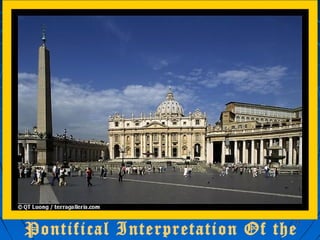
Pontifical Interpretation Of the
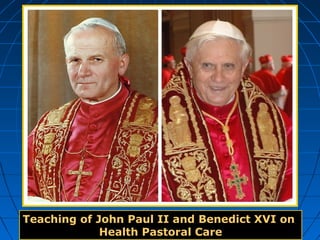
7272Teaching of John Paul II and Benedict XVI onTeaching of John Paul II and Benedict XVI on
Health Pastoral CareHealth Pastoral Care
737373737373
7474
DUTY ASSIGNED BY
JOHN PAUL II:
Salvifici Doloris
Dolentium Hominum
Pastor Bonus
Year 2000 Message
Addresses to the International
Conferences and Various
Messages
75757575
JOHN PAUL II: salient points on HealthJOHN PAUL II: salient points on Health
Pastoral Care.Pastoral Care.
We shall only discuss the teaching of the last two Pontiffs.We shall only discuss the teaching of the last two Pontiffs.
Nevertheless we shall also make reference to the wealth of theNevertheless we shall also make reference to the wealth of the
teachings of Pius XII and Paul VI.teachings of Pius XII and Paul VI.
A synthesis of the teaching of John Paul II on Health Pastoral CareA synthesis of the teaching of John Paul II on Health Pastoral Care
tells us that the only answer to the fundamental problems of life, whichtells us that the only answer to the fundamental problems of life, which
are illness and the death, and overcomes the absurd, is when Christare illness and the death, and overcomes the absurd, is when Christ
Our Lord incorporates the suffering, pain and death of everyone intoOur Lord incorporates the suffering, pain and death of everyone into
his passion, death and resurrection. And on our part, when we thankhis passion, death and resurrection. And on our part, when we thank
the Lord for this gift of Redemption and we let ourselves to be overrunthe Lord for this gift of Redemption and we let ourselves to be overrun
by the presence of the suffering and glorious Christ. Already on theby the presence of the suffering and glorious Christ. Already on the
cross Christ appeared with his both glorious and suffering face to thecross Christ appeared with his both glorious and suffering face to the
highest degree. This point is particularly emphasized by the Apostolichighest degree. This point is particularly emphasized by the Apostolic
LetterLetter Salvifici DolorisSalvifici Doloris, the Apostolic Exhortation, the Apostolic Exhortation Novo MillennioNovo Millennio
IneunteIneunte and the Apostolic Letter Motu Proprioand the Apostolic Letter Motu Proprio Dolentium HominumDolentium Hominum
with which he established this Dicastery.with which he established this Dicastery.
7575
7676
Another original point of the servant of God, John Paul II, concerns the
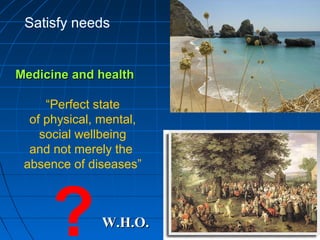
concept of the health. The World Health Organisation (Constitution of the
WHO, 1948) defined health as “a state of complete physical, mental and
social well being and not merely the absence of disease or infirmity.”
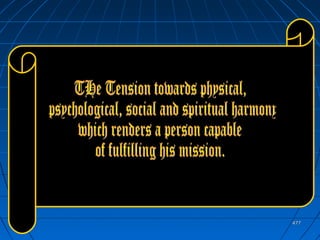
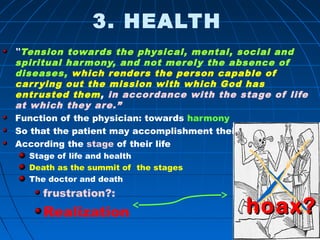
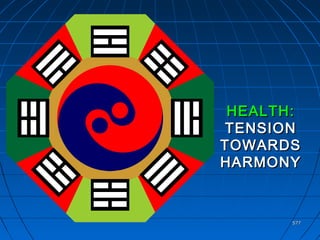
In his Message for the World Day of the Sick of the Jubilee Year 2000,
John Paul II, tells us that “health far from being identified with the mere
absence of illness ought to be perceived as a tension toward a fuller
harmony and healthy balance on the physical, psychological, spiritual
and social level. In this perspective, the person himself is called to
mobilize all of his available energies to fulfill his own vocation and for the
good of others” (n.13).
7777
John Paul II: salient points on HealthJohn Paul II: salient points on Health
Pastoral CarePastoral Care..
Health Pastoral CareHealth Pastoral Care
AnswerAnswer to the fundamental existentialto the fundamental existential
problems that bother humanity afflicted byproblems that bother humanity afflicted by
suffering, abandonment and illness.suffering, abandonment and illness.
Pain, suffering and death,Pain, suffering and death,
Have an answer only inHave an answer only in in thein the passion, deathpassion, death
and resurrection of Christ.and resurrection of Christ.
Health is:Health is:
TheThe tension toward harmonytension toward harmony and notand not
merely the absence of illness; it renders manmerely the absence of illness; it renders man
capable of fulfilling the mission received fromcapable of fulfilling the mission received from
God, according the stage of his own life.God, according the stage of his own life.
7777
7878
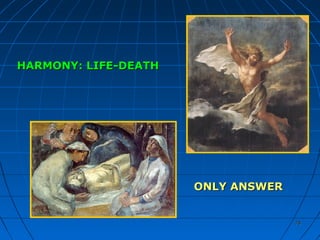
HARMONY: LIFE-DEATHHARMONY: LIFE-DEATH
ONLY ANSWERONLY ANSWER
7979
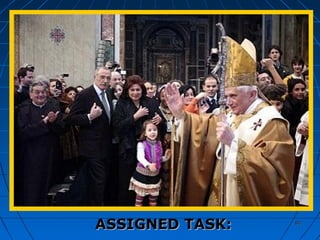
8080
ASSIGNED TASK:ASSIGNED TASK:
818181818181
8282
BENEDICT XVI: SALIENT POINTSBENEDICT XVI: SALIENT POINTS
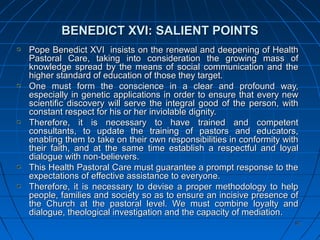
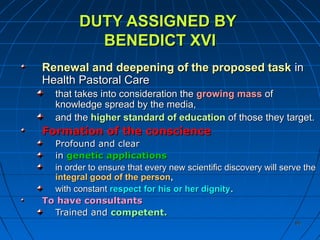
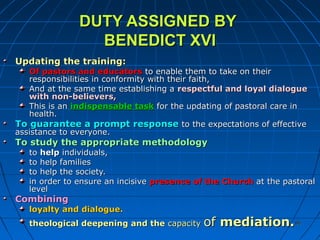
Pope Benedict XVI insists on the renewal and deepening of HealthPope Benedict XVI insists on the renewal and deepening of Health
Pastoral Care, taking into consideration the growing mass ofPastoral Care, taking into consideration the growing mass of
knowledge spread by the means of social communication and theknowledge spread by the means of social communication and the
higher standard of education of those they target.higher standard of education of those they target.
One must form the conscience in a clear and profound way,One must form the conscience in a clear and profound way,
especially in genetic applications in order to ensure that every newespecially in genetic applications in order to ensure that every new
scientific discovery will serve the integral good of the person, withscientific discovery will serve the integral good of the person, with
constant respect for his or her inviolable dignity.constant respect for his or her inviolable dignity.
Therefore, it is necessary to have trained and competentTherefore, it is necessary to have trained and competent
consultants, to update the training of pastors and educators,consultants, to update the training of pastors and educators,
enabling them to take on their own responsibilities in conformity withenabling them to take on their own responsibilities in conformity with
their faith, and at the same time establish a respectful and loyaltheir faith, and at the same time establish a respectful and loyal
dialogue with non-believers.dialogue with non-believers.
This Health Pastoral Care must guarantee a prompt response to theThis Health Pastoral Care must guarantee a prompt response to the
expectations of effective assistance to everyone.expectations of effective assistance to everyone.
Therefore, it is necessary to devise a proper methodology to helpTherefore, it is necessary to devise a proper methodology to help
people, families and society so as to ensure an incisive presence ofpeople, families and society so as to ensure an incisive presence of
the Church at the pastoral level. We must combine loyalty andthe Church at the pastoral level. We must combine loyalty and
dialogue, theological investigation and the capacity of mediation.dialogue, theological investigation and the capacity of mediation.
8383
BENEDICT XVI: SALIENT POINTSBENEDICT XVI: SALIENT POINTS
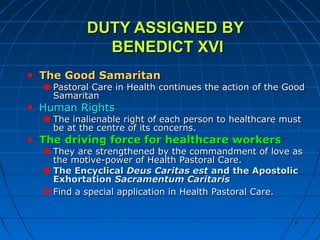
Health Pastoral Care continues the action of the Good Samaritan andHealth Pastoral Care continues the action of the Good Samaritan and
puts the inalienable right of each person to healthcare at the centre ofputs the inalienable right of each person to healthcare at the centre of
its concerns. The driving force that strengthens health pastoral careits concerns. The driving force that strengthens health pastoral care
agents is Love.agents is Love.
The EncyclicalThe Encyclical Deus Caritas estDeus Caritas est and the Apostolic Exhortationand the Apostolic Exhortation
Sacramentum CaritatisSacramentum Caritatis find a special application in the care of sickfind a special application in the care of sick
people: the Eucharist is this force of love.people: the Eucharist is this force of love.
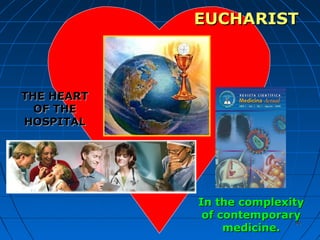
In the hospitals, the Chapel must be the heart that beats, in whichIn the hospitals, the Chapel must be the heart that beats, in which
Jesus offers Himself to the Father for the life of Mankind.Jesus offers Himself to the Father for the life of Mankind.
The Eucharist given to the sick with respect and with a spirit of prayerThe Eucharist given to the sick with respect and with a spirit of prayer
is the vital lymph that comforts them and infuses in their souls theis the vital lymph that comforts them and infuses in their souls the
interior light, helping them to live with faith and hope the conditions ofinterior light, helping them to live with faith and hope the conditions of
sickness and suffering.sickness and suffering. [8][8]
[8[8] Cf. Benedict] Cf. Benedict XVIXVI,, Address to the Pontifical Council for Health Pastoral Care on the Occasion of theAddress to the Pontifical Council for Health Pastoral Care on the Occasion of the
XX International Conference on the Human GenomeXX International Conference on the Human Genome, 19 November 2005; Benedict XVI,, 19 November 2005; Benedict XVI, Address toAddress to
the Pontifical Council for Health Pastoral Care on the Occasion of its VII Plenary Assemblythe Pontifical Council for Health Pastoral Care on the Occasion of its VII Plenary Assembly, 22 March, 22 March
2007.2007.
84848484
The EncyclicalThe Encyclical Spe SalviSpe Salvi: “Man is worth so much to God that he himself became: “Man is worth so much to God that he himself became
man in order toman in order to suffer withsuffer with man in an utterly real way, in flesh and blood, as isman in an utterly real way, in flesh and blood, as is
revealed to us in the account of Jesus’s Passion. Hence in all human sufferingrevealed to us in the account of Jesus’s Passion. Hence in all human suffering
we are joined by one who experiences and carries that sufferingwe are joined by one who experiences and carries that suffering withwith us; henceus; hence
con-solatiocon-solatio is present in all suffering, the consolation of God's compassionateis present in all suffering, the consolation of God's compassionate
love and so the star of hope rises.”love and so the star of hope rises.” [9][9]
In the Messages on the occasion of the World Day of the Sick he tells us: “IIn the Messages on the occasion of the World Day of the Sick he tells us: “I
would now like to address you, dear brothers and sisters, tried by illness, towould now like to address you, dear brothers and sisters, tried by illness, to
invite you to offer your condition of suffering, together with Christ, to the Father,invite you to offer your condition of suffering, together with Christ, to the Father,
certain that every trial accepted with resignation is meritorious and draws divinecertain that every trial accepted with resignation is meritorious and draws divine
goodness upon the whole of humanity.”goodness upon the whole of humanity.” [10][10]
““Through her individual members and institutions, the Church continues to standThrough her individual members and institutions, the Church continues to stand
alongside the suffering and to attend the dying, striving to preserve their dignityalongside the suffering and to attend the dying, striving to preserve their dignity
at these significant moments of human existence.”at these significant moments of human existence.” [11][11]
““It is specifically from the Eucharist that pastoral care in health must draw theIt is specifically from the Eucharist that pastoral care in health must draw the
necessary spiritual strength to come effectively to man's aid and to help him tonecessary spiritual strength to come effectively to man's aid and to help him to
understand the salvific value of his own suffering.”understand the salvific value of his own suffering.” [12][12]
[9][9] Spe Salvi,Spe Salvi, n.39.n.39.
[10][10] Message for the World Day of the Sick, 2006, 9.Message for the World Day of the Sick, 2006, 9.
[11][11] Message for the World Day of the Sick, 2007, 2.Message for the World Day of the Sick, 2007, 2.
[12][12] Message for the World Day of the Sick, 2008, 4.Message for the World Day of the Sick, 2008, 4.
8484
BENEDICT XVI: SALIENT POINTSBENEDICT XVI: SALIENT POINTS
8585
DUTY ASSIGNED BYDUTY ASSIGNED BY
BENEDICT XVIBENEDICT XVI
Renewal and deepening of the proposed taskRenewal and deepening of the proposed task inin
Health Pastoral CareHealth Pastoral Care
that takes into consideration thethat takes into consideration the growing massgrowing mass ofof
knowledge spread by the media,knowledge spread by the media,
and theand the higher standard of educationhigher standard of education of those they target.of those they target.
Formation of the conscienceFormation of the conscience
Profound and clearProfound and clear
inin geneticgenetic applicationsapplications
in order to ensure that every new scientific discovery will serve thein order to ensure that every new scientific discovery will serve the
integral good of the personintegral good of the person,,
with constantwith constant respect for his or her dignityrespect for his or her dignity..
To have consultantsTo have consultants
Trained andTrained and competent.competent.
8686
DUTY ASSIGNED BYDUTY ASSIGNED BY
BENEDICT XVIBENEDICT XVI
Updating theUpdating the training:training:
Of pastors and educatorsOf pastors and educators to enable them to take on theirto enable them to take on their
responsibilities in conformity with their faith,responsibilities in conformity with their faith,
And at the same time establishing aAnd at the same time establishing a respectful and loyal dialoguerespectful and loyal dialogue
with non-believers,with non-believers,
This is anThis is an indispensable taskindispensable task for the updating of pastoral care infor the updating of pastoral care in
health.health.
To guarantee a prompt responseTo guarantee a prompt response to the expectations of effectiveto the expectations of effective
assistance to everyone.assistance to everyone.
To study the appropriate methodologyTo study the appropriate methodology
toto helphelp individuals,individuals,
to help familiesto help families
to help the society.to help the society.
in order to ensure an incisivein order to ensure an incisive presence of the Churchpresence of the Church at the pastoralat the pastoral
levellevel
CombiningCombining
loyalty and dialogue.loyalty and dialogue.
theological deepening and thetheological deepening and the capacitycapacity ofof mediation.mediation.
8787
DUTY ASSIGNED BYDUTY ASSIGNED BY
BENEDICT XVIBENEDICT XVI
The Good SamaritanThe Good Samaritan
Pastoral Care in Health continues the action of the GoodPastoral Care in Health continues the action of the Good
SamaritanSamaritan
Human RightsHuman Rights
The inalienable right of each person to healthcare mustThe inalienable right of each person to healthcare must
be at the centre of its concerns.be at the centre of its concerns.
The driving force for healthcare workersThe driving force for healthcare workers
They are strengthened by the commandment of love asThey are strengthened by the commandment of love as
the motive-power of Health Pastoral Care.the motive-power of Health Pastoral Care.
The EncyclicalThe Encyclical Deus Caritas estDeus Caritas est and the Apostolicand the Apostolic
ExhortationExhortation Sacramentum CaritarisSacramentum Caritaris
Find a special application in Health Pastoral Care.Find a special application in Health Pastoral Care.
8888
DUTY ASSIGNED BYDUTY ASSIGNED BY
BENEDICT XVIBENEDICT XVI
The Apostolic ExhortationThe Apostolic Exhortation Sacramentum Caritatis:Sacramentum Caritatis:
Eucharist.Eucharist.
TheThe strength to take care of the sick and givestrength to take care of the sick and give
meaning to their sufferingmeaning to their suffering
The Chapel.The Chapel.
In the hospitals,In the hospitals, the Chapel must bethe Chapel must be the centre,the centre,
the heartthe heart that beats,that beats, in which Jesus offers Himselfin which Jesus offers Himself
to the Father for the life of mankind.to the Father for the life of mankind.
The vital lymph.The vital lymph.
The Eucharist given to the sick, with respect and aThe Eucharist given to the sick, with respect and a
spirit of prayer isspirit of prayer is the vital lymph that comfortsthe vital lymph that comforts
themthem and infuses in their souls the interior light,and infuses in their souls the interior light,
helping them to live with faith and hope thehelping them to live with faith and hope the
conditions of sickness and suffering.conditions of sickness and suffering.
89898989
DUTY ASSIGNED BYDUTY ASSIGNED BY
BENEDICT XVIBENEDICT XVI
Spe SalviSpe Salvi:: Help the one who is suffering, to liveHelp the one who is suffering, to live
and to understand that his present sufferingand to understand that his present suffering isis
shared by and experienced by Christ.shared by and experienced by Christ.
This is theThis is the “con passion”“con passion” of the passion ofof the passion of
ChristChrist..
This is how theThis is how the EucharistEucharist is understood.is understood.
This is theThis is the comfortcomfort for every suffering.for every suffering.
Messages 2006-2008:Messages 2006-2008:
Thus the Church alongside those who sufferThus the Church alongside those who suffer
preserves theirpreserves their dignity.dignity.
Suffering has aSuffering has a value.value.
that man obtains from thethat man obtains from the EucharistEucharist
8989
9090
THE HEARTTHE HEART
OF THEOF THE
HOSPITALHOSPITAL
In the complexityIn the complexity
of contemporaryof contemporary
medicine.medicine.
EUCHARISTEUCHARIST
919191919191
92929292
SYNTHESISSYNTHESIS
Synthesis of the Pontifical Magisterium on Health Pastoral Care:Synthesis of the Pontifical Magisterium on Health Pastoral Care:
to converge the existential problems of pain, illness, suffering, death and life, into theto converge the existential problems of pain, illness, suffering, death and life, into the
death and the resurrection of Christ, in its Eucharistic realization;death and the resurrection of Christ, in its Eucharistic realization;
sanctifying in this way the sick person and the healthcare worker; centering thissanctifying in this way the sick person and the healthcare worker; centering this
Pastoral Care on the Eucharist;Pastoral Care on the Eucharist;
to form the consciences;to form the consciences;
to unite healthcare professionals, bishops, chaplains, physicians, nurses, pharmacists,to unite healthcare professionals, bishops, chaplains, physicians, nurses, pharmacists,
healthcare administrators, volunteers etc.;healthcare administrators, volunteers etc.;
to be in touch with the particular Churches and with the international, national orto be in touch with the particular Churches and with the international, national or
regional health organizations;regional health organizations;
to be up to date with problems of health on the scientific, technical, legal and politicalto be up to date with problems of health on the scientific, technical, legal and political
levels.levels.
If we wantIf we want to organizeto organize the pontifical proposals according to whatthe pontifical proposals according to what
Health Pastoral Care is evangelically, they will be arranged accordingHealth Pastoral Care is evangelically, they will be arranged according
to the three mentioned characteristics:to the three mentioned characteristics:
• Listen to Christ the Shepherd,Listen to Christ the Shepherd,
• Feeding on HimFeeding on Him
• Uniting ourselves toUniting ourselves to Him.Him.
These are the three characteristics of theThese are the three characteristics of the three ministriesthree ministries of theof the
activity of the Church, that is: Word, Sanctification and Communion.activity of the Church, that is: Word, Sanctification and Communion.
On the basis of these we shall now organizeOn the basis of these we shall now organize the teaching of the Churchthe teaching of the Church
on Health Pastoral Care.on Health Pastoral Care. 9292
9393
PONTIFICAL MAGISTERIUMPONTIFICAL MAGISTERIUM
WORD:WORD: Orientation on health:Orientation on health:
Pain, Illness, Suffering, Death, Life.Pain, Illness, Suffering, Death, Life.
Solution in Christ who suffers our pain.Solution in Christ who suffers our pain.
Updating on the issues of healthUpdating on the issues of health
Scientific, Technical, legal and Political.Scientific, Technical, legal and Political.
SANCTIFICATION:SANCTIFICATION: Unity and Sanctification ofUnity and Sanctification of
the healthcare professionals and the sick;the healthcare professionals and the sick;
Easter and EucharistEaster and Eucharist::
Bishops, chaplains, physicians, nurses,Bishops, chaplains, physicians, nurses,
pharmacists, administrators, volunteers.pharmacists, administrators, volunteers.
All types of Sick people.All types of Sick people.
COMMUNIONCOMMUNION:: Contact with HealthContact with Health
OrganizationsOrganizations::
94949494
9595
9696
In this third point of the first part of the book, we discussIn this third point of the first part of the book, we discuss
how to arrive at the praxis itself of Health Pastoral Care.how to arrive at the praxis itself of Health Pastoral Care.
The main point is the elaboration of a plan for HealthThe main point is the elaboration of a plan for Health
Pastoral Care: How is this plan made? We proceed followingPastoral Care: How is this plan made? We proceed following
the same subdivision used in presenting the Pontificalthe same subdivision used in presenting the Pontifical
Magisterium: the three ministries of the Church.Magisterium: the three ministries of the Church.
Consequently, we propose in the first place the generalConsequently, we propose in the first place the general
objective to be achieved, then the specific objectives inobjective to be achieved, then the specific objectives in
each of the ministries of this Pastoral Care. We are aware ofeach of the ministries of this Pastoral Care. We are aware of
the challenges we have to respond to in order to realizethe challenges we have to respond to in order to realize
these objectives, and we try to do so in three stages: in thethese objectives, and we try to do so in three stages: in the
first stage we make some proposals, in the second wefirst stage we make some proposals, in the second we
indicate ways and in the third we try to offer practicalindicate ways and in the third we try to offer practical
solutions for the realization of both the proposals and thesolutions for the realization of both the proposals and the
indicated ways.indicated ways.
97979797
In order to respond to the question
“How should it be done?”, we in the
Pontifical Council for Health Care Workers
(for Health Pastoral Care) have
elaborated the gospel teaching and the
pontifical magisterium on Health Pastoral
Care according to the three classical
ministries in the Church: Word,
Sanctification and Communion, on the
basis of well-defined objectives in each
ministry and the practical suggestions
with regard to the challenges it raises,
the proposals we make, the identified
ways and the possible practical answers.
98989898
9999
PONTIFICAL COUNCILPONTIFICAL COUNCIL
100100
MINISTRIES IN THE CHURCHMINISTRIES IN THE CHURCH
(Elaboration of the pontifical teaching)(Elaboration of the pontifical teaching)
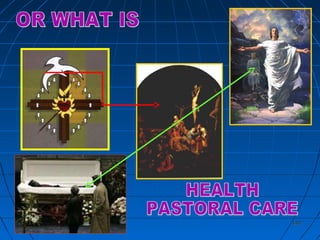
101101
The WordThe Word
This concerns the fundamental issues in the teaching of the Church, such asThis concerns the fundamental issues in the teaching of the Church, such as
life, death, pain, disease, anxiety, etc. John Paul II and Benedict XVI state thatlife, death, pain, disease, anxiety, etc. John Paul II and Benedict XVI state that
at the centre of the teaching on Health Pastoral Care we find Jesus Christat the centre of the teaching on Health Pastoral Care we find Jesus Christ
who suffers in those suffering: our suffering is His suffering and, because ofwho suffers in those suffering: our suffering is His suffering and, because of
this, it is transformed into the joy of His Resurrection.this, it is transformed into the joy of His Resurrection.
As a result, health appears as a tension towards harmony, which isAs a result, health appears as a tension towards harmony, which is
understood and lived thanks to the love of the Holy Spirit, since the Holy Spiritunderstood and lived thanks to the love of the Holy Spirit, since the Holy Spirit
is the only one who can unite us with Christ.is the only one who can unite us with Christ.
Therefore, in Health Pastoral Care, both formation and profound study of theTherefore, in Health Pastoral Care, both formation and profound study of the
essence of the human condition are extremely important.essence of the human condition are extremely important.
This religious formation, which is consequently ethical, cannot be neglected inThis religious formation, which is consequently ethical, cannot be neglected in
seminaries, in colleges of the religious, in the formation of all health careseminaries, in colleges of the religious, in the formation of all health care
workers and in general, in all Catholic centres of education and catechesis.workers and in general, in all Catholic centres of education and catechesis.
This formation is necessary especially in front of the present advanced stageThis formation is necessary especially in front of the present advanced stage
of science and technology of health, particularly when it comes to questionsof science and technology of health, particularly when it comes to questions
on the beginning and end of human life, which must absolutely be protected.on the beginning and end of human life, which must absolutely be protected.
102102
In the above-mentioned addresses, Pope Benedict XVI insists on the renewal and deepening ofIn the above-mentioned addresses, Pope Benedict XVI insists on the renewal and deepening of
Health Pastoral Care. He observes that we have to take into account the great mass of currentHealth Pastoral Care. He observes that we have to take into account the great mass of current
knowledge in this scientific and technological field, the public to which it is directed and itsknowledge in this scientific and technological field, the public to which it is directed and its
legitimate expectations.legitimate expectations.
Consequently, the Pope affirms that there is need for a clear and profound formation of theConsequently, the Pope affirms that there is need for a clear and profound formation of the
consciences, so as to enlighten them especially on issues that arise in the field of Biogenetics,consciences, so as to enlighten them especially on issues that arise in the field of Biogenetics,
in order to guarantee that each new scientific discovery serves the integral good of the person,in order to guarantee that each new scientific discovery serves the integral good of the person,
and does not harm his inviolable dignity. Therefore, it is necessary to reckon on good andand does not harm his inviolable dignity. Therefore, it is necessary to reckon on good and
competent consultants, who are well-trained for the formation of pastors and educators. In thiscompetent consultants, who are well-trained for the formation of pastors and educators. In this
way the pastors and educators will be updated so as to assume their responsibility in line withway the pastors and educators will be updated so as to assume their responsibility in line with
our faith, and in a true and respectful dialogue with non believers.our faith, and in a true and respectful dialogue with non believers.
In this way, our own expectations can be guaranteed and satisfied. Health Pastoral Care mustIn this way, our own expectations can be guaranteed and satisfied. Health Pastoral Care must
also find its methodology to properly assist sick people, their families and society as a whole, soalso find its methodology to properly assist sick people, their families and society as a whole, so
as to ensure an incisive presence of the Church in this very important pastoral field.as to ensure an incisive presence of the Church in this very important pastoral field.
By combining loyalty to the doctrine of the Church with the capacity to dialogue with otherBy combining loyalty to the doctrine of the Church with the capacity to dialogue with other
points of view of the contemporary world of health, we can make much progress. It is thereforepoints of view of the contemporary world of health, we can make much progress. It is therefore
necessary to carry out profound theological studies and at the same time develop a propernecessary to carry out profound theological studies and at the same time develop a proper
capacity of mediation. [13]capacity of mediation. [13]
As a result, it is extremely important to be familiar with the new frontiers and be up-to-date inAs a result, it is extremely important to be familiar with the new frontiers and be up-to-date in
the scientific, technical and legal novelties, at the local, national and international levels. It isthe scientific, technical and legal novelties, at the local, national and international levels. It is
clear that such pastoral care can not be accomplished without a competent team that is alsoclear that such pastoral care can not be accomplished without a competent team that is also
open to continuous dialogue.open to continuous dialogue.
[13[13]] Cf. Benedict XVI,Cf. Benedict XVI, Address to the Pontifical Council for Health Pastoral Care on the Occasion of the XX InternationalAddress to the Pontifical Council for Health Pastoral Care on the Occasion of the XX International
Conference on the Human GenomeConference on the Human Genome, 19 November 2005; Benedict XVI,, 19 November 2005; Benedict XVI, Address to the Pontifical Council for HealthAddress to the Pontifical Council for Health
Pastoral Care on the Occasion of its VII Plenary AssemblyPastoral Care on the Occasion of its VII Plenary Assembly, 22 March 2007., 22 March 2007.
The WordThe Word
103103
WORDWORD
Teaching of the Magisterium
Fundamental questions
Christ in the one who suffers and he who suffers in Christ
Health as tension towards harmony
Formation and Study
Essence of the human condition
Programmatic orientations
ethical-religious formation
The new Frontiers
Continuous updating in Health Pastoral Care
Legal and political novelties
Scientific and technical novelties
104104
SanctificationSanctification
Health Pastoral Care shows the solicitude of the Church forHealth Pastoral Care shows the solicitude of the Church for
the sick and for those who suffer, and provides specialthe sick and for those who suffer, and provides special
assistance to the health care workers. It manifests to all, theassistance to the health care workers. It manifests to all, the
sorrowful and glorious Face of Christ and teaches that oursorrowful and glorious Face of Christ and teaches that our
suffering and death complete what is lacking in the Passion ofsuffering and death complete what is lacking in the Passion of
Christ, thanks to the same merits of Christ.Christ, thanks to the same merits of Christ.
Health Pastoral Care should include the way to holiness in itsHealth Pastoral Care should include the way to holiness in its
planning; but more still, its pastoral planning springs from theplanning; but more still, its pastoral planning springs from the
grace and holiness of life, prayer and the sacraments. In it,grace and holiness of life, prayer and the sacraments. In it,
the Eucharist received as Viaticum, Anointing of the Sick,the Eucharist received as Viaticum, Anointing of the Sick,
Reconciliation, and the Word of God are of vital importance.Reconciliation, and the Word of God are of vital importance.
Health Pastoral Care makes us converge into the full harmonyHealth Pastoral Care makes us converge into the full harmony
of the Holy Trinity through the death and resurrection ofof the Holy Trinity through the death and resurrection of
Christ.Christ.
105105
SANCTIFICATIONSANCTIFICATION
Solicitude of the Church for the sick and those
who suffer.
Spiritual assistance to Health Care workers
To begin from the Face of Christ
Sorrowful and Glorious
Redemption, Grace, Illness and Death.
Pastoral Planning
Holiness, Prayer, Eucharist, Penance, Grace
Word of God, Trinitarian Communion.
106106
CommunionCommunion
In order achieve communion in HealthIn order achieve communion in Health
Pastoral Care, it is necessary to coordinate itPastoral Care, it is necessary to coordinate it
in an intelligent way: all the Associations ofin an intelligent way: all the Associations of
Health Care Workers should be properlyHealth Care Workers should be properly
coordinated and contacts should becoordinated and contacts should be
established with the local Churches and withestablished with the local Churches and with
Healthcare Organizations, those Catholic andHealthcare Organizations, those Catholic and
non-Catholic, local, national andnon-Catholic, local, national and
international.international.
107107
COMMUNIONCOMMUNION
Coordinate Health Pastoral Care
Coordinate the Associations of Health
Care Workers
Contacts with local Churches
Contacts with international and national
Healthcare Organizations, be they
Catholic or non-Catholic.
108108
109109
Operational SynthesisOperational Synthesis
If we wish to summarize the pontificalIf we wish to summarize the pontifical
proposal for Pastoral Care in Health, weproposal for Pastoral Care in Health, we
could state that its task is to show thecould state that its task is to show the
concern of the Church for the sick andconcern of the Church for the sick and
those who suffer, through her doctrine andthose who suffer, through her doctrine and
research, sanctification and sacraments,research, sanctification and sacraments,
as well as coordination and contacts.as well as coordination and contacts.
110110
OPERATIONAL SYNTHESISOPERATIONAL SYNTHESIS
Our Duty:
Manifest the solicitude of the Church for the
sick and those who suffer.
Through:
Doctrine – research -
Sanctification – sacraments -
Coordination – contacts-
111111
112112
ELABORATION OF THE PROPOSAL BYELABORATION OF THE PROPOSAL BY
THE PONTIFICAL COUNCILTHE PONTIFICAL COUNCIL
In conformity to the Gospel of Health,In conformity to the Gospel of Health,
interpreted by the Pontificalinterpreted by the Pontifical
Magisterium, the Pontifical Council forMagisterium, the Pontifical Council for
Health Care Workers (for HealthHealth Care Workers (for Health
Pastoral Care) proposes one generalPastoral Care) proposes one general
Objective and three specific goals.Objective and three specific goals.
113113
O
B
J
E
C
T
I
V
E
114114
GENERAL OBJECTIVEGENERAL OBJECTIVE
““Promote,Promote, direct,direct, developdevelop andand
coordinatecoordinate Health Pastoral Care inHealth Pastoral Care in
the Churchthe Church
according to the Teachings of theaccording to the Teachings of the
Holy Father,Holy Father,
to face the challengesto face the challenges that emergethat emerge
today in the World of Health”.today in the World of Health”.
115115
Specific GoalsSpecific Goals
These specific goals will be arrangedThese specific goals will be arranged
according to the organization envisagedaccording to the organization envisaged
in the pontifical proposal; that is, on thein the pontifical proposal; that is, on the
basis of the three ministries in thebasis of the three ministries in the
Church: Word, Sanctification andChurch: Word, Sanctification and
Communion.Communion.
116116
W
O
R
D
117117
Goal of the WordGoal of the Word
To enlighten, through the Gospel, the world ofTo enlighten, through the Gospel, the world of
Health, illness and death, transmitting to it theHealth, illness and death, transmitting to it the
strong testimony of the Resurrection.strong testimony of the Resurrection.
In this goal, we intend to particularlyIn this goal, we intend to particularly
emphasize the virtue of Hope in answer toemphasize the virtue of Hope in answer to
current problem of secularism. We do not wantcurrent problem of secularism. We do not want
to remain in a purely deistic type ofto remain in a purely deistic type of
transcendence, but rather a clear and validtranscendence, but rather a clear and valid
transcendence revealed by Christ, by meanstranscendence revealed by Christ, by means
of his death and resurrection.of his death and resurrection.
118118
Specific Objective:Specific Objective:
WORDWORD
To enlighten through the Gospel
the world of health, illness and
death, transmitting to them the
strong testimony of the
Resurrection
Explanation:
Emphasize the virtue of a living Hope
of the Resurrection.
119119
SANCTIFICATION
120120
Goal of SanctificationGoal of Sanctification
In order to sanctify the sick and the healthcare workers, we must be unitedIn order to sanctify the sick and the healthcare workers, we must be united
to Christ’s death and resurrection.to Christ’s death and resurrection.
According to John Paul’s teaching inAccording to John Paul’s teaching in Salvifici DolorisSalvifici Doloris and Benedict XVI’sand Benedict XVI’s
current teaching, our goal is to evangelize the world of sickness and health,current teaching, our goal is to evangelize the world of sickness and health,
completing what is missing in the Passion of Christ; this is the only way tocompleting what is missing in the Passion of Christ; this is the only way to
respond to the absurdity of death and the effects of suffering and pain.respond to the absurdity of death and the effects of suffering and pain.
We arrive at this goal mainly through prayer, in which we ask Christ to takeWe arrive at this goal mainly through prayer, in which we ask Christ to take
up our suffering, pain and death in his passion and death. In this way heup our suffering, pain and death in his passion and death. In this way he
can offer us the only possible true Health.can offer us the only possible true Health.
In this goal, we obviously realize that our suffering and death do not turnIn this goal, we obviously realize that our suffering and death do not turn
into wellbeing, but rather into happiness, which is very much different frominto wellbeing, but rather into happiness, which is very much different from
what today is known as Health: the complete wellbeing. Only in this waywhat today is known as Health: the complete wellbeing. Only in this way
can we arrive at true harmony in life, which is what constitutes true Health.can we arrive at true harmony in life, which is what constitutes true Health.
Paradoxically, this harmony consists in accepting and taking one’s cross andParadoxically, this harmony consists in accepting and taking one’s cross and
living in the Crucified Christ. This is not possible without the gift of Christliving in the Crucified Christ. This is not possible without the gift of Christ
himself, his grace, his gift that he gives us in his death and resurrection. Hishimself, his grace, his gift that he gives us in his death and resurrection. His
death took away the sin of the world and thus defeated all the evil that candeath took away the sin of the world and thus defeated all the evil that can
exist in the physical, mental, social and cosmic spheres.exist in the physical, mental, social and cosmic spheres.
This union with Christ patient and victorious can be accomplished onlyThis union with Christ patient and victorious can be accomplished only
through the action of the Holy Spirit. Therefore the goal of sanctification inthrough the action of the Holy Spirit. Therefore the goal of sanctification in
Health Pastoral Care can be reached only through humble prayer, in whichHealth Pastoral Care can be reached only through humble prayer, in which
we ask the Holy Spirit to give us Health, uniting ourselves to Christ whowe ask the Holy Spirit to give us Health, uniting ourselves to Christ who
died and rose.died and rose.
121121
Specific Objective:Specific Objective:
SANCTIFICATIONSANCTIFICATION
Sanctify the sick and the healthcare
workers, uniting themuniting them to Christ’s Death
and Resurrection.
Explanation:
Only by completing what is lacking in the
passion of Christ, can we give sense to pain,
suffering and death.
So Christ assumes our suffering intointo His own
suffering.
The union with the suffering Christ is
accomplished only by the Holy Spirit
122122
CC
OO
MM
MM
UU
NN
II
OO
NN
123123
Goal of CommunionGoal of Communion
To coordinate Health Pastoral Care within the ecclesial communion so as toTo coordinate Health Pastoral Care within the ecclesial communion so as to
accomplish the indispensable duty to arrive at unity.accomplish the indispensable duty to arrive at unity.
Our task here is solidarity. The one sheepfold mentioned by Christ the GoodOur task here is solidarity. The one sheepfold mentioned by Christ the Good
Shepherd (Jn, 10) is built upon the image of the Holy Trinity, where life is theShepherd (Jn, 10) is built upon the image of the Holy Trinity, where life is the
supreme harmony from the infinite and mutual donation of Love. By divinesupreme harmony from the infinite and mutual donation of Love. By divine
power, it is possible to build this unity in Health Pastoral Care, throughpower, it is possible to build this unity in Health Pastoral Care, through
reciprocal donation, for example through the Trinitarian action in the Church.reciprocal donation, for example through the Trinitarian action in the Church.
This is the only Health, because it is the only possibility of full harmony. InThis is the only Health, because it is the only possibility of full harmony. In
this way Pastoral Health Care brings the true life in abundance to humanity.this way Pastoral Health Care brings the true life in abundance to humanity.
In this way, Christ builds his body, which is the Church, whereby each one ofIn this way, Christ builds his body, which is the Church, whereby each one of
us, according to the measure of his own divine donation, receives the Holyus, according to the measure of his own divine donation, receives the Holy
Spirit to accomplish his mission in this form:Spirit to accomplish his mission in this form: “if we live by the truth and in“if we live by the truth and in
love, we shall grow completely into Christ, who is the head by whom thelove, we shall grow completely into Christ, who is the head by whom the
whole Body is fitted and joined together, every joint adding its own strength,whole Body is fitted and joined together, every joint adding its own strength,
for each individual part to work according to its function. So the body growsfor each individual part to work according to its function. So the body grows
until it has built itself up in love.”until it has built itself up in love.” (Eph 4, 15-16). This is the way of realizing(Eph 4, 15-16). This is the way of realizing
in Health Pastoral Care the union of all health care workers amongin Health Pastoral Care the union of all health care workers among
themselves, and with the sick in Christ dead and risen.themselves, and with the sick in Christ dead and risen.
124124
Specific Objective: COMMUNIONSpecific Objective: COMMUNION
Coordinate Health PastoralCoordinate Health Pastoral
Care in the Church to realizeCare in the Church to realize
communion.communion.
Explanation:Explanation:
Our task is solidarity, according to theOur task is solidarity, according to the
ecclesialecclesial Trinitarian Image,Trinitarian Image, whichwhich
renders the ecclesial unity ofrenders the ecclesial unity of
CommunionCommunion in the Body of Christ, whoin the Body of Christ, who
died and rose, effective.died and rose, effective.
125125
126126
WHAT SHOULD BE DONE?WHAT SHOULD BE DONE?
In order to realise this PastoralIn order to realise this Pastoral
Care in Health, I would like toCare in Health, I would like to
talk about the four points:talk about the four points:
challenges,challenges,
general proposals,general proposals,
ways,ways,
answersanswers..
127127
ChallengesChallengesOne of the challenges is overcoming the purely philanthropic attitude or mereOne of the challenges is overcoming the purely philanthropic attitude or mere
compassionate solidarity or even just a social or professional commitmentcompassionate solidarity or even just a social or professional commitment
towards the poor and unprotected sick person. The challenge consists intowards the poor and unprotected sick person. The challenge consists in
proclaiming in this Pastoral Care the death and resurrection of the Lord.proclaiming in this Pastoral Care the death and resurrection of the Lord.
That is to say that we actually have answers to the most profound problems ofThat is to say that we actually have answers to the most profound problems of
humanity and therefore to death. Very often, in a secularized culture it is saidhumanity and therefore to death. Very often, in a secularized culture it is said
that in front of extreme and desperate suffering the best thing is the discretionthat in front of extreme and desperate suffering the best thing is the discretion
of respectful silence. But saying this reveals a lack of faith, because silence isof respectful silence. But saying this reveals a lack of faith, because silence is
not an answer, the only answer is Christ who died and rose. Pastoral prudencenot an answer, the only answer is Christ who died and rose. Pastoral prudence
on the other hand advises on how and when to say it.on the other hand advises on how and when to say it.
Another challenge consists in promoting Health Pastoral Care. Today there isAnother challenge consists in promoting Health Pastoral Care. Today there is
the impression, even in big meetings of the Church, that this Pastoral Care isthe impression, even in big meetings of the Church, that this Pastoral Care is
very difficult nowadays and that it would be better to leave it on the margins. Itvery difficult nowadays and that it would be better to leave it on the margins. It
is too often absent from pastoral plans. There is concern for life, the option foris too often absent from pastoral plans. There is concern for life, the option for
the poor etc…, but the last events of life are preferably left in silence.the poor etc…, but the last events of life are preferably left in silence.
The third challenge is in trying to unify Health Pastoral Care in the Church.The third challenge is in trying to unify Health Pastoral Care in the Church.
There are many obstacles in this area. One has to have much discretion so asThere are many obstacles in this area. One has to have much discretion so as
not to give the impression that unifying Health Pastoral Care in the Church,not to give the impression that unifying Health Pastoral Care in the Church,
would be intrusion into the territory of another power’s competence. It iswould be intrusion into the territory of another power’s competence. It is
certainly a service and not a harmful power, it is a convergence of mutual helpcertainly a service and not a harmful power, it is a convergence of mutual help
between different parties that have to help each other in order not to lose theirbetween different parties that have to help each other in order not to lose their
identity.identity.
128128
ChallengesChallenges
Philanthropic attitudePhilanthropic attitude
Silence on Health Pastoral CareSilence on Health Pastoral Care
UnityUnity of the Church in Health Pastoral
Care
OrientationOrientation
PromotionPromotion
CoordinationCoordination
129129
General proposalsGeneral proposals
Let us begin with those proposals concerningLet us begin with those proposals concerning
the third challenge which is coordination. Wethe third challenge which is coordination. We
shall refer later to the other two challenges.shall refer later to the other two challenges.
We propose to organize Health Pastoral Care inWe propose to organize Health Pastoral Care in
each country, maintaining contacts with theeach country, maintaining contacts with the
Pontifical Council and have a national, regionalPontifical Council and have a national, regional
and diocesan coordination.and diocesan coordination.
The other challenges will be treated in the waysThe other challenges will be treated in the ways
to be followed.to be followed.
130130
General ProposalsGeneral Proposals
Organize Health Pastoral Care inOrganize Health Pastoral Care in
each countryeach country
Remain in contact with theRemain in contact with the
Pontifical CouncilPontifical Council
Have aHave a national coordinationnational coordination
Have aHave a regional coordinationregional coordination
Have aHave a diocesan coordinationdiocesan coordination
131131
WaysWays
We wish to point out four different ways to be followed in the field of HealthWe wish to point out four different ways to be followed in the field of Health
Pastoral Care.Pastoral Care.
First of all, offer guidance on the meaning of health, suffering and death, theFirst of all, offer guidance on the meaning of health, suffering and death, the
problems of the changing era in which we live, the complex problems ofproblems of the changing era in which we live, the complex problems of
Biogenetics, the relationship between Globalization and Health, Heath and theBiogenetics, the relationship between Globalization and Health, Heath and the
Economy, Politics and Health etc…Economy, Politics and Health etc…
Secondly, collaborate with the various health workers: doctors, nurses,Secondly, collaborate with the various health workers: doctors, nurses,
pharmacists, volunteers, administrators in health, Bioethics committees, etc…pharmacists, volunteers, administrators in health, Bioethics committees, etc…
Third, support the rapport between Health Pastoral Care and the Sanctuaries,Third, support the rapport between Health Pastoral Care and the Sanctuaries,
where many people go to pray for their health; be in touch with catholic schoolswhere many people go to pray for their health; be in touch with catholic schools
of medicine, nursing schools, health organizations, both Catholic and non-of medicine, nursing schools, health organizations, both Catholic and non-
Catholic, public and private.Catholic, public and private.
Fourth, promote the rights of people to health care; keeping up to date on theFourth, promote the rights of people to health care; keeping up to date on the
progress in sciences and medical technology especially in Biogenetics; face upprogress in sciences and medical technology especially in Biogenetics; face up
to the problems of socialization or privatization of medicine; pay attention to theto the problems of socialization or privatization of medicine; pay attention to the
emerging diseases, like AIDS and drug addiction, or re-emerging diseases likeemerging diseases, like AIDS and drug addiction, or re-emerging diseases like
Tuberculosis and Malaria and other diseases that are sexually transmitted. ToTuberculosis and Malaria and other diseases that are sexually transmitted. To
hold in due consideration the chronic diseases of old age and cancer. Layhold in due consideration the chronic diseases of old age and cancer. Lay
emphasize on the chronic illnesses of the elderly people, particularly theemphasize on the chronic illnesses of the elderly people, particularly the
degenerative diseases and the new forms of discrimination, such as denyingdegenerative diseases and the new forms of discrimination, such as denying
reanimation to a prematurely born child or one born with a serious deformationreanimation to a prematurely born child or one born with a serious deformation..
132132
WWaysays
 GuidingGuiding
 HealthHealth
 SufferingSuffering
 New TimesNew Times
 CollaboratingCollaborating
 ActualActual
situation ofsituation of
the healththe health
care workerscare workers
 FavoringFavoring
 ShrinesShrines
 Medical FacultiesMedical Faculties
 Other OrganizationsOther Organizations
 FollowingFollowing
 RightsRights
 Science andScience and
TechnologyTechnology
 SocializationSocialization
 Emerging DiseasesEmerging Diseases
133133
AnswersAnswers
 Proceeding in this way, we can already find the answers for those who areProceeding in this way, we can already find the answers for those who are
working in the field of Health Pastoral Care. We could even be more concrete, byworking in the field of Health Pastoral Care. We could even be more concrete, by
identifying fields of action in each one of the ecclesial ministries, in Healthidentifying fields of action in each one of the ecclesial ministries, in Health
Pastoral Care, and thus respond to the challenges we have listed.Pastoral Care, and thus respond to the challenges we have listed.
 Regarding the ministry of the Word, we have to develop a sound and thoroughRegarding the ministry of the Word, we have to develop a sound and thorough
Theology of Pastoral Care in Health and enter in dialogue with the CatholicTheology of Pastoral Care in Health and enter in dialogue with the Catholic
Schools of medicine; we have to publish and encourage studies dealing with keySchools of medicine; we have to publish and encourage studies dealing with key
problems of our society in the field of health.problems of our society in the field of health.
 We need a pastoral Guide for health care workers and we should promote,We need a pastoral Guide for health care workers and we should promote,
organize and direct meetings, conferences and research in all fields of interest,organize and direct meetings, conferences and research in all fields of interest,
especially that of Bioethics.especially that of Bioethics.
 Regarding Sanctification, we should reinforce the Sacrament of the Anointing ofRegarding Sanctification, we should reinforce the Sacrament of the Anointing of
the Sick, offer guidance on and promote emergency Baptism, especially inthe Sick, offer guidance on and promote emergency Baptism, especially in
paediatric hospitals and in the maternities, highlight the importance of thepaediatric hospitals and in the maternities, highlight the importance of the
Viaticum, the celebration of the Sacrament of Reconciliation in hospitals and,Viaticum, the celebration of the Sacrament of Reconciliation in hospitals and,
whenever necessary the Sacrament of Matrimony.whenever necessary the Sacrament of Matrimony.
 We have to encourage the use of the various existing rituals and make themWe have to encourage the use of the various existing rituals and make them
available to those who need them. It is necessary to intensify prayer for sick andavailable to those who need them. It is necessary to intensify prayer for sick and
by the sick. The prayer of the holy rosary should be privileged. The union of theby the sick. The prayer of the holy rosary should be privileged. The union of the
missionary sick people which exists should be promoted. They need guidancemissionary sick people which exists should be promoted. They need guidance
because they offer their own suffering as prayer that unites with the suffering ofbecause they offer their own suffering as prayer that unites with the suffering of
Christ.Christ.
134134
With regard to communion, in line with the issue of theWith regard to communion, in line with the issue of the
coordination we hinted upon, it is necessary to encourage thecoordination we hinted upon, it is necessary to encourage the
above mentioned union of the sick people who pray, the union ofabove mentioned union of the sick people who pray, the union of
health care chaplains, catholic physicians, nurses, pharmacists,health care chaplains, catholic physicians, nurses, pharmacists,
volunteers and administrators in health. The union of catholicvolunteers and administrators in health. The union of catholic
hospitals is of extreme importance.hospitals is of extreme importance.
There is need to promote the celebration of the World Day of theThere is need to promote the celebration of the World Day of the
Sick. We should have a strong presence in the mass media so as toSick. We should have a strong presence in the mass media so as to
ensure space for health care issues. It is beneficial for us to defuseensure space for health care issues. It is beneficial for us to defuse
our statistics so as to let people know what the Catholic Church isour statistics so as to let people know what the Catholic Church is
doing. We have to use the Internet and increase our websites.doing. We have to use the Internet and increase our websites.
We should especially take care of sick people, who are victimsWe should especially take care of sick people, who are victims
HIV/AIDS, drug addiction, tuberculosis, malaria, chronic diseases ofHIV/AIDS, drug addiction, tuberculosis, malaria, chronic diseases of
old age, cancer etc. We have to promote palliative care and followold age, cancer etc. We have to promote palliative care and follow
the ethical norms for organ donation, etc.the ethical norms for organ donation, etc.
““The Good Samaritan” Foundation, created by Pope John Paul IIThe Good Samaritan” Foundation, created by Pope John Paul II
and confirmed by Pope Benedict XVI, plays a special role. Itsand confirmed by Pope Benedict XVI, plays a special role. Its
purpose is to financially assist the poorest and needy sick peoplepurpose is to financially assist the poorest and needy sick people
worldwide.worldwide.
135135
AnswersAnswers
WordWord
TheologyTheology,, Faculties,Faculties,
Publications, PastoralPublications, Pastoral
Guide.Guide.
Conferences,Conferences,
Congresses,Congresses,
Research, Bioethics.Research, Bioethics.
SanctificationSanctification
Anointing,Anointing, Baptism,Baptism,
Viaticum, OtherViaticum, Other
SacramentsSacraments,,
Ritual, Celebrations,Ritual, Celebrations,
Prayer.Prayer.
CommunionCommunion
PersonnelPersonnel:: Union of the sickUnion of the sick,,
Chaplains, Religious, Physicians,Chaplains, Religious, Physicians,
Nurses, Pharmacists, Volunteers.Nurses, Pharmacists, Volunteers.
InstitutionsInstitutions:: Hospitals.Hospitals.
EventsEvents:: World Day of the Sick.World Day of the Sick.
MediaMedia:: Good communication,Good communication,
Mass Media, InternetMass Media, Internet..
EmergingEmerging re-emergingre-emerging
Diseases:Diseases:
Drugs, HIV/AIDS, PalliativeDrugs, HIV/AIDS, Palliative
Care, Elderly, InfantsCare, Elderly, Infants..
The “Good Samaritan”The “Good Samaritan”
Most needy patientsMost needy patients
136136
CONCLUSIONSCONCLUSIONS
As a conclusion to all we have said above, we can say that Health Pastoral CareAs a conclusion to all we have said above, we can say that Health Pastoral Care
represents the ecclesial call to harmonize death and life.represents the ecclesial call to harmonize death and life.
This apparent paradox and contradiction, can only be accomplished by the HolyThis apparent paradox and contradiction, can only be accomplished by the Holy
Spirit, when he unites us to the death of Christ. In this way Christ himself assumesSpirit, when he unites us to the death of Christ. In this way Christ himself assumes
our suffering and death into his own suffering, passion and death, when heour suffering and death into his own suffering, passion and death, when he
incorporates us to Himself.incorporates us to Himself.
The Holy Spirit does not limit this union to the incorporation into the death ofThe Holy Spirit does not limit this union to the incorporation into the death of
Christ, he extends it victoriously by uniting us to his resurrection.Christ, he extends it victoriously by uniting us to his resurrection.
Thus the Spirit unites us to the triumphant Christ, who re-creates the wholeThus the Spirit unites us to the triumphant Christ, who re-creates the whole
universe, and brings the eternal Decree of the Father to fulfilment, which is theuniverse, and brings the eternal Decree of the Father to fulfilment, which is the
total harmony, reconciling through the blood of his cross, that is through him,total harmony, reconciling through the blood of his cross, that is through him,
everything in heaven and everything on earth (Col. 1, 20).everything in heaven and everything on earth (Col. 1, 20).
Therefore, Health Pastoral Care is not only a project of “charity” for the benefit ofTherefore, Health Pastoral Care is not only a project of “charity” for the benefit of
the sick, but rather a profound penetration into the vital mission of the Church; athe sick, but rather a profound penetration into the vital mission of the Church; a
mission that Christ assigned to his apostles and disciples.mission that Christ assigned to his apostles and disciples.
To accomplish this mission, Health Pastoral Care has to be supported by aTo accomplish this mission, Health Pastoral Care has to be supported by a
profound faith, along with efficient charity and hope that resists any challenge. Thisprofound faith, along with efficient charity and hope that resists any challenge. This
is the only way to accomplish God’s plan for Health Pastoral Care, which consistsis the only way to accomplish God’s plan for Health Pastoral Care, which consists
in realizing in the field of health the image of the Holy Trinity, through the Paschalin realizing in the field of health the image of the Holy Trinity, through the Paschal
Incarnation of Christ, according to the parameters to which St. Paul the ApostleIncarnation of Christ, according to the parameters to which St. Paul the Apostle
alludes when talking about building the mystical Body of Christ, and healludes when talking about building the mystical Body of Christ, and he
synthesizes this in a marvellous way in the phrase: “Making the Truth in Love”synthesizes this in a marvellous way in the phrase: “Making the Truth in Love”
(Eph. 4, 15).(Eph. 4, 15).
137137137137
Consequently, the foundation for Health Pastoral Care is God who isConsequently, the foundation for Health Pastoral Care is God who is
Love.Love.
The mission of the Church in the area of suffering is to do good to theThe mission of the Church in the area of suffering is to do good to the
one who suffers and do good through one’s own suffering; to liberateone who suffers and do good through one’s own suffering; to liberate
love from within man through the disinterested giving to the one wholove from within man through the disinterested giving to the one who
suffers and of the person that suffers.suffers and of the person that suffers.
The spirituality of the Christian health care worker consists in lettingThe spirituality of the Christian health care worker consists in letting
oneself be configured by the Holy Spirit to Christ who suffers, as theoneself be configured by the Holy Spirit to Christ who suffers, as the
sacrament of the mercy and affection of the Father, through the deathsacrament of the mercy and affection of the Father, through the death
and resurrection of the Lord partaken in the Eucharist. It is an Easterand resurrection of the Lord partaken in the Eucharist. It is an Easter
spirituality, which is full of hope and the fullness of life.spirituality, which is full of hope and the fullness of life.
It is a Marian spirituality: the Virgin Mary invoked as “Health of theIt is a Marian spirituality: the Virgin Mary invoked as “Health of the
Sick” is our model of service, who in her total openness to redemption,Sick” is our model of service, who in her total openness to redemption,
expresses the care and mercy of God toward every person in need ofexpresses the care and mercy of God toward every person in need of
help in his/her suffering.help in his/her suffering.
138138
CONCLUSIONSCONCLUSIONS
Health Pastoral Care is the ecclesial call to
harmonizeharmonize death with life.
UnitingUniting through the Holy Spirit the suffering
humanity in Christ, with the Victorious Risen
Christ, after the example of Mary.
Thus rendering suffering positive and creative.
It requires deep faith, effective charity and solidsolid
hope to
““MakeMake the Truththe Truth inin Love”Love”
(Eph 4,15) = Action of the FatherAction of the Father,, through Christthrough Christ,, in the Holy Spiritin the Holy Spirit
139139
Pastoral Care: Jn 10.
Hear the voice, Feed the sheepFeed the sheep, Die forDie for
the sheep.the sheep.
Health: Mk 16.Health: Mk 16.
“Curate infirmos”
Jn 10 Mk 16=
140140140140
141141
142142
CENTRAL THEMESCENTRAL THEMES
ININ
HEALTHHEALTH
PASTORAL CAREPASTORAL CARE
143143143143
144144
145145
As we have said in the introduction, in this second part of the book weAs we have said in the introduction, in this second part of the book we
enter into a reflection on the principal aspects of Health Pastoral Care,enter into a reflection on the principal aspects of Health Pastoral Care,
presenting them in five ,chapters: Life; pain; suffering and death. Howpresenting them in five ,chapters: Life; pain; suffering and death. How
can we unite death with life? Health; How can one present all thiscan we unite death with life? Health; How can one present all this
according to the contemporary culture both on the level of medicalaccording to the contemporary culture both on the level of medical
sciences and the level of the physician himself as professor ofsciences and the level of the physician himself as professor of
medicine?medicine?
In the first chapter on Life, we try to present a theological reflection onIn the first chapter on Life, we try to present a theological reflection on
life, beginning from the two earlier bases: the scientific foundation andlife, beginning from the two earlier bases: the scientific foundation and
the philosophical foundation. At the beginning of the chapter wethe philosophical foundation. At the beginning of the chapter we
explain the method that we use for the development of the topic. In theexplain the method that we use for the development of the topic. In the
scientific foundation we introduce some basic data from Biogeneticsscientific foundation we introduce some basic data from Biogenetics
on the origin of life: we find here an entirely special movement. In theon the origin of life: we find here an entirely special movement. In the
philosophical foundation, taking on from the scientific foundation, wephilosophical foundation, taking on from the scientific foundation, we
ask ourselves what exists beyond Biogenetics on the origin of life andask ourselves what exists beyond Biogenetics on the origin of life and
we discover life as a movement of the opposition of contraries. Anwe discover life as a movement of the opposition of contraries. An
opposition that is essential for the vital movement. From this basis weopposition that is essential for the vital movement. From this basis we
proceed with the close examination of this movement of vitalproceed with the close examination of this movement of vital
opposition and from this we try to say a word on the origin of life in theopposition and from this we try to say a word on the origin of life in the
Holy Trinity and in the Easter incarnation.Holy Trinity and in the Easter incarnation.
146146
In this second part we try to propose a practicalIn this second part we try to propose a practical
application of what we have described in the first part asapplication of what we have described in the first part as
Health Pastoral CareHealth Pastoral Care..
The core of what we said in the first part is recapitulated in twoThe core of what we said in the first part is recapitulated in two
themes: life and death. What we propose here is a reflection onthemes: life and death. What we propose here is a reflection on
life and death, according to Health Pastoral Care.life and death, according to Health Pastoral Care.
We develop the theme of life in the first chapter as a basis forWe develop the theme of life in the first chapter as a basis for
the other four Chapters. The theme of death is developed inthe other four Chapters. The theme of death is developed in
two chapters, one on pain and death, according to the thoughttwo chapters, one on pain and death, according to the thought
of Pope John Paul II inof Pope John Paul II in Salvifici DolorisSalvifici Doloris; and the other on; and the other on
Viaticum. In this latter chapter we arrive at the peak of theViaticum. In this latter chapter we arrive at the peak of the
solution to the paradox between life and death, since thesolution to the paradox between life and death, since the
sacraments of anointing of the sick and, above all, the Viaticumsacraments of anointing of the sick and, above all, the Viaticum
are hands of Christ, which in every sick or dying personare hands of Christ, which in every sick or dying person
constitute the only possibility that makes life and deathconstitute the only possibility that makes life and death
converge.converge.
147147
The chapter on health is treated according to the definition ofThe chapter on health is treated according to the definition of
health, received from Pope John Paul II, that is, as tension towardshealth, received from Pope John Paul II, that is, as tension towards
harmony.harmony.
To close this second part of the book on Health Pastoral Care weTo close this second part of the book on Health Pastoral Care we
respond to the question: How can we communicate this Gospel torespond to the question: How can we communicate this Gospel to
our contemporaries? We try to give the answer from the academicour contemporaries? We try to give the answer from the academic
point of view of a professor of medicine. How should medicalpoint of view of a professor of medicine. How should medical
science be presented from a Christian or Catholic point of view?science be presented from a Christian or Catholic point of view?
This second part in particular is from the conceptual andThis second part in particular is from the conceptual and
experimental point of view based on a personal experience that Iexperimental point of view based on a personal experience that I
went through during the major surgical operation I had.went through during the major surgical operation I had.
We shall arrive at the same conclusion in the five chapters: only inWe shall arrive at the same conclusion in the five chapters: only in
the death and resurrection of Christ can one understand thethe death and resurrection of Christ can one understand the
participation created by the Trinitarian divine life and only in thisparticipation created by the Trinitarian divine life and only in this
way can life and death, be reconciled. Arriving at this, is the goal ofway can life and death, be reconciled. Arriving at this, is the goal of
Pastoral Care in Health.Pastoral Care in Health.
148148
An introductory annotation concerning the sequence of ideasAn introductory annotation concerning the sequence of ideas
treated might help to understand better this second part:treated might help to understand better this second part:
In the first place, I present some scientific data on theIn the first place, I present some scientific data on the
topic I deal with, which will constitute the basis for furthertopic I deal with, which will constitute the basis for further
reflections.reflections.
From this data (in many cases very elementary), I try toFrom this data (in many cases very elementary), I try to
develop two parts basing on a philosophical anddevelop two parts basing on a philosophical and
theological reflection.theological reflection.
148148
149149
150150
151151
METHODMETHOD
In order to respond to this question I will try to cross the three ascending stagesIn order to respond to this question I will try to cross the three ascending stages
mentioned in the Introduction: the scientific, philosophical and theological stages.mentioned in the Introduction: the scientific, philosophical and theological stages.
I will begin from the sense of faith of the people of God on life, which we all know,I will begin from the sense of faith of the people of God on life, which we all know,
and from this sense I will enunciate some elementary postulations of the scienceand from this sense I will enunciate some elementary postulations of the science
of life and then reflect on them in the light of some philosophical points. Takingof life and then reflect on them in the light of some philosophical points. Taking
these two reflections as the starting point, I will present an entirely analogicalthese two reflections as the starting point, I will present an entirely analogical
consideration “in an exploratory way”, on the life in the Holy Trinity and on theconsideration “in an exploratory way”, on the life in the Holy Trinity and on the
redeeming Incarnation.redeeming Incarnation.
I will principally present the scientific foundation, to which I will certainly addI will principally present the scientific foundation, to which I will certainly add
nothing new, apart from the perspective upon which I synthesize the data thatnothing new, apart from the perspective upon which I synthesize the data that
enables us to elaborate the philosophical foundation, which in turn will allow us toenables us to elaborate the philosophical foundation, which in turn will allow us to
make the analogy of the theological approach so as to say something on themake the analogy of the theological approach so as to say something on the
mystery of human life.mystery of human life.
152152
SCIENCES OF LIFE
PHILOSOPHICAL REFLECTION
THEOLOGICAL REFLECTION
153153153153
154154
155155
Rockville, MD, September 3, 2007
156156
LIFELIFE
?
157157
158158
I.I. Scientific FoundationsScientific Foundations
Allow me to refer to certain scientific foundationsAllow me to refer to certain scientific foundations
regarding the origin of human life.regarding the origin of human life.
I will do this only because they will be useful to me asI will do this only because they will be useful to me as
elementary facts from which I would like to begin myelementary facts from which I would like to begin my
analysis of life as a gift of love.analysis of life as a gift of love.
For more information on this scientific data, cf. E.For more information on this scientific data, cf. E.
Sgreccia,Sgreccia, Manuale della BioeticaManuale della Bioetica (Milano) 1994; A.(Milano) 1994; A.
Vanhoye, “Vita”, inVanhoye, “Vita”, in Dizionario di Teologia PastoraleDizionario di Teologia Pastorale
SantariaSantaria; J. Lozano,; J. Lozano, Metabioethics and BiomedicineMetabioethics and Biomedicine,,
(Vatican) 2006, pp. 171-171; T. Strachan,(Vatican) 2006, pp. 171-171; T. Strachan, GenéticaGenética
humana molecularhumana molecular, Torino 2007., Torino 2007.
159159
The beginning of human LifeThe beginning of human Life
Human life begins in a cell that is formed of aHuman life begins in a cell that is formed of a
cellular membrane, the cytoplasm, the nuclearcellular membrane, the cytoplasm, the nuclear
membrane and the nucleus.membrane and the nucleus.
In the cytoplasm there is a series of structuresIn the cytoplasm there is a series of structures
with various functions such as the ribosomes,with various functions such as the ribosomes,
where the proteins are synthesised. These arewhere the proteins are synthesised. These are
seen as the primary product of genetic activity.seen as the primary product of genetic activity.
The nuclear membrane separates the cytoplasmThe nuclear membrane separates the cytoplasm
from the nucleus, inside which there are thefrom the nucleus, inside which there are the
chromosomes, in which are deposited the DNAchromosomes, in which are deposited the DNA
and the genes which, in their turn, are located inand the genes which, in their turn, are located in
the DNA. Human life takes origin from thethe DNA. Human life takes origin from the
chromosomes through the energy of the DNAchromosomes through the energy of the DNA
with its genes. How does all this happen?with its genes. How does all this happen?
160160
THE BEGINING OF HUMANTHE BEGINING OF HUMAN
LIFELIFE
Human life begins in a cell that is formed of a:Human life begins in a cell that is formed of a:
Cellular membrane, cytoplasm, nuclear membrane and nucleusCellular membrane, cytoplasm, nuclear membrane and nucleus
In the cytoplasm there are a series of structures with differentIn the cytoplasm there are a series of structures with different
functions such as the ribosomes,functions such as the ribosomes,
where thewhere the ProteinsProteins are synthesized; they areare synthesized; they are considered as theconsidered as the
primary product of the genetic activity.primary product of the genetic activity.
The nuclear membrane separates the cytoplasm from the nucleus,The nuclear membrane separates the cytoplasm from the nucleus,
inside which we find theinside which we find the
Chromosomes in which are deposited theChromosomes in which are deposited the DNA andDNA and the genesthe genes..
Human life takes origin from the chromosomes through theHuman life takes origin from the chromosomes through the
energy of DNA with its genes.energy of DNA with its genes.
How does it happen?How does it happen?
161161
The initial elements of human life:The initial elements of human life:
1. The Actors1. The Actors
There are five actors, namely: the chromosomes, of which there are 23 pairsThere are five actors, namely: the chromosomes, of which there are 23 pairs
and thus 46 in total; the DNA (deoxyribonucleic acid), which constitutes theand thus 46 in total; the DNA (deoxyribonucleic acid), which constitutes the
material of the chromosomes, and wraps together rather like a helix with onematerial of the chromosomes, and wraps together rather like a helix with one
and three quarter turns; the RNA (ribonucleic acid, both the messenger andand three quarter turns; the RNA (ribonucleic acid, both the messenger and
transfer: mRNA and tRNA; the genes (a minimal portion of the DNA whichtransfer: mRNA and tRNA; the genes (a minimal portion of the DNA which
determines life: it is composed of hundreds of nitrogenous bases that mustdetermines life: it is composed of hundreds of nitrogenous bases that must
be ordered three by three – which together are called “triplet”’; and thebe ordered three by three – which together are called “triplet”’; and the
proteins (which when they have a metabolism function are called ‘enzymes’,proteins (which when they have a metabolism function are called ‘enzymes’,
and are formed by a sequence of amino acids ordered by the DNA).and are formed by a sequence of amino acids ordered by the DNA).
The function of the genes is explained below.The function of the genes is explained below.
Of the 23 pairs of human chromosomes, 22 are called autosomes and oneOf the 23 pairs of human chromosomes, 22 are called autosomes and one
pair, the 23rd, is of heterochromosomes X or Y, which are the sexpair, the 23rd, is of heterochromosomes X or Y, which are the sex
chromosomes. When the pair has two X chromosomes the sex is female andchromosomes. When the pair has two X chromosomes the sex is female and
when it has an X chromosome and a Y chromosome the sex is male. Thewhen it has an X chromosome and a Y chromosome the sex is male. The
genes are a linear sequence of nucleotides inside the DNA molecule. Thegenes are a linear sequence of nucleotides inside the DNA molecule. The
genes lie along each chromosomes, as already indicated.genes lie along each chromosomes, as already indicated.
162162
INITIAL ELEMENTS OF THE HUMAN LIFEINITIAL ELEMENTS OF THE HUMAN LIFE
CHROMOSOMESCHROMOSOMES ::
23 pairs: 46 in total.23 pairs: 46 in total.
DNADNA::
Deoxyribonucleic acid that is located in the chromosomes.Deoxyribonucleic acid that is located in the chromosomes.
RNARNA::
Ribonucleic acid,Ribonucleic acid,
Messenger and transfer.Messenger and transfer.
GENES:GENES:
Smallest portion of the DNA that determines life (triplets).Smallest portion of the DNA that determines life (triplets).
25,000 in every human cell25,000 in every human cell
PROTEINSPROTEINS::
There are 20 amino acidsThere are 20 amino acids
are ordered in “triplets” of mRNAare ordered in “triplets” of mRNA
163163
Human Chromosomes
The 23 pairs ofThe 23 pairs of
HumanHuman
Chromosomes.Chromosomes.
The 23rd
pair is
made of
heterochomosomes
X or Y. When it is
XX,
it gives rise to the
female sex;
When it is XY it
gives rise to the
male sex.
164164
2. Movement2. Movement
The basic movement of DNA takes place from the nucleus of the cell to itsThe basic movement of DNA takes place from the nucleus of the cell to its
cytoplasm. To do this its information passes through the membrane of the nucleuscytoplasm. To do this its information passes through the membrane of the nucleus
by means of the mRNA and goes in the cytoplasm with the proteins that it has toby means of the mRNA and goes in the cytoplasm with the proteins that it has to
order. The DNA is reproduced in the nucleus, is transcribed in the nucleus itself,order. The DNA is reproduced in the nucleus, is transcribed in the nucleus itself,
and is translated outside the nucleus, in the cytoplasm, in the ribosome, and,and is translated outside the nucleus, in the cytoplasm, in the ribosome, and,
when translated, it reaches the proteins, which, as has already been pointed out,when translated, it reaches the proteins, which, as has already been pointed out,
are located in the cytoplasm itself. It sends its information from the nucleus, thisare located in the cytoplasm itself. It sends its information from the nucleus, this
information is transcribed and is translated so that it may reach the proteins.information is transcribed and is translated so that it may reach the proteins.
The reception of the information, its transcription and its translation take place inThe reception of the information, its transcription and its translation take place in
the ribonucleic acid (RNA), which is called ‘messenger’ RNA (mRNA), until it goesthe ribonucleic acid (RNA), which is called ‘messenger’ RNA (mRNA), until it goes
out of the nucleus of the cell and then becomes ‘transfer’ RNA (tRNA), whichout of the nucleus of the cell and then becomes ‘transfer’ RNA (tRNA), which
transfers the amino acids to the place of the protein synthesis or rather the pointtransfers the amino acids to the place of the protein synthesis or rather the point
where the ribosome “stitches” together the amino acids into an orderly series ofwhere the ribosome “stitches” together the amino acids into an orderly series of
polypeptides.polypeptides.
The 20 amino acids of the protein that orders the DNA are the following: Alanine,The 20 amino acids of the protein that orders the DNA are the following: Alanine,
Arginine, Asparagine, Aspartic acid, Cysteine, Glutamine, Glutamic acid, Glycine,Arginine, Asparagine, Aspartic acid, Cysteine, Glutamine, Glutamic acid, Glycine,
Histidine, Isoleucine, Leucine, Lysine, Methionine, Phenylalanine, Proline, Serine,Histidine, Isoleucine, Leucine, Lysine, Methionine, Phenylalanine, Proline, Serine,
Threonine, Typtophan, Tyrosine and Valine.Threonine, Typtophan, Tyrosine and Valine.
165165
Basic Movement
of the DNA
through the
RNA
towards the
synthesis
of the
Protein
The DNA is located in the NucleusNucleus of the cell. Its information must travel
up to the CytoplasmCytoplasm, where the ProteinsProteins are found
WHOLE VIEW OF THE DNA MOVEMENTWHOLE VIEW OF THE DNA MOVEMENT
166166
THE 20 AMINO ACIDSTHE 20 AMINO ACIDS
AlanineAlanine ArginineArginine AsparagineAsparagine Aspartic acidAspartic acid
CysteineCysteine GlutamineGlutamine Glutamic acidGlutamic acid GlycineGlycine
HistidineHistidine IsoleucineIsoleucine LeucineLeucine LysineLysine
MethionineMethionine PhenylalaninePhenylalanine ProlineProline SerineSerine
ThreonineThreonine TryptophanTryptophan TyrosineTyrosine ValineValine
167167
3.The Structure of DNA3.The Structure of DNA
The structure of DNA consists of three elements that combineThe structure of DNA consists of three elements that combine
with each other but which in their simplest expression are: awith each other but which in their simplest expression are: a
nitrogenous base, a phosphoric acid and a deoxyribose (anitrogenous base, a phosphoric acid and a deoxyribose (a
pentose sugar).pentose sugar).
The nitrogenous base can be a ‘purine’ or ‘pyrimidine’: theThe nitrogenous base can be a ‘purine’ or ‘pyrimidine’: the
purine base is made up of Adenine and Guanine; thepurine base is made up of Adenine and Guanine; the
pyrimidine base is made up of Cytosine and Thymine. Thepyrimidine base is made up of Cytosine and Thymine. The
purine and pyrimidine bases are joined through hydrogenpurine and pyrimidine bases are joined through hydrogen
connections.connections.
Inside the chromosomes, the proteins of the chromatin (like theInside the chromosomes, the proteins of the chromatin (like the
histones) help to compact and control the transcription of thehistones) help to compact and control the transcription of the
genes.genes.
The set of these three elements forms a nucleotide. The set ofThe set of these three elements forms a nucleotide. The set of
nucleotides are chained together and these chains form thenucleotides are chained together and these chains form the
DNA.DNA.
168168
DNADNA structureDNA structure
+ Purine and pyrimidinePurine and pyrimidine
bases:bases:
* Adenine* Adenine
(pur)(pur)
* Cytosine* Cytosine
(pri)(pri)
* Guanine* Guanine
(pur)(pur)
* Thymine (pri)* Thymine (pri)
+ Phosphoric acid+ Phosphoric acid
+ Sugar (deoxyribose)+ Sugar (deoxyribose)
The combinationsThe combinations
are:are:
+ Adenine-Thymine+ Adenine-Thymine
+ Cytosine-Guanine+ Cytosine-Guanine
HISTONASHistones:Histones:
Proteins associated with
the DNA in
the nucleus of
the cell.
169169
D
E
T
A
I
L
S
O
F
DD
NN
AA
170170
4.4. RNARNA
 The RNA is different from the DNA in that it has only one bandThe RNA is different from the DNA in that it has only one band
rather than the two possessed by the ‘helix’ of the DNA. In thisrather than the two possessed by the ‘helix’ of the DNA. In this
band, it has the same nitrogenous bases as DNA, with theband, it has the same nitrogenous bases as DNA, with the
exception of Thymine which is replaced by another one calledexception of Thymine which is replaced by another one called
“Uracil”. It is thus made up of Adenine, Cytosine, Guanine and“Uracil”. It is thus made up of Adenine, Cytosine, Guanine and
Uracil.Uracil.
 The messenger RNA (mRNA) transcribes the information of theThe messenger RNA (mRNA) transcribes the information of the
DNA in the nucleus and transmits this information to the cytoplasmDNA in the nucleus and transmits this information to the cytoplasm
in order to order the amino acids of the proteins.in order to order the amino acids of the proteins.
 The information that is ‘photographed’ by the mRNA is read in theThe information that is ‘photographed’ by the mRNA is read in the
sequences of the three genes that we mentioned above and saidsequences of the three genes that we mentioned above and said
that they are called “triplets”. These triplets, in their turn, are calledthat they are called “triplets”. These triplets, in their turn, are called
“Codons” and codify the information for the insertion of a specific“Codons” and codify the information for the insertion of a specific
amino acid during the protein synthesis.amino acid during the protein synthesis.
 The transfer RNA (tRNA) has a site for the attachment of the aminoThe transfer RNA (tRNA) has a site for the attachment of the amino
acid and a region with the three bases (nucleotides), calledacid and a region with the three bases (nucleotides), called
“Anticodons”, that identifies the corresponding “codon” of three“Anticodons”, that identifies the corresponding “codon” of three
bases of the mRNA through the pairing of complementary bases. Inbases of the mRNA through the pairing of complementary bases. In
this way, the correct sequence of the amino acids of the proteins isthis way, the correct sequence of the amino acids of the proteins is
171171
The RNA has a
single band and
instead of the
Thymine it has
another
substance:
URACIL.URACIL.
Details of RNADetails of RNA
172172
mRNA (messenger RNA)
The MThe Messenger
RNARNA
photographs
the DNA
and transmits the
information
to cytoplasm
to order
the amino acids
of the Protein.
173173
The message carried by the RNA is
read in a sequences of three
GENESGENES (triplets), which serve
as patterns for the synthesis of the
proteins.
These triplets are called
CODONS.CODONS.
Here the transfer RNA
(tRNA) transfers the place of the
protein synthesis.
The ANTICODONSANTICODONS identify the
corresponding “codons”, and in this
way they determine the correct
sequence of the amino acids of the
Protein.
THE JOURNEY OF THE RNATHE JOURNEY OF THE RNA
174174
5. Exons5. Exons
The exons, together with the introns, constitute the portionThe exons, together with the introns, constitute the portion
of the gene that is transcribed by the RNA polymeraseof the gene that is transcribed by the RNA polymerase
during the transcription. The exons, unlike the introns, areduring the transcription. The exons, unlike the introns, are
found again in the mature mRNA.found again in the mature mRNA.
Little is known about the intron. Some say that it helps theLittle is known about the intron. Some say that it helps the
exon in the codification.exon in the codification.
175175
The EXONEXON
is the codifier
of the sequence
of the proteins.
The INTRONINTRON
helps in the
codification.
THE EXONTHE EXON
176176
SYNTHESIS AND PROCEDURE OF THESYNTHESIS AND PROCEDURE OF THE
RNARNA
RNA in the
Nucleus.
RNA in the
CytoplasmCytoplasm
The mRNA in
the cytoplasm
does not have
introns.
177177
6. The Genes6. The Genes
The genes are the basic units of heredity ordered in a line in the cell nucleusThe genes are the basic units of heredity ordered in a line in the cell nucleus
as a small part of DNA (between 2% and 3% of the acid). Each gene containsas a small part of DNA (between 2% and 3% of the acid). Each gene contains
many nucleotides. A nucleotide is made up of a five carbon sugar, phosphoricmany nucleotides. A nucleotide is made up of a five carbon sugar, phosphoric
acid and a nitrogenous base. The nitrogenous base is in its turn can be of fouracid and a nitrogenous base. The nitrogenous base is in its turn can be of four
various types, namely: adenine, cytosine, guanine and thymine. It is veryvarious types, namely: adenine, cytosine, guanine and thymine. It is very
important to observe that the sequence and the proportion of these elementsimportant to observe that the sequence and the proportion of these elements
determines the properties of the gene. The genes act through the molecules ofdetermines the properties of the gene. The genes act through the molecules of
the ribonucleic acid for the metabolism of the organism or for the production ofthe ribonucleic acid for the metabolism of the organism or for the production of
the proteins. The proteins, in their turn, are made up of chains of amino acids.the proteins. The proteins, in their turn, are made up of chains of amino acids.
The sequence of the amino acids in a specific protein determines if this proteinThe sequence of the amino acids in a specific protein determines if this protein
will form a part of the structure of an organism or of its metabolism. There arewill form a part of the structure of an organism or of its metabolism. There are
other components of genes in animals and plants that are of a proportion ofother components of genes in animals and plants that are of a proportion of
ten to one in relation to the nitrogen base. But not much is yet known aboutten to one in relation to the nitrogen base. But not much is yet known about
them.them.
The internal sequence in the nucleotide is the sequence of the nitrogen basesThe internal sequence in the nucleotide is the sequence of the nitrogen bases
purine and pyrimidine, which are formed into groups of three that have thepurine and pyrimidine, which are formed into groups of three that have the
name of triplets. It is very important to note that it is the internal and externalname of triplets. It is very important to note that it is the internal and external
sequence of these bases and their proportion that marks the differencesequence of these bases and their proportion that marks the difference
between all living beings. An example of a sequence of triplets could be: ATT---between all living beings. An example of a sequence of triplets could be: ATT---
CGC---CGA---AAC---ACG---AAA.CGC---CGA---AAC---ACG---AAA.
178178
Genes
The gene is a
linear sequence
of nucleotides
inside a DNA
molecule
The genes are
aligned
along each
Chromosomes
They are the fundamental information base of the genomeThey are the fundamental information base of the genome
25,000 genes distributed among 46 chromosomes25,000 genes distributed among 46 chromosomes
179179
ASSESSMENT OF THE EXPRESSION OF THEASSESSMENT OF THE EXPRESSION OF THE
GENESGENES
180180
7.7.The Genetic CodeThe Genetic Code
The genetic code is the genetic information ciphered by theThe genetic code is the genetic information ciphered by the
sequence of nucleotides. The information of the genetic codesequence of nucleotides. The information of the genetic code
of the DNA is transcribed into complementary information inof the DNA is transcribed into complementary information in
the triplets of the messenger RNA, which have the name ofthe triplets of the messenger RNA, which have the name of
codons, and this, lastly, is translated in order to arrange thecodons, and this, lastly, is translated in order to arrange the
amino acids of the protein.amino acids of the protein.
Once the whole process has been completed it is thenOnce the whole process has been completed it is then
possible topossible to locatelocate the place where the genes are to be foundthe place where the genes are to be found
in the human chromosomes. These places receive the Latinin the human chromosomes. These places receive the Latin
term “term “loci”loci”. It is thus possible to determine the work that each. It is thus possible to determine the work that each
gene carries out with each amino acid of the proteins. In thisgene carries out with each amino acid of the proteins. In this
way it has been possible to fill in the map of the humanway it has been possible to fill in the map of the human
genome, its genetic code.genome, its genetic code.
181181
Legend:
Amino acids specified by each codon sequence on mRNA. Key for
the above table:
Ala: Alanine
• Cys: Cysteine
• Asp: Aspartic acid
• Glu: Glutamic acid
• Phe: Phenylalanine
• Gly: Glycine
• His: Histidine
• Ile: Isoleucine
• Lys: Lysine
• Leu: Leucine
• Met: Methionine
• Asn: Asparagine
• Pro: Proline
• Gln: Glutamine
• Arg: Arginine
• Ser: Serine
• Thr: Threonine
• Val: Valine
• Trp: Tryptophane
• Tyr: Tyrosisne
• A = adenine G = guanine C = cytosine T = thymine U = uracil
DNA transfersinformation to mRNA in the form of a code defined
by a sequence of nucleotides bases. During protein synthesis,
ribosomes move along the mRNA molecule and "read" its sequence
three nucleotides at a time (codon) from the 5' end to the 3' end.
Each amino acid is specified by the mRNA's codon, and then pairs
with a sequence of three complementary nucleotides carried by a
particular tRNA (anticodon).
• Since RNA is constructed from four types of nucleotides, there are
64 possible triplet sequences or codons (4x4x4).Three of these
possible codons specify the termination of the polypeptide chain.
They are called "stop codons". That leaves 61 codons to specify
only 20 different amino acids. Therefore, most of the amino acids
are represented by more than one codon. The genetic code is said
to be degenerate.
The GeneticGenetic
CodeCode
can be traced in the
“loci” (places) of the
chromosomes where
each geneeach gene
(25,000 in(25,000 in
eacheach
cell)cell) is located. One
can then determine the
function of each gene
on the amino acids of
the proteins. In this way
it is possible to fill in
the Map of theMap of the
HumanHuman
Genome.Genome.
THE GENETIC CODETHE GENETIC CODE
The 20 amino acids20 amino acids
of the protein.
182182
8.8. ReproductionReproduction
The cells that are thus formed divide and reproduce themselvesThe cells that are thus formed divide and reproduce themselves
through “Mitosis” in geometric proportions; each one with its 46through “Mitosis” in geometric proportions; each one with its 46
chromosomes, except in the case of the reproduction of the cells ofchromosomes, except in the case of the reproduction of the cells of
the gonads which reproduce through another process that is termedthe gonads which reproduce through another process that is termed
“Meiosis”, by which the chain of chromosomes which formed a helix“Meiosis”, by which the chain of chromosomes which formed a helix
of 46 separates into two halves.of 46 separates into two halves.
Each half goes to the ovule in women and to the spermatozoon inEach half goes to the ovule in women and to the spermatozoon in
men. When the ovule is fertilised by the spermatozoon it reproducesmen. When the ovule is fertilised by the spermatozoon it reproduces
itself already with the 46 normal chromosomes through the processitself already with the 46 normal chromosomes through the process
of mitosis, thereby forming the blastocyt, the embryo and the foetus.of mitosis, thereby forming the blastocyt, the embryo and the foetus.
Some people refer to the embryos between the 1st and 14th day asSome people refer to the embryos between the 1st and 14th day as
pre-embryos. However, this name does not correspond to the reality,pre-embryos. However, this name does not correspond to the reality,
since there is no exogenous difference between the embryos in thissince there is no exogenous difference between the embryos in this
stage of human life and the subsequent ones.stage of human life and the subsequent ones.
183183
BlastocystThe gonad cells are
formed by
MeiosisMeiosis
and when the ovule
is fertilised by the
spermatozoon they
multiply by
MitosisMitosis to
arrive at the
BLASTOCYSBLASTOCYS
T.T.
FROM THE DNA TO THE BLASTOCYSTFROM THE DNA TO THE BLASTOCYST
184184
184184
PRE-EMBRYOPRE-EMBRYO
Some people call pre-embryos, thoseSome people call pre-embryos, those embryos betweenembryos between
the 1the 1stst
and 14and 14thth
day.day.
After fertilization the path ofAfter fertilization the path of differentiation and growthdifferentiation and growth
of the zygote isof the zygote is::
11stst
division, segmentation: 30 hours later,division, segmentation: 30 hours later,
Blastocyst: 4Blastocyst: 4thth
day,day,
Implantation in the uterine mucous membrane: fromImplantation in the uterine mucous membrane: from
the 6the 6thth
to the 7to the 7thth
day,day,
Initial utero-placental blood circulation: 13Initial utero-placental blood circulation: 13thth
day.day.
These constitute aThese constitute a continuous biological processescontinuous biological processes
until birthuntil birth, according to a program incorporated in the, according to a program incorporated in the
embryo or foetus; without any essential exogenousembryo or foetus; without any essential exogenous
human interference.human interference.
185185
Fertilization – BirthFertilization – Birth
186186
186186
BLASTOCYSBLASTOCYS
TT
VISIBLEVISIBLE
EMBRYOEMBRYO
1st1st
TRIMESTERTRIMESTER
2nd TRIMESTER2nd TRIMESTER
3rd TRIMESTER3rd TRIMESTER
BIRTHBIRTH
A CONTINUOUS PROCESS: FROM FERTILIZATION TOA CONTINUOUS PROCESS: FROM FERTILIZATION TO
BIRTHBIRTH
ZYGOTEZYGOTE 30 hours
4 totipotent cells
4 days: Morula:
12 pluripotent cells
Stemcells
Embryoblast.
TotipotentTotipotent cellscells
each one could generateeach one could generate
aa humanhuman person.person.
PluripotenPluripoten
tt cellscells . Have. Have
the capacitythe capacity toto
generategenerate
220220 tissuestissues
and organs ofand organs of
the humanthe human
being.being.
187187
Conclusion from the biogeneticConclusion from the biogenetic
pointspoints
On the basis of what has been said above, we can draw theOn the basis of what has been said above, we can draw the
following conclusions:following conclusions:
Life presents itself as a movement.Life presents itself as a movement.
As an organic movement.As an organic movement.
As a complementary organic movement that alwaysAs a complementary organic movement that always
proceeds on the basis of complex relationships.proceeds on the basis of complex relationships.
And it always has a finality.And it always has a finality.
Life thus emerges as “Life thus emerges as “a complementary organica complementary organic
movement of relationships and finality”.movement of relationships and finality”.
188188
CONCLUSIONS FROM THECONCLUSIONS FROM THE
BIOGENETIC POINTSBIOGENETIC POINTS
Life appears as aLife appears as a movement.movement.
As anAs an organic movement.organic movement.
As aAs a complementarycomplementary movementmovement thatthat
proceeds on the basis of complexproceeds on the basis of complex
relationships.relationships.
That always have aThat always have a finality.finality.
LifeLife thus emerges as athus emerges as a “complementary“complementary
organic movement of relationships and aorganic movement of relationships and a
finality”finality” ..
189189
190190
191191
1.1.What is life?What is life?
The Ancient Definition of LifeThe Ancient Definition of Life
According to the classical definition, life is the ability to moveAccording to the classical definition, life is the ability to move
oneself. The ancients thus told us that life isoneself. The ancients thus told us that life is the being orthe being or
action of the substance, which according to its own natureaction of the substance, which according to its own nature
or its natural action realizes itself through the movement oror its natural action realizes itself through the movement or
through a certain operationthrough a certain operation. One is dealing here with a being. One is dealing here with a being
that has been constituted in its essential parts and that nowthat has been constituted in its essential parts and that now
launches itself towards life, that is to say towards its internallaunches itself towards life, that is to say towards its internal
movement.movement.
But what is this movement? Here is the answer: it is what itBut what is this movement? Here is the answer: it is what it
is in capacity and power as such. Life, therefore, is said tois in capacity and power as such. Life, therefore, is said to
be the primordial capacity to be and to act.be the primordial capacity to be and to act.
192192
What is life?What is life?
 Organic MovementOrganic Movement
In order to clarify more this organic or finalistic movement, it can beIn order to clarify more this organic or finalistic movement, it can be
understood better by opposing it to a certain conception of life that isunderstood better by opposing it to a certain conception of life that is
situated within a mechanistic parameter, where vital movement issituated within a mechanistic parameter, where vital movement is
seen as a quantic collision.seen as a quantic collision.
The organic movement that constitutes life is not a clash of quantityThe organic movement that constitutes life is not a clash of quantity
of the Cartesianof the Cartesian res extensares extensa but a finalistic expansion thatbut a finalistic expansion that
transcends quantity, albeit not departing from it. Specificallytranscends quantity, albeit not departing from it. Specifically
because of this finality, the vital movement is a movement that webecause of this finality, the vital movement is a movement that we
find in the field of relationships and which aims towards a definitefind in the field of relationships and which aims towards a definite
finality which precisely ensures that organic life is a unity whereasfinality which precisely ensures that organic life is a unity whereas
vital disintegration is death.vital disintegration is death.
193193
1. Then, what is the life?1. Then, what is the life?
Ability to moveAbility to move oneself.oneself.
TThe being or action of the substance,he being or action of the substance,
which according to its own nature or itswhich according to its own nature or its
natural actionnatural action realizes itselfrealizes itself through thethrough the
movementmovement or through some action.or through some action.
Movement: What it is inMovement: What it is in potencypotency as such.as such.
SubstantialSubstantial Constitutive movementConstitutive movement
Not onlyNot only LocalLocal quantitative movement.quantitative movement.
Life: Primordial Capacity toLife: Primordial Capacity to be and tobe and to
actact..
194194
2. Organicity2. Organicity
To be acting and acting while being. In every movement, however, thereTo be acting and acting while being. In every movement, however, there
are two poles, one from which one proceeds, and the other to which oneare two poles, one from which one proceeds, and the other to which one
moves. That to which one moves is its finality, which, indeed, specifiesmoves. That to which one moves is its finality, which, indeed, specifies
and defines the whole of the movement. Whither, therefore, does lifeand defines the whole of the movement. Whither, therefore, does life
tend? I believe that the answer is that life tends towards unity. Organicitytend? I believe that the answer is that life tends towards unity. Organicity
is what specifies life, there is a unity that organises the living being fromis what specifies life, there is a unity that organises the living being from
within and there is a unity that organises it from without, that is to say inwithin and there is a unity that organises it from without, that is to say in
relation to other beings.relation to other beings.
But for there to be organicity there must be a distinction of the parts, aBut for there to be organicity there must be a distinction of the parts, a
distinction of organs, both within and without, otherwise there cannot bedistinction of organs, both within and without, otherwise there cannot be
unity. Internal unity, the organicity of a living being makes it present inunity. Internal unity, the organicity of a living being makes it present in
life; to generate its organicity is to generate its life. However, thislife; to generate its organicity is to generate its life. However, this
organicity is not limited to within but aims at external organicity, at unityorganicity is not limited to within but aims at external organicity, at unity
with other living beings. Internal unity confers individuality, however it iswith other living beings. Internal unity confers individuality, however it is
not vital if it is not intimately transformed by external unity, by thenot vital if it is not intimately transformed by external unity, by the
relationship with other living beings.relationship with other living beings.
195195
 External organicity influences individuality in such a wayExternal organicity influences individuality in such a way
that it cannot close itself up within itself to be an exclusivethat it cannot close itself up within itself to be an exclusive
life: it obtains its own richness when it opens to others andlife: it obtains its own richness when it opens to others and
achieves the unity, the harmony, and the convergence ofachieves the unity, the harmony, and the convergence of
the diverse.the diverse.
 We could thus say that life is the convergence of distinctWe could thus say that life is the convergence of distinct
beings. External organicity thus becomes, in a certain way,beings. External organicity thus becomes, in a certain way,
internal organicity, without, however, injuring theinternal organicity, without, however, injuring the
distinction of living beings.distinction of living beings.
196196
2.2. OrganicityOrganicity
To beTo be realizingrealizing and realizing while being.and realizing while being.
Terminals of movement: Origin-Destiny:Terminals of movement: Origin-Destiny:
Creative,Creative, OriginOrigin..
Destiny:Destiny: unity-organicityunity-organicity
Unity:Unity: convergence of distinct beings:convergence of distinct beings:
OrganicityOrganicity
Internal:Internal: individuality.individuality.
External:External: relationrelation with other beings.with other beings.
197197
ORIGIN
DESTINY
Life as organicity
198198
CONVERGENCE
INTERNAL
EXTERNA
L
Life as organicity
199199
3. Internal and external unity3. Internal and external unity
Life:Life: fullfillingfullfilling movement.movement.
Needs - Satisfaction:Needs - Satisfaction: distinction.distinction.
Distinction based onDistinction based on possessionpossession
and deprivationand deprivation
The OPPOSITIONThe OPPOSITION betweenbetween
possession and deprivationpossession and deprivation
constitutes theconstitutes the vitalvital foundation.foundation.
200200
4. Negation of Distinction4. Negation of Distinction
Each being can be said to be distinct because it has what another beingEach being can be said to be distinct because it has what another being
does not have and it does not have what that other being has. There is andoes not have and it does not have what that other being has. There is an
aspect of life that implies negation and through this negation life isaspect of life that implies negation and through this negation life is
produced. Such negation implies an affirmation that requires organicity,produced. Such negation implies an affirmation that requires organicity,
the same convergence in the unity of different beings: life.the same convergence in the unity of different beings: life.
This convergence of distinct beings, which in the final analysis constitutesThis convergence of distinct beings, which in the final analysis constitutes
life in its totality, has been propounded or denied in various ways in thelife in its totality, has been propounded or denied in various ways in the
history of thought. One way of doing this is pantheism in all its forms;history of thought. One way of doing this is pantheism in all its forms;
another is participation. There is also a way of thinking that structuresanother is participation. There is also a way of thinking that structures
many contemporary currents, namely the basic denial of externalmany contemporary currents, namely the basic denial of external
organicity, or at least when man has come to embrace the so-calledorganicity, or at least when man has come to embrace the so-called
culture or anti-culture of death.culture or anti-culture of death.
In pantheism distinct organicity does not exist at a real level becauseIn pantheism distinct organicity does not exist at a real level because
barriers have been eliminated: one is everything and everything is one.barriers have been eliminated: one is everything and everything is one.
Thus, pantheism does not explain life because in pantheism there is noThus, pantheism does not explain life because in pantheism there is no
real coincidence of distinct beings. Instead, there is an amorphous wholereal coincidence of distinct beings. Instead, there is an amorphous whole
and thus a whole without life. In truth, in pantheism an authenticand thus a whole without life. In truth, in pantheism an authentic
opposition between deprivation and possession does not exist becauseopposition between deprivation and possession does not exist because
everything is everything.everything is everything.
201201
4. Negation of Distinction4. Negation of Distinction
The whole without distinctionThe whole without distinction
Pantheism:Pantheism:
One is everythingOne is everything
Everything is one.Everything is one.
Without distinction there is noWithout distinction there is no
complementarity.complementarity.
ThereforeTherefore there is no life.there is no life.
202202
Diverse logical oppositionsDiverse logical oppositions
Instead in approaches that are distant from pantheism, there exists an opposition,Instead in approaches that are distant from pantheism, there exists an opposition,
but we should pay attention to the kind of oppositionbut we should pay attention to the kind of opposition that is envisagedthat is envisaged: life is: life is
opposition, opposition according to logic can be opposition of contrariety oropposition, opposition according to logic can be opposition of contrariety or
opposition of contradiction. If we are dealing with contrariety, we find ourselves inopposition of contradiction. If we are dealing with contrariety, we find ourselves in
the domain of life. If we are dealing with contradiction, it leads us to death. Thethe domain of life. If we are dealing with contradiction, it leads us to death. The
opposition of contrariety unites contraries through a copulative particle – this andopposition of contrariety unites contraries through a copulative particle – this and
this; the opposition of contradiction excludes one of these opposites in order tothis; the opposition of contradiction excludes one of these opposites in order to
affirm the other. In excluding one of the opposites, the organicity no longer existsaffirm the other. In excluding one of the opposites, the organicity no longer exists
and thus one cannot speak of life.and thus one cannot speak of life.
In exploring more deeply what has just been observed, we can state that there isIn exploring more deeply what has just been observed, we can state that there is
opposition between two contents when the position of one, after a certain fashion,opposition between two contents when the position of one, after a certain fashion,
excludes the position of the other.excludes the position of the other.
According to what the character of this exclusion is, there are different types ofAccording to what the character of this exclusion is, there are different types of
opposition.opposition.
The opposition of contradiction is irreducible, if between being and non-being itThe opposition of contradiction is irreducible, if between being and non-being it
does not tolerate a medium term. The opposition of contrariety or contrarydoes not tolerate a medium term. The opposition of contrariety or contrary
opposition ensures that the two contents exclude each other in a special field ofopposition ensures that the two contents exclude each other in a special field of
being and thus accepts that there is a medium term in the universal field of being.being and thus accepts that there is a medium term in the universal field of being.
Contrary opposition can be privative or relative according to whether the twoContrary opposition can be privative or relative according to whether the two
contents are opposed by deprivation-possession or by mere relation.contents are opposed by deprivation-possession or by mere relation.
203203
I. Diverse logical oppositionsI. Diverse logical oppositions
Opposition ofOpposition of contradiction:contradiction:
DEATHDEATH
Opposition ofOpposition of contrariety:contrariety:
LIFELIFE
204204
1. The Opposition of Contradiction1. The Opposition of Contradiction
There is a mentality in modernity that is strongly based upon theThere is a mentality in modernity that is strongly based upon the
opposition of contradiction. This is the evolutionistic mentality whenopposition of contradiction. This is the evolutionistic mentality when
applied to man, both directly and fully. Indeed, in the evolutionisticapplied to man, both directly and fully. Indeed, in the evolutionistic
mentality the survival of species takes place through a struggle untomentality the survival of species takes place through a struggle unto
death which is an opposition of contradiction, and thus through thedeath which is an opposition of contradiction, and thus through the
survival of the strongest. This is a mechanistic conception whichsurvival of the strongest. This is a mechanistic conception which
perceives life as a simple contradictory movement of quantic collision.perceives life as a simple contradictory movement of quantic collision.
Probably, many passages of the theory of the evolution of beings thatProbably, many passages of the theory of the evolution of beings that
are inferior to man can be explained in some sectors by reference toare inferior to man can be explained in some sectors by reference to
this struggle for life. But this theory cannot be applied in its totalitythis struggle for life. But this theory cannot be applied in its totality
because even though it is certain that a gradation exists in thebecause even though it is certain that a gradation exists in the
contemporary existence of species in the infra-human living world,contemporary existence of species in the infra-human living world,
today a gradualness in these species persists given that the inferiortoday a gradualness in these species persists given that the inferior
species have not disappeared. And overall they form the organic infra-species have not disappeared. And overall they form the organic infra-
human sphere.human sphere.
205205
However, the problem emerges strongly when this explanation of life throughHowever, the problem emerges strongly when this explanation of life through
contradictory opposition is applied to life itself in the human sphere. In thiscontradictory opposition is applied to life itself in the human sphere. In this
case, one encounters the opinion that the dominion and the survival of thecase, one encounters the opinion that the dominion and the survival of the
strongest is a norm and from this opinion spring all the Malthusian views, andstrongest is a norm and from this opinion spring all the Malthusian views, and
views about super-races, according to which some people affirm themselvesviews about super-races, according to which some people affirm themselves
by trying to kill others, in a savage way in primitive stages and in aby trying to kill others, in a savage way in primitive stages and in a
sophisticated way in today’s world. This is the culture of contradiction or –sophisticated way in today’s world. This is the culture of contradiction or –
and this is the same thing – the culture of death or more strictly speaking theand this is the same thing – the culture of death or more strictly speaking the
anti-culture of death.anti-culture of death.
In this approach, organicity does not exist, life as organicity disappears, andIn this approach, organicity does not exist, life as organicity disappears, and
this is because there is no term of contradiction which can be opposedthis is because there is no term of contradiction which can be opposed
because this has been destroyed. The problem, given that the term ofbecause this has been destroyed. The problem, given that the term of
opposition is absolutely indispensable for life, is that life, because this termopposition is absolutely indispensable for life, is that life, because this term
no longer exists, withers, and one thus comes to the culture of death. Thereno longer exists, withers, and one thus comes to the culture of death. There
is no term against which to affirm oneself and given that this belongsis no term against which to affirm oneself and given that this belongs
internally as well to its own organicity, individual life itself perishes. Onceinternally as well to its own organicity, individual life itself perishes. Once
again, beginning with the same logic as well, we find ourselves faced with theagain, beginning with the same logic as well, we find ourselves faced with the
culture of death.culture of death. [14][14]
[14][14] Cf.Cf. St. Thomas Aquainas,St. Thomas Aquainas, Summa Contra Gentiles,Summa Contra Gentiles, 4,11;4,11; Summa TheologicaSumma Theologica I q.18 aa.1-2;I q.18 aa.1-2; Aristotle,Aristotle,
Metaphysics,Metaphysics, X, 3;b.X, 3;b. De AnimaDe Anima II,1-2.;II,1-2.; J.J. Dopp,Dopp, Lecons de Logique formelle 3 vols,Lecons de Logique formelle 3 vols, Lovain 1950Lovain 1950;; DrieschDriesch
H.- Woltereck R,H.- Woltereck R, Das Lebens Problem in der Lichte der modernen Forschung.Das Lebens Problem in der Lichte der modernen Forschung. 1931;1931; J.J. Fröbes,Fröbes, TractatusTractatus
Logicae Formalis,Logicae Formalis, Roma 1940, pp. 70 ff. and 156 ff.Roma 1940, pp. 70 ff. and 156 ff.
206206
1. Opposition of contradiction1. Opposition of contradiction
YES NOYES NO
Human evolution.Human evolution.
Applying the law of evolution to theApplying the law of evolution to the humanhuman
coexistencecoexistence,, (present ideologies):(present ideologies):
Destruction of the weakDestruction of the weak
Supremacy of the strongestSupremacy of the strongest
Lack ofLack of complementarity.complementarity.
DeathDeath
LIFE: COMPLEMENTARITYLIFE: COMPLEMENTARITY
207207
contradictioncontradiction
208208
2. Opposition of Contrariety2. Opposition of Contrariety
The authentic opposition that can guarantee life is theThe authentic opposition that can guarantee life is the
opposition of contrariety which, as has already been pointedopposition of contrariety which, as has already been pointed
out in this chapter, is expressed through a copulative particle,out in this chapter, is expressed through a copulative particle,
‘this and that’.‘this and that’.
In other words, life is organic complementarity, a being livesIn other words, life is organic complementarity, a being lives
because that being is opposed to another living being,because that being is opposed to another living being,
because it does not possess what the other being has butbecause it does not possess what the other being has but
wants to take part in that being’s richness. In turn, the otherwants to take part in that being’s richness. In turn, the other
living being lives because, in remaining distinct, it shares inliving being lives because, in remaining distinct, it shares in
the richness of the first living being.the richness of the first living being.
The ideal is for this participation to be without any reduction,The ideal is for this participation to be without any reduction,
that is to say, without taking anything that each one of thethat is to say, without taking anything that each one of the
living beings possesses in itself. We are faced here byliving beings possesses in itself. We are faced here by
opposition through simple relation.opposition through simple relation.
209209
OPPOSITIONOPPOSITION OF
CONTRARIETYCONTRARIETY
How ?
210210
2. Opposition of Contrariety2. Opposition of Contrariety
CopulativeCopulative Proposition : ThisProposition : This andand that.that.
Necessities and satisfactionsNecessities and satisfactions
Relation of complementarityRelation of complementarity
Complementarity and participation of life inComplementarity and participation of life in
reciprocal donation.reciprocal donation.
Deprivation-Possession: theDeprivation-Possession: the RELATIONRELATION
startsstarts
Ideal inIdeal in pure RELATIONpure RELATION withoutwithout
deprivationdeprivation..
211211
CONCLUSION OF THECONCLUSION OF THE
DIALECTICDIALECTIC
The philosophical conclusion is thatThe philosophical conclusion is that
life is a movement of contrarylife is a movement of contrary
opposition and not contradictoryopposition and not contradictory
between necessity and satisfactionbetween necessity and satisfaction
The ideal contrary oppositionThe ideal contrary opposition
would be that of the purewould be that of the pure
relationshiprelationship
212212
CONCLUSION OF THECONCLUSION OF THE
DIALECTICDIALECTIC
Life is theLife is the primordialprimordial capacity to be and tocapacity to be and to
act.act.
BetweenBetween opposite organic components.opposite organic components.
Not inNot in contradictory oppositioncontradictory opposition, which, which
means death.means death.
But inBut in contrary oppositioncontrary opposition, that is born, that is born
from the same identity of the organicfrom the same identity of the organic
components.components.
The ideal of this opposition will be that ofThe ideal of this opposition will be that of
purepure RELATIONSHIP.RELATIONSHIP.
213213
PURE RELATIONSHIP,
HOW?
214214
THEOLOGICAL REFLECTIONTHEOLOGICAL REFLECTION
If we now ask ourselves: what else besides Philosophy can help toIf we now ask ourselves: what else besides Philosophy can help to
understand life?understand life?
We find the answer in chapter 11 of theWe find the answer in chapter 11 of the Gospel of JohnGospel of John in the episodein the episode
of the resurrection of Lazarus: Christ says to the dead man: “Lazarus,of the resurrection of Lazarus: Christ says to the dead man: “Lazarus,
come out!” And the passage from death to life takes place visibly by thecome out!” And the passage from death to life takes place visibly by the
movement: immovable Lazarus covered with bandages, starts moving,movement: immovable Lazarus covered with bandages, starts moving,
walks and comes out.walks and comes out.
Once again the movement that we observe in Biogenetics and inOnce again the movement that we observe in Biogenetics and in
Philosophy in order to understand life, appears: Lazarus comes out ofPhilosophy in order to understand life, appears: Lazarus comes out of
death to life. It is true, it is a movement, but a very special movement indeath to life. It is true, it is a movement, but a very special movement in
which the “terminus a quo” is death; what is vital in this movement?which the “terminus a quo” is death; what is vital in this movement?
It is the movement of total opposition between death and life, aIt is the movement of total opposition between death and life, a
movement that we have defined as of “contradiction.” But, will themovement that we have defined as of “contradiction.” But, will the
contradiction be the source of life, if we defined it as deathcontradiction be the source of life, if we defined it as death
philosophically?philosophically?
215215
In order that there may be life, the ideal opposition would in factIn order that there may be life, the ideal opposition would in fact
be the opposition of contrariety, where deprivation does notbe the opposition of contrariety, where deprivation does not
exist. Is it possible that this ideal opposition generates in theexist. Is it possible that this ideal opposition generates in the
contradiction of death a pure relationship of opposition withoutcontradiction of death a pure relationship of opposition without
any deprivation? This would be possible if the opposition ofany deprivation? This would be possible if the opposition of
contradiction is assumed and transformed into pure contrariety.contradiction is assumed and transformed into pure contrariety.
The following reflection would like to point out some ways ofThe following reflection would like to point out some ways of
arriving at this assumptionarriving at this assumption..
We shall begin from the ideal pure relational opposition in theWe shall begin from the ideal pure relational opposition in the
Holy Trinity, which is the primigenial source of life, and thenHoly Trinity, which is the primigenial source of life, and then
converge in the assumption of the opposition of contradictionconverge in the assumption of the opposition of contradiction
caused by the history of man, which in the Easter Incarnation iscaused by the history of man, which in the Easter Incarnation is
transformed by the action of the Spirit into pure opposition oftransformed by the action of the Spirit into pure opposition of
contrariety in the total mutual donation.contrariety in the total mutual donation.
216216
FROM
DEATH
TO
LIFEM
O
V
E
M
E
N
T
Jn. 11.Jn. 11.
217217
1. LIFE IN THE MOST HOLY TRINITY1. LIFE IN THE MOST HOLY TRINITY
It is exactly the ideal of the opposition by pure relationship thatIt is exactly the ideal of the opposition by pure relationship that
is realised in the source of the life of the whole of the creation –is realised in the source of the life of the whole of the creation –
the Most Holy Trinity. According to what God Himself hasthe Most Holy Trinity. According to what God Himself has
revealed to us, the Most Holy Trinity is made up of a relativerevealed to us, the Most Holy Trinity is made up of a relative
opposition and an absolute coincidence. This is what is meantopposition and an absolute coincidence. This is what is meant
when we say that God is one in three distinct persons.when we say that God is one in three distinct persons.
In God, the opposition between the divine persons is anIn God, the opposition between the divine persons is an
opposition of relation, without privation involving reduction andopposition of relation, without privation involving reduction and
without possession meaning any diminution of the other person.without possession meaning any diminution of the other person.
The opposition between the divine persons is an opposition ofThe opposition between the divine persons is an opposition of
relative contrariety. This means that what one person has isrelative contrariety. This means that what one person has is
related to what the other person possesses so that privationrelated to what the other person possesses so that privation
persists in an infinite possession.persists in an infinite possession.
218218
Life in the Most Holy TrinityLife in the Most Holy Trinity
This apparent contradiction is clarified when we consider theThis apparent contradiction is clarified when we consider the
three divine persons in concrete terms: the Father does not havethree divine persons in concrete terms: the Father does not have
filiation, however He is Father through filiation; the Son does notfiliation, however He is Father through filiation; the Son does not
have fatherhood, however he is the Son through fatherhood; andhave fatherhood, however he is the Son through fatherhood; and
the Spirit does not have active inspiration, however he is the Spiritthe Spirit does not have active inspiration, however he is the Spirit
through the active inspiration of the Father and the Son.through the active inspiration of the Father and the Son.
The infinite life of the three divine persons is realised through anThe infinite life of the three divine persons is realised through an
absolute and total giving of that life, from the Father to the Son,absolute and total giving of that life, from the Father to the Son,
from the Son to the Father, from the Father and the Son to thefrom the Son to the Father, from the Father and the Son to the
Spirit, and from the Spirit to the Father and the Son. For thisSpirit, and from the Spirit to the Father and the Son. For this
reason they are one God. The distinction of the three divinereason they are one God. The distinction of the three divine
persons is only through an opposition of relative contrariety andpersons is only through an opposition of relative contrariety and
with their opposition of relative contrariety they are life in itself,with their opposition of relative contrariety they are life in itself,
that is to say one God and three distinct persons at the samethat is to say one God and three distinct persons at the same
time.time. The only true life, source of every possible life, past, presentThe only true life, source of every possible life, past, present
and future.and future.
219219
Life in the Most Holy TrinityLife in the Most Holy Trinity
From this divine model we can grasp that life is moving oneself in aFrom this divine model we can grasp that life is moving oneself in a
set of relationships towards full giving. One gives what one has andset of relationships towards full giving. One gives what one has and
one receives what one does not have in an unending process thatone receives what one does not have in an unending process that
enriches and which is, precisely, the vital process.enriches and which is, precisely, the vital process.
The fundamental points are the relationships which form the basisThe fundamental points are the relationships which form the basis
of the contrary opposition, not to close up within one’s ownof the contrary opposition, not to close up within one’s own
possession or in one’s own privation but to open oneself up in apossession or in one’s own privation but to open oneself up in a
total giving; making of the privation the basis of one’s own life. Thustotal giving; making of the privation the basis of one’s own life. Thus
life is a fertile relationship of loving giving.life is a fertile relationship of loving giving.
This is life in itself and when God transmits it to His creation, and inThis is life in itself and when God transmits it to His creation, and in
a special way when He transmits it to man, He does so in this way.a special way when He transmits it to man, He does so in this way.
God inscribes this giving into human freedom. And in fact whenGod inscribes this giving into human freedom. And in fact when
man does not want to move to this giving, he closes himself upman does not want to move to this giving, he closes himself up
within himself, he opposes himself to others in contradiction. This iswithin himself, he opposes himself to others in contradiction. This is
sin and that which is similar, death.sin and that which is similar, death.
220220
1. Life in the Most Holy Trinity1. Life in the Most Holy Trinity
Relative opposition and absolute coincidence.Relative opposition and absolute coincidence.
PrivationPrivation without diminutionwithout diminution, possession without, possession without
remnants:remnants:
One God, Three distinct Persons.One God, Three distinct Persons.
Privation in thePrivation in the reciprocal donationreciprocal donation of the infiniteof the infinite
possession.possession.
Life: Fecund Relationship, loving donation.Life: Fecund Relationship, loving donation.
Paradigm for the created participation.Paradigm for the created participation.
Death:Death: Withholding to oneself.Withholding to oneself. Withdraw intoWithdraw into
oneselfoneself:: Sin.Sin.
221221
LIFELIFE
IN THE MOSTIN THE MOST
HOLY TRINITYHOLY TRINITY
RECIPROCALRECIPROCAL
AND TOTALAND TOTAL
LOVINGLOVING
DONATIONDONATION
222222
The Life in the Most Holy TrinityThe Life in the Most Holy Trinity
The FatherThe Father
thinks aboutthinks about
HimselfHimself
Generates the Word:Generates the Word:
His Son.His Son.
The Father and the Son mutually love each otherThe Father and the Son mutually love each other
The Holy Spirit proceeds as Love.The Holy Spirit proceeds as Love.
Three infinite persons, One God,Three infinite persons, One God,
Thought, Love and Total Fecundity:Thought, Love and Total Fecundity:
Total donation without privationTotal donation without privation:: LifeLife..
223223
2. Life in the Incarnation.2. Life in the Incarnation.
The history of salvation is written into the domain of these co-The history of salvation is written into the domain of these co-
ordinates as a history of freedom. And since man chose theordinates as a history of freedom. And since man chose the
opposition of contradiction, sin and death, and God, despite this,opposition of contradiction, sin and death, and God, despite this,
did not abandon him who continues to be His image, the history ofdid not abandon him who continues to be His image, the history of
mankind came to be a history that is realised in two terms:mankind came to be a history that is realised in two terms:
contradiction-contrariety; death-life; hatred-love; selfishness-contradiction-contrariety; death-life; hatred-love; selfishness-
giving.giving.
In this domain the paschal Incarnation came to carry out theIn this domain the paschal Incarnation came to carry out the
breaking of contradiction in a loving construction of relationalbreaking of contradiction in a loving construction of relational
contrariety. That is to say, death came to be defeated by thecontrariety. That is to say, death came to be defeated by the
resurrection. Christ took upon himself the contradiction, theresurrection. Christ took upon himself the contradiction, the
maximum privation of man, which means his sin and his death,maximum privation of man, which means his sin and his death,
and he took this privation-contradiction upon himself, to the pointand he took this privation-contradiction upon himself, to the point
of suffering it in himself with the suffering of death. But this death,of suffering it in himself with the suffering of death. But this death,
assumed by Christ in the love of the Holy Spirit, becomes theassumed by Christ in the love of the Holy Spirit, becomes the
source of life in the resurrection.source of life in the resurrection.
224224
Death stands as the highest test of love, the highest test ofDeath stands as the highest test of love, the highest test of
giving. And thus Christ, “unblemished”, that is of the absolutegiving. And thus Christ, “unblemished”, that is of the absolute
contradiction of man, recreated the new man making himcontradiction of man, recreated the new man making him
participate in the relations of the Trinity. This is the illogicalparticipate in the relations of the Trinity. This is the illogical
profundity of history that only the Omnipotence of God-Loveprofundity of history that only the Omnipotence of God-Love
can make logical, as the highest human expression of thecan make logical, as the highest human expression of the
Truth: Christ, the Word of God made Flesh.Truth: Christ, the Word of God made Flesh.
It will no longer be death that totally excludes life, ratherIt will no longer be death that totally excludes life, rather
death that gives life, total privation that becomes total wealth.death that gives life, total privation that becomes total wealth.
Now it will no longer be death against life, but death and life,Now it will no longer be death against life, but death and life,
emphasizing the copulative proposition. This is the illogicalemphasizing the copulative proposition. This is the illogical
profundity of history that only the Omnipotence of God-Loveprofundity of history that only the Omnipotence of God-Love
was able to render logical, as the highest human expression ofwas able to render logical, as the highest human expression of
the Truth: Christ, the Word of God made Flesh, who died andthe Truth: Christ, the Word of God made Flesh, who died and
rose.rose.
225225
2. Life in the Incarnation.2. Life in the Incarnation.
History of the freedom of donation.History of the freedom of donation.
Oscillation between contrariety and contradiction:Oscillation between contrariety and contradiction:
Prevalence of contradiction.Prevalence of contradiction.
Incarnation,Incarnation, breaking of the contradiction:breaking of the contradiction:
Death and Resurrection.Death and Resurrection.
Participation of the trinitarian relationsParticipation of the trinitarian relations
Historical Logic of the Holy Spirit:Historical Logic of the Holy Spirit:
Absurd, death, contradiction: overcome by the love ofAbsurd, death, contradiction: overcome by the love of
contrariety; Resurrection.contrariety; Resurrection.
226226
Peace War
Incarnation
:HISTORY::HISTORY:
227227
3. Contradiction taken on in Contrariety3. Contradiction taken on in Contrariety
Deepening what we have said, Christ takes upon himself the contradiction andDeepening what we have said, Christ takes upon himself the contradiction and
transforms it into a relational contrariety of the greatest love and thus of thetransforms it into a relational contrariety of the greatest love and thus of the
greatest life, contrariety in which he relatively opposes himself to man, who doesgreatest life, contrariety in which he relatively opposes himself to man, who does
not have life, as a subject to whom he gives what he needs in totality, life.not have life, as a subject to whom he gives what he needs in totality, life.
The Trinitarian life of contrary opposition of pure giving now passes through theThe Trinitarian life of contrary opposition of pure giving now passes through the
contradiction of death in order to defeat death itself and to transform it into purecontradiction of death in order to defeat death itself and to transform it into pure
giving in the Spirit. He converts it into giving of pure love. The contradiction ofgiving in the Spirit. He converts it into giving of pure love. The contradiction of
death is overcome in the relative opposition of contrariety, which is a relationshipdeath is overcome in the relative opposition of contrariety, which is a relationship
of love.of love.
It has already been observed that the opposition of contradiction generates theIt has already been observed that the opposition of contradiction generates the
culture of death. In Christ, this opposition led him to the greatest death, so toculture of death. In Christ, this opposition led him to the greatest death, so to
speak, and thus the Redemption consisted in the transformation of this greatestspeak, and thus the Redemption consisted in the transformation of this greatest
death into the greatest life, transforming contradiction through the Spirit, in adeath into the greatest life, transforming contradiction through the Spirit, in a
pure relationship of love, as total giving. This is the ultimate meaning of thepure relationship of love, as total giving. This is the ultimate meaning of the
resurrection.resurrection. Death without Christ continues to be a total contradiction; it is onlyDeath without Christ continues to be a total contradiction; it is only
in Christ that it is transformed into a source of the only possible life:in Christ that it is transformed into a source of the only possible life:
REDEMPTION.REDEMPTION.
228228
3.3. Contradiction taken on inContradiction taken on in
ContrarietyContrariety
 The Trinitarian life reaches manThe Trinitarian life reaches man throughthrough
death.death.
 The greatest opposition of contradictionThe greatest opposition of contradiction
becomesbecomes the greatest opposition of contrariety.the greatest opposition of contrariety.
 The Death of ChristThe Death of Christ –– The Holy SpiritThe Holy Spirit –– TheThe
ResurrectionResurrection –– The true and only Life:The true and only Life:
REDEMPTION.REDEMPTION.
229229
OVERCOMING THE CONTRADICTIONOVERCOMING THE CONTRADICTION
230230
CONTRADICTIONCONTRADICTION
231231
Conclusion: If, as we have said, life is theConclusion: If, as we have said, life is the
capacity to be and to act, we can now concludecapacity to be and to act, we can now conclude
that life is the capacity to be and to act throughthat life is the capacity to be and to act through
a contradictory opposition - namely death- thea contradictory opposition - namely death- the
contrary opposition as a relationship ofcontrary opposition as a relationship of
absolute loving donation, in which oneabsolute loving donation, in which one
receives the participated life of the Most Holyreceives the participated life of the Most Holy
Trinity.Trinity.
The only possible true life is thus theThe only possible true life is thus the
Resurrection.Resurrection.
232232
THEOLOGICAL CONCLUSIONSTHEOLOGICAL CONCLUSIONS
Life consists in movingLife consists in moving from death to lifefrom death to life
through a fecund relationship that consiststhrough a fecund relationship that consists
in ain a loving donationloving donation
which in Christ means giving himselfwhich in Christ means giving himself untounto
deathdeath
so as to resurrect throughso as to resurrect through the Love of thethe Love of the
Holy Spirit.Holy Spirit.
The only possible life:The only possible life: the Resurrectionthe Resurrection
233233
233233
GENERAL CONCLUSIONSGENERAL CONCLUSIONS
In the reflection that we made on certain elements of Biogenetics thatIn the reflection that we made on certain elements of Biogenetics that
describe the beginning of human life, we made an initial conclusion in whichdescribe the beginning of human life, we made an initial conclusion in which
we stated that life is like a “complementary organic movement ofwe stated that life is like a “complementary organic movement of
relationships and finality”.relationships and finality”.
When the analysis proceeded further into the philosophical aspect all thatWhen the analysis proceeded further into the philosophical aspect all that
had been previously affirmed was confirmed, and we said that life is “movinghad been previously affirmed was confirmed, and we said that life is “moving
on oneself” and that this implies a vital opposition which in order to be suchon oneself” and that this implies a vital opposition which in order to be such
must not be of contradiction but of contrariety, that is of integration.must not be of contradiction but of contrariety, that is of integration.
From a theological point of view we proceeded in the light of the resurrectionFrom a theological point of view we proceeded in the light of the resurrection
of Lazarus and said that life can be nothing else but an opposition ofof Lazarus and said that life can be nothing else but an opposition of
contrariety, that is to say of integration, however one which passes throughcontrariety, that is to say of integration, however one which passes through
the contradiction of death, in the history of salvation.the contradiction of death, in the history of salvation.
233233
234234
Life is love. Only love breaks the contradiction of death and transforms itsLife is love. Only love breaks the contradiction of death and transforms its
absurdity of total destruction into an inexhaustible source of life. What isabsurdity of total destruction into an inexhaustible source of life. What is
illogical becomes full and total rationality. It is the historical logic of Loveillogical becomes full and total rationality. It is the historical logic of Love
that irrupts in the world in the Mystery of the paschal Incarnation. Thusthat irrupts in the world in the Mystery of the paschal Incarnation. Thus
should we understand Tertullian’s aphorism: “should we understand Tertullian’s aphorism: “Credo quia ineptumCredo quia ineptum”; to”; to
which we respond with “which we respond with “Sed historicum”.Sed historicum”. Thus, life which is a giving ofThus, life which is a giving of
love, flows victoriously illuminating the obscurity of death, sustained in thelove, flows victoriously illuminating the obscurity of death, sustained in the
total trust in Him who made it triumph in the resurrection of Jesus Christ.total trust in Him who made it triumph in the resurrection of Jesus Christ.
The greatest vital movement is the movement of the Incarnation, whichThe greatest vital movement is the movement of the Incarnation, which
develops to arrive through the passion and death of Christ to the fullnessdevelops to arrive through the passion and death of Christ to the fullness
of life in the resurrection, in the ascension and in the glorious life of theof life in the resurrection, in the ascension and in the glorious life of the
Lord Jesus.Lord Jesus.
The absolute conclusion is that life is the maximum donation of God toThe absolute conclusion is that life is the maximum donation of God to
man, which starting from the nothingness of death realizes the newman, which starting from the nothingness of death realizes the new
creation of the fullness of life sharing with us his trinitarian life, in thecreation of the fullness of life sharing with us his trinitarian life, in the
glorious triumph of the total Christ.glorious triumph of the total Christ.
235235
GENERAL CONCLUSIONS:GENERAL CONCLUSIONS:
DONATIONDONATION
The beginning of human life is obtained through anThe beginning of human life is obtained through an organicorganic
movementmovement and tends towards the internal and external unity ofand tends towards the internal and external unity of
distinct elements.distinct elements.
Life thus presents itself asLife thus presents itself as opposition of distinct beingsopposition of distinct beings, however, however
not as a logical opposition of contradiction, but that of contrariety.not as a logical opposition of contradiction, but that of contrariety.
The opposition of contrariety is an opposition ofThe opposition of contrariety is an opposition of
complementaritycomplementarity, one in which privation is necessary in order to, one in which privation is necessary in order to
have the distinction.have the distinction.
Except in the case when this oppositionExcept in the case when this opposition is only relative,is only relative, as with theas with the
Most Holy Trinity.Most Holy Trinity.
236236
GENERAL CONCLUSIONS:GENERAL CONCLUSIONS:
HISTORICALHISTORICAL
TheThe opposition of contradiction prevailedopposition of contradiction prevailed in the history of man.in the history of man.
Redemption consists in the fact that God, made man,Redemption consists in the fact that God, made man, takestakes
this contradiction embracing death.this contradiction embracing death.
The climax of the human-divine History consists in the factThe climax of the human-divine History consists in the fact
that through the Love of the Holy Spirit, the Father raises histhat through the Love of the Holy Spirit, the Father raises his
Son andSon and converts the opposition of contradiction intoconverts the opposition of contradiction into
pure opposition of contrariety.pure opposition of contrariety.
It is aIt is a relative opposition between Christ and humanityrelative opposition between Christ and humanity
that establishes the true life, which is that trinitarianthat establishes the true life, which is that trinitarian
movement shared with mankind through the death andmovement shared with mankind through the death and
resurrection of the Lord.resurrection of the Lord.
237237
GENERAL CONCLUSIONS:GENERAL CONCLUSIONS:
MUTUAL LOVING DONATIONMUTUAL LOVING DONATION
Therefore Life is Love.Therefore Life is Love.
It is organicity directed by LoveIt is organicity directed by Love
Only Love breaks the contradictionOnly Love breaks the contradiction
The logical absurdity becomesThe logical absurdity becomes the onlythe only
rationalityrationality
It is theIt is the historical logic of Lovehistorical logic of Love
The Mystery of the Pascal IncarnationThe Mystery of the Pascal Incarnation
““Credo quia ineptum”Credo quia ineptum” (Tertullian)(Tertullian)
““SED HISTORICUM”.SED HISTORICUM”.
LIFE CONSISTS IN:LIFE CONSISTS IN:
Overcoming the contradiction with Love: TheOvercoming the contradiction with Love: The
authenticauthentic LIFE AS MUTUAL DONATIONLIFE AS MUTUAL DONATION consistsconsists
in this.in this.
238238
OrganicOrganic
complementarycomplementary
movement ofmovement of
Relationships andRelationships and
finalityfinality..
Primordial capacityPrimordial capacity
of being and actingof being and acting
Opposed finalityOpposed finality
of contrarietyof contrariety..
Moving fromMoving from
deathdeath..
Fecund relationship:Fecund relationship:
Loving donation.Loving donation.
Death of ChristDeath of Christ
becomes thebecomes the RESURRECTIONRESURRECTION
through the Spiritthrough the Spirit
MUTUALMUTUAL
DONATION.DONATION.
Scientific levelScientific level..
Philosophical levelPhilosophical level..
Theo-Theo-
logicallogical
level.level.
239239
239239
239239
CLIMAX OF LIFE
240240
240240
240240
241241241
242242242
243243243
The second chapter deals with the anti-life realities: pain, suffering
and death. In this chapter we fundamentally follow the teaching of
Pope John Paul II in the Apostolic Letter Salvifici Doloris. We
introduce this teaching speaking of the different types of knowledge
and how that which is required here is entirely special, since it is not
obtained without faith. We then make brief presentation of the
different solutions to the problem of pain, which are offered in some
of the most important religions of the contemporary world, so as to
enter fully into Christianity. The basic consideration of this chapter is
that suffering and death are an enigma that has no answer as such,
unless one enters fully into the mystery. Entering the mystery we
realize that in order to perceive an answer the emphasis shifts from
suffering itself to solidarity. Only from a solidarity that is entirely
special can one attempt an answer that allows the mystery to
illuminate the obscurity of suffering. It is a solidarity that originates
from the “trinitarian solidarity” and comes down to us from the
solidarity of the Easter Incarnation.
244244
The Holy Father John Paul II left us a great legacy.
Among the treasures he left us excels that of the
doctrine on suffering and pain. He taught us the true
sense of this enigma that has always tormented the
human spirit. In fact, one which is the true test for
the validity of a religion. And he did this in a double
way. First in the Apostolic Letter Salvifici Doliris, and
then with his own suffering, especially in his terminal
illness, and with his death. He put in practice what he
had often taught.
As a small contribution to the great personality of
John Paul II, I will make this humble effort to enter
into his thought on this difficult topic.
244
245245245
246246
ADIEU!ADIEU!
LEGACYLEGACY
246
247247247
248248248
249249
 Before expounding the unrivalled thought of John Paul II
on human pain, I will by way of introduction make a brief
reference to some scientific data on the physiology of
human pain; and given the openness of the Holy Father to
all the values of humanity, I will synthetically refer to the
essential contents of the thought in the four solutions that
are advanced by the other great religions, besides
Christianity, so as to attempt a dialogue with them.
 These are Hinduism, Buddhism, Islam, and the traditional
African religions, which have many common elements with
the traditional religious thought in other parts of the world.
249
250250
We do not like limits. Contemporary culture has
accustomed us to breaking them. However, suddenly what
is without limits appears absurd, in the same way that
which has limits also appears absurd. This is the problem
encountered by post-modernity when it speaks about the
paralogism of instability.
In a mechanistic approach a non-limit requires a final
cause and a limit requires a reason. Yet it is expected that
the particular should not be questioned and the habitual
should not be exceeded; at the most one can expect a
merely descriptive presentation and nothing else.
Only this analytical description will be favoured, an
approach in which it is possible to consider one element
after another in a mere concatenation, just as a line
follows from a point and a level from a line, without a
strictly mechanistic mentality being superseded.
250
251251
From the discovery of the map of the human genome,
which in its complexity resembles a grand piano that has
three million keys, which are to be played during the
whole life of a human being, and from an observation of
the diversity of genes, because all of them are different,
one sees that it is impossible to understand the
beginning of human life, or any other life, from a
mechanistic point of view that examines one element
after another in all its complexity, and not only as a list,
and so another type of approach is required, which
allows a simultaneous vision of the totality.
In this approach we enter into a perspective involving
relationships, whereby one point is in relationship with
countless other points. The analytic method must
necessarily be followed by the synthetic one, for
otherwise it is not possible to arrive at the reality being
investigated.
251
252
he breaking of limits, the “ultra plus”, belongs to this vision of
totality, however with certain reservations. We are used to
knowledge that is equivalent to a manipulation, that is to say
what is knowable and what is transformable; what can be
manipulated is instrumental reasoning. Man does not necessarily
adapt to the environment, rather he adapts the environment to
himself.
ow, in many fields we must locate ourselves beyond the
experimental knowledge of transformation, the instrumental
knowledge of dominion and remain in the knowledge of
observation, which above and beyond the supposed aesthetic
taste will lead us to respectful admiration and even humble
adoration. This is the wise reasoning. [15]
his is exactly the perspective with which we would like to enter
deeply into the problem of pain, so as to overwhelm its enigmatic
formulation and enter into the halo of the mystery that is adored.
[15] Cf. V. Cappelleti, “The Human Genome: Historical Analysis and Ethical Considerations,” in
Pontificia Academia Pro Vita, Human Genome, Human Person and the Society of the Future,
Libreria Editricie Vaticana, Città del Vaticano 199, pp. 23-39.
252
253253
TYPES OFTYPES OF
KNOWLEDGE:KNOWLEDGE:
OBSERVABLE.
ANALYTICAL.
SYNTHETICAL.
MANIPULABLE.MANIPULABLE.
CONTEMPLABLE.
ADORABLE.ADORABLE.
PAINPAIN
253
254254
1. Medical Observations on Pain1. Medical Observations on Pain
Pain is an unpleasant sensory and emotional experience
associated with tissue damage, from which the organism
suffers.
Pain could be a symptom of an illness or be an illness
itself. In the first case, it constitutes a useful sign of
physiological alarm; in the second instance it has no goal
and could be a starting point for another psychological or
organic pathology. From the part of the organism where it
originates, it is transmitted to the brain through the
nervous fibres, and when it reaches the spinal cord it rises
to the cerebral cortex, where both the nociceptive stimulus
and the elaboration of symptoms of pain is perceived.
254
255255
Pain could appear in an acute or chronic form. Acute pain appears
suddenly and has a limited duration. It stops within a short time of
the treatment of the illness that causes it. The chronic pain
(illness) has a prolonged duration (over three months) and causes
an elevated psycho-organic impact on the patient. At times it also
continues after the healing of the illness that caused it
(neuropathic pain, herpes zoster) or it accompanies an incurable
illness.
The intensity of pain is subjective (threshold of pain): there are
people who bear the pain more than others; one often observes a
difference in pain tolerance by the same person depending on the
cause of the pain and above all according to his psychological
situation.[16]
[16] Cf. S. Castellano, “Pain: the Scientific Data,” in Dolentium Hominum 58 (2005) 24-27; P. L.
Zucchi, “Pain Therapy,” in Dolentium Hominum 58 (2005) 28-34; M. Evangelista, “Pallitive Care,” in
Dolentium Hominum 58 (2005) 34-42. (Wide Bibliography) 255
Medical Observations on PainMedical Observations on Pain
256256
1. Medical Observations on Pain1. Medical Observations on Pain
““Unpleasant sensory and emotionalUnpleasant sensory and emotional
experience associated with a tissueexperience associated with a tissue
damage, from which the organismdamage, from which the organism
suffers.”suffers.”
SymptomSymptom of Illness.
AcuteAcute= short, symptomatic pain.
ChronicChronic= permanent illness;
independent nociceptive stimulus; psycho
- organic effect;
Accompanies the illness.
256
257257
ITINERARY OF PAINITINERARY OF PAIN
Nociceptive stimulusNociceptive stimulus
Nervous fibresNervous fibres
Spinal cordSpinal cord
Cerebral cortexCerebral cortex
Pain symptomPain symptom
Point of the organismPoint of the organism
257
258258
2.2. Solutions of the Great ReligionsSolutions of the Great Religions
In Hinduism the cause of suffering is the “Karma”, which is
the consequence of bad actions done in this life or during
previous reincarnations. The liberation from the Karma comes
from the knowledge of Truth, and from the proclaiming of the
Word of God. God Himself is the solution. There are also other
causes of this malady, and they are the gods, the world,
ignorance, and suffering.
In Buddhism the problem of pain is expressed in the four
noble truths: 1. Everything is suffering; 2. Its cause is “selfish
passion-anxiety”; 3. Only the Nirvana can eliminate the cause.
This already happens in this life, but will be achieved fully only
in the future; 4. The path to Nirvana is the “eight forms of
righteousness”, that is to say righteousness of vision, of
thought, of speech, of action, of life, of efforts, of attention,
and of meditation.
258
259259
In Islam suffering is caused by opposition to the
proclamation of the Word of God. It is God who can
remedy pain. According to the Shiite current of Islam, it
is affirmed that there was a solution to pain through
compensation; a redeemer called Al Hally, died crucified
in Baghdad in the year 922.
In traditional African religions, suffering is caused
by spirits or ancestors who have been offended by the
crimes against life or other moral offences such as
theft, slavery, etc. As a solution, one needs to identify
first the offended spirit, and then offer sacrifices in
honour of him. [17]
[17] Cf. F. Arinze, “The Pedagogy of Pain in Other Religions,” in Dolentium Hominum 31
(l996) 194-197.
259
Solutions of the Great ReligionsSolutions of the Great Religions
260260
2.2. Solutions of the Great ReligionsSolutions of the Great Religions
HinduismHinduism
CauseCause: Bad actions, karma (reincarnations). Gods, the world,: Bad actions, karma (reincarnations). Gods, the world,
ignorance, suffering.ignorance, suffering.
SolutionSolution: Knowledge of God and his Word.: Knowledge of God and his Word.
BuddhismBuddhism
CauseCause: Selfish Passion - Anxiety.: Selfish Passion - Anxiety.
Solution:Solution: Nirvana through the octupleNirvana through the octuple righteousness:righteousness: ofof
vision, thought, speech, action, life, efforts, attention andvision, thought, speech, action, life, efforts, attention and
meditation.meditation. Suppression of the desireSuppression of the desire..
IslamIslam
CauseCause: Opposition to the Word of God.: Opposition to the Word of God.
SolutionSolution: Divine help (Redeemer? Shiite current): Divine help (Redeemer? Shiite current)
Traditional African ReligionsTraditional African Religions
CauseCause: Offence to the spirits by crimes (theft, slavery...): Offence to the spirits by crimes (theft, slavery...)
SolutionSolution: Sacrifices to the offended spirits.: Sacrifices to the offended spirits.
260
261261
3. Dialogue with Christianity3. Dialogue with Christianity
We find a constant in these schemata: the cause of
suffering is the sin committed; in Hinduism, they are
bad actions or “Karma”; for Buddhism it is selfish
passion-anxiety; for Islam it is opposition to the Word
of God; and for the African traditional religions, the
cause of suffering are the crimes committed. From this
point of view, we are not far away from Christianity, in
which the cause of suffering is sin, albeit sin of a very
special kind, the original sin.
261
262262
However, the strongest difference between these
religions and Christianity lies in the solution to suffering.
The most distant from the Christian solution is Buddhism
given that in this religion suffering has to be overcome
through a purely human action, namely the octuple
righteousness. Instead the other religions always offer a
link with the divine as a solution.
We may say that Buddhism is full secularisation (as a
system of thought it is atheist and it only becomes theist,
so to speak, in its form of popular religiosity). On the
contrary, in Hinduism the Word of God is the solution, the
same with Islam, while in the traditional religions it is the
sacrifices to God.
262
Dialogue with ChristianityDialogue with Christianity
263263
3.3. Dialogue with ChristianityDialogue with Christianity
Correlation:Correlation:
CauseCause: Sin.: Sin.
SolutionSolution: God.: God.
Exception, Buddhism:Exception, Buddhism:
Cause: psychological.psychological.
SolutionSolution: psychological,: psychological,
the octuple righteousnessthe octuple righteousness
Immanent areligiousImmanent areligious
solution.solution.
263
264264
Within this framework of the great religions
I will now outline the key features of the
thought of John Paul II, drawn from his
Apostolic Letter
Salvifici Doloris.
264
265265265
266266266
As a title for this chapter I chose “Pain: Enigma or
Mystery”, since for Pope John Paul II, pain is an enigma that
is solved only in the mystery.
Before addressing the subject in detail, I would like to
engage in a clarification of terms: when reference is made
to pain, on the whole reference is made to suffering caused
by physiological events. The other term that is used is
“suffering”.
When this latter term is used one has in mind something
that is greater, reference is made to the whole gamut of
human pain – physical or mental pain, material or spiritual.
267
In outlining the thought of John Paul II, I will employ the
word “suffering”, in which I include both physical pain and any
other kind of pain.
I will develop the subject in three parts: the first part deals
with suffering as an enigma; the second discuses suffering as
a mystery; and the third is a commentary on the doctrine of
John Paul II.
We are explicitly studying the subject of suffering, but it is
logical that the final point of reference is death. And therefore
the fundamental point of study is death.
268268
Strictly speaking, pain andStrictly speaking, pain and
suffering are not the same,suffering are not the same,
suffering means more thansuffering means more than
pain, however in thepain, however in the
reflections that follow thereflections that follow the
two terms are used astwo terms are used as
synonyms.synonyms.
Clarification of theClarification of the
TerminologyTerminology.
268
269269269
270270
The Pope begins his analysis of the problem of suffering
like this. He does not conceal the fact that one is dealing
with something that is complex and enigmatic,
something that is intangible, something that should be
treated with respect, with all possible compassion, and
with fear as well. But this does not justify not trying to
understand it because this is the only way of overcoming
it.
Subsequently, he makes a first attempt to delimit the
field by speaking about the range of suffering and its
subject, observing at the outset that misunderstanding
about suffering can even lead to a denial of God. [18]
[18] Cf. Salvifici Doloris, n. 9.
270
The Enigma of SufferingThe Enigma of Suffering
271271
The Pope says that suffering is something much wider
that sickness, because there is both physical suffering
and moral suffering.
In addition to individual suffering there is collective
suffering, which is due to the errors and transgressions
committed by men, and in particular to wars. There are
moments when this collective suffering increases.[19]
Suffering has a subject and that subject is the
individual. However, it does not remain confined to the
individual but generates solidarity with other people
who suffer since the only person who is especially
aware of this is man and the whole man. Suffering thus
implies solidarity.[20]
[19] Cf. Salvifici Doloris, n. 8.
[20] Cf. Salvifici Doloris, n. 8 . 271
The Enigma of SufferingThe Enigma of Suffering
272
It is difficult to define the cause of suffering, or of the evil
that is joined to suffering. Man asks God about this and he
frequently denies God because he thinks that he cannot find
a reason for his suffering. [21]
First, it is necessary to locate the enigma in its rightful
dimension and to begin to look for its cause.
The Pope says that suffering is an experience of a
privation of a good. This privation is the evil. Thus the
cause of the suffering is an evil; however suffering and evil
are not identical.
[21] Cf. Salvifici Doloris, n. 9
The Enigma of SufferingThe Enigma of Suffering
273273
1. Existential Approach1. Existential Approach
Very difficultdifficult topic.
Leads to a denialdenial of God.
Extension:Extension:
Physical, spiritual, individual,
collective.
Solidarity in Suffering.
Difficult to define the cause.
Essence:Essence:
Experience of the privation of theExperience of the privation of the
Good.Good.
Is it an evilIs it an evil?? 273
274274
Very difficult topicVery difficult topic ...... 274
275275
As regards evil, this is privation; it does not possess in itself a
positive entity and thus it cannot be a cause or a positive
principle. Its origin is a mere privation.
There are as many evils as there are absences; these
shortages generate pain, sadness, dismay, disappointment, or
even despair, according to the intensity of the suffering. It
exists in dispersion, but at the same time involves solidarity.
Given that privation is its starting point, a question is posed:
why has this privation taken place, what has caused it?
In order to answer this question, the Pope abandons the
terrain of the enigma and moves on to that of mystery. He
does not try to do this with the cloudy obscurity of a myth but
enters to the full into the core of Christian faith.
In Christian faith, the mystery is not obscurity but dazzling
clarity.
275
The Enigma of SufferingThe Enigma of Suffering
276276
Its etymological root helps us to understand it a bit; it comes
from the Greek “Μυω” or Μυειν”, which means to close one’s
eyes. Not in the sense of proceeding blindly but of closing one’s
eyes when one is dazzled, as occurs when one looks directly at
the sun.
It is only the light that dazzles, it is the excess of luminosity that
prevents us from looking ahead, from looking at what
constitutes the mystery of suffering.
In addition, the Christian mystery is not only something that one
contemplates; it is also something that one experiences.
Only by experiencing the mystery can one enter its
comprehension. Only in living out the mystery of Christian
suffering can one understand a little of what suffering means,
and, as the Pope says beforehand, transcend it and rise above it.
I will now attempt a description of suffering.
276
The Enigma of SufferingThe Enigma of Suffering
277277
2. Reflection on the experience2. Reflection on the experience
Suffering and evil are not identical.not identical.
Evil is its cause.
Evil is a privation: it does not posses a positive
entity.
As many evils as sufferings: diversity of sufferings.
Where does this privation come fromcome from?
Who has taken away from this particular person
who is suffering? Who has done evil to us?
The answer is: Mystery!Mystery!
Not as something irrational, but dazzling: “Μυω”, “to
close the eyes”.
277
278278278
279279MYSTERYMYSTERY279
280280
We emphasize two themes that the Pope
addresses in the passage that introduces
us to the mystery of suffering:
evil and suffering;
Christ takes on suffering and transforms
it.
280
281281
1. Evil and Suffering1. Evil and Suffering
We enter into the mystery guided by God himself, and it is in the
Revelation into which the Pope leads us so as to then proceed to
advancing into the mystery.
The Holy Father tells us that in the biblical language of the Old
Testament, at the outset, suffering and evil were the same. But
thanks to Greek language, especially in the New Testament,
there is a distinction between suffering and evil.
Suffering is an attitude that is active or passive in relation to an
evil, or more precisely, in relation to the absence of a good that
one ought to have.[22]
[22] Cf. Salvifici Doloris, n. 7.
281
282282
Indeed, in the Book of Job and in some of the other books of the
Old Testament, the answer is that the cause of evil lies in a
transgression of the natural order created by God. [23]
Suffering and disorder are said to be the same thing or at least it
is thought that suffering is caused by disorder. This is the thesis
of Job’s friends.
However, God rejects this thesis in affirming the innocence of
Job, and his suffering remains a mystery: not all suffering comes
from transgression and this attests to Job’s uprightness.
This is a prefiguring of the Passion of the Lord. In addition, it is
stated that suffering is a trial that is imposed to correct people,
so that evil can be followed by good, for the purposes of
conversion, for the reconstruction of the good.[24]
[23] Cf. Salvifici Doloris, n. 10.
[24] Cf. Salvifici Doloris, nn. 11-12.
282
283283
1. Evil and Suffering1. Evil and Suffering
Old Testament.Old Testament.
At first suffering and evil are the same.
Afterwards there is a distinction: evil is itsevil is its
cause.cause.
Job: The cause is the transgression of the
natural order.
God rejects this answer:God rejects this answer:
Suffering is the trial of the righteous.
Prefiguring of the PassionPassion of the Lord.
PrerequisitePrerequisite in order that from the evil the
good may come forth.
283
284284
2. Christ Takes on Suffering and2. Christ Takes on Suffering and
Transforms it.Transforms it.
The Pope then takes another step and comes to the centre of the
mystery of suffering in the following way: during his mortal life
Christ conquered pain through miracles. He took upon himself the
pain of everybody and consciously suffered it on his cross.
The only response can come from the love of God on the cross
alone. [25] The solution to the problem of suffering is given by
God the Father: it consists in “giving” His Son.
Evil is sin; which causes suffering and death. Through his cross
Christ defeats sin, and with his resurrection he defeats death: Jn
3:16. [26]
In the song of the Servant of God, in prophet Isaiah, one can see
with even greater force than the gospels what the passion of
Christ actually means. [27]
[25] Cf. Salvifici Doloris, n. 13.
[26] Cf. Salvifici Doloris, n. 14.
[27] Cf. Salvifici Doloris, n. 17.
284
285285
It is redemptive suffering. Its profundity is to be
measured in terms of the profundity of the historical evil
of the world and in particular because the person who
suffers it is God.
Christ provides an answer to the problem of suffering
with the same subject of the question: he offers all his
readiness to help and compassion; his presence is
effective: he helps, gives, and gives himself. [28]
Suffering generates love for those who suffer, a
disinterested love directed towards helping them by
alleviating their suffering.
This is now done in an organised and official way
through health care organisations and their
professionals, and also through volunteers. [29]
[28] Cf. Salvifici Doloris, n. 28.
[29] Cf. Salvifici Doloris, n. 29.
285
286286
This is a real vocation, especially when a person is joined
to the Church through the profession of Christian belief.
In this field, the help that families provide to their sick
relatives is important. Those who act not only on behalf
of sick people but also to drive off a series of evils also
belong to the category of Good Samaritans: those who
fight against hatred, violence, cruelty, against every kind
of suffering of the body and the soul.
Every individual must feel that he is called in the first
person to bear witness to his love in suffering and he
must not leave official institutions to themselves. [30]
[30] Cf. Salvifici Doloris, n. 29.
286
287287
The parable of the Good Samaritan converges with what Christ
says in the Final Judgement: “I was sick and you visited me”.
Christ himself is the person who is looked after and taken care
of; the person who fell into the hands of robbers.
The meaning of suffering is to do good by suffering and to do
good to those who suffer.
The Pope concludes by observing that the mystery of man is
revealed in Christ, and the mystery of man is in a special way
the mystery of suffering. The enigma of pain and death is
revealed in Christ. Only in love can one find the salvific
response of pain. May the pain of Mary and the saints help us
to find this response! May suffering be transformed into a
spring of strength for the whole of mankind! [31]
[31] Cf. Salvifici Doloris, n. 30.
287
288288
22. Christ Takes on Suffering
and Transforms it
ConquersConquers pain through miracles.
Responds to suffering with love.
Good Samaritan, final judgement, Revelation of the
Mystery, the only Response is love.
Takes upon himselfTakes upon himself the pain
in his passion.
CULMINATESCULMINATES
In the Cross.In the Cross.
Response to suffering with suffering.suffering with suffering.
ProfundityProfundity of the pain.
Infinitude of the person who suffers.
Takes on each and every suffering.
288
289289
CONQUERSCONQUERS
289
290290290
291291
TAKES UPON HIMSELFTAKES UPON HIMSELF
291
292292
CULMINATESCULMINATES
292
293293
PROFUNDITYPROFUNDITY
293
294294
I was sick andI was sick and
You visited me…You visited me…
JUDGEMENTJUDGEMENT
294
295295295
296296
1.1. Epistemological StatusEpistemological Status
In order to understand better the thought of the Pope, an
epistemological note is required. Knowledge has already been
spoken about in this paper in a special way: the reverent
knowledge that worships. Now we can be more specific: we are
dealing with thought that is only understood through faith.
At this level we are not dealing with something that is
irrational, or in a perspective characteristic of Heidegger, which
involves a confused and cloudy mystery that is beyond
linguistic analysis.
Certainly the concept of knowledge analysed from the logical
perspective of language is not adequate: language observed by
scientific experience or by the logical formality of the language
itself, even when placing it in a specific game of language itself,
religious language.
And it is certainly the case that we are not in a sort of
paralogism of instability or ‘small tales’.
296
297297
We must begin from the objectivity of knowledge and its logical
rationality, understanding that knowledge is true when there is
a correspondence between it and surrounding reality.
From this starting point, the knowledge of faith enjoys full
rationality, not in the sense that its contents are rationally
demonstrable but in the best sense, i.e. that it is completely
rational to believe, and that its contents do not have any
contrary reason which can lead the fact of believing in them to
be seen as absurd, even though they cannot be demonstrated
internally to be credible since they go beyond the rational
domain, although, and I repeat the point, they do not deny that
domain.
Their rationality is based on the ultimate authority of the Word
pronounced by God himself, who cannot lie to himself nor lie to
us.
297
298298
Statements of faith are based upon the rational
demonstration of the fact of Revelation and the historical
fact of Christ as God made flesh, his passion, his death
and his resurrection. Despite this, although it is rational
to believe, it is not obligatory, because on the one hand
faith remains a gift and a gift of God, and on the other,
even when receiving the divine offer of believing man
remains free to agree to this offer.
Once this epistemological premise has been established
we can enter the thought of the Pope because it
advances not within an invented religious ideology but
by expounding the historical central contents of
Revelation on the mystery of suffering and pain.
298
299299
1. Epistemological Status1. Epistemological Status
It is not the “weak thought”“weak thought” of “aesthetic
rationality”.
From the laboratory knowledge.
From linguistic analysis
From the “Paralogy of instability”.
It is knowledge that wins the “homo pavidus”
with the “strong thought”.“strong thought”.
Objectivity of knowledge.
Logical rationality
Conformity with the object.
Affirmation of Faith.
Central Historical Content ofCentral Historical Content of
Revelation.Revelation.
299
300300
2.2. The Gradual Approach of theThe Gradual Approach of the
Thought of John Paul IIThought of John Paul II
I think that the unfolding of his thought rises by six steps
towards the fullness of the mystery of suffering and pain.
These steps can be summarised as follows:
Suffering is not in itself bad but is the effect of a
negative cause. Evil is not a positive entity but a
deprivation. Deprivation does not require a positive
cause but the search for who gave rise to that
deprivation.
Sin is at the origin of deprivation. The sin committed by
a man propagates itself through human solidarity. Sin
can be eliminated through suffering itself in a context of
solidarity that is completely special in character.
300
301301
The Gradual Approach of the ThoughtThe Gradual Approach of the Thought
of John Paul IIof John Paul II
Such solidarity can only be given by God. This gift of solidarity
is the meaning of the Incarnation; it is the logic of Jesus Christ.
Through such solidarity Christ completed the elimination of sin
through his suffering in his life, passion, death and resurrection.
This divine action was an action of the Most Holy Trinity
because the Eternal Father gave His Son to mankind so that
mankind could be redeemed through the action of the Holy
Spirit. The Holy Spirit is the Love of the Father and the Son, and
only through the Love of the Spirit can mysterious redemptive
solidarity take place.
Through the solidarity of Christ with the whole of mankind, the
human pain of all time was suffered by Christ in his passion and
redemptive death. Thus human pain, suffering, was transformed
from something negative into something positive, a source of
life, because it became redemptive.
301
302302
Every person in their suffering is joined to the suffering
of Christ and in this way, mysteriously, their suffering
becomes a source of life and of resurrection. Pain and
suffering are the door by which we can encounter Christ
and experience in him his presence as life and
resurrection through the work of the Spirit of Love, the
Holy Spirit. This is what Our Lady the Virgin Mary did in
the first place, and with her all the saints.
This definitive destruction of suffering through suffering
leads us to destroy contemporary suffering with a whole
series of means at our disposal as well, as is the case
with the Good Samaritan.
302
303303Suffering is not bad in itself
Cause and elimination: Solidarity
Divine solidarity: Trinitarian, incarnational and paschal
All human pain in Christ: Redemptive source of life
Doorway to Christ.: Suffering
THE GOOD SAMARITAN:THE GOOD SAMARITAN:
Destruction of SufferingDestruction of Suffering
2. Six steps in the2. Six steps in the
Thought ofThought of
John Paul II.John Paul II.
303
304304Destruction of pain: NAIMDestruction of pain: NAIM 304
305305
3.3. The Core of the MysteryThe Core of the Mystery
The Pope thus places us in the core of the mystery
whose light dazzles us.
This is because we are in the intimacy of the Most Holy
Trinity, in the loving reality of the unity of God in the
trinity of the Persons, and we are in the density of that
mystery, the central mystery of the whole of the
Christian religion, not in an abstract way or closed up in
an immensity of distance but in a nearness, which
means, the human history in which eternity irrupts into
temporality, through the historicity of the Incarnation of
the Word, his birth, life, passion and resurrection.
305
306306306
307307
4.4. Understanding the MysteryUnderstanding the Mystery
It is a trinitarian and christological solidarity in which
the absolute fullness of life is achieved through death,
and it is called cross and resurrection.
Here we are in the core of the Christian mystery. One
that is accessible only if we experience it: if someone
remains outside it, he cannot experience its efficacy and
find the solution.
The solution to the mystery of evil is not obtained solely
through a theological exposition but also through an
experience of something which when looked at for a
period becomes obscured because of its excess of light,
but which nonetheless is very real, the most real reality,
we may say, because it is the only way by which to
achieve happiness.
307
308308
4.4. Understanding the MysteryUnderstanding the Mystery
Trinitarian Solidarity.Solidarity.
SolidaritySolidarity in the Incarnation.
Knowledge through
experience.experience.
ParadoxicalParadoxical Solution.
Death, cradle of life.
The only solution.
308
309309
TotalTotal
SolidaritySolidarity
•TRINITYTRINITY
•INCARNATIONINCARNATION
•EASTEREASTER
309
310310
5.5. From Suffering to SolidarityFrom Suffering to Solidarity
For this reason, the mystery of pain moves from pain in
itself to the mystery of solidarity.
Solidarity as the foundation of the whole of existence is
not only good will towards everyone, a way of committing
oneself socially and being aware that we all belong to the
same race, culture, nationality etc. It is experiencing a tie
between all human beings so internally that this is not a
qualification that comes to us once we exist – it is
existence itself.
It belongs to the divinised human life itself as a gift
received by the person who takes part in the mystery
itself of the very life of God.
310
311311
The life of God is infinitely perfect in each of
the divine persons through the internal
solidarity that exists between the Father and
the Son and the Holy Spirit.
This infinite solidarity is the infinite Love, the
Holy Spirit, which is poured into our hearts, the
infinite love that is God Himself.
The mystery of suffering is to be found in the
mystery of Love, in the mystery of the Spirit.
311
312312
5. From Suffering to Solidarity5. From Suffering to Solidarity
TransferTransfer of the Enigma of
Suffering to the Mystery of
Solidarity.
Existence, as an internal
essentialessential human union.
ImageImage of the trinitarian Union
through the Holy Spirit.
312
313313
SolidaritySolidarity
in the Mysteryin the Mystery
of theof the
IncarnationIncarnation
313
314314
6.6. Constitutive Solidarity in ChristConstitutive Solidarity in Christ
In this way, the mystery of suffering-love enters the very
constitution of God made flesh; the Son was made flesh
by the work of the Holy Spirit.
As Christ is the innermost model of every man, the Holy
Spirit, the Love of God, redemptive suffering, enters the
objective constitution, we may say the ontological
constitution, of mankind.
But differently from a cold objectivity, it is something that
belongs to our being in its objectivity but with the utmost
loving solidarity, because it is, and it depends on, our free
will so that we can accept it or reject it.
In accepting it we become men totally through suffering-
love; in rejecting it, on the contrary, we destroy ourselves
as men through suffering-hatred.
314
315315
6.6. Constitutive Solidarity in ChristConstitutive Solidarity in Christ
Constitution of the IncarnatedIncarnated Word.
United Humanity.
Person: Relational nature of thePerson: Relational nature of the
rational substance (person).rational substance (person).
Divine FiliationDivine Filiation andand original sin.original sin.
Solidarity,Solidarity, Obedience-Rebellion.Obedience-Rebellion.
Formation of humanityhumanity as such.
Loving and united objectivity and
subjectivity.
Construction of man through suffering.Construction of man through suffering.
*** suffering –*** suffering – lovelove - united.- united.
Destruction of man through suffering.Destruction of man through suffering.
*** suffering -*** suffering - hatredhatred – egoíst.– egoíst. 315
316316
Constitutive SolidarityConstitutive Solidarity 316
317317
7.7. Suffering considered from theSuffering considered from the
ResurrectionResurrection
The Pope is aware of the difficulties that are encountered in
thinking this way, and for this reason he tells us that the reality of
solidarity-based suffering is understood only through the
resurrection.
From our solidarity with the highest expression of life – the risen
Christ – we can understand our loving solidarity with Christ
suffering on the cross.
Just as Christ rose and in his resurrection he includes the
resurrection of mankind, of all of us and of each one of us, so also
in the suffering of Christ are included the sufferings and pain of all
of us and of each one of us.
There is no separation between the resurrection and the cross, but
instead a convergence both in Christ and in us. Thus the Pope
says that Christ contains in his glorified body the signs of his
wounds.
317
318318
7.7. Suffering considered from theSuffering considered from the
ResurrectionResurrection
Difficulty of understanding it
from the perspective of
death.death.
Possibility of understanding it
from the perspective of the
Resurrection.Resurrection.
The risen Christ, conservesconserves in
his glorious body the wounds of
the Cross.
318
319319
DEATH: ENIGMADEATH: ENIGMA
RESURRECTIONRESURRECTION
::
MYSTERYMYSTERY
319
320320
8.8. The Meaning of the Glorious CrossThe Meaning of the Glorious Cross
Thus one grasps and understands what would otherwise be an
unsustainable paradox, a scandal and an example of madness,
namely how the cross is glorious, that is to say how the cross
from being the most fearful evil of total death becomes the
glorious beginning of the whole of the second creation.
The nothing from which springs this new world of happiness, this
definitive Heaven, does not spring from an “innocent nothing” but
from a “guilty nothing”, that highest evil of sin, and which
definitively leads to the cross.
And from the cross, not because of the cross but because of the
omnipotence of the Father and the solidarity-Love of the Spirit,
the Word made flesh recreates in us the authentic Adam, the man
of truth, the model projected by God from eternity, so that we
can be authentically human.
320
321321
8.8. The Meaning of the Glorious CrossThe Meaning of the Glorious Cross
Cross:Cross: total death
Glorious beginningGlorious beginning of the New Creation
The present “Nothing” of the New Creation
““Guilty nothing”Guilty nothing”
ProcessProcess of the New Creation:
Creative Omnipotence of the Father
Creation of solidarity through the Spirit
Conformation with the Incarnate Word
Glorious cross: Death-ResurrectionGlorious cross: Death-Resurrection
““Guilty nothing”: sin of the worldGuilty nothing”: sin of the world
321
322322
Glorious CrossGlorious Cross
322
323323
New Creation in deathNew Creation in death
323
“Guilty NothingGuilty Nothing”
324324
The only way by which to decipher the enigma of pain
and suffering is the way of love. A love that is able to
transform “the guilty nothing” into full reality.
The lack of meaning, the lack of direction, the radical
anti-culture, contradiction and death, into fullness of
meaning, full direction, ascendant culture, glorious
affirmation, and life; madness and foolishness into what
is wisest and most sensible.
And the intimate solidarity of triumphant love, which in
the most terrible suffering that kills, revives in loving
solidarity. It is victory over death.
324
325325
In this way, John Paul II leads us to peer in a
mysterious, dazzling way, which is the only valid
approach, into the meaning of human pain; and the
enigma finally becomes a mystery.
A joyous mystery that is luminous and full of happiness.
This is the paradox that becomes logical again through
the Omnipotent Love of God the Father, His Spirit, and it
has its effectiveness at the culminating point of the
history of humanity when he grants us intimate solidarity
of all men in the Easter of the Word made flesh.
325
326326
REMOVING THE VEIL OF THE ENIGMA:REMOVING THE VEIL OF THE ENIGMA:
Suffering and pain are not an evil.are not an evil.
They proceed from evil:They proceed from evil: The original sin.The original sin.
Christ annihilates evil through his suffering.through his suffering.
Every human sufferingEvery human suffering is recapitulated in Christ on the
Cross. He suffers it and transforms it into joy through the
resurrection.
In order that, down the ages, the suffering and pain of
every person be converted into annihilation of the evil, one
has to unite solidlyunite solidly with the suffering of Christ and the
whole humanity, and thus be able to participate in the
resurrection.
This is theThis is the victoriousvictorious personalpersonal
participation in the Passion andparticipation in the Passion and
Resurrection of Christ.Resurrection of Christ.
326
327327327
328328
Solidarity
in pain
328
329
TRANSFORMATIONTRANSFORMATION
OF THE MYSTERYOF THE MYSTERY ::
MYSTERY OFMYSTERY OF
HUMAN SUFFERINGHUMAN SUFFERING
MYSTERY OF THEMYSTERY OF THE
DIVINE HUMAN SOLIDARITYDIVINE HUMAN SOLIDARITY
=
329
330
Total SolutionTotal Solution
To the EnigmaTo the Enigma
Of Pain andOf Pain and
DeathDeath
330
331
““In my estimation, all that we sufferIn my estimation, all that we suffer
in the present timein the present time
is nothing in comparisonis nothing in comparison
with the Glory whichwith the Glory which
is destined to be disclosed for us…”is destined to be disclosed for us…”
(Rom. 8,18)
331
332332332332
333333
334334
 From the consideration of the preceding chapter, it is logicalFrom the consideration of the preceding chapter, it is logical
that the question now is: how is this form of solidarity withthat the question now is: how is this form of solidarity with
the suffering person realized, and especially when deaththe suffering person realized, and especially when death
arrives, how can he participate in this solidarity and find anarrives, how can he participate in this solidarity and find an
answer that also gives happiness within a completeanswer that also gives happiness within a complete
malaise? This question is the key to Health Pastoral Caremalaise? This question is the key to Health Pastoral Care
and the ultimate reason why this book has the title "Life inand the ultimate reason why this book has the title "Life in
Death". This answer is the Viaticum. Especially theDeath". This answer is the Viaticum. Especially the
Viaticum, since it is to be understood also together with theViaticum, since it is to be understood also together with the
Sacrament of Anointing of the sick. Sacraments that areSacrament of Anointing of the sick. Sacraments that are
unfortunately rarely administered in some parts, this beingunfortunately rarely administered in some parts, this being
a sign of the secularization of the contemporary society,a sign of the secularization of the contemporary society,
however, without which the answers given would behowever, without which the answers given would be
nothing but beautiful theories or memories of extraordinarynothing but beautiful theories or memories of extraordinary
facts of the past. Our reflection develops in three points:facts of the past. Our reflection develops in three points:
Death and life, Solidarity-communion, and Eternity.Death and life, Solidarity-communion, and Eternity.
335335
336336
As we said in the introduction to this second part, the difference
between theory and practice, in the paradoxical union between death
and life only takes place through the immediate divine action that
makes us participate in the death and resurrection of Christ.
In this third chapter we try to reflect on “how” this divine action is
realized. The answer is: through the sacraments; and particularly in
the terminal circumstances of life, through the sacraments of the
Anointing of the Sick and especially through the Viaticum.
The sacraments prolong in the time the beneficent actions that Christ
realized during his time on earth. These two sacraments of the
Anointing of the Sick and the Viaticum, enhance the salvific action of
Christ by actually uniting death with life, and making of the death of
every person, united to that of Christ, the cradle of the life.
337337
Today when people reach the terminal stage of the life, there are various
proposals among which we point out two in particular: euthanasia and palliative
care. [32]
Palliative care offers treatments to terminally sick people to alleviate their
pains, they do not heal them, but they help one to have a dignified death.
There are various types of palliative care: physical, psychological, family and
social, as well as spiritual.
Physical palliative care alleviates pain, the psychological offers understanding,
the family palliative care sustains the sick person, the social one offers
company, for example the voluntary services, and the spiritual care unites the
sick person with God.
Anointing of the Sick and Viaticum can be put among the spiritual cares,
though as we have already said, they go beyond the palliative care.
[32] Cf. Pontifical Council for Health Pastoral Care, “Palliative Care,” in Dolentium Hominum n.58 (2005).
338338
Unfortunately there is a growing movement for the legalization
of euthanasia in various countries. It is the peak of the culture of
death. On the Christian side, palliative care is being extended. It
is something that concurs a lot with the sacredness of life and its
respect up to its natural end. Nevertheless, there is still a certain
secularist influence in this care, which does not take into account
the mentioned sacraments. There rejection is often generalized,
for they think that they lead to the same death.
In order to have a comprehensive approach to these sacraments
today, especially the Sacrament of the Eucharist in the Viaticum,
we situate them in the area of palliative care.
339339
1. PALLIATIVE CARE1. PALLIATIVE CARE
What is it?What is it?
Therapies applied toTherapies applied to
terminally ill patients.terminally ill patients.
They do not heal them,They do not heal them,
They only alleviate theThey only alleviate the
pain,pain,
Facilitate aFacilitate a dignified deathdignified death
340340
ALLEVIATE PAINALLEVIATE PAIN
341341
DIFFERENT KINDS OFDIFFERENT KINDS OF
PALLIATIVE CAREPALLIATIVE CARE
Physical:Physical: pain-killerspain-killers
Family:Family: Sustained by theSustained by the
relativesrelatives
Social:Social: Offering to accompanyOffering to accompany
Psychological:Psychological: OfferingOffering
understandingunderstanding
Spiritual:Spiritual: Connecting the sickConnecting the sick
person with Godperson with God
342342
PALLIATIVE CARE:
PHYSICALPHYSICAL
FAMILYFAMILY
PSYCHOLOGICALPSYCHOLOGICAL
343343343343
2. Spiritual palliative care
All types of care are necessary, however, I will deal only
with the spiritual palliative care.
When it comes to the Christian spiritual palliative care,
this is truly more than just “palliative care”; it goes
beyond, it does not only alleviate pain, it turns it into
happiness.
Christian spiritual palliative care realizes the paradox of
converting illness and death into a source of life, through
uniting one’s own death with that of Christ. Through this
spiritual care, one arrives at the apex of life, where all the
vital desires of the person are satisfied.
343343
344344344344
This wonder is realized through the sacraments of the
Church, above all through the sacraments of Anointing
of the Sick and the Eucharist received as Viaticum.
After a brief hint on the Sacrament of the Anointing of
the Sick, I will focus on some reflections on the
Viaticum, since in the Eucharist received as Viaticum,
the mystery of overcoming the paradox of death
becoming life and happiness, fully comes true. We
shortly present the doctrinal points recapitulating the
Second Vatican Council, from which I start to reflect on
three points: Viaticum as life, as communion and as
eternity
344344
345345345345
Considering the Eucharist as the definitive health, is
something that has unfortunately fallen into disuse,
especially in some circles that are too securalized. Many
think that calling a priest for the Anointing of the Sick and
bringing them the Viaticum is like calling a grave digger.
People fear death a lot and certainly any coming near to it.
Nevertheless, we ask the question: Is Viaticum really the
prologue to the obscurity of death? Is it about something
disgraceful that offends the polite sensibility of
contemporary man? What is the Eucharist received as
Viaticum? Is it about a depressing topic that worsens the
deteriorated health of a terminally ill patient?
345345
346346
2. CATHOLIC SPIRITUAL2. CATHOLIC SPIRITUAL
PALLIATIVE CAREPALLIATIVE CARE
More than palliativeMore than palliative
They giveThey give full healthfull health
They are the essence ofThey are the essence of
ChristianityChristianity
Death and ResurrectionDeath and Resurrection
Through the SacramentsThrough the Sacraments
Anointing of the SickAnointing of the Sick
Eucharist: theEucharist: the ViaticumViaticum
347347
SPIRITUAL PALLIATIVESPIRITUAL PALLIATIVE
CARECARE
348348
ANOINTINGANOINTING
OF THEOF THE
SICKSICK
349349
THE VIATICUMTHE VIATICUM
350350
3. The Second Vatican Council3. The Second Vatican Council
Pope Benedict XVI, asked in his first recommendations not to forget
the Second Vatican Council, since its wealth is such that there is no
way we may think of having exhausted it.
I will highlight three paragraphs taken from two Constitutions of theI will highlight three paragraphs taken from two Constitutions of the
Second Vatican Council:Second Vatican Council: Lumen GentiumLumen Gentium andand SacrosanctumSacrosanctum
ConciliumConcilium..
As regards the sacrament of the anointing of the sick, the DogmaticAs regards the sacrament of the anointing of the sick, the Dogmatic
Constitution on the Church tells us that ‘”Constitution on the Church tells us that ‘” by the sacred anointing ofby the sacred anointing of
the sick and the prayer of the priests the whole Church commendsthe sick and the prayer of the priests the whole Church commends
the sick to the suffering and glorified Lord, asking that He maythe sick to the suffering and glorified Lord, asking that He may
lighten their suffering and save them,”lighten their suffering and save them,” [33] and also exhorts them soand also exhorts them so
that by freely uniting themselves to the Passion and death of Christthat by freely uniting themselves to the Passion and death of Christ
they contribute to the good of the People of God.they contribute to the good of the People of God. [34]
[33] Cf. Jam. 5,14-16.
[34] Cf. Rom. 8,17; Col. 1,24; 2 Tim 2,11-12; 1 Pet 4,13
351351
In the same Constitution, later on in the same section, weIn the same Constitution, later on in the same section, we
are told that “are told that “taking part in the Eucharistic sacrifice, whichtaking part in the Eucharistic sacrifice, which
is the fount and apex of the whole Christian life, they offeris the fount and apex of the whole Christian life, they offer
the Divine Victim to God, and offer themselves along withthe Divine Victim to God, and offer themselves along with
It…they manifest that unity of the people of God…It…they manifest that unity of the people of God…
wondrously brought about by this most august sacramentwondrously brought about by this most august sacrament.”.”
LG n.11;LG n.11;
In the Constitution on sacred Liturgy it is observed: “In the Constitution on sacred Liturgy it is observed: “andand
the same apostle exhorts us to constantly bearthe same apostle exhorts us to constantly bear
mortification in our bodies so that the life of Jesus is alsomortification in our bodies so that the life of Jesus is also
manifested in our mortal lives.manifested in our mortal lives.”” [35] It is for this reasonIt is for this reason
that we ask the Lord in the sacrifice of the Mass that “inthat we ask the Lord in the sacrifice of the Mass that “in
accepting the spiritual offering, he makes of us an eternalaccepting the spiritual offering, he makes of us an eternal
offering to himselfoffering to himself”.”. [36]
[35] Cf. 2 Cor 4,10-11;
[36] Roman Missal, Secret for Monday within the octave of Pentecost; Sacrosantum Concilium, 12).
352352
3. THE SECOND VATICAN3. THE SECOND VATICAN
COUNCILCOUNCIL
““Lumen Gentium” (n.11)Lumen Gentium” (n.11)
Anointing of the SickAnointing of the Sick
The whole Church commends the sick toThe whole Church commends the sick to
the suffering and glorified Lord:the suffering and glorified Lord: healsheals
them;them; unites them to the passionunites them to the passion
and death of Christand death of Christ
Offering together with ChristOffering together with Christ realizesrealizes
the unitythe unity of the People of Godof the People of God
EucharistEucharist
Crowns Anointing.Crowns Anointing.
353353
““Sacrosanctum Concilium” (n.12)Sacrosanctum Concilium” (n.12)
WeWe offer the mortificationoffer the mortification of ourof our
Bodies together with the divine Victim.Bodies together with the divine Victim.
The life ofThe life of Jesus is manifestedJesus is manifested in ourin our
mortal lifemortal life
In accepting our spiritual offering, theIn accepting our spiritual offering, the
Eternal FatherEternal Father makes of us an eternalmakes of us an eternal
offering for Himself.offering for Himself.
354354
 4.Viaticum4.Viaticum::
The Core of the ReflectionThe Core of the Reflection
As a guiding thread of the reflections that follow, I will begin from what IAs a guiding thread of the reflections that follow, I will begin from what I
refer to as “refer to as “the contemporaneous character”the contemporaneous character” of the mandate of theof the mandate of the
Eucharist received from the Lord himself “do this in remembrance of me”.Eucharist received from the Lord himself “do this in remembrance of me”.
In every Eucharist our concrete time and that of all centuries is inserted intoIn every Eucharist our concrete time and that of all centuries is inserted into
the highest event of history in which everything achieves its culminatingthe highest event of history in which everything achieves its culminating
point – the paschal supper, the death and resurrection of the Lord or, in orderpoint – the paschal supper, the death and resurrection of the Lord or, in order
to be more explicit, the whole of the meaning of the mystery of theto be more explicit, the whole of the meaning of the mystery of the
Incarnation in its completeness. From the eternal decree of the Father,Incarnation in its completeness. From the eternal decree of the Father,
concealed before all centuries, until the current eternal presence of Christ atconcealed before all centuries, until the current eternal presence of Christ at
the right hand of the Father,the right hand of the Father, all is present today in the Eucharist. Our timeall is present today in the Eucharist. Our time
““merges in the time of the Eucharistmerges in the time of the Eucharist.”
Following this central thread I will try to draw up certain ideas about life,Following this central thread I will try to draw up certain ideas about life,
communion and eternity that are implied in the reception of Viaticum.communion and eternity that are implied in the reception of Viaticum.
355355
4. VIATICUM:4. VIATICUM:
THE CORE OF THE REFLECTIONTHE CORE OF THE REFLECTION
THE EUCHARIST:THE EUCHARIST:
““DO THIS IN MEMORY OF ME”DO THIS IN MEMORY OF ME”
THE GUIDING THREAD:THE GUIDING THREAD:
TheThe whole mysterywhole mystery of Christ,of Christ,
from the Incarnation to Hisfrom the Incarnation to His
presence now in heaven, allpresence now in heaven, all
included, is madeincluded, is made present at thepresent at the
moment of the Viaticummoment of the Viaticum
ForFor lifelife,, communioncommunion andand
eternity.eternity.
356356““DO THIS IN MEMORY OF ME”DO THIS IN MEMORY OF ME” 356356
357357
358358
1. Viaticum as the apex of life1. Viaticum as the apex of life
Viaticum is the apex of life. The Eucharist is the total source of lifeViaticum is the apex of life. The Eucharist is the total source of life
because it is the simultaneous presence of the whole of the mystery ofbecause it is the simultaneous presence of the whole of the mystery of
Christ. We are dealing here with the recreation of a new creature. In theChrist. We are dealing here with the recreation of a new creature. In the
Eucharist one always shares in the medicine of immortality. However, inEucharist one always shares in the medicine of immortality. However, in
Viaticum, on the threshold of death, the contemporary character of death isViaticum, on the threshold of death, the contemporary character of death is
given with the fullness of life; medicine is received by which to defeatgiven with the fullness of life; medicine is received by which to defeat
death by the highest irruption of life.death by the highest irruption of life.
Our death is this – death as the ultimate staging post. But with the ViaticumOur death is this – death as the ultimate staging post. But with the Viaticum
our death ceases to be a final point for the grave and is transformed into aour death ceases to be a final point for the grave and is transformed into a
cradle in an authentic rebirthcradle in an authentic rebirth..
359359
1. Viaticum as the apex of life1. Viaticum as the apex of life
On the cross Christ abandons himself into the hands of theOn the cross Christ abandons himself into the hands of the
Father and renders up his Spirit to him. And this rendering upFather and renders up his Spirit to him. And this rendering up
of Love, the Spirit, is the force by which the Father convertsof Love, the Spirit, is the force by which the Father converts
the death of Christ into a source of life and raises him.the death of Christ into a source of life and raises him.
Our abandoning ourselves to the Father at the final moment isOur abandoning ourselves to the Father at the final moment is
like a total loving embrace in the Spirit. It is an embrace withlike a total loving embrace in the Spirit. It is an embrace with
the hands of Christ nailed on the cross, and with Christ inthe hands of Christ nailed on the cross, and with Christ in
Viaticum our mortal embrace is converted into the specialViaticum our mortal embrace is converted into the special
immortality of the resurrection. Christ spoke about his lastimmortality of the resurrection. Christ spoke about his last
hour as the hour of his glorification. The Viaticum transformshour as the hour of his glorification. The Viaticum transforms
our final hour into the hour of our glorification.our final hour into the hour of our glorification.
360360
1. VIATICUM AS APEX OF LIFE1. VIATICUM AS APEX OF LIFE
Embracing presence of the mysteryEmbracing presence of the mystery, that crowns the, that crowns the
Anointing of the Sick.Anointing of the Sick.
Re-creation of theRe-creation of the new creature.new creature.
The medicine ofThe medicine of immortality.immortality.
Highest irruption of life on theHighest irruption of life on the threshold of death.threshold of death.
Converts from the grave into aConverts from the grave into a cradle.cradle.
The way:The way:
The hour of the glorification of Christ:The hour of the glorification of Christ: our hour ofour hour of
glorification.glorification.
Cross and resurrectionCross and resurrection by the loveby the love of the Spirit.of the Spirit.
361361
THE WHOLE MYSTERYTHE WHOLE MYSTERY
NOW IN THE EUCHARISTNOW IN THE EUCHARIST
362362
2. The Meaning of Death2. The Meaning of Death
In the Viaticum our death is united to the death of Christ and thus completes whatIn the Viaticum our death is united to the death of Christ and thus completes what
was lacking in the passion of Christ for the salvation of the whole world. Thewas lacking in the passion of Christ for the salvation of the whole world. The
highest event of our existence reaches that culmination when we are in syntony withhighest event of our existence reaches that culmination when we are in syntony with
Christ and with Christ we offer our life for the salvation of the world.Christ and with Christ we offer our life for the salvation of the world.
Thus we come to give a full meaning to suffering, to sickness and to pain, which areThus we come to give a full meaning to suffering, to sickness and to pain, which are
accepted so that they may complete in our bodies what was lacking in the passion ofaccepted so that they may complete in our bodies what was lacking in the passion of
Christ so as to give them full meaning of death.Christ so as to give them full meaning of death.
It is a paradox that transforms the funeral procession that accompanies usIt is a paradox that transforms the funeral procession that accompanies us
throughout our lives, by the merit of Christ, which in Christ and through himthroughout our lives, by the merit of Christ, which in Christ and through him
obtains for us the immortal new life.obtains for us the immortal new life.
This union of the painful precedents of every life that come before death and deathThis union of the painful precedents of every life that come before death and death
itself with all its sufferings and the death of Christ, is the Eucharist received asitself with all its sufferings and the death of Christ, is the Eucharist received as
Viaticum. It offers us the contemporaneous reality of the whole our life with the lifeViaticum. It offers us the contemporaneous reality of the whole our life with the life
of Christ and makes us heirs of the eternal life.of Christ and makes us heirs of the eternal life.
363363
2. VIATICUM AND THE MEANING2. VIATICUM AND THE MEANING
OF DEATHOF DEATH
The death of ChristThe death of Christ on the cross:on the cross:
Redemption: full life for humanity.Redemption: full life for humanity.
The death of the ChristianThe death of the Christian by the power of theby the power of the
Viaticum:Viaticum:
Is unitedIs united to that of Christ the Redeemer,to that of Christ the Redeemer,
Completing whatCompleting what is lackingis lacking in the passion ofin the passion of
Christ.Christ.
AcquiringAcquiring fullness of lifefullness of life for Himself and forfor Himself and for
the whole humanity,the whole humanity,
Fullness of the meaningFullness of the meaning of our death andof our death and
suffering,suffering,
Our merits through the merits of Christ obtainOur merits through the merits of Christ obtain
triumph over death.triumph over death.
364364
VIATICUMVIATICUM
TRIUMPH OVER DEATHTRIUMPH OVER DEATH
365365
Completing what is lacking in the passion of ChristCompleting what is lacking in the passion of Christ
366366
IMMORTALITY?IMMORTALITY? ==
FROM DEATHFROM DEATH
TO REBIRTHTO REBIRTH
IN CHRISTIN CHRIST
BY THEBY THE
HOLY SPIRITHOLY SPIRIT
367367
368368
1. Obscurity and Loneliness1. Obscurity and Loneliness
 People often talk about thePeople often talk about the
terrible loneliness of deathterrible loneliness of death
because nobody can take thebecause nobody can take the
place of anyone else and weplace of anyone else and we
all have to die.all have to die.
369369
1. OBSCURITY AND LONELINESS1. OBSCURITY AND LONELINESS
TheThe awfulawful problem,problem,
Loneliness at theLoneliness at the
moment of death:moment of death:
“nobody dies in my“nobody dies in my
place”;place”;
Everything remains inEverything remains in
obscurityobscurity
370370370370
The Loneliness and Obscurity of DeathThe Loneliness and Obscurity of Death
371371
2. Viaticum: Light2. Viaticum: Light
This is true, but for a Christian, through Viaticum, this loneliness is not asThis is true, but for a Christian, through Viaticum, this loneliness is not as
terrible as it would appear to be at first sight.terrible as it would appear to be at first sight.
In the Eucharist received as Viaticum we are in full and intimate union withIn the Eucharist received as Viaticum we are in full and intimate union with
Christ who dies in each one of our deaths; however he does not die in theChrist who dies in each one of our deaths; however he does not die in the
shadows of annihilation but in the luminosity of the resurrection.shadows of annihilation but in the luminosity of the resurrection.
This luminosity is the company of the personal Truth of the whole ofThis luminosity is the company of the personal Truth of the whole of
existence which, lived in Christ, brings with it the merciful and benevolentexistence which, lived in Christ, brings with it the merciful and benevolent
judgement of our Saviour. It is the merciful love of the Father that lives injudgement of our Saviour. It is the merciful love of the Father that lives in
the person who dies, because of the Eucharist, and which is the all powerfulthe person who dies, because of the Eucharist, and which is the all powerful
Love of the Holy Spirit. In the Viaticum we enter the communion of theLove of the Holy Spirit. In the Viaticum we enter the communion of the
Trinity as the last step of the ladder of the perfection of our earthly life so asTrinity as the last step of the ladder of the perfection of our earthly life so as
to open ourselves to the supreme perfection of heaven.to open ourselves to the supreme perfection of heaven.
372372
2. VIATICUM: LIGHT2. VIATICUM: LIGHT
LightLight
The luminosity of theThe luminosity of the resurrectionresurrection
The onlyThe only truthtruth of human lifeof human life
TheThe conscienceconscience, merits, the merit, merits, the merit
of Christof Christ
TheThe infinite mercyinfinite mercy of Godof God
TheThe trinitariantrinitarian CommunionCommunion
373373
LIGHT: THE ONLY TRUTH OF EVERY HUMAN LIFELIGHT: THE ONLY TRUTH OF EVERY HUMAN LIFE
374374FAITH: LIGHT IN THE MYSTERYFAITH: LIGHT IN THE MYSTERY
375375
THE LUMINOSITY OF THE RESURRECTIONTHE LUMINOSITY OF THE RESURRECTION
376376
3. Accompanying3. Accompanying
In Christ, the head of the mystical Christ, we enter into the communion ofIn Christ, the head of the mystical Christ, we enter into the communion of
the saints with the Most Holy Virgin Mary, with St. Joseph, with all thethe saints with the Most Holy Virgin Mary, with St. Joseph, with all the
saints, with all those who are in the state of purgatory and with all thesaints, with all those who are in the state of purgatory and with all the
Christians with whom we are in communion. All of them accompany us atChristians with whom we are in communion. All of them accompany us at
the definitive moment of the passing over and help us to take thethe definitive moment of the passing over and help us to take the
transcendental leap towards absolute happiness.transcendental leap towards absolute happiness.
In Christ, Alpha and Omega, the first born of the universe, virtually theIn Christ, Alpha and Omega, the first born of the universe, virtually the
whole of creation is found, and at the moment, through the Eucharistwhole of creation is found, and at the moment, through the Eucharist
received in Viaticum, it is the whole of creation waiting in us for itsreceived in Viaticum, it is the whole of creation waiting in us for its
redemptionredemption
The whole of creation obtains this redemption from him who dies in ChristThe whole of creation obtains this redemption from him who dies in Christ
since because of the Viaticum, it is situated in the moment in which he willsince because of the Viaticum, it is situated in the moment in which he will
inherit it in Christ himself, Who renders him the centre of the universe,inherit it in Christ himself, Who renders him the centre of the universe,
thought and willed by the Father as the firstborn of the universe in Christthought and willed by the Father as the firstborn of the universe in Christ
himself, the Firstborn of the universehimself, the Firstborn of the universe.. [37][37]
[37][37] Col. 1, 15-20Col. 1, 15-20
377377
3. Accompanying3. Accompanying
Thus with the Viaticum, for each Christian arrives theThus with the Viaticum, for each Christian arrives the
culminating moment, one to which St. Paul refers in his Letterculminating moment, one to which St. Paul refers in his Letter
to the Ephesians:to the Ephesians:
“…“…for he has made known to us in all wisdom and insight thefor he has made known to us in all wisdom and insight the
mystery of his will, according to his purpose which he set forthmystery of his will, according to his purpose which he set forth
in Christ as a plan for the fullness of time, to unite all things inin Christ as a plan for the fullness of time, to unite all things in
him, things in heaven and things on earth.him, things in heaven and things on earth.
In him we were also chosen, destined in accord with theIn him we were also chosen, destined in accord with the
purpose of the one who accomplishes all things according topurpose of the one who accomplishes all things according to
the intention of his will, so that we might exist for the praise ofthe intention of his will, so that we might exist for the praise of
his glory, we who first hoped in Christhis glory, we who first hoped in Christ.. [38][38]
[38][38] Eph 1, 9-12.Eph 1, 9-12.
378378
3. VIATICUM: ACCOMPANYING3. VIATICUM: ACCOMPANYING
ByBy unitinguniting with Christwith Christ
TheThe Trinitarian indwellingTrinitarian indwelling
TheThe accompanyingaccompanying of the Churchof the Church
Mary and JosephMary and Joseph
The Angels and the SaintsThe Angels and the Saints
The Souls in PurgatoryThe Souls in Purgatory
All those in communion with theAll those in communion with the ChurchChurch
TheThe Whole Creation, the UniverseWhole Creation, the Universe
379379
United in ChristUnited in Christ
380380
Paul, an apostle of Christ Jesus by the will of GodPaul, an apostle of Christ Jesus by the will of God
to the holy ones who are faithful in Christ Jesus:to the holy ones who are faithful in Christ Jesus:
grace to you and peace from God our Fathergrace to you and peace from God our Father
and the Lord Jesus Christ. Blessed be the Godand the Lord Jesus Christ. Blessed be the God
and Father of our Lord Jesus Christ, whoand Father of our Lord Jesus Christ, who
has blessed us in Christ with every spiritual blessinghas blessed us in Christ with every spiritual blessing
in the heavens, as he chose us in him,in the heavens, as he chose us in him,
before the foundation of the world,before the foundation of the world,
to be holy and without blemish before him.to be holy and without blemish before him.
In love he destined us for adoption to himselfIn love he destined us for adoption to himself
through Jesus Christ, in accord with the favor of his will,through Jesus Christ, in accord with the favor of his will,
for the praise of the glory of his gracefor the praise of the glory of his grace
that he granted us in the beloved.that he granted us in the beloved.
In him we have redemption by his blood,In him we have redemption by his blood,
the forgiveness of transgressions,the forgiveness of transgressions,
in accord with the riches of his grace that he lavished upon us.in accord with the riches of his grace that he lavished upon us.
In all wisdom and insight, he has made known to usIn all wisdom and insight, he has made known to us
the mystery of his will in accord with his favorthe mystery of his will in accord with his favor
that he set forth in him as a plan for the fullness of times,that he set forth in him as a plan for the fullness of times,
to sum up all things in Christ, in heaven and on earth.to sum up all things in Christ, in heaven and on earth.
In him we were also chosen, destined in accordIn him we were also chosen, destined in accord
with the purpose of the one who accomplishes all thingswith the purpose of the one who accomplishes all things
according to the intention of his will,according to the intention of his will,
so that we might exist for the praise of his glory,so that we might exist for the praise of his glory,
we who first hoped in Christ. In him you also,we who first hoped in Christ. In him you also,
who have heard the word of truth, the gospel of your salvation,who have heard the word of truth, the gospel of your salvation,
and have believed in him,and have believed in him,
were sealed with the promised holy Spirit,were sealed with the promised holy Spirit,
which is the first installment of our inheritancewhich is the first installment of our inheritance
toward redemption as God's possession,toward redemption as God's possession,
to the praise of his gloryto the praise of his glory.. Eph 1:1-13Eph 1:1-13
381381
United withUnited with
the Holy Trinity,the Holy Trinity,
Blessed Virgin MaryBlessed Virgin Mary
and the Angelsand the Angels
382382
He is the image of the invisible God, the first-born of all creation; for in him
all things were created, in heaven and on earth, visible and invisible,
whether thrones or dominions or principalities or authorities – all things
were created through him and for him. He is before all things, and in him
all things hold together. He is the head of the body, the church;
he is the beginning, the first-born from the dead, that in everything he might
be pre-eminent. For in him all the fullness of God was pleased to dwell,
and through him to reconcile to himself all things, whether on earth or in heaven,
making peace by the blood of his cross. And you, who once were estranged
and hostile in mind, doing evil deeds, he has now reconciled in his body
of flesh by his death, in order to present you holy and blameless
and irreproachable before him, provided that you continue in the faith,
stable and steadfast, not shifting from the hope of the gospel
which you heard, which has been preached to every creature
under heaven, and of which I, Paul, became a minister.
Col 1:16-23
383383
United with Mary and JosephUnited with Mary and Joseph
384384
United with the souls in PurgatoryUnited with the souls in Purgatory
385385385385
To all thoseTo all those
in communionin communion
with the Churchwith the Church
385385
386386
United with the UniverseUnited with the Universe
387387
4. Proportions
Experiencing the loneliness of death is identifiable
with those who do not have faith. In Viaticum faith
sustains us through the definitive presence of Christ.
Viaticum is the crowning of the individual, solidarity
inspired, triumph of communion, brotherhood,
friendship, total love, and the self-giving of future
happiness.
The proportion between loneliness and faith at the
moment of death is inverse, i.e. greater faith means less
loneliness and greater loneliness means less faith.
388388
-Faith = + Obscurity & LonelinessFaith = + Obscurity & Loneliness
+ Faith = - Obscurity & Loneliness+ Faith = - Obscurity & Loneliness
4. INVERSE PROPORTIONS4. INVERSE PROPORTIONS::
389389
390390
1. EUCHARISTIC PRESENCE
The permanent presence of Christ in the Eucharistic host offersThe permanent presence of Christ in the Eucharistic host offers
us a foretaste of eternity. Christ appears independently of theus a foretaste of eternity. Christ appears independently of the
conditions of time and space.conditions of time and space.
His dimension transcends all imagination, which is alwaysHis dimension transcends all imagination, which is always
conditioned by measurements of time and space.conditioned by measurements of time and space.
This reality that is given in all Eucharistic acts in a very specialThis reality that is given in all Eucharistic acts in a very special
way takes place when crossing the threshold of eternity in theway takes place when crossing the threshold of eternity in the
Viaticum.Viaticum.
391391
1. EUCHARISTIC PRESENCE1. EUCHARISTIC PRESENCE
ModeMode of the presence of Christ inof the presence of Christ in
the Eucharist:the Eucharist:
Independent of the conditions ofIndependent of the conditions of
timetime andand space,space,
Without applyingWithout applying itsits
dimensions to the eucharisticdimensions to the eucharistic
species,species,
Crossing the threshold ofCrossing the threshold of
eternityeternity
392392
2. Eternity2. Eternity
In a classic way Boetius defined eternity as “In a classic way Boetius defined eternity as “Interminabilis vitae tota simulInterminabilis vitae tota simul
atque perfecta possessio”atque perfecta possessio”:: the unending, simultaneous and perfectthe unending, simultaneous and perfect
possession of life.possession of life. [39][39]
In this definition we can perceive a trace that allows us to unveil stutteringIn this definition we can perceive a trace that allows us to unveil stuttering
– participation in divine life. Indeed, the frontier, so to speak, between what– participation in divine life. Indeed, the frontier, so to speak, between what
is of the divine and what is of the creature, is movement.is of the divine and what is of the creature, is movement.
God is unchanging; the creature is changing.God is unchanging; the creature is changing.
This is certainly not only a quantitative movement that can be measuredThis is certainly not only a quantitative movement that can be measured
with the coordinates of time and space, but is also an essential movementwith the coordinates of time and space, but is also an essential movement
that becomes perfect progressively. It is the vital movement about which wethat becomes perfect progressively. It is the vital movement about which we
spoke in the first chapter on life, in this second parts of the book.spoke in the first chapter on life, in this second parts of the book.
[39][39] S. M Boetius, De Consolatione Philosophiae, V, 6.
393393
2. ETERNITY2. ETERNITY
Boetius:Boetius:
““Interminabilis vitae tota simul atqueInterminabilis vitae tota simul atque
perfecta posessio”:perfecta posessio”: The unending,The unending,
simultaneous and perfect possessionsimultaneous and perfect possession
of life.of life.
Immutability:Immutability: Omni perfection: Divinity.Omni perfection: Divinity.
FrontierFrontier between Creator and creaturebetween Creator and creature
Motion.Motion.
Not only quantitative, but alsoNot only quantitative, but also
qualitativequalitative..
394394
3. Immutability3. Immutability
Divine immutability is not a state of static quietness that is lacking inDivine immutability is not a state of static quietness that is lacking in
dynamism, but a fullness of activity that means omni perfection. This omnidynamism, but a fullness of activity that means omni perfection. This omni
perfection is not only the aristotelic concept of “immobile engine” but alsoperfection is not only the aristotelic concept of “immobile engine” but also
the fullness of dedication in an infinite giving of love, which means life inthe fullness of dedication in an infinite giving of love, which means life in
the Most Holy Trinity. It is a dynamism that does not wish to possess becausethe Most Holy Trinity. It is a dynamism that does not wish to possess because
in itself it is everything. This is because it is loving-giving withoutin itself it is everything. This is because it is loving-giving without
diminution, loving-receiving without increase: God is love. He is not onlydiminution, loving-receiving without increase: God is love. He is not only
infinitely lovable but infinitely loving.infinitely lovable but infinitely loving.
This immutability of perfect joy in infinite loving dedication is the authenticThis immutability of perfect joy in infinite loving dedication is the authentic
divine immutability, the very nature of the life of God.divine immutability, the very nature of the life of God.
To share in the divine nature is to enter this community that is full of love; itTo share in the divine nature is to enter this community that is full of love; it
is to enter the circle of the Trinity, defeating the mutability of desire andis to enter the circle of the Trinity, defeating the mutability of desire and
progressive growth, in the satisfaction of the creature to the fullness of itsprogressive growth, in the satisfaction of the creature to the fullness of its
capacities. This is life, only like this, without adding anything: it is health.capacities. This is life, only like this, without adding anything: it is health.
395395
3. DIVINE IMMUTABILITY3. DIVINE IMMUTABILITY
Fullness of the dynamism of the divineFullness of the dynamism of the divine
personspersons..
The dynamism of the infinite reciprocalThe dynamism of the infinite reciprocal
giving of Love in the Holy Trinity:giving of Love in the Holy Trinity:
Loving each other and giving to eachLoving each other and giving to each
other without decreasing,other without decreasing,
Loving each other and receivingLoving each other and receiving
each other without increasing.each other without increasing.
The nature of GodThe nature of God
Love in the immutability of perfect joy:Love in the immutability of perfect joy:
Loving in anLoving in an infinite actinfinite act of giving andof giving and
receiving without increasing orreceiving without increasing or
decreasing.decreasing.
396396
Life in the Most Holy TrinityLife in the Most Holy Trinity
TheThe
FatherFather
thinksthinks
ofof
HimselHimsel
ff
GeneratesGenerates
the Wordthe Word
His SonHis Son
The Father and the Son Love each otherThe Father and the Son Love each other
The Holy Spirit proceeds as LoveThe Holy Spirit proceeds as Love
Three persons thinking and loving each other totally,Three persons thinking and loving each other totally,
IN MUTUAL DONATION, WITHOUT INCREASING OR DECREASING:IN MUTUAL DONATION, WITHOUT INCREASING OR DECREASING:
ONE ETERNAL GODONE ETERNAL GOD 396396
397397
IMMUTABILITY IN PERFECT DONATIONIMMUTABILITY IN PERFECT DONATION
398398
Mutability and Immutability in Christ
The Eucharist achieves this wonder. Thus Christ says: “if any one eats of this
bread, he will live forever…Anyone who does eat my flesh and drinks my blood has
eternal life, and I shall raise that person up on the last day. Whoever eats my flesh
and drinks my blood lives in me and I live in that person. As the living Father sent
me, and I draw life from the Father, so whoever eats me will also draw life from
me.” “This is my body given for you; …This cup is the new covenant in my blood
poured out for you.” [40]
This is Viaticum: to share in the body of Christ who gives himself over to death and
in his Blood that was shed on the cross, and therefore to enter into eternity. The
limit of the created mutability is overcome in death through the Viaticum. This is
because the frontier between what is divine and the creature is crossed via the
bridge, which is the cross.
Unlike the intra-trinitarian life, life in Christ arrives at the maximum mutability
which is death, and this maximum mutability is transformed into immutability in
the resurrection, through the love of the Holy Spirit.
[40][40] Jn 6, 51, 54, 57Jn 6, 51, 54, 57;; Lc. 22. 14-20.Lc. 22. 14-20.
399399
MUTABILITY AND IMMUTABILITY INMUTABILITY AND IMMUTABILITY IN
CHRISTCHRIST
The whole Mystery of Christ, dead and risen according to hisThe whole Mystery of Christ, dead and risen according to his
human nature, is:human nature, is:
To love-giving himself in his totality: death-mutabilityTo love-giving himself in his totality: death-mutability
To love-receiving himself in his totality: Resurrection-To love-receiving himself in his totality: Resurrection-
eternity.eternity.
Through this way his human nature crosses the threshold ofThrough this way his human nature crosses the threshold of
immutability to eternity:immutability to eternity:
His total decreasing: Death;His total decreasing: Death;
His total increasing: Resurrection.His total increasing: Resurrection.
Both of them areBoth of them are intercommunicating.intercommunicating.
PermanencePermanence of his wounds in his glorious Body.of his wounds in his glorious Body.
400400
4. Divinization through the4. Divinization through the
ViaticumViaticum
This is Viaticum: to share in the
body of Christ who gives himself
over to death and in his blood that
was shed on the cross, and
therefore enter into eternity
through maximum mutability.
401401
4. DIVINIZATION TRHOUGH4. DIVINIZATION TRHOUGH
THE VIATICUMTHE VIATICUM
Only united in Christ,Only united in Christ, the dyingthe dying
person crossesperson crosses the threshold ofthe threshold of
eternity:eternity:
From time to eternity,From time to eternity,
From mobility to immobility,From mobility to immobility,
Towards a participation in theTowards a participation in the
divinity.divinity.
402402
Christ said:Christ said: “If any one eats of this bread,
he will live FOREVER…
Whoever eats my flesh and drinks
my blood lives in me and I live in that person.
As the living Father sent me, and
I draw life from the Father, so whoever eats me
will also
DRAW LIFE FROM ME”
(Jn 6:51; 5:57)
403403
5. THE BRIDGE TO BE5. THE BRIDGE TO BE
CROSSEDCROSSED
The limit of the created mutability is
overcome in death through the
Viaticum. And the frontier between
what is divine and the creature is
crossed via the bridge, which is the
cross.
404404
5. THE BRIDGE TO BE CROSSED5. THE BRIDGE TO BE CROSSED
TheThe only bridgeonly bridge between time andbetween time and
eternityeternity is the cross.is the cross.
TheThe guideguide across the bridge is theacross the bridge is the
Holy Spirit.Holy Spirit.
The procedure is theThe procedure is the action of Christaction of Christ
on the cross: “on the cross: “Then Jesus, crying with a loud voice,Then Jesus, crying with a loud voice,
said, "Father, into thy hands I commit my Spirit!" And havingsaid, "Father, into thy hands I commit my Spirit!" And having
said this he breathed his last.”said this he breathed his last.” (Lk 23, 46)(Lk 23, 46)
TheThe total offeringtotal offering of human life to the eternalof human life to the eternal
Father.Father.
405405405405
BRIDGEBRIDGE
BETWEENBETWEEN
TIME ANDTIME AND
ETERNITYETERNITY
405405
406406
6. THE DYNAMISM OF THE
VIATICUM
The fullness of health is death.The fullness of health is death.
However, not any death, but death in Christ andHowever, not any death, but death in Christ and
with Christ, intimately united to the death ofwith Christ, intimately united to the death of
Christ.Christ.
This is the Viaticum, the fullness of health.This is the Viaticum, the fullness of health.
407407
6. THE DYNAMISM OF THE6. THE DYNAMISM OF THE
VIATICUMVIATICUM
TheThe dynamism to crossdynamism to cross the threshold betweenthe threshold between
mobility and immobility:mobility and immobility:
Loving totally, giving all life.Loving totally, giving all life.
Giving: total diminution.Giving: total diminution.
Receiving: absolute increase.Receiving: absolute increase.
In reciprocal communication between suffering andIn reciprocal communication between suffering and
happiness.happiness.
MeaningMeaning from the death and resurrection offrom the death and resurrection of
Christ.Christ.
Mysterious union with Christ, dead and risen inMysterious union with Christ, dead and risen in
thethe Viaticum.Viaticum.
408408408408408408
TOWARDS ETERNAL LIFETOWARDS ETERNAL LIFE
409409
410410
It was for this reason that I said at the beginning that Viaticum is whatIt was for this reason that I said at the beginning that Viaticum is what
fully specifies Health Pastoral Care, because it is the horizon towardsfully specifies Health Pastoral Care, because it is the horizon towards
which the humanity that goes beyond life, advances.which the humanity that goes beyond life, advances.
When with Pope John Paul II we defined health as “tension towardsWhen with Pope John Paul II we defined health as “tension towards
physical, mental, social and spiritual harmony”, we were directing ourphysical, mental, social and spiritual harmony”, we were directing our
vision towards the Viaticum. Death is disharmony, however with thevision towards the Viaticum. Death is disharmony, however with the
Viaticum, the full disharmony does not become tension towards harmony,Viaticum, the full disharmony does not become tension towards harmony,
but harmony itself, which is the risen Christ.but harmony itself, which is the risen Christ.
The disorder of death becomes greatest order, the anxiety of death isThe disorder of death becomes greatest order, the anxiety of death is
converted into the greatest tranquillity. The Viaticum is the definitiveconverted into the greatest tranquillity. The Viaticum is the definitive
guarantee of peace for each one of us at death, because this is preciselyguarantee of peace for each one of us at death, because this is precisely
what peace is: “ tranquillity in order.”what peace is: “ tranquillity in order.”
This is the maximum pastoral assistance that we can offer to our sickThis is the maximum pastoral assistance that we can offer to our sick
elderly people.elderly people.
411411
PALLIATIVE CARE?PALLIATIVE CARE?
The Viaticum goes beyond:The Viaticum goes beyond:
Does not only alleviate pain and sufferingDoes not only alleviate pain and suffering
But in complete malaise,But in complete malaise, gives happinessgives happiness
ThisThis is the eternal lifeis the eternal life::
TheThe perfect,perfect, simultaneous and full possession of ansimultaneous and full possession of an
endless life,endless life,
According to theAccording to the capacitycapacity of each single person,of each single person,
and according to theand according to the mercy of God andmercy of God and
the merits of man THROUGH THEthe merits of man THROUGH THE
MERITS OF CHRISTMERITS OF CHRIST..
412412
413413
414414
415415
VIDEO CLIP
 In this fourth chapter of the second part of the book, weIn this fourth chapter of the second part of the book, we
deal with health. By now, we have drawn from thedeal with health. By now, we have drawn from the
preceding chapters the background that helps us topreceding chapters the background that helps us to
understand better the central point: Health. We begin withunderstand better the central point: Health. We begin with
the various definitions of health that have been given; thenthe various definitions of health that have been given; then
with the Servant of God, Pope John Paul II, we define it aswith the Servant of God, Pope John Paul II, we define it as
a tension towards harmony. We thus reflect on its religiousa tension towards harmony. We thus reflect on its religious
basis, looking at Sacred Scripture, both the Old and Newbasis, looking at Sacred Scripture, both the Old and New
Testaments, so as to then study the different elements inTestaments, so as to then study the different elements in
the description of health given to us by the dear departedthe description of health given to us by the dear departed
Pope, how to unite these elements, the journey to findPope, how to unite these elements, the journey to find
health and the various forms of health. We conclude thishealth and the various forms of health. We conclude this
chapter with a hint on eternal health in continuity with thechapter with a hint on eternal health in continuity with the
temporal health, and finally the definition of health that wetemporal health, and finally the definition of health that we
propose.propose.
416416
417417
HEALTH
On the background of the three preceding
chapters, we can now reflect on the other important
topic of Health Pastoral Care, that is, Health itself.
What is health?
We all experience health when we have it and
sickness when it comes our way. However, from the
experience to the concept things change, because it
is not easy to describe health. In fact, health is
something that preserves life, and to enter into the
mystery of life is not an easy thing, as we have
reflected in the previous chapters.
418418
419419
420420
I. HEALTH
1. Various definitions of Health
Some definitions of health have been presented as follows:
1. Health is the silence of the organs.
2. Health consists in the absence of disease.
3. Health is a state of perfect physical, mental and social wellbeing and not merely
the absence of disease or infirmity.
4. Health is the level of functional and/or metabolic effectiveness of an organism,
both at the micro (cellular) and the macro (social) levels.
5. Health is a dynamic equilibrium in continuous movement from a state of health to
a state of illness, whereby these oscillations depend on numerous biological,
psychological and/or social factors or variables that are in intimate and
continuous interaction.
6. Health consists in the ability to react to adverse factors of any type, without
jeopardizing the system of life.
7. Health is a process, it is capacity and disposition to live in an autonomous,
participative way and with ability to experience joy and happiness.
8. From the mental point of view, it is said that health is the ability to love, rejoice
and tolerate.
It is said that the factors that are the general determinants of health include
human biology, environment, lifestyle and healthcare services. Physical exercise,
nutrition and mental health are considered to be very important factors. [41]
[41] Cf. http//en.wikipedia.org/wiki/Health
421421
Health is
the silence of
the Organs.
SS
II
LL
EE
NN
CC
EE
OO
FF
TT
HH
EE
OO
RR
GG
AA
NN
SS
422422
Health is a state of
perfect physical, mental
and social wellbeing and
not merely the absence of
disease or infirmity.
423423
Health consists
in the absence of
diseases.
AA
BB
SS
EE
NN
CC
EE
OO
FF
DD
II
SS
EE
AA
SS
EE
SS
424424
Health is the level of
functional and/or metabolic
effectiveness of an organism,
both at the micro (cellular)
and the macro (social) levels.
425425
Health is a dynamic equilibrium
in continuous movement from a
state of health to a state of
illness, whereby these
oscillations depend on numerous
adverse factors of any type,
without jeopardizing the system
of life.DYNAMIC EQUILIBRIUM
426426
Health is a process, it is
capacity and disposition to
live in an autonomous,
participative way and with
ability to experience joy and
happiness.
AUTONOMY
SOLIDARITY
HAPPINESS
JOY
427427
From the mental point
of view, health is the
ability to love, rejoice
and tolerate.
LOVE
REJOICE
TOLERATETOLERATE
428428
2. Observations on the definitions of Health
Examining these eight definitions, or better, descriptions of health,
we discover that they proceed from the conception of man that one
has, that is to say, they imply a certain underlying anthropology.
From a mechanistic and materialistic anthropology one cannot
expect a definition of health that is not exclusively of a biological
type, presented in purely material terms. Thus some of these
definitions have conceived health only as the absence of disease or
within the exclusive sphere of corporeal sensations.
Setting aside this mentality, health is now contemplated not only
by concentrating on disease as such, but on the sick person in his
complexity. Such are the definitions that include psychological and
social aspects. Among these, the most accepted one today has
been that formulated by the WHO, which states that health “Is a
state of perfect physical, mental and social wellbeing and not
merely the absence of disease.”
429429
This definition has the merit of going beyond the merely mechanistic
conception and takes into consideration, in defining health, not only the
diseases, but also the sick person. From this point of view, it exceeds
other definitions that originate from a mechanistic perspective and
opens to the mental and social dimensions.
Unfortunately, however, including perfect wellbeing in the concept of
health this definition becomes unrealistic and remains a mere desire,
which is moreover unattainable.
Consequently, this health cannot be found any where, and all that is
conceived, based on this definition, risks to be a complete failure. Think
about the frustration of the whole of medical science, of all health care
professionals, who work so that the patients may have health; yet, this
can never be achieved, since the state of perfect wellbeing will never
be reached; instead, the inevitable death of the sick person would be
the greatest frustration.
430430
There are other definitions that instead aim at having a certain harmony. One
definition speaks of harmonizing health with illness; another affirms that health
is the ability not to let oneself be upset by the negative external factors
breaking into the individual’s equilibrium; or the ability to remain always in joy
and happiness, living in an autonomous and integrated way.
It seems to me that these definitions already have one more merit, for they
seek harmony. However these same definitions also fall into pretence, when
they speak of harmony, joy and happiness, yet in reality, the person is instead
upset by illness.
Besides, defining health as harmony between illness and health does not
resolve the problem, since one ought to have stated first what health is, so as
to be able to compare it with illness, otherwise he would affirm the same for the
same, that is to say, that health is health.
To be realistic, harmony in its totality does not exist in this world, neither in
the individual mental or physical circle, nor at the social level. Nevertheless,
this mention of harmony, puts us in some way on the trail, which we can follow
so as to come closer to a realistic concept of health.
431431
2. Observations2. Observations
Every definition has anEvery definition has an underlyingunderlying
Anthropology..
Some are based on aSome are based on a positivist biologicalpositivist biological
anthropology.anthropology.
Others, onOthers, on psychological aspects.psychological aspects.
Then others seekThen others seek harmony,harmony, joy, equilibrium.joy, equilibrium.
The WHO, a perfect state.The WHO, a perfect state. Deceptive.Deceptive.
RepetitiveRepetitive Definitions.Definitions.
432432
II. HEALTH AS A TENSION TOWARDS HARMONY
Definition of Health by John Paul II
I am referring to the concept given to us by the Servant of God John
Paul II, in his Message for the World Day of the Sick in the Jubilee Year
2000. In that Message, the Servant of God John Paul II affirms that health
is: “The tension towards physical, psychological, social and spiritual
harmony, and not merely the absence of disease, which renders man
capable of fulfilling the mission entrusted to him by God in his life.” [42]
Background to the definition of John Paul II
It is obvious that this definition is founded on the Christian
understanding of man. We can say that the desire of every religion is that
the divinity gives us health. This health is lost either because of natural
causes of the cosmic events or due to the bad history of men, and it can
be regained when these natural causes are dominated culturally or when
men free themselves from the evil actions they do.
[42] Cf. John Paul II, Message for the VIII World Day of the Sick for the Year 2000, n. 13.
433433
All is different in the Christian understanding of health. Health is
not found in the proper arrangement of elements, or in the human
acts that free us from a bad history. In fact, health is not even an
objective gift that God gives us, but it is the same God who gives
himself to us in Jesus Christ. The Christian understanding of health
is a holistic perception that includes everything of the human
person, in all of his dimensions, both present and future. Such is
the case that the end desired by every Christian is called eternal
health.
Already in the Old Testament we find concepts of health like: “to
make a space”, “to free oneself from the enemy”, “to reach victory”,
“to help”, “to recover”, “to save”, and he who gives health is the
Lord. He is the refuge against the threats to health, against the
enemies who can take away health. He is the Lord of life and
death, gives life and frees from death.
434434
In the New Testament health is given by the Saviour. All the work of Christ
is conceived as health, He introduces himself as health and as He who
librates us from all that opposes health. Health is his Kingdom. The healing
miracles done by Jesus are interpreted in this form, which though they
restore temporal health, they point to an end as to an announcement of the
definitive health, that which the Saviour actually comes to bring to us.
We have to insist that it concerns temporal health, but it is not detached
from the whole health, rather, the health about which the New Testament
speaks is not only something spiritual, it is total, it arrives also at the total
renewal of the cosmos. [43]
Basing ourselves on this anthropological conception, we shall now try to
explain the description of health left to us by the Servant of God, John Paul
II.
[43] Cf. W. Koester, Heil, in LThk., 5,76-77: J. Ratzinger, Ibid, 78-80.
435435
1.1. Religious background to theReligious background to the
definition of John Paul IIdefinition of John Paul II
The duty of any religion isThe duty of any religion is to find in theto find in the
divinity, he who can give us healthdivinity, he who can give us health..
To restoreTo restore the cosmic harmonythe cosmic harmony throughthrough
human culture.human culture.
Regain healthRegain health by stopping the evil actionsby stopping the evil actions thatthat
caused its loss.caused its loss.
Christianity is situated in a completelyChristianity is situated in a completely
different perspective.different perspective.
436436
2.2. Old TestamentOld Testament
Health in theHealth in the Old TestamentOld Testament..
““To make space”; “to free oneself from theTo make space”; “to free oneself from the
enemy”; “to reach victory”; “help”; “recover”;enemy”; “to reach victory”; “help”; “recover”;
“save”; “health”.“save”; “health”.
Neither man nor the forcesNeither man nor the forces of nature giveof nature give
health.health.
Health is only given by GodHealth is only given by God..
The Lord isThe Lord is the refugethe refuge against all threats to health.against all threats to health.
He is theHe is the Lord of healthLord of health: of life and death.: of life and death.
437437
3. New Testament3. New Testament
Health in the New Testament.Health in the New Testament.
In a positive sense all the work of Christ is notIn a positive sense all the work of Christ is not
only conceived as Redemption, butonly conceived as Redemption, but as Health.as Health.
There is a step forwardThere is a step forward, he does not give health, he, he does not give health, he
is healthis health::
The Kingdom he announcesThe Kingdom he announces is health.is health.
He himself isHe himself is the Kingdom of God.the Kingdom of God.
He himselfHe himself is Healthis Health..
The healing miracles lead to the victory over death, toThe healing miracles lead to the victory over death, to thethe
resurrectionresurrection..
Christ is health, not only “spiritual”, but alsoChrist is health, not only “spiritual”, but also
“corporeal”, in fact, “cosmic”.“corporeal”, in fact, “cosmic”.
438438
AA
NN
TT
HH
RR
OO
PP
OO
LL
OO
GG
YY
BB
II
OO
LL
OO
GG
YY
PP
SS
YY
CC
HH
OO
LL
OO
GG
YY
PP
OO
SS
II
TT
II
VV
II
SS
TT
HH
AA
RR
MM
OO
NN
YY
PILLARS THATPILLARS THAT
SUPPORTSUPPORT
THE VARIOUSTHE VARIOUS
DEFINITIONSDEFINITIONS
OF HEALTHOF HEALTH
439439
Seeking God for Health.Seeking God for Health.
RestorationRestoration
of the Cosmicof the Cosmic
HarmonyHarmony..
LiberationLiberation
from evilfrom evil
action.action.
440440
ONLY GOD GIVES HEALTH.ONLY GOD GIVES HEALTH.
441441
CHRIST IS HEALTHCHRIST IS HEALTH
442442
Health as the tensionHealth as the tension
towards harmony.towards harmony.
..
Health is the tension towardsHealth is the tension towards
physical, psychological, socialphysical, psychological, social
and spiritual harmony,and spiritual harmony,
and not merely the absence ofand not merely the absence of
disease,disease,
which renders man capable ofwhich renders man capable of
fulfilling the missionfulfilling the mission
entrusted to him..entrusted to him..
443443
444444
III. Elements of John Paul II’s definition
1. Tension
We begin with the first concept: tension. First of all health is something
that does not only reside in the organs of man, but it involves the whole
person and pushes him to tend forward. That “forward” is within the line of
hope. One expects something. Health is the capacity to attend, the
capacity to hope. He who does not hope for anything and remains closed
in himself has lost health.
This “tending forward” means that health has some degrees, and that it
can be obtained in different measures, but the perfectibility of what is
obtained remains always open.
This perfectibility is the ladder of hope: it is based on what one already
has, and from this reality one tends towards a better future. One produces
in this way a continuous drive that never stops and which when conceived
in a correct way, preserves against any depression.
Authentic hope amounts to immunity against any frustration.
445445
1.Tension1.Tension
InvolvesInvolves the whole person.the whole person.
MeansMeans “tending forward”.“tending forward”.
EnvelopsEnvelops hope:hope:
He who does not hope does not have healthHe who does not hope does not have health
HasHas degrees:degrees:
Does not mean perfection.Does not mean perfection.
MeansMeans perfectibility.perfectibility.
It is theIt is the ladder of hope.ladder of hope.
It is aIt is a continuous drive.continuous drive.
Renders one immune againstRenders one immune against depression anddepression and
frustration.frustration.
F
O
R
W
A
R
D
447447
2. Harmony
That which is hoped for, that towards which one tends is harmony. Certainly, full
harmony is not attainable in this life. Therefore it is not realistic to expect, as the
definition of the WHO says, “a state of perfect wellbeing.” But what is realistic is to
tend towards harmony; in other words, to slowly increase in oneself the partial
harmony that one already possesses.
Therefore health is a struggle against what opposes harmony in man. This
affirmation is clarified considering that harmony is the orderly confluence of distinct
elements, that is, the unity. And unity is life, since disintegration is actually death.
To tend towards harmony is to strive to have and to increase life, and health is
really the only way to preserve and to increase the life.
Looking at the class of harmony that seeks health, we realize that in this tension
it is not only an issue of mere desires, but concrete facts that continually realize
harmony in tension, which actually increase that which one already has, and
correct the defects of disharmony that may be existing. In fact, it tends towards a
fourfold harmony, or rather: physical, psychological, social and spiritual.
It is evident that this harmony refers to the single aspects, but it cannot be
referred to the individual aspects if there is no harmony in the four aspects
together, in the manner of communicating vessels.
448448
2. Harmony2. Harmony
Full harmony as a goal.Full harmony as a goal.
Perfect harmony here on earth is anPerfect harmony here on earth is an illusion.illusion.
One has partial harmonyOne has partial harmony as aas a dynamic and growingdynamic and growing partpart
of health.of health.
HarmonyHarmony is unity, and therefore, life.is unity, and therefore, life.
Health consists inHealth consists in striving for life:striving for life:
StriveStrive for unity.for unity.
StriveStrive for harmony.for harmony.
This harmony isThis harmony is fourfold:fourfold:
Physical, psychological, social, spiritual.Physical, psychological, social, spiritual.
Internal,Internal, in every aspect.in every aspect.
Inter-communicableInter-communicable: communicating vessels.: communicating vessels.
449449
H
A
R
M
O
N
Y
PHYSICAL
PSYCHOLOGICAL
SOCIAL
SPIRITUAL
450450
3. Physical
To develop physical harmony means fostering the whole
biological aspect of health, an aspect at which many
contemporary conceptions of medicine aim, is not denied,
but makes its partiality known. Health is also the absence of
diseases, but not only that.
Therefore, to fight against illnesses, and with all strength,
belongs to the very concept of health.
It is clear that in the physical harmony, in the absence of
diseases, there are some degrees; one may have more o
less physical health.
451451
3.3. PhysicalPhysical
We recuperateWe recuperate some of the initialsome of the initial
definitions:definitions:
““Silence of the organs”; “Absence ofSilence of the organs”; “Absence of
diseases”; “functional and/or metabolicdiseases”; “functional and/or metabolic
effectiveness of an organism”.effectiveness of an organism”.
Degrees:Degrees:
ImportanceImportance of the functional ineffectiveness.of the functional ineffectiveness.
Still the exclusive goal ofStill the exclusive goal of manymany healthhealth
carecare workers.workers.
452452
SILENCE OF THE ORGANS
453453
4. Psychological4. Psychological
When we speak of psychological harmony we mean the harmony inWhen we speak of psychological harmony we mean the harmony in
self direction. Remember that famous myth of the charioteer, whichself direction. Remember that famous myth of the charioteer, which
Plato narrates in the Dialogue of Phaedrus in the following way:Plato narrates in the Dialogue of Phaedrus in the following way:
The charioteer flew in the intelligible world, drawn by two horses, oneThe charioteer flew in the intelligible world, drawn by two horses, one
pulled well, the other badly: one white and the other black. All of apulled well, the other badly: one white and the other black. All of a
sudden, because of the black horse, the charioteer loses control andsudden, because of the black horse, the charioteer loses control and
they all fall in the abyss and the wings of the wagon are broken. Thethey all fall in the abyss and the wings of the wagon are broken. The
winged wagon is the soul, the intellect, the rational part, the charioteerwinged wagon is the soul, the intellect, the rational part, the charioteer
that drives; it directs the other parts, although they sometimes discuss.that drives; it directs the other parts, although they sometimes discuss.
The white horse is the irascible part of man, courage, impulse,The white horse is the irascible part of man, courage, impulse,
cleverness and action. The black horse is the lustful part, desire,cleverness and action. The black horse is the lustful part, desire,
satisfaction of the physical needs. The physical birth of a person bringssatisfaction of the physical needs. The physical birth of a person brings
with it the fall of the soul into the body and it loses control of the wingedwith it the fall of the soul into the body and it loses control of the winged
wagon, which falls into the abyss. The wings break and it cannot flywagon, which falls into the abyss. The wings break and it cannot fly
anymore, but with the stump it still has sensibility and restlessness thatanymore, but with the stump it still has sensibility and restlessness that
make it go up again little by little.make it go up again little by little.
454454
Without accepting the dualistic trait of Plato, we are however
able to affirm that psychological harmony consists in the
harmony of the two horses, the white one and the black one, and
that harmony is governed by the charioteer. The intellect, will,
the irascible part of man, courage, impulse, cleverness, action
and the lustful part, desire, satisfaction of the physical needs,
etc… they have to balance and be in harmony, in order to
walk the journey of life satisfactorily.
In other words, psychological harmony consists in ones own
self-transparency and conscious self-guidance towards a worthy
and appropriate goal, especially when the physical illnesses
intensify or when extrinsic, physical or affective factors
undermine the person. The Intellect, will, feelings, vital instincts
are all in perfect harmony. The sixth and seventh definition of
health given above, touch this aspect.
455455
CELESTIAL
WINGED
CHARIOTEE
RIBELLION
EQUILIBRIUM
=
HARMONY
456456
5. Social
The human person has, so to say, two sides that constitute
him, the individual side and the social side. The harmony towards
which one tends in health, is the individual harmony, but also the
social harmony.
Social harmony is the harmony of balancing with other people.
It is the harmony of love. It means justice, peace, love. It means
discovering the other person, both individually and collectively,
giving oneself to him/her and receiving him/her at the same time.
It extends from the harmony of the family and friendship, to that
which is social in the various types of manifestations, like the
political, economic, scientific and generally cultural. Here we can
also speak of the environmental harmony, which means
preservation of the environment against pollution. The destruction
of the environment also destroys the social, psychological and
physical health.
457457
5. Social5. Social
Individual side and social sideIndividual side and social side of the person.of the person.
Social Harmony:Social Harmony: mutual balancingmutual balancing with otherwith other
people:people:
Justice, Peace, Love.Justice, Peace, Love.
Family, friendship, economical, political,Family, friendship, economical, political,
environmental, cultural.environmental, cultural.
Without social health there is no health.Without social health there is no health.
458458
INDIVIDUAL
SIDE
SOCIAL
SIDE
HEALTHHEALTH
459459
6. Spiritual
When we speak of spiritual health, we mean the degree of
human total unification. The human person is unified when he has
a vital objective towards which he strives in totality.
Spiritual health coordinates, so to say, the physical,
psychological and social health, in as much as it directs all three
towards this vital objective.
If a person is lost and does not know what to do in life, towards
what or whom he should direct his existence, that person does
not have spiritual health.
Therefore, the vital objective has to be worthy in itself and
capable of ordering the physical, psychological and social health
towards itself.
A mistake in the choice of this objective leads to the failure of
achieving the desired harmony and one does not actually have
health. A person will have harmony and thus health in the
measure to which this objective dominates his existence.
460460
6. Spiritual6. Spiritual
Total human unification.Total human unification.
Vital ObjectiveVital Objective towards which one strivestowards which one strives
in totality:in totality:
Worthy and capableWorthy and capable of satisfying man.of satisfying man.
Mistake in the choiceMistake in the choice: severe illness.: severe illness.
CoordinationCoordination of the physical,of the physical,
psychological and social health:psychological and social health:
Enables communication betweenEnables communication between the threethe three
forms of health.forms of health.
MeasureMeasure of the total degree of health.of the total degree of health.
461461
7. Unification
Because of this, the Servant of God John Paul II asserts that
health depends on the fulfilment of the mission that God has
assigned to each person.
The mission is the vital objective that has to unify the whole life.
This mission, in many ways, consists in the fact that each has to
overcome death and have a life that never ends. Or rather, the
mission of each individual consists in achieving the fullness of life.
Health is for preserving life.
The spirituality of health does not only consist in preserving the
present life, but also in multiplying it in an almost infinite way.
This spiritual health is not in contrast with the physical,
psychological and social health, but besides unifying them as we
have said, in the fulfilment of one’s own mission, it prolongs the
various forms of health up to unimaginable frontiers.
462462
7. Unification7. Unification
Unity is achieved through theUnity is achieved through the vital mission.vital mission.
Task:Task: overcome death:overcome death:
Maximum health.Maximum health.
Fullness of life.Fullness of life.
TheThe spiritualityspirituality of health:of health:
PreservePreserve life.life.
Multiply it andMultiply it and increase itincrease it in an almost infinite way.in an almost infinite way.
DiversityDiversity of health:of health:
Diversity ofDiversity of missions.missions.
Diversity ofDiversity of persons, characters.persons, characters.
Diversity of circumstances.circumstances.
HarmonyHarmony through the intercommunication ofthrough the intercommunication of thethe
missions.missions.
Social HealthSocial Health
Family, Society,Family, Society,
Environment…Environment…
Psycological HealthPsycological Health
Mind ad Thought,Mind ad Thought,
WillWill
Physic HealthPhysic Health
The Body…The Body…
SPIRITUASPIRITUA
LL
464464
8. The Way
While discussing the Hope of humanity, Pope Benedict XVI speaks of the different hopes
that we have, both the small individual hopes and the collective ones; and the insufficiency
of these hopes in the conscience of humanity, so much that having been historically
surpassed, of late many arrive at a mere relativist subjectivism.
Applying these concepts of hope to the vital objectives, we can say in accordance with
the pope’s affirmation that lately humanity had thought that the vital objective is science,
and set it as the supreme unifier of life; but on seeing that it did not succeed in satisfying all
the needs of humanity, people instead turned to ideologies; but these also proved to be
totally inadequate to unify life. And so humanity took refuge in extreme relativism and
subjectivism (Cf. Encyclical Spe Salvi).
At this point we find ourselves with the only authentic proposal, for it is historical: the vital
objective and way to arrive at this spiritual health is offered gratuitously to every person by
God himself in Jesus Christ. He is the only health. He assumes us in his death and
resurrection, through the great Love, the Holy Spirit.
Accomplishing the mission means answering with all human love to this divine Love and,
thus unifying the whole existence in love. This love is not only between God and one
person in particular, but it is a love that extends to the whole human family, beginning with
one’s own family and reaching to the whole humanity. Rather it is a total love that
embraces the whole universe. Love, Unity, Harmony and Health are interchangeable
concepts.
465465
8. The Way8. The Way
Only way offeredOnly way offered: (: (Spe SalviSpe Salvi):):
Insufficiency ofInsufficiency of sciences.sciences.
Insufficiency ofInsufficiency of ideologies.ideologies.
The only historical factThe only historical fact of overcoming death:of overcoming death:
Christ who died and rose.Christ who died and rose.
The way:The way:
To be incorporatedTo be incorporated into the death and resurrection of Christ.into the death and resurrection of Christ.
IncorporationIncorporation through the Lovethrough the Love of the Holy Spirit.of the Holy Spirit.
Universality:Universality:
ForFor all people:all people:
For those who haveFor those who have faith in Christ.faith in Christ.
For those whoFor those who do not have faith in Christ.do not have faith in Christ.
InIn a way that is known to God alonea way that is known to God alone..
Total Health:Total Health:
Spiritual, Material, CosmicSpiritual, Material, Cosmic..
466466
CHRIST
WHO DIED
AND ROSE
IDEOLOGY
SCIENCE
T
H
E
W
A
Y
??
??
467467
9. Diversity of health
The tendency towards harmony and the achieved harmony consequently has
certain levels that in any case depend on the configuration with Christ who died and
rose; that is to say that they depend on the gift of the Love of the Holy Spirit and the
amount of human love with which one freely responds to this divine Love.
The diversity of the divine gifts received from this Love constitute a diversity of
missions that is never repeatable, the diversity of each human person, the diversity of
the distinct characters, the diversity of the circumstances in which one lives. In this
way the various spiritualities and the distinct harmonies are shaped. Consequently, we
arrive at the diversity of health and the levels of health. It is therefore evident that
between one person and another health is always different, and it is also different
depending on each one’s stage of life.
As a final observation, we note that this vital objective is an objective for the whole
humanity; nevertheless, according to the divine plan, it appears differently to each
individual. We cannot therefore say that this is important only for Catholics, or for
those who have a non-Christian faith. It is for everybody. How in fact those who do not
share the Christian faith achieve this harmony, is finally something that only God
knows.
468468
DIVERSITY OF MISSION, PERSONS, CHARACTER,DIVERSITY OF MISSION, PERSONS, CHARACTER, HEALTHHEALTH
469469
VITAL OBJECTIVEVITAL OBJECTIVE
==
ABSOLUTE FULLNESSABSOLUTE FULLNESS
DIFFERENT CIRCUMSTANCES OF LIFE : HABITAT AND HEALTHDIFFERENT CIRCUMSTANCES OF LIFE : HABITAT AND HEALTH
471471
The central affirmation in this reflection is that
health is harmony and the latter is achieved only by
overcoming death; the only way to overcome death
is to be, in full reality, incorporated into the death
and resurrection of Christ.
We can therefore understand why the Servant of
God John Paul II gave us this definition of Health as
the tension towards physical, psychological, social
and spiritual harmony, and not merely the absence
of disease, which renders the person capable of
fulfilling the mission entrusted to him by the Lord. .
472472
CONCLUSIONCONCLUSION
Health is harmonyHealth is harmony
This is achieved inThis is achieved in various degreesvarious degrees
which determine the levels of healthwhich determine the levels of health
produced through the tendency towardsproduced through the tendency towards
harmony.harmony.
This harmony isThis harmony is physical, psychological,physical, psychological,
social and spiritual.social and spiritual.
It is only achieved byIt is only achieved by overcoming death.overcoming death.
473473
CONCLUSIONCONCLUSION
The onlyThe only true and historical waytrue and historical way ofof
overcoming death is to be incorporatedovercoming death is to be incorporated
into the death and resurrection of Christ.into the death and resurrection of Christ.
This incorporation is done byThis incorporation is done by the Holythe Holy
Spirit, the infinite Love of GodSpirit, the infinite Love of God and hisand his
full harmony.full harmony.
Therefore, Health, Harmony, Life, andTherefore, Health, Harmony, Life, and
Unity are concepts thatUnity are concepts that involve eachinvolve each
otherother..
Consequently Health is:Consequently Health is:
474474
475475INTERCOMUNICATION: MISSIONS, HEALTHINTERCOMUNICATION: MISSIONS, HEALTH
476476
TOTAL HEALTH:TOTAL HEALTH:
SPIRITUALSPIRITUAL
MATERIALMATERIAL
COSMICCOSMIC
477477
478478
479479
480480
In this chapter that closes the book, we finally ask ourselves as to how we can
present the core of Health Pastoral Care to the contemporary society. In order
to respond to this, we have entitled this chapter "Profile of the Catholic
professor of medicine". How can one distinguish a Catholic professor of
medicine from a non-Catholic one? To answer this question and, therefore, to
be able to present Health Pastoral Care on the academic level, we proceed in
the following way: What is culture? What is a teacher? How does one pass from
being a teacher of medicine to being a professor of medicine? The answer
focuses on the victory over frustration, which necessarily accompanies a non-
Catholic teacher of medicine, in as much as the only thing he can teach to his
students is to postpone a bit their patient’s moment of death; on the contrary,
the Catholic professor of medicine is he who teaches how to overcome death
even through medicine. The Catholic professor of medicine is he who teaches
how to be a Catholic physician. Under this perspective we discuss the identity
of the Catholic physician using three signs of vocation: God calls us to exist; to
be near Him; and to serve others. This is the fundamental call that constitutes
the Church. We thus study how the Catholic physician, as a Church, is a
witness to the resurrection of the Lord, who overcomes death also through
medicine, procrastinating the fullness of life, and making us already participate
in the same resurrection of the Lord Jesus.
481481
482482
What we have tried to develop in this second part touches something very deep in
Christianity, which is not easy to understand in a secularized society like ours. However,
this difficulty does not take away the obligation we have to make it known to all in its
marvelous reality. How can this be done?
We try to respond to this challenge from what could be considered as the source to
which one ought to arrive, and to me this source seems be medical science, as such. How
can one teach the bringing together of death and life in such way that death becomes the
source of life in the medical environment of a Faculty of Medicine? What would,
therefore be the profile of a Catholic professor of medicine in this sector?
Tracing the profile of the Catholic teacher of Medicine is a very wide-ranging task. It
requires understanding what a teacher means, what a teacher of medicine means, and to
know what can qualify him as Catholic.
The question is: will a non-Catholic teacher of medicine actually be different from a
Catholic teacher of medicine? And if this were possible, in what will this difference
consist?
In trying to respond to these questions, I will follow this sequence: the teacher as the
one who educates, the teacher as a professor and the teacher as a catholic Professor.
483483
To talk about a teacher is to talk about culture. Culture has been
defined in very many ways; here I understand it as the humanization of
nature.
I understand nature to be everything outside the subject, and which the
individual needs in order to live. Viewing culture like this means that
education will be the assimilation of culture.
It is necessary to understand the process of culture to understand the
process of education. This involves four basic stages: introspection,
tradition, assimilation and progress.
In introspection, individuals realize their own needs. In tradition, they
see what they are offered to meet these needs. In assimilation, they
meet them. And in progress, they detect new needs and proceed to
create new satisfiers which they have not found in tradition. [44]
[44] Cf. Javier Lozano, “Hacia el Tercer milenio”, CEM, México 1988, Hacia una teología de la
cultura, pp. 47-107. Especially on the magisterium and culture, cf. Javier Lozano, Teología Estado y
Sociedad, pp. 51-77; Francisco Larroyo, Ciencias de Educación, primera parte, Ontología de la
cultura.
484484
BASIC NOTIONS
Culture is the
humanization ofhumanization of
naturenature
Nature is all that which
is found outside the
subject.
Education is the
485485
Culture:Culture:
HumanizationHumanization
of natureof nature
486486
BASIC NOTIONS
The stages of culture are:
IntrospectionIntrospection
TraditionTradition
AssimilationAssimilation
ProgressProgress
487487IntrospectionIntrospection
AssimilationAssimilation
TraditionTradition
ProgressProgress
Stages of cultureStages of culture
488488
489489
I. The Catholic professor of medicine
The teacher of medicine as one who teaches:
A teacher is one who instructs, indicates. He instructs, indicates
(in Latin “in signare” meaning indicate with a sign) to the
students what they need and must appropriate.
This means that first of all the teacher has to know what the
students need in order to guide them in their own introspection
and to realize what their needs are.
Guiding the student in his own introspection is the first step of
education, that properly means “to draw out of,” “educere,” he
will therefore have to help the student to develop his potentiality.
Without this initial stage, the education is useless.
490490
Once the teacher has taught the students to know their own needs, they show
them how they can meet these needs in tradition. This is what tends to be called
a “cultural asset.”
Having detected the “cultural asset”, they also signal the way to be able to
appropriate this asset and assimilate it.
They also need to signal new horizons, both in relation to needs and in relation
to possible new horizons. They teach the research which leads to the “creation”
of new cultural assets as something necessary.
Consequently, medical culture consists of the humanization of medicine, and
medical education consists of the assimilation of the humanization of medicine.
The task of the teacher of medicine is to signal to the medical student how to
assimilate the humanization of medicine, and continuously make progress in it.
491491
MEDICALMEDICAL
CULTURECULTURE
HumanizationHumanization
of Medicine.Medicine.
492492
Cultural Stages
indicates:
IntrospectionIntrospection
Cultural AssetsCultural Assets
AssimilationAssimilation
ProgressProgress
492492
493493
Following the steps of all culture, in the introspection stage, the
teacher of medicine needs to indicate to the student the way so that
it is the student himself who finds the needs that he has, which
leads him to seek the medical tradition as a satisfier of these needs.
Here in the first place we can see aptitude or inability of the
student to learn medical culture. If his needs, which are related to
his abilities, are not those which are fulfilled with medical culture,
the teacher should indicate to the possible student that they should
not be educated in a culture that they do not need, or for which they
are not capable.
494494
THE
TEACHER
One who teaches
“Signare”: indicateindicate
Satisfactory
Builder
of the person
494494
495495495
Introspection
Aptitude to
learn Medicine
(apprehendere)
495
??
496496
Having passed the introspection step in medical
culture, the teacher of medicine should indicate the
medical tradition.
That is, the whole set of medical “cultural assets” that
exist. Here we find the complex field of medical
science, technology and art.
The teacher of medicine should have a command of
this field, or, given the complexity of current medical
know-how, at least the speciality that they are
teaching.
497497497
Tradition
Medical Knowledge
498498
In addition to scientific and technical competence, the teacher
of medicine, like any other teacher, should be an expert in
educational science, especially in Didactics, since when
“teaching”, they should do so with such clarity that the
students can find the medical cultural asset that they are being
shown.
The teacher of medicine thus tackles the third step of culture,
assimilation. It is not sufficient to teach medical culture; rather
it is necessary to indicate to the students the practical path
which has to be taken to have a command of it.
499499499
Satisfy needs
Medicine and healthMedicine and health
“Perfect state
of physical, mental,
social wellbeing
and not merely the
absence of diseases”
?W.H.O.W.H.O.
500500500
AssimilationAssimilation
Expert in
Didactics
501501
Once the teacher of medicine has completed this third
step, they should open up subsequent ways for the
students to recognize subsequent medical needs and,
based on that already existing, to succeed in
“creating” new medical cultural assets in the future.
In particular, they should indicate the ways of
medical progress, and how their students should
move along these previously unexplored paths.
502502502
Progress
Gateway to the future
of Medicine
503503
2. The teacher of medicine as a professor
In addition to being a teacher, the teacher of medicine should be
a professor, and here we expand our thoughts to enter the field
of the Catholic teacher of medicine. As teachers, to a certain
extent, they share their personality with any other teacher of
medicine, of whatever mentality or ideology. As a professor, it is
different.
Indeed, the word professor contains a religious connotation, as it
comes from the verb to profess, which means adherence to a
faith and its profession. If the teacher just remains at the level of
teacher, they will be frustrated and so will their students. They
indicate health and life sciences and technology but, being
realistic, they indicate that the whole of medical science and
technology finally lose the battle, because death arrives and, in
the face of death, all medical science and technology are shown
to be impotent and fail.
504504
Being sincere with themselves and with their students, at
the levels of introspection and assimilation of medicine to
overcome disease, they should signal the ultimate failure
of all medical science, technology and art, as death can be
found at the end of all their efforts.
Only if they are capable of indicating, together with the
same medicine and in a way from it, the overcoming of
death, does their teaching have a lasting value and is not
lost in just delaying the end as much as possible.
However, for this they must go beyond the mere level of
the teacher and truly become a professor. To profess a
faith which opens up health and life to transcendence.
505505505
Medicine
and death
Does one achieveDoes one achieve
the objective for thethe objective for the
teaching ofteaching of
Medicine?Medicine?
Medicine andMedicine and
frustrationfrustration
HOAXHOAX
506506
Solution
to the
frustration
Only byOnly by
overcomingovercoming
deathdeath..
Possibility?
Passing from
“Teacher”
to “Professor”
507507507
ProfessorProfessor
““Professio”.Professio”.
ConnectionConnection
to a faithto a faith
that transcendsthat transcends
deathdeath
508508
CatholicCatholic
ProfessorProfessor
of Medicineof Medicine
Teacher
of the sciences
and art of health,
which are open to the victory
over death.
Only possibility:Only possibility:
Profess Faith
in the death and resurrection
of Christ
As the most
authentic medical fact
that completes
the whole medical teaching.
Catholic Professor of MedicineCatholic Professor of Medicine
He who teaches through Medicine,
how to overcome death.
508
509509
510510
511511
512512
THE IDENTITY OF THE
CATHOLIC PHYSICIAN
513513
II. The Catholic physician
I take as the basis the Charter for Health
Care Workers published by the
Pontifical Council for the Health
Pastoral Care, which in turn refers to the
thought of God’s Servant John Paul II in
this respect and from the identity
expressed by the Pope, and in it I try to
put together a few ideas to interpret and
discuss it.
514514
CHARTER FOR HEALTH CARE WORKERS
The Catholic physician is described as follows in the
Charter for Health Care Workers:
The Catholic physician’s profession requires them to be
guardians and servants of human life. They should do this
through a vigilant and caring presence with the sick.
The medical and healthcare activity is based on an
interpersonal relationship. It is a meeting between trust
and conscience. The trust of one who is marked by
suffering and disease who trusts in another person who
can take care of his needs and who comes to his
assistance, to care for him and heal him.
515515
The patient is not just a clinical case, but rather a sick person
towards whom the physician should adopt an attitude of sincere
sympathy, suffering together with him, through personal
participation in the specific situations of the individual patient.
Sickness and suffering are phenomena which, when examined
in depth, go beyond medicine and deal with the essence of the
human condition in this world.
The physician who takes care of the sick must be aware that the
whole of humanity is involved, and that complete dedication is
required. This is their mission, and is the fruit of a call or
vocation that the physician listens to, personified in the
suffering and invoking face of the patient who trusts in their
care. Here the physician’s mission to give life is linked to the
life of Christ, who came to give life and to give it in abundance
(Jn 10,10).
516516
This life transcends the physical life and reaches the heights
of the most Holy Trinity. It is the new and eternal life that
consists of communion with the Father to whom every man is
called freely in the Son, through the work of the Holy Spirit.
The physician is like the “Good Samaritan” who stops beside
the sick person, becoming his neighbour, because of his
understanding and sympathy, in short because of his charity.
The physician thus shares the love of God as an instrument of
diffusion and at the same time becomes infected with the love
of God for man.
This is the therapeutic charity of Christ who went around
doing good and healing everyone (Acts 10,38). And at the
same time, it is the charity towards Christ represented in each
patient. It is he who is cured in each man or woman, “I was
sick, and you visited me”, as the Lord will say in the Last
Judgment (Mt 25, 31-40).
517517
It thus results that the physicians’ identity is the
identity received from their therapeutic ministry,
their ministry of life. They collaborate with God in
the recovery of health in the sick person’s body.
The Church assumes the work of the physician as
part of its ministry, and considers the service to sick
people to be an integral part of its mission. It knows
that physical evil imprisons the spirit, just as the
evil of the spirit subdues the body. Through their
therapeutic ministry, physicians thus share in the
pastoral and evangelizing action of the Church.
518518
The ways that they should take are those
marked by the dignity of the human being and
therefore by moral law.
Especially when it is a question of practising
their activity in the field of Biogenetics and
Biotechnology. Bioethics will provide the
procedures for them, outlining their principles
of action. [45]
[45] Cf. Pontifical Council for Pastoral Assistance to Health Care Workers, Charter for
Health Care Workers, Vatican Press, Vatican City 1995, nn. 1-7.
519519
CHARACTERISTICS OF THE
CATHOLIC PHYSICIAN: CHARTER FOR
HEALTH CARE WORKERS
 Guardian and Servant of life
 Trust between doctor and patient
 Vocation: Call, Christ in the
sick person.
Mission: to give life to the full (Jn 10:10).
Therapeutic Charity: Good Samaritan, Last
Judgement.
Therapeutic Ministry; Ecclesial mission.
 Moral law and human dignity.
520520
The Identity of the Physician
A powerful synthesis of the Christian
identity of the physician can be found in this
position of the Pontifical Council for Health
Pastoral Care. As already mentioned, I will
strive to reflect on this identity, paying
particular attention to the fact that it is an
identity received from a vocation and a
mission which founds a very special
ministry, the therapeutic ministry, the
ministry of life, the ministry of health.
521521
2. Vocation and the Church: Three Characteristics of Vocation
We can begin by referring to the meaning of a vocation in the Church.
Etymologies often help to take us back to the original meaning of the words that
we use frequently and which appear to be weakened through use.
One of them is the word Church. There are two etymologies, the Greek and the
Latin. Its Greek etymology takes us to the verb Ekkalein, to call. The Church,
Ekklesia, would be the plural participle of the verb Ekkalein , and would mean
those who have been called.
Looking from the Latin etymological perspective, the Church is the effect of the
“Vocation”. The “Vocation”, etymologically speaking, is the nominalized Latin
acceptance of the Latin verb VOCARE, to call, (the same as “ekkalein”) and this
would mean the same calling which brings together those who have been called,
that is, which congregates them in the Church. The vocation thus makes the
Church.
522522
The only “Vocation” or fundamental calling is the one
made by God with the Word with which he calls into
existence everything that exists, and this calling, this
primigenial “vocation”, is Christ, who is the Word of God
through which everything that exists and each of us is
called into existence (c.f. Eph 1,3-10; Col 1,15-20).
It is especially interesting to see that God’s maximum
way to call everything that exists, the maximum presence
of Christ in the world, is through the Eucharist, as it is the
memorial, the presence of Christ in the present of history
(c.f. Lk 22,19).
523523
In this calling from God, we discover three essential moments
which make it up and which we can summarize in three words:
“BEING”, “WITH”, “FOR”. We are thus called to be (to
exist), with God, for others.
We can verify this in Christ’s call to his apostles (Mk 3,14-15),
and most especially in the call to the Virgin Mary to be the
Mother of God, the Messiah (Lk 1,26-38). But it is a paradigm
that spreads throughout the history of Salvation.
We are going to use these three words of the Vocation as a
guideline to reflect on the pontifical doctrine on the identity of
the Catholic physician which we set out in the Charter of the
Pontifical Council.
523
524524
2. VOCATION
and the CHURCH
 Church, call and vocation:
 Call to be
 Call to remain with God
 Call to serve man
 “TO BE”, “WITH”, “FOR”
525525525
ChristChrist
calls:calls:
CHURCHCHURCH
526526526
God calls:God calls:
Mary : “To be”Mary : “To be”
Mother: “With”Mother: “With”
Of theOf the
Redeemer: “For”Redeemer: “For”
527527
A. “TO BE”
 Profession
 Love of
God
 Life
 Formation
528528
A. “BEING”
When we talk about “Being” in the vocation, we
are talking about total existence. God speaks and
everything begins to exist.
Genesis says: “God said, Let there be light. And
there was light...(1,3). When God pronounces
his Word, it is practical: he does what he says,
and everything has its consistency, its beginning
and its end, its totality, in it.
529529529
ocation: Creation
God calls:
All begins to exist
530530
When we talk about true Catholic physicians, they are so
because of a true vocation received from the same God
from which they receive their whole existence,
obviously without excluding the same physician’s
collaboration with the calling.
How does God call the physician to the medical
vocation, and of what does this vocation consist?
Below we offer some characteristics of the “being” of
this calling.
531531
FIRST
CHARACTERISTIC OF
VOCATION
 Position totally of Faith
 The full Vocation is the call
which is Christ: Almighty Word
of the Father
 Call to existence: so that the
physician may arrive at his full
existence.
532532532
Christ:Christ:
The Call.The Call.
AlmightyAlmighty
WordWord
of the Fatherof the Father
533533
The callThe call
TO BE,TO BE,
TO EXISTTO EXIST
AS A PHYSICIANAS A PHYSICIAN
534534
1. The profession
Firstly, we will say that God calls the physician for a
profession which is not the same as for a trade. Historically,
three professions are recognized, that of the priest, that of
the physician and that of the ruler or judge. It should be
noted that, as we said earlier, the profession is somewhat
linked to the profession of the faith, it is something
religious.
The profession is not strictly speaking something legal, as
what is legal may or may not be carried out, or changed
depending on the will of those who take on an obligation.
On the contrary, the profession is an obligation and a
responsibility which is contracted with God himself.
535535
It is a responsibility and responsibility originally meant
the capacity to respond, and respond comes from the
Greek ““Σπενδεν” which originally meant to offer a
sacrifice of libation to God.
Medical professional responsibility means a
commitment (Commitment is “Συνγραφειν” in Greek,
which means to write together), which is written jointly
by man and God.
536536
This sacred nature of the medical profession led to the
Hippocratic oath, which is the oath not to harm the
patient, to always do good to them and to be totally in
in favour of life in all its stages, an oath which is not a
promise made to the patient, but rather directly to God.
In this context the physician’s vocation is a vocation
which is born from the love of God, and it is God that
the physician follows in this profession, as an
extremely benevolent Good. [46]
[46] Cf. D.G. Guillen, “The Hippocratic Oath in the Development of Medicine”, in Dolentium
Hominum 31 (1996) 22-28.
536
537537
1. PROFESSION
 “Sacredness” of Profession
 Three Professions
• Priest, Judge, Physician.
 Profession and commitment with
God
 Commitment: “Συνγραφειν”
538538538
The three PROFESIONS:
PriestPriest +++ JudgeJudge +++ PhysicianPhysician
539539
HippocraticHippocratic
OathOath
540540
2. The love of God in the physician
However, despite the sublime nature of this Hippocratic position, it is
limited and defective. We were talking about the love of God, but this
love, in accordance with the classical Greek mentality, the mentality of
Socrates and Plato, which Hippocrates shared, is defective because it
presupposes need and is never plenitude.
Indeed, for classical Greek philosophy, God does not love. He is
extremely benevolent, but he does not love, as love would mean a lack
and God cannot lack anything. Love is only characteristic of the needy
man interested in sating himself, not of God the All-perfect.
In Greek mythology, love arises from Poros and Penia in Aphrodite’s
wedding. Poros represents expediency, need, and Penia, poverty; on
bringing together need and poverty, love is born as self-interested
desire. [47]
[47] Cf. V. Cappelletti, “Where there is Love for the Art of Medicine, there is Love for Man”, in Dolentium
Hominum 31 (1996) 12-14.
541541
This mentality is completely corrected by the divine
Revelation: God himself is Love. This is the deepest
definition of God. His love does not consist of him
lacking something, but rather of the greatest circulation
of his kindness, which is presented is such a way that
God the Father loves the world that he created so much
that, out of his love for it, he gives his one and only Son
in death (Jn 3,16).
The Christian medical profession is therefore centred on
love, but not on self-interested and poor, Hippocratic,
love, but rather it imitates the perfect love of God and
has its paradigm in the Good Samaritan, thus suffering
together with the sick, sympathizing with them and
providing them with everything they need to cure them.
542542
The Good Samaritan is thus the example to be imitated by
the Christian physician. The Good Samaritan is the figure
of Christ who has compassion for the whole of sick and
fallen humanity, and raises it up to deification. He is
infinite love and is in both those who love and those who
are loved. He is in both as plenitude. [48]
The Good Samaritan is thus the figure which identifies the
physician who takes pity to such an extent on their patient
that they do everything they can to return them to health,
out of total love.
[48] Cf. V. Cappelletti, “Where there is Love for the Art of Medicine, there is Love for Man”, in Dolentium
Hominum 31 (1996) 12-14.
543543
GOD LOVESGOD LOVES
544544
GOD HEALSGOD HEALS
LOVINGLOVING
545545
GOD LOVESGOD LOVES
THROUGHTHROUGH
THE PHYSICIANTHE PHYSICIAN
546546
Speaking about the love that physicians must have for God
and thus for their patients, Pope Pius XII talks to us about
the commandments of the law of God in the sphere of
medicine. He talks to us about the first commandment which
is to love God above all else and about the second which is
to love your neighbour like yourself, and the identity of
physicians consists of this love when their relations with the
patient are surrounded by humanity and understanding,
gentleness and devotion.
The same Pope Pius XII complements the characteristics of
the physician by referring to two other commandments in
particular, the fifth, “you shall not kill” and the eighth, “you
shall not give false testimony”. [49]
[49] Cf. Pius XII, “All’Unione Italiana Medico Biologica di ‘San Luca’,” in Pio XII Discorsi ai medici, Fiorenzo
Angelini (ed.), Edizione Orizzonte Medico, Roma 1959, pp. 46-54.
547547547
FIGHTING PAINFIGHTING PAIN
548548
3. LIFE
 Fifth Commandment
 “DO NOT KILL”
 Abortion, Eugenics, Stem Cells,
Pre-embryos, Frozen embryos,
Embryo or Foetus Tissues,
Inhumane Experiments,
Euthanasia.
549549
3. Respect for and Defence of Life
The fifth commandment reminds us how the identity of
the Christian physician consists in the love they are
obliged to have for God and for their patient, they are
totally obliged to defend life at any of its stages, but
especially at the stages at where it is weakest, which are
the initial and the terminal stages. Their personality is
formed from a clear and absolute no to abortion and no
to euthanasia.
The whole meaning of human life is contained in the fifth
commandment, as a gift given by God to man and
woman as mere administrators, and which should only
have its origin in marriage.
550550
DO NOT KILLDO NOT KILL
551551551
Always
save Life
552552
4. Medical training
The eighth commandment, “you shall not give false testimony”, tells us
about the physician’s clear commitment to the truth, both to the truth of
disease and of health, and to the truth of medical science. [50]
The physician’s identity comes from the training that they receive.
However, if we look at what is occurring in many Faculties of Medicine,
we can see that this training has many defects. Indeed, the curriculum of the
medical carrier has two essential parts. The first is the basic knowledge and
the second is the knowledge that is obtained from the clinical science
divided into disciplines or from a consideration of the different organs of
the human body.
It is obvious that these subjects should be taught, but at the same time it is
noted that there is a bio-technical reductionism. On presenting the subjects,
their anthropocentric value and the ethical, affective and existential values
have been lost.
[50] Cf. Pius XII, “All’Unione Italiana Medico Biologica di ‘San Luca’,” in Pio XII Discorsi ai medici, Fiorenzo
Angelini (ed.), Edizione Orizzonte Medico, Roma 1959, pp. 46-54.
553553
We often find as a paradigm of the current clinical applications a
fragmentation and reduction of the patient to organs and biological or
technological functions and medicines.
The intention is to obtain a command of fragmented specialized
knowledge without the perspective of the whole, through knowledge
and relational competence with other human fields outside medicine.
The idea of health is proposed as a passive adaptation to pathogenic
stimuli and to those of a bio-physical nature. The adaptation of the
clinic is carried out with often exclusive reference to the
requirements, even of an economic nature, of the national health
system.
A loss of the ethical values in medicine and the anonymity of the
patients are observed. It is even seen that little value is given to the
existential aspects of the medical profession, to the person of the
patient, of the physician and of the nurse.
554554
In the face of these problems of “being” a physician
from the beginning of the training that is received, a
series of methods has been conceived to make the
teaching active.
Especially from the so-called PBL (Problem-Based
Learning) and the teaching method oriented toward the
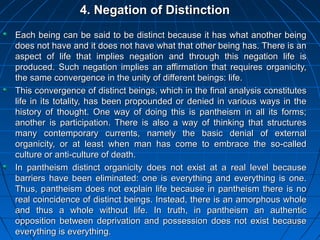
community which sees the physician as a necessarily
competent person on a relational and scientific level,
inserted in a community reality, capable of collaborating
with other health figures and of administering the
resources available with continuing learning, always an
advocate of the patient’s health, capable of combining
knowledge with medical practice, and therefore with
ongoing training.
555555
This kind of medical training would offer a new
understanding of health and of disease. It would pay
attention to prevention and the handling of the disease
in the context of the individuality of the patient
complemented by their own family and society as a
whole.
It would thus develop a learning based more on
curiosity and continuous investigation than on passive
acquisitions. It would reduce the information load. It
would encourage direct contact with the patients
through a personalized analysis of their problems and of
the whole of their curriculum.
556556
A programme should therefore be prepared which is
based on the following principles:
1. Existence of a comprehensive and ultimate meaning
of medical knowledge.
2. Definition of its epistemological orientation.
3. Definition of the values, the motivations, the
psychological maturity, the quality of the objective
knowledge and the methodological, relational and
technical capacities, applied to the exercising of the
profession.
557557
4. Definition of the values, the motivations, the capacities and
the quality of the training of the teachers.
5. Definition of the general and specific objectives of the
training.
6. Definition of the teaching methods. These principles
contain the epistemological knowledge of present-day
medicine which considers health as a psycho-biological
construction determined by the possibility and the quality of
the person’s resources and whose aim is to give a single
response to the fundamental questions of human existence. [51]
[51] Cf. Brera Giuseppe Rodolfo, La formazione dei medici del terzo Millennio. La scuola medica come
scuola di uomini e di umanità. Conferenza inaugurale dell’anno accademico 1998-1999. Università
Ambrosiana di Milano, inaugurazione della Scuola di Medicina.
558558
4. MEDICAL TRAINING
 Eighth Commandment
 “YOU SHALL NOT TELL
LIES”
 Medical commitment to the truth
 Curricular formation
 Scientific and technical. Excellence.
 Human. Individual and social,
environmental
 Moral (Bioethics). Values
 Permanent Formation
559559
COMMITMENT TOCOMMITMENT TO
THE TRUTHTHE TRUTH
Informed
consent
560560
FORMATION
IN VALUES
561561
HUMANHUMAN
FORMATIONFORMATION
562562
SCIENTIFICSCIENTIFIC
FORMATIONFORMATION
Diversity of
methods
563563
5. Permanent Formation
The physician's identity is not shaped once and for all in their initial training,
but rather is prolonged in their lifelong learning.
It demands a very careful preparation of students of medicine, but at the same
time requires the continuing and progressive preparation of the professors who
teach any medical subject, a preparation that should never be lacking.
The professors in particular have the responsibility to promote new physicians,
and they will never achieve this if they are not sure of each student's capacity to
carry out such a delicate mission.
The same eighth commandment obliges all physicians to keep professional
secrecy and, as we have already mentioned, to have a sound medical culture
which should be improved constantly through lifelong learning. [52]
[52] Cf. Pius XII, “All’Unione Italiana Medico Biologica di ‘San Luca’,” in Pio XII Discorsi ai medici, Fiorenzo Angelini
(ed.), Edizione Orizzonte Medico, Roma 1959, pp. 46-54.
564564564
Permanent Formation
565565
B. “WITH”
Reflection of
Christ in the
physician
Pain
Health
566566
 B. “WITH”
We said that the second characteristic of the Christian
vocation is expressed by the preposition “with”, with
God.
That is to say that every vocation is to be with God our
Lord, who prepares man to carry out a mission which,
without his strength, it would be pointless to carry out.
In the book of Exodus we can read what Moses says to
God on mount Horeb: “Who am I that I should go to
Pharaoh and bring the Israelites out of Egypt, and God
said: I will be with you...” (Cf. Ex 3,12).
567567567
Vocation: Mission
 God callsGod calls
 Divine powerDivine power
 ““do not be afraiddo not be afraid
 I am WITH YOUI am WITH YOU””
Moses
568568
1. Reflection of Christ the physician
In this section we set out the deepest values that should shape the identity
of the Catholic physician. The personality of the Christian physician is
identified with the “reflection” of Christ the physician. Christ sent his
apostles to cure all ailments and diseases and said to them, I will be with
you to the end of the time (Mk 16,17; Mt 28,20). The physician performs
the therapeutic ministry in this way, beside the apostles, as a continuation
of the mission of Christ and as his “reflection.”
This reflection should be understood in all its breadth. The physician
should reveal the whole life of Christ, which is the presence of Christ in
the physician. Because Christ cures all ailments and diseases with all his
action taken as a whole. The miracle healings that he performed,
including the resurrection of the dead, were not definitive in his struggle
against the evil that exists in humanity, against its ailments and death, but
rather just a sign of the profound reality that entails his own death and
resurrection.
569569
CALLED TO BE
WITH CHRIST
570570
Presence
of Christ
the
Physician
571571
2. Pain
He took all suffering, all ailments, all disease, without exception, and
recapitulated them in his own death as the death of God who had become man,
so that no pain would remain outside, and from his death he destroyed death
itself, he conquered it in the plenitude of his resurrection.
One of the physician’s main doubts is always the problem of pain. This question
only has its answer here, when pain does not appear as something negative, but
rather as a positivity which, it is true, ends in death, but in a death fecund with
resurrection.
The physician should thus offer care, revealing the death and the resurrection of
Christ. An identification of the physician as such, as a healer, with Christ the
healer, is necessary for this revelation.
This identification is now carried out especially through the Eucharist and
through the other sacraments. The sacraments are the historic presence of Christ
today, in the concrete moment of our life.
572572
Pain
573573
CONTINUATIONCONTINUATION
OF THE MISSIONOF THE MISSION
OF CHRIST:OF CHRIST:
TO HEALTO HEAL
574574
3. Health
Consequently, the physician should realize that health is comprehensive and
bodily health should not be talked about as something radically different from
the complete health that we call eternal health or salvation. The physician’s
ministry is therefore an ecclesial ministry which is directed towards the
salvation of man through his body, but which involves other aspects.
We thus have describe health as:
A dynamic tension towards physical, mental, social and
spiritual harmony and not just the absence of disease, which
renders a person capable of carrying out the mission with which
God has entrusted them, in accordance with the stage of life at
which they are. [53]
[53] Cf. John Paul II, Message for the World Day of the Sick, 11 Febraury 2000, n.13.
575575
The physician’s mission is therefore to ensure that this dynamic
tension towards complete harmony exists, as required at each stage of
the life of this specific person who is their patient, so that they can
carry out the mission with which God has entrusted them.
Thus, the contradiction of reducing the medical function to the single
physical and chemical aspect of the disease. His function is
comprehensive and moreover cannot be static, but rather should be
inserted within the dynamism of the patients who tend toward their
own harmony.
In this context, death is not a frustration for the physician, but rather a
triumph, as they have accompanied their patient in such a way that
they have been able to use their talents to the full at each stage of
their life. When it has reached its end, the medical function ends, not
with a cry of impotence, but rather with the satisfaction of a mission
fulfilled, both by the patient and by the physician.
576576
3. HEALTH
“Tension towards the physical, mental, social and
spiritual harmony, and not merely the absence of
diseases, which renders the person capable of
carrying out the mission with which God has
entrusted them, in accordance with the stage of life
at which they are.”
Function of the physician: towards harmony
So that the patient may accomplishment their mission
According the stage of their life
Stage of life and health
Death as the summit of the stages
The doctor and death
frustration?:
Realization hoaxhoax??
577577
HEALTH:HEALTH:
TENSIONTENSION
TOWARDSTOWARDS
HARMONYHARMONY
578578
Thus, the physician is truly with Christ and their profession is
identified in this communion with Christ, and then the physician
joins together with God our Father like a son with his Father, and
their professional love becomes the action of the Love of God in
himself, which is the Holy Spirit. A Christian physician is therefore
one who is always guided by the Holy Spirit.
It is from the Holy Spirit and with the Holy Spirit that the
compassion which exist between the physician and the patient is to
be understood, all the due humanization of medicine and all the
demand for updating and lifelong learning, since the Love of the
Holy Spirit makes the physician an essentially open person for the
rest, as they are obliged to do so before God because of their
profession of Faith that gives significance to their medical
profession.
We thus succeed in outlining the third trait of the medical identity, being
for others, it is the “FOR” of their vocation and of their professional
identity.
579579579
PRESENCEPRESENCE
OFOF
CHRISTCHRIST
THETHE
PHYSICIANPHYSICIAN
580580580
The
Physician
Reflects
Christ
Who heals
581581
C. “FOR”
Openness to theOpenness to the
patientpatient
FundamentalFundamental
qualities of thequalities of the
physicianphysician
Portrait of thePortrait of the
physicianphysician
Morality and LawMorality and Law
Team WorkTeam Work
582582
C. “FOR”
When God chose Moses, it is very clear that he did so to remove
his people from the power of the Egyptians. God says, “I have
come down to rescue them from the hand of the Egyptians” (Ex
3,8)
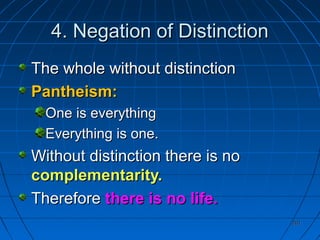
Physicians cannot withdraw into themselves. They cannot simply
think that they already have enough money, that they do not need
to work any more, and that therefore they will now leave their
profession. A true physician is a physician for life. If they have
truly received this vocation, they will have it for ever and they
must practise it for humanity as a mission specifically received for
the good of all, and for which they must account to God when He
says to them, “I was sick, and you looked after me” (Mt 25, 36,43).
583583583
Vocation: Service:Vocation: Service:
God calls,God calls,
SO THAT you liberateSO THAT you liberate
my peoplemy people
584584
THETHE
PHYSICIAPHYSICIA
NIS FORNIS FOR
OTHERSOTHERS
585585
1. Openness to the patient
We said that the love of the medical profession imitates the love of God which
disseminates itself. Physicians cannot hide their knowledge in pure theories and
laboratories, but rather should expand it in favour of the community. They have
received the gift of taking care of life and making it grow.
Their vocation is for life, never for death, which would be to obscure the mission
with which God has entrusted each human being. According to Pope John Paul
II, nowadays the religious ministry is connected to the therapeutic ministry of
physicians in the affirmation of human life and of all those specific contingencies
in which life itself can be endangered by deliberate human will.
Their deepest identity involves being ministers of life and never instruments of
death. This is the most intimate nature of their noble profession.
They are called to humanize medicine and the places where they practise it, and
to use the most advanced technologies for life and not for death, always having
Christ, the physician of bodies and of souls, as their supreme model. [54]
[54] Cf. John Paul II, “Al XV Congresso dei Medici Cattolici,” in Cinquanta’anni di vita per la vita AMCI 1944-1994,
Edizione Orizzonte Medico, Roma1994, pp. 105-114.
586586
According to Pope Pius XII, Catholic physicians should place
their knowledge, their strengths, their heart and their devotion at
the disposal of the sick. They should understand that they and their
patients are subject to the will of God. Medicine is a reflection of
the goodness of God. They should help the sick to accept their
illness, and they should make sure they are not dazzled by
technology and use the gifts that God has given them and not give
in to the pressure to assaults on life. They should remain firm in
the face of the temptations of materialism. [55]
The good physician must therefore have dianoetic virtues and
skills and convert them into virtuosity, that is to say into a habit,
so that both the virtues of theoretical science and those of practice
come together in them as if they were their second nature. [56]
[55] Cf. Pius XII, “Radio Messaggio al VII Congresso Internazionale dei Medici Cattolici (11.09.1956),” in
Pio XII Discorsi ai medici, p. 503.
[56] Cf. D. G. Guillen, “The Hippocratic Oath in the Development of Medicine”, pp.12-14.
587587
THIRD
CHARACTERISTIC
OF VOCATION
 The vocation is always “FOR”
 Physician, social profession
 Absurdity of medical individualism
Economic position
Scientific position
Prestigious position
 “I was sick and you visited me”
588588588
The PhysicianThe Physician
RespondsResponds
to Christ:to Christ:
CALLEDCALLED
FORFOR
OTHERSOTHERS
589589
1. OPENNESS TO
THE PATIENT
 The Love of God is self-diffusive
 Ministry for life: Communicate life
 Humanize medical sciences and
technologies
 Medicine is a reflection of divine
goodness
 Knowledge and practices: dianoetic
virtues and skills
590590590
COMUNICATECOMUNICATE
LIFELIFE
591591
2. Fundamental qualities of the physician
The fundamental qualities of the physician have thus been classified under 5
sections:
1. Awareness of responsibility, 2. Humility, 3. Respect, 4. Love and 5.
Truthfulness.
Awareness of responsibility leads them to work with the patient and be aware of
what it means to be a physician who gives the direction.
Humility tells them that physicians look after their patients and not the opposite.
Humility makes them see themselves as indebted to the patient. Physicians
cannot speak of “their” patients, but rather the patients will speak of “their”
physician. Physicians should receive their patients as written on the lintel of an
old German hospital: “Recipere quasi Christum”; they should receive their
patients as if they were Christ himself.
Respect and love for the patient, about which we have already spoken, are the
basis for their humility. They know that they have received a mission for which
they do not have the necessary strength, but rather they receive it from the
person who sends them.
592592
Truthfulness entails being aware of the great trust that the patient places
in them on revealing their personal matters. Truthfulness is required in the
diagnosis and in the therapy, not just on the bodily but also on the
complete, mental, social, psychic, spiritual level.
They should never experiment on the patient if this involves a danger
disproportionate to the good that they intend to do. This must be
absolutely necessary and the patient must agree to it. They should notify
the patient of the development of their illness, tell them the truth about
their condition in the most appropriate way and at the most appropriate
time possible.
They should complement their action with the action of the priest as both
missions, that of the priest and that of the physician, are closely
connected. [57]
[57] Cf. P. Martini, “Arzt und Seelsorge”, in LTK (1) 912-915.
593593593
Medicine:Medicine:
ReflectionReflection
ofof
divinedivine
goodnessgoodness
594594594
Reflection
595595595
Responsibility
596596
2. FUNDAMENTAL QUALITIES OF THE
PHYSICIAN
 Awareness of responsibility
 Humility
• “my patients” or “my doctor”?
 Esteem of the patients
• “recipere quasi Christum”
 Respect for the sick
• Accomplish a mission
 Truthfulness
• Truthfulness in the Diagnosis and
Therapy
• Communication with the Sick
• Integrate his work with that of the
priest
597597
3. Portrait of the Physician
The figure of the physician portrayed by Zarathushtra, who was
a stranger to Christian culture is very interesting.
The “Portrait of the perfect medical doctor” described by
Enrique Jorge Enriquez, in 16th
century Spain in the flowery
language of the time, is still current. [58]
Nowadays, we would talk about medical excellence. This would
be what Aristotle called the “Τελειοσ ιατροσ” (perfect
physician), or Galen called “Αριστοσ ιατροσ” (best
physician).
In any case, the authentic portrait of the physician, will always
be that “reflected” by Christ the physician.
[58] Cited by D. G. Guillen, “The Hippocratic Oath in the Development of Medicine” p. 26.
598598
3.
P
O
R
T
R
A
I
T
599599
ZarathustraZarathustra
says:says:
600600
ZoroasterZoroaster :: Zend-AvestaZend-Avesta
The doctor “ mustThe doctor “ must knowknow the variousthe various
parts of the body, their articulation,parts of the body, their articulation,
the remedies for the illness;the remedies for the illness;
MustMust bebe amiable, not jealous, gentleamiable, not jealous, gentle
in his expression, without pride;in his expression, without pride;
Enemy of the illness andEnemy of the illness and friendfriend ofof
the patientthe patient;;
Modest, innocent, not evil or violent,Modest, innocent, not evil or violent,
careful, noble in action, withcareful, noble in action, with goodgood
reputationreputation ;;
HisHis motivesmotives are not the profit but aare not the profit but a
spiritual reward, ready to listen,spiritual reward, ready to listen,
authentic, friend of men.”authentic, friend of men.”
601601601
“The physician must have the fear of theThe physician must have the fear of the
Lord, he must be very humble and notLord, he must be very humble and not
proud or vainglorious, and must beproud or vainglorious, and must be
charitable towards the poor, gentle, kind,charitable towards the poor, gentle, kind,
affable and not vengeful. He must beaffable and not vengeful. He must be
prudent moderate and not too daring…,prudent moderate and not too daring…,
should know how to control himself, andshould know how to control himself, and
he should be honest and reserved; hehe should be honest and reserved; he
should work on his skill and avoidshould work on his skill and avoid
idleness. He must be well-read and mustidleness. He must be well-read and must
have answers to everything”have answers to everything”
Enrique Jorge Enrçquez ,,
Spain, XVI CenturySpain, XVI Century601
602602602
THE AUTHENTICTHE AUTHENTIC
PORTRIATPORTRIAT
OF THEOF THE
PHYSICIANPHYSICIAN
603603
4. Morality and Law
Initially we said that the medical profession is something that
goes beyond the Law and is positioned in the framework of
Morality, and this is true, but this does not mean that we can do
without medical Law.
Medical Law without adequate morality would be arbitrariness
based on shameful interests. Morality without medical Law
would just be general principles without direct application.
The rules of medical Law must be sufficiently clear and brief to
aid the physician’s action.
 The leading principle is always the same: the physician’s goal is
to assist and heal, and not to do harm nor kill.
604604
It is worth mentioning in particular the field of Ethics, the field of Morality,
in which the physician must be competent, but in which so often they are not
specialists. Bioethics committees are therefore required in each health centre,
and should also be created in the teaching centres, in open dialogue with the
specialists in the different subjects concerned.
With regard to Bioethics Committees, they are conceived as based on an
objective ethics and not plunged into a relativism that would empty Ethics of
its own normative nature and would convert it into to mere arbitrariness, to
the service of collective or individual egoistic interests
Physicians are thus trained to bear witness to God in all the medical, trade
union and political environments, etc. They can even be valid bearers of
ecumenical dialogue and dialogue with other religions, as sickness does not
know religious barriers.
The physician will thus actively belong to the Church as an individual person
and as a group. [59]
[59] Cf. S. Leone, in Orizzonte Medico, 6, Nov-Dec.1996, 10-11.
605605
4.
MORALITY
AND LAW
 Law without Morality: arbitrariness;
 Morality without Law: inefficient.
 Leading principle of medical Law:
• The physicians’s goal is to assist
and heal, and not to do harm nor
kill
 Bioethics Committees
 Witnesses of the Christian values.
606606
APPLICATION OFAPPLICATION OF
MORALITYMORALITY
607607
5 Teamwork
In order to carry out such a demanding mission, physicians
cannot stay enclosed in their own individuality, but rather should
first open up to other physicians and be sufficiently humble to
work in collaboration and as a team, both on strictly
physiological matters, and especially on those relational matters
connected to fields of which they do not necessarily have a
command and which to a certain extent are outside their
competence, namely sociological, anthropological and political
aspects, and those from technical fields beyond their profession,
namely everything that strictly concerns the field of computer
science.
608608
In a certain way, within this opening-up, in the Spanish field of medicine
what two authors call the decalogue of the new physician is designed.
They express it like this:
1. Multidisciplinary teamwork with a single person ultimately responsible.
2. The more scientific the professional is, the better.
3. The human aspects will be strengthened in professional practice.
4. Action will be adapted to agreed scientific diagnostic and therapeutic
protocols.
5. They will be aware of the expense. In addition to the protocols, they
will use guides to good practice.
609609
6. They shall aid coexistence and solidarity with work colleagues and with the
patients.
7. They shall think that all healthcare acts can involve a preventive action, and even a
promotion of health.
8. They shall bear in mind at all times the need to care for the satisfaction of the
service user.
9. The Patient Service Units will be strengthened, circulating the complaints and
suggestions which arise among the people affected. Frequent opinion surveys will be
held.
10. It will be essential to apply ethical principles to the professional activities. [60]
[60] M. A. Asenjo – A. Trilla, “Necesidad de nuevos profesionales para las nuevas situaciones
sanitarias”, in Todo Hospital, 149 (1988) 497-499.
610610
5. TEAM WORK
The New Doctor’s Decalogue:
1. Multidisciplinary team 2. Scientific and
professional
3. Humanization 4. Consensus
protocols
5. Cost Conscious 6. Coexistense-
Solidarity
7. Prevention-promotion8. Patient
satisfaction
9. Complaints-Suggestions 10. Application of
Ethics
611611
TEAM WORK
612612612
MultidisciplinaryMultidisciplinary
613613613
TO CONCLUDE…
614614
We conclude this chapter summarizing it in the following affirmations:
Being a Catholic physician is a ministry which arises from a vocation in the
Church.
It is a therapeutic ministry.
It is closely linked to God our Father, revealed in Christ the physician, full
of the Love which is the Holy Spirit.
Being a physician is a way to arrive at the fullness of the human being; to
initiate the resurrection already.
It involves proximity and a special intimacy with God, which at the same
time means an opening-up and a complete gift to others.
This is the Catholic identity of the physician, to be the reflection of Christ
the healer.
615615
Being a Catholic professor of medicine is to have far-reaching sight to be able to see the
resurrection in death.
It is not just this, though. It is the ability to sense a harmonious tension in health and
illness, which leads to plenitude, in accordance with the different stages of the life of
people. And it is to feel in medical science, technology and skills the omnipotent power
of God who resurrects his Son Jesus Christ and who gives us a foretaste of the
resurrection in medical progress.
Being a Catholic professor of medicine is to teach the Love with which the Holy Spirit
delivers Jesus Christ on the cross to the Father, and with his loving strength brings him
back to life.
Being a Catholic professor of medicine is to teach the physician to be the loving caress
of God who looks after his children in sickness and in death, making their condition
more bearable for them and opening them to a complete hope of health which will no
longer be tension towards harmony, but rather the total harmony of love.
Being a Catholic professor of medicine is to teach the physician to be the reflection of
Christ the healer.
616616
CONCLUSIONS
 To be a Catholic Physician is a ministry
arising from a vocation in the Church.
 It is a way to arrive at the fullness of
the human being.
 It implies an intimacy with God and a
trustful openness to man
 The Catholic Physician is the
reflection of the healing Christ.
617617
The Catholic professor of medicine
teaches
To see the resurrection in MedicineTo see the resurrection in Medicine
and in death.and in death.
To see in illness and in health the tension
towards harmony.harmony.
To have a foretaste offoretaste of the force ofthe force of
the resurrectionthe resurrection in the Medicinein the Medicine
To meet the Holy Spiritmeet the Holy Spirit in the patient,
as the power that gives life.
To be the loving caress of Godloving caress of God to the
sick person.
To be the reflection of Christ thereflection of Christ the
healer
618618
The Professor ofThe Professor of
Medicine teachesMedicine teaches
the physician to givethe physician to give
life anticipatinglife anticipating
THE RESURRECTIONTHE RESURRECTION
619619619
The Catholic
Professor
of Medicine
teaches
the physician
to be the
caress of God
to the
sick person
620620620
A REFLECTION OFA REFLECTION OF
CHRIST THE HEALERCHRIST THE HEALER
THE PROFESSORTHE PROFESSOR
OF MEDICINEOF MEDICINE
TEACHES TO BE:TEACHES TO BE:
621621
622622
As a conclusion to all we have discussed we can say that Health
Pastoral Care represents an ecclesial call to harmonize life with death.
This apparent paradox and contradiction can only be resolved with the
Holy Spirit when he unites us to the death of Christ. In this way Christ
himself assumes our suffering and death into his own suffering, passion
and death, incorporating us to Himself. Christ accomplishes this
incorporation by making himself present through the sacraments,
particularly in the Eucharist.
The Holy Spirit does not limit this union to our incorporation to the death
of Christ, but he extends it victoriously, uniting us to his resurrection.
Thus the Spirit unites us to the triumphant Christ, who recreates the
whole universe and brings the eternal Decree of the Father to fulfilment,
which is the total harmony, full health, reconciling through the blood of his
cross, that is through him, all that is on earth and all that is in heaven (cf.
Col. 1, 20).
.
CONCLUSIONS
623623
Therefore, Health Pastoral Care is not only a project of “charity” for the
benefit of the sick, but rather a deep penetration into the fundamental
mission of the Church; a mission that Christ assigned to his apostles and
disciples.
To accomplish this mission, Health Pastoral Care has to be carried out
with a deep faith, along with an effective charity and a hope that withstands
any challenge. This is the only way to carry out God’s plan for Health
Pastoral Care, which consists in realizing in the field of Health the image of
the Holy Trinity through the Paschal incarnation of Christ, according to the
parameters to which the apostle Paul alludes when he discusses building
the mystical Body of Christ, and which he sums up marvellously in this
phrase: “’alezeùontes dé èn ‘agape” (making the truth in love, Eph. 4,15).
Consequently, the foundation of Health Pastoral Care is God who is Truth
in Love.
624624
Health Pastoral Care
IS:
“Making the Truth in Love”
POWER
TRUTH
LOVE
625625625
Health
Pastoral Care
IS:
“Do this in memory of Me”
626626
HEALTH
PASTORAL CARE
IS:
DEATDEAT
LIFELIFE
The paradox
is vanquished
627627
628628
The mission of the Church in the area of suffering is to
do good to the one who suffers and do good through one’s
own suffering; to liberate love from within man through
the disinterested giving to the one who suffers and of the
person that suffers.
The spirituality of the Christian health care worker
consists in letting oneself be configured by the Holy Spirit
to Christ who suffers, as the sacrament of the mercy and
affection of the Father, through the death and resurrection
of the Lord partaken in the Eucharist. It is an Easter
spirituality, which is full of hope and the fullness of life.
It is a Marian spirituality: the Virgin Mary invoked as
“Health of the Sick” is our model of service, who in her
total openness to redemption, expresses the care and
mercy of God toward every person in need of help in
his/her suffering.
629629
630630
Health
Pastoral care
IS :
Mary,
Health of the Sick
631631
Heath
Pastoral care
IS :
Harmony
With the Universe
632632
TrinitariaTrinitaria
nn
participatioparticipatio
nn
In a word:
Health
Pastoral Care
IS:
Dying in Christ
so as to rise
with Him
633633
BIBLIOGRAPHY
 Pius XII, “All’Unione Italiana Medico Biologica di ‘San Luca’,” in Pio XII
Discorsi ai medici, Fiorenzo Angelini (ed.), Edizione Orizzonte Medico, Roma 1959,
pp. 43-55
 Pius XII, “Radio Messaggio al VII Congresso internazionale dei Medici
cattolici (11-9-56)”, in Pio XII Discorsi ai medici, Fiorenzo Angelini (ed.),
Edizione Orizzonte Medico, Roma 1959, pp. 503- 518.
 John Paul II, Apostolic Letter Salvifici Doloris, 11 February 1984, in AAS 76 (1984)
201-250.
 John Paul II, Apostolic Letter Motu proprio Dolentium Hominum,11February 1985,
in AAS 77 (1985) 457-467.
 John Paul II, Apostolic Letter Pastor Bonus, 28 June 1988, in AAS 80 (1988) 841-
930.
 John Paul II, “Al XV Congresso dei Medici Cattolici,” in Cinquant’anni di vita per la
vita AMCI 1944-1994, Edizione Orizzonte Medico, Roma 1994, pp. 108 -
114.
 John Paul II, Message of the Holy Father for the World Day of the Sick for the
Year 2000, in Dolentium Hominum 42 (1999) 4-10.
 John Paul II, Apostolic Letter Novo Millennio Inenute, 6 January 2001, in
AAS 93 (2001) 266-309.
634634
 Benedict XVI, Address to the Pontifical Council for Health Pastoral Care on the
Occasion of its XX International Conference on the Human Genome,
19 November 2005.
 Benedict XVI, Message for the World Day of the Sick 2006.
 Benedict XVI, Message for the World Day of the Sick 2007.
 Benedict XVI, Address to the Pontifical Council for Health pastoral Care
on the Occasion of its VII Plenary Assembly, 22 March 2007.
 Benedict XVI, Encyclical Letter Spe Salvi, 30 November 2007.
 Benedict XVI, Message for the World Day of the Sick 2008.
 Pontifical Council for Pastoral Assistance to Health Care Workers, Charter for
Health Care Workers, Vatican Press, Vatican City 1995.
 Pontifical Council for Health Pastoral Care, “Palliative Care,” in Dolentium
Hominum 58 (2005).
635635
 Aristotle, Metafísica, X, 3;b. De Anima II,1-2.
 Arinze F., “The Pedagogy of Pain in other Religions,” in Dolentium Hominum 31
(1996) 194-197.
 Asenjo M.A.,Trilla A., “Necesidad de nuevos profesionales para las nuevas
situaciones sanitarias,” in Todo hospital 149,(1988) 497-499.
 Boetius M. S., De Consolatione Philosophiae, V.6.
 Brera G. R., La formazione dei medici del terzo Millennio. La scuola medica
come scuola di uomini e di umanità. Conferenza inaugurale dell’anno
accademico 1998-1999. Università ambrosiana di Milano, inaugurazione
della Scuola di Medicina.
 Burdo C. (and others), “La vie et l’evolution,” in Archives de Philosophie 6
(1928).
 Cappelletti V., “Where there is Love for the Art of Medicine, there is Love for
Man”, in Dolentium Hominum 31(1996), 12-14.
 Cappelletti V., “The Human Genome: Historical Analysis and Ethical
Considerations,” in Pontificia Academia Pro Vita, Human Genome, Human
Person and the Society of the Future, Libreria Editrice Vaticana, Città del
Vaticano 1999, pp. 23-39.
 Castellano S., “Pain : the Scientific Data”, in Dolentium Hominum 58 (2005)
24- 27. (Wide Bibliography).
 Cina G., Locci E., Rocchetta C., Sandrin L. (eds.), Dizionario di Teologia
Pastorale Sanitaria, Edizione Camillianae, Torino 1997.
636636
 Colombo R., “The Human Genome Project: the Moral Limits of Research,” in
Pontifical Academy for life, Medicine and law, for or against life?, Libreria
Editrice Vaticana, Vatican City 1999, 69-125
 Depoortere K., “Vita,” in Dizionario di Teologia Pastorale Sanitaria, Cina G. ed
altri (eds.), Edizione Camillianae, Torino 1997, 1381-1387.
 Dopp J., Lecons de Logique formelle 3 vols, Lovaina 1950.
 Driesch H., Woltereck R., Das Lebens Problem in der Lichte der modernen
Forschung 1931.
 Evangelista M., “Palliative Care,” in Dolentium Hominum 58 (2005) 34-
42. (Wide Bibliography).
 Fröbes J., Tractatus Logicae Formalis, Roma 1940.
 Gracia G. D., “The Hippocratic Oath in the Development of Medicine, “ in
Dolentium Hominum 31 (1996), 22-28.
 Larroyo F., Ciencias de la Educación, Mèxico 1960.
 Leone S., in Orizzonte medico (6) Nov-dec.1996, 10-11.
 Links, Biogenética, México 2000.
637637
 Lozano J., Hacia el Tercer Milenio, Teología y Cultura, CEM, Mexico 1988,
pp.47-107.
 Lozano J., Teología Estado y Sociedad, Zacatecas 1996.
 Lozano J., Teología y Medicina, Edizioni Dehoniane Bologna, Bologna 2000.
 Lozano J., Metabioethics and Biomedicine, Editrice Velar, Bergamo 2006.
 Manua G., Metafisica del dono, Cherico 2006.
 Martini P., Arzt und Seelsorge, in LTK (1) 912-915.
 Morande P. El indiferentismo religioso en América Latina. Desafíos pastorales,
in Ateísmo y Fe XXVII-1, 12-18.
 Sgreccia E., Manual de Bioética, México 1996.
 S. Tomaso di Aquino, Summa contra Gentiles, 4,11; Summa
Theologica I q.18 aa.1-2.
 Strachan T., Genetica umana molecolare, Torino 2007.
 Zucchi, P. L., “Pain Therapy,” in Dolentium Hominum 58 (2005) 28-34
(Wide Bibliography)

Life in death

  • 1.
  • 2.
  • 3.
  • 4.
  • 5.
  • 6.
  • 7.
    77  The titleof this book may seem provocative: “Life in death.” It wouldThe title of this book may seem provocative: “Life in death.” It would seem more logical to say the contrary: “Death in life”, given that life endsseem more logical to say the contrary: “Death in life”, given that life ends with death. Nevertheless, the title is more logical than what one maywith death. Nevertheless, the title is more logical than what one may think, because it corresponds to the only reality that gives sense tothink, because it corresponds to the only reality that gives sense to everything, and thus enables everything to be logical. If human life wereeverything, and thus enables everything to be logical. If human life were to end with death, nothing would have sense. This title touches theto end with death, nothing would have sense. This title touches the central aspect of Christianity: the resurrection of Christ. He is the Onecentral aspect of Christianity: the resurrection of Christ. He is the One who gives us life in death through the resurrection.who gives us life in death through the resurrection.  In the book we ask ourselves how this happens, and the answer is:In the book we ask ourselves how this happens, and the answer is: through Health Pastoral Care. We develop the answer in two parts: in thethrough Health Pastoral Care. We develop the answer in two parts: in the first part we try to explain what Health Pastoral Care is, and in the secondfirst part we try to explain what Health Pastoral Care is, and in the second part we treat the essential themes that are the basis of an authenticpart we treat the essential themes that are the basis of an authentic Health Pastoral Care.Health Pastoral Care.  I am very grateful to Cardinal Paul Poupard, emeritus President of theI am very grateful to Cardinal Paul Poupard, emeritus President of the Pontifical Council for Culture and Inter-religious Dialogue, who paid mePontifical Council for Culture and Inter-religious Dialogue, who paid me the tribute of writing a beautiful Preface, making a complete and profoundthe tribute of writing a beautiful Preface, making a complete and profound presentation of the book: I am sure that reading it will be very beneficial.presentation of the book: I am sure that reading it will be very beneficial.
  • 8.
  • 9.
  • 10.
    1010 CONTENTSCONTENTSPrefacePreface FIRST PART:FIRST PART: HEALTHPASTORAL CARE IN THE CHURCHHEALTH PASTORAL CARE IN THE CHURCH I.I. The Present State of Health Pastoral CareThe Present State of Health Pastoral Care II.II. What is Health Pastoral Care? What Should be DonWhat is Health Pastoral Care? What Should be Don III.III. How Should it be Done?How Should it be Done? SECOND PART:SECOND PART: CENTRAL THEMES IN HEALTH PASTORAL CARECENTRAL THEMES IN HEALTH PASTORAL CARE I.I. Life, Giving of LoveLife, Giving of Love II.II. Pain, Enigma or Mystery?Pain, Enigma or Mystery? III.III. ViaticumViaticum IV.IV. HealthHealth 1010
  • 11.
    1111 CONTENTS:CONTENTS: PrefacePreface IntroductionIntroduction First Part :FirstPart : HEALTH PASTORAL CARE IN THE CHURCH.HEALTH PASTORAL CARE IN THE CHURCH. I. Present SituationI. Present Situation 1. Present Situation1. Present Situation 2. Positive and Negative Points2. Positive and Negative Points II. What is Health Pastoral Care? What Should be Done?II. What is Health Pastoral Care? What Should be Done? 1. The Gospels1. The Gospels 2. The Pontifical Magisterium2. The Pontifical Magisterium III. How Should it be Done?III. How Should it be Done? 1. Elaboration according to the Ministries in the Church1. Elaboration according to the Ministries in the Church 2. Elaboration according to the Objectives2. Elaboration according to the Objectives 3. Practical Proposals:3. Practical Proposals: - Challenges- Challenges - General Proposals- General Proposals - Ways- Ways - Answers- Answers 1111
  • 12.
    1212 Second Part:Second Part:CENTRAL THEMES IN HEALTH PASTORALCENTRAL THEMES IN HEALTH PASTORAL CARECARE Chapter 1:Chapter 1: LIFE, GIVING OF LOVELIFE, GIVING OF LOVE I.I. Scientific FoundationScientific Foundation  The Beginning of Human LifeThe Beginning of Human Life  The Initial Elements of Human LifeThe Initial Elements of Human Life  ConclusionsConclusions II.II. Philosophical FoundationPhilosophical Foundation  Opposition of ContradictionOpposition of Contradiction  Opposition of ContrarietyOpposition of Contrariety  ConclusionsConclusions III.III. Theological ReflectionTheological Reflection  Life in the Most Holy TrinityLife in the Most Holy Trinity  Life in the IncarnationLife in the Incarnation  Contradiction taken on in ContrarietyContradiction taken on in Contrariety  ConclusionsConclusions CONCLUSIONSCONCLUSIONS 1212
  • 13.
    1313 Chapter 2:Chapter 2:PAIN AND DEATH: ENIGMA ORPAIN AND DEATH: ENIGMA OR MYSTERY?MYSTERY? IntroductionIntroduction Types of KnowledgeTypes of Knowledge 1. Medical Observations on Pain1. Medical Observations on Pain 2. Solutions of the Great2. Solutions of the Great ReligionsReligions 3. Dialogue with Christianity3. Dialogue with Christianity I. The Enigma of PainI. The Enigma of Pain 1. Existential Approach1. Existential Approach 2. Reflection on the Experience2. Reflection on the Experience II. The MysteryII. The Mystery 1. Evil and Suffering1. Evil and Suffering 2. Christ takes on Suffering2. Christ takes on Suffering and Transforms itand Transforms it 1313 III. CommentsIII. Comments 1. Epistemological Status1. Epistemological Status 2. The Gradual Approach of the2. The Gradual Approach of the Thought of John Paul IIThought of John Paul II 3. The Core of the Mystery3. The Core of the Mystery 4. Understanding the Mystery4. Understanding the Mystery 5. From Suffering to Solidarity5. From Suffering to Solidarity 6. Constitutive Solidarity in Christ6. Constitutive Solidarity in Christ 7. Suffering considered from7. Suffering considered from ResurrectionResurrection 8. The Meaning of the Glorious8. The Meaning of the Glorious CrossCross ConclusionConclusion
  • 14.
    1414 Chapter 3:Chapter 3:VIATICUMVIATICUM IntroductionIntroduction 1. Palliative care1. Palliative care 2. Catholic Spiritual Palliative2. Catholic Spiritual Palliative CareCare 3. The Second Vatican Council3. The Second Vatican Council 4. Viaticum: the Core of the4. Viaticum: the Core of the ReflectionReflection I. Death and LifeI. Death and Life 1. Viaticum as the Apex of1. Viaticum as the Apex of LifeLife 2. The Meaning of Death2. The Meaning of Death II. CommunionII. Communion 1. Obscurity and Loneliness1. Obscurity and Loneliness 2. Viaticum: Light2. Viaticum: Light 3. Accompanying3. Accompanying 4. Proportions4. Proportions III. EternityIII. Eternity 1. Eucharistic Presence1. Eucharistic Presence 2. Eternity2. Eternity 3. Immutability3. Immutability 4. Divinization through the4. Divinization through the ViaticumViaticum 5. The Bridge to be Crossed5. The Bridge to be Crossed 6. The Dynamism of the6. The Dynamism of the ViaticumViaticum ConclusionConclusion Palliative Care?Palliative Care? 1414
  • 15.
    1515 Chapter 4:Chapter 4:HEALTHHEALTH I. What is Health?I. What is Health? 1. Definitions1. Definitions 2. Observations2. Observations II. Health as a tension towardsII. Health as a tension towards harmony:harmony: Religious backgroundReligious background Old TestamentOld Testament New TestamentNew Testament III. Elements of John Paul II’sIII. Elements of John Paul II’s Definition of Health:Definition of Health: 1. Tension1. Tension 2. Harmony2. Harmony 3. Physical3. Physical 4. Psychological4. Psychological 5. Social5. Social 6. Spiritual6. Spiritual 7. Unification7. Unification 8. Way8. Way 9. Diversity of Health9. Diversity of Health CONCLUSIONSCONCLUSIONS
  • 16.
    1616 Chapter 5:Chapter 5:PROFILE OF THE CATHOLICPROFILE OF THE CATHOLIC PROFESSOR OF MEDICINEPROFESSOR OF MEDICINE Introduction:Introduction: CultureCulture The TeacherThe Teacher I. THE CATHOLIC PROFESSOR OFI. THE CATHOLIC PROFESSOR OF MEDICINEMEDICINE 1. The Catholic Teacher of Medicine1. The Catholic Teacher of Medicine 2. The Teacher of Medicine as a2. The Teacher of Medicine as a ProfessorProfessor II. IDENTITY OF THE CATHOLICII. IDENTITY OF THE CATHOLIC PHYSICIANPHYSICIAN 1. Charter for Health Care Workers1. Charter for Health Care Workers 2. Vocation and the Church: Three2. Vocation and the Church: Three Characteristics of VocationCharacteristics of Vocation A. BEINGA. BEING 1. The Profession1. The Profession 2. The Love of God2. The Love of God 3. Life3. Life 4. Medical Training4. Medical Training B.B. WITHWITH 1. Revelation of Christ1. Revelation of Christ 2. Pain2. Pain 3. Health3. Health C.C. FORFOR 1. Openness to the Patient1. Openness to the Patient 2. Fundamental Qualities of2. Fundamental Qualities of the Physicianthe Physician 3. Portrait of the Physician3. Portrait of the Physician 4. Morality and Law4. Morality and Law 5. Teamwork5. Teamwork CONCLUSIONSCONCLUSIONS 1616
  • 17.
  • 18.
    1818 PrefacePreface It is atrue privilege for me to write a preface to this work, LIFE IN DEATH, by my brother, neighbour and friend, Cardinal Javier Lozano Barragán, the President of the Pontifical Council for Health Care Workers.  With this evocative title, whose words ring out loud and clear as a forcefully-made proclamation, the principal figure responsible for Health Pastoral Care within the institutions of the Roman Curia that help the Holy Father in his “care for all Churches” presents us with strong beliefs that are underpinned by solid foundations and accompanied by a rich documentation. His aim is to support the pastoral action of the whole of the Church in this limitless field in which a determining struggle is under way against the counter-culture of death, which is now invading the world at the dawn of the new millennium.
  • 19.
    1919  In anotable pedagogic presentation, in which images of various nuances command the attention of the reader and help him to remember a summary of the points that are luminously expounded, the Cardinal emphasises the striking statistics that reflect the centuries-old commitment of the Church to service to the sick and the immense cohorts of all those who suffer in the world, in the vastness of the five continents. However, he does not conceal the growing shadows that are provoked by a galloping secularisation of devastating effects, a true steamroller, which, if we are not careful, will tend to reduce charity to mere philanthropy, depriving it of its Christological roots and mutilating its eschatological dimension.  “The truth is that only in the mystery of the incarnate Word does the mystery of man take on light…Through Christ and in Christ, the riddles of sorrow and death grow meaningful. Apart from His Gospel, they overwhelm us. Christ has risen, destroying death by His death; He has lavished life upon us so that, as sons in the Son, we can cry out in the Spirit; Abba, Father!” (Gaudium et Spes, n. 22).
  • 20.
    2020 Without this greatvision of faith observed to us by the Second Vatican Council, charity is transmuted into compassion, theological hope is reduced to human hope, and the struggle for life becomes deprived of its principal motivation – the safeguarding of that image of God which is every human person, beginning with the weakest and the poorest, created in the image and likeness of his Creator, whose mortal body, enveloped by his immortal soul, is called, beyond earthly death, to the resurrection of the flesh and to eternal life, as indeed we profess in the Creed. “How can I know where I am going if I do not know where I come from?”, his Royal Highness Otto of Habsburg declared in his nineties. Although we live ineluctably in this fleeting world, passing from the cradle to the grave, our faith transcends the dramatic closure of this mortal finitude and opens it to an eternal future of beauty, love and peace. “Man rise infinitely above man”, wrote Pascal in one of his striking Thoughts, which continue to make us reflect still today. “I do not die, I enter life”, the little Theresa confided with faith in the infirmary of Carmel of Lisieux, at the moment of her return to the heavenly Father.
  • 21.
    2121 While the notableadvances of technological developments and the growing influence of the mass media are forming a new spirit based on positivism and practical behaviour that is impregnated with a profound materialism, the dominant culture sees death only as a definitive failure whose ineluctable expiry date is continually rejected without, however, being able to be definitively exorcised. The life sciences themselves would appear to reduce man to being only a living being amongst other living beings, that is to say they would dissolve him, were they to prove that life, however complex it may be, is reduced to nothing else but vulnerable matter that is irremediably perishable. Like light broken down by a prism, man runs the risk of being broken down by a clinical outlook that no longer manages to grasp his living being in its personal unity and integrity. All of this draws attention to the importance of a Pastoral Care in Health that is based upon belief in the transcendence of man, a singular being who cannot be reduced to the level of other living beings and to the mechanisms that structure exchanges of energy. The man of the age of information technology and disenchanted modernity, between the will to live and the certainty of dying needs to rediscover in the faith in life after death, the strength to lead with serenity his mysterious and shadowy passage towards the light. This is the horizon that Cardinal Barragán gives to Health Pastoral Care, illustrating clearly how God, the Father of all men, reconciled death with life through the death and resurrection of His beloved Son Jesus, the son of the Virgin Mary.
  • 22.
    2222 Of particular eloquencehere is the author’s preliminary list of the Biblical foundations of Health Pastoral Care, beginning with the inescapable reference to the Good Shepherd of chapter ten of the Gospel of St. John, the Good Samaritan, who continues to inspire the Church in her inexhaustible charity for the sick and for all those who suffer in body and soul, to help them to live according to the ancient adage mens sana in corpore sano. With the Cardinal we follow Jesus through the streets of Palestine as he unceasingly heals the sick and raises the dead. We reflect profitably on the teaching of the Popes of our time, in particular the luminous Apostolic Letter of the Servant of God John Paul II, Salvifici Doloris, and the reiterated appeals of his successor, Pope Benedict XVI, for the formation of consciences and respectful dialogue with non-believers.  Nourished by these luminous teachings, Health Pastoral Care is offered to the whole of the Church under the vigorous impulse of the Pontifical Council led by Cardinal Barragán, who has recently successfully overcome a serious operation, in a sequence that is limpid in all its components: “Challenges, Proposals, Ways, Answers”.
  • 23.
    2323 The maternal careof the Church for all sick and infirm people is expressed in the teaching of hope in the resurrection, the sanctification of the sacraments, through Anointing of the Sick, the Eucharist, and in particular Holy Viaticum, and fraternal contacts impregnated with sensitivity. Life in Death. In this valuable vademecum, with its philosophical, theological and scientific facts on life and death, health, an ideal profile of the Christian medical doctor and the Catholic idea of medical science and art could not but be present. Far from replacing the local Churches, the Pontifical Council for Health Care Workers, like all the dicasteries of the Roman Curia, has no other aim than that of helping them to promote, direct, develop and coordinate the care of the whole of the Church in this privileged sphere, something which requires a profound vision of faith, steady hope, and charity without restrictions, following the example of Christ the Good Shepherd, the Good Samaritan and divine Physician of bodies and souls. We should thank Cardinal Barragán for offering us this valuable “service of love” (Benedict XVI, Deus Caritas Est, n. 28). From the Vatican, 11 June 2008 Cardinal Paul Poupard, President Emeritus of the Pontifical Council for Culture and the Pontifical Council for Inter-religious Dialogue
  • 24.
    2424 INTRODUCTIONINTRODUCTION Thanks to theadvanced state of sciences and technology, many things that onceThanks to the advanced state of sciences and technology, many things that once seemed impossible to us, today they are completely ordinary. It suffices to thinkseemed impossible to us, today they are completely ordinary. It suffices to think about the means of social communication; because of the “internet” the telegramabout the means of social communication; because of the “internet” the telegram was the first become outdated. Today one hardly sends a telegram. With thewas the first become outdated. Today one hardly sends a telegram. With the wonder of mobile telephones we are increasingly closer to each other. Think aboutwonder of mobile telephones we are increasingly closer to each other. Think about the “video conferences” by which we communicate live, using both sound andthe “video conferences” by which we communicate live, using both sound and images. It would seem that in our era everything is possible. If not in our presentimages. It would seem that in our era everything is possible. If not in our present time, it is possible in a virtuality that promises a proximate or remote future withtime, it is possible in a virtuality that promises a proximate or remote future with technology that is up to now unforeseen. Not to talk about the field of Biogeneticstechnology that is up to now unforeseen. Not to talk about the field of Biogenetics with the wonders it offers us.with the wonders it offers us. Biomedicine is trying to cross all frontiers. Over the last years, the average age ofBiomedicine is trying to cross all frontiers. Over the last years, the average age of humanity has increased considerably. Nevertheless, there is something that is nothumanity has increased considerably. Nevertheless, there is something that is not yet overcome, neither will it ever be overcome, even with the highest progress ofyet overcome, neither will it ever be overcome, even with the highest progress of science and technology in the most distant future, and that is the death.science and technology in the most distant future, and that is the death. From the non-technological epochs to the present era people have desired to findFrom the non-technological epochs to the present era people have desired to find “the source of perennial youth,” all in vain. The very aging of the cells and the“the source of perennial youth,” all in vain. The very aging of the cells and the impossibility of replacing them in an advanced state of illness or old age, speak toimpossibility of replacing them in an advanced state of illness or old age, speak to us of the scientific absurdity of being able to defeat death.us of the scientific absurdity of being able to defeat death. In front of the inevitability of the end, our present society tries to hide death,In front of the inevitability of the end, our present society tries to hide death, since held within its technical-scientific parameters, it does not find an answer atsince held within its technical-scientific parameters, it does not find an answer at all. Moreover, it suffers defeat daily.all. Moreover, it suffers defeat daily.
  • 25.
    2525 Thank God realityis not simply wrapped up in the parameters of scientific andThank God reality is not simply wrapped up in the parameters of scientific and technological transformations. There are domains that are much more valid thantechnological transformations. There are domains that are much more valid than those subject to the empirical scientific and technological experience, whichthose subject to the empirical scientific and technological experience, which actually give us the deep vision of what we have available for achieving wondersactually give us the deep vision of what we have available for achieving wonders that infinitely overcome the transformations of this same reality through itsthat infinitely overcome the transformations of this same reality through its exploitation.exploitation. This is precisely the goal of Health Pastoral Care: to overcome death byThis is precisely the goal of Health Pastoral Care: to overcome death by harmonizing it with life. We appreciate and take all the sciences andharmonizing it with life. We appreciate and take all the sciences and technologies into consideration, but we do not stop there. We go beyond themtechnologies into consideration, but we do not stop there. We go beyond them by entering into the reality itself. We know that the complexity of the reality isby entering into the reality itself. We know that the complexity of the reality is not exhausted in quantitative terms. Its quality is such that what is more realnot exhausted in quantitative terms. Its quality is such that what is more real remains in the light and shades of the mystery.remains in the light and shades of the mystery. We do not venture into something irrational, but in something that astounds, forWe do not venture into something irrational, but in something that astounds, for being founded on utmost rationality, it exceeds it surpassing our own capacitybeing founded on utmost rationality, it exceeds it surpassing our own capacity and does not require empirical knowledge but rather knowledge that is beyondand does not require empirical knowledge but rather knowledge that is beyond the empirical. It is knowledge that surpasses comprehension of things that canthe empirical. It is knowledge that surpasses comprehension of things that can be manipulated. It is knowledge based on what can be observed, however forbe manipulated. It is knowledge based on what can be observed, however for this observation one needs a supplement of vision called faith. Thus that whichthis observation one needs a supplement of vision called faith. Thus that which is observable turns into something adorable. And it is this knowledge changedis observable turns into something adorable. And it is this knowledge changed into adoration that can finally give us the only way of overcoming death withinto adoration that can finally give us the only way of overcoming death with death itself, and make it become an inexhaustible source of life.death itself, and make it become an inexhaustible source of life.
  • 26.
    2626 How can thisovercoming, this conversion of the tomb into a cradle beHow can this overcoming, this conversion of the tomb into a cradle be achieved? This is the reason that moved me to write these few ideasachieved? This is the reason that moved me to write these few ideas concerning the work we do in the Pontifical Council for Healthcareconcerning the work we do in the Pontifical Council for Healthcare Workers. Certainly this is the nucleus of the Redemption that ChristWorkers. Certainly this is the nucleus of the Redemption that Christ offers us, which exceeds a lot what can be said in Health Pastoraloffers us, which exceeds a lot what can be said in Health Pastoral Care. My intention is to outline only some ideas from the GospelCare. My intention is to outline only some ideas from the Gospel itself, the way the Popes have interpreted it in relation to this Pastoralitself, the way the Popes have interpreted it in relation to this Pastoral Care, and the work we are doing in this Dicastery so as to realize thisCare, and the work we are doing in this Dicastery so as to realize this divine wonder: to reconcile life with death and death with life; thedivine wonder: to reconcile life with death and death with life; the harmony between life and death.harmony between life and death. In this respect, one of the most important duties of this PontificalIn this respect, one of the most important duties of this Pontifical Council is to enlighten people on all that concerns Pastoral Care inCouncil is to enlighten people on all that concerns Pastoral Care in Health. It is therefore important to answer the question: what isHealth. It is therefore important to answer the question: what is Health Pastoral Care? To offer some ideas that can help us arrive atHealth Pastoral Care? To offer some ideas that can help us arrive at this answer is the objective that I intend to and will try to pursue inthis answer is the objective that I intend to and will try to pursue in the following way:the following way: The book is divided into two parts. In the first part, after the initialThe book is divided into two parts. In the first part, after the initial general presentation of Health Pastoral Care, I will discuss threegeneral presentation of Health Pastoral Care, I will discuss three points: To begin with, I talk about the state of Health Pastoral Care inpoints: To begin with, I talk about the state of Health Pastoral Care in the world, giving its positive and negative points; subsequently I trythe world, giving its positive and negative points; subsequently I try to answer the question on what Health Pastoral Care is from theto answer the question on what Health Pastoral Care is from the perspective of the Gospels and the Pontifical Doctrine; finally as aperspective of the Gospels and the Pontifical Doctrine; finally as a third step I will present what should be done so as to realize thisthird step I will present what should be done so as to realize this Pastoral Care in Health: the challenges, proposals, ways and answers.Pastoral Care in Health: the challenges, proposals, ways and answers. 2626
  • 27.
    27272727 Considering these perspectivesI present some elements that I deemConsidering these perspectives I present some elements that I deem important for the planning of Health Pastoral Care, be it at the level of ourimportant for the planning of Health Pastoral Care, be it at the level of our Dicastery or that of the Episcopal conferences, dioceses and parishes; as wellDicastery or that of the Episcopal conferences, dioceses and parishes; as well as the various religious charismas, orders and congregations that areas the various religious charismas, orders and congregations that are involved in Health Pastoral Careinvolved in Health Pastoral Care.. I conclude the first part of the book indicating the way according to which I tryI conclude the first part of the book indicating the way according to which I try to realize my proposal: to show how God our Father reconciled death with lifeto realize my proposal: to show how God our Father reconciled death with life in the death and resurrection of his Son, Our Lord Jesus Christ.in the death and resurrection of his Son, Our Lord Jesus Christ. The second part applies what Health Pastoral Care is to its crucial points,The second part applies what Health Pastoral Care is to its crucial points, developing in five chapters the themes of life, suffering and death togetherdeveloping in five chapters the themes of life, suffering and death together with the Sacrament of the Viaticum, and the theme of the health itself. Andwith the Sacrament of the Viaticum, and the theme of the health itself. And the last chapter seeks to respond to the question on how to communicatethe last chapter seeks to respond to the question on how to communicate nowadays these profound truths of Christianity to our contemporaries, evennowadays these profound truths of Christianity to our contemporaries, even from the academic point of view.from the academic point of view. The reflection that I now present can serve as a simple GUIDE FOR HEALTHThe reflection that I now present can serve as a simple GUIDE FOR HEALTH PASTORAL CARE. It is a very general Guide that has to be appliedPASTORAL CARE. It is a very general Guide that has to be applied practically in the dioceses and in the parishes according to the different localpractically in the dioceses and in the parishes according to the different local circumstancescircumstances..
  • 28.
    28282828 Regarding the methodthat I will use, it will be a combination of written textRegarding the method that I will use, it will be a combination of written text and audiovisual presentation.and audiovisual presentation. It is said that human culture has gone through three major formulations, thatIt is said that human culture has gone through three major formulations, that is: the oral, written and audiovisual cultures. The oral culture is structured inis: the oral, written and audiovisual cultures. The oral culture is structured in the meeting between persons; the written in the book and in the law; and thethe meeting between persons; the written in the book and in the law; and the audiovisual in the news and in shows. It is also said that today we are actuallyaudiovisual in the news and in shows. It is also said that today we are actually in the audiovisual culture, in which technology triumphs as the great conquerorin the audiovisual culture, in which technology triumphs as the great conqueror of the limitations of space and timeof the limitations of space and time [1][1].. Therefore, in the methodological presentation, I intend to use the three toolsTherefore, in the methodological presentation, I intend to use the three tools of cultural transmission in such way that the fundamental ideas presented inof cultural transmission in such way that the fundamental ideas presented in the ordinary text can stand out clearly with the help of special text format,the ordinary text can stand out clearly with the help of special text format, voice, images, color and movement. The ordinary text will be interrupted atvoice, images, color and movement. The ordinary text will be interrupted at particular points where it is deemed useful to insert a synthesis, an image or aparticular points where it is deemed useful to insert a synthesis, an image or a video-clip. This presentation can be viewed on the screen of the computer. Forvideo-clip. This presentation can be viewed on the screen of the computer. For this purpose a CD is offered, attached in the 3 cover page of the book. Thethis purpose a CD is offered, attached in the 3 cover page of the book. The audiovisual presentation contains 9 video-clips and 637 slides. The video-clipsaudiovisual presentation contains 9 video-clips and 637 slides. The video-clips offer a synthetic explanation of the various parts of the book and are situatedoffer a synthetic explanation of the various parts of the book and are situated before the presentation of the parts they refer to.before the presentation of the parts they refer to. [1][1] Cf. P. Morande,Cf. P. Morande, ““El indiferentismo religioso en América Latina. Desafíos pastorales,”El indiferentismo religioso en América Latina. Desafíos pastorales,” inin AteísmoAteísmo y Fe XXVII-1,y Fe XXVII-1, 12-1812-18..
  • 29.
    2929 I have tospecify that two of the themes presented here, I had alreadyI have to specify that two of the themes presented here, I had already discussed them elsewhere; they are significantly developed here, becausediscussed them elsewhere; they are significantly developed here, because of their pertinence to the core of Pastoral Care in Health and for the noveltyof their pertinence to the core of Pastoral Care in Health and for the novelty in the method, especially in as much as we try to present in a sensible andin the method, especially in as much as we try to present in a sensible and concrete way through the different images, movements and colours, thatconcrete way through the different images, movements and colours, that which in itself would otherwise be abstract. Here I would like to refer towhich in itself would otherwise be abstract. Here I would like to refer to chapters two and four in the second part of the book; these themeschapters two and four in the second part of the book; these themes (suffering and the physician) I had already discussed them in the book(suffering and the physician) I had already discussed them in the book Teologia y MedicinaTeologia y Medicina, EDB (2001)., EDB (2001). This book represents the fruits of my personal experience in almostThis book represents the fruits of my personal experience in almost twelve years as President of the Pontifical Council for Health Care Workerstwelve years as President of the Pontifical Council for Health Care Workers (for Health Pastoral Care).(for Health Pastoral Care). It is my duty to thank all those who have made the publication of thisIt is my duty to thank all those who have made the publication of this book in its audiovisual complexity, possible.book in its audiovisual complexity, possible.
  • 30.
    3030 I particularly thankHis Excellency Mgr. José Luis Redrado O.H.,I particularly thank His Excellency Mgr. José Luis Redrado O.H., Secretary of the Pontifical Council, Rev. Fr. Felice Ruffini M.I., theSecretary of the Pontifical Council, Rev. Fr. Felice Ruffini M.I., the Undersecretary, for his efficient collaboration, Rev. Fr. Federico LombardiUndersecretary, for his efficient collaboration, Rev. Fr. Federico Lombardi S.J., for the recording of the “Video-clips” at theS.J., for the recording of the “Video-clips” at the Centro Televisivo VaticanoCentro Televisivo Vaticano,, Rev. Sr. Juliana Gomes Resende for her precious collaboration, Rev. Fr.Rev. Sr. Juliana Gomes Resende for her precious collaboration, Rev. Fr. Charles Namugera, Rev. Mgr. Antonio Soto, and many others who haveCharles Namugera, Rev. Mgr. Antonio Soto, and many others who have helped me in the arrangement, translation and correction of the texts in thehelped me in the arrangement, translation and correction of the texts in the different languages. A special thanks also goes to the publisher “Velar” fordifferent languages. A special thanks also goes to the publisher “Velar” for the excellent job done.the excellent job done. May Our Lady, “Health of the Sick” accept this effort and render it usefulMay Our Lady, “Health of the Sick” accept this effort and render it useful for the sick people, and for the many healthcare professionals and workersfor the sick people, and for the many healthcare professionals and workers who want to practice their faith through the exercise of Medicine.who want to practice their faith through the exercise of Medicine. Vatican City, 15 August 2008, Feast of the Assumption of Our Lady.Vatican City, 15 August 2008, Feast of the Assumption of Our Lady. Javier Cardinal Lozano Barragán President of the Pontifical Council for Health Care Workers (for Health Pastoral Care)
  • 31.
    3131 METHODOLOGYMETHODOLOGY I first presenttheI first present the continuouscontinuous text.text. I then illustrate the salient points inI then illustrate the salient points in the text usingthe text using images, syntheses andimages, syntheses and video-clips.video-clips. The images or syntheses areThe images or syntheses are presented usingpresented using variousvarious colourscolours,, according to the sequence of ideas.according to the sequence of ideas. It is aIt is a multimediamultimedia presentation thatpresentation that seeks to underline the main ideas,seeks to underline the main ideas, and not a mere repetition.and not a mere repetition.
  • 32.
    3232 FIRST PART:FIRST PART: HEALTHHEALTH PASTORALCAREPASTORAL CARE IN THE CHURCHIN THE CHURCH
  • 33.
  • 34.
    3434 The first partof the book responds to the question on whatThe first part of the book responds to the question on what Health Pastoral Care is. The answer is broken down intoHealth Pastoral Care is. The answer is broken down into three points: 1. The present state of Health Pastoral Care inthree points: 1. The present state of Health Pastoral Care in the world. 2. What should be done. 3. How it should bethe world. 2. What should be done. 3. How it should be done. In the introduction to this part we present in a basicdone. In the introduction to this part we present in a basic way what Health Pastoral Care is, adding what Christ saysway what Health Pastoral Care is, adding what Christ says in thein the Gospel of JohnGospel of John, that He is the Shepherd, as well as, that He is the Shepherd, as well as the command of Christ to his apostles to heal the sick, inthe command of Christ to his apostles to heal the sick, in thethe Gospels of MarkGospels of Mark andand LukeLuke.. As regards the present state of Health Pastoral Care in theAs regards the present state of Health Pastoral Care in the world, it is very important to note the considerable numberworld, it is very important to note the considerable number of Centres for Health Pastoral Care managed by theof Centres for Health Pastoral Care managed by the Catholic Church. This shows the importance of having clearCatholic Church. This shows the importance of having clear concepts on what Health Pastoral Care is. In this part, weconcepts on what Health Pastoral Care is. In this part, we point out the positive and negative points that need to bepoint out the positive and negative points that need to be considered.considered.
  • 35.
  • 36.
    3636 PRELIMINARIESPRELIMINARIES Biblical FoundationsBiblical Foundations Ageneral answer as to what Health Pastoral Care is, can obviously comeA general answer as to what Health Pastoral Care is, can obviously come from the Word of God. It is the Lord who tells us what it is, and all ourfrom the Word of God. It is the Lord who tells us what it is, and all our reflections can only be a development of what He tells us.reflections can only be a development of what He tells us. By and large, it is chapter 10 ofBy and large, it is chapter 10 of John’s GospelJohn’s Gospel that offers us the primarythat offers us the primary approach to understanding the whole of Pastoral Care, when we look at whatapproach to understanding the whole of Pastoral Care, when we look at what the Good Shepherd, Christ himself does. In synthesis, we can say that histhe Good Shepherd, Christ himself does. In synthesis, we can say that his action as the Good Shepherd has three fundamental features: He speaks toaction as the Good Shepherd has three fundamental features: He speaks to his sheep and they listen to his voice; He feeds his sheep, to the point ofhis sheep and they listen to his voice; He feeds his sheep, to the point of giving his life for them; and He gathers them in the sheepfold, where theygiving his life for them; and He gathers them in the sheepfold, where they should all converge and where He defends them against the wolves (Jn 10, 1-should all converge and where He defends them against the wolves (Jn 10, 1- 21).21). To be able to understand the link between the Church and Health, we need toTo be able to understand the link between the Church and Health, we need to analyse the mission that Christ entrusts to his disciples and apostles, when heanalyse the mission that Christ entrusts to his disciples and apostles, when he sends them to heal the sick (Lk 10, 9; Mk 16, 18).sends them to heal the sick (Lk 10, 9; Mk 16, 18). If we now wish to understand Health Pastoral Care, we have to link the aboveIf we now wish to understand Health Pastoral Care, we have to link the above mentioned two series of texts, the one on the Good Shepherd in John chaptermentioned two series of texts, the one on the Good Shepherd in John chapter 10, and those on the sending of the disciples and apostles to heal the sick.10, and those on the sending of the disciples and apostles to heal the sick. Reading them together, we see that Health Pastoral Care consists in curingReading them together, we see that Health Pastoral Care consists in curing the sick, hearing with them and in them the voice of Christ; feeding them tothe sick, hearing with them and in them the voice of Christ; feeding them to the point of giving life for them together with Christ; uniting them in an intimatethe point of giving life for them together with Christ; uniting them in an intimate communion with Christ and defending them against the wolves.communion with Christ and defending them against the wolves.
  • 37.
    3737 FIRST APROACHFIRST APROACH PastoralCare: Jn 10. Hear the voice, Feed the sheepFeed the sheep, Die forDie for the sheep, Gather the sheep.the sheep, Gather the sheep. Health: Mk 16.Health: Mk 16. “Curate infirmos” Jn 10 Mk 16=
  • 38.
  • 39.
    3939 1. THE PRESENTSITUATION1. THE PRESENT SITUATION The first question that we ask ourselves now concerns the current situation of Health PastoralThe first question that we ask ourselves now concerns the current situation of Health Pastoral Care in the Church.Care in the Church. Looking at the statistics, we realize that today there are 114,738 centres for Health PastoralLooking at the statistics, we realize that today there are 114,738 centres for Health Pastoral Care worldwide. These include hospices, advice centres, orphanages, asylums, rehabilitationCare worldwide. These include hospices, advice centres, orphanages, asylums, rehabilitation and re-education centres, mother and child centres, etc. Many of these centres have beenand re-education centres, mother and child centres, etc. Many of these centres have been established at the parish, diocesan or national levels; some are directed by Bishops, religiousestablished at the parish, diocesan or national levels; some are directed by Bishops, religious Orders and Congregations, or by charities.Orders and Congregations, or by charities. It is worth noting that in almost all Bishops’ Conferences there is a Department for HealthIt is worth noting that in almost all Bishops’ Conferences there is a Department for Health Pastoral Care, headed by a Bishop appointed “ad hoc” by the same Bishops’ Conference.Pastoral Care, headed by a Bishop appointed “ad hoc” by the same Bishops’ Conference. In addition to this, there are various Associations for Health Pastoral Care: chaplains, menIn addition to this, there are various Associations for Health Pastoral Care: chaplains, men and women religious, physicians, nurses, pharmacists, volunteers and hospitals. Many are inand women religious, physicians, nurses, pharmacists, volunteers and hospitals. Many are in contact with the national and international civil health care authorities.contact with the national and international civil health care authorities. Precisely we have 114, 738 Catholic Centres for Health Pastoral Care, of which 5,246 arePrecisely we have 114, 738 Catholic Centres for Health Pastoral Care, of which 5,246 are Hospitals, 17,530 Dispensaries, 577 Leprosaria, 15,208 Homes for the Old, the ChronicallyHospitals, 17,530 Dispensaries, 577 Leprosaria, 15,208 Homes for the Old, the Chronically ill, Invalids, and the Handicapped, 9,616 Orphanages, 10,939 Children’s homes, 13,485ill, Invalids, and the Handicapped, 9,616 Orphanages, 10,939 Children’s homes, 13,485 Matrimonial Advice Centres, 31,312 Special centres for social education and re-educationMatrimonial Advice Centres, 31,312 Special centres for social education and re-education Centres, 10,825 other Institutions. Distributed by Continents we have: 15,619 Health PastoralCentres, 10,825 other Institutions. Distributed by Continents we have: 15,619 Health Pastoral Centres in Africa; 40,583 in America; 20,322 in Asia; 35,929 in Europe, and 2,285 in Oceania.Centres in Africa; 40,583 in America; 20,322 in Asia; 35,929 in Europe, and 2,285 in Oceania. [2][2] [2][2] Secretaria StatusSecretaria Status, Annuarium Statisticum Ecclesiae 2005, Libreria Editrice Vaticana,, Annuarium Statisticum Ecclesiae 2005, Libreria Editrice Vaticana, pp. 355-366.pp. 355-366.
  • 40.
    4040 WORLDWORLD Total: Catholic HealthCentresTotal: Catholic Health Centres == 114,738114,738 Hospitals:Hospitals: == 5,2465,246 Dispensaries:Dispensaries: == 17,53017,530 Leprosaria:Leprosaria: == 577577 Homes for the Old, ChronicallyHomes for the Old, Chronically ill, invalids, Handicapped:ill, invalids, Handicapped: = 15,208= 15,208 Orphanages:Orphanages: == 9,6169,616 Children’s homes:Children’s homes: == 10,93910,939 Matrimonial Advice Centres:Matrimonial Advice Centres: == 13,48513,485 Centres for Social education:Centres for Social education: == 31,31231,312 Others:Others: == 10,82510,825
  • 41.
    4141 CATHOLIC HEALTHCATHOLIC HEALTH CENTRESBY CONTINENTCENTRES BY CONTINENT 15,61915,619 IN AFRICAIN AFRICA 40,58340,583 ININ AMERICAAMERICA 20,32220,322 IN ASIAIN ASIA 35,92935,929 IN EUROPEIN EUROPE 2,2852,285 ININ(Annuarium Statisticum Ecclesiae, 2005, pp. 355-366.)
  • 42.
    4242 Health Pastoral CareHealthPastoral Care ProfessionalsProfessionals BishopsBishops in charge in the Bishops’in charge in the Bishops’ ConferencesConferences Bishops,Bishops, Pastors, Assistants.Pastors, Assistants. Associations:Associations: ChaplainsChaplains ReligiousReligious PhysiciansPhysicians NursesNurses PharmacistsPharmacists VolunteersVolunteers Hospitals (A.I.S.A.C.)Hospitals (A.I.S.A.C.) Health AuthoritiesHealth Authorities
  • 43.
    4343 HEALTH PASTORAL CAREIN THE WORLDHEALTH PASTORAL CARE IN THE WORLD
  • 44.
  • 45.
    4545 Positive PointsPositive Points Allthat is mentioned above is positive, however, we would like toAll that is mentioned above is positive, however, we would like to emphasize in particular:emphasize in particular: the presence of Bishops in charge of Health Pastoral Care in eachthe presence of Bishops in charge of Health Pastoral Care in each Conference of Bishops;Conference of Bishops; the efficiency of International Associations of Catholic Doctors,the efficiency of International Associations of Catholic Doctors, Pharmacists and Nurses;Pharmacists and Nurses; the starting of a union of Catholic Hospitals;the starting of a union of Catholic Hospitals; the union of hospital Chaplains;the union of hospital Chaplains; the Catholic Volunteers;the Catholic Volunteers; and the interest in Health Pastoral Care, manifested byand the interest in Health Pastoral Care, manifested by Conferences of Bishops during their “Ad LiminaConferences of Bishops during their “Ad Limina”” visits.visits.
  • 46.
    4646 Positive PointsPositive Points Bishopsin ChargeBishops in Charge of Health Pastoralof Health Pastoral Care in each Conference of Bishops.Care in each Conference of Bishops. A certain efficiency ofA certain efficiency of FIAMC,FIAMC, CICIAMS and theCICIAMS and the Pharmacists’Pharmacists’ associations.associations. Starting of the union ofStarting of the union of CatholicCatholic HospitalsHospitals Union of HospitalUnion of Hospital ChaplainsChaplains Catholic VolunteersCatholic Volunteers ““Ad LiminaAd Limina”” Visits.Visits.
  • 47.
    4747 BISHOPS IN CHARGEOF HEALTH PASTORAL CAREBISHOPS IN CHARGE OF HEALTH PASTORAL CARE
  • 48.
    4848 HEALTH PASTORAL CAREPROFESSIONALSHEALTH PASTORAL CARE PROFESSIONALS
  • 49.
    4949 Negative PointsNegative Points Thefirst negative point that one notes is the secularisation. BecauseThe first negative point that one notes is the secularisation. Because of this, there is no proper understanding of pain and suffering. Deathof this, there is no proper understanding of pain and suffering. Death is concealed or presented in a distorted manner.is concealed or presented in a distorted manner. Quite often, one finds a false idea of the virtue of Charity thatQuite often, one finds a false idea of the virtue of Charity that presents it as mere philanthropy, so as to gain acceptance in thepresents it as mere philanthropy, so as to gain acceptance in the contemporary world.contemporary world. Many times, Health Pastoral Care is obscured by shades of pain, andMany times, Health Pastoral Care is obscured by shades of pain, and it is considered as if it were only motivated by human compassion.it is considered as if it were only motivated by human compassion. Even in religious circles one does not easily speak about it. Many doEven in religious circles one does not easily speak about it. Many do not understand charity as gratuitous love and self donation, but as annot understand charity as gratuitous love and self donation, but as an emotional reaction. People forget that charity is part and parcel ofemotional reaction. People forget that charity is part and parcel of Christian faith, since they seek to do away with its essential element:Christian faith, since they seek to do away with its essential element: the incorporation into the suffering of Christ and his resurrection.the incorporation into the suffering of Christ and his resurrection. If faith and charity lack, even the virtue of hope is also weakened andIf faith and charity lack, even the virtue of hope is also weakened and instead of celebrating Jesus Christ’s victory over pain and death,instead of celebrating Jesus Christ’s victory over pain and death, Health Pastoral Care merely focuses on a certain philanthropicHealth Pastoral Care merely focuses on a certain philanthropic compassion.compassion. There is a considerable decline of the presence of the religious menThere is a considerable decline of the presence of the religious men and women in Health Pastoral Care.and women in Health Pastoral Care.
  • 50.
    5050 NEGATIVE POINTSNEGATIVE POINTS Secularization.Secularization. DistortedpresentationDistorted presentation or hiding of pain,or hiding of pain, suffering, and death.suffering, and death. False idea ofFalse idea of CharityCharity as mere assistance toas mere assistance to the sick (as a purely social program).the sick (as a purely social program). Weakening of theWeakening of the faithfaith in the Resurrectionin the Resurrection Weakening of the virtue ofWeakening of the virtue of Hope.Hope. DiminutionDiminution of health pastoral workers.of health pastoral workers.
  • 51.
    5151 DISTORTION OF PAINAND DEATHDISTORTION OF PAIN AND DEATH
  • 52.
  • 53.
  • 54.
    5454 In the secondpoint of the firstIn the second point of the first partpart of the book, under theof the book, under the title “What should be done”, we move on to the explanationtitle “What should be done”, we move on to the explanation of what Health Pastoral Care is. We present this on twoof what Health Pastoral Care is. We present this on two levels: the first one is that of the Gospels. Here we asklevels: the first one is that of the Gospels. Here we ask ourselves, how does Christ behave when he heals the sick?ourselves, how does Christ behave when he heals the sick? In this way we find out the true concept of Health PastoralIn this way we find out the true concept of Health Pastoral Care and, therefore, what we have to do in order to realizeCare and, therefore, what we have to do in order to realize it. We examine 22 miracles of healing performed by ourit. We examine 22 miracles of healing performed by our Lord and we draw from His conduct, fifteen essentialLord and we draw from His conduct, fifteen essential elements for the realization of an authentic Health Pastoralelements for the realization of an authentic Health Pastoral Care.Care. Furthermore, we ask ourselves as to how the Gospel ofFurthermore, we ask ourselves as to how the Gospel of Health is interpreted in the Magisterial Teaching of the lastHealth is interpreted in the Magisterial Teaching of the last two Pontiffs: John Paul II and Benedict XVI. We organizetwo Pontiffs: John Paul II and Benedict XVI. We organize this interpretation according to the three classical ministriesthis interpretation according to the three classical ministries in the Church: Word, Sanctification and Communioin the Church: Word, Sanctification and Communion.n.
  • 55.
  • 56.
  • 57.
    5757 WHAT IS HEALTHPASTORALWHAT IS HEALTH PASTORAL CARE?CARE? THE GOSPELSTHE GOSPELS In order to expound more on the answerIn order to expound more on the answer to the question on what Health Pastoralto the question on what Health Pastoral Care is, we shall now reflect on fourCare is, we shall now reflect on four points:points: a general view of healings accomplisheda general view of healings accomplished by Jesus Christ; the enumeration of theby Jesus Christ; the enumeration of the basic elements derived from thesebasic elements derived from these healings; the evangelical way behind thesehealings; the evangelical way behind these elements; and the synthesis of the actionelements; and the synthesis of the action of the healing Christ in the Parable of theof the healing Christ in the Parable of the “Good Samaritan”.“Good Samaritan”.
  • 58.
    5858 General View ofHealings in theGeneral View of Healings in the GospelsGospels We find the following miracles inWe find the following miracles in St. Mark’s GospelSt. Mark’s Gospel: the healing of Peter’s mother in: the healing of Peter’s mother in law, the healing of the paralytic, who is brought down through the roof, thelaw, the healing of the paralytic, who is brought down through the roof, the resurrection of Jairus’ daughter, the healing of the haemorrhoid woman, the manresurrection of Jairus’ daughter, the healing of the haemorrhoid woman, the man with a withered hand, the deaf and dumb, the blind man from Bethsaida and of thewith a withered hand, the deaf and dumb, the blind man from Bethsaida and of the leper.leper. [3][3] St. MathewSt. Mathew reports the healings of the Centurion’s servant, of two blind men, of thereports the healings of the Centurion’s servant, of two blind men, of the deaf and dumb and of two blind men from Jericho.deaf and dumb and of two blind men from Jericho. [4][4] St. LukeSt. Luke, we find the resurrection of the son of the widow of Nain, the healing of the, we find the resurrection of the son of the widow of Nain, the healing of the crippled woman in the synagogue, of the dropsical man and of 10 leprous men, ascrippled woman in the synagogue, of the dropsical man and of 10 leprous men, as well as that of Malcus.well as that of Malcus. [5][5] St. JohnSt. John reports the healing of the Centurion’s son, the paralytic from Bethsaida, ofreports the healing of the Centurion’s son, the paralytic from Bethsaida, of a blind man and the resurrection of Lazarus.a blind man and the resurrection of Lazarus. [6][6] On the whole, the Gospels report 22 miracles, but it is evident that for theOn the whole, the Gospels report 22 miracles, but it is evident that for the synoptics, many times different evangelists refer to the same miracle.synoptics, many times different evangelists refer to the same miracle. There are other references to healing miracles in general. The evangelists thenThere are other references to healing miracles in general. The evangelists then report how in certain occasions Christ healed many sick people.report how in certain occasions Christ healed many sick people. [3][3] Mk 1, 29:32, 40-45; 2, 1-12; 5, 21-43; 7: 31-37; 8, 22-26.Mk 1, 29:32, 40-45; 2, 1-12; 5, 21-43; 7: 31-37; 8, 22-26. [4][4] Mt 8, 5-13; 9, 27-31; 12 2-23, 20, 29-34.Mt 8, 5-13; 9, 27-31; 12 2-23, 20, 29-34. [5][5] Lk 7, 11-17; 13, 10-13; 14, 1-6; 17, 11-19; 22, 50-51.Lk 7, 11-17; 13, 10-13; 14, 1-6; 17, 11-19; 22, 50-51. [6][6] Jn 4, 46-54; 5, 1-9; 9, 1-7; 11, 38-44. Here we do not take into consideration the interventions of Christ on evil spirits.Jn 4, 46-54; 5, 1-9; 9, 1-7; 11, 38-44. Here we do not take into consideration the interventions of Christ on evil spirits.
  • 59.
    5959 Overall VisionOverall Vision ofHealings in the Gospelsof Healings in the Gospels  St. MarkSt. Mark – Simon’s mother-in-law, paralytic from the roof, Jairus’ daughter, the haemorrhoid woman, the man with a withered hand, the deaf & dumb, the blind man of Bethsaida, the leper.  St. MatthewSt. Matthew – The Centurion’s servant, the two blind men, the deaf & dumb, the two blind men of Jericho  St. Luke – Resurrection at Nain, the crippled woman, the dropsical man, the ten lepers and Malcus  St. John – The Centurion’s son, the Bethsaida paralytic, a blind man, Lazarus  TOTAL: 22 miraclesTOTAL: 22 miracles
  • 60.
    6060 Basic elements forHealth Pastoral CareBasic elements for Health Pastoral Care in the Gospelsin the Gospels Reflecting on these narratives we can identify theReflecting on these narratives we can identify the following elements that are manifested by Christ whilefollowing elements that are manifested by Christ while healing the sick and which must be the basis for Pastoralhealing the sick and which must be the basis for Pastoral Care in Health;Care in Health; Touching Christ, seeing Christ, hearing Christ, theTouching Christ, seeing Christ, hearing Christ, the resurrection, salvation, life, theological virtues of faith,resurrection, salvation, life, theological virtues of faith, hope and charity, prayer, praise to God, gratitude,hope and charity, prayer, praise to God, gratitude, friendship, compassion, forgiveness, personalfriendship, compassion, forgiveness, personal identification with the sick person and discretion.identification with the sick person and discretion. In summary, there are fifteen elements in Christ’s healingIn summary, there are fifteen elements in Christ’s healing action, which ought to guide an authentic evangelicalaction, which ought to guide an authentic evangelical pastoral care in health.pastoral care in health.
  • 61.
    6161 EVANGELICAL ELEMENTS OFEVANGELICALELEMENTS OF HEALTH PASTORAL CAREHEALTH PASTORAL CARE Contact with Christ Seeing Christ Hearing Christ’s voice Resurrection Salvation Life Virtues: Faith, Hope and Charity Prayer Praise Gratitude Friendship Compassion Forgiveness Identifying with the sick person Discretion  TOTAL: 15 elements
  • 62.
    6262 The Evangelical Wayfor HealthThe Evangelical Way for Health Pastoral CarePastoral Care Now if we, on the basis of the above elements, want to mark outNow if we, on the basis of the above elements, want to mark out the way that Health Pastoral Care should take, in order to followthe way that Health Pastoral Care should take, in order to follow in the footsteps of Christ, the Good Shepherd who heals hisin the footsteps of Christ, the Good Shepherd who heals his sheep, we have to say that:sheep, we have to say that: Health Pastoral Care consists in fundamentally uniting the world ofHealth Pastoral Care consists in fundamentally uniting the world of health and its care to Christ, manifesting to all his salvifichealth and its care to Christ, manifesting to all his salvific presence as a source of life and as the only way of masteringpresence as a source of life and as the only way of mastering one’s own life.one’s own life. In this health pastoral care, it is necessary to listen to ChristIn this health pastoral care, it is necessary to listen to Christ always and see him through faith and a solid hope in thealways and see him through faith and a solid hope in the resurrection.resurrection. The pastoral health care worker should be all-friendly, full of tactThe pastoral health care worker should be all-friendly, full of tact and identify with each patient. He should be compassionate,and identify with each patient. He should be compassionate, forgiving, does not alienate the patient and strive to see that allforgiving, does not alienate the patient and strive to see that all care is directed towards and converges in the Resurrection ofcare is directed towards and converges in the Resurrection of Christ and his own.Christ and his own. In order to follow this way, he needs to constantly revive theIn order to follow this way, he needs to constantly revive the three virtues of faith, hope and charity, deepening them throughthree virtues of faith, hope and charity, deepening them through prayers of petition, commendation and thanksgiving to the Lord.prayers of petition, commendation and thanksgiving to the Lord.
  • 63.
    6363 The way forHealth PastoralThe way for Health Pastoral CareCare The way for Pastoral Care in Health is developed through realizing the fundamental link between the world of Health and Christ, which manifests the Lord as the loving source and master of life, and the only salvific presence. In this Pastoral Care it is necessary to hear and see God with the solid hope of resurrection. One has to prosper in friendship, tact, identifying with every sick person, having compassion, forgiving and respecting everyone. And also see to it that all this Pastoral Care converges in the resurrection of the Lord and our own. There is need to constantly revive the three theological virtues of faith, hope and charity. These are deepened through prayers of petition, praise and thanksgiving.
  • 64.
  • 65.
  • 66.
    6666 A practical synthesisof theA practical synthesis of the Gospel of HealthGospel of Health The practical synthesis of all that we have said isThe practical synthesis of all that we have said is contained in the parable of the Good Samaritan (Lk, 10,contained in the parable of the Good Samaritan (Lk, 10, 25-37) who is Christ himself (the emblem of our25-37) who is Christ himself (the emblem of our Pontifical Council).Pontifical Council). Eight elements can be identified in this parable: (i) theEight elements can be identified in this parable: (i) the Good Samaritan is fully conscious of the reality, he seesGood Samaritan is fully conscious of the reality, he sees the wounded man; (ii) He feels compassion, he isthe wounded man; (ii) He feels compassion, he is touched; (iii) He treats him, he pours oil and wine on histouched; (iii) He treats him, he pours oil and wine on his wounds; (iv) He shares his property, he puts thewounds; (iv) He shares his property, he puts the wounded man on his horse; (v) Entrusts him towounded man on his horse; (v) Entrusts him to competent people, he puts the wounded man in the carecompetent people, he puts the wounded man in the care of the innkeeper; (vi) He spends his money generously,of the innkeeper; (vi) He spends his money generously, gives him two coins; (vii) He is prepared to pay the rest,gives him two coins; (vii) He is prepared to pay the rest, “if anything lacks…”; (viii) He checks the results, when“if anything lacks…”; (viii) He checks the results, when he returns.he returns.
  • 67.
    6767 Practical synthesis ofthe Gospel ofPractical synthesis of the Gospel of Health: The Good SamaritanHealth: The Good Samaritan To be conscious of theTo be conscious of the reality:reality: sees thesees the woundedwounded To sympathise with:To sympathise with: he is touchedhe is touched To Treat:To Treat: pouring oil and winepouring oil and wine Shares his own propertyShares his own property: puts the wounded: puts the wounded man on hisman on his horsehorse Goes toGoes to competent peoplecompetent people : the innkeeper: the innkeeper Spends hisSpends his money:money: two denarii.two denarii. Without limitsWithout limits, generosity, if something, generosity, if something lacks...lacks... Verifies theVerifies the results:results: when he returns...when he returns... Lk 10,25-37Lk 10,25-37
  • 68.
    6868 The Good SamaritanTheGood SamaritanLk 10,25-37:
  • 69.
  • 70.
    7070 THE PONTIFICALTHE PONTIFICALMAGISTERIUMMAGISTERIUM How is the gospel teaching presented by the Magisterium, especially byHow is the gospel teaching presented by the Magisterium, especially by popes John Paul II and Benedict XVI?popes John Paul II and Benedict XVI? The answer can be found especially in 9 Documents:The answer can be found especially in 9 Documents: Dolentium Hominum,Dolentium Hominum, Pastor Bonus, Salvifici Doloris, Message for the Year 2000Pastor Bonus, Salvifici Doloris, Message for the Year 2000 (Message for the(Message for the World Day of the Sick in the Jubilee Year),World Day of the Sick in the Jubilee Year), “Novo Millennio ineunte”“Novo Millennio ineunte” and theand the Address of Pope Benedict XVI to the Pontifical Council for Health PastoralAddress of Pope Benedict XVI to the Pontifical Council for Health Pastoral Care, on the occasion of its International Conferences and its VII PlenaryCare, on the occasion of its International Conferences and its VII Plenary Assembly, in the Messages for the World Day of the Sick and in hisAssembly, in the Messages for the World Day of the Sick and in his Encyclical letters “Encyclical letters “Deus Caritas estDeus Caritas est” and “” and “Spe SalviSpe Salvi”.”. [7][7] In these documents, the Popes establish the duties of the Dicastery and theIn these documents, the Popes establish the duties of the Dicastery and the objective of the Pontifical Council.objective of the Pontifical Council. (Constitutively in the Motu Proprio(Constitutively in the Motu Proprio Dolentium HominumDolentium Hominum and the Apostolicand the Apostolic ConstitutionConstitution Pastor BonusPastor Bonus).). This is proportionally valid not only for the Health Pastoral Care of theThis is proportionally valid not only for the Health Pastoral Care of the Pontifical Council but also for the whole ChurchPontifical Council but also for the whole Church.. [7] John Paul II,[7] John Paul II, Salvifici DolorisSalvifici Doloris, 26;, 26; Pastor BonusPastor Bonus, 152-153;, 152-153; Dolentium HominumDolentium Hominum, 2-6;, 2-6; Message of the HolyMessage of the Holy Father for the World Day of the Sick for the Year 2000Father for the World Day of the Sick for the Year 2000, n. 13, in, n. 13, in Dolentium HominumDolentium Hominum 42 (1999) 9;42 (1999) 9; Novo MillennioNovo Millennio ineunteineunte, 28-58;, 28-58; Address of Pope Benedict XVI to the Pontifical Council for Health Pastoral Care on the OccasionAddress of Pope Benedict XVI to the Pontifical Council for Health Pastoral Care on the Occasion of the XX International Conference on the Human Genome,of the XX International Conference on the Human Genome, 19 November 200519 November 2005; Address of Pope Benedict XVI to; Address of Pope Benedict XVI to the Pontifical Council for Health Pastoral Care on the Occasion of its VII Plenary Assembly,the Pontifical Council for Health Pastoral Care on the Occasion of its VII Plenary Assembly, March 22, 2007;March 22, 2007; Benedict XVI, Encyclical Letter Spe Salvi,Benedict XVI, Encyclical Letter Spe Salvi, n.39.n.39. Message for the World Day of the SickMessage for the World Day of the Sick 2006, n.92006, n.9; Message for; Message for the World Day of the Sickthe World Day of the Sick 2007. n.22007. n.2; Message for the World Day of the Sick; Message for the World Day of the Sick 2008, n.42008, n.4..
  • 71.
  • 72.
    7272Teaching of JohnPaul II and Benedict XVI onTeaching of John Paul II and Benedict XVI on Health Pastoral CareHealth Pastoral Care
  • 73.
  • 74.
    7474 DUTY ASSIGNED BY JOHNPAUL II: Salvifici Doloris Dolentium Hominum Pastor Bonus Year 2000 Message Addresses to the International Conferences and Various Messages
  • 75.
    75757575 JOHN PAUL II:salient points on HealthJOHN PAUL II: salient points on Health Pastoral Care.Pastoral Care. We shall only discuss the teaching of the last two Pontiffs.We shall only discuss the teaching of the last two Pontiffs. Nevertheless we shall also make reference to the wealth of theNevertheless we shall also make reference to the wealth of the teachings of Pius XII and Paul VI.teachings of Pius XII and Paul VI. A synthesis of the teaching of John Paul II on Health Pastoral CareA synthesis of the teaching of John Paul II on Health Pastoral Care tells us that the only answer to the fundamental problems of life, whichtells us that the only answer to the fundamental problems of life, which are illness and the death, and overcomes the absurd, is when Christare illness and the death, and overcomes the absurd, is when Christ Our Lord incorporates the suffering, pain and death of everyone intoOur Lord incorporates the suffering, pain and death of everyone into his passion, death and resurrection. And on our part, when we thankhis passion, death and resurrection. And on our part, when we thank the Lord for this gift of Redemption and we let ourselves to be overrunthe Lord for this gift of Redemption and we let ourselves to be overrun by the presence of the suffering and glorious Christ. Already on theby the presence of the suffering and glorious Christ. Already on the cross Christ appeared with his both glorious and suffering face to thecross Christ appeared with his both glorious and suffering face to the highest degree. This point is particularly emphasized by the Apostolichighest degree. This point is particularly emphasized by the Apostolic LetterLetter Salvifici DolorisSalvifici Doloris, the Apostolic Exhortation, the Apostolic Exhortation Novo MillennioNovo Millennio IneunteIneunte and the Apostolic Letter Motu Proprioand the Apostolic Letter Motu Proprio Dolentium HominumDolentium Hominum with which he established this Dicastery.with which he established this Dicastery. 7575
  • 76.
    7676 Another original pointof the servant of God, John Paul II, concerns the concept of the health. The World Health Organisation (Constitution of the WHO, 1948) defined health as “a state of complete physical, mental and social well being and not merely the absence of disease or infirmity.” In his Message for the World Day of the Sick of the Jubilee Year 2000, John Paul II, tells us that “health far from being identified with the mere absence of illness ought to be perceived as a tension toward a fuller harmony and healthy balance on the physical, psychological, spiritual and social level. In this perspective, the person himself is called to mobilize all of his available energies to fulfill his own vocation and for the good of others” (n.13).
  • 77.
    7777 John Paul II:salient points on HealthJohn Paul II: salient points on Health Pastoral CarePastoral Care.. Health Pastoral CareHealth Pastoral Care AnswerAnswer to the fundamental existentialto the fundamental existential problems that bother humanity afflicted byproblems that bother humanity afflicted by suffering, abandonment and illness.suffering, abandonment and illness. Pain, suffering and death,Pain, suffering and death, Have an answer only inHave an answer only in in thein the passion, deathpassion, death and resurrection of Christ.and resurrection of Christ. Health is:Health is: TheThe tension toward harmonytension toward harmony and notand not merely the absence of illness; it renders manmerely the absence of illness; it renders man capable of fulfilling the mission received fromcapable of fulfilling the mission received from God, according the stage of his own life.God, according the stage of his own life. 7777
  • 78.
  • 79.
  • 80.
  • 81.
  • 82.
    8282 BENEDICT XVI: SALIENTPOINTSBENEDICT XVI: SALIENT POINTS Pope Benedict XVI insists on the renewal and deepening of HealthPope Benedict XVI insists on the renewal and deepening of Health Pastoral Care, taking into consideration the growing mass ofPastoral Care, taking into consideration the growing mass of knowledge spread by the means of social communication and theknowledge spread by the means of social communication and the higher standard of education of those they target.higher standard of education of those they target. One must form the conscience in a clear and profound way,One must form the conscience in a clear and profound way, especially in genetic applications in order to ensure that every newespecially in genetic applications in order to ensure that every new scientific discovery will serve the integral good of the person, withscientific discovery will serve the integral good of the person, with constant respect for his or her inviolable dignity.constant respect for his or her inviolable dignity. Therefore, it is necessary to have trained and competentTherefore, it is necessary to have trained and competent consultants, to update the training of pastors and educators,consultants, to update the training of pastors and educators, enabling them to take on their own responsibilities in conformity withenabling them to take on their own responsibilities in conformity with their faith, and at the same time establish a respectful and loyaltheir faith, and at the same time establish a respectful and loyal dialogue with non-believers.dialogue with non-believers. This Health Pastoral Care must guarantee a prompt response to theThis Health Pastoral Care must guarantee a prompt response to the expectations of effective assistance to everyone.expectations of effective assistance to everyone. Therefore, it is necessary to devise a proper methodology to helpTherefore, it is necessary to devise a proper methodology to help people, families and society so as to ensure an incisive presence ofpeople, families and society so as to ensure an incisive presence of the Church at the pastoral level. We must combine loyalty andthe Church at the pastoral level. We must combine loyalty and dialogue, theological investigation and the capacity of mediation.dialogue, theological investigation and the capacity of mediation.
  • 83.
    8383 BENEDICT XVI: SALIENTPOINTSBENEDICT XVI: SALIENT POINTS Health Pastoral Care continues the action of the Good Samaritan andHealth Pastoral Care continues the action of the Good Samaritan and puts the inalienable right of each person to healthcare at the centre ofputs the inalienable right of each person to healthcare at the centre of its concerns. The driving force that strengthens health pastoral careits concerns. The driving force that strengthens health pastoral care agents is Love.agents is Love. The EncyclicalThe Encyclical Deus Caritas estDeus Caritas est and the Apostolic Exhortationand the Apostolic Exhortation Sacramentum CaritatisSacramentum Caritatis find a special application in the care of sickfind a special application in the care of sick people: the Eucharist is this force of love.people: the Eucharist is this force of love. In the hospitals, the Chapel must be the heart that beats, in whichIn the hospitals, the Chapel must be the heart that beats, in which Jesus offers Himself to the Father for the life of Mankind.Jesus offers Himself to the Father for the life of Mankind. The Eucharist given to the sick with respect and with a spirit of prayerThe Eucharist given to the sick with respect and with a spirit of prayer is the vital lymph that comforts them and infuses in their souls theis the vital lymph that comforts them and infuses in their souls the interior light, helping them to live with faith and hope the conditions ofinterior light, helping them to live with faith and hope the conditions of sickness and suffering.sickness and suffering. [8][8] [8[8] Cf. Benedict] Cf. Benedict XVIXVI,, Address to the Pontifical Council for Health Pastoral Care on the Occasion of theAddress to the Pontifical Council for Health Pastoral Care on the Occasion of the XX International Conference on the Human GenomeXX International Conference on the Human Genome, 19 November 2005; Benedict XVI,, 19 November 2005; Benedict XVI, Address toAddress to the Pontifical Council for Health Pastoral Care on the Occasion of its VII Plenary Assemblythe Pontifical Council for Health Pastoral Care on the Occasion of its VII Plenary Assembly, 22 March, 22 March 2007.2007.
  • 84.
    84848484 The EncyclicalThe EncyclicalSpe SalviSpe Salvi: “Man is worth so much to God that he himself became: “Man is worth so much to God that he himself became man in order toman in order to suffer withsuffer with man in an utterly real way, in flesh and blood, as isman in an utterly real way, in flesh and blood, as is revealed to us in the account of Jesus’s Passion. Hence in all human sufferingrevealed to us in the account of Jesus’s Passion. Hence in all human suffering we are joined by one who experiences and carries that sufferingwe are joined by one who experiences and carries that suffering withwith us; henceus; hence con-solatiocon-solatio is present in all suffering, the consolation of God's compassionateis present in all suffering, the consolation of God's compassionate love and so the star of hope rises.”love and so the star of hope rises.” [9][9] In the Messages on the occasion of the World Day of the Sick he tells us: “IIn the Messages on the occasion of the World Day of the Sick he tells us: “I would now like to address you, dear brothers and sisters, tried by illness, towould now like to address you, dear brothers and sisters, tried by illness, to invite you to offer your condition of suffering, together with Christ, to the Father,invite you to offer your condition of suffering, together with Christ, to the Father, certain that every trial accepted with resignation is meritorious and draws divinecertain that every trial accepted with resignation is meritorious and draws divine goodness upon the whole of humanity.”goodness upon the whole of humanity.” [10][10] ““Through her individual members and institutions, the Church continues to standThrough her individual members and institutions, the Church continues to stand alongside the suffering and to attend the dying, striving to preserve their dignityalongside the suffering and to attend the dying, striving to preserve their dignity at these significant moments of human existence.”at these significant moments of human existence.” [11][11] ““It is specifically from the Eucharist that pastoral care in health must draw theIt is specifically from the Eucharist that pastoral care in health must draw the necessary spiritual strength to come effectively to man's aid and to help him tonecessary spiritual strength to come effectively to man's aid and to help him to understand the salvific value of his own suffering.”understand the salvific value of his own suffering.” [12][12] [9][9] Spe Salvi,Spe Salvi, n.39.n.39. [10][10] Message for the World Day of the Sick, 2006, 9.Message for the World Day of the Sick, 2006, 9. [11][11] Message for the World Day of the Sick, 2007, 2.Message for the World Day of the Sick, 2007, 2. [12][12] Message for the World Day of the Sick, 2008, 4.Message for the World Day of the Sick, 2008, 4. 8484 BENEDICT XVI: SALIENT POINTSBENEDICT XVI: SALIENT POINTS
  • 85.
    8585 DUTY ASSIGNED BYDUTYASSIGNED BY BENEDICT XVIBENEDICT XVI Renewal and deepening of the proposed taskRenewal and deepening of the proposed task inin Health Pastoral CareHealth Pastoral Care that takes into consideration thethat takes into consideration the growing massgrowing mass ofof knowledge spread by the media,knowledge spread by the media, and theand the higher standard of educationhigher standard of education of those they target.of those they target. Formation of the conscienceFormation of the conscience Profound and clearProfound and clear inin geneticgenetic applicationsapplications in order to ensure that every new scientific discovery will serve thein order to ensure that every new scientific discovery will serve the integral good of the personintegral good of the person,, with constantwith constant respect for his or her dignityrespect for his or her dignity.. To have consultantsTo have consultants Trained andTrained and competent.competent.
  • 86.
    8686 DUTY ASSIGNED BYDUTYASSIGNED BY BENEDICT XVIBENEDICT XVI Updating theUpdating the training:training: Of pastors and educatorsOf pastors and educators to enable them to take on theirto enable them to take on their responsibilities in conformity with their faith,responsibilities in conformity with their faith, And at the same time establishing aAnd at the same time establishing a respectful and loyal dialoguerespectful and loyal dialogue with non-believers,with non-believers, This is anThis is an indispensable taskindispensable task for the updating of pastoral care infor the updating of pastoral care in health.health. To guarantee a prompt responseTo guarantee a prompt response to the expectations of effectiveto the expectations of effective assistance to everyone.assistance to everyone. To study the appropriate methodologyTo study the appropriate methodology toto helphelp individuals,individuals, to help familiesto help families to help the society.to help the society. in order to ensure an incisivein order to ensure an incisive presence of the Churchpresence of the Church at the pastoralat the pastoral levellevel CombiningCombining loyalty and dialogue.loyalty and dialogue. theological deepening and thetheological deepening and the capacitycapacity ofof mediation.mediation.
  • 87.
    8787 DUTY ASSIGNED BYDUTYASSIGNED BY BENEDICT XVIBENEDICT XVI The Good SamaritanThe Good Samaritan Pastoral Care in Health continues the action of the GoodPastoral Care in Health continues the action of the Good SamaritanSamaritan Human RightsHuman Rights The inalienable right of each person to healthcare mustThe inalienable right of each person to healthcare must be at the centre of its concerns.be at the centre of its concerns. The driving force for healthcare workersThe driving force for healthcare workers They are strengthened by the commandment of love asThey are strengthened by the commandment of love as the motive-power of Health Pastoral Care.the motive-power of Health Pastoral Care. The EncyclicalThe Encyclical Deus Caritas estDeus Caritas est and the Apostolicand the Apostolic ExhortationExhortation Sacramentum CaritarisSacramentum Caritaris Find a special application in Health Pastoral Care.Find a special application in Health Pastoral Care.
  • 88.
    8888 DUTY ASSIGNED BYDUTYASSIGNED BY BENEDICT XVIBENEDICT XVI The Apostolic ExhortationThe Apostolic Exhortation Sacramentum Caritatis:Sacramentum Caritatis: Eucharist.Eucharist. TheThe strength to take care of the sick and givestrength to take care of the sick and give meaning to their sufferingmeaning to their suffering The Chapel.The Chapel. In the hospitals,In the hospitals, the Chapel must bethe Chapel must be the centre,the centre, the heartthe heart that beats,that beats, in which Jesus offers Himselfin which Jesus offers Himself to the Father for the life of mankind.to the Father for the life of mankind. The vital lymph.The vital lymph. The Eucharist given to the sick, with respect and aThe Eucharist given to the sick, with respect and a spirit of prayer isspirit of prayer is the vital lymph that comfortsthe vital lymph that comforts themthem and infuses in their souls the interior light,and infuses in their souls the interior light, helping them to live with faith and hope thehelping them to live with faith and hope the conditions of sickness and suffering.conditions of sickness and suffering.
  • 89.
    89898989 DUTY ASSIGNED BYDUTYASSIGNED BY BENEDICT XVIBENEDICT XVI Spe SalviSpe Salvi:: Help the one who is suffering, to liveHelp the one who is suffering, to live and to understand that his present sufferingand to understand that his present suffering isis shared by and experienced by Christ.shared by and experienced by Christ. This is theThis is the “con passion”“con passion” of the passion ofof the passion of ChristChrist.. This is how theThis is how the EucharistEucharist is understood.is understood. This is theThis is the comfortcomfort for every suffering.for every suffering. Messages 2006-2008:Messages 2006-2008: Thus the Church alongside those who sufferThus the Church alongside those who suffer preserves theirpreserves their dignity.dignity. Suffering has aSuffering has a value.value. that man obtains from thethat man obtains from the EucharistEucharist 8989
  • 90.
    9090 THE HEARTTHE HEART OFTHEOF THE HOSPITALHOSPITAL In the complexityIn the complexity of contemporaryof contemporary medicine.medicine. EUCHARISTEUCHARIST
  • 91.
  • 92.
    92929292 SYNTHESISSYNTHESIS Synthesis of thePontifical Magisterium on Health Pastoral Care:Synthesis of the Pontifical Magisterium on Health Pastoral Care: to converge the existential problems of pain, illness, suffering, death and life, into theto converge the existential problems of pain, illness, suffering, death and life, into the death and the resurrection of Christ, in its Eucharistic realization;death and the resurrection of Christ, in its Eucharistic realization; sanctifying in this way the sick person and the healthcare worker; centering thissanctifying in this way the sick person and the healthcare worker; centering this Pastoral Care on the Eucharist;Pastoral Care on the Eucharist; to form the consciences;to form the consciences; to unite healthcare professionals, bishops, chaplains, physicians, nurses, pharmacists,to unite healthcare professionals, bishops, chaplains, physicians, nurses, pharmacists, healthcare administrators, volunteers etc.;healthcare administrators, volunteers etc.; to be in touch with the particular Churches and with the international, national orto be in touch with the particular Churches and with the international, national or regional health organizations;regional health organizations; to be up to date with problems of health on the scientific, technical, legal and politicalto be up to date with problems of health on the scientific, technical, legal and political levels.levels. If we wantIf we want to organizeto organize the pontifical proposals according to whatthe pontifical proposals according to what Health Pastoral Care is evangelically, they will be arranged accordingHealth Pastoral Care is evangelically, they will be arranged according to the three mentioned characteristics:to the three mentioned characteristics: • Listen to Christ the Shepherd,Listen to Christ the Shepherd, • Feeding on HimFeeding on Him • Uniting ourselves toUniting ourselves to Him.Him. These are the three characteristics of theThese are the three characteristics of the three ministriesthree ministries of theof the activity of the Church, that is: Word, Sanctification and Communion.activity of the Church, that is: Word, Sanctification and Communion. On the basis of these we shall now organizeOn the basis of these we shall now organize the teaching of the Churchthe teaching of the Church on Health Pastoral Care.on Health Pastoral Care. 9292
  • 93.
    9393 PONTIFICAL MAGISTERIUMPONTIFICAL MAGISTERIUM WORD:WORD:Orientation on health:Orientation on health: Pain, Illness, Suffering, Death, Life.Pain, Illness, Suffering, Death, Life. Solution in Christ who suffers our pain.Solution in Christ who suffers our pain. Updating on the issues of healthUpdating on the issues of health Scientific, Technical, legal and Political.Scientific, Technical, legal and Political. SANCTIFICATION:SANCTIFICATION: Unity and Sanctification ofUnity and Sanctification of the healthcare professionals and the sick;the healthcare professionals and the sick; Easter and EucharistEaster and Eucharist:: Bishops, chaplains, physicians, nurses,Bishops, chaplains, physicians, nurses, pharmacists, administrators, volunteers.pharmacists, administrators, volunteers. All types of Sick people.All types of Sick people. COMMUNIONCOMMUNION:: Contact with HealthContact with Health OrganizationsOrganizations::
  • 94.
  • 95.
  • 96.
    9696 In this thirdpoint of the first part of the book, we discussIn this third point of the first part of the book, we discuss how to arrive at the praxis itself of Health Pastoral Care.how to arrive at the praxis itself of Health Pastoral Care. The main point is the elaboration of a plan for HealthThe main point is the elaboration of a plan for Health Pastoral Care: How is this plan made? We proceed followingPastoral Care: How is this plan made? We proceed following the same subdivision used in presenting the Pontificalthe same subdivision used in presenting the Pontifical Magisterium: the three ministries of the Church.Magisterium: the three ministries of the Church. Consequently, we propose in the first place the generalConsequently, we propose in the first place the general objective to be achieved, then the specific objectives inobjective to be achieved, then the specific objectives in each of the ministries of this Pastoral Care. We are aware ofeach of the ministries of this Pastoral Care. We are aware of the challenges we have to respond to in order to realizethe challenges we have to respond to in order to realize these objectives, and we try to do so in three stages: in thethese objectives, and we try to do so in three stages: in the first stage we make some proposals, in the second wefirst stage we make some proposals, in the second we indicate ways and in the third we try to offer practicalindicate ways and in the third we try to offer practical solutions for the realization of both the proposals and thesolutions for the realization of both the proposals and the indicated ways.indicated ways.
  • 97.
    97979797 In order torespond to the question “How should it be done?”, we in the Pontifical Council for Health Care Workers (for Health Pastoral Care) have elaborated the gospel teaching and the pontifical magisterium on Health Pastoral Care according to the three classical ministries in the Church: Word, Sanctification and Communion, on the basis of well-defined objectives in each ministry and the practical suggestions with regard to the challenges it raises, the proposals we make, the identified ways and the possible practical answers.
  • 98.
  • 99.
  • 100.
    100100 MINISTRIES IN THECHURCHMINISTRIES IN THE CHURCH (Elaboration of the pontifical teaching)(Elaboration of the pontifical teaching)
  • 101.
    101101 The WordThe Word Thisconcerns the fundamental issues in the teaching of the Church, such asThis concerns the fundamental issues in the teaching of the Church, such as life, death, pain, disease, anxiety, etc. John Paul II and Benedict XVI state thatlife, death, pain, disease, anxiety, etc. John Paul II and Benedict XVI state that at the centre of the teaching on Health Pastoral Care we find Jesus Christat the centre of the teaching on Health Pastoral Care we find Jesus Christ who suffers in those suffering: our suffering is His suffering and, because ofwho suffers in those suffering: our suffering is His suffering and, because of this, it is transformed into the joy of His Resurrection.this, it is transformed into the joy of His Resurrection. As a result, health appears as a tension towards harmony, which isAs a result, health appears as a tension towards harmony, which is understood and lived thanks to the love of the Holy Spirit, since the Holy Spiritunderstood and lived thanks to the love of the Holy Spirit, since the Holy Spirit is the only one who can unite us with Christ.is the only one who can unite us with Christ. Therefore, in Health Pastoral Care, both formation and profound study of theTherefore, in Health Pastoral Care, both formation and profound study of the essence of the human condition are extremely important.essence of the human condition are extremely important. This religious formation, which is consequently ethical, cannot be neglected inThis religious formation, which is consequently ethical, cannot be neglected in seminaries, in colleges of the religious, in the formation of all health careseminaries, in colleges of the religious, in the formation of all health care workers and in general, in all Catholic centres of education and catechesis.workers and in general, in all Catholic centres of education and catechesis. This formation is necessary especially in front of the present advanced stageThis formation is necessary especially in front of the present advanced stage of science and technology of health, particularly when it comes to questionsof science and technology of health, particularly when it comes to questions on the beginning and end of human life, which must absolutely be protected.on the beginning and end of human life, which must absolutely be protected.
  • 102.
    102102 In the above-mentionedaddresses, Pope Benedict XVI insists on the renewal and deepening ofIn the above-mentioned addresses, Pope Benedict XVI insists on the renewal and deepening of Health Pastoral Care. He observes that we have to take into account the great mass of currentHealth Pastoral Care. He observes that we have to take into account the great mass of current knowledge in this scientific and technological field, the public to which it is directed and itsknowledge in this scientific and technological field, the public to which it is directed and its legitimate expectations.legitimate expectations. Consequently, the Pope affirms that there is need for a clear and profound formation of theConsequently, the Pope affirms that there is need for a clear and profound formation of the consciences, so as to enlighten them especially on issues that arise in the field of Biogenetics,consciences, so as to enlighten them especially on issues that arise in the field of Biogenetics, in order to guarantee that each new scientific discovery serves the integral good of the person,in order to guarantee that each new scientific discovery serves the integral good of the person, and does not harm his inviolable dignity. Therefore, it is necessary to reckon on good andand does not harm his inviolable dignity. Therefore, it is necessary to reckon on good and competent consultants, who are well-trained for the formation of pastors and educators. In thiscompetent consultants, who are well-trained for the formation of pastors and educators. In this way the pastors and educators will be updated so as to assume their responsibility in line withway the pastors and educators will be updated so as to assume their responsibility in line with our faith, and in a true and respectful dialogue with non believers.our faith, and in a true and respectful dialogue with non believers. In this way, our own expectations can be guaranteed and satisfied. Health Pastoral Care mustIn this way, our own expectations can be guaranteed and satisfied. Health Pastoral Care must also find its methodology to properly assist sick people, their families and society as a whole, soalso find its methodology to properly assist sick people, their families and society as a whole, so as to ensure an incisive presence of the Church in this very important pastoral field.as to ensure an incisive presence of the Church in this very important pastoral field. By combining loyalty to the doctrine of the Church with the capacity to dialogue with otherBy combining loyalty to the doctrine of the Church with the capacity to dialogue with other points of view of the contemporary world of health, we can make much progress. It is thereforepoints of view of the contemporary world of health, we can make much progress. It is therefore necessary to carry out profound theological studies and at the same time develop a propernecessary to carry out profound theological studies and at the same time develop a proper capacity of mediation. [13]capacity of mediation. [13] As a result, it is extremely important to be familiar with the new frontiers and be up-to-date inAs a result, it is extremely important to be familiar with the new frontiers and be up-to-date in the scientific, technical and legal novelties, at the local, national and international levels. It isthe scientific, technical and legal novelties, at the local, national and international levels. It is clear that such pastoral care can not be accomplished without a competent team that is alsoclear that such pastoral care can not be accomplished without a competent team that is also open to continuous dialogue.open to continuous dialogue. [13[13]] Cf. Benedict XVI,Cf. Benedict XVI, Address to the Pontifical Council for Health Pastoral Care on the Occasion of the XX InternationalAddress to the Pontifical Council for Health Pastoral Care on the Occasion of the XX International Conference on the Human GenomeConference on the Human Genome, 19 November 2005; Benedict XVI,, 19 November 2005; Benedict XVI, Address to the Pontifical Council for HealthAddress to the Pontifical Council for Health Pastoral Care on the Occasion of its VII Plenary AssemblyPastoral Care on the Occasion of its VII Plenary Assembly, 22 March 2007., 22 March 2007. The WordThe Word
  • 103.
    103103 WORDWORD Teaching of theMagisterium Fundamental questions Christ in the one who suffers and he who suffers in Christ Health as tension towards harmony Formation and Study Essence of the human condition Programmatic orientations ethical-religious formation The new Frontiers Continuous updating in Health Pastoral Care Legal and political novelties Scientific and technical novelties
  • 104.
    104104 SanctificationSanctification Health Pastoral Careshows the solicitude of the Church forHealth Pastoral Care shows the solicitude of the Church for the sick and for those who suffer, and provides specialthe sick and for those who suffer, and provides special assistance to the health care workers. It manifests to all, theassistance to the health care workers. It manifests to all, the sorrowful and glorious Face of Christ and teaches that oursorrowful and glorious Face of Christ and teaches that our suffering and death complete what is lacking in the Passion ofsuffering and death complete what is lacking in the Passion of Christ, thanks to the same merits of Christ.Christ, thanks to the same merits of Christ. Health Pastoral Care should include the way to holiness in itsHealth Pastoral Care should include the way to holiness in its planning; but more still, its pastoral planning springs from theplanning; but more still, its pastoral planning springs from the grace and holiness of life, prayer and the sacraments. In it,grace and holiness of life, prayer and the sacraments. In it, the Eucharist received as Viaticum, Anointing of the Sick,the Eucharist received as Viaticum, Anointing of the Sick, Reconciliation, and the Word of God are of vital importance.Reconciliation, and the Word of God are of vital importance. Health Pastoral Care makes us converge into the full harmonyHealth Pastoral Care makes us converge into the full harmony of the Holy Trinity through the death and resurrection ofof the Holy Trinity through the death and resurrection of Christ.Christ.
  • 105.
    105105 SANCTIFICATIONSANCTIFICATION Solicitude of theChurch for the sick and those who suffer. Spiritual assistance to Health Care workers To begin from the Face of Christ Sorrowful and Glorious Redemption, Grace, Illness and Death. Pastoral Planning Holiness, Prayer, Eucharist, Penance, Grace Word of God, Trinitarian Communion.
  • 106.
    106106 CommunionCommunion In order achievecommunion in HealthIn order achieve communion in Health Pastoral Care, it is necessary to coordinate itPastoral Care, it is necessary to coordinate it in an intelligent way: all the Associations ofin an intelligent way: all the Associations of Health Care Workers should be properlyHealth Care Workers should be properly coordinated and contacts should becoordinated and contacts should be established with the local Churches and withestablished with the local Churches and with Healthcare Organizations, those Catholic andHealthcare Organizations, those Catholic and non-Catholic, local, national andnon-Catholic, local, national and international.international.
  • 107.
    107107 COMMUNIONCOMMUNION Coordinate Health PastoralCare Coordinate the Associations of Health Care Workers Contacts with local Churches Contacts with international and national Healthcare Organizations, be they Catholic or non-Catholic.
  • 108.
  • 109.
    109109 Operational SynthesisOperational Synthesis Ifwe wish to summarize the pontificalIf we wish to summarize the pontifical proposal for Pastoral Care in Health, weproposal for Pastoral Care in Health, we could state that its task is to show thecould state that its task is to show the concern of the Church for the sick andconcern of the Church for the sick and those who suffer, through her doctrine andthose who suffer, through her doctrine and research, sanctification and sacraments,research, sanctification and sacraments, as well as coordination and contacts.as well as coordination and contacts.
  • 110.
    110110 OPERATIONAL SYNTHESISOPERATIONAL SYNTHESIS OurDuty: Manifest the solicitude of the Church for the sick and those who suffer. Through: Doctrine – research - Sanctification – sacraments - Coordination – contacts-
  • 111.
  • 112.
    112112 ELABORATION OF THEPROPOSAL BYELABORATION OF THE PROPOSAL BY THE PONTIFICAL COUNCILTHE PONTIFICAL COUNCIL In conformity to the Gospel of Health,In conformity to the Gospel of Health, interpreted by the Pontificalinterpreted by the Pontifical Magisterium, the Pontifical Council forMagisterium, the Pontifical Council for Health Care Workers (for HealthHealth Care Workers (for Health Pastoral Care) proposes one generalPastoral Care) proposes one general Objective and three specific goals.Objective and three specific goals.
  • 113.
  • 114.
    114114 GENERAL OBJECTIVEGENERAL OBJECTIVE ““Promote,Promote,direct,direct, developdevelop andand coordinatecoordinate Health Pastoral Care inHealth Pastoral Care in the Churchthe Church according to the Teachings of theaccording to the Teachings of the Holy Father,Holy Father, to face the challengesto face the challenges that emergethat emerge today in the World of Health”.today in the World of Health”.
  • 115.
    115115 Specific GoalsSpecific Goals Thesespecific goals will be arrangedThese specific goals will be arranged according to the organization envisagedaccording to the organization envisaged in the pontifical proposal; that is, on thein the pontifical proposal; that is, on the basis of the three ministries in thebasis of the three ministries in the Church: Word, Sanctification andChurch: Word, Sanctification and Communion.Communion.
  • 116.
  • 117.
    117117 Goal of theWordGoal of the Word To enlighten, through the Gospel, the world ofTo enlighten, through the Gospel, the world of Health, illness and death, transmitting to it theHealth, illness and death, transmitting to it the strong testimony of the Resurrection.strong testimony of the Resurrection. In this goal, we intend to particularlyIn this goal, we intend to particularly emphasize the virtue of Hope in answer toemphasize the virtue of Hope in answer to current problem of secularism. We do not wantcurrent problem of secularism. We do not want to remain in a purely deistic type ofto remain in a purely deistic type of transcendence, but rather a clear and validtranscendence, but rather a clear and valid transcendence revealed by Christ, by meanstranscendence revealed by Christ, by means of his death and resurrection.of his death and resurrection.
  • 118.
    118118 Specific Objective:Specific Objective: WORDWORD Toenlighten through the Gospel the world of health, illness and death, transmitting to them the strong testimony of the Resurrection Explanation: Emphasize the virtue of a living Hope of the Resurrection.
  • 119.
  • 120.
    120120 Goal of SanctificationGoalof Sanctification In order to sanctify the sick and the healthcare workers, we must be unitedIn order to sanctify the sick and the healthcare workers, we must be united to Christ’s death and resurrection.to Christ’s death and resurrection. According to John Paul’s teaching inAccording to John Paul’s teaching in Salvifici DolorisSalvifici Doloris and Benedict XVI’sand Benedict XVI’s current teaching, our goal is to evangelize the world of sickness and health,current teaching, our goal is to evangelize the world of sickness and health, completing what is missing in the Passion of Christ; this is the only way tocompleting what is missing in the Passion of Christ; this is the only way to respond to the absurdity of death and the effects of suffering and pain.respond to the absurdity of death and the effects of suffering and pain. We arrive at this goal mainly through prayer, in which we ask Christ to takeWe arrive at this goal mainly through prayer, in which we ask Christ to take up our suffering, pain and death in his passion and death. In this way heup our suffering, pain and death in his passion and death. In this way he can offer us the only possible true Health.can offer us the only possible true Health. In this goal, we obviously realize that our suffering and death do not turnIn this goal, we obviously realize that our suffering and death do not turn into wellbeing, but rather into happiness, which is very much different frominto wellbeing, but rather into happiness, which is very much different from what today is known as Health: the complete wellbeing. Only in this waywhat today is known as Health: the complete wellbeing. Only in this way can we arrive at true harmony in life, which is what constitutes true Health.can we arrive at true harmony in life, which is what constitutes true Health. Paradoxically, this harmony consists in accepting and taking one’s cross andParadoxically, this harmony consists in accepting and taking one’s cross and living in the Crucified Christ. This is not possible without the gift of Christliving in the Crucified Christ. This is not possible without the gift of Christ himself, his grace, his gift that he gives us in his death and resurrection. Hishimself, his grace, his gift that he gives us in his death and resurrection. His death took away the sin of the world and thus defeated all the evil that candeath took away the sin of the world and thus defeated all the evil that can exist in the physical, mental, social and cosmic spheres.exist in the physical, mental, social and cosmic spheres. This union with Christ patient and victorious can be accomplished onlyThis union with Christ patient and victorious can be accomplished only through the action of the Holy Spirit. Therefore the goal of sanctification inthrough the action of the Holy Spirit. Therefore the goal of sanctification in Health Pastoral Care can be reached only through humble prayer, in whichHealth Pastoral Care can be reached only through humble prayer, in which we ask the Holy Spirit to give us Health, uniting ourselves to Christ whowe ask the Holy Spirit to give us Health, uniting ourselves to Christ who died and rose.died and rose.
  • 121.
    121121 Specific Objective:Specific Objective: SANCTIFICATIONSANCTIFICATION Sanctifythe sick and the healthcare workers, uniting themuniting them to Christ’s Death and Resurrection. Explanation: Only by completing what is lacking in the passion of Christ, can we give sense to pain, suffering and death. So Christ assumes our suffering intointo His own suffering. The union with the suffering Christ is accomplished only by the Holy Spirit
  • 122.
  • 123.
    123123 Goal of CommunionGoalof Communion To coordinate Health Pastoral Care within the ecclesial communion so as toTo coordinate Health Pastoral Care within the ecclesial communion so as to accomplish the indispensable duty to arrive at unity.accomplish the indispensable duty to arrive at unity. Our task here is solidarity. The one sheepfold mentioned by Christ the GoodOur task here is solidarity. The one sheepfold mentioned by Christ the Good Shepherd (Jn, 10) is built upon the image of the Holy Trinity, where life is theShepherd (Jn, 10) is built upon the image of the Holy Trinity, where life is the supreme harmony from the infinite and mutual donation of Love. By divinesupreme harmony from the infinite and mutual donation of Love. By divine power, it is possible to build this unity in Health Pastoral Care, throughpower, it is possible to build this unity in Health Pastoral Care, through reciprocal donation, for example through the Trinitarian action in the Church.reciprocal donation, for example through the Trinitarian action in the Church. This is the only Health, because it is the only possibility of full harmony. InThis is the only Health, because it is the only possibility of full harmony. In this way Pastoral Health Care brings the true life in abundance to humanity.this way Pastoral Health Care brings the true life in abundance to humanity. In this way, Christ builds his body, which is the Church, whereby each one ofIn this way, Christ builds his body, which is the Church, whereby each one of us, according to the measure of his own divine donation, receives the Holyus, according to the measure of his own divine donation, receives the Holy Spirit to accomplish his mission in this form:Spirit to accomplish his mission in this form: “if we live by the truth and in“if we live by the truth and in love, we shall grow completely into Christ, who is the head by whom thelove, we shall grow completely into Christ, who is the head by whom the whole Body is fitted and joined together, every joint adding its own strength,whole Body is fitted and joined together, every joint adding its own strength, for each individual part to work according to its function. So the body growsfor each individual part to work according to its function. So the body grows until it has built itself up in love.”until it has built itself up in love.” (Eph 4, 15-16). This is the way of realizing(Eph 4, 15-16). This is the way of realizing in Health Pastoral Care the union of all health care workers amongin Health Pastoral Care the union of all health care workers among themselves, and with the sick in Christ dead and risen.themselves, and with the sick in Christ dead and risen.
  • 124.
    124124 Specific Objective: COMMUNIONSpecificObjective: COMMUNION Coordinate Health PastoralCoordinate Health Pastoral Care in the Church to realizeCare in the Church to realize communion.communion. Explanation:Explanation: Our task is solidarity, according to theOur task is solidarity, according to the ecclesialecclesial Trinitarian Image,Trinitarian Image, whichwhich renders the ecclesial unity ofrenders the ecclesial unity of CommunionCommunion in the Body of Christ, whoin the Body of Christ, who died and rose, effective.died and rose, effective.
  • 125.
  • 126.
    126126 WHAT SHOULD BEDONE?WHAT SHOULD BE DONE? In order to realise this PastoralIn order to realise this Pastoral Care in Health, I would like toCare in Health, I would like to talk about the four points:talk about the four points: challenges,challenges, general proposals,general proposals, ways,ways, answersanswers..
  • 127.
    127127 ChallengesChallengesOne of thechallenges is overcoming the purely philanthropic attitude or mereOne of the challenges is overcoming the purely philanthropic attitude or mere compassionate solidarity or even just a social or professional commitmentcompassionate solidarity or even just a social or professional commitment towards the poor and unprotected sick person. The challenge consists intowards the poor and unprotected sick person. The challenge consists in proclaiming in this Pastoral Care the death and resurrection of the Lord.proclaiming in this Pastoral Care the death and resurrection of the Lord. That is to say that we actually have answers to the most profound problems ofThat is to say that we actually have answers to the most profound problems of humanity and therefore to death. Very often, in a secularized culture it is saidhumanity and therefore to death. Very often, in a secularized culture it is said that in front of extreme and desperate suffering the best thing is the discretionthat in front of extreme and desperate suffering the best thing is the discretion of respectful silence. But saying this reveals a lack of faith, because silence isof respectful silence. But saying this reveals a lack of faith, because silence is not an answer, the only answer is Christ who died and rose. Pastoral prudencenot an answer, the only answer is Christ who died and rose. Pastoral prudence on the other hand advises on how and when to say it.on the other hand advises on how and when to say it. Another challenge consists in promoting Health Pastoral Care. Today there isAnother challenge consists in promoting Health Pastoral Care. Today there is the impression, even in big meetings of the Church, that this Pastoral Care isthe impression, even in big meetings of the Church, that this Pastoral Care is very difficult nowadays and that it would be better to leave it on the margins. Itvery difficult nowadays and that it would be better to leave it on the margins. It is too often absent from pastoral plans. There is concern for life, the option foris too often absent from pastoral plans. There is concern for life, the option for the poor etc…, but the last events of life are preferably left in silence.the poor etc…, but the last events of life are preferably left in silence. The third challenge is in trying to unify Health Pastoral Care in the Church.The third challenge is in trying to unify Health Pastoral Care in the Church. There are many obstacles in this area. One has to have much discretion so asThere are many obstacles in this area. One has to have much discretion so as not to give the impression that unifying Health Pastoral Care in the Church,not to give the impression that unifying Health Pastoral Care in the Church, would be intrusion into the territory of another power’s competence. It iswould be intrusion into the territory of another power’s competence. It is certainly a service and not a harmful power, it is a convergence of mutual helpcertainly a service and not a harmful power, it is a convergence of mutual help between different parties that have to help each other in order not to lose theirbetween different parties that have to help each other in order not to lose their identity.identity.
  • 128.
    128128 ChallengesChallenges Philanthropic attitudePhilanthropic attitude Silenceon Health Pastoral CareSilence on Health Pastoral Care UnityUnity of the Church in Health Pastoral Care OrientationOrientation PromotionPromotion CoordinationCoordination
  • 129.
    129129 General proposalsGeneral proposals Letus begin with those proposals concerningLet us begin with those proposals concerning the third challenge which is coordination. Wethe third challenge which is coordination. We shall refer later to the other two challenges.shall refer later to the other two challenges. We propose to organize Health Pastoral Care inWe propose to organize Health Pastoral Care in each country, maintaining contacts with theeach country, maintaining contacts with the Pontifical Council and have a national, regionalPontifical Council and have a national, regional and diocesan coordination.and diocesan coordination. The other challenges will be treated in the waysThe other challenges will be treated in the ways to be followed.to be followed.
  • 130.
    130130 General ProposalsGeneral Proposals OrganizeHealth Pastoral Care inOrganize Health Pastoral Care in each countryeach country Remain in contact with theRemain in contact with the Pontifical CouncilPontifical Council Have aHave a national coordinationnational coordination Have aHave a regional coordinationregional coordination Have aHave a diocesan coordinationdiocesan coordination
  • 131.
    131131 WaysWays We wish topoint out four different ways to be followed in the field of HealthWe wish to point out four different ways to be followed in the field of Health Pastoral Care.Pastoral Care. First of all, offer guidance on the meaning of health, suffering and death, theFirst of all, offer guidance on the meaning of health, suffering and death, the problems of the changing era in which we live, the complex problems ofproblems of the changing era in which we live, the complex problems of Biogenetics, the relationship between Globalization and Health, Heath and theBiogenetics, the relationship between Globalization and Health, Heath and the Economy, Politics and Health etc…Economy, Politics and Health etc… Secondly, collaborate with the various health workers: doctors, nurses,Secondly, collaborate with the various health workers: doctors, nurses, pharmacists, volunteers, administrators in health, Bioethics committees, etc…pharmacists, volunteers, administrators in health, Bioethics committees, etc… Third, support the rapport between Health Pastoral Care and the Sanctuaries,Third, support the rapport between Health Pastoral Care and the Sanctuaries, where many people go to pray for their health; be in touch with catholic schoolswhere many people go to pray for their health; be in touch with catholic schools of medicine, nursing schools, health organizations, both Catholic and non-of medicine, nursing schools, health organizations, both Catholic and non- Catholic, public and private.Catholic, public and private. Fourth, promote the rights of people to health care; keeping up to date on theFourth, promote the rights of people to health care; keeping up to date on the progress in sciences and medical technology especially in Biogenetics; face upprogress in sciences and medical technology especially in Biogenetics; face up to the problems of socialization or privatization of medicine; pay attention to theto the problems of socialization or privatization of medicine; pay attention to the emerging diseases, like AIDS and drug addiction, or re-emerging diseases likeemerging diseases, like AIDS and drug addiction, or re-emerging diseases like Tuberculosis and Malaria and other diseases that are sexually transmitted. ToTuberculosis and Malaria and other diseases that are sexually transmitted. To hold in due consideration the chronic diseases of old age and cancer. Layhold in due consideration the chronic diseases of old age and cancer. Lay emphasize on the chronic illnesses of the elderly people, particularly theemphasize on the chronic illnesses of the elderly people, particularly the degenerative diseases and the new forms of discrimination, such as denyingdegenerative diseases and the new forms of discrimination, such as denying reanimation to a prematurely born child or one born with a serious deformationreanimation to a prematurely born child or one born with a serious deformation..
  • 132.
    132132 WWaysays  GuidingGuiding  HealthHealth SufferingSuffering  New TimesNew Times  CollaboratingCollaborating  ActualActual situation ofsituation of the healththe health care workerscare workers  FavoringFavoring  ShrinesShrines  Medical FacultiesMedical Faculties  Other OrganizationsOther Organizations  FollowingFollowing  RightsRights  Science andScience and TechnologyTechnology  SocializationSocialization  Emerging DiseasesEmerging Diseases
  • 133.
    133133 AnswersAnswers  Proceeding inthis way, we can already find the answers for those who areProceeding in this way, we can already find the answers for those who are working in the field of Health Pastoral Care. We could even be more concrete, byworking in the field of Health Pastoral Care. We could even be more concrete, by identifying fields of action in each one of the ecclesial ministries, in Healthidentifying fields of action in each one of the ecclesial ministries, in Health Pastoral Care, and thus respond to the challenges we have listed.Pastoral Care, and thus respond to the challenges we have listed.  Regarding the ministry of the Word, we have to develop a sound and thoroughRegarding the ministry of the Word, we have to develop a sound and thorough Theology of Pastoral Care in Health and enter in dialogue with the CatholicTheology of Pastoral Care in Health and enter in dialogue with the Catholic Schools of medicine; we have to publish and encourage studies dealing with keySchools of medicine; we have to publish and encourage studies dealing with key problems of our society in the field of health.problems of our society in the field of health.  We need a pastoral Guide for health care workers and we should promote,We need a pastoral Guide for health care workers and we should promote, organize and direct meetings, conferences and research in all fields of interest,organize and direct meetings, conferences and research in all fields of interest, especially that of Bioethics.especially that of Bioethics.  Regarding Sanctification, we should reinforce the Sacrament of the Anointing ofRegarding Sanctification, we should reinforce the Sacrament of the Anointing of the Sick, offer guidance on and promote emergency Baptism, especially inthe Sick, offer guidance on and promote emergency Baptism, especially in paediatric hospitals and in the maternities, highlight the importance of thepaediatric hospitals and in the maternities, highlight the importance of the Viaticum, the celebration of the Sacrament of Reconciliation in hospitals and,Viaticum, the celebration of the Sacrament of Reconciliation in hospitals and, whenever necessary the Sacrament of Matrimony.whenever necessary the Sacrament of Matrimony.  We have to encourage the use of the various existing rituals and make themWe have to encourage the use of the various existing rituals and make them available to those who need them. It is necessary to intensify prayer for sick andavailable to those who need them. It is necessary to intensify prayer for sick and by the sick. The prayer of the holy rosary should be privileged. The union of theby the sick. The prayer of the holy rosary should be privileged. The union of the missionary sick people which exists should be promoted. They need guidancemissionary sick people which exists should be promoted. They need guidance because they offer their own suffering as prayer that unites with the suffering ofbecause they offer their own suffering as prayer that unites with the suffering of Christ.Christ.
  • 134.
    134134 With regard tocommunion, in line with the issue of theWith regard to communion, in line with the issue of the coordination we hinted upon, it is necessary to encourage thecoordination we hinted upon, it is necessary to encourage the above mentioned union of the sick people who pray, the union ofabove mentioned union of the sick people who pray, the union of health care chaplains, catholic physicians, nurses, pharmacists,health care chaplains, catholic physicians, nurses, pharmacists, volunteers and administrators in health. The union of catholicvolunteers and administrators in health. The union of catholic hospitals is of extreme importance.hospitals is of extreme importance. There is need to promote the celebration of the World Day of theThere is need to promote the celebration of the World Day of the Sick. We should have a strong presence in the mass media so as toSick. We should have a strong presence in the mass media so as to ensure space for health care issues. It is beneficial for us to defuseensure space for health care issues. It is beneficial for us to defuse our statistics so as to let people know what the Catholic Church isour statistics so as to let people know what the Catholic Church is doing. We have to use the Internet and increase our websites.doing. We have to use the Internet and increase our websites. We should especially take care of sick people, who are victimsWe should especially take care of sick people, who are victims HIV/AIDS, drug addiction, tuberculosis, malaria, chronic diseases ofHIV/AIDS, drug addiction, tuberculosis, malaria, chronic diseases of old age, cancer etc. We have to promote palliative care and followold age, cancer etc. We have to promote palliative care and follow the ethical norms for organ donation, etc.the ethical norms for organ donation, etc. ““The Good Samaritan” Foundation, created by Pope John Paul IIThe Good Samaritan” Foundation, created by Pope John Paul II and confirmed by Pope Benedict XVI, plays a special role. Itsand confirmed by Pope Benedict XVI, plays a special role. Its purpose is to financially assist the poorest and needy sick peoplepurpose is to financially assist the poorest and needy sick people worldwide.worldwide.
  • 135.
    135135 AnswersAnswers WordWord TheologyTheology,, Faculties,Faculties, Publications, PastoralPublications,Pastoral Guide.Guide. Conferences,Conferences, Congresses,Congresses, Research, Bioethics.Research, Bioethics. SanctificationSanctification Anointing,Anointing, Baptism,Baptism, Viaticum, OtherViaticum, Other SacramentsSacraments,, Ritual, Celebrations,Ritual, Celebrations, Prayer.Prayer. CommunionCommunion PersonnelPersonnel:: Union of the sickUnion of the sick,, Chaplains, Religious, Physicians,Chaplains, Religious, Physicians, Nurses, Pharmacists, Volunteers.Nurses, Pharmacists, Volunteers. InstitutionsInstitutions:: Hospitals.Hospitals. EventsEvents:: World Day of the Sick.World Day of the Sick. MediaMedia:: Good communication,Good communication, Mass Media, InternetMass Media, Internet.. EmergingEmerging re-emergingre-emerging Diseases:Diseases: Drugs, HIV/AIDS, PalliativeDrugs, HIV/AIDS, Palliative Care, Elderly, InfantsCare, Elderly, Infants.. The “Good Samaritan”The “Good Samaritan” Most needy patientsMost needy patients
  • 136.
    136136 CONCLUSIONSCONCLUSIONS As a conclusionto all we have said above, we can say that Health Pastoral CareAs a conclusion to all we have said above, we can say that Health Pastoral Care represents the ecclesial call to harmonize death and life.represents the ecclesial call to harmonize death and life. This apparent paradox and contradiction, can only be accomplished by the HolyThis apparent paradox and contradiction, can only be accomplished by the Holy Spirit, when he unites us to the death of Christ. In this way Christ himself assumesSpirit, when he unites us to the death of Christ. In this way Christ himself assumes our suffering and death into his own suffering, passion and death, when heour suffering and death into his own suffering, passion and death, when he incorporates us to Himself.incorporates us to Himself. The Holy Spirit does not limit this union to the incorporation into the death ofThe Holy Spirit does not limit this union to the incorporation into the death of Christ, he extends it victoriously by uniting us to his resurrection.Christ, he extends it victoriously by uniting us to his resurrection. Thus the Spirit unites us to the triumphant Christ, who re-creates the wholeThus the Spirit unites us to the triumphant Christ, who re-creates the whole universe, and brings the eternal Decree of the Father to fulfilment, which is theuniverse, and brings the eternal Decree of the Father to fulfilment, which is the total harmony, reconciling through the blood of his cross, that is through him,total harmony, reconciling through the blood of his cross, that is through him, everything in heaven and everything on earth (Col. 1, 20).everything in heaven and everything on earth (Col. 1, 20). Therefore, Health Pastoral Care is not only a project of “charity” for the benefit ofTherefore, Health Pastoral Care is not only a project of “charity” for the benefit of the sick, but rather a profound penetration into the vital mission of the Church; athe sick, but rather a profound penetration into the vital mission of the Church; a mission that Christ assigned to his apostles and disciples.mission that Christ assigned to his apostles and disciples. To accomplish this mission, Health Pastoral Care has to be supported by aTo accomplish this mission, Health Pastoral Care has to be supported by a profound faith, along with efficient charity and hope that resists any challenge. Thisprofound faith, along with efficient charity and hope that resists any challenge. This is the only way to accomplish God’s plan for Health Pastoral Care, which consistsis the only way to accomplish God’s plan for Health Pastoral Care, which consists in realizing in the field of health the image of the Holy Trinity, through the Paschalin realizing in the field of health the image of the Holy Trinity, through the Paschal Incarnation of Christ, according to the parameters to which St. Paul the ApostleIncarnation of Christ, according to the parameters to which St. Paul the Apostle alludes when talking about building the mystical Body of Christ, and healludes when talking about building the mystical Body of Christ, and he synthesizes this in a marvellous way in the phrase: “Making the Truth in Love”synthesizes this in a marvellous way in the phrase: “Making the Truth in Love” (Eph. 4, 15).(Eph. 4, 15).
  • 137.
    137137137137 Consequently, the foundationfor Health Pastoral Care is God who isConsequently, the foundation for Health Pastoral Care is God who is Love.Love. The mission of the Church in the area of suffering is to do good to theThe mission of the Church in the area of suffering is to do good to the one who suffers and do good through one’s own suffering; to liberateone who suffers and do good through one’s own suffering; to liberate love from within man through the disinterested giving to the one wholove from within man through the disinterested giving to the one who suffers and of the person that suffers.suffers and of the person that suffers. The spirituality of the Christian health care worker consists in lettingThe spirituality of the Christian health care worker consists in letting oneself be configured by the Holy Spirit to Christ who suffers, as theoneself be configured by the Holy Spirit to Christ who suffers, as the sacrament of the mercy and affection of the Father, through the deathsacrament of the mercy and affection of the Father, through the death and resurrection of the Lord partaken in the Eucharist. It is an Easterand resurrection of the Lord partaken in the Eucharist. It is an Easter spirituality, which is full of hope and the fullness of life.spirituality, which is full of hope and the fullness of life. It is a Marian spirituality: the Virgin Mary invoked as “Health of theIt is a Marian spirituality: the Virgin Mary invoked as “Health of the Sick” is our model of service, who in her total openness to redemption,Sick” is our model of service, who in her total openness to redemption, expresses the care and mercy of God toward every person in need ofexpresses the care and mercy of God toward every person in need of help in his/her suffering.help in his/her suffering.
  • 138.
    138138 CONCLUSIONSCONCLUSIONS Health Pastoral Careis the ecclesial call to harmonizeharmonize death with life. UnitingUniting through the Holy Spirit the suffering humanity in Christ, with the Victorious Risen Christ, after the example of Mary. Thus rendering suffering positive and creative. It requires deep faith, effective charity and solidsolid hope to ““MakeMake the Truththe Truth inin Love”Love” (Eph 4,15) = Action of the FatherAction of the Father,, through Christthrough Christ,, in the Holy Spiritin the Holy Spirit
  • 139.
    139139 Pastoral Care: Jn10. Hear the voice, Feed the sheepFeed the sheep, Die forDie for the sheep.the sheep. Health: Mk 16.Health: Mk 16. “Curate infirmos” Jn 10 Mk 16=
  • 140.
  • 141.
  • 142.
  • 143.
  • 144.
  • 145.
    145145 As we havesaid in the introduction, in this second part of the book weAs we have said in the introduction, in this second part of the book we enter into a reflection on the principal aspects of Health Pastoral Care,enter into a reflection on the principal aspects of Health Pastoral Care, presenting them in five ,chapters: Life; pain; suffering and death. Howpresenting them in five ,chapters: Life; pain; suffering and death. How can we unite death with life? Health; How can one present all thiscan we unite death with life? Health; How can one present all this according to the contemporary culture both on the level of medicalaccording to the contemporary culture both on the level of medical sciences and the level of the physician himself as professor ofsciences and the level of the physician himself as professor of medicine?medicine? In the first chapter on Life, we try to present a theological reflection onIn the first chapter on Life, we try to present a theological reflection on life, beginning from the two earlier bases: the scientific foundation andlife, beginning from the two earlier bases: the scientific foundation and the philosophical foundation. At the beginning of the chapter wethe philosophical foundation. At the beginning of the chapter we explain the method that we use for the development of the topic. In theexplain the method that we use for the development of the topic. In the scientific foundation we introduce some basic data from Biogeneticsscientific foundation we introduce some basic data from Biogenetics on the origin of life: we find here an entirely special movement. In theon the origin of life: we find here an entirely special movement. In the philosophical foundation, taking on from the scientific foundation, wephilosophical foundation, taking on from the scientific foundation, we ask ourselves what exists beyond Biogenetics on the origin of life andask ourselves what exists beyond Biogenetics on the origin of life and we discover life as a movement of the opposition of contraries. Anwe discover life as a movement of the opposition of contraries. An opposition that is essential for the vital movement. From this basis weopposition that is essential for the vital movement. From this basis we proceed with the close examination of this movement of vitalproceed with the close examination of this movement of vital opposition and from this we try to say a word on the origin of life in theopposition and from this we try to say a word on the origin of life in the Holy Trinity and in the Easter incarnation.Holy Trinity and in the Easter incarnation.
  • 146.
    146146 In this secondpart we try to propose a practicalIn this second part we try to propose a practical application of what we have described in the first part asapplication of what we have described in the first part as Health Pastoral CareHealth Pastoral Care.. The core of what we said in the first part is recapitulated in twoThe core of what we said in the first part is recapitulated in two themes: life and death. What we propose here is a reflection onthemes: life and death. What we propose here is a reflection on life and death, according to Health Pastoral Care.life and death, according to Health Pastoral Care. We develop the theme of life in the first chapter as a basis forWe develop the theme of life in the first chapter as a basis for the other four Chapters. The theme of death is developed inthe other four Chapters. The theme of death is developed in two chapters, one on pain and death, according to the thoughttwo chapters, one on pain and death, according to the thought of Pope John Paul II inof Pope John Paul II in Salvifici DolorisSalvifici Doloris; and the other on; and the other on Viaticum. In this latter chapter we arrive at the peak of theViaticum. In this latter chapter we arrive at the peak of the solution to the paradox between life and death, since thesolution to the paradox between life and death, since the sacraments of anointing of the sick and, above all, the Viaticumsacraments of anointing of the sick and, above all, the Viaticum are hands of Christ, which in every sick or dying personare hands of Christ, which in every sick or dying person constitute the only possibility that makes life and deathconstitute the only possibility that makes life and death converge.converge.
  • 147.
    147147 The chapter onhealth is treated according to the definition ofThe chapter on health is treated according to the definition of health, received from Pope John Paul II, that is, as tension towardshealth, received from Pope John Paul II, that is, as tension towards harmony.harmony. To close this second part of the book on Health Pastoral Care weTo close this second part of the book on Health Pastoral Care we respond to the question: How can we communicate this Gospel torespond to the question: How can we communicate this Gospel to our contemporaries? We try to give the answer from the academicour contemporaries? We try to give the answer from the academic point of view of a professor of medicine. How should medicalpoint of view of a professor of medicine. How should medical science be presented from a Christian or Catholic point of view?science be presented from a Christian or Catholic point of view? This second part in particular is from the conceptual andThis second part in particular is from the conceptual and experimental point of view based on a personal experience that Iexperimental point of view based on a personal experience that I went through during the major surgical operation I had.went through during the major surgical operation I had. We shall arrive at the same conclusion in the five chapters: only inWe shall arrive at the same conclusion in the five chapters: only in the death and resurrection of Christ can one understand thethe death and resurrection of Christ can one understand the participation created by the Trinitarian divine life and only in thisparticipation created by the Trinitarian divine life and only in this way can life and death, be reconciled. Arriving at this, is the goal ofway can life and death, be reconciled. Arriving at this, is the goal of Pastoral Care in Health.Pastoral Care in Health.
  • 148.
    148148 An introductory annotationconcerning the sequence of ideasAn introductory annotation concerning the sequence of ideas treated might help to understand better this second part:treated might help to understand better this second part: In the first place, I present some scientific data on theIn the first place, I present some scientific data on the topic I deal with, which will constitute the basis for furthertopic I deal with, which will constitute the basis for further reflections.reflections. From this data (in many cases very elementary), I try toFrom this data (in many cases very elementary), I try to develop two parts basing on a philosophical anddevelop two parts basing on a philosophical and theological reflection.theological reflection. 148148
  • 149.
  • 150.
  • 151.
    151151 METHODMETHOD In order torespond to this question I will try to cross the three ascending stagesIn order to respond to this question I will try to cross the three ascending stages mentioned in the Introduction: the scientific, philosophical and theological stages.mentioned in the Introduction: the scientific, philosophical and theological stages. I will begin from the sense of faith of the people of God on life, which we all know,I will begin from the sense of faith of the people of God on life, which we all know, and from this sense I will enunciate some elementary postulations of the scienceand from this sense I will enunciate some elementary postulations of the science of life and then reflect on them in the light of some philosophical points. Takingof life and then reflect on them in the light of some philosophical points. Taking these two reflections as the starting point, I will present an entirely analogicalthese two reflections as the starting point, I will present an entirely analogical consideration “in an exploratory way”, on the life in the Holy Trinity and on theconsideration “in an exploratory way”, on the life in the Holy Trinity and on the redeeming Incarnation.redeeming Incarnation. I will principally present the scientific foundation, to which I will certainly addI will principally present the scientific foundation, to which I will certainly add nothing new, apart from the perspective upon which I synthesize the data thatnothing new, apart from the perspective upon which I synthesize the data that enables us to elaborate the philosophical foundation, which in turn will allow us toenables us to elaborate the philosophical foundation, which in turn will allow us to make the analogy of the theological approach so as to say something on themake the analogy of the theological approach so as to say something on the mystery of human life.mystery of human life.
  • 152.
    152152 SCIENCES OF LIFE PHILOSOPHICALREFLECTION THEOLOGICAL REFLECTION
  • 153.
  • 154.
  • 155.
  • 156.
  • 157.
  • 158.
    158158 I.I. Scientific FoundationsScientificFoundations Allow me to refer to certain scientific foundationsAllow me to refer to certain scientific foundations regarding the origin of human life.regarding the origin of human life. I will do this only because they will be useful to me asI will do this only because they will be useful to me as elementary facts from which I would like to begin myelementary facts from which I would like to begin my analysis of life as a gift of love.analysis of life as a gift of love. For more information on this scientific data, cf. E.For more information on this scientific data, cf. E. Sgreccia,Sgreccia, Manuale della BioeticaManuale della Bioetica (Milano) 1994; A.(Milano) 1994; A. Vanhoye, “Vita”, inVanhoye, “Vita”, in Dizionario di Teologia PastoraleDizionario di Teologia Pastorale SantariaSantaria; J. Lozano,; J. Lozano, Metabioethics and BiomedicineMetabioethics and Biomedicine,, (Vatican) 2006, pp. 171-171; T. Strachan,(Vatican) 2006, pp. 171-171; T. Strachan, GenéticaGenética humana molecularhumana molecular, Torino 2007., Torino 2007.
  • 159.
    159159 The beginning ofhuman LifeThe beginning of human Life Human life begins in a cell that is formed of aHuman life begins in a cell that is formed of a cellular membrane, the cytoplasm, the nuclearcellular membrane, the cytoplasm, the nuclear membrane and the nucleus.membrane and the nucleus. In the cytoplasm there is a series of structuresIn the cytoplasm there is a series of structures with various functions such as the ribosomes,with various functions such as the ribosomes, where the proteins are synthesised. These arewhere the proteins are synthesised. These are seen as the primary product of genetic activity.seen as the primary product of genetic activity. The nuclear membrane separates the cytoplasmThe nuclear membrane separates the cytoplasm from the nucleus, inside which there are thefrom the nucleus, inside which there are the chromosomes, in which are deposited the DNAchromosomes, in which are deposited the DNA and the genes which, in their turn, are located inand the genes which, in their turn, are located in the DNA. Human life takes origin from thethe DNA. Human life takes origin from the chromosomes through the energy of the DNAchromosomes through the energy of the DNA with its genes. How does all this happen?with its genes. How does all this happen?
  • 160.
    160160 THE BEGINING OFHUMANTHE BEGINING OF HUMAN LIFELIFE Human life begins in a cell that is formed of a:Human life begins in a cell that is formed of a: Cellular membrane, cytoplasm, nuclear membrane and nucleusCellular membrane, cytoplasm, nuclear membrane and nucleus In the cytoplasm there are a series of structures with differentIn the cytoplasm there are a series of structures with different functions such as the ribosomes,functions such as the ribosomes, where thewhere the ProteinsProteins are synthesized; they areare synthesized; they are considered as theconsidered as the primary product of the genetic activity.primary product of the genetic activity. The nuclear membrane separates the cytoplasm from the nucleus,The nuclear membrane separates the cytoplasm from the nucleus, inside which we find theinside which we find the Chromosomes in which are deposited theChromosomes in which are deposited the DNA andDNA and the genesthe genes.. Human life takes origin from the chromosomes through theHuman life takes origin from the chromosomes through the energy of DNA with its genes.energy of DNA with its genes. How does it happen?How does it happen?
  • 161.
    161161 The initial elementsof human life:The initial elements of human life: 1. The Actors1. The Actors There are five actors, namely: the chromosomes, of which there are 23 pairsThere are five actors, namely: the chromosomes, of which there are 23 pairs and thus 46 in total; the DNA (deoxyribonucleic acid), which constitutes theand thus 46 in total; the DNA (deoxyribonucleic acid), which constitutes the material of the chromosomes, and wraps together rather like a helix with onematerial of the chromosomes, and wraps together rather like a helix with one and three quarter turns; the RNA (ribonucleic acid, both the messenger andand three quarter turns; the RNA (ribonucleic acid, both the messenger and transfer: mRNA and tRNA; the genes (a minimal portion of the DNA whichtransfer: mRNA and tRNA; the genes (a minimal portion of the DNA which determines life: it is composed of hundreds of nitrogenous bases that mustdetermines life: it is composed of hundreds of nitrogenous bases that must be ordered three by three – which together are called “triplet”’; and thebe ordered three by three – which together are called “triplet”’; and the proteins (which when they have a metabolism function are called ‘enzymes’,proteins (which when they have a metabolism function are called ‘enzymes’, and are formed by a sequence of amino acids ordered by the DNA).and are formed by a sequence of amino acids ordered by the DNA). The function of the genes is explained below.The function of the genes is explained below. Of the 23 pairs of human chromosomes, 22 are called autosomes and oneOf the 23 pairs of human chromosomes, 22 are called autosomes and one pair, the 23rd, is of heterochromosomes X or Y, which are the sexpair, the 23rd, is of heterochromosomes X or Y, which are the sex chromosomes. When the pair has two X chromosomes the sex is female andchromosomes. When the pair has two X chromosomes the sex is female and when it has an X chromosome and a Y chromosome the sex is male. Thewhen it has an X chromosome and a Y chromosome the sex is male. The genes are a linear sequence of nucleotides inside the DNA molecule. Thegenes are a linear sequence of nucleotides inside the DNA molecule. The genes lie along each chromosomes, as already indicated.genes lie along each chromosomes, as already indicated.
  • 162.
    162162 INITIAL ELEMENTS OFTHE HUMAN LIFEINITIAL ELEMENTS OF THE HUMAN LIFE CHROMOSOMESCHROMOSOMES :: 23 pairs: 46 in total.23 pairs: 46 in total. DNADNA:: Deoxyribonucleic acid that is located in the chromosomes.Deoxyribonucleic acid that is located in the chromosomes. RNARNA:: Ribonucleic acid,Ribonucleic acid, Messenger and transfer.Messenger and transfer. GENES:GENES: Smallest portion of the DNA that determines life (triplets).Smallest portion of the DNA that determines life (triplets). 25,000 in every human cell25,000 in every human cell PROTEINSPROTEINS:: There are 20 amino acidsThere are 20 amino acids are ordered in “triplets” of mRNAare ordered in “triplets” of mRNA
  • 163.
    163163 Human Chromosomes The 23pairs ofThe 23 pairs of HumanHuman Chromosomes.Chromosomes. The 23rd pair is made of heterochomosomes X or Y. When it is XX, it gives rise to the female sex; When it is XY it gives rise to the male sex.
  • 164.
    164164 2. Movement2. Movement Thebasic movement of DNA takes place from the nucleus of the cell to itsThe basic movement of DNA takes place from the nucleus of the cell to its cytoplasm. To do this its information passes through the membrane of the nucleuscytoplasm. To do this its information passes through the membrane of the nucleus by means of the mRNA and goes in the cytoplasm with the proteins that it has toby means of the mRNA and goes in the cytoplasm with the proteins that it has to order. The DNA is reproduced in the nucleus, is transcribed in the nucleus itself,order. The DNA is reproduced in the nucleus, is transcribed in the nucleus itself, and is translated outside the nucleus, in the cytoplasm, in the ribosome, and,and is translated outside the nucleus, in the cytoplasm, in the ribosome, and, when translated, it reaches the proteins, which, as has already been pointed out,when translated, it reaches the proteins, which, as has already been pointed out, are located in the cytoplasm itself. It sends its information from the nucleus, thisare located in the cytoplasm itself. It sends its information from the nucleus, this information is transcribed and is translated so that it may reach the proteins.information is transcribed and is translated so that it may reach the proteins. The reception of the information, its transcription and its translation take place inThe reception of the information, its transcription and its translation take place in the ribonucleic acid (RNA), which is called ‘messenger’ RNA (mRNA), until it goesthe ribonucleic acid (RNA), which is called ‘messenger’ RNA (mRNA), until it goes out of the nucleus of the cell and then becomes ‘transfer’ RNA (tRNA), whichout of the nucleus of the cell and then becomes ‘transfer’ RNA (tRNA), which transfers the amino acids to the place of the protein synthesis or rather the pointtransfers the amino acids to the place of the protein synthesis or rather the point where the ribosome “stitches” together the amino acids into an orderly series ofwhere the ribosome “stitches” together the amino acids into an orderly series of polypeptides.polypeptides. The 20 amino acids of the protein that orders the DNA are the following: Alanine,The 20 amino acids of the protein that orders the DNA are the following: Alanine, Arginine, Asparagine, Aspartic acid, Cysteine, Glutamine, Glutamic acid, Glycine,Arginine, Asparagine, Aspartic acid, Cysteine, Glutamine, Glutamic acid, Glycine, Histidine, Isoleucine, Leucine, Lysine, Methionine, Phenylalanine, Proline, Serine,Histidine, Isoleucine, Leucine, Lysine, Methionine, Phenylalanine, Proline, Serine, Threonine, Typtophan, Tyrosine and Valine.Threonine, Typtophan, Tyrosine and Valine.
  • 165.
    165165 Basic Movement of theDNA through the RNA towards the synthesis of the Protein The DNA is located in the NucleusNucleus of the cell. Its information must travel up to the CytoplasmCytoplasm, where the ProteinsProteins are found WHOLE VIEW OF THE DNA MOVEMENTWHOLE VIEW OF THE DNA MOVEMENT
  • 166.
    166166 THE 20 AMINOACIDSTHE 20 AMINO ACIDS AlanineAlanine ArginineArginine AsparagineAsparagine Aspartic acidAspartic acid CysteineCysteine GlutamineGlutamine Glutamic acidGlutamic acid GlycineGlycine HistidineHistidine IsoleucineIsoleucine LeucineLeucine LysineLysine MethionineMethionine PhenylalaninePhenylalanine ProlineProline SerineSerine ThreonineThreonine TryptophanTryptophan TyrosineTyrosine ValineValine
  • 167.
    167167 3.The Structure ofDNA3.The Structure of DNA The structure of DNA consists of three elements that combineThe structure of DNA consists of three elements that combine with each other but which in their simplest expression are: awith each other but which in their simplest expression are: a nitrogenous base, a phosphoric acid and a deoxyribose (anitrogenous base, a phosphoric acid and a deoxyribose (a pentose sugar).pentose sugar). The nitrogenous base can be a ‘purine’ or ‘pyrimidine’: theThe nitrogenous base can be a ‘purine’ or ‘pyrimidine’: the purine base is made up of Adenine and Guanine; thepurine base is made up of Adenine and Guanine; the pyrimidine base is made up of Cytosine and Thymine. Thepyrimidine base is made up of Cytosine and Thymine. The purine and pyrimidine bases are joined through hydrogenpurine and pyrimidine bases are joined through hydrogen connections.connections. Inside the chromosomes, the proteins of the chromatin (like theInside the chromosomes, the proteins of the chromatin (like the histones) help to compact and control the transcription of thehistones) help to compact and control the transcription of the genes.genes. The set of these three elements forms a nucleotide. The set ofThe set of these three elements forms a nucleotide. The set of nucleotides are chained together and these chains form thenucleotides are chained together and these chains form the DNA.DNA.
  • 168.
    168168 DNADNA structureDNA structure +Purine and pyrimidinePurine and pyrimidine bases:bases: * Adenine* Adenine (pur)(pur) * Cytosine* Cytosine (pri)(pri) * Guanine* Guanine (pur)(pur) * Thymine (pri)* Thymine (pri) + Phosphoric acid+ Phosphoric acid + Sugar (deoxyribose)+ Sugar (deoxyribose) The combinationsThe combinations are:are: + Adenine-Thymine+ Adenine-Thymine + Cytosine-Guanine+ Cytosine-Guanine HISTONASHistones:Histones: Proteins associated with the DNA in the nucleus of the cell.
  • 169.
  • 170.
    170170 4.4. RNARNA  TheRNA is different from the DNA in that it has only one bandThe RNA is different from the DNA in that it has only one band rather than the two possessed by the ‘helix’ of the DNA. In thisrather than the two possessed by the ‘helix’ of the DNA. In this band, it has the same nitrogenous bases as DNA, with theband, it has the same nitrogenous bases as DNA, with the exception of Thymine which is replaced by another one calledexception of Thymine which is replaced by another one called “Uracil”. It is thus made up of Adenine, Cytosine, Guanine and“Uracil”. It is thus made up of Adenine, Cytosine, Guanine and Uracil.Uracil.  The messenger RNA (mRNA) transcribes the information of theThe messenger RNA (mRNA) transcribes the information of the DNA in the nucleus and transmits this information to the cytoplasmDNA in the nucleus and transmits this information to the cytoplasm in order to order the amino acids of the proteins.in order to order the amino acids of the proteins.  The information that is ‘photographed’ by the mRNA is read in theThe information that is ‘photographed’ by the mRNA is read in the sequences of the three genes that we mentioned above and saidsequences of the three genes that we mentioned above and said that they are called “triplets”. These triplets, in their turn, are calledthat they are called “triplets”. These triplets, in their turn, are called “Codons” and codify the information for the insertion of a specific“Codons” and codify the information for the insertion of a specific amino acid during the protein synthesis.amino acid during the protein synthesis.  The transfer RNA (tRNA) has a site for the attachment of the aminoThe transfer RNA (tRNA) has a site for the attachment of the amino acid and a region with the three bases (nucleotides), calledacid and a region with the three bases (nucleotides), called “Anticodons”, that identifies the corresponding “codon” of three“Anticodons”, that identifies the corresponding “codon” of three bases of the mRNA through the pairing of complementary bases. Inbases of the mRNA through the pairing of complementary bases. In this way, the correct sequence of the amino acids of the proteins isthis way, the correct sequence of the amino acids of the proteins is
  • 171.
    171171 The RNA hasa single band and instead of the Thymine it has another substance: URACIL.URACIL. Details of RNADetails of RNA
  • 172.
    172172 mRNA (messenger RNA) TheMThe Messenger RNARNA photographs the DNA and transmits the information to cytoplasm to order the amino acids of the Protein.
  • 173.
    173173 The message carriedby the RNA is read in a sequences of three GENESGENES (triplets), which serve as patterns for the synthesis of the proteins. These triplets are called CODONS.CODONS. Here the transfer RNA (tRNA) transfers the place of the protein synthesis. The ANTICODONSANTICODONS identify the corresponding “codons”, and in this way they determine the correct sequence of the amino acids of the Protein. THE JOURNEY OF THE RNATHE JOURNEY OF THE RNA
  • 174.
    174174 5. Exons5. Exons Theexons, together with the introns, constitute the portionThe exons, together with the introns, constitute the portion of the gene that is transcribed by the RNA polymeraseof the gene that is transcribed by the RNA polymerase during the transcription. The exons, unlike the introns, areduring the transcription. The exons, unlike the introns, are found again in the mature mRNA.found again in the mature mRNA. Little is known about the intron. Some say that it helps theLittle is known about the intron. Some say that it helps the exon in the codification.exon in the codification.
  • 175.
    175175 The EXONEXON is thecodifier of the sequence of the proteins. The INTRONINTRON helps in the codification. THE EXONTHE EXON
  • 176.
    176176 SYNTHESIS AND PROCEDUREOF THESYNTHESIS AND PROCEDURE OF THE RNARNA RNA in the Nucleus. RNA in the CytoplasmCytoplasm The mRNA in the cytoplasm does not have introns.
  • 177.
    177177 6. The Genes6.The Genes The genes are the basic units of heredity ordered in a line in the cell nucleusThe genes are the basic units of heredity ordered in a line in the cell nucleus as a small part of DNA (between 2% and 3% of the acid). Each gene containsas a small part of DNA (between 2% and 3% of the acid). Each gene contains many nucleotides. A nucleotide is made up of a five carbon sugar, phosphoricmany nucleotides. A nucleotide is made up of a five carbon sugar, phosphoric acid and a nitrogenous base. The nitrogenous base is in its turn can be of fouracid and a nitrogenous base. The nitrogenous base is in its turn can be of four various types, namely: adenine, cytosine, guanine and thymine. It is veryvarious types, namely: adenine, cytosine, guanine and thymine. It is very important to observe that the sequence and the proportion of these elementsimportant to observe that the sequence and the proportion of these elements determines the properties of the gene. The genes act through the molecules ofdetermines the properties of the gene. The genes act through the molecules of the ribonucleic acid for the metabolism of the organism or for the production ofthe ribonucleic acid for the metabolism of the organism or for the production of the proteins. The proteins, in their turn, are made up of chains of amino acids.the proteins. The proteins, in their turn, are made up of chains of amino acids. The sequence of the amino acids in a specific protein determines if this proteinThe sequence of the amino acids in a specific protein determines if this protein will form a part of the structure of an organism or of its metabolism. There arewill form a part of the structure of an organism or of its metabolism. There are other components of genes in animals and plants that are of a proportion ofother components of genes in animals and plants that are of a proportion of ten to one in relation to the nitrogen base. But not much is yet known aboutten to one in relation to the nitrogen base. But not much is yet known about them.them. The internal sequence in the nucleotide is the sequence of the nitrogen basesThe internal sequence in the nucleotide is the sequence of the nitrogen bases purine and pyrimidine, which are formed into groups of three that have thepurine and pyrimidine, which are formed into groups of three that have the name of triplets. It is very important to note that it is the internal and externalname of triplets. It is very important to note that it is the internal and external sequence of these bases and their proportion that marks the differencesequence of these bases and their proportion that marks the difference between all living beings. An example of a sequence of triplets could be: ATT---between all living beings. An example of a sequence of triplets could be: ATT--- CGC---CGA---AAC---ACG---AAA.CGC---CGA---AAC---ACG---AAA.
  • 178.
    178178 Genes The gene isa linear sequence of nucleotides inside a DNA molecule The genes are aligned along each Chromosomes They are the fundamental information base of the genomeThey are the fundamental information base of the genome 25,000 genes distributed among 46 chromosomes25,000 genes distributed among 46 chromosomes
  • 179.
    179179 ASSESSMENT OF THEEXPRESSION OF THEASSESSMENT OF THE EXPRESSION OF THE GENESGENES
  • 180.
    180180 7.7.The Genetic CodeTheGenetic Code The genetic code is the genetic information ciphered by theThe genetic code is the genetic information ciphered by the sequence of nucleotides. The information of the genetic codesequence of nucleotides. The information of the genetic code of the DNA is transcribed into complementary information inof the DNA is transcribed into complementary information in the triplets of the messenger RNA, which have the name ofthe triplets of the messenger RNA, which have the name of codons, and this, lastly, is translated in order to arrange thecodons, and this, lastly, is translated in order to arrange the amino acids of the protein.amino acids of the protein. Once the whole process has been completed it is thenOnce the whole process has been completed it is then possible topossible to locatelocate the place where the genes are to be foundthe place where the genes are to be found in the human chromosomes. These places receive the Latinin the human chromosomes. These places receive the Latin term “term “loci”loci”. It is thus possible to determine the work that each. It is thus possible to determine the work that each gene carries out with each amino acid of the proteins. In thisgene carries out with each amino acid of the proteins. In this way it has been possible to fill in the map of the humanway it has been possible to fill in the map of the human genome, its genetic code.genome, its genetic code.
  • 181.
    181181 Legend: Amino acids specifiedby each codon sequence on mRNA. Key for the above table: Ala: Alanine • Cys: Cysteine • Asp: Aspartic acid • Glu: Glutamic acid • Phe: Phenylalanine • Gly: Glycine • His: Histidine • Ile: Isoleucine • Lys: Lysine • Leu: Leucine • Met: Methionine • Asn: Asparagine • Pro: Proline • Gln: Glutamine • Arg: Arginine • Ser: Serine • Thr: Threonine • Val: Valine • Trp: Tryptophane • Tyr: Tyrosisne • A = adenine G = guanine C = cytosine T = thymine U = uracil DNA transfersinformation to mRNA in the form of a code defined by a sequence of nucleotides bases. During protein synthesis, ribosomes move along the mRNA molecule and "read" its sequence three nucleotides at a time (codon) from the 5' end to the 3' end. Each amino acid is specified by the mRNA's codon, and then pairs with a sequence of three complementary nucleotides carried by a particular tRNA (anticodon). • Since RNA is constructed from four types of nucleotides, there are 64 possible triplet sequences or codons (4x4x4).Three of these possible codons specify the termination of the polypeptide chain. They are called "stop codons". That leaves 61 codons to specify only 20 different amino acids. Therefore, most of the amino acids are represented by more than one codon. The genetic code is said to be degenerate. The GeneticGenetic CodeCode can be traced in the “loci” (places) of the chromosomes where each geneeach gene (25,000 in(25,000 in eacheach cell)cell) is located. One can then determine the function of each gene on the amino acids of the proteins. In this way it is possible to fill in the Map of theMap of the HumanHuman Genome.Genome. THE GENETIC CODETHE GENETIC CODE The 20 amino acids20 amino acids of the protein.
  • 182.
    182182 8.8. ReproductionReproduction The cellsthat are thus formed divide and reproduce themselvesThe cells that are thus formed divide and reproduce themselves through “Mitosis” in geometric proportions; each one with its 46through “Mitosis” in geometric proportions; each one with its 46 chromosomes, except in the case of the reproduction of the cells ofchromosomes, except in the case of the reproduction of the cells of the gonads which reproduce through another process that is termedthe gonads which reproduce through another process that is termed “Meiosis”, by which the chain of chromosomes which formed a helix“Meiosis”, by which the chain of chromosomes which formed a helix of 46 separates into two halves.of 46 separates into two halves. Each half goes to the ovule in women and to the spermatozoon inEach half goes to the ovule in women and to the spermatozoon in men. When the ovule is fertilised by the spermatozoon it reproducesmen. When the ovule is fertilised by the spermatozoon it reproduces itself already with the 46 normal chromosomes through the processitself already with the 46 normal chromosomes through the process of mitosis, thereby forming the blastocyt, the embryo and the foetus.of mitosis, thereby forming the blastocyt, the embryo and the foetus. Some people refer to the embryos between the 1st and 14th day asSome people refer to the embryos between the 1st and 14th day as pre-embryos. However, this name does not correspond to the reality,pre-embryos. However, this name does not correspond to the reality, since there is no exogenous difference between the embryos in thissince there is no exogenous difference between the embryos in this stage of human life and the subsequent ones.stage of human life and the subsequent ones.
  • 183.
    183183 BlastocystThe gonad cellsare formed by MeiosisMeiosis and when the ovule is fertilised by the spermatozoon they multiply by MitosisMitosis to arrive at the BLASTOCYSBLASTOCYS T.T. FROM THE DNA TO THE BLASTOCYSTFROM THE DNA TO THE BLASTOCYST
  • 184.
    184184 184184 PRE-EMBRYOPRE-EMBRYO Some people callpre-embryos, thoseSome people call pre-embryos, those embryos betweenembryos between the 1the 1stst and 14and 14thth day.day. After fertilization the path ofAfter fertilization the path of differentiation and growthdifferentiation and growth of the zygote isof the zygote is:: 11stst division, segmentation: 30 hours later,division, segmentation: 30 hours later, Blastocyst: 4Blastocyst: 4thth day,day, Implantation in the uterine mucous membrane: fromImplantation in the uterine mucous membrane: from the 6the 6thth to the 7to the 7thth day,day, Initial utero-placental blood circulation: 13Initial utero-placental blood circulation: 13thth day.day. These constitute aThese constitute a continuous biological processescontinuous biological processes until birthuntil birth, according to a program incorporated in the, according to a program incorporated in the embryo or foetus; without any essential exogenousembryo or foetus; without any essential exogenous human interference.human interference.
  • 185.
  • 186.
    186186 186186 BLASTOCYSBLASTOCYS TT VISIBLEVISIBLE EMBRYOEMBRYO 1st1st TRIMESTERTRIMESTER 2nd TRIMESTER2nd TRIMESTER 3rdTRIMESTER3rd TRIMESTER BIRTHBIRTH A CONTINUOUS PROCESS: FROM FERTILIZATION TOA CONTINUOUS PROCESS: FROM FERTILIZATION TO BIRTHBIRTH ZYGOTEZYGOTE 30 hours 4 totipotent cells 4 days: Morula: 12 pluripotent cells Stemcells Embryoblast. TotipotentTotipotent cellscells each one could generateeach one could generate aa humanhuman person.person. PluripotenPluripoten tt cellscells . Have. Have the capacitythe capacity toto generategenerate 220220 tissuestissues and organs ofand organs of the humanthe human being.being.
  • 187.
    187187 Conclusion from thebiogeneticConclusion from the biogenetic pointspoints On the basis of what has been said above, we can draw theOn the basis of what has been said above, we can draw the following conclusions:following conclusions: Life presents itself as a movement.Life presents itself as a movement. As an organic movement.As an organic movement. As a complementary organic movement that alwaysAs a complementary organic movement that always proceeds on the basis of complex relationships.proceeds on the basis of complex relationships. And it always has a finality.And it always has a finality. Life thus emerges as “Life thus emerges as “a complementary organica complementary organic movement of relationships and finality”.movement of relationships and finality”.
  • 188.
    188188 CONCLUSIONS FROM THECONCLUSIONSFROM THE BIOGENETIC POINTSBIOGENETIC POINTS Life appears as aLife appears as a movement.movement. As anAs an organic movement.organic movement. As aAs a complementarycomplementary movementmovement thatthat proceeds on the basis of complexproceeds on the basis of complex relationships.relationships. That always have aThat always have a finality.finality. LifeLife thus emerges as athus emerges as a “complementary“complementary organic movement of relationships and aorganic movement of relationships and a finality”finality” ..
  • 189.
  • 190.
  • 191.
    191191 1.1.What is life?Whatis life? The Ancient Definition of LifeThe Ancient Definition of Life According to the classical definition, life is the ability to moveAccording to the classical definition, life is the ability to move oneself. The ancients thus told us that life isoneself. The ancients thus told us that life is the being orthe being or action of the substance, which according to its own natureaction of the substance, which according to its own nature or its natural action realizes itself through the movement oror its natural action realizes itself through the movement or through a certain operationthrough a certain operation. One is dealing here with a being. One is dealing here with a being that has been constituted in its essential parts and that nowthat has been constituted in its essential parts and that now launches itself towards life, that is to say towards its internallaunches itself towards life, that is to say towards its internal movement.movement. But what is this movement? Here is the answer: it is what itBut what is this movement? Here is the answer: it is what it is in capacity and power as such. Life, therefore, is said tois in capacity and power as such. Life, therefore, is said to be the primordial capacity to be and to act.be the primordial capacity to be and to act.
  • 192.
    192192 What is life?Whatis life?  Organic MovementOrganic Movement In order to clarify more this organic or finalistic movement, it can beIn order to clarify more this organic or finalistic movement, it can be understood better by opposing it to a certain conception of life that isunderstood better by opposing it to a certain conception of life that is situated within a mechanistic parameter, where vital movement issituated within a mechanistic parameter, where vital movement is seen as a quantic collision.seen as a quantic collision. The organic movement that constitutes life is not a clash of quantityThe organic movement that constitutes life is not a clash of quantity of the Cartesianof the Cartesian res extensares extensa but a finalistic expansion thatbut a finalistic expansion that transcends quantity, albeit not departing from it. Specificallytranscends quantity, albeit not departing from it. Specifically because of this finality, the vital movement is a movement that webecause of this finality, the vital movement is a movement that we find in the field of relationships and which aims towards a definitefind in the field of relationships and which aims towards a definite finality which precisely ensures that organic life is a unity whereasfinality which precisely ensures that organic life is a unity whereas vital disintegration is death.vital disintegration is death.
  • 193.
    193193 1. Then, whatis the life?1. Then, what is the life? Ability to moveAbility to move oneself.oneself. TThe being or action of the substance,he being or action of the substance, which according to its own nature or itswhich according to its own nature or its natural actionnatural action realizes itselfrealizes itself through thethrough the movementmovement or through some action.or through some action. Movement: What it is inMovement: What it is in potencypotency as such.as such. SubstantialSubstantial Constitutive movementConstitutive movement Not onlyNot only LocalLocal quantitative movement.quantitative movement. Life: Primordial Capacity toLife: Primordial Capacity to be and tobe and to actact..
  • 194.
    194194 2. Organicity2. Organicity Tobe acting and acting while being. In every movement, however, thereTo be acting and acting while being. In every movement, however, there are two poles, one from which one proceeds, and the other to which oneare two poles, one from which one proceeds, and the other to which one moves. That to which one moves is its finality, which, indeed, specifiesmoves. That to which one moves is its finality, which, indeed, specifies and defines the whole of the movement. Whither, therefore, does lifeand defines the whole of the movement. Whither, therefore, does life tend? I believe that the answer is that life tends towards unity. Organicitytend? I believe that the answer is that life tends towards unity. Organicity is what specifies life, there is a unity that organises the living being fromis what specifies life, there is a unity that organises the living being from within and there is a unity that organises it from without, that is to say inwithin and there is a unity that organises it from without, that is to say in relation to other beings.relation to other beings. But for there to be organicity there must be a distinction of the parts, aBut for there to be organicity there must be a distinction of the parts, a distinction of organs, both within and without, otherwise there cannot bedistinction of organs, both within and without, otherwise there cannot be unity. Internal unity, the organicity of a living being makes it present inunity. Internal unity, the organicity of a living being makes it present in life; to generate its organicity is to generate its life. However, thislife; to generate its organicity is to generate its life. However, this organicity is not limited to within but aims at external organicity, at unityorganicity is not limited to within but aims at external organicity, at unity with other living beings. Internal unity confers individuality, however it iswith other living beings. Internal unity confers individuality, however it is not vital if it is not intimately transformed by external unity, by thenot vital if it is not intimately transformed by external unity, by the relationship with other living beings.relationship with other living beings.
  • 195.
    195195  External organicityinfluences individuality in such a wayExternal organicity influences individuality in such a way that it cannot close itself up within itself to be an exclusivethat it cannot close itself up within itself to be an exclusive life: it obtains its own richness when it opens to others andlife: it obtains its own richness when it opens to others and achieves the unity, the harmony, and the convergence ofachieves the unity, the harmony, and the convergence of the diverse.the diverse.  We could thus say that life is the convergence of distinctWe could thus say that life is the convergence of distinct beings. External organicity thus becomes, in a certain way,beings. External organicity thus becomes, in a certain way, internal organicity, without, however, injuring theinternal organicity, without, however, injuring the distinction of living beings.distinction of living beings.
  • 196.
    196196 2.2. OrganicityOrganicity To beTobe realizingrealizing and realizing while being.and realizing while being. Terminals of movement: Origin-Destiny:Terminals of movement: Origin-Destiny: Creative,Creative, OriginOrigin.. Destiny:Destiny: unity-organicityunity-organicity Unity:Unity: convergence of distinct beings:convergence of distinct beings: OrganicityOrganicity Internal:Internal: individuality.individuality. External:External: relationrelation with other beings.with other beings.
  • 197.
  • 198.
  • 199.
    199199 3. Internal andexternal unity3. Internal and external unity Life:Life: fullfillingfullfilling movement.movement. Needs - Satisfaction:Needs - Satisfaction: distinction.distinction. Distinction based onDistinction based on possessionpossession and deprivationand deprivation The OPPOSITIONThe OPPOSITION betweenbetween possession and deprivationpossession and deprivation constitutes theconstitutes the vitalvital foundation.foundation.
  • 200.
    200200 4. Negation ofDistinction4. Negation of Distinction Each being can be said to be distinct because it has what another beingEach being can be said to be distinct because it has what another being does not have and it does not have what that other being has. There is andoes not have and it does not have what that other being has. There is an aspect of life that implies negation and through this negation life isaspect of life that implies negation and through this negation life is produced. Such negation implies an affirmation that requires organicity,produced. Such negation implies an affirmation that requires organicity, the same convergence in the unity of different beings: life.the same convergence in the unity of different beings: life. This convergence of distinct beings, which in the final analysis constitutesThis convergence of distinct beings, which in the final analysis constitutes life in its totality, has been propounded or denied in various ways in thelife in its totality, has been propounded or denied in various ways in the history of thought. One way of doing this is pantheism in all its forms;history of thought. One way of doing this is pantheism in all its forms; another is participation. There is also a way of thinking that structuresanother is participation. There is also a way of thinking that structures many contemporary currents, namely the basic denial of externalmany contemporary currents, namely the basic denial of external organicity, or at least when man has come to embrace the so-calledorganicity, or at least when man has come to embrace the so-called culture or anti-culture of death.culture or anti-culture of death. In pantheism distinct organicity does not exist at a real level becauseIn pantheism distinct organicity does not exist at a real level because barriers have been eliminated: one is everything and everything is one.barriers have been eliminated: one is everything and everything is one. Thus, pantheism does not explain life because in pantheism there is noThus, pantheism does not explain life because in pantheism there is no real coincidence of distinct beings. Instead, there is an amorphous wholereal coincidence of distinct beings. Instead, there is an amorphous whole and thus a whole without life. In truth, in pantheism an authenticand thus a whole without life. In truth, in pantheism an authentic opposition between deprivation and possession does not exist becauseopposition between deprivation and possession does not exist because everything is everything.everything is everything.
  • 201.
    201201 4. Negation ofDistinction4. Negation of Distinction The whole without distinctionThe whole without distinction Pantheism:Pantheism: One is everythingOne is everything Everything is one.Everything is one. Without distinction there is noWithout distinction there is no complementarity.complementarity. ThereforeTherefore there is no life.there is no life.
  • 202.
    202202 Diverse logical oppositionsDiverselogical oppositions Instead in approaches that are distant from pantheism, there exists an opposition,Instead in approaches that are distant from pantheism, there exists an opposition, but we should pay attention to the kind of oppositionbut we should pay attention to the kind of opposition that is envisagedthat is envisaged: life is: life is opposition, opposition according to logic can be opposition of contrariety oropposition, opposition according to logic can be opposition of contrariety or opposition of contradiction. If we are dealing with contrariety, we find ourselves inopposition of contradiction. If we are dealing with contrariety, we find ourselves in the domain of life. If we are dealing with contradiction, it leads us to death. Thethe domain of life. If we are dealing with contradiction, it leads us to death. The opposition of contrariety unites contraries through a copulative particle – this andopposition of contrariety unites contraries through a copulative particle – this and this; the opposition of contradiction excludes one of these opposites in order tothis; the opposition of contradiction excludes one of these opposites in order to affirm the other. In excluding one of the opposites, the organicity no longer existsaffirm the other. In excluding one of the opposites, the organicity no longer exists and thus one cannot speak of life.and thus one cannot speak of life. In exploring more deeply what has just been observed, we can state that there isIn exploring more deeply what has just been observed, we can state that there is opposition between two contents when the position of one, after a certain fashion,opposition between two contents when the position of one, after a certain fashion, excludes the position of the other.excludes the position of the other. According to what the character of this exclusion is, there are different types ofAccording to what the character of this exclusion is, there are different types of opposition.opposition. The opposition of contradiction is irreducible, if between being and non-being itThe opposition of contradiction is irreducible, if between being and non-being it does not tolerate a medium term. The opposition of contrariety or contrarydoes not tolerate a medium term. The opposition of contrariety or contrary opposition ensures that the two contents exclude each other in a special field ofopposition ensures that the two contents exclude each other in a special field of being and thus accepts that there is a medium term in the universal field of being.being and thus accepts that there is a medium term in the universal field of being. Contrary opposition can be privative or relative according to whether the twoContrary opposition can be privative or relative according to whether the two contents are opposed by deprivation-possession or by mere relation.contents are opposed by deprivation-possession or by mere relation.
  • 203.
    203203 I. Diverse logicaloppositionsI. Diverse logical oppositions Opposition ofOpposition of contradiction:contradiction: DEATHDEATH Opposition ofOpposition of contrariety:contrariety: LIFELIFE
  • 204.
    204204 1. The Oppositionof Contradiction1. The Opposition of Contradiction There is a mentality in modernity that is strongly based upon theThere is a mentality in modernity that is strongly based upon the opposition of contradiction. This is the evolutionistic mentality whenopposition of contradiction. This is the evolutionistic mentality when applied to man, both directly and fully. Indeed, in the evolutionisticapplied to man, both directly and fully. Indeed, in the evolutionistic mentality the survival of species takes place through a struggle untomentality the survival of species takes place through a struggle unto death which is an opposition of contradiction, and thus through thedeath which is an opposition of contradiction, and thus through the survival of the strongest. This is a mechanistic conception whichsurvival of the strongest. This is a mechanistic conception which perceives life as a simple contradictory movement of quantic collision.perceives life as a simple contradictory movement of quantic collision. Probably, many passages of the theory of the evolution of beings thatProbably, many passages of the theory of the evolution of beings that are inferior to man can be explained in some sectors by reference toare inferior to man can be explained in some sectors by reference to this struggle for life. But this theory cannot be applied in its totalitythis struggle for life. But this theory cannot be applied in its totality because even though it is certain that a gradation exists in thebecause even though it is certain that a gradation exists in the contemporary existence of species in the infra-human living world,contemporary existence of species in the infra-human living world, today a gradualness in these species persists given that the inferiortoday a gradualness in these species persists given that the inferior species have not disappeared. And overall they form the organic infra-species have not disappeared. And overall they form the organic infra- human sphere.human sphere.
  • 205.
    205205 However, the problememerges strongly when this explanation of life throughHowever, the problem emerges strongly when this explanation of life through contradictory opposition is applied to life itself in the human sphere. In thiscontradictory opposition is applied to life itself in the human sphere. In this case, one encounters the opinion that the dominion and the survival of thecase, one encounters the opinion that the dominion and the survival of the strongest is a norm and from this opinion spring all the Malthusian views, andstrongest is a norm and from this opinion spring all the Malthusian views, and views about super-races, according to which some people affirm themselvesviews about super-races, according to which some people affirm themselves by trying to kill others, in a savage way in primitive stages and in aby trying to kill others, in a savage way in primitive stages and in a sophisticated way in today’s world. This is the culture of contradiction or –sophisticated way in today’s world. This is the culture of contradiction or – and this is the same thing – the culture of death or more strictly speaking theand this is the same thing – the culture of death or more strictly speaking the anti-culture of death.anti-culture of death. In this approach, organicity does not exist, life as organicity disappears, andIn this approach, organicity does not exist, life as organicity disappears, and this is because there is no term of contradiction which can be opposedthis is because there is no term of contradiction which can be opposed because this has been destroyed. The problem, given that the term ofbecause this has been destroyed. The problem, given that the term of opposition is absolutely indispensable for life, is that life, because this termopposition is absolutely indispensable for life, is that life, because this term no longer exists, withers, and one thus comes to the culture of death. Thereno longer exists, withers, and one thus comes to the culture of death. There is no term against which to affirm oneself and given that this belongsis no term against which to affirm oneself and given that this belongs internally as well to its own organicity, individual life itself perishes. Onceinternally as well to its own organicity, individual life itself perishes. Once again, beginning with the same logic as well, we find ourselves faced with theagain, beginning with the same logic as well, we find ourselves faced with the culture of death.culture of death. [14][14] [14][14] Cf.Cf. St. Thomas Aquainas,St. Thomas Aquainas, Summa Contra Gentiles,Summa Contra Gentiles, 4,11;4,11; Summa TheologicaSumma Theologica I q.18 aa.1-2;I q.18 aa.1-2; Aristotle,Aristotle, Metaphysics,Metaphysics, X, 3;b.X, 3;b. De AnimaDe Anima II,1-2.;II,1-2.; J.J. Dopp,Dopp, Lecons de Logique formelle 3 vols,Lecons de Logique formelle 3 vols, Lovain 1950Lovain 1950;; DrieschDriesch H.- Woltereck R,H.- Woltereck R, Das Lebens Problem in der Lichte der modernen Forschung.Das Lebens Problem in der Lichte der modernen Forschung. 1931;1931; J.J. Fröbes,Fröbes, TractatusTractatus Logicae Formalis,Logicae Formalis, Roma 1940, pp. 70 ff. and 156 ff.Roma 1940, pp. 70 ff. and 156 ff.
  • 206.
    206206 1. Opposition ofcontradiction1. Opposition of contradiction YES NOYES NO Human evolution.Human evolution. Applying the law of evolution to theApplying the law of evolution to the humanhuman coexistencecoexistence,, (present ideologies):(present ideologies): Destruction of the weakDestruction of the weak Supremacy of the strongestSupremacy of the strongest Lack ofLack of complementarity.complementarity. DeathDeath LIFE: COMPLEMENTARITYLIFE: COMPLEMENTARITY
  • 207.
  • 208.
    208208 2. Opposition ofContrariety2. Opposition of Contrariety The authentic opposition that can guarantee life is theThe authentic opposition that can guarantee life is the opposition of contrariety which, as has already been pointedopposition of contrariety which, as has already been pointed out in this chapter, is expressed through a copulative particle,out in this chapter, is expressed through a copulative particle, ‘this and that’.‘this and that’. In other words, life is organic complementarity, a being livesIn other words, life is organic complementarity, a being lives because that being is opposed to another living being,because that being is opposed to another living being, because it does not possess what the other being has butbecause it does not possess what the other being has but wants to take part in that being’s richness. In turn, the otherwants to take part in that being’s richness. In turn, the other living being lives because, in remaining distinct, it shares inliving being lives because, in remaining distinct, it shares in the richness of the first living being.the richness of the first living being. The ideal is for this participation to be without any reduction,The ideal is for this participation to be without any reduction, that is to say, without taking anything that each one of thethat is to say, without taking anything that each one of the living beings possesses in itself. We are faced here byliving beings possesses in itself. We are faced here by opposition through simple relation.opposition through simple relation.
  • 209.
  • 210.
    210210 2. Opposition ofContrariety2. Opposition of Contrariety CopulativeCopulative Proposition : ThisProposition : This andand that.that. Necessities and satisfactionsNecessities and satisfactions Relation of complementarityRelation of complementarity Complementarity and participation of life inComplementarity and participation of life in reciprocal donation.reciprocal donation. Deprivation-Possession: theDeprivation-Possession: the RELATIONRELATION startsstarts Ideal inIdeal in pure RELATIONpure RELATION withoutwithout deprivationdeprivation..
  • 211.
    211211 CONCLUSION OF THECONCLUSIONOF THE DIALECTICDIALECTIC The philosophical conclusion is thatThe philosophical conclusion is that life is a movement of contrarylife is a movement of contrary opposition and not contradictoryopposition and not contradictory between necessity and satisfactionbetween necessity and satisfaction The ideal contrary oppositionThe ideal contrary opposition would be that of the purewould be that of the pure relationshiprelationship
  • 212.
    212212 CONCLUSION OF THECONCLUSIONOF THE DIALECTICDIALECTIC Life is theLife is the primordialprimordial capacity to be and tocapacity to be and to act.act. BetweenBetween opposite organic components.opposite organic components. Not inNot in contradictory oppositioncontradictory opposition, which, which means death.means death. But inBut in contrary oppositioncontrary opposition, that is born, that is born from the same identity of the organicfrom the same identity of the organic components.components. The ideal of this opposition will be that ofThe ideal of this opposition will be that of purepure RELATIONSHIP.RELATIONSHIP.
  • 213.
  • 214.
    214214 THEOLOGICAL REFLECTIONTHEOLOGICAL REFLECTION Ifwe now ask ourselves: what else besides Philosophy can help toIf we now ask ourselves: what else besides Philosophy can help to understand life?understand life? We find the answer in chapter 11 of theWe find the answer in chapter 11 of the Gospel of JohnGospel of John in the episodein the episode of the resurrection of Lazarus: Christ says to the dead man: “Lazarus,of the resurrection of Lazarus: Christ says to the dead man: “Lazarus, come out!” And the passage from death to life takes place visibly by thecome out!” And the passage from death to life takes place visibly by the movement: immovable Lazarus covered with bandages, starts moving,movement: immovable Lazarus covered with bandages, starts moving, walks and comes out.walks and comes out. Once again the movement that we observe in Biogenetics and inOnce again the movement that we observe in Biogenetics and in Philosophy in order to understand life, appears: Lazarus comes out ofPhilosophy in order to understand life, appears: Lazarus comes out of death to life. It is true, it is a movement, but a very special movement indeath to life. It is true, it is a movement, but a very special movement in which the “terminus a quo” is death; what is vital in this movement?which the “terminus a quo” is death; what is vital in this movement? It is the movement of total opposition between death and life, aIt is the movement of total opposition between death and life, a movement that we have defined as of “contradiction.” But, will themovement that we have defined as of “contradiction.” But, will the contradiction be the source of life, if we defined it as deathcontradiction be the source of life, if we defined it as death philosophically?philosophically?
  • 215.
    215215 In order thatthere may be life, the ideal opposition would in factIn order that there may be life, the ideal opposition would in fact be the opposition of contrariety, where deprivation does notbe the opposition of contrariety, where deprivation does not exist. Is it possible that this ideal opposition generates in theexist. Is it possible that this ideal opposition generates in the contradiction of death a pure relationship of opposition withoutcontradiction of death a pure relationship of opposition without any deprivation? This would be possible if the opposition ofany deprivation? This would be possible if the opposition of contradiction is assumed and transformed into pure contrariety.contradiction is assumed and transformed into pure contrariety. The following reflection would like to point out some ways ofThe following reflection would like to point out some ways of arriving at this assumptionarriving at this assumption.. We shall begin from the ideal pure relational opposition in theWe shall begin from the ideal pure relational opposition in the Holy Trinity, which is the primigenial source of life, and thenHoly Trinity, which is the primigenial source of life, and then converge in the assumption of the opposition of contradictionconverge in the assumption of the opposition of contradiction caused by the history of man, which in the Easter Incarnation iscaused by the history of man, which in the Easter Incarnation is transformed by the action of the Spirit into pure opposition oftransformed by the action of the Spirit into pure opposition of contrariety in the total mutual donation.contrariety in the total mutual donation.
  • 216.
  • 217.
    217217 1. LIFE INTHE MOST HOLY TRINITY1. LIFE IN THE MOST HOLY TRINITY It is exactly the ideal of the opposition by pure relationship thatIt is exactly the ideal of the opposition by pure relationship that is realised in the source of the life of the whole of the creation –is realised in the source of the life of the whole of the creation – the Most Holy Trinity. According to what God Himself hasthe Most Holy Trinity. According to what God Himself has revealed to us, the Most Holy Trinity is made up of a relativerevealed to us, the Most Holy Trinity is made up of a relative opposition and an absolute coincidence. This is what is meantopposition and an absolute coincidence. This is what is meant when we say that God is one in three distinct persons.when we say that God is one in three distinct persons. In God, the opposition between the divine persons is anIn God, the opposition between the divine persons is an opposition of relation, without privation involving reduction andopposition of relation, without privation involving reduction and without possession meaning any diminution of the other person.without possession meaning any diminution of the other person. The opposition between the divine persons is an opposition ofThe opposition between the divine persons is an opposition of relative contrariety. This means that what one person has isrelative contrariety. This means that what one person has is related to what the other person possesses so that privationrelated to what the other person possesses so that privation persists in an infinite possession.persists in an infinite possession.
  • 218.
    218218 Life in theMost Holy TrinityLife in the Most Holy Trinity This apparent contradiction is clarified when we consider theThis apparent contradiction is clarified when we consider the three divine persons in concrete terms: the Father does not havethree divine persons in concrete terms: the Father does not have filiation, however He is Father through filiation; the Son does notfiliation, however He is Father through filiation; the Son does not have fatherhood, however he is the Son through fatherhood; andhave fatherhood, however he is the Son through fatherhood; and the Spirit does not have active inspiration, however he is the Spiritthe Spirit does not have active inspiration, however he is the Spirit through the active inspiration of the Father and the Son.through the active inspiration of the Father and the Son. The infinite life of the three divine persons is realised through anThe infinite life of the three divine persons is realised through an absolute and total giving of that life, from the Father to the Son,absolute and total giving of that life, from the Father to the Son, from the Son to the Father, from the Father and the Son to thefrom the Son to the Father, from the Father and the Son to the Spirit, and from the Spirit to the Father and the Son. For thisSpirit, and from the Spirit to the Father and the Son. For this reason they are one God. The distinction of the three divinereason they are one God. The distinction of the three divine persons is only through an opposition of relative contrariety andpersons is only through an opposition of relative contrariety and with their opposition of relative contrariety they are life in itself,with their opposition of relative contrariety they are life in itself, that is to say one God and three distinct persons at the samethat is to say one God and three distinct persons at the same time.time. The only true life, source of every possible life, past, presentThe only true life, source of every possible life, past, present and future.and future.
  • 219.
    219219 Life in theMost Holy TrinityLife in the Most Holy Trinity From this divine model we can grasp that life is moving oneself in aFrom this divine model we can grasp that life is moving oneself in a set of relationships towards full giving. One gives what one has andset of relationships towards full giving. One gives what one has and one receives what one does not have in an unending process thatone receives what one does not have in an unending process that enriches and which is, precisely, the vital process.enriches and which is, precisely, the vital process. The fundamental points are the relationships which form the basisThe fundamental points are the relationships which form the basis of the contrary opposition, not to close up within one’s ownof the contrary opposition, not to close up within one’s own possession or in one’s own privation but to open oneself up in apossession or in one’s own privation but to open oneself up in a total giving; making of the privation the basis of one’s own life. Thustotal giving; making of the privation the basis of one’s own life. Thus life is a fertile relationship of loving giving.life is a fertile relationship of loving giving. This is life in itself and when God transmits it to His creation, and inThis is life in itself and when God transmits it to His creation, and in a special way when He transmits it to man, He does so in this way.a special way when He transmits it to man, He does so in this way. God inscribes this giving into human freedom. And in fact whenGod inscribes this giving into human freedom. And in fact when man does not want to move to this giving, he closes himself upman does not want to move to this giving, he closes himself up within himself, he opposes himself to others in contradiction. This iswithin himself, he opposes himself to others in contradiction. This is sin and that which is similar, death.sin and that which is similar, death.
  • 220.
    220220 1. Life inthe Most Holy Trinity1. Life in the Most Holy Trinity Relative opposition and absolute coincidence.Relative opposition and absolute coincidence. PrivationPrivation without diminutionwithout diminution, possession without, possession without remnants:remnants: One God, Three distinct Persons.One God, Three distinct Persons. Privation in thePrivation in the reciprocal donationreciprocal donation of the infiniteof the infinite possession.possession. Life: Fecund Relationship, loving donation.Life: Fecund Relationship, loving donation. Paradigm for the created participation.Paradigm for the created participation. Death:Death: Withholding to oneself.Withholding to oneself. Withdraw intoWithdraw into oneselfoneself:: Sin.Sin.
  • 221.
    221221 LIFELIFE IN THE MOSTINTHE MOST HOLY TRINITYHOLY TRINITY RECIPROCALRECIPROCAL AND TOTALAND TOTAL LOVINGLOVING DONATIONDONATION
  • 222.
    222222 The Life inthe Most Holy TrinityThe Life in the Most Holy Trinity The FatherThe Father thinks aboutthinks about HimselfHimself Generates the Word:Generates the Word: His Son.His Son. The Father and the Son mutually love each otherThe Father and the Son mutually love each other The Holy Spirit proceeds as Love.The Holy Spirit proceeds as Love. Three infinite persons, One God,Three infinite persons, One God, Thought, Love and Total Fecundity:Thought, Love and Total Fecundity: Total donation without privationTotal donation without privation:: LifeLife..
  • 223.
    223223 2. Life inthe Incarnation.2. Life in the Incarnation. The history of salvation is written into the domain of these co-The history of salvation is written into the domain of these co- ordinates as a history of freedom. And since man chose theordinates as a history of freedom. And since man chose the opposition of contradiction, sin and death, and God, despite this,opposition of contradiction, sin and death, and God, despite this, did not abandon him who continues to be His image, the history ofdid not abandon him who continues to be His image, the history of mankind came to be a history that is realised in two terms:mankind came to be a history that is realised in two terms: contradiction-contrariety; death-life; hatred-love; selfishness-contradiction-contrariety; death-life; hatred-love; selfishness- giving.giving. In this domain the paschal Incarnation came to carry out theIn this domain the paschal Incarnation came to carry out the breaking of contradiction in a loving construction of relationalbreaking of contradiction in a loving construction of relational contrariety. That is to say, death came to be defeated by thecontrariety. That is to say, death came to be defeated by the resurrection. Christ took upon himself the contradiction, theresurrection. Christ took upon himself the contradiction, the maximum privation of man, which means his sin and his death,maximum privation of man, which means his sin and his death, and he took this privation-contradiction upon himself, to the pointand he took this privation-contradiction upon himself, to the point of suffering it in himself with the suffering of death. But this death,of suffering it in himself with the suffering of death. But this death, assumed by Christ in the love of the Holy Spirit, becomes theassumed by Christ in the love of the Holy Spirit, becomes the source of life in the resurrection.source of life in the resurrection.
  • 224.
    224224 Death stands asthe highest test of love, the highest test ofDeath stands as the highest test of love, the highest test of giving. And thus Christ, “unblemished”, that is of the absolutegiving. And thus Christ, “unblemished”, that is of the absolute contradiction of man, recreated the new man making himcontradiction of man, recreated the new man making him participate in the relations of the Trinity. This is the illogicalparticipate in the relations of the Trinity. This is the illogical profundity of history that only the Omnipotence of God-Loveprofundity of history that only the Omnipotence of God-Love can make logical, as the highest human expression of thecan make logical, as the highest human expression of the Truth: Christ, the Word of God made Flesh.Truth: Christ, the Word of God made Flesh. It will no longer be death that totally excludes life, ratherIt will no longer be death that totally excludes life, rather death that gives life, total privation that becomes total wealth.death that gives life, total privation that becomes total wealth. Now it will no longer be death against life, but death and life,Now it will no longer be death against life, but death and life, emphasizing the copulative proposition. This is the illogicalemphasizing the copulative proposition. This is the illogical profundity of history that only the Omnipotence of God-Loveprofundity of history that only the Omnipotence of God-Love was able to render logical, as the highest human expression ofwas able to render logical, as the highest human expression of the Truth: Christ, the Word of God made Flesh, who died andthe Truth: Christ, the Word of God made Flesh, who died and rose.rose.
  • 225.
    225225 2. Life inthe Incarnation.2. Life in the Incarnation. History of the freedom of donation.History of the freedom of donation. Oscillation between contrariety and contradiction:Oscillation between contrariety and contradiction: Prevalence of contradiction.Prevalence of contradiction. Incarnation,Incarnation, breaking of the contradiction:breaking of the contradiction: Death and Resurrection.Death and Resurrection. Participation of the trinitarian relationsParticipation of the trinitarian relations Historical Logic of the Holy Spirit:Historical Logic of the Holy Spirit: Absurd, death, contradiction: overcome by the love ofAbsurd, death, contradiction: overcome by the love of contrariety; Resurrection.contrariety; Resurrection.
  • 226.
  • 227.
    227227 3. Contradiction takenon in Contrariety3. Contradiction taken on in Contrariety Deepening what we have said, Christ takes upon himself the contradiction andDeepening what we have said, Christ takes upon himself the contradiction and transforms it into a relational contrariety of the greatest love and thus of thetransforms it into a relational contrariety of the greatest love and thus of the greatest life, contrariety in which he relatively opposes himself to man, who doesgreatest life, contrariety in which he relatively opposes himself to man, who does not have life, as a subject to whom he gives what he needs in totality, life.not have life, as a subject to whom he gives what he needs in totality, life. The Trinitarian life of contrary opposition of pure giving now passes through theThe Trinitarian life of contrary opposition of pure giving now passes through the contradiction of death in order to defeat death itself and to transform it into purecontradiction of death in order to defeat death itself and to transform it into pure giving in the Spirit. He converts it into giving of pure love. The contradiction ofgiving in the Spirit. He converts it into giving of pure love. The contradiction of death is overcome in the relative opposition of contrariety, which is a relationshipdeath is overcome in the relative opposition of contrariety, which is a relationship of love.of love. It has already been observed that the opposition of contradiction generates theIt has already been observed that the opposition of contradiction generates the culture of death. In Christ, this opposition led him to the greatest death, so toculture of death. In Christ, this opposition led him to the greatest death, so to speak, and thus the Redemption consisted in the transformation of this greatestspeak, and thus the Redemption consisted in the transformation of this greatest death into the greatest life, transforming contradiction through the Spirit, in adeath into the greatest life, transforming contradiction through the Spirit, in a pure relationship of love, as total giving. This is the ultimate meaning of thepure relationship of love, as total giving. This is the ultimate meaning of the resurrection.resurrection. Death without Christ continues to be a total contradiction; it is onlyDeath without Christ continues to be a total contradiction; it is only in Christ that it is transformed into a source of the only possible life:in Christ that it is transformed into a source of the only possible life: REDEMPTION.REDEMPTION.
  • 228.
    228228 3.3. Contradiction takenon inContradiction taken on in ContrarietyContrariety  The Trinitarian life reaches manThe Trinitarian life reaches man throughthrough death.death.  The greatest opposition of contradictionThe greatest opposition of contradiction becomesbecomes the greatest opposition of contrariety.the greatest opposition of contrariety.  The Death of ChristThe Death of Christ –– The Holy SpiritThe Holy Spirit –– TheThe ResurrectionResurrection –– The true and only Life:The true and only Life: REDEMPTION.REDEMPTION.
  • 229.
  • 230.
  • 231.
    231231 Conclusion: If, aswe have said, life is theConclusion: If, as we have said, life is the capacity to be and to act, we can now concludecapacity to be and to act, we can now conclude that life is the capacity to be and to act throughthat life is the capacity to be and to act through a contradictory opposition - namely death- thea contradictory opposition - namely death- the contrary opposition as a relationship ofcontrary opposition as a relationship of absolute loving donation, in which oneabsolute loving donation, in which one receives the participated life of the Most Holyreceives the participated life of the Most Holy Trinity.Trinity. The only possible true life is thus theThe only possible true life is thus the Resurrection.Resurrection.
  • 232.
    232232 THEOLOGICAL CONCLUSIONSTHEOLOGICAL CONCLUSIONS Lifeconsists in movingLife consists in moving from death to lifefrom death to life through a fecund relationship that consiststhrough a fecund relationship that consists in ain a loving donationloving donation which in Christ means giving himselfwhich in Christ means giving himself untounto deathdeath so as to resurrect throughso as to resurrect through the Love of thethe Love of the Holy Spirit.Holy Spirit. The only possible life:The only possible life: the Resurrectionthe Resurrection
  • 233.
    233233 233233 GENERAL CONCLUSIONSGENERAL CONCLUSIONS Inthe reflection that we made on certain elements of Biogenetics thatIn the reflection that we made on certain elements of Biogenetics that describe the beginning of human life, we made an initial conclusion in whichdescribe the beginning of human life, we made an initial conclusion in which we stated that life is like a “complementary organic movement ofwe stated that life is like a “complementary organic movement of relationships and finality”.relationships and finality”. When the analysis proceeded further into the philosophical aspect all thatWhen the analysis proceeded further into the philosophical aspect all that had been previously affirmed was confirmed, and we said that life is “movinghad been previously affirmed was confirmed, and we said that life is “moving on oneself” and that this implies a vital opposition which in order to be suchon oneself” and that this implies a vital opposition which in order to be such must not be of contradiction but of contrariety, that is of integration.must not be of contradiction but of contrariety, that is of integration. From a theological point of view we proceeded in the light of the resurrectionFrom a theological point of view we proceeded in the light of the resurrection of Lazarus and said that life can be nothing else but an opposition ofof Lazarus and said that life can be nothing else but an opposition of contrariety, that is to say of integration, however one which passes throughcontrariety, that is to say of integration, however one which passes through the contradiction of death, in the history of salvation.the contradiction of death, in the history of salvation. 233233
  • 234.
    234234 Life is love.Only love breaks the contradiction of death and transforms itsLife is love. Only love breaks the contradiction of death and transforms its absurdity of total destruction into an inexhaustible source of life. What isabsurdity of total destruction into an inexhaustible source of life. What is illogical becomes full and total rationality. It is the historical logic of Loveillogical becomes full and total rationality. It is the historical logic of Love that irrupts in the world in the Mystery of the paschal Incarnation. Thusthat irrupts in the world in the Mystery of the paschal Incarnation. Thus should we understand Tertullian’s aphorism: “should we understand Tertullian’s aphorism: “Credo quia ineptumCredo quia ineptum”; to”; to which we respond with “which we respond with “Sed historicum”.Sed historicum”. Thus, life which is a giving ofThus, life which is a giving of love, flows victoriously illuminating the obscurity of death, sustained in thelove, flows victoriously illuminating the obscurity of death, sustained in the total trust in Him who made it triumph in the resurrection of Jesus Christ.total trust in Him who made it triumph in the resurrection of Jesus Christ. The greatest vital movement is the movement of the Incarnation, whichThe greatest vital movement is the movement of the Incarnation, which develops to arrive through the passion and death of Christ to the fullnessdevelops to arrive through the passion and death of Christ to the fullness of life in the resurrection, in the ascension and in the glorious life of theof life in the resurrection, in the ascension and in the glorious life of the Lord Jesus.Lord Jesus. The absolute conclusion is that life is the maximum donation of God toThe absolute conclusion is that life is the maximum donation of God to man, which starting from the nothingness of death realizes the newman, which starting from the nothingness of death realizes the new creation of the fullness of life sharing with us his trinitarian life, in thecreation of the fullness of life sharing with us his trinitarian life, in the glorious triumph of the total Christ.glorious triumph of the total Christ.
  • 235.
    235235 GENERAL CONCLUSIONS:GENERAL CONCLUSIONS: DONATIONDONATION Thebeginning of human life is obtained through anThe beginning of human life is obtained through an organicorganic movementmovement and tends towards the internal and external unity ofand tends towards the internal and external unity of distinct elements.distinct elements. Life thus presents itself asLife thus presents itself as opposition of distinct beingsopposition of distinct beings, however, however not as a logical opposition of contradiction, but that of contrariety.not as a logical opposition of contradiction, but that of contrariety. The opposition of contrariety is an opposition ofThe opposition of contrariety is an opposition of complementaritycomplementarity, one in which privation is necessary in order to, one in which privation is necessary in order to have the distinction.have the distinction. Except in the case when this oppositionExcept in the case when this opposition is only relative,is only relative, as with theas with the Most Holy Trinity.Most Holy Trinity.
  • 236.
    236236 GENERAL CONCLUSIONS:GENERAL CONCLUSIONS: HISTORICALHISTORICAL TheTheopposition of contradiction prevailedopposition of contradiction prevailed in the history of man.in the history of man. Redemption consists in the fact that God, made man,Redemption consists in the fact that God, made man, takestakes this contradiction embracing death.this contradiction embracing death. The climax of the human-divine History consists in the factThe climax of the human-divine History consists in the fact that through the Love of the Holy Spirit, the Father raises histhat through the Love of the Holy Spirit, the Father raises his Son andSon and converts the opposition of contradiction intoconverts the opposition of contradiction into pure opposition of contrariety.pure opposition of contrariety. It is aIt is a relative opposition between Christ and humanityrelative opposition between Christ and humanity that establishes the true life, which is that trinitarianthat establishes the true life, which is that trinitarian movement shared with mankind through the death andmovement shared with mankind through the death and resurrection of the Lord.resurrection of the Lord.
  • 237.
    237237 GENERAL CONCLUSIONS:GENERAL CONCLUSIONS: MUTUALLOVING DONATIONMUTUAL LOVING DONATION Therefore Life is Love.Therefore Life is Love. It is organicity directed by LoveIt is organicity directed by Love Only Love breaks the contradictionOnly Love breaks the contradiction The logical absurdity becomesThe logical absurdity becomes the onlythe only rationalityrationality It is theIt is the historical logic of Lovehistorical logic of Love The Mystery of the Pascal IncarnationThe Mystery of the Pascal Incarnation ““Credo quia ineptum”Credo quia ineptum” (Tertullian)(Tertullian) ““SED HISTORICUM”.SED HISTORICUM”. LIFE CONSISTS IN:LIFE CONSISTS IN: Overcoming the contradiction with Love: TheOvercoming the contradiction with Love: The authenticauthentic LIFE AS MUTUAL DONATIONLIFE AS MUTUAL DONATION consistsconsists in this.in this.
  • 238.
    238238 OrganicOrganic complementarycomplementary movement ofmovement of RelationshipsandRelationships and finalityfinality.. Primordial capacityPrimordial capacity of being and actingof being and acting Opposed finalityOpposed finality of contrarietyof contrariety.. Moving fromMoving from deathdeath.. Fecund relationship:Fecund relationship: Loving donation.Loving donation. Death of ChristDeath of Christ becomes thebecomes the RESURRECTIONRESURRECTION through the Spiritthrough the Spirit MUTUALMUTUAL DONATION.DONATION. Scientific levelScientific level.. Philosophical levelPhilosophical level.. Theo-Theo- logicallogical level.level.
  • 239.
  • 240.
  • 241.
  • 242.
  • 243.
    243243243 The second chapterdeals with the anti-life realities: pain, suffering and death. In this chapter we fundamentally follow the teaching of Pope John Paul II in the Apostolic Letter Salvifici Doloris. We introduce this teaching speaking of the different types of knowledge and how that which is required here is entirely special, since it is not obtained without faith. We then make brief presentation of the different solutions to the problem of pain, which are offered in some of the most important religions of the contemporary world, so as to enter fully into Christianity. The basic consideration of this chapter is that suffering and death are an enigma that has no answer as such, unless one enters fully into the mystery. Entering the mystery we realize that in order to perceive an answer the emphasis shifts from suffering itself to solidarity. Only from a solidarity that is entirely special can one attempt an answer that allows the mystery to illuminate the obscurity of suffering. It is a solidarity that originates from the “trinitarian solidarity” and comes down to us from the solidarity of the Easter Incarnation.
  • 244.
    244244 The Holy FatherJohn Paul II left us a great legacy. Among the treasures he left us excels that of the doctrine on suffering and pain. He taught us the true sense of this enigma that has always tormented the human spirit. In fact, one which is the true test for the validity of a religion. And he did this in a double way. First in the Apostolic Letter Salvifici Doliris, and then with his own suffering, especially in his terminal illness, and with his death. He put in practice what he had often taught. As a small contribution to the great personality of John Paul II, I will make this humble effort to enter into his thought on this difficult topic. 244
  • 245.
  • 246.
  • 247.
  • 248.
  • 249.
    249249  Before expoundingthe unrivalled thought of John Paul II on human pain, I will by way of introduction make a brief reference to some scientific data on the physiology of human pain; and given the openness of the Holy Father to all the values of humanity, I will synthetically refer to the essential contents of the thought in the four solutions that are advanced by the other great religions, besides Christianity, so as to attempt a dialogue with them.  These are Hinduism, Buddhism, Islam, and the traditional African religions, which have many common elements with the traditional religious thought in other parts of the world. 249
  • 250.
    250250 We do notlike limits. Contemporary culture has accustomed us to breaking them. However, suddenly what is without limits appears absurd, in the same way that which has limits also appears absurd. This is the problem encountered by post-modernity when it speaks about the paralogism of instability. In a mechanistic approach a non-limit requires a final cause and a limit requires a reason. Yet it is expected that the particular should not be questioned and the habitual should not be exceeded; at the most one can expect a merely descriptive presentation and nothing else. Only this analytical description will be favoured, an approach in which it is possible to consider one element after another in a mere concatenation, just as a line follows from a point and a level from a line, without a strictly mechanistic mentality being superseded. 250
  • 251.
    251251 From the discoveryof the map of the human genome, which in its complexity resembles a grand piano that has three million keys, which are to be played during the whole life of a human being, and from an observation of the diversity of genes, because all of them are different, one sees that it is impossible to understand the beginning of human life, or any other life, from a mechanistic point of view that examines one element after another in all its complexity, and not only as a list, and so another type of approach is required, which allows a simultaneous vision of the totality. In this approach we enter into a perspective involving relationships, whereby one point is in relationship with countless other points. The analytic method must necessarily be followed by the synthetic one, for otherwise it is not possible to arrive at the reality being investigated. 251
  • 252.
    252 he breaking oflimits, the “ultra plus”, belongs to this vision of totality, however with certain reservations. We are used to knowledge that is equivalent to a manipulation, that is to say what is knowable and what is transformable; what can be manipulated is instrumental reasoning. Man does not necessarily adapt to the environment, rather he adapts the environment to himself. ow, in many fields we must locate ourselves beyond the experimental knowledge of transformation, the instrumental knowledge of dominion and remain in the knowledge of observation, which above and beyond the supposed aesthetic taste will lead us to respectful admiration and even humble adoration. This is the wise reasoning. [15] his is exactly the perspective with which we would like to enter deeply into the problem of pain, so as to overwhelm its enigmatic formulation and enter into the halo of the mystery that is adored. [15] Cf. V. Cappelleti, “The Human Genome: Historical Analysis and Ethical Considerations,” in Pontificia Academia Pro Vita, Human Genome, Human Person and the Society of the Future, Libreria Editricie Vaticana, Città del Vaticano 199, pp. 23-39. 252
  • 253.
  • 254.
    254254 1. Medical Observationson Pain1. Medical Observations on Pain Pain is an unpleasant sensory and emotional experience associated with tissue damage, from which the organism suffers. Pain could be a symptom of an illness or be an illness itself. In the first case, it constitutes a useful sign of physiological alarm; in the second instance it has no goal and could be a starting point for another psychological or organic pathology. From the part of the organism where it originates, it is transmitted to the brain through the nervous fibres, and when it reaches the spinal cord it rises to the cerebral cortex, where both the nociceptive stimulus and the elaboration of symptoms of pain is perceived. 254
  • 255.
    255255 Pain could appearin an acute or chronic form. Acute pain appears suddenly and has a limited duration. It stops within a short time of the treatment of the illness that causes it. The chronic pain (illness) has a prolonged duration (over three months) and causes an elevated psycho-organic impact on the patient. At times it also continues after the healing of the illness that caused it (neuropathic pain, herpes zoster) or it accompanies an incurable illness. The intensity of pain is subjective (threshold of pain): there are people who bear the pain more than others; one often observes a difference in pain tolerance by the same person depending on the cause of the pain and above all according to his psychological situation.[16] [16] Cf. S. Castellano, “Pain: the Scientific Data,” in Dolentium Hominum 58 (2005) 24-27; P. L. Zucchi, “Pain Therapy,” in Dolentium Hominum 58 (2005) 28-34; M. Evangelista, “Pallitive Care,” in Dolentium Hominum 58 (2005) 34-42. (Wide Bibliography) 255 Medical Observations on PainMedical Observations on Pain
  • 256.
    256256 1. Medical Observationson Pain1. Medical Observations on Pain ““Unpleasant sensory and emotionalUnpleasant sensory and emotional experience associated with a tissueexperience associated with a tissue damage, from which the organismdamage, from which the organism suffers.”suffers.” SymptomSymptom of Illness. AcuteAcute= short, symptomatic pain. ChronicChronic= permanent illness; independent nociceptive stimulus; psycho - organic effect; Accompanies the illness. 256
  • 257.
    257257 ITINERARY OF PAINITINERARYOF PAIN Nociceptive stimulusNociceptive stimulus Nervous fibresNervous fibres Spinal cordSpinal cord Cerebral cortexCerebral cortex Pain symptomPain symptom Point of the organismPoint of the organism 257
  • 258.
    258258 2.2. Solutions ofthe Great ReligionsSolutions of the Great Religions In Hinduism the cause of suffering is the “Karma”, which is the consequence of bad actions done in this life or during previous reincarnations. The liberation from the Karma comes from the knowledge of Truth, and from the proclaiming of the Word of God. God Himself is the solution. There are also other causes of this malady, and they are the gods, the world, ignorance, and suffering. In Buddhism the problem of pain is expressed in the four noble truths: 1. Everything is suffering; 2. Its cause is “selfish passion-anxiety”; 3. Only the Nirvana can eliminate the cause. This already happens in this life, but will be achieved fully only in the future; 4. The path to Nirvana is the “eight forms of righteousness”, that is to say righteousness of vision, of thought, of speech, of action, of life, of efforts, of attention, and of meditation. 258
  • 259.
    259259 In Islam sufferingis caused by opposition to the proclamation of the Word of God. It is God who can remedy pain. According to the Shiite current of Islam, it is affirmed that there was a solution to pain through compensation; a redeemer called Al Hally, died crucified in Baghdad in the year 922. In traditional African religions, suffering is caused by spirits or ancestors who have been offended by the crimes against life or other moral offences such as theft, slavery, etc. As a solution, one needs to identify first the offended spirit, and then offer sacrifices in honour of him. [17] [17] Cf. F. Arinze, “The Pedagogy of Pain in Other Religions,” in Dolentium Hominum 31 (l996) 194-197. 259 Solutions of the Great ReligionsSolutions of the Great Religions
  • 260.
    260260 2.2. Solutions ofthe Great ReligionsSolutions of the Great Religions HinduismHinduism CauseCause: Bad actions, karma (reincarnations). Gods, the world,: Bad actions, karma (reincarnations). Gods, the world, ignorance, suffering.ignorance, suffering. SolutionSolution: Knowledge of God and his Word.: Knowledge of God and his Word. BuddhismBuddhism CauseCause: Selfish Passion - Anxiety.: Selfish Passion - Anxiety. Solution:Solution: Nirvana through the octupleNirvana through the octuple righteousness:righteousness: ofof vision, thought, speech, action, life, efforts, attention andvision, thought, speech, action, life, efforts, attention and meditation.meditation. Suppression of the desireSuppression of the desire.. IslamIslam CauseCause: Opposition to the Word of God.: Opposition to the Word of God. SolutionSolution: Divine help (Redeemer? Shiite current): Divine help (Redeemer? Shiite current) Traditional African ReligionsTraditional African Religions CauseCause: Offence to the spirits by crimes (theft, slavery...): Offence to the spirits by crimes (theft, slavery...) SolutionSolution: Sacrifices to the offended spirits.: Sacrifices to the offended spirits. 260
  • 261.
    261261 3. Dialogue withChristianity3. Dialogue with Christianity We find a constant in these schemata: the cause of suffering is the sin committed; in Hinduism, they are bad actions or “Karma”; for Buddhism it is selfish passion-anxiety; for Islam it is opposition to the Word of God; and for the African traditional religions, the cause of suffering are the crimes committed. From this point of view, we are not far away from Christianity, in which the cause of suffering is sin, albeit sin of a very special kind, the original sin. 261
  • 262.
    262262 However, the strongestdifference between these religions and Christianity lies in the solution to suffering. The most distant from the Christian solution is Buddhism given that in this religion suffering has to be overcome through a purely human action, namely the octuple righteousness. Instead the other religions always offer a link with the divine as a solution. We may say that Buddhism is full secularisation (as a system of thought it is atheist and it only becomes theist, so to speak, in its form of popular religiosity). On the contrary, in Hinduism the Word of God is the solution, the same with Islam, while in the traditional religions it is the sacrifices to God. 262 Dialogue with ChristianityDialogue with Christianity
  • 263.
    263263 3.3. Dialogue withChristianityDialogue with Christianity Correlation:Correlation: CauseCause: Sin.: Sin. SolutionSolution: God.: God. Exception, Buddhism:Exception, Buddhism: Cause: psychological.psychological. SolutionSolution: psychological,: psychological, the octuple righteousnessthe octuple righteousness Immanent areligiousImmanent areligious solution.solution. 263
  • 264.
    264264 Within this frameworkof the great religions I will now outline the key features of the thought of John Paul II, drawn from his Apostolic Letter Salvifici Doloris. 264
  • 265.
  • 266.
    266266266 As a titlefor this chapter I chose “Pain: Enigma or Mystery”, since for Pope John Paul II, pain is an enigma that is solved only in the mystery. Before addressing the subject in detail, I would like to engage in a clarification of terms: when reference is made to pain, on the whole reference is made to suffering caused by physiological events. The other term that is used is “suffering”. When this latter term is used one has in mind something that is greater, reference is made to the whole gamut of human pain – physical or mental pain, material or spiritual.
  • 267.
    267 In outlining thethought of John Paul II, I will employ the word “suffering”, in which I include both physical pain and any other kind of pain. I will develop the subject in three parts: the first part deals with suffering as an enigma; the second discuses suffering as a mystery; and the third is a commentary on the doctrine of John Paul II. We are explicitly studying the subject of suffering, but it is logical that the final point of reference is death. And therefore the fundamental point of study is death.
  • 268.
    268268 Strictly speaking, painandStrictly speaking, pain and suffering are not the same,suffering are not the same, suffering means more thansuffering means more than pain, however in thepain, however in the reflections that follow thereflections that follow the two terms are used astwo terms are used as synonyms.synonyms. Clarification of theClarification of the TerminologyTerminology. 268
  • 269.
  • 270.
    270270 The Pope beginshis analysis of the problem of suffering like this. He does not conceal the fact that one is dealing with something that is complex and enigmatic, something that is intangible, something that should be treated with respect, with all possible compassion, and with fear as well. But this does not justify not trying to understand it because this is the only way of overcoming it. Subsequently, he makes a first attempt to delimit the field by speaking about the range of suffering and its subject, observing at the outset that misunderstanding about suffering can even lead to a denial of God. [18] [18] Cf. Salvifici Doloris, n. 9. 270 The Enigma of SufferingThe Enigma of Suffering
  • 271.
    271271 The Pope saysthat suffering is something much wider that sickness, because there is both physical suffering and moral suffering. In addition to individual suffering there is collective suffering, which is due to the errors and transgressions committed by men, and in particular to wars. There are moments when this collective suffering increases.[19] Suffering has a subject and that subject is the individual. However, it does not remain confined to the individual but generates solidarity with other people who suffer since the only person who is especially aware of this is man and the whole man. Suffering thus implies solidarity.[20] [19] Cf. Salvifici Doloris, n. 8. [20] Cf. Salvifici Doloris, n. 8 . 271 The Enigma of SufferingThe Enigma of Suffering
  • 272.
    272 It is difficultto define the cause of suffering, or of the evil that is joined to suffering. Man asks God about this and he frequently denies God because he thinks that he cannot find a reason for his suffering. [21] First, it is necessary to locate the enigma in its rightful dimension and to begin to look for its cause. The Pope says that suffering is an experience of a privation of a good. This privation is the evil. Thus the cause of the suffering is an evil; however suffering and evil are not identical. [21] Cf. Salvifici Doloris, n. 9 The Enigma of SufferingThe Enigma of Suffering
  • 273.
    273273 1. Existential Approach1.Existential Approach Very difficultdifficult topic. Leads to a denialdenial of God. Extension:Extension: Physical, spiritual, individual, collective. Solidarity in Suffering. Difficult to define the cause. Essence:Essence: Experience of the privation of theExperience of the privation of the Good.Good. Is it an evilIs it an evil?? 273
  • 274.
    274274 Very difficult topicVerydifficult topic ...... 274
  • 275.
    275275 As regards evil,this is privation; it does not possess in itself a positive entity and thus it cannot be a cause or a positive principle. Its origin is a mere privation. There are as many evils as there are absences; these shortages generate pain, sadness, dismay, disappointment, or even despair, according to the intensity of the suffering. It exists in dispersion, but at the same time involves solidarity. Given that privation is its starting point, a question is posed: why has this privation taken place, what has caused it? In order to answer this question, the Pope abandons the terrain of the enigma and moves on to that of mystery. He does not try to do this with the cloudy obscurity of a myth but enters to the full into the core of Christian faith. In Christian faith, the mystery is not obscurity but dazzling clarity. 275 The Enigma of SufferingThe Enigma of Suffering
  • 276.
    276276 Its etymological roothelps us to understand it a bit; it comes from the Greek “Μυω” or Μυειν”, which means to close one’s eyes. Not in the sense of proceeding blindly but of closing one’s eyes when one is dazzled, as occurs when one looks directly at the sun. It is only the light that dazzles, it is the excess of luminosity that prevents us from looking ahead, from looking at what constitutes the mystery of suffering. In addition, the Christian mystery is not only something that one contemplates; it is also something that one experiences. Only by experiencing the mystery can one enter its comprehension. Only in living out the mystery of Christian suffering can one understand a little of what suffering means, and, as the Pope says beforehand, transcend it and rise above it. I will now attempt a description of suffering. 276 The Enigma of SufferingThe Enigma of Suffering
  • 277.
    277277 2. Reflection onthe experience2. Reflection on the experience Suffering and evil are not identical.not identical. Evil is its cause. Evil is a privation: it does not posses a positive entity. As many evils as sufferings: diversity of sufferings. Where does this privation come fromcome from? Who has taken away from this particular person who is suffering? Who has done evil to us? The answer is: Mystery!Mystery! Not as something irrational, but dazzling: “Μυω”, “to close the eyes”. 277
  • 278.
  • 279.
  • 280.
    280280 We emphasize twothemes that the Pope addresses in the passage that introduces us to the mystery of suffering: evil and suffering; Christ takes on suffering and transforms it. 280
  • 281.
    281281 1. Evil andSuffering1. Evil and Suffering We enter into the mystery guided by God himself, and it is in the Revelation into which the Pope leads us so as to then proceed to advancing into the mystery. The Holy Father tells us that in the biblical language of the Old Testament, at the outset, suffering and evil were the same. But thanks to Greek language, especially in the New Testament, there is a distinction between suffering and evil. Suffering is an attitude that is active or passive in relation to an evil, or more precisely, in relation to the absence of a good that one ought to have.[22] [22] Cf. Salvifici Doloris, n. 7. 281
  • 282.
    282282 Indeed, in theBook of Job and in some of the other books of the Old Testament, the answer is that the cause of evil lies in a transgression of the natural order created by God. [23] Suffering and disorder are said to be the same thing or at least it is thought that suffering is caused by disorder. This is the thesis of Job’s friends. However, God rejects this thesis in affirming the innocence of Job, and his suffering remains a mystery: not all suffering comes from transgression and this attests to Job’s uprightness. This is a prefiguring of the Passion of the Lord. In addition, it is stated that suffering is a trial that is imposed to correct people, so that evil can be followed by good, for the purposes of conversion, for the reconstruction of the good.[24] [23] Cf. Salvifici Doloris, n. 10. [24] Cf. Salvifici Doloris, nn. 11-12. 282
  • 283.
    283283 1. Evil andSuffering1. Evil and Suffering Old Testament.Old Testament. At first suffering and evil are the same. Afterwards there is a distinction: evil is itsevil is its cause.cause. Job: The cause is the transgression of the natural order. God rejects this answer:God rejects this answer: Suffering is the trial of the righteous. Prefiguring of the PassionPassion of the Lord. PrerequisitePrerequisite in order that from the evil the good may come forth. 283
  • 284.
    284284 2. Christ Takeson Suffering and2. Christ Takes on Suffering and Transforms it.Transforms it. The Pope then takes another step and comes to the centre of the mystery of suffering in the following way: during his mortal life Christ conquered pain through miracles. He took upon himself the pain of everybody and consciously suffered it on his cross. The only response can come from the love of God on the cross alone. [25] The solution to the problem of suffering is given by God the Father: it consists in “giving” His Son. Evil is sin; which causes suffering and death. Through his cross Christ defeats sin, and with his resurrection he defeats death: Jn 3:16. [26] In the song of the Servant of God, in prophet Isaiah, one can see with even greater force than the gospels what the passion of Christ actually means. [27] [25] Cf. Salvifici Doloris, n. 13. [26] Cf. Salvifici Doloris, n. 14. [27] Cf. Salvifici Doloris, n. 17. 284
  • 285.
    285285 It is redemptivesuffering. Its profundity is to be measured in terms of the profundity of the historical evil of the world and in particular because the person who suffers it is God. Christ provides an answer to the problem of suffering with the same subject of the question: he offers all his readiness to help and compassion; his presence is effective: he helps, gives, and gives himself. [28] Suffering generates love for those who suffer, a disinterested love directed towards helping them by alleviating their suffering. This is now done in an organised and official way through health care organisations and their professionals, and also through volunteers. [29] [28] Cf. Salvifici Doloris, n. 28. [29] Cf. Salvifici Doloris, n. 29. 285
  • 286.
    286286 This is areal vocation, especially when a person is joined to the Church through the profession of Christian belief. In this field, the help that families provide to their sick relatives is important. Those who act not only on behalf of sick people but also to drive off a series of evils also belong to the category of Good Samaritans: those who fight against hatred, violence, cruelty, against every kind of suffering of the body and the soul. Every individual must feel that he is called in the first person to bear witness to his love in suffering and he must not leave official institutions to themselves. [30] [30] Cf. Salvifici Doloris, n. 29. 286
  • 287.
    287287 The parable ofthe Good Samaritan converges with what Christ says in the Final Judgement: “I was sick and you visited me”. Christ himself is the person who is looked after and taken care of; the person who fell into the hands of robbers. The meaning of suffering is to do good by suffering and to do good to those who suffer. The Pope concludes by observing that the mystery of man is revealed in Christ, and the mystery of man is in a special way the mystery of suffering. The enigma of pain and death is revealed in Christ. Only in love can one find the salvific response of pain. May the pain of Mary and the saints help us to find this response! May suffering be transformed into a spring of strength for the whole of mankind! [31] [31] Cf. Salvifici Doloris, n. 30. 287
  • 288.
    288288 22. Christ Takeson Suffering and Transforms it ConquersConquers pain through miracles. Responds to suffering with love. Good Samaritan, final judgement, Revelation of the Mystery, the only Response is love. Takes upon himselfTakes upon himself the pain in his passion. CULMINATESCULMINATES In the Cross.In the Cross. Response to suffering with suffering.suffering with suffering. ProfundityProfundity of the pain. Infinitude of the person who suffers. Takes on each and every suffering. 288
  • 289.
  • 290.
  • 291.
  • 292.
  • 293.
  • 294.
    294294 I was sickandI was sick and You visited me…You visited me… JUDGEMENTJUDGEMENT 294
  • 295.
  • 296.
    296296 1.1. Epistemological StatusEpistemologicalStatus In order to understand better the thought of the Pope, an epistemological note is required. Knowledge has already been spoken about in this paper in a special way: the reverent knowledge that worships. Now we can be more specific: we are dealing with thought that is only understood through faith. At this level we are not dealing with something that is irrational, or in a perspective characteristic of Heidegger, which involves a confused and cloudy mystery that is beyond linguistic analysis. Certainly the concept of knowledge analysed from the logical perspective of language is not adequate: language observed by scientific experience or by the logical formality of the language itself, even when placing it in a specific game of language itself, religious language. And it is certainly the case that we are not in a sort of paralogism of instability or ‘small tales’. 296
  • 297.
    297297 We must beginfrom the objectivity of knowledge and its logical rationality, understanding that knowledge is true when there is a correspondence between it and surrounding reality. From this starting point, the knowledge of faith enjoys full rationality, not in the sense that its contents are rationally demonstrable but in the best sense, i.e. that it is completely rational to believe, and that its contents do not have any contrary reason which can lead the fact of believing in them to be seen as absurd, even though they cannot be demonstrated internally to be credible since they go beyond the rational domain, although, and I repeat the point, they do not deny that domain. Their rationality is based on the ultimate authority of the Word pronounced by God himself, who cannot lie to himself nor lie to us. 297
  • 298.
    298298 Statements of faithare based upon the rational demonstration of the fact of Revelation and the historical fact of Christ as God made flesh, his passion, his death and his resurrection. Despite this, although it is rational to believe, it is not obligatory, because on the one hand faith remains a gift and a gift of God, and on the other, even when receiving the divine offer of believing man remains free to agree to this offer. Once this epistemological premise has been established we can enter the thought of the Pope because it advances not within an invented religious ideology but by expounding the historical central contents of Revelation on the mystery of suffering and pain. 298
  • 299.
    299299 1. Epistemological Status1.Epistemological Status It is not the “weak thought”“weak thought” of “aesthetic rationality”. From the laboratory knowledge. From linguistic analysis From the “Paralogy of instability”. It is knowledge that wins the “homo pavidus” with the “strong thought”.“strong thought”. Objectivity of knowledge. Logical rationality Conformity with the object. Affirmation of Faith. Central Historical Content ofCentral Historical Content of Revelation.Revelation. 299
  • 300.
    300300 2.2. The GradualApproach of theThe Gradual Approach of the Thought of John Paul IIThought of John Paul II I think that the unfolding of his thought rises by six steps towards the fullness of the mystery of suffering and pain. These steps can be summarised as follows: Suffering is not in itself bad but is the effect of a negative cause. Evil is not a positive entity but a deprivation. Deprivation does not require a positive cause but the search for who gave rise to that deprivation. Sin is at the origin of deprivation. The sin committed by a man propagates itself through human solidarity. Sin can be eliminated through suffering itself in a context of solidarity that is completely special in character. 300
  • 301.
    301301 The Gradual Approachof the ThoughtThe Gradual Approach of the Thought of John Paul IIof John Paul II Such solidarity can only be given by God. This gift of solidarity is the meaning of the Incarnation; it is the logic of Jesus Christ. Through such solidarity Christ completed the elimination of sin through his suffering in his life, passion, death and resurrection. This divine action was an action of the Most Holy Trinity because the Eternal Father gave His Son to mankind so that mankind could be redeemed through the action of the Holy Spirit. The Holy Spirit is the Love of the Father and the Son, and only through the Love of the Spirit can mysterious redemptive solidarity take place. Through the solidarity of Christ with the whole of mankind, the human pain of all time was suffered by Christ in his passion and redemptive death. Thus human pain, suffering, was transformed from something negative into something positive, a source of life, because it became redemptive. 301
  • 302.
    302302 Every person intheir suffering is joined to the suffering of Christ and in this way, mysteriously, their suffering becomes a source of life and of resurrection. Pain and suffering are the door by which we can encounter Christ and experience in him his presence as life and resurrection through the work of the Spirit of Love, the Holy Spirit. This is what Our Lady the Virgin Mary did in the first place, and with her all the saints. This definitive destruction of suffering through suffering leads us to destroy contemporary suffering with a whole series of means at our disposal as well, as is the case with the Good Samaritan. 302
  • 303.
    303303Suffering is notbad in itself Cause and elimination: Solidarity Divine solidarity: Trinitarian, incarnational and paschal All human pain in Christ: Redemptive source of life Doorway to Christ.: Suffering THE GOOD SAMARITAN:THE GOOD SAMARITAN: Destruction of SufferingDestruction of Suffering 2. Six steps in the2. Six steps in the Thought ofThought of John Paul II.John Paul II. 303
  • 304.
    304304Destruction of pain:NAIMDestruction of pain: NAIM 304
  • 305.
    305305 3.3. The Coreof the MysteryThe Core of the Mystery The Pope thus places us in the core of the mystery whose light dazzles us. This is because we are in the intimacy of the Most Holy Trinity, in the loving reality of the unity of God in the trinity of the Persons, and we are in the density of that mystery, the central mystery of the whole of the Christian religion, not in an abstract way or closed up in an immensity of distance but in a nearness, which means, the human history in which eternity irrupts into temporality, through the historicity of the Incarnation of the Word, his birth, life, passion and resurrection. 305
  • 306.
  • 307.
    307307 4.4. Understanding theMysteryUnderstanding the Mystery It is a trinitarian and christological solidarity in which the absolute fullness of life is achieved through death, and it is called cross and resurrection. Here we are in the core of the Christian mystery. One that is accessible only if we experience it: if someone remains outside it, he cannot experience its efficacy and find the solution. The solution to the mystery of evil is not obtained solely through a theological exposition but also through an experience of something which when looked at for a period becomes obscured because of its excess of light, but which nonetheless is very real, the most real reality, we may say, because it is the only way by which to achieve happiness. 307
  • 308.
    308308 4.4. Understanding theMysteryUnderstanding the Mystery Trinitarian Solidarity.Solidarity. SolidaritySolidarity in the Incarnation. Knowledge through experience.experience. ParadoxicalParadoxical Solution. Death, cradle of life. The only solution. 308
  • 309.
  • 310.
    310310 5.5. From Sufferingto SolidarityFrom Suffering to Solidarity For this reason, the mystery of pain moves from pain in itself to the mystery of solidarity. Solidarity as the foundation of the whole of existence is not only good will towards everyone, a way of committing oneself socially and being aware that we all belong to the same race, culture, nationality etc. It is experiencing a tie between all human beings so internally that this is not a qualification that comes to us once we exist – it is existence itself. It belongs to the divinised human life itself as a gift received by the person who takes part in the mystery itself of the very life of God. 310
  • 311.
    311311 The life ofGod is infinitely perfect in each of the divine persons through the internal solidarity that exists between the Father and the Son and the Holy Spirit. This infinite solidarity is the infinite Love, the Holy Spirit, which is poured into our hearts, the infinite love that is God Himself. The mystery of suffering is to be found in the mystery of Love, in the mystery of the Spirit. 311
  • 312.
    312312 5. From Sufferingto Solidarity5. From Suffering to Solidarity TransferTransfer of the Enigma of Suffering to the Mystery of Solidarity. Existence, as an internal essentialessential human union. ImageImage of the trinitarian Union through the Holy Spirit. 312
  • 313.
    313313 SolidaritySolidarity in the Mysteryinthe Mystery of theof the IncarnationIncarnation 313
  • 314.
    314314 6.6. Constitutive Solidarityin ChristConstitutive Solidarity in Christ In this way, the mystery of suffering-love enters the very constitution of God made flesh; the Son was made flesh by the work of the Holy Spirit. As Christ is the innermost model of every man, the Holy Spirit, the Love of God, redemptive suffering, enters the objective constitution, we may say the ontological constitution, of mankind. But differently from a cold objectivity, it is something that belongs to our being in its objectivity but with the utmost loving solidarity, because it is, and it depends on, our free will so that we can accept it or reject it. In accepting it we become men totally through suffering- love; in rejecting it, on the contrary, we destroy ourselves as men through suffering-hatred. 314
  • 315.
    315315 6.6. Constitutive Solidarityin ChristConstitutive Solidarity in Christ Constitution of the IncarnatedIncarnated Word. United Humanity. Person: Relational nature of thePerson: Relational nature of the rational substance (person).rational substance (person). Divine FiliationDivine Filiation andand original sin.original sin. Solidarity,Solidarity, Obedience-Rebellion.Obedience-Rebellion. Formation of humanityhumanity as such. Loving and united objectivity and subjectivity. Construction of man through suffering.Construction of man through suffering. *** suffering –*** suffering – lovelove - united.- united. Destruction of man through suffering.Destruction of man through suffering. *** suffering -*** suffering - hatredhatred – egoíst.– egoíst. 315
  • 316.
  • 317.
    317317 7.7. Suffering consideredfrom theSuffering considered from the ResurrectionResurrection The Pope is aware of the difficulties that are encountered in thinking this way, and for this reason he tells us that the reality of solidarity-based suffering is understood only through the resurrection. From our solidarity with the highest expression of life – the risen Christ – we can understand our loving solidarity with Christ suffering on the cross. Just as Christ rose and in his resurrection he includes the resurrection of mankind, of all of us and of each one of us, so also in the suffering of Christ are included the sufferings and pain of all of us and of each one of us. There is no separation between the resurrection and the cross, but instead a convergence both in Christ and in us. Thus the Pope says that Christ contains in his glorified body the signs of his wounds. 317
  • 318.
    318318 7.7. Suffering consideredfrom theSuffering considered from the ResurrectionResurrection Difficulty of understanding it from the perspective of death.death. Possibility of understanding it from the perspective of the Resurrection.Resurrection. The risen Christ, conservesconserves in his glorious body the wounds of the Cross. 318
  • 319.
  • 320.
    320320 8.8. The Meaningof the Glorious CrossThe Meaning of the Glorious Cross Thus one grasps and understands what would otherwise be an unsustainable paradox, a scandal and an example of madness, namely how the cross is glorious, that is to say how the cross from being the most fearful evil of total death becomes the glorious beginning of the whole of the second creation. The nothing from which springs this new world of happiness, this definitive Heaven, does not spring from an “innocent nothing” but from a “guilty nothing”, that highest evil of sin, and which definitively leads to the cross. And from the cross, not because of the cross but because of the omnipotence of the Father and the solidarity-Love of the Spirit, the Word made flesh recreates in us the authentic Adam, the man of truth, the model projected by God from eternity, so that we can be authentically human. 320
  • 321.
    321321 8.8. The Meaningof the Glorious CrossThe Meaning of the Glorious Cross Cross:Cross: total death Glorious beginningGlorious beginning of the New Creation The present “Nothing” of the New Creation ““Guilty nothing”Guilty nothing” ProcessProcess of the New Creation: Creative Omnipotence of the Father Creation of solidarity through the Spirit Conformation with the Incarnate Word Glorious cross: Death-ResurrectionGlorious cross: Death-Resurrection ““Guilty nothing”: sin of the worldGuilty nothing”: sin of the world 321
  • 322.
  • 323.
    323323 New Creation indeathNew Creation in death 323 “Guilty NothingGuilty Nothing”
  • 324.
    324324 The only wayby which to decipher the enigma of pain and suffering is the way of love. A love that is able to transform “the guilty nothing” into full reality. The lack of meaning, the lack of direction, the radical anti-culture, contradiction and death, into fullness of meaning, full direction, ascendant culture, glorious affirmation, and life; madness and foolishness into what is wisest and most sensible. And the intimate solidarity of triumphant love, which in the most terrible suffering that kills, revives in loving solidarity. It is victory over death. 324
  • 325.
    325325 In this way,John Paul II leads us to peer in a mysterious, dazzling way, which is the only valid approach, into the meaning of human pain; and the enigma finally becomes a mystery. A joyous mystery that is luminous and full of happiness. This is the paradox that becomes logical again through the Omnipotent Love of God the Father, His Spirit, and it has its effectiveness at the culminating point of the history of humanity when he grants us intimate solidarity of all men in the Easter of the Word made flesh. 325
  • 326.
    326326 REMOVING THE VEILOF THE ENIGMA:REMOVING THE VEIL OF THE ENIGMA: Suffering and pain are not an evil.are not an evil. They proceed from evil:They proceed from evil: The original sin.The original sin. Christ annihilates evil through his suffering.through his suffering. Every human sufferingEvery human suffering is recapitulated in Christ on the Cross. He suffers it and transforms it into joy through the resurrection. In order that, down the ages, the suffering and pain of every person be converted into annihilation of the evil, one has to unite solidlyunite solidly with the suffering of Christ and the whole humanity, and thus be able to participate in the resurrection. This is theThis is the victoriousvictorious personalpersonal participation in the Passion andparticipation in the Passion and Resurrection of Christ.Resurrection of Christ. 326
  • 327.
  • 328.
  • 329.
    329 TRANSFORMATIONTRANSFORMATION OF THE MYSTERYOFTHE MYSTERY :: MYSTERY OFMYSTERY OF HUMAN SUFFERINGHUMAN SUFFERING MYSTERY OF THEMYSTERY OF THE DIVINE HUMAN SOLIDARITYDIVINE HUMAN SOLIDARITY = 329
  • 330.
    330 Total SolutionTotal Solution Tothe EnigmaTo the Enigma Of Pain andOf Pain and DeathDeath 330
  • 331.
    331 ““In my estimation,all that we sufferIn my estimation, all that we suffer in the present timein the present time is nothing in comparisonis nothing in comparison with the Glory whichwith the Glory which is destined to be disclosed for us…”is destined to be disclosed for us…” (Rom. 8,18) 331
  • 332.
  • 333.
  • 334.
    334334  From theconsideration of the preceding chapter, it is logicalFrom the consideration of the preceding chapter, it is logical that the question now is: how is this form of solidarity withthat the question now is: how is this form of solidarity with the suffering person realized, and especially when deaththe suffering person realized, and especially when death arrives, how can he participate in this solidarity and find anarrives, how can he participate in this solidarity and find an answer that also gives happiness within a completeanswer that also gives happiness within a complete malaise? This question is the key to Health Pastoral Caremalaise? This question is the key to Health Pastoral Care and the ultimate reason why this book has the title "Life inand the ultimate reason why this book has the title "Life in Death". This answer is the Viaticum. Especially theDeath". This answer is the Viaticum. Especially the Viaticum, since it is to be understood also together with theViaticum, since it is to be understood also together with the Sacrament of Anointing of the sick. Sacraments that areSacrament of Anointing of the sick. Sacraments that are unfortunately rarely administered in some parts, this beingunfortunately rarely administered in some parts, this being a sign of the secularization of the contemporary society,a sign of the secularization of the contemporary society, however, without which the answers given would behowever, without which the answers given would be nothing but beautiful theories or memories of extraordinarynothing but beautiful theories or memories of extraordinary facts of the past. Our reflection develops in three points:facts of the past. Our reflection develops in three points: Death and life, Solidarity-communion, and Eternity.Death and life, Solidarity-communion, and Eternity.
  • 335.
  • 336.
    336336 As we saidin the introduction to this second part, the difference between theory and practice, in the paradoxical union between death and life only takes place through the immediate divine action that makes us participate in the death and resurrection of Christ. In this third chapter we try to reflect on “how” this divine action is realized. The answer is: through the sacraments; and particularly in the terminal circumstances of life, through the sacraments of the Anointing of the Sick and especially through the Viaticum. The sacraments prolong in the time the beneficent actions that Christ realized during his time on earth. These two sacraments of the Anointing of the Sick and the Viaticum, enhance the salvific action of Christ by actually uniting death with life, and making of the death of every person, united to that of Christ, the cradle of the life.
  • 337.
    337337 Today when peoplereach the terminal stage of the life, there are various proposals among which we point out two in particular: euthanasia and palliative care. [32] Palliative care offers treatments to terminally sick people to alleviate their pains, they do not heal them, but they help one to have a dignified death. There are various types of palliative care: physical, psychological, family and social, as well as spiritual. Physical palliative care alleviates pain, the psychological offers understanding, the family palliative care sustains the sick person, the social one offers company, for example the voluntary services, and the spiritual care unites the sick person with God. Anointing of the Sick and Viaticum can be put among the spiritual cares, though as we have already said, they go beyond the palliative care. [32] Cf. Pontifical Council for Health Pastoral Care, “Palliative Care,” in Dolentium Hominum n.58 (2005).
  • 338.
    338338 Unfortunately there isa growing movement for the legalization of euthanasia in various countries. It is the peak of the culture of death. On the Christian side, palliative care is being extended. It is something that concurs a lot with the sacredness of life and its respect up to its natural end. Nevertheless, there is still a certain secularist influence in this care, which does not take into account the mentioned sacraments. There rejection is often generalized, for they think that they lead to the same death. In order to have a comprehensive approach to these sacraments today, especially the Sacrament of the Eucharist in the Viaticum, we situate them in the area of palliative care.
  • 339.
    339339 1. PALLIATIVE CARE1.PALLIATIVE CARE What is it?What is it? Therapies applied toTherapies applied to terminally ill patients.terminally ill patients. They do not heal them,They do not heal them, They only alleviate theThey only alleviate the pain,pain, Facilitate aFacilitate a dignified deathdignified death
  • 340.
  • 341.
    341341 DIFFERENT KINDS OFDIFFERENTKINDS OF PALLIATIVE CAREPALLIATIVE CARE Physical:Physical: pain-killerspain-killers Family:Family: Sustained by theSustained by the relativesrelatives Social:Social: Offering to accompanyOffering to accompany Psychological:Psychological: OfferingOffering understandingunderstanding Spiritual:Spiritual: Connecting the sickConnecting the sick person with Godperson with God
  • 342.
  • 343.
    343343343343 2. Spiritual palliativecare All types of care are necessary, however, I will deal only with the spiritual palliative care. When it comes to the Christian spiritual palliative care, this is truly more than just “palliative care”; it goes beyond, it does not only alleviate pain, it turns it into happiness. Christian spiritual palliative care realizes the paradox of converting illness and death into a source of life, through uniting one’s own death with that of Christ. Through this spiritual care, one arrives at the apex of life, where all the vital desires of the person are satisfied. 343343
  • 344.
    344344344344 This wonder isrealized through the sacraments of the Church, above all through the sacraments of Anointing of the Sick and the Eucharist received as Viaticum. After a brief hint on the Sacrament of the Anointing of the Sick, I will focus on some reflections on the Viaticum, since in the Eucharist received as Viaticum, the mystery of overcoming the paradox of death becoming life and happiness, fully comes true. We shortly present the doctrinal points recapitulating the Second Vatican Council, from which I start to reflect on three points: Viaticum as life, as communion and as eternity 344344
  • 345.
    345345345345 Considering the Eucharistas the definitive health, is something that has unfortunately fallen into disuse, especially in some circles that are too securalized. Many think that calling a priest for the Anointing of the Sick and bringing them the Viaticum is like calling a grave digger. People fear death a lot and certainly any coming near to it. Nevertheless, we ask the question: Is Viaticum really the prologue to the obscurity of death? Is it about something disgraceful that offends the polite sensibility of contemporary man? What is the Eucharist received as Viaticum? Is it about a depressing topic that worsens the deteriorated health of a terminally ill patient? 345345
  • 346.
    346346 2. CATHOLIC SPIRITUAL2.CATHOLIC SPIRITUAL PALLIATIVE CAREPALLIATIVE CARE More than palliativeMore than palliative They giveThey give full healthfull health They are the essence ofThey are the essence of ChristianityChristianity Death and ResurrectionDeath and Resurrection Through the SacramentsThrough the Sacraments Anointing of the SickAnointing of the Sick Eucharist: theEucharist: the ViaticumViaticum
  • 347.
  • 348.
  • 349.
  • 350.
    350350 3. The SecondVatican Council3. The Second Vatican Council Pope Benedict XVI, asked in his first recommendations not to forget the Second Vatican Council, since its wealth is such that there is no way we may think of having exhausted it. I will highlight three paragraphs taken from two Constitutions of theI will highlight three paragraphs taken from two Constitutions of the Second Vatican Council:Second Vatican Council: Lumen GentiumLumen Gentium andand SacrosanctumSacrosanctum ConciliumConcilium.. As regards the sacrament of the anointing of the sick, the DogmaticAs regards the sacrament of the anointing of the sick, the Dogmatic Constitution on the Church tells us that ‘”Constitution on the Church tells us that ‘” by the sacred anointing ofby the sacred anointing of the sick and the prayer of the priests the whole Church commendsthe sick and the prayer of the priests the whole Church commends the sick to the suffering and glorified Lord, asking that He maythe sick to the suffering and glorified Lord, asking that He may lighten their suffering and save them,”lighten their suffering and save them,” [33] and also exhorts them soand also exhorts them so that by freely uniting themselves to the Passion and death of Christthat by freely uniting themselves to the Passion and death of Christ they contribute to the good of the People of God.they contribute to the good of the People of God. [34] [33] Cf. Jam. 5,14-16. [34] Cf. Rom. 8,17; Col. 1,24; 2 Tim 2,11-12; 1 Pet 4,13
  • 351.
    351351 In the sameConstitution, later on in the same section, weIn the same Constitution, later on in the same section, we are told that “are told that “taking part in the Eucharistic sacrifice, whichtaking part in the Eucharistic sacrifice, which is the fount and apex of the whole Christian life, they offeris the fount and apex of the whole Christian life, they offer the Divine Victim to God, and offer themselves along withthe Divine Victim to God, and offer themselves along with It…they manifest that unity of the people of God…It…they manifest that unity of the people of God… wondrously brought about by this most august sacramentwondrously brought about by this most august sacrament.”.” LG n.11;LG n.11; In the Constitution on sacred Liturgy it is observed: “In the Constitution on sacred Liturgy it is observed: “andand the same apostle exhorts us to constantly bearthe same apostle exhorts us to constantly bear mortification in our bodies so that the life of Jesus is alsomortification in our bodies so that the life of Jesus is also manifested in our mortal lives.manifested in our mortal lives.”” [35] It is for this reasonIt is for this reason that we ask the Lord in the sacrifice of the Mass that “inthat we ask the Lord in the sacrifice of the Mass that “in accepting the spiritual offering, he makes of us an eternalaccepting the spiritual offering, he makes of us an eternal offering to himselfoffering to himself”.”. [36] [35] Cf. 2 Cor 4,10-11; [36] Roman Missal, Secret for Monday within the octave of Pentecost; Sacrosantum Concilium, 12).
  • 352.
    352352 3. THE SECONDVATICAN3. THE SECOND VATICAN COUNCILCOUNCIL ““Lumen Gentium” (n.11)Lumen Gentium” (n.11) Anointing of the SickAnointing of the Sick The whole Church commends the sick toThe whole Church commends the sick to the suffering and glorified Lord:the suffering and glorified Lord: healsheals them;them; unites them to the passionunites them to the passion and death of Christand death of Christ Offering together with ChristOffering together with Christ realizesrealizes the unitythe unity of the People of Godof the People of God EucharistEucharist Crowns Anointing.Crowns Anointing.
  • 353.
    353353 ““Sacrosanctum Concilium” (n.12)SacrosanctumConcilium” (n.12) WeWe offer the mortificationoffer the mortification of ourof our Bodies together with the divine Victim.Bodies together with the divine Victim. The life ofThe life of Jesus is manifestedJesus is manifested in ourin our mortal lifemortal life In accepting our spiritual offering, theIn accepting our spiritual offering, the Eternal FatherEternal Father makes of us an eternalmakes of us an eternal offering for Himself.offering for Himself.
  • 354.
    354354  4.Viaticum4.Viaticum:: The Coreof the ReflectionThe Core of the Reflection As a guiding thread of the reflections that follow, I will begin from what IAs a guiding thread of the reflections that follow, I will begin from what I refer to as “refer to as “the contemporaneous character”the contemporaneous character” of the mandate of theof the mandate of the Eucharist received from the Lord himself “do this in remembrance of me”.Eucharist received from the Lord himself “do this in remembrance of me”. In every Eucharist our concrete time and that of all centuries is inserted intoIn every Eucharist our concrete time and that of all centuries is inserted into the highest event of history in which everything achieves its culminatingthe highest event of history in which everything achieves its culminating point – the paschal supper, the death and resurrection of the Lord or, in orderpoint – the paschal supper, the death and resurrection of the Lord or, in order to be more explicit, the whole of the meaning of the mystery of theto be more explicit, the whole of the meaning of the mystery of the Incarnation in its completeness. From the eternal decree of the Father,Incarnation in its completeness. From the eternal decree of the Father, concealed before all centuries, until the current eternal presence of Christ atconcealed before all centuries, until the current eternal presence of Christ at the right hand of the Father,the right hand of the Father, all is present today in the Eucharist. Our timeall is present today in the Eucharist. Our time ““merges in the time of the Eucharistmerges in the time of the Eucharist.” Following this central thread I will try to draw up certain ideas about life,Following this central thread I will try to draw up certain ideas about life, communion and eternity that are implied in the reception of Viaticum.communion and eternity that are implied in the reception of Viaticum.
  • 355.
    355355 4. VIATICUM:4. VIATICUM: THECORE OF THE REFLECTIONTHE CORE OF THE REFLECTION THE EUCHARIST:THE EUCHARIST: ““DO THIS IN MEMORY OF ME”DO THIS IN MEMORY OF ME” THE GUIDING THREAD:THE GUIDING THREAD: TheThe whole mysterywhole mystery of Christ,of Christ, from the Incarnation to Hisfrom the Incarnation to His presence now in heaven, allpresence now in heaven, all included, is madeincluded, is made present at thepresent at the moment of the Viaticummoment of the Viaticum ForFor lifelife,, communioncommunion andand eternity.eternity.
  • 356.
    356356““DO THIS INMEMORY OF ME”DO THIS IN MEMORY OF ME” 356356
  • 357.
  • 358.
    358358 1. Viaticum asthe apex of life1. Viaticum as the apex of life Viaticum is the apex of life. The Eucharist is the total source of lifeViaticum is the apex of life. The Eucharist is the total source of life because it is the simultaneous presence of the whole of the mystery ofbecause it is the simultaneous presence of the whole of the mystery of Christ. We are dealing here with the recreation of a new creature. In theChrist. We are dealing here with the recreation of a new creature. In the Eucharist one always shares in the medicine of immortality. However, inEucharist one always shares in the medicine of immortality. However, in Viaticum, on the threshold of death, the contemporary character of death isViaticum, on the threshold of death, the contemporary character of death is given with the fullness of life; medicine is received by which to defeatgiven with the fullness of life; medicine is received by which to defeat death by the highest irruption of life.death by the highest irruption of life. Our death is this – death as the ultimate staging post. But with the ViaticumOur death is this – death as the ultimate staging post. But with the Viaticum our death ceases to be a final point for the grave and is transformed into aour death ceases to be a final point for the grave and is transformed into a cradle in an authentic rebirthcradle in an authentic rebirth..
  • 359.
    359359 1. Viaticum asthe apex of life1. Viaticum as the apex of life On the cross Christ abandons himself into the hands of theOn the cross Christ abandons himself into the hands of the Father and renders up his Spirit to him. And this rendering upFather and renders up his Spirit to him. And this rendering up of Love, the Spirit, is the force by which the Father convertsof Love, the Spirit, is the force by which the Father converts the death of Christ into a source of life and raises him.the death of Christ into a source of life and raises him. Our abandoning ourselves to the Father at the final moment isOur abandoning ourselves to the Father at the final moment is like a total loving embrace in the Spirit. It is an embrace withlike a total loving embrace in the Spirit. It is an embrace with the hands of Christ nailed on the cross, and with Christ inthe hands of Christ nailed on the cross, and with Christ in Viaticum our mortal embrace is converted into the specialViaticum our mortal embrace is converted into the special immortality of the resurrection. Christ spoke about his lastimmortality of the resurrection. Christ spoke about his last hour as the hour of his glorification. The Viaticum transformshour as the hour of his glorification. The Viaticum transforms our final hour into the hour of our glorification.our final hour into the hour of our glorification.
  • 360.
    360360 1. VIATICUM ASAPEX OF LIFE1. VIATICUM AS APEX OF LIFE Embracing presence of the mysteryEmbracing presence of the mystery, that crowns the, that crowns the Anointing of the Sick.Anointing of the Sick. Re-creation of theRe-creation of the new creature.new creature. The medicine ofThe medicine of immortality.immortality. Highest irruption of life on theHighest irruption of life on the threshold of death.threshold of death. Converts from the grave into aConverts from the grave into a cradle.cradle. The way:The way: The hour of the glorification of Christ:The hour of the glorification of Christ: our hour ofour hour of glorification.glorification. Cross and resurrectionCross and resurrection by the loveby the love of the Spirit.of the Spirit.
  • 361.
    361361 THE WHOLE MYSTERYTHEWHOLE MYSTERY NOW IN THE EUCHARISTNOW IN THE EUCHARIST
  • 362.
    362362 2. The Meaningof Death2. The Meaning of Death In the Viaticum our death is united to the death of Christ and thus completes whatIn the Viaticum our death is united to the death of Christ and thus completes what was lacking in the passion of Christ for the salvation of the whole world. Thewas lacking in the passion of Christ for the salvation of the whole world. The highest event of our existence reaches that culmination when we are in syntony withhighest event of our existence reaches that culmination when we are in syntony with Christ and with Christ we offer our life for the salvation of the world.Christ and with Christ we offer our life for the salvation of the world. Thus we come to give a full meaning to suffering, to sickness and to pain, which areThus we come to give a full meaning to suffering, to sickness and to pain, which are accepted so that they may complete in our bodies what was lacking in the passion ofaccepted so that they may complete in our bodies what was lacking in the passion of Christ so as to give them full meaning of death.Christ so as to give them full meaning of death. It is a paradox that transforms the funeral procession that accompanies usIt is a paradox that transforms the funeral procession that accompanies us throughout our lives, by the merit of Christ, which in Christ and through himthroughout our lives, by the merit of Christ, which in Christ and through him obtains for us the immortal new life.obtains for us the immortal new life. This union of the painful precedents of every life that come before death and deathThis union of the painful precedents of every life that come before death and death itself with all its sufferings and the death of Christ, is the Eucharist received asitself with all its sufferings and the death of Christ, is the Eucharist received as Viaticum. It offers us the contemporaneous reality of the whole our life with the lifeViaticum. It offers us the contemporaneous reality of the whole our life with the life of Christ and makes us heirs of the eternal life.of Christ and makes us heirs of the eternal life.
  • 363.
    363363 2. VIATICUM ANDTHE MEANING2. VIATICUM AND THE MEANING OF DEATHOF DEATH The death of ChristThe death of Christ on the cross:on the cross: Redemption: full life for humanity.Redemption: full life for humanity. The death of the ChristianThe death of the Christian by the power of theby the power of the Viaticum:Viaticum: Is unitedIs united to that of Christ the Redeemer,to that of Christ the Redeemer, Completing whatCompleting what is lackingis lacking in the passion ofin the passion of Christ.Christ. AcquiringAcquiring fullness of lifefullness of life for Himself and forfor Himself and for the whole humanity,the whole humanity, Fullness of the meaningFullness of the meaning of our death andof our death and suffering,suffering, Our merits through the merits of Christ obtainOur merits through the merits of Christ obtain triumph over death.triumph over death.
  • 364.
  • 365.
    365365 Completing what islacking in the passion of ChristCompleting what is lacking in the passion of Christ
  • 366.
    366366 IMMORTALITY?IMMORTALITY? == FROM DEATHFROMDEATH TO REBIRTHTO REBIRTH IN CHRISTIN CHRIST BY THEBY THE HOLY SPIRITHOLY SPIRIT
  • 367.
  • 368.
    368368 1. Obscurity andLoneliness1. Obscurity and Loneliness  People often talk about thePeople often talk about the terrible loneliness of deathterrible loneliness of death because nobody can take thebecause nobody can take the place of anyone else and weplace of anyone else and we all have to die.all have to die.
  • 369.
    369369 1. OBSCURITY ANDLONELINESS1. OBSCURITY AND LONELINESS TheThe awfulawful problem,problem, Loneliness at theLoneliness at the moment of death:moment of death: “nobody dies in my“nobody dies in my place”;place”; Everything remains inEverything remains in obscurityobscurity
  • 370.
    370370370370 The Loneliness andObscurity of DeathThe Loneliness and Obscurity of Death
  • 371.
    371371 2. Viaticum: Light2.Viaticum: Light This is true, but for a Christian, through Viaticum, this loneliness is not asThis is true, but for a Christian, through Viaticum, this loneliness is not as terrible as it would appear to be at first sight.terrible as it would appear to be at first sight. In the Eucharist received as Viaticum we are in full and intimate union withIn the Eucharist received as Viaticum we are in full and intimate union with Christ who dies in each one of our deaths; however he does not die in theChrist who dies in each one of our deaths; however he does not die in the shadows of annihilation but in the luminosity of the resurrection.shadows of annihilation but in the luminosity of the resurrection. This luminosity is the company of the personal Truth of the whole ofThis luminosity is the company of the personal Truth of the whole of existence which, lived in Christ, brings with it the merciful and benevolentexistence which, lived in Christ, brings with it the merciful and benevolent judgement of our Saviour. It is the merciful love of the Father that lives injudgement of our Saviour. It is the merciful love of the Father that lives in the person who dies, because of the Eucharist, and which is the all powerfulthe person who dies, because of the Eucharist, and which is the all powerful Love of the Holy Spirit. In the Viaticum we enter the communion of theLove of the Holy Spirit. In the Viaticum we enter the communion of the Trinity as the last step of the ladder of the perfection of our earthly life so asTrinity as the last step of the ladder of the perfection of our earthly life so as to open ourselves to the supreme perfection of heaven.to open ourselves to the supreme perfection of heaven.
  • 372.
    372372 2. VIATICUM: LIGHT2.VIATICUM: LIGHT LightLight The luminosity of theThe luminosity of the resurrectionresurrection The onlyThe only truthtruth of human lifeof human life TheThe conscienceconscience, merits, the merit, merits, the merit of Christof Christ TheThe infinite mercyinfinite mercy of Godof God TheThe trinitariantrinitarian CommunionCommunion
  • 373.
    373373 LIGHT: THE ONLYTRUTH OF EVERY HUMAN LIFELIGHT: THE ONLY TRUTH OF EVERY HUMAN LIFE
  • 374.
    374374FAITH: LIGHT INTHE MYSTERYFAITH: LIGHT IN THE MYSTERY
  • 375.
    375375 THE LUMINOSITY OFTHE RESURRECTIONTHE LUMINOSITY OF THE RESURRECTION
  • 376.
    376376 3. Accompanying3. Accompanying InChrist, the head of the mystical Christ, we enter into the communion ofIn Christ, the head of the mystical Christ, we enter into the communion of the saints with the Most Holy Virgin Mary, with St. Joseph, with all thethe saints with the Most Holy Virgin Mary, with St. Joseph, with all the saints, with all those who are in the state of purgatory and with all thesaints, with all those who are in the state of purgatory and with all the Christians with whom we are in communion. All of them accompany us atChristians with whom we are in communion. All of them accompany us at the definitive moment of the passing over and help us to take thethe definitive moment of the passing over and help us to take the transcendental leap towards absolute happiness.transcendental leap towards absolute happiness. In Christ, Alpha and Omega, the first born of the universe, virtually theIn Christ, Alpha and Omega, the first born of the universe, virtually the whole of creation is found, and at the moment, through the Eucharistwhole of creation is found, and at the moment, through the Eucharist received in Viaticum, it is the whole of creation waiting in us for itsreceived in Viaticum, it is the whole of creation waiting in us for its redemptionredemption The whole of creation obtains this redemption from him who dies in ChristThe whole of creation obtains this redemption from him who dies in Christ since because of the Viaticum, it is situated in the moment in which he willsince because of the Viaticum, it is situated in the moment in which he will inherit it in Christ himself, Who renders him the centre of the universe,inherit it in Christ himself, Who renders him the centre of the universe, thought and willed by the Father as the firstborn of the universe in Christthought and willed by the Father as the firstborn of the universe in Christ himself, the Firstborn of the universehimself, the Firstborn of the universe.. [37][37] [37][37] Col. 1, 15-20Col. 1, 15-20
  • 377.
    377377 3. Accompanying3. Accompanying Thuswith the Viaticum, for each Christian arrives theThus with the Viaticum, for each Christian arrives the culminating moment, one to which St. Paul refers in his Letterculminating moment, one to which St. Paul refers in his Letter to the Ephesians:to the Ephesians: “…“…for he has made known to us in all wisdom and insight thefor he has made known to us in all wisdom and insight the mystery of his will, according to his purpose which he set forthmystery of his will, according to his purpose which he set forth in Christ as a plan for the fullness of time, to unite all things inin Christ as a plan for the fullness of time, to unite all things in him, things in heaven and things on earth.him, things in heaven and things on earth. In him we were also chosen, destined in accord with theIn him we were also chosen, destined in accord with the purpose of the one who accomplishes all things according topurpose of the one who accomplishes all things according to the intention of his will, so that we might exist for the praise ofthe intention of his will, so that we might exist for the praise of his glory, we who first hoped in Christhis glory, we who first hoped in Christ.. [38][38] [38][38] Eph 1, 9-12.Eph 1, 9-12.
  • 378.
    378378 3. VIATICUM: ACCOMPANYING3.VIATICUM: ACCOMPANYING ByBy unitinguniting with Christwith Christ TheThe Trinitarian indwellingTrinitarian indwelling TheThe accompanyingaccompanying of the Churchof the Church Mary and JosephMary and Joseph The Angels and the SaintsThe Angels and the Saints The Souls in PurgatoryThe Souls in Purgatory All those in communion with theAll those in communion with the ChurchChurch TheThe Whole Creation, the UniverseWhole Creation, the Universe
  • 379.
  • 380.
    380380 Paul, an apostleof Christ Jesus by the will of GodPaul, an apostle of Christ Jesus by the will of God to the holy ones who are faithful in Christ Jesus:to the holy ones who are faithful in Christ Jesus: grace to you and peace from God our Fathergrace to you and peace from God our Father and the Lord Jesus Christ. Blessed be the Godand the Lord Jesus Christ. Blessed be the God and Father of our Lord Jesus Christ, whoand Father of our Lord Jesus Christ, who has blessed us in Christ with every spiritual blessinghas blessed us in Christ with every spiritual blessing in the heavens, as he chose us in him,in the heavens, as he chose us in him, before the foundation of the world,before the foundation of the world, to be holy and without blemish before him.to be holy and without blemish before him. In love he destined us for adoption to himselfIn love he destined us for adoption to himself through Jesus Christ, in accord with the favor of his will,through Jesus Christ, in accord with the favor of his will, for the praise of the glory of his gracefor the praise of the glory of his grace that he granted us in the beloved.that he granted us in the beloved. In him we have redemption by his blood,In him we have redemption by his blood, the forgiveness of transgressions,the forgiveness of transgressions, in accord with the riches of his grace that he lavished upon us.in accord with the riches of his grace that he lavished upon us. In all wisdom and insight, he has made known to usIn all wisdom and insight, he has made known to us the mystery of his will in accord with his favorthe mystery of his will in accord with his favor that he set forth in him as a plan for the fullness of times,that he set forth in him as a plan for the fullness of times, to sum up all things in Christ, in heaven and on earth.to sum up all things in Christ, in heaven and on earth. In him we were also chosen, destined in accordIn him we were also chosen, destined in accord with the purpose of the one who accomplishes all thingswith the purpose of the one who accomplishes all things according to the intention of his will,according to the intention of his will, so that we might exist for the praise of his glory,so that we might exist for the praise of his glory, we who first hoped in Christ. In him you also,we who first hoped in Christ. In him you also, who have heard the word of truth, the gospel of your salvation,who have heard the word of truth, the gospel of your salvation, and have believed in him,and have believed in him, were sealed with the promised holy Spirit,were sealed with the promised holy Spirit, which is the first installment of our inheritancewhich is the first installment of our inheritance toward redemption as God's possession,toward redemption as God's possession, to the praise of his gloryto the praise of his glory.. Eph 1:1-13Eph 1:1-13
  • 381.
    381381 United withUnited with theHoly Trinity,the Holy Trinity, Blessed Virgin MaryBlessed Virgin Mary and the Angelsand the Angels
  • 382.
    382382 He is theimage of the invisible God, the first-born of all creation; for in him all things were created, in heaven and on earth, visible and invisible, whether thrones or dominions or principalities or authorities – all things were created through him and for him. He is before all things, and in him all things hold together. He is the head of the body, the church; he is the beginning, the first-born from the dead, that in everything he might be pre-eminent. For in him all the fullness of God was pleased to dwell, and through him to reconcile to himself all things, whether on earth or in heaven, making peace by the blood of his cross. And you, who once were estranged and hostile in mind, doing evil deeds, he has now reconciled in his body of flesh by his death, in order to present you holy and blameless and irreproachable before him, provided that you continue in the faith, stable and steadfast, not shifting from the hope of the gospel which you heard, which has been preached to every creature under heaven, and of which I, Paul, became a minister. Col 1:16-23
  • 383.
    383383 United with Maryand JosephUnited with Mary and Joseph
  • 384.
    384384 United with thesouls in PurgatoryUnited with the souls in Purgatory
  • 385.
    385385385385 To all thoseToall those in communionin communion with the Churchwith the Church 385385
  • 386.
    386386 United with theUniverseUnited with the Universe
  • 387.
    387387 4. Proportions Experiencing theloneliness of death is identifiable with those who do not have faith. In Viaticum faith sustains us through the definitive presence of Christ. Viaticum is the crowning of the individual, solidarity inspired, triumph of communion, brotherhood, friendship, total love, and the self-giving of future happiness. The proportion between loneliness and faith at the moment of death is inverse, i.e. greater faith means less loneliness and greater loneliness means less faith.
  • 388.
    388388 -Faith = +Obscurity & LonelinessFaith = + Obscurity & Loneliness + Faith = - Obscurity & Loneliness+ Faith = - Obscurity & Loneliness 4. INVERSE PROPORTIONS4. INVERSE PROPORTIONS::
  • 389.
  • 390.
    390390 1. EUCHARISTIC PRESENCE Thepermanent presence of Christ in the Eucharistic host offersThe permanent presence of Christ in the Eucharistic host offers us a foretaste of eternity. Christ appears independently of theus a foretaste of eternity. Christ appears independently of the conditions of time and space.conditions of time and space. His dimension transcends all imagination, which is alwaysHis dimension transcends all imagination, which is always conditioned by measurements of time and space.conditioned by measurements of time and space. This reality that is given in all Eucharistic acts in a very specialThis reality that is given in all Eucharistic acts in a very special way takes place when crossing the threshold of eternity in theway takes place when crossing the threshold of eternity in the Viaticum.Viaticum.
  • 391.
    391391 1. EUCHARISTIC PRESENCE1.EUCHARISTIC PRESENCE ModeMode of the presence of Christ inof the presence of Christ in the Eucharist:the Eucharist: Independent of the conditions ofIndependent of the conditions of timetime andand space,space, Without applyingWithout applying itsits dimensions to the eucharisticdimensions to the eucharistic species,species, Crossing the threshold ofCrossing the threshold of eternityeternity
  • 392.
    392392 2. Eternity2. Eternity Ina classic way Boetius defined eternity as “In a classic way Boetius defined eternity as “Interminabilis vitae tota simulInterminabilis vitae tota simul atque perfecta possessio”atque perfecta possessio”:: the unending, simultaneous and perfectthe unending, simultaneous and perfect possession of life.possession of life. [39][39] In this definition we can perceive a trace that allows us to unveil stutteringIn this definition we can perceive a trace that allows us to unveil stuttering – participation in divine life. Indeed, the frontier, so to speak, between what– participation in divine life. Indeed, the frontier, so to speak, between what is of the divine and what is of the creature, is movement.is of the divine and what is of the creature, is movement. God is unchanging; the creature is changing.God is unchanging; the creature is changing. This is certainly not only a quantitative movement that can be measuredThis is certainly not only a quantitative movement that can be measured with the coordinates of time and space, but is also an essential movementwith the coordinates of time and space, but is also an essential movement that becomes perfect progressively. It is the vital movement about which wethat becomes perfect progressively. It is the vital movement about which we spoke in the first chapter on life, in this second parts of the book.spoke in the first chapter on life, in this second parts of the book. [39][39] S. M Boetius, De Consolatione Philosophiae, V, 6.
  • 393.
    393393 2. ETERNITY2. ETERNITY Boetius:Boetius: ““Interminabilisvitae tota simul atqueInterminabilis vitae tota simul atque perfecta posessio”:perfecta posessio”: The unending,The unending, simultaneous and perfect possessionsimultaneous and perfect possession of life.of life. Immutability:Immutability: Omni perfection: Divinity.Omni perfection: Divinity. FrontierFrontier between Creator and creaturebetween Creator and creature Motion.Motion. Not only quantitative, but alsoNot only quantitative, but also qualitativequalitative..
  • 394.
    394394 3. Immutability3. Immutability Divineimmutability is not a state of static quietness that is lacking inDivine immutability is not a state of static quietness that is lacking in dynamism, but a fullness of activity that means omni perfection. This omnidynamism, but a fullness of activity that means omni perfection. This omni perfection is not only the aristotelic concept of “immobile engine” but alsoperfection is not only the aristotelic concept of “immobile engine” but also the fullness of dedication in an infinite giving of love, which means life inthe fullness of dedication in an infinite giving of love, which means life in the Most Holy Trinity. It is a dynamism that does not wish to possess becausethe Most Holy Trinity. It is a dynamism that does not wish to possess because in itself it is everything. This is because it is loving-giving withoutin itself it is everything. This is because it is loving-giving without diminution, loving-receiving without increase: God is love. He is not onlydiminution, loving-receiving without increase: God is love. He is not only infinitely lovable but infinitely loving.infinitely lovable but infinitely loving. This immutability of perfect joy in infinite loving dedication is the authenticThis immutability of perfect joy in infinite loving dedication is the authentic divine immutability, the very nature of the life of God.divine immutability, the very nature of the life of God. To share in the divine nature is to enter this community that is full of love; itTo share in the divine nature is to enter this community that is full of love; it is to enter the circle of the Trinity, defeating the mutability of desire andis to enter the circle of the Trinity, defeating the mutability of desire and progressive growth, in the satisfaction of the creature to the fullness of itsprogressive growth, in the satisfaction of the creature to the fullness of its capacities. This is life, only like this, without adding anything: it is health.capacities. This is life, only like this, without adding anything: it is health.
  • 395.
    395395 3. DIVINE IMMUTABILITY3.DIVINE IMMUTABILITY Fullness of the dynamism of the divineFullness of the dynamism of the divine personspersons.. The dynamism of the infinite reciprocalThe dynamism of the infinite reciprocal giving of Love in the Holy Trinity:giving of Love in the Holy Trinity: Loving each other and giving to eachLoving each other and giving to each other without decreasing,other without decreasing, Loving each other and receivingLoving each other and receiving each other without increasing.each other without increasing. The nature of GodThe nature of God Love in the immutability of perfect joy:Love in the immutability of perfect joy: Loving in anLoving in an infinite actinfinite act of giving andof giving and receiving without increasing orreceiving without increasing or decreasing.decreasing.
  • 396.
    396396 Life in theMost Holy TrinityLife in the Most Holy Trinity TheThe FatherFather thinksthinks ofof HimselHimsel ff GeneratesGenerates the Wordthe Word His SonHis Son The Father and the Son Love each otherThe Father and the Son Love each other The Holy Spirit proceeds as LoveThe Holy Spirit proceeds as Love Three persons thinking and loving each other totally,Three persons thinking and loving each other totally, IN MUTUAL DONATION, WITHOUT INCREASING OR DECREASING:IN MUTUAL DONATION, WITHOUT INCREASING OR DECREASING: ONE ETERNAL GODONE ETERNAL GOD 396396
  • 397.
    397397 IMMUTABILITY IN PERFECTDONATIONIMMUTABILITY IN PERFECT DONATION
  • 398.
    398398 Mutability and Immutabilityin Christ The Eucharist achieves this wonder. Thus Christ says: “if any one eats of this bread, he will live forever…Anyone who does eat my flesh and drinks my blood has eternal life, and I shall raise that person up on the last day. Whoever eats my flesh and drinks my blood lives in me and I live in that person. As the living Father sent me, and I draw life from the Father, so whoever eats me will also draw life from me.” “This is my body given for you; …This cup is the new covenant in my blood poured out for you.” [40] This is Viaticum: to share in the body of Christ who gives himself over to death and in his Blood that was shed on the cross, and therefore to enter into eternity. The limit of the created mutability is overcome in death through the Viaticum. This is because the frontier between what is divine and the creature is crossed via the bridge, which is the cross. Unlike the intra-trinitarian life, life in Christ arrives at the maximum mutability which is death, and this maximum mutability is transformed into immutability in the resurrection, through the love of the Holy Spirit. [40][40] Jn 6, 51, 54, 57Jn 6, 51, 54, 57;; Lc. 22. 14-20.Lc. 22. 14-20.
  • 399.
    399399 MUTABILITY AND IMMUTABILITYINMUTABILITY AND IMMUTABILITY IN CHRISTCHRIST The whole Mystery of Christ, dead and risen according to hisThe whole Mystery of Christ, dead and risen according to his human nature, is:human nature, is: To love-giving himself in his totality: death-mutabilityTo love-giving himself in his totality: death-mutability To love-receiving himself in his totality: Resurrection-To love-receiving himself in his totality: Resurrection- eternity.eternity. Through this way his human nature crosses the threshold ofThrough this way his human nature crosses the threshold of immutability to eternity:immutability to eternity: His total decreasing: Death;His total decreasing: Death; His total increasing: Resurrection.His total increasing: Resurrection. Both of them areBoth of them are intercommunicating.intercommunicating. PermanencePermanence of his wounds in his glorious Body.of his wounds in his glorious Body.
  • 400.
    400400 4. Divinization throughthe4. Divinization through the ViaticumViaticum This is Viaticum: to share in the body of Christ who gives himself over to death and in his blood that was shed on the cross, and therefore enter into eternity through maximum mutability.
  • 401.
    401401 4. DIVINIZATION TRHOUGH4.DIVINIZATION TRHOUGH THE VIATICUMTHE VIATICUM Only united in Christ,Only united in Christ, the dyingthe dying person crossesperson crosses the threshold ofthe threshold of eternity:eternity: From time to eternity,From time to eternity, From mobility to immobility,From mobility to immobility, Towards a participation in theTowards a participation in the divinity.divinity.
  • 402.
    402402 Christ said:Christ said:“If any one eats of this bread, he will live FOREVER… Whoever eats my flesh and drinks my blood lives in me and I live in that person. As the living Father sent me, and I draw life from the Father, so whoever eats me will also DRAW LIFE FROM ME” (Jn 6:51; 5:57)
  • 403.
    403403 5. THE BRIDGETO BE5. THE BRIDGE TO BE CROSSEDCROSSED The limit of the created mutability is overcome in death through the Viaticum. And the frontier between what is divine and the creature is crossed via the bridge, which is the cross.
  • 404.
    404404 5. THE BRIDGETO BE CROSSED5. THE BRIDGE TO BE CROSSED TheThe only bridgeonly bridge between time andbetween time and eternityeternity is the cross.is the cross. TheThe guideguide across the bridge is theacross the bridge is the Holy Spirit.Holy Spirit. The procedure is theThe procedure is the action of Christaction of Christ on the cross: “on the cross: “Then Jesus, crying with a loud voice,Then Jesus, crying with a loud voice, said, "Father, into thy hands I commit my Spirit!" And havingsaid, "Father, into thy hands I commit my Spirit!" And having said this he breathed his last.”said this he breathed his last.” (Lk 23, 46)(Lk 23, 46) TheThe total offeringtotal offering of human life to the eternalof human life to the eternal Father.Father.
  • 405.
  • 406.
    406406 6. THE DYNAMISMOF THE VIATICUM The fullness of health is death.The fullness of health is death. However, not any death, but death in Christ andHowever, not any death, but death in Christ and with Christ, intimately united to the death ofwith Christ, intimately united to the death of Christ.Christ. This is the Viaticum, the fullness of health.This is the Viaticum, the fullness of health.
  • 407.
    407407 6. THE DYNAMISMOF THE6. THE DYNAMISM OF THE VIATICUMVIATICUM TheThe dynamism to crossdynamism to cross the threshold betweenthe threshold between mobility and immobility:mobility and immobility: Loving totally, giving all life.Loving totally, giving all life. Giving: total diminution.Giving: total diminution. Receiving: absolute increase.Receiving: absolute increase. In reciprocal communication between suffering andIn reciprocal communication between suffering and happiness.happiness. MeaningMeaning from the death and resurrection offrom the death and resurrection of Christ.Christ. Mysterious union with Christ, dead and risen inMysterious union with Christ, dead and risen in thethe Viaticum.Viaticum.
  • 408.
  • 409.
  • 410.
    410410 It was forthis reason that I said at the beginning that Viaticum is whatIt was for this reason that I said at the beginning that Viaticum is what fully specifies Health Pastoral Care, because it is the horizon towardsfully specifies Health Pastoral Care, because it is the horizon towards which the humanity that goes beyond life, advances.which the humanity that goes beyond life, advances. When with Pope John Paul II we defined health as “tension towardsWhen with Pope John Paul II we defined health as “tension towards physical, mental, social and spiritual harmony”, we were directing ourphysical, mental, social and spiritual harmony”, we were directing our vision towards the Viaticum. Death is disharmony, however with thevision towards the Viaticum. Death is disharmony, however with the Viaticum, the full disharmony does not become tension towards harmony,Viaticum, the full disharmony does not become tension towards harmony, but harmony itself, which is the risen Christ.but harmony itself, which is the risen Christ. The disorder of death becomes greatest order, the anxiety of death isThe disorder of death becomes greatest order, the anxiety of death is converted into the greatest tranquillity. The Viaticum is the definitiveconverted into the greatest tranquillity. The Viaticum is the definitive guarantee of peace for each one of us at death, because this is preciselyguarantee of peace for each one of us at death, because this is precisely what peace is: “ tranquillity in order.”what peace is: “ tranquillity in order.” This is the maximum pastoral assistance that we can offer to our sickThis is the maximum pastoral assistance that we can offer to our sick elderly people.elderly people.
  • 411.
    411411 PALLIATIVE CARE?PALLIATIVE CARE? TheViaticum goes beyond:The Viaticum goes beyond: Does not only alleviate pain and sufferingDoes not only alleviate pain and suffering But in complete malaise,But in complete malaise, gives happinessgives happiness ThisThis is the eternal lifeis the eternal life:: TheThe perfect,perfect, simultaneous and full possession of ansimultaneous and full possession of an endless life,endless life, According to theAccording to the capacitycapacity of each single person,of each single person, and according to theand according to the mercy of God andmercy of God and the merits of man THROUGH THEthe merits of man THROUGH THE MERITS OF CHRISTMERITS OF CHRIST..
  • 412.
  • 413.
  • 414.
  • 415.
    415415 VIDEO CLIP  Inthis fourth chapter of the second part of the book, weIn this fourth chapter of the second part of the book, we deal with health. By now, we have drawn from thedeal with health. By now, we have drawn from the preceding chapters the background that helps us topreceding chapters the background that helps us to understand better the central point: Health. We begin withunderstand better the central point: Health. We begin with the various definitions of health that have been given; thenthe various definitions of health that have been given; then with the Servant of God, Pope John Paul II, we define it aswith the Servant of God, Pope John Paul II, we define it as a tension towards harmony. We thus reflect on its religiousa tension towards harmony. We thus reflect on its religious basis, looking at Sacred Scripture, both the Old and Newbasis, looking at Sacred Scripture, both the Old and New Testaments, so as to then study the different elements inTestaments, so as to then study the different elements in the description of health given to us by the dear departedthe description of health given to us by the dear departed Pope, how to unite these elements, the journey to findPope, how to unite these elements, the journey to find health and the various forms of health. We conclude thishealth and the various forms of health. We conclude this chapter with a hint on eternal health in continuity with thechapter with a hint on eternal health in continuity with the temporal health, and finally the definition of health that wetemporal health, and finally the definition of health that we propose.propose.
  • 416.
  • 417.
    417417 HEALTH On the backgroundof the three preceding chapters, we can now reflect on the other important topic of Health Pastoral Care, that is, Health itself. What is health? We all experience health when we have it and sickness when it comes our way. However, from the experience to the concept things change, because it is not easy to describe health. In fact, health is something that preserves life, and to enter into the mystery of life is not an easy thing, as we have reflected in the previous chapters.
  • 418.
  • 419.
  • 420.
    420420 I. HEALTH 1. Variousdefinitions of Health Some definitions of health have been presented as follows: 1. Health is the silence of the organs. 2. Health consists in the absence of disease. 3. Health is a state of perfect physical, mental and social wellbeing and not merely the absence of disease or infirmity. 4. Health is the level of functional and/or metabolic effectiveness of an organism, both at the micro (cellular) and the macro (social) levels. 5. Health is a dynamic equilibrium in continuous movement from a state of health to a state of illness, whereby these oscillations depend on numerous biological, psychological and/or social factors or variables that are in intimate and continuous interaction. 6. Health consists in the ability to react to adverse factors of any type, without jeopardizing the system of life. 7. Health is a process, it is capacity and disposition to live in an autonomous, participative way and with ability to experience joy and happiness. 8. From the mental point of view, it is said that health is the ability to love, rejoice and tolerate. It is said that the factors that are the general determinants of health include human biology, environment, lifestyle and healthcare services. Physical exercise, nutrition and mental health are considered to be very important factors. [41] [41] Cf. http//en.wikipedia.org/wiki/Health
  • 421.
    421421 Health is the silenceof the Organs. SS II LL EE NN CC EE OO FF TT HH EE OO RR GG AA NN SS
  • 422.
    422422 Health is astate of perfect physical, mental and social wellbeing and not merely the absence of disease or infirmity.
  • 423.
    423423 Health consists in theabsence of diseases. AA BB SS EE NN CC EE OO FF DD II SS EE AA SS EE SS
  • 424.
    424424 Health is thelevel of functional and/or metabolic effectiveness of an organism, both at the micro (cellular) and the macro (social) levels.
  • 425.
    425425 Health is adynamic equilibrium in continuous movement from a state of health to a state of illness, whereby these oscillations depend on numerous adverse factors of any type, without jeopardizing the system of life.DYNAMIC EQUILIBRIUM
  • 426.
    426426 Health is aprocess, it is capacity and disposition to live in an autonomous, participative way and with ability to experience joy and happiness. AUTONOMY SOLIDARITY HAPPINESS JOY
  • 427.
    427427 From the mentalpoint of view, health is the ability to love, rejoice and tolerate. LOVE REJOICE TOLERATETOLERATE
  • 428.
    428428 2. Observations onthe definitions of Health Examining these eight definitions, or better, descriptions of health, we discover that they proceed from the conception of man that one has, that is to say, they imply a certain underlying anthropology. From a mechanistic and materialistic anthropology one cannot expect a definition of health that is not exclusively of a biological type, presented in purely material terms. Thus some of these definitions have conceived health only as the absence of disease or within the exclusive sphere of corporeal sensations. Setting aside this mentality, health is now contemplated not only by concentrating on disease as such, but on the sick person in his complexity. Such are the definitions that include psychological and social aspects. Among these, the most accepted one today has been that formulated by the WHO, which states that health “Is a state of perfect physical, mental and social wellbeing and not merely the absence of disease.”
  • 429.
    429429 This definition hasthe merit of going beyond the merely mechanistic conception and takes into consideration, in defining health, not only the diseases, but also the sick person. From this point of view, it exceeds other definitions that originate from a mechanistic perspective and opens to the mental and social dimensions. Unfortunately, however, including perfect wellbeing in the concept of health this definition becomes unrealistic and remains a mere desire, which is moreover unattainable. Consequently, this health cannot be found any where, and all that is conceived, based on this definition, risks to be a complete failure. Think about the frustration of the whole of medical science, of all health care professionals, who work so that the patients may have health; yet, this can never be achieved, since the state of perfect wellbeing will never be reached; instead, the inevitable death of the sick person would be the greatest frustration.
  • 430.
    430430 There are otherdefinitions that instead aim at having a certain harmony. One definition speaks of harmonizing health with illness; another affirms that health is the ability not to let oneself be upset by the negative external factors breaking into the individual’s equilibrium; or the ability to remain always in joy and happiness, living in an autonomous and integrated way. It seems to me that these definitions already have one more merit, for they seek harmony. However these same definitions also fall into pretence, when they speak of harmony, joy and happiness, yet in reality, the person is instead upset by illness. Besides, defining health as harmony between illness and health does not resolve the problem, since one ought to have stated first what health is, so as to be able to compare it with illness, otherwise he would affirm the same for the same, that is to say, that health is health. To be realistic, harmony in its totality does not exist in this world, neither in the individual mental or physical circle, nor at the social level. Nevertheless, this mention of harmony, puts us in some way on the trail, which we can follow so as to come closer to a realistic concept of health.
  • 431.
    431431 2. Observations2. Observations Everydefinition has anEvery definition has an underlyingunderlying Anthropology.. Some are based on aSome are based on a positivist biologicalpositivist biological anthropology.anthropology. Others, onOthers, on psychological aspects.psychological aspects. Then others seekThen others seek harmony,harmony, joy, equilibrium.joy, equilibrium. The WHO, a perfect state.The WHO, a perfect state. Deceptive.Deceptive. RepetitiveRepetitive Definitions.Definitions.
  • 432.
    432432 II. HEALTH ASA TENSION TOWARDS HARMONY Definition of Health by John Paul II I am referring to the concept given to us by the Servant of God John Paul II, in his Message for the World Day of the Sick in the Jubilee Year 2000. In that Message, the Servant of God John Paul II affirms that health is: “The tension towards physical, psychological, social and spiritual harmony, and not merely the absence of disease, which renders man capable of fulfilling the mission entrusted to him by God in his life.” [42] Background to the definition of John Paul II It is obvious that this definition is founded on the Christian understanding of man. We can say that the desire of every religion is that the divinity gives us health. This health is lost either because of natural causes of the cosmic events or due to the bad history of men, and it can be regained when these natural causes are dominated culturally or when men free themselves from the evil actions they do. [42] Cf. John Paul II, Message for the VIII World Day of the Sick for the Year 2000, n. 13.
  • 433.
    433433 All is differentin the Christian understanding of health. Health is not found in the proper arrangement of elements, or in the human acts that free us from a bad history. In fact, health is not even an objective gift that God gives us, but it is the same God who gives himself to us in Jesus Christ. The Christian understanding of health is a holistic perception that includes everything of the human person, in all of his dimensions, both present and future. Such is the case that the end desired by every Christian is called eternal health. Already in the Old Testament we find concepts of health like: “to make a space”, “to free oneself from the enemy”, “to reach victory”, “to help”, “to recover”, “to save”, and he who gives health is the Lord. He is the refuge against the threats to health, against the enemies who can take away health. He is the Lord of life and death, gives life and frees from death.
  • 434.
    434434 In the NewTestament health is given by the Saviour. All the work of Christ is conceived as health, He introduces himself as health and as He who librates us from all that opposes health. Health is his Kingdom. The healing miracles done by Jesus are interpreted in this form, which though they restore temporal health, they point to an end as to an announcement of the definitive health, that which the Saviour actually comes to bring to us. We have to insist that it concerns temporal health, but it is not detached from the whole health, rather, the health about which the New Testament speaks is not only something spiritual, it is total, it arrives also at the total renewal of the cosmos. [43] Basing ourselves on this anthropological conception, we shall now try to explain the description of health left to us by the Servant of God, John Paul II. [43] Cf. W. Koester, Heil, in LThk., 5,76-77: J. Ratzinger, Ibid, 78-80.
  • 435.
    435435 1.1. Religious backgroundto theReligious background to the definition of John Paul IIdefinition of John Paul II The duty of any religion isThe duty of any religion is to find in theto find in the divinity, he who can give us healthdivinity, he who can give us health.. To restoreTo restore the cosmic harmonythe cosmic harmony throughthrough human culture.human culture. Regain healthRegain health by stopping the evil actionsby stopping the evil actions thatthat caused its loss.caused its loss. Christianity is situated in a completelyChristianity is situated in a completely different perspective.different perspective.
  • 436.
    436436 2.2. Old TestamentOldTestament Health in theHealth in the Old TestamentOld Testament.. ““To make space”; “to free oneself from theTo make space”; “to free oneself from the enemy”; “to reach victory”; “help”; “recover”;enemy”; “to reach victory”; “help”; “recover”; “save”; “health”.“save”; “health”. Neither man nor the forcesNeither man nor the forces of nature giveof nature give health.health. Health is only given by GodHealth is only given by God.. The Lord isThe Lord is the refugethe refuge against all threats to health.against all threats to health. He is theHe is the Lord of healthLord of health: of life and death.: of life and death.
  • 437.
    437437 3. New Testament3.New Testament Health in the New Testament.Health in the New Testament. In a positive sense all the work of Christ is notIn a positive sense all the work of Christ is not only conceived as Redemption, butonly conceived as Redemption, but as Health.as Health. There is a step forwardThere is a step forward, he does not give health, he, he does not give health, he is healthis health:: The Kingdom he announcesThe Kingdom he announces is health.is health. He himself isHe himself is the Kingdom of God.the Kingdom of God. He himselfHe himself is Healthis Health.. The healing miracles lead to the victory over death, toThe healing miracles lead to the victory over death, to thethe resurrectionresurrection.. Christ is health, not only “spiritual”, but alsoChrist is health, not only “spiritual”, but also “corporeal”, in fact, “cosmic”.“corporeal”, in fact, “cosmic”.
  • 438.
  • 439.
    439439 Seeking God forHealth.Seeking God for Health. RestorationRestoration of the Cosmicof the Cosmic HarmonyHarmony.. LiberationLiberation from evilfrom evil action.action.
  • 440.
    440440 ONLY GOD GIVESHEALTH.ONLY GOD GIVES HEALTH.
  • 441.
  • 442.
    442442 Health as thetensionHealth as the tension towards harmony.towards harmony. .. Health is the tension towardsHealth is the tension towards physical, psychological, socialphysical, psychological, social and spiritual harmony,and spiritual harmony, and not merely the absence ofand not merely the absence of disease,disease, which renders man capable ofwhich renders man capable of fulfilling the missionfulfilling the mission entrusted to him..entrusted to him..
  • 443.
  • 444.
    444444 III. Elements ofJohn Paul II’s definition 1. Tension We begin with the first concept: tension. First of all health is something that does not only reside in the organs of man, but it involves the whole person and pushes him to tend forward. That “forward” is within the line of hope. One expects something. Health is the capacity to attend, the capacity to hope. He who does not hope for anything and remains closed in himself has lost health. This “tending forward” means that health has some degrees, and that it can be obtained in different measures, but the perfectibility of what is obtained remains always open. This perfectibility is the ladder of hope: it is based on what one already has, and from this reality one tends towards a better future. One produces in this way a continuous drive that never stops and which when conceived in a correct way, preserves against any depression. Authentic hope amounts to immunity against any frustration.
  • 445.
    445445 1.Tension1.Tension InvolvesInvolves the wholeperson.the whole person. MeansMeans “tending forward”.“tending forward”. EnvelopsEnvelops hope:hope: He who does not hope does not have healthHe who does not hope does not have health HasHas degrees:degrees: Does not mean perfection.Does not mean perfection. MeansMeans perfectibility.perfectibility. It is theIt is the ladder of hope.ladder of hope. It is aIt is a continuous drive.continuous drive. Renders one immune againstRenders one immune against depression anddepression and frustration.frustration.
  • 446.
  • 447.
    447447 2. Harmony That whichis hoped for, that towards which one tends is harmony. Certainly, full harmony is not attainable in this life. Therefore it is not realistic to expect, as the definition of the WHO says, “a state of perfect wellbeing.” But what is realistic is to tend towards harmony; in other words, to slowly increase in oneself the partial harmony that one already possesses. Therefore health is a struggle against what opposes harmony in man. This affirmation is clarified considering that harmony is the orderly confluence of distinct elements, that is, the unity. And unity is life, since disintegration is actually death. To tend towards harmony is to strive to have and to increase life, and health is really the only way to preserve and to increase the life. Looking at the class of harmony that seeks health, we realize that in this tension it is not only an issue of mere desires, but concrete facts that continually realize harmony in tension, which actually increase that which one already has, and correct the defects of disharmony that may be existing. In fact, it tends towards a fourfold harmony, or rather: physical, psychological, social and spiritual. It is evident that this harmony refers to the single aspects, but it cannot be referred to the individual aspects if there is no harmony in the four aspects together, in the manner of communicating vessels.
  • 448.
    448448 2. Harmony2. Harmony Fullharmony as a goal.Full harmony as a goal. Perfect harmony here on earth is anPerfect harmony here on earth is an illusion.illusion. One has partial harmonyOne has partial harmony as aas a dynamic and growingdynamic and growing partpart of health.of health. HarmonyHarmony is unity, and therefore, life.is unity, and therefore, life. Health consists inHealth consists in striving for life:striving for life: StriveStrive for unity.for unity. StriveStrive for harmony.for harmony. This harmony isThis harmony is fourfold:fourfold: Physical, psychological, social, spiritual.Physical, psychological, social, spiritual. Internal,Internal, in every aspect.in every aspect. Inter-communicableInter-communicable: communicating vessels.: communicating vessels.
  • 449.
  • 450.
    450450 3. Physical To developphysical harmony means fostering the whole biological aspect of health, an aspect at which many contemporary conceptions of medicine aim, is not denied, but makes its partiality known. Health is also the absence of diseases, but not only that. Therefore, to fight against illnesses, and with all strength, belongs to the very concept of health. It is clear that in the physical harmony, in the absence of diseases, there are some degrees; one may have more o less physical health.
  • 451.
    451451 3.3. PhysicalPhysical We recuperateWerecuperate some of the initialsome of the initial definitions:definitions: ““Silence of the organs”; “Absence ofSilence of the organs”; “Absence of diseases”; “functional and/or metabolicdiseases”; “functional and/or metabolic effectiveness of an organism”.effectiveness of an organism”. Degrees:Degrees: ImportanceImportance of the functional ineffectiveness.of the functional ineffectiveness. Still the exclusive goal ofStill the exclusive goal of manymany healthhealth carecare workers.workers.
  • 452.
  • 453.
    453453 4. Psychological4. Psychological Whenwe speak of psychological harmony we mean the harmony inWhen we speak of psychological harmony we mean the harmony in self direction. Remember that famous myth of the charioteer, whichself direction. Remember that famous myth of the charioteer, which Plato narrates in the Dialogue of Phaedrus in the following way:Plato narrates in the Dialogue of Phaedrus in the following way: The charioteer flew in the intelligible world, drawn by two horses, oneThe charioteer flew in the intelligible world, drawn by two horses, one pulled well, the other badly: one white and the other black. All of apulled well, the other badly: one white and the other black. All of a sudden, because of the black horse, the charioteer loses control andsudden, because of the black horse, the charioteer loses control and they all fall in the abyss and the wings of the wagon are broken. Thethey all fall in the abyss and the wings of the wagon are broken. The winged wagon is the soul, the intellect, the rational part, the charioteerwinged wagon is the soul, the intellect, the rational part, the charioteer that drives; it directs the other parts, although they sometimes discuss.that drives; it directs the other parts, although they sometimes discuss. The white horse is the irascible part of man, courage, impulse,The white horse is the irascible part of man, courage, impulse, cleverness and action. The black horse is the lustful part, desire,cleverness and action. The black horse is the lustful part, desire, satisfaction of the physical needs. The physical birth of a person bringssatisfaction of the physical needs. The physical birth of a person brings with it the fall of the soul into the body and it loses control of the wingedwith it the fall of the soul into the body and it loses control of the winged wagon, which falls into the abyss. The wings break and it cannot flywagon, which falls into the abyss. The wings break and it cannot fly anymore, but with the stump it still has sensibility and restlessness thatanymore, but with the stump it still has sensibility and restlessness that make it go up again little by little.make it go up again little by little.
  • 454.
    454454 Without accepting thedualistic trait of Plato, we are however able to affirm that psychological harmony consists in the harmony of the two horses, the white one and the black one, and that harmony is governed by the charioteer. The intellect, will, the irascible part of man, courage, impulse, cleverness, action and the lustful part, desire, satisfaction of the physical needs, etc… they have to balance and be in harmony, in order to walk the journey of life satisfactorily. In other words, psychological harmony consists in ones own self-transparency and conscious self-guidance towards a worthy and appropriate goal, especially when the physical illnesses intensify or when extrinsic, physical or affective factors undermine the person. The Intellect, will, feelings, vital instincts are all in perfect harmony. The sixth and seventh definition of health given above, touch this aspect.
  • 455.
  • 456.
    456456 5. Social The humanperson has, so to say, two sides that constitute him, the individual side and the social side. The harmony towards which one tends in health, is the individual harmony, but also the social harmony. Social harmony is the harmony of balancing with other people. It is the harmony of love. It means justice, peace, love. It means discovering the other person, both individually and collectively, giving oneself to him/her and receiving him/her at the same time. It extends from the harmony of the family and friendship, to that which is social in the various types of manifestations, like the political, economic, scientific and generally cultural. Here we can also speak of the environmental harmony, which means preservation of the environment against pollution. The destruction of the environment also destroys the social, psychological and physical health.
  • 457.
    457457 5. Social5. Social Individualside and social sideIndividual side and social side of the person.of the person. Social Harmony:Social Harmony: mutual balancingmutual balancing with otherwith other people:people: Justice, Peace, Love.Justice, Peace, Love. Family, friendship, economical, political,Family, friendship, economical, political, environmental, cultural.environmental, cultural. Without social health there is no health.Without social health there is no health.
  • 458.
  • 459.
    459459 6. Spiritual When wespeak of spiritual health, we mean the degree of human total unification. The human person is unified when he has a vital objective towards which he strives in totality. Spiritual health coordinates, so to say, the physical, psychological and social health, in as much as it directs all three towards this vital objective. If a person is lost and does not know what to do in life, towards what or whom he should direct his existence, that person does not have spiritual health. Therefore, the vital objective has to be worthy in itself and capable of ordering the physical, psychological and social health towards itself. A mistake in the choice of this objective leads to the failure of achieving the desired harmony and one does not actually have health. A person will have harmony and thus health in the measure to which this objective dominates his existence.
  • 460.
    460460 6. Spiritual6. Spiritual Totalhuman unification.Total human unification. Vital ObjectiveVital Objective towards which one strivestowards which one strives in totality:in totality: Worthy and capableWorthy and capable of satisfying man.of satisfying man. Mistake in the choiceMistake in the choice: severe illness.: severe illness. CoordinationCoordination of the physical,of the physical, psychological and social health:psychological and social health: Enables communication betweenEnables communication between the threethe three forms of health.forms of health. MeasureMeasure of the total degree of health.of the total degree of health.
  • 461.
    461461 7. Unification Because ofthis, the Servant of God John Paul II asserts that health depends on the fulfilment of the mission that God has assigned to each person. The mission is the vital objective that has to unify the whole life. This mission, in many ways, consists in the fact that each has to overcome death and have a life that never ends. Or rather, the mission of each individual consists in achieving the fullness of life. Health is for preserving life. The spirituality of health does not only consist in preserving the present life, but also in multiplying it in an almost infinite way. This spiritual health is not in contrast with the physical, psychological and social health, but besides unifying them as we have said, in the fulfilment of one’s own mission, it prolongs the various forms of health up to unimaginable frontiers.
  • 462.
    462462 7. Unification7. Unification Unityis achieved through theUnity is achieved through the vital mission.vital mission. Task:Task: overcome death:overcome death: Maximum health.Maximum health. Fullness of life.Fullness of life. TheThe spiritualityspirituality of health:of health: PreservePreserve life.life. Multiply it andMultiply it and increase itincrease it in an almost infinite way.in an almost infinite way. DiversityDiversity of health:of health: Diversity ofDiversity of missions.missions. Diversity ofDiversity of persons, characters.persons, characters. Diversity of circumstances.circumstances. HarmonyHarmony through the intercommunication ofthrough the intercommunication of thethe missions.missions.
  • 463.
    Social HealthSocial Health Family,Society,Family, Society, Environment…Environment… Psycological HealthPsycological Health Mind ad Thought,Mind ad Thought, WillWill Physic HealthPhysic Health The Body…The Body… SPIRITUASPIRITUA LL
  • 464.
    464464 8. The Way Whilediscussing the Hope of humanity, Pope Benedict XVI speaks of the different hopes that we have, both the small individual hopes and the collective ones; and the insufficiency of these hopes in the conscience of humanity, so much that having been historically surpassed, of late many arrive at a mere relativist subjectivism. Applying these concepts of hope to the vital objectives, we can say in accordance with the pope’s affirmation that lately humanity had thought that the vital objective is science, and set it as the supreme unifier of life; but on seeing that it did not succeed in satisfying all the needs of humanity, people instead turned to ideologies; but these also proved to be totally inadequate to unify life. And so humanity took refuge in extreme relativism and subjectivism (Cf. Encyclical Spe Salvi). At this point we find ourselves with the only authentic proposal, for it is historical: the vital objective and way to arrive at this spiritual health is offered gratuitously to every person by God himself in Jesus Christ. He is the only health. He assumes us in his death and resurrection, through the great Love, the Holy Spirit. Accomplishing the mission means answering with all human love to this divine Love and, thus unifying the whole existence in love. This love is not only between God and one person in particular, but it is a love that extends to the whole human family, beginning with one’s own family and reaching to the whole humanity. Rather it is a total love that embraces the whole universe. Love, Unity, Harmony and Health are interchangeable concepts.
  • 465.
    465465 8. The Way8.The Way Only way offeredOnly way offered: (: (Spe SalviSpe Salvi):): Insufficiency ofInsufficiency of sciences.sciences. Insufficiency ofInsufficiency of ideologies.ideologies. The only historical factThe only historical fact of overcoming death:of overcoming death: Christ who died and rose.Christ who died and rose. The way:The way: To be incorporatedTo be incorporated into the death and resurrection of Christ.into the death and resurrection of Christ. IncorporationIncorporation through the Lovethrough the Love of the Holy Spirit.of the Holy Spirit. Universality:Universality: ForFor all people:all people: For those who haveFor those who have faith in Christ.faith in Christ. For those whoFor those who do not have faith in Christ.do not have faith in Christ. InIn a way that is known to God alonea way that is known to God alone.. Total Health:Total Health: Spiritual, Material, CosmicSpiritual, Material, Cosmic..
  • 466.
  • 467.
    467467 9. Diversity ofhealth The tendency towards harmony and the achieved harmony consequently has certain levels that in any case depend on the configuration with Christ who died and rose; that is to say that they depend on the gift of the Love of the Holy Spirit and the amount of human love with which one freely responds to this divine Love. The diversity of the divine gifts received from this Love constitute a diversity of missions that is never repeatable, the diversity of each human person, the diversity of the distinct characters, the diversity of the circumstances in which one lives. In this way the various spiritualities and the distinct harmonies are shaped. Consequently, we arrive at the diversity of health and the levels of health. It is therefore evident that between one person and another health is always different, and it is also different depending on each one’s stage of life. As a final observation, we note that this vital objective is an objective for the whole humanity; nevertheless, according to the divine plan, it appears differently to each individual. We cannot therefore say that this is important only for Catholics, or for those who have a non-Christian faith. It is for everybody. How in fact those who do not share the Christian faith achieve this harmony, is finally something that only God knows.
  • 468.
    468468 DIVERSITY OF MISSION,PERSONS, CHARACTER,DIVERSITY OF MISSION, PERSONS, CHARACTER, HEALTHHEALTH
  • 469.
  • 470.
    DIFFERENT CIRCUMSTANCES OFLIFE : HABITAT AND HEALTHDIFFERENT CIRCUMSTANCES OF LIFE : HABITAT AND HEALTH
  • 471.
    471471 The central affirmationin this reflection is that health is harmony and the latter is achieved only by overcoming death; the only way to overcome death is to be, in full reality, incorporated into the death and resurrection of Christ. We can therefore understand why the Servant of God John Paul II gave us this definition of Health as the tension towards physical, psychological, social and spiritual harmony, and not merely the absence of disease, which renders the person capable of fulfilling the mission entrusted to him by the Lord. .
  • 472.
    472472 CONCLUSIONCONCLUSION Health is harmonyHealthis harmony This is achieved inThis is achieved in various degreesvarious degrees which determine the levels of healthwhich determine the levels of health produced through the tendency towardsproduced through the tendency towards harmony.harmony. This harmony isThis harmony is physical, psychological,physical, psychological, social and spiritual.social and spiritual. It is only achieved byIt is only achieved by overcoming death.overcoming death.
  • 473.
    473473 CONCLUSIONCONCLUSION The onlyThe onlytrue and historical waytrue and historical way ofof overcoming death is to be incorporatedovercoming death is to be incorporated into the death and resurrection of Christ.into the death and resurrection of Christ. This incorporation is done byThis incorporation is done by the Holythe Holy Spirit, the infinite Love of GodSpirit, the infinite Love of God and hisand his full harmony.full harmony. Therefore, Health, Harmony, Life, andTherefore, Health, Harmony, Life, and Unity are concepts thatUnity are concepts that involve eachinvolve each otherother.. Consequently Health is:Consequently Health is:
  • 474.
  • 475.
  • 476.
  • 477.
  • 478.
  • 479.
  • 480.
    480480 In this chapterthat closes the book, we finally ask ourselves as to how we can present the core of Health Pastoral Care to the contemporary society. In order to respond to this, we have entitled this chapter "Profile of the Catholic professor of medicine". How can one distinguish a Catholic professor of medicine from a non-Catholic one? To answer this question and, therefore, to be able to present Health Pastoral Care on the academic level, we proceed in the following way: What is culture? What is a teacher? How does one pass from being a teacher of medicine to being a professor of medicine? The answer focuses on the victory over frustration, which necessarily accompanies a non- Catholic teacher of medicine, in as much as the only thing he can teach to his students is to postpone a bit their patient’s moment of death; on the contrary, the Catholic professor of medicine is he who teaches how to overcome death even through medicine. The Catholic professor of medicine is he who teaches how to be a Catholic physician. Under this perspective we discuss the identity of the Catholic physician using three signs of vocation: God calls us to exist; to be near Him; and to serve others. This is the fundamental call that constitutes the Church. We thus study how the Catholic physician, as a Church, is a witness to the resurrection of the Lord, who overcomes death also through medicine, procrastinating the fullness of life, and making us already participate in the same resurrection of the Lord Jesus.
  • 481.
  • 482.
    482482 What we havetried to develop in this second part touches something very deep in Christianity, which is not easy to understand in a secularized society like ours. However, this difficulty does not take away the obligation we have to make it known to all in its marvelous reality. How can this be done? We try to respond to this challenge from what could be considered as the source to which one ought to arrive, and to me this source seems be medical science, as such. How can one teach the bringing together of death and life in such way that death becomes the source of life in the medical environment of a Faculty of Medicine? What would, therefore be the profile of a Catholic professor of medicine in this sector? Tracing the profile of the Catholic teacher of Medicine is a very wide-ranging task. It requires understanding what a teacher means, what a teacher of medicine means, and to know what can qualify him as Catholic. The question is: will a non-Catholic teacher of medicine actually be different from a Catholic teacher of medicine? And if this were possible, in what will this difference consist? In trying to respond to these questions, I will follow this sequence: the teacher as the one who educates, the teacher as a professor and the teacher as a catholic Professor.
  • 483.
    483483 To talk abouta teacher is to talk about culture. Culture has been defined in very many ways; here I understand it as the humanization of nature. I understand nature to be everything outside the subject, and which the individual needs in order to live. Viewing culture like this means that education will be the assimilation of culture. It is necessary to understand the process of culture to understand the process of education. This involves four basic stages: introspection, tradition, assimilation and progress. In introspection, individuals realize their own needs. In tradition, they see what they are offered to meet these needs. In assimilation, they meet them. And in progress, they detect new needs and proceed to create new satisfiers which they have not found in tradition. [44] [44] Cf. Javier Lozano, “Hacia el Tercer milenio”, CEM, México 1988, Hacia una teología de la cultura, pp. 47-107. Especially on the magisterium and culture, cf. Javier Lozano, Teología Estado y Sociedad, pp. 51-77; Francisco Larroyo, Ciencias de Educación, primera parte, Ontología de la cultura.
  • 484.
    484484 BASIC NOTIONS Culture isthe humanization ofhumanization of naturenature Nature is all that which is found outside the subject. Education is the
  • 485.
  • 486.
    486486 BASIC NOTIONS The stagesof culture are: IntrospectionIntrospection TraditionTradition AssimilationAssimilation ProgressProgress
  • 487.
  • 488.
  • 489.
    489489 I. The Catholicprofessor of medicine The teacher of medicine as one who teaches: A teacher is one who instructs, indicates. He instructs, indicates (in Latin “in signare” meaning indicate with a sign) to the students what they need and must appropriate. This means that first of all the teacher has to know what the students need in order to guide them in their own introspection and to realize what their needs are. Guiding the student in his own introspection is the first step of education, that properly means “to draw out of,” “educere,” he will therefore have to help the student to develop his potentiality. Without this initial stage, the education is useless.
  • 490.
    490490 Once the teacherhas taught the students to know their own needs, they show them how they can meet these needs in tradition. This is what tends to be called a “cultural asset.” Having detected the “cultural asset”, they also signal the way to be able to appropriate this asset and assimilate it. They also need to signal new horizons, both in relation to needs and in relation to possible new horizons. They teach the research which leads to the “creation” of new cultural assets as something necessary. Consequently, medical culture consists of the humanization of medicine, and medical education consists of the assimilation of the humanization of medicine. The task of the teacher of medicine is to signal to the medical student how to assimilate the humanization of medicine, and continuously make progress in it.
  • 491.
  • 492.
    492492 Cultural Stages indicates: IntrospectionIntrospection Cultural AssetsCulturalAssets AssimilationAssimilation ProgressProgress 492492
  • 493.
    493493 Following the stepsof all culture, in the introspection stage, the teacher of medicine needs to indicate to the student the way so that it is the student himself who finds the needs that he has, which leads him to seek the medical tradition as a satisfier of these needs. Here in the first place we can see aptitude or inability of the student to learn medical culture. If his needs, which are related to his abilities, are not those which are fulfilled with medical culture, the teacher should indicate to the possible student that they should not be educated in a culture that they do not need, or for which they are not capable.
  • 494.
    494494 THE TEACHER One who teaches “Signare”:indicateindicate Satisfactory Builder of the person 494494
  • 495.
  • 496.
    496496 Having passed theintrospection step in medical culture, the teacher of medicine should indicate the medical tradition. That is, the whole set of medical “cultural assets” that exist. Here we find the complex field of medical science, technology and art. The teacher of medicine should have a command of this field, or, given the complexity of current medical know-how, at least the speciality that they are teaching.
  • 497.
  • 498.
    498498 In addition toscientific and technical competence, the teacher of medicine, like any other teacher, should be an expert in educational science, especially in Didactics, since when “teaching”, they should do so with such clarity that the students can find the medical cultural asset that they are being shown. The teacher of medicine thus tackles the third step of culture, assimilation. It is not sufficient to teach medical culture; rather it is necessary to indicate to the students the practical path which has to be taken to have a command of it.
  • 499.
    499499499 Satisfy needs Medicine andhealthMedicine and health “Perfect state of physical, mental, social wellbeing and not merely the absence of diseases” ?W.H.O.W.H.O.
  • 500.
  • 501.
    501501 Once the teacherof medicine has completed this third step, they should open up subsequent ways for the students to recognize subsequent medical needs and, based on that already existing, to succeed in “creating” new medical cultural assets in the future. In particular, they should indicate the ways of medical progress, and how their students should move along these previously unexplored paths.
  • 502.
  • 503.
    503503 2. The teacherof medicine as a professor In addition to being a teacher, the teacher of medicine should be a professor, and here we expand our thoughts to enter the field of the Catholic teacher of medicine. As teachers, to a certain extent, they share their personality with any other teacher of medicine, of whatever mentality or ideology. As a professor, it is different. Indeed, the word professor contains a religious connotation, as it comes from the verb to profess, which means adherence to a faith and its profession. If the teacher just remains at the level of teacher, they will be frustrated and so will their students. They indicate health and life sciences and technology but, being realistic, they indicate that the whole of medical science and technology finally lose the battle, because death arrives and, in the face of death, all medical science and technology are shown to be impotent and fail.
  • 504.
    504504 Being sincere withthemselves and with their students, at the levels of introspection and assimilation of medicine to overcome disease, they should signal the ultimate failure of all medical science, technology and art, as death can be found at the end of all their efforts. Only if they are capable of indicating, together with the same medicine and in a way from it, the overcoming of death, does their teaching have a lasting value and is not lost in just delaying the end as much as possible. However, for this they must go beyond the mere level of the teacher and truly become a professor. To profess a faith which opens up health and life to transcendence.
  • 505.
    505505505 Medicine and death Does oneachieveDoes one achieve the objective for thethe objective for the teaching ofteaching of Medicine?Medicine? Medicine andMedicine and frustrationfrustration HOAXHOAX
  • 506.
    506506 Solution to the frustration Only byOnlyby overcomingovercoming deathdeath.. Possibility? Passing from “Teacher” to “Professor”
  • 507.
  • 508.
    508508 CatholicCatholic ProfessorProfessor of Medicineof Medicine Teacher ofthe sciences and art of health, which are open to the victory over death. Only possibility:Only possibility: Profess Faith in the death and resurrection of Christ As the most authentic medical fact that completes the whole medical teaching. Catholic Professor of MedicineCatholic Professor of Medicine He who teaches through Medicine, how to overcome death. 508
  • 509.
  • 510.
  • 511.
  • 512.
    512512 THE IDENTITY OFTHE CATHOLIC PHYSICIAN
  • 513.
    513513 II. The Catholicphysician I take as the basis the Charter for Health Care Workers published by the Pontifical Council for the Health Pastoral Care, which in turn refers to the thought of God’s Servant John Paul II in this respect and from the identity expressed by the Pope, and in it I try to put together a few ideas to interpret and discuss it.
  • 514.
    514514 CHARTER FOR HEALTHCARE WORKERS The Catholic physician is described as follows in the Charter for Health Care Workers: The Catholic physician’s profession requires them to be guardians and servants of human life. They should do this through a vigilant and caring presence with the sick. The medical and healthcare activity is based on an interpersonal relationship. It is a meeting between trust and conscience. The trust of one who is marked by suffering and disease who trusts in another person who can take care of his needs and who comes to his assistance, to care for him and heal him.
  • 515.
    515515 The patient isnot just a clinical case, but rather a sick person towards whom the physician should adopt an attitude of sincere sympathy, suffering together with him, through personal participation in the specific situations of the individual patient. Sickness and suffering are phenomena which, when examined in depth, go beyond medicine and deal with the essence of the human condition in this world. The physician who takes care of the sick must be aware that the whole of humanity is involved, and that complete dedication is required. This is their mission, and is the fruit of a call or vocation that the physician listens to, personified in the suffering and invoking face of the patient who trusts in their care. Here the physician’s mission to give life is linked to the life of Christ, who came to give life and to give it in abundance (Jn 10,10).
  • 516.
    516516 This life transcendsthe physical life and reaches the heights of the most Holy Trinity. It is the new and eternal life that consists of communion with the Father to whom every man is called freely in the Son, through the work of the Holy Spirit. The physician is like the “Good Samaritan” who stops beside the sick person, becoming his neighbour, because of his understanding and sympathy, in short because of his charity. The physician thus shares the love of God as an instrument of diffusion and at the same time becomes infected with the love of God for man. This is the therapeutic charity of Christ who went around doing good and healing everyone (Acts 10,38). And at the same time, it is the charity towards Christ represented in each patient. It is he who is cured in each man or woman, “I was sick, and you visited me”, as the Lord will say in the Last Judgment (Mt 25, 31-40).
  • 517.
    517517 It thus resultsthat the physicians’ identity is the identity received from their therapeutic ministry, their ministry of life. They collaborate with God in the recovery of health in the sick person’s body. The Church assumes the work of the physician as part of its ministry, and considers the service to sick people to be an integral part of its mission. It knows that physical evil imprisons the spirit, just as the evil of the spirit subdues the body. Through their therapeutic ministry, physicians thus share in the pastoral and evangelizing action of the Church.
  • 518.
    518518 The ways thatthey should take are those marked by the dignity of the human being and therefore by moral law. Especially when it is a question of practising their activity in the field of Biogenetics and Biotechnology. Bioethics will provide the procedures for them, outlining their principles of action. [45] [45] Cf. Pontifical Council for Pastoral Assistance to Health Care Workers, Charter for Health Care Workers, Vatican Press, Vatican City 1995, nn. 1-7.
  • 519.
    519519 CHARACTERISTICS OF THE CATHOLICPHYSICIAN: CHARTER FOR HEALTH CARE WORKERS  Guardian and Servant of life  Trust between doctor and patient  Vocation: Call, Christ in the sick person. Mission: to give life to the full (Jn 10:10). Therapeutic Charity: Good Samaritan, Last Judgement. Therapeutic Ministry; Ecclesial mission.  Moral law and human dignity.
  • 520.
    520520 The Identity ofthe Physician A powerful synthesis of the Christian identity of the physician can be found in this position of the Pontifical Council for Health Pastoral Care. As already mentioned, I will strive to reflect on this identity, paying particular attention to the fact that it is an identity received from a vocation and a mission which founds a very special ministry, the therapeutic ministry, the ministry of life, the ministry of health.
  • 521.
    521521 2. Vocation andthe Church: Three Characteristics of Vocation We can begin by referring to the meaning of a vocation in the Church. Etymologies often help to take us back to the original meaning of the words that we use frequently and which appear to be weakened through use. One of them is the word Church. There are two etymologies, the Greek and the Latin. Its Greek etymology takes us to the verb Ekkalein, to call. The Church, Ekklesia, would be the plural participle of the verb Ekkalein , and would mean those who have been called. Looking from the Latin etymological perspective, the Church is the effect of the “Vocation”. The “Vocation”, etymologically speaking, is the nominalized Latin acceptance of the Latin verb VOCARE, to call, (the same as “ekkalein”) and this would mean the same calling which brings together those who have been called, that is, which congregates them in the Church. The vocation thus makes the Church.
  • 522.
    522522 The only “Vocation”or fundamental calling is the one made by God with the Word with which he calls into existence everything that exists, and this calling, this primigenial “vocation”, is Christ, who is the Word of God through which everything that exists and each of us is called into existence (c.f. Eph 1,3-10; Col 1,15-20). It is especially interesting to see that God’s maximum way to call everything that exists, the maximum presence of Christ in the world, is through the Eucharist, as it is the memorial, the presence of Christ in the present of history (c.f. Lk 22,19).
  • 523.
    523523 In this callingfrom God, we discover three essential moments which make it up and which we can summarize in three words: “BEING”, “WITH”, “FOR”. We are thus called to be (to exist), with God, for others. We can verify this in Christ’s call to his apostles (Mk 3,14-15), and most especially in the call to the Virgin Mary to be the Mother of God, the Messiah (Lk 1,26-38). But it is a paradigm that spreads throughout the history of Salvation. We are going to use these three words of the Vocation as a guideline to reflect on the pontifical doctrine on the identity of the Catholic physician which we set out in the Charter of the Pontifical Council. 523
  • 524.
    524524 2. VOCATION and theCHURCH  Church, call and vocation:  Call to be  Call to remain with God  Call to serve man  “TO BE”, “WITH”, “FOR”
  • 525.
  • 526.
    526526526 God calls:God calls: Mary: “To be”Mary : “To be” Mother: “With”Mother: “With” Of theOf the Redeemer: “For”Redeemer: “For”
  • 527.
    527527 A. “TO BE” Profession  Love of God  Life  Formation
  • 528.
    528528 A. “BEING” When wetalk about “Being” in the vocation, we are talking about total existence. God speaks and everything begins to exist. Genesis says: “God said, Let there be light. And there was light...(1,3). When God pronounces his Word, it is practical: he does what he says, and everything has its consistency, its beginning and its end, its totality, in it.
  • 529.
  • 530.
    530530 When we talkabout true Catholic physicians, they are so because of a true vocation received from the same God from which they receive their whole existence, obviously without excluding the same physician’s collaboration with the calling. How does God call the physician to the medical vocation, and of what does this vocation consist? Below we offer some characteristics of the “being” of this calling.
  • 531.
    531531 FIRST CHARACTERISTIC OF VOCATION  Positiontotally of Faith  The full Vocation is the call which is Christ: Almighty Word of the Father  Call to existence: so that the physician may arrive at his full existence.
  • 532.
  • 533.
    533533 The callThe call TOBE,TO BE, TO EXISTTO EXIST AS A PHYSICIANAS A PHYSICIAN
  • 534.
    534534 1. The profession Firstly,we will say that God calls the physician for a profession which is not the same as for a trade. Historically, three professions are recognized, that of the priest, that of the physician and that of the ruler or judge. It should be noted that, as we said earlier, the profession is somewhat linked to the profession of the faith, it is something religious. The profession is not strictly speaking something legal, as what is legal may or may not be carried out, or changed depending on the will of those who take on an obligation. On the contrary, the profession is an obligation and a responsibility which is contracted with God himself.
  • 535.
    535535 It is aresponsibility and responsibility originally meant the capacity to respond, and respond comes from the Greek ““Σπενδεν” which originally meant to offer a sacrifice of libation to God. Medical professional responsibility means a commitment (Commitment is “Συνγραφειν” in Greek, which means to write together), which is written jointly by man and God.
  • 536.
    536536 This sacred natureof the medical profession led to the Hippocratic oath, which is the oath not to harm the patient, to always do good to them and to be totally in in favour of life in all its stages, an oath which is not a promise made to the patient, but rather directly to God. In this context the physician’s vocation is a vocation which is born from the love of God, and it is God that the physician follows in this profession, as an extremely benevolent Good. [46] [46] Cf. D.G. Guillen, “The Hippocratic Oath in the Development of Medicine”, in Dolentium Hominum 31 (1996) 22-28. 536
  • 537.
    537537 1. PROFESSION  “Sacredness”of Profession  Three Professions • Priest, Judge, Physician.  Profession and commitment with God  Commitment: “Συνγραφειν”
  • 538.
    538538538 The three PROFESIONS: PriestPriest+++ JudgeJudge +++ PhysicianPhysician
  • 539.
  • 540.
    540540 2. The loveof God in the physician However, despite the sublime nature of this Hippocratic position, it is limited and defective. We were talking about the love of God, but this love, in accordance with the classical Greek mentality, the mentality of Socrates and Plato, which Hippocrates shared, is defective because it presupposes need and is never plenitude. Indeed, for classical Greek philosophy, God does not love. He is extremely benevolent, but he does not love, as love would mean a lack and God cannot lack anything. Love is only characteristic of the needy man interested in sating himself, not of God the All-perfect. In Greek mythology, love arises from Poros and Penia in Aphrodite’s wedding. Poros represents expediency, need, and Penia, poverty; on bringing together need and poverty, love is born as self-interested desire. [47] [47] Cf. V. Cappelletti, “Where there is Love for the Art of Medicine, there is Love for Man”, in Dolentium Hominum 31 (1996) 12-14.
  • 541.
    541541 This mentality iscompletely corrected by the divine Revelation: God himself is Love. This is the deepest definition of God. His love does not consist of him lacking something, but rather of the greatest circulation of his kindness, which is presented is such a way that God the Father loves the world that he created so much that, out of his love for it, he gives his one and only Son in death (Jn 3,16). The Christian medical profession is therefore centred on love, but not on self-interested and poor, Hippocratic, love, but rather it imitates the perfect love of God and has its paradigm in the Good Samaritan, thus suffering together with the sick, sympathizing with them and providing them with everything they need to cure them.
  • 542.
    542542 The Good Samaritanis thus the example to be imitated by the Christian physician. The Good Samaritan is the figure of Christ who has compassion for the whole of sick and fallen humanity, and raises it up to deification. He is infinite love and is in both those who love and those who are loved. He is in both as plenitude. [48] The Good Samaritan is thus the figure which identifies the physician who takes pity to such an extent on their patient that they do everything they can to return them to health, out of total love. [48] Cf. V. Cappelletti, “Where there is Love for the Art of Medicine, there is Love for Man”, in Dolentium Hominum 31 (1996) 12-14.
  • 543.
  • 544.
  • 545.
  • 546.
    546546 Speaking about thelove that physicians must have for God and thus for their patients, Pope Pius XII talks to us about the commandments of the law of God in the sphere of medicine. He talks to us about the first commandment which is to love God above all else and about the second which is to love your neighbour like yourself, and the identity of physicians consists of this love when their relations with the patient are surrounded by humanity and understanding, gentleness and devotion. The same Pope Pius XII complements the characteristics of the physician by referring to two other commandments in particular, the fifth, “you shall not kill” and the eighth, “you shall not give false testimony”. [49] [49] Cf. Pius XII, “All’Unione Italiana Medico Biologica di ‘San Luca’,” in Pio XII Discorsi ai medici, Fiorenzo Angelini (ed.), Edizione Orizzonte Medico, Roma 1959, pp. 46-54.
  • 547.
  • 548.
    548548 3. LIFE  FifthCommandment  “DO NOT KILL”  Abortion, Eugenics, Stem Cells, Pre-embryos, Frozen embryos, Embryo or Foetus Tissues, Inhumane Experiments, Euthanasia.
  • 549.
    549549 3. Respect forand Defence of Life The fifth commandment reminds us how the identity of the Christian physician consists in the love they are obliged to have for God and for their patient, they are totally obliged to defend life at any of its stages, but especially at the stages at where it is weakest, which are the initial and the terminal stages. Their personality is formed from a clear and absolute no to abortion and no to euthanasia. The whole meaning of human life is contained in the fifth commandment, as a gift given by God to man and woman as mere administrators, and which should only have its origin in marriage.
  • 550.
  • 551.
  • 552.
    552552 4. Medical training Theeighth commandment, “you shall not give false testimony”, tells us about the physician’s clear commitment to the truth, both to the truth of disease and of health, and to the truth of medical science. [50] The physician’s identity comes from the training that they receive. However, if we look at what is occurring in many Faculties of Medicine, we can see that this training has many defects. Indeed, the curriculum of the medical carrier has two essential parts. The first is the basic knowledge and the second is the knowledge that is obtained from the clinical science divided into disciplines or from a consideration of the different organs of the human body. It is obvious that these subjects should be taught, but at the same time it is noted that there is a bio-technical reductionism. On presenting the subjects, their anthropocentric value and the ethical, affective and existential values have been lost. [50] Cf. Pius XII, “All’Unione Italiana Medico Biologica di ‘San Luca’,” in Pio XII Discorsi ai medici, Fiorenzo Angelini (ed.), Edizione Orizzonte Medico, Roma 1959, pp. 46-54.
  • 553.
    553553 We often findas a paradigm of the current clinical applications a fragmentation and reduction of the patient to organs and biological or technological functions and medicines. The intention is to obtain a command of fragmented specialized knowledge without the perspective of the whole, through knowledge and relational competence with other human fields outside medicine. The idea of health is proposed as a passive adaptation to pathogenic stimuli and to those of a bio-physical nature. The adaptation of the clinic is carried out with often exclusive reference to the requirements, even of an economic nature, of the national health system. A loss of the ethical values in medicine and the anonymity of the patients are observed. It is even seen that little value is given to the existential aspects of the medical profession, to the person of the patient, of the physician and of the nurse.
  • 554.
    554554 In the faceof these problems of “being” a physician from the beginning of the training that is received, a series of methods has been conceived to make the teaching active. Especially from the so-called PBL (Problem-Based Learning) and the teaching method oriented toward the community which sees the physician as a necessarily competent person on a relational and scientific level, inserted in a community reality, capable of collaborating with other health figures and of administering the resources available with continuing learning, always an advocate of the patient’s health, capable of combining knowledge with medical practice, and therefore with ongoing training.
  • 555.
    555555 This kind ofmedical training would offer a new understanding of health and of disease. It would pay attention to prevention and the handling of the disease in the context of the individuality of the patient complemented by their own family and society as a whole. It would thus develop a learning based more on curiosity and continuous investigation than on passive acquisitions. It would reduce the information load. It would encourage direct contact with the patients through a personalized analysis of their problems and of the whole of their curriculum.
  • 556.
    556556 A programme shouldtherefore be prepared which is based on the following principles: 1. Existence of a comprehensive and ultimate meaning of medical knowledge. 2. Definition of its epistemological orientation. 3. Definition of the values, the motivations, the psychological maturity, the quality of the objective knowledge and the methodological, relational and technical capacities, applied to the exercising of the profession.
  • 557.
    557557 4. Definition ofthe values, the motivations, the capacities and the quality of the training of the teachers. 5. Definition of the general and specific objectives of the training. 6. Definition of the teaching methods. These principles contain the epistemological knowledge of present-day medicine which considers health as a psycho-biological construction determined by the possibility and the quality of the person’s resources and whose aim is to give a single response to the fundamental questions of human existence. [51] [51] Cf. Brera Giuseppe Rodolfo, La formazione dei medici del terzo Millennio. La scuola medica come scuola di uomini e di umanità. Conferenza inaugurale dell’anno accademico 1998-1999. Università Ambrosiana di Milano, inaugurazione della Scuola di Medicina.
  • 558.
    558558 4. MEDICAL TRAINING Eighth Commandment  “YOU SHALL NOT TELL LIES”  Medical commitment to the truth  Curricular formation  Scientific and technical. Excellence.  Human. Individual and social, environmental  Moral (Bioethics). Values  Permanent Formation
  • 559.
    559559 COMMITMENT TOCOMMITMENT TO THETRUTHTHE TRUTH Informed consent
  • 560.
  • 561.
  • 562.
  • 563.
    563563 5. Permanent Formation Thephysician's identity is not shaped once and for all in their initial training, but rather is prolonged in their lifelong learning. It demands a very careful preparation of students of medicine, but at the same time requires the continuing and progressive preparation of the professors who teach any medical subject, a preparation that should never be lacking. The professors in particular have the responsibility to promote new physicians, and they will never achieve this if they are not sure of each student's capacity to carry out such a delicate mission. The same eighth commandment obliges all physicians to keep professional secrecy and, as we have already mentioned, to have a sound medical culture which should be improved constantly through lifelong learning. [52] [52] Cf. Pius XII, “All’Unione Italiana Medico Biologica di ‘San Luca’,” in Pio XII Discorsi ai medici, Fiorenzo Angelini (ed.), Edizione Orizzonte Medico, Roma 1959, pp. 46-54.
  • 564.
  • 565.
    565565 B. “WITH” Reflection of Christin the physician Pain Health
  • 566.
    566566  B. “WITH” Wesaid that the second characteristic of the Christian vocation is expressed by the preposition “with”, with God. That is to say that every vocation is to be with God our Lord, who prepares man to carry out a mission which, without his strength, it would be pointless to carry out. In the book of Exodus we can read what Moses says to God on mount Horeb: “Who am I that I should go to Pharaoh and bring the Israelites out of Egypt, and God said: I will be with you...” (Cf. Ex 3,12).
  • 567.
    567567567 Vocation: Mission  GodcallsGod calls  Divine powerDivine power  ““do not be afraiddo not be afraid  I am WITH YOUI am WITH YOU”” Moses
  • 568.
    568568 1. Reflection ofChrist the physician In this section we set out the deepest values that should shape the identity of the Catholic physician. The personality of the Christian physician is identified with the “reflection” of Christ the physician. Christ sent his apostles to cure all ailments and diseases and said to them, I will be with you to the end of the time (Mk 16,17; Mt 28,20). The physician performs the therapeutic ministry in this way, beside the apostles, as a continuation of the mission of Christ and as his “reflection.” This reflection should be understood in all its breadth. The physician should reveal the whole life of Christ, which is the presence of Christ in the physician. Because Christ cures all ailments and diseases with all his action taken as a whole. The miracle healings that he performed, including the resurrection of the dead, were not definitive in his struggle against the evil that exists in humanity, against its ailments and death, but rather just a sign of the profound reality that entails his own death and resurrection.
  • 569.
  • 570.
  • 571.
    571571 2. Pain He tookall suffering, all ailments, all disease, without exception, and recapitulated them in his own death as the death of God who had become man, so that no pain would remain outside, and from his death he destroyed death itself, he conquered it in the plenitude of his resurrection. One of the physician’s main doubts is always the problem of pain. This question only has its answer here, when pain does not appear as something negative, but rather as a positivity which, it is true, ends in death, but in a death fecund with resurrection. The physician should thus offer care, revealing the death and the resurrection of Christ. An identification of the physician as such, as a healer, with Christ the healer, is necessary for this revelation. This identification is now carried out especially through the Eucharist and through the other sacraments. The sacraments are the historic presence of Christ today, in the concrete moment of our life.
  • 572.
  • 573.
    573573 CONTINUATIONCONTINUATION OF THE MISSIONOFTHE MISSION OF CHRIST:OF CHRIST: TO HEALTO HEAL
  • 574.
    574574 3. Health Consequently, thephysician should realize that health is comprehensive and bodily health should not be talked about as something radically different from the complete health that we call eternal health or salvation. The physician’s ministry is therefore an ecclesial ministry which is directed towards the salvation of man through his body, but which involves other aspects. We thus have describe health as: A dynamic tension towards physical, mental, social and spiritual harmony and not just the absence of disease, which renders a person capable of carrying out the mission with which God has entrusted them, in accordance with the stage of life at which they are. [53] [53] Cf. John Paul II, Message for the World Day of the Sick, 11 Febraury 2000, n.13.
  • 575.
    575575 The physician’s missionis therefore to ensure that this dynamic tension towards complete harmony exists, as required at each stage of the life of this specific person who is their patient, so that they can carry out the mission with which God has entrusted them. Thus, the contradiction of reducing the medical function to the single physical and chemical aspect of the disease. His function is comprehensive and moreover cannot be static, but rather should be inserted within the dynamism of the patients who tend toward their own harmony. In this context, death is not a frustration for the physician, but rather a triumph, as they have accompanied their patient in such a way that they have been able to use their talents to the full at each stage of their life. When it has reached its end, the medical function ends, not with a cry of impotence, but rather with the satisfaction of a mission fulfilled, both by the patient and by the physician.
  • 576.
    576576 3. HEALTH “Tension towardsthe physical, mental, social and spiritual harmony, and not merely the absence of diseases, which renders the person capable of carrying out the mission with which God has entrusted them, in accordance with the stage of life at which they are.” Function of the physician: towards harmony So that the patient may accomplishment their mission According the stage of their life Stage of life and health Death as the summit of the stages The doctor and death frustration?: Realization hoaxhoax??
  • 577.
  • 578.
    578578 Thus, the physicianis truly with Christ and their profession is identified in this communion with Christ, and then the physician joins together with God our Father like a son with his Father, and their professional love becomes the action of the Love of God in himself, which is the Holy Spirit. A Christian physician is therefore one who is always guided by the Holy Spirit. It is from the Holy Spirit and with the Holy Spirit that the compassion which exist between the physician and the patient is to be understood, all the due humanization of medicine and all the demand for updating and lifelong learning, since the Love of the Holy Spirit makes the physician an essentially open person for the rest, as they are obliged to do so before God because of their profession of Faith that gives significance to their medical profession. We thus succeed in outlining the third trait of the medical identity, being for others, it is the “FOR” of their vocation and of their professional identity.
  • 579.
  • 580.
  • 581.
    581581 C. “FOR” Openness totheOpenness to the patientpatient FundamentalFundamental qualities of thequalities of the physicianphysician Portrait of thePortrait of the physicianphysician Morality and LawMorality and Law Team WorkTeam Work
  • 582.
    582582 C. “FOR” When Godchose Moses, it is very clear that he did so to remove his people from the power of the Egyptians. God says, “I have come down to rescue them from the hand of the Egyptians” (Ex 3,8) Physicians cannot withdraw into themselves. They cannot simply think that they already have enough money, that they do not need to work any more, and that therefore they will now leave their profession. A true physician is a physician for life. If they have truly received this vocation, they will have it for ever and they must practise it for humanity as a mission specifically received for the good of all, and for which they must account to God when He says to them, “I was sick, and you looked after me” (Mt 25, 36,43).
  • 583.
    583583583 Vocation: Service:Vocation: Service: Godcalls,God calls, SO THAT you liberateSO THAT you liberate my peoplemy people
  • 584.
  • 585.
    585585 1. Openness tothe patient We said that the love of the medical profession imitates the love of God which disseminates itself. Physicians cannot hide their knowledge in pure theories and laboratories, but rather should expand it in favour of the community. They have received the gift of taking care of life and making it grow. Their vocation is for life, never for death, which would be to obscure the mission with which God has entrusted each human being. According to Pope John Paul II, nowadays the religious ministry is connected to the therapeutic ministry of physicians in the affirmation of human life and of all those specific contingencies in which life itself can be endangered by deliberate human will. Their deepest identity involves being ministers of life and never instruments of death. This is the most intimate nature of their noble profession. They are called to humanize medicine and the places where they practise it, and to use the most advanced technologies for life and not for death, always having Christ, the physician of bodies and of souls, as their supreme model. [54] [54] Cf. John Paul II, “Al XV Congresso dei Medici Cattolici,” in Cinquanta’anni di vita per la vita AMCI 1944-1994, Edizione Orizzonte Medico, Roma1994, pp. 105-114.
  • 586.
    586586 According to PopePius XII, Catholic physicians should place their knowledge, their strengths, their heart and their devotion at the disposal of the sick. They should understand that they and their patients are subject to the will of God. Medicine is a reflection of the goodness of God. They should help the sick to accept their illness, and they should make sure they are not dazzled by technology and use the gifts that God has given them and not give in to the pressure to assaults on life. They should remain firm in the face of the temptations of materialism. [55] The good physician must therefore have dianoetic virtues and skills and convert them into virtuosity, that is to say into a habit, so that both the virtues of theoretical science and those of practice come together in them as if they were their second nature. [56] [55] Cf. Pius XII, “Radio Messaggio al VII Congresso Internazionale dei Medici Cattolici (11.09.1956),” in Pio XII Discorsi ai medici, p. 503. [56] Cf. D. G. Guillen, “The Hippocratic Oath in the Development of Medicine”, pp.12-14.
  • 587.
    587587 THIRD CHARACTERISTIC OF VOCATION  Thevocation is always “FOR”  Physician, social profession  Absurdity of medical individualism Economic position Scientific position Prestigious position  “I was sick and you visited me”
  • 588.
    588588588 The PhysicianThe Physician RespondsResponds toChrist:to Christ: CALLEDCALLED FORFOR OTHERSOTHERS
  • 589.
    589589 1. OPENNESS TO THEPATIENT  The Love of God is self-diffusive  Ministry for life: Communicate life  Humanize medical sciences and technologies  Medicine is a reflection of divine goodness  Knowledge and practices: dianoetic virtues and skills
  • 590.
  • 591.
    591591 2. Fundamental qualitiesof the physician The fundamental qualities of the physician have thus been classified under 5 sections: 1. Awareness of responsibility, 2. Humility, 3. Respect, 4. Love and 5. Truthfulness. Awareness of responsibility leads them to work with the patient and be aware of what it means to be a physician who gives the direction. Humility tells them that physicians look after their patients and not the opposite. Humility makes them see themselves as indebted to the patient. Physicians cannot speak of “their” patients, but rather the patients will speak of “their” physician. Physicians should receive their patients as written on the lintel of an old German hospital: “Recipere quasi Christum”; they should receive their patients as if they were Christ himself. Respect and love for the patient, about which we have already spoken, are the basis for their humility. They know that they have received a mission for which they do not have the necessary strength, but rather they receive it from the person who sends them.
  • 592.
    592592 Truthfulness entails beingaware of the great trust that the patient places in them on revealing their personal matters. Truthfulness is required in the diagnosis and in the therapy, not just on the bodily but also on the complete, mental, social, psychic, spiritual level. They should never experiment on the patient if this involves a danger disproportionate to the good that they intend to do. This must be absolutely necessary and the patient must agree to it. They should notify the patient of the development of their illness, tell them the truth about their condition in the most appropriate way and at the most appropriate time possible. They should complement their action with the action of the priest as both missions, that of the priest and that of the physician, are closely connected. [57] [57] Cf. P. Martini, “Arzt und Seelsorge”, in LTK (1) 912-915.
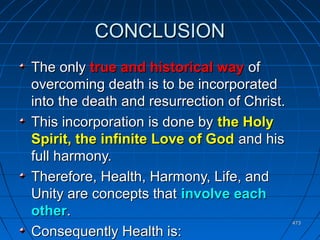
  • 593.
  • 594.
  • 595.
  • 596.
    596596 2. FUNDAMENTAL QUALITIESOF THE PHYSICIAN  Awareness of responsibility  Humility • “my patients” or “my doctor”?  Esteem of the patients • “recipere quasi Christum”  Respect for the sick • Accomplish a mission  Truthfulness • Truthfulness in the Diagnosis and Therapy • Communication with the Sick • Integrate his work with that of the priest
  • 597.
    597597 3. Portrait ofthe Physician The figure of the physician portrayed by Zarathushtra, who was a stranger to Christian culture is very interesting. The “Portrait of the perfect medical doctor” described by Enrique Jorge Enriquez, in 16th century Spain in the flowery language of the time, is still current. [58] Nowadays, we would talk about medical excellence. This would be what Aristotle called the “Τελειοσ ιατροσ” (perfect physician), or Galen called “Αριστοσ ιατροσ” (best physician). In any case, the authentic portrait of the physician, will always be that “reflected” by Christ the physician. [58] Cited by D. G. Guillen, “The Hippocratic Oath in the Development of Medicine” p. 26.
  • 598.
  • 599.
  • 600.
    600600 ZoroasterZoroaster :: Zend-AvestaZend-Avesta Thedoctor “ mustThe doctor “ must knowknow the variousthe various parts of the body, their articulation,parts of the body, their articulation, the remedies for the illness;the remedies for the illness; MustMust bebe amiable, not jealous, gentleamiable, not jealous, gentle in his expression, without pride;in his expression, without pride; Enemy of the illness andEnemy of the illness and friendfriend ofof the patientthe patient;; Modest, innocent, not evil or violent,Modest, innocent, not evil or violent, careful, noble in action, withcareful, noble in action, with goodgood reputationreputation ;; HisHis motivesmotives are not the profit but aare not the profit but a spiritual reward, ready to listen,spiritual reward, ready to listen, authentic, friend of men.”authentic, friend of men.”
  • 601.
    601601601 “The physician musthave the fear of theThe physician must have the fear of the Lord, he must be very humble and notLord, he must be very humble and not proud or vainglorious, and must beproud or vainglorious, and must be charitable towards the poor, gentle, kind,charitable towards the poor, gentle, kind, affable and not vengeful. He must beaffable and not vengeful. He must be prudent moderate and not too daring…,prudent moderate and not too daring…, should know how to control himself, andshould know how to control himself, and he should be honest and reserved; hehe should be honest and reserved; he should work on his skill and avoidshould work on his skill and avoid idleness. He must be well-read and mustidleness. He must be well-read and must have answers to everything”have answers to everything” Enrique Jorge Enrçquez ,, Spain, XVI CenturySpain, XVI Century601
  • 602.
  • 603.
    603603 4. Morality andLaw Initially we said that the medical profession is something that goes beyond the Law and is positioned in the framework of Morality, and this is true, but this does not mean that we can do without medical Law. Medical Law without adequate morality would be arbitrariness based on shameful interests. Morality without medical Law would just be general principles without direct application. The rules of medical Law must be sufficiently clear and brief to aid the physician’s action.  The leading principle is always the same: the physician’s goal is to assist and heal, and not to do harm nor kill.
  • 604.
    604604 It is worthmentioning in particular the field of Ethics, the field of Morality, in which the physician must be competent, but in which so often they are not specialists. Bioethics committees are therefore required in each health centre, and should also be created in the teaching centres, in open dialogue with the specialists in the different subjects concerned. With regard to Bioethics Committees, they are conceived as based on an objective ethics and not plunged into a relativism that would empty Ethics of its own normative nature and would convert it into to mere arbitrariness, to the service of collective or individual egoistic interests Physicians are thus trained to bear witness to God in all the medical, trade union and political environments, etc. They can even be valid bearers of ecumenical dialogue and dialogue with other religions, as sickness does not know religious barriers. The physician will thus actively belong to the Church as an individual person and as a group. [59] [59] Cf. S. Leone, in Orizzonte Medico, 6, Nov-Dec.1996, 10-11.
  • 605.
    605605 4. MORALITY AND LAW  Lawwithout Morality: arbitrariness;  Morality without Law: inefficient.  Leading principle of medical Law: • The physicians’s goal is to assist and heal, and not to do harm nor kill  Bioethics Committees  Witnesses of the Christian values.
  • 606.
  • 607.
    607607 5 Teamwork In orderto carry out such a demanding mission, physicians cannot stay enclosed in their own individuality, but rather should first open up to other physicians and be sufficiently humble to work in collaboration and as a team, both on strictly physiological matters, and especially on those relational matters connected to fields of which they do not necessarily have a command and which to a certain extent are outside their competence, namely sociological, anthropological and political aspects, and those from technical fields beyond their profession, namely everything that strictly concerns the field of computer science.
  • 608.
    608608 In a certainway, within this opening-up, in the Spanish field of medicine what two authors call the decalogue of the new physician is designed. They express it like this: 1. Multidisciplinary teamwork with a single person ultimately responsible. 2. The more scientific the professional is, the better. 3. The human aspects will be strengthened in professional practice. 4. Action will be adapted to agreed scientific diagnostic and therapeutic protocols. 5. They will be aware of the expense. In addition to the protocols, they will use guides to good practice.
  • 609.
    609609 6. They shallaid coexistence and solidarity with work colleagues and with the patients. 7. They shall think that all healthcare acts can involve a preventive action, and even a promotion of health. 8. They shall bear in mind at all times the need to care for the satisfaction of the service user. 9. The Patient Service Units will be strengthened, circulating the complaints and suggestions which arise among the people affected. Frequent opinion surveys will be held. 10. It will be essential to apply ethical principles to the professional activities. [60] [60] M. A. Asenjo – A. Trilla, “Necesidad de nuevos profesionales para las nuevas situaciones sanitarias”, in Todo Hospital, 149 (1988) 497-499.
  • 610.
    610610 5. TEAM WORK TheNew Doctor’s Decalogue: 1. Multidisciplinary team 2. Scientific and professional 3. Humanization 4. Consensus protocols 5. Cost Conscious 6. Coexistense- Solidarity 7. Prevention-promotion8. Patient satisfaction 9. Complaints-Suggestions 10. Application of Ethics
  • 611.
  • 612.
  • 613.
  • 614.
    614614 We conclude thischapter summarizing it in the following affirmations: Being a Catholic physician is a ministry which arises from a vocation in the Church. It is a therapeutic ministry. It is closely linked to God our Father, revealed in Christ the physician, full of the Love which is the Holy Spirit. Being a physician is a way to arrive at the fullness of the human being; to initiate the resurrection already. It involves proximity and a special intimacy with God, which at the same time means an opening-up and a complete gift to others. This is the Catholic identity of the physician, to be the reflection of Christ the healer.
  • 615.
    615615 Being a Catholicprofessor of medicine is to have far-reaching sight to be able to see the resurrection in death. It is not just this, though. It is the ability to sense a harmonious tension in health and illness, which leads to plenitude, in accordance with the different stages of the life of people. And it is to feel in medical science, technology and skills the omnipotent power of God who resurrects his Son Jesus Christ and who gives us a foretaste of the resurrection in medical progress. Being a Catholic professor of medicine is to teach the Love with which the Holy Spirit delivers Jesus Christ on the cross to the Father, and with his loving strength brings him back to life. Being a Catholic professor of medicine is to teach the physician to be the loving caress of God who looks after his children in sickness and in death, making their condition more bearable for them and opening them to a complete hope of health which will no longer be tension towards harmony, but rather the total harmony of love. Being a Catholic professor of medicine is to teach the physician to be the reflection of Christ the healer.
  • 616.
    616616 CONCLUSIONS  To bea Catholic Physician is a ministry arising from a vocation in the Church.  It is a way to arrive at the fullness of the human being.  It implies an intimacy with God and a trustful openness to man  The Catholic Physician is the reflection of the healing Christ.
  • 617.
    617617 The Catholic professorof medicine teaches To see the resurrection in MedicineTo see the resurrection in Medicine and in death.and in death. To see in illness and in health the tension towards harmony.harmony. To have a foretaste offoretaste of the force ofthe force of the resurrectionthe resurrection in the Medicinein the Medicine To meet the Holy Spiritmeet the Holy Spirit in the patient, as the power that gives life. To be the loving caress of Godloving caress of God to the sick person. To be the reflection of Christ thereflection of Christ the healer
  • 618.
    618618 The Professor ofTheProfessor of Medicine teachesMedicine teaches the physician to givethe physician to give life anticipatinglife anticipating THE RESURRECTIONTHE RESURRECTION
  • 619.
    619619619 The Catholic Professor of Medicine teaches thephysician to be the caress of God to the sick person
  • 620.
    620620620 A REFLECTION OFAREFLECTION OF CHRIST THE HEALERCHRIST THE HEALER THE PROFESSORTHE PROFESSOR OF MEDICINEOF MEDICINE TEACHES TO BE:TEACHES TO BE:
  • 621.
  • 622.
    622622 As a conclusionto all we have discussed we can say that Health Pastoral Care represents an ecclesial call to harmonize life with death. This apparent paradox and contradiction can only be resolved with the Holy Spirit when he unites us to the death of Christ. In this way Christ himself assumes our suffering and death into his own suffering, passion and death, incorporating us to Himself. Christ accomplishes this incorporation by making himself present through the sacraments, particularly in the Eucharist. The Holy Spirit does not limit this union to our incorporation to the death of Christ, but he extends it victoriously, uniting us to his resurrection. Thus the Spirit unites us to the triumphant Christ, who recreates the whole universe and brings the eternal Decree of the Father to fulfilment, which is the total harmony, full health, reconciling through the blood of his cross, that is through him, all that is on earth and all that is in heaven (cf. Col. 1, 20). . CONCLUSIONS
  • 623.
    623623 Therefore, Health PastoralCare is not only a project of “charity” for the benefit of the sick, but rather a deep penetration into the fundamental mission of the Church; a mission that Christ assigned to his apostles and disciples. To accomplish this mission, Health Pastoral Care has to be carried out with a deep faith, along with an effective charity and a hope that withstands any challenge. This is the only way to carry out God’s plan for Health Pastoral Care, which consists in realizing in the field of Health the image of the Holy Trinity through the Paschal incarnation of Christ, according to the parameters to which the apostle Paul alludes when he discusses building the mystical Body of Christ, and which he sums up marvellously in this phrase: “’alezeùontes dé èn ‘agape” (making the truth in love, Eph. 4,15). Consequently, the foundation of Health Pastoral Care is God who is Truth in Love.
  • 624.
    624624 Health Pastoral Care IS: “Makingthe Truth in Love” POWER TRUTH LOVE
  • 625.
  • 626.
  • 627.
  • 628.
    628628 The mission ofthe Church in the area of suffering is to do good to the one who suffers and do good through one’s own suffering; to liberate love from within man through the disinterested giving to the one who suffers and of the person that suffers. The spirituality of the Christian health care worker consists in letting oneself be configured by the Holy Spirit to Christ who suffers, as the sacrament of the mercy and affection of the Father, through the death and resurrection of the Lord partaken in the Eucharist. It is an Easter spirituality, which is full of hope and the fullness of life. It is a Marian spirituality: the Virgin Mary invoked as “Health of the Sick” is our model of service, who in her total openness to redemption, expresses the care and mercy of God toward every person in need of help in his/her suffering.
  • 629.
  • 630.
  • 631.
  • 632.
  • 633.
    633633 BIBLIOGRAPHY  Pius XII,“All’Unione Italiana Medico Biologica di ‘San Luca’,” in Pio XII Discorsi ai medici, Fiorenzo Angelini (ed.), Edizione Orizzonte Medico, Roma 1959, pp. 43-55  Pius XII, “Radio Messaggio al VII Congresso internazionale dei Medici cattolici (11-9-56)”, in Pio XII Discorsi ai medici, Fiorenzo Angelini (ed.), Edizione Orizzonte Medico, Roma 1959, pp. 503- 518.  John Paul II, Apostolic Letter Salvifici Doloris, 11 February 1984, in AAS 76 (1984) 201-250.  John Paul II, Apostolic Letter Motu proprio Dolentium Hominum,11February 1985, in AAS 77 (1985) 457-467.  John Paul II, Apostolic Letter Pastor Bonus, 28 June 1988, in AAS 80 (1988) 841- 930.  John Paul II, “Al XV Congresso dei Medici Cattolici,” in Cinquant’anni di vita per la vita AMCI 1944-1994, Edizione Orizzonte Medico, Roma 1994, pp. 108 - 114.  John Paul II, Message of the Holy Father for the World Day of the Sick for the Year 2000, in Dolentium Hominum 42 (1999) 4-10.  John Paul II, Apostolic Letter Novo Millennio Inenute, 6 January 2001, in AAS 93 (2001) 266-309.
  • 634.
    634634  Benedict XVI,Address to the Pontifical Council for Health Pastoral Care on the Occasion of its XX International Conference on the Human Genome, 19 November 2005.  Benedict XVI, Message for the World Day of the Sick 2006.  Benedict XVI, Message for the World Day of the Sick 2007.  Benedict XVI, Address to the Pontifical Council for Health pastoral Care on the Occasion of its VII Plenary Assembly, 22 March 2007.  Benedict XVI, Encyclical Letter Spe Salvi, 30 November 2007.  Benedict XVI, Message for the World Day of the Sick 2008.  Pontifical Council for Pastoral Assistance to Health Care Workers, Charter for Health Care Workers, Vatican Press, Vatican City 1995.  Pontifical Council for Health Pastoral Care, “Palliative Care,” in Dolentium Hominum 58 (2005).
  • 635.
    635635  Aristotle, Metafísica,X, 3;b. De Anima II,1-2.  Arinze F., “The Pedagogy of Pain in other Religions,” in Dolentium Hominum 31 (1996) 194-197.  Asenjo M.A.,Trilla A., “Necesidad de nuevos profesionales para las nuevas situaciones sanitarias,” in Todo hospital 149,(1988) 497-499.  Boetius M. S., De Consolatione Philosophiae, V.6.  Brera G. R., La formazione dei medici del terzo Millennio. La scuola medica come scuola di uomini e di umanità. Conferenza inaugurale dell’anno accademico 1998-1999. Università ambrosiana di Milano, inaugurazione della Scuola di Medicina.  Burdo C. (and others), “La vie et l’evolution,” in Archives de Philosophie 6 (1928).  Cappelletti V., “Where there is Love for the Art of Medicine, there is Love for Man”, in Dolentium Hominum 31(1996), 12-14.  Cappelletti V., “The Human Genome: Historical Analysis and Ethical Considerations,” in Pontificia Academia Pro Vita, Human Genome, Human Person and the Society of the Future, Libreria Editrice Vaticana, Città del Vaticano 1999, pp. 23-39.  Castellano S., “Pain : the Scientific Data”, in Dolentium Hominum 58 (2005) 24- 27. (Wide Bibliography).  Cina G., Locci E., Rocchetta C., Sandrin L. (eds.), Dizionario di Teologia Pastorale Sanitaria, Edizione Camillianae, Torino 1997.
  • 636.
    636636  Colombo R.,“The Human Genome Project: the Moral Limits of Research,” in Pontifical Academy for life, Medicine and law, for or against life?, Libreria Editrice Vaticana, Vatican City 1999, 69-125  Depoortere K., “Vita,” in Dizionario di Teologia Pastorale Sanitaria, Cina G. ed altri (eds.), Edizione Camillianae, Torino 1997, 1381-1387.  Dopp J., Lecons de Logique formelle 3 vols, Lovaina 1950.  Driesch H., Woltereck R., Das Lebens Problem in der Lichte der modernen Forschung 1931.  Evangelista M., “Palliative Care,” in Dolentium Hominum 58 (2005) 34- 42. (Wide Bibliography).  Fröbes J., Tractatus Logicae Formalis, Roma 1940.  Gracia G. D., “The Hippocratic Oath in the Development of Medicine, “ in Dolentium Hominum 31 (1996), 22-28.  Larroyo F., Ciencias de la Educación, Mèxico 1960.  Leone S., in Orizzonte medico (6) Nov-dec.1996, 10-11.  Links, Biogenética, México 2000.
  • 637.
    637637  Lozano J.,Hacia el Tercer Milenio, Teología y Cultura, CEM, Mexico 1988, pp.47-107.  Lozano J., Teología Estado y Sociedad, Zacatecas 1996.  Lozano J., Teología y Medicina, Edizioni Dehoniane Bologna, Bologna 2000.  Lozano J., Metabioethics and Biomedicine, Editrice Velar, Bergamo 2006.  Manua G., Metafisica del dono, Cherico 2006.  Martini P., Arzt und Seelsorge, in LTK (1) 912-915.  Morande P. El indiferentismo religioso en América Latina. Desafíos pastorales, in Ateísmo y Fe XXVII-1, 12-18.  Sgreccia E., Manual de Bioética, México 1996.  S. Tomaso di Aquino, Summa contra Gentiles, 4,11; Summa Theologica I q.18 aa.1-2.  Strachan T., Genetica umana molecolare, Torino 2007.  Zucchi, P. L., “Pain Therapy,” in Dolentium Hominum 58 (2005) 28-34 (Wide Bibliography)