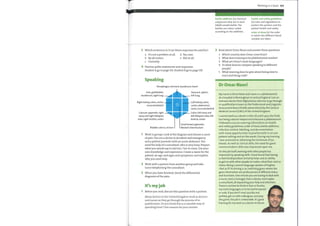
OXFORD ENGLISH FORCAREERS
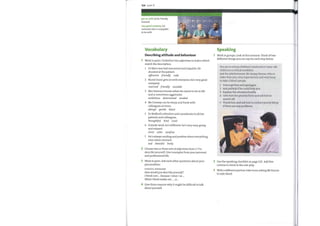
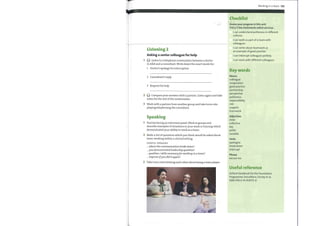
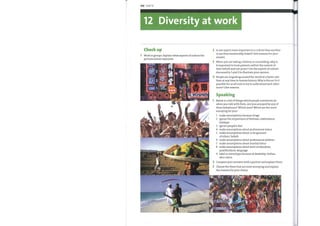
Sam McCarter
Student's Book
OXFORD
UNIVERSITY PRESS
Mag. Gnålu
inglés I Llng01stlco
2.
4 Unit 1
1Presenting complaints
Check up
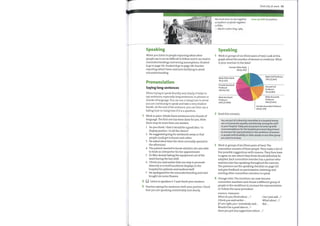
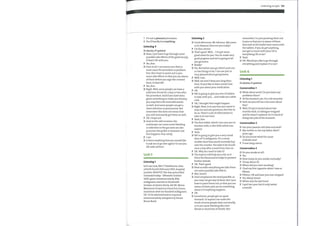
Work in pairs. Match each photograph with what the
person is saying.
ff
2
3
2
3
Howimportant are accurate patient records?
Give reasons.
In your country, are patient records kept on computer
or on paper? Which ofthese two systems do youthink
is better? Why?
Listening 1
Personal details
G) Look at the chart containing personal details ofMr
Karlson. Then listen and correct any details 1—8 that
maybe wrong. Tick (V) items that are correct.
Surname:
First name(s)
Address 3 Manalo-vw,
Karlson
Sex M
CcvsttefielWManchester M6 7DE
Admission details DwvwowvvWcwWøt4 p. no.
Ö-vv 9 Novevnber 2008
Hospital No 19736045
DOB 2710 53
Telephone number 0166 405 7001
Marital Status Süvtøle,'
Occupation Postma,vv
C/o pcu'vvüvvr' cwnv
G) Listen again and check your answers.
1
2
3
4
5
6
7
8
1
I just need to find
Mr Jensen's notes.
3
Good morning,
Mrs Dean.
My name's Dr Bray.
2
My hospital number?
It's 3438235 and my
GP's name is Dr Lane.
4
Sorry, I don't know my
GP's phone number.
Can I leave that blank?
Work in pairs. Decide what questions the doctor asks
for each piece of information on the form.
Language spot
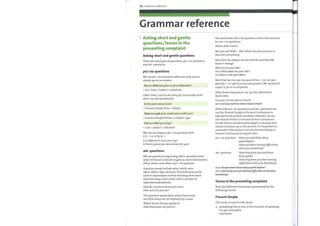
Asking short and gentle questions
Ask gentle questions to put the patient at ease. Use
Can you tell me what / who + noun + verb?
What's your surname /family name?
Can you tell me whatyour surname /family name is?
Remove words to make questions shorter.
What's yourfirst name? Yourfirst name?
Haveyou any other names? (And) Any other names?
Go to Grammar reference p.122
3.
Presenting complaints 5
Makegentle questions or short questions for the
questions you made in Listening 1, 3.
2 When taking the history of the presenting complaint
(HPC), you often ask about pain. Use these words to
complete the questions.
makes it worse / better?
on?
spread anywhere else?
hadthe pain?
the pain for me?
constant?
did it start?
you up at night?
the pain is like?
get the pain?
had the pain before?
a
b
c
d
e
f
g
h
i
j
k
Where do you
Does the pain
Does it wake
Can you tell me what
Can you describe
How long have you
Is there anything which
When
Is there anything which brings it
Is the pain
Have you
3 Work in pairs. Matchthese words to a question in 2
1
2
3
4
5
6
7
8
9
10
duration
onset
severity
trigger
radiation
and character
In this unit
asking about personal details
asking questions about the presenting complaint
O describing and asking about pain
O writing up a case report
Listening 2
Presenting complaints
1 Work in pairs. What do you think each patient in
pictures a—h might be complaining of?
(O Listen. Match each picture in 1 with a conversation.
exacerbation / alleviation
2
site
previous episode
constancy
3
1
2
3
4
5
6
7
8
4 Work in pairs. Each choose a pain and ask each other
questions to identify the pain.
4
(O Listen again. What three questions are used by the
doctor to ask about the presenting complaint (PC) ?
1 What's
2 Can you tell me what
3 What can
What other questions can you use to ask about the PC?
4.
6 Unit 1
Listento five people stating where they are having
5
a problem. Which part ofthe body are they referring to?
6 With a partner, think of non-technical terms for body
parts a—k.
a clavicle
c sternum
e umbilicus
g carpus
h patella
i tibia
j calcaneus
Pronunciation
Medical terms: word stress
3
4
5
Cover the stress patterns in 1. Take turns saying
a word to your partner, who will then identify
a stress pattern 1—4.
Try not to look at 1 and 2. Work in pairs. Take turns reading
the sentences below by adding the correct words that
match the stress pattern.
b
d
f
k
oesophagus
abdomen
intestines
talus
a
b
c
d
e
f
g
Mrs Evans can't walk properly.
She's got a pain in her e Oo e.
He's very tender here on the right side of the
o e near his kidneys.
Ahmed's o e o feels as if it's on fire when he swallows.
He damaged his o Oo when he fell on the pavement.
00,
James has got a crushing pain around the
but nothing in his arms or legs.
O o in the right hand.
I think there is a fracture in the
The pain radiates from around the o Oo e to the back.
Work in small groups. Take turns describing a patient you
have treated with a problem related to the parts ofthe body
a—k and then answer questions from the group members.
What.
... investigations did
you carry out?
Vocabulary
Describing pain
. was the treatment?
was the prognosis?
1 Work in pairs. Write words from a—k above that match
each ofthese stress patterns.
1
000
2
000
3
4
Listen and check your answers.
2
Work in pairs. Which descriptions 1—10 do you associate
with the conditions a—j? In some cases, there maybe more
than one answer.
I
2
3
4
5
6
7
8
9
10
piercing / boring
extremely severe / intense
aching
scalding / burning
like a tight band
around myhead
dull / persistent / vague
excruciating / thunderclap
shooting
spasmodic
crushing / gripping
a
b
c
d
e
f
g
h
i
j
sciatica
ureteric colic
acute pancreatitis
appendicitis
degenerative arthritis
cluster headache
cystitis
tension headache
sub-arachnoid
haemorrhage
angina pectoris
5.
44
2 Work inpairs. Decide howyouwould differentiate
between the pain in b—e in 1. Give reasons
for your answer.
3 For each description, write M(mild), S (severe), or
V (very severe). Then say which condition a—j in 1
each patient below is possibly describing.
1
2
3
4
5
I get this vague headache sometimes
during the week.
The headache is excruciating.
I can't bear to look at the light.
The pain in my stomach is so bad it
makes me double up.
I get this sharp pain when you press my
side here on the right and then let go.
All myjoints hurt. I am wracked with pain.
4 You can ask a patient to describe pain on a scale of 1 to
10. What other ways can you ask a patient to assess the
severity of pain?
It's myjob
Before you read the text about Dr Henderson, a
cardiologist, discuss with a partner what you think
being a cardiologist involves.
2 All ofthe statements below are true. Find information
in the text to support each statement.
1
2
3
4
5
6
Dr Henderson's team is very skilled.
The work ofher team depends on the support
of other people.
Details about the closest relative are taken from
patients.
Patients have two numbers (other than their phone
number) ontheir hospital records.
The data collected need to be accurate.
Checks are carried out to make sure patients are who
they say they are.
Presenting complaints 7
Use SOCRATES in the history of the presenting complaint to help
you remember the main questions you need to ask about pain:
site; onset; character; radiation; associations; timing; exacerbating
and alleviating factors; severity
differentiate (v) distinguish; tell the difference between
Dr Gillian Henderson
My name is Dr Henderson. I'm a cardiologist at a
London hospital. The highly trained team of which I
am part deals with the diagnosis, investigation, and
treatment of patients with all forms of heart disease,
including cardiac transplantation and some sorts of
vascular disease.
None of our work would be possible without the
support of other people in the hospital team —the
triage nurses, the receptionists, and so on. Their work is
vital to the smooth running ofthe department. When
patients arrive for the first time, personal information
is taken: name, address, telephone numbers, next
of kin for contact in case of emergency, and other
information such as their GP's name and address, their
NHS number, and their unique hospital number.
We deal with a large catchment area and also deal
with referrals from outside the area, tourists, visitors
to A&E, private patients, and so on, so the potential for
confusion is great unless the data that are taken are
accurate and the systems secure.
At various stages of patients' contact with the hospital,
information is checked to make sure it is correct and
that the patients can confirm their identity. For
example, on arrival at a clinic patients might be asked
their GP's name or part oftheir telephone number, for
example the last three numbers.
Then during the consultation
a nurse or a doctor might also
ask their date of birth. All this
is for the benefit of the patient
to ensure the hospital team
does not make mistakes and
people do not use patients'
details fraudulently.
We can then turn to
dealing with the
patients' treatment
in safety.
6.
8 Unit 1
A&E (n) Accident and
Emergency
rapport (n) relationship
inspiratory
000 e crepitations
Listening 3
A presenting complaint
Work in pairs or groups. Decide what the abbreviations
below stand for.
Pube 100/nu;z
BP: 100/70 wuz/Hg
JVP Nddevated
CVSNAD
OVE
Widespread early ivospiratm•yfvte crepitatimtß
abdemez — TtorpzaZ
e Language spot
Tenses in the presenting complaint
Understanding the time patients are referring to
when they speak is crucial to making a correct
diagnosis. You should be very comfortable
understanding the difference between the Present
Simple, Present Continuous, Present Perfect, and
Present Perfect Continuous.
Go to Grammar reference p.122
1 Decide whether each sentence a—i relates to the time
shown in diagrams 1, 2, 3, or 4 below.
2
1
2
3
4
CNS- NAD
Listen to part of a conversation between Dr Martin,
a doctor in A&E, and MrWood. As you listen, make your
own notes about MrWood's presenting complaint.
Speaking
Discuss the signs above.
Discuss the correct diagnosis for the shoulder pain.
Decide what the diagnosis was on arrival at the hospital.
Outline your immediate treatment.
PC = Presenting complaint
Time
1 Present Simple
Time
2 Present Continuous
Time
3 Present Perfect
PC
Now
PC
Now
PC
Now
PC
Time
PRESENT PERFECT
PRESENT CONTINUOUS
Now
4 Present Perfect Continuous
7.
2 Work inpairs. Complete the sentences below with
the correct form ofthe verb. If more than one tense is
possible, explain the difference.
a
b
c
d
e
f
h
i
61
1
I've got a headache.
I've been having this shooting pain in my
leg.
I keep getting these flashing lights around
my eyes and a sharp pain.
I have been having these terrible backaches.
The pain goes right through you.
Have you been having any pain?
I'm getting these headaches off and on now.
I'm not taking anything for them.
The attacks have increased.
1
2
3
4
5
7
(have) these pains since last
Mymother
Tuesday. She still has them.
(you normally go) for a run at the same time
every day?
(ease) a little since yesterday.
The pain
It's better now.
1 (lie) in bed for four weeks now. I haven't
been out of it once, doctor.
I can see the rash
redder.
(get worse). It's much
(not take) any medication at the moment.
(pain spread) to your shoulder or is it just
here?
Presenting complaints 9
Speaking
1 Work in pairs. Decide what possible conditions the
notes below relate to.
?abtjowtabove belly
through to back; wtakes we double up;
rumrcye after afal-ty wteaZ; drink
a lof(alcdcd); sharp ?am,•
had it several times befre;
there authe time;
caute mt after dimer
lut
s harp paLvvi,wt-heright"de,•
vncvkvy nwdovcbleyup;
never hacV ifbefore;
feelüvsick;, sae;very
tender to-touch;
o-vtby relieve
it bendinglcneety
to-chest
2 Work in pairs. Decide what questions the doctor
asked in each case. Take turns asking and answering
questions.
3 Student A, go to page 114. Student B, take a history from
Student A. Write notes as you listen and decide what
the patient's complaint is.
4 Student B, go to page 116. Student A, take a history from
Student B. Write notes as you listen and decide what
the patient's complaint is.
8.
10 Unit 1
Cultureproject
Being aware ofyour own body language and
the body language ofyour patients will help
you in taking a history.
1 Find a picture a—c to match each description of body
language 1—7.
a The doctor is not sure about what
1
he is saying.
2 The patient is not comfortable or at ease.
2
3
In groups, discuss what the body language in 1 would
mean in your own culture.
Use the internet to find:
3
4
5
6
7
The patient is angry.
The doctor is bored and unsympathetic.
The doctor is showing interest and inviting
the patient to continue speaking.
The patient doesn't understand what
the doctor is saying.
The doctor and patient aren't
communicating.
1
2
3
other fields besides medicine where understanding
non-verbal communication is important.
what a patient-centred approach in history taking
means.
what the Calgary Cambridge method is.
9.
clerk (a patient)(v) take a history from a
patient and write it up
Writing
A case report
Complete the extract from the case report written by Dr Martin
after the consultation with Mr Wood on page 8. Insert the verbs
in the correct form into the appropriate blank space.
present have be smoke
be work radiate
A 49-year-old man 1 in E with
chest pain. He had had the pain for 3 hours
prior to arrival. The pain
centre of his chest and
2 in the
3 to his left
shoulder.
He
exercise,
previous
a day and
4 a history of chest pain on
which has been present for the
six months.
5 approximately 20 cigarettes
6 teetotal. He has been
prescribed aspirin, B-blockers for the previous
two years, and a GTN spray to use as required,
which is two to three times per week. His
father died of a myocardial infarction aged 65.
7 as a gallery attendant.
2 Complete the clerking fromthese notes.
O/e sweaty aburkna[cf-ces Wb CPS. BP PP.
1 mtn r€pdar. Hegwe anaVesca streptckcnase (V beta
blcckers—cmfuute. Pawvsetfle avu after Ays
Presenting complaints 11
Checklist
Assess your progress in this unit.
Tick (V) the statements which are true.
I can ask a patient about personal details.
I can ask about the presenting complaint.
I can ask a patient about pain.
I can understand time relationships
in the PC and HPC.
Key words
Nouns
body language
culture
non-verbal communication
Adjectives for pain
aching
boring
burning
crushing
dull
excruciating
gripping
intense
persistent
piercing
scalding
severe
shooting
spasmodic
thunderclap
vague
Useful reference
Oxford Handbook of Clinical Medicine
7th edition, Longmore et al,
ISBN 978-0-19-856837-7
10.
12 Unit 2
2Working in general practice
Check up
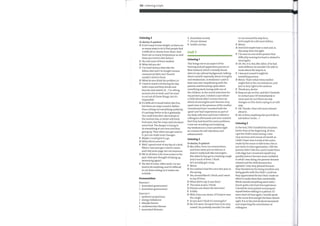
Work in pairs. Can you predict
what each person's job involves?
What do you think are their main
responsibilities within the team?
e,rhni/iliii
11.
2 What doyouthink is the most stressful aspect of
medical work? What is the most rewarding?
Vocabulary
Medical jobs
Match these jobs to the pictures on page 12.
Working in general practice 13
In this unit
Past Simple and Present Perfect
asking questions in the family history
e using non-technical language
asking questions in the general history
writing a referral letter
o
Pronunciation 1
Main stress
Listen and mark the main stress in the words
and phrases.
1
2
3
4
5
6
7
00000
0000
eeooee
1
2
3
4
5
6
7
practice manager
receptionist
general practitioner
midwife
district nurse
health visitor
practice nurse
2 Add the job titles ofthe people in 1 on page 12 to the
sentences below. You can use singular or plural nouns.
1 A practice is run by a
2
3
work with individuals, families, and
groups like the elderly and new-born babies in the
community.
need very good interpersonal skills because
they are the first contact people have with the
practice.
4 Ninety-seven per cent of the UK population is
2
3
1
2
All ofthe people in the pictures in Check up work as
part of GP practice team. In groups, discuss how each
person supports the GP in his / her work. Which person
in your opinion is the most important besides the GP?
Discuss who does the work ofthe people above in your
country.
Listening 1
A GP's job
Listen to a GP talking about her work in an inner
city area. Decide whether these statements about her
work are true (T) or false (F).
registered with a
5 The duties of a include 'traditional'
nursing skills and running specialist clinics for
immunization, diabetes, and so on.
6 An important link between hospitals, GPs, and other
health professionals involved in antenatal care is
the
1
2
3
4
5
7 visit those who are housebound or those
The GP works in the centre of London.
High crime rates do not affect the people working at
the GP practice.
The workload is lighter than in rural areas.
Patients move from one GP practice to
another.
GPs receive no extra payment for working in
deprived areas.
recently discharged from hospital and / or dress
wounds.
3 A GP's place ofwork is called a surgery. Surgery also
refers to the time GPs see patients. Do doctors work
outside hospitals in your country? If so, where?
Work in pairs. Compare and contrast working in city
urban and rural areas in your home country.
12.
14 Unit 2
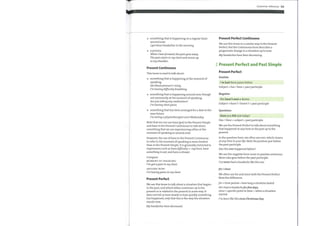
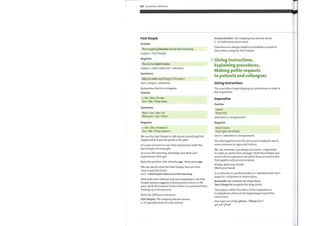
eLanguage spot
Present Perfect and Past Simple
We use the Present Perfect for actions which happen
in the past at any time up to now. The exact time is
not known or not defined.
Now
We use the Past Simple for specific times in the past.
The exact time is known or defined, but sometimes
Use these words to make sentences.
1
2
3
4
5
6
7
8
9
coughing start five days ago be so bad it wake
me up every night.
when attacks first come on?
anything make it worse since start?
he never take any medication in his life.
what happen when you be near animals as a child?
myfather die over 20 years ago.
you get these problems every day when you
live in Africa?
ever have coughing attacks like this before ?
your family ever have illness like this as far
as you aware ?
2
3
4
2
Work in pairs. Ask each other questions using
the time is not mentioned.
Last year / Two days ago /
Yesterday, etc.
these phrases.
travel abroad be a patient
Now
be in hospital as a patient read a novel in English
use the internet to study ride a motorcycle
BEGIN:
Haveyou /Has anyone in yourfamily ever ...?
When / Where didyou ...?
Didyou /Howoften didyou ....?
Didyou
Work in pairs. Decide the questions you would ask
patients about themselves or their family in the past to
When you take a history, pay attention to the
patient's use of the Past Simple and the Present
Perfect. Look at this statement from Listening 1:
In recentyears many developments, both
technological and social, have occurred.
The time of the occurrence of each event is not
specific. Look at diagram A above.
I started work as a GP in this area over 20years ago.
The tense is the Past Simple. The time is specific.
Look at diagram B above.
Now look at the relationship in a case history
between the Present Perfect and Past Simple.
DOCTOR: Haveyou ever hada headache like this
before? (Present Perfect)
PATIENT: Yes.lhada similar headache three months
ago. (Past Simple)
Go to Grammar reference p.123
find out about:
o pain.
o cough.
o food poisoning.
similar illness.
o headache.
Role-play a patient and a doctor. Ask each other
questions about the symptoms in 3
Speaking
Work in pairs. Look at the extract from a talk about
general practice in the NHS. Student A, go to page 114.
Student B, go to page 116. Ask each other questions to
complete the missing information in your text.
Work with a partner and discuss these topics.
1 The recent history ofthe heath care system in your
home country
2 The most important feature ofthe health care
systems where you come from
13.
(n) an employeeof the
civil servant
government
like a teacher or doctor.
contributory (adj) helping to cause
locum GP (n) a GP who stands in for
another doctor who is temporarily away
on holiday or off sick
Working in general practice 15
precipitants (adj) factors which cause
something
productive (adj) producing a substance
(like sputum)
siblings (n) brothers and sisters
Listening 2
A case history
1 Before you listen to the conversation between Mr
Bloomfield, a 28 y/o civil servant, and a locum GP,
Dr Dickson, look at the notes below. With a partner,
discuss whythe past medical history, family history,
personal and social history, and drugs and allergy
history are important.
2 Listen and complete the notes below.
PC
C/o breathlessness, 3/52
1
with 'JUfu:te
HPC
Attacks worse:
2
4
productive
5
3
6
7 tiwces/week
Cough coakes about
Other S!WtPtOUOS.• chest
cawes:
8
hÆcry sugests
No hÆÜ-ry of
FawuZy HÆory
Mafher/sißer.•
10
attacks
11
12
3 Work in small groups. Discuss these questions.
1 What is the differential diagnosis?
2 What investigations would you do?
3 What treatment do you think should be given?
4 The doctor does not take a detailed family history or
social and personal history because most ofthis is
recorded onthe patient's notes. If a doctor is seeing
a patient for the first time, what questions should
he / she ask in the family history about:
1
2
3
2
3
Vocabulary
Signs and symptoms
Decide whether these are signs or symptoms. Some maybe
both.
Condition a
1 blocked nose
2 raised temperature
3 tender over sinuses
4 headache worse on bending
5 runny nose
Condition b
1 breathlessness
2 tachypnoea
3 tight chest
4 night and morning coughing
5 prolonged expiration
6 wheeze
Condition c
1 raised pulse
2 recent vomiting / diarrhoea
3 dehydration
4 abdominal tenderness
5 crampy abdominal pain
Work in pairs. Discuss which conditions the signs and
symptoms in 1 might relate to.
On your own, make a list ofthe signs and symptoms you
would expect to see in a patient with a) diverticular disease
and b) pneumonia. Compare your answers for both patients
with a partner.
Speaking
Work in pairs. Take turns role-playing the conversation
between Dr Dickson and Mr Bloomfield. Use the notes from
the exercise to guide you.
Discuss what questions you would ask about conditions a, b,
and c above.
What investigations could you do, if any, to confirm the
diagnosis in each case?
1
2
3
4
5
siblings?
children?
close relatives ?
parents?
family illness?
14.
16 Unit 2
drinksocially (v) consume
alcohol with friends — not on
a regular basis
waterworks (n) the urinary
system
Vocabulary
Non-technical language
When you speak to patients, you need to use non-
technical language that the patient understands. Look
at the two example questions from the case history.
Which verb meansprecipitate and which means start?
1 When do the attacks come on?
2 Are you aware of anything that triggers the attacks?
Work in pairs. Replace the technical words in italics
2
with non-technical words from the list. You may have
to change the form ofthe word.
Listening 3
Short questions in the general history
Listen to the last part ofthe conversation between
Dr Dickson and Mr Bloomfield, when he asked some
questions about the general history. Write down the
questions he asked about:
1 appetite.
2 bowels.
3 waterworks.
4 sleeping.
avoid admit
do
prone
stick to book
have / have got
to come and go
there all the time
1
2
3
4
Patient care
Expand the short questions.
EXAMPLE
You been offwork at all? —Haveyou been offwork at all?
1
2
3
4
5
6
7
8
9
We're going to have to perform a few tests.
She's sufferingfrom a very bad bout offlu.
It might be a good idea to refrainfrom fatty foods for
a while.
He is susceptible to many minor illnesses.
You said the cough is intermittent.
Your cough is persistent?
It's difficult to adhere to any kind of life change.
You won't have to be hospitalized.
You're scheduled to see the nurse in the allergy clinic
next Tuesday.
1
2
3
4
5
6
7
8
9
10
11
You eating well?
Your appetite 0K?
You sleeping 0K?
You passing water a lot?
Your periods 0K?
Had any diarrhoea?
Lost any weight?
Been living there long?
Youbeen keeping well?
You 0Kin yourself?
You been looking after yourself?
3 Work in pairs. Use the phrases belowto make questions
with the non-technical words. Take turns role-playing
a patient with flu or a cough, and take a short history
from each other.
Do you / Does it ...?
When ....? Is there... ?
Did you ...? Have you ever ...? / Are you / Is it ... ?
EXAMPLE
Areyouprone to coughs?Areyou booked to see ...?
Doyoufind it difficult to stick to medication?
Doesyour cough come andgo? Haveyou ever had ... P
Work in pairs. Say a full question to your partner. He /
She should shorten it without looking at the book.
Now do it the other way round and give the short
question first.
Take turns asking each other questions from the
general history using any ofthe questions above.
15.
Pronunciation 2
Questions: risingand falling intonation
Spoken questions usually either rise or fall at the
end. Short questions used in taking general history
usually rise. This is because they are meant to be a
quick checklist. The doctor is asking for a quick yes
or no. If falling intonation were used, it could make
the patient feel that the doctor is expecting a certain
answer.
G) Listen to the extract from the conversation in
Listening 3.
Whenthe doctor asks the questions, does his voice go
up or down at the end ofthe questions?
DOCTOR: Is your appetite 0K?
PATIENT: Yes, I never seemto have any problems
onthat score.
DOCTOR: Bowels 0K?
Working in general practice 17
Listen to ten questions and decide whether the
speaker's voice rises or falls at the end ofthe question.
Write R for rise and F for fall.
10
Work in pairs. Take turns reading the questions in the
listening script on page 134. Does your partner's voice
go up or down?
Reading
Work in pairs. Look at the pictures and decide which
social problems they show.
16.
18 Unit 2
deprivation(n) poverty
factors (n) causes
incidence (n) occurrence
plateau (n) level
pronounced (adj) evident
social classes I and II (n) in the
classification of the population
for research purposes, the two
highest social classes
Social factors in general practice
Social deprivation is associated with
death from all causes. The most
pronounced effect is with circulatory
and other smoking-related diseases.
A similar trend is seen with infant
mortality, morbidity from chronic
illness (particularly musculoskeletal,
cardiovascular, and respiratory
conditions), and teenage pregnancy.
This is not a new problem, nor one
unique to the UK. It may partly be due
to smoking and eating habits, but this
disparity was in evidence 80y ago when
those of social classes I and II were
more likely to smoke, eat foods high in
saturated fats, and take less exercise.
Disparity in health is closely related to
income. In the UK, an proportion of
the population is now living on 50%
ofaverage income than 20y ago — the
mortality gap has grown proportionately.
This has an impact on general practice.
There is higher incidence ofillness
requirement for primary care team
services and the use ofout-of-hours
and A&E services amongst deprived
communities.
Other factors which have an effect
are homelessness, sleeping rough,
employment and unemployment,
divorce, and immigration status. The
adverse effects ofliving in temporary
accommodation are well documented.
For example, adults have a incidence
of depression than people ofsimilar
social standing in their own homes.
Children are less likely to receive their
immunizations, more likely to have
childhood accidents, and have higher
incidence ofminor and diarrhoeal
diseases. Among those sleeping rough,
poor diet, poor accommodation, and
lack ofaccess to medical services are
universal problems. A study done
in 1986 in London found one third
are psychotic, a quarter have severe
physical problems, and two-thirds have
no contact whatsoever with medical
services. Evidence shows that if services
are provided, homeless people will use
them.
The effects ofwork have been
compared to effects ofvitamins - we
need a certain amount to be healthy; then
there is a plateau, where extra doesn't
work, and too much is harmful.
2 Match the symbols or abbreviations in the text
to these words.
1 years 3 less than
2 increased/ increasing 4 leading to / resulting in
3 Work in pairs. Answer these questions.
1 What main social factors are given?
2 Can you give your own reasons whythose
in social classes I and II were more likely to smoke
80 years ago?
3 What reasons could you give for the increased
incidence of depression in those living in temporary
accommodation?
4 Why is poor diet a problem among those
sleeping rough?
4 In small groups, discuss whythe following maybe
higher among the unemployed or those under the
threat ofbeing unemployed in the UK: coronary
vascular disease, cancers, violence, accidents.
5 Discuss what the situation is like in your own country
in deprived areas.
1
Writing
A referral letter
Work in pairs. Look at the referral letter on page 19 written
by a GP to a specialist at a hospital for one ofher patients.
Tick the features of / points covered bythe letter.
2
3
4
5
6
7
8
9
12
13
[3
[3
C]
clear communication
date of referral
date of birth ofthe patient
hospital number
NHS number
patient's name and address
investigations performed with results
treatments tried with outcomes
relevant past medical history and family history
reason for referral
presenting condition
social circumstances
clear signature
17.
OTC (adj) overthe counter
= available in a shop
Piriton (proper n) an
over-the-counter medication
to treat allergies
volunteer (n) a person who
works without payment
NHS Number 6684335792
Hospital Number 1017786F
22 August 2007
Dear Dr Ahmed,
Re David Hunt 17 May 1985(M)
18 Greencross Street, London SE5 2PD
This patient has complained of a rash which has erupted on a
number of occasions in different parts of his body on and off
for more than three years. Recently, he has also complained of
bilateral intermittent nasal blockage, itchy nose and eyes, watery
nasal discharge. The rashes have also increased in frequency
and duration, treated on occasion with antibiotics and OTC
medication. This does not appear to be related to allergy to pets,
nor work or other common factors. The rash has responded to
Piriton. The patient has had allergy sensitivity testing with no
conclusive result. The patient spent several years in West Africa
working as a volunteer in his early 20s. The Africa connection may
have some bearing and I would appreciate your opinion.
Yours sincerely,
2 Student Alook at the letter above. Student B look at the letter on
page 117 only. Ask each other questions to find nine differences in
the letter.
3 Underline all the main verbs in the letter. What tense
is each verb?
4 Work in pairs. Discuss what you would include in a referral letter
to the gastroenterologist at the hospital, Dr Mason, about a
patient you suspect ofhaving diverticular disease.
5 Use the checklist at the bottom ofpage 18 to write the letter.
Project
1 Find these on the internet. Look for information about UK GPs'
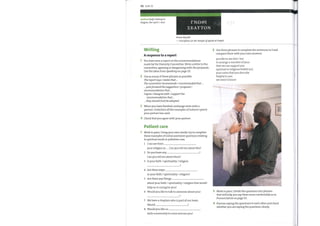
training, work, and codes of conduct.
1 the British Medical Association (BMA):
www.bma.org.uk
2 the General Medical Council (GMC): www.gmc-uk.org
3 the Royal College of General Practitioners: www.rcgp.org.uk
4 Oxford University Press: www.oup.com/uk/medicine/
handbooks
2 Discuss the work of a GP in the UK compared with similar doctors
in your own country.
Working in general practice 19
Checklist
Assess your progress in this unit.
Tick (V) the statements which are true.
I can use the Past Simple and
Present Perfect.
I can ask questions in the family history.
I can ask questions in the general history
I can understand and use non-technical
language.
I can write a referral letter.
Key words
Jobs
district nurse
general practitioner
health visitor
midwife
practice manager
practice nurse
receptionist
Nouns
practice
referral letter
sign
symptom
Adjectives
prone
runny (nose)
tender
Non-technical verbs
admit
avoid
book
come and go
stick to
Useful reference
Oxford Handbook of General Practice
2nd edition, Simon et al,
ISBN 978-0-19-856581-9
18.
20 Unit3
3 Instructionsand procedures
Check up
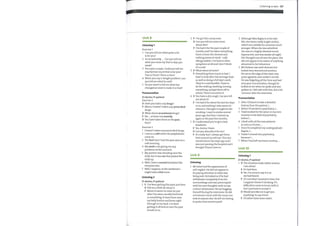
Work in pairs. Decide what pictures a—fhave in
common.
2 For each picture, discuss what is happening and what
you think happens before and after.
3 Work in small groups. Talk about your own experiencc
on the ward for the first time. What was the best or
worst experience you ever had on the ward round as a
junior doctor?
7
2
3
4
Decide whyyou think each tip has been given.
Listen and complete the reasons given for each tip.
Use no more than five words for each gap.
Listening 1
Preparing for the first ward round
Work in groups. Discuss these tips for a first ward
round with a consultant.
a
b
c
d
e
as you want to demonstrate that you are
... to avoid wasting time ... running around
... so that you can
. because they may be more knowledgeable about
. in that wayyou can
a
b
c
d
e
Make sure you know the names of your patients and
where they are.
Find out from the bed managers if any patients have
been moved and to where.
Check that all the case notes, investigations, and so
on are onthe ward.
Invite a nurse who knows your patients to come on
the ward rounds.
Record case histories and results clearly and
concisely.
Discuss whether you would give the same tips to a
junior colleague in this situation. What additional
advice would you give? Think about the consultant's
usual questions, drug charts, and the patient's home
care situation.
19.
Patient care
1 Workin pairs. Discuss whyyou need to do these things
before you carry out a procedure.
1 Obtain consent from the patient for the procedure.
2 Introduce yourself.
3 Prepare the trolley.
2 Discuss what else you need to do.
Vocabulary
Instructions for a procedure
1 Use the words to complete the instructions
for a procedure.
prepare
wash
obtain
a
b
mark attach
sterilize drain
withdraw
the stylet.
10 drops of CSF into the three
Instructions and procedures 21
In this unit
O following procedures in training
giving and receiving instructions
e
making polite requests to patients and colleagues
understanding abbreviations
understanding case notes
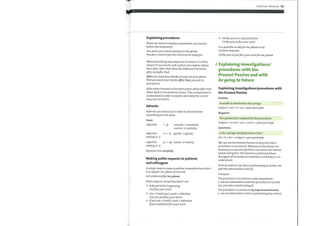
Language spot
Giving instructions
The imperative form of the verb can be used for giving
very clear and direct instructions. It is very direct, and
in certain contexts (for example a doctor speaking to
a patient), it can sound abrupt or even rude.
Infinitive without to
Complete the drug charts.
Negative
Don't /Do notforget to complete the drug charts.
Adverbs
Always complete the drug charts.
Explaining procedures
The Present Simple and You are used for describing
steps in a procedure.
You washyour hands. Then youput on gloves.
Adverbs
You clean the area thoroughly.
Negative
You don 't need to put the instruments awayyet.
Go to Grammar reference p.124
c
h
specimen tubes.
the point between L3/4 where the
needle is to be inserted.
your hands and put on sterile gloves.
consent for the procedure.
the area ofthe patient's back.
the equipment onthe trolley.
the manometer.
2
3
Write out in the correct order a complete list of
instructions for a lumbar puncture.
Use the diagram and take turns explaining the lumbar
puncture procedure to each other.
First, youprepare the equipment on the trolley.
After that
Work in small groups. Choose one ofthe two diagrams
below and prepare instructions for the procedure.
2 Work in pairs. Decide what procedure the instructions
relate to and discuss any steps that have been left out. IM injection Arterial blood sample
20.
22 Unit 3
disposeof (v) throw away
fingertip (n) end of a finger
(adj) joined together
interlaced
thoroughly (adv) completely
Speaking
1 Use the words and the diagrams below. Write
instructions (using the imperative) on howto wash
your hands. Then compare your instructions with a
partner.
dry
forearms
fingers
handle
locked
take
soap (up)
wet
interlaced
thoroughly
thumbs
rotationally
paper towel dispose of
rub
massage
fingertips
hands
dispenser
9
rinse
bin
palms
touch
O
O
o
o
2
3
1
2
Work in pairs. Look only at the diagrams and take turns
explaining to your partner howto wash your hands
thoroughly.
Work in small groups. Discuss this text.
Controlled studies in hospitals have followed health care
workers with video cameras through their daily routines.
Manyhealth care professionals actually do not wash their
hands and, surprisingly, doctors were the worst offenders.
Up to 50% of doctors do not wash their hands in between
patients.
Is hand washing always necessary? When and why do you
think it is necessary?
Reading
Work in pairs. The text on page 23 describes the practical
DOPS (Direct Observation of Procedural Skills) procedures
on which trainee doctors in the Foundation programme in
the UK are assessed. Underline the noun which you think
will follow the verb in the text.
O
o
1
2
3
4
5
6
7
provide
feedback food information data
undertake
searches procedures surveys investigations
assess
theory attitude competence cost
identify
people strengths patients places
administer
medications help business punishment
seek
property keys time help
consider
feelings age reason cost
Discuss howthe verb and noun pairs might relate to a text
on assessment of practical procedures.
21.
Instructions and procedures23
core (adj) main, central, primary
encounter (n) session / meeting
RCP (n) Royal College of Physicians
4.
3 Read the text and decide which alternative in italics
below makes these sentences true.
1 During the year, trainees are examined by (the same
/ various) assessors.
2 The timing, the procedure, and the observer are
chosen (partly /solely) bythe trainee.
3 DOPS was (created / adopted) by the RCP.
4 As part ofthe Foundation programme, it is (expected
/ suggested) that the weaknesses of each trainee in a
DOPS should be improved.
5
6
7
Preparation for a DOPS encounter on the part ofthe
trainee needs to be (fairly / very) evident.
During a DOPS, a trainee (may/ must not) seek help
from anyone else.
Communication skills are (considered / ignored)
during the examination.
DOPS (Direct Observation of Procedural Skills)
DOPS is designed to provide feedback What is DOPS?
on procedural skills essential to
It is essential that all trainees
the provision of good clinical care.
should be adequately assessed
Trainees will be asked to undertake
for competence in the practical
four to six observed encounters, or
procedures that they undertake.
procedures, during the year with a
Directly Observed Procedural
different observer for each encounter.
Skills (DOPS) is a method that has
The assessors include among others
been designed specifically for
experienced specialists, appropriate
the assessment of practical skills
nursing staff, or consultants in a
and was originally developed and
secondary care setting. The estimated
time taken by each procedure
is 20 minutes (i.e. 15 minutes for
the assessment and 5 minutes for
feedback).
Each DOPS should represent
a different procedure and trainees
should choose from each of the core
problem groups identified in the
F2 curriculum by the end of the
year. The trainee chooses the timing,
procedure, and observer.
evaluated by the RCP. In keeping with
the Foundation programme quality
improvement assessment model,
strengths and areas for development
should be identified following each
DOPS encounter.
DOPS includes a range of procedures,
for example venepuncture, IV
cannnulation, the use of local
anaesthetics, arterial puncture in an
adult, blood culture (peripheral), and
blood culture (central). Also included
are nasogastric tube insertion
and airway care, including simple
adjuncts and intubation.
Each doctor needs to satisfy a number
of criteria, some of which are given
below. Apart from overall ability
to perform a particular procedure,
the trainee needs to demonstrate
an understanding of relevant
anatomy and the technique of the
procedure. There needs to be a
clear demonstration of appropriate
preparation before the procedure
takes place as well as knowledge of
the appropriate analgesia or safe
sedation and aseptic technique.
Apart from the technical ability, a
trainee needs to seek help where
appropriate and demonstrate post
procedure management as well as
good communication skills, while
at the same time considering the
feelings of the patient.
4 Work in groups. Discuss the criteria mentioned in the
last paragraph. You maywant to look specifically at
the reasons for the criteria and / or the difficulty in
meeting the standards.
Speaking
Work in pairs. Describe the steps in a primary survey.
Work with a partner from another group and take
turns explaining the steps to each other.
22.
24 Unit 3
Listening2
Listen to the instructions again and write them
down in note form.
G) Work in pairs. Write the complete instructions.
Check your answers by listening to the recording again.
23.
4 What procedureis shown below?
5 Make a list of instructions you would give to a patient
to carry out the whole procedure.
6 Work in pairs. Take turns giving the patient
instructions.
Language spot
Making polite requests to patients
Giving instructions to a patient byjust using the
simple imperative can sound very harsh if a patient
is ill. To soften imperatives, addfor me, please. Note
with some verbs this still might sound hard, if the
instruction or request is short.
Undressfor me, please.
Compare
Bendyour headforwardfor me, please.
Use can / could to make the instruction gentler by
changing it into a request. Could is slightly gentler
than can.
Canyou (just) + infinitive without to +(please)?
Canyoujust bendyour headforwardfor me, (please)?
Couldyou (just) bendyour headforwardfor me,
(please)?
Instructions and procedures 25
harsh (adj) rude or insensitive
pop (v) move quickly or for a
short time
tilt (v) move into a slanted
position
You can also use Ifyou can / Could youjust
+ infinitive without to + (please) and infinitive
+ ifyou can / could.
Ifyou can / Couldyoujust bendyour headforward
for me?
Just bendyour headforwardfor me, ifyou can / could.
You can also use I'd like you to + verb.
I'd like you tojust bendyour headforwardfor me,
please.
Useful expressions for softening:
now 0K that's it fine
1
2
that'sfine good
just
Go to Grammar reference p.125
Work in pairs. Decide which ofthese instructions are
inappropriate to use with a patient.
a Could youjust lie on your left side for me?
b If you could just pop off your clothes andthen ...
c On your left side, please.
d Just bring your legs upto your chest. Yes, like that and
relax. I'm just going to .
e Canyoujust bend your knees towards your chin and
curl your neck?
f I'd like you to stand up for me, if you can.
g Take off your shirt.
Complete the sentences with these words and your own.
make tilt
keep
pop
standup cough turn
1
2
3
4
5
6
7
Can screen and undress for me, please?
I need to examine your lower back, so if you
Just
I'd like
Could
Can you
1
for me. And again. That's fine.
Do you need any help getting
head to the left? Yes. That's it.
tight fist for me? Fine.
still for me ifyou can. 0K.
Listening 3
Instructions
Listen. Check your answers for 2 above.
24.
26 Unit 3
portfolio(n) a comprehensive
record of your training, your
CV with your work record, proof
of qualifications, records of
presentations, appraisals, praise
like thankyou cards.
It's myjob
Read about Dr Franco Carulli. Find:
1 the name given to a medical team.
2 who supervises the practical procedures junior
doctors perform.
3 who leads the daily ward rounds.
Dr Franco Carulli
I am newly qualified. I work as a junior doctor at Alderbay
General Hospital as part ofa medical team, or 'firm'. I
work with two otherjunior doctors also in the first year of
postgraduate training. Our main aim is to learn as much
as possible from our seniors. The first people we turn
to are two doctors in their second year oftraining. They
supervise any practical procedures we do and are available
to help us when we have problems.
Above these senior doctors there are specialist registra rs.
They are usually in charge of daily ward rounds.They also
work in outpatient clinics, deal with inpatient referrals,
teach, and undertake procedures and operations.They
give us instructions about what investigations need to be
performed. Specialist registrars are training posts for the
next grade up, consultant level. They can be bleeped at any
time if we need advice or to refer a patient. If nobody at
these two levels is available, we refer to the consultants
who are responsible for our posts.
We see each consultant when they do their weekly
ward rounds, once on a Wednesday and the other on a
Friday morning. These rounds are the most tense and
Speaking
It is important to be able to organize a case
presentation to your colleagues and to keep a record for
your portfolio. Work in groups. Discuss what happens
at each stage in the presentation checklist.
4 who deals with patient referrals.
5 who leads the weekly ward rounds.
6 whenthe busiest time ofthe week is.
7 who rewrites the drug charts.
hectic times each week, as we have to make sure all the
patient records are up-to-date and present patients to the
consultant. In addition to doctors at all levels ofthe firm,
there may be a nurse present, as well as undergraduate
students and doctors doing clinical attachments.
Myjob also involves a wide range of duties from clerking
patients, keeping the patient lists in order, requesting
investigations and making sure the results are received,
and referring and liaising with specialists
as part ofa multidisciplinary team, doing
practical proced u res, administrative tasks
like rewriting drug charts, and doingTTOs.
We have to keep our knowledge up-to-date
through training from our seniors and
keep a log or record of all the special
procedures we learn and cases we see.
We also have to find time for learning
to present cases to our peers and
other colleagues. I also find time
to talk to the patients and
their families!
Presentation checklist
C] Give a title
Present history and physical examination
Cl Invite suggestions for diagnosis and management
C] Give investigations and results
Ask for comments
Give the diagnosis
Ü Discuss subsequent management
Ü Summarize
Question and answer
25.
2 Work ingroups ofthree. Prepare a case presentation on
PowerPoint for a patient with abdominal aortic aneurysm (AAA)
(OHCM7 p.586) or gallstones (OHCM7 p.590) or use an example
from your own experience. You maypresent the whole or part of
the presentation.
USEFUL EXPRESSIONS
What doyou think the diagnosis is?
What doyou think the management is?
Are there any comments sofar?
The diagnosis is ....
What doyou think the subsequent management is?
To summarize, ...
Are there any questions?
3 Present one ofthe cases in 2 to a partner in another group.
As you listen, take notes.
4 Ask the presenter questions when you are invited to do so.
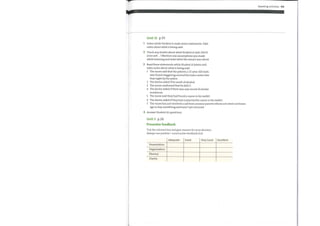
5 Give feedback to the presenter using the form on page 119.
Writing
Case notes
1 Work in pairs. Discuss these case notes about a young manwho
was admitted to hospital after a road traffic accident (RTA).
EXAMPLE WARD ROUND ENTRY
3/09/09 WRMrStmte, (SPR) slept badly
0800 Day 2J>Dt RTA/RTC No Ttausea qmwitiÆtg Ito blood tr,uc.sfwimt
Patient stabilized
swelliftg brcu;gifY Ttofed
ObsC236.4 BP 120/80 65
Plac
1 psbwdBP, FBC,ddEzg/1NR, LFT, u+E
2 Aimfor (d) later today/wuute (O/P 6/52)
DrJdut Blunt
Bleep 7959
2 What do the underlined items mean?
3 Write a similar ward round entry for the notes you took in
Speaking 3 above or use a case you are familiar with. Remember
to keep it anonymous. Use the entry above as a guide.
Instructions and procedures 27
Checklist
Assess your progress in this unit.
Tick (V) the statements which are true.
I can follow procedures in training.
I can give and receive basic instructions.
I can use the simple past.
I can understand abbreviations.
I can understand and write case notes.
Key words
Nouns
consent
procedure
tip
ward round
Adjectives
multidisciplinary
Verbs
attach
bleep
drain
mark
obtain
pop
prepare
sterilize
withdraw
Abbreviations
RTA
spR
TTOs
WR
Useful reference
Oxford Handbook for the Foundation
Programme 2nd edition, Hurley et al,
ISBN 978-0-19-954773-9
26.
28 Unit4
4 Explainingand reassuring
Check up
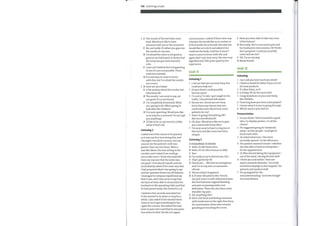
Look at the picture. Which procedure do you think is
1
about to take place?
4)
2 Work in pairs. Discuss the questions.
1 What do you think the patient's reaction to the
instruments and the situation would be?
2 What about the doctor's reaction?
3 Do all patients react to instruments
in the same way?
4 What specific examples of patients' and doctors'
reactions can you give from your own experience?
Pronunciation
Word stress
Match each suffix which describes a surgical procedure
to the correct description.
1
2
4
5
6
Suffix
1 -ectomy
2 -oscopy
3 -ostomy
4 -(o)tomy
Relating to
a an opening between
two cavities or the outside
b cutting something open
c removal of a structure by surgery
d the act of examining
What is the stress pattern of each ofthese words?
1 endoscope 2 endoscopy 3 endoscopic
Listen and check your answers.
G) Listen. Write the number (1—7) of each word you
hear next to the appropriate pattern.
Which ofthese is true ofthe stress patterns in three- or
four-syllable words?
1 The stress is always on the first syllable.
2 There is no clear stress pattern.
3 The stress generallyfalls onthe third syllable from
the end ( e O•e)
Work in groups ofthree. Each choose a different
instrument below and explain its purpose in your own
words. Then discuss howyou think each instrument is
likely to develop in the next three decades.
27.
Explaining and reassuring29
In this unit
understanding and using non-technical language
explaining complications and reassuring the patient
O acknowledging a visual cue
writing information about complications
Change the sentences describing procedures into the
Passive. Decide whether they require an agent or not.
Give a reason.
Listening 1
Patient care
Listen to an extract from a talk by Dr Quinn
explaining how a gastroscopy is performed. Make notes
about the three pieces of advice given to patients before
the procedure is carried out.
1 anti-acid therapy
2 eating
3 driving
2 Work in pairs and compare notes.
3 What verb forms are used bythe doctor?
Read Language spot and check your answer.
Language spot
Explaining investigations/procedures
with the Present Passive
Active sentences say who is doing an action. Passive
O
sentences don't necessarily say who is doing the
action, though they can.
Positive
Verbs not requiring objects (by not necessary)
Active: The doctor attaches the needle to the syringe.
Passive: The needle is attached to the syringe
(by the doctor).
Note: We don't need to say who it is done by because
it is part of a procedure.
Negative
Active: A doctor does not use a tourniquet in this
procedure.
Passive: A tourniquet is not used in this procedure.
Verbs requiring objects (by necessary)
Active: Only experienced doctors perform this
procedure.
Passive: This procedure is performed only by experienced
doctors.
Negative
Active: Nurses don 'tperform this procedure.
Passive: This procedure is notperformed by nurses.
Go to Grammar reference p.125
1
2
3
4
5
6
7
8
The doctor inserts the needle.
Nurses often perform this procedure.
The doctor then applies gentle pressure to the
puncture site.
The sister explains the procedure to the patient.
The nurse cleans the skin.
Doctors without training don't perform this
emergency procedure.
The doctor taps the vein.
Generally, nurses don't perform this procedure.
2 Work in pairs. Use the words to label the
diagram of a gastroscopy a—e.
1
2
3
5
4
a
b
c
d
e
a flexible tube
side channels for introducing other instruments
a grabbing instrument
a light and camera
endoscope
28.
30 Unit4
informed consent(n) consent
for an invasive procedure which
is given by a patient after the
procedure has been explained
3 Look at the statements which are taken from a
training session for doctors. Complete the sentences by
choosing a word from either the noun or verb list. You
will have to change the form ofthe verbs you use.
We wantyou to be comfortable whileyou waitfor the doctor.
Nouns
section
consent
Verbs
blow
advance
patient air
endoscope mucosa
swallow obtain
give sedate
is
anaesthetize
biopsy
1
2
3
5
7
8
Informed
The pharynx is
The patient is
4 The
is
using a spray.
to induce drowsiness.
is introduced and
further down the oesophagus and
into the stomach and duodenum.
is into the stomach
via a side channel in the endoscope to allow
visualization ofthe stomach mucosa.
6 The is
guard to bite on.
The patient is asked to
ofthe endoscope.
The stomach is
a plastic mouth
the first
using
7
2
Using the diagram and sentences in 2 and 3, practise
explaining the procedure to a partner. You maymix the
active and the passive. Use the questions and adverbs
belowto help you.
Howdoyouperform a gastroscopy?
What is donefirst?
What is done/ happens after ... ?
e First ... , Then ... , Next ... , Afterthat...,
Listening 2
Explaining gastroscopy (endoscopy)
Listen to Dr Quinn explaining the endoscopy to a
patient, MrBeacon. Which steps 1—8 in Language spot 3
does the doctor mention?
Which words does the doctor use for the following?
a thin 'grabbing' instrument which is passed down a
side channel.
4 Work in pairs. Change the statements in 3 into
instructions with the imperative.
EXAMPLE
1 Obtain informed consent.
5 Take turns saying the Passive statements to your
partner, who changes them into the active. Then do it
the other way round.
6 Put the statements 1—8 in 3 into the correct order. Note
some ofthe statements relate to part ofthe same step.
I
2
3
4
5
6
7
8
9
oesophagus
anaesthetize
pharynx
flexible
biopsy
sedative
examine
eructate
visualize
29.
Explaining and reassuring31
backbone (n) spinal cord
3 Work with a partner and find words in 3 which have
the stress pattern
4 Work in pairs. Make these statements softer
for the patient.
1 We're doing an endoscopy. 0K?
2 We want to look at your gullet and your stomach.
3 We'll make you relaxed.
4 We'll pass a bendy tube into your stomach.
5 Your stomach will be looked at.
6 We'll take a sample ofthe stomach lining
7 Air is blown into your stomach.
5 Compare your answers with the transcript of
Dr Quinn's conversation. Take turns explaining the
procedure to the patient.
Vocabulary
Reassuring
The doctor uses two adjectives to help make
the procedure less frightening and thus reassure
the patient.
EXAMPLE
The tube will have a tiny camera.
It's a routineprocedure.
Which sentences are not very reassuring?
1
2
3
Listening 3
Emphasis
Listen to the statements 1—8 in Vocabulary 1 and
underline the word the doctor emphasizes/stresses
in each. Why does the doctor emphasize the words?
EXAMPLE
1 simple
What do you think the doctor says when the patient
mentions it sounds a bit scary?
What do youthink the doctor talks about next?
1
2
3
4
5
6
7
8
It's a very simple procedure.
We're just going to take some fluid from your
backbone.
You'll just feel slightly sore after the test.
All you'll feel is a tiny scratch, nothing more.
It'll take ten minutes.
It only takes a few minutes.
It's not a pleasant procedure.
You'll hardly feel anything.
2 Which ofthe words in sentences 1—8 in 1 can be
replaced by these words?
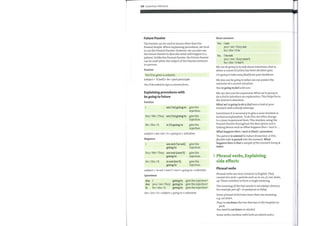
Language spot
Explaining procedures with
be going to future
Doctors needto explain procedures before they
perform them so that they can obtain patient consent.
The future with be going to is usually used to explain a
procedure, even when the patient has not yet agreed to
the procedure or given consent. The be going to future
is used because it is the clearest and most direct way
to give an explanation. Whenthe procedure is fully
explained, the patient can give informed consent.
We're going to giveyou a mild sedative.
o In addition to using the be going to future, doctors
often use fixed expressions with Whatto explain
procedures.
Whatwe're going to do is take a tiny sample
fromyour scalp.
What happens then is we are going to giveyou
a mild sedative.
What happens next is that we insert the needle.
What we need to do after that is stitch the wound.
Go to Grammar reference p.126
a little bit
small
barely
straightforward
a little
just
pinprick
30.
32 Unit4
armpit (n)axilla
come round (v) regain consciousness
go over (n) repeat
gut (n) bowel/instestines
neck of womb (n) cervix
opportunistic (adj) taking advantage of a situation
piles (n) haemorrhoids
Change the explanations to be going to future and
simplify the medical terms. Where indicated, use an
expression with What.
Sometimes you mayhave to give a patient a brief
2
explanation of a procedure. Explain these conditions
using the expressions below.
I
2
3
4
5
6
7
8
9
A sample is taken from the bowel.
Next, the end ofthe intestines is attached to an
opening on the abdomen. (What ...)
A sample is taken from the cervix.
After that, a tube is passed through the urethra.
(What
The glands are then removed from the axilla.
(What
Next, a sample is removed from the lung. (What ...)
After that, a tube is advanced down past the prostate
into the bladder. (What ...)
A dye is then injected into the pancreatic and bile
ducts to visualize them. (What ...)
The muscle is repaired with a mesh.
a condition where
an illness where
EXAMPLE
a procedure where
a device which you use to
Work in pairs. Decide which statement in 1 might be
2
said during one ofthese tests and procedures.
a
b
c
d
g
h
i
cystoscopy
radical mastectomy
colostomy
colonoscopy
colposcopy
ERCP
catheterization
bronchoscopy
herniorrhaphy
3
4
anaemia not enough pigmentin the blood
It's a condition whereyou do not have enough ofa
special pigment or colouring in your blood.
1 appendicitis inflamed remove
2 Alzheimer's disease someone memory loss mood
changes cause not known
3 haemorrhoidectomy piles tie cut out
4 diverticulitis sac / pouch weak points gut infected
inflammation pain diarrhoea constipation
5 sigmoidoscopy look at colon sample
6 anaesthesia general put you to sleep come round
Work in pairs. Practise explaining the conditions above.
One partner begins by asking
What's (a) ... , doctor?
Which situations would you need consent for? Discuss
the importance of explaining consent and compliance
to a patient.
Reading
2
The leaflet on page 33 gives information about
gastroscopy. Work in pairs. Look only at the headings in
bold and decide what information each part ofthe text
contains.
Find words or phrases in the text with the same
meaning as:
Speaking
Work in pairs. Explain two ofthe procedures in
Language spot 2 above. Use the structures in 1 and
remember to reassure the patient.
FURTHER USEFUL EXPRESSIONS
Is there anythingyou'd like me to go over/repeat?
0K? Is everything clear / 0Ksofar?
I
2
3
4
5
6
avoid food
calm
use anything mechanical
a friend to take you home
not 100% reliable
a painful pharynx
31.
sip (n) avery small drink of liquid
3 Work in pairs. Decide what questions you would ask
to obtain the answers in 2. Use the words
in the text to help you make the questions.
Use these notes to help you.
What preparation do I need to do?
The hospital department will usually give you
instructions before your test. These commonly include:
Don't eat for 4—6 hours before the test. The stomach
needs to be empty. (Small sips of water may be
allowed up to two hours before the test.)
If you have a sedative, have somebody accompany
you home.
If you are taking any other medication, tell your
doctor. It may need to be stopped before the test.
What can I expect after a gastroscopy?
Most people are ready to go home after resting
for half an hour or so.
If you have had a sedative, you may take a bit longer to
be ready to go home. The sedative will normally make
you feel quite pleasant and relaxed. However, you
should not drive, operate machinery or drink alcohol
for 24 hours after having the sedative.You will need
somebody to accompany you home and to stay with
you for 24 hours until the effects have fully worn off.
Most people are able to resume normal activities after
24 hours.
Is gastroscopy reliable?
Gastroscopy is a good test for seeing abnormalities in
the upper gut. However, it is not foolproof. For example,
gastroscopy may not detect a small number of cases of
early ulcers or early cancer.
4 Work in pairs. Take turns explaining to a patient the
preparation for the procedure and things to be careful
about afterwards. Use the answers 1—6 in 2 to guide you
and add other information from the text.
1
2
3
4
5
6
Explaining and reassuring 33
What/need 4—6 hours before
How/sedative/feel
What/not/do
What /need/after the operation
How successful/test
What/some people have afterwards
Are there any side effects or complications
from having a gastroscopy?
Most gastroscopies are done without any problem.
Some people have a mild sore throat for a day or so
afterwards.You may feel tired or sleepy for several
hours if you have a sedative. There is a slightly
increased risk of developing a chest infection or
pneumonia following a gastroscopy.
Occasionally, the endoscope causes some damage
to the gut. This may cause bleeding, infection,
and rarely, perforation. If any of the following occur
within 48 hours after a gastroscopy, consult a doctor
immediately:
Abdominal pain
Fever
Difficulty breathing
Vomiting blood
A small number of people have a heart attack
or stroke during, or soon after, a gastroscopy. These
serious complications are rare in most people who
are otherwise reasonably healthy.
-J
32.
34 Unit 4
Vocabulary
Explainingcomplications
and reassuring the patient
1 Work in pairs. Underline the adverbs offrequency
in the sentences below and then put them in order,
starting with the least frequent.
1 Procedures like this are usually done under sedation.
2 We often get patients who have no complications.
3 Fortunately, we have never had a patient who has
had serious complications with this procedure.
4 The procedure rarely goes wrong.
5 It always takes me a while to recover from an
anaesthetic.
6 Patients sometimes get a headache afterwards.
2 What synonyms do you know for the adverbs above?
Listening 4
Discussing complications
Work in pairs. Discuss the possible complications of a
gastroscopy.
Q Listen and list the complications the doctor
2
mentions.
3 Why does the doctor point out the side effects to the
patient?
4 What phrases does the doctor use for occasionally,
automatically, and seldom?
5 Listen again and list three ways the doctor makes the
complications less threatening.
Speaking
1 When doctors see a patient showing emotion, they
can make a comment or observation. This is called
acknowledging a visual cue.
Match each picture a—fwith a statement 1—6.
I
2
3
4
5
6
It's better to let it all out rather than bottling it up.
You look very happy to be going home.
I can see you're a bit alarmed bythe procedure.
You look rather nervous about this.
I can see you're in pain.
You look a bit confused bywhat I've said.
2
3
4
Complete each doctor's response above by adding the
most suitable development below to reassure or show
that he/she cares.
EXAMPLE
a Would you like me to get you something?
b But remember you are very lucky we caught it early.
c But we'll soon give you something to help you relax.
So there is no need to worry.
d So wouldyou like me to go over it again for you?
e So I won't keep you long.
f But it won't take long and it's pain-free.
Work in pairs. Discuss what other ways you could
acknowledge the visual cues in 2. What would you do
in your own country?
Work in pairs. Discuss the complications ofthe
procedures below. Give at least two common
complications in each case.
a haemorrhoidectomy e chemotherapy
b colonoscopy
c blood test
d lumbar puncture
f pleural aspiration
g ERCP
33.
4
bsg.org.uk/index.php
medicinenet.com
oxfordjournals.org
medlineplus.gov
patient.co.uk
Project
Find information onthe websites above about the complications
involved in doing gastroscopy and other procedures.
Writing
1 It is important that patients are informed not just ofbenefits but
also of possible complications. Work in pairs. Make a list ofthe
complications involved in:
doing an arterial blood gas (ABG)
IV inj ections
2 In each case, make notes whythe complications (can)
occur, when they (can) occur, and the chances ofthe patient
having them.
3 Choose one ofthe two procedures and decide the three or four
most important complications.
4 Write a section for a web page entry explaining the
complications. Use these tips to help you.
1
2
3
4
5
6
7
Look at the reading on page 33 and the script for Listening 4 on
page 135. Use word and expressions from these sections.
Use bullet points if necessary.
Write no more than 150 words in total.
Write about each complication separately.
Use the following words and expressions to help you:
sometimes, occasionally, rarely, somepeople, there are some
people, not everyone.
Try to use the Present Simple Active and Passive and the
imperative for actions.
Avoid using the Past Simple.
5 Work in pairs. Take turns explaining the complications. Reassure
the patient where possible. Remember to show emotion and
acknowledge the visual cues!
USEFUL EXPRESSIONS
You sound a bit / a little / slightly ...., ifIam right
It sounds as if...
You appear very ...
You seem really ..
Whatl havejust said seems to ...
It looks like this news has cheeredyou up a lot.
You look as if...
Explaining and reassuring 35
Checklist
Assess your progress in this unit.
Tick (V) the statements which are true.
I can explain procedures to patients.
I can explain complications and reassure
the patient.
I can understand and acknowledge visual
cues.
I can understand and use non-technical
language.
I can write information about complications.
Key words
Nouns
endoscope
gastroscopy
informed consent
instrument
sample
telescope
visualization
Suffixes
-ectomy
-oscopy
-ostomy
Adjectives
foolproof
sore
Non-technical words
backbone
bendy
come round
go over
numb
pinprick
th roat
Useful reference
Oxford Handbook of Clinical Medicine
7th edition, Longmore et al,
ISBN 978-0-19-856837-7
34.
36 Unit 5
5Dealing with medication
Check up
Classify the drugs a—h according to type.
•Paracetamol
Cyclizine
•Sal butanol
d Aspirin
DAmoxici11in
Ranitidine
DC hlorphenamine
Diazapam
antibiotic
analgesic
antiemetic
sedative / hypnotic
gastrointestinal
antihistamine
cardiovascular
respiratory
Work in pairs. Discuss the benefit of each drug given.
USEFUL EXPRESSIONS
It is used to ...
It's prescribed in order to ...
It helps ...
In the United States, drugs are approved for use by the
Food and Drug Administration (FDA) and in the UK by
the National Institute for Clinical Excellence (NICE).
Which body licenses / approves drugs in your country?
Discuss the arguments for and against making generic
versions of newmedicines available in every country.
Patient care
There are guidelines for prescribing any drug in the
hospital. Discuss whythese are important and what might
go wrong if you do not follow them.
1
2
3
4
5
Always consult the BNF when prescribing
for children.
Consult your seniors when in doubt.
Check if the patient has allergic reactions
to drugs.
Check if the patient is a responsible person.
Check for alternatives to drugs.
5.00
What other guidelines do youthink should be followed
before prescribing on or off the ward?
35.
Vocabulary
Abbreviations
1 Match thesecommon prescription abbreviations with
their meaning.
Dealing with medication 37
In this unit
o talking about medications
o understanding drug charts and abbreviations
explaining benefits and side effects
o understanding and using patient language
o completing a clinical incident report
Listening 1
A drug chart
Study the chart below and make sure you understand
the abbreviations, headings, and so on.
1
2
3
5
7
4 od
PO
prn
stat
om
a
b
c
d
e
f
g
in the morning
two tablets
by mouth / orally
immediately
gram
as required
once a day / 24h
Patient
Mrs T Hawthorne
Drug
1
Route
3
Max Frequency
6
Indications for use
7
Dob Hospital No
04.02.63 1834572
Date
Start
Dose
50 mg
2
Time
4
Dose
50 mg
8
5
2 Work in pairs. Say the meaning ofthese abbreviations
used in administering drugs.
the frequency of drugs:
on, bd, tds, qds, 4—6h, 8h, 1—4h
the route of administration:
IV, IM, SC, PR, INH, NEB
measurements:
pg, mg, ml
3 Work in pairs. Take turns reading this chart aloud. Say
the abbreviations as complete words.
Max dose / 24hr
600 mg
Route
Drug
paracetamol
loperamide
ranitidine
atorvastatin
EXAMPLE
Dose
lg
4 mg
150 mg
10 (10-80 mg)
Freq
qds
PRN
bd
od
Route 24 hMax
po
PO
PO
PO
16 mg
300 mg
80 mg
2
Give the patient one gram ofparacetamolfour times a
day by mouth up to a maximum of4 grams.
Give between ... and ....
Give up to a maximum of..
Listen to a doctor checking the chart with a
colleague and complete the missing information
in the chart.
36.
38 Unit 5
concordance(n) a process
whereby the doctor / prescriber
and the patient cooperate
in the prescribing process
to maximize the taking of
medication
Joyce Carne
generic (adj) general, non-
specific
(n) a postgraduate
master's
degree: an MA / MSc
(n) range, capacity
scope
I work as a nurse practitioner (NP) at New York City
Hospital. I am a registered nurse who has completed
specific advanced nursing education. I have a master's
in cardiovascular medicine and training in the diagnosis
and management of common medical conditions in this
specialty.
I provide much of the same basic, non-emergency care
provided by physicians, generally of the type seen in
their specific practice areas like family practice offices,
urgent care centers, and rural health clinics, and maintain
collaborative working relationships with physicians.
As an NP, I am licensed by the state in which I practice
through the NCC (National Certification Corporation)
for specialty practice. Rather than a generic focus of
Speaking
Work in pairs to practise completing a patient's chart.
Student A go to page 114. Student B, go to page 117.
education, as a nurse practitioner I am able to specialize
in an area of study I desire and provide care within the
scope of my expertise.
I may treat both acute and chronic conditions, as well as
prescribe medications and therapies for the patient at
hand. The core philosophy ofthe field is individualized
care. Nurse practitioners focus on patients' conditions as
well as the effects of illness on the lives ofthe patients
and their families. Informing patients about
their health care and encouraging them
to participate in decisions are central
to the care provided by NPs.
A major concern for myself and other
medical practitioners at all levels
is concordance, once a drug has been
prescribed. Concordance involves a
process of prescribing and
medicine-taking; it is a kind of
partnership. It is notjust a matter of
explaining the benefits of prescribed
drugs and the side effects which can
sometimes happen, but which may not.
Improving concordance is about
involving the patient in making
decisions about the treatment.
It's my Job
1 Work in pairs. Readthe text and then answer the
questions.
1 Is concordance a cause for concern for Nurse Carne
and her fellow NPs?
2 What type of conditions can she treat?
3 What does she consider the central philosophy of
working as a nurse practitioner?
4 Why does she feel her patients need to be involved
in treatment decisions?
5 What specific post-graduate training has she
undergone?
6 How does her work compare with that of
physicians?
37.
4
2 In groups,discuss who you think should have the right
to prescribe medicine.
3 Do you have nurse practitioners or nurses with similar
roles in your country? Describe their roles regarding
administering and prescribing medicine.
Listening 2
Benefits and side effects
The sentences below are from an explanation of
the benefits and side effects of aspirin to a patient,
MrJohnson, who is being discharged after an
uncomplicated MI. Work in pairs. In your ownwords,
complete the blank spaces in the doctor's sentences.
1
2
3
4
5
6
7
I've got some good news for you. You've made
and we're going to
First, I'd just like to have a brief chat with
you
If at anytime you want to stop me and ask
questions, . There's a lot of
C
information to take in at one time.
We're going to give you a very small dose of75 mg.
It's a much smaller dose than you'd normally buy
over the counter. You take it
The aspirin will help you a lot, as
and so
And I emphasize the wordpossible,
. But I just have to point them out, so
that you are aware ofthem and can do something
about it if anything happens.
Sometimes, people get
Or aspirin can make
Or it can cause
3
4
5
6
1
2
3
4
Dealing with medication 39
Q Listen and make notes for each blank space in 1
Do not try to write down every word.
Compare your notes with a partner and then write the
complete sentences.
Listen again and check your answers.
Look at the listening script and see how close your
answers were.
Work in pairs. Take turns explaining the benefits and
side effects of aspirin.
Speaking
Work in pairs. Answer the questions below about the
doctor in Listening 2. Does the doctor:
1 use simple non-technical language?
2 keep the drug regime simple?
3 explain the function ofthe medication clearly?
4 ask the patient to repeat the information given?
Does the doctor involve the patient in making decisions
about taking the medication? Why/Why not?
If you think that the doctor could have done more, what
could he have done?
Work in pairs. Take turns explaining the benefit and
side effects of aspirin again. If you need help, check the
script on page 135.
38.
40 Unit 5
Languagespot
Phrasal verbs
In Listening 2 the doctor says to the patient:
There's a lot ofinformation to take in at one time.
The verb to take in means here to understand. It is a
separable phrasal verb because you can separate the
verb take and the particle in:
It is difficult to take in information.
verb particle
It is difficult to take information in.
verb particle
The verb to get up is an example of an inseparable
phrasal verb because you cannot separate the verb
and the particle:
Ifyou can, take the medication soon after
you gg! up in the morning.
verb particle
Rewrite these sentences using the phrasal verbs.
You may have to change the form of the verb and you
maybe able to separate the particle from the verb.
take out write out point out cut down
look at get in touch with get into
1
2
3
4
5
6
7
The doctor identified a few benefits and
a few side effects.
You could keep a pill boxwith the days ofthe week
on it and remove the tablets each day.
Completing a prescription requires great care.
Don't forget to read the instructions on the label.
Try to adopt a routine for taking medication
if you can.
Contact the hospital immediately if anything
changes.
It works by reducing the workload ofthe heart.
i
1
o Language spot
Explaining side effects: can /may
When you explain the benefits of a drug to a patient,
you state what the drug does. To show that a drug
or medicine causes side effects in some people, it is
important to understand the difference between can
and may. Both words are used to express possibility
and are often used interchangeably. However, can
indicates a theoretical possibility while may indicates
a real possibility. Compare:
That door can be locked.
= It is possible to lock that door. Right now, it is either
locked or unlocked.
That door may be locked.
= It is possible that the door is locked right now. If it is
locked, we won't be able to open it.
can
Can is used to say that a side effect is possible.
This medication can cause some stomach irritation.
= It is possiblefor this medication to cause some
stomach irritation.
Here, can indicates that stomach irritation is a
possibility. To reassure patients, you can emphasize
that the side effect is theoretically possible, but not of
serious concern to the patient you're talking to.
This occasionally causes stomach irritation in some
people.
Sometimes, people get stomach irritation with this, but
it isn 't usually a problem.
may
May also expresses that a side effect is possible.
This medication may cause some stomach irritation.
= It is possible that this medication will cause some
stomach irritation.
In this case, may indicates the possibility of the
statement being or becoming true. The word may in
this sense is frequently stressed, and indicates that
stomach irritation is a strong possibility. You may
want to emphasize this.
There's a strong possibility that this will upsetyour
stomach.
Go to Grammar reference p.126
39.
IE&EI
EFFEcTS
Use the wordsto complete the sentences.
7
possibility will
1
2
3
4
Dealing with medication 41
feel ill (v) be nauseated
Speaking
Work in groups ofthree. Discuss the benefits and side
effects ofthese drugs for a patient at discharge who
has had a mild, uncomplicated MI. See page 34 to
review adverbs of frequency.
Atenolol GTN spray Simvastatin
Benefits
Side effects
Take turns explaining the medication to your partners.
USEFUL EXPRESSIONS
And like aspirin ...
In some cases the tablets can ...
Somepeople.
There are somepeople ...
Is everything clear sofar?
Howdoyoufeel about taking this medication?
Doyou thinkyou will be able to remember to take them
asprescribed?
Also try to use some ofthe phrasal verbs from
Language spot on page 40.
The third student should listen and give feedback
using this grid, where 1 is the highest.
Feedback form
may can
probably
may not
1 In some people, it can cause a fleeting headache,
but it doesn't mean you get one.
2 Theoretically, this can cause low blood pressure,
but you won't have a problem.
1
2
3
4
5
Using simple language
Deals with the benefits
Deals well with the side effects
Involves the patient
Checks the patient has understood
3 Some people get blurred vision, but it
happen in your case.
4 There's a strong that this will upset
your stomach. In fact, it may make you feel really ill.
5 Swelling ofthe ankle is not common, but it is
possible—it
6 This
happen.
make you feel dizzy, so you
should be careful when you drive.
2 Work in pairs. Write sentences like those in 1 about the
benefits and side effects ofthe sedative diazepam.
If possible, keep a video record.
Play back the recording to
your classmates. Use the
feedback form to discuss the
conversation.
Readers should note that
BNFis regularly updated and
that the current edition is
available at BNF.org.
12 3 45
12 3 45
12 3 45
12 3 45
12 3 45
British
National
Formulary
September 2008
bnf.org
40.
42 Unit5
complementary (adj)balanced
factor (n) cause, element
regimen (n) course of
treatment, schedule
Reading
Statistics for concordance in General Practice in the UK
Sufficient concordance to attain therapeutic objectives occurs
about 50% of the time.
1:6 patients take medicine exactly as directed; 1:3 take medication
as directed 80—90% of the time; 1:3 take medication 40—80%
of the time; the remaining 16—17% take medications directed
of the time. 20% of prescriptions are never cashed.
Read the text and answer these questions.
1 What features ofnew medicines should make
people take the medicines prescribed to them?
2 Which medicines are least likely to be taken by patients?
3 Which group is more likely not to take medicine
prescribed because they do not believe the illness
4
5
6
7
Besides providing information, what effective ways
can improve compliance?
What is more important than increasing compliance
in patients?
What do patients need to be helped to make?
What can be of help to both the individual and the
general population?
is there?
Concordance
Non-compliance in medicine taking
is a long-standing problem in all
therapeutic areas, including the
treatment of cancer. There is strong
evidence that, despite the introduction
of new medicines which have fewer side
effects and are more convenient to use,
many people still do not take them as
prescribed — even when not doing so
can have life-threatening consequences.
Medicines prescribed for preventive
purposes are especially likely not to
be taken as prescribed. This may be
because people do not feel immediately
threatened and, in the case of
symptomless conditions such as raised
cholesterol levels and hypertension, feel
no obvious benefit at the time when
medicines are taken.
Factors associated with
poor compliance include:
o complex regimens involving multiple
doses and several medicines.
unwanted side effects.
o concerns about the value or
appropriateness oftaking medicines
in particular contexts.
denial of illness, especially among
younger people.
o confusion or physical difficulties
associated with medicine taking,
which most frequently affect
older people.
Effective ways of improving
compliance rates involve the
complementary use of educative,
practical, and emotionally and
behaviourally supportive interventions,
rather than the provision of information
alone. There is evidence that, regardless
of the specific knowledge imparted,
self-management programmes
which help to raise people's sense of
self-efficacy and confidence promote
better medicine ta king.
Health professionals should respect
patients' autonomy and accept that
increasing compliance with prescribing
instructions is not as important as
meeting patients' individual needs and
priorities. Patients need help to make
informed choices about treatment. For
example, there is a need to differentiate
clearly between situations where
varying the timing or quantity of
medicine doses may do little harm or
even be beneficial, and situations in
which there is a high probability of
adverse clinical outcomes.
Improvements in self-management
skills and compliance in medicine
taking can generate significant benefits
for individuals and the population
as a whole. Combining medication
reviews with other forms of timely and
appropriate support for patients and
carers represents an important route
towa rds better and more cost-effective
use of medicines.
2 Work in groups. Discuss the question of compliance
among patients in your country by:
1 answering questions 1—7 in 1
2 comparing the statistics at the top of page 41 with
those for your own country, if they are available.
3 giving examples of non-compliance and effective
ways of dealing with it.
Project
Search the web and check references to clinical
incident reporting in UKhospitals. Find out what is
involved in the procedure.
1 Is such reporting a good idea?
2 What is it called in your country and what
happens there?
41.
Writing
Clinical incident reporting
1Look at the sample clinical incident reporting form below.
Name of staff involved Grade and specialty Agency/locum
c.J. F-th,t
Brief details of incident:
Patient wasprescribed augwce-wtiz 625wy/8h PO, despite
allergy (this cows 9tated 011 drugchart). This
cows %ded by the the patteq,tdid
take aurwce-É(Æi4t. The team PRHO cmt,tacted avad
alternaz9ee antibiotic unsprescribed.
2 Without looking at the form in 1, expand the notes below into
full sentences.
Notes
patien.tprescrübeycuqmevutüvv625 8h/PO
notecV
phcwmcwüstpa.fient nottcvkeaugmentüvv
Dr Pereetea,vw
contactcatervwtüveya,ntübioticprescrübv
3 Complete two clinical incident reporting forms from the notes
below In each case it was a 'near miss' incident.
Notes
wtcg iv up to 1 WY.
chart/patient epileptic. Ttofed Dwtca,kt
Zhou teauc cmøta.ct
alternatwe drug
Notes
prescribe tefracycDtæ 250-500 / 6k drugchart
%0fed
Ttdtake drug Dr Harper team cmotact
4 In groups, discuss clinical incident reporting. Give examples from
your experience. Discuss whythe procedure is important for the
patient, the hospital, and for you and/or your colleagues.
5 Is it difficult to admit mistakes like this in all cultures?
Give reasons and examples.
Dealing with medication 43
Checklist
Assess your progress in this unit.
Tick (v/) the statements which are true.
I can talk about medications.
I can understand drug charts and
abbreviations.
I can talk about the benefits and side
effects of medications.
I can understand and use patient language.
I can write / understand a clinical incident
report.
Key words
Nouns
benefit
side effect
Abbreviations
bd
g
IM
INH
NEB
od
om
on
prn
qds
sc
stat
tds
tt
Useful reference
Oxford Handbook for the Foundation
Programme 2nd edition, Hurley et al,
ISBN 978-0-19-954773-9
42.
44 Unit 6
6Lifestyle
Check up
Work in groups. Describe the lifestyle factors which the
pictures below represent.
Match each statement belowwith the most
appropriate picture.
When I exercise
regularly, I feel healthy.
I wish I could stop
snacking.
I feel eating healthy
food will help me fight
off infection.
I can't see anything
wrong with eating
fatty food. I've never
been sick in my life.
I'm worn out and it's
making me ill.
I can't live without my
cigarettes and drink.
Work in pairs. Discuss whetherthe attitudes ofthe
people in the statements in 2 are positive or negative.
Discuss the illnesses the people in pictures a and c
might be predisposed to. Is it easy to change people's
lifestyle habits? Why/Why not?
What do you think are the best ways to encourage
people to change their exercise / eating habits?
43.
Lifestyle 45
In thisunit
O asking about family history and social history
O understanding lifestyle changes from
the patient's perspective
o encouraging and motivating patients
O talking with patients about their lifestyles
Listening 1
Family history and social history
To help patients change their lifestyles it is important
to know something about their family and social
history. Otherwise, any encouragement to change
may not fit in with the patient's lifestyle.
Listen. Decide whether the doctor is asking
1
about the family history (F) or social history (S).
2
3
1
2
3
4
4
Work in pairs. Compare your choices.
Look at these statements and decide which, if any, fit
most with the ranking you have given for each choice.
1 2 3
2 Listen again and write down in note form the
questions the doctor asked in each case.
3 Work in pairs. Compare your notes and make
full questions.
4 What tenses are used in the questions?
5 What other questions can you ask about:
I don't see why I need
to change.
It's impossible for me to
change at the moment.
Trying to change habits
like this only makes me
nervous.
When I try to give up
something (like eating
less chocolate), I tend to
do it even more.
5
I know it's bad, but I
enjoy it / them.
6
I can see the advantages
of changing, but I'm
not sure I can do it.
7
I want to change.
I just have to make
the effort.
1 home? 4 alcohol? 5 money problems?
2 occupation? 3 hobbies? 6 changes in habits?
6 If you try to advise patients without knowing the
information in each conversation, how could it
annoy or worry the patient?
7 Work in pairs. Ask each other questions about
the topics in 5
Speaking
Choose at least two things belowwhich you yourself
find difficult to change. Rank each choice on a scale
of 1 to 5 where I is easy and 5 very difficult.
1 2
eating chocolate
snacking between meals
avoiding stress
drinking fizzy / sugary drinks
drinking tea / coffee
not doing exercise
smoking
driving a car
other
Look at the pictures. Which do you think reflects your
own attitude when people are trying to help you
change habits?
44.
46 Unit 6
achievable(adj) able to be
reached
(v) produce / create
devise
(v) give up
kick
regime (n) plan
(v) get used to
settle into
Ask your partner to explain the reasons behind
5
the choices, the ranking, and the statements they
have chosen in 1 and 3
USEFUL EXPRESSIONS
It's not easy to ... I've tried many times ...
I keep going back ...
Myfriends /family / colleagues do the same, so ...
I know the advantage, but ...
Myfamily /friends want me to ...
Discuss this question in groups. Why do you think it
6
is necessary to consider patients' beliefs, emotions,
willingness in helping them to change lifestyle habits?
Vocabulary
Language for exercise
Match each verb with the best noun phrase to create
general advice for exercising.
1 take up
a some physical activity
b minor changes
2 kick
a anew routine
b old habits
3 stick to
a anewregime
b the amount of exercise you do gradually
4 settle into
a old habits
b anew routine
5 increase
a the amount of exercise you do gradually
b anew regime
6 make
a old habits
b minor changes
7 devise
a your own exercise programme
b some physical activity
2
3
4
5
Add one ofthe phrases 1—7 to these sentences. You may
use each phrase only once. You may need to change the
form ofthe verb.
1
2
3
4
5
6
7
Once you
improvement.
If you
, you'll begin to notice some
and set yourself achievable
aims, you'll be more likely to succeed.
It is difficult to
into it ...
, but once you have got
Have you thought of getting someone to help you
Start small and then try to
It's better to
routine.
that fits into your daily
is not easy, but it is not impossible to
break them.
Work in groups. Decide what youthink are the three
2.
most important ideas 1—7 from
Introduce more specific examples for sentences 1—7
in 2. You can choose from this list: light or strenuous
walking, swimming, a brisk walk, visit a gym, cycling,
getting off the bus one or two stops earlier, running,
USEFUL PHRASES
You can / could ... For example, if...
Take turns talking to each other about taking up more
exercise and the risks and the benefits. You can refuse
to accept the advice by using one ofthe phrases from
Speaking 3 on page 45.
45.
Advice for doctorstaking
a social history from a patient:
Probe without prying.
—Oxford Handbook
ofClinical Medicine
Speaking
1 Work in groups. Discuss this quotation fromthe
Oxford Handbook ofGeneral Practice, Second Edition.
Increasing stress is a feature of society as a whole.
GPs score twice the national average on stress test
scores.
2 Discuss what you think are the three main causes of
stress faced by doctors in general practice. State one
main effect of stress on a doctor's clinical work, the
general practice, and home life.
3 What actions can doctors take to reduce the stress they
can face at work?
4 The British Medical Association (BMA ) offers a
confidential stress counselling service for members.
Are there similar services in your own country?
Writing
Help with stress
Work in groups. Discuss situations where you were (or
a colleague was) facing stress.
2 Work in groups. Describe to each other situations
where you had to deal with your own stress or helped a
colleague to do so.
3 Afellow doctor has mentioned in an email to you that
he is stressed in his new GP practice in Australia. He
mentions:
Lifestyle 47
Listening 2
Being sympathetic
Look at these statements. What are the doctor
and patient talking about? Then listen and decide
which statements are true. Check your answers with a
partner.
1
2
3
4
1
2
3
4
5
6
7
The patient has tried to diet before.
The patient has tried to stop eating crisps and other
junk foods in the past.
The doctor suggests a gradual approach.
The doctor is sympathetic to the patient's situation.
The patient is reluctant to try the approach
suggested bythe doctor.
The doctor suggests taking up yoga as an exercise.
The patient's excuse is to do with injury.
Howwould you describe the doctor's approach:
sensitive or annoying?
Would the doctor's suggestions work in all cases?
Give examples.
Work in pairs. Take turns role-playing the doctor and
encouraging Mr Ford, who is 110 kgs and 1.80 metres
tall with a waist size of 110 cms, to lose weight through
exercise. Use the BMI chart to help you explain.
WEIGHT IN KG
40 50 60 70 80 90 100 110 120 130 140 150
o too much work.
rapid changes in technology.
the fact that he never takes breaks.
he is reluctant to talk to his colleagues and family as
he does not want to appear weak.
z
Write a reply mentioning one or more ofthe above
factors and describe a real past situation where you
faced stress and howyou dealt with it.
5'9
u- 518
- 57
5'5
5'4
6'4
6'2
6'1
6'
5'11
5'10
5'6
5'3
5'2
5'1
4'11
4110
1.98
1.96
1.94
1.92
1.90
1.88
1.86
1.84
1.82
1.80
1.78
1.76
1.74
1.72
1.70
1.68
1.66
1.64
1.62
1.60
1.58
1.56
1.54
1.52
1.50
1.48
6 7 8 9 10 11 12 13 14 15 16 17 18 19 20 21 22 23 2425
WEIGHT IN STONES
Underweight Normal Overweight Obese Morbidly Obese
46.
48 Unit 6
oLanguage spot
Encouraging patients
and making suggestions
Vocabulary on page 46 showed ways to encourage
patients to change their lifestyle. In addition to
those, you can also use modals to make suggestions.
For tentative suggestions, you can use the modals
could / can / might.
You could (for example) get offthe bus one stop early.
You can (for example) get offthe bus one stop early.
You might like to try (for example) getting offthe bus
one stop early.
Should / shouldn't / ought / oughtn't to are used
for strong suggestions. But be careful. These can be
annoying rather than encouraging and are probably
best avoided.
You should give up smoking.
You shouldn 't eatfattyfoods.
Go to Grammar reference p.127
Rewrite the sentences below using the words in
brackets.
1 You should try to take it easy for a couple of days and
have a couple of days off. (Have you thought of)
2 You should step up the exercise very gradually.
(It's better)
3 Spend more time on a physically demanding form of
exercise. (You could)
4 Eat white meat or fish where you can rather than red
meat. (Instead of eating red meat)
5 You should do something which will get you out and
about. (Try and)
6 You should have a balanced rather than a crash diet.
(You might)
2
3
1
Work in groups. Discuss what encouragement you
would give to a patient who is trying to lose weight.
You might want to talk about:
foods to avoid:fattyfo-Dd6, salt/ sugar, cries,
biscuits, cakes, efc.
— urfu:te wteat red wteat
dairy products: s/ciwowted wilk /
se-uü-s/ciwuued
Sprtimosand preferably wcorefruÆt
aud efabtes a day
(oily) 2 /3 times a tvæek
2-4 litresßccid, i.e. water, %dtea /
Work in pairs. Take turns encouraging each other to eat
a more healthy diet.
Patient care
Work in pairs. Decide which ofthese best explains
sympathy and which empathy.
1
2
3
4
understanding the patient's feelings because you
have seen other patients in similar situations before
a mixture of self-experience and understanding of
the patient's condition
understanding what the patient is feeling because
you have experienced it yourself
an understanding ofwhat the patient is feeling
based on clinical knowledge
47.
2 Work inpairs. Below are five statements made
in doctor / patient role-plays. Decide which are
sympathetic and which empathetic. Are any ofthem
very personal?
1 1 know it's not easy to change habits because I've
faced the same problems myself.
2 Giving up smoking isn't easy, but have you thought
perhaps of cutting down gradually?
3 When people try to make changes like this, at first it
seems difficult.
4 1 appreciate it's difficult, but have you thought ofthe
advantages ofgiving up?
5 1 know what it's like because I have been there
myself.
3 Are the personal statements appropriate? Will the
patient respond to them? How could you make them
less personal?
4 Using sympathywith a patient helps you discuss and
negotiate. In pairs, discuss strategies to answer the
patient's 'barrier' statements below. Use or adapt one
ofthe statements in 2 or one ofyour own.
1
2
3
4
5
Lifestyle 49
Facts and figures on smoking
In the UK, 12 million adults smoke cigarettes and
a further 3 million smoke pipes and cigars.
Prevalence: highest aged 20—24
— Oxford Handbook ofGenera/ Practice
mini-targets (n) short-term aims or goals
Speaking
Work in groups ofthree. Discuss howto deal with this
role-play scenario. Remember to consider the patient's
point ofview.
A 50 year-old male patient, MrHarding, is just about to
be discharged from hospital. He has smoked
at least 20 cigarettes a day for most ofhis adult life.
Talk to him about stopping completely.
Decide on five criteria youthink should be included in
the assessment of a candidate role-playing the scenario
in an exam. Use the speaking checklist on page 120.
Take turns role-playing the scenario in 1 as a patient, a
doctor / candidate, and an examiner. The role-play lasts
5 minutes. The examiner uses a stopwatch to time the
role-play and listens to the role-play checking it using
the speaking checklist.
At the end of each role-play, the doctors / candidates
say howthey have done, using the checklist. The
examiner should then give constructive feedback.
Work in groups. Discuss the difficulties of dealing
with changes in lifestyle. You maywant to talk about
these points: imposition, not knowing the whole story,
annoying the patient.
1
It's impossible for me
to give up drinking
alcohol.
2
I've tried to stop
smoking, but I can't.
3
I can't take any time
off work as we are
very busy.
4
I find it difficult to stop
eating between meals.
5
I haven't really got the
time to do any exercise.
5 Work in pairs. Take turns replying to statements
1—5 in 4. Develop the answer by negotiation with the
patient, giving suggestions about setting mini-targets,
monitoring progress, and motivating the patient.
6 Work in groups. Discuss which ways of negotiating and
encouraging the patient are the best.
48.
50 Unit 6
Overweightand obesity pose a major risk to long-term health
by increasing the risk of chronic illnesses. In 2005, 7.4 million
people aged 18 years and over (54% of the adult population) were
classified as overweight or obese, an increase from 5.4 million
adults (45% of the adult population) in 1995.
— Australian Social Trends 2007
Reading
Before reading the text, complete the sentences
with your own ideas.
1 Obesity is the result of
2 Lifestyle factors associated with obesity
are
Overweight and obesity
3 Obesity affects long-term health by
4 The cost of obesity in Australia was
5 higher rate of obesity
6 Self-perception of ownbodyweight among men and
older women has implications for
Overweight and obesity have become
world-wide concerns, reaching
epidemic proportions. Obesity is
caused by an energy imbalance
where energy intake exceeds energy
expended over time. This imbalance
has been linked to lifestyle factors
such as increased consumption of
foods with high levels ofsugar and
saturated fats, as well as a reduction
in physical activity.
Overweight and obesity
pose a major risk to long-term
health by increasing the risk of
chronic illnesses such as diabetes,
cardiovascular disease, and some
cancers. It has been estimated
that obesity and its associated
illnesses cost Australian society and
governments a total of $21 billion
in 2005. In July 2006, the Australian
Government implemented a five-
year, $500 million program, the
Australian Better Health Initiative,
aimed at reducing the impacts of
chronic disease which includes a
focus on promoting healthy weight.
This article discusses adults who
were classified as overweight or obese
according to their body mass index
(BMI), based on self-reported height
and weight.
Overweight
and obesity trends
In 2004-05, more than half (54%)
of all adults, or 7.4 million people
aged 18 years and over were either
overweight or obese, an increase
from 45% (5.4 million adults) in
1995. Using age-standardized data,
the rate ofoverweight adults has
increased from 33% in 1995 to
36% in 2004—05, while the rate of
obesity in adults has increased from
13% to 18% over the same period.
Each ofthe national health surveys
conducted since 1995 has reported a
higher rate ofoverweight and obesity
for males than for females.
Perceptions of own weight
For manypeople, particularly men
and older women, self-perception
of'acceptable weight' differs from
the standard BMI definitions.
This may have implications for the
management ofhealthy bodyweight
in adults. In 2004—05, more than half
of adults (63% ofmales and 59% of
females) considered themselves to be
ofacceptable weight. The proportion
ofmales (32%) and females (38%)
who considered themselves to be
overweight was considerably lower
than those who were classified as
overweight / obese according to their
BMI (62% and 45% respectively).
Between 1995 and 2004-05,
after adjusting for differences in
the age structure ofthe population,
the proportion ofpeople in the
overweight and obese BMI categories
who considered themselves to be
of acceptable weight increased.
In 2004-05, almost half (47%) of
males and around one-fifth (21 %)
offemales who were overweight or
obese considered themselves to be
of acceptable weight. This compares
with age-standardized rates of
around one-third (35%) for males
and 12% for females in 1995.
2 Now read the text and find the sentences in I. Compare
the text with your own answers.
3 Work in pairs. Discuss whether the medical profession
alone can change perceptions about lifestyle, weight,
exercise, smoking and drinking.
49.
Pronunciation
Word stress innoun phrases
In a noun phrase the stress can often fall on either the first
or second word. The placement ofthe stress usually affects the
meaning. Listen. Underline the syllable in each case that takes
the main stress.
1 Australian government
2 Australian government
2 Match each pronunciation in 1 to a meaning.
a It was the Australian government, not the New Zealand
government.
b It was the Australian government, not the Australian media.
3 Work in pairs. Scan the text in Reading on page 50 and find
these phrases.
1 epidemic proportions
2 energy imbalance
3 lifestyle factors
4 cardiovascular disease
5 associated illnesses
6 Australian society
7 chronic disease
8 health surveys
4 Decide where the stress falls in each word in the pair as it occurs
in the text. Underline the stress which is more important in each
pair.
Listen and check your answers.
5
6 Work in pairs. Read aloud alternate paragraphs.
Project
Search the web and find out about conducting research in the
medical field.
UK websites:
o Research in the NHS: www.dh.gov.uk
o National Research Register (NRR):
www.update-software.com/national
o Royal College of General Practitioners (RCGP):
www.rcgp.org.uk
o Funding: www.redinfo.org.uk
See also pages 92—93 Oxford Handbook ofGeneral Practice,
Second Edition.
Lifestyle 51
Checklist
Assess your progress in this unit.
Tick (V) the statements which are true.
I can ask about family, social and personal
history.
I can understand the Past Simple.
I can encourage and motivate patients.
I can talk with patients about
their lifestyles.
Key words
Nouns
BMI Body Mass Index
diet
empathy
exercise
habits
hobbies
lifestyle
mini-targets
obesity
overweight
routine
stress
sympathy
Verbs
devise
encourage
kick
motivate
settle into
take up
Useful reference
Oxford Handbook of General Practice
2nd edition, Simon et al,
ISBN 978-0-19-856581-9
50.
52 Reading bank
Readingbank
1 'TV doctor'
Join these word combinations used in
the text. Then check your answers in
the text.
1
2
3
4
5
6
7
develop
focus on
order
a
b
c
manoeuvre d
make e
depersonalize f
isolate g
people
a chest X-ray
a cough
their rounds
care
the chart
the robot
2 Read the text. Are these statements
true (T) or false (F)?
1 Arobot came to visit Ries Daniel
the evening after his operation.
2 Louis Kavoussi, Daniel's urologist,
spoke to Daniel from a machine
called Dr Robot.
3 The patient developed a fever
during the course ofthe day.
4 An abdominal X-ray was ordered
by Dr Kavoussi.
5 Robots are being used by doctors
to talk to each other as well as
patients.
6 Some people feel robots allow
doctors to spend more time with
their patients.
3 Correct the false statements with
a word or words fromthe text.
4 Find words which mean:
1 supporters or those for.
2 disbelievers or those against.
Machines let physicians
make rounds from a distance
RIES DANIEL was waiting in his hospital room the morning after
bladder surgery when the door finally swung open. But it wasn't
his doctor. Instead, a robot rolled in, wheeled over, and pivoted
its 15-inch video-screen 'head' toward the 80-year-old lying in
his bed at Baltimore's Johns Hopkins Hospital.
'Good morning,' said a voice from the robot's speaker. It was Louis
Kavoussi, Daniel's urologist. His face peered down from the screen
atop the 167-centimetre-tall device dubbed Dr Robot. 'So, how was
your evening? No problems?'
Studying his patient through an image beamed back to his office
by Dr Robot's video camera, Kavoussi was concerned because Daniel
had run a fever overnight and developed a cough. 'You're not looking
as good as yesterday,' said Kavoussi, zooming in the camera for a
closer look after having focused on Daniel's chart moments before.
'I didn't have my martini,' said Daniel, managing a smile.
'Well, let's see howyou are feeling later on today,' Kavoussi said .
'Ifyou're feeling better, we'll send you home, all right?'
After telling Daniel that he was ordering a chest X-ray and
other tests, Kavoussi tweaked a joystick to manoeuvre the robot
back to the hallway.
Such robot-assisted exchanges are being repeated in dozens
ofhospitals across the country by doctors who use the machines
to make their rounds, monitor intensive-care units, respond to
emergency calls, and consult with other physicians.
Proponents say this and other new 'telemedicine' technologies are
allowing doctors to use their time more efficiently and serve more
patients, often at odd hours or in remote places where the sick would
otherwise have a hard time seeing a doctor.
'There's a tremendous amount ofmedical care being provided
from a distance today through technology like this,' said Jonathan
D Linkous, executive director ofthe American Telemedicine
Association.
Sceptics, however, fear that the technology is further depersonalizing
health care, accelerating the trend ofdoctors spending less and less
time with their patients, and eroding what remains ofthe doctor-
patient relationship.
'This is a triumph ofthe model ofmedicine that has abandoned
the idea ofpersonal interaction and providing comfort in favour
of a model ofthe patient-physician interaction as essentially an
exchange ofinformation,' said David Magnus, a Stanford University
bioethicist. 'You can see a face, but there's no touch, no laying on of
hands, no personal contact. We're increasingly isolating people in
a sea oftechnology.'
51.
Reading bank 53
000
000
2Medicines
1 Look at the title and the pictures
and skim the article quickly.
Who is the text written for?
a Pharmacists
b The general public
c Doctors
2 What is the main topic ofthe article?
a Advice for patients on obtaining
medication cheaply
b Advising pharmacists
about what the general public
should know
c Advising people about knowledge
of medication
3 Match highlighted words in the
text with these meanings.
KNOW YOUR MEDICINES
If you or someone you care for is taking medicines,
it is important to have the right information.
Modern medicines are safe and effective. But to
get the most out of your medicines you need
to know how to use them — and, where
appropriate — how to choose them, But
where do you go to get the facts and advice
you need? Some people turn to friends and
neighbours, to books and magazines and,
increasingly, the internet. But for expert advice near
where you live, shop, or work, ask your local pharmacist.
Ask an expert
Pharmacists are experts in medicines and can help
you to make the right choices. They are highly trained
in all aspects of medicines and their professional code
ensures that any information you share remains
confidential. This expert knowledge can help you
understand more about your medicines so that you
can use them safely and effectively.
Medicines matter
1
2
3
4
5
6
7
8
shops
unorthodox / unconventional
/ traditional
herpes simplex
ask for help from somebody
guarantee
obtain the maximum
benefit from
insects which infest the hair
approved
4 Answer these questions.
1 How are modern medicines
described?
2 Howcan people get expert advice?
3 How is public safety protected as
regards medicines?
4 How should people obtain the best
advice from pharmacists?
5 Why do some medications need to
be taken with food?
6 Do you think pharmacists
should be allowed to prescribe
medications? Why? Why not?
To protect the public, all medicines must be tested and officially
authorized to make sure that they are safe and produced to a quality
standard. There are different types of medicines. Some are only
available on prescription, others are only available from pharmacies, and
there are a small number that can be bought from other retail outlets .
To be sure that you get the best product and advice for your needs, ask
your pharmacist, the expert on medicines.
Everyday health
Your pharmacist can supply medicines for a range of minor problems
and can advise you about the best way of treating problems such as
coughs and colds, sprains and bruises, headlice, cold sores, and skin
problems. To get the best advice, explain how long you have had the
problem and how it makes you feel. Give the names and dosages of any
other medicines you are taking and don't forget to mention any herbal
or other complementary remedies.
If you don't feel comfortable about discussing your health
at the pharmacy counter, you can speak to the pharmacist
in a quiet area away from other customers.
Getting the most from your medicines
Always read the instructions on the label or in the leaflet. If you are
unsure about how to take your medicines, then ask your pharmacist.
Medicines work in different ways.
Some are taken before you eat so they get into your system quickly.
Some need to be taken on their own as they don't work properly
if taken with certain foods, herbal preparations, or other medicines.
Some are taken with or after food because there is a chance that
they could otherwise irritate your stomach.
Together, you and your pharmacist can work out how best to choose and
take your medicine so that it fits in with your daily routine.
52.
54 Reading bank
3Assessment
Skim the text and match each
heading to the appropriate part of
the case study (A or B).
1 Talking about being assessed
2 Talking about filling out
assessment forms
2 Use these sentences to fill in the
gaps in the text.
a The feedback has helped me
realize that this can often
benefit the team and patient
care.
b Individual comments can be
added in the questionnaire and
are listed with your results.
c Being able to follow a case
you've admitted all the way
through to discharge gives you a
complete overview.
d Being able to discuss this case
with my consultant reassured
me that I had managedthe case
appropriately and improved my
knowledge on the subject for the
future.
3 Find words in the text which are
the opposite of:
PART A
PART B
1
2
3
4
5
6
7
junior
make worse
possibly
little
innocent
criticize
mildest
CASE STUDY
understanding assessment
Dr Liam Sullivan, Fl Doctor, Manchester
Finding time to fill out assessment forms with my senior colleagues was
quite difficult at the start ofmyplacement. I was too focused on getting
that perfect case where I could perform really well. I later realized that
the idea ofthe assessments was not to score brilliantly throughout but
to show the progression during the year. Having the assessments and
receiving feedback helped me improve mypractice — it's definitely
better to complete some assessments early on. Keeping this in mind,
I made sure I kept the assessment forms close to hand. I've found that
whilst I'm on call is the best time to pick up cases.
1
Case-based discussion gives you a good opportunity to raise concerns
with your consultant. I had admitted an elderly lady with ascites and
chronic renal failure who was suffering from dehydration. When I
was trying to rehydrate her, she received too much fluid and slipped
into pulmonary oedema. I felt guilty and thought I had given her poor
treatment.
2
Multi-souxce feedback
The multi-source feedback assessment tool we used was the Mini
Peer Assessment Tool (Mini PAT), which I found very useful. When
starting work, fellow colleagues sometimes commend your actions.
Occasionally a senior will be impressed and mention it to you. Rarely,
however, does anyone write it down, which is one ofthe reasons this
tool is so valuable.
How it works
Each foundation doctor is responsible for nominating his or her own
assessors. These may include any member ofthe team from consultants
to Fls, sisters, and allied healthcare professionals. They each receive
a questionnaire covering many aspects ofyour performance from
medical knowledge to professional attitude.
Once completed, they are sent anonymously to a central office. You
also complete the questionnaire and the results are collated to present
your self-appraisal ratings against your chosen assessor's ratings and
the national average.
3
The results
It can be disconcerting reading criticism, no matter how constructive.
In myMini PAT, I received a comment that I could improve my
practice by discussing clinical management with myseniors more
frequently. I had felt that I didn't want to bother my seniors with minor
management issues.
4
Top tips
Plan which placement you'll be completing the assessment in
ahead oftime, make sure that you choose the maximum number of
assessors possible, and finally don't forget the harshest assessors
are often your friends.
53.
Reading bank 55
Darkside of sunny Spain for
Britain's elderly expatriates
4 The language barrier
1 Before you read, work with a partner and
discuss these questions.
1 Have you ever used an interpreter
during a consultation? Describe what
it was like. Was the interpreter a
professional? Was it easy or difficult
to talk to the patient?
2 Are there any advantages or
disadvantages using interpreters?
2 Read the article and answer these
questions.
1 What three things is the charity Help
providing British patients?
2 What are Spanish doctors refusing
to do?
3 Howis the language barrier affecting
consultation time with expats?
4 Howmany expat British patients use
hand gestures and phrase books to
communicate?
5 How do expats abuse the Spanish
health care system?
3 Complete these sentences using the
highlighted words in the text. There are
more words than sentences.
1 The large numbers of British people
settling on the Costa Blanca are
increasing the
on the Spanish health service.
2 Research bythe Spanish Society of
General Medicine indicates that a
minority of expats can
with staff.
3 The Spanish Society of General
Medicine is now asking for extra
to help with the rise in expenditure.
4 The charity Help, which is run
by expats, is to the expat
community.
5 Dr Diego Vargas says that the lack
of clear communication is a medical
6 Many expats, according to
the Spanish Health Minister, don't
have suitable medical
It is a familiar sight in any British
hospital — older women in blue
sashes staffing a makeshift charity
stall in a busy corridor. But here in
Denia Hospital on Spain's Costa
Blanca, the volunteers have no
time to serve tea. The expat-run
charity Help is indispensable ,
providing interpreting and
sometimes nursing and aftercare
for the growing number of British
patients that pass through here.
Tens of thousands of British settlers
pursuing a dream retirement in the
sun have doubled the population in
this area in the past two years — and
put a growing strain on a creaking
Spanish health service.
Now Spanish authorities say they
are placing an unbearable burden
on scant medical resources and
are demanding that the UKpays
for their care. And in a move likely
to send a chill through the expat
community, Spanish doctors — even
those who speak English — are
now refusing to treat anyone who
cannot speak Spanish without an
interpreter present.
Dr Diego Vargas, a spokesman
for the Spanish Society of General
Medicine, says the language
barrier is a medical risk . 'It makes
diagnosis difficult — even doubling
consultation time — and can give rise
to serious misunderstandings and
errors, for which the doctor will be
held responsible.'
Research by the society shows a
large increase in expats presenting
with serious conditions at hospitals
throughout the Spanish costas, but
fewer than 10 per cent can
communicate with staff, with
almost a third relying on hand
gestures and phrase books.
Jill Porter Smith, 75, who retired
here from Cambridge 25 years ago,
volunteers at Denia Hospital five
days a week. 'Most of our clinics
now have a sign over the door
saying, "Non-Spanish speakers will
not be seen without an interpreter,"
but with only a handful speaking
fluent Spanish in a community of
over 40,000, our volunteers are
stretched to the limit. It's not
unusual to deal with British people
who have lived here over 20 years
and complain about medical staff
not speaking English. Because
waiters and barmen speak English,
they expect doctors to.'
The society is now calling for
extra resources to deal with the
rising costs. Regional health
authorities complain that providing
drugs, health, and social care for
more than a million ageing Brits
— and to a lesser extent, Germans
and Dutch — is crippling, prompting
the Spanish Health Minister, Elena
Salgado, to demand an annual E40m
from the UKgovernment.
She says expats abuse the system
by using health facilities without
registering as residents. 'Many are
relocating to Spain and receiving
medical treatment for serious
conditions more quickly and of a
high standard unavailable to them
on their own NI--IS but, as many of
these are 'invisible' residents and
have no appropriate medical cover ,
Spain is recouping only a fraction of
the costs of treating them,' she told
fellow ministers.
54.
56 Reading bank
5The nocebo effect
Work in pairs. Answer these questions.
1 What is the placebo effect?
2 Do you knowwhat the nocebo
effect is? Scan the first four
paragraphs for negative words.
Predict what the nocebo effect
means.
2 Scan the text and find the words
which are described below.
1 Iam a two-word verb and I mean
found by accident.
2 Iam a two-word plural noun
meaning issues that are often
associated with an illness.
3 Iam along word meaning
something which is perceived
as an occurrence orfact.
4 Iam an adjective and I am
connected with predictions which
come true or are certain to come
true because they create the right
conditions.
5 Iam a verb in the -ing form and
I am used with words like problem,
etc. I mean to deal with / tackle /
focus on.
6 lamaverb and I mean used a term
for thefirst time.
7 1 am a noun and I am a collection
ofwords.
3 Read the text and find:
1 an example ofwomen dying
because they thought they were
likely to have heart disease.
2 an explanation ofthe wordplacebo.
3 the annual cost to the U.S. health
system of drug side effects.
4 the name ofa psychologist who
studies the influence of people's
expectations on their experiences.
5 the meaning of nocebo.
4 In groups, discuss whether you think
the placebo or nocebo effects have any
influence on treatment.
THE NOCEBO EFFECT:
PLACEBO'S EVIL rrw1N
EN YEARS AGO, researchers stumbled onto a striking finding: Women
who believed that they were prone to heart disease were nearly four
times as likely to die as women with similar risk factors who didn't hold
such fatalistic views.
The higher risk ofdeath, in other words, had nothing to do with the usual
heart disease culprits — age, blood pressure, cholesterol, weight. Instead, it
tracked closely with belief. Think sick, be sick.
That study is a classic in the annals ofresearch on the 'nocebo' phenom-
enon, the evil twin ofthe placebo effect. While the placebo effect refers to
health benefits produced by a treatment that should have no effect, patients
experiencing the nocebo effect experience the opposite. They presume the
worst, health-wise, and that's just what they get.
'They're convinced that something is going to go wrong, and it's a self-
fulfilling prophecy,' said Arthur Barsky, a psychiatrist at Boston's Brigham
and Women's Hospital who published an article earlier this year in the
Journal of the American Medical Association beseeching his peers to pay
closer attention to the nocebo effect. 'From a clinical point ofview, this is
by no means peripheral or irrelevant.'
Barsky's target is drug side effects, which cost the U.S. health system more
than $76 billion a year, according to a 1995 University of Arizona study. If
even a small percentage ofthose costs are caused by patient expectations of
harm, addressing the nocebo effect could save a nifty sum.
But convincing doctors that their patients' problems may be more than
biochemical is no simple trick. The nocebo effect is difficult to study, and
medical training leads doctors to seek a bodily cause for physical ills.
'Nocebos often cause a physical effect, but it's not a physically produced
effect,' said Irving Kirsch, a psychologist at the University ofConnecticut in
Storrs who studies the ways that expectations influence what people expe-
rience. 'What's the cause? In many cases it's an unanswered question.'
The word nocebo, Latin for 'I will harm,' doesn't represent a new idea —
just one that hasn't caught on widely among clinicians and scientists. More
than four decades after researchers coined the term, only a few medical
journal articles mention it. Outside the medical community, being 'scared
to death' or 'worried sick' are expressions that have long been part of the
popular lexicon, noted epidemiologist Robert Hahn from the Centers for
Disease Control and Prevention in Atlanta.
Is such language just hyperbole? Not to those who accept, for example,
the idea ofvoodoo death — a hex so powerful that the victim of the curse
dies of fright. While many in the scientific community may regard voo-
doo with scepticism, the idea that gut reactions mayhave biological conse-
quences can't be simply dismissed.
'Surgeons are wary of people who are convinced that they will die,' said
Herbert Benson, a Harvard professor and the president ofthe Mind/Body
Medical Institute in Boston. C There are examples of studies done on peo-
ple undergoing surgery who almost want to die to re-contact a loved one.
Close to 100 per cent ofpeople under those circumstances die.'
55.
6 Salt caves
Workin groups ofthree. Before
you read the article discuss
whether you agree with these
statements. Give reasons and
examples.
1 Finding ways to relax is vital
for people in modern work
environments.
2 Health care systems should
fund ways to help people relax
and change their lifestyles.
3 Alternative therapies are
invaluable in our modern way
oflife.
Decide whether these statements
are true (T) or false (F).
1
2
3
4
5
6
7
Galos Caves has not succeeded
as a venture.
A session at Galos Cave is
equivalent to a week bythe sea.
Galos Cave is not a natural
phenomenon.
Salt caves are rare in Eastern
Europe.
In Europe, salt caves are used as
a form oftreatment.
The atmosphere at Galos Cave is
other-worldly.
The only sounds in the cave are
the whispers of clients.
Correct the false statements.
Find words and phrases in the text
with these meanings.
1 relaxing
2 place of escape
3 regain their strength
4 huge number
5 proof
Look back at the statements
in 1 above. Have you changed
your mind?
Eält tatreg
Little can penetrate the solitude
and soothing effects created from
the roaring of the waves or the
smell and feel of saltwater. But
exactly how is a Midwesterner
in the United States supposed to
temporarily escape the everyday
pressures of work, family,
finances, and other worries? The
answer isn't in the Bahamas, but
rather next door to a Polish buffet
on the north side of Chicago.
There, Barrington resident Ewa
Chwala has successfully recreated
the experience of a seaside
getaway, complete with comfy
beach chairs. One 45-minute
session at Chwala's Galos Caves
is like three days at the sea. The
artificial cave, containing 16 tons
of Black Sea salt, transports
visitors to another world. Chwala
decided to bring the salt therapy
concept to Chicago three years
ago after experiencing salt caves
in Poland during a vacation with
her husband, Stanislaw.
Salt caves are common in
Eastern Europe, said Chwala,
who is originally from Poland.
Europeans looking to improve
their health often visit the caves
as part of rehabilitation, she said.
'Lots of people come in and they
enjoy it,' said Chwala, 48. She
and her husband also own the
smorgasbord-style restaurant
Reading bank 57
next door, called the Jolly Inn.
'They relax more easily and
forget the things they do on a
daily basis. When you come in
that door, you leave everything
behind you.'
Sparkling, white stalactites
hang down from the ceiling of
the cave, which also features a
pillar of sea horses hand-carved
from the salt. A mermaid statue
sits peacefully in the corner as
soft light illuminates seashells
and coloured stones on the walls.
Strategically placed black lights
provide an exotic ambiance and
a feeling that you've not only left
Chicago, but Earth itself.
While breathing in the
warm, refreshing, salty air, the
background noise of crashing
waves, marine life, and calming
music removes you even further
from the outside world.
'l read about how good salt
therapy is supposed to be,' Debie
Gajewski, 53, of Niles said before
trying out the salt cave for the
first time. With her was Lorraine
Stukenberg, 75, of Chicago, who
also had never been to a salt cave.
Gajewski said she was hoping
the visit would provide some
relief from her fibromyalgia and
severe allergies. In addition to
helping people recharge their
batteries, salt therapy may be
beneficial for a whole host of
health issues. These include
sinus problems, asthma, chronic
pneumonia and bronchitis, and
skin conditions.
Fox River Grove family practice
physician Michael Reilly said he
isn't aware of any hard evidence
on the healing powers of sea salt.
Still, the idea that salt therapy
helps people feel better makes
sense, said Reilly, who specializes
in holistic medicine.
56.
58 Reading bank
7Children's sleep
Complete these questions with a word
from the text.
1
2
3
4
5
6
7
What used to happen when the clock
the magic hour?
What have electronic done to the
bedrooms of many children?
Are there natural
in sleep need?
children off
What is the effect of
to bed too early?
during the day necessary
Is
beyond four years? Why?
to adequate sleep
What is the
for kids?
What comes with a regular
bedtime
2 Answer the questions in 1
3 Work with a partner. Are the
highlighted words used in the text as a
verb, an adjective, or a noun?
verb adjective noun
1
2
3
4
5
6
listen
slept
to live
wake-up
get up
switch-off Ü
4 Work in groups. Which paragraph
mentions ways for children to obtain
a sound sleep? Are these solutions
effective? Why? Why not? Are there
others?
Children's sleep
Once upon a time, not so long ago, when the clock struck the
magic hour, in a land where the bedroom's centrepiece was indeed
the bed, children would quietly listen 1 to a story until the sleep fairy
carried them off to the land ofnod. There they slept 2 peacefully
through the night, waking up feeling alert next morning, to live 3
happily ever after.
Alas, today, the electronic paraphernalia of many a kid's bedroom
have transformed it into a time-free extension of cyberspace, with
the sleep fairy and the land of nod having been zapped by aliens
from planet 'messenger-msn'.
Are we too lax with their sleep? When should they go to bed
and howmuch sleep do they need? At all ages there are natural
differences in sleep need— there's no fixed amount. Healthy
five year olds need 10—12 hours, eight year olds, 9—11 hours, and
for early teens it's 8—10 hours. The earlier to bed, the sooner they'll
wake up, and there's no point in packing them offtoo early unless
others want peace and quiet; otherwise it's an early morning
wake-up 4 — probably for all concerned. Daytime napping is not
usually necessary beyond four years, especially as it delays bedtime
and shortens night-time sleep.
The key to adequate sleep is whether kids get up 5 fairly easily in
the morning, are alert and happy for most ofthe day, and not too
grouchy. Younger children persistently sleep deprived (even having
their sleep interrupted by snoring and breathing difficulties) seem
not to be sleepy, but irritable, 'overactive', seek constant stimulation,
and can't concentrate for long. Such symptoms can be mistaken
for mild ADHD (attention deficit hyperactivity disorder). For older
children and teenagers, though, sleep loss just makes them sleepy
and grumpy.
Sound sleep comes with a regular bedtime routine, quietening down
and, ideally, having had plenty of mental stimulation and exercise,
as this fatigues both body and brain, when the owners will be worn
out and pleased to go to bed anyway. Ban the electronic fun at
bedtime for the youngsters, and have an agreed switch-off 6 time for
the teenagers. Reading in bed is fine — it probably won't be for long
as sleep will soon overtake them.
Most kids have the occasional bad night, often through worry. TLC
usually does the trick, and only a part ofthat lost sleep needs to be
recovered anyway— obtained from an early night. Nightmares are
commonbut best forgotten, only of concern ifthey cause distress
throughout the day.
As for that bedtime snack, it can be fun, but don't overdo it, as kids
don't suffer from'night-time starvation' and, by the way, neither do
adults — it's largely a myth.
57.
Reading bank 59
Whata half-smile really means
Simple annoyance or outright rage?
8 Expressions
1 Work in pairs. In each section 1—7 of
the text, a word is in the wrong place.
Move it to the right place.
2 Find the nouns in the text which
complete these phrases.
facial
1
2 true
nonverbal
3
emotional
4
recognition
5
training
6
3 Choose one ofthe phrases 1—6
to complete these sentences about
the text.
a Ekman is an expert in
the physiology of emotion and
b According to Ekman, a
can improve people's ability
to recognize emotions.
c People's may only flash
quickly across their faces.
d The failure to read is
frequently the result ofnot being
able to see very small expressions.
refers to the facial
expressions that show when
someone is hiding an emotion on
purpose or unconsciously.
f Ekman's METT CD allows people to
test their by looking at the
expressions of 14 people quickly.
4 Work in groups. Whyis it important
to understand howpeople show
their emotions? Give examples from
your own experience of reading or
misreading patients' emotions.
Think you're good at reading people?
Most people feel they are, but actually
miserably at it, fail confusing a half
smile with approval when it signals
contempt or accepting an expression
of apparent confidence while missing
the concealed fear that lies beneath it.
Misreading facial expressions
and the emotions underlying them
in a lot of misunderstandings and
results miscommunication .2 Often
the failure comes from an inability to
recognize minute expressions — micro-
expressions that flash across a face for
less than a 15th of a second — that reveal
the true emotions a person maybe
uncomfortable expressing conceal or is
simplytrying to .3
'These expressions tend to be very
extreme and very fast,' says Paul
Ekman, professor ofpsychology at the
University of California, San Francisco,
School ofMedicine and an expert in the
physiology of emotion and nonverbal
communication. ' Eighty to 90 per cent
ofpeople we don't see them tested .'4
Micro-expressions represent 'the
most extreme expressions human
beings can make in a very fast period
oftime' and usually involve the entire
face. Subtle expressions are
overlooked because easily they involve
minor movement in parts ofthe face 5
— raised eyelids that might signal the
beginnings offear or surprise, or the
angled upturn ofthe inner eyebrows
that might signal the beginnings of
sadness.
But a newset of CD-ROMs developed
by Ekman can help people recognize
emotional 'leakage' — facial expressions
that signal when a person is wilfully
suppressing or unconsciously
repressing an emotion.
In conjunction with his book
Emotions Revealed, Ekman has produced
two CD-ROMs to train anyone, in under
an hour, to spot fleeting expressions and
interpret emotions they might miss
if otherwise theywere distracted by a
person's gestures or tone of voice .6
The Micro Expression Training Tool,
or METT, covers concealed emotions,
and the Subtle Expression Training
Tool, or SETT, explores more subtle
expressions that occur when someone is
just beginning to feel an emotion.
Both CD-ROMs are easy to use and
cover expressed the seven emotions
universally by all cultures 7 — anger, fear,
disgust, surprise, sadness, happiness,
and contempt (interpreted as moral
superiority).
The METT CD offers a pretest to help
viewers score their recognition skills
by viewing fleeting expressions of 14
people and choosing the corresponding
emotion. Then a training session shows
and describes the characteristics ofthe
expression related to each emotion,
with a practice session using 28 faces.
After the pretest, users can retake the
test with 14 newfaces and compare the
two scores.
Ekman said that in his tests of about
10,000 people, most correctly read
emotional expressions only slightly
more than halfthe time. People who
take the CD-ROMtest, he said, tend to
score 50 to 60 per cent. But after doing
the training and practice they score
80 to 85 per cent.
4)
58.
60 Reading bank
9Psychiatry
Skim all the questions and the text.
Decide which ofthese is the best title
for the text.
a Depressive, stress-related, and
anxiety disorders
b Psychiatry across cultures
c Psychiatry as a branch of Western
medicine
2 Use the highlighted words in each
paragraph to complete the paragraph
headings below.
1 of psychiatry
and cultural
of illnesses found to be
2 The
the same in various countries
3 Cultural in
certain disorders
4 The impact of globalization on
5 The importance of cultural
3 Work in pairs. Locate the answers
below in the passage and make
appropriate questions for each,
using these question words:
how many/ when / (by) what.
1
2
3
4
5
(by) Western social and cultural
factors
in 1896
nine
(by) a large number of
epidemiological studies and
similar results for bipolar disorder
'culture-bound syndromes'
1
2
3
4
5
4 Work in groups. Do you think
awareness of cultural issues needs
to be taken seriously whentreating
patients? Why? Why not? Give
reasons and examples fromyour own
experience.
Understanding psychiatry
Psychiatry is undeniably a branch ofWestern medicine and
our conception ofpsychiatric illness (and howbest to treat it) is
undoubtedly heavily influenced byWestern social and cultural
factors. However, the scientific validity ofthese concepts can be
readily tested if they can be shownto cross cultural boundaries .
Emil Kraepelin recognized this argument when he visited
Java in 1896 and found that the clinical symptoms of'dementia
praecox' could be seen in patients he met there, just as they were
manifest in his own patients in Germany. It was not until the
WHO International Pilot Study of Schizophrenia in 1973 that
the incidence of schizophrenia (defined by narrow criteria) was
found to be 0.7—1.4 per 10,000 aged 15—54 across all nine countries
studied worldwide. Despite the variations in the content of
delusions and hallucinations (which were culturally derived)
the form was found to be the same. These conclusions have been
supported by a large number of epidemiological studies and
similar results have beenfound for bipolar disorder.
The manifestations of depressive, stress-related, and anxiety
disorders show the greatest cultural variations . The myth that
these are predominantly Western diseases held sway for a long
time, based on views ofWestern civilization articulated most
eloquently by Freud in Civilization and its Discontents (1930).
Certain manifestations of emotional distress, termed 'culture-
bound syndromes' by PMYap, a former professor of psychiatry
in Hong Kong , are particular to different cultures. These present
as mixed disorders of behaviour, emotions, and beliefs and
may have local names. Some are clear symptom-correlates
of disorders found in ICD-IO and DSM-IV; others have no
Western equivalent but appear to be variations of somatoform,
conversion, or dissociative disorders. Some Western disorders (e.g.
anorexia nervosa, deliberate self-harm) are rarely seen in non-
Western countries . However, as we move towards a more
global society , 'Western influences' appear to be making these
types of disorder increasingly frequent in non-Western societies .
Debate continues as to whether Western diagnostic
categories are universally valid. Understanding the
biological underpinnings ofthe common disease entities
(e.g. schizophrenia, bipolar affective disorder, depression,
anxiety) andthe development oftreatments based upon our
understanding of neurophysiological and neuropharmocological
mechanisms will inform this debate. However, awareness of
cultural issues as they impact upon an individual, their illness
(and illness beliefs), andthe relationship between psychiatry and
patient, is critical if we are to successfully provide appropriate
interventions.
59.
10 Memories
Work inpairs. Skim the text quickly
and decide which four out ofthe six
paragraphs A—F deal with:
1
2
3
4
making videos
creating shadow boxes
and writing
putting together
memory books
making audio recordings
2 Work in pairs. Decide the part
of speech (noun, verb, or adjective)
of each meaning. Then find the
word(s) in the text.
1
2
3
4
5
6
7
8
highlights, significant events
put (quickly)
strengthen
turning the pages of a book etc.
(with curiosity)
things that people have given you
which you save to remind yourself
ofthem
special, treasured
photographs
able to be touched physically
A
B
C
D
3 Complete these sentences with words
fromthe text. Use one word for each
blank space.
1
2
3
4
5
If people who are terminally ill
know in advance they are dying,
they can make things their
can remember them by.
Most memory books contain
snapshots but you can also include
certain things like E
to remind you of dinners.
Listening to audio tapes made by
terminally ill patients can help
survivors when they are
the loved one they have lost.
F
Videos can help the terminally ill
showthe that they have for
those who will survive them.
Provided one person of
someone, they are not really gone.
Reading bank 61
Keeping the memory ofloved ones alive
The thought oflosing loved ones can be unbearable. The idea ofnever
again seeing their faces or hearing their voices can intensify the sadness that is
felt when someone close is diagnosed with a terminal illness. Having advance
warning that time is limited, though, can provide terminally ill patients with
opportunities to create memorabilia for their loved ones so that they can leave
behind a few smiles and maybe even a kind word or two.
Most people enjoy leafing through old photo albums — the tattered snapshots
are sure to elicit many memories of days gone by. For those who know
that they will not be able to be a part oftheir family's lives for much longer,
creating memory books for loved ones can be a way to preserve cherished
memories for years to come. Memory books range from simple photo albums
to highly detailed scrapbooks. Most books include photos, ofcourse, but
including ticket stubs, menus from special dinners, or personal notes can
make the books even more special.
While familiar faces are easily captured in photographs, loved ones often miss
hearing the voices oftheir departed friends and family members. By making
audio recordings for those they leave behind, terminally ill patients can
know that whenever their survivors are missing them, they can simply play a
recording and hear their voices. Parents ofyoung children may choose to read
favourite bedtime stories, sing lullabies, or simply talk about the love that they
have for their children. Tapes can be made for assorted friends and family
members, individualizing the messages for each recipient.
If photos are nice and tape recordings are even better, videos are the ultimate
way for the terminally ill to leave their loved ones with little pieces of
themselves. Again, different videos can be produced for each loved one, with
the emphasis being on making them as personal as possible. Parents who
know that they will miss important milestones in their children's lives can
prepare videos offering the advice they had hoped to deliver in person. For
example, a dying parent may prepare videos ofthemselves talking to their
children about the importance ofeducation, being true to yourself, finding
lasting love, or prioritizing the important things in life. More than anything,
these videos should be used for the terminally ill to express themselves and
the feelings that they have for those they will be leaving behind.
There are also what are called shadow boxes where people display a few
treasured items, creating keepsakes that can be kept in view for survivors to
enjoy and serve as remembrances ofthose lost. And ofcourse few things are
more powerful than the written word, especially when notes and letters are
handwritten, rather than typed.
It has been said that as long as one person holds memories ofsomeone, they
are not really gone. Losing a close friend or family member is one oflife's
difficult realities, but most people keep their departed loved ones forever
near by thinking back over the times that they shared. Creating tangible
memorabilia can reinforce those memories, helping survivors to keep loved
ones a part oftheir lives.
60.
62 Reading bank
11Being a midwife
Work in pairs. Words can have more
than one meaning. Find words in
the text which have these general
meanings. They are not in order.
1
2
3
4
5
6
to be responsible for or to take
care of:
financial benefits or a parcel:
very common and ordinary or
normal and not interesting:
discover by searching or discover
by chance:
to be thankful for something or
to recognize the value of:
not connected with
someone's work or public
life or owned by individuals
or businesses:
2 Underline the meaning in 1—6 in 1
which is used in the text.
3 Match the questions below to the
highlighted answers in the text.
a
b
c
d
e
f
g
What kind of care does the nurse
attempt to stress?
What forces people away
government hospitals?
How does she describe her
manner in treating patients in
Malawi?
How does she describe nursing?
Howwell equipped is the
hospital she works in?
Why do tutors in the UK rarely go
into the clinical area?
What are government hospitals
in Malawi like staff-wise?
Being a midwife
In Malawi, all hospitals, especially government hospitals, are greatly
understaffed 1. For example, one qualified nurse with the assistance
of a patient attendee (similar to the nursing assistants in the UK) looks
after a 75-bed tuberculosis ward in a busy city hospital.
Poor pay 2 drives the qualified nurses out of government hospitals
to work in the private sector or to take their skills to other countries.
Here at St Luke's, we are a mission hospital and it's difficult to keep
staff, for similar reasons of a poor wage and allowances package.
I am a nurse tutor and work 50% in the classroom and 50% in the
clinical area. My role incorporates the task of teaching in the classroom
and also following the students into the clinical area to carry out the
teaching of skills, general supervision, and performing assessments of
competency. In the UK, tutors very rarely go into the clinical area, as
there are always plenty of members of staff to mentor students 3
while they are on their practical placements. This is not the case in
Malawi; you will often find students on their own in a ward full of very
sick patients.
Through training I try to emphasize the importance of ensuring
individualized 4 care is carried out. I also stress that nursing is a
partnership between the nurse, patient, their friends and family, and
that good nursing care is achieved in collaboration with these
individuals, and other health professionals in the multi-disciplinary
team .5
Ensuring that patients are cared for with respect, in a non-
judgemental 6 manner, is a very important aspect of my job
here in sub-Saharan Africa, where a high percentage of patients
on the wards are HIV positive.
I have learnt to cope in a clinical area that is very poorly 7 resourced.
I have had to become very inventive and utilize everyday items in
an attempt to solve the problems that I come up against. I have also
learnt to appreciate the NHS in the UK, and hopefully I will never
complain about the lack of resources again!
Helen Browning
is a volunteer
midwife in Malawi
4 In groups, discuss whether you
think volunteer work is of any
value. Give examples and reasons
from your own country and
experience.
61.
Reading bank 63
IWI(n) tribe / people/ nation / grouping of people with the same ancestry
kaupapa (n) meaning / philosophy
(n) the Maori Language
te reo
(n) extended family
whanau
Maori Health Providers in New Zealand
12 The Maori
1 Skim the passage and decide what
type ofwords (nouns, verbs, or
adjectives) are required in the blank
spaces 1—12.
2 Work in pairs. Decide whether these
words can be used as nouns (N), verbs
(V), or adjectives (Adj).
1
2
3
4
5
6
7
8
9
10
11
12
concentrated
traditional
incorporates
concepts
reaching
target
constitute
emphasis
appropriate
apply
tailored
coverage
3 Insert the words in the most
appropriate place in the text.
4 Answer these questions.
1 Howhave health services in
New Zealand been shaped?
2 Who are Maori Health providers?
3 Do Maori health providers make
up a large or small proportion of
total health services?
4 What is the goal Maori health care
providers hope to achieve?
5 What is the philosophy ofthe
Maori health providers from a
financial point ofview?
6 What is the focus ofMaori
providers?
7 What percentage ofMaori health
providers' patients are themselves
Maori?
Similar to education, health services
in New Zealand have been 1
to Maori through the growth of
alternative Maori providers, as well as
efforts to improve health services for
Maori within mainstream services.
Maori health providers are defined as
'providers that are contracted to deliver
health and disability services that
2 Maori clients or communities;
are led by a Maori governance and
management structure and express
Maori kaupapa; and consider the
wider issues ofMaori development
and how it might 3 to their own
organization'.
Maori providers are variously
arranged, set up by iwi and Maori
organizations. There are currently
around 250 providers, up from
20 in the mid-1990s. Maori health
providers 4 a relatively small share
of total health services. In 2004 an
estimated 3 per cent of the total health
budget was spent on Maori health
providers (Ministry of Health, 2004).
Maori health providers aim to
provide services that are 5 and
responsive to Maori health needs. This
includes a focus on Maorivalues and
6 ofhealth and wellness within
a kaupapa Maori (philosophy). Service
delivery 7 aspects of Maori
customs, including use of te reo in
consultation and for health promotion
materials. Maori health providers tend
to be smaller than other providers and
have a strong community-based and
not-for-profit philosophy.
Maori providers focus on primary
services and public health promotion
as well as mental health and disability.
There are no Maori providers in
secondary and tertiary care. Providers
vary notably in their size and the
services that they provide, which
include clinical services, community
health programmes, public health
campaigns, vaccinations, disability
support programmes, mentalhealth
services, including residential care,
community support, and 8
Maori healing services. Maori health
providers also provide services in
multiple geographic sites, and in some
cases mobile health units (Crengle, et
al., 1999). Most are small in size and
scope, but some have broader regional
9 , such as Ngati Porou Hauora on
the East Coast.
Because oftheir limited number
and size, Maori health providers
only cover a small share ofthe total
population. Geographically, they are
10 in the North Island, where the
majority ofMaori live. The majority of
patients ofMaori providers are Maori,
however non-Maori also access the
services. Nearly 60 per cent of patients
ofthe Maori providers included in
the NatMedCa survey were Maori
themselves, while 22 per cent were
New Zealand European, and the
remainder Pacific (Crengle, et al., 2004).
Maori providers appear to do well in
11 populations with poorer health
status and high need. According to
the NatMedCa survey the majority of
patients were from areas of high socio-
economic deprivation.
Because oftheir greater 12
on holistic and whanau-based
approaches, Maori providers are
more likely to provide services which
are multi-sectoral and go beyond
basic health services, such as
physiotherapy and social services.
62.
64 Reading bankkey
Reading bank key
1
1
2
3
4
2
1
2
3
4
3
1
2
3
4
1
2
3
'TV Doctor' (p.52)
lc 2f 3b 4g 5d 6e 7a
IF 2T 3F 4F 5T 6F
1 (evening) morning
3 (during the course of the day) overnight
4 (abdominal) chest
6 (more) less and less
1 proponents
2 sceptics
Medicines (p.53)
5
1
2
3
4
6
1
2
3
4
5
7
1
2
3
4
The nocebo effect (p.56)
1
2
1
2
3
4
1
2
3
4
5
Atreatment that should have no effect can produce
a benefit because the patient believes it will.
Students' own answers.
stumbled onto
risk factors
phenomenon
self-fulfilling
5 addressing
6 coined
7 lexicon
b
c
1
2
3
4
1
2
3
4
5
6
retail outlets
complementary
cold sores
turn to
Safe and effective.
5
6
7
8
ensures
get the most out of
headlice
authorized
Womenwho believed that theywere prone to
heart disease were nearly four times as likely to die as
womenwith similar risk factors who didn't hold such
fatalistic views.
Health benefits produced by a treatment that should have
no effect.
More than $76 billion.
Irving Kirsch.
I will harm.
They can ask their local pharmacist.
All medicines must be tested and officially authorized.
They should explain how long they have had the problem
and how it makes them feel; give the names and dosages
of any other medicines they are taking and not forget to
mention any herbal or other complementary remedies.
So they don't irritate your stomach.
Students' own answers.
Students' own answers.
Salt caves (p.57)
Students' own answers.
IF 2F 3T 4F 5T 6T
1
2
4
7
1
2
3
It was successful.
It is equivalent to 3 days.
They are common.
There is music, the sound ofwaves, and sea-life.
Assessment (p.54)
1B 2A
a4 b3 c 1 d 2
1 senior
2 improve
3 definitely
4 too much
The language barrier (p.55)
soothing / calming
getaway
recharge their batteries
5
6
7
guilty
commend
harshest
Students' own answers.
Children's sleep (p.58)
4 host
5 evidence
5 napping
6 key
7 routine
1
2
3
4
1
2
3
4
5
6
7
1
2
struck
paraphernalia
differences
packing
1
2
I
2
3
4
5
1
2
3
Students' own answers.
Students' own answers.
Interpreting and sometimes nursing and aftercare.
To treat anyone who cannot speak Spanish without an
interpreter present.
Doubling consultation time.
Almost a third.
By using health facilities without registering as residents.
Children would quietly listen to a story until the sleep fairy
carried them offto the land of nod.
They have transformed them into a time-free extension of
cyberspace.
Yes.
Theywake up early.
No. It delays bedtime and shortens nighttime sleep.
Kids getting up fairly easily in the morning, being alert and
happy for most of the day, and not too grouchy.
strain
communicate
resources
4 indispensable
5 risk
6 cover
Sound sleep.
verb
verb
3 verb
4 noun
5 verb
6 adjective
Fifth paragraph. Students' own answers.
63.
Reading bank key65
8
2
3
4
9
2
3
4
Expressions (p.59) 10
2
3
11
1
2
3
4
12
1
2
3
4
Memories (p.61)
ID 2E 3B 4C
1
2
3
4
5
6
7
1
2
3
4
5
6
1
2
3
4
5
6
actually fail miserably at it ...
them results in a lot of misunderstandings and
miscommunication.
expressing or is simply trying to conceal.
. we tested don't see them.'
Subtle expressions are easily overlooked because they ...
... they might otherwise miss if they ...
. the seven emotions universally expressed by all
cultures ...
facial expressions
true emotions
nonverbal communication
emotional leakage
recognition skills
training session
3 (nonverbal communication)
6 (training session)
1 (facial expressions)
2 (true emotions)
4 (emotional leakage)
5 (recognition skills)
1
2
3
4
1
2
noun
verb
verb
verb
milestones
pop
reinforce/intensify
leafing (through)
5 noun
adj
6
7 noun
8 adJ
memorabilia
cherished
snapshots
tangible
loved ones
menus
3 missing
4 feelings
Being a midwife (p.62)
5 holds memories
5 to appreciate
6 private
1
2
1
2
3
4
5
6
to look after
package
3 everyday
4 find
to be responsible for
financial benefits
very common and ordinary
discover by chance
to be thankful for something
owned by individuals or businesses
a4 b 2 c6 d 5 e 7 f 3 gl
Students' own answers.
The Maori (p.63)
Students' own answers.
Psychiatry (p.60)
b
1
2
3
4
5
1
2
3
4
5
Validity, boundaries
form
variations
non-Western societies
awareness
What heavily influences our conception of psychiatric
illness (and howbest to treat it)? By what are our
conceptions ofpsychiatric illness (and howbest to treat it)
heavily influenced?
When did Emil Kraepelin visit Java?
Howmanycountries took part in the WHO International
Pilot Study of Schizophrenia in 1973 ?
What supported the conclusions of the WHO pilot study?
By what were the conclusions ofthe WHO pilot study
supported?
What did PMYap call certain manifestations of emotional
distress?
1
Adj
5
6
V/Adj
1
Adj
2
3
4
5
6 N/V
tailored
1
2 target
apply
3
4 constitute
1
2
3
4
5
6
7.
7
8
9
12
7
8
9
11
12
5
6
7
8
Adj
Adj
V/Adj
appropriate
concepts
incorporates
traditional
9 coverage
10 concentrated
11 reaching
12 emphasis
Students' own answers.
Through the growth of alternative Maori providers
and efforts to improve health services for Maori within
mainstream services.
Providers that are contracted to deliver to their own
organization.
A small proportion.
To provide services that are appropriate and responsive to
Maori health needs.
Anot-for-profit philosophy.
Primary services and public health promotion as well as
mental health and disability.
Nearly 60% of patients.
64.
66 Unit 7
7Parents and young children
Check up
Work in groups. Describe what is happening in
each picture. In particular, describe the interactions
between the adults and the children.
The environment for treating children needs to be
made different fromthat for treating adults. Why?
How?
Patients who are less than 15 years of age make up 20%
ofthe average GP practice in the UK and the under
4s consult their GP more than any other age group
except the elderly. Is this pattern the same in your own
country? Why/Whynot?
Vocabulary
Qualities of a good paediatrician
Work in pairs. Complete the table belowwith the
relevant positive or negative adjective describing the
qualities of a good paediatrician.
1
3
4
5
6
Positive
patient
efficient
reliable
sensitive
honest
Negative
diffident (nervous)
disrespectful
65.
2 Complete thesesentences using an appropriate
adjective from the table in 1 on page 66.
1 Dr Mansour is very in everything she
does. She prepares for her ward rounds methodically
and everything is where it should be and in order.
2 Dr Mubarek is a very sort ofperson.
He does things quickly and often makes the parents
and children nervous by showing he wants the
consultation to end.
3 Dr Andrews is very to all patients.
He greets them properly and takes their wishes into
account.
4 Dr Chandos is not very with himself.
He finds it difficult to admit his weaknesses while
showing off his strengths. Being realistic about
weaknesses helps us to learn and develop our skills.
5 My colleague can be very
She annoyed the patient when she referred to her
husband and she wasn't married. The patient was
quite upset.
6 It's not easy to feel the first time you
do something new, but with practice you begin to
feel very good about it.
7 Dr Kamara sensed that the teamthought she was
, because she let them down: she
made mistakes on the ward and was late on several
occasions.
3 Give a noun for each quality the doctor is describing in
2.
sentences 1—7 in
4 Work in pairs. Make a list of other qualities youthink
a good doctor, not just a paediatrician, needs to have.
Say why each quality is essential.
5 Are there any qualities that a paediatrician needs to
have more ofthan other doctors? Why/Whynot?
Parents and young children 67
In this unit
o understanding and using non-technical language
o using the First Conditional for real future events
o using the Second Conditional for reassurance
and reflection
o reassuring parents
o reflecting in speaking and writing about one's experience
It's my Job
Dr Nasrin Ahmed
My name is Dr Nasrin Ahmed and I work as a
paediatrician in a central Auckland, New Zealand hospital.
I have always enjoyed working with young children and
their parents. One ofthe main factors that led me to
consider specializing in this field was my own experience
of bringing up my two young children. The understanding
this has given me has helped me to empathize more with
parents when they become very anxious.
Bringing up my own children has made me acutely
aware ofthe pa rental fear of potential th reats
throughout childhood from infant diseases—illnesses like
infectious parotitis, varicella, morbilli, rubeola, pertussis,
acute laryngotracheobronchitis, rubella, meningitis,
poliomyelitis, and tetanus. And then there is the parents'
apprehension associated with
vaccinations like MMR. If I were
not a doctor myself, I would
probably feel as concerned
and fretful about my own
children as many ofthe
parents I see who want
to discuss combined
vaccinations for
their children.
Work in pairs. Change one word in each sentence below
using words fromthe passage to make them true.
1
2
3
4
5
Dr Ahmedhas never enjoyed working with young
children and their parents.
Dr Ahmedhas no children ofher own.
The experience of raising her own children means Dr
Ahmed is fairly conscious ofthe fears faced by parents
throughout their children's childhood.
Dr Ahmed feels that being a doctor possibly
makes her less worried about vaccination for
her own children.
All ofthe parents Dr Ahmed deals with are anxious
about vaccinations.
66.
68 Unit 7
comeout in (v) become
covered with
German (measles) (adj)
German comes from germane,
i.e. closely related to
jab (n) vaccination injection
up (adj) swollen
Listening 1
Talking about oneself
scab (v) to form a crust / scab
on a wound or a sore
stridor (n) an inspiratory
sound which is due to partial
obstruction of the upper
airways
runny nose (n) coryza
Listen to Dr Ahmedtalking about herself and
answer these questions.
1 Whywas it difficult for Dr Ahmedto talk about
herself?
2 What does she describe as a weakness in herself?
3 Does she have the weakness now?
4 What example does she use to explain her
weakness? Describe how and when she used the
example.
5 What does she nowfeel about recording and
analysing her weaknesses?
Dr Ahmed mentions how she recorded both the 'good
2
and bad' experiences as part of her daily reflection.
What do you understand by reflection ? Have you been
asked to keep a record ofyour learning experiences?
Would this be acceptable in all cultures?
3 Is it easy for you to talk about your strengths and
weaknesses? Why/Why not?
4 Work in pairs. Describe your own strengths and
weaknesses. Whenyou are speaking, make sure you
talk about genuine qualities that relate to yourself: I
feel thatIam ...
Vocabulary
Non-technical language
Without looking back to the text in It's myjob on
page 67, write the medical equivalent ofthese
non-technical terms.
2
3
4
5
Use the non-technical words in 1 above to complete
these sentences.
1
2
3
4
5
6
7
If he had epiglottitis, he would have stridor
all the time and not just when he is upset,
so I think it's
The glands behind his ear are up, but there are usually
no complications with
If you have just been vaccinated for
you'll need to avoid getting pregnant for the next
six months.
If he had , he'd have several symptoms
like fever, conjunctivitis, cough, and a runny nose.
I think it's just a viral rash he's got.
Ifhe had all his jabs, then he is well protected against
, even if he broke the skin with the
dirty needle.
I think he's got
I
2
3
4
5
6
7
chickenpox
German measles
whooping cough
mumps
measles
croup
lockj aw
, doctor. He had fever
and then he came out in spots on his body in clumps
and then they started to scab over.
If he had , wouldn't he have a strong
breathing-in sound and coughing fits with vomiting?
Work in pairs. Discuss howto differentiate between
croup and epiglottitis.
Howwould you manage a case ofchickenpox in a child?
Are the childhood illnesses listed above common in your
country? What other diseases are common?
67.
Parents and youngchildren 69
elicit (v) obtain
GCS (n) Glasgow Coma Scale
shy away from (v) avoid
Vocabulary
Signs and symptoms
1 Work in pairs. Check that you understand a mother's
statements below and decide what condition they
might relate to.
1
2
3
4
5
6
7
8
He keeps touching his head.
He's been shying awayfrom bright lights.
He can't move his head very much.
He's not himself at all. I've never seen him
like this before.
He's been running a high temperature.
He's come out in a rash around his middle.
He's been making odd crying noises.
He's been making these odd movements.
3
4
2
3
4
Work in pairs. You are in A&E when Mr Peters, the
father of a child, Andrew, with the above signs and
symptoms rings. Make a list of questions you would
ask to elicit information.
In pairs, take turns phoning the A&E and asking each
other questions about the child, whom you suspect of
having meningitis.
Speaking
Role-playing doctor and patient scenarios helps you
to empathize with patients. Work in groups: A and B.
Group A study the role-play card on page 114 and
Group B study the card on page 117.
Listening 2
Reassuring an anxious parent
Q Listen to an extract from a conversation between
Dr Thompson in A&E who is reassuring a mother
Mrs Allen, who is anxious that her child has meningitis.
Complete the sentences below using no more than
four words.
2 Match each statement in 1 with one ofthe signs and
symptoms below.
Symptoms
headache
neck stiffness
photophobia
seizures
unwell
Signs
raised pulse
+— decreased blood pressure
raised temperature
decreased GCS or abnormal mood
neck stiffness
+ — rash
focal neurology
1
2
3
4
5
6
7
I think he's actually got
Well, if you use steam, it
If it were, I'd
and he
the light more.
That's what
the cough.
himto be very unwell.
a rash and shy awayfrom
in the circumstances,
and you're very right to be cautious.
Keep an , and don't hesitate to
contact your GP immediately, or ...
.. come and see us if there are
Check your answers with a partner. Then listen again
and add any missing words.
Which ofthe statements in 1 does the doctor use
to reassure the patient? Which statement shows
empathy?
Take turns reassuring the parent that his or her child
does not have meningitis.
68.
70 Unit 7
reflecton (v) think over,
consider
Language spot
First Conditional vs Second Conditional
First Conditional: If+ subject + Present Simple form,
subject + will + infinitive without to.
The doctor in Listening 2 uses the First Conditional
to talk about a situation where the result is a real
possibility in the future.
Ifyou use steam, it'll help to ease the cough.
Second Conditional: If + subject + Past Simple form,
subject + would + infinitive without to.
The Second Conditional is used for hypothetical
/ unreal situations. The doctor in Listening 2 uses
the Second Conditional to reassure the mother
by showing that the child is not suffering from a
particular condition.
Ifhe had meningitis, I would expect him to be very
unwell.
If it were meningitis, ...
When you reflect on your experience, you can also
use the Second Conditional to show what you would
do to improve on your experience.
IfIfaced the same situation again, I would do things
very differently.
Go to Grammar reference p.128
Decide whether the Ifclauses below are real or
hypothetical. Then complete the sentences with a—h,
putting the verbs into the correct tense.
1 Ifit were croup,
2 If we do not do these screening tests,
3 Ifyou get the patient to relax,
4 At six weeks, if you stare at the baby's face,
5 If I had a chance to do the whole thing again,
6 If you bring the child in on the 23rd November,
7
8
a
b
c
d
e
f
g
h
If you give him the solution in little sips,
If I had to talk to the mother again,
she stare normally back.
I certainly be a lot more sympathetic.
we carry out the 6-week check.
it be easier to carry out the procedure.
I prepare for the consultation better.
increase the risk of permanent damage.
she have a really bad barking cough.
it help stop him from bringing it up.
2
3
Project
Find out at what ages checks are done on a child in the
first six years in the UK.
WEBSITE
DOH Children's National Framework (2004)
www.dh.gov.uk
OHGP2 pp.816-823
Find out what developmental screening you would do
at the six-week check for gross motor development and
fine motor development and vision.
Work in pairs. Take turns explaining the checks to
parents with a six-week-old baby girl.
69.
bout (n) attack,episode
(n pl) standards,
criteria
measures, principles
feedback (n) comments to help
you improve. They can
be positive and negative.
prick (v) pierce, puncture
Patient care
1 Reassuring parents with young children and babies in
order to relieve anxiety is a challenge. In groups, decide
whetherthese doctors' statements made to parents are
reassuring or not. Give reasons for your answers.
2
2
3
4
Parents and young children 71
Make a list of possible statements you might use to
reassure the parents in this situation.
Mr and Mrs Barton are anxious that their child, Robert,
who has had several bouts offebrile convulsions might
develop epilepsy.
Speaking
Practise for OSCE scenarios. Use the speaking checklist
on page 120 and addfive ofthese criteria to help you
1
Fortunately, only a very
small percentage of
babies go on to develop
permanent damage.
Let's hope Jane is not
one of them!
2
Rashes are very
common, and not every
rash leads to meningitis,
but it is good that you
are alert to this.
3
If he were about six and
a half and couldn't say
certain consonants like
s,f, and th, we'd probably
have to look into it.
4
Many parents recently
have brought their child
in with exactly the same
rash, but there is a viral
rash going around.
5
I can assure you if there
is a fracture of the femur
from the delivery, it's
nothing to worry about.
6
Epiglottitis is very rare
here now; but we've had
a few cases recently.
7
If he had a brain tumour,
the rise in pressure in
his head would be much
slower.
give feedback.
Reassurance
Fluency
Empathy
Sympathy
Sensitivity
Organization
Addressing the patient's concerns
Using the patient's name
Take turns reassuring Mr / Mrs Barton that their
three-year-old child is not suffering from epilepsy and
reassure them about the future.
Work in pairs. Take turns role-playing the doctor and
a parent. Choose one of the scenarios below for your
partner. Then without anypreparation, your partner
should reassure you.
A mother or father, Mr / Mrs Lennox, presents
with a child:
1 who has pricked his finger on a dirty needle
in the park. The parent is anxious the child might
get HIV / AIDS.
2 who is about to have an MMR vaccination
3 who has swallowed a small silver coin.
Give feedback using the checklist you created for 1.
70.
72 Unit 7
(v)give
confer
inhibit (v) stop, prevent
replication (n) copying
Listening 3
Sharing experiences with colleagues
Sharing experiences with colleagues to obtain
feedback and advice is a necessary part ofthe
learning process.
Listen to a doctor training in paediatrics talking to a
colleague about a child who had febrile convulsions.
Answer these questions.
Recommendations for the use of the vaccine
The objective ofthe immunization programme
1 for all eligible individuals. Over 90% of
individuals will seroconvert to measles, mumps, and
rubella antibodies after the first dose ofthe MMRvaccines
currently used in the UK (Tischer and Gerike, 2000).
Antibody responses from pre-licence studies maybe
higher, however, than clinical protection under routine
1
2
3
4
5
6
7
Was the doctor confident or nervous initially?
Was the doctor organized or disorganized?
Was the doctor empathetic or insensitive at first?
Did the parents and the child become less or
more tense?
Did the doctor feel the consultation generally went
well or badly?
Did the doctor learn a little or a lot from the
experience?
Would the doctor change anything in his approach
or do the same again next time?
use. 2 confers protection in around 90%
Reading
Work in pairs. Use the extracts a—g to complete the text.
of individuals for measles (Morse et al., 1994; Medical
Research Council, 1977). Asingle dose of a rubella-
containing vaccine confers around 95 to 100% protection
(Plotkin and Orenstein, 2004). A single dose of a mumps-
containing vaccine used in the UK confers between
61 and 91% protection against mumps (Plotkin and
Orenstein, 2004, Chapter 20). Amore recent study in the
UK suggested that a single dose ofMMRis around 64%
effective against mumps (Harling et al., 2005). Therefore,
3
MMR is recommended when protection against
measles, mumps, and/or rubella is required. MMRvaccine
can be given irrespective of a history of measles, mumps,
or rubella infection or vaccination. There are no ill effects
a
b
c
d
e
f
g
because they have pre-existing immunity that
inhibits replication ofthe vaccine viruses.
two doses ofMMR are required to produce
satisfactory protection against measles, mumps,
and rubella.
ideally at 13 months of age
two further doses given at the recommended times
after the first birthday and pre-school.
Evidence shows that a single dose ofmeasles-
containing vaccine
is to provide two doses ofMMRvaccine at
appropriate intervals
but residual maternal antibodies mayreduce the
response rate to the vaccine.
from immunizing such individuals
Children under tenyears ofage
4
The first dose of MMR should be given at any time after
the first birthday, 5 . Immunization before
13 months of age provides earlier protection in localities
where the risk of measles is higher, 6
The optimal age chosen for scheduling children is
therefore a compromise between risk of disease and level
ofprotection.
If a dose ofMMRis given before the first birthday, either
because oftravel to an endemic country, or because of
a local outbreak, then this dose should be ignored,
and 7
71.
competitive (adj) determined
bya competition (between
applicants)
2 A second dose ofMMRis normally given before school entry
but can be given routinely at any time from three months after
the first dose. Is it better to wait three months? Is there any
reason for this?
3 Do you know what the immunization schedule is in the UK?
What are the differences between this and the one in your
own country?
4 Does immunization cause concern among parents in your home
country? Why? How do you overcome this unease?
Culture project
1 Work in pairs. Decide which ofthese statements about applying
for work you agree or disagree with.
In my country
1 finding a job is very competitive.
2 it is not considered acceptable to talk about things you are
good at.
3 talking about weaknesses would be a sign offailure.
4 reflecting about your work would be considered
a waste oftime.
5 discussing gaps in one's knowledge helps one's personal
development.
2 Work in pairs. Compare and contrast the culture ofjob interviews
in UK and your home country.
Writing
Reflecting on one's own experiences
Part ofthe personal development aspect oftraining is reflecting
on your own experience. Work in groups. Make a list ofnouns to
cover your strengths and weaknesses.
2 Work on your own. Choose a difficult or challenging experience
you have had recently relating to dealing with a child or the
parents ofa child. Write a short reflective description ofwhat
happened. Note that this should be totally aboutyour own
experience and notfrom a textbook. Use these questions as
headings.
o What made the experience memorable and worth recording?
o What effect did the experience have on you andthe patient?
Did it affect your colleagues? How?
o What did you learn from the experience?
o What would you do differently if you had a similar case?
Parents and young children 73
Checklist
Assess your progress in this unit.
Tick (V) the statements which are true.
I can understand and use non-technical
language.
I can ask use the First Conditional for real
future events.
I can use the Second Conditional for
reassurance and reflection.
I can reassure parents.
I can reflect about my performance.
Key words
Nouns
croup
immunization
job application
process
reassurance
reflection
scenario
sensitivity
strength
weakness
Verbs
not be yourself
run (a temperature)
shy away from
Adjectives
efficient
honest
patient
reliable
respectful
sensitive
Useful reference
Oxford Handbook of General Practice
2nd edition, Simon et al,
ISBN 978-0-19-856581-9
72.
74 Unit 8
8Communication
Check up
Look at the pictures a—f and decide what
difficulty, if any, the doctors might have in
dealing with each patient.
I want to talk about how
I feel. But I don't know
how to. I'm depressed for
no reason I understand
and I'm embarrassed
about it. I just feel
awkward.
He's just like my
parents. Thinks he
knows everything.
I feel and look fine.
I don't understand
why I have to stay in
hospital.
I find it difficult to talk
about my drinking.
I feel quite guilty
I know more than he
does. I've read all there
is to know about this.
His colleague made
a mistake and now
he's covering it up.
Match the doctor's thoughts 1—6 with a picture in 1.
2
3
4
5
1
2
3
4
5
6
Jennie is quite shy and finds it difficult to talk to an
adult authority figure.
MrJones is defensive and evasive about his illness.
I need to elicit the information carefully without
upsetting him.
Sheila appears reluctant to stay in hospital.
But I need to get her to stay in for her own safety.
I can see Carol is very knowledgeable, but she
doesn't know everything.
I need to be careful what I say because I might
put a colleague in a difficult situation.
John looks very down. It's not easy to speak to him,
but I know he wants to talk.
Work in groups. List at least three strategies to deal
with the situations in the photographs.
Do the strategies work across all situations or are
they specific to a particular situation? Give relevant
examples from your work / internship where possible.
Do the strategies work across cultures? Is there
potential for misunderstanding? How? Why?
73.
Patient care
Being awareof what the patient wants and says
from the psychological point of view can help you
understand your patients.
1 People often speak generally and use apparently vague
language. Work in pairs. Fromthis list of patients'
feelings, choose the three most common reasons in
your opinion whypatient language appears vague.
Communication 75
In this unit
o dealing with patients from a psychological point of view
o clarifying general and vague statements
o asking and responding to open questions
helping patients to be more specific
e
writing about personal achievements
Listening 1
Acknowledging verbal cues
Averbal cue is something patients say which gives
you a clue about what they are thinking or helps you
probe gently for information. Often the cues are vague
or general words and phrases. To overcome a patient's
vagueness and to build trust, you can probe bytaking
small steps towards the information youwant.
Work in pairs. Look at the statements below made
by patients. Decide what you think is the context
and which information you would like to ask about
in each case.
1
I do not know what
to say in answer to the
doctor's question.
2
I have difficulty thinking
of specific examples.
3
I don't know this doctor;
I need to test her to see if
she can be trusted.
4
I don't want to say
anything negative
about myself.
5
I am not sure what the
doctor expects as
an answer.
6
I always speak in
a vague way;
English is always vague.
a
b
c
d
e
PATIENT:
DOCTOR:
PATIENT:
DOCTOR:
PATIENT:
DOCTOR:
PATIENT:
DOCTOR:
PATIENT:
DOCTOR:
I have, maybe, a couple of drinks a day.
I have quite a lot to eat, I think.
Occasionally, I'll have more drugs
than that.
It's quite bad at work at the moment.
Myboyfriend said I had a weight
problem.
2 Work in groups. Decide what you yourself
do when you are talking to somebodyyou
do not knowwell, in a professional situation
or any situation.
3 Give examples ofyour own experience.
2
3
4
5
6
Work in pairs. What question you would ask to clarify
each statement?
Listen and match a patient's statement in 1 to each
ofthe doctor's questions.
1
2
3
4
5
Listen again and write down as far as you can what
the doctor says.
Give your own answers for the doctors' questions,
e.g. maybe 3 or4 a day.
Work in pairs. Student A says one of the statements
above and Student B asks an appropriate question.
Use the questions from the recording or use your own
words and then develop the conversation in your own
way, probing gently.
74.
76 Unit 8
Holt's'law'
People want to present themselves in a good light, so be inclined
to double any stated quantities (of food, drink, drugs, and so on).
Speaking
Work in pairs. Student Ago to page 115. Student B go to
page 118. Do the two role plays.
Pronunciation
Stress in the sentence
Patients sometimes give a hint about what they are
thinking or what they want to talk about. They can
stress certain words in the sentence.
Work with a partner. Look at the short conversation
belowbetween a doctor and a patient. Decide
which word youthink is going to be stressed
in each exchange 1—5.
DOCTOR: Have you taken any drugs? 1
PATIENT: Mmm, I haven't taken any prescribed drugs. 2
DOCTOR: What about recreational drugs? 3
PATIENT: No, ... at least not recently. 4
DOCTOR: You've taken them in the past, then? 5
Q Listen and check your answers. Why do you think
2
the doctor asked the questions in lines 3 and 5?
Listen to the patient speaking and underline the
3
word whichthe speaker emphasizes in each sentence.
1
2
3
4
5
6
7
I haven't taken any prescribed drugs.
I was in a café when the palpitations came on.
The first time I had the pain was on a cold morning.
Mywork's not giving me any problems at the
moment.
Mypartner was standing near the child,
but it was me that picked the child up.
Well, I have a normal breakfast like everyone else.
Well, I suppose at the weekends I might have
a fewmore.
prescribed (adj) drugs on
prescription from the doctor as
opposed to over-the-counter or
recreational drugs
6 Work with a different partner. Take turns being
the patient and saying the above statements and
responding.
Speaking
O IN
O
O
O
4 Work in pairs. Compare your answers. Then decide
what you would say next to the patient.
5 Work in pairs. Make sure you can say the statements
above with the correct stress. Then say the sentences
with a different stress. Howis the meaning changed?
For example, I haven 't ta ken any prescribed drugs (but
I've taken illegal drugs).
75.
Communication 77
Unless youare patient centred
your patient will never be
fully satisfied with you or fully
cooperative.
— Oxford Handbook
ofClinical Medicine
Doctors usually use a combination of open and
closed questions to help clarify vague answers that
patients give and to build up a relationship of trust
that encourages the patient to explain fully and
1 Work in pairs. Look at the scenario below. Make a list of
the main points you would talk about. (Please note that
in this case the patient is not suicidal.)
A 37-year-dd male patientpresents with
urhipla,9hfro-wt a road traffic accidevot tum
weeks ago. He is depressed.
2 Look at the patient's thoughts in the pictures on
page 76. Make a list of some things the patient
might be concerned / thinking about.
3 Work in groups. Compare your answers to 1 and 2
4 Work in pairs. Take turns role-playing the doctor
and the patient.
Language spot
Open and closed questions
A closed question can usually be answered with one
or two words.
DOCTOR: Areyou sleeping well?
PATIENT: Yes.
Closed questions are used to elicit specific pieces
of information. However, sometimes the answer is
vague, and doctors need more information to make
a diagnosis.
Is everything 0K at work?
DOCTOR:
PATIENT: Sort of.
An open question usually can't be answered with
just one or two words, so it encourages a patient to
explain more.
Can you tell me more aboutyour work / the pain /
the headache?
Often an open question is formed as a gentle
imperative statement.
Tell me more aboutyour work / the pain / the
headache.
And what aboutyour home life?
clearly.
DOCTOR:
PATIENT:
DOCTOR:
PATIENT:
DOCTOR:
PATIENT:
DOCTOR:
PATIENT:
Tell me more aboutyour work.
Well, there's an awful lot ofit! At the
moment I have to coverforpeople and I
am run offmyfeet with no help and .
You sayyou have no help. Why is that?
Another manager is offsick.
Doyoufeel stressed about it?
Yes, I guess I do.
Stressed about ...
Deadlines, paperwork, sales targets ...
Go to Grammar reference p.128
Use these words to make open questions.
1 Can/ details / pain?
2 Tell / way/ injury / affects you.
3 What happened / when / accident?
4 How / think / things / develop / after this?
5 Can/ tell / what worries / here?
6 Describe / typical day/ me.
7 What about / job? How / things there?
Look at these questions and decide whether they are
open or closed.
2
3
4
5
1
2
3
4
5
6
7
How are you?
Did you take anything for it?
Whenyou say it hurts a lot, what do you mean
bythat?
In what way?
What about your studies?
Are you eating 0K?
What happened exactly?
Work in groups. When do you use open questions?
What is the function of open questions? What is the
function of closed questions? Give examples. Which do
you find easier to ask?
What is the relationship between open and closed
questions?
What happens in the case history if all your questions
are closed?
76.
78 Unit 8
DTs(n) delirium tremens
Patient care
One way to encourage a patient to cooperate is to ask
open questions. When patients answer open questions,
they provide a lot of information at one time.
A doctor has asked what brought the patient to the
hospital. In pairs, decide howyou would develop their
conversation. Note that there maybe more than one
possibility.
PATIENT: My heart's been beating like madthis
morning.
DOCTOR: Can you tell me howit started?
PATIENT: (Hand to chest over heart) Well, it came on
at about 8.30 on mywayto workjust now.
I was sitting in a café reading when my
heart started beating like mad and I got
really scared. I've never had anything like it
in mylife.
DOCTOR:
Listening 2
Appropiate response
Listen and circle the most appropriate response to
the patient in each case.
1
2
3
4
1
1
2
3
4
5
a
b
c
a
b
c
a
b
c
a
b
c
a
b
c
What kind of pain is it?
What's your appetite like?
And has it been getting worse?
Have you taken anything for it?
Howlong have you had the runny nose for?
If it's not a cold, what do you think it might be?
It's the nature oflife these days. Wejust have to
get on with it.
It sounds as if you don't need any help.
It sounds as if you are under a lot of pressure
and need some help.
When did it start?
So you've started smoking again recently?
Have you taken anything to relieve it?
Have you had a headache like this before?
So you've had a headache like this before?
I'll just get you a few painkillers.
1
2
3
4
5
Does the doctor need to ask when the problem
started?
Does the doctor need to ask whether the patient has
had this problem before?
What information is given that youwould like to
know more about?
Is the café significant or not?
Does the patient's fear need to be addressed?
Work with a partner. Check your answers and decide
whythe alternatives are suitable / not suitable.
Listen again and take notes about what the patient
says in each case. Then check your notes with a partner.
Work with a partner. Take turns responding to the
patient using notes from 3.
Vocabulary
Alcohol
Use these words to complete the sentences.
moderate binge social drink
heavy guilty annoyed teetotal
1 1 wouldn't say I was a
I don't get the DTs or anything.
2 Have you ever felt
criticizing your drinking?
3 1'm completely
drinker.
by someone
I haven't touched a
drop since I came off two years ago.
77.
drinker.
(n) refusing to
denial
acknowledgesomething
out with friends
away from home e.g.
in a restaurant / cinema
Speaking
Communication 79
plastered (adj) drunk
treatment options (n)
choices given to a patient
4 1 would say I'm more ofa
I only drink when I'm out with friends.
5 1've been done several times for
driving.
6 Ever felt bad or
7
about your drinking?
drinking? Yeah, sometimes I get
really plastered with myfriends at the weekends.
8 1'm a very
7 units a week.
drinker — less than
2 What do you understand bythe mnemonic CAGE?
Which sentences 1—8 in 1 relate to CAGE? What do
the other letters stand for? How sensitive is CAGE at
detecting alcoholism?
3 How can patient denial prevent treatment?
4 In some cultures, drinking alcohol is not acceptable.
How can you approach the topic sensitively with a
patient?
5 Write some open questions, which you can use to probe
the patient about drinking. Use these notes to help you:
1
2
3
4
5
6
ho-w describedrünEü'tff?
lcü'üofdri,nker?
telbd,rünkü'tff recently
whatLbo-utdri,nküvearly day? when/
firstd,rü'W?
a.d,vwntagetyofcutt-üncdoww?yowthouøhtof
how famo(/by /friend&/feebdri,nkü'tff?
7 How feeba.bo-utdrünlcüv?yo-wwouottcstop?
Project
1 Another screening method is TWEAK. Find what the
mnemonic stands for. Search the web or look at OHCM7
page 275. Where is it more sensitive than CAGE?
2 Who are the AA and Alcohol Concern?
What do they do?
3 Find other words from the web related to plastered to
describe being drunk.
2
3
4
5
6
7
Work in pairs. Decide what questions you would ask
the patient in this scenario. Remember CAGE and
TWEAK and the question from 5 in Vocabulary.
A 45 -year-o-tWpati,evtt, Mr Cairvw, presenty
wßvwproblenvofcacohotüxnv. Heywantyhelp
gövüvup.
Takethehüstory.
Take turns role-playing the doctor and patient and
asking / answering questions. Remember to ask
questions to clarify any vague statements made bythe
patient. Try to avoid using technical language in both
roles. Ifthe doctor uses technical language, the patient
should ask the doctor to explain.
Work in pairs. What treatment options can you
mention when you counsel Mr Cairns to cut down or
cut out drinking? How many should you give?
What criteria should you use for choosing the options ?
Use your own medical knowledge.
Use the speaking checklist on page 120. Decide what
five criteria to use to give feedback to each other. In
pairs, role-play the counselling session.
Do two more role-plays. Student A, go to page 115.
Student B, go to page 118.
Give feedback to your partner. Then list three difficulties
faced bythe doctor in empathizing with the patient and
three faced bythe patient.
78.
80 Unit 8
Reading
Workin pairs. Look at these headings and guess the
contents ofthe text below. Then match the headings to
an appropriate number 1—5 in the text.
Cognitive barriers
Biological and genetic barriers
Psychological barriers
Metaphysics at the bedside
Barriers to prevention
1
2
Not everyone responds to preventive measures. Some
ofus because of our genes, are 'immune' to the benefits
of exercise, for example. As our understanding of
genetic advances improves, our habitual advice of
'take more exercise' looks increasingly old fashioned.
What we should really do is get to know our patients
psychologically and genetically and tailor advice such
as 'for you diet advice is more important than exercise'.
3
When, if ever, we think about devastating but
preventable ill health in ourselves, we may either
believe that 'it won't happento me' or we immediately
dare fate to make it happen. To some people, over-
enthusiastic and 'intimidating' advice from bodies
such as the UKHealth Education Authority, creates
cognitive barriers to prevention, provoking anger
and rejection bythose who resent their taxes being
spent by a state which assumes that all its citizens
are five-year-olds who cannot be trusted to think for
themselves.
4
We often find ourselves sitting on beds trying to
persuade wayward patients to courses of preventive
action, which will clearly benefit them. Wethink
this very clarity should be enoughto persuade the
person to act. But we resign ourselves to the fact that
action will not follow. Why is this so often the case?
The first person to know the answer to this question
was the world's 'worst patient', the poet Samuel
2 Answer these questions about the text.
1
2
3
4
5
Why do doctors need to get to knowtheir patients
psychologically and genetically?
What approach should doctors take once they have
done this?
What is the effect on some patients of'strong'
advice?
What should help persuade patients to act? Does it
work?
What does knowledge ofthe destructive power of
alcohol do?
Taylor Coleridge, who answers our question in this
way: To love ourfuture Selfis almost as hard to love our
Neighbour.
5
All ofus at times are prone to promote our own
destruction as keenly as we promote our own survival.
Knowing that alcohol maybring about our own
destruction gives the substance a certain appeal
when we are in a certain frame ofmind— particularly
ifwe do not knowthe sordid details ofwhat death from
alcohol involves.
00000
79.
3 Work inpairs. Answer question 1 in 2 from your own and your
colleagues' experiences.
4 Does an understanding of psychology have a role to play in
medicine?
Writing
Writing accurately for training or work applications
1 Accuracy is one ofthe criteria used in assessing an applicant
for training or work. Look at the sentences 1—6 belowwhich are
taken from an answer to a question on non-medical achievement
which may be relevant to future training. Work in pairs and find
nine spelling mistakes.
1 1 worked as a volunter on an inner-city training project
trying to motivate young people facing a range ofproblems,
including drug addction, alcohol abuse, and so on.
2 My greatest acheivement was setting up and running training
on barriers to prevention for the volunteers.
3 In the project, Iwas mainly intrested in helping to
develop various psycological interventions tailored
to each individual's needs.
4 The work is relevent to the training I plan to do for
a number of reasons.
5 Ilearnt howvital patient comitment to treatment was in order
to prevent relapse
6 The insight into the comunication skills I gained was
invaluable because I developped a greater understanding of
the dynamics of interaction between people.
2 Write a short piece ofno more than 100 words on an achievement
ofyour own outside the formal medical field.
3 Check what you have written for mistakes, especially spelling
mistakes.
4 Give your text to a colleague to read for mistakes.
Communication 81
Checklist
Assess your progress in this unit.
Tick (V) the statements which are true.
I can deal with the patient from a
psychological point of view.
I can clarify general and vague statements.
I can ask and respond to open questions.
I can help patients to be more specific.
I can write about personal achievements.
Key words
Nouns
achievement
barriers (to prevention)
CAGE
metaphysics
social drinker
treatment options
Verbs
clarify
cooperate
TWEAK
Adjectives
annoyed
awkward
binge
cognitive
defensive
guilty
moderate
psychological
teetotal
vague
Useful reference
Oxford Handbook of Clinical Specialities
8th edition, Collier and Longmore,
ISBN 978-0-19-922888-1
80.
82 Unit 9
9Working in psychiatry
Vocabulary
Check up
Appearance, behaviour, and manner
Work in groups. Can you matchthe pictures with the
descriptions? Check your answers below.
Work in pairs. Make sure you understand the nouns
1 introduced cognitive behavioural therapy below. Use a dictionary if necessary. Then change each
2 described his structural model ofthe mind
3 was the first to use the termpsychiatry
4 introduced lithium for treatment of mania
noun into an adjective.
Noun Adjective
1
2
3
4
5
6
7
aggressiveness
restlessness
withdrawal
distraction
flamboyance
anxiety
carelessness
2
3
4
Complete each sentence below with an adjective
from 1
I
2
3
4
5
6
7
John was about his appearance. He
was shabbily dressed and his hair wasn't combed.
Jane was She barely said a word.
When she spoke, she did not look at me.
Harry was . He couldn't sit still and
kept twitching all the time.
Mary was very . She was focused, but
you could tell she was worried about something.
Pat is . She dresses in quite
extravagant and formal clothes with bright colours.
Susan was very She was very
argumentative. I did not feel safe and sat with my
seat near the door.
He appeared throughout the
b Freud, 1923 d Beck, 1963
2 Do any ofthe contributions made by the above or other
people rank as the most important in the history of
psychiatry? Why/Whynot?
3 Is it important to be aware ofthe history ofmedicine in
general and psychiatry in particular? Why/Why not?
interview, looking out ofthe window as if he was
hearing voices.
Which nouns from the list have corresponding verbs?
Decide whether the descriptions in 2 are related to
mania, psychosis, depression, or anxiety. Are these
four affective or organic disorders?
81.
Working in psychiatry83
In this unit
describing and assessing psychiatric conditions
O using the Past Perfect and using weak forms in speech
o talking about self-harm
expressing wishes and negotiating with /
persuading patients
writing descriptions of a patient's mental state
Work in pairs. Look at the list of questions below.
Decide which section ofthe examination the questions
Listening
Describing patients
(D Work in pairs. Look at the table below and make sure
1
that you understand all the words. Then listen to the
doctor describing the three patients and make notes
about each patient using the appropriate features 1—6.
1
2
3
4
5
6
MrJones Miss Rigby Mr Dickson
Appearance
Eye contact
Manner
Mode of speech
Insight
Doctor's feelings
relate to: orientation or language.
What day ofthe week is it?
What is the date today?
What is the month?
What is the year?
What season ofthe year is it?
What country are we in?
What town or city are we in?
What are the two main streets nearby?
What floor ofthe building are we on?
What is the name ofthis place?
Note: Give one point for each correct answer.
1 point
1 point
1 point
1 point
1 point
1 point
1 point
1 point
1 point
1 point
2 Compare your notes with your partner.
Listen again and check your answers. Decide the
3
likely diagnosis in each case.
Speaking
A mini—mental state examination is used to
assess dementia.
2
1
2
Look at the full examination list on page 121. Decide
which ofthese phrases is suitable for introducing each
section and which you can use at the beginning ofthe
assessment.
I need to ask you some
routine questions as
part of an assessment.
Some of the questions
may seem a bit simple,
but if you just bear with
me, it won't take long.
3
I'm now going to ask you
some questions about ...
4
I'm going to give you ...
5
I want you to .
82.
84 Unit 9
Psychotherapydenotes treatment of mental disorders
and behavioural disturbances using such psychological
techniques as support, suggestion, persuasion,
re-education, reassurance, and insight in order to alter
maladaptive patterns of coping and to encourage
personality growth.
— Dorlands Medical Dictionary
3 Which doctor's responses below are appropriate when
a patient answers a question?
1
That's correct.
2
0K.
3
That's wrong.
4
Thank you.
5
That's fine.
4 Role-play the test on page 121 with a partner. Before
you take the test as a patient, decide what result you
want to achieve, and howmany deliberate mistakes
you will make to put your score in one ofthe three
bands:
>28 = normal; 25—27 borderline; < 25 dementia.
5 Whenyou are interviewed as a patient, give the
number of incorrect answers that will give your chosen
outcome. As a doctor, mark only the answers which are
wrong.
6 At the end ofthe interview, compare the doctor's result
with the patient's intended score. Are they the same?
It's myjob
Work in pairs. Try to predict which five skills are
mentioned by Dr Turner. Then find the five skills
mentioned by Dr Turner.
(n) hostility,
alienation
unfriendliness, distancing
proficient (adj) expert,
gifted, capable
Dr Tom Turner
My name is DrTom Turner and I have been asked many
times why I chose psychiatry. I had chosen a period
in A&E for my next undergraduate rotation when an
opportunity to work on a psychiatric ward came up,
and it seemed like an interesting option. So it wasn't
something I planned fora longtime.
Now I work as a locum psychiatrist, which fits in
perfectly with my lifestyle. I have followed a range of
courses and training in various areas of psychotherapy,
cognitive behavioural therapy, and so on. But the most
important skills I think I have learnt and that have
carried me through these years are those emphasized
in my internship by my mentor and which still hold
true today.
First of all, there is being able to allow time to help in
the healing process —for the patient, the family, and
the doctor. Coming from the hectic life of my previous
department, I now seemed to be moving in another
dimension. I soon found that impatience was not
going to help me or the patients and that the whole
process began with the first contact through to
discharge from a ward.
Listening is another but no less valuable skill.
1
2
3
4
5
6
7
8
knowing howto use one's own daily life skills
speaking clearly and carefully
listening to the patient
using sympathy and empathy
developing the patient's trust
stopping oneselffrom makingjudgements
about the patient
letting time run its course
being proficient in psychotherapy
I had of course done a lot in my training,
but working on the ward impressed
upon me the effect on the patient ofjust
having someone taking time to listen.
And through this came trust. Being
non-judgemental as we listen to patients
is another important technique, as
otherwise there is a
danger of patient alienation.
Finally, there is the ability of
using our skills of daily
living which we can re-teach
to patients as they
prepare for discharge.
m)
2 Why is each ofthe skills mentioned by Dr Turner
important?
83.
Working in psychiatry85
Kafka's law In youth we
do examinations to get into
institutions, in old age to get
out of them.
e Language spot
The Past Simple and the Past Perfect
Use the Past Simple and the Past Perfect to describe
an event or period which happened before a point
or period in the past.
I had chosen a period in A&Efor my next
undergraduate rotation when an opportunity
to work on a psychiatric ward came up.
These expressions are commonly used.
Afterl had eaten, I returned to work.
The shift was over by the time I had written
up the notes.
I had already left the ward when he arrived.
Ifell asleep before I hadfinished studying.
Once I'dfinished washing my hands, Iwas ready
to begin.
Go to Grammar reference p.128
1 Complete these sentences by putting the verbs in the
correct tense.
1
2
3
4
5
6
7
Dr Glover already (finish) his ward rounds when the
consultant (telephone).
The doctor (rush) to the ward, but the patient already
(disappear).
I (do) some assessment tests before, so I (know)
what to do.
Mrs Scott (be) well-known to the police. They (arrest)
her once before and (bring) her to the hospital.
You (make) up your mind about your future career
when you (be) at secondary school?
He (not complete) his internship bythe time he
(leave) his home country.
In 1960, a year after Roche (first synthesize)
diazepam, Roche along with Merck and Lundbeck
(introduce) amitriptyline to the market.
2 In the sentences in 1, underline the action which
happened first.
2
3
4
5
NOR.
Pronunciation
Weak forms
Whenthe Past Perfect is used in speech, it is generally a
weak form, i.e. the word is not stressed or is combined
with a preceding word like I.
Listen to the beginnings of sentences 1—7 below
from people talking about their experience and
decide whether the words and syllables underlined
have a weak stress or a strong stress.
1 After I'd learnt to take a detailed history from
the patient, I ...
2 Before I'd worked in psychiatry, I ...
3 1'd worked for five years in myown country in the
field ofpsychiatry before I ...
4 1 dealt with all the newpatients as soon as I'd seen ...
5 Once I'd completed myundergraduate degree, I ...
6 1 hadn't moved into psychiatry because ...
7 When I'd left myhome country, I ...
Work in pairs. Check your answers.
Complete one sentence from 1 which is relevant to you.
Say and then explain your sentence to your partner
and ask questions about each other's experiences and
feelings about them.
Make five questions about your own training and work
experience that you would like to be asked.
USEFUL LANGUAGE
Afteryou had ... , didyou ... ? Beforeyou ... , hadyou ... ?
Hadyou ... beforeyou ... ? Hadyou ever thought ... ?
Onceyou had ... , what didyou ... ?
Exchange your list with someone in another pair and
ask each other the questions. Develop the conversation
from your own experience.
84.
86 Unit 9
Reading
Workin pairs. Before you read the text, make a list
ofthe points you would ask about in the presenting
symptoms in taking a psychiatric history. Use your
ownknowledge and experience.
Oh, I wish I had not
been born.
If only I could get a job.
I wish I were well.
I wish I didn't wake
up so early.
Everything is my
own fault.
I'd rather do anything
than be depressed.
Eliciting the history
Introduce yourself, explain to the patient howlong
the interview will take, and explain its purpose. Find
out howthe patient came to be referred and what
his expectations are (e.g. about treatment). Ifthe
patient denies having any problem or is reluctant
to start talking about himself, do not hurry him. Try
asking 'How are you ' What has been happening to
you? ' 'What are the most important things? ' Another
approach for hospital patients is to indicate why
the GP referred the patient and then ask what the
patient thinks about this. Sit back and listen, without
interrupting, noting exact examples of what the
patient is saying. Take more control after about 3
minutes to cover the following topics.
Presenting symptoms. Agree a problem list with
the patient early and be sure it is comprehensive,
e.g. by asking 'If we were able to deal with all these,
would things then be all right?' or 'If I were to help
you, howwouldthings be different?' Then take each
problem in turn and find out about the onset, the
duration, the effects on the patient's life and family;
events coinciding with the onset; the solutions tried;
reasons whythey failed. The next step is to enquire
about moods and beliefs during the last weeks (this is
different from the mental state examination which
refers to the mental state at the time of interview).
Specifically check for:
suicidal thoughts, plans, or actions — the more
specific these are the greater the danger. Discussing
suicide does not increase the danger.
depression — low mood, anhedonia (unable to feel
pleasure), self-denigration ('I amworthless', 'Oh, I
wish I had not been born'); guilt ('It's all myfault'),
lack of interest in hobbies and friends plus biological
markers of depression (early morning waking,
decreased appetite and sexual activity, weight loss).
mania; symptoms of psychosis (persecutory beliefs,
delusions, hallucinations); drug and alcohol use;
obsessional thoughts; anxiety; eating disorders
(e.g. young women; often not volunteered, and
important). Note compulsive behaviour
(e.g. excessive hand washing).
85.
Working in psychiatry87
Patient care
Complete the questions about self-harm by using one
word from each box. You mayhave to change the form
of any verbs and there maybe more than one answer.
2 Find phrases in the text with exactly the same
meanings as:
a state the length ofthe interview.
b what the patient hopes to gain.
c does not want to begin speaking.
d find out the patient's opinion ofthis.
e make sure that you cover everything.
3 Answer the questions about the text.
1 What approaches are suggested for dealing with
patients who are hesitant about talking to the
doctor?
2 What should you check for specifically
in the history?
3 When are suicidal thoughts, plans, or actions more
dangerous?
4 What are the biological markers of depression?
5 Using your own experience, howwould you identify
anxiety from a patient's behaviour?
4 What questions would you ask about the patient's
present circumstances, early years and development,
and pre-morbid personality?
5 Using your own experience, describe examples of
cases you have encountered. Remember to ensure
confidentiality whenyou are talking.
1
2
3
2
3
made end go feel take harm
life (x2) bed future yourself preparations
Have you ever felt so low that you have considered
1
2
3
4
5
6
How do you about the
Have you ever wished you could to
and not wake up in the morning?
Have you ever thought of your
Have you thought about howyou would do it?
Have you
Have you tried to
any
your own
What other questions might you ask about harming
oneself and life not being worth living?
Whywould you ask each ofthe questions above?
Speaking
Student A go to page 115. Student B go to page 118. Read
the two scenarios and use the advice and questions in
this unit to think about what you might say.
In pairs, use the speaking checklist on page 120.
Write down five criteria for giving feedback.
Role-play both scenarios. Patients should give feedback
to doctors after each scenario. Remember to be positive
and give constructive criticism.
86.
88 Unit 9
oLanguage spot
Wishes and consequences in negotiations
To say we wish the past had been different, we use
I wish + the Past Perfect.
I wish I had gone/come to the hospital sooner.
I wish I hadn't had the operation.
To say we wish a present situation were different,
we use I wish + the Past Simple form.
I wish my wife were here.
I wish my wife weren 't in hospital.
To say what we wish we could do now, we use
I wish + could.
I wish I could go home.
To make an emphatic wish, we use If only instead
o
of I wish.
Ifonly I had come to the hospital sooner.
To talk about an imaginary situation, we use
Imagine / (Let's)Suppose / What if/Let's say.
Supposeyoufell and hurtyourselfand nobody was
around. (What wouldyou do?)
Go to Grammar reference p.129
Complete these sentences by putting the verbs in the
correct form and adding any necessary words.
1 1 wish come to see him yesterday.
2 If only they let me go home family this afternoon.
3 Imagine you have a fit when you are alone in
swimming pool.
4 1 wish he recover completely.
5 Suppose go home. Who would look after you?
6 1 wish not lose temper patient last night.
7 1 wishvisitors go away and leave us in peace.
2 Work in pairs. Write seven questions about your
career wishes / work. Then ask another partner the
questions and develop each conversation in your own
1
2
3
Speaking
Read these notes. Then work in pairs. To help you
understand what the patient might feel, write seven
sentences about the patient's wishes from 1—7 below
A 30-year-old patient, Susan Price, has taken
an overdose of paracetamol and wishes to go
home. She looks and feels well, but you want
to keep her in for another 24 hours to keep
an eye on her in case there are any physical
reactions. (She is no longer a suicide risk.)
1 go home now
4
3 see myfamily
not stop me going
home now
6 be at work
2
5
7
not taking tablets
in first place
doctor see I am 0K
be out enjoying
myself
way.
EXAMPLES
Doyou wish you . had chosen psychiatry?
had done morepsychiatry?
didn 't have to get up so early?
Use these notes to write seven ways the doctor might
persuade her to stay in hospital.
1 you collapse in the street
2 relapse on your own at home
3 you fall
4 you drive and collapse
5 cause accident
6 damage your liver
7 nobody around and passed out
Work in pairs. Take turns andtry to persuade the
patient to stay in hospital. Keep in mind the patient's
unspoken wishes.
87.
Some patients withmania are cheerful. They laugh, play, dance day
and night. Sometimes they wear flowers on their head as if they
had been a winner in a game. These patients do not bring worries
to their relatives. But others fly into a rage ...
—Quotationfrom Artaeus ofCappadocia, AD90, in OHCS
Writing
Extract from a mental state examination
Work in groups. Write up these notes.
A former patientofyoury, Mr Tho-wtpsovv,
whew25 yearyold/ wacfo-wvwb waznd,erün.ff
üvvthestreet confwsed/.
founcVby police;2 vvto-rvuü0ff
patientadwüttecV0-neyyear earlier sünaLlar
aggrusöve./ cvvwV con.fwsed/
ta,lEüQff rapidly I-lez scud/thetran,spo-rtsystewv
need&to-fiv it no-w
concentratin-vvpoor
notproperly dressed/thoughpre>v'üoudy alwayy
fo-rvnølby dresæd/cvnd/ very tidy
üvptpaired.;, notazwareyofwhathe
vnalcü'l.ff ünappropri,a.te gestureyto-thepo-lLce
and/ vucrse&
carefubaboutbeingcvlo-vw wi,th/thepaåevut wi,thout
a/ clear escape; route
2 Count howmanytimes you used the Past Perfect and
compare your answer with other groups.
Working in psychiatry 89
Checklist
Assess your progress in this unit.
Tick (V) the statements which are true.
I can describe and assess psychiatric
conditions.
I can use the Past Perfect and weak forms
in speech.
I can express wishes and negotiate
with / persuade patients.
I can talk about self-harm.
I can write descriptions of a patient's
mental state.
Key words
Nouns
affective disorders
anxiety
cognitive behavioural therapy
concentration
depression
mania
mini-mental state examination
psychosis
psychotherapy
self-harm
Adjectives
aggressive
anxious
argumentative
careless
distracted
flamboyant
non-judgemental
restless
withdrawn
Useful reference
Oxford Handbook of Psychiatry 2nd edition,
Sempie et al, ISBN 978-0-19-923946-7
88.
90 Unit 10
10Terminal illness and dying
Check up
Work in pairs. Describe in your ownwords what is
happening in each picture.
urn;
.11
-S
2 Match the statements below made by family members
to the pictures.
1 Our palliative care nurse, Nurse Thomas, is highly
trained. My mother has enjoyed being looked after
in her ownhome.
2 It was difficult for the doctor to tell us that the
machine was going to be switched off. It was our
son's wish and he is helping other people to live.
3 1 don't knowwhat we would do without the help of
the staff at the pain clinic.
4 Myfather prefers being in the hospice rather than
at home alone when I'm at work. We have both
accepted the situation, but we have both gone
through a whole range of emotions.
3 Work in pairs. Is it better for patients who are
terminally ill to be cared for mainly bytheir families in
the community? Why/Why not?
4 What is the function of a pain clinic?
Vocabulary
Reactions to bad news
Work in pairs. Cover the words in the right-hand
column and try to give the meaning ofthe words 1—7.
1
2
3
4
I
2
3
4
5
6
7
shock
disbelief
resignation
numbness
isolation
panic
denial
a not being able to /
refusing to accept something
b fear, loss of control
c surprise, being stunned
d acceptance of a bad situation
e not being able to feel anything at all
f not believing something
g separation, loneliness
Match the words with their meanings a—g.
Complete the sentences 1—7 below using a form ofthe
words above.
1
2
3
4
5
6
7
The news left me feeling totally
I couldn't feel anything at all.
When I found out that myfather had cancer, I was
stunned. The news me deeply.
Myfather has refused to accept that anything was
wrong with him. I think he just that
he has anything serious. It is his way of coping with
the situation.
I felt angry at first, but I suppose I knew all along
something was wrong so I quickly
myselfto the fact that I had cancer.
I felt so somehow. It was as ifthe
diagnosis had cut me off from my surroundings
and family.
Whenwe hear bad news, a common reaction is to
doubt or what we have heard.
I was so afraid I lost control of myself. I didn't know
what to do. I just
Do people in all cultures express their reactions to bad
news in the same ways? Give examples.
89.
Terminal illness anddying 91
Listening 1
Recognizing and dealing
with patients' emotions
Listen to the three extracts from doctors breaking
bad news to patients.
2 Work in pairs. Decide which emotions 1—7 in
Vocabulary 1 the patients are exhibiting. There maybe
more than one answer in each case.
1
2
3
3 Complete these statements from each ofthe three
conversations.
1 Yes. I'm sorry to say it's as
2 It's not easy to
results are correct.
, but I'm afraid the
3 It's very upsetting. Would you like us
Or can I get you anything?
4 Listen again. Does the doctor's voice go up or down
at the end of each statement 1—3 ? Does this make the
doctor sound sincere or casual?
It's myjob
Work in pairs. In the text, how does Frances MacGregor
describe these aspects of her job?
1 dealing with the emotion ofthe patient and family
2 going to the funeral ofpatients
3 working with other health care professionals
4 helping people have some control over their lives
2 Classify each piece of information 1—4 according
to what Frances says, as an example of: teamwork;
a healing experience; a worthwhile experience; a
difficulty.
In this unit
o recognizing and dealing with patients' emotions
expressing likes, dislikes, and preferences
breaking bad news about terminal illness and death
e
o talking and writing about coping mechanisms for doctors
3 What emotions do patients and / or their families
experience when they are first told about terminal
illness?
Frances MacGregor
I'm a Marie Curie nurse. I work in the community with
terminally ill patients. I normally do nine-hour shifts at
night arriving mid evening and then working through
to the next morning.
I enjoy doing my work enormously because I find it
very rewarding. You might think that dealing with
terminally ill patients would be very depressing but
it is not as bad as it seems. First of all, from both the
patient's and the family's point of view the work we do
is very valuable because it allows them both to exercise
some control over their lives. The majority of terminally
ill patients prefer to spend their remaining days at
home if they can rather than in a hospital or hospice.
In the morning, we sometimes hand over to Macmillan
nurses if we are dealing with cancer patients, which
allows for round-the-clock care. The care we provide is
free and we work in conjunction with GPs and other
health professionals.
Yet such work is not without its difficulties.
Not keeping enough distance from the situation
— especially the emotions ofthe patient and the
family — and getting personally involved are common
problems.The younger the patient, the less easy it is
for me personally. While no death is easy at least with
an elderly person they have had 'a good innings', which
can make it easier to bear.
You always need someone to talk to at
times or something to do to relieve the
stress, but what suits me personally is
swimming which I like doing as often
as I can after a shift. It surprises me
that it is often minor incidences that
trigger the greatest reaction, while the
major events are easier to bear. Frequently,
my colleagues and I are invited to
funerals which is a cathartic experience
for the families and ourselves.
90.
92 Unit 10
carein the community (n)
looking after patients in their
homes rather than in a hospital
or a hospice
hospice (n) a hospital or rest
home which provides specialist
care for terminally ill patients
Web project
1 Look on the web for information on care in the
community.
Marie Curie nurses —www.mariecurie.org.uk
o Macmillan nurses —www.Macmillan.org.uk
o Gold Standard Framework in Palliative care
—Liverpool Care Pathwayfor the dying patient (LCP)
—page 746 OHPC and
www.mcpcil.org.uk/liverpool_care_pathway
2 What main areas ofwork are both these organizations
involved in?
3 Look for similar organizations in Australia, New
Zealand, andthe USA.
4 Work in groups. Describe the emphasis of care for the
terminally ill in your own country.
o Is it communitybased or hospital based?
o Does the family receive anyhelp from specialist
nurses at home? If not, how do you think care of
elderly patients can be improved in the country in
which you are living / in your home country?
5 Is community care of such patients a cheap option
compared to hospital / hospice care?
Language spot
Expressing likes, dislikes, and preferences
like, hate, can't bear + verb + -ing OR + to infinitive is
used to talk about a general preference or a matter
of routine.
Ilike / hate / can 't bear being at home alone.
OR I like / hate / can't bear to be at home alone.
enjoy, dislike, can 't stand, detest + verb + -ing only
I enjoy / dislike / can 't stand being at the hospice.
Would like / hate / love + infinitive with to
o
I would like / hate / love to stay in the hospice.
Prefer + verb + -ing OR infinitive with to
Iprefer staying in the hospice (to staying at home).
OR Iprefer to stay in the hospice (rather than (to)(stay)
at home).
O
Would prefer + infinitive with to
I would prefer to stay at the hospice (than go home).
Would rather + infinitive without to
I'd rather stay in the hospice.
Go to Grammar reference p.129
Work in pairs. Put the verbs into the correct form
in these sentences. Some mayhave more than one
possible answer.
1
2
3
4
5
6
7
8
Mrs Jones prefers (be) in her own home rather than
the hospital.
Would you like (spend) time abroad over the
next few years?
I'd hate (live) at the hospital.
He'd like (go) to the respite home this weekend.
I would prefer not (have to) get up so early
every morning.
Do you dislike (start) early in the morning?
He'd rather not (take) anything for the pain
at the moment.
As a rule, I like (get) to bed around 10 p.m.
2
3
Work in pairs. Write seven questions using these forms.
Would you rather ... ?
Do you like or hate ... ?
Would you prefer to ... ?
Do you dislike ... ?
Do you like to ... ?
Do you prefer to ... ?
Do you enjoy ... ?
Change your partner and ask your questions.
91.
warning shot (n)statement
to prepare the patient for
bad news
Terminal illness and dying 93
Trust is necessary precisely
where we cannot be certain.
lfwe had certainty, we
wouldn't need to trust.
—Onora O'Neill, Reith Lecture
Speaking
Work in groups. Read this scenario and check if you
want to add any steps to the plan below.
Mr Jones, a 68-year-old patient, has been
diagnosed with mesothelioma. He has only
got several months left to live. You have
to inform his daughter about this and
talk about pain management. The father
has given consent for his daughter to be
i nformed.
Introclucfiovv/ Greeting-
'Wwrnüvshoe
I daughter
Length/oftümeleft (be;vague)
Careürvt-hehowtez
Pa.övv mcvn.agemwnt
open; for thefutwrez
2
3
4
5
6
7
Look at the picture and decide howyou would react to
the patient's daughter crying.
Decide which ofthese you think the patient's
daughter might say and where they fit in the plan.
1
2
3
4
5
6
7
8
9
10
I don't really know what mesothelioma is.
Well, I thought it might happen like this.
He hates being in hospital.
He'd rather be at home.
I'd like to look after him at home.
Is there anything you can give him for the pain?
Howlong has he got?
Thank you for asking, doctor, but I'd rather you
continued.
Yes, it's very difficult. I just didn't think it would
make me feel so lonely.
What about nursing help at home?
Use the speaking checklist on page 120. Choose five
criteria (e.g. sincerity, empathy, simplicity) for giving
feedback.
Work in pairs. Take turns role-playing the doctor and
the patient's daughter.
USEFUL PHRASES
It's better to let it all out and ...
It's not easy to ...
It's a matter of...
Wouldyou like me to stop ...
We all go through a range ofemotions. ...
Whenyou have finished, the doctors should give
feedback about their own performance first. Give a
grade 1—5 where 1 is very good.
For further practice, use your own experience to create
a scenario about liver, prostate, or bowel cancer which
has spread. Work with a partner and role-play one of
the scenarios.
92.
94 Unit 10
Reading
Workin pairs. The text below describes a process
for breaking bad news to patients. Using your own
knowledge and experience, decide what you think the
main steps might be.
2 There are ten steps given in the text. Scan the text for
words that indicate a step is about to be mentioned,
e.g. Thefirstphase ... in paragraph 2.
3 Make a list ofthe ten steps.
BREAKING BAD NEWS
There is no easy way to break bad news, nor is there
any fixed way of doing so. A starting point is, per-
haps, to find out how other people deal with the situ-
ation and take the best from their experiences to suit
yourself.
One very useful approach is Kaye's ten steps to break-
ing bad news (Kaye P, 1996, Breaking Bad News, A 10-
step approach, Northampton EPL Publications). The
first phase in the process is preparation for the inter-
view with the patient, reading all the notes, making sure
you know who should be present, making sure that the
setting for breaking the news is suitable and private. The
second stage in the interview is finding out what the pa-
tient or family knows about the situation. Following
this comes a 'warning shot' like 'I am afraid the news is
not good' to help prepare the patient for what is coming.
The fourth step is denial with the patient controlling the
situation by the amount of information he / she wants
to be given. Next comes any further explanation, check-
ing the patient understands using simple diagrams and
simple language.
patient may be afraid of asking for more infor-
mation so ask gently ifyou think they would like you to
give more. And then, the seventh step is to listen to the
patient's concerns (physical or emotional health or to
social or spiritual issues).
The next step is to allow the patient to express their
feelings. This may be the key phase in the interview
from the patient's point of view. The final two steps in
the process are summarizing concerns and making a
treatment plan, and then making sure you offer yourself
for further explanation and possibly a family meeting.
4
5
Work in groups. How can you empathize with the
patient when breaking bad news? Consider:
1 asking yourselfwhat it would be like to be
the patient.
2 howthe is patient feeling.
3 the patient's concerns which they are not
mentioning.
4 the patient's past coping mechanisms.
5 the patient's outlook on life, cultural or otherwise.
Describe howfamilies are informed about death in
your country / culture and others you are familiar with.
93.
Terminal illness anddying 95
Complete these phrases using words and phrases made
from and related to the word die.
Vocabulary
Words and phrases related to death
Work in pairs. Check that you know all these verbs and
then add them to the appropriate sentences below. You
will need to change the form ofthe verb.
1
2
3
4
5
After a person is , what ceremonies
Traditionally, howlong do people mourn, after the
of a relative?
mourn
fade
pass away bottle up
pass
layout perform die of
a heart attack.
very fast, I'm afraid.
When a person
Is a
in your culture, ... ?
patient usually looked
1
2
3
4
5
6
7
8
He
He is
You need to come now.
We need to
after at ... or in ... ?
When a person has
to perform a post-mortem?
, is it common
a post-mortem. Do you
understand what this means?
He
People
peacefully this morning.
for different lengths oftime.
in the chapel of
Procedures surrounding death differ from culture to
culture. Work in pairs. Ask each other the questions
using the phrases above and develop your answers in
your ownway.
The body has been
rest, if you would like to visit it.
Please accept my sincere condolences and
them on to your family.
Rather than the emotion, it is
perhaps better to let it out and have a good cry.
Find words in the sentences above with the same
meaning as these words.
1 do
2 decline
3 die
4 give
5 suppress
6 sympathy
7 autopsy
94.
96 Unit 10
abuse(n) misuse
bereaved (adj) having lost
a loved one or close member
of the family
(adj) not acceptable
unethical
morally
Listening 2
Informing a relative about a death
(O Listen to Dr Masood talking about howhe
informed Mrs Mann about the death ofher husband
who had been brought into the hospital after a road
traffic accident.
Listen again and complete what the doctor said
from his description.
Speaking
Work in groups. Look at this proposal and decide
1
whether the arguments below are for (F) or against (A)
it. Note any other opinions you think are relevant.
People should be made to carry donor cards stating
that they do not wish to donate their body parts for
1
2
3
4
5
6
organ transplant purposes.
is open to abuse
saves lives
is unethical
is unnatural
shortage of organs
is dangerous
NHS
NHS organ oonov Register
donorcard
gives comfort to
bereaved families
is insensitive / traumatic
subject to deal with after
death
1
2
3
4
5
6
7
Mrs Mann? Good afternoon. My name is Dr Masood
and I have just come from the theatre.
Could
I am afraid so.
I am
your husband.
here for a moment?
is not good.
we were not
And I amvery sorry that he has
Would you like to get you something?
Are there any relatives you would
or would you
It is not
say I amvery sorry.
yourself?
with this. I just want again to
Work in pairs. Compare your answers.
What else do you think the doctor probably asked?
Decide howyouthink the patient reacted to the
statements and questions in 2.
Take turns role-playing the conversation between Dr
Masood and Mrs Mann.
2
3
4
5
Decide whether your group is for or against the
proposal and give reasons. Choose a group member to
record your arguments and main reasons.
As a class, debate the issue. Nominate one class
member to record the arguments given and reasons.
Work in pairs. Write seven statements or questions
you think youwould use in this scenario.
You have to ask Mr and Mrs Graham ifyou can
use the organs oftheir 21-year-old son David
for transplant purposes. He is on a life support
machine and has been declared clinically brain-
dead. David was carrying a donor card in his wallet.
Take turns role-playing the scenario.
95.
coping mechanisms (n)ways or strategies to help deal
with (difficult) situations
When faced with situations that generate strong
emotion, it is difficult for doctors to maintain the
doctor-patient barrier and not be affected and/or
absorb the emotion expressed by patients. The same
applies to most if not all health professionals.
Speaking
1 Work in groups. Explain howthese tips can help you cope with
the emotional demands ofyour work, especially when dealing
with patients who are terminally ill or dying. Choose which you
think is the most effective and why.
1 Talk to colleagues / a senior nurse.
2 Eat and sleep properly.
3 Take regular exercise or take up a hobby.
4 Socialize with friends and colleagues.
5 Be conscious ofyour own physical health.
6 Get away from the hospital.
7 Reflect on one's own emotions after the patient interview.
2 Are there any other coping mechanisms that you have found
useful from your own experience?
3 Report what you think to the whole class.
Writing
Preferred coping mechanisms
Make notes about activities you do or mechanisms you use
to take your mind off the emotional stresses at work. Mention
some you have tried and didn't like. Try to make your activities
realistic and personal to you, whichwill help distinguish you
from other people.
Nofes
Fcal
Me;otaL/
Social
2 Work in groups. Compare the strategies you like and give reasons.
3 On your own, write about 150—200 words reflecting onwhat
activities you like doing in your spare time to help you relax.
Terminal illness and dying 97
Checklist
Assess your progress in this unit.
Tick (V) the statements which are true.
I can recognize patients' emotions.
I can deal with patients' emotions.
I can express likes, dislikes,
and preferences.
I can break bad news about terminal
illness and death.
I can talk and write about coping
mechanisms for doctors.
Key words
Nouns
coping mechanisms
denial
disbelief
donor card
isolation
Marie Curie nurse
numbness
organ transplant
panic
resignation
shock
Adjectives
rewarding
terminally ill
Verbs
bottle up
dislike
fade
pass away
prefer
Phrase
I'd rather
Useful reference
Oxford Handbook of Palliative Care,
Watson et al, ISBN 978-0-19-850897-7
96.
98 Unit 11
11Working in a team
Check up
1 Work in groups. Describe the attitude ofthe people
to each other in the pictures a—d. What do you think
they are doing?
Is it 0K ...?
Excuse me ...
Should I
0
Culture project
Work in pairs. Make sure you understand each
situation below. Describe howyou would deal with
each situation in your own culture / language.
2 In the pictures, who is:
1 engaged in small talk?
2 asking for advice / help?
3 interrupting a conversation?
4 requesting help from a consultant?
3 Why is it important to develop and maintain good
working relationships with colleagues?
4 Describe the most effective working relationship(s)
you have developed up to now in your career. What has
made it / them special?
1
2
3
4
5
6
7
interrupting a conversation between two nurses
meeting a colleague you don't know well in the
corridor at work
asking a colleague on the ward for help
asking a consultant for help
apologizing for being late for the ward handover
asking permission from someone you don't know to
use equipment
offering help to a colleague you see in trouble / busy
2
3
4
Make a question for each item: Haveyou ever ... ?
Work with a partner from another group and ask
each other questions about 1—7 above. Find out what
happened: Doyou rememberwhatyou said? What
happened ? Did it ever happen in English?
Give an example for each item 1—7.
97.
Working in ateam 99
Vocabulary
Teamwork
Match each adjective with as manynouns as possible.
1
2
3
4
5
6
7
team
cooperation
spirit
role
close
ffecOJe community
joint
practical
VAJ multidisciplinary
responsibility
team
moral social
support
public oxec01e
partnership
working
2 Complete these sentences using a noun and an
adjective pair from 1. Use each noun once only.
1 When group members cooperate closely with each
one playing their part responsibly, it helps foster a
members.
2
among the various
is required between
all the members in the clinical team.
3 He built up a
of different specialists.
4 Everybody plays a
in the team.
5 A genuine team bears
for its errors without pointing the finger ofblame.
6 It is important to give each other moral as well as
7 The consultant established a
with colleagues in another hospital.
3 Work in groups. Discuss what experience you have had
ofworking in your home country as part of a
team and/or in a hierarchical structure. Talk about
other countries' systems you know. Are there any
differences / similarities? Give examples.
In this unit
O understanding politeness in different cultures
working as part of a team with colleagues
writing about team work as an example of good practice
O interrupting colleagues politely
e working with different colleagues
8.
Writing
Describing an example of good practice
Think of an example of a situation where you worked
well as part of a team in your professional or private
life. Make notes about the various steps using the
diagram below. For example, you could describe a
medical emergency involving various colleagues,
medical and non-medical, and howthey fitted into
the sequence of events.
TEAMWORK: STEPS
1
2
3
4
5
6
7
2
3
Write the steps in a continuous piece ofwriting. Try to
fit as manyofthe words from Vocabulary I as possible.
Whenyou have finished, underline the words you have
used from the list.
Work in pairs. Swap your texts and check that each of
you has described the steps you listed in 1
98.
100 Unit 11
(n)person who looks
carer
after a family member, friend,
or client at home
(adj) central, main
core
Reading
Work in pairs. Before you look at the text from Section
4 Syllabus and Competences ofthe Foundation
Programme Curriculum, make your ownlist ofwhat
you think are the main skills and attributes required in
working with colleagues.
Find words and phrases in the text with the same
meaning as these.
show
1
result
2
points ofview
3
understand / recognize the value of
4
show consideration for
5
take note of / pay attention to
6
mould
7
5.0 Working with colleagues
Outcome: demonstrates effective teamwork skills
within the clinical team and in the larger
medical context
Subject
(i) Communication with colleagues and teamwork
Knowl edge
Understands :
o who needs what information
others' perspectives in contributing to
management decisions
Attitudes / behaviours
appreciates the perspective of different
disciplines medical and non-medical
o respects all those with whom doctors work
whatever their professional qual ifications,
lifestyle culture, rel igion, bel iefs, ethnic
background, gender, sexual ity, disabil ity,
age, or social or economic status.
Core competences and skills
e listens to other health care professionals
and heeds their views
o has a good understanding of the role
of other team members in the clinical team
and understands their competences and care
philosophies
takes leadership role in the context
of own competence when necessary
treats all members of the health care team
with respect, whatever their professional
qual ifications, lifestyle, culture,
rel igion, bel iefs, ethnic background,
gender, sexual ity, disability, age, or
social or economic status.
understands the cl inical setting and
the interactions within it and shapes
practice effectively in the light of such
understanding and insights
puts goals of the cl inical team before
personal agenda
can show leadership skills where
appropriate, but at the same time
works effectively with others towards
a common goal
encourages an atmosphere of open
communication and appropriate directed
communication within teams
discusses the role of the vol untary
sector in supporting patients, carers,
and families
99.
3 Answer thesequestions.
1 What does Understands who needs what information
mean?
2 A doctor in training needs to show that he/she
appreciates the perspective of different disciplines
medical and non-medical. Give an example ofthis from
your own experience.
3 Give an example of a situation where you heeded the
views of others in a clinical or non-clinical setting.
Did you find it difficult or easy to accept the advice?
Give reasons for your answer.
4 Whyis it necessary to put the aims ofthe clinical
team first?
5 Why do you think that an atmosphere of open
communication should be encouraged within teams?
Give examples from your own experience.
Listening 1
Appropriate responses
(O Listen to seven statements by medical professionals
and decide what is happening, for example interrupting
a colleague. There maybe more than one activity
happening in each conversation.
(O Listen again and decide which ofthese is a more polite
2
response in each case.
3
4
Working in a team 101
Howwould you respond to each ofthe polite answers
you have chosen?
EXAMPLES
Thanksfor being so understanding.
That'sfine.
Thankyou.
Not at all.
That's really kind ofyou.
Mypleasure.
I hope it stays that way.
That would be great.
Howwould you respond to each ofthe impolite
answers?
C]
C]
C]
[3
I'm a bit tied up at the moment.
Yeah, sure. No problem.
Yes, by all means.
Mm. Haven't you got your own?
Oh, it happens to us all. I was late myself.
I know, and I wanted to get away ontime.
I've heard that one before.
What do you think I am, a machine?
I can do it in a few moments, if that's 0K.
Busy, but I am enjoying it, thank you.
It's horrible.
Oh, thank you. That's very kind ofyou.
Yeah, here, take that.
I was trying to have a rest.
That's 0K. It's not a problem. How can I help?
100.
102 Unit 11
oLanguage spot
Being polite
Asking for permission
If you are with a group of people, it's generally
o
more polite to ask permission to do something
rather than to just do what you want to do.
You think: I want to make a phone call.
Is it 0K ifI make a phone call?
You say:
Asking for help
Whenyou need help, it's generally more polite to
ask for help than to demand it.
You think: I need help lifting this.
You say: Wouldyou mind helping me lift this?
Offering help
Whenyou can see that someone needs help, it's
o
generally more polite to make your offer as a
question rather than a statement.
You think: Ican helpyou with that.
You say: Wouldyou like some help with that?
Go to Grammar reference p.130
Deciding howto approach different people for help or
to offer help in another language can be tricky. Decide
which ofthe two alternatives below is more polite.
1 Asking close colleagues if you can do something
a Is it 0Kif I open the window?
b C] I want to openthe window. 0K?
2 Asking close colleagues if you could do something
that is more personal
a Is your laptop free? I need it for a second.
b Do youthink I could possibly use your laptop?
3 Asking someone you do not knowvery well if you
could do something
a C] Would you mind if I borrowed this notepad?
b I want to borrow this notepad.
4 Interrupting colleagues you do not know well and
asking for help
a I know you're busy, but I need help.
b C] I'm sorry to disturb you, but could you help me
here?
5
6
7
Interrupting a colleague you know well
and asking for help
a Excuse me, but could you help mehere?
b Hi. I'd like some help here.
Interrupting by acknowledging what the person is
doing and then making a request
a I can see that you are very busy, but could you
help me?
b You look busy, but I need help.
Offering help to a colleague you do not know well
a C] Would you like me to help you?
b C] Here. Let me help you.
2 Complete the sentences by using a word or phrase
from each box below.
do you think is it 0K excuse me
would you mind I can see sorry to
closed
clear
I'm
bother
use
writing come and have
you, but could
1
2
3
4
you give me a hand?
, but could you
a look at this?
very much if I
the door as there's a draught?
that you are
up your notes, but can I just check something
with you?
5
off the table?
6
if I
I could possibly
the things
your office for this afternoon?
101.
bottle additives (n)chemical
substances that are in each
blood sample bottle. The
bottles are colour coded
according to the additives.
Working in a team 103
health and safety guidelines
(n) rules and regulations to
protect the workers and the
patient health and safety
order of draw (n) the order
in which the different blood
samples are taken
3 Which sentences in 2 can these responses be used for?
a It's not a problem at all. d Yes, sure.
2
b By all means.
c Certainly.
e Not at all.
4 Practise polite statements and responses.
Student A go to page 116. Student B go to page 118.
Speaking
Oesophagus, stomach, duodenum, heart
Liver, gallbladder,
duodenum, right lung
Right kidney, colon, ureter,
musculoskeletal
ovary and right fallopian
tube, right testicle, ureter
Bladder, uterus, rectum
Q)
Stomach, spleen,
Left kidney, colon,
ureter, abdominal,
aorta, musculoskeletal
Colon, left ovary and
left fallopian tube, left
testicle, ureter
Small bowel, appendix,
Meckel's diverticulum
Work in groups. Look at the diagram and choose a cause
of pain. You are a doctor in Accident and emergency
and a patient presents with an acute abdomen. You
need the help of a consultant, who is very busy. Prepare
what you would say to ask him / her to come. Use your
own knowledge and experience. Create a name for the
patient, an age, and signs and symptoms, and explain
whyyou need help.
2 Work with a partner from another group andtake
turns telephoning the consultant.
3 Whenyou have finished, check the differential
diagnosis ofthe pain.
It's myjob
1 Before you read, discuss this question with a partner.
Many doctors in the United Kingdom work as doctors
and nurses as they go through the process of re-
qualification. Do you think this is a valuable way of
spending time? Give reasons for your answer.
Read about Omar Noori and answer these questions.
1 Which country does Omar come from?
2 What does training to be phlebotomist involve?
3 What are Omar's main languages?
4 To what does he compare speaking to different
people?
5 What warning does he give about being slow to
react and being rude?
Dr Omar Noori
My name is Omar Noori and I work as a phlebotomist
at a hospital in Birmingham in central England. I am an
overseas doctor from Afghanistan who has to go through
re-qualification known as the Professional and Linguistic
Assessment Board (PLAB) administered by the General
Medical Council (GMC) ofthe United Kingdom.
I cannot work as a doctor in the UK until I pass the PLAB,
but being a doctor helped me to become a phlebotomist.
I followed a course covering information on health
and safety guidelines, order of draw, bottle additives,
infection control, labelling, and documentation
with many opportunities to practise both in an out-
patient setting and on the wards. During my training
I was assessed on obtaining the minimum of 50
bloods. As well as clinical skills, the need for good
communication skills was impressed upon me.
On thejob itself, working with other people has
improved my speaking skills. I have found that having
a cheerful disposition certainly helps and an ability
to get on with other people no matter what their rank or
status. Being a second language speaker of English,
I feel as if I'm driving a car, switching gears where the
gears themselves are professionals of different status
and functions. One minute you are having to deal with
a nurse, next a manager, then a doctor, and maybe
a consultant, all requesting your help and attention.
There is no time to think in Dari or Pushto,
my main languages, or to be bad tempered
or rude. Ifyou don't react quickly and
politely, get on with colleagues, and play
the game, thejob is unbearable. It's good
training for my work as a doctor in future.
102.
104 Unit 11
geton with (v) be friendly
towards
very good company (n)
someone who is enjoyable
to be with
Vocabulary
t;
1
2
3
Speaking
Work in groups. Look at this scenario. Think oftwo
different things you can say for each step below.
You are in a busy children's ward and a 5-year-old
child is in a critical condition.
Ask the phlebotomist, Mr Sanjay Kumar, who is
older than you, very experienced, and very busy,
to take a blood sample.
2
3
4
Describing attitude and behaviour
Work in pairs. Underline two adjectives in italics which
match the description.
1 Dr Muir was bad mannered and impolite. He
shouted at the patient.
offensive friendly rude
2 Nurse Dunn gets on with everyone; he's very good
company.
reserved friendly sociable
3 Mrs Paterson knows what she wants to do in life
and is sometimes aggressive.
ambitious determined modest
4 Mr Conway can be sharp and frank with
colleagues at times.
abrupt gentle blunt
5 Dr Bedford's attentive and considerate to all her
patients and colleagues.
thoughtful kind cruel
6 Outside work, he's different: he's very easy-going
and relaxed.
strict calm carefree
7 He's always smiling and positive about everything,
even when stressed.
sad cheerful lively
Choose two or three sets of adjectives from 1—7 to
describe yourself. Give examples from your personal
and professional life.
Work in pairs. Ask each other questions about your
personalities.
USEFUL PHRASES
Howwouldyou describeyourself?
I think Iam ... because /since /as ...
WhatI think makes me ... , is ...
Give three reasons why it might be difficult to talk
about yourself.
1
2
3
4
5
Interrupt him and apologize.
Ask politely if he could help you.
Explain the situation briefly.
Give him the priority form and ask him to
send it off.
Thank him and ask him to contact you by bleep
if there are any problems.
Use the speaking checklist on page 120. Add five
criteria to check in the role-play.
With a different partner, take turns asking Mr Kumar
to take blood.
103.
Listening 2
Asking asenior colleague for help
Listen to a telephone conversation between a doctor
in A&E and a consultant. Write down the exact words for:
1 Doctor's apology for interruption
2 Consultant's reply
3 Request for help
Q Compare your answers with a partner. Listen again and take
2
notes for the rest ofthe conversation.
3 Work with a partner from another group and take turns role-
playing telephoning the consultant.
Speaking
Practise facing an interview panel. Work in groups and
describe examples of situations in your work or training which
demonstrated your ability to work as a team.
2 Make a list of questions which you think would be asked about
team-working within a clinical setting.
USEFUL PHRASES
where the communication broke down?
you demonstrated leadership qualities?
qualities / skills necessaryforworking in a team?
improve ifyou did it again?
3 Take turns interviewing each other about being a team player.
Working in a team 105
Checklist
Assess your progress in this unit.
Tick (V) the statements which are true.
I can understand politeness in different
cultures.
I can work as part of a team with
colleagues.
I can write about teamwork as
an example of good practice.
I can interrupt colleagues politely.
I can work with different colleagues.
Key words
Nouns
colleague
cooperation
good practice
partnership
perspective
politeness
responsibility
role
support
teamwork
Adjectives
close
collective
key
polite
sociable
Verbs
apologize
break down
interrupt
Phrase
excuse me
Useful reference
Oxford Handbook for the Foundation
Programme 2nd edition, Hurley et al,
ISBN 978-0-19-954773-9
104.
106 Unit 12
12Diversity at work
Check up
Work in groups. Explain what aspects of culture the
pictures below represent.
YOSHID
Is one aspect more important to a culture than another
or are they inextricably linked? Give reasons for your
answer.
When you are taking a history or counselling, why is
it important to treat patients within the context of
their beliefs and not yours? Use the aspects of culture
discussed in 1 and 2 to illustrate your opinion.
People are migrating around the world at a faster rate
than at any time in human history. Whyis this so? Is it
possible for us all nowto try to understand each other
more? Give reasons.
Speaking
Below is a list ofthings which people sometimes do
whenyou talk with them. Are you annoyed by any of
these behaviours? Which ones? Which are the most
annoying for you?
1
2
3
4
5
6
7
8
9
make assumptions because of age
ignore the importance offestivals, celebrations,
holidays
ignore people's diet
make assumptions about professional status
make assumptions about or be ignorant
of others' beliefs
make assumptions about professional abilities
make assumptions about marital status
make assumptions about level of education,
qualifications, language
label or stereotype because of disability, clothes,
skin colour
Compare your answers with a partner and explain them.
Choose the three that are most annoying and explain
the reasons for your choice.
105.
Diversity at work107
In this unit
O understanding culture and religion
in a multicultural society
o avoiding and responding to tactless comments
e using reported speech
o speaking fluently
o assessing religious / faith / spiritual needs
Listening
Avoiding and responding
to tactless comments
1 Look at the poster from a London hospital. Why do you
think that the poster was displayed?
ca//ed 6///0&."
Ageism is everywhere and can be so NHS
insulting. Think about what you say.
Think about what you do.
2 Work in pairs. Look at the list of responses a—h and try
to work out what the speaker is responding to in each
case.
3
4
2
(O Listen and match each statement 1—8 to a response
a—h in 2
Listen to each statement in turn. How could the speaker
have rephrased each statement to make it less annoying?
Patient care
Work in pairs. Decide which questions you might ask a
patient to obtain these responses.
1
2
3
4
5
6
7
I live with mypartner and mytwo children.
No. My parents both passed away fairly recently.
It's doctor, but you can just call me Sheila.
Yes. My surname is originally from Sierra Leone, in
West Africa, but I was born here.
Yes. My husband's in a wheelchair now, but he is
working full-time.
The only time I can't come is during the end of
Ramadan.
Mmm. I can't take any medicines that have beef in
them.
a
b
c
d
e
f
g
h
Actually, I'm not a meat eater. I'm vegetarian.
I am not married.
I'm sorry, but my name is Sivapalan and it's not Miss,
it's Professor.
I'm not a patient. I'm an honorary consultant.
I'm teetotal.
I maybe blind, but I run a very successful business.
I'm not sure that you do.
No. I go to prayers on that day.
USEFUL PHRASES
Are there anyfestivals or celebrations thatyou need to ... ?
Can you tell me who ... you at home?
What aboutyour ... ? Are they... ?
Tell me aboutyour ....
Is there anything elseyou think I... ?
Are there any medicinesyou can 't takefor any reason?
Couldyou tell me what normally happens ... ?
Howshall I callyou (Miss, Mrs, MS, Doctor)?
Isyourfamily namefrom ... ?
I knowyour husband is in a ... , but is he ... ?
What aboutyour ... ?
Take turns asking each other the questions you have
created. Give your own answers to the questions — real or
imaginary.
106.
108 Unit 12
1
Reading
Readthese comments about some issues relating
to cultural background that are important for health
professionals in the UKto know about.
Being originally from the West
Indies, I feel uncomfortable
answering intimate questions
even though my doctor has
explained that everything
between us is confidential.
I have also been misinterpreted
because of lack of eye-contact.
Here in the UK it is a negative
thing. But where I come
from it's to do with showing
respect.
I'm Hindu. Like other
cultures, we have dietary
restrictions, for example not
eating beef or veal. The cow
is sacred to Hindus, so we
cannot take beef insulin. We
also prefer to die at home
rather than in a hospice and
the Hindu body should not
be touched by non-Hindus.
All adults are cremated.
means invasion is threatened.
Some strict Christians are
teetotal and some approve
of natural methods of birth
control only.
I'm British. What things would
I point out? It is important
not to assume that everyone
drinks alcohol. And mutual
gaze is a sensitive issue with
us— not enough indicating
shiftiness and too much
meaning you are making
unwelcome advances. As
regards interpersonal space,
for many people of different
backgrounds here in England
just as in other Western
countries getting too close
I am a Muslim, and for us alcohol is
prohibited, so we cannot take tonics.
We eat meat that is prepared in the
halal fashion and do not eat pork.
Some Muslims may refuse to take
their medication during Ramadan,
but according to Muslim rules, ill
people must not fast. As for death,
the body should not be touched by
non-Muslims and all Muslims
are buried. We do not agree to
post-mortems being done unless
they are legally required.
Myfamily are Jewish.
We have certain dietary
restrictions. Pork, rabbit,
and shellfish are forbidden,
and meat must be prepared
in the kosher fashion. Some
liberal Jews may not adhere
to dietary restrictions. No
post-mortems are agreed
to unless legally required.
I am a Sikh. We have no family
names. Singh and Kaur indicate
only sex and religion, so that
we often need to give extra
identification for hospital notes.
As regards diet, beef is forbidden
and most of us are vegetarian.
Alcohol is forbidden, so we can't
really take any tonics.
107.
Diversity at work109
rota (n) schedule, list
2 Work in pairs. Underline the alternatives
that are correct in the sentences below.
1
2
3
4
5
6
Among West Indians, not making eye-contact
is a sign of respect / disrespect.
Beef insulin should not be / can be offered to Hindus.
Sikhs are mainly / in some case vegetarians.
All /Some Muslims will not take medicine
during Ramadan
In England, people generally can feel uncomfortable
if others come too close / move awayfrom them.
All /SomeJewish people follow certain dietary
restrictions.
v
d
S
w
c
b
q
d
v
a
x
Y
s
k
p
n
o
e
z
s
u
t
W
p
u
r
e
s
P
e
c
p
w
p
o
g
k
h
S
z
h
m
e
c
e
m
z
q
t
t
t
v
Z
k
a
n
u
o
f
e
n
z
r
s
x
3 Give examples of aspects ofyour own culture.
Say whythey are important to you.
Project
Work in pairs. Answer these questions.
1 When and how do you think the mispronunciation
and misspelling ofnames can cause problems fromthe
cultural point ofview?
2 Have you ever used someone's name wrongly in speech
or in writing? What happened?
3 Has anyone ever used your name wrongly? What
happened?
4 Are names and titles important in dealing with
colleagues of similar / different status? Give reasons.
5 Is it polite to call an adult bytheir surname alone in
your language culture? Is it the same in the UK and
other English speaking cultures?
2 Look at the information about Sikh names. Then use your
own knowledge or check the internet to find out examples
of names from the other groups in the reading.
Vocabulary
Awareness of feelings
Find eight verbs. You can read vertically and horizontally.
The first letter of each verb is given.
2
3
4
5
Use a form of each verb to complete the sentences
below. Use a dictionary if necessary.
1
2
3
4
5
6
7
He felt he was being unjustly
he thought he should be praised.
No applicants should be
because oftheir background,
Mysensibilities were completely
when the rota was drawn up.
He didn't mean to
calling herMrs.
when
against
the patient by
What the doctor said left the patient feeling really
He treated patients and colleagues alike with the
utmost
All members ofthe medical team play a(n)
8 He
role.
that he didn't check the patient's
1
3 o
6
7
8
d
c
u
name before the consultation.
Rewrite the sentences in 2 so they have the same
meaning, but use one ofthese words in the form given.
upsetting critical regretful ignorant
respected offensive discrimination invaluable
Think about your own professional and personal
experience. Make three questions beginning Haveyou
ever innocently ?
Work in pairs. Give your questions to your partner. Ask
each other the questions and explain what happened
in each case.
108.
110 Unit 12
Languagespot
Reported speech
We use reported speech forms to talk about things
that other people have said.
I'll be late today!
I can'tfind my
car keys!
Dr Singh says he'll be
late today. He can't
find his car keys.
When will you be here?
He says he'll be here at 10:00.
JOHN
Monday, 9:00 a.m.
Dr Singh phoned again.
He won't be at work today.
ANN
Monday, 10:15 a.m.
AMIR
When does he say he'll be here?
F i
At 10:00.
ELLA
What's the problem?
LORENZO
GILL
Dr Singh wasn't at work on Monday,
but he's here today. Is it 0K to plan
a meeting this afternoon?
Wednesday
It will be better to
plan the meeting
for Friday
DrSingh phoned at 9:00. He said he'd be late. John asked
when he'd be there. He said he'd be there at 10:00.
Ann told Lorenzo that DrSingh phoned again. He had
said he wouldn't be at work today. Lorenzo asked what
theproblem was.
Gill told Ella that DrSingh hadn 't been at work on
Monday, but that he was at work on Wednesday. She
asked if it was 0Kto plan a meeting that afternoon.
Ella said it would be better toplan the meeting
forFriday.
Go to Grammar reference p.130
2
Work in pairs. Change these sentences into
reported speech.
'Mr Jones has just telephoned to say he can't come
1
for the afternoon clinic,' said Nurse Burnes.
'Is it 0Kto call you by your first name, Mrs Hall?'
2
asked the nurse.
'Ahmed, could you tell me howthis is done in your
3
home country?' asked Dr Ono.
'It would be better to give up eating red meat like
4
pork and beef,' said Dr Sind.
'What is his patient number?' asked the nurse.
5
6 'I left my appointment card at home,' said Mrs Taylor.
'T am not sure howto pronounce your name,' he said.
7
Work in pairs. One student says one ofthe sentences
above or the reported speech and the partner changes
it to direct or indirect speech as appropriate.
109.
Diversity at work111
come up with (v) produce
We must learn to live together
as brothers or perish together
as fools.
—Martin Luther King, 7964
Speaking
Speaking
When you listen to people reporting what other
people say it can be difficult to follow and it can lead to
misunderstandings and wrong assumptions. Student
A go to page 116. Student B go to page 118. Practise
reporting what's been said and clarifying to avoid
misunderstanding.
Pronunciation
Saying long sentences
Whentrying to speak fluently and clearly, it helps to
say sentences, especially long sentences, in phrases or
chunks oflanguage. You can use a rising tone to show
you are continuing to speak and take a very shallow
breath. At the end ofthe sentence, you can then use a
falling tone or rising tone if it is a question.
1 Work in pairs. Divide these sentences into chunks of
language. The first one has been done for you. Note
there may be more than one answer.
1
2
3
4
Work in groups of six (three pairs oftwo). Look at this
graph about the number ofwomen in medicine. What
is your reaction to the data?
Female Other Rank
6% (6, 912)
Male Other Rank
70/0 (7, 421)
Female Assistant
Professor
15% (16,152)
Male Assistant
Professor
26% (27, 896)
Read this scenario.
Male Full Professor
21% (22,667)
Female Full
Professor
3% (3,683)
Male Associate
Professor
16% (17,423)
Female Associate Professor
6% (6, 074)
1
2
3
4
5
6
7
Do you think / that it would be a good idea / to
display posters / in all the clinics?
He suggested going for weekends away so that
people could get to know each other.
He asked what time the clinic normally opened in
the afternoon.
The patient wantedto know whether she was able
to book an interpreter for her appointment.
Dr Wen denied taking the equipment out ofthe
ward during the last shift.
I think you said earlier that one wayto promote
diversity is to hold lunchtime displays in the
hospital for patients and medical staff.
He apologized for the misunderstanding and even
bought me some flowers.
Listen to speakers 1—7 and check your answers.
2
3 Practise saying the sentences with your partner. Check
that you are speaking comfortably and clearly.
You are part ofa diversity committee in a hospital whose
aim is to promote equality and diversity among the staff
at your hospital. Today your purpose is to come up with
recommendations for the hospital personnel department
to increase the representation in the workforce of women
or people with disability or older people or any other group
you want to choose.
Work in groups of six (three pairs oftwo). The
committee consists ofthree people. They make a list of
five possible suggestions with reasons. Theythen have
to agree on one whichthey think should definitely be
adopted. Each committee member has a partner who
watches him/her speaking throughout the exercise.
The partners use the speaking checklist on page 120
and give feedback on participation, listening, and
inviting other committee members to speak.
Change roles. The monitors can now become
committee members and choose a different group of
people in the workforce to increase the representation
of. Follow the same procedure.
USEFUL PHRASES
What doyou think about ... ? Can Ijust add ...?
I thinkyou said earlier ... What about ...?
IfIam right, you /somebodysaid. But ...
Would it be a good idea to... ?
Haveyou got any suggestions about ... ?
110.
112 Unit 12
spiritual(adj) relating to
religion, the spirit / soul
Writing
rN0@1
EEAYTON
'Know thyself.'
—Inscription on the Temple ofApollo at Delphi
2 Use these phrases to complete the sentences in 1 and
A response to a report
1 You have seen a report on the recommendations
made by the Diversity Committee. Write a letter to the
committee, agreeing or disagreeing with the proposals.
Use the ideas from Speaking on page 111.
2 Use as many ofthese phrases as possible.
The report says / states that ...
The committee recommends / recommended that ...
... putsforward the suggestion /proposal /
recommendation that ...
I agree / disagree with / support the
recommendation that ...
. they should (not) be adopted
3 When you have finished, exchange texts with a
partner. Underline all the examples of indirect speech
your partner has used.
4 Check that you agree with your partner.
Patient care
Work in pairs. Using your ownwords, try to complete
these examples of initial assement questions relating
to spiritual needs in palliative care.
1
2
3
4
5
6
7
8
I can see from
your religion as .... Can you tell me about this?
Do you have any
Can you tell me about them?
Is your faith / spirituality / religion
Are there ways
in your faith / spirituality / religion?
Are there any things
about your faith / spirituality / religion that would
help us in caring for you?
Would you like to talk to someone about your
We have a chaplain who is part of our team.
Would
Would you like us
faith community to come and see you?
3
4
compare them with your own answers.
you like to see him / her
to arrange a member ofyour
that we can support you
spiritual or religious beliefs (x2)
your notes that you describe
helpful to you
we need to know
Work in pairs. Divide the questions into phrases
that will help you say them more comfortably as in
Pronunciation on page 111.
Practise saying the questions to each other and check
whether you are saying the questions clearly.
111.
Speaking
Work in pairs.You have to assess a terminally ill patient's
spiritual needs. Prepare what you would say in the scenario
using these steps.
1 Give the patient a name and age.
2 Give the patient a faith or religion or spiritual needs.
3 Decide what the patient's needs are.
4 Ask the relevant questions above.
5 Offer help in the future.
2 With a partner from another pair, take turns assessing
the patient's spiritual needs. Develop the conversation
in your own way.
3 As a whole class, debate the need for the doctor to be aware of his
/ her own of spiritual beliefs and values in order to help patients.
Is it necessary? Why/Why not?
Diversity at work 113
Checklist
Assess your progress in this unit.
Tick (J) the statements which are true.
I can understand culture and religion
in a multicultural society.
I can avoid and respond to
thoughtless / tactless comments.
I can use indirect speech.
I can breath while speaking.
I can assess religious / faith
/ spiritual needs.
Key words
Nouns
assumption
awareness
diversity
initial assessment
Adjectives
critical
halal
kosher
multicultural
prohibited
regretful
spiritual
tactless
Verbs
discriminate
ignore
offend
respect
stereotype
upset
value
Useful reference
Oxford Handbook of General Practice
2nd edition, Simon et al,
ISBN 978-0-19-856581-9
112.
114 Speaking activities
Speakingactivities
Student A
Unit 1 p.9
You are:
Surname
Sex
Address
Ward
Hospital No
DOB
Telephone number
Marital Status
Occupation
Complaint:
Unit 2 p.14
Madeline (F)
or Maurice Matthews
66 Monkton Avenue
Northfields, London SW 15 5BP
Guys Ward at 2 p.m.
on 17th July 2008
211538966
19 06 43
02071117893
Single
Teacher
Dr Payne
kidney stones
worst pain ever; throbbing;
nearly passed out; in side;
doesn't go anywhere else;
vomited — pain so bad; nothing
leaves; try not to move
The average patient will visit their GP about four
times a year, with 78% of people consulting their GP
at least once during each year.
Compared to 25% ten years ago, about 40% ofthe GP
workforce in England is female.
Units p.38
Ask and answer questions with Student B to complete
the chart for the same patient.
Whenyou have finished, read the chart aloud to your
partner. Make at least two deliberate mistakes as you
read and see if your partner can spot them.
USEFUL EXPRESSIONS
2
1
2
. dated ...
. signed by...
• "for
Patient
Mr Andrew Marks
. by...
. prescribed by ...
Not applicable
Dob
Date
1
Drug
Route
IM
2 18.05.09
Start
Dose
50 mg
Max dose / 24hr
5
Pharmacy
Hospital No
59731127B
Time
3
Dose
50 mg
Route
IM
4
In
o 1 , the National Insurance Act provided
free GP care for all working men.
2, the National Health Service (NHS)
In
Max Frequency
4h
Indications for use
analgesic
Signature
Doherty
Unit 7 p.69
Part 1
Given by
6
was formed, giving
population.
In the UK, there are about
3 for the entire
4 GPs working
in 5 , surgeries.
There are more GPs than all consultants in all
specialties combined. Of all practices in the UK,
6 are single-handed (one GP).
about a
Annually, over 250 million consultations take place,
with 15% ofthe population seeing a GP in anytwo-
week period.
Each GP looks after around 2,000 patients on
average, and will conduct about 7,000 consultations
per year.
GPs refer 14% ofthe population to hospital
specialties, meaning that 86% of all health needs are
managed within primary care.
Play the role of a doctor in A &E. Answer the phone call
from an anxious parent (Student B), take the history,
and explain in non-technical language the likely
diagnosis and what to do next.
Part 2
Spend 3—5 minutes checking with other Student As
that you understand the notes below.
Decide on seven technical words which you (as the
patient) and the doctor should avoid in the role-play.
113.
3 Pretend tobe the parent of the child described below.
Phone A &E (Student B). Answer the questions the
doctor asks you, but remember that you are a parent.
Give non-technical answers. Ifthe doctor uses technical
words, you should say: Sorry, I don 't understand what
you mean.
4 Use the checklist to give feedback on the technical
words used.
You are Mr / Mrs Pembroke and you are very anxious
about your one-year-old child.
Signs and symptoms:
crying
diarrhoea (the runs)
watery stools (poo is watery)
no blood (in the stool)
not vomiting (throwing up / bringing up)
started during the night
first time this has happened
no skin turgor (skin returns to normal when
pinched)
no sunken eyes
no sunken fontanelle (skull is normal)
nothing else apparently wrong
weaned, so on dairy milk
posseting?
(doesn't know diarolyte -ORS )
Use your own knowledge and experience to help you
as you role-play. As you are the parent, try to avoid
using technical language. Ask the doctor to explain any
technical language that he / she uses.
Unit 8 p.76
You are a patient. Tell the doctor (Student B) the
information below, but only give the clarifying
information when asked so that the doctor has to probe
for it.
1 1suppose I'm quite lazy really. lget up quite late.
usually after noon
about 4 days a week
never before 11 a.m.
o
2 1 eatfattyfood now and again.
3
4
5
Speaking activities 115
I can get a bit low at times.
most days
every day in fact
quite depressed
in fact very depressed
I don 't get thepain that often.
maybe once a week or so
actually once a week
I've notfelt like harming myself
for a while now.
2 or 3 weeks
actually 2 weeks ago
felt like this several times before
o
2
2
2
You are a doctor. Listen to what the patient (Student B)
says, and then probe for more information.
Unit 8 p.79
You are 25-year-old Charlie Chadwell (M or F)
presenting with a runny nose. You are a cocaine addict
and wish to give up. Answerthe doctor's (Student B's)
questions.
You are a doctor. 30-year-old Andy (M) / Heather
(F) Knox (Student B), presents with insomnia and
depression. Take a briefhistory and suggest treatment
options.
Unit9 p.87
You are Mr / Mrs Brown, aged 47. You are anxious about
financial problems. Use these words to tell the doctor
(Student B) about your problem.
o
o
2 months
anxious / worried / depressed
frustrated
family arguments
wife / children unhappy
loss ofjob
loss of self-esteem
tried anotherjob, part-time work, didn't succeed
age
no specific skills
want computer skills
You are a doctor. Listen to Mr / Mrs Green (Student B),
aged 25, who has had thoughts of self-harm. Talk with
the patient about the problem. Use the questions for
self-harm in Patient care, page 87.
o
o
O
a few nights a week
3—4 nights a week
fried meat
bread
eggs
114.
116 Speaking activities
Unit11 p.103
Spend several minutes thinking about the scenarios in
each statement below. Underline the important words
in each statement. The first one has been done for you.
Think what you would expect for the answer.
1
2
3
4
5
6
7
I'm sorry I've lost the charts.
You seemto be getting on very well. Everything's
running very smoothly.
I'm sorry for interrupting you, but could you tell me
where I can find the blank drug charts?
Excuse me. You are very busy, I can see, but could
you have a look at this patient for me?
Howis it going? Everything okay? Not too
overwhelmed?
Do you need any help in here?
Do you think I could possibly use your phone?
Student B
Unit 1
p.9
You are:
Surname
Sex
Address
Ward
Hospital No
DOB
Telephone number
Marital Status
Occupation
Complaint:
Terence (M) or Tanya Becks
255 Adelaide Drive
Glasgow GA9 IVF
Steele Ward at 5 a.m. on 25th January
2008
378839127
23 03 55
02071114731
Married
Bank Manager
Dr Legge
caffeine-induced palpitations
2 Work with Student B. Take turns saying your sentences
in 1 and responding politely. Use the underlined words
to try to say the sentences rather than just reading
them. Use the responses in 2 on page 103 where
possible, or make up your ownpolite responses.
Unit 12 p.lll
Read these statements while Student B listens and
takes notes about what is being said.
1 Dr Jones asked whether the patient drank or
smoked.
2 The patient said she didn't do either.
3 Dr Jones asked if the patient had any special dietary
requirements.
4 She said she could eat pork but not beef.
5 The doctor asked if she was able to do exercise
during the pregnancy.
6 She said there was no problem as she went
swimming every day
7 The doctor advised her to avoid certain foods like
blue and soft cheeses like Brie and Camembert.
2 Answer Student B's questions.
3 Listen while Student B reads seven statements. Take
notes about what is being said.
4 Check any doubts about what Student B said: Did the
doctor ask ... ? Mention any assumptions you made
while listening and state what the extract was about.
heart beating very fast; worried me; started as was coming
out of a café; double espresso — drink a lot of coffee; has
happened before in the morning on way to work
Unit 2 p.14
o
In 1911 the National Insurance Act provided free
GP care for all working men.
In 1948 the National Health Service, or NHS, was
formed, giving free comprehensive care for the entire
population.
In the UKthere are about 42,000 GPs working in
10,500 surgeries.
There are more GPs than all consultants in all
specialties combined. Of all practices in the UK, about
a quarter are single-handed (one GP).
Annually, over
with
1 consultations take place,
2 % ofthe population seeing a GP in
any two-week period.
Each GP looks after around 2,000 patients on average,
and will conduct about 3 consultations per
year.
GPs refer 4 % ofthe population to hospital
specialties, meaning that 86% of all health needs are
managed within primary care.
The average patient will visit their GP about four
times a year, with 5 % of people consulting
their GP at least once during each year.
Compared to 25% ten years ago, about
ofthe GP workforce in England is female.
115.
Speaking activities 117
HospitalNo
Unit 2 p.19
Referral letter
NHS Number 6784335792
Hospital Number 1017786S
22 August 2007
Dear Dr Ahmed,
Re David Hunt 17 May 1975(M)
18 Greencross Street, London SE17 2PD
This patient has complained of a rash which has
erupted on a number of occasions in different
parts of his body on and offfor more than three
months. Recently, he has also complained ofbilateral
intermittent nasal blockage, itchy nose and eyes,
watery nasal discharge. The rashes have also decreased
in frequency and duration, treated on occasion with
antibiotics and OTC medication. This does not appear
to be related to allergyto carpets, nor work or other
common factors. The rash has responded to Piriton.
The patient has had allergy sensitivity testing with
no conclusive result. The patient spent several years in
East Africa working as a teacher in his early 20s. The
Africa connection mayhave some bearing and I would
appreciate your opinion.
Yours sincerely,
Adrian Davidson (Dr)
Unit 5 p.38
1 Ask and answer questions with Student Ato complete
the chart for the same patient.
2 Whenyou have finished, read the chart aloud to your
partner. Make at least two deliberate mistakes as you
read and see ifyour partner can spot them.
USEFUL EXPRESSIONS
dated ...
. by...
. signed by...
. prescribed by
•••for
Not applicable
Patient
Drug
Pethidine
Route
1
3
Dob
17.07.80
Date
18.05.09
Max Frequency
4
Indications for use
analgesic
Signature
6
Unit 7 p.69
Part 1
Dose Start
50 mg 17.05.09
Max dose / 24hr
n/a
Route
Pharmacy
2
Time
7.40
Dose
50 mg
5
Given by
S N Ahmed
2
3
4
Spend 3—5 minutes checking with other Student Bs that
you understand the notes below.
Decide on seven technical words which you as the
patient should avoid in the role-play.
Pretend to be the parent ofthe child described below.
Phone A & E (Student A). Answerthe questions the
doctor asks you, but remember that you are a parent.
Give non-technical answers. Ifthe doctor uses technical
words, the patient should say: Sorry, I don 't understand
whatyou mean.
Use the checklist to give feedback on the technical
words used.
You are Mr / Mrs Deng and you are very anxious about
your six-month-old child.
Signs and symptoms:
abdominal colic (pain in the tummy)
spasms of pain in the tummy
child draws knees to chest and screams
pale
attacks 10—15 minutes apart
last 2—3 minutes and becoming more frequent
vomiting
no rectal bleeding
started this morning
116.
118 Speaking activities
Part2
Play the role of a doctor in A & E. Answer the phone call
from an anxious parent (Student A), take the history,
and explain in non-technical language the likely
diagnosis and what to do next.
Use your ownknowledge and experience to help you
as you role-play. As you are the parent, try to void
using technical language. Ask the doctor to explain any
technical language that he/she uses.
Unit 8 p.76
You are a doctor. Listen to what the patient (Student A)
says, and then probe for more information.
2 You are a patient. Tell the doctor (Student A) the
information below, but only give the clarifying
information when asked so that the doctor has to
probe for it.
1 1 don't smoke many cigarettes a day.
about 20 or so
o
maybe more some days
30
O
five days a week or so
2 1 eata normal breakfast, like everyone else, most days.
black coffee and a slice oftoast
o
5—6 days a week
3 1'd have one or two snacks during the day.
2, sometimes 3 in the morning
the same in the afternoon
o
crisps
chocolate biscuits
O
sweets
4 1 walk rather than take the car quite a lot.
2—3 times a week
O
walk to the shop
100 metres away
5 My husband / wife can get on my nerves now
and again.
3—4 times a week
o
maybe every day
nagging me to do things
Unit 8 p.79
You are a doctor. 25-year-old Charlie Chadwell (Student
A) , presents with a runny nose. S/he is a cocaine addict
and wishes to give up. Take a brief history and suggest
treatment options.
2
2
2
You are 30-year-old Andy (M) / Heather (F) Knox. You
have been taking amphetamines and wish to give up,
but have been suffering from insomnia and depression.
Answer the doctor's (Student A's) questions.
Unit 9 p.87
You are a doctor. Listen to Mr / Mrs Brown (Student A),
aged 47, who's got anxiety about financial problems.
Following the advice ofthe reading on page 86, talk
with him / her about these difficulties.
You are Mr / Mrs Green, aged 25. You have had thoughts
of self-harm and thought about taking your own life,
but you have not made any detailed plans. Use these
ideas to tell the doctor (Student A) about your problem.
o
e
o
thoughts of self-harm
hesitant when speaking (e.g. Er, ... no. Er, ... not really.)
no firm plans for harming self
last three or four days
anxious about exams
problems with friend / relationships
loss of confidence
angry with self and world
worried about failure
worried about the amount of studying
anxious about the future
only studying
Unit 11 p.103
Spend several minutes thinking about the scenarios in
each statement below. Underline the important words
in each statement. The first one has been done for you.
Think what you would expect for the answer.
1
2
3
4
5
6
7
Do you need any help with the paperwork before the
consultant does his rounds?
I'm sorry for butting in like this, but I need some help
with a patient.
Is it 0K if I open this window? It's a bit stuffy in here.
Would you mind if I switch off the equipment? I
can't hear what's being said.
It's suddenly turned very cold. I can't get warmed up.
Can I give you a hand with preparing the trolley?
Do you think I could possibly pop out for a few
moments?
Work with Student A. Take turns saying your sentences
in 1 and responding politely. Use the underlined words
to try to say the sentences rather thanjust reading
them. Use the responses in 2 on page 103 where
possible, or make up your own polite responses.
117.
Speaking activities 119
Unit12 p.lll
Listen while Student A reads seven statements. Take
notes about what is being said.
2 Check any doubts about what Student A said: Did Dr
Jones ask ... ? Mention any assumptions you made
while listening and state what the extract was about.
3 Read these statements while Student Alistens and
takes notes about what is being said.
1
2
3
4
5
6
7
The nurse said that the patient, a 25-year-old male,
was found staggering around the town centre late
that night bythe police.
The doctor asked if he smelt of alcohol.
The nurse confirmed that he didn't.
The doctor asked if there was any record of similar
incidences.
The nurse said they had found a name in his wallet.
The doctor asked if they had contacted the name in the wallet.
The nurse has just received a call from anxious parents whose son went out hours
ago to buy something and hasn't yet returned.
4 Answer Student A's questions.
Unit 3 p.26
Presenter feedback
Tick the relevant box and give reasons for your decision.
Always use positive / constructive feedback first.
Adequate Good
Presentation
Organization
Fluency
Clarity
Very Good Excellent
118.
120 Speaking activities
Speakingchecklist
Unit 6
Unit 7
Unit 8
Unit 9
Unit 10
Unit 11
Unit 12
Date
Criteria
1
2
3
4
5
*Grades
A Good
p•49
P.n
p.79
P.87
p.93
p.104
p.lll
Candidate:
Grade* Comments
B Satisfactory
C Needs improvement
This Page Photocopiable O Oxford University Press
119.
Speaking activities 121
Unit9 p.83
Mini—Mental State Examination (MMSE)
Give one point for each correct answers. A score higher than 28 indicates a normal mental state. A score of 25—27 is
borderline and a score of less than 25 indicates dementia.
What day ofthe week is it?
What is the date today?
What is the month?
What is the year?
What season ofthe year is it?
What country are we in?
What town or city are we in?
What are the two main streets nearby?
What floor ofthe building are we on?
What is the name ofthis place?
Read the following and then offer the paper:
'I am going to give you a piece of paper.
Take it in your right hand, fold it in half, and place it on your lap.'
Show a pencil and ask what it is called.
Show a wristwatch and ask what it is called.
Say: 'Repeat after me. No ifs, ands, or buts.'
Say: 'Read what is written here and do what it says.'
Showthem a card which reads:
'CLOSE YOUR EYES.'
Say: 'Write a complete sentence on this sheet of paper.'
Say: 'Here is a drawing. Please copy it.'
Say: 'I am going to name three objects.
When I have finished, repeat them back to me, and remember them
as I am going to ask you to say them again in a few minutes.
Apple, penny, table.'
Say: 'I want you to take 7 awayfrom 100. Take 7 away from that
number and keep subtracting until I say stop.
What were the three objects I asked you to repeat (Apple, penny, table) ?
1 point
1 point
1 point
1 point
1 point
1 point
1 point
1 point
1 point
1 point
1 point for each ofthree actions.
1 point
1 point
1 point
1 point
1 point
1 point
1 point for each object repeated
1 point for each of 5 subtractions
1 point for each object repeated
120.
122 Grammar reference
Grammarreference
1 Asking short and gentle
questions, Tenses in the
presenting complaint
Asking short and gentle questions
There are two types of questions,yes / no questions
and wh- questions.
yes / no questions
We use yes / no questions whenwe only need a
simpleyes or no answer.
Do you feel any pain in your abdomen?
= Do / Does + subject + infinitive
Other verbs, such as be, have got, and modal verbs
don't use the auxiliary do.
Is the pain worse now?
= Present Simple of be + subject
Have you got your medication with you?
= Present Simple of have + subject + got
Can you feel your legs?
= Can + subject + infinitive
We can also begin ayes / no question with
Is it or Is there ...?.
Is it difficult to raiseyour leg?
Is there anyone we can contactforyou?
wh- questions
We use questions beginning with a question word
whenwe want someone to give us more information.
Often, these come after ayes / no question.
Ouestion words include what, which, who,
when, where, why, and how. The word how can be
used in expressions such as how long, how much,
and how many, and is used with a number of
adjectives and adverbs.
Howfar can you extendyour arm?
How well canyou see?
The question words what, which, how much,
and how many can be followed by a noun.
Which doctor didyou speak to?
How muchpain areyou in?
The word order after the question word is the same as
foryes / no questions.
Where does it hurt?
We also use What ... like? when we ask someone to
describe something.
Note that we always use the verb be, and that like
doesn't change.
What is thepain like?
NOT What dees thepain like?
OR What is the pain likes?
Note that we can use Canyou tell me ...? or Canyou
describe ... ? to ask for more information. We would not
expect ayes or no response.
After these expressions, we use the affirmative
word order.
Canyou tell me where it hurts?
With bothyes / no questions and wh- questions we
use the Present Simple or Present Continuous to
talk about the present situation. However, we use
the Present Perfect or Present Perfect Continuous
to talk about a situation that began in the past and
which continues up to the present. It's important to
remember that we don't use the Present Simple or
Present Continuous to express this.
yes / no question: Haveyou had these dizzy
wh- question:
spells before?
Haveyou been having difficulties
with your breathing?
How long haveyou had these
dizzy spells?
How long haveyou been having
difficulties with your breathing?
Tenses in the presenting complaint
Note the different timescales represented bythe
following tenses.
Present Simple
This tense is used to talk about:
something that is true at the moment of speaking.
I've got chestpains.
Ifeel better.
121.
something that ishappening on a regular basis
around now.
I get these headaches in the morning.
O a process.
When I leanforward, thepain goes away.
The pain starts in mychest and moves up
to myshoulder.
Present Continuous
This tense is used to talk about:
something that is happening at the moment of
o
speaking.
His bloodpressure's rising.
I'm having difficulty breathing.
something that is happening around now, though
not necessarily at the moment of speaking.
Areyou taking any medication?
I'm having chestpains.
something that has been arranged for a date in the
near future.
I'm seeing a physiotherapist next Wednesday.
Note that we can use have (got) in the Present Simple
and have in the Present Continuous to talk about
something that we are experiencing either at the
moment of speaking or around now.
However, the use of have in the Present Continuous
to refer to the moment of speaking is more limited
than in the Present Simple. It is generally restricted to
expressions such as have difficulty + -ing form, have
something to eat, and have a shower.
Compare:
MOMENT OF SPEAKING:
I've got a pain in my chest.
AROUND NOW:
I'm having pains in my chest.
Present Perfect
We use this tense to talk about a situation that begins
in the past, and which either continues up to the
present or is related to the present in some way. It
does not tell us how slowly or how quickly something
has happened, only that this is the waythe situation
stands now.
Myheadaches have decreased.
Grammar reference 123
Present Perfect Continuous
We use this tense in a similar way to the Present
Perfect, but the Continuous form describes a
progressive change in a situation up to now.
Myheadaches have been decreasing.
2 Present Perfect and Past Simple
Present Perfect
Positive
I've had these pains before.
Subject + has / have + past participle
Negative
She hasn't seen a doctor.
Subject + hasn 't / haven 't + past participle
Ouestions
Have you felt sick today?
Has /Have + subject + past participle
We use the Present Perfect to talk about something
that happened at anytime in the past up to the
present.
In the question form, we often use ever, which means
at any time in your life. Note the position just before
the past participle.
Has this ever happened before?
We use the negative form never in positive sentences.
Never also goes before the past participle.
I've never had a headache like this one.
for/since
We often use for and since with the Present Perfect.
Note the difference.
for + time period = howlong a situation lasted
He's had a headacheforfive days.
since + specific point in time = when a situation
started
I've been like this since Christmas Day.
122.
124 Grammar reference
PastSimple
Positive
The coughing became worse this morning.
Subject + Past Simple
Negative
The doctor didn't come.
Subject + didn 't (did not) + infinitive
Ouestions
Did you take anything for the pain?
Did + subject + infinitive
Remember that be is irregular.
Positive
I / He / She / It was
You / We / Theywere
Ouestions
Was I / he / she / it?
Were you / we / they?
Negative
I / He / She / It wasn't
You / We / Theyweren't
We use the Past Simple to talk about something that
happened at a specific point in the past.
It is very commonto use time expressions with the
Past Simple, for example:
at 10.00, this morning,yesterday, last week, and
expressions with ago.
Note the position: two minutes ago, threeyears ago.
We can usefor with the Past Simple, but not since.
Iwas in painfor hours.
Note that even without any time expression, the Past
Simple always suggests a fixed period oftime in the
past, while the Present Perfect refers to a period oftime
leading up to the present.
Note the difference between:
Past Simple: The coughing became worse.
(= it's possible that it is now better)
Present Perfect: The coughing has become worse.
(z it's definitely worse now)
Therefore it is always helpful to establish a period of
time when using the Past Simple.
3 Giving instructions,
Explaining procedures,
Making polite requests
to patients and colleagues
Giving instructions
The most direct way of giving an instruction or order is
the imperative.
Imperative
Positive
Listen.
Keep still.
Infinitive (+ complement)
Negative
Don't move.
Don't get out ofbed.
Don't + infinitive (+ complement)
The full negative form Do not is more emphatic and is
more common in signs and notices.
We can, however, use always and never + imperative
to make an instruction stronger. Note that always and
never refer to a general rule rather than an instruction
that applies only on one occasion.
Always washyour hands.
Washyour hands.
It is commonto use Remember to + infinitive andDon't
forget to + infinitive in instructions.
Remember to complete the drug charts.
Don'tforget to complete the drug charts.
One way to soften the effect ofthe imperative is
to addplease, either at the beginning or end ofthe
instruction.
Don't get out ofbed, please. /Please don't
get out ofbed.
123.
Explaining procedures
Whenwe wantto explain a procedure, we putyou
before the imperative.
You washyour hands andput on the gloves.
You don't need toput the instruments awayyet.
When describing any sequence of events, it is often
clearer to use words such asfirst, next, before, before
that, after, after that. Note the difference between
after and after that.
Afteryou wash your hands, youput on yourgloves.
Firstyou washyour hands. After that, youput on
yourgloves.
After refers forward to the next action while after that
refers back to the previous action. This is important to
understand in order to explain precisely the correct
sequence of events.
Adverbs
Adverbs are necessary in order to describe how
something is to be done.
Form
adjective + -ly
adjective
ending in -e
adjective y + -ily
ending in -y
smooth —s/ smoothly
careful carefully
gentle —y gently
heavy heavily
Examine him carefully.
Making polite requests to patients
and colleagues
A simple wayto make a positive imperative less direct
is to addfor me, please at the end.
Get undressedfor me, please.
Other ways to sound less direct are:
Addjust at the beginning
O
Justflexyour wrist.
o Can/ Couldyou (+just) + infinitive
Canyoujustflexyour wrist?
Ifyou can / could (+just) + infinitive
Ifyou couldjustflexyour wrist.
Grammar reference 125
0 1'd like you to (+just) infinitive
I'd like you toflexyour wrist.
It is possible to addfor me, please to all
ofthese requests.
I'd likeyou tojustflexyour wristfor me, please.
4 Explaining investigations/
procedures with the
Present Passive and with
be going to future
Explaining investigations/procedures with
the Present Passive
Positive
A needle is attached to the syringe.
Subject + am / is / are + past participle
Negative
The patient isn't sedated for this procedure.
Subject + 'm not / isn 't / aren't + past participle
Ouestions
Is the syringe sterilized before that?
Am /Is /Are + subject + past participle
We can use the Present Passive to describe how a
procedure is carried out. Whereas in the Active it is
necessary to say who performs an action, the Passive
avoids doing this. The Passive is preferred where
the agent ofthe action is irrelevant, not known, or is
understood.
If we do want to say who is performing an action, we
add this information with by.
Compare:
Theprocedure is carried out under anaesthetic.
(= we are interested in howthe procedure is carried
out, not who is performing it)
Theprocedure is carried out by experienced doctors.
we are interested in who is performing the action)
124.
126 Grammar reference
FuturePassive
The Passive can be used in tenses other than the
Present Simple. When explaining procedures, we tend
to use the Present Passive. However, we can also use
the Future Passive to describe what will happen to a
patient. Unlike the Present Passive, the Future Passive
can be used whenthe subject of the Passive sentence
is a person.
Positive
You'll be given a sedative.
Subject + 'II (will) + be + past participle
You'll be asked to sign a consentform.
Explaining procedures with
be going to future
Positive
1 am ('m) going to
You / We / They are ('re) going to
He / She / It is ('s) going to
give the
injection.
give the
injection.
give the
injection.
subject + am /are / is + going to + infinitive
Negative
1 amnot ('m not)
going to
You / We / They are not (aren't)
He / She / It
going to
is not (isn't)
going to
give the
injection.
give the
injection.
give the
injection.
subject + 'm not / aren't / isn't +going to + infinitive
Ouestions
Am I going to give the injection?
Are you / we / they going to give the injection?
Is he / she / it going to give the injection?
Am /Are /Is + subject + going to + infinitive
Short answers
Yes, I am.
you / we / they are.
he / she / it is.
No, I'm not.
you / we / they aren't.
he / she / it isn't.
We use be going to to talk about intentions, that is,
when a course of action has been decided upon.
I'm going to take somefluidfromyour backbone.
We also use be going to whenwe can predict the
outcome of a current situation.
You're going tofeel a bit sore.
We can also use the expression What we're going to
do is (to) to introduce an explanation. This helps focus
the listener's attention.
What we're going to do is (to) have a look atyour
stomach with a bendy telescope.
Sometimes it is necessary to give a more involved or
technical explanation. To do this, we often change
to a more impersonal form. This involves using the
Present Passive throughout the description and a
linking device such as What happens then / next is ....
What happens then / next is (that) + procedure
Thepatient is sedated to induce drowsiness. A thin,
flexible tube is passed into the stomach. What
happens then is that a sample ofthe stomach lining is
taken.
5 Phrasal verbs, Explaining
side effects
Phrasal verbs
Phrasal verbs are very common in English. They
consist of a verb + particle such as in, on, at, out, down,
up. These combine to form a single meaning.
The meaning ofthe two words is not always obvious,
for exampleput off= to postpone or delay.
Some phrasal verbs have more than one meaning,
e.g. cut down.
They've cut down the tree that was in the hospital car
park.
You need to cut down on alcohol.
Some verbs combine with both an adverb and a
125.
preposition, e.g. getin touch with, lookforward to.
The same verb can be combined with a number of
particles, e.g. get into, get over, put up with.
When a phrasal verb has an object, the object can go
either before or after the adverb.
They're going to close the unit down.
They're going to close down the unit.
Ifthe object is a pronoun, the pronoun always goes
before the particle.
They're going to close it down.
Note, however, that we generally put a long object
after the particle.
We don 't want to switch offthe equipment that's
keeping him alive.
Where a phrasal verb has no object, the verb and
particle are never separated. Examples are get up, get
in touch (with), stand out.
He hasn't got in touch (with us) yet.
Nurse Graham came in about halfan hour ago.
Prepositional verbs
In English, manyverbs are followed by a preposition
before the object, e.g. look at, go in, listen to, askfor.
Note that in prepositional verbs the preposition is
never separated from the verb.
Couldyou look at these x-rays?
Explaining side effects
Can and may are both useful in explaining side
effects, as both are used to express possibility.
However, they have slightly different senses.
can / may
We use can and mayto express greater or lesser
degrees of certainty.
can + infinitive
When used either in the impersonal form or in the
more direct you form, can relates to situations in
general rather than to a specific instance.
Thisprocedure can lead to partialparalysis.
You can get headaches with this medication.
Each ofthe sentences above expresses a theoretical
outcome.
Grammar reference 127
Another wayto express a possibility more remotely is
with expressions such as not allpeople / somepeople
/ in somepeople / there are somepeople who.
Not all people experience this side effect.
There are somepeople who sail through the treatment.
may+ infinitive
To express a more distinct possibility to an individual
we use the more direct You + may.
You mayexperience some swelling.
maynot + infinitive
The negative form of may also conveys different
degrees of certainty.
may not = It is possible that something won't happen.
You may not experienceparalysis with this treatment.
= It is possible.
Note that may not is only ever used in its full form.
6 Encouraging patients
and making suggestions
can /could/might
We use can, could, and might to make tentative
suggestions.
We can / could / might try a different treatment.
You could give up smoking.
You might try taking up a sport.
You can cycle to work.
should/shouldn't, ought /oughtn't
Generally, these verbs are used in order to give advice.
They express much much stronger suggestions
than can, could, and might, however, and can convey
disapproval.
You ought to get more exercise.
You shouldn't eat so much red meat.
126.
128 Grammar reference
7First and Second Conditionals
First Conditional
We use the First Conditional to talk about the realistic
consequence of a potential situation.
Ifthe pain gets any worse, you'll need to come
back in.
If+ subject + Present Simple, subject + will ('II)
8 Open and closed questions
We often use yes / no questions for closed questions
and wh- questions to ask for further information.
yes / no question
wh- question
Areyou in pain?
Where does it hurt?
+ infinitive
— ifclause = main clause
Remember that the verb in the ifclause is always in
the Present Simple or Present Continuous. We never
use will.
The verb in the main clause can be a modal
instead of will.
Ifweprolong this treatment, his condition might
actually deteriorate.
Second Conditional
We use the Second Conditional to talk about a
consequence of a hypothetical situation.
If he had the operation, he'd feel muchbetter.
If+ subject + Past Simple, subject + would + infinitive
= ifclause = main clause
Note that we never use would in the ifclause.
We can use the Past Continuous in the ifclause. We
can also use the subjunctive were instead of was.
Ifthe baby was / were sufferingfrom meningitis, she
would be extremely ill.
When giving advice, we often begin with Iflwereyou.
IfI wereyou, I'd get a second opinion.
The verb in the main clause can be could or might.
Ifwe operated on him, he might have a better chance.
Order of clauses
The ifclause usually comes first, but it can Come after
the main clause. Note that we do not use a commato
separate the two clauses in this case.
You'll need to come back in ifthepain gets any worse.
He'dfeel much better ifhe had the operation.
We can use other expressions for open questions
that encourage someone to describe a situation or
experience more fully.
Tell me more about + object pronoun + complement
Tell me more about the medication you're taking.
Can / Couldyou describe ... + complement
Can / Couldyou describe howyou'refeeling?
Howabout / What about + complement
Howabout / What aboutyourdiet?
We can also use brief question forms that encourage
open answers. We use these to follow up on a specific
piece of information. We use expressions such as
Like ...? /How+ adjective or adverb.
A: One ofmy moles has changed.
B : How much?
A: I keep seeing things infront ofmyeyes.
B: Like ...? /Like what?
9 Past Simple and Past Perfect,
Wishes and consequences in
negotiations
Past Simple
Remember that we normally use the Past Simple to
refer back to a point in the past. We often do this with
time expressions.
He started working at the hospital a year ago.
The nurse gave him an injection.
Past Perfect
Positive
The patient had died during the night.
Subject + had + past participle
Negative
I hadn't finished mytraining.
Subject + hadn't (had not) + past participle
127.
Questions
Had you takenthe wrong dose?
Had + subject + past participle
We can combine the Past Simple with the Past
Perfect to describe a situation that happened before
a point in the past. We use the Past Perfect for what
happened earlier.
The man was very ill.
PAST SIMPLE
He had taken an overdose
PAST PERFECT
In the sentence above, the mantook an overdose
before he became ill.
Note that when one short action immediately follows
another, we use the Past Simple.
I washed my hands andput on the gloves.
However, we can also use when + Past Perfect or after
+ Past Simple / Past Perfect.
When I had washed my hand, Iput on the gloves.
Afterl washed / had washed my hands,
Iput on the gloves.
We can use when or by the time before the Past
Simple.
I had already left the ward when / by the time he
arrived.
Be careful which tense you use when with, as
it affects the order in which events happen. Compare:
When he arrived, I left. I left at the same time
he arrived.)
When he arrived, I had left. I left before he arrived.)
Wishes and consequences
To express a wish we use I wish or ifonly. Ifonly is
more emphatic thanIwish.
I wish and ifonly are used with the Past Perfect to
express a wish about the past.
I wish I had listened toyou sooner.
Ifonly the nurse hadn't made that error.
We use I wish and ifonly with the Past Simple to
o
express a wish for things to be different.
I wish we had more time.
Ifonly the hospital was nearer.
With the verb be, we can use the subjunctive were
instead of was.
I wish the hospital were nearer.
Grammar reference 129
Ifonlyl were more diplomatic.
We use would + infinitive instead ofthe Past
Simple when we express a wish for another person
or agent to be different.
I wish you would listen to the patient more.
Ifonly she would make a decision.
We use could + infinitive to express a wish about
an ability or opportunity.
I wish I could go home.
Ifonly I could move my legs.
To express a supposition, we use several
expressions. These are generally followed by
subject + past tense verb.
Suppose ..., Let's suppose ..., Imagine ..., Let's say ...,
What if...
Supposeyou had to callfor help?
What ifyou were callingfor help and nobody came?
All these expressions can be followed by What would
you do then?
Imagineyou had an accident. What would
you do then?
10 Expressing likes, dislikes,
and preferences
There are several ways of talking about things we like
or don't like.
We use the following verbs to talk about our general
preferences.
o
like, love, hate, can 't bear + -ing / infinitive with to.
She likes having her independence.
He can 't bear to be interrupted when he's speaking.
enjoy, dislike, can 't stand, detest + -ing only
She enjoys talking to the otherpatients.
I detest staying on this ward.
prefer + -ing or infinitive with to
Iprefer being examined by afemale doctor.
Iprefer to be examined by afemale doctor.
128.
130 Grammar reference
Weuse the following verbs to talk about preferences
in a more specific situation. They are similar in
meaning to want or don't want.
would like, would hate, would love + infinitive
with to
We often shorten would to 'd in the positive form. The
negative and question forms of would hate and would
love aren't used very frequently.
Wouldyou like to seeyourfather now?
I'd hate to cause any inconvenience.
She'd love to have more visitors.
wouldprefer + infinitive with to
Wouldprefer suggests a choice between two or
more options.
We'd prefer to operate sooner rather than later.
Wouldyouprefer to have more time to think about it?
(= rather than to make a decision now)
The negative form is wouldprefer + not + infinitive
with to.
I'd prefer not to be given any more drugs.
would rather + infinitive
o
Would rather has exactly the same meaning as
wouldprefer.
I'd rather have the operation now.
Wouldyou rather restfor a while?
The negative form is would rather + not + infinitive.
She'd rather not give her consent.
11 Being polite
There are a number of expressions we can use for
functions such as asking for permission, asking for
help, or offering to help. The following are those that
we use whenwishing to be polite. It is generally true
that more direct statements are considered impolite,
e.g. Give me ... or I need.
Asking for permission
Is it 0KifI+ infinitive
Is it 0K ifI close the door?
Doyou think I could (possibly) + infinitive
Doyou think I could (possibly) take a look
atyour notes?
Wouldyou mind if1+ Past Simple
Wouldyou mind ifI took this book?
Asking for help
Couldyou help me, please?
Wouldyou mind helping me, please?
We can extend this as follows, especially if you are
interrupting someone who is busy. The expression
I'm sorry to disturbyou is quite formal.
I'm sorry to disturbyou, but couldyou help me?
Whenwe wish to interrupt someone in a less
formal way, we can begin our request for help with
Excuse me.
Excuse me, couldyou help me?
Another way ofinterrupting someone in order to ask
for help is to acknowledge the interruption.
I can see thatyou're (vey) busy, but ...
I can see thatyou're very busy, but couldyou answer
this questionfor me?
Offering help
We sometimes need to be sensitive to people we
knowwhen offering to help, as they mayfeel that a
criticism is implied. We therefore use a polite form
even when we knowthe person quite well.
Wouldyou like me to + infinitive
Wouldyou like me to tryforyou?
12 Reported speech
Reporting statements
When reporting what someone has said, we make
changes to the tense, as follows:
Tenses
Present Simple
Present Continuous
Present Perfect
Past Simple
B UT Past Perfect
Modal verbs
must
can
will
past Simple
Past Continuous
past Perfect
past Perfect
past Perfect
had to
could
would
When reporting a statement, we use a reporting verb
such as say, tell, explain, or advise.
129.
Present Simple
DIRECT SPEECH
'Thetreatment is quite radical, 'said the doctor.
REPORTED SPEECH
The doctor said that the treatment was quite radical.
Present Continuous
DIRECT SPEECH
'Dr Smith is still doing her rounds, 'said NurseJones.
REPORTED SPEECH
Nurse Jones said that Dr Smith was still doing her
rounds.
Note that it may sometimes be necessary to change
pronouns and adverbs of place and time.
Modal verb
DIRECT SPEECH
'I'll call you tomorrow, 'said the nurse.
REPORTED SPEECH
She nurse said she would call him / her/ me
the next day.
Whether we need to make these changes depends
on changes in the situation, i.e. if we are reporting
something in a different place or at a different time.
These are the changes that may need to be made.
PRONOUN I
PLACE
TIME
my
here
now
today
yesterday
tomorrow
this week
last week
an hour ago
—Y
-5
he / she
his / her
there, at the ...
then, at that time
that day,
on Wednesday, etc.
the daybefore,
the previous day
the next day,
on Thursday, etc.
that week
the week before
an hour before
Note that after tell and advise we must use an object
pronoun, such as me, her, him, us, etc.
Present Perfect
DIRECT SPEECH
'I've never tried that before, 'he told the nurse.
REPORTED SPEECH
He told the nurse that he had never tried that before.
Grammar reference 131
Past Simple
DIRECT SPEECH
'I had an appendectomy when I wasyounger."
REPORTED SPEECH
'He said that he had had an appendectomy when he was
younger.
Note that when a statement is still true when we're
reporting it, we often don't need to change the tense
ofthe main verb. When the statement has been made
very recently, we often don't need to change the tense
ofthe reporting verb.
DIRECT SPEECH
MrBrown: 'I like being on this ward.'
REPORTED SPEECH
MrBrown says he likes being on this ward.
Reporting questions
When reporting what someone has asked, we make
changes to verb tenses and word order.
yes / no questions
When reporting ayes / no question, we use the
reporting verb ask and change the tense ofthe
main verb. However, note the structure if+ positive
word order.
DIRECT SPEECH
'Haveyou taken any medication?'
REPORTED SPEECH
The doctor asked ifI had taken any medication.
DIRECT SPEECH
Doyou want to ask any questions?'
REPORTED SPEECH
She asked (me) ifI wanted to ask any questions.
Wh- questions
When reporting a wh- question, we keep the question
word, change the tense ofthe main verb, and use
positive word order.
DIRECT SPEECH
'Where wereyou treated before, Mr Taylor?'
REPORTED SPEECH
She asked Mr Taylor where he'd been treated before.
130.
132 Listening scripts
Listeningscripts
Unit 1
Listening 1
D = doctor, P=patient
D I'd like to check some information
about your personal details, if I may.
P 0K.
D Can you tell me what your family
name is?
P It's Karlson.
D Karlson. And your first name?
P It's Dave.
D Any other names?
P Mymiddle name's Ian.
D 0K. That's male. And can you tell me
what your address is?
P It's 3 Park View Mansions, Castlefield,
Manchester, M6 7DE.
D Whenwere you admitted?
P Yesterday, the 9th, at 2 p.m.
D 0K.9th of November 2008 at 2 p.m.,
Duncan Ward. And do you knowyour
hospital number?
P Yes. It's here. It's 19733045.
D 0K, ... 33045.
D Andwhat's your date of birth?
P 7-9-53.
D Your telephone number?
P 0166 4057001.
D 0K. Are you married or single?
P I'm single.
D Right. Single. What do you do for
a living?
P I'm a postman
D And lastly, who's your GP?
P DrJones.
D 0K, Mr Karlson. Thank you.
Listening 2
D = doctor, P=patient
Exercise 1
1 D What's brought you here?
P Mywrist is throbbing since I fell in
the street.
2 D Can you tell me what seems to be
bothering you?
P I've got a really sore throat.
3 D What's brought you here?
P I've been getting a kind ofboring
pain right here, which goes through
to myback.
4 D Can you tell me what seems to be
bothering you?
P Well, it feels a bit tenderjust here on
myright side.
5
6
7
8
D Can you tell me what seems to be
bothering you?
P I've got this gnawing kind ofpain
right about here in my stomach.
D What can we do for you?
P Well, I've got this sharp pain up and
down myleg.
D What can we do for you?
P I feel as if there's a tight band
squeezing all the way round my
head.
D What's brought you here?
P I've got this crushing pain right here
in mychest.
Exercise 5
1 It's just here around mybelly button.
2 The pain is just here on myheel.
3 Mywrist hurts.
4 It's just here below my ankle.
5 Itfeels as if mytummy is on fire.
Pronunciation
1 sternum, talus, carpus
2 clavicle, abdomen, tibia
3 patella, intestines
4 umbilicus, calcaneus, oesophagus
Listening 3
D=doctor, P=patient
D Good morning MrWood, I'm Dr
Martin, one ofthe doctors in A &E.
What's brought you here today?
P I've ... I've got this chest pain.
D And you seem to be having some
trouble catching your breath.
P Y... Yes.
D Would you like me to give you some
painkillers before we go on?
P Yes, please.
D 0K. We'll get some for you.
And I'll be as brief as I can.
P Thank you, doctor.
D Can you show me exactly where the
pain is?
P I've been getting it right here in the
centre of mychest.
D Right. I see. And howlong've
you had it?
P For the past hour.
D The past hour.
And is the pain constant?
P Yes. At the moment it's there
all the time.
D And does it go anywhere else?
P At the moment, it's just here in the
centre ofmychest, but it was in my
left shoulder before.
D Can you describe the pain for me?
P It's all over here. It's not a sharp pain.
It's like a tightness, as if someone's
squeezing mychest.
D And when did the pain start first?
P It came on first when Iwas bending
over ... in the garden about two
weeks ago .
D It's 0K. Take your time.
P And then I got this ... dull pain and I
had shortness of breath.
D So it started with you bending over
in the garden. And the shortness of
breath started at the same time?
P Yes.
D Have you had this pain before?
P Not the pain in the chest, no. I had
a pain in myleft shoulder and arm
when I was walking to work one
morning about a month ago.
D 0K. I see from the notes that you're a
bus driver.
P Yes, that's right. Not the best ofjobs to
be starting at five on a frosty morning.
D No. definitely not. Did you do anything
about the pain?
P I thought it was a touch of arthritis.
There'd been a heavy frost, and I just
rubbed some liniment into it.
D Howlong did it last?
P Off and on for about a week, and then I
didn't think any more of it.
D 0K. And have you felt sick at all?
P Yes.
D And have you been sick at all?
P No. I haven't brought anything up.
D 0K. I'd like to ask you some questions ...
Unit 2
Pronunciation 1
1
2
3
4
5
6
7
practice manager
receptionist
general practitioner
midwife
district nurse
health visitor
practice nurse
131.
Listening 1
Myname isDr Choudhary, and I am a GP
working in an inner city area in London,
just on the edge ofthe East End. I started
work as a GP in this area over 20 years
ago. In recent years many developments,
both technological and social, have
occurred, affecting the practice
enormously.
I enjoyed mywork here a lot at the
beginning and I still do now. But there
are many problems an in area like
this, which you would not find in rural
communities in this country or in my
home country— India. The crime rates
are high, which affects the morale of the
patients we serve and ultimately the
morale ofthe GP practice. The workload
is heavier than in most rural districts,
which sometimes puts potential GPs off
moving into the area. However, I have
always found the job very rewarding.
Another feature of an inner city GP
practice is that patients move around a
lot. As regards compensation for working
in deprived areas in the inner city,
sometimes GPs receive extra payment.
Listening 2
D=doctor, P=patient
D Good morning, Mr Bloomfield. My
name's Dr Dickson, I'm a locum GP
standing in for Dr Wright. What can
we do for you?
P I've been having some problems with
mybreathing.
D Mm-hmm. Can you tell me a little bit
more about this ?
P Well, I keep getting breathlessness
and wheezing in my chest. It all
started about three weeks ago, and
I've been coughing a lot with it, some
white phlegm. I thought it might be a
cold coming on, but then after about
another week I started finding it more
and more difficult to catch mybreath.
D Right, so you've had the wheezing and
the breathlessness for roughly three
weeks.
P Yes, give or take a day.
D And do you get these bouts of
wheezing and shortness of breath
every day?
P No. they come and go.
D Howfrequently do you get them?
P The first week there was only one I
think, and then they started getting
worse, three, four times a week. It's
not being able to get mybreath that's
really worrying.
D And so the attacks, have they
increased in the past two weeks?
P Yes. They're much more frequent.
D 0K. When do the attacks come on?
P At anytime, but they seem to be worse
at night. And in the morning.
D Have you noticed any change in the
severity of the attacks, especially in
the morning?
P Yeah.
D Do they wake you up at night?
P About three times a week.
D I see. You been off work at all?
P No. But I nearly didn't go in yesterday.
D Was that the worst so far?
P Yeah.
D And have you had anything else
with it?
P Erm, I've felt a bit tight across
the chest.
D Any pain with it?
P Nojust tightness.
D Are you aware of anything that
triggers the attacks?
P Erm, like what?
D Dust, feathers, new carpets?
P No, I can't really say I am.
D 0K. Have you had any infections
recently like flu or sore throat or chest
infection?
P No. Not for a long time, except this.
D And what about medications?
Are you taking anything?
P No.
D No aspirin?
P No.
D Are you doing any exercise,
jogging for instance?
P No.
D What about pets? Do you have pets at
home?
P Erm no, but my neighbours have a cat.
But I don't see it that much.
D Everything 0K at home?
P Yeah, things are fine.
D And what about work? I see you're a
civil servant. Any stress or problems at
work or anything like that?
Listening scripts 133
P Mmm,work's been getting me down
recently.
D In what way?
P Well, there's been alot of changes
going on and recently and I suppose
I'm a bit anxious what with the
mortgage and that.
D Mm-hmm. And this has been getting
to you?
P Yes ... more and more.
D I see. And does the wheezing et cetera
continue over the weekends?
P Erm, no. When I come to think about it,
it doesn't.
D 0K. Some general questions. Have you
ever had anything like this before?
P No, never.
D Do you have other illnesses?
P Erm.
D High blood pressure, diabetes or heart
problems?
P No. Nothing like that. This is the first
time I've been ill in mylife.
D Has anyone in your family had
anything similar?
P No. Not as far as I know.
D What about eczema? Anyone in your
family with that?
P Both my sister and mymother have it.
Listening 3
D=doctor, P=patient
D 0K. Do you smoke?
P No.
D You drink?
P Just socially. Maybe, a couple ofbeers a
week, nothing more than that.
D Is your appetite 0K?
P Yes, I never seem to have any problems
on that score.
D Bowels 0K?
P Yes.
D Waterworks 0K?
P Yes.
D Sleeping 0K?
P Yes.
D General health 0K otherwise?
P Yes.
D I think we'd better have a look at
you. Could just pop behind
the screen and.
132.
134 Listening scripts
Pronunciation2
Exercise 1
D Is your appetite 0K?
P Yes, I never seem to have any problems
on that score.
D Bowels 0K?
Exercise 2
1 Can you tell me a little bit more about
this? (F)
2 Have you been eating properly? (F)
3 Your appetite 0K? (R)
4 Are your sleeping 0K? (R)
5 Howfrequently do you get them? (F)
6 Are you passing water a lot? (R)
7 You had any diarrhoea? (R)
8 Have you lost any weight? (R)
9 Howlong've you been living there? (F)
10 You been keeping well? (R)
Unit 3
Listening 1
There are manythings that will become
obvious once you have done your first
ward round, but I can give you a few tips
that helped me on myfirst day. The first
thing is: make sure you knowthe names
of all your patients and where they are
in the ward, as you want to demonstrate
that you are familiar with your patients.
The next tip is always check with the
bed managers if any patients have
been moved and if so where to in order
to avoid wasting time, especially the
consultant's, running around looking
for patients. Also make sure you have
all the case-notes, X-rays, and so on
on hand so that you can refer to them
quickly. It is useful to invite a nurse who
knows your patients to come on rounds
with you, because they maybe more
knowledgeable about the patients on the
ward than you are.
As regards the case histories and results,
record them clearly and concisely; in that
wayyou can access information easily.
Listening 2
1 Can youjust bend your head slightly
to the left? 0K.
2 1'd like you to raise your arm above
your head for me.
3 Nowroll your sleeve above your elbow.
Yes. That's fine.
4 Would youjust pop up on the couch
for me? That's it.
5 Could you lean forward a little bit for
me? Good. That's it.
6 If you couldjust move towards the
edge ofthe couch. Yes. That's it.
7 NowI want you just turn over onto
your tummy.
Listening 3
1
2
3
4
5
6
7
Can youjust pop behind the screen
and undress for me, please?
I need to examine your lower back, so
if you could turn onto your tummyfor
me, please. Thank you.
Just cough for me. And again.
That's fine.
I'd like you to stand up for me. Do you
need any help getting up?
Could you just tilt your head to the
left? Yes. That's it
Can you make a tight fist for me? Fine.
I'd like you to keep nice and still for me,
if you can. 0K.
Unit 4
Pronunciation
Exercise 3
1 endoscope
2 endoscopy
3 endoscopic
Exercise 4
1 endoscopy
2 proctoscope
3 gastroscopy
4 colposcopic
5 gastrectomy
6 proctoscopic
7 gastroscopic
Listening 1
Once the procedure is explained to the
patient, advice is given about what
preparation is required before it is
carried out. The patient is asked to
stop anti-acid therapy for two weeks
beforehand if possible. For eating and
drinking, the patient is advised to take
nil by mouthfor 8 hours before the
procedure is done, but note that water
up to 4 hours pre-op maybe 0K. As
regards driving, the patient is advised
not to drive if sedation is involved in the
procedure. Aleaflet about the procedure
is always given to the patient and follow-
up is also .
Listening 2
Exercise 1
D=doctor, P=patient
D I need to explain the procedure to you
and get you to sign the consent form.
P 0K.
D So we're going to do something
called a gastroscopy. Do you know
what that is?
P No, I don't. No.
D Well, what we are going to do is have a
look at your gullet and your stomach
to see what's going on there.
P 0K.
D It's a routine procedure. What we
are going to do first is to give you
something to help you relax, and then
we're going to numb your throat with
a spray. Then, we are going to pass a
bendy tube, which is no thicker than
your little finger, down through your
throat into your stomach. 0K?
P I see.
D The tube will have a tiny camera
on the end so that we can look at
your stomach. And if we see anything
there what we can do is take a tiny
tissue sample.
P Right.
D We're also going to blow some air
into your stomach to help us see a bit
better, so you will feel a bit full and
possibly want to belch.
P It sounds a bit scary.
D I agree it can ...
Listening 3
Exercise 3
1 It's a very simple procedure.
2 We're just going to take some fluid
from your backbone.
3 You'll just feel slightly sore after
the test.
4 All you'll feel is a tiny scratch,
nothing more.
5 It'll takes ten minutes.
6 It only takes a few minutes.
133.
7 It's nota pleasant procedure.
8 You'll hardly feel anything.
Listening 4
D=doctor, P=patient
D Now, I just have to go through some
possible side effects ofthe gastroscopy,
if that's 0K with you.
P Yes, fine.
D First of all, I can assure you that in
most cases the procedure is problem-
free. But I have to point out to you
some side effects so that you are aware
of them before you sign the consent
form. Is that 0K?
P Yes, fine.
D Right. Well, some people can have a
mild sore throat for a day or two after
the procedure. And ifyou have been
given something to make you drowsy,
you may feel a bit tired afterwards
as well. And some people can get a
chest infection or pneumonia. But
remember this does not meanthat
you will necessarily get these as well.
P 0K. I hope not.
D And on the odd occasion, the
endoscope can cause some bleeding
or infection in the gut and can also
puncture the gullet or stomach, but
this happens very rarely.
P I see.
D Is there anything that you would like
to ask me or go over again? Or are you
0Kwith all this ?
Unit 5
Listening 1
Let's see now, Mrs T Hawthorne, date
of birth fourth February 1963, hospital
number 1834572Z. She was prescribed
Tramadol today— fifteenth October
2009, given intramuscularly, fifty
milligrams, started on thirteenth
October at eleven thirty. All 0K. Mmm
Maximumfrequency every four hours,
maximum dose six hundred milligrams.
0K. To be administered as required
intramuscularly and given by Senior
Nurse Bond.
Listening 2
D Good afternoon, MrJohnson. Myname
is Dr Haward. Howare you today?
P I'm fine, doctor.
D That's good. Well, ... I've got some
good news for you. You've made very
good progress and we're going to let
you go home.
P Really?
D Yes. But before you go, there's just one
or two things to do. I can see you're
very pleased about going home.
P Well, I am.
D Well, we won't keep you long then.
First, I'd just like to have a brief chat
with you about your medication.
P 0K.
D We're going to give you lots oftablets
to take with you ... and make you rattle
a bit.
P 0K. I thought that might happen.
D Right. Now, if at anytime you want to
stop me and ask questions, feel free to
do so. There's a lot of information to
take in at one time.
P Yeah, fine.
D The first tablet, which I am sure you're
familiar with, is this little white one,
aspirin.
P Yeah.
D We're going to give you a very small
dose of 75 milligrams. It's a much
smaller dose than you'd normally buy
over the counter. You take it by mouth
once a day after a meal from now on.
P 0K. Why do I need to take it?
D The aspirin will help you a lot, as it
thins the blood and so helps to prevent
further attacks.
P 0K. That's good.
D Nowas with everything we take there
are some possible side effects.
P Mm-hmm?
D And I emphasize the wordpossible, as
you may not get any ofthem. But I just
have to point them out, so that you are
aware ofthem and can do something
about it if anything happens.
P 0K.
D Sometimes, people get an upset
stomach. Or aspirin can make the
stools of some people dark and smelly,
or it can cause bleeding like nose
bleeds or shortness of breath. But
Listening scripts 135
remember, I'm just pointing them out
to you so that you're aware ofthem.
Also look at the leaflet that comes with
the tablets. If you do get anything,
just get in touch with your GP. Is
everything 0K so far?
P Yeah.
D 0K. Would you like to go through
everything and explain it to me?
Unit 6
Listening 1
D=doctor, P=patient
Conversation 1
D What about work? Do you have any
problems there?
P At the moment, yes. It's a bit stressful.
D And can you tell me a bit more about
this?
P Well, I'd say it started about two
months back. A colleague resigned
and he wasn't replaced. So I'm kind of
doing two jobs at the moment.
Conversation 2
D Are your parents still alive and well?
P Mymother is, but myfather died 3
years ago.
D Do you knowwhat the cause
of death was?
P It was lung cancer.
Conversation 3
D Do you smoke at all?
P Yes.
D Howmany do you smoke normally?
P I'd say about 20.
D When did you start smoking?
P I had myfirst cigarette when Iwas er
fifteen.
D Fifteen. 0K and have you ever stopped.
P Yes. Manytimes!
D Whenwas the last time?
P Iquitlastyear.Butitonlylasted
a month.
134.
136 Listening scripts
Listening2
D=doctor, P=patient
D It isn't easy to lose weight, as there are
so manyways to do it that people find
it difficult to choose from them. And
there are so manytemptations as well.
Have you tried to diet before?
P Yes, but none of them worked.
D What did you do?
P I've tried various diets like the
Atkins diet and I've bought various
commercial diets, but I found I
couldn't stick to them.
D What do you think the problem is?
P I tend to snack a lot during the day
with crisps and fizzy drinks and
biscuits and sweets. Er ... I'm sitting
around a lot at work, and I've tried
to cut out all these things, but it's
impossible.
D It's difficult to break habits like this,
but there are ways round it. Rather
than cutting out everything suddenly,
it's perhaps better to do it gradually.
You could have diet cola instead of
the normal cola, or better still fresh
fruit juice, low fat crisps and introduce
some fruit. The danger is trying to
do everything at one time and then
giving up. Then when you get used to
it, you can make more changes.
P Maybe, I could giveita go.
D What about exercise?
P Well, I spend most of myday at a desk.
When I was younger I used to swim
and I did some yoga, but not anymore.
D We've all been a bit more active in the
past. Have you thought oftaking up
swimming again?
P Yes. But it's time. After work, I'm too
tired to do anything, and it's difficult
to cut down eating, as it makes me
irritable.
Pronunciation
Exercise 1
1 Australian government
2 Australian government
Exercise 5
1
2
3
4
5
epidemic proportions
energy imbalance
lifestyle factors
cardiovascular disease
associated illnesses
6 Australian society
7 chronic disease
8 health surveys
Unit 7
Listening 1
This brings me to an aspect ofthe
training andjob application process in
NewZealand, which I initially found
alien to mycultural background: talking
about oneself, especially about strengths
and weaknesses. Aweakness I used to
have was over-empathizing with the
parents and becoming upset when
something went wrong with one of
the children. In the recent interview for
mypresent post, I related a case where
a child almost didn't recover from an
attack of meningitis and I became very
upset even in the presence of the mother.
I mentioned how I recorded both the
'good' and 'bad' experiences as part of
mydaily reflection and how I talked to
colleagues afterwards and soon realized
that they had faced the some problems.
I now see recording and analyzing
myweakness in a more positive light
as a means for self-education and
advancement.
Listening 2
D=doctor, P=patient
D Mrs Allen, from our examination,
and from what you've told me, it
doesn't really look like meningitis.
But what he has got is a barking cough
and a touch of fever. I think
he's actually got croup.
P Mmm.
D You said he's had this once this year in
the spring.
P Yes, around March I think, and I went
to my GP then.
D What did he say it was then?
P The same as you, I think.
D Did you use steam the last time?
P A little.
D Well, if you use steam, it'll help to ease
the cough.
P So you don't think it's meningitis?
D No. If it were, I'd expect him to be very
unwell. He probably wouldn't be able
to run around the way he is;
he'd maybe be a bit more listless.
P Mmm.
D And he'd maybe have a rash and, er,
shy away from the light.
P I've seen on one ofthe posters that
difficulty moving his head is related to
meningitis.
D Ah. Yes, it is. But, Mrs Allen, if he had
neck stiffness, he wouldn't be able to
move about the way he is.
P I was just scared it might be
something serious.
D Mmm.That's what every mother
might feel in the circumstances, and
you're very right to be cautious.
P Thank you, doctor.
D Keep an eye on him, and don't hesitate
to contact your GP immediately or
come and see us if there are any
changes or if he starts crying in an odd
way.
P 0K. Thanks. I feel a bit more relaxed
about it.
D Ah. Is there anything else you'd like to
ask before I write ...?
Listening 3
In the end, I felt I handled the situation
better than at the beginning. At first,
I got the child's name wrong. I was
very nervous and unsure of myself, as
I didn't have time to look at the notes
made by the nurse or talk to her; this is
just down to bad organization. I felt the
parents didn't like this, and it made them
a bit edgy, but I recovered myselfvery
quickly and as I became more confident
in what I was doing, the parents became
relaxed and the child became less
agitated. I was very pleased because
they thanked me for being sensitive and
being gentle with the child. I could see
they appreciated the fact that I made an
effort to make themfeel comfortable.
While overall everything went well, I
learnt quite a lot from this experience.
I should be more patient and prepare
myselfbefore talking to a patient. If I
were short of time again, I would speak
to the nurse first and get the basic details
right. It is in the end all about teamwork
and respecting the contribution of
colleagues.
135.
Unit 8
Listening 1
Exercise1
1 Can you tell me what quite a lot
is for you?
2 So occasionally .... Can you tell me
what you mean by that in days per
week?
3 You said a couple. Could you tell me
exactly howmuch that is for you?
Two or three? Three or four?
4 When you say a 'weight problem', can
you tell me what he said?
5 Do you want to tell me what has
changed at work to make it so bad?
Pronunciation
D=doctor, P=patient
Exercise 2
D Have you taken any drugs?
P Mmm,I haven't taken any prescribed
drugs.
D What about recreational drugs?
P No, ... at least not recently.
D You have taken them in the past,
then?
Exercise 3
1 1 haven't taken any prescribed drugs.
2 Iwas in a café whenthe palpitations
came on.
3 The first time I had the pain was ona
cold morning.
4 Mywork's not giving me any
problems at the moment.
5 Mypartner was standing near the
child, but it was me that picked the
child up.
6 Well, I have a normal breakfast like
everyone else.
7 Well, I suppose, at the weekends I
might have a few more.
Listening 2
D=doctor, P=patient
1 P I've been getting this pain just here.
D Tell me a little bit about it.
P Mmmit seems to come onjust
after I've eaten usually fried food
or something. It starts here near
mybelly button and bores right
through to myback. I've been
getting it off and on over the past
month or so.
2
3
4
5
P I've got this runny nose.
D Can you tell me some more
about this?
P I've had it for the past couple of
months and I've taken everything
there is from the chemist and
nothing seems to work — cold,
allergy tablets. I've had no other
symptoms at all and I don't think
it's a cold.
D What about at home?
P Everything there is just as bad. I
have to look after two teenage boys
as well as doing a full day's work.
They're a real handful. I have to
do the cooking, washing, ironing,
everything, and get them offto
school. There's no end to it.
D You have a dry cough. Can you tell
me about it?
P I've had it for about the last ten days
or so, and nothing I take seems to
relieve it. I thought it might be the
smoking. I used to smoke several
years ago, but then I started up
again in the past few months.
D I understand you've got a bad
headache.
P Yes, doctor, I have.
D Can you describe it for me?
P It's really bad. I always get them
here around myleft eye. This one
started about two days ago and I
was just passing the hospital and I
thought I'd just come in.
2
3
Listening scripts 137
Although Miss Rigby is in her late
40s, she wears really bright clothes,
which are suitable for someone much
younger. When she was admitted
she was in a highly elevated mood,
hyperactive, and was awake all night.
Her thoughts are all over the place. She
did not appear to be aware of anything
abnormal in her behaviour.
MrDickson was well-dressed, but
looked very worried and anxious.
He sat on the edge ofthe chair, was
quite agitated, and couldn't sit still.
He was fidgeting all the time and had
very poor concentration, though he
looked at me when he spoke and was
spoken to. I felt safe with him, but a bit
'nervous' after the interview.
Pronunciation
1
2
3
4
5
6
7
After I'd learnt to take a detailed
history from the patient, I ...
Before I'd worked in psychiatry, I .
I had worked for five years in my own
country in the field of psychiatry,
before I ...
I dealt with all the new patients
as soon as I'd seen ....
Once I'd completed myundergraduate
degree, I ...
I hadn't moved into psychiatry,
because I ...
When I had left myhome country, ...
Unit 9
Listening
1 MrJones had the appearance of
self-neglect. He did not appear to
be paying attention to what was
being said. He looked as if he had
withdrawn completely from his
surroundings and was preoccupied
with his own thoughts with no eye
contact whatsoever. He sat hugging
himself during the interview. He did
not interact muchwith the nurse nor
look at anyone else. He left me feeling
in quite a low mood myself.
Unit 10
Listening I
D=doctor, P=patient
1 D The situation looks rather serious,
I am afraid.
P It's bad then.
D Yes. I'm sorry to say it is as
we had feared.
P It's not whatlwantedto hear, but
I suppose I knew it all along. It's
difficult to come to terms with it,
but I just have to accept it.
D Would you like meto get you
anything? A cup oftea?
P I'd rather have some water.
136.
138 Listening scripts
2D The results of the test have come
back. Would you like to have
someone with you at the moment?
P No, not really. I'd rather you gave me
the results on myown.
D I'm afraid the news is not good as
good as we had hoped. It shows that
the lump has got some harmful
cells.
P I just can't believe this is happening
to me; it's just not possible. There
must be a mistake.
D It is not easyto come to terms
with this, but I'm afraid the results
are correct.
3 D How are you today?
P Abit anxious about the results, but
otherwise 0K.
D The results, I am sorry to say, are
not good. It's as we feared.
P I'm completely devastated. What
am I going to do? Who's going to
look after the children?
D It is very upsetting. Would you like
us to stop for a moment? Or can I get
you anything?
P I'd like to be on myown for a little
while if that's 0K.
Listening 2
I asked one of the nurses to be present,
as it was myfirst time doing this, and
I thought I would be nervous, but my
concern for the patient's wife was
greater than myown fears. WhenI
saw Mrs Mann she was sitting in the
corridor, and I asked if we could go
into a side room. I think she could tell
from mymanner that the news was
not good. I introduced myself, and she
immediately asked if the news was bad.
I had prepared what I was going to say
and her question threw me off-balance.
I managed to compose myself and say
that it was, and I was sorry to say that
we had not been able to resuscitate her
husband on the operating table and that
he had passed away. She started to cry.
I waited a few seconds and asked her
if she wanted to be alone or stop for a
while. I also asked if she wanted Sister
Jones or me to get something for her.
I gave her a tissue. She asked if he had
been in pain, but I said that he was pain-
free when he died. He did not regain
I.
consciousness. I asked ifthere were any
relatives she would like us to contact or
if she'd prefer do so herself. She said she
would like us to do it and asked if she
could see the body. I told her it wasn't
easy to come to terms with this and
again that I was very sorry. She was very
dignified and I felt quite upset by the
experience.
Unit 11
Listening 1
C Have you been able to take any more
ofthe history?
D Not really. She's in too much pain and
her husband is very anxious. He thinks
she's pregnant. Could you possibly
come and see her?
C 0K. I'm on myway.
D Manythanks.
Unit 12
Listening
1
2
3
4
5
6
7
I can see that you are very busy, but
could you help me?
Do you think I could possibly
borrow a pen?
I'm sorry I'm late. I got caught in the
traffic. I should have left earlier.
Excuse me. I knowyou are busy
but is there any chance that you
could take some blood from some
patients for me?
How's it going? Everything 0K?
Not too overwhelmed?
Oh, dear. Would you like me to give
you a hand with those files?
I'm very sorry to have to ring you at
this hour, but Mrs Jones has had a
relapse.
1
2
3
4
5
6
7
8
Can I ask you how much you drink?
I think it would be better if you cut out
all meat products.
It's Miss Palan, is it?
Is Friday 0K for the next visit?
Congratulations on your new baby,
Mrs Willetts.
How long have you been unemployed?
I know what it is you're going through.
Which ward is your bed in?
Pronunciation
Listening 2
C=Consultant, D=Doctor
C Hello. Dr McClaren here.
D Hello. It's Dr John Duncan in A&E.
C Yes?
D I'm really sorry to disturb you, but ...
C That's perfectly 0K.
D Thank you. ... Wehave an emergency
and I'm on my own, as someone's
off sick.
C Tell me what's happened.
D A25 year-old patient, Mrs Trench,
has just come in with abdominal pain.
She has had some vaginal bleeding
and pain on passing water and
defecation. There has also been some
shoulder-tip pain.
C 0K. Anything else?
D She's a bit faint and feeling nauseous
with tenderness in the right iliac fossa.
On examination, there was extreme
guarding on touching the cervix.
1
2
3
4
5
6
7
Do you think / that it would be a good
idea / to display posters / in all the
clinics?
He suggested going for weekends
away / so that people / could get to
know each other.
He asked what time / the clinic
normally opened / in the afternoon.
The patient wanted to know / whether
she was able to book an interpreter /
for her appointment.
Dr Wen denied taking the equipment /
out of the ward / during the last shift.
I think you said earlier / that one
wayto promote diversity / is to hold
lunchtime displays in the hospital / for
patients and medical staff.
He apologized for the
misunderstanding / and even bought
me some flowers.

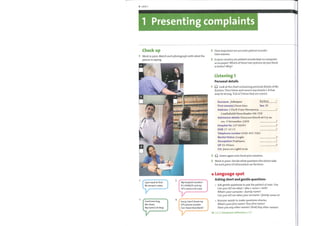
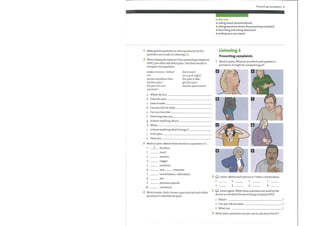
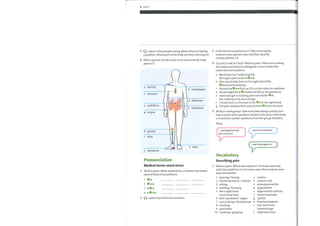
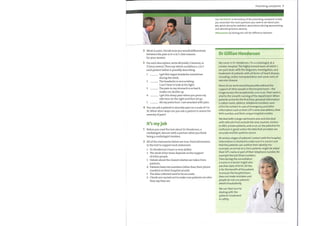
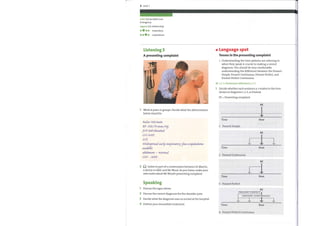
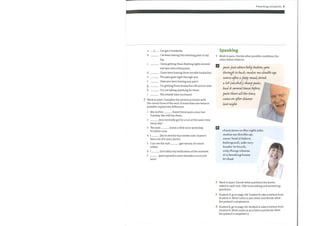
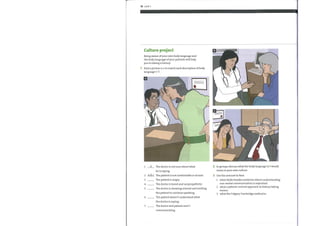
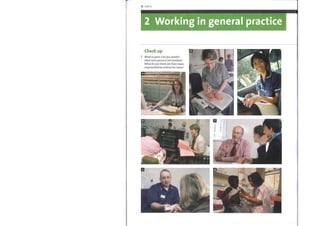
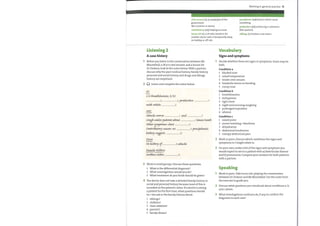
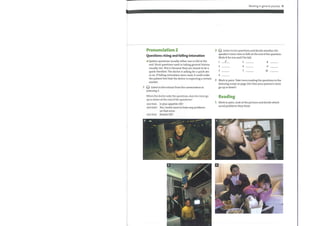
![18 Unit 2
deprivation (n) poverty
factors (n) causes
incidence (n) occurrence
plateau (n) level
pronounced (adj) evident
social classes I and II (n) in the
classification of the population
for research purposes, the two
highest social classes
Social factors in general practice
Social deprivation is associated with
death from all causes. The most
pronounced effect is with circulatory
and other smoking-related diseases.
A similar trend is seen with infant
mortality, morbidity from chronic
illness (particularly musculoskeletal,
cardiovascular, and respiratory
conditions), and teenage pregnancy.
This is not a new problem, nor one
unique to the UK. It may partly be due
to smoking and eating habits, but this
disparity was in evidence 80y ago when
those of social classes I and II were
more likely to smoke, eat foods high in
saturated fats, and take less exercise.
Disparity in health is closely related to
income. In the UK, an proportion of
the population is now living on 50%
ofaverage income than 20y ago — the
mortality gap has grown proportionately.
This has an impact on general practice.
There is higher incidence ofillness
requirement for primary care team
services and the use ofout-of-hours
and A&E services amongst deprived
communities.
Other factors which have an effect
are homelessness, sleeping rough,
employment and unemployment,
divorce, and immigration status. The
adverse effects ofliving in temporary
accommodation are well documented.
For example, adults have a incidence
of depression than people ofsimilar
social standing in their own homes.
Children are less likely to receive their
immunizations, more likely to have
childhood accidents, and have higher
incidence ofminor and diarrhoeal
diseases. Among those sleeping rough,
poor diet, poor accommodation, and
lack ofaccess to medical services are
universal problems. A study done
in 1986 in London found one third
are psychotic, a quarter have severe
physical problems, and two-thirds have
no contact whatsoever with medical
services. Evidence shows that if services
are provided, homeless people will use
them.
The effects ofwork have been
compared to effects ofvitamins - we
need a certain amount to be healthy; then
there is a plateau, where extra doesn't
work, and too much is harmful.
2 Match the symbols or abbreviations in the text
to these words.
1 years 3 less than
2 increased/ increasing 4 leading to / resulting in
3 Work in pairs. Answer these questions.
1 What main social factors are given?
2 Can you give your own reasons whythose
in social classes I and II were more likely to smoke
80 years ago?
3 What reasons could you give for the increased
incidence of depression in those living in temporary
accommodation?
4 Why is poor diet a problem among those
sleeping rough?
4 In small groups, discuss whythe following maybe
higher among the unemployed or those under the
threat ofbeing unemployed in the UK: coronary
vascular disease, cancers, violence, accidents.
5 Discuss what the situation is like in your own country
in deprived areas.
1
Writing
A referral letter
Work in pairs. Look at the referral letter on page 19 written
by a GP to a specialist at a hospital for one ofher patients.
Tick the features of / points covered bythe letter.
2
3
4
5
6
7
8
9
12
13
[3
[3
C]
clear communication
date of referral
date of birth ofthe patient
hospital number
NHS number
patient's name and address
investigations performed with results
treatments tried with outcomes
relevant past medical history and family history
reason for referral
presenting condition
social circumstances
clear signature](https://image.slidesharecdn.com/libro-medicine-1-250504214809-83d092da/85/Libro-Medicine-practico-y-teorico-1-pdf-16-320.jpg)
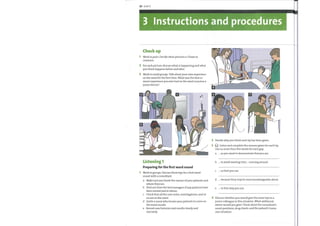
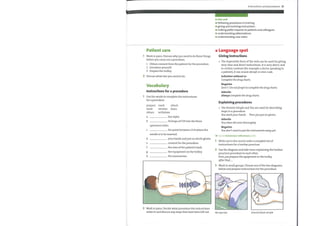
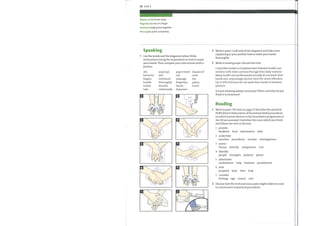
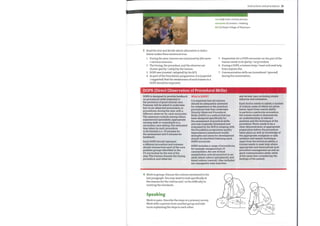
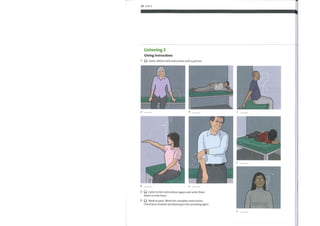
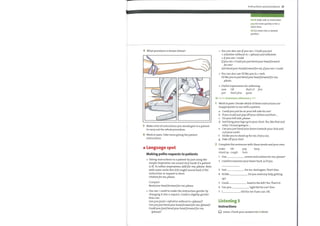
![26 Unit 3
portfolio (n) a comprehensive
record of your training, your
CV with your work record, proof
of qualifications, records of
presentations, appraisals, praise
like thankyou cards.
It's myjob
Read about Dr Franco Carulli. Find:
1 the name given to a medical team.
2 who supervises the practical procedures junior
doctors perform.
3 who leads the daily ward rounds.
Dr Franco Carulli
I am newly qualified. I work as a junior doctor at Alderbay
General Hospital as part ofa medical team, or 'firm'. I
work with two otherjunior doctors also in the first year of
postgraduate training. Our main aim is to learn as much
as possible from our seniors. The first people we turn
to are two doctors in their second year oftraining. They
supervise any practical procedures we do and are available
to help us when we have problems.
Above these senior doctors there are specialist registra rs.
They are usually in charge of daily ward rounds.They also
work in outpatient clinics, deal with inpatient referrals,
teach, and undertake procedures and operations.They
give us instructions about what investigations need to be
performed. Specialist registrars are training posts for the
next grade up, consultant level. They can be bleeped at any
time if we need advice or to refer a patient. If nobody at
these two levels is available, we refer to the consultants
who are responsible for our posts.
We see each consultant when they do their weekly
ward rounds, once on a Wednesday and the other on a
Friday morning. These rounds are the most tense and
Speaking
It is important to be able to organize a case
presentation to your colleagues and to keep a record for
your portfolio. Work in groups. Discuss what happens
at each stage in the presentation checklist.
4 who deals with patient referrals.
5 who leads the weekly ward rounds.
6 whenthe busiest time ofthe week is.
7 who rewrites the drug charts.
hectic times each week, as we have to make sure all the
patient records are up-to-date and present patients to the
consultant. In addition to doctors at all levels ofthe firm,
there may be a nurse present, as well as undergraduate
students and doctors doing clinical attachments.
Myjob also involves a wide range of duties from clerking
patients, keeping the patient lists in order, requesting
investigations and making sure the results are received,
and referring and liaising with specialists
as part ofa multidisciplinary team, doing
practical proced u res, administrative tasks
like rewriting drug charts, and doingTTOs.
We have to keep our knowledge up-to-date
through training from our seniors and
keep a log or record of all the special
procedures we learn and cases we see.
We also have to find time for learning
to present cases to our peers and
other colleagues. I also find time
to talk to the patients and
their families!
Presentation checklist
C] Give a title
Present history and physical examination
Cl Invite suggestions for diagnosis and management
C] Give investigations and results
Ask for comments
Give the diagnosis
Ü Discuss subsequent management
Ü Summarize
Question and answer](https://image.slidesharecdn.com/libro-medicine-1-250504214809-83d092da/85/Libro-Medicine-practico-y-teorico-1-pdf-24-320.jpg)
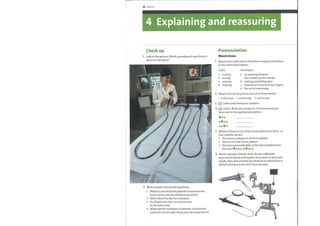
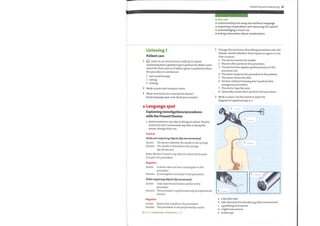
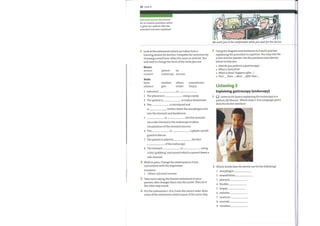
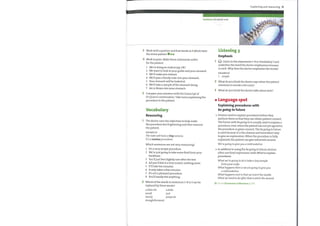
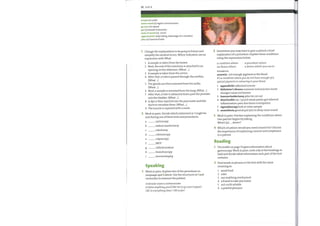
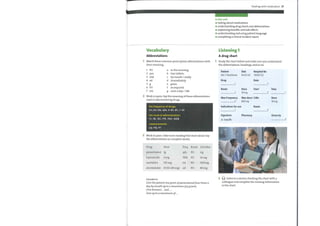
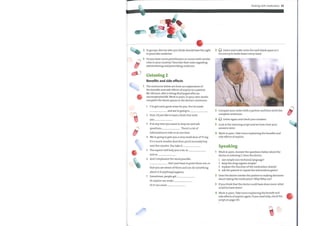
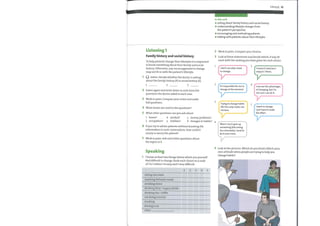
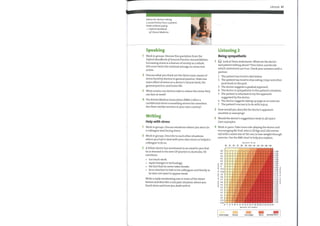
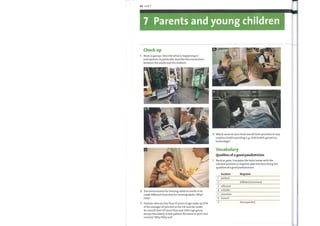
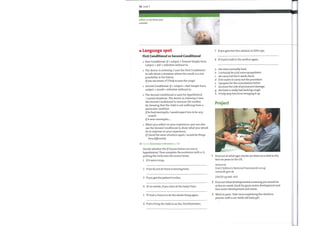
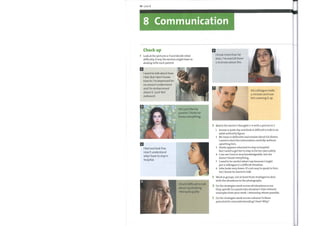
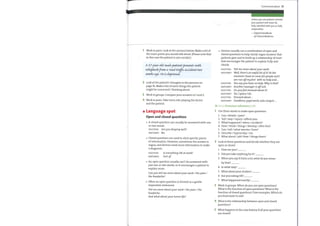
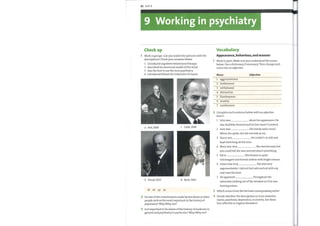
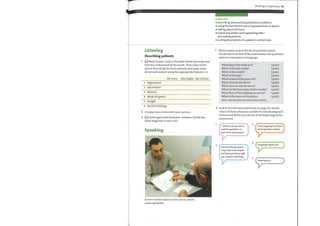
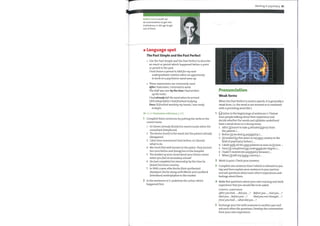
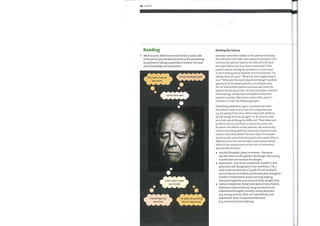
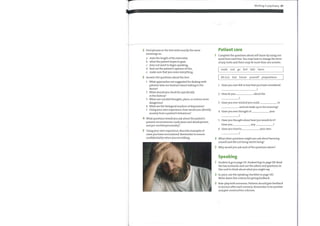
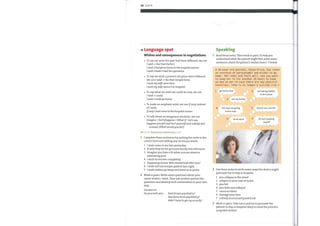
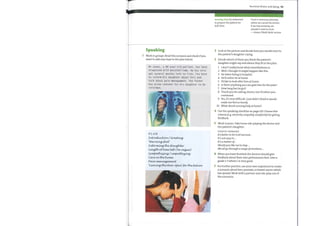
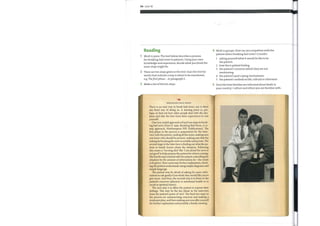
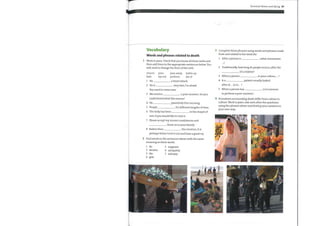
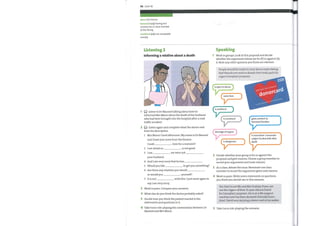
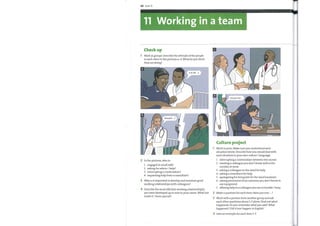
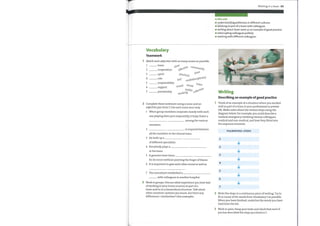
![3 Answer these questions.
1 What does Understands who needs what information
mean?
2 A doctor in training needs to show that he/she
appreciates the perspective of different disciplines
medical and non-medical. Give an example ofthis from
your own experience.
3 Give an example of a situation where you heeded the
views of others in a clinical or non-clinical setting.
Did you find it difficult or easy to accept the advice?
Give reasons for your answer.
4 Whyis it necessary to put the aims ofthe clinical
team first?
5 Why do you think that an atmosphere of open
communication should be encouraged within teams?
Give examples from your own experience.
Listening 1
Appropriate responses
(O Listen to seven statements by medical professionals
and decide what is happening, for example interrupting
a colleague. There maybe more than one activity
happening in each conversation.
(O Listen again and decide which ofthese is a more polite
2
response in each case.
3
4
Working in a team 101
Howwould you respond to each ofthe polite answers
you have chosen?
EXAMPLES
Thanksfor being so understanding.
That'sfine.
Thankyou.
Not at all.
That's really kind ofyou.
Mypleasure.
I hope it stays that way.
That would be great.
Howwould you respond to each ofthe impolite
answers?
C]
C]
C]
[3
I'm a bit tied up at the moment.
Yeah, sure. No problem.
Yes, by all means.
Mm. Haven't you got your own?
Oh, it happens to us all. I was late myself.
I know, and I wanted to get away ontime.
I've heard that one before.
What do you think I am, a machine?
I can do it in a few moments, if that's 0K.
Busy, but I am enjoying it, thank you.
It's horrible.
Oh, thank you. That's very kind ofyou.
Yeah, here, take that.
I was trying to have a rest.
That's 0K. It's not a problem. How can I help?](https://image.slidesharecdn.com/libro-medicine-1-250504214809-83d092da/85/Libro-Medicine-practico-y-teorico-1-pdf-99-320.jpg)
![102 Unit 11
o Language spot
Being polite
Asking for permission
If you are with a group of people, it's generally
o
more polite to ask permission to do something
rather than to just do what you want to do.
You think: I want to make a phone call.
Is it 0K ifI make a phone call?
You say:
Asking for help
Whenyou need help, it's generally more polite to
ask for help than to demand it.
You think: I need help lifting this.
You say: Wouldyou mind helping me lift this?
Offering help
Whenyou can see that someone needs help, it's
o
generally more polite to make your offer as a
question rather than a statement.
You think: Ican helpyou with that.
You say: Wouldyou like some help with that?
Go to Grammar reference p.130
Deciding howto approach different people for help or
to offer help in another language can be tricky. Decide
which ofthe two alternatives below is more polite.
1 Asking close colleagues if you can do something
a Is it 0Kif I open the window?
b C] I want to openthe window. 0K?
2 Asking close colleagues if you could do something
that is more personal
a Is your laptop free? I need it for a second.
b Do youthink I could possibly use your laptop?
3 Asking someone you do not knowvery well if you
could do something
a C] Would you mind if I borrowed this notepad?
b I want to borrow this notepad.
4 Interrupting colleagues you do not know well and
asking for help
a I know you're busy, but I need help.
b C] I'm sorry to disturb you, but could you help me
here?
5
6
7
Interrupting a colleague you know well
and asking for help
a Excuse me, but could you help mehere?
b Hi. I'd like some help here.
Interrupting by acknowledging what the person is
doing and then making a request
a I can see that you are very busy, but could you
help me?
b You look busy, but I need help.
Offering help to a colleague you do not know well
a C] Would you like me to help you?
b C] Here. Let me help you.
2 Complete the sentences by using a word or phrase
from each box below.
do you think is it 0K excuse me
would you mind I can see sorry to
closed
clear
I'm
bother
use
writing come and have
you, but could
1
2
3
4
you give me a hand?
, but could you
a look at this?
very much if I
the door as there's a draught?
that you are
up your notes, but can I just check something
with you?
5
off the table?
6
if I
I could possibly
the things
your office for this afternoon?](https://image.slidesharecdn.com/libro-medicine-1-250504214809-83d092da/85/Libro-Medicine-practico-y-teorico-1-pdf-100-320.jpg)