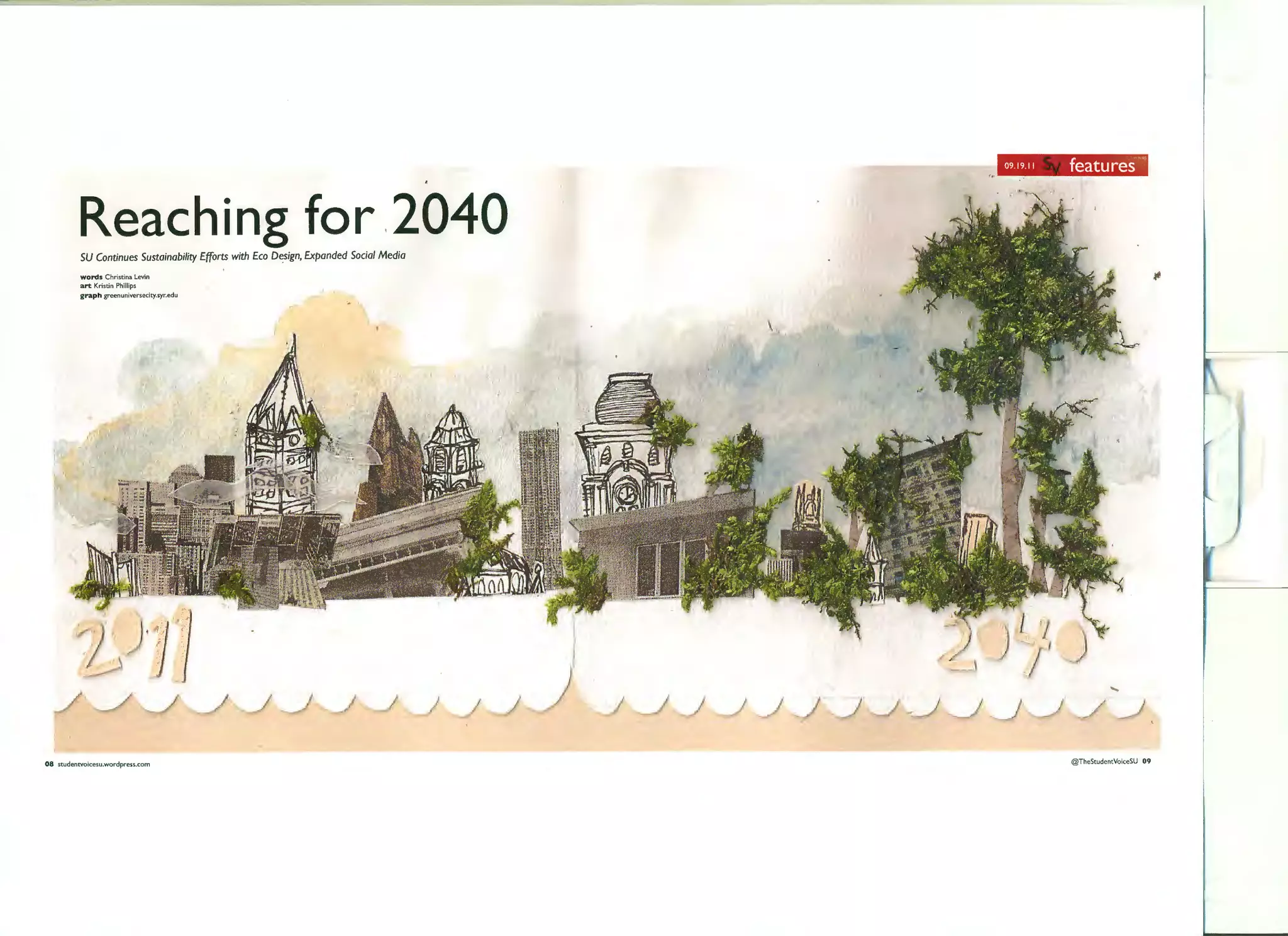
Reaching for 2040SU Continues Sustainability Efforts with Eco D~sign, Expanded Social Media
words Christina Levin
art Kristin Phillips
graph greenuniversecity.syr.edu
·y;J
08 studentvoicesu.wordpress.com
"~ ·
,....,
091911 features
:r'
...
@TheStudentVoiceSU 09
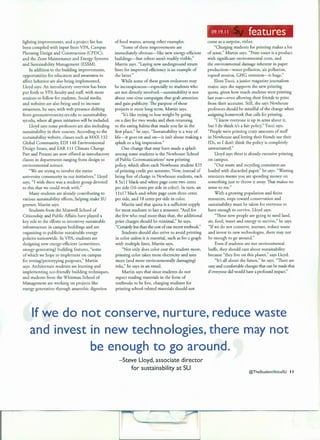
Ever since Chancellor Cantor signed the
American College and University Presidents'
Climate Commitment (ACUPCC) in 2007,
Syracuse University has been one of the largest
private universities in the nation to commit to
becoming carbon-neutral by 2040. The goal of
establishing climate neutrality, or producing
zero net greenhouse gas emissions, was outlined
in a timeline called the Climate Action Plan
(CAP) by September 2009, according to the
university's sustainability website.
Steve Lloyd, the associate director for
sustainability at SU and a member of the
Climate Action executive committee, said SU
is on track with CAP, advancing it toward the
target date.
"We can see 2040 from here even as we take
the first steps," he says.
The ACUPCC is a high-profile effort to
address global climate change undertaken by
a network of colleges and universities across
the United States that has made institutional
commitments to eliminate net greenhouse gas
emissions from specified campus operations,
according to its website. Its mission is to
accelerate progress toward climate neutrality and
sustainability by mobilizing the higher education
sector to educate students, create solutions, and
provide leadership-by-example for the rest of
society. As ofSept. 1Oth, 2011 , there are 670
signatories, according to the website.
"It's lil<e trying to lose weight
by going on a diet for two
weel<s and then returning to
the eating habits that made
you fat in the first place"
-Rick Martin, SU's principal
sustainability analyst
Rick Martin, principal sustainability
analyst who has led SU's efforts to complete
the greenhouse gas inventory required by
ACUPCC, says that all of the resources the
society depends on are finite, and the side-
effects--climate change, resource depletion,
pollution of precious freshwater, erosion and
salinization of topsoil-ofconsuming at the
same pace we have been in the past century or
so are too perilous.
"Because our society needs to learn to 'live
smart,' colleges and universities (including SU)
have a responsibility to take a leading role," he
says. "After all, 'learning' and 'smart' are kind of
our main line of business. And helping not just
our students, but society as a whole, to learn
and improve is what Scholarship in Action is
all about."
The university is currently working on
improving its central heating plant, the
efficiency of campus buildings, and its
transportation infrastructure, Martin says.
The College ofVisual and Performing
Arts was the first group to be selected for
participation in CAP, Lloyd says. Its buildings
have already been audited for energy and
SU's GHG Emissions over Time
140000
120000
100000
80000 BAU (gross)
60000
40000
CAP (gross)
20000 CAP (net)
0
'I('"" Lt') en M ...... 'I('"" Lt') en M ......
0 0 0 'I('"" 'I('"" N N N M M
10
0 0 0 0 0 0 0 0 0 0
N N N N N N N N N N
__,__........'""'l'iii~r
lighting improvements, and a project list has
been compiled with input from VPA, Campus
Planning Design and Construction (CPDC),
and the Zone Maintenance and Energy Systems
and Sustainability Management (ESSM).
In addition to the building improvements,
opportunities for education and awareness to
affect behavior are also being implemented,
Lloyd says. An introductory overview has been
put forth to VPA faculty and staff, with more
sessions to follow for students. Social media
and websites are also being used to increase
awareness, he says, with web presence shifting
from greenuniversecity.syr.edu to sustainability.
syr.edu, where all green initiatives will be included.
Lloyd says some professors are also including
sustainability in their courses. According to the
sustainability website, classes such as MAX 132
Global Community, EDI 148 Environmental
Design Issues, and EAR 111 Climate Change
Past and Present are now offered as introductory
classes in departments ranging from design to
environmental science.
"We are trying to involve the entire
university community in our initiatives," Lloyd
says. "I wish there was a student group devoted
to this that we could work with."
Many students are already contributing to
various sustainability efforts, helping make SU
greener, Martin says.
Students from the Maxwell School of
Citizenship and Public Affairs have played a
key role to the efforts to inventory sustainable
infrastructure in campus buildings and are
organizing to publicize sustainable energy
policies nationwide. In VPA, students are
designing new energy-efficient (sometimes,
energy-generating) building features, "some
ofwhich we hope to implement on campus
for testing/prototyping purposes," Martin
says. Architecture students are learning and
implementing eco-friendly building techniques,
and students from the Whitman School of
Management are working on projects like
energy generation through anaerobic digestion
of food wastes, among other examples.
"Some of these improvements are
immediately obvious-like new energy-efficient
buildings-but others aren't readily visible,"
Martin says. "Laying new underground steam
lines for improved efficiency is an example of
the latter."
While some of these green endeavors may
be inconspicuous-especially to students who
are not directly involved-sustainability is not
about one-time campaigns that grab attention
and gain publicity. The purpose of these
projects is more long-term, Martin says.
"It's like trying to lose weight by going
on a diet for two weeks and then returning
to the eating habits that made you fat in the
first place," he says. "Sustainability is a way of
life-it goes on and on-it isn't about making a
splash or a big impression."
One change that may have made a splash
among some students is the Newhouse School
of Public Communications' new printing
policy, which allots each Newhouse student $25
of printing credit per semester. Now, instead of
being free of charge to Newhouse students, each
8.5x11 black-and-white page costs two cents
per side (16 cents per side in color). In turn, an
11x17 black-and-white page costs three cents
per side, and 18 cents per side in color.
Martin said that quota is a sufficient supply
for most students to last a semester. "And for
the few who read more than that, the additional
print charges should be minimal," he says.
"Certainly less than the cost ofone recent textbook"
Students should also strive to avoid printing
in color unless it is essential, such as for a graph
with multiple lines, Martin says.
"Nor only does color cost the student more,
printing color takes more electricity and uses
more (and more environmentally damaging)
inks," he says in an email.
Martin says that since students do nor
expect reading materials in the form of
textbooks to be free, charging students for
printing school-related materials should not
o9.19.11 features
come as a surprise, either.
"Charging students for printing makes a lor
of sense," Martin says. "Print toner is a product
with significant environmental costs, and
the environmental damage inherent in paper
production-water pollution, air pollution,
topsoil erosion, GHG emission-is huge."
Elora Tocci, a junior magazine journalism
major, says she supports the new printing
quota, given how much students were printing
last year-even allowing their friends to print
from their accounts. Still, she says Newhouse
professors should be mindful of the change when
assigning homework that calls for printing.
"I know everyone is up in arms about it,
bur I do think it's a fair policy," Tocci says.
"People were printing crazy amounts of stuff
in Newhouse and letting their friends use their
IDs, so I don't think the policy is completely
unwarranted."
Lloyd says there is already excessive printing
on campus.
"Our waste and recycling containers are
loaded with discarded paper," he says. "Wasting
resources means you are spending money on
something just to throw it away. That makes no
sense to me."
With a growing population and finite
resources, steps toward conservation and
sustainability must be taken for everyone to
have enough to survive, Lloyd says.
"These new people are going to need land,
air, food, water and energy to survive," he says.
"Ifwe do not conserve, nurture, reduce waste
and invest in new technologies, there may not
be enough to go around."
Even if students are not environmental
buffs, they should care about sustainability
because "they live on this planet," says Lloyd.
"It's all about the future," he says. "There are
easy and comfortable changes that can be made that
ifeveryone did would have a profound impact."
If we do not conserve, nurture, reduce waste
and invest in new technologies, there may not
be enough to go around.
-Steve Lloyd, associate director
for sustainability at SU
@TheStudentVoiceSU I I

LEVIN - Student Voice - September 2011

  • 1.
    Reaching for 2040SUContinues Sustainability Efforts with Eco D~sign, Expanded Social Media words Christina Levin art Kristin Phillips graph greenuniversecity.syr.edu ·y;J 08 studentvoicesu.wordpress.com "~ · ,...., 091911 features :r' ... @TheStudentVoiceSU 09
  • 2.
    Ever since ChancellorCantor signed the American College and University Presidents' Climate Commitment (ACUPCC) in 2007, Syracuse University has been one of the largest private universities in the nation to commit to becoming carbon-neutral by 2040. The goal of establishing climate neutrality, or producing zero net greenhouse gas emissions, was outlined in a timeline called the Climate Action Plan (CAP) by September 2009, according to the university's sustainability website. Steve Lloyd, the associate director for sustainability at SU and a member of the Climate Action executive committee, said SU is on track with CAP, advancing it toward the target date. "We can see 2040 from here even as we take the first steps," he says. The ACUPCC is a high-profile effort to address global climate change undertaken by a network of colleges and universities across the United States that has made institutional commitments to eliminate net greenhouse gas emissions from specified campus operations, according to its website. Its mission is to accelerate progress toward climate neutrality and sustainability by mobilizing the higher education sector to educate students, create solutions, and provide leadership-by-example for the rest of society. As ofSept. 1Oth, 2011 , there are 670 signatories, according to the website. "It's lil<e trying to lose weight by going on a diet for two weel<s and then returning to the eating habits that made you fat in the first place" -Rick Martin, SU's principal sustainability analyst Rick Martin, principal sustainability analyst who has led SU's efforts to complete the greenhouse gas inventory required by ACUPCC, says that all of the resources the society depends on are finite, and the side- effects--climate change, resource depletion, pollution of precious freshwater, erosion and salinization of topsoil-ofconsuming at the same pace we have been in the past century or so are too perilous. "Because our society needs to learn to 'live smart,' colleges and universities (including SU) have a responsibility to take a leading role," he says. "After all, 'learning' and 'smart' are kind of our main line of business. And helping not just our students, but society as a whole, to learn and improve is what Scholarship in Action is all about." The university is currently working on improving its central heating plant, the efficiency of campus buildings, and its transportation infrastructure, Martin says. The College ofVisual and Performing Arts was the first group to be selected for participation in CAP, Lloyd says. Its buildings have already been audited for energy and SU's GHG Emissions over Time 140000 120000 100000 80000 BAU (gross) 60000 40000 CAP (gross) 20000 CAP (net) 0 'I('"" Lt') en M ...... 'I('"" Lt') en M ...... 0 0 0 'I('"" 'I('"" N N N M M 10 0 0 0 0 0 0 0 0 0 0 N N N N N N N N N N __,__........'""'l'iii~r
  • 3.
    lighting improvements, anda project list has been compiled with input from VPA, Campus Planning Design and Construction (CPDC), and the Zone Maintenance and Energy Systems and Sustainability Management (ESSM). In addition to the building improvements, opportunities for education and awareness to affect behavior are also being implemented, Lloyd says. An introductory overview has been put forth to VPA faculty and staff, with more sessions to follow for students. Social media and websites are also being used to increase awareness, he says, with web presence shifting from greenuniversecity.syr.edu to sustainability. syr.edu, where all green initiatives will be included. Lloyd says some professors are also including sustainability in their courses. According to the sustainability website, classes such as MAX 132 Global Community, EDI 148 Environmental Design Issues, and EAR 111 Climate Change Past and Present are now offered as introductory classes in departments ranging from design to environmental science. "We are trying to involve the entire university community in our initiatives," Lloyd says. "I wish there was a student group devoted to this that we could work with." Many students are already contributing to various sustainability efforts, helping make SU greener, Martin says. Students from the Maxwell School of Citizenship and Public Affairs have played a key role to the efforts to inventory sustainable infrastructure in campus buildings and are organizing to publicize sustainable energy policies nationwide. In VPA, students are designing new energy-efficient (sometimes, energy-generating) building features, "some ofwhich we hope to implement on campus for testing/prototyping purposes," Martin says. Architecture students are learning and implementing eco-friendly building techniques, and students from the Whitman School of Management are working on projects like energy generation through anaerobic digestion of food wastes, among other examples. "Some of these improvements are immediately obvious-like new energy-efficient buildings-but others aren't readily visible," Martin says. "Laying new underground steam lines for improved efficiency is an example of the latter." While some of these green endeavors may be inconspicuous-especially to students who are not directly involved-sustainability is not about one-time campaigns that grab attention and gain publicity. The purpose of these projects is more long-term, Martin says. "It's like trying to lose weight by going on a diet for two weeks and then returning to the eating habits that made you fat in the first place," he says. "Sustainability is a way of life-it goes on and on-it isn't about making a splash or a big impression." One change that may have made a splash among some students is the Newhouse School of Public Communications' new printing policy, which allots each Newhouse student $25 of printing credit per semester. Now, instead of being free of charge to Newhouse students, each 8.5x11 black-and-white page costs two cents per side (16 cents per side in color). In turn, an 11x17 black-and-white page costs three cents per side, and 18 cents per side in color. Martin said that quota is a sufficient supply for most students to last a semester. "And for the few who read more than that, the additional print charges should be minimal," he says. "Certainly less than the cost ofone recent textbook" Students should also strive to avoid printing in color unless it is essential, such as for a graph with multiple lines, Martin says. "Nor only does color cost the student more, printing color takes more electricity and uses more (and more environmentally damaging) inks," he says in an email. Martin says that since students do nor expect reading materials in the form of textbooks to be free, charging students for printing school-related materials should not o9.19.11 features come as a surprise, either. "Charging students for printing makes a lor of sense," Martin says. "Print toner is a product with significant environmental costs, and the environmental damage inherent in paper production-water pollution, air pollution, topsoil erosion, GHG emission-is huge." Elora Tocci, a junior magazine journalism major, says she supports the new printing quota, given how much students were printing last year-even allowing their friends to print from their accounts. Still, she says Newhouse professors should be mindful of the change when assigning homework that calls for printing. "I know everyone is up in arms about it, bur I do think it's a fair policy," Tocci says. "People were printing crazy amounts of stuff in Newhouse and letting their friends use their IDs, so I don't think the policy is completely unwarranted." Lloyd says there is already excessive printing on campus. "Our waste and recycling containers are loaded with discarded paper," he says. "Wasting resources means you are spending money on something just to throw it away. That makes no sense to me." With a growing population and finite resources, steps toward conservation and sustainability must be taken for everyone to have enough to survive, Lloyd says. "These new people are going to need land, air, food, water and energy to survive," he says. "Ifwe do not conserve, nurture, reduce waste and invest in new technologies, there may not be enough to go around." Even if students are not environmental buffs, they should care about sustainability because "they live on this planet," says Lloyd. "It's all about the future," he says. "There are easy and comfortable changes that can be made that ifeveryone did would have a profound impact." If we do not conserve, nurture, reduce waste and invest in new technologies, there may not be enough to go around. -Steve Lloyd, associate director for sustainability at SU @TheStudentVoiceSU I I