Anggrita Cahyaningtyas,
Natasha Elkington
Demystifying
communication
By Anggrita Cahyaningtyas, Natasha Elkington
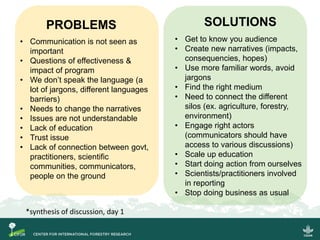
PROBLEMS
• Communication is not seen as
important
• Questions of effectiveness &
impact of program
• We don’t speak the language (a
lot of jargons, different languages
barriers)
• Needs to change the narratives
• Issues are not understandable
• Lack of education
• Trust issue
• Lack of connection between govt,
practitioners, scientific
communities, communicators,
people on the ground
SOLUTIONS
• Get to know you audience
• Create new narratives (impacts,
consequencies, hopes)
• Use more familiar words, avoid
jargons
• Find the right medium
• Need to connect the different
silos (ex. agriculture, forestry,
environment)
• Engage right actors
(communicators should have
access to various discussions)
• Scale up education
• Start doing action from ourselves
• Scientists/practitioners involved
in reporting
• Stop doing business as usual
*synthesis of discussion, day 1
Engaging audience for
impact
By Anggrita Cahyaningtyas, Natasha Elkington
Environmental issues: big problem built over
small habits
Putting human factor and interaction in
environmental issues
WHAT KIND OF STORIES OF ENVIRONMENT
YOU WANT TO SEE?
Group 1 (Yishak Dinku, Hailemariam Kibret, Yimer
Dawud, Tesfaye Gonfa)
• Forested areas and heavily forested areas
• Talk to families that lives there about their livelihood
• What are lacking from their lives?
• What’s the benefit of forest?
• Talk to experts
Group 2 (Beyene Engidaw Semayat, Endale Zewdie,
Hiwot Workagegnehu)
Story 1
• Integrated landuse planning in the country
• Story of importance of having integration
• Competing sectors have similar goals at the end of the day
(forestry, agriculture, animal husbandry)
• Impact oriented story for govt
Story 2
• Natural forest conservation and human health
• Bringing stories of individuals who make changes (ex: story
about monk who do restoration)
• Show interconnectedness between nature & human health
Story ideas group 3 (Daniel Amare, Lemlem Tajebe,
Talemos Data)
• Relationship between environment and people
• Environment is calling us
• Stories from Tigray and Dirdawe
• Lady who put her effort to create farming land by
taking soil from her neighbor
• Guy who make greener area in deserted place
• Ask people what they feel about degradation
• Experts give commentaries about the importance of
environment
• We want to see clean & sustainable environment
Story ideas group 4-Highlighting success stories coming from
small scale interventions (Kassahun Chanie, Asfaw Mariame,
Adefires Worku)
Story 1: Humbo
• Humbo case where they have carbon credit project
• Communal land owned by 70 members
• Land is regraded, landslide during the rainy season
• Community participations restored land in short time
• Now people getting carbon credit and create different business and
Story 2: Debreberhan in Amhara Region
• Person who try to plant trees, there is resistance from the
community
• Love the community and environment will bring change
• Farming and livelihood are thriving
Group 5 (Abeje Eshete, Tesfaye Gashaw, Mengisteab
Teshome, Shibre Bekele)
Story 1:
• Land use in the area is changed from smallholder area to
charcoal business
• Smoke problem
• Business need to also think of environmental consequences
and how it affects other people
Story 2
• Share company taking advantage from people,
• Taking people’s lives and house
• Waste problems in river
• We have to invest but in what expense we are investing?
Shifting attitudes and
mindsets
Learning from the younger generation movement
By Anggrita Cahyaningtyas, Natasha Elkington
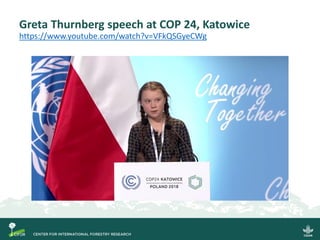
Greta Thurnberg speech at COP 24, Katowice
https://www.youtube.com/watch?v=VFkQSGyeCWg
What works in the movement started by Greta
Thunberg?
• Talks about impact, questioning the future of children→
very impactful & awakening for parents and adults
• It touches the heart
• Women and children are the first victims, Greta are both girl &
children
• Relate the issue to wider scale of damage caused by action of
the people
• Tenacity & resistance
• even when asked to stop by Prime Minister
• Honesty
• Clarity
What works in the movement started by Greta
Thunberg?
• Bravery
• to reach out to key actors and talk about sensitive issues
• to address the imbalance between the poor and the
privileged
• Right message at the right place to right audience
• Her audience is world leaders
• She does not put the blame on other people
• She puts human touch in the speech (addressing the
leader as her fathers and mothers)
How to participate in the movement?
• Warn wider public in conservation, development
• Impact of degradation, reverse impact, social circles
• Use public figure to talk about climate restoration
• Join the movement on social media
• Getting church into the movement
• Also be brave to address the issue in where you work
• Putting stories of children in Ethiopia related to forest
and climate change, because it’s their future too
Multimedia storytelling
What works and what not
By Anggrita Cahyaningtyas, Natasha Elkington
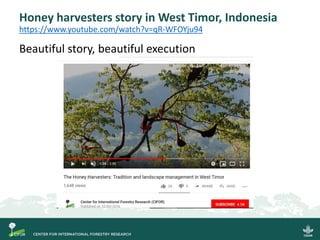
Honey harvesters story in West Timor, Indonesia
https://www.youtube.com/watch?v=qR-WFOYju94
Beautiful story, beautiful execution
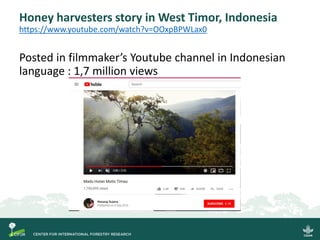
Honey harvesters story in West Timor, Indonesia
https://www.youtube.com/watch?v=OOxpBPWLax0
Posted in filmmaker’s Youtube channel in Indonesian
language : 1,7 million views
Honey harvesters story in West Timor, Indonesia
What works:
• Beautiful shots
• It captures attention
• We let the sound and picture tell the story
• It shows people respecting nature
What can be better:
• Sometimes text is distracting
• Need good narration for visually impaired
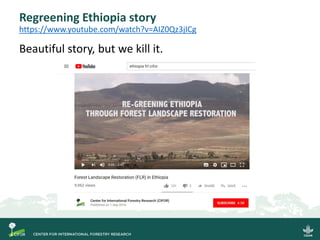
Regreening Ethiopia story
https://www.youtube.com/watch?v=AIZ0Qz3jICg
Beautiful story, but we kill it.
Regreening Ethiopia story
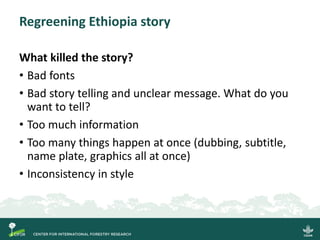
What killed the story?
• Bad fonts
• Bad story telling and unclear message. What do you
want to tell?
• Too much information
• Too many things happen at once (dubbing, subtitle,
name plate, graphics all at once)
• Inconsistency in style
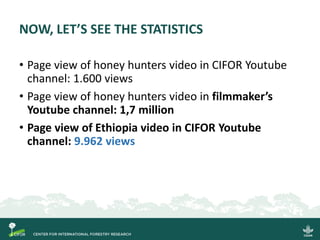
NOW, LET’S SEE THE STATISTICS
• Page view of honey hunters video in CIFOR Youtube
channel: 1.600 views
• Page view of honey hunters video in filmmaker’s
Youtube channel: 1,7 million
• Page view of Ethiopia video in CIFOR Youtube
channel: 9.962 views
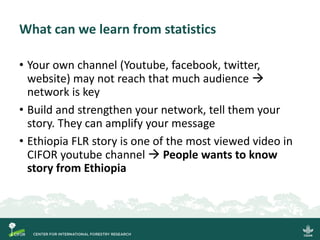
What can we learn from statistics
• Your own channel (Youtube, facebook, twitter,
website) may not reach that much audience →
network is key
• Build and strengthen your network, tell them your
story. They can amplify your message
• Ethiopia FLR story is one of the most viewed video in
CIFOR youtube channel → People wants to know
story from Ethiopia
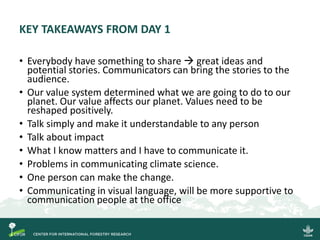
KEY TAKEAWAYS FROM DAY 1
• Everybody have something to share → great ideas and
potential stories. Communicators can bring the stories to the
audience.
• Our value system determined what we are going to do to our
planet. Our value affects our planet. Values need to be
reshaped positively.
• Talk simply and make it understandable to any person
• Talk about impact
• What I know matters and I have to communicate it.
• Problems in communicating climate science.
• One person can make the change.
• Communicating in visual language, will be more supportive to
communication people at the office
KEY TAKEAWAYS FROM DAY 1
• Many ideas are generated for upcoming program for radio
• Learn how to communicate climate change and forest to
other, got ideas for documentary program
• Learn the power of words from the blind man video
• How we craft the message
• Change is coming. Decision must be made
• How to develop good stories and messages
• Learn strong message from Greta: if we love others and
give real and honest message, it will spread further
KEY TAKEAWAYS FROM DAY 1
• How to simplify science for audience
• Importance of simple words to communicate
• Talk clearly, to the point, using simple and understandable
words
• Very different approach of communication training, very
simple and understandable
• The need of understanding of values of your self, your
peer, your people, your audience (policy makers,
researchers, etc) and associating them to the programs,
works.
• We tend to take what we have for granted.
• Environment is not in the agenda of media, government,
because even the government does not understand.
TAG US
Twitter:
@Indianmaasai
@rain_shaman
@CIFOR
Facebook
• CIFOR (Center for International Forestry Research)
Presenting research and
ideas, simply
Some tips
By Anggrita Cahyaningtyas, Natasha Elkington
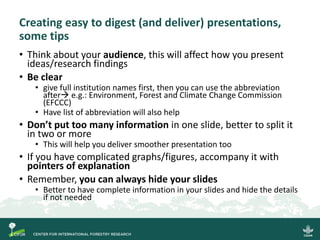
Creating easy to digest (and deliver) presentations,
some tips
• Think about your audience, this will affect how you present
ideas/research findings
• Be clear
• give full institution names first, then you can use the abbreviation
after→ e.g.: Environment, Forest and Climate Change Commission
(EFCCC)
• Have list of abbreviation will also help
• Don’t put too many information in one slide, better to split it
in two or more
• This will help you deliver smoother presentation too
• If you have complicated graphs/figures, accompany it with
pointers of explanation
• Remember, you can always hide your slides
• Better to have complete information in your slides and hide the details
if not needed
Social Media
Some tips
By Anggrita Cahyaningtyas, Natasha Elkington
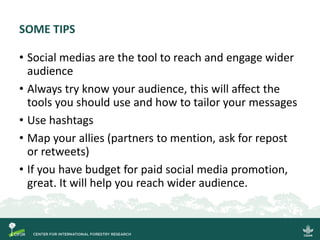
SOME TIPS
• Social medias are the tool to reach and engage wider
audience
• Always try know your audience, this will affect the
tools you should use and how to tailor your messages
• Use hashtags
• Map your allies (partners to mention, ask for repost
or retweets)
• If you have budget for paid social media promotion,
great. It will help you reach wider audience.
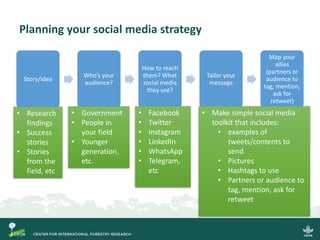
Story/idea
Who’s your
audience?
How to reach
them? What
social media
they use?
Tailor your
message
Map your
allies
(partners or
audience to
tag, mention,
ask for
retweet)
Planning your social media strategy
• Research
findings
• Success
stories
• Stories
from the
field, etc
• Government
• People in
your field
• Younger
generation,
etc.
• Facebook
• Twitter
• Instagram
• LinkedIn
• WhatsApp
• Telegram,
etc
• Make simple social media
toolkit that includes:
• examples of
tweets/contents to
send
• Pictures
• Hashtags to use
• Partners or audience to
tag, mention, ask for
retweet

Let's talk trees

  • 1.
  • 2.
  • 3.
    PROBLEMS • Communication isnot seen as important • Questions of effectiveness & impact of program • We don’t speak the language (a lot of jargons, different languages barriers) • Needs to change the narratives • Issues are not understandable • Lack of education • Trust issue • Lack of connection between govt, practitioners, scientific communities, communicators, people on the ground SOLUTIONS • Get to know you audience • Create new narratives (impacts, consequencies, hopes) • Use more familiar words, avoid jargons • Find the right medium • Need to connect the different silos (ex. agriculture, forestry, environment) • Engage right actors (communicators should have access to various discussions) • Scale up education • Start doing action from ourselves • Scientists/practitioners involved in reporting • Stop doing business as usual *synthesis of discussion, day 1
  • 4.
    Engaging audience for impact ByAnggrita Cahyaningtyas, Natasha Elkington
  • 5.
    Environmental issues: bigproblem built over small habits Putting human factor and interaction in environmental issues WHAT KIND OF STORIES OF ENVIRONMENT YOU WANT TO SEE?
  • 6.
    Group 1 (YishakDinku, Hailemariam Kibret, Yimer Dawud, Tesfaye Gonfa) • Forested areas and heavily forested areas • Talk to families that lives there about their livelihood • What are lacking from their lives? • What’s the benefit of forest? • Talk to experts
  • 7.
    Group 2 (BeyeneEngidaw Semayat, Endale Zewdie, Hiwot Workagegnehu) Story 1 • Integrated landuse planning in the country • Story of importance of having integration • Competing sectors have similar goals at the end of the day (forestry, agriculture, animal husbandry) • Impact oriented story for govt Story 2 • Natural forest conservation and human health • Bringing stories of individuals who make changes (ex: story about monk who do restoration) • Show interconnectedness between nature & human health
  • 8.
    Story ideas group3 (Daniel Amare, Lemlem Tajebe, Talemos Data) • Relationship between environment and people • Environment is calling us • Stories from Tigray and Dirdawe • Lady who put her effort to create farming land by taking soil from her neighbor • Guy who make greener area in deserted place • Ask people what they feel about degradation • Experts give commentaries about the importance of environment • We want to see clean & sustainable environment
  • 9.
    Story ideas group4-Highlighting success stories coming from small scale interventions (Kassahun Chanie, Asfaw Mariame, Adefires Worku) Story 1: Humbo • Humbo case where they have carbon credit project • Communal land owned by 70 members • Land is regraded, landslide during the rainy season • Community participations restored land in short time • Now people getting carbon credit and create different business and Story 2: Debreberhan in Amhara Region • Person who try to plant trees, there is resistance from the community • Love the community and environment will bring change • Farming and livelihood are thriving
  • 10.
    Group 5 (AbejeEshete, Tesfaye Gashaw, Mengisteab Teshome, Shibre Bekele) Story 1: • Land use in the area is changed from smallholder area to charcoal business • Smoke problem • Business need to also think of environmental consequences and how it affects other people Story 2 • Share company taking advantage from people, • Taking people’s lives and house • Waste problems in river • We have to invest but in what expense we are investing?
  • 11.
    Shifting attitudes and mindsets Learningfrom the younger generation movement By Anggrita Cahyaningtyas, Natasha Elkington
  • 12.
    Greta Thurnberg speechat COP 24, Katowice https://www.youtube.com/watch?v=VFkQSGyeCWg
  • 13.
    What works inthe movement started by Greta Thunberg? • Talks about impact, questioning the future of children→ very impactful & awakening for parents and adults • It touches the heart • Women and children are the first victims, Greta are both girl & children • Relate the issue to wider scale of damage caused by action of the people • Tenacity & resistance • even when asked to stop by Prime Minister • Honesty • Clarity
  • 14.
    What works inthe movement started by Greta Thunberg? • Bravery • to reach out to key actors and talk about sensitive issues • to address the imbalance between the poor and the privileged • Right message at the right place to right audience • Her audience is world leaders • She does not put the blame on other people • She puts human touch in the speech (addressing the leader as her fathers and mothers)
  • 15.
    How to participatein the movement? • Warn wider public in conservation, development • Impact of degradation, reverse impact, social circles • Use public figure to talk about climate restoration • Join the movement on social media • Getting church into the movement • Also be brave to address the issue in where you work • Putting stories of children in Ethiopia related to forest and climate change, because it’s their future too
  • 16.
    Multimedia storytelling What worksand what not By Anggrita Cahyaningtyas, Natasha Elkington
  • 17.
    Honey harvesters storyin West Timor, Indonesia https://www.youtube.com/watch?v=qR-WFOYju94 Beautiful story, beautiful execution
  • 18.
    Honey harvesters storyin West Timor, Indonesia https://www.youtube.com/watch?v=OOxpBPWLax0 Posted in filmmaker’s Youtube channel in Indonesian language : 1,7 million views
  • 19.
    Honey harvesters storyin West Timor, Indonesia What works: • Beautiful shots • It captures attention • We let the sound and picture tell the story • It shows people respecting nature What can be better: • Sometimes text is distracting • Need good narration for visually impaired
  • 20.
  • 21.
    Regreening Ethiopia story Whatkilled the story? • Bad fonts • Bad story telling and unclear message. What do you want to tell? • Too much information • Too many things happen at once (dubbing, subtitle, name plate, graphics all at once) • Inconsistency in style
  • 22.
    NOW, LET’S SEETHE STATISTICS • Page view of honey hunters video in CIFOR Youtube channel: 1.600 views • Page view of honey hunters video in filmmaker’s Youtube channel: 1,7 million • Page view of Ethiopia video in CIFOR Youtube channel: 9.962 views
  • 23.
    What can welearn from statistics • Your own channel (Youtube, facebook, twitter, website) may not reach that much audience → network is key • Build and strengthen your network, tell them your story. They can amplify your message • Ethiopia FLR story is one of the most viewed video in CIFOR youtube channel → People wants to know story from Ethiopia
  • 24.
    KEY TAKEAWAYS FROMDAY 1 • Everybody have something to share → great ideas and potential stories. Communicators can bring the stories to the audience. • Our value system determined what we are going to do to our planet. Our value affects our planet. Values need to be reshaped positively. • Talk simply and make it understandable to any person • Talk about impact • What I know matters and I have to communicate it. • Problems in communicating climate science. • One person can make the change. • Communicating in visual language, will be more supportive to communication people at the office
  • 25.
    KEY TAKEAWAYS FROMDAY 1 • Many ideas are generated for upcoming program for radio • Learn how to communicate climate change and forest to other, got ideas for documentary program • Learn the power of words from the blind man video • How we craft the message • Change is coming. Decision must be made • How to develop good stories and messages • Learn strong message from Greta: if we love others and give real and honest message, it will spread further
  • 26.
    KEY TAKEAWAYS FROMDAY 1 • How to simplify science for audience • Importance of simple words to communicate • Talk clearly, to the point, using simple and understandable words • Very different approach of communication training, very simple and understandable • The need of understanding of values of your self, your peer, your people, your audience (policy makers, researchers, etc) and associating them to the programs, works. • We tend to take what we have for granted. • Environment is not in the agenda of media, government, because even the government does not understand.
  • 27.
  • 28.
    Presenting research and ideas,simply Some tips By Anggrita Cahyaningtyas, Natasha Elkington
  • 29.
    Creating easy todigest (and deliver) presentations, some tips • Think about your audience, this will affect how you present ideas/research findings • Be clear • give full institution names first, then you can use the abbreviation after→ e.g.: Environment, Forest and Climate Change Commission (EFCCC) • Have list of abbreviation will also help • Don’t put too many information in one slide, better to split it in two or more • This will help you deliver smoother presentation too • If you have complicated graphs/figures, accompany it with pointers of explanation • Remember, you can always hide your slides • Better to have complete information in your slides and hide the details if not needed
  • 30.
    Social Media Some tips ByAnggrita Cahyaningtyas, Natasha Elkington
  • 31.
    SOME TIPS • Socialmedias are the tool to reach and engage wider audience • Always try know your audience, this will affect the tools you should use and how to tailor your messages • Use hashtags • Map your allies (partners to mention, ask for repost or retweets) • If you have budget for paid social media promotion, great. It will help you reach wider audience.
  • 32.
    Story/idea Who’s your audience? How toreach them? What social media they use? Tailor your message Map your allies (partners or audience to tag, mention, ask for retweet) Planning your social media strategy • Research findings • Success stories • Stories from the field, etc • Government • People in your field • Younger generation, etc. • Facebook • Twitter • Instagram • LinkedIn • WhatsApp • Telegram, etc • Make simple social media toolkit that includes: • examples of tweets/contents to send • Pictures • Hashtags to use • Partners or audience to tag, mention, ask for retweet