- CS Nimisha Verma
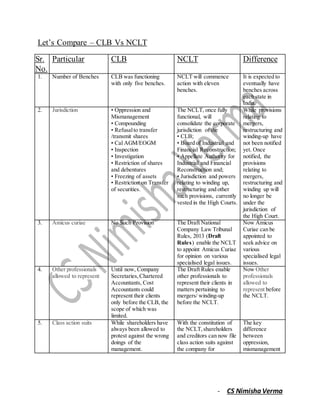
Let’s Compare – CLB Vs NCLT
Sr.
No.
Particular CLB NCLT Difference
1. Number of Benches CLB was functioning
with only five benches.
NCLT will commence
action with eleven
benches.
It is expected to
eventually have
benches across
each state in
India.
2. Jurisdiction • Oppression and
Mismanagement
• Compounding
• Refusalto transfer
/transmit shares
• Cal AGM/EOGM
• Inspection
• Investigation
• Restriction of shares
and debentures
• Freezing of assets
• Restriction on Transfer
of securities.
The NCLT, once fully
functional, will
consolidate the corporate
jurisdiction of the
• CLB;
• Board of Industrial and
Financial Reconstruction;
• Appellate Authority for
Industrial and Financial
Reconstruction and;
• Jurisdiction and powers
relating to winding up,
restructuring and other
such provisions, currently
vested in the High Courts.
While provisions
relating to
mergers,
restructuring and
winding-up have
not been notified
yet. Once
notified, the
provisions
relating to
mergers,
restructuring and
winding up will
no longer be
under the
jurisdiction of
the High Court.
3. Amicus curiae No Such Provision The Draft National
Company Law Tribunal
Rules, 2013 (Draft
Rules) enable the NCLT
to appoint Amicus Curiae
for opinion on various
specialised legal issues.
Now Amicus
Curiae can be
appointed to
seek advice on
various
specialised legal
issues.
4. Other professionals
allowed to represent
Until now, Company
Secretaries,Chartered
Accountants, Cost
Accountants could
represent their clients
only before the CLB, the
scope of which was
limited.
The Draft Rules enable
other professionals to
represent their clients in
matters pertaining to
mergers/ winding-up
before the NCLT.
Now Other
professionals
allowed to
represent before
the NCLT.
5. Class action suits While shareholders have
always been allowed to
protest against the wrong
doings of the
management.
With the constitution of
the NCLT,shareholders
and creditors can now file
class action suits against
the company for
The key
difference
between
oppression,
mismanagement
- CS Nimisha Verma
breaching the provisions
of the Act.
(Sections 241-
244) and class
action suits
(Section 245)
can be summed
up in the
following points:
• Under Section
245, members as
well as deposit
holders can file
an application as
opposed to only
member;
• Application
can be filed, in
addition to
company and its
statutory
appointees,
against audit
firms and any
other
independent
consultants;
• Application
can be filed for
future activities
as well in
addition to
current or past
activities.
6. Dedicated online
portal
No such Facility The Draft Rules introduce
a ‘dedicated online
portal’ through which all
the parties or central or
state government
agencies and local
government bodies may
electronically send and
receive documents to or
from the NCLT and make
required payments.
Introduction of
‘dedicated
online portal’
- CS Nimisha Verma
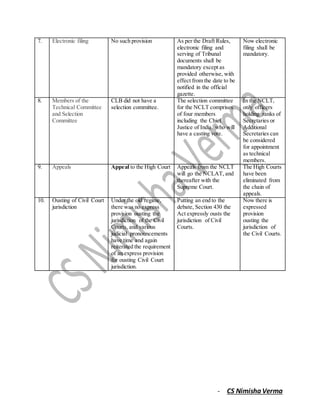
7. Electronic filing No such provision As per the Draft Rules,
electronic filing and
serving of Tribunal
documents shall be
mandatory except as
provided otherwise, with
effect from the date to be
notified in the official
gazette.
Now electronic
filing shall be
mandatory.
8. Members of the
Technical Committee
and Selection
Committee
CLB did not have a
selection committee.
The selection committee
for the NCLT comprises
of four members
including the Chief
Justice of India, who will
have a casting vote.
In the NCLT,
only officers
holding ranks of
Secretaries or
Additional
Secretaries can
be considered
for appointment
as technical
members.
9. Appeals Appeal to the High Court Appeals from the NCLT
will go the NCLAT, and
thereafter with the
Supreme Court.
The High Courts
have been
eliminated from
the chain of
appeals.
10. Ousting of Civil Court
jurisdiction
Under the old regime,
there was no express
provision ousting the
jurisdiction of the Civil
Courts, and various
judicial pronouncements
have time and again
reiterated the requirement
of an express provision
for ousting Civil Court
jurisdiction.
Putting an end to the
debate, Section 430 the
Act expressly ousts the
jurisdiction of Civil
Courts.
Now there is
expressed
provision
ousting the
jurisdiction of
the Civil Courts.

Let's compare - CLB & NCLT / NCLAT

  • 1.
    - CS NimishaVerma Let’s Compare – CLB Vs NCLT Sr. No. Particular CLB NCLT Difference 1. Number of Benches CLB was functioning with only five benches. NCLT will commence action with eleven benches. It is expected to eventually have benches across each state in India. 2. Jurisdiction • Oppression and Mismanagement • Compounding • Refusalto transfer /transmit shares • Cal AGM/EOGM • Inspection • Investigation • Restriction of shares and debentures • Freezing of assets • Restriction on Transfer of securities. The NCLT, once fully functional, will consolidate the corporate jurisdiction of the • CLB; • Board of Industrial and Financial Reconstruction; • Appellate Authority for Industrial and Financial Reconstruction and; • Jurisdiction and powers relating to winding up, restructuring and other such provisions, currently vested in the High Courts. While provisions relating to mergers, restructuring and winding-up have not been notified yet. Once notified, the provisions relating to mergers, restructuring and winding up will no longer be under the jurisdiction of the High Court. 3. Amicus curiae No Such Provision The Draft National Company Law Tribunal Rules, 2013 (Draft Rules) enable the NCLT to appoint Amicus Curiae for opinion on various specialised legal issues. Now Amicus Curiae can be appointed to seek advice on various specialised legal issues. 4. Other professionals allowed to represent Until now, Company Secretaries,Chartered Accountants, Cost Accountants could represent their clients only before the CLB, the scope of which was limited. The Draft Rules enable other professionals to represent their clients in matters pertaining to mergers/ winding-up before the NCLT. Now Other professionals allowed to represent before the NCLT. 5. Class action suits While shareholders have always been allowed to protest against the wrong doings of the management. With the constitution of the NCLT,shareholders and creditors can now file class action suits against the company for The key difference between oppression, mismanagement
  • 2.
    - CS NimishaVerma breaching the provisions of the Act. (Sections 241- 244) and class action suits (Section 245) can be summed up in the following points: • Under Section 245, members as well as deposit holders can file an application as opposed to only member; • Application can be filed, in addition to company and its statutory appointees, against audit firms and any other independent consultants; • Application can be filed for future activities as well in addition to current or past activities. 6. Dedicated online portal No such Facility The Draft Rules introduce a ‘dedicated online portal’ through which all the parties or central or state government agencies and local government bodies may electronically send and receive documents to or from the NCLT and make required payments. Introduction of ‘dedicated online portal’
  • 3.
    - CS NimishaVerma 7. Electronic filing No such provision As per the Draft Rules, electronic filing and serving of Tribunal documents shall be mandatory except as provided otherwise, with effect from the date to be notified in the official gazette. Now electronic filing shall be mandatory. 8. Members of the Technical Committee and Selection Committee CLB did not have a selection committee. The selection committee for the NCLT comprises of four members including the Chief Justice of India, who will have a casting vote. In the NCLT, only officers holding ranks of Secretaries or Additional Secretaries can be considered for appointment as technical members. 9. Appeals Appeal to the High Court Appeals from the NCLT will go the NCLAT, and thereafter with the Supreme Court. The High Courts have been eliminated from the chain of appeals. 10. Ousting of Civil Court jurisdiction Under the old regime, there was no express provision ousting the jurisdiction of the Civil Courts, and various judicial pronouncements have time and again reiterated the requirement of an express provision for ousting Civil Court jurisdiction. Putting an end to the debate, Section 430 the Act expressly ousts the jurisdiction of Civil Courts. Now there is expressed provision ousting the jurisdiction of the Civil Courts.