LET REVIEW MATERIALS CHILD AND ADOLESCENT DEVELOPMENT.docx
1.
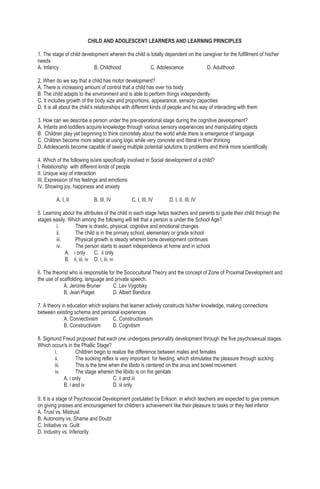
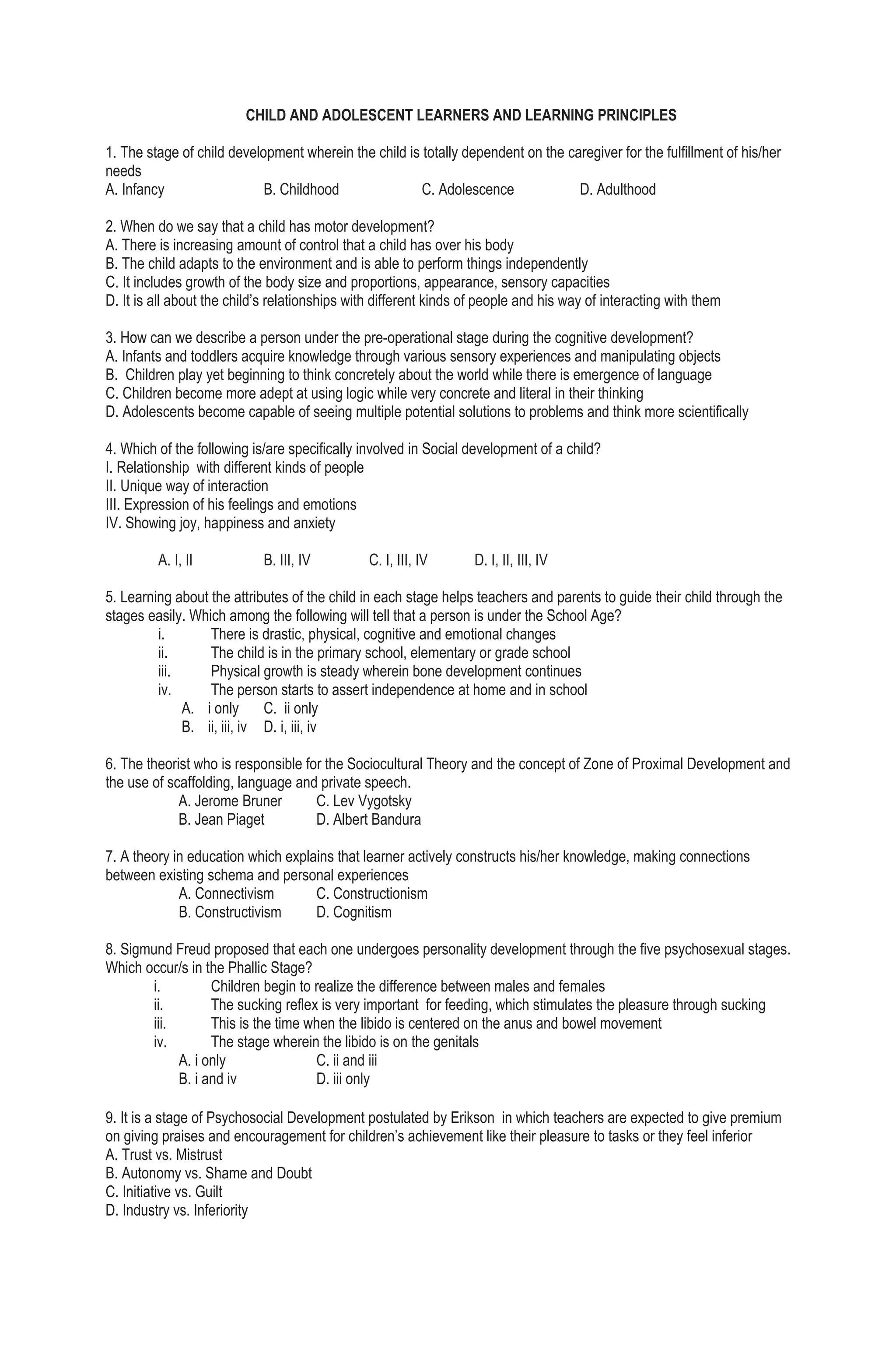
CHILD AND ADOLESCENTLEARNERS AND LEARNING PRINCIPLES
1. The stage of child development wherein the child is totally dependent on the caregiver for the fulfillment of his/her
needs
A. Infancy B. Childhood C. Adolescence D. Adulthood
2. When do we say that a child has motor development?
A. There is increasing amount of control that a child has over his body
B. The child adapts to the environment and is able to perform things independently
C. It includes growth of the body size and proportions, appearance, sensory capacities
D. It is all about the child’s relationships with different kinds of people and his way of interacting with them
3. How can we describe a person under the pre-operational stage during the cognitive development?
A. Infants and toddlers acquire knowledge through various sensory experiences and manipulating objects
B. Children play yet beginning to think concretely about the world while there is emergence of language
C. Children become more adept at using logic while very concrete and literal in their thinking
D. Adolescents become capable of seeing multiple potential solutions to problems and think more scientifically
4. Which of the following is/are specifically involved in Social development of a child?
I. Relationship with different kinds of people
II. Unique way of interaction
III. Expression of his feelings and emotions
IV. Showing joy, happiness and anxiety
A. I, II B. III, IV C. I, III, IV D. I, II, III, IV
5. Learning about the attributes of the child in each stage helps teachers and parents to guide their child through the
stages easily. Which among the following will tell that a person is under the School Age?
i. There is drastic, physical, cognitive and emotional changes
ii. The child is in the primary school, elementary or grade school
iii. Physical growth is steady wherein bone development continues
iv. The person starts to assert independence at home and in school
A. i only C. ii only
B. ii, iii, iv D. i, iii, iv
6. The theorist who is responsible for the Sociocultural Theory and the concept of Zone of Proximal Development and
the use of scaffolding, language and private speech.
A. Jerome Bruner C. Lev Vygotsky
B. Jean Piaget D. Albert Bandura
7. A theory in education which explains that learner actively constructs his/her knowledge, making connections
between existing schema and personal experiences
A. Connectivism C. Constructionism
B. Constructivism D. Cognitism
8. Sigmund Freud proposed that each one undergoes personality development through the five psychosexual stages.
Which occur/s in the Phallic Stage?
i. Children begin to realize the difference between males and females
ii. The sucking reflex is very important for feeding, which stimulates the pleasure through sucking
iii. This is the time when the libido is centered on the anus and bowel movement
iv. The stage wherein the libido is on the genitals
A. i only C. ii and iii
B. i and iv D. iii only
9. It is a stage of Psychosocial Development postulated by Erikson in which teachers are expected to give premium
on giving praises and encouragement for children’s achievement like their pleasure to tasks or they feel inferior
A. Trust vs. Mistrust
B. Autonomy vs. Shame and Doubt
C. Initiative vs. Guilt
D. Industry vs. Inferiority
2.
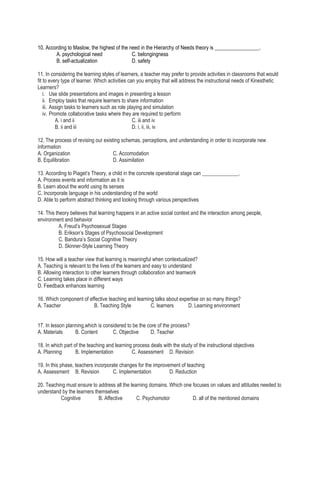
10. According toMaslow, the highest of the need in the Hierarchy of Needs theory is _________________.
A. psychological need C. belongingness
B. self-actualization D. safety
11. In considering the learning styles of learners, a teacher may prefer to provide activities in classrooms that would
fit to every type of learner. Which activities can you employ that will address the instructional needs of Kinesthetic
Learners?
i. Use slide presentations and images in presenting a lesson
ii. Employ tasks that require learners to share information
iii. Assign tasks to learners such as role playing and simulation
iv. Promote collaborative tasks where they are required to perform
A. i and ii C. iii and iv
B. ii and iii D. i, ii, iii, iv
12. The process of revising our existing schemas, perceptions, and understanding in order to incorporate new
information
A. Organization C. Accomodation
B. Equilibration D. Assimilation
13. According to Piaget’s Theory, a child in the concrete operational stage can ______________.
A. Process events and information as it is
B. Learn about the world using its senses
C. Incorporate language in his understanding of the world
D. Able to perform abstract thinking and looking through various perspectives
14. This theory believes that learning happens in an active social context and the interaction among people,
environment and behavior
A. Freud’s Psychosexual Stages
B. Erikson’s Stages of Psychosocial Development
C. Bandura’s Social Cognitive Theory
D. Skinner-Style Learning Theory
15. How will a teacher view that learning is meaningful when contextualized?
A. Teaching is relevant to the lives of the learners and easy to understand
B. Allowing interaction to other learners through collaboration and teamwork
C. Learning takes place in different ways
D. Feedback enhances learning
16. Which component of effective teaching and learning talks about expertise on so many things?
A. Teacher B. Teaching Style C. learners D. Learning environment
17. In lesson planning,which is considered to be the core of the process?
A. Materials B. Content C. Objective D. Teacher
18. In which part of the teaching and learning process deals with the study of the instructional objectives
A. Planning B. Implementation C. Assessment D. Revision
19. In this phase, teachers incorporate changes for the improvement of teaching
A. Assessment B. Revision C. Implementation D. Reduction
20. Teaching must ensure to address all the learning domains. Which one focuses on values and attitudes needed to
understand by the learners themselves
Cognitive B. Affective C. Psychomotor D. all of the mentioned domains