Library Graduate Trainee: Lessons learnt from Cataloguing
2.
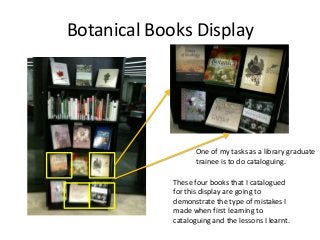
Botanical Books Display
Oneof my tasks as a library graduate
trainee is to do cataloguing.
These four books that I catalogued
for this display are going to
demonstrate the type of mistakes I
made when first learning to
cataloguing and the lessons I learnt.
3.
Punctuation
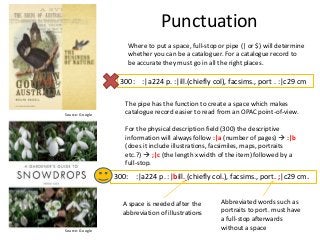
Where to puta space, full-stop or pipe (| or $) will determine
whether you can be a cataloguer. For a catalogue record to
be accurate they must go in all the right places.
300: :|a224 p. :|ill.(chiefly col), facsims., port . :|c29 cm
Source: Google
The pipe has the function to create a space which makes
catalogue record easier to read from an OPAC point-of-view.
For the physical description field (300) the descriptive
information will always follow :|a (number of pages) :|b
(does it include illustrations, facsimiles, maps, portraits
etc.?) ;|c (the length x width of the item) followed by a
full-stop.
300: :|a224 p. :|bill. (chiefly col.), facsims., port. ;|c29 cm.
A space is needed after the
abbreviation of illustrations
Source: Google
Abbreviated words such as
portraits to port. must have
a full-stop afterwards
without a space
4.
Classification System
•
•
•
•
The classificationof item in a library is vital to
ensure it is placed correctly within the library.
Working in a botanical garden library the
classification system is extremely specialised.
Here at Kew Gardens, we use the BenthamHooker Classification System.
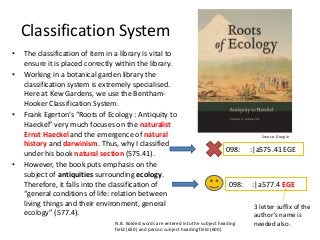
Frank Egerton’s “Roots of Ecology : Antiquity to
Haeckel” very much focuses on the naturalist
Ernst Haeckel and the emergence of natural
history and darwinism. Thus, why I classified
under his book natural section (575.41).
However, the book puts emphasis on the
subject of antiquities surrounding ecology.
Therefore, it falls into the classification of
“general conditions of life: relation between
living things and their environment, general
ecology” (577.4).
Source: Google
098:
098:
N.B. Bolded words are entered into the subject heading
field (650) and person subject heading field (600)
:|a575.41 EGE
:|a577.4 EGE
3 letter suffix of the
author’s name is
needed also.
Lessons learnt andthe future
• Everyday I am still learning about the rules of cataloguing and happy
to say that I am in-between second and third-level description
cataloguing. YAY!
• Cataloguing takes practice and can be subjective in certain
areas, especially if you work in a specialise collection. So I am grateful
I can have my work checked by the Head Cataloguer on a daily or
weekly basis. Shadowing a cataloguer is a good way to learn about
cataloguing in your department
• My grasp of cataloguing has allowed me to gain more knowledge
about the field. I am now being trained to catalogue even more
specialised books about mycology/fungi and to authorise authority
headings using Library of Congress.
• I am definitely looking forward to my next step in my cataloguing
adventures.
Thank you!